
29 Stunning Winter Wreath Ideas That Will Elevate Your Home Decor This Season

You know the feeling: forty minutes into a Pinterest rabbit hole, you have saved a dozen winter wreaths and you still cannot tell which one actually belongs on your door.
We spent a few weekends comparing what is on shelves at Target, Walmart, IKEA, and the craft-store floral aisle — plus more Etsy browsing than we will admit — to narrow this down to 29 ideas spanning roughly $20 to $210. Budget and luxury versions show up side by side, because a $30 wreath and a $180 wreath can photograph identically once you know which parts to swap.
Inside you will find traditional berry-and-plaid, rustic pinecone, flocked-and-frosty, and cottage-inspired gingham styles, each matched to a real photo from a real home. The 2026 mood is shop-your-own-bin and add one good thing, which is exactly how most of these wreaths came together in the first place.
And stay until the end — we break down the most common mistakes that can ruin these looks.
📌 Save this to Pinterest for later — you’ll want to revisit these ideas.
1. Frosted Evergreen Wreath on a Classic White Porch
A frosted wreath reads best when its center sits at eye level, roughly 66 inches off the floor or about 10 to 12 inches down from the top of the door. On a standard 36-inch door, go with a 24-inch wreath; on anything wider than 42 inches, size up to 30 or 32 inches or the ring will look like a coaster. Hang from an over-the-door hook rather than driving a nail through the panel, and slip a small felt pad behind the wreath so the frost does not scuff the paint.
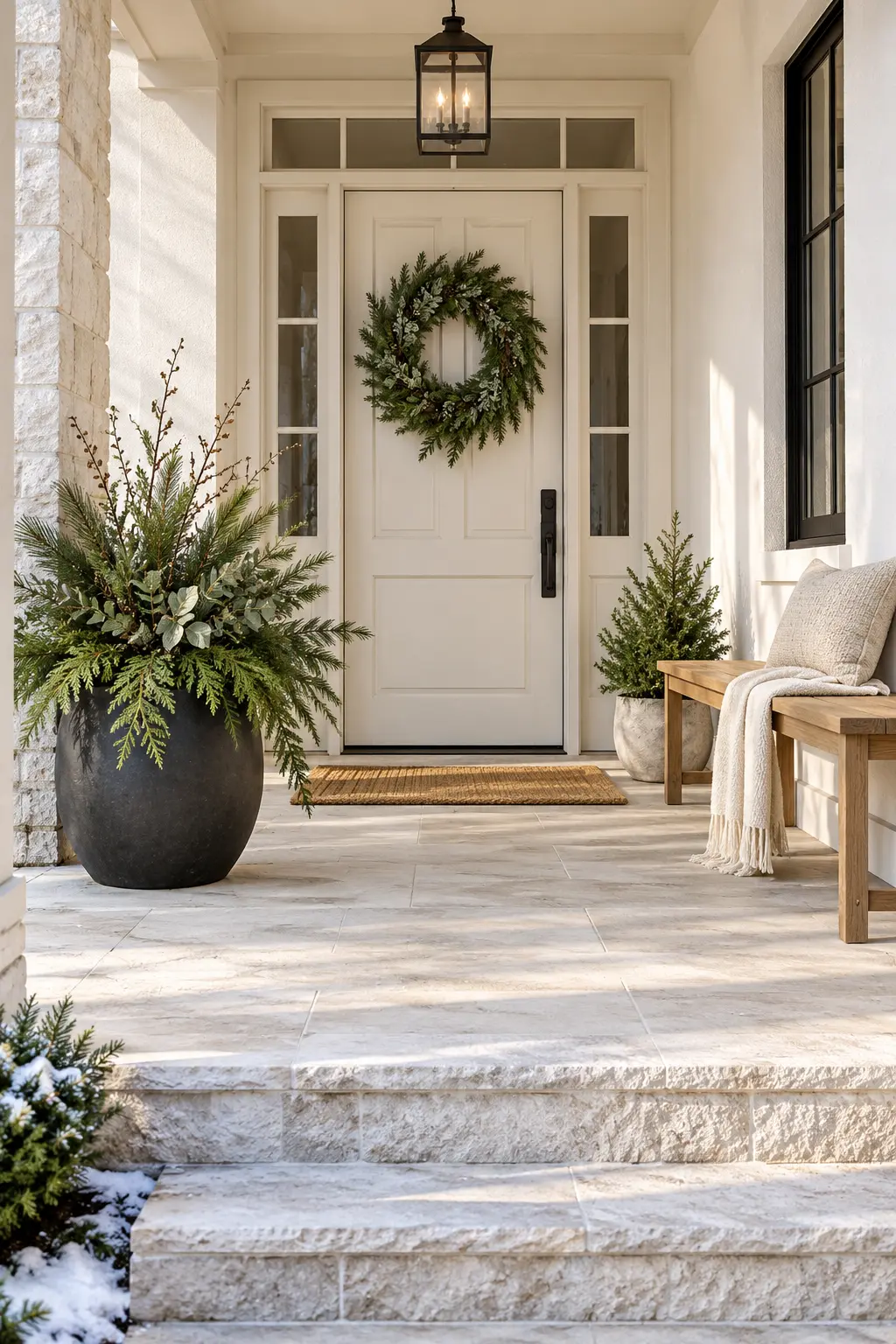
The single decision that carries this entryway is repetition: one dark gray planter, doubled. Two identical planters flanking the door give the frosted wreath a frame, and the light wood bench picks up the warmth so the whole scene does not go cold and gray. Take the second planter away and the wreath floats. Add a mismatched planter and your eye starts negotiating instead of resting.
2. Evergreen and Pinecone Wreath with Buffalo Check Layers
Three things are doing the work here. First, contrast in temperature: crisp white siding against warm beige check keeps the entry from feeling like a catalog page. Second, layering at the threshold, where a buffalo check rug under a coir mat creates a visual ramp up to the door. Third, the planters repeat the vertical angle of the door trim, so the composition stays square and calm instead of busy.
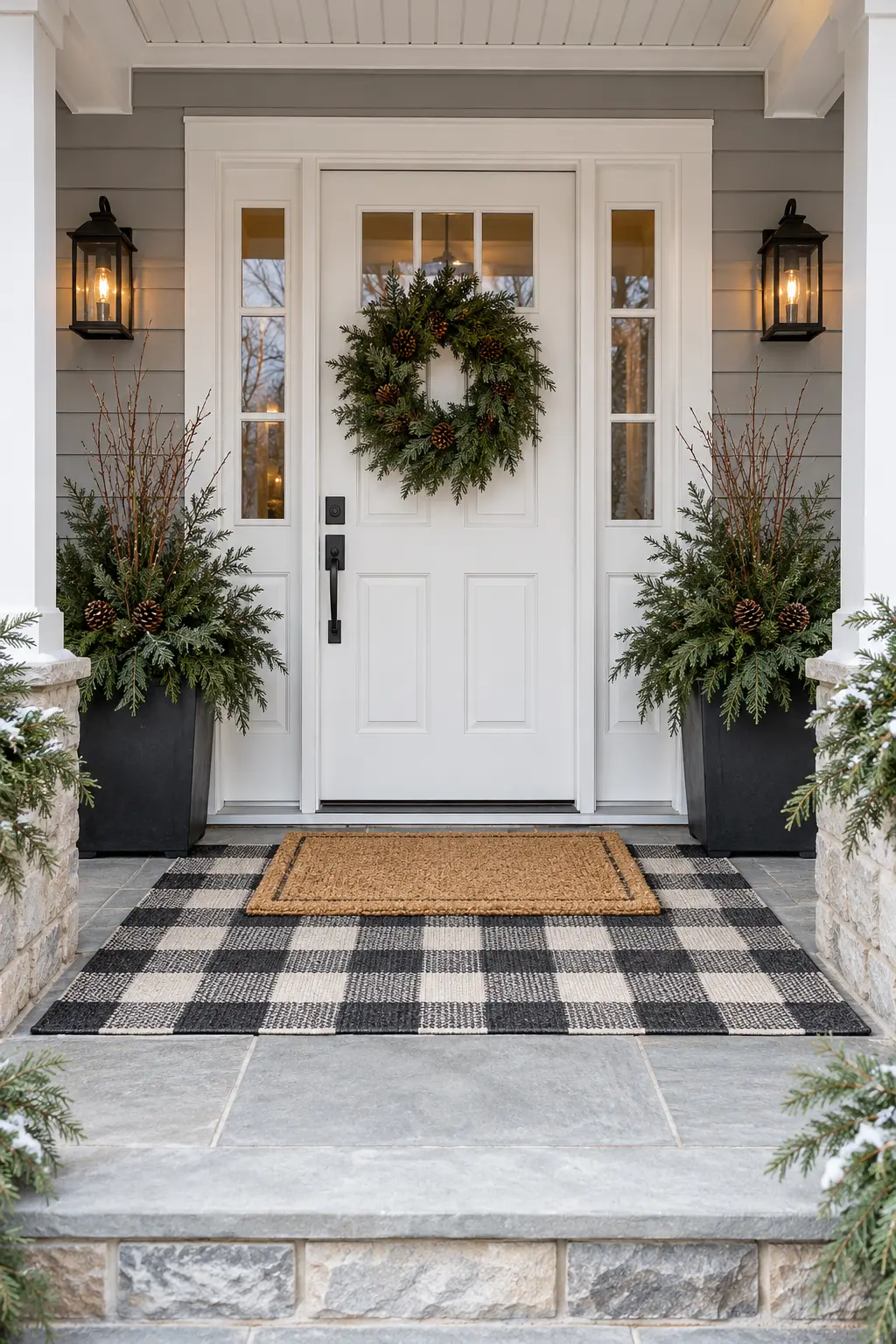
Coir sheds. That is the deal. Between the fibers and the wet winter boots, you will be sweeping that porch every couple of days, and the buffalo check underneath will get damp and stiff if it sits in snowmelt. Shake both mats weekly, and in slush season swap the fabric layer for an outdoor-safe rubber-backed version. Nothing kills this look faster than a gray, half-frozen plaid mat.
3. Lantern-Lit Entryway Wreath with Burlap and Gold
- Evergreen wreath with pinecones and gold ornaments: $45–$95
- Two black candle lanterns: $60–$140 for the pair
- Warm white LED candles: $12–$28
- Evergreen garland with white berries: $35–$75
- Patterned runner or area rug: $40–$120
- Burlap bow and ribbon: $8–$16
Total: $200–$474
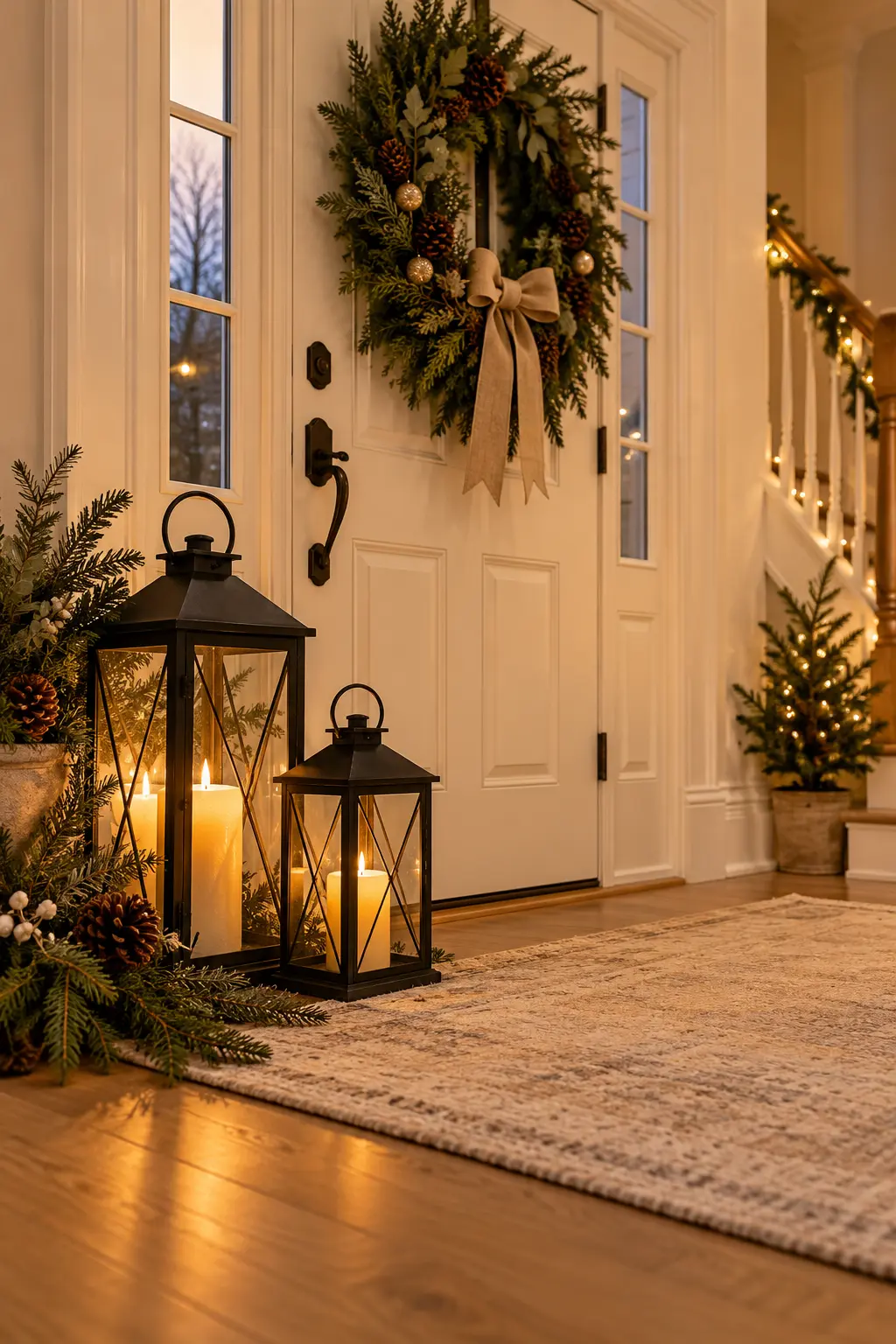
Budget alternative: skip the new lanterns and use two candle holders you already own, then put the savings into a fuller garland. Volume reads as money; props do not.
Here is the formula in percentages: 55% deep green across the wreath, garland, and candles, 25% crisp white from the door and berries, 12% matte black lanterns, 8% warm gold. Swap the gold for copper and the whole thing slides rustic; swap the white berries for red and it goes full traditional. The percentages stay the same either way, which is why it photographs so well.
4. Red Berry Wreath Against a Weathered Brick Wall
Real berries are gorgeous for about nine days and then they drop, and on brick those stains are permanent. Faux berries hold up better but fade toward pink after two seasons of direct sun. If this wall catches afternoon light, plan to replace the berry picks annually or seal them with a UV-protectant craft spray in October. Budget about $15 a year for upkeep, which is still cheaper than a new wreath.
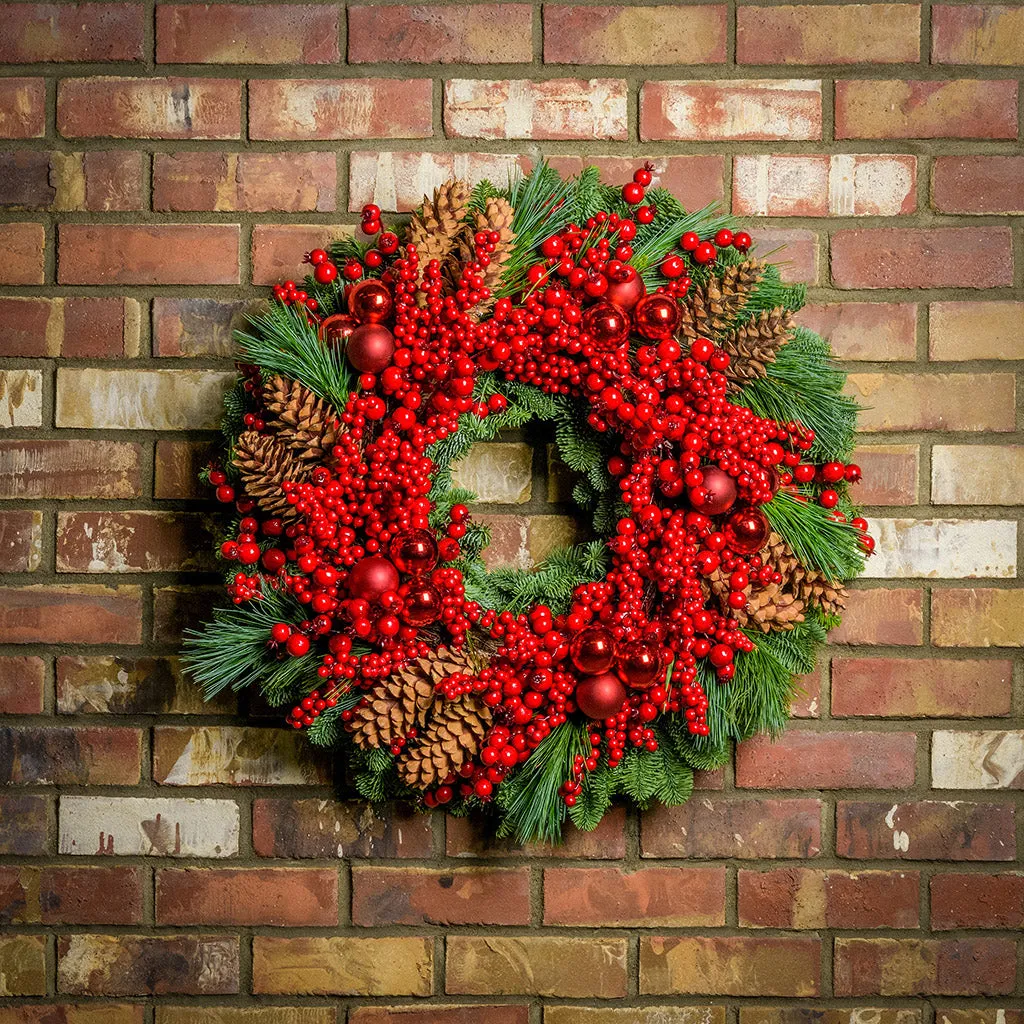
A dense 30-inch wreath like this one runs $90 to $140 at a garden center. You can build the same look for under $45: a $12 plain pine wreath from a craft store, two berry picks and a pinecone bundle from the floral aisle, and twenty minutes with floral wire. Facebook Marketplace in late November is full of people selling last year’s wreaths for $10 — strip them and rebuild. Nobody walking past your door can tell a $40 wreath from a $140 one from six feet away.
5. Mixed Floral Wreath with Dried Citrus Slices
This is a fat, generous wreath — 26 to 30 inches across — and it needs a door to match. On a standard 36-inch front door it is a statement; on a narrow 30-inch closet door it will swallow the whole panel. Pair it with a porch at least 5 feet deep so you can step back and actually see it. If your entry is tight, drop to 22 inches and cut the flower count by a third rather than using smaller flowers.

Cluster in threes, not pairs. Flowers, berries, and citrus should be grouped in odd numbers of the same material, placed at three different points around the ring instead of spaced evenly. Even spacing looks manufactured; three irregular clusters look gathered. Keep each cluster roughly the size of your palm and leave the top third mostly green — that is where the hanger lives and where the eye gets to rest.
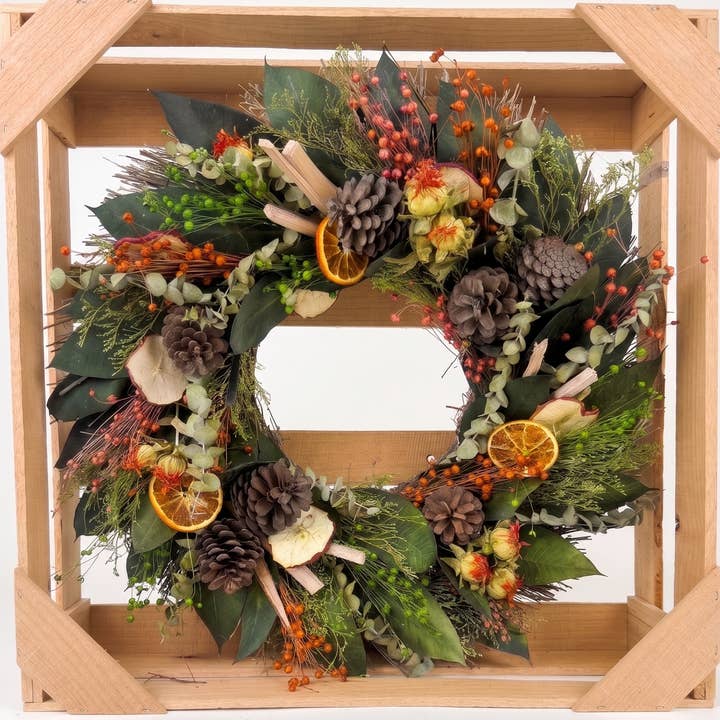
6. Harvest-Toned Wreath with Pinecones and Dried Apple
- Slice apples and oranges a quarter inch thick and blot the excess juice with a paper towel.
- Lay them on a parchment-lined sheet pan, no overlap and no oil.
- Bake at 200°F for 2 to 3 hours, flipping every 45 minutes.
- Pull them when they are leathery rather than brittle, then cool completely on a rack.
- Seal both sides with a thin coat of matte craft sealer so they do not draw insects.
About 3 hours of mostly passive time and under $6 of fruit. Make a double batch — you will want extras for garlands.
The dried apple slices are the quiet hero. Everyone expects orange at the holidays; the pale, almost ivory apple is what makes this wreath feel gathered rather than purchased. They also soften the orange so it never tips into pumpkin territory, and they add a second neutral texture against all that greenery. Lose the apple and the palette flattens into a standard citrus wreath.
7. Hand-Tied Evergreen Wreath on a Craft Table
Wreath-making went from grandmother’s kitchen table to a sold-out Saturday workshop. Search interest in DIY wreath bases has climbed steadily since 2023, and craft stores now stock twig forms year-round instead of just in November. What is driving it is the same thing driving slow decorating generally: people want one object they actually made sitting next to eight things they bought. It is the antidote to a fully algorithmic home.

Think in three ratios. Eighty percent greenery by volume, 15% accent from berries, ribbon, or twine, and 5% surprise — one element like a eucalyptus sprig that does not match anything else on the ring. Then follow the density rule: greens in bunches of three, accents in clusters of five, and a bare patch of about 6 inches at the top for the hanger. Change the accent color and you have an entirely different wreath from the same math.
8. Frosted Wreath with Glitter Bow and Blue Berries
Frosted wreaths are the most marked-up thing on the shelf — you are paying $120 for a $30 wreath and a can of spray snow. Buy the plain evergreen version for $25 to $40 at Walmart or IKEA, then hit it lightly with floral spray snow from six inches away. A glitter bow and a pick of blue berries add about $12. Same frost, roughly half the price, and you control how heavy the flocking lands. Compare with Idea #1 — same finish, much warmer palette.
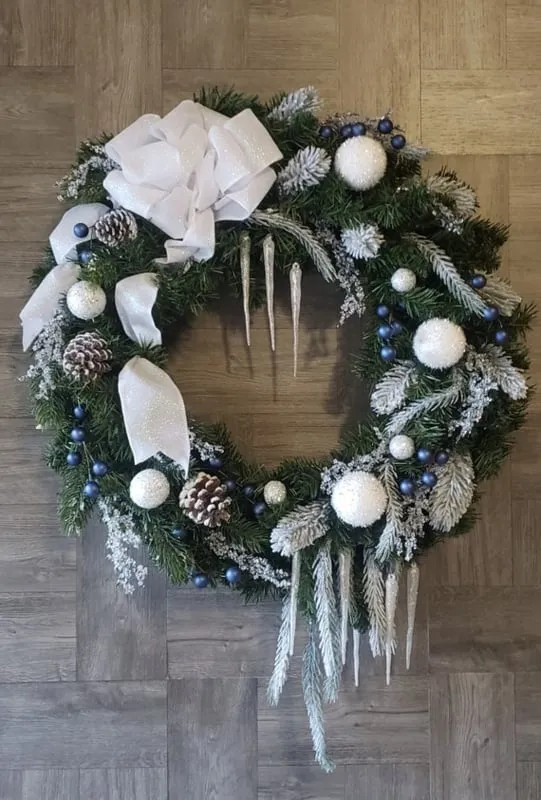
Glitter is a lifestyle, not an accent. It will be on your doormat, in your entryway, and eventually in your car. If the wreath hangs inside a hallway rather than on an exterior door, seal it with two light coats of matte spray and let it cure outside for a day. And be honest about the blue: in a room with warm wood and beige walls, dark blue berries can read cold and slightly corporate.
9. White Bloom and Thistle Wreath on Pale Wood
- Measure the door’s flat panel, not the full width — trim eats 4 to 6 inches.
- Weigh the finished wreath. Anything over 4 pounds needs a ribbon hanger over the top of the door, not a hook.
- Check which direction the door faces. South-facing doors fade dried materials in a single season.
- Confirm you have a flat, dust-free box for storage; this one will not survive a garbage bag.
- Decide between 22 and 26 inches before buying materials — the foliage amount roughly doubles.

Twenty-two to 24 inches is the sweet spot for an interior door, a pantry, or a window. Twenty-six to 30 belongs on a front door, and it needs a porch at least 4 feet deep so the wreath does not get wind-whipped. If your front door is double-wide, go to 36 inches and hang one centered rather than two small ones. Two smalls always look apologetic.
10. Eucalyptus and Fern Wreath in Soft Sage Tones
The palette is nearly monochrome — sage, olive, silver-green — and it works because the texture range is enormous. Rounded eucalyptus leaves, feathery fern fronds, and slender silver sprigs create depth without a single contrasting color. Scale does the rest: big leaves sit low and to the sides, fine foliage stays at the top. It is a masterclass in getting visual interest from shape rather than hue.
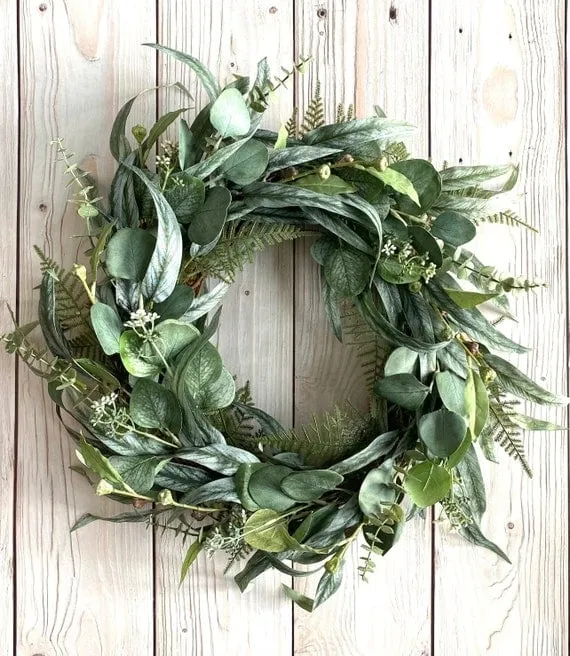
Use a minimum of three foliage types, each with a distinctly different leaf size: one large at 2 to 3 inches, one medium, one fine under half an inch. Work in groups of three stems at a time and always angle them slightly downward, following the curve of the ring. Foliage stuck straight out reads like a hedge; foliage that sweeps reads like it grew there.
11. Green Wreath with a Many-Tailed Plaid Ribbon Bow
- Choose four wired ribbons in related tones: one plaid, one solid velvet, one stripe, one small floral.
- Cut each to 24 inches, then pinch and twist the centers together.
- Secure the pinch with a zip tie rather than wire — it holds shape better and will not rust.
- Fluff each loop, then cut the tails at an angle, longest at 14 to 18 inches.
- Attach to the wreath at 4 or 8 o’clock with floral wire, never dead center.
Fifteen minutes and about $20 in ribbon if you buy by the spool.
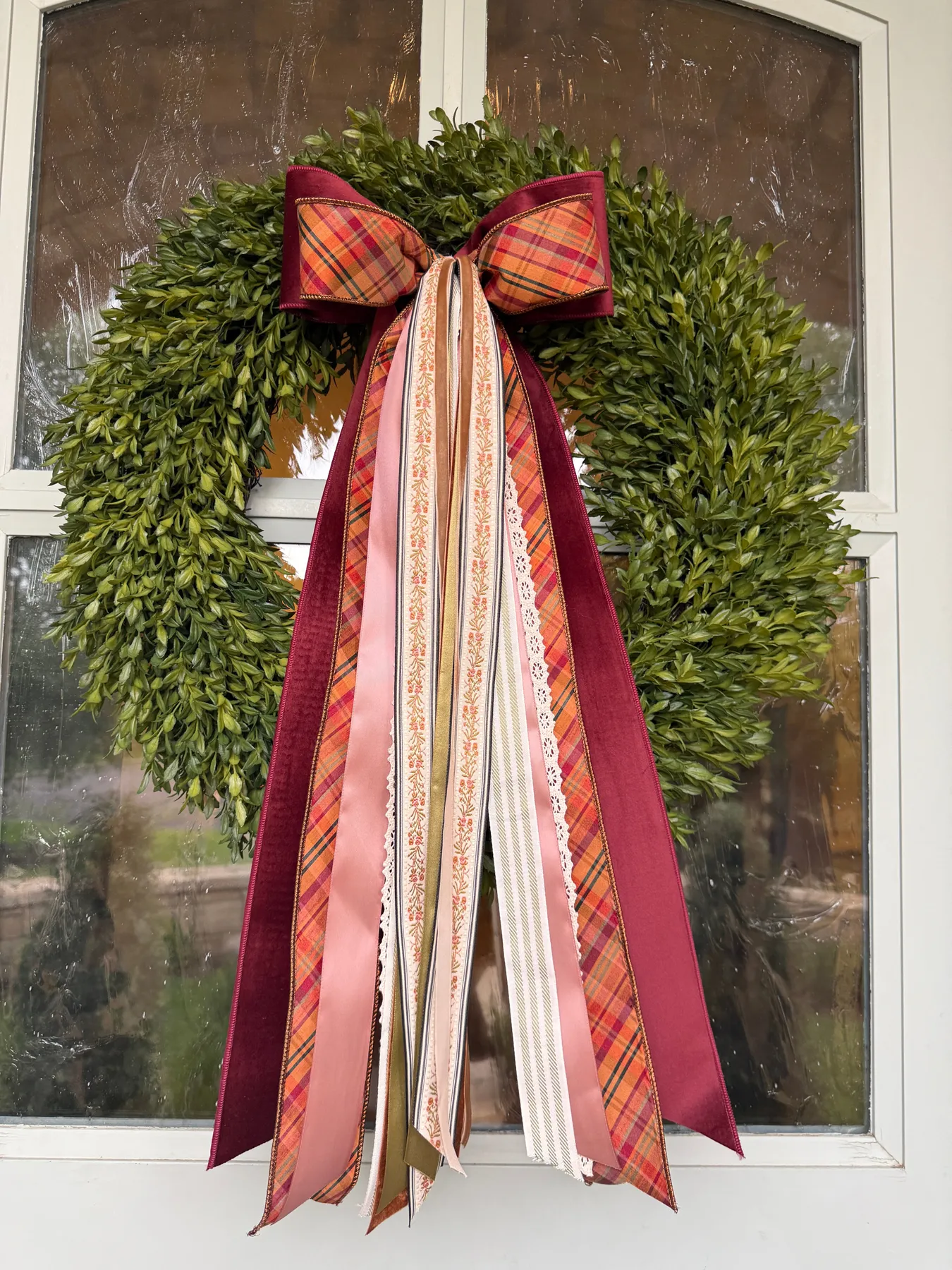
Multi-ribbon bows are the first thing to fail. Wire edges kink, velvet crushes flat in storage, and cut tails fray within a season. Trim the tails with pinking shears and dab a little fray check on the ends before you hang it. Store the bow flat in tissue rather than folded in a bin, and expect to replace the velvet layer every two years or so if the wreath lives outside.
12. Velvet Ribbon Wreath on a Cream Pantry Door
Sixty-five percent cream, 20% forest green, 10% deep red velvet, 5% gold hardware. That is it. The genius is restraint — one ribbon, no ornaments, barely a berry in sight. Swap the red for navy and it becomes winter-neutral; swap for brown velvet and it reads almost autumnal. The cream door is doing 40% of the work here, so check that your surface is actually cream and not builder-beige before you commit.
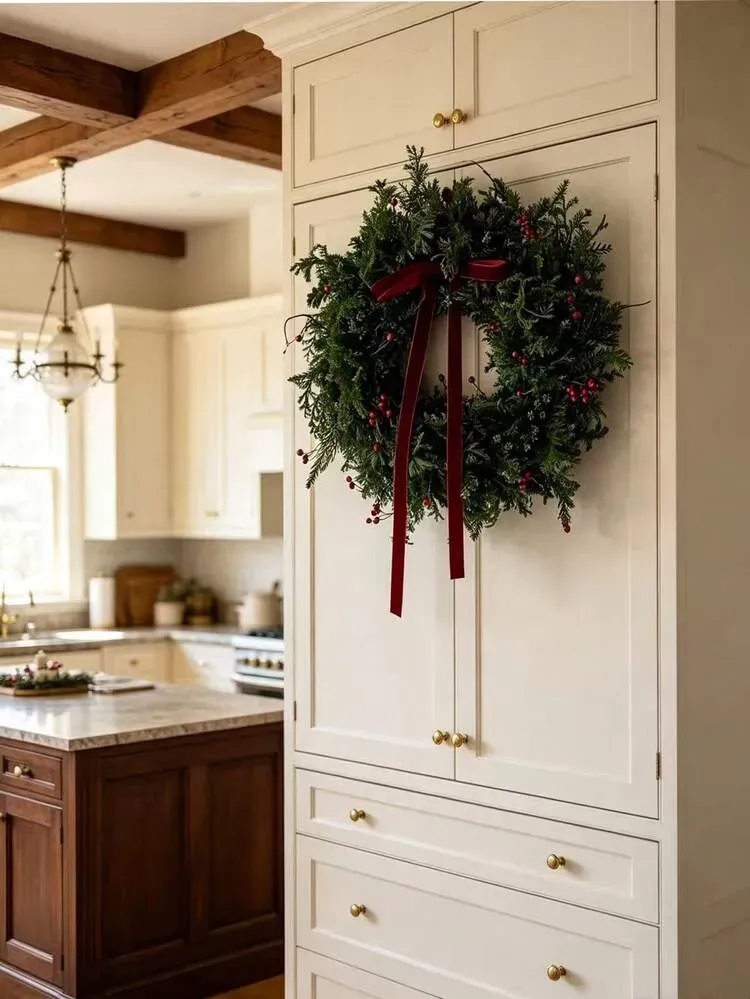
A 24-inch evergreen wreath at Target runs $20 to $30, and a full spool of velvet ribbon is $10 to $16 — the whole look lands under $50. The trick is buying ribbon wide enough: 2.5 to 3 inches, not the 1-inch craft stuff. Hang the tails long and let them drape past the wreath’s lower edge. That extra length is what makes a $30 wreath look like a $130 one.
13. Berry-Laden Wreath with Burlap Bow on a Wood Door
A bottom bow is a commitment. It anchors the wreath low and visually shortens the door, which is lovely on a tall plank door and awkward on a standard-height one. Burlap also holds moisture — on an exterior wood door, that bow will mildew by February. Treat it with a fabric protector before hanging, and check the back of the bow after every storm. If it feels damp, bring it in to dry overnight.
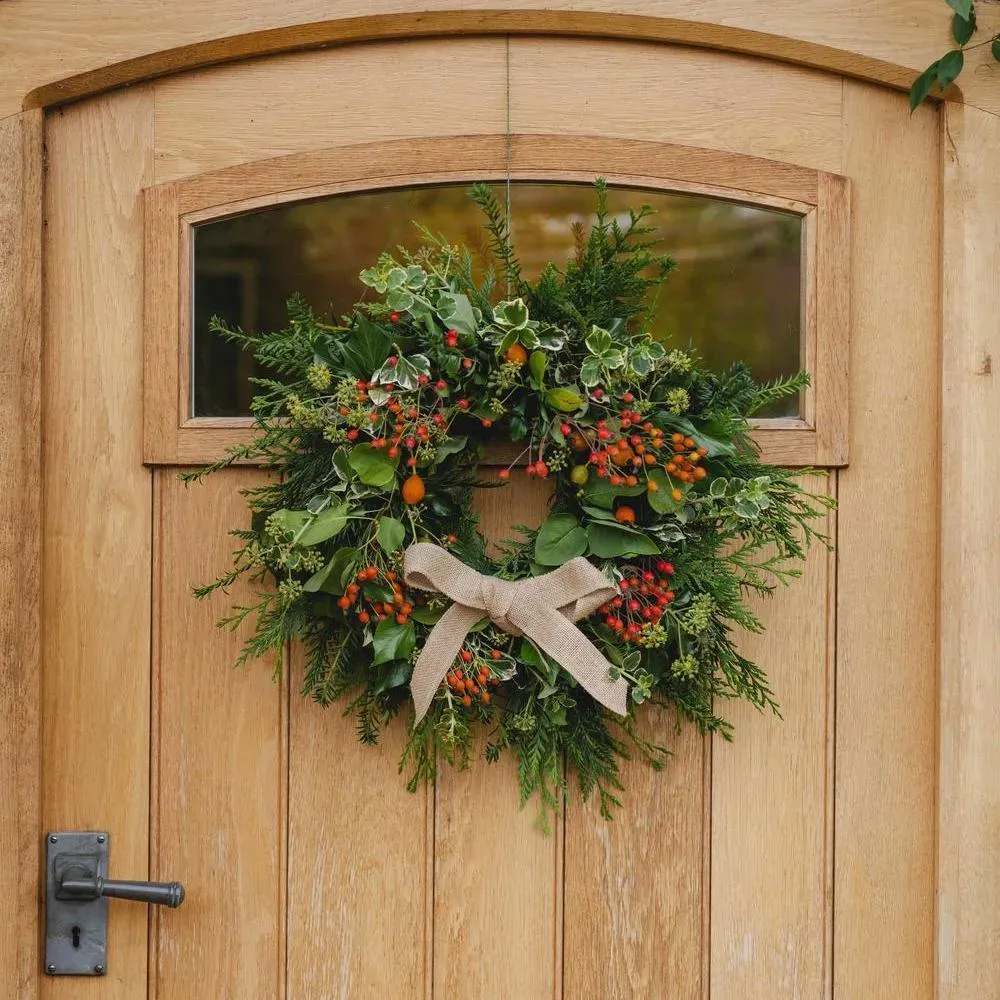
The whole composition is a high-low conversation. Glossy red and orange berries are formal; burlap emphatically is not. Pairing them keeps the wreath from tipping into either fussy or shabby. The natural wood door does the same job — it is warm and unfinished, so bright berries feel like they were gathered from the yard rather than bought as a set of twelve.
14. Bell-and-Copper Ribbon Wreath on Weathered Siding
Match ribbon drop to wreath size. Tails should hang about one-third of the wreath’s diameter below the lowest point of the ring — so a 24-inch wreath wants 8-inch tails, a 30-inch wants 10. Any longer and the ribbon steals the eye; any shorter and it looks like a leftover scrap. One more thing worth knowing: copper and burnished gold read as collected, while bright yellow-gold reads as new. Pick the duller metal every time.
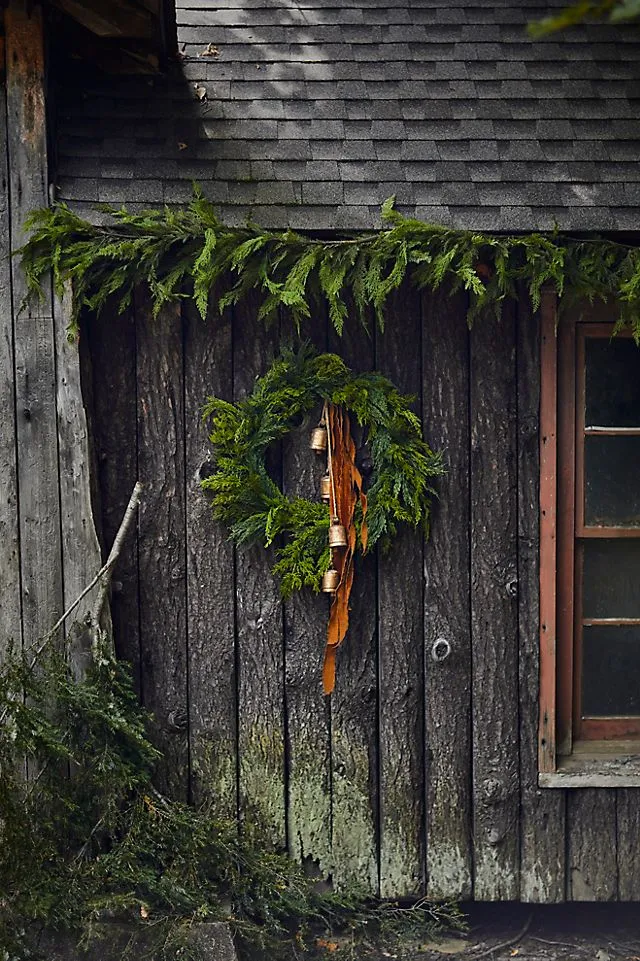
Weathered siding and shingles can handle a bigger wreath than a painted door, because the background is busy and needs something substantial to hold it. A 26-to-30-inch wreath is right here, hung with the top of the ring about 8 inches below the eave line. Add a garland above only if the wall is at least 8 feet tall. Idea #16 is the smaller-door version of this same rustic palette.
15. Galvanized Bell Wreath on a Dark Green Door
The bells are the whole personality. Two galvanized metal bells on thick jute rope turn a fairly standard mixed-green wreath into something that looks like it belongs on a barn. Because the door is also dark green, the wreath and door merge into one mass, and the dull silver is the only thing separating them. Swap the bells for red bows and you have a completely different, much more ordinary wreath.
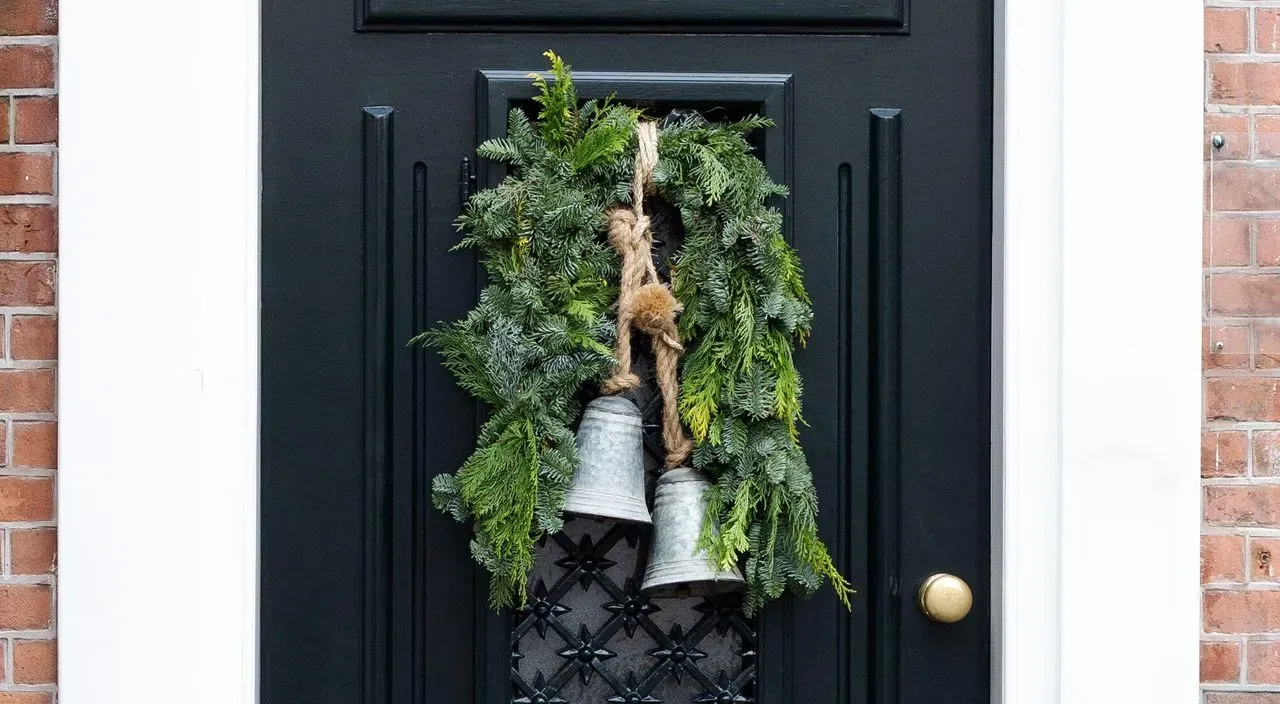
- Mixed evergreen 24-inch wreath: $45–$85
- Two galvanized bells: $10–$22
- Jute rope or twine: $4–$8
- Small pom-pom accent: $2–$5
Total: $61–$120
Budget alternative: skip the craft-store bells and check a farm supply store. Feed-store cowbells cost about $6 each and look better than anything in the floral aisle.
16. Building a Wreath from a Twig Base and Red Berries
- Start with a grapevine or twig base — 12 to 14 inches is plenty, since the finished wreath will read closer to 20.
- Cut greens into 4-inch sprigs and bundle three at a time.
- Wire each bundle to the base, overlapping the previous one so no mechanics show.
- Work clockwise all the way around, then go back and fill gaps from the opposite direction.
- Add berries and pinecones last, wired individually, in odd-numbered clusters.
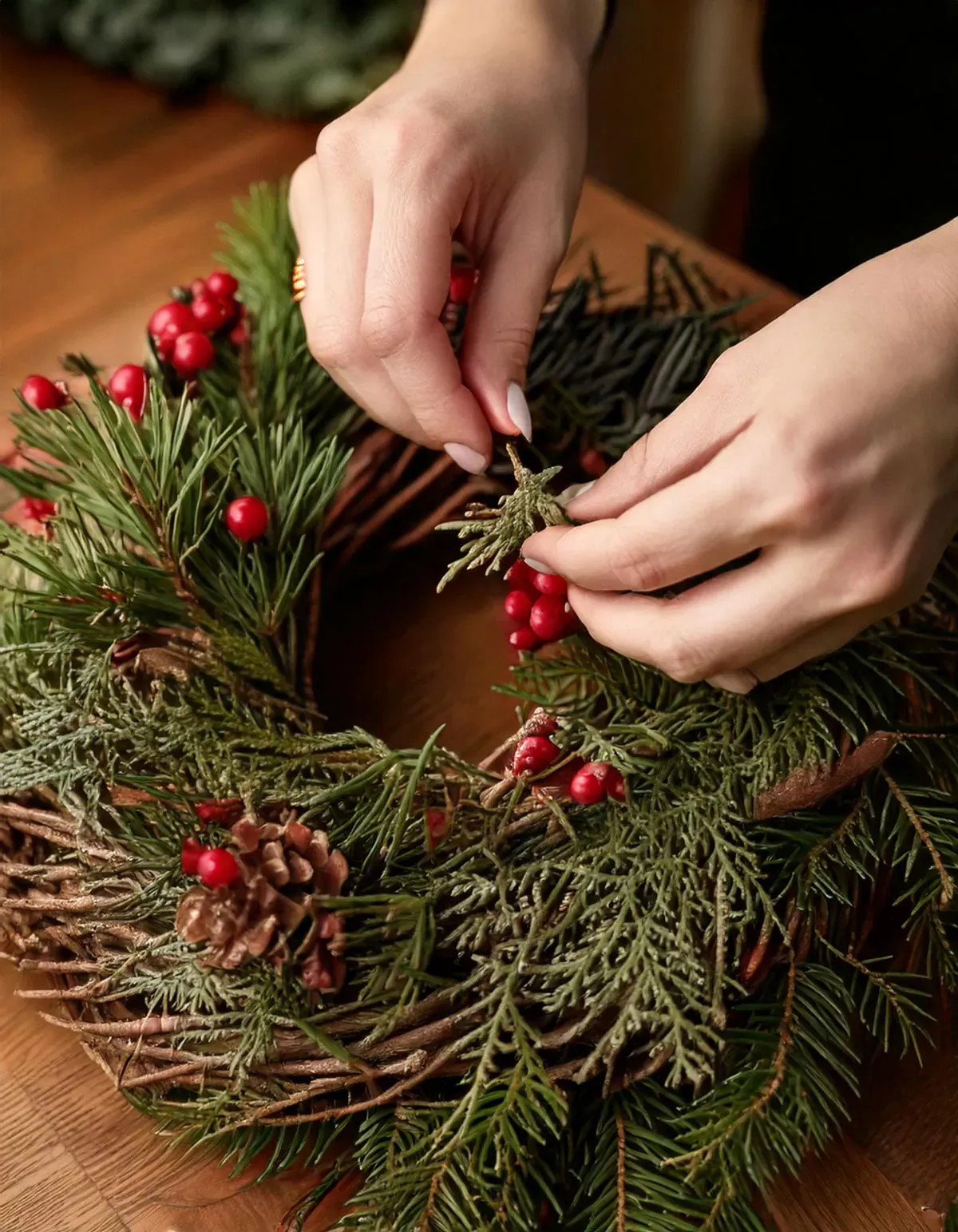
About 90 minutes for a first-timer and $25 to $40 in materials.
Making instead of buying is the throughline of 2026 decor. Wreath workshops sold out in October, and the wreath-making tag has become a genuine hobby category rather than a seasonal hashtag. Part of it is cost, since a handmade wreath runs a third of a boutique one. Part of it is that a slightly lopsided, hand-wired wreath now signals taste the way a perfect store-bought one used to.
17. Pinecone Wreath with Wooden Stars and Silver Berries
A pinecone-only base gives you a monochrome brown field, and that is what makes the accents pop so hard. Silver berries and pale wood stars would disappear against green; against brown, they are the only cool tones in the room. The varying pinecone sizes create natural rhythm too, with big cones at the bottom quarter and small ones up top. That trick is borrowed from wreath-making manuals a hundred years old.
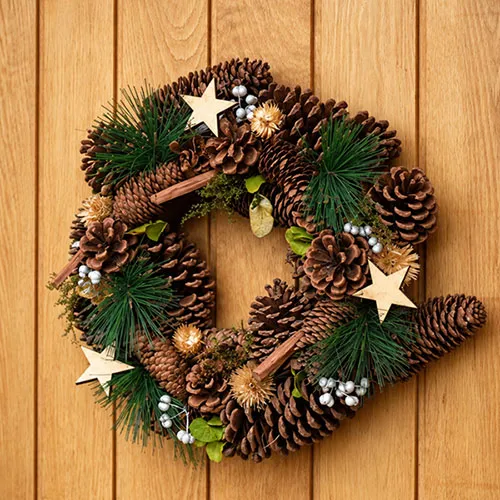
Pinecones are free if you know where to walk. Gather in late fall, bake them at 200°F for 30 minutes to take care of anything living inside, and they will last for years. Stars can be cut from scrap balsa or bought as a $5 pack at a craft store. A wreath this size sells for $80 to $110; made from gathered materials it lands closer to $20, and the wire form is reusable forever.
18. Crimson Bow and Bronze Bell Wreath on White Planks
- Test the bow against your actual wall — crimson looks pinkish against cool white planks and rich against warm white.
- Weigh the bells before wiring; three small ones beat one heavy one for hang balance.
- Check that your hanger clears the plank texture, because rough wood eats ribbon.
- Photograph the wreath in the light it will actually live in — north-facing walls flatten red fast.

White distressed planks are a beautiful backdrop and a harsh one. Anything slightly cool — silver, icy blue, cool-toned red — turns a little sour against them, and the wreath’s shadow falls hard. Hang this on a wall that gets indirect light rather than a spotlight, or the texture of the pinecones disappears into a black-and-white silhouette. And if those planks are vinyl rather than wood, expect to see a seam behind the ribbon.
19. Plaid Bow Wreath with Glossy Red Berries
Place the bow off-center — 4 o’clock or 8 o’clock, roughly a third of the way around from the top. A centered bow makes the wreath look like a clock; an off-center one creates flow and lets the tails travel across the greenery. Keep the tails asymmetrical too: one long, one short, both cut at an angle. Symmetry is what makes a wreath look like it came straight out of a box.

Twenty-four to 28 inches works on a standard 36-inch exterior door. Going bigger than usual is fine here because the plaid and pinecones add visual weight — a 30-inch version of a simpler wreath would feel heavy, but this one carries it. On a narrow city rowhouse door, stay at 22 and cut the pinecones by half. Compare with Idea #6, where a busier wreath needs a wider door to breathe.
20. Peach Ribbon Wreath Above a Pomegranate Mantel
The peach ribbon is the risk that pays off. Everything else on this mantel is expected: evergreen, red berries, pomegranates, a lit candle. That single long strand of fuzzy peach is what stops the whole arrangement from being another red-and-green fireplace. It works because peach sits close enough to red to feel related and far enough away to feel considered. Pull it and you have a nice mantel. Leave it and you have a memorable one.
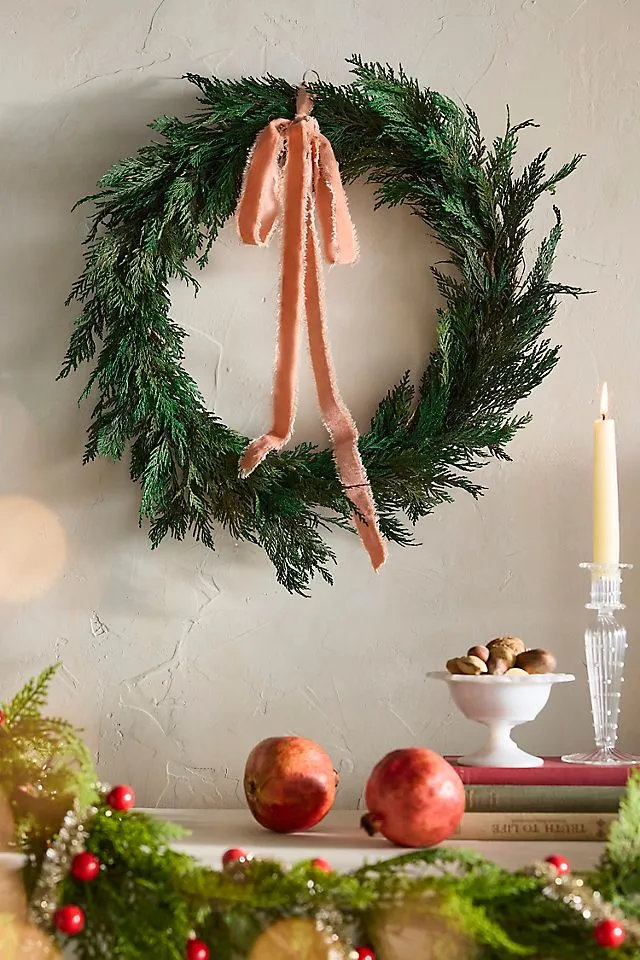
Roughly 65% evergreen across the wreath and garland, 20% warm off-white from the textured wall and the pedestal bowl, 10% peach ribbon, 5% red accents. The off-white matters more than the numbers suggest, since it is the pause between all that green and red. Swap peach for dusty blue and the formula holds. Swap it for bright gold and you will need to halve the red berries.
21. Teal Velvet Bloom Wreath with Gilded Pinecones
Gold-sprayed pinecones shed. Every time you move this wreath, tiny flakes land on the door and the floor, and by spring the cones look patchy. Touch them up with a small brush and craft gold rather than respraying the whole thing. Velvet flowers collect dust and hold it, so vacuum them gently with a brush attachment on the lowest setting, or hit them with a hair dryer on cool from two feet away. Store flat; crushed velvet never really recovers.
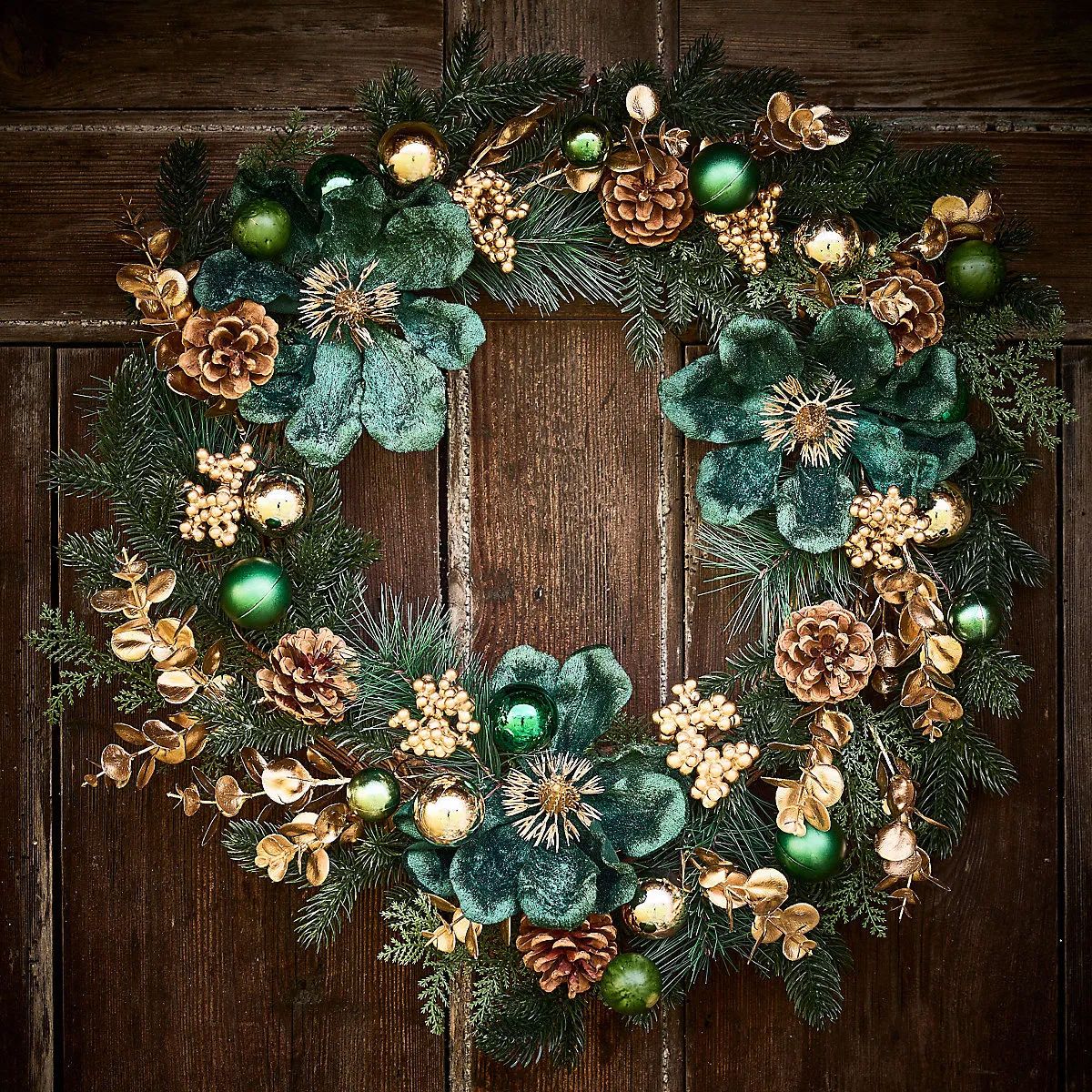
Everything here is green, gold, or teal — a tight jewel-toned triangle that feels expensive because it refuses to add a fourth color. The teal blooms give the wreath a matte, rich texture against glossy ornaments, and the gold centers create small points of light exactly where your eye lands. Against dark wood paneling, that limited palette reads as deliberate rather than decorated.
22. Dried Citrus and Thistle Wreath with Burlap Sash
- Dry your citrus at least a week ahead — this is not a same-day project.
- Weigh the wreath after adding dried fruit; slices get heavy in a hurry.
- Check that your ribbon has a fabric backing rather than paper, or it will tear at the knot.
- Seal dried fruit on both sides so it does not draw insects or absorb humidity.

Dried-and-gathered is the decorating story of 2026. Interest in oven-dried citrus and thistle accents has been climbing since fall, and it is tied to a broader shift: people are treating their own kitchens as a supply closet. Orange slices cost pennies and photograph beautifully, which is precisely the combination this audience rewards. They also store flat, which is more than you can say for most holiday decor.
23. White Poinsettia Wreath with Silver Baubles
White fabric poinsettias need to be bent, not glued. Open each petal by hand — pinch the center, then ease the layers outward and slightly downward so they cup. Flat flowers look like plastic; cupped ones catch light. Then wire each bloom in at three points instead of one so it does not spin. Two minutes per flower, and it is the difference between a wreath that reads elegant and one that reads craft-fair.
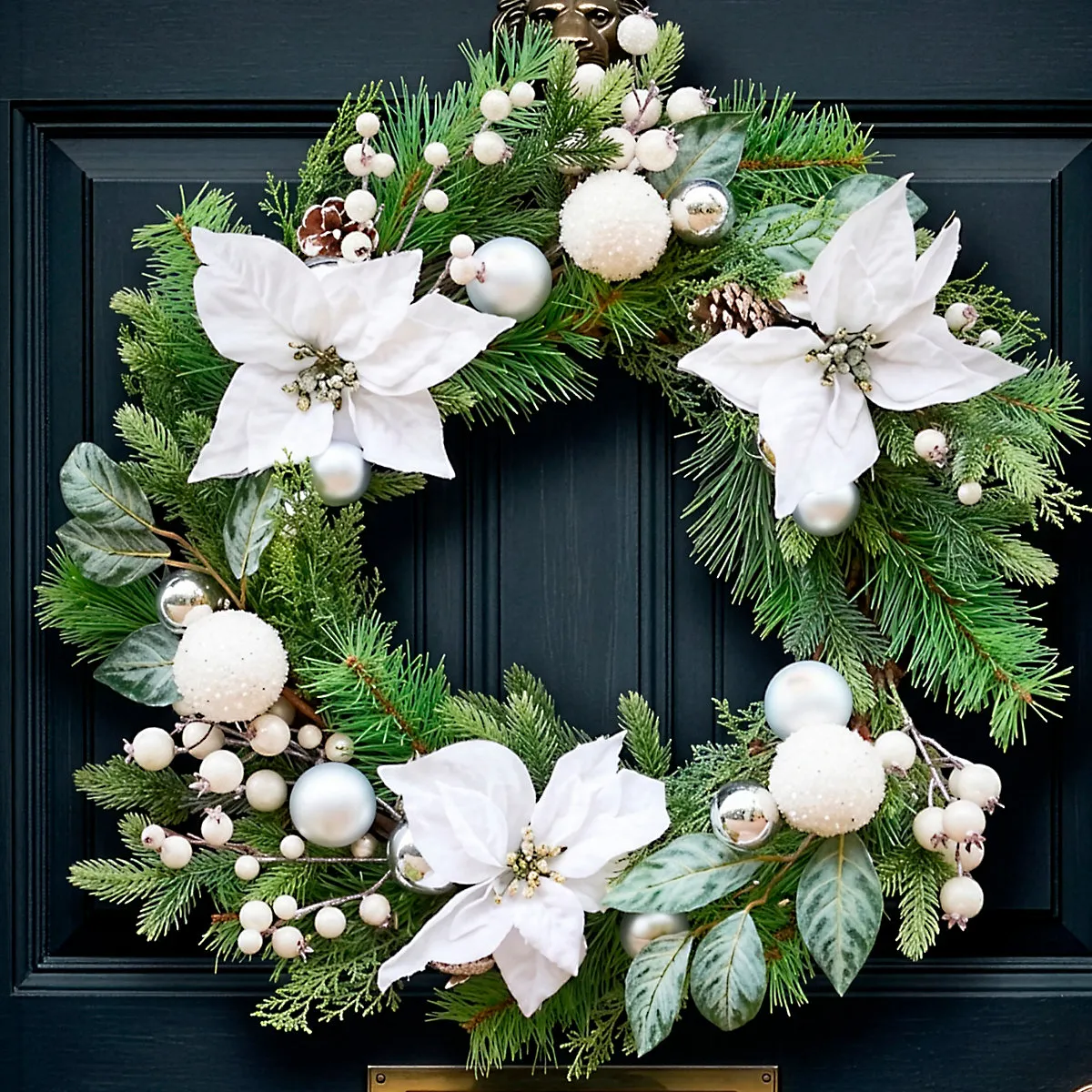
It is the white-on-green contrast, full stop. There is no red, no gold, no plaid — just forest green, white, and silver, which makes the whole thing feel quieter and considerably more expensive than it is. The brass lion knocker peeking out underneath reinforces the formality. Add a single red berry to this wreath and the spell breaks.
24. Pinecone and White Berry Wreath on a Twig Base
- Bend your wire picks into a U before pushing them through the twig base — straight wire splits the vines.
- Attach the largest pinecones first at the bottom quarter, using two wire points each.
- Fill upward with medium cones, spacing them roughly 4 inches apart.
- Tuck white berry clusters into the gaps last so they sit on top of the brown rather than behind it.
- Hang it, then rotate a quarter turn and check from the side — pinecones always look denser from the front.

Roughly an hour, and about $30 in materials if you gather the cones yourself.
Twenty-four inches is the practical default, and this wreath is a good argument for it — pinecones add bulk, so a 24-inch pinecone wreath reads more like a 28-inch green one. On a standard 36-inch door, do not go past 26 or the ring will crowd the frame. For interior use over a console or in a hallway, twenty inches is plenty.
25. Flocked Wreath with Pink Feathers and a Deer
Seventy percent flocked white, 15% dusty pink, 10% gold, 5% sage. The flocking is what lets pink work in December — against plain green, pink feathers would look like a spring wreath that got lost. Against snow-white branches, they read as frost catching light. Pink is the safest risk you can take in a white wreath. For a snowier take on the same idea, Idea #27 swaps the pink for silver.
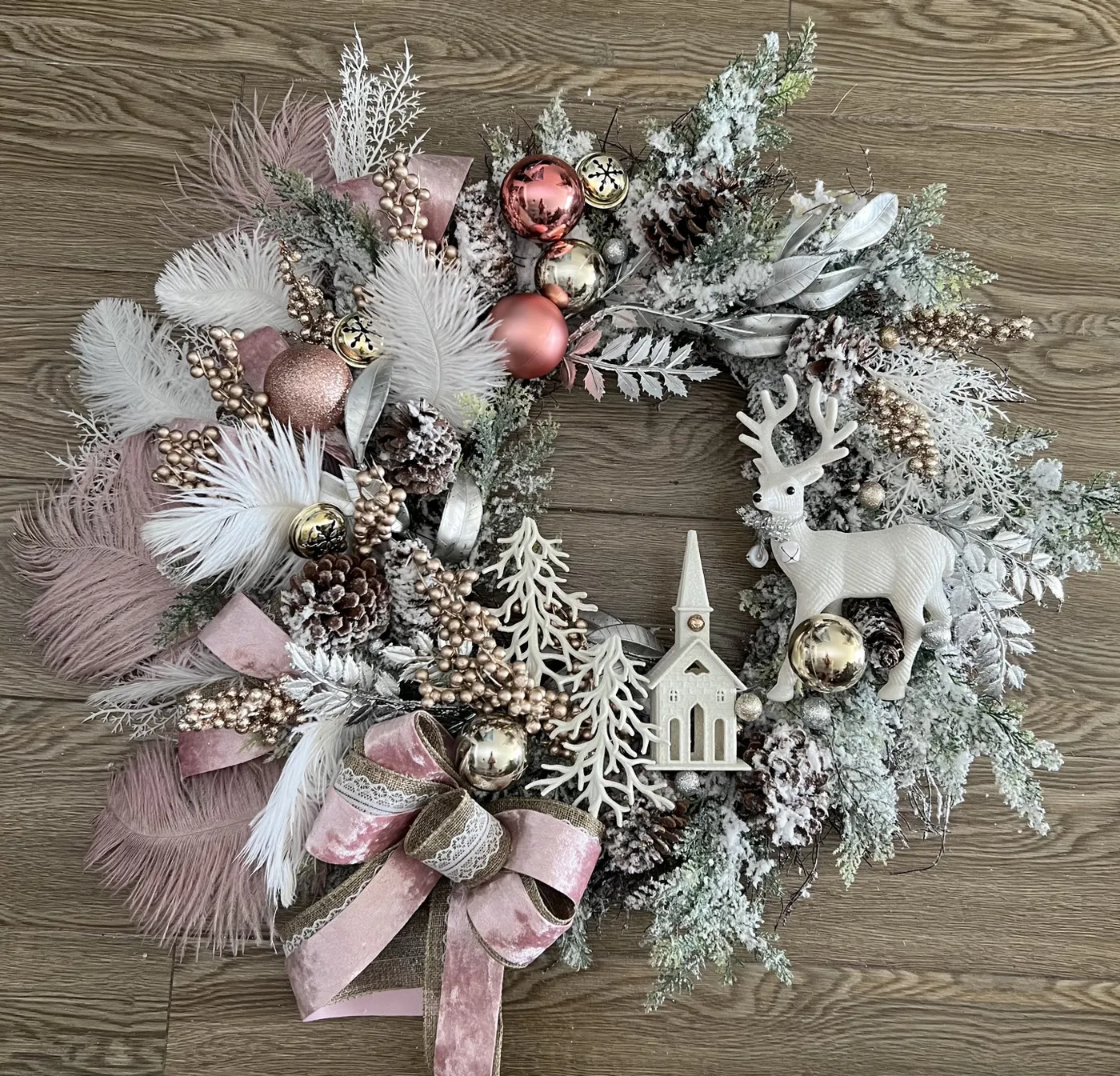
Flocked wreaths are the priciest category on this list, $110 to $200 for a good one. Make your own instead: a $30 faux pine wreath plus a $10 can of spray flocking, applied in two light passes with 20 minutes of drying in between. The feathers are the cheap part — a $6 bag from a craft store goes a long way. Skip the figurines and raid a thrift store’s Christmas bin.
26. Flocked Village Wreath with Tiny Wooden Houses
This is an indoor wreath, and it needs to stay there. Flocking turns into a gray smear in rain, and the tiny houses are not attached to anything that survives a slammed door. If it must go outside, put it under a covered porch with zero direct weather and accept a one-season lifespan. Also, hand it rather than hooking it — the village section is heavier than it looks.
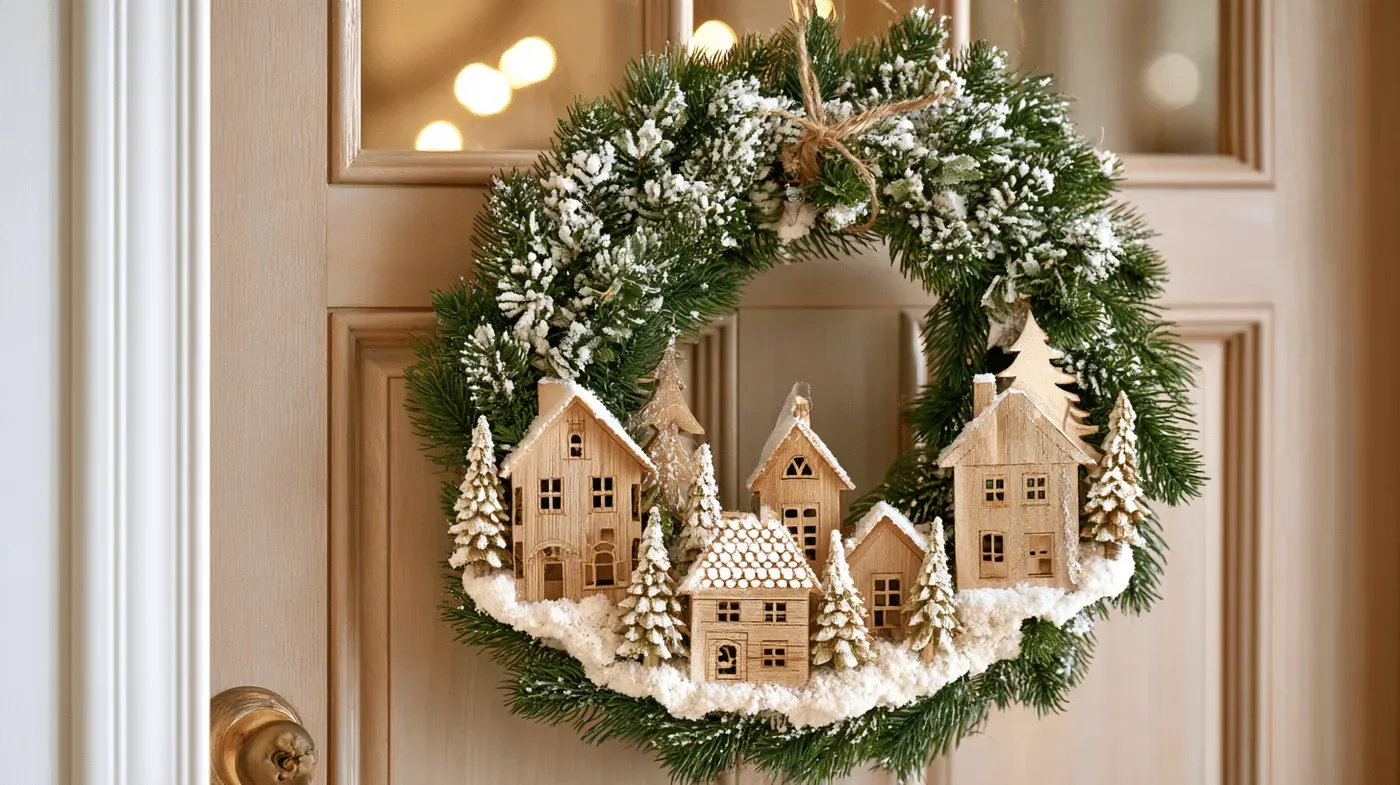
The wreath tells a story, and that is a wildly underrated design tool. A miniature village tucked into snow turns a decorative object into a small scene, which is why people stop and look instead of walking past. Scale does the heavy lifting: the houses are tiny enough to feel like a secret, and the flocking gives them a ground plane. Remove the figures and it is just a white wreath.
27. Snow-Dusted Berry Wreath Above a Silver Mantel
When a wreath hangs above a mantel, align its bottom edge 12 to 18 inches above the tallest object on the shelf — not above the mantel itself. That gap is what tells the eye the two things are related rather than stacked. Then repeat one material between them: the red berries up top should reappear in the garland below, or the pair will look like two separate purchases.
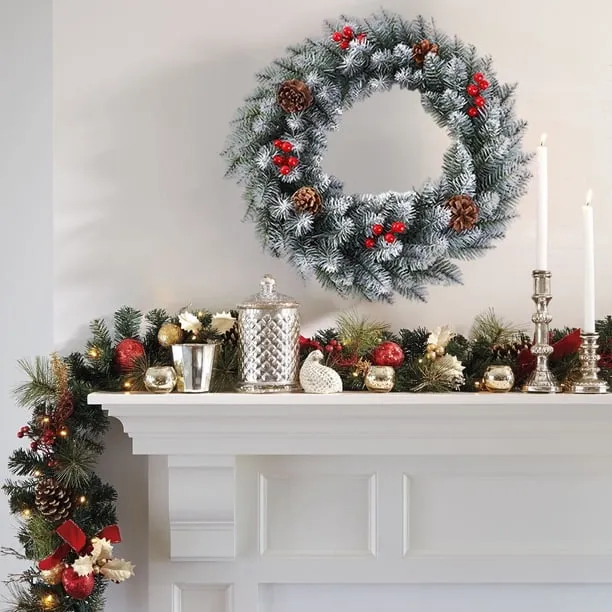
Mercury glass looks like money and cleans like a nightmare. It is hand-wash only, spots if it air-dries, and the silver finish clouds if water gets inside. Candlesticks with white tapers are lower maintenance but generate soot, so trim wicks to a quarter inch and you will cut the black film in half. Check whether the flocking on the wreath is wax- or spray-based too; wax attracts dust and needs a soft brush annually.
28. Silver Bow Wreath with Matte White Ornaments
The silver bow is oversized — deliberately, disproportionately large — and that is the entire design idea. Small bows on big wreaths look timid. A bow that is nearly the width of the wreath’s inner opening reads confident and gives the eye a single resting point among all those ornaments. Everything else, the pinecones and berries and matte spheres, exists to support that one gesture.

- Mixed evergreen 28-inch wreath: $60–$120
- Wired silver ribbon, 3-inch width: $12–$22
- Matte white and glossy silver ornaments: $18–$40
- Pinecones (gathered): $0–$8
- Assorted berry picks: $10–$20
Total: $100–$210
Budget alternative: buy the ornaments December 26 at 75% off and build the wreath next season. The same materials land around $35.
29. Gingham Ribbon Wreath with Frosted Blue Berries
- Cut gingham into 8-inch strips, then notch each end so it does not fray flat.
- Weave the strips through the wreath at four points, tucking the ends into the greenery rather than tying them.
- Wire pinecones over the ribbon tucks so the mechanics disappear.
- Add berries in clusters of three, alternating red and frosted blue around the ring.
- Finish by pulling a few ribbon tails loose at the bottom for movement.
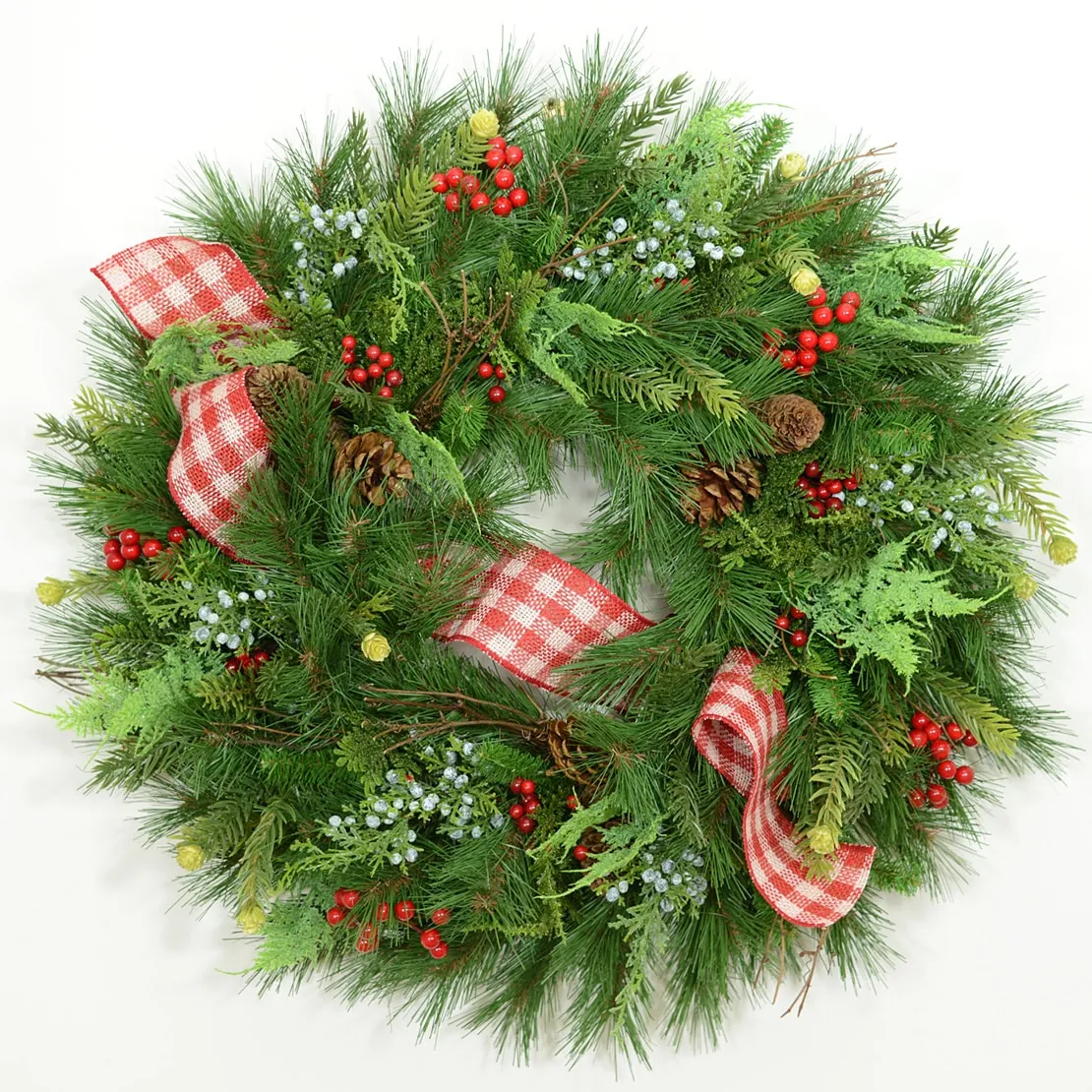
Twenty minutes and about $10 of ribbon if you already own the wreath.
Gingham and blue-white berries have been creeping up since cottagecore peaked, and they have landed in holiday decor as a softer alternative to the red-and-green standard. What is driving it now is the same thing pushing the quieter Christmas look overall: people are decorating with what they already own rather than buying a new theme every November. If you are starting from nothing, Idea #7 shows the base-building math.
One Door, Twenty-Nine Ways to Say Winter
You do not need a new wreath every year — you need one good base and a ribbon swap, and you are most of the way there. Start with the size that fits your actual door, pick one accent you genuinely love, and let everything else stay quiet.
📌 Pin your favorites now so they are waiting for you next November, when the shelves are picked over and your patience is thin.