
Old-fashioned Christmas trees are quietly taking over Pinterest right now, and honestly, we get it. After a decade of minimalist Scandi trees with three ornaments and a lot of attitude, people are hauling the vintage glass back down from the attic.
We spent weeks digging through HomeGoods, Etsy, Anthropologie, and Target to pull together 31 ideas that actually deliver, from $8 ornaments to a $1,200 full staircase garland treatment. Inside you’ll find vintage traditional, Victorian opulent, rustic farmhouse, and retro tinsel-glam trees, with budget and luxury versions compared side by side and every single idea shoppable.
In 2026 the pendulum swung back toward memory: mismatched heirlooms, real popcorn garland, trees that look collected rather than coordinated. And stay until the end — we break down the most common mistakes that can ruin these looks.
📌 Save this to Pinterest for later — you’ll want to revisit these ideas.
1. Brick Walls, Arched Windows, and a White-Gold Tree
Three things do the heavy lifting here. First, contrast: crisp white upholstery and a carved white mantel against raw red brick keep the room from feeling like a tavern. Second, the tree’s palette — white, gold, and glass — picks up the arched window trim so it reads calm instead of competing. Third, the mantel garland repeats the tree’s green at eye level, which ties the whole wall together.
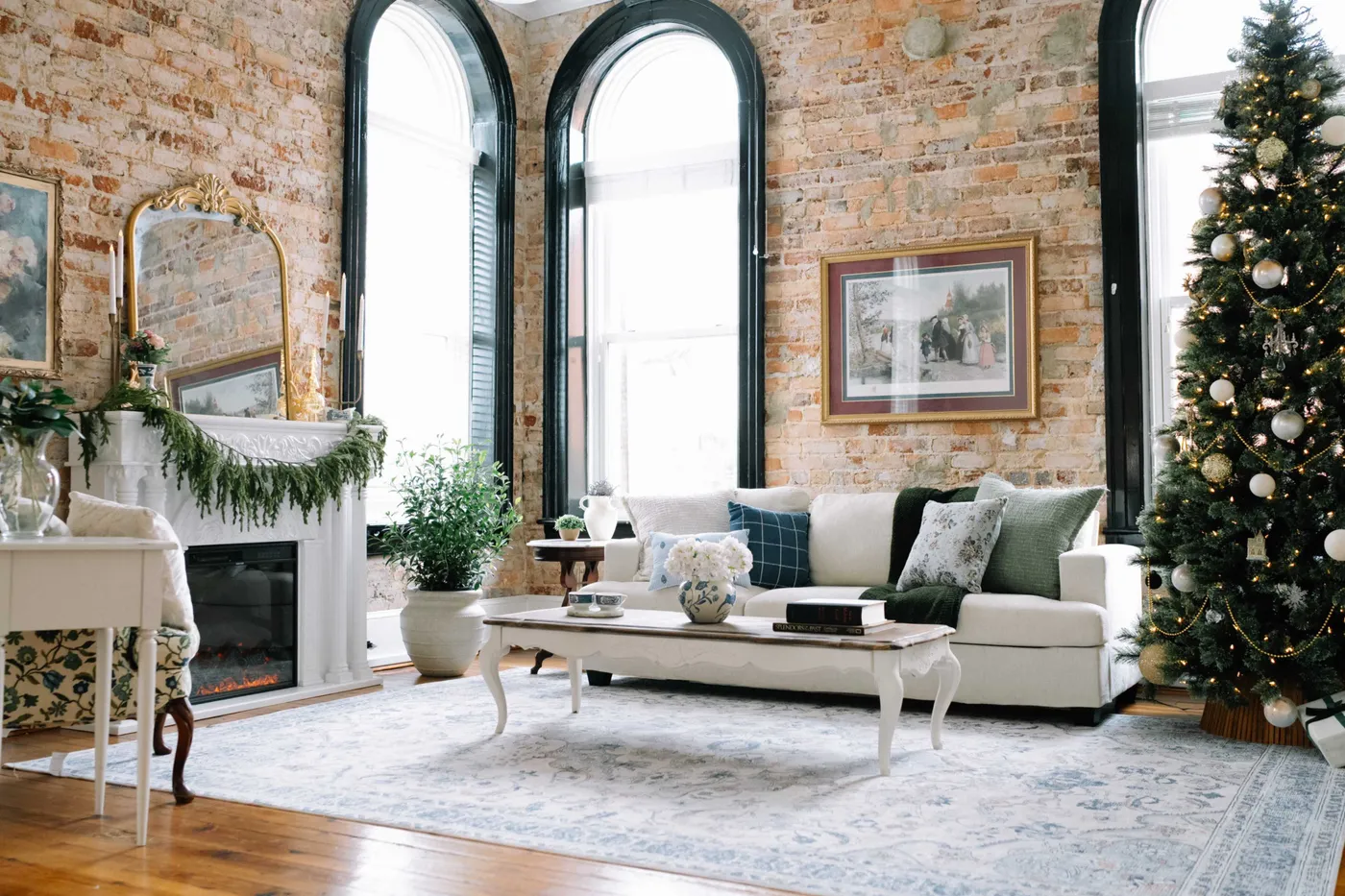
Run your mantel garland on cup hooks every 12 inches — not one long swoop — so it dips between anchors and looks grown rather than glued. Then weave a second, lighter strand and let it hang 4 to 6 inches below the first. Two depths read as real greenery; one depth reads as a scarf. Total hardware cost: about $8.
2. Glass Ornaments, Brown Paper, and Exposed Beams
It’s the clear glass ornaments. On a tree lit from inside, clear glass doesn’t show color — it shows light, bending one warm bulb into a dozen small ones. Swap them for opaque red and you’d have a perfectly nice tree that photographs half as well. Keep at least a third of the tree in clear or mercury glass and let the rest carry the color.
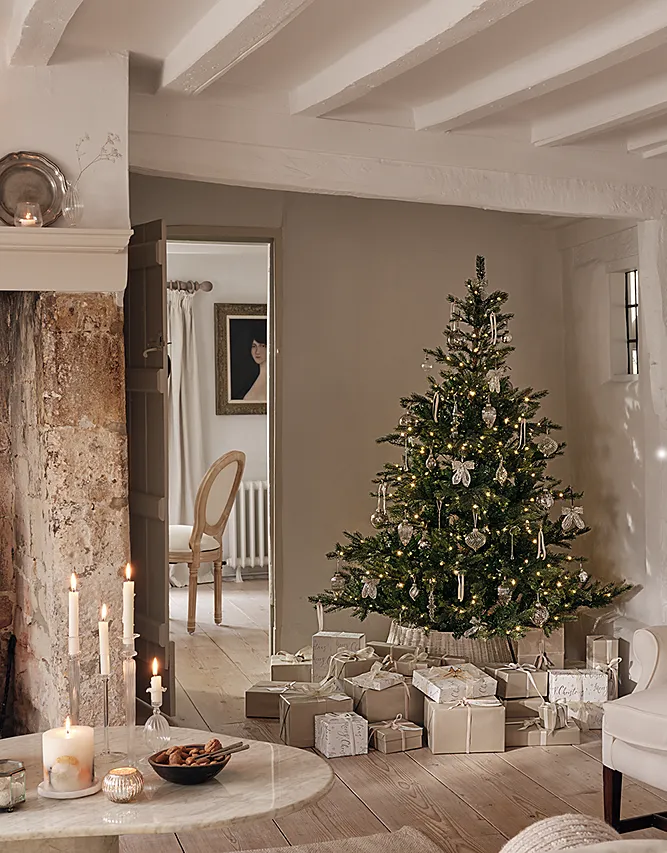
Wrapping gifts this way costs less than a roll of printed paper. About 40 minutes for eight boxes and roughly $12 in supplies:
- Kraft paper, matte side out, corners folded flat
- White cotton twine wrapped three times each direction
- A sprig of real cedar or rosemary tucked under the twine
- A small kraft tag, name written in fine-tip pen
Skip the ribbon entirely — the greenery is the decoration.
3. Garland Up the Staircase with Red Bows
The formula here is roughly 60 percent cream and dark wood, 30 percent forest green, 10 percent holly red. The green does the volume work — tree, mantel, staircase, all working from the same garland. Red appears only in bows and ornaments, which is exactly why it pops instead of shouting. To swap it: keep the ratio, change green to copper and red to plum, and the same room reads autumn.
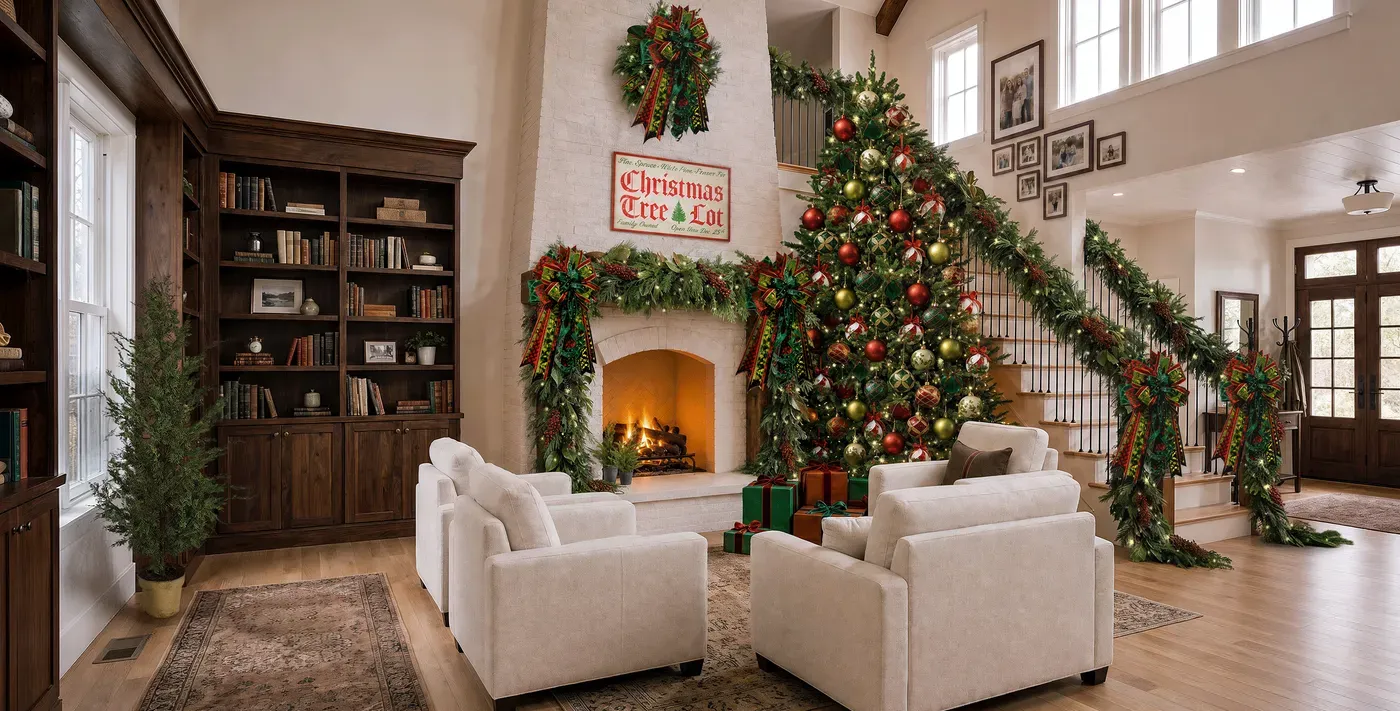
What it actually costs to recreate the staircase-and-mantel treatment:
- Garland, three 9-ft strands with mixed tips: $90–$220
- Wired ribbon for bows: $30–$60
- Ornaments for a 9-ft tree, 100–150 pieces: $80–$250
- Warm white lights, 600–900 count: $40–$90
- Extra bows, picks, stockings: $30–$80
Total: roughly $270–$700 for the full display. Budget alternative: buy garland and ribbon in January clearance and store it flat — you’ll land near $150, and last year’s greens look exactly like this year’s.
4. A Vintage Red Truck Parked Beside a Warm-Lit Tree
Displays like this are all over Pinterest because they photograph like a memory — warm bulbs, faded red paint, a little snow. It’s the same pull behind the grandmillennial wave: people want Christmas to look like the version they half-remember. The staying power is decent. A vintage truck is a commitment, but the formula underneath it — warm white light against a dark green tree — isn’t going anywhere.
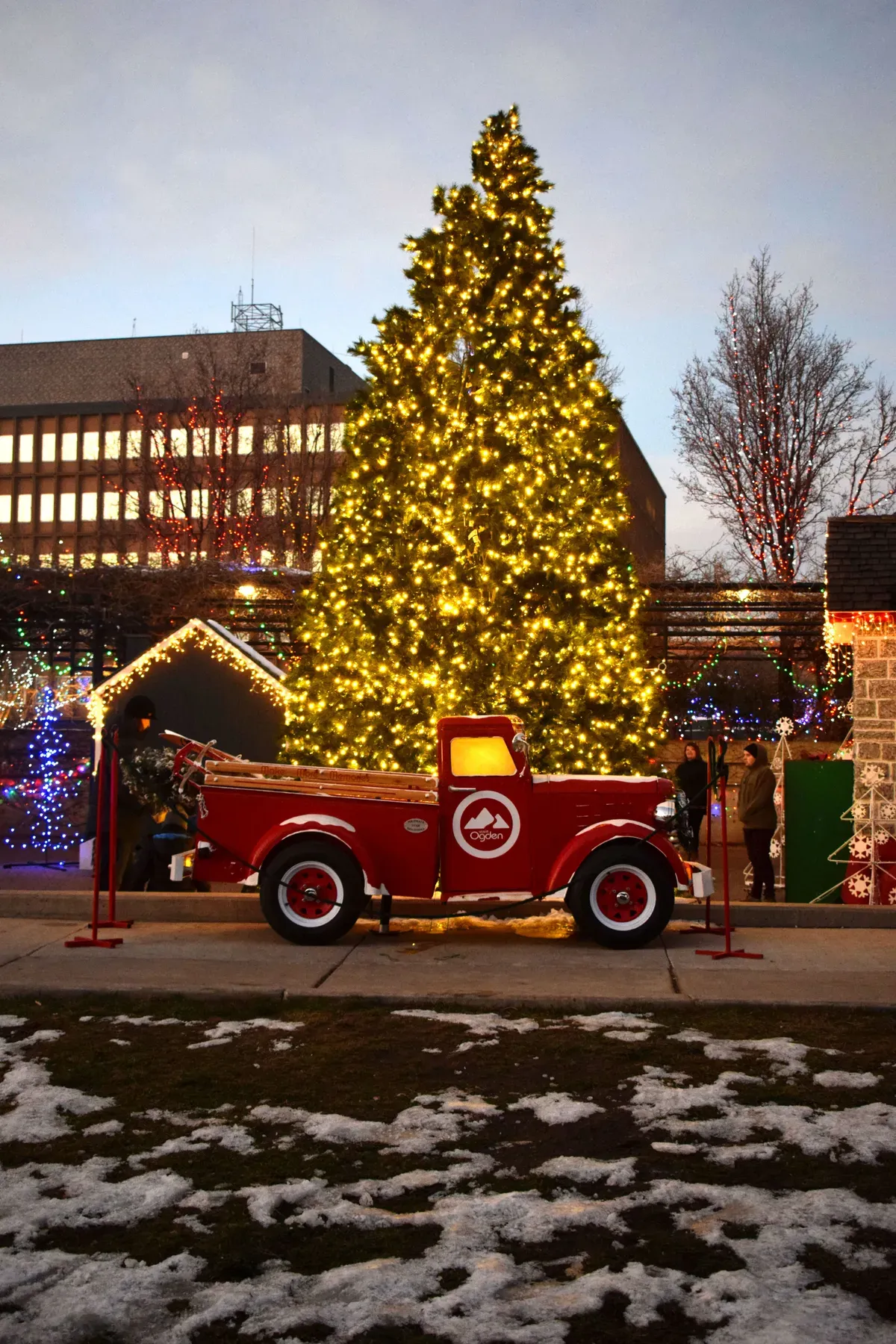
Practical warning: outdoor vignettes need lights you can plug in safely and materials that survive weather. Real evergreens drop needles within a week outside; flocked artificial holds up better but yellows in direct sun. If the ground stays wet, that truck bed becomes a rust problem, so put anything wooden on a rubber mat. Want the nostalgia without the weatherproofing? Take it inside — see Idea #23.
5. Deep Red Damask, Brass Frames, and Antique Glass
The wallpaper. A dark red damask behind a green tree sounds like a fight, but the pattern’s low contrast does the opposite — it gives the tree a moody backdrop that makes gold tinsel and mercury glass glow. On a plain white wall the very same tree would look like a store display. Wallpaper or paint is the cheapest way to make vintage ornaments look expensive.
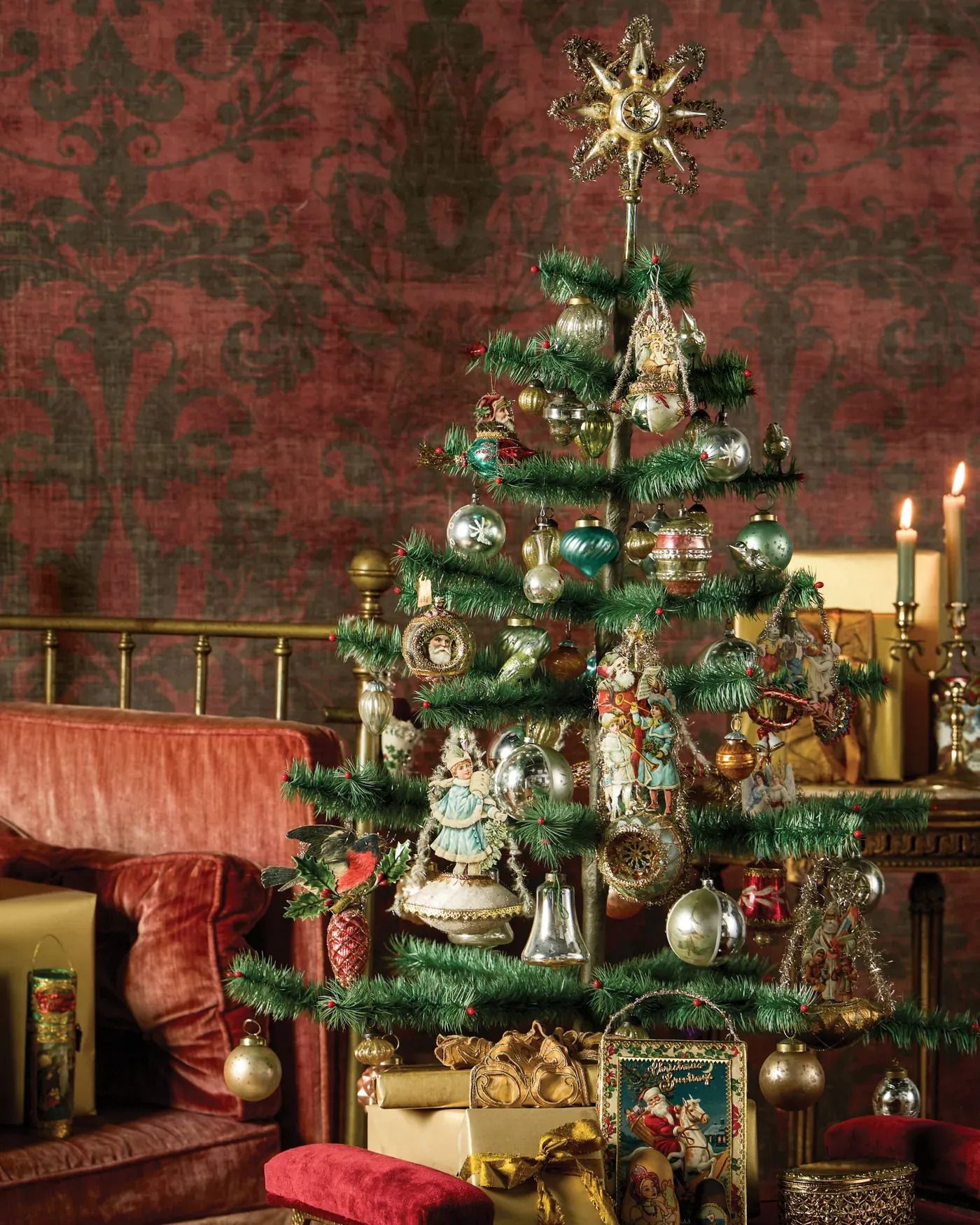
on upkeep: vintage glass needs hand-washing in cool water and never the dishwasher, tinsel tangles if you look at it wrong, and dark damask shows dust faster than you’d expect — plan a feather-duster pass every two weeks in December. Gold-wrapped gifts crease in storage; a low iron on the back side smooths them in seconds. Budget 30 minutes at the start and end of each season.
6. A Train Set Circling the Tree in a Blue-Gray Parlor
Build the train loop 14 to 18 inches out from the trunk, not tight against the skirt. That gap is what keeps the track from looking like a collar, and it gives gifts somewhere to sit without blocking the cars. If your floor is carpeted, lay a quarter-inch plywood base under the track — it’s the difference between a train that runs all season and one you’re re-railing every night.
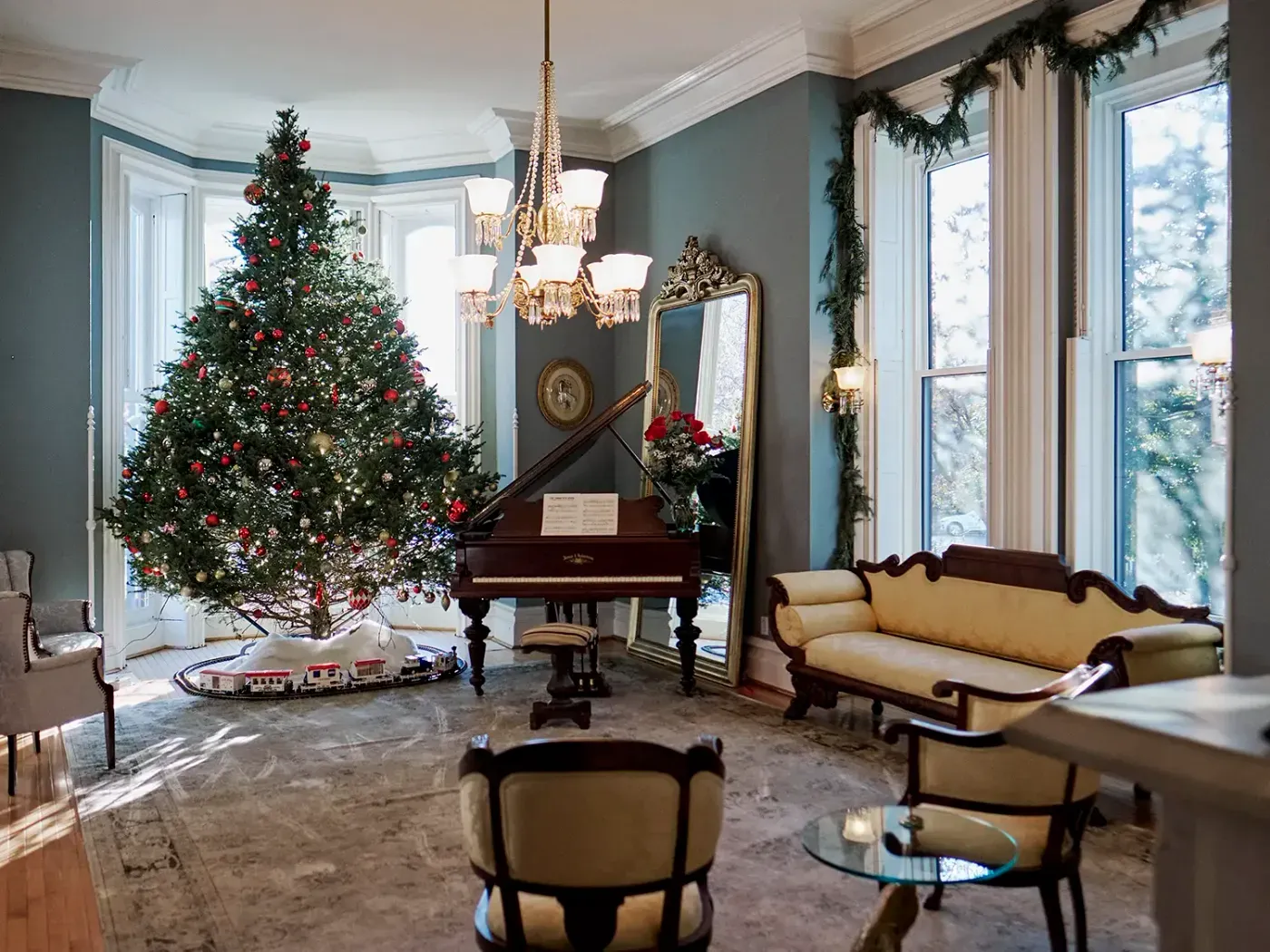
This look needs air. The tree reads around 9 feet, the ceiling is 12 or better, and that bay window wall spans 14 feet or so — anything smaller and the piano and chaise start elbowing each other. Under 200 square feet, borrow the palette (blue-gray, warm red, brass) rather than the layout, and scale the tree down. See Idea #16 for the slim version that fits a corner.
7. Gold Snowflakes on Chain and Glossy Red Baubles
Hanging ornaments at different depths is what makes a tree look collected rather than loaded. This takes about 30 minutes and $6 in supplies:

- Cut ribbon or gold chain into 4-inch loops
- Hang specialty pieces 3 inches off the branch, not flush
- Place a plain ball directly behind each specialty piece for depth
- Step back every ten ornaments — symmetry hides at close range
Gold chain catches light between the branches, which is why the close-up shots look so rich.
Skip the boutique sets. Walmart and Target sell plain gold snowflakes and glossy red glass balls in multi-packs for $8 to $15, and Etsy sellers move vintage gold chain by the yard for about $4 a foot. A 6-foot tree needs roughly 60 ornaments — 40 balls, 20 specialty — and you can build that for around $60 if you shop the December 26 sales.
8. Teal Walls, Velvet Ribbon, and Jars of Ornaments
Count the colors: forest green, rich red, antique gold, and teal walls. That’s four, usually one too many — except the teal is architecture, not decoration, and the gold shows up only in small doses. The rule that saves it: every ornament color has to appear somewhere else in the room. Teal balls echo the wall, gold echoes the lamp base, red echoes the velvet ribbon.
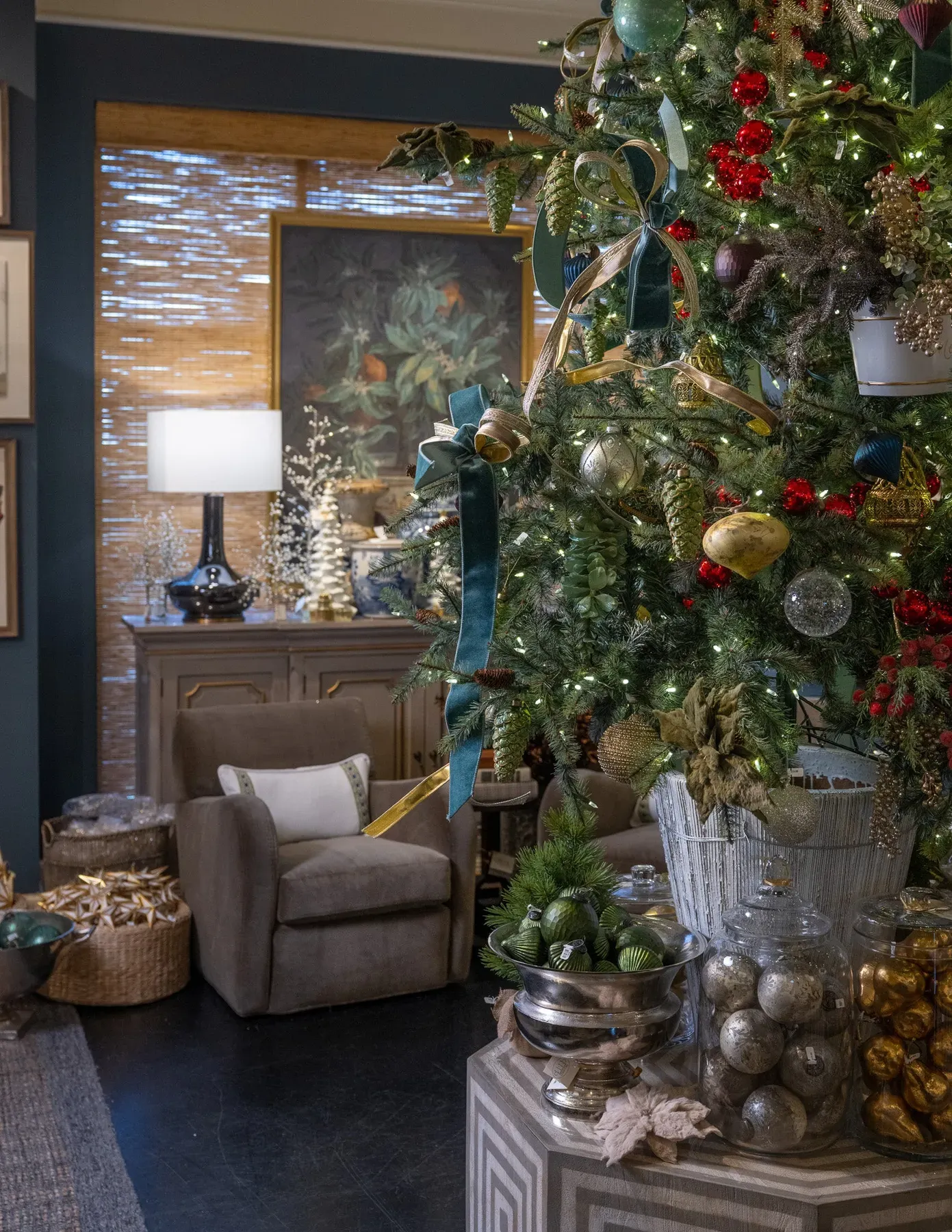
Velvet ribbon is the difference between a decorated tree and a styled one. Cut 18-inch lengths, fold them in half, and tuck the loop over a branch instead of tying it — you get that loose, expensive drape rather than a bow. Space them every 8 to 10 inches, always place one directly under the topper, and buy two widths (1.5 inch and 3 inch) so the scale varies.
9. A Slim Flocked Tree Next to a Modern Dining Table
Pencil trees solve dining rooms, hallways, and any spot where a full tree would eat a chair. A 7-foot slim flocked tree is only about 24 inches wide at the base — it fits a corner with 30 inches of clearance and still reads tall. Ceiling height matters more than floor space here: under 8 feet, drop to a 6-footer or the whole thing feels crammed.
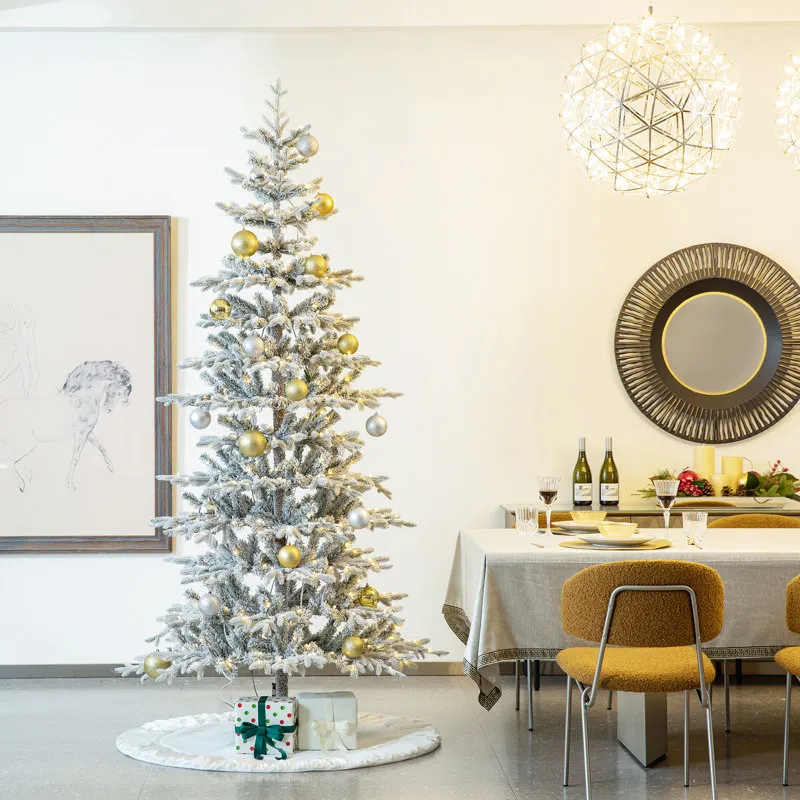
Rough numbers for the slim flocked setup:
- Slim flocked tree, 7 ft: $80–$250
- Matte gold and silver ball set, 40–60 pieces: $25–$70
- Warm white lights if not pre-lit: $15–$40
- Patterned tree skirt: $20–$50
- Topper: $10–$35
Total: about $150–$445. Budget alternative: buy a plain green pencil tree for $40 and a can of spray flocking for $12 — mist the outer tips only and you get 80 percent of the look for a third of the price.
10. Popcorn Garland, Silver Tinsel, and a Real Evergreen
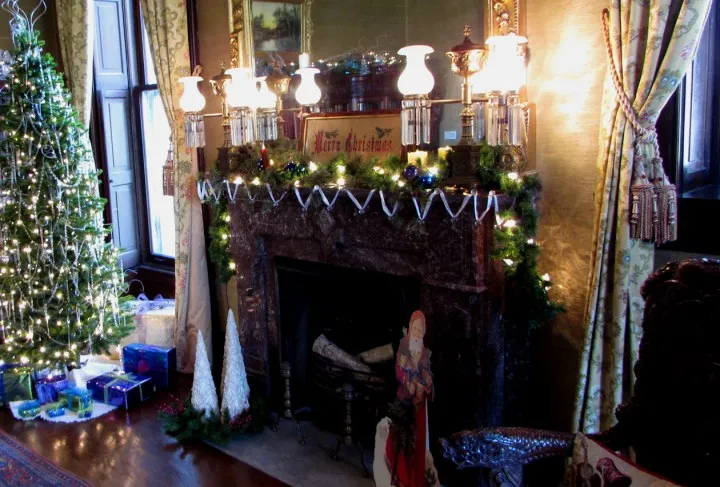
Popcorn garland is a two-evening project, and the drying step is the one everyone skips.
- Pop plain popcorn — no butter, no salt — and let it sit uncovered overnight
- Thread a 12-foot length of heavy thread with a large-eye needle
- Push through the center of each piece, leaving a half-inch gap
- Alternate every fifth piece with a cranberry for color
- Drape in loose swags and secure the ends with twist ties
Cost: about $10. Time: 90 minutes plus the overnight dry.
Popcorn garland looks wonderful for about ten days, then the tips start to yellow. Popping it the night before and drying it out helps, and skip butter entirely — salted, buttered popcorn attracts everything with legs. If you have a counter-surfing dog or a toddler, run the garland above the four-foot mark, or swap in dried orange slices, which last for years and smell better in storage.
11. A Library with Two Trees and Red Velvet Seating
Two trees in one room works here for one reason: the shelves. Dark wood bookcases give the eye a vertical grid to rest on, so the trees read as two accents rather than two competitors. The railing garland then connects them at a third height — floor, eye level, railing — and the red velvet seating repeats the ornament color all the way down at the bottom.
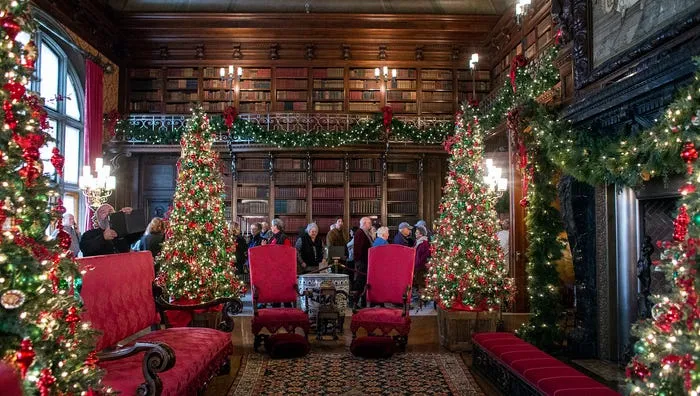
This is a double-height room, so the trees are 10 to 12 feet and the railing garland runs 25 feet or more. Realistically that’s 300 to 400 ornaments and well over a thousand lights. In a standard 8-foot-ceiling living room, use one tree and skip the railing — the palette translates, the volume doesn’t. Budget for lights before ornaments; they’re what you actually see from across the room.
12. A Plaid-Coated Santa Holding a Sack of Tiny Gifts
Collectible Santas run $80 to $400 at department stores. The same silhouette — plaid coat, big faux fur trim, one arm extended — turns up at HomeGoods for $25 to $45 most Novembers, and thrift stores are full of hand-carved ones in January for under $15. It’s the same collector’s instinct behind Idea #5‘s antique ornaments, just a much smaller receipt.

The stern expression is the whole thing. Most Santa figures smile, and that’s exactly why this one holds a room — a little gravity makes him read as an heirloom instead of a decoration. Put him where he’s noticed at eye level, on a console or a stack of books, never jammed into a corner. The plaid is the costume; the face is the character.
13. Cardinals, Gingham Bows, and Heavy Flocking
Flocked trees show every fingerprint and every hook, so hang by the cap and touch the branches as little as possible. Better tip: those cardinals aren’t ornaments, they’re clips. Clip-on birds sit wherever you put them, at whatever depth you choose, which is what makes a tree look inhabited. Use eight to twelve, facing slightly different directions, and keep them out of direct sun so the red doesn’t fade.
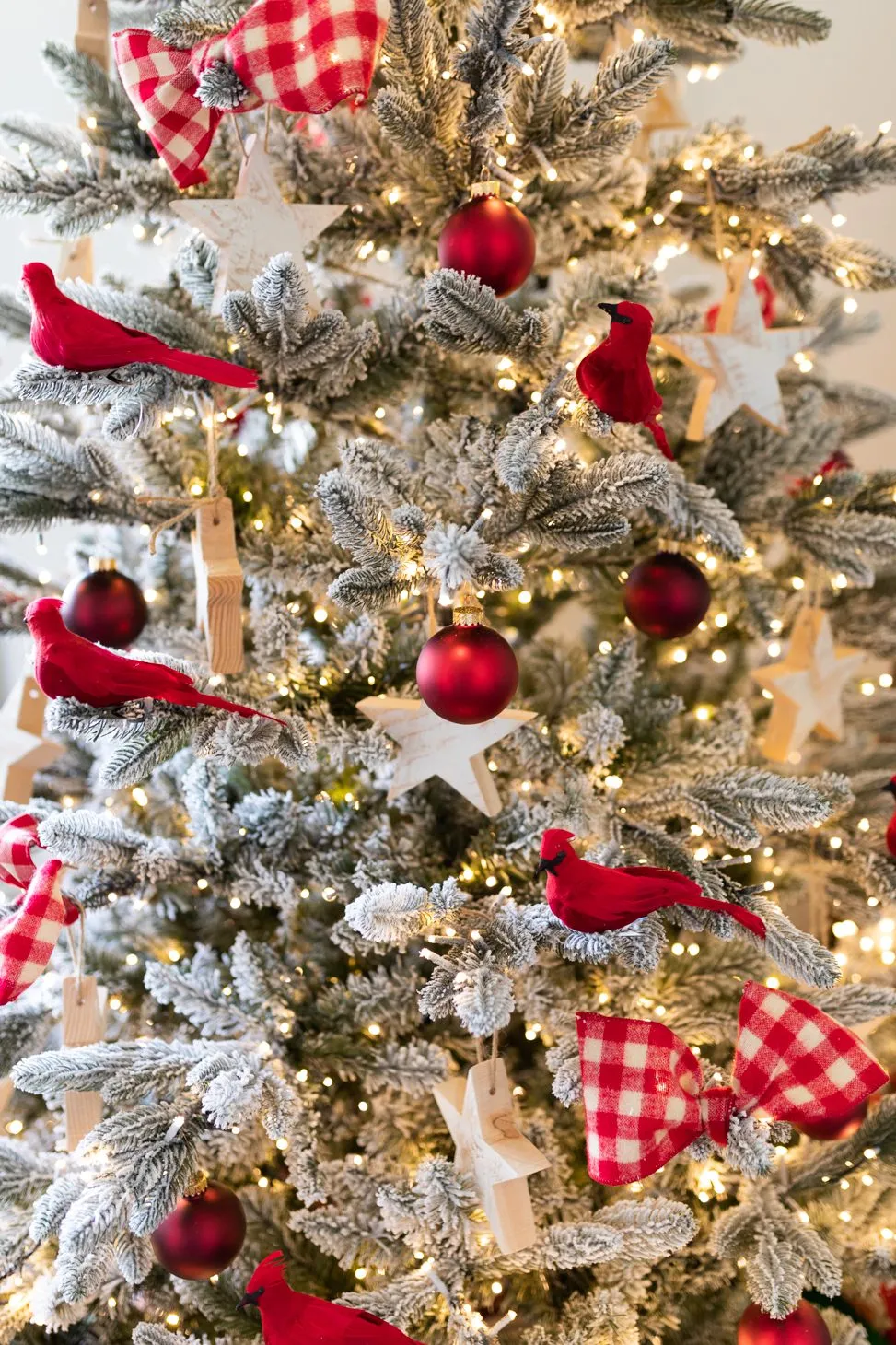
This is a two-color tree: white flocking and red, with natural wood as the neutral. Roughly 70 percent white, 25 percent red, 5 percent wood tone. The gingham bows are the only pattern in the room, which is why they don’t overwhelm. Swap red for navy and gingham for solid navy ribbon and you keep the exact same cozy formula with a completely different mood.
14. An Archway Garland in a Marble Hallway
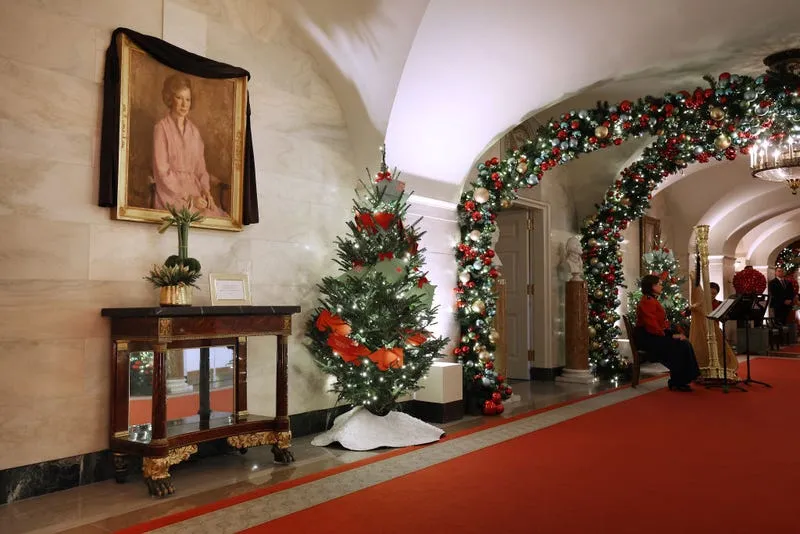
An archway garland takes an afternoon and about $60 to $150 in materials.
- Measure the span and multiply by 1.5 — swags need slack
- Mark attachment points every 3 to 4 feet with removable hooks
- Start at the center, work outward, let each swag dip 8 to 10 inches
- Weave lights in last, following the greenery instead of spiraling
- Add ornaments at the low points where the eye lands
Two hours, and no nails in the plaster.
Hallway decorating is genuinely having a moment — searches for entryway Christmas climb every November, because it’s the first thing guests see and the last thing anyone finishes. An archway garland is the highest-impact, lowest-square-footage move in the house. It also photographs beautifully from a doorway, which is not a coincidence.
15. Red Baubles, Pinecones, and Stockings on the Mantel
This tree works because nothing on it is precious. Red and gold baubles, pinecones, a gold star — all of it readable from across the room. The mantel garland repeats the tree’s green at a second height, and the stockings are the only white on that wall, which keeps the whole thing from turning into a blob of red and green. Readable from twelve feet away is the test every ornament should pass.
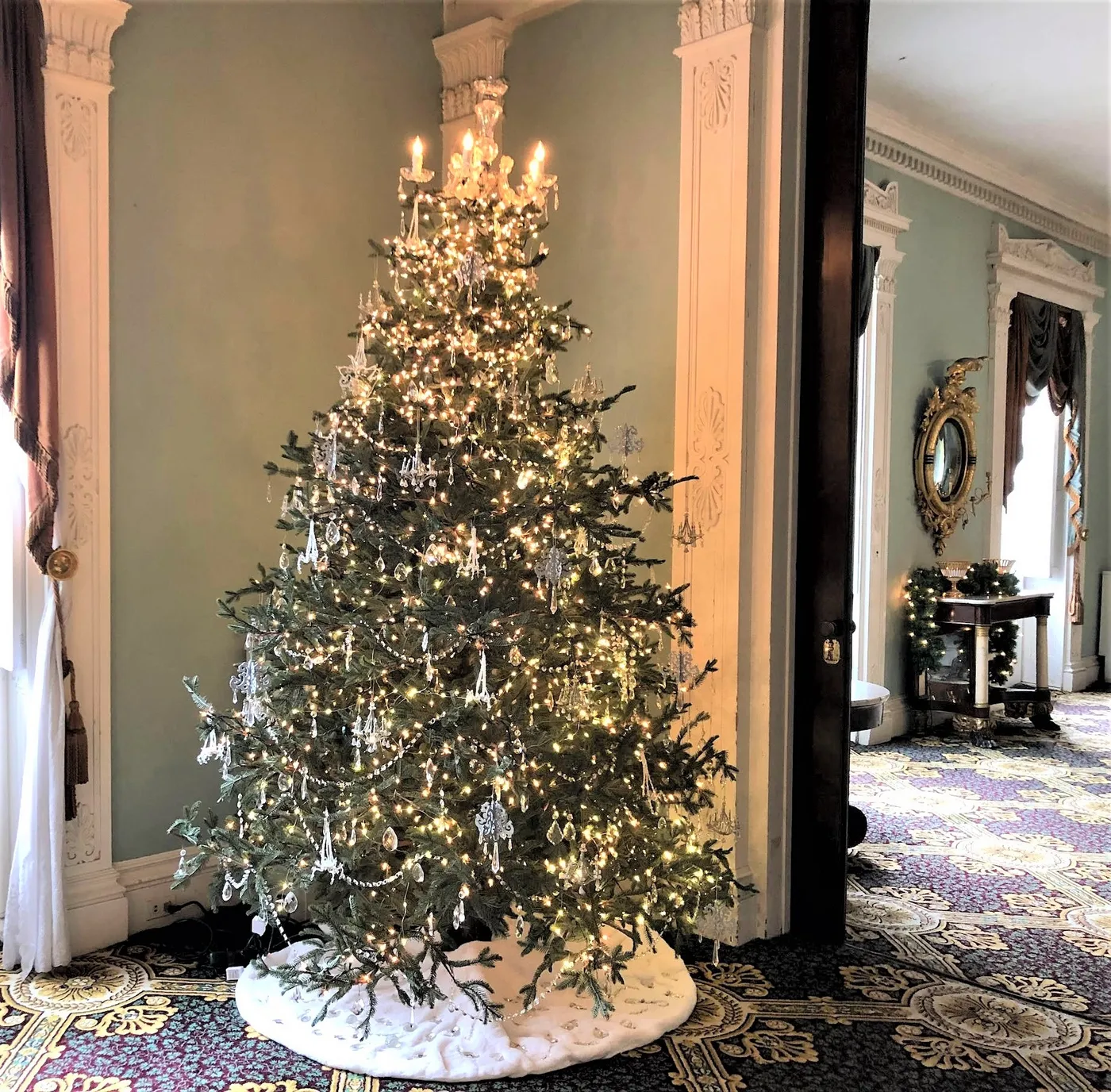
Realistic costs for the classic version, tree included:
- 7.5-ft tree: $120–$350
- Warm white lights, 600 count: $20–$60
- Red and gold ornament set, 60–80 pieces: $40–$120
- Pinecone and floral picks: $15–$40
- Mantel garland: $30–$80
- Stockings and tree skirt: $40–$105
Total: roughly $265–$755. Budget alternative: a $60 tree, ornaments bought in 100-count boxes, and one splurge on good lights gets you to about $150.
16. A White Tree Collar Against Sage Green Walls
The tree collar. A distressed white wooden box instead of a fabric skirt is a small change with an outsized effect — it hides the stand completely, holds its shape all season, and works against sage walls in a way a red skirt never would. If you have a tripod stand you hate looking at, this is the $40 to $80 fix that solves it permanently.
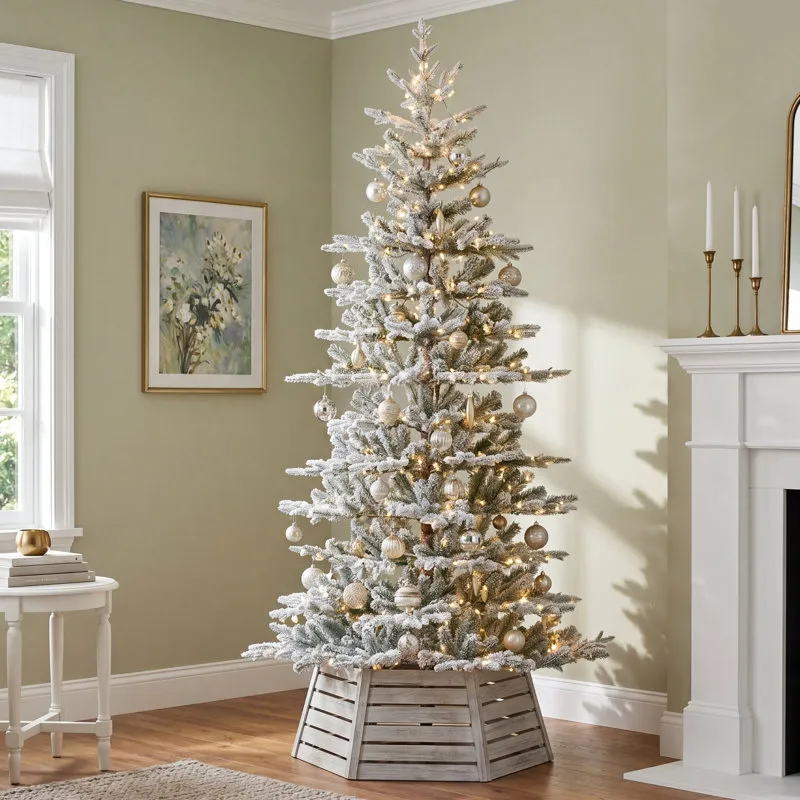
Flocked trees drop. Expect a white dusting on the floor by New Year’s, and vacuum with a brush attachment rather than a beater bar. Store flocked trees in a breathable bag — vacuum-sealed plastic crushes the flocking and it never fluffs back. Keep them away from radiators, too; heat turns the white coating cream within a season or two, and there’s no fixing that.
17. Small Glass Balls in Every Color, Packed Tight
This is a 90/10 tree: about 90 percent ornament coverage, 10 percent visible branch. That density is what makes a $40 box of glass balls look like a collection. Color-wise it’s a scatter of red, gold, blue, and silver at roughly equal weight, unified by warm white lights and a single gold star. Add a fifth color and it gets noisy; remove one and it flattens out.
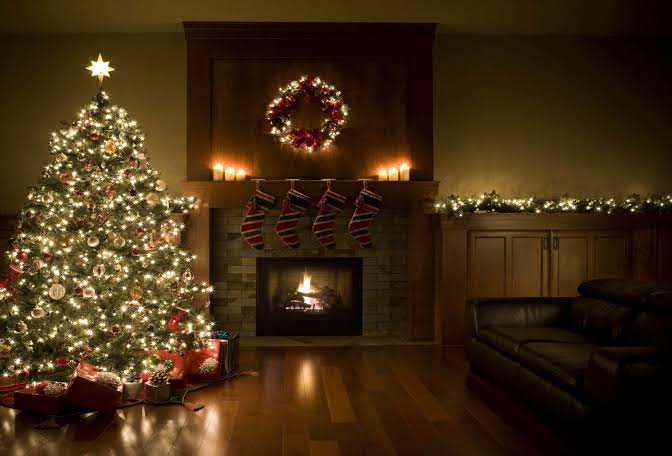
You can build this for under $80. Walmart and Target sell 100-count glass ball sets for $25 to $40 in November, and estate sales are the real secret — a shoebox of somebody’s 1960s ornaments often goes for $10. Mix new with old; the variation in size and finish is what makes a dense tree look collected instead of purchased. For a pared-back take on the same density, see Idea #26.
18. A Silver Tinsel Tree with Red Teardrops
Tinsel trees are back because the pendulum swung. After years of quiet, natural, barely-decorated trees, people want shine and a little kitsch. Resale sites are full of 1960s aluminum trees at $150 to $400, and reproductions start around $40. This one has staying power: it’s nostalgic, it photographs with flash like a dream, and it stores flat in a closet.
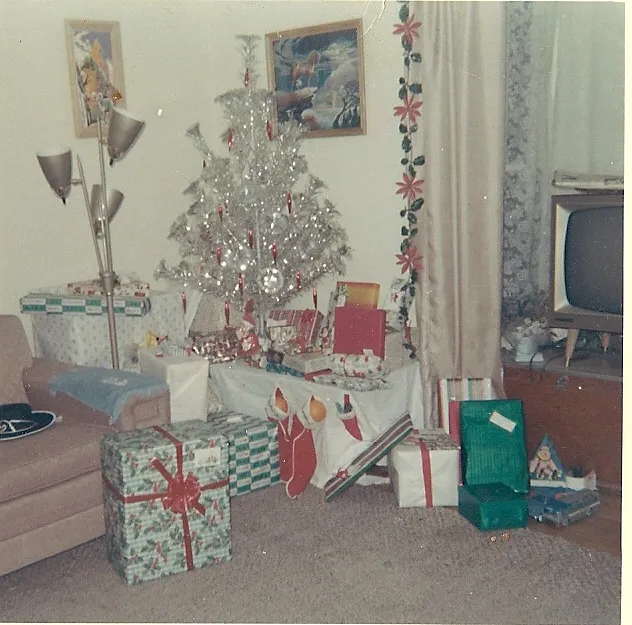
Tinsel sheds, and it sheds forever. Keep the tree on a low-pile rug or hard floor, never deep shag, or you’ll be picking silver out of it in July. Also: never wrap lights directly around vintage aluminum tinsel — the metal can short a bulb. Put a floor uplight behind the tree instead and the tinsel will glow without the risk.
19. Whimsical Glass Characters and Tinsel Garlands
The characters. A tree full of matching balls is a color scheme; a tree with a glass fox, a grinning elf, and a glittered mushroom is a story. The workable ratio is one character ornament for every three plain ones, spaced so each gets a little air. That’s the difference between an heirloom collection and a display of inventory.
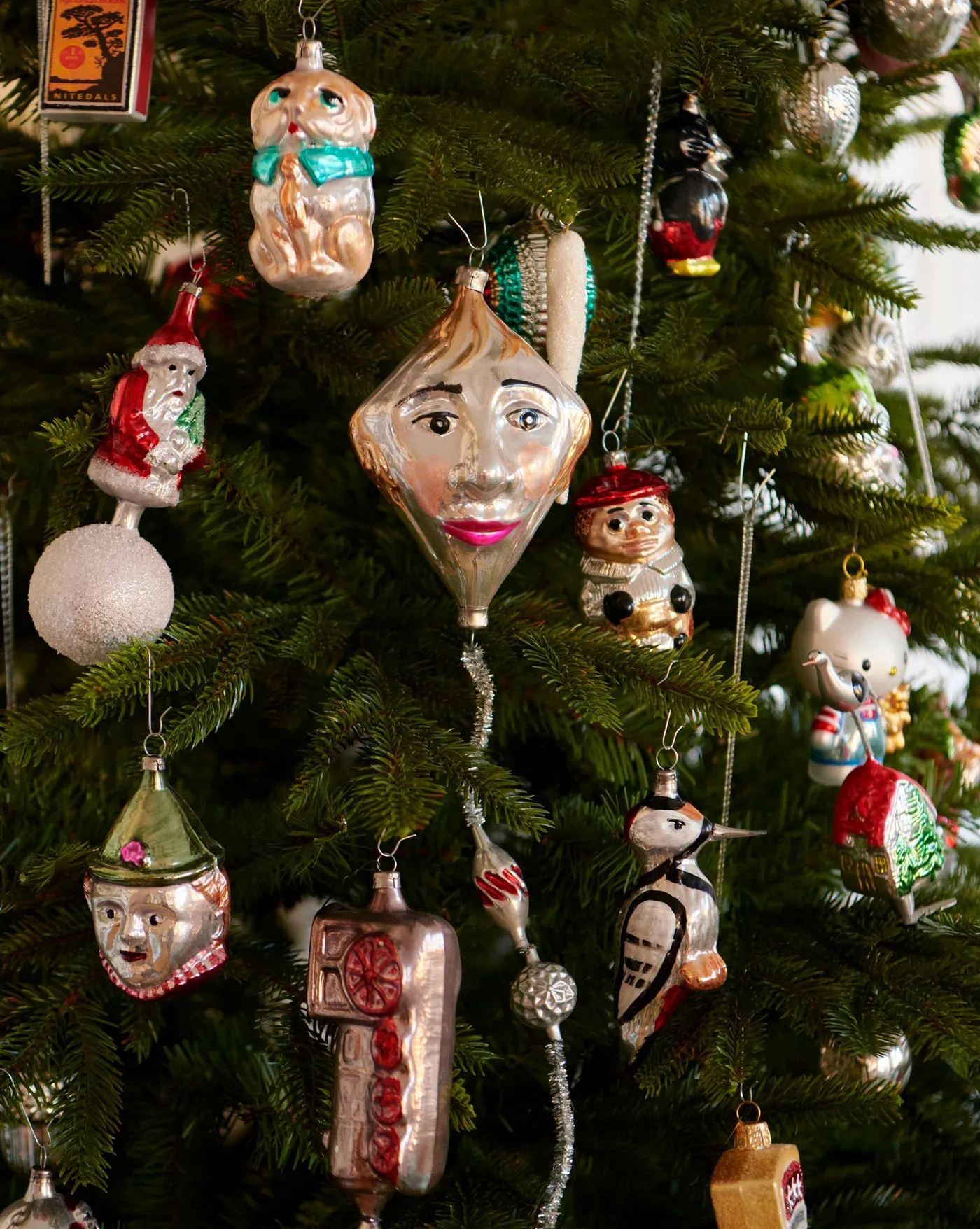
Vintage glass is lighter than modern glass and the caps are thinner, so use 2-inch wire hooks rather than ribbon — ribbon slips and the ornament hangs crooked. Never hang glass over a heat vent or a doorway where it can swing. Store in a compartmented box with acid-free tissue, not newspaper; newsprint ink transfers to glass and never comes off.
20. Heart-Shaped Photo Frames in a Wallpapered Bedroom
Photo ornaments are the most emotionally valuable things on a tree and the most likely to get ruined. Keep them off the lowest branches if there are kids or pets, and photograph each one before you hang it — if a glass frame breaks, you still have the picture. Also, floral wallpaper plus a green tree plus red bedding is a lot of pattern; keep the ornaments small so the wall stays the backdrop.
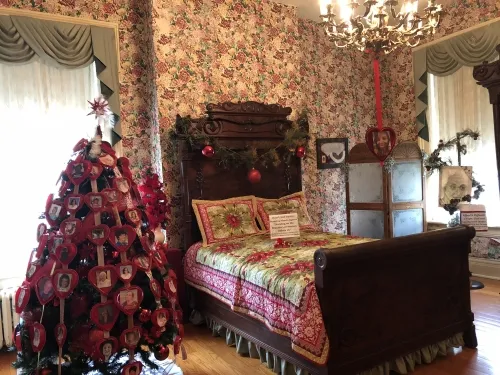
Three ornate elements share this room and somehow don’t fight: the carved sleigh bed, the floral wallpaper, and the multi-arm chandelier. They agree on a warm palette — cream, red, brass — and they sit at three different heights, so the eye reads layers instead of clutter. The green tree is the only cool note in the room, which is exactly why it stands out.
21. Multicolored Lights on a Real Tree in a Dark Room
Colored lights read best in low ambient light against dark surfaces — leather, wood, deep paint. In a bright white room they wash out by 5 p.m. If your living room is light, save the multicolored lights for a den or a basement tree. A 6- to 7-foot real tree with 400 to 500 mini lights is the sweet spot; past that the colors blend into white anyway.
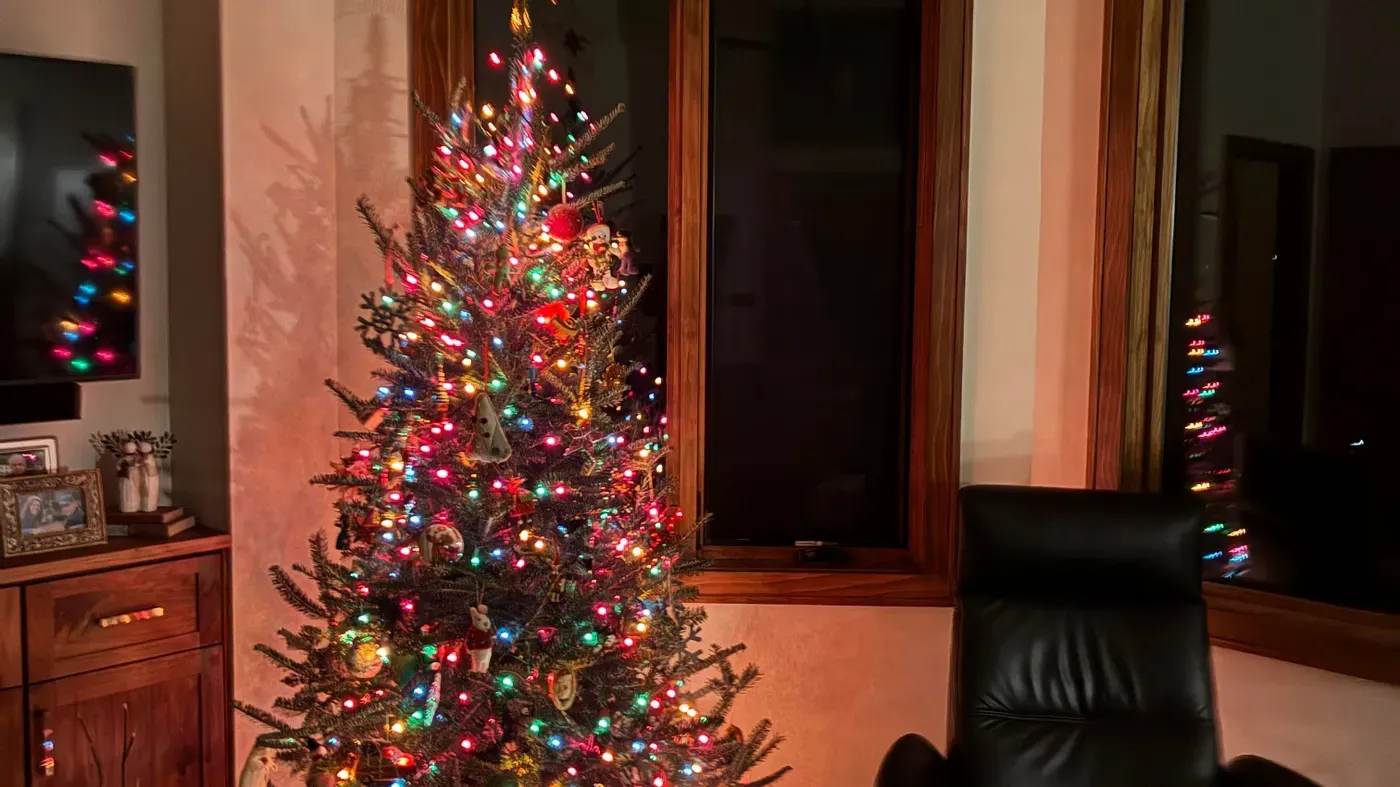
A real tree drinks — a fresh-cut 7-footer takes a quart or more in the first week, so check the stand every morning. A dry tree is a fire hazard, not just a droopy one. Needles will fall no matter what; put a washable blanket underneath and vacuum every other day. Compare with Idea #2, where the wrapped gifts do the floor-covering work.
22. A Sparse Natural Tree in a Gilded Victorian Room
Sparse trees need styling, not filling. Space ornaments 8 to 10 inches apart, hang the largest ones low and slightly inside where the branches part, and let the trunk show — that’s the charm. Fluff branches outward with your forearm rather than your fingertips so you don’t snap the wire. A 6-foot sparse tree takes about 30 ornaments and 200 lights, a third of a normal tree.
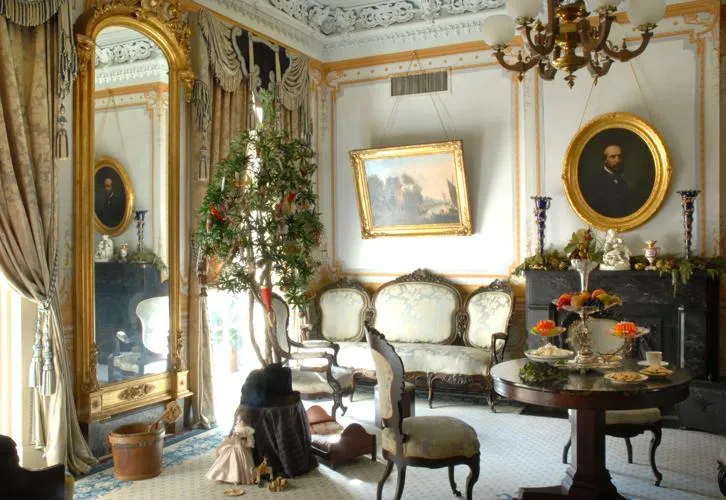
The sparse tree is the anti-haul decoration: fewer ornaments, natural shape, nothing matching. It arrived alongside a wider interest in visible craft and old-world interiors, and it’s holding because it’s cheap to do well and easy to store. Expect to see more of it in 2026 in Victorian-leaning rooms, paired with gold frames, red berries, and absolutely no tinsel.
23. Faux Fur Trim, Red Velvet, and a Golden Staff
Carved Santas with real velvet run $200 and up from collectible shops. For the same silhouette at a fraction: HomeGoods and T.J. Maxx stock resin-and-fabric versions for $30 to $60 in November, and Etsy sellers list vintage papier-mâché Santas in the $40 to $90 range. A plain wooden figure from a craft store plus a yard of red velvet and faux fur trim can be dressed for about $25.
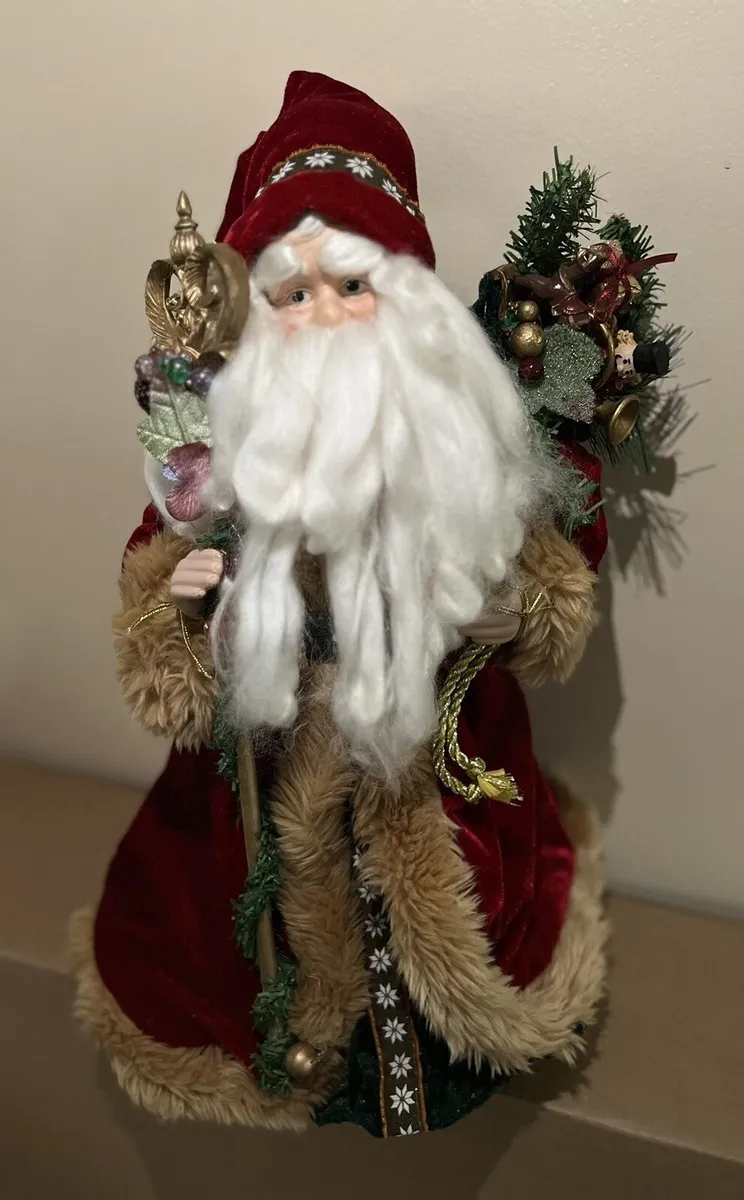
The palette is simple: deep red 50 percent, forest green 30 percent, warm brown and gold 20 percent. The fur trim is what makes the red read expensive — without a light neutral next to it, velvet just looks red. If your room runs cooler, swap the brown fur for cream and the greenery for eucalyptus, and the figure still works on a shelf.
24. A Pink Mercury Glass Starburst on Top
The pink. Everything else in a vintage Christmas scheme is red, green, gold, or silver, which is exactly why one hit of rose-colored mercury glass stops people mid-sentence. It reads mid-century without a single other retro object in the room. Put it on a tree of silver and pale glass and let it be the only warm-pink note you allow.
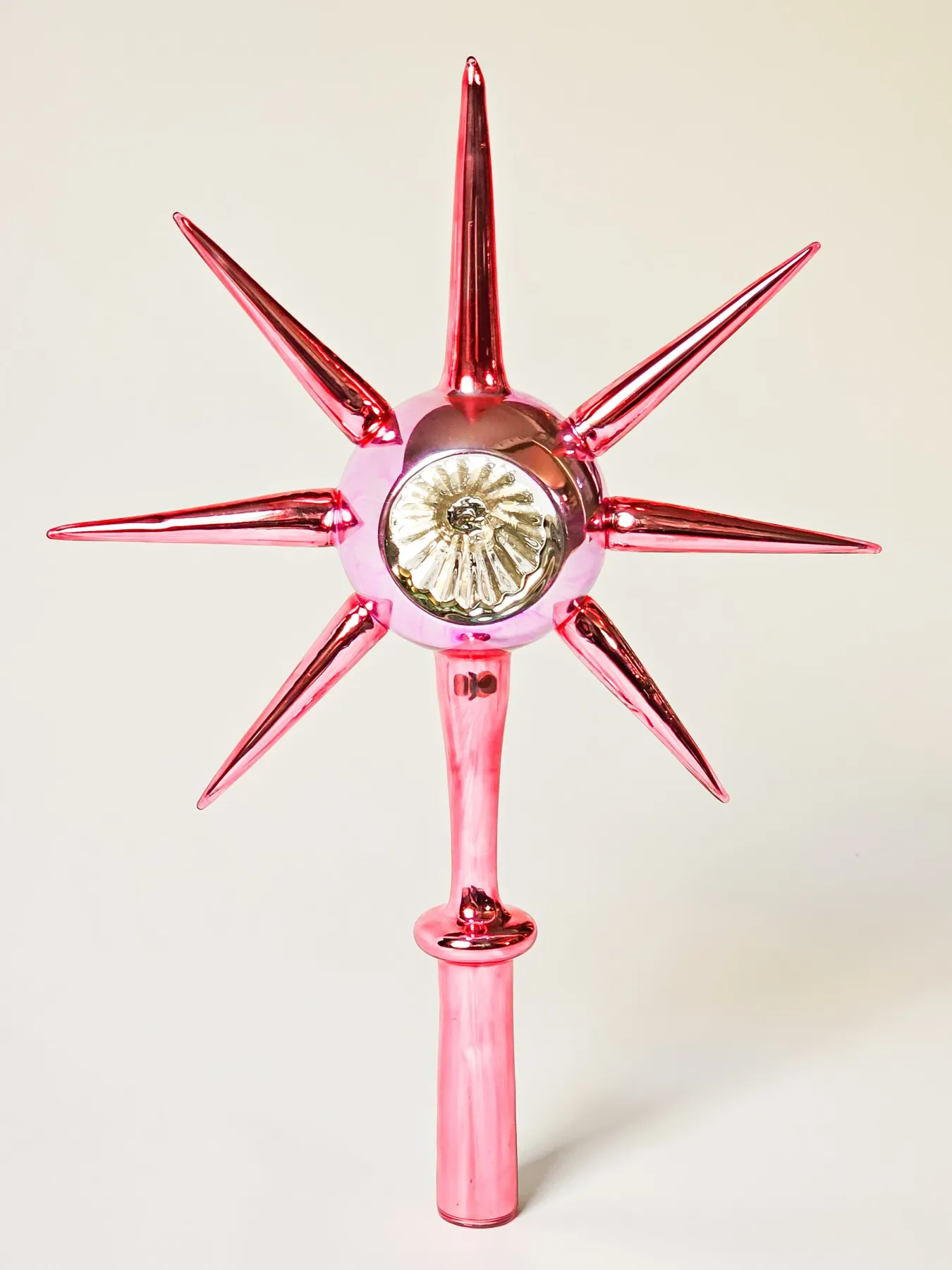
Mercury glass is glass — thin, and often silvered inside, which means it can flake if it gets damp. Don’t store it in a garage or attic where temperatures swing; condensation is what kills the finish. And check the stem against your top branch before buying. A heavy topper on a weak leader will lean all season and eventually snap the wire.
25. Silver Filigree, Faux Pearls, and Frosted Leaves
Getting a filigree topper to sit straight is a fifteen-minute job and about $5 in hardware.
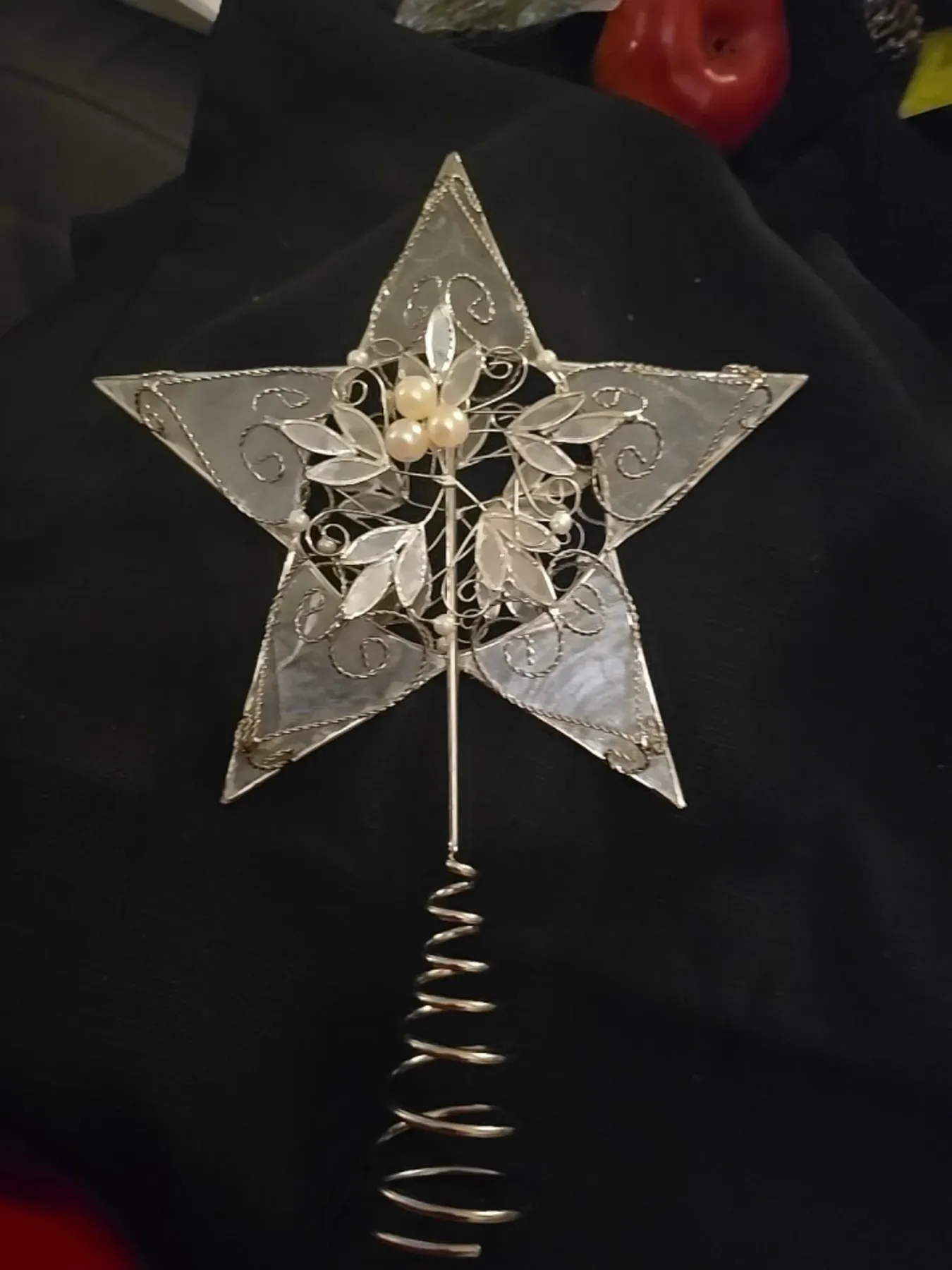
- Trim the top leader to 3 inches so the spiral base has something to grip
- Wrap floral wire around the base and down the branch for support
- Bend the star’s points forward slightly so it faces the room
- Clip a small light behind the filigree to make the pearls glow
Do this before you decorate — reaching over ornaments is how these things get bent.
Filigree star toppers land around $35 to $90 at boutique holiday shops. For less: Etsy has vintage silver filigree toppers in the $12 to $30 range, and craft stores sell wire star forms for about $4 that you can fill with faux pearls from a $6 strand. A glue gun and twenty minutes gets you something nobody else on the block owns.
26. Glossy Red Balls Against Soft Bokeh Lights
Glossy ornaments need matte neighbors or the tree turns into a mirror ball. For every three shiny red balls, add one matte red, one white, and one textural piece — a pinecone, a felt star, a wooden bead. That ratio is what makes a close-up shot look rich, and it’s the fastest upgrade for a tree that feels flat in person but fine in photos.

Red and green is the oldest combination in the book and it works for a reason: they’re complementary, so they vibrate slightly when placed side by side. The trick here is scale — large ornaments low, small ones toward the top — which mimics how a real tree’s branches thin toward the crown. Warm bulbs then turn every glossy surface into a second light source.
27. A Capiz-Style Star in Red, Green, and Gold
The translucency. A capiz-style star glows from behind instead of bouncing light back at you, so it reads like stained glass at the top of the tree. That matters most on a pre-lit or colored-light tree, where a solid metal topper would just be a silhouette. If you’re swapping toppers this year, choose one that lets the light through.
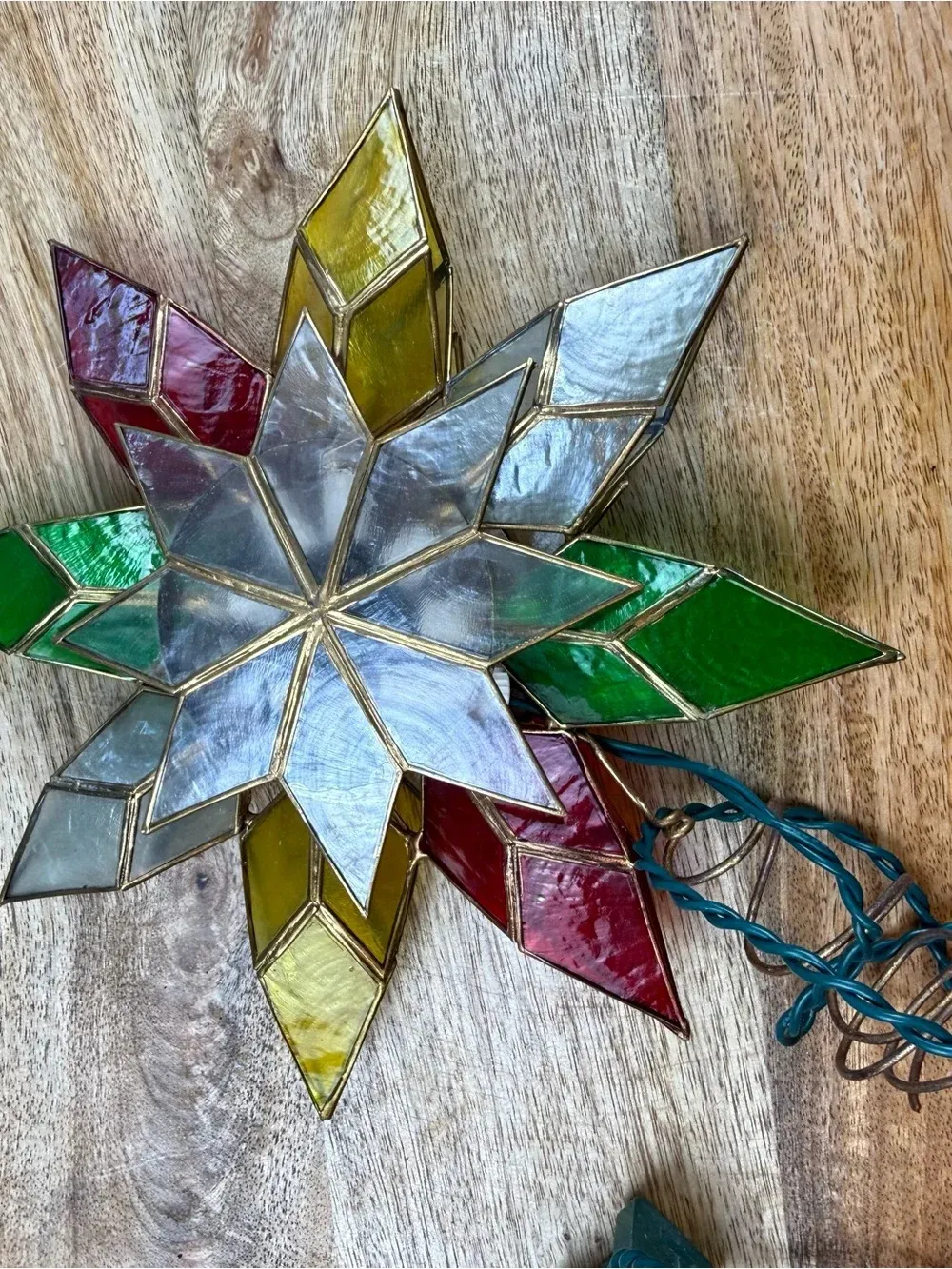
Attaching a lit topper so it sits straight and the cord disappears takes about 15 minutes:
- Test the topper’s lights before it goes anywhere near the tree
- Set it on the top branch, then check it from the sofa, not from below
- Run the cord down the trunk and clip it every 10 inches
- Hide the cord behind a wide ribbon or a strip of matching garland
- Plug into a switched power strip so you’re not crawling under the tree
The switched strip is the upgrade nobody talks about.
28. A Tiny Silver Tinsel Tree on a Dark Wood Table
Small vignettes follow the same math as big trees, just compressed. Here it’s roughly 60 percent neutral (beige wall, dark wood, black frame), 30 percent silver tinsel, 10 percent green from the framed botanical print. The rule for a 12- to 18-inch tabletop tree: give it one companion object — a frame, a candle — and leave the rest of the surface empty.
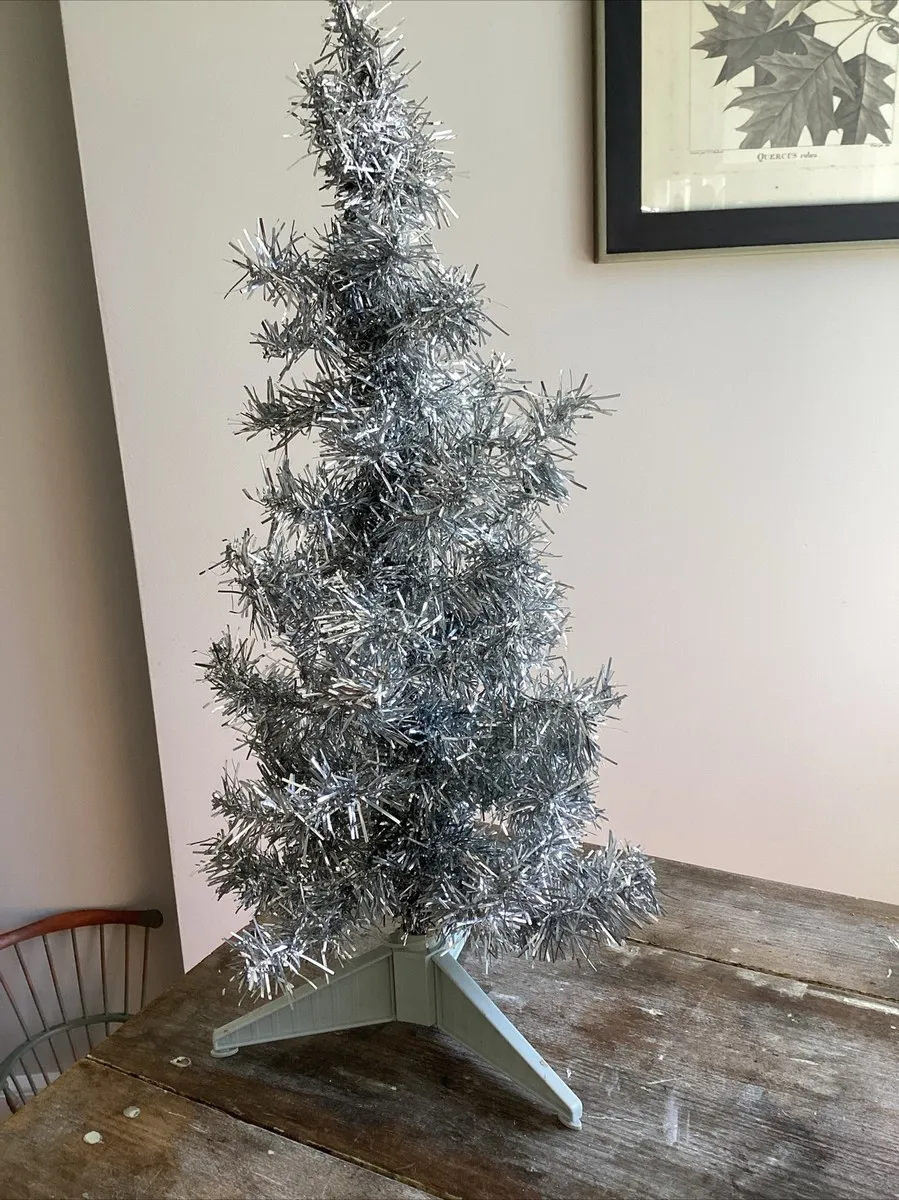
Tabletop trees work best between 12 and 24 inches tall on a surface at least 16 inches deep and 30 inches wide. Go smaller and it reads as a desk toy. If your console is only 12 inches deep, choose a 15-inch tree plus a small framed print rather than a bigger tree. For the full-size version of this same tinsel idea, see Idea #18.
29. Iridescent Panels with Pearl Clusters
Pearl beads on a topper are almost always glued, and glue gives up in a hot attic. Store this kind of piece in a padded box in a climate-controlled closet, and support the base with a wire twist if it’s heavy — never hang it by the spring alone. Iridescent film also dulls with dust, so a soft brush is the entire maintenance routine. Never a damp cloth.
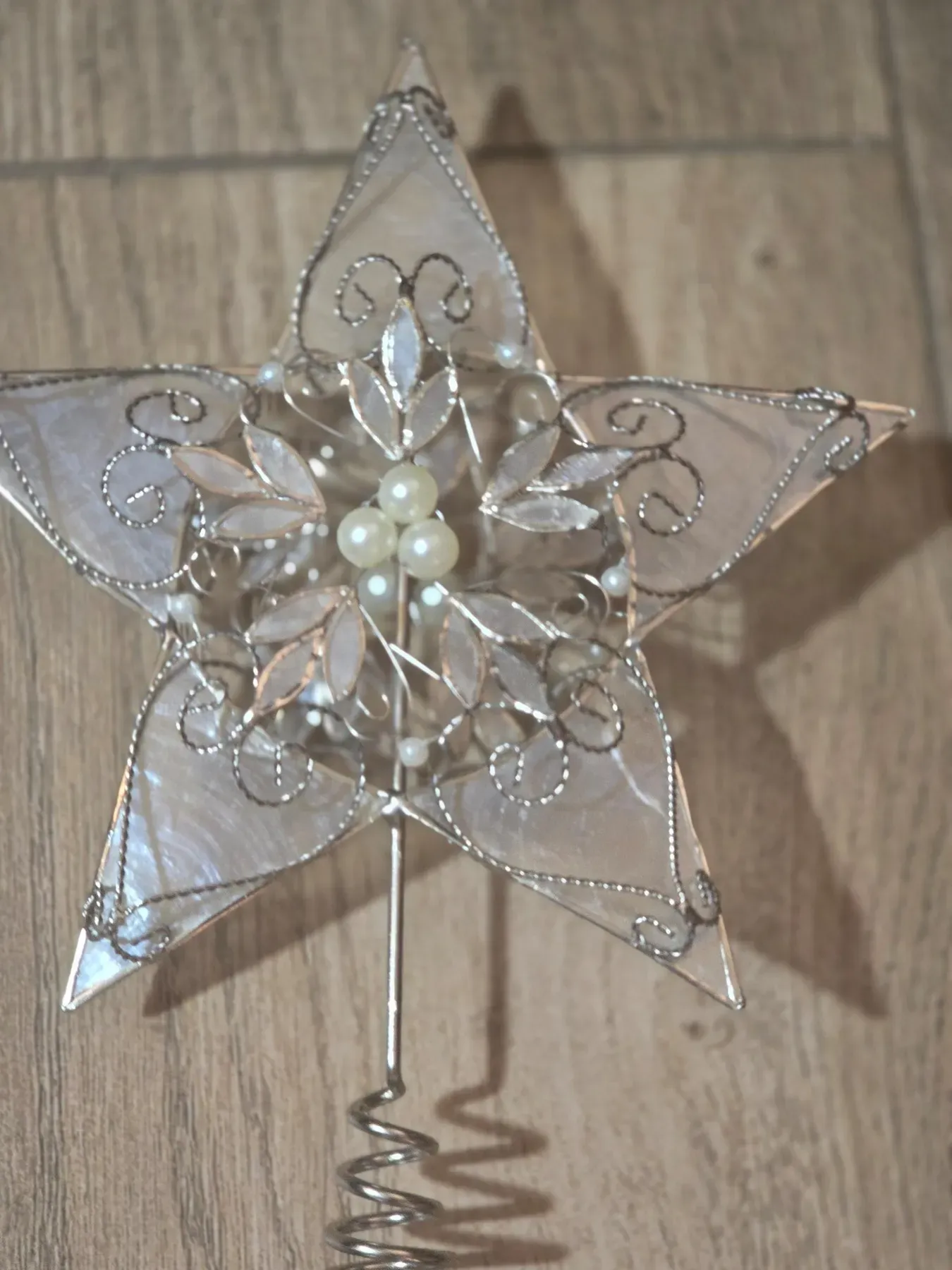
Boutique versions of this topper run $40 to $85. The thrift-store route is better: boxed vintage toppers turn up for $3 to $10 year-round because most shoppers only look in December. Pair a plain $5 star form with a strand of craft pearls ($6) and a few metallic leaves from a floral pick, and you’ve got the same delicacy for under $20.
30. Distressed Metal, Punched Stars, and Yellow Yarn
The yellow yarn. A dark distressed metal star on a cream holly runner is lovely but expected; the yellow yarn is the move nobody plans. It’s the same instinct as red ribbon on brown paper — one bright, slightly off note that makes everything around it read intentional. Wrap it loosely, let the ends fray, and resist the urge to make it neat.
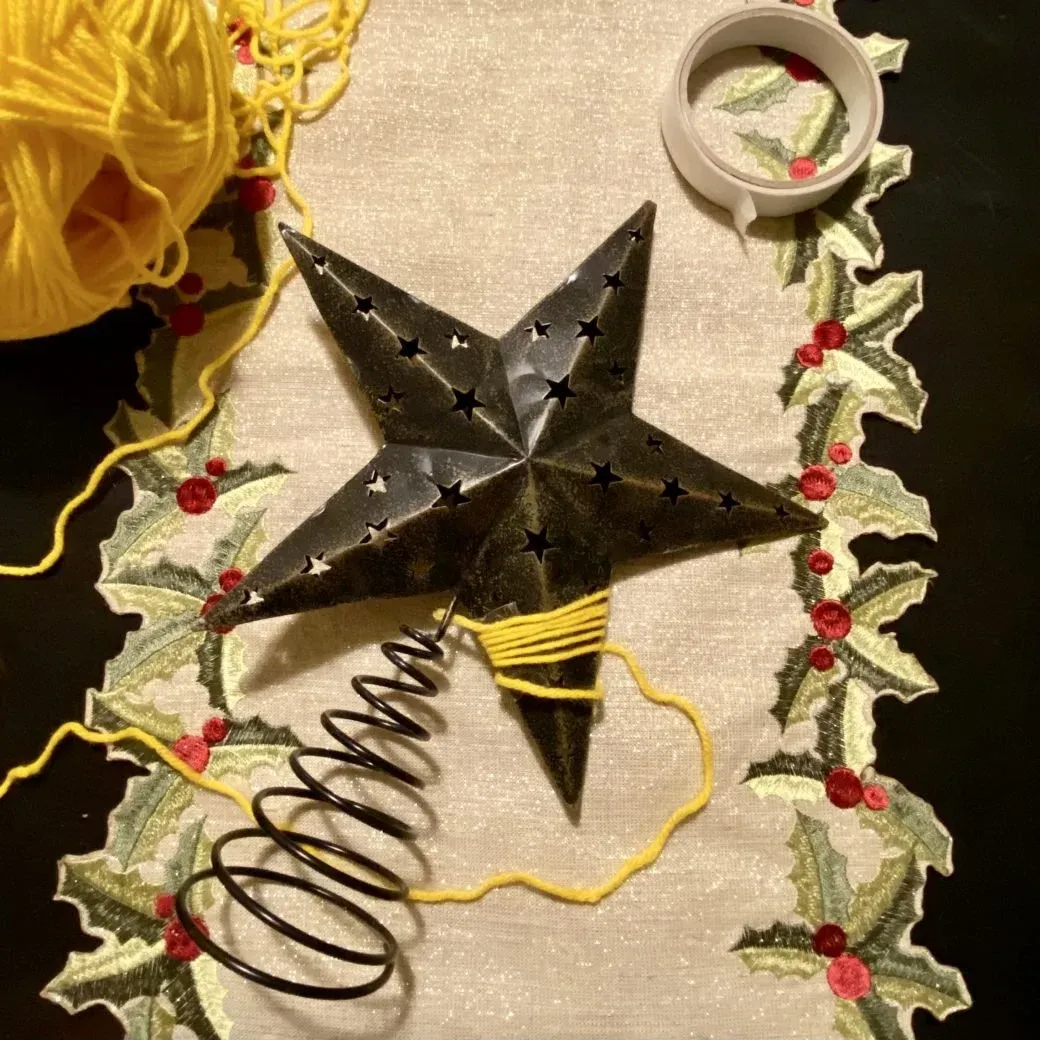
Rustic metal toppers are heavier than they look, and the spiral base is usually sized for a real tree’s leader branch. On an artificial tree the top wire is thinner and will bend, so reinforce it with a short dowel or a zip tie before you commit. If the finish is unsealed, keep it away from humidifiers or it’ll have rust spots by next December.
31. A Lighted Stained-Glass Star with Colored Facets
Vintage lighted toppers are climbing on resale sites — 1970s originals now run $40 to $120, up from almost nothing five years ago. It’s part of a broader move toward warm, colored, slightly nostalgic December lighting instead of all-white minimalism. Reproductions exist and they’re fine, but the originals have a glow that’s genuinely hard to fake.
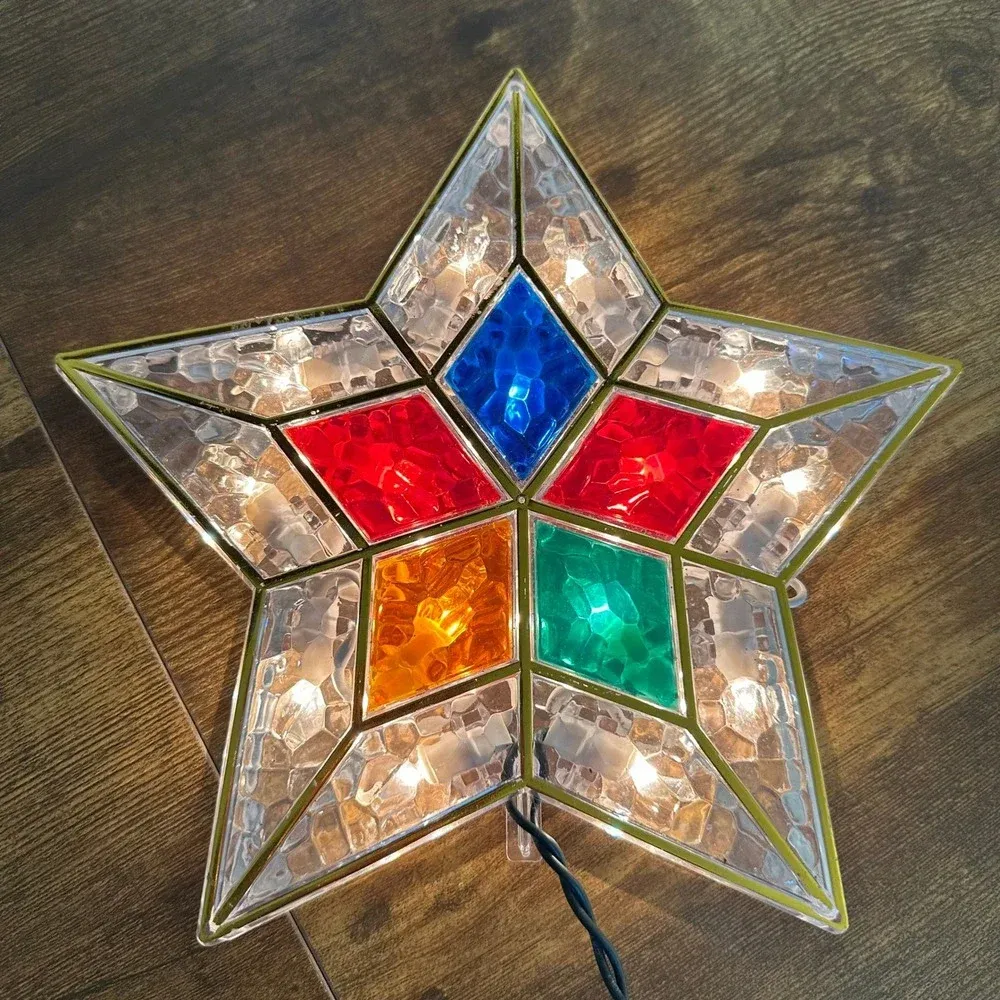
Four saturated facets — red, blue, orange, green — inside a clear frame, and it still reads calm, because the clear panels give the eye somewhere to rest. That’s the rule for colored accents anywhere in a room: always pair the color with an equal amount of neutral. The golden border then ties the whole thing back to the warm bulbs below.
Go Ahead — Dig Out the Old Ornaments
The best old-fashioned trees aren’t bought in one trip — they’re accumulated, one glass fox and one grandmother’s bauble at a time. Start with the palette and the lights, then let the rest of the collection catch up over a few Decembers.
📌 Pin your favorite ideas now so you have them on hand when the boxes come down from the attic.