
33 Jaw-Dropping Winter Table Centerpiece Ideas You Need to Try for 2026-2027

Still scrolling through winter table centerpieces photos without knowing where to start? We’ve been there — spending hours pinning ideas that never quite come together in real life. After filtering through hundreds of options across Pottery Barn, Crate & Barrel, and IKEA, we narrowed it down to 33 ideas that actually deliver — from budget-friendly $15 candle setups to investment-worthy $450 centerpieces. You’ll find rustic lodge tablescapes, winter wonderland arrangements, natural earthy centerpieces, and festive traditional settings, with budget and luxury versions compared side by side so you can choose what fits your space and wallet. Winter 2026 is all about bringing the outdoors in with organic textures and warm candlelight — a shift away from fussy, over-styled centerpieces toward something that feels genuinely inviting. And stay until the end — we break down the most common mistakes that can ruin these looks. Save this post now — you’ll want it when you’re ready to shop.
1. A Rustic Lodge Table Beneath Antler Light
When styling a table beneath a hanging statement piece like that antler chandelier, keep your tabletop elements low — no taller than 6 inches — so the visual line from ceiling to table stays clear. Use amber-tinted glass for your candle holders to echo the fire’s warm glow without competing with it. The checkered runner works because it breaks up the dark wood without adding another competing texture. Limit your palette to three tones — here it’s wood brown, creamy white, and amber — and repeat them across the table for cohesion.
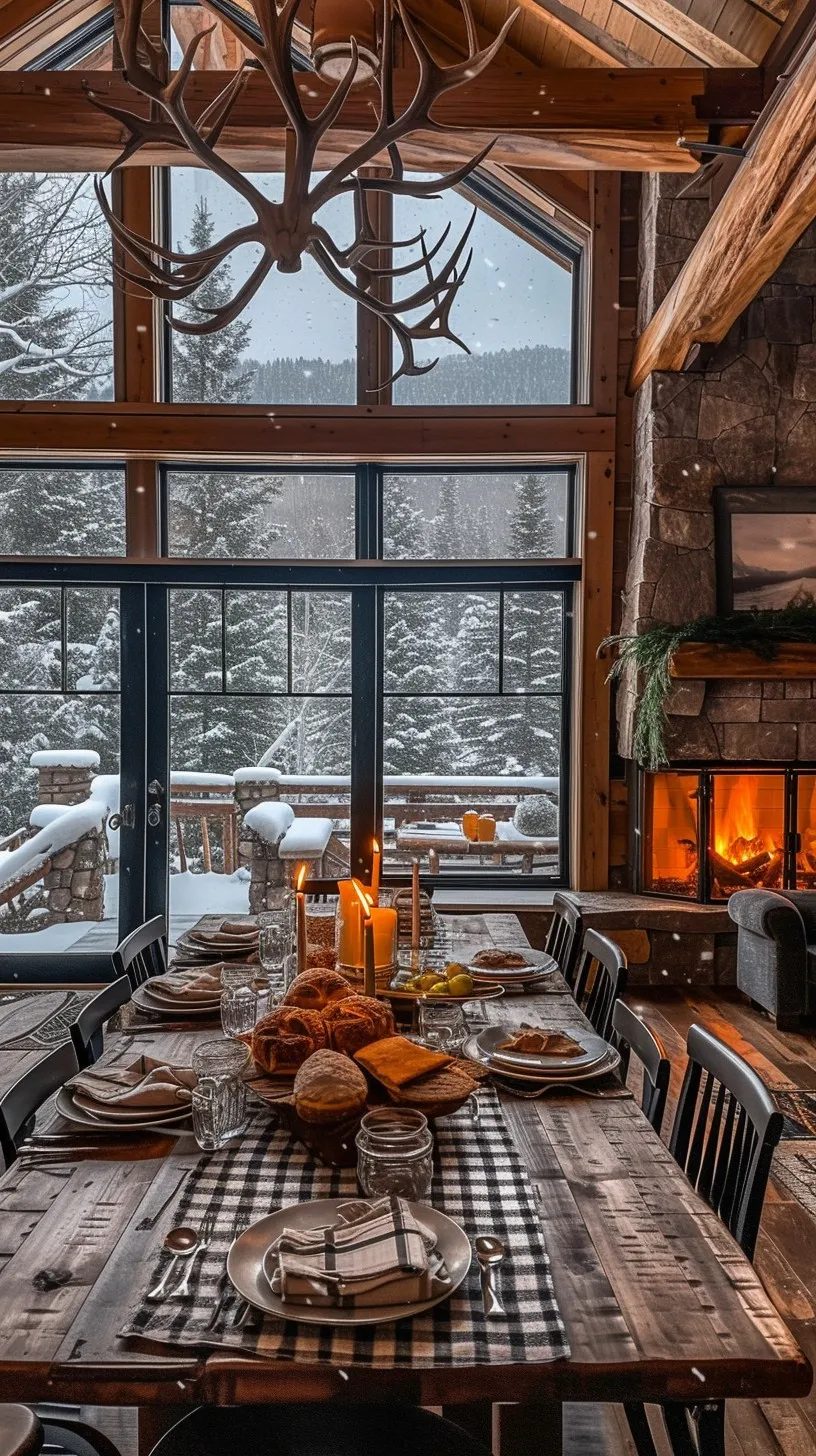
This lodge-inspired look captures the 2026 shift toward cozy maximalism — where warmth trumps minimal restraint. On Pinterest, searches for cabin core dining are up 40% over last year, and it’s easy to see why: after years of all-white tablescapes, people crave the depth and texture that dark wood, stone, and candlelight provide. The antler chandelier and stone fireplace ground the room in a way that feels enduring, not trendy. This taps into our collective desire for spaces that feel like a genuine retreat from the outside world.
2. Overhead Dried Florals with Ceramic Warmth
The single element that makes this table unforgettable is the overhead dried floral arrangement. Remove it, and you’re left with a nice but conventional dinner setting — green ceramic dishes, white linen, grey tapers. The suspended organic cluster of brown ferns and white blooms draws the eye upward, creating depth that a table-level centerpiece simply can’t achieve. It transforms the entire room into an immersive dining experience. This is the kind of move a professional event designer makes, and it costs surprisingly little to recreate with dried materials that last for years.
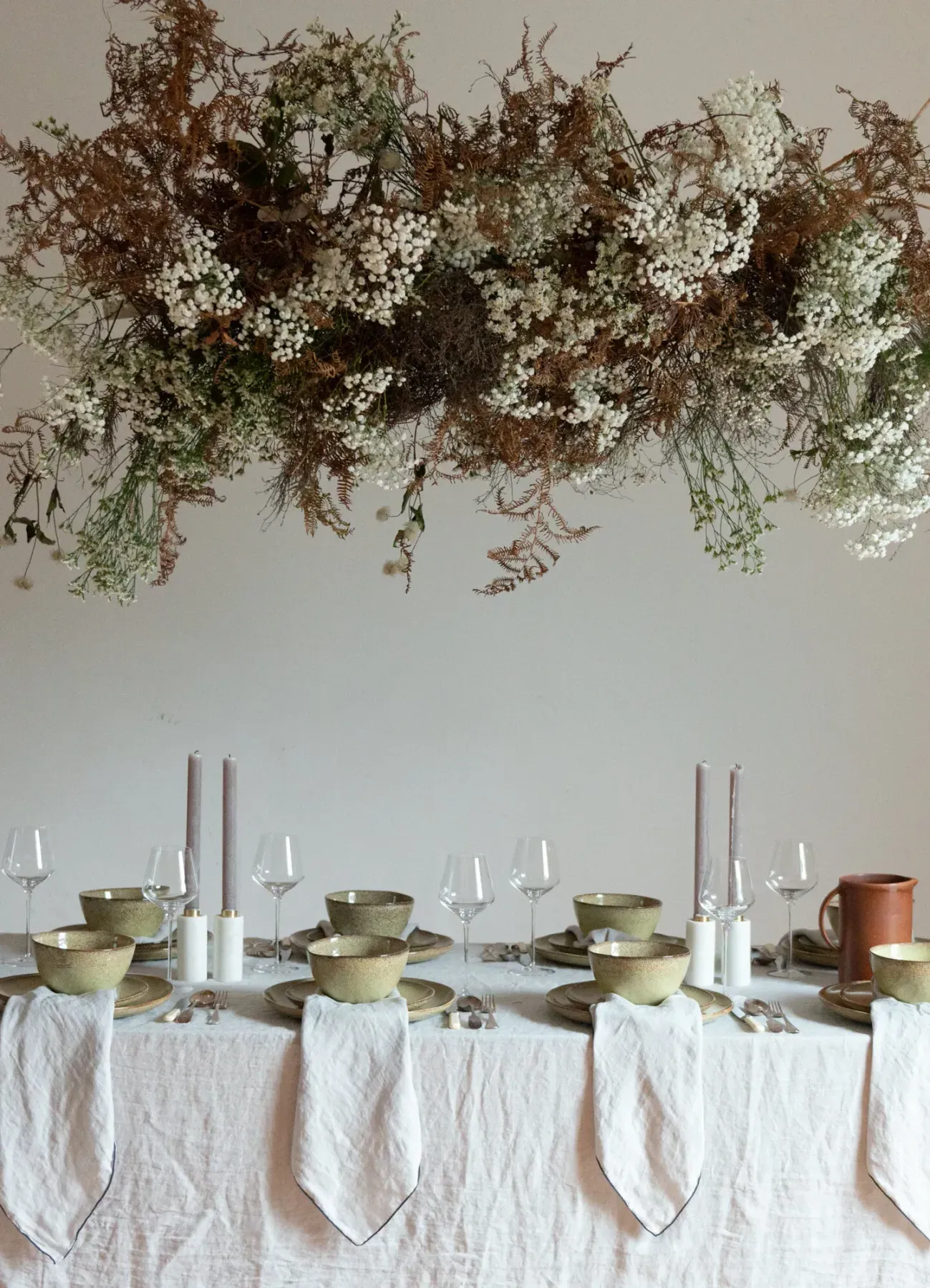
Break down this tablescape as 50% neutral base (white linen, cream dishes) + 30% earthy accent (light green ceramics, brown dried florals) + 20% metallic and glass (candle holders, wine glasses, dark trim on napkins). The magic is in the proportion — the neutral base keeps it serene, while the green and brown add just enough organic tension. Swap the green ceramic for deep blue and the dried browns for silver branches, and you have a completely different mood using the same formula.
3. Forest Floor Meets Festive Table
- Main furniture: botanical tablecloth and planter — $45–$80
- Natural elements: moss, pinecones, birch logs, copper bells — $25–$50
- Dinnerware: layered blue and white plates (set of 4) — $60–$120
- Textiles: teal napkins with gold rings — $30–$55
- Glassware: assorted clear drinkware — $35–$70
- Total: $195–$375
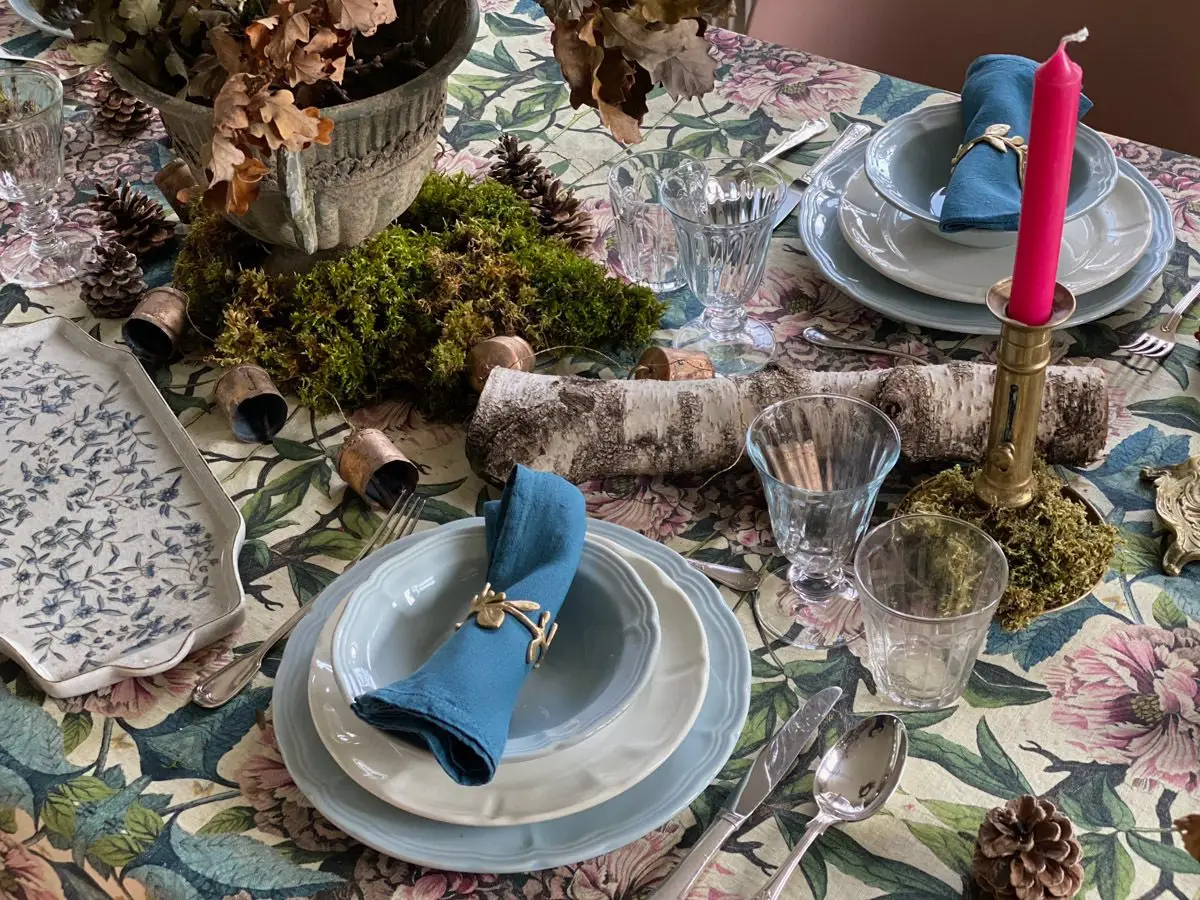
This look thrives on layers — and that means time. The birch logs and moss need replacing every season if they’re real (or a careful dusting if they’re faux). The copper bells will patina over time, which can work for or against the vibe depending on your preference. And that botanical tablecloth? It’s the boss of this table — everything else has to work with it. Make sure you love the print before you commit, because swapping it out changes the entire personality of the room. Start with the cloth, then build outward.
4. Red and White Winter Blooms in Gold-Base Glass
- Start with a fluted dark green glass vase (gold base optional but worth it) as your anchor — it sets the color story before any flower goes in.
- Build a base layer of evergreen branches and eucalyptus to create structure and fill negative space.
- Add the hero blooms: red gerbera daisies for pop, white hydrangeas and roses for volume.
- Tuck in decorative bare branches and a large pinecone with white-dusted tips for texture.
- Finish with a bright green spherical ornament nestled in the flowers — that unexpected shine lifts the whole thing.
- Tie a festive ribbon with holly and berry pattern around the vase — the burlap-like background keeps it from feeling precious.
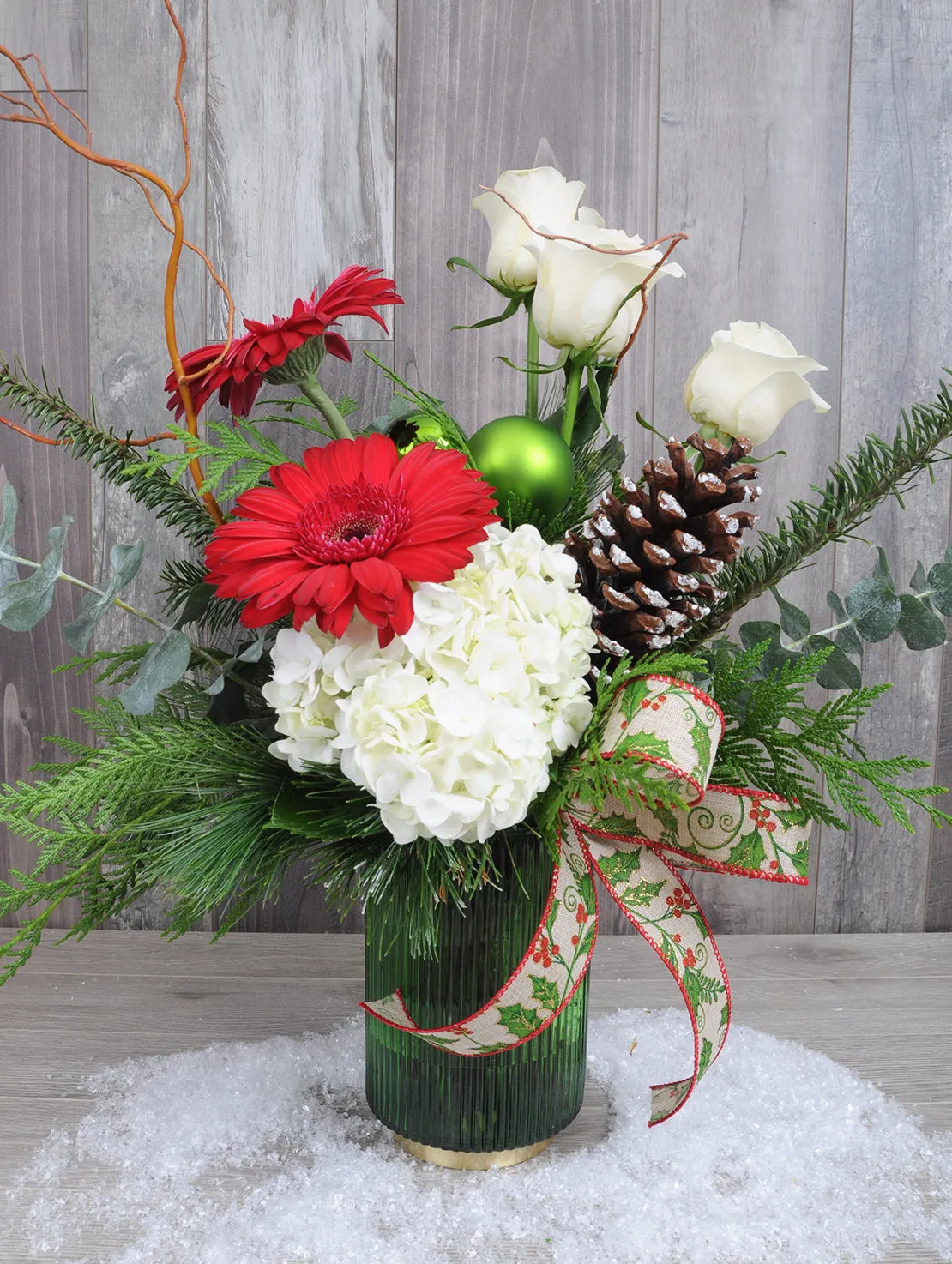
What makes this arrangement work is the deliberate contrast between matte and glossy surfaces. The matte green vase and matte gerbera petals ground the glossy white roses and shiny ornament. The ribbon adds a horizontal element that breaks up all the vertical lines. Notice how the white-dusted pinecone tips echo the white flowers — that subtle repetition ties the natural elements to the decorative ones. Every texture has a counterpart, which keeps the eye moving without feeling chaotic.
5. White Roses on Wood Slices with Natural Accents
You can recreate this look for under $80 by swapping the rustic live-edge table for a basic wood table from IKEA topped with a thrifted wood slab ($15–$25 on Facebook Marketplace). The wooden box centerpieces are easy DIYs from craft stores — buy unfinished wood boxes for $8 each, add white roses from Trader Joe’s ($10), and use eucalyptus bunches ($4 each) for the silver-green filler. Skip the wood slice chargers and use plain white paper placemats instead — the effect is similar at a fraction of the cost. Moss, pine cones, and cinnamon sticks from a craft store will run you about $12 total.
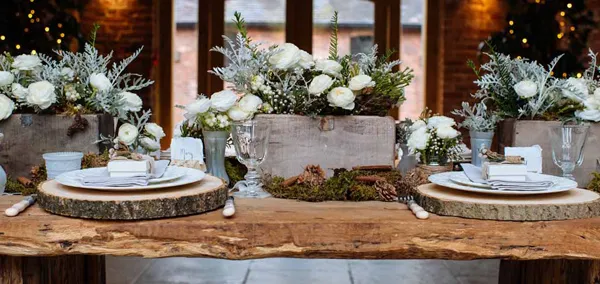
This setup works best on a table that’s at least 72 inches long — any shorter and the multiple box centerpieces will feel crowded. Minimum room size for this arrangement is 12×12 feet, with an 8-foot ceiling or higher (the low, spread-out profile needs breathing room above). If you’re working with a smaller space, consolidate the floral boxes into one long rectangular trough centerpiece instead of multiple small boxes — same look, less visual real estate. Compare with Idea #2 for a more vertical overhead approach that suits narrower tables.
6. Logs, Greenery, and Black Tapers on Plaid
The designer trick here is the wood log centerpiece — those aren’t just decorative; they serve as natural candle pedestals. Arrange black tapered candles directly on or between the logs, varying the heights so you have a staggered silhouette. The dark plaid runner provides a visual anchor that keeps the organic wood from feeling scattered. For the waffle-knit napkins with the wooden snowflake detail, fold them simply — a flat rectangle — so the texture speaks for itself. The contrast between the rustic logs and the refined black tapers is what gives this table its quiet confidence.
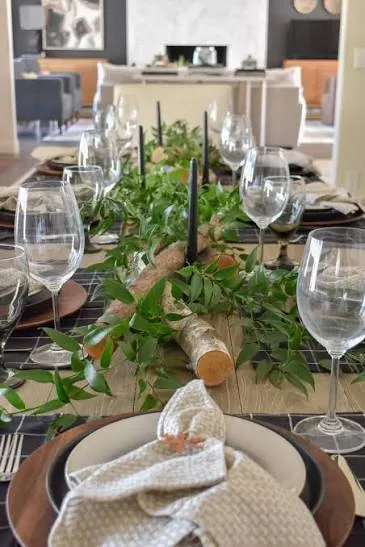
Let’s talk about those wood logs: they’ll shed bark and bits for the first week or two. Place a thin clear plastic runner underneath if you’re using a porous table — or better yet, seal the logs with a clear matte spray to stop the shedding entirely. The greenery garland needs refreshing every 5-7 days if using real pine; faux versions from craft stores last all season but need a gentle dusting with a hairdryer on cool. The waffle-knit napkins are machine-washable, which is a relief. Budget about $25 per season to refresh natural elements.
7. Icy Branches in Blue and Silver Elegance
that makes this winter wonderland table sing is the clear vases with icy white branches and clear beads. Without those translucent, light-catching elements, you’d have a pretty blue-and-silver table setting — nice, but not memorable. The branches create vertical drama while the beads add a sense of snowfall frozen in time. The white petal confetti scattered across the table is the supporting player that connects the centerpiece to the rest of the setting. This is a table that understands that winter magic comes from light and transparency, not from heavy ornamentation.
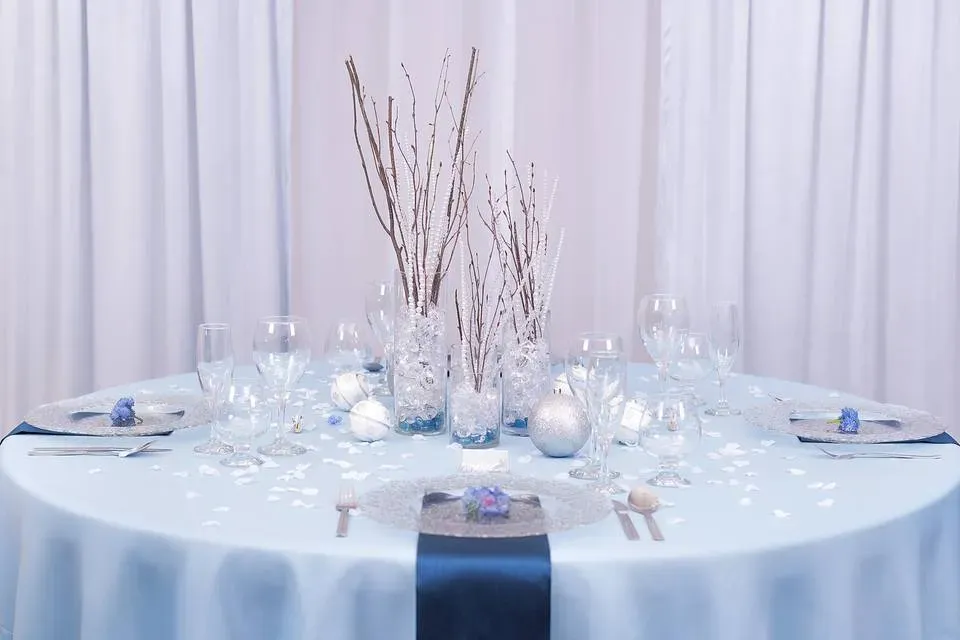
- Measure your table diameter — this round table setup needs at least 48 inches across to accommodate the multiple vases without feeling crowded.
- Confirm your ceiling height — the icy branches need at least 18 inches of clearance above the table to read properly.
- Check your lighting — this look relies on soft, cool-toned ambient light; harsh overhead warm bulbs will kill the icy effect.
- Make sure you have enough silver chargers for every seat — mismatched metals will break the spell.
8. Poinsettias in a Boot with Brass Candlelight
- Main centerpiece: vintage black boot planter and poinsettias — $35–$65
- Lighting: brass candlestick with white tapers — $25–$45
- Dinnerware: red and white winter-patterned dishes (set of 4) — $55–$110
- Chargers: carved wooden plate chargers — $30–$50
- Glassware: assorted colored glasses (blue, green, clear) — $40–$75
- Total: $185–$345
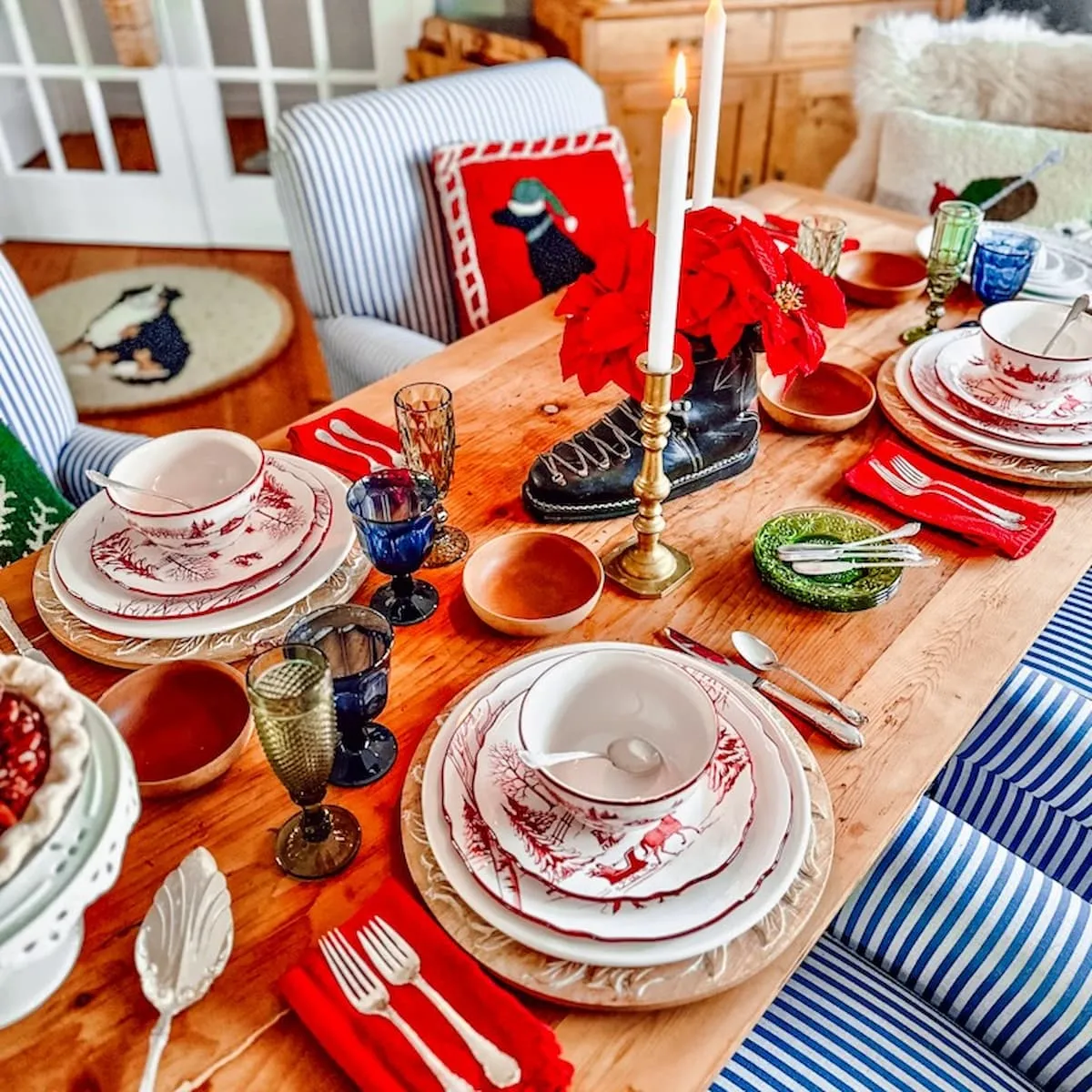
Here’s the thing about a vintage boot as a planter: it needs to be waterproof on the inside. Line it with a plastic container or heavy-duty garbage bag before adding soil — otherwise, water damage will destroy the boot and your table. The poinsettias will need bright, indirect light to stay vibrant through the holiday season; if your dining room is dark, rotate them to a sunny window during the day and bring them back for dinner. And that assorted colored glassware looks charming but is a pain to replace if one breaks — buy at least one extra of each color.
9. Blue Watercolor Linens with Potted Greenery
This table follows a 40% neutral + 40% cool tone + 20% organic accent formula. The neutral layer is the white plates and glassware. The cool tone comes from the blue and white watercolor tablecloth and navy dining chairs. The organic accent is the mix of potted plants, dried flowers, and green fruit accents at each place setting. The overhead branch decoration with dried pods adds the crucial vertical dimension — without it, the table would read flat. To adapt this formula for a warmer palette, swap the blue for terracotta and burgundy, and replace the green fruits with persimmons or pomegranates.
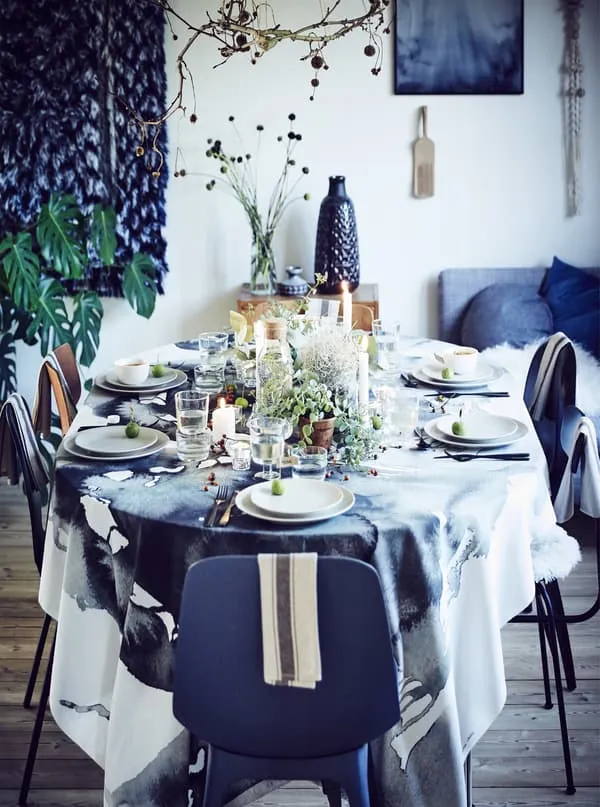
Watercolor-patterned linens are having a real moment in 2026 — and not just in pastels. This blue-on-blue approach taps into the artisan table trend that’s been building across Pinterest and Instagram, where handmade-looking textiles replace mass-produced prints. The dried floral elements echo the broader shift toward sustainable decor that can be used year after year. Unlike fast-furniture trends that burn out in a season, this watercolor-and-plants look has staying power because it’s rooted in natural materials and personal expression rather than a single TikTok aesthetic.
10. Red Roses, White Carnations, and a Gingerbread Guest
You can get this entire look for under $60 by shopping smart. Grab a $15 bunch of red roses from Aldi, a $7 bundle of white carnations, and $5 worth of greenery with frosted details from a craft store. The ‘Merry Christmas’ ribbon is $3 at Hobby Lobby, and the gingerbread man figurine is $4 at Target. Use a simple glass vase you already own (or a thrifted one for $2). The pinecone? Free from your backyard or a park. This is proof that festive doesn’t require expensive — it’s about how you combine the elements, not how much you spend on each one.
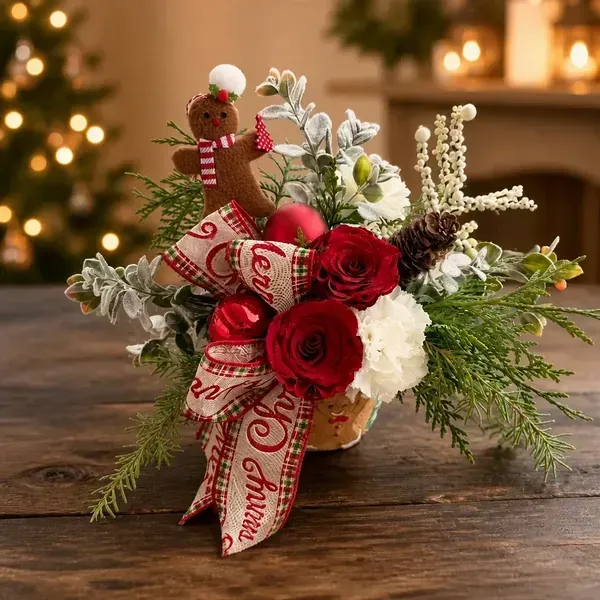
- Fill the glass vase with water and add the greenery as a base layer.
- Arrange the red roses first — they’re your tallest element, so keep them central and varied in height.
- Add white carnations around the edges to create contrast and fill gaps.
- Tie the ‘Merry Christmas’ ribbon around the vase in a simple bow.
- Place the gingerbread man figurine front and center, leaning slightly against the vase.
- Tuck in the pinecone and red baubles at the base to complete the scene.
11. Silver and White on a Garland-Run Table
This table understands contrast in a way that’s worth studying. The dense green garland reads as one continuous shape, while the tall white candles in silver holders punch upward in a clear vertical rhythm. The nailhead trim on the upholstered chairs echoes the silver of the candle holders, creating a subtle metallic conversation across the room. Silver pinecones scattered along the garland mirror the silver chargers below. The white plates and napkins create a clean break between the dark wood table and the rich green centerpiece. The rule of thirds is at play here: one-third garland, one-third table surface, one-third architectural space above.
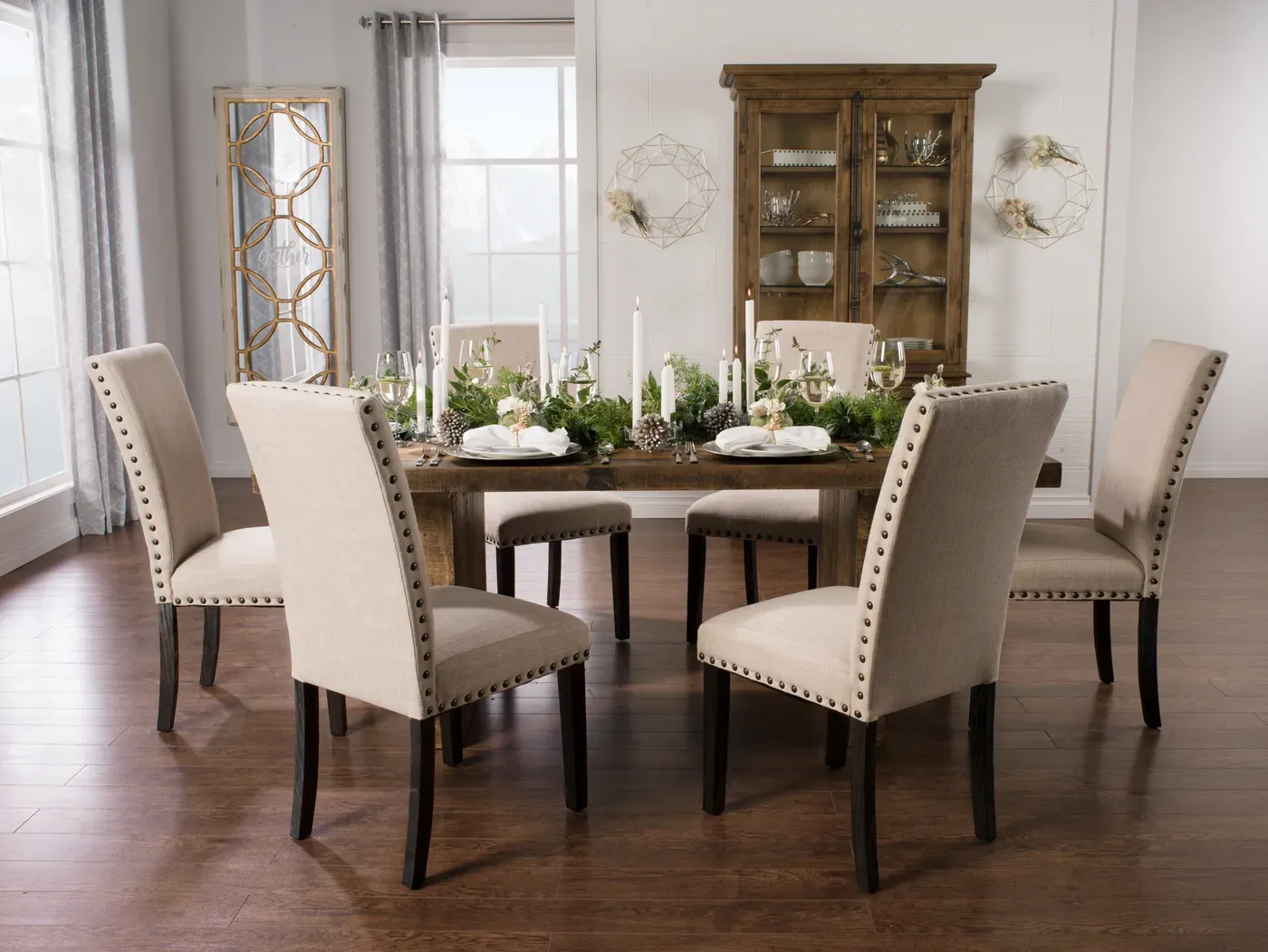
This setup needs a table at least 84 inches long to let the garland stretch without bunching up. Minimum room width is 12 feet — the chairs with nailhead trim need clearance to slide back, and the silver pinecones need breathing room. Ceiling height should be at least 9 feet to accommodate the tall white candles (12-inch tapers) without feeling cramped. For smaller rooms, try Idea #6 — it uses similar materials but on a more intimate scale with wood logs instead of a full garland. That approach works well in spaces as small as 10×10 feet.
12. Artichokes, Greenery, and Gold Deer Napkin Rings
Here’s a tip that’ll save you money: artichoke-shaped floral vessels can be DIY’d with hollowed-out real artichokes for a single-use dinner, or you can find ceramic versions at HomeGoods for under $15 each. The trick to making them read as intentional rather than odd is to keep the arrangement tight and low — no more than 4 inches above the vessel rim. For the greenery runner, use two long garlands laid parallel with a slight overlap in the middle — this gives you that lush, full look without buying three garlands. The gold deer head napkin rings should all face the same direction down the table for a cohesive line.
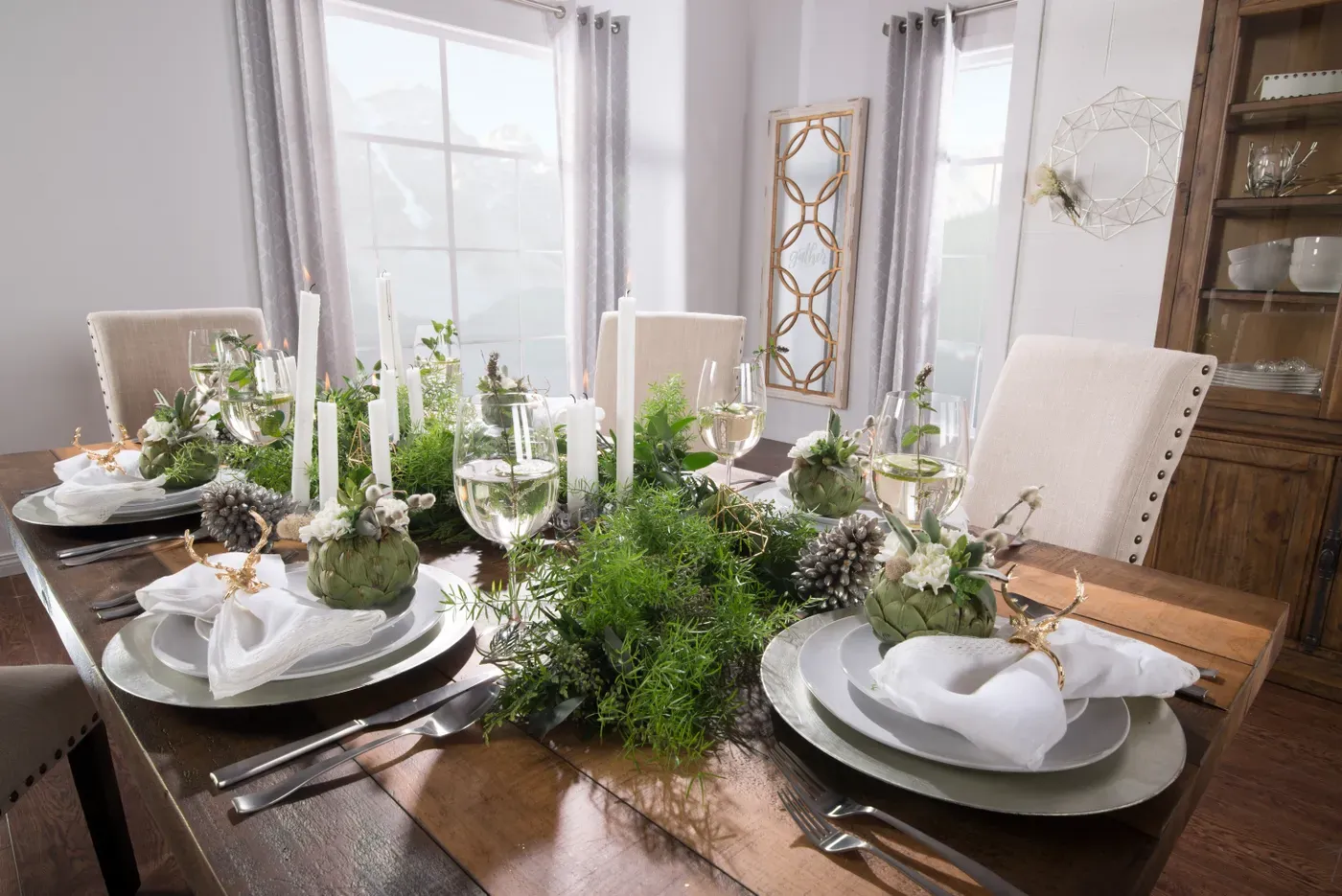
The gold deer head napkin rings are the one thing that makes this table unforgettable. Remove them, and you have a perfectly nice natural centerpiece with greenery and candles — pleasant but familiar. Those small gold heads add an element of surprise that ties the rustic greenery to the elegant silver chargers and gold mirror frame in the background. They create a moment of whimsy that tells guests this isn’t just dinner — it’s an experience. The napkin ring is the detail people will remember and ask about, which is exactly what a signature decorative element should do.
13. A Hanging Wreath with Fairy Lights Above Red Plates
- Main furniture: light linen tablecloth, wooden chairs — $80–$150
- Centerpiece: circular greenery wreath with fairy lights — $45–$90
- Dinnerware: red scalloped plates and olive green napkins (set of 6) — $65–$120
- Lighting: tall mustard-colored taper candles in holders — $30–$50
- Accent: two-tiered stand with pomegranates — $25–$40
- Total: $245–$450
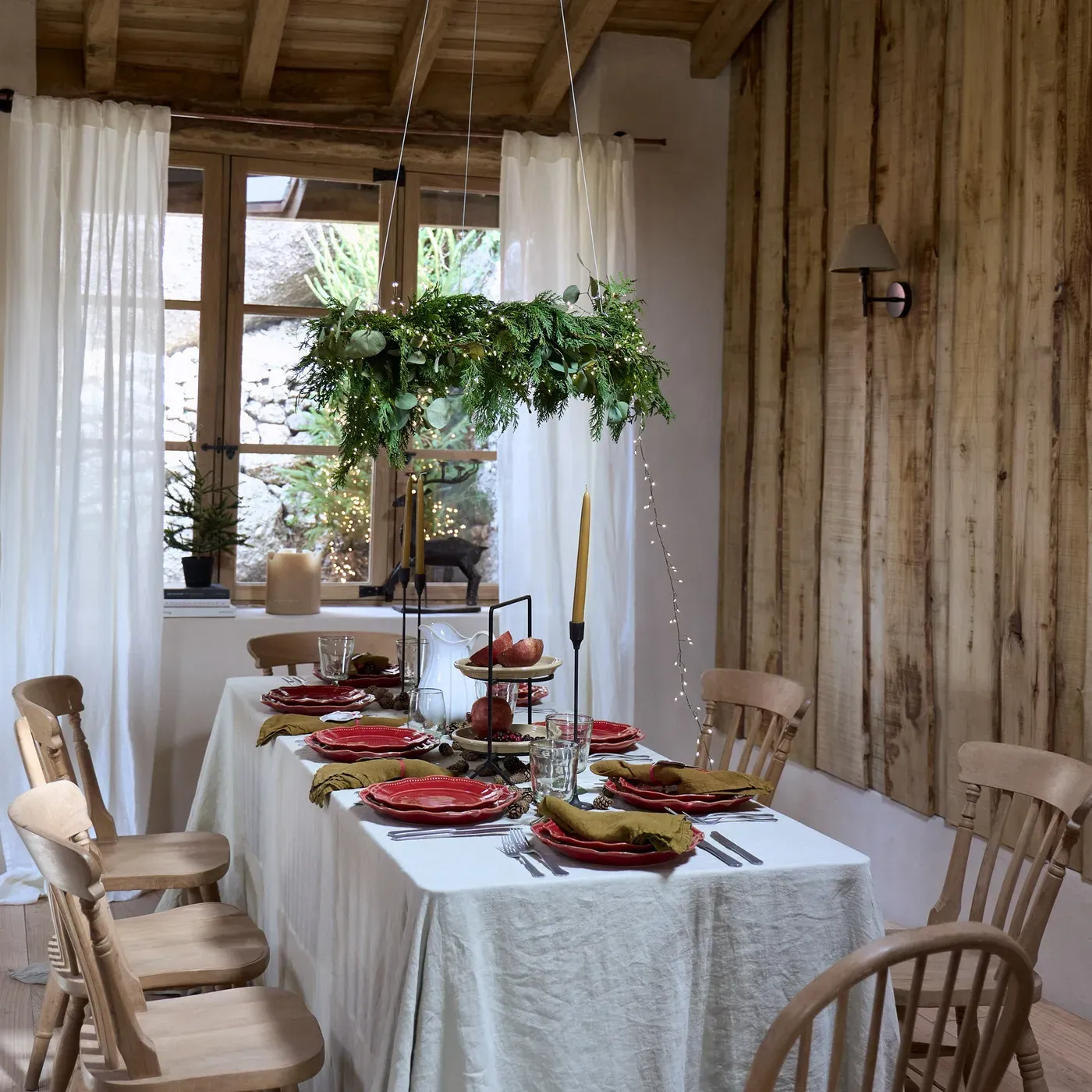
Think of this as the hanging cousin of Idea #11 — similar green-dominant palette, but the elevation changes everything. Before you commit, check three things: First, your ceiling must support a hanging wreath — test with a small dry run using fishing line and a paper ring. Second, the fairy lights need a nearby outlet or battery pack discreetly hidden in the greenery. Third, the red scalloped plates are loud — make sure the rest of the room can handle that color pop. If your space leans cool-toned, swap the red for cream or pale pink to keep the peace.
14. Paper Lanterns and Wood Slices in Rustic Light
White paper lanterns look magical in photos, but here’s what no one tells you: they collect dust visibly and can yellow under kitchen heat if your dining room is open to the cooking area. They also dim the room slightly — you’ll need additional warm light sources (like the fireplace mantel with glass bottles in this room) to keep the space from feeling flat. The wood log slice wall panel is a commitment — those slices expand and contract with humidity and can crack or pop off over time. If you’re renting, use adhesive strips designed for textured walls, but test on a single slice first.
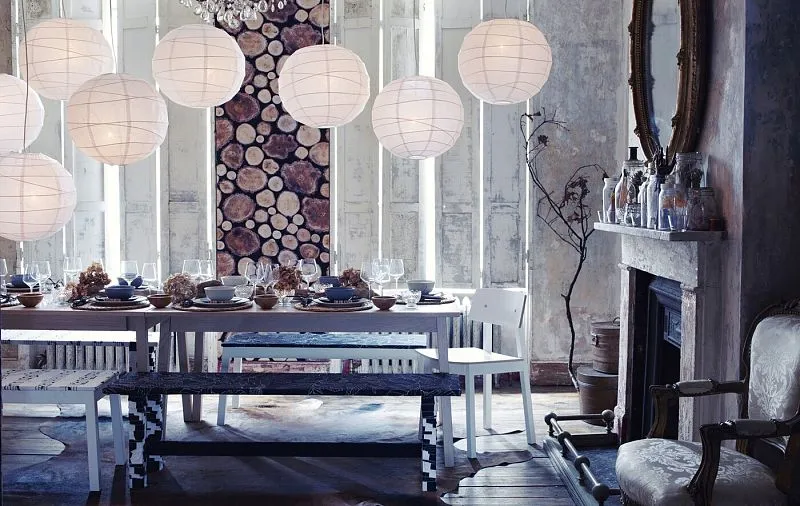
This look works best in a long, narrow dining room — think 8×18 feet or similar proportions. The paper lanterns need a minimum ceiling height of 10 feet to hang properly without interfering with sight lines across the table. The table should be at least 84 inches long to balance the scale of the lanterns and the fireplace mantel. If your room is shorter than 8 feet in width, skip the sideboard-style elements and focus on the table itself — the log slice wall panel becomes overwhelming in tight spaces. For compact layouts, Idea #6 offers a similar wood-and-warmth vibe without the square footage demands.
15. Dusty Blue Vase with Soft Pink and Candle Glow
Recreate this serene look for under $70. The dusty blue vase is your anchor — check Target (around $15) or thrift stores (often under $5). White and light pink flowers can be store-bought or grocery store bundles ($12–$20). The woven placemats run $4 each at IKEA. Stacked blue and white plates can be mixed and matched from secondhand shops — look for solid blue dinner plates and white salad plates with a blue rim. The blue fabric table runner and napkins are easy sewing projects or budget finds at Walmart. The trick is to keep the blue tones consistent across all the textiles and dinnerware.
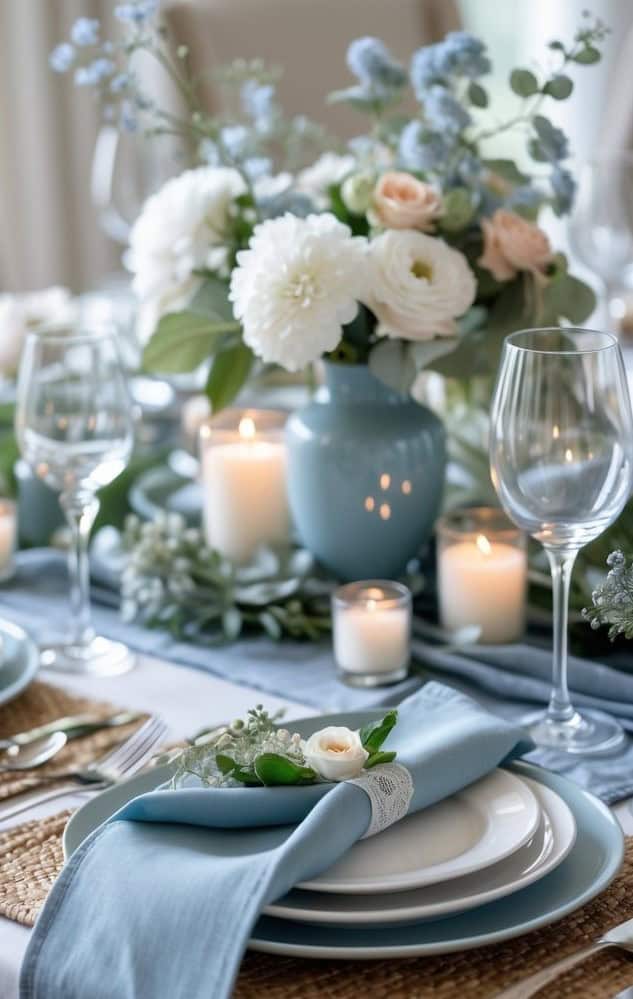
This table is a masterclass in the 60-30-10 rule: 60% neutral base (woven placemats, white plates, cream candles) + 30% accent color (dusty blue in the vase, runner, and napkins) + 10% highlight (light pink flowers and warm candle glow). The formula works because the dominant neutral keeps it calm, the blue provides personality without overpowering, and the pink adds that tiny pop of warmth that keeps the setting from feeling cold. Swap the dusty blue for sage green and the light pink for peach, and you have a completely different but equally balanced tablescape.
16. Blue and White Floral Tablecloth with Crystal Candles
This table works because it commits fully to formality without feeling stuffy. The blue and white floral tablecloth is the foundation — its botanical pattern provides all the visual interest needed, so everything else can be clean and restrained. The crystal candlesticks with grey tapered candles are a genius move: grey is more modern than white and plays beautifully against the navy and white of the cloth. The gold-rimmed glassware catches the candlelight and adds just enough shine to prevent the table from reading as flat. Notice the chevron pattern on the napkins — it echoes the angular quality of the crystal without competing with the floral print.
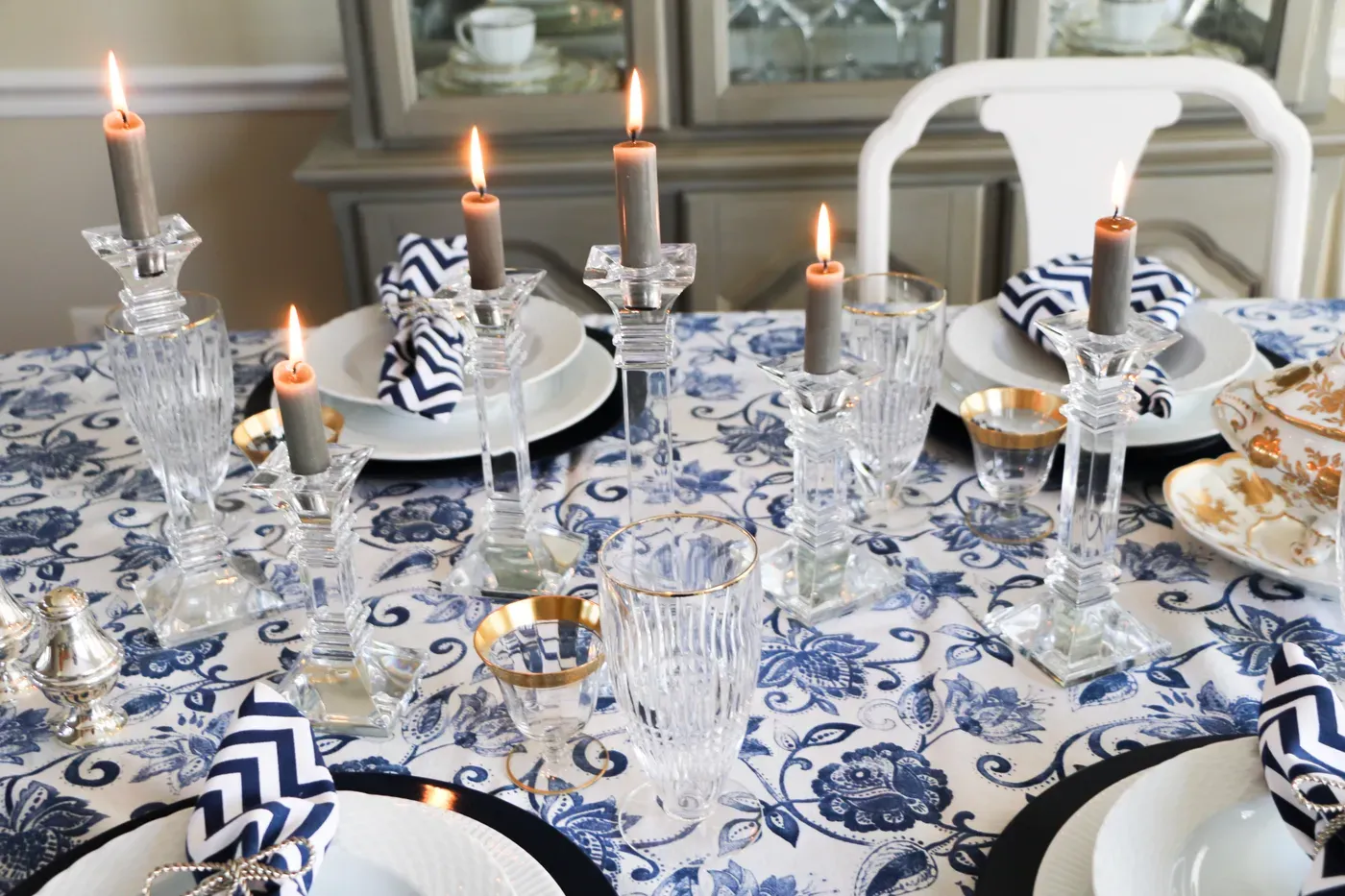
Crystal candlesticks and gold-rimmed glassware require careful handling: hand wash only, dry immediately to avoid water spots, and store separately to prevent scratching. The floral tablecloth should be spot-cleaned promptly — red wine on white fabric is a risk with any festive dinner. Budget $30–$50 per year for professional cleaning if the cloth is heavily used. The grey tapers will drip wax less than white ones (fewer additives), but they still need trimming to 1/4 inch before each burn. If upkeep sounds daunting, try the printed tablecloth from Idea #9 — similar formality, lower maintenance.
17. Jute, Linen, and a Crocheted Snowflake Napkin
The designer’s eye knows this table is about texture first and color second. Layer a jute runner over a linen tablecloth — the roughness of jute against the smoothness of linen creates a tactile experience that guests unconsciously respond to. The small potted evergreen plant is a strategic choice: it brings living green to the table without the maintenance of cut flowers. For the red and white candle pairing, place them at slightly different heights by using different-sized holders. The crocheted snowflake napkin ring should be the star of each place setting — let the napkin itself be simple white linen so the snowflake gets full attention.
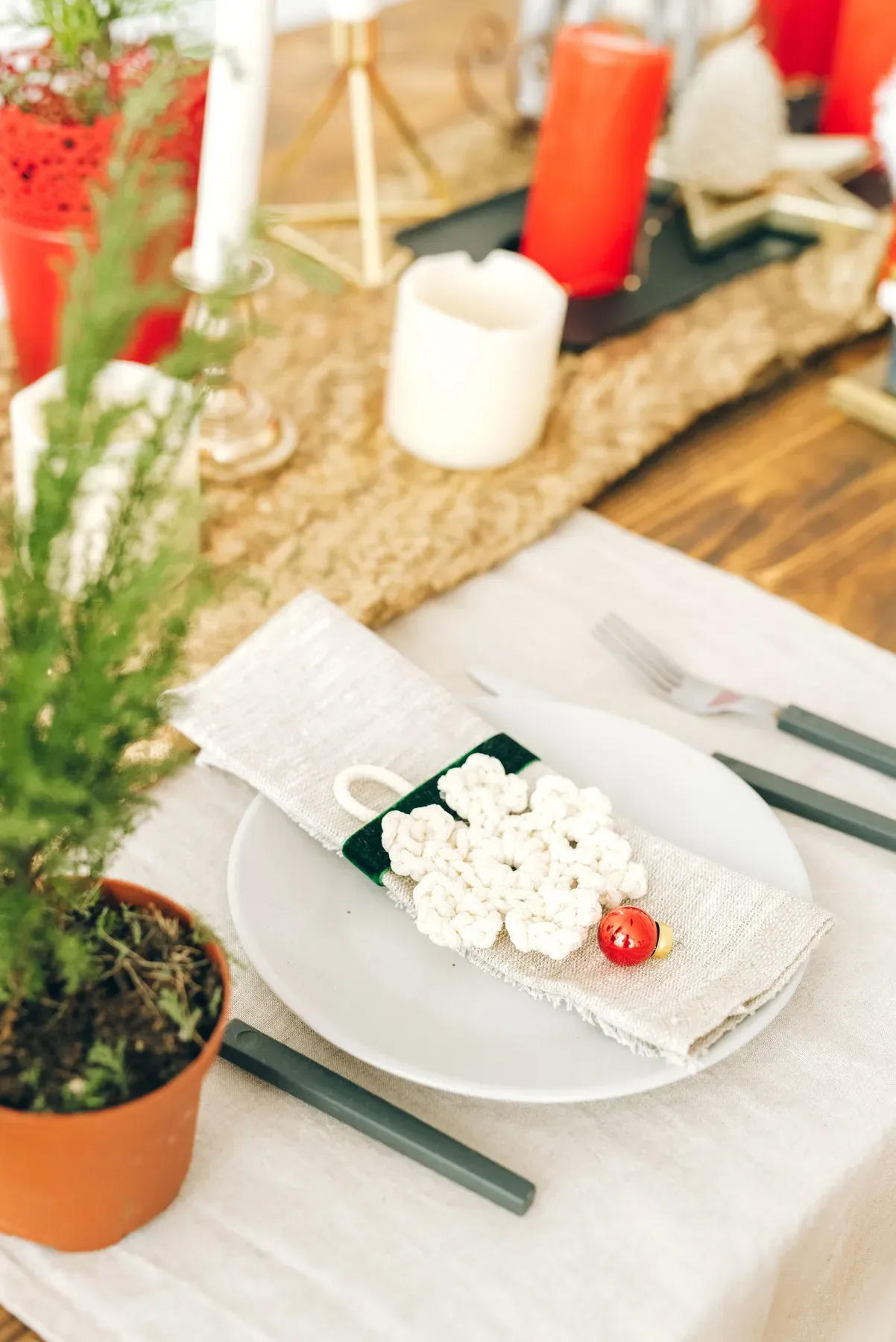
- Start with the linen tablecloth as your base — iron it well, as wrinkles show prominently against the jute runner.
- Center the jute runner — it should run the full length of the table and hang 2–3 inches over each end.
- Place the potted evergreen on a small saucer or trivet to protect the jute from water damage.
- Arrange the red and white candles in a loose cluster, varying heights between 4 and 10 inches.
- Fold each linen napkin into a simple rectangle and secure with the crocheted snowflake.
- Add the red mini bauble ornament near the evergreen as a final pop of festive color.
18. Vintage Charm Meets Cozy Winter Decor
The single element that defines this vintage winter tablescape is the commitment to heirloom-quality accessories that look collected, not staged. Whether it’s mercury glass candle holders, antique silverplate flatware, or hand-embroidered linens passed down through family, the unifying thread is that nothing looks fresh off a store shelf. Layered vintage dishes with slightly mismatched patterns create a table that feels genuinely personal. The arrangement should look as if it’s evolved over time — add a piece here, subtract one there — rather than being assembled all at once in a shopping trip.
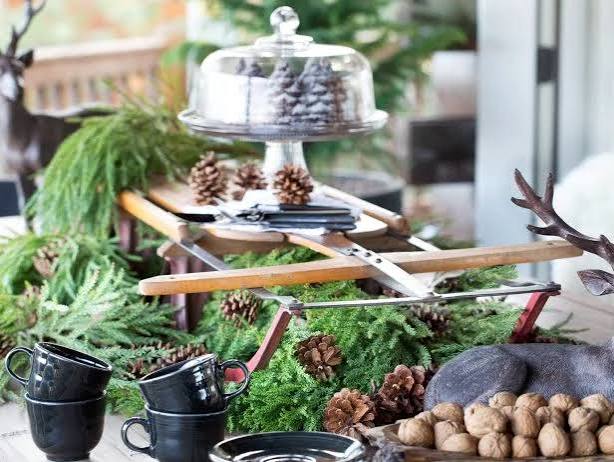
This vintage approach is surging in 2026 as a direct counterpoint to the mass-produced uniformity that dominated the early 2020s. On Pinterest, searches for vintage winter tablescapes are up 55% year over year, driven by a desire for sustainability and individuality. People are raiding estate sales and grandmothers’ cupboards rather than buying new. This has staying power because it’s not a trend you can buy into — it’s a practice of collecting and curating over time. Unlike seasonal fast decor that gets donated in January, a vintage winter table actually gains character as the years pass.
19. Olive Branches and Red Berries in Warm Lantern Light
Here’s a pro technique for creating a centerpiece that looks effortless but is carefully engineered: use olive branches as your structural backbone and deep red foliage as the accent pop. The stone-textured grey vase is doing heavy lifting — its matte, rough finish contrasts with the glossy leaves and creates visual interest without adding more elements. Place the hurricane glass lanterns slightly off-center from the vase, not symmetrically flanking it. Asymmetry feels more natural and allows the eye to travel across the whole arrangement. The hammered gold votives scattered among the fruit bowls catch the light from different angles and add warmth without overwhelming.
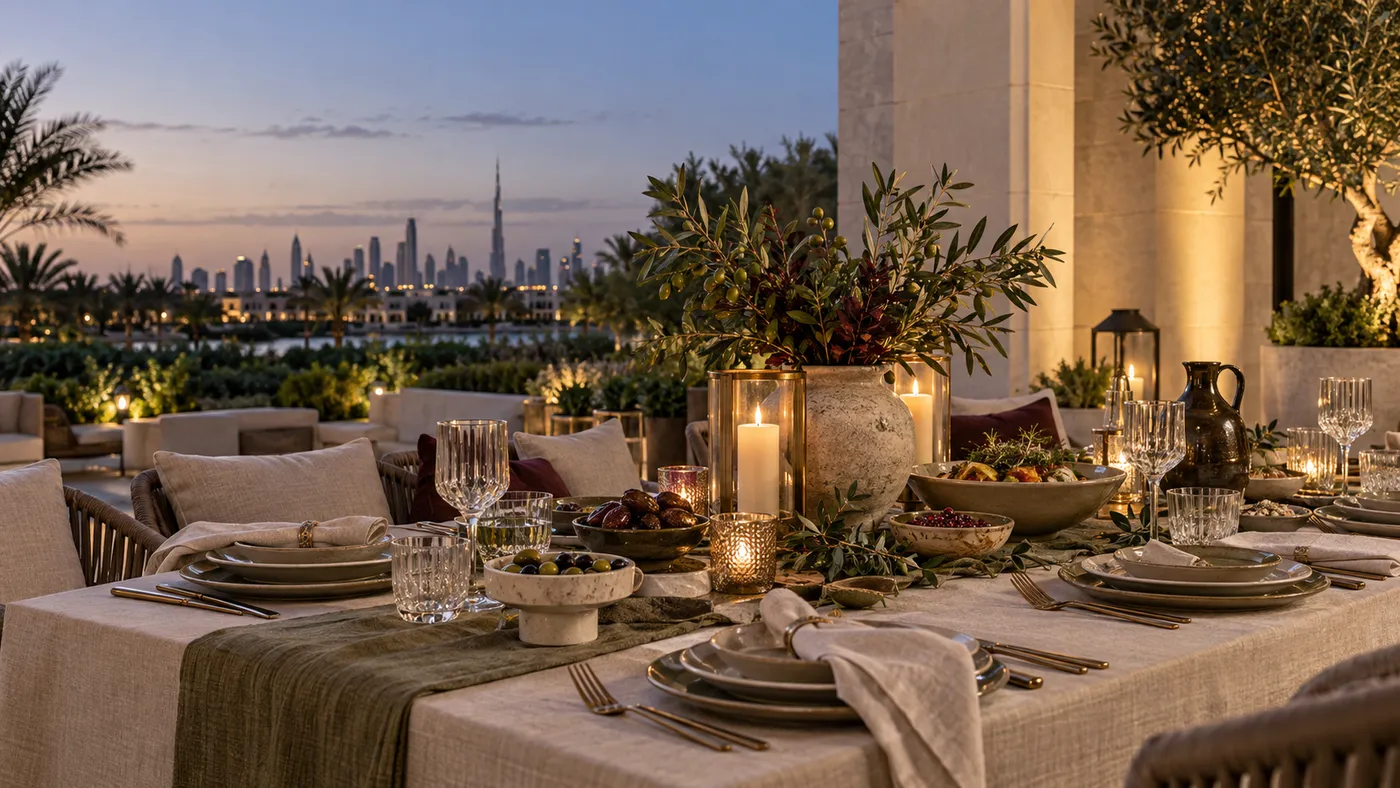
This table works because it functions on multiple levels — literally. The olive branches and red foliage stand vertically, the hurricane lanterns create a middle elevation, and the bowls of olives, dates, and pomegranates sit low on the table. You have three distinct visual layers: high (branches), mid (lanterns), and low (fruit bowls and votives). This layering keeps the eye moving and makes a relatively small table feel expansive. The fruits and nuts also serve a practical purpose — they’re edible, which makes the table feel generous and alive in a way that purely decorative centerpieces can’t match.
20. Floating Candles in a Cedar Garland on White
This barn-chic look is one of the most budget-friendly options in this collection. A white tablecloth from IKEA runs $15–$25, and the cedar or pine garland can be foraged or bought for $20–$30 at a Christmas tree lot. The glass cylindrical candle holders for floating candles are $3–$5 each at craft stores — buy 6–8 of them. Floating candles are cheaper than pillar candles and last longer per burn. The votive candle holders for the smaller candles can be thrifted for under $10 total. The string lights in the background are a separate investment (about $20) but transform the whole space. Total for the table: under $80.
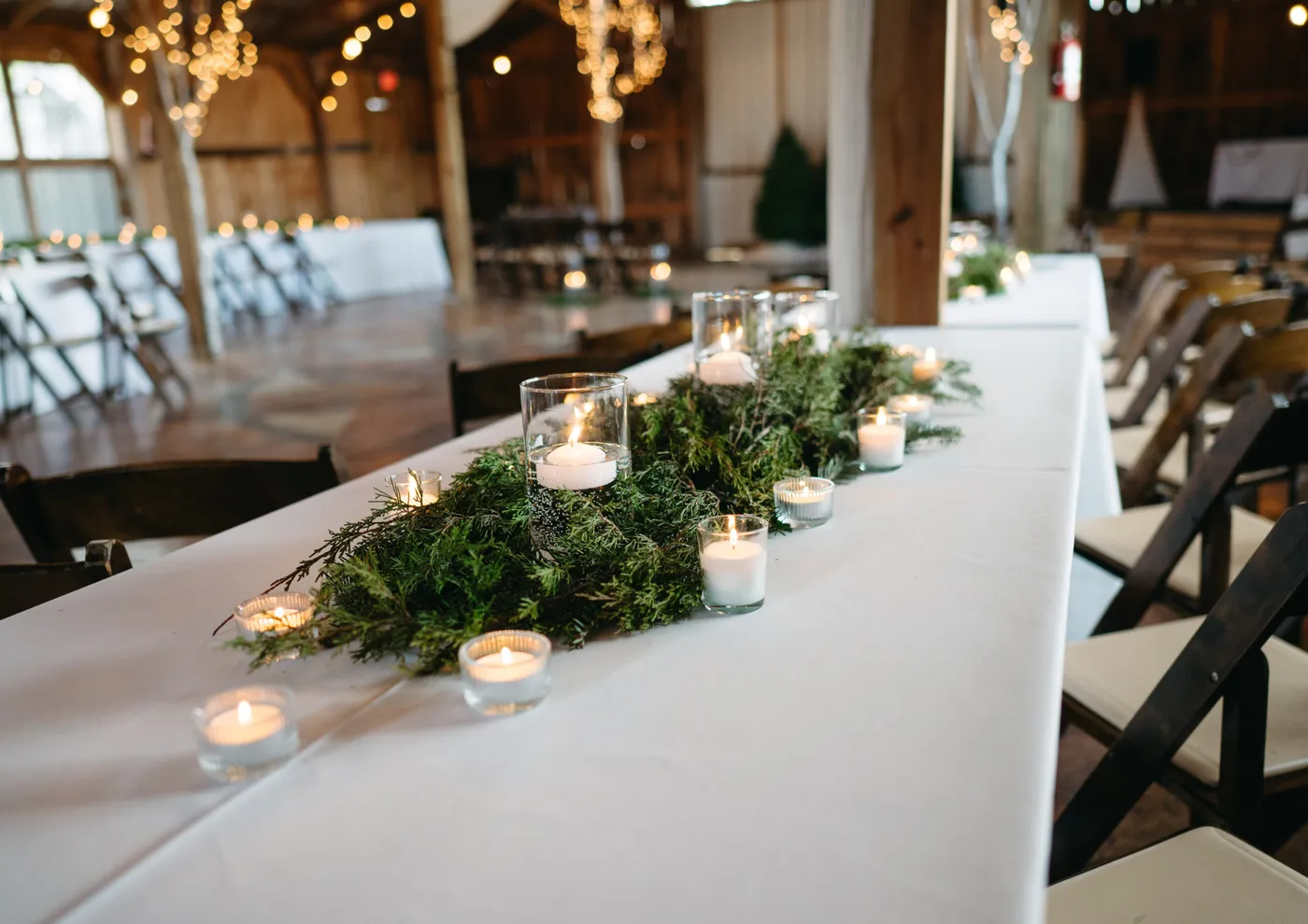
The floating candles are beautiful but fussy — they drift toward the edge of their containers as they burn, and you’ll need to reposition them if the water level drops. The greenery garland will shed needles within 3–5 days of cutting, so set this up no more than two days before your event. If you’re using the table for more than one meal, cover the garland with a light sheet between uses to slow drying. The string lights visible in the background look magical but need to be at least 6 feet away from the table to avoid competing with the candlelight for visual attention.
21. Mason Jar Blooms with Thistle and Evergreen
- Fill each mason jar with water and add a few drops of flower food for longevity.
- Start with the evergreen branches as your base — they create structure and fill the jar visually.
- Add the deep red amaryllis or roses in the center — these are your hero blooms.
- Tuck in the blue thistle around the edges — the purple-blue adds unexpected contrast against the red.
- Arrange the jars down the center of the table, spacing them 10–12 inches apart for visual rhythm.
- Place the textured votive candles between the jars, alternating heights for a staggered glow effect.
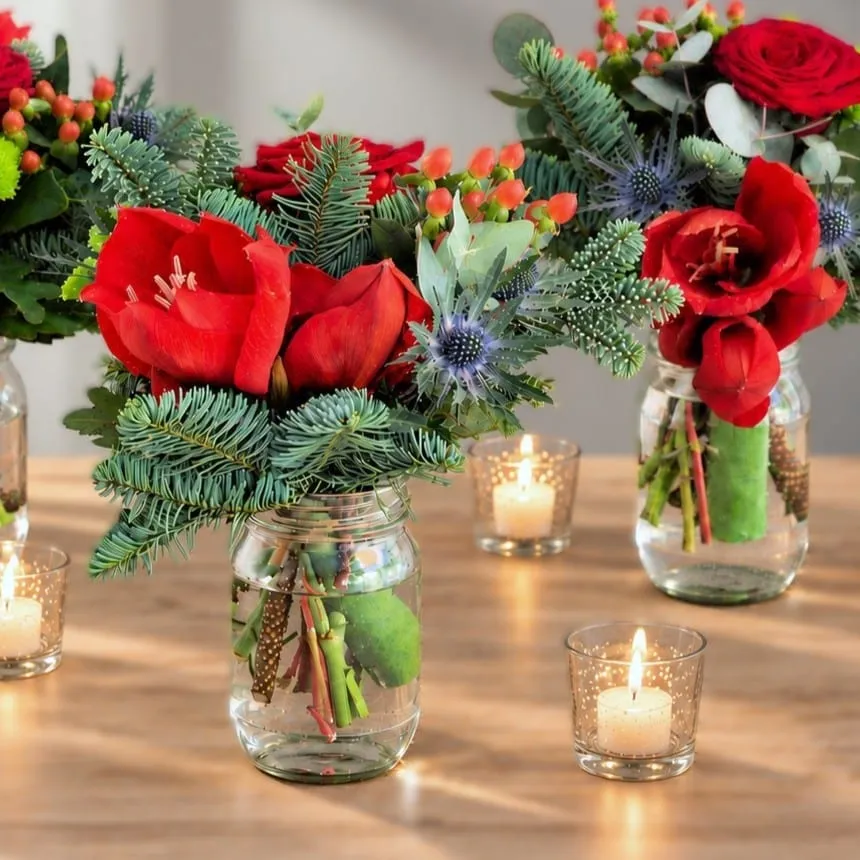
This arrangement works beautifully on tables 60–96 inches long with a standard 8-foot ceiling. The mason jars are low enough (6–8 inches) that they won’t obstruct sight lines across the table. For a 6-foot table, use 3–4 jars; for an 8-foot table, use 5 jars. Width-wise, the table should be at least 36 inches to accommodate the jars and votives without crowding place settings. This is one of the most forgiving designs in this guide — it scales up or down easily and works in rooms as small as 10×10 feet.
22. Clouds of Baby’s Breath with Pale Blue Plates
Apply the 70-20-10 formula to this dreamy table: 70% white (baby’s breath, pillar candles, white in the plates) + 20% pale blue (matte plates, drinking glasses) + 10% warm glow (candlelight, small string lights). The dominance of white baby’s breath creates the cloud-like effect that defines this table — but notice that the blue accents are what give it structure. Without the pale blue, this would be a lovely all-white table that tends toward bland. The blue anchors the ethereal flowers and gives the eye a place to rest. String lights woven through the baby’s breath add that crucial warm element that keeps the palette from feeling cold.
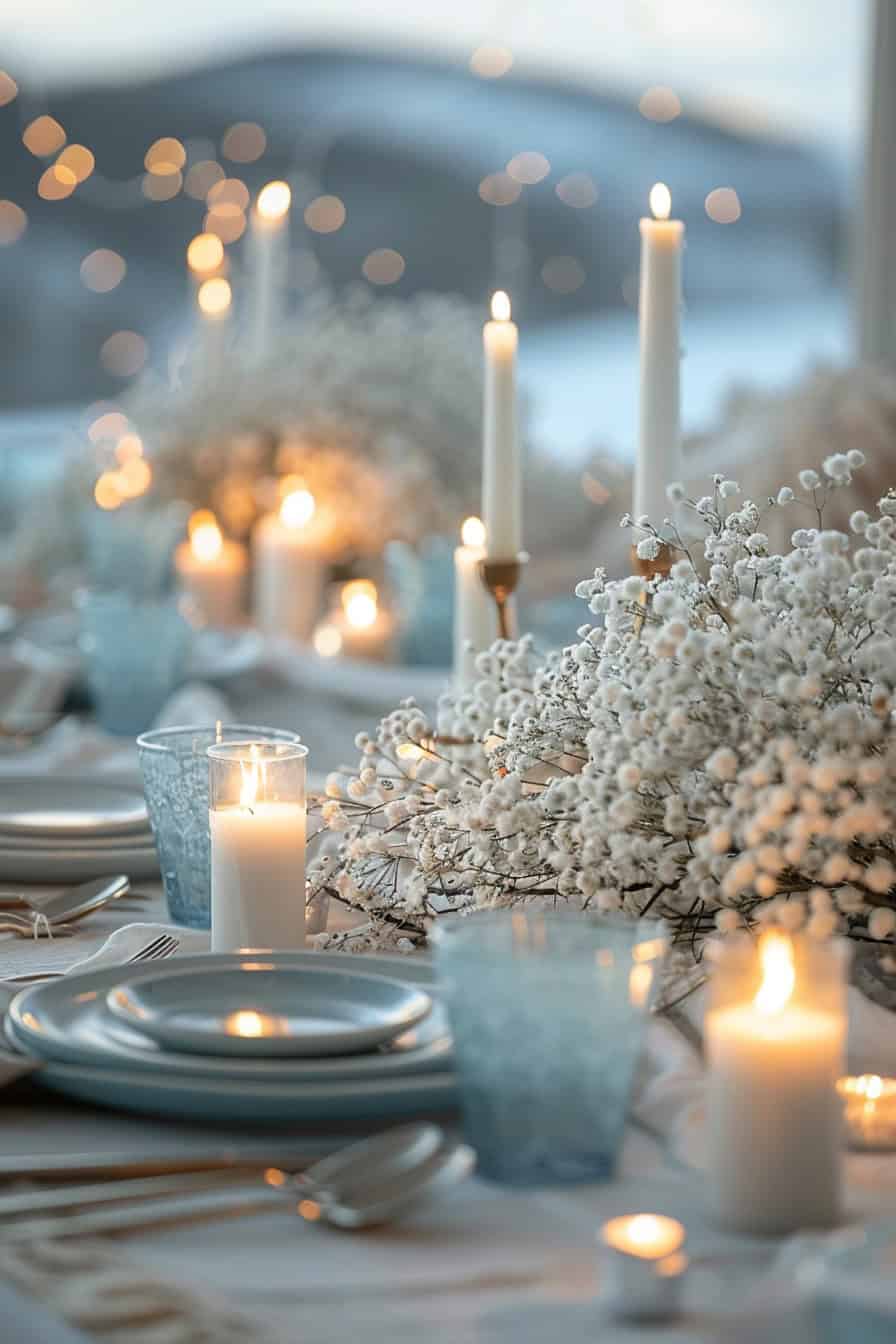
The white baby’s breath is the one thing that defines this table — and here’s why it matters more than the candles or the plates: baby’s breath is the only flower that creates volume without weight. It fills space visually while remaining airy, which means your table feels abundant without feeling crowded. Other white flowers like hydrangeas or roses would create dense chunks that block sight lines. Baby’s breath also dries beautifully, so this centerpiece can last weeks instead of days. If you were to remove it, the table would revert to a simple candlelit dinner — lovely but ordinary.
23. Glitter Cone Trees and Reindeer on Faux Fur
- Confirm your table can handle the visual weight — this is a maximalist look that needs a wide surface (at least 40 inches) to breathe.
- Check the room lighting — gold and silver metallic elements need warm ambient light to sparkle; cool LED light will make them look flat.
- Make sure the faux fur runner is secured — it can slide on smooth wood tables; use double-sided tape at the ends.
- Test the hurricane lanterns for stability — glass on fur is slippery; consider a thin silicone mat underneath each one.
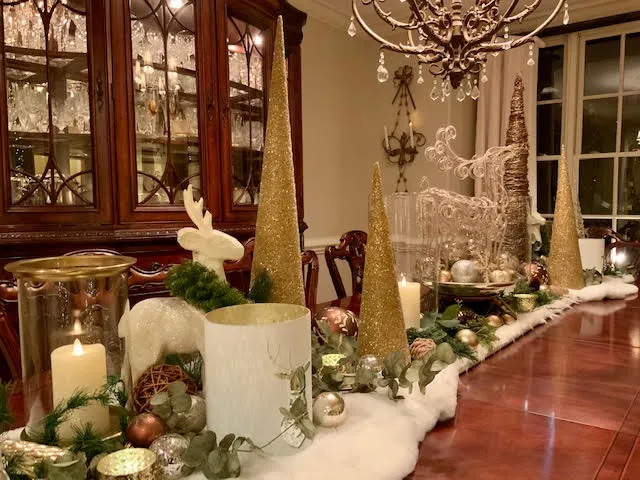
For the glitter cone trees — often sold as bottle brush trees — buy them in three heights (6, 9, and 12 inches) and arrange them in a zigzag line rather than a straight row. Staggering creates depth and allows each tree to catch light from a different angle. The white reindeer figurines should all face one direction (either all toward the table center or all toward the guests) for a cohesive narrative. The metallic gold and silver ornaments aren’t just decoration — they act as light reflectors. Place them near the hurricane lanterns to maximize the glow effect. This is a look that rewards deliberate placement.
24. Evergreen and Candlelight with a Snowy View
This table succeeds because of a principle called borrowed scenery — the snowy mountain landscape visible through the windows becomes part of the tablescape. The evergreen sprigs and pinecones on the table echo the landscape outside, creating a seamless indoor-outdoor connection. The assorted lit candles and votives provide the warm foreground counterpoint to the cool snow outside. The dark wood window frames and chairs frame the view, while the woven placemats add organic texture that bridges interior and exterior materials. This is a textbook example of letting your environment dictate your decor choices.
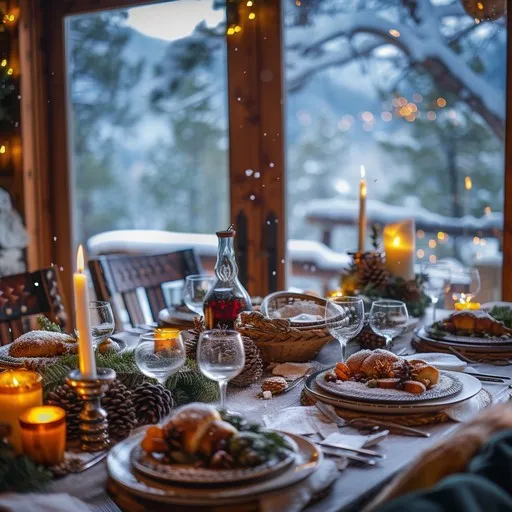
This arrangement is perfect for rooms with large windows facing a winter landscape. Minimum table length is 72 inches, and the room should be at least 14 feet deep to allow the windows to read as part the composition rather than a distraction. The window frames should be dark or neutral — bright white frames would compete with the snow outside. If you don’t have a snowy view, try Idea #7 — it brings the winter wonderland indoors through icy branches and blue accents, creating the same atmosphere regardless of what’s outside your window.
25. White Roses and Green Tapers in Crystal Clarity
This elegant look is more accessible than it appears. Budget alternative: skip the crystal glassware and use clear glass from IKEA ($2–$4 per piece). The white roses can be from Trader Joe’s ($10 for a bunch) or even white carnations ($6) for a similar effect. The clear glass cylinders for the green taper candles are sold in multipacks at craft stores — $15 for a set of 6. The green tapers themselves are $8 for a box of 12 at IKEA or Target. The white tablecloth is a basic linen from Amazon ($20–$30). Total recreatable for under $80, which is about 80% less than the cost of true crystal and custom florals.
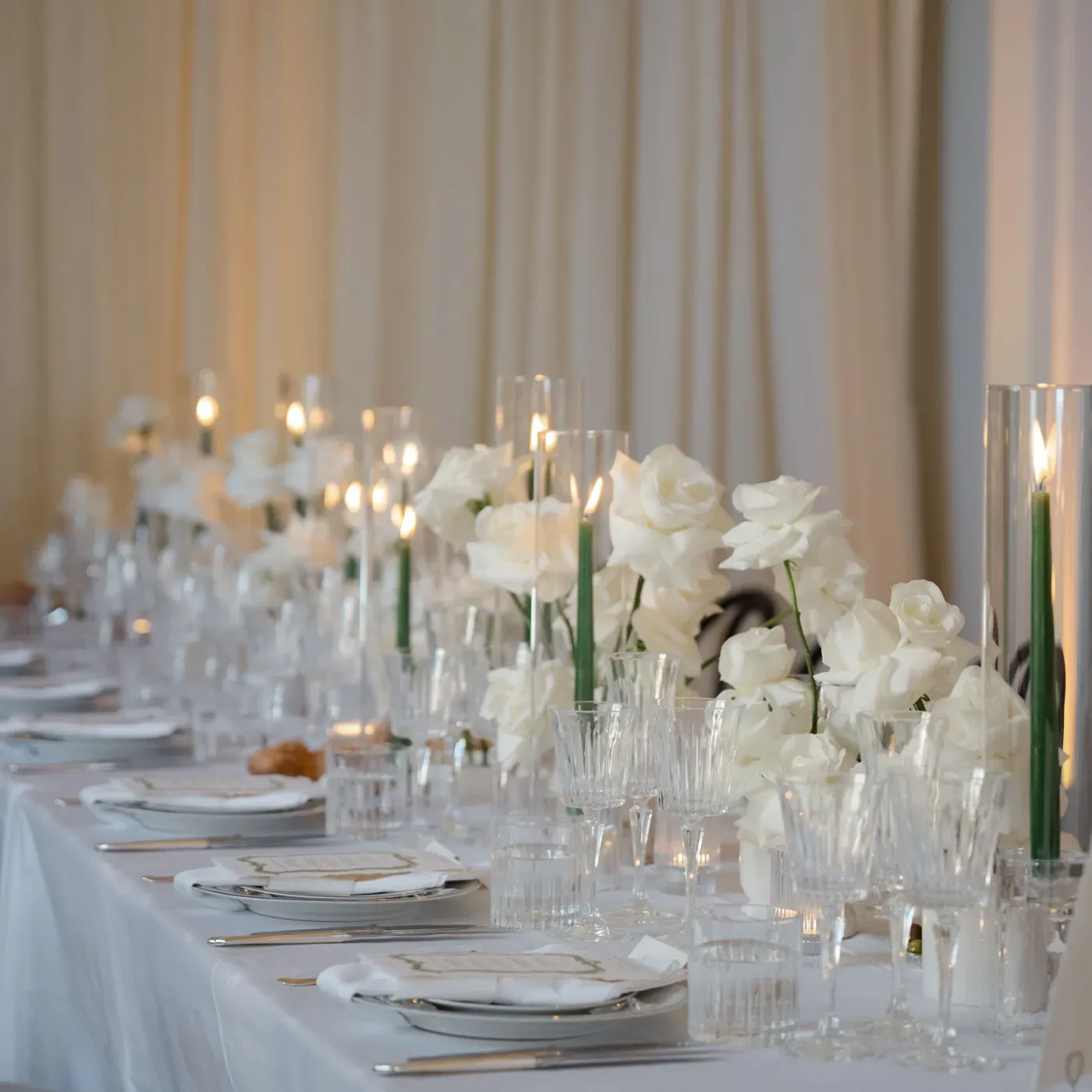
The white roses need fresh water every other day and the outer petals removed as they brown — budget 10 minutes of maintenance per day. The green tapers will drip (all colored candles do more than white), so place a small brass or glass drip catcher halfway down each candle to protect the tablecloth. Crystal glassware requires polishing with a lint-free cloth after each wash to prevent water spots. If low maintenance is your priority, swap the real roses for high-quality silk ones and the green tapers for LED versions — same look, zero upkeep. The green candles in clear cylinders from Idea #15 offer a similar aesthetic with less maintenance.
26. Evergreen, Red Berries, and Frosted Pinecones Up Close
- Select a sturdy base — a wooden tray or wide ceramic dish at least 14 inches in diameter.
- Start with a full layer of dark green evergreen branches, ensuring no base material is visible.
- Tuck sprigs of red berries (fresh holly or faux winterberry) in clusters of 3–4 for visual impact.
- Place the frosted pinecones on top — the white tips should be the highest point for contrast.
- Fluff and adjust the branches so the arrangement looks naturally dense, not systematically placed.
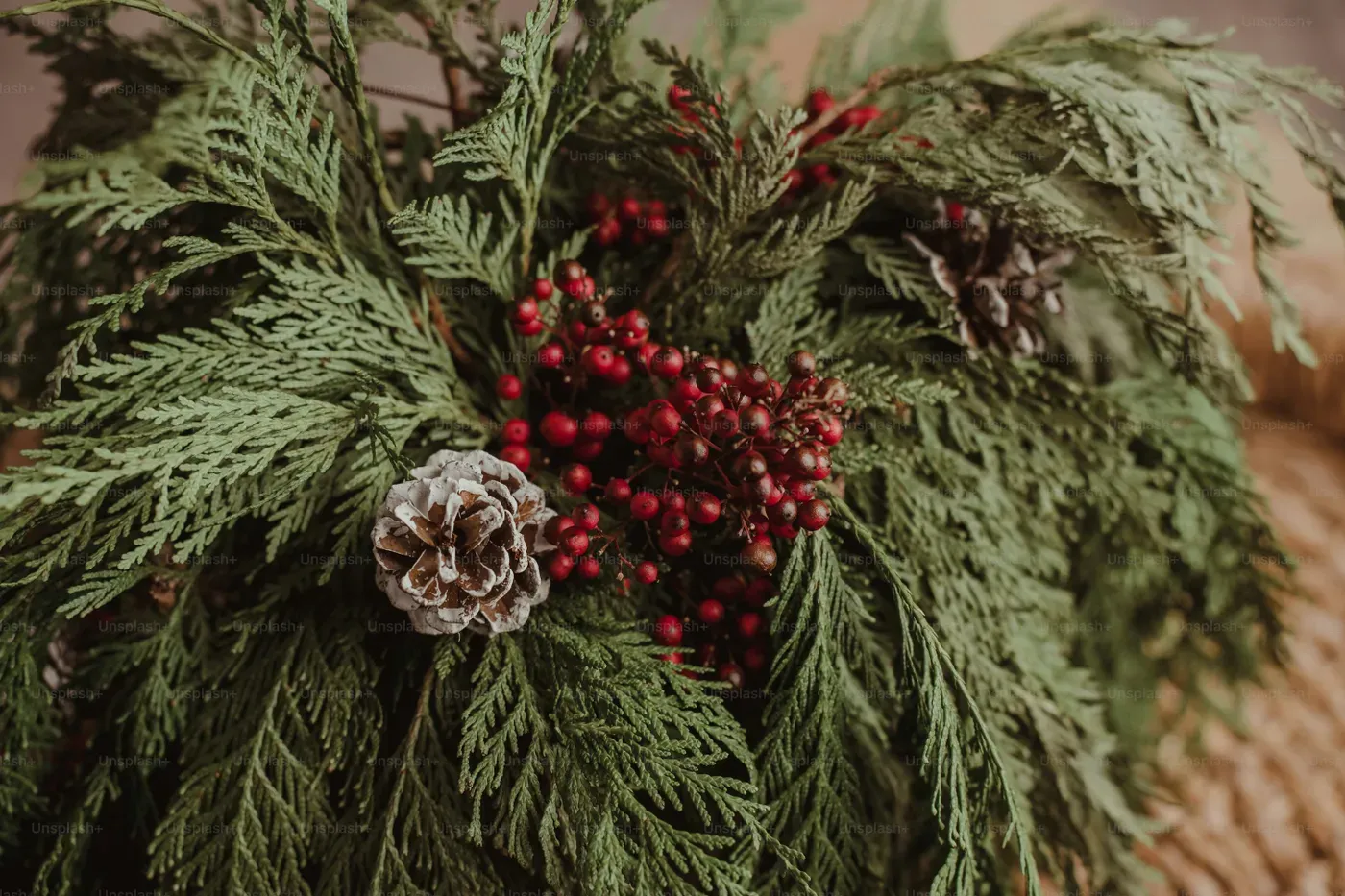
This arrangement looks simple but has a hidden challenge: keeping the red berries vibrant. If you’re using fresh holly or winterberry, they’ll start to dry and drop within 4–6 days. Mist them daily with water to extend their life. The frosted pinecones are likely faux (real ones can mold if treated with craft snow), but they can shed that white powder if handled roughly — apply a clear matte hairspray sealant when you first get them. The dark green evergreen branches will last 7–10 days indoors; to maximize longevity, cut the stems at an angle before placing them in water-soaked floral foam hidden beneath the foliage.
27. Poinsettia Ring Around a Single White Pillar
This centerpiece follows a simple radial formula: 60% circular greenery ring (the base) + 30% red poinsettia accents (distributed around the circle) + 10% gold berries and white candle (the focal points). The circle draws the eye naturally to the center, where the white pillar candle serves as the anchor. The gold berries add small moments of shine that prevent the red and green from feeling too Christmas-card predictable. Swap the red poinsettias for white ones and the gold berries for silver, and you have a completely different mood — elegant and frosty rather than warm and traditional.
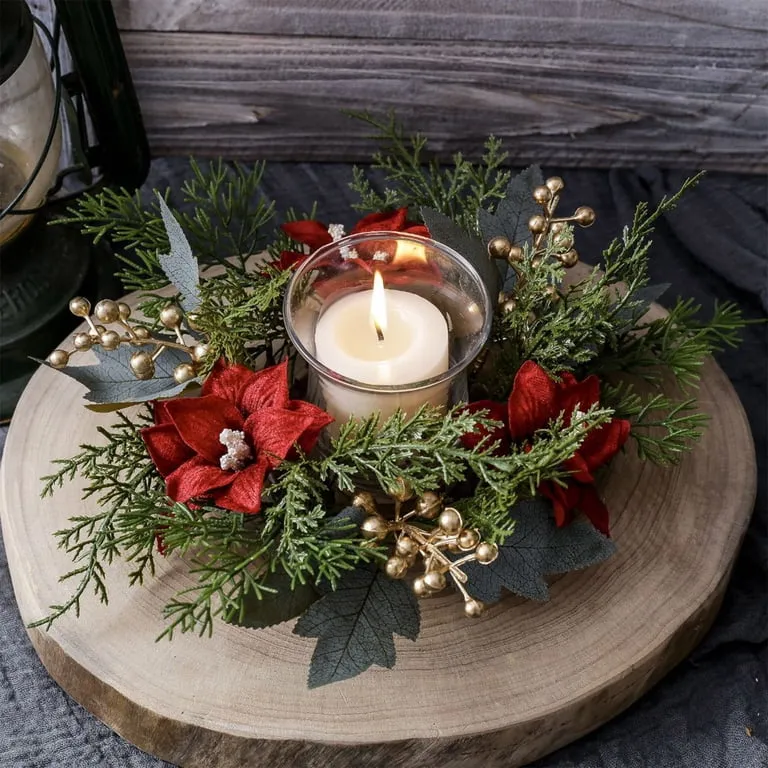
Recreate this for under $40: a white pillar candle at Target ($5), a glass candle holder ($3), a wood slice base from a craft store ($6), faux greenery garland from a dollar store ($7), one small poinsettia plant ($4), a bundle of gold berry stems from Hobby Lobby ($5 on sale), and a large pinecone from a craft store ($2). The beauty of this design is that the wood slice base elevates everything visually — it’s the single most important element for making the arrangement look intentional rather than thrown together. Without the wood slice, this is a candle surrounded by greenery. With it, it’s a curated centerpiece.
28. Cedar, Candle, and Stone on a Dark Rimmed Dish
This is a lesson in restraint: two white pillar candles, cedar sprigs, one pinecone, one stone — all on a dark-rimmed rectangular dish. The designer’s trick here is the shadow play. The natural light hitting the candles creates distinct shadows that become part of the composition. Position this centerpiece where afternoon light can hit it — morning light from the east creates long shadows, while late afternoon light wraps around the candles differently. The grey natural stone isn’t just decoration; it’s a functional weight that keeps the lighter pinecone in place and adds a sculptural element. The dark rim of the dish frames the entire arrangement and prevents the organic materials from visually wandering.
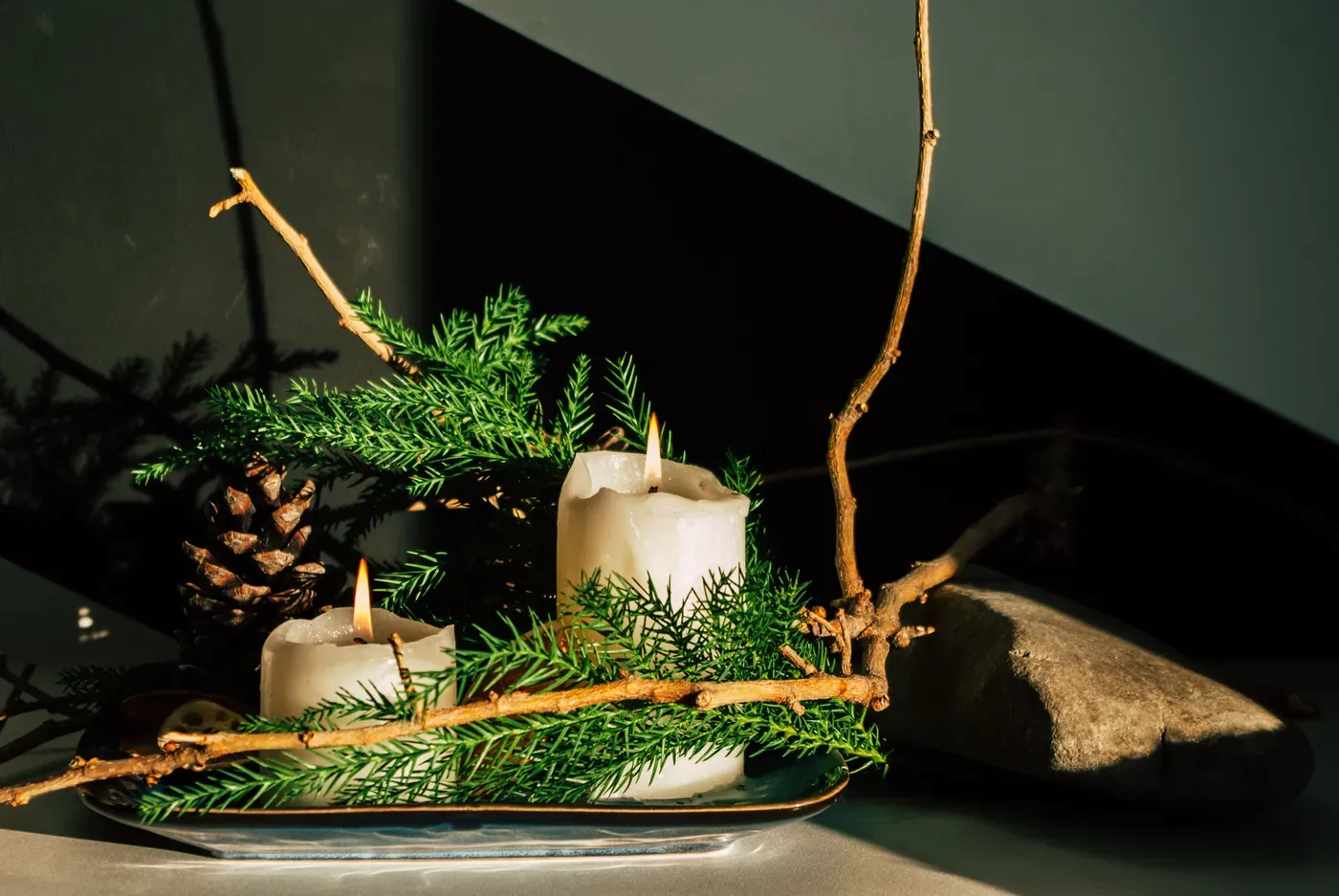
that makes this minimalist arrangement work is that dark-rimmed rectangular dish. Without it, you’d have candles and greenery sitting directly on the table — which can work in a rustic setting but reads as unfinished here. The dish provides a defined boundary that contains the organic elements and gives the eye a clear edge. It also allows you to place this centerpiece on any surface (table, sideboard, credenza) without worrying about water rings or needle dropping. The contrast between the precise dark rim and the wild cedar sprigs is the entire visual conversation — order containing chaos.
29. Moss Runner with Wax-Covered Bottle Candles
This table works because it inverts expectations: the runners are made of green moss and small flowers rather than fabric, and the candles are wax-coated glass bottles rather than traditional holders. The dark slate placemats provide a dramatic counterpoint to the organic moss — hard against soft, dark against light. The layered plates (white bowl with dark floral design on a light blue plate on a white plate) create a vertical rhythm that matches the verticality of the wax bottles. The dark blue napkins with white botanical print echo the floral theme without competing with the centerpiece. Everything is connected, nothing is redundant.
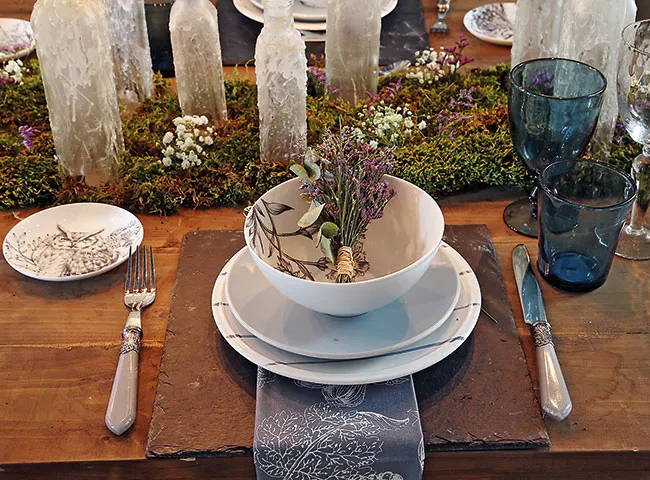
Here’s the reality check on those wax-coated bottle candles: they’re stunning but they will drip wax everywhere as they burn. Place a wide ceramic tray or a deep dish underneath them to catch drips. The moss runner needs misting every 2–3 days to stay vibrant — dried-out moss turns brown and sheds particles onto your table. If you’re using real moss, it can harbor small insects. Freeze it for 48 hours before using to kill any hitchhikers. The slate placemats are heavy (about 1 pound each) and can scratch a wooden table — use felt pads underneath. This is a high-impact look that demands mid-level maintenance.
30. A Golden Deer Amid Frosted Foliage
You can recreate this glamorous centerpiece for under $35. The golden deer figurine is the splurge piece — check craft stores (Michael’s, Hobby Lobby) for 50% off holiday sales, or find a similar one on Amazon for $12–$18. The hexagonal wooden base with teal pattern can be DIYed: buy a plain wooden plaque for $3, paint it with teal acrylic ($2), and add a geometric stencil ($2). The green leafy foliage can be from a $6 garland cut into smaller pieces. The frosted or glitter-dusted stems are $4 for a bundle at craft stores. Assemble on a dark ceramic platter or tray you already own. Total: under $35 for a centerpiece that looks far more expensive.

This gold deer figurine approach is having a moment in 2026 as part of a broader return to decorative objects that feel like miniature sculptures. On Pinterest, searches for animal figurine centerpieces are up 35% year over year, driven by designers showcasing single-statement objects rather than complex arrangements. This has staying power because it’s not seasonally limited — the golden deer works for Christmas, New Year’s, and even through winter with the right foliage swap. For a more minimal take, pair the deer alone with a single candle, as seen in Idea #23 but with a single sculptural object instead of a full tableau.
31. Three White Tapers with Evergreens and Ornaments
This classic arrangement needs a minimum table width of 42 inches to accommodate the pedestal or base plus place settings on either side. The ideal room size is 12×14 feet with a standard 8-foot ceiling — the three tall tapers (12 inches each) need headroom but not cathedral heights. On a round table, this works best with a diameter of 48–60 inches. On a rectangular table, position the arrangement in the center with at least 24 inches of clear table on each side for place settings. This is a flexible design that adapts well to different room sizes — scale the base up or down proportionally.
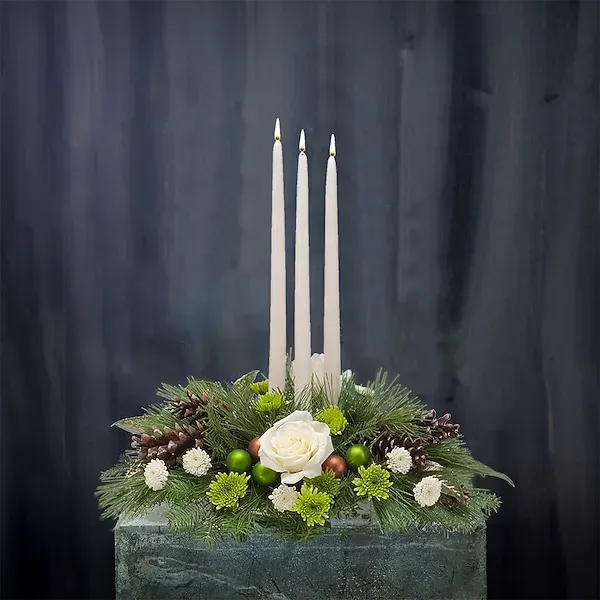
- Start with your pedestal or base — a textured dark teal or blue-green pedestal gives a rich foundation.
- Create a circular base of evergreen branches that extends 3–4 inches beyond the pedestal edge.
- Place the three white taper candles in the center, forming a triangle for even visual weight.
- Tuck the white rose and chrysanthemums around the candle bases for soft floral contrast.
- Add the green and bronze spherical ornaments in clusters, alternating colors for rhythm.
- Nestle the pinecones between the flowers and ornaments to bridge natural and decorative elements.
32. White Village Houses on a Round Table with Blue Napkins
Here’s the designer secret to making ceramic village houses work without looking kitschy: keep them all white and matte, vary the heights, and never use more than five in a grouping. The light wood round table with the teal base is doing crucial work here — a dark or ornate table would compete with the houses. The bottle brush trees (also known as glitter trees in other designs) should be solid white to match the houses, creating a unified winter landscape rather than a colorful Christmas scene. The snow-dusted green foliage garland should be low and dense, acting as a visual base that the houses sit on.
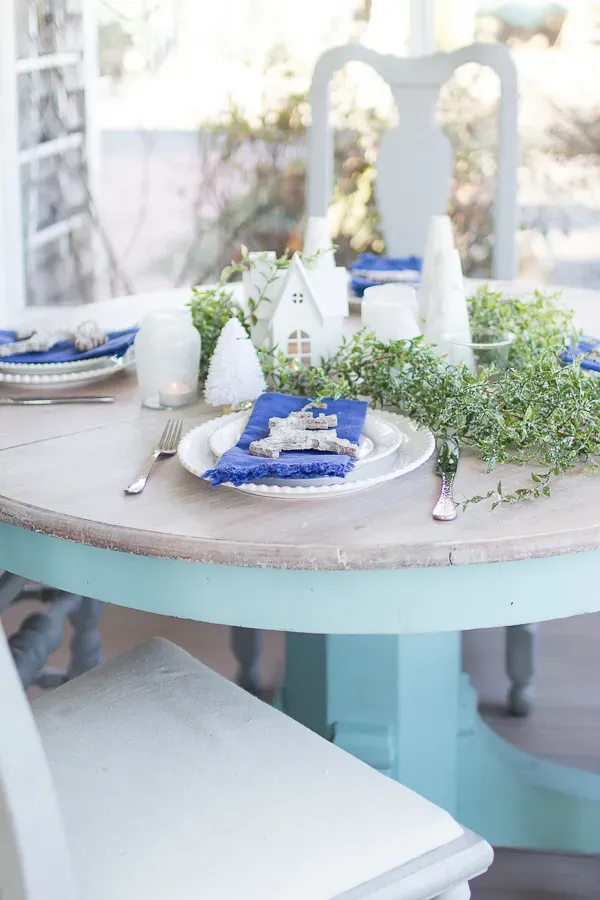
- Verify your table can withstand the weight — ceramic houses are heavier than they look, especially in a set of 5+ pieces.
- Check that the beaded plates are dishwasher safe — many beaded ceramic pieces are hand-wash only.
- Test the royal blue napkins against your existing decor — bright blue is a strong accent color that needs to be intentional.
- Measure the height of the tallest house against your eye level — guests should be able to see over the centerpiece when seated.
33. Blue Lanterns and Green Glass on White Linen
The blue lanterns with white pillar candles are the centerpiece of this table, and they’re surprisingly low-maintenance: the glass enclosures protect the candles from drafts, so they burn evenly and last longer than exposed candles. The white tablecloth is your biggest maintenance concern — it shows every drop and crumb. Use a washable polyester-linen blend instead of real linen if you’re planning multiple meals. The green glassware (goblets, small bowls) should be hand-washed to maintain clarity. The green handled silverware will hold up in the dishwasher, but the green coating can wear off over time — hand washing extends its life significantly.
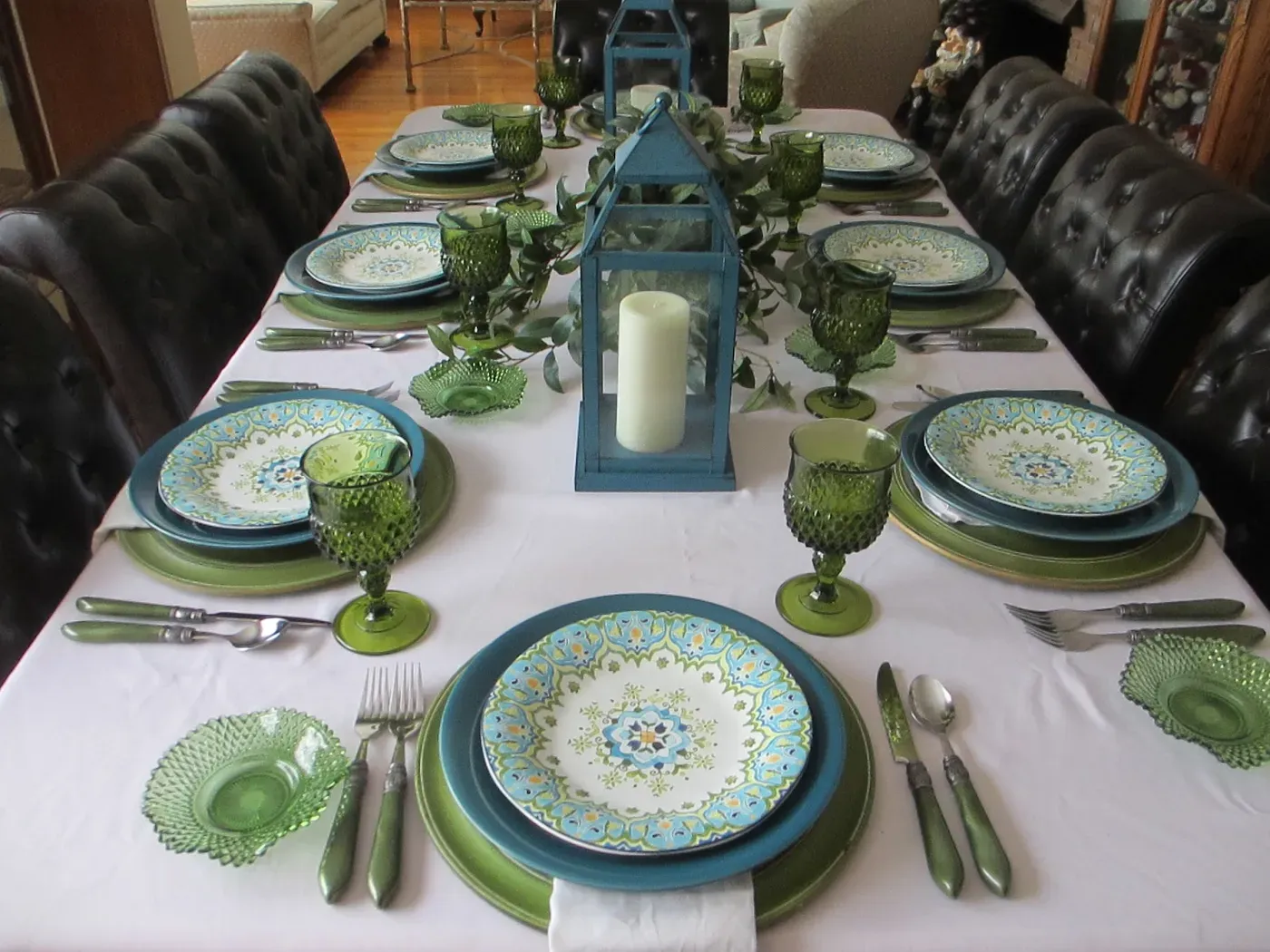
Before you commit to this blue-and-green palette, know that it’s surprisingly specific. The deep teal blue of the lanterns combined with the lime green of the glassware creates a high-contrast color pairing that doesn’t easily accommodate other colors. Adding red, gold, or white accents would disrupt the balance. If your existing dining room decor includes warm tones (wood floors with red undertones, brass light fixtures, cream walls), this cool palette might feel disconnected. Test by holding a teal napkin and a lime green glass against your room’s dominant surfaces before purchasing. If the contrast feels jarring, try Idea #16 — similar formality with a more traditional navy-and-white pairing.
From Pin to Table: Make It Happen
These 33 ideas prove that winter table centerpieces don’t have to be complicated to be stunning. Whether you’re drawn to rustic lodge charm, elegant winter white, or something entirely your own, the best approach is to start with one element you love and build from there. Pin your favorites, gather your materials, and give yourself permission to make it your own. 📌 Save this to Pinterest for later — you’ll want to revisit these ideas when you’re ready to create your perfect winter table.