
You know that feeling when you finally find the tree that looks exactly right for your space — and it’s not even in a store, it’s in someone’s log cabin with a brick fireplace glowing behind it?
We spent serious time digging through Etsy, Target, Wayfair, and Amazon to bring you only what’s worth your attention this year. Everything here lands between $14 and $480, so there’s a version of this for every budget.
Inside you’ll find 25 curated rustic trees, mantels, and tabletop vignettes — cabin lodge, neutral winter white, vintage farmhouse, and whimsical folk art — and the budget and luxury versions of each are compared side by side.
In 2026 the pull is away from all-white minimalism and back toward texture you can actually touch: burlap, bark, raw wood, dried orange slices, and 2700K bulbs that make a room feel lit by firelight instead of a screen. And stay until the end — we break down the most common mistakes that can ruin these looks.
📌 Save this to Pinterest for later — you’ll want to revisit these ideas. Your future self will thank you in November.
1. A Log Cabin Tree Anchored by Brick and Candlelight
Plaid ribbon only looks expensive when it drapes instead of snapping into shape. Cut 3-inch-wide ribbon into 18-inch tails, fold each one into a loose loop, and push the loop into the branch joint — skip the bow entirely. On a 7-foot tree, about two dozen of those loops is the sweet spot. More than that and the tree starts reading as gift wrap instead of a tree.
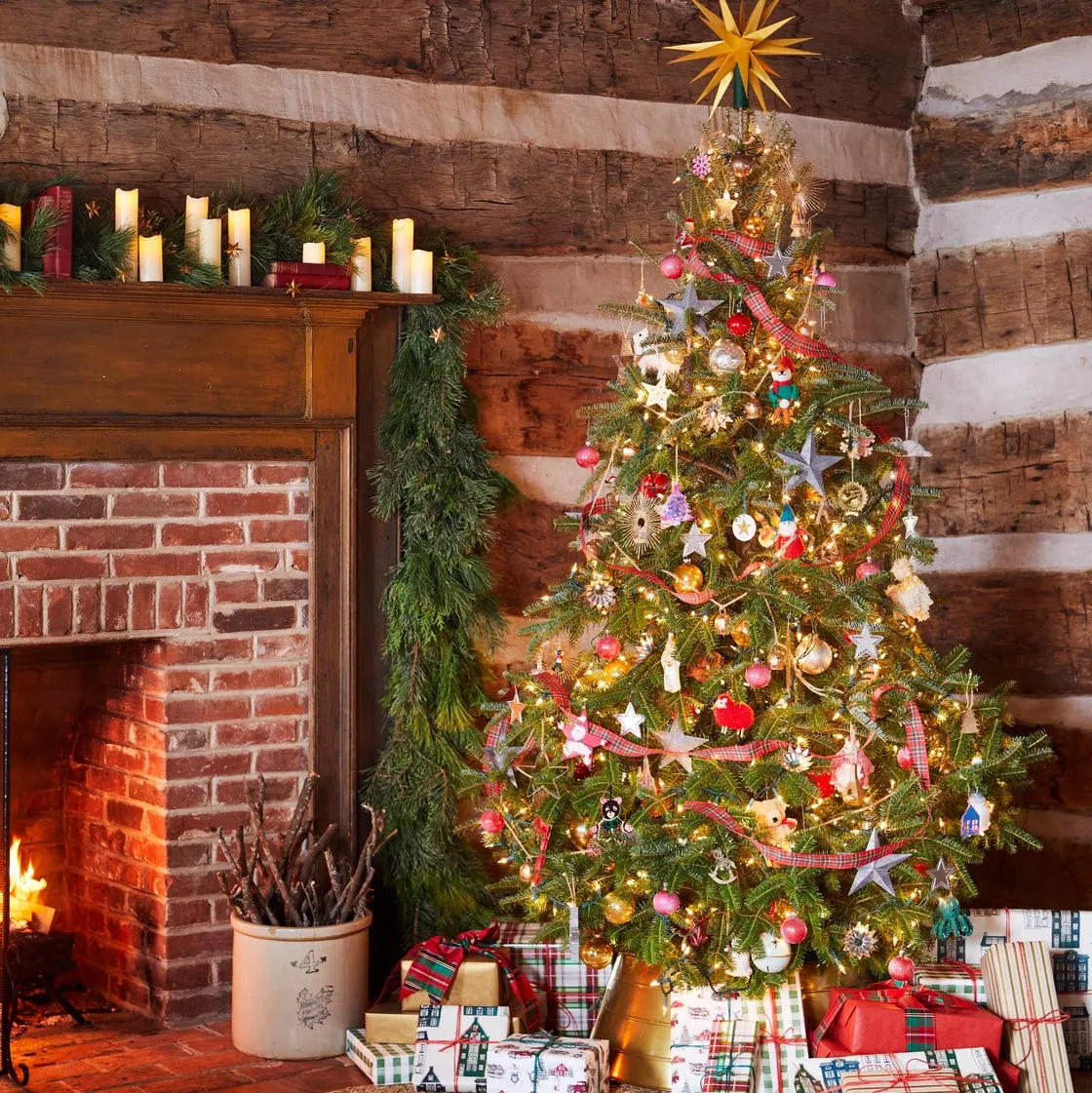
The star topper, the plaid, the pillar candles on the mantel — none of it would land without the stacked log wall behind the tree. That raw, warm brown backdrop is what turns pine green into something that looks lit from the inside out. Strip the logs away and this becomes a nice tree in a nice room. Keep them, and the tree stops being decor and starts being part of the house.
2. Two Red Reindeer Flanking a Faux Fur Tree Skirt
Two red deer, one tree, zero guessing. The symmetry does the heavy lifting — your eye lands on the center of the tree and stays there. The white plush skirt lifts the base off the hardwood, and the blue-grey window trim quietly cools down all that warm yellow light. It’s really a three-color room: green, red, and a blue-grey that keeps the red from shouting.
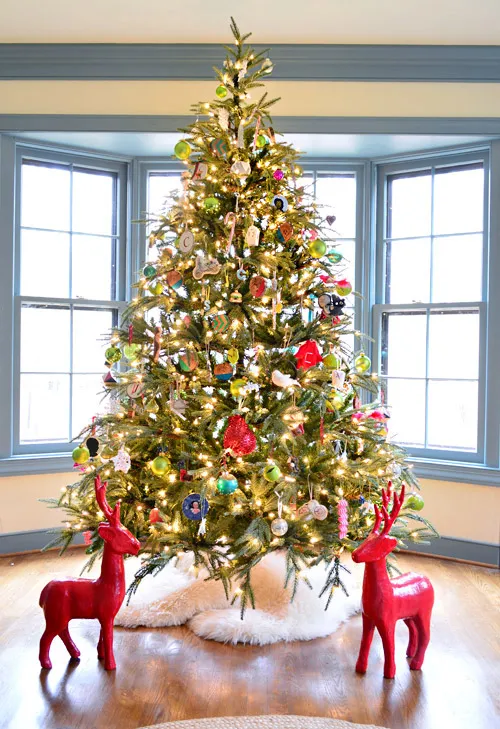
Faux fur is a magnet. If you have a shedding dog, or a cat who believes that skirt is a bed, plan on shaking it out weekly and vacuuming it on the lowest setting with a brush attachment. Bay windows also cook — south- and west-facing glass can fade one side of a tree while the other stays green. Rotate the tree a quarter turn every couple of weeks and it stays even.
3. Flocked Tree, Plaid Ribbon, and a Mantel of Gnomes
Styling that mantel takes about 20 minutes and under $40 if you thrift the miniature trees.
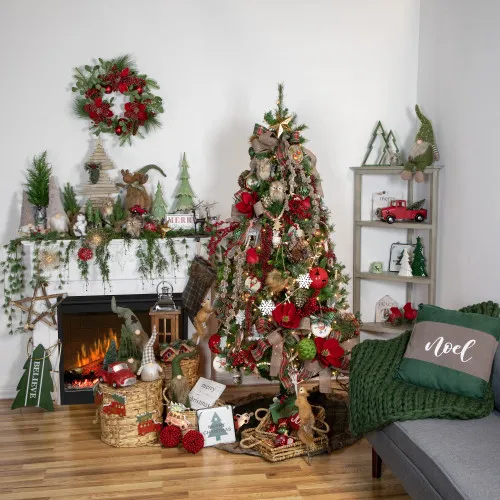
- Run a greenery swag along the whole shelf first — it hides the gaps between everything else you add.
- Cluster three miniature trees at one end, never centered, and vary their heights by 3 to 4 inches.
- Tuck gnomes in front of the tree bases so only hats and beards show.
- Leave one bare 6-inch stretch near the middle so the arrangement can breathe.
- Finish with a woven basket on the floor below, angled toward the sofa.
Gnomes have quietly been winning for a few years, and in 2026 they’ve settled in as a permanent fixture rather than a fad — flocked trees and woodland animal ornaments are riding the same wave. The reason is simple: this look photographs beautifully in low winter light, and nothing here is nailed down, so it all packs into two baskets in January.
4. White Sofa, Watercolor Berries, and Red-Wrapped Gifts
A white slipcovered sofa, a stack of red and white gifts, and one framed watercolor with red berries — you can build this for under $120. Target and Walmart sell holiday lumbar pillows for $12 to $18 each; the watercolor is a $6 Etsy printable in a $14 thrift frame. Gold-toned textured side tables pop up on Facebook Marketplace constantly for $30 to $45. Skip one pillow and buy the frame instead. If you want the same restraint with less red, see Idea #5.
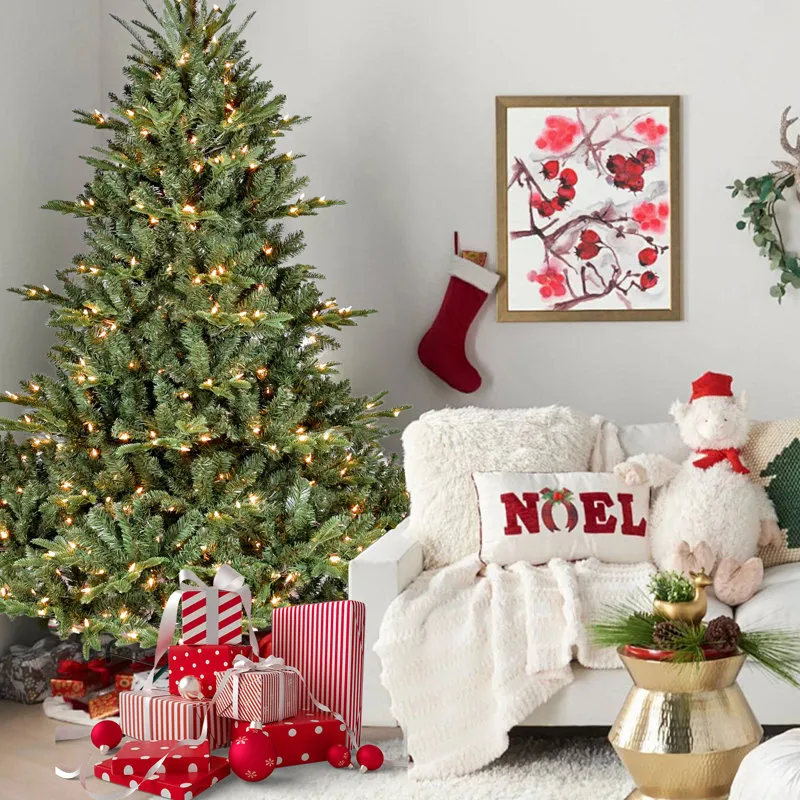
Wrap gifts in exactly two papers and one ribbon width. That’s it. When red and white are the only two papers under the tree, a stack of eight presents reads as a design decision. Add a third pattern and it reads as clutter. Use plain white butcher paper for the larger boxes so the smaller red ones do all the talking.
5. Snow-Dusted Tree with White Poinsettias and Antlers
Heavily flocked trees read bigger than they measure. In a room with 9-foot ceilings, a 7 to 7.5-foot flocked tree is the ceiling — go taller and the flocking starts to feel like weather. In an 8-foot room, drop to 6.5 feet. Leave at least 3 feet between branches and drapes, and 18 inches of walkway on the side people actually use. A room under 10 by 10 feet calls for a tabletop version instead.
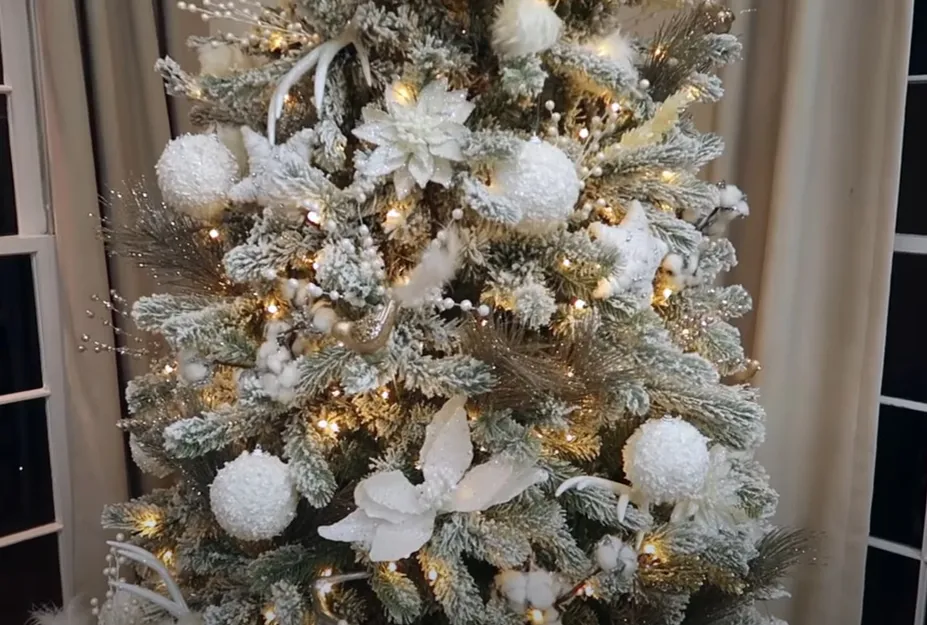
There’s no color here at all, so the whole thing lives on texture: glitter balls, matte poinsettia petals, flocking that looks like frost, and white antlers that break up the roundness. The warm string lights are doing a second job, keeping the scheme from going cold and blue. Pull the lights out and the white turns flat. That’s the trick — monochrome plus warmth.
6. Burlap Garland and Pinecones Above a Galvanized Collar
The formula is 70 percent natural, 20 percent red, 10 percent metal. Burlap, pinecones, and green needles make up the base; berries and poinsettia blooms bring the red; the galvanized collar is the only metal in the room. Swap the red for navy velvet ribbon and the collar for aged copper and you have a completely different tree using the identical ratio. Change the accents, never the percentages.
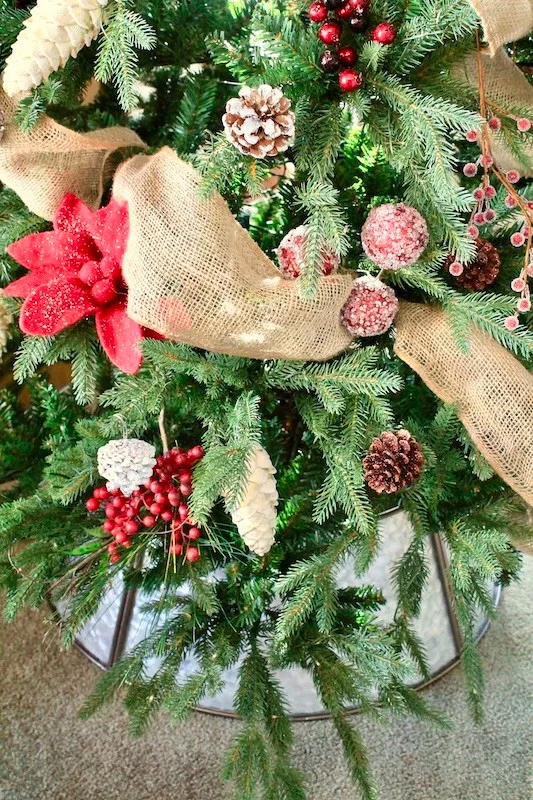
Burlap sheds. Expect fibers on the floor for the first week no matter how carefully you handle it, and don’t wash it — burlap shrinks and warps. Real pinecones drop scales and sap, so bake them at 200 degrees F for 30 minutes and let them cool completely before they touch fabric. The galvanized collar is the easy part: one damp cloth and it’s done. Budget about 15 minutes of upkeep a week.
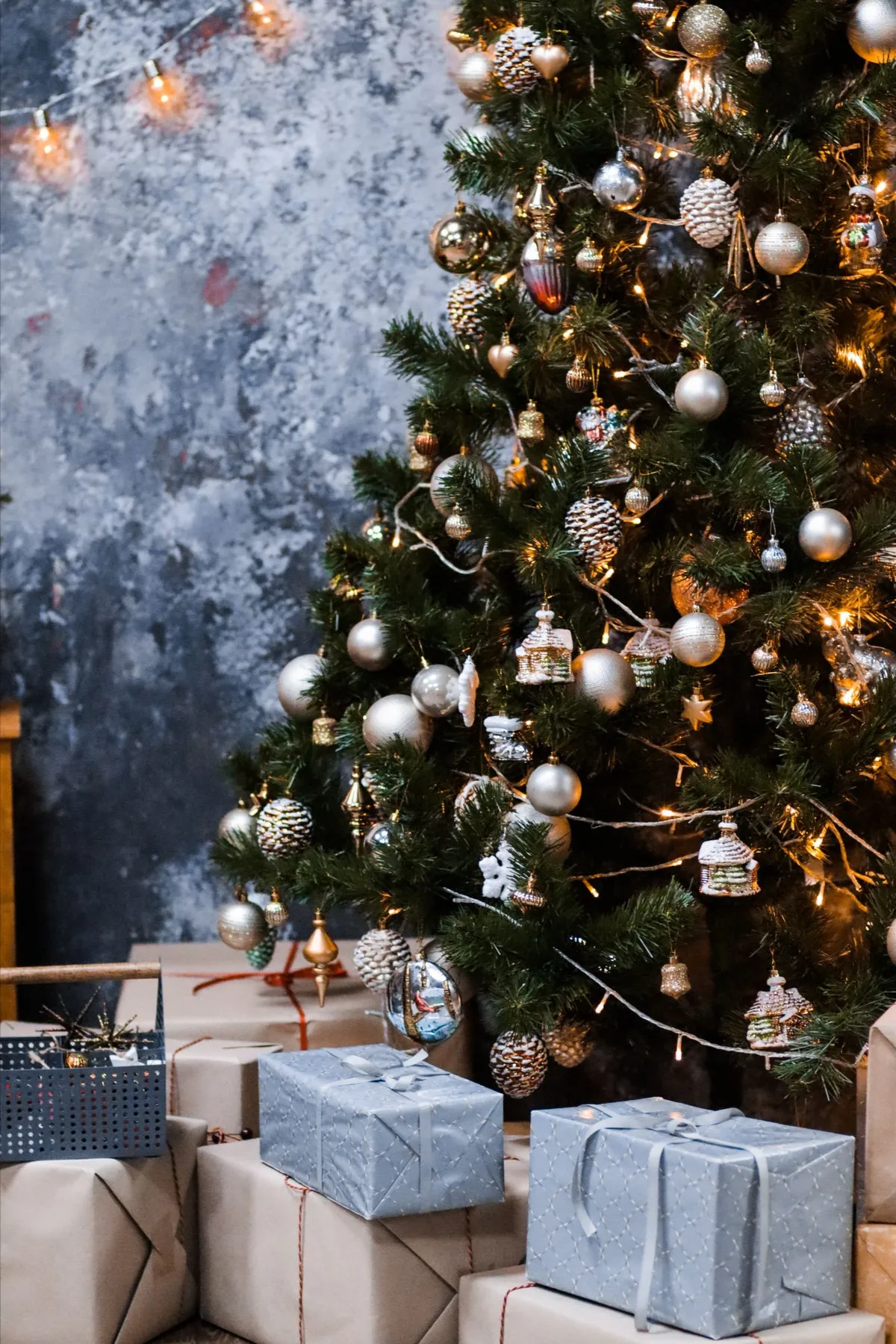
7. Silver Baubles and Kraft Paper Against a Gray Wall
Here’s what this setup runs, give or take:
- Tree and lighting: $90-$220 for a 7-foot unlit tree plus two strands of warm fairy lights
- Textiles: $25-$60 for a knit skirt or plaid throw tucked at the base
- Ornaments and decor: $45-$130 for silver and gold baubles, pinecone ornaments, and cabin figurines
- Wrapping: $15-$30 for kraft paper and light blue patterned boxes
- Wall treatment: $0-$80 if you’re painting — leave a textured gray wall alone
- Total: roughly $175 to $520
Budget alternative: IKEA’s 6.5-foot tree runs about $60 and a 24-pack of mixed silver ornaments is $15. Thrift the cabin figurines — they turn up in January donation piles for $1 to $3 each.
And it’s the gray wall that’s really doing the work. Silver ornaments read differently depending on what’s behind them: against warm beige they turn soft champagne, but against a cool textured gray they snap into actual metal. If your walls are warm, buy champagne instead of silver and stop fighting it.
8. Brown Velvet Ruffled Skirt Under Gold and Green
Velvet crushes, and it keeps the memory. Your skirt will arrive with fold lines, so steam it before the tree goes up, not after — you’ll never get a clean shot at it once branches are in the way. It also attracts every cat within two miles and collects needles like a lint trap. Shake it out weekly and store it rolled, never folded.
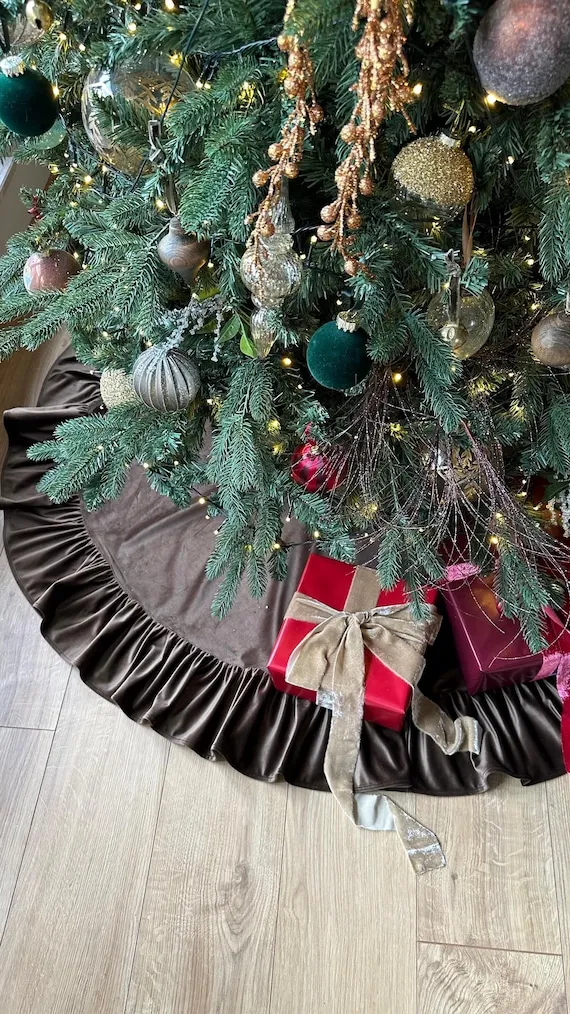
Size the skirt, don’t guess. Measure the widest branch span of your tree, then buy a skirt about 1.5 times that. A 7-foot tree usually spans 48 inches, which means a 60 to 72-inch skirt. Too small and the stand peeks out at the corners; too big and it looks like the tree borrowed someone else’s coat.
9. Rusted Metal Cutout Trees Lit on a Stone Porch
Rusted metal has crossed over from salvage yards to the entry, and it’s the least fussy holiday look of the decade — no storage bin, no color matching, no worrying about stains. The patina improves with weather instead of degrading. Expect to see more of it in 2026 as people trade disposable garlands for pieces they can leave up through February without embarrassment.
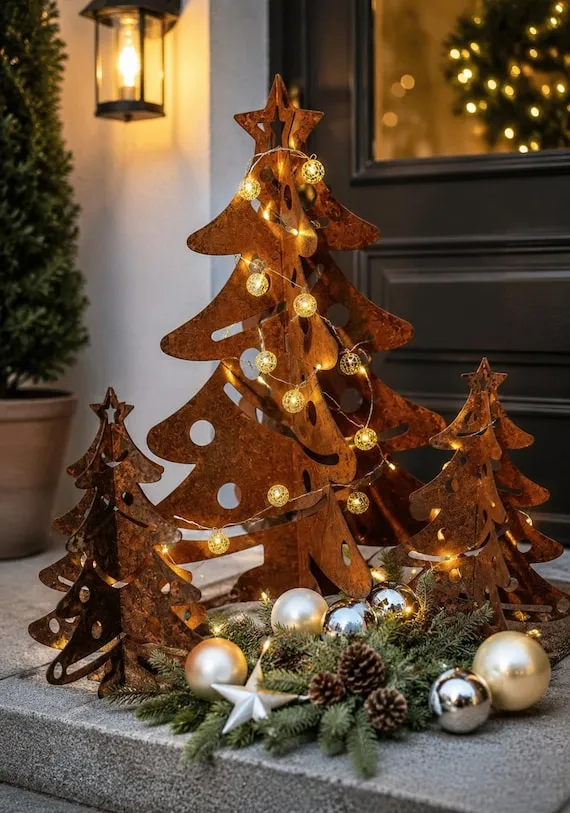
Lighting a cutout tree takes about 25 minutes and $30.
- Zip-tie a strand of round-bulb lights along the inner frame, not the outer edges.
- Run the cord down the back so it disappears behind the sculpture.
- Add an outdoor-rated timer so you’re not plugging in twice a day.
- Pile evergreen boughs and pinecones around the base to hide the cord.
- Tuck in three or four gold and silver ornaments — that’s all the sparkle it needs.
Compare with Idea #24 — same rusted metal vocabulary, scaled down to a tabletop.
10. Slatted Wood Tabletop Tree in Gray and Natural Brown
Tabletop trees exist for consoles, but size matters more than people expect. A 12 to 20-inch tree works on a 30 to 40-inch table; anything taller starts competing with whatever hangs above it. These read best in rooms from about 8 by 10 feet up, and if you’re working with a 14-foot wall, you want a trio at three different heights instead of one lonely tree.
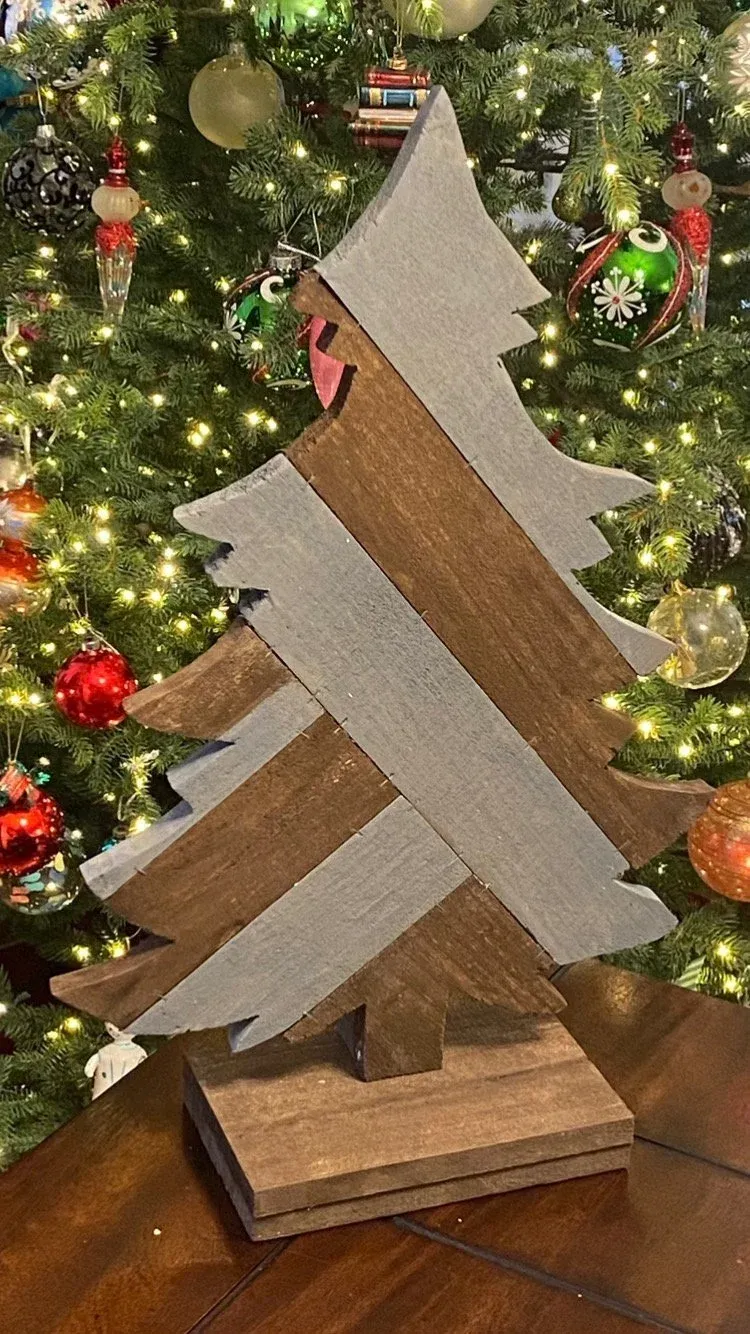
The mix here is 60 percent dark wood, 30 percent weathered gray, 10 percent warm light spilling from the tree behind it. That’s why the alternating slats work — it’s the same material at two different values, so your eye reads texture without a single ornament. Want it warmer? Swap the gray slats for cream-painted ones. Keep the ratio and the piece still holds together.
11. Rusted Metal Disc with a Wooden Deer Layered On Top
It’s the shadow. Because the wooden deer is mounted slightly off the metal disc, it throws a soft silhouette across that rusted patina every time the tree lights shift behind it. That gap is the entire reason a $12 ornament looks like something from a gallery. Glue it flat against the disc and you just have a deer on a circle.
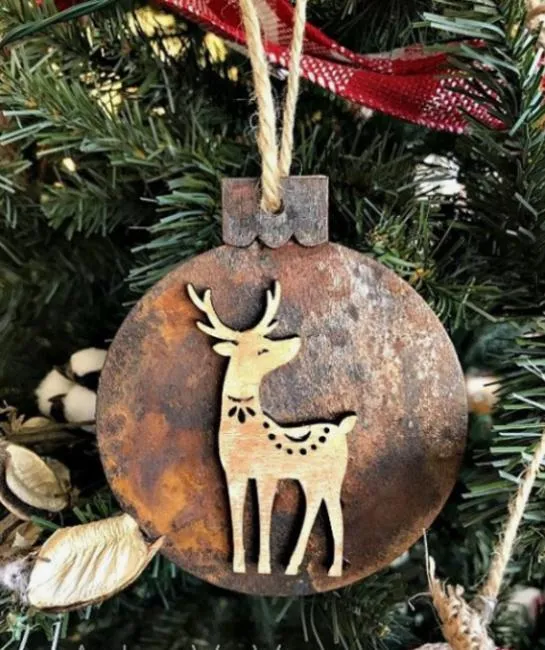
The craft-store version runs $6 to $12: one wood disc, one small deer cutout, a scrap of twine, two dabs of wood glue. Etsy sellers price finished versions between $9 and $24, so if you’re making more than six, buy the pieces in bulk. Thrift stores and estate sales turn up genuinely rusted versions cheap — look in the tool and hardware boxes, not the craft bins.
12. Copper, Champagne, and Glossy Black on Dense Branches
Two things are happening at once. Copper, gold, and champagne sit within a few degrees of each other on the color wheel, so they layer without fighting. And the glossy black balls give the scheme somewhere to land — without them, warm metallics just float. The black-framed window repeats that same dark line in the background, which makes the whole palette feel deliberate instead of accidental.
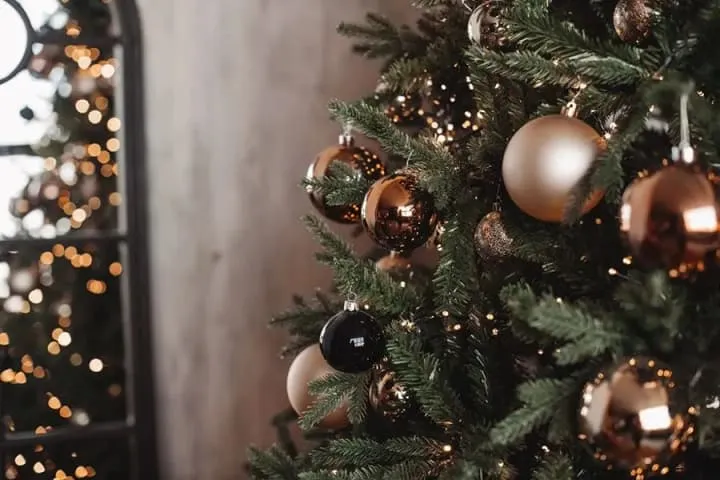
Glossy finishes show everything: dust, fingerprints, the smudge your hand leaves when you rehang one. At close range they’re gorgeous; from across the room they mostly read as shiny. If you have pets who bat at low branches, keep heavy glass pieces in the top two-thirds and stock the bottom with lightweight metallics that won’t take out a branch when they fall.
13. Fresh Evergreen Branches with Glossy Red Baubles
Fresh greens drink more than you think. A real tree needs roughly one quart of water per inch of trunk diameter in that first week — a 4-inch trunk means a gallon a day, minimum. Check it twice daily for the first ten days. Using cut branches instead? Re-cut the stems at an angle, soak overnight in cool water, then mist every other day once they’re on the mantel.

Fresh evergreens ask for more room than faux. Plan a 6-foot swag for a standard 5 to 6-foot mantel, and give yourself a 12 by 12-foot room at minimum so the scent doesn’t overwhelm a small space. Ceilings under 8 feet get crowded fast with real branches. Tighter than that, go faux and hang one fresh wreath. Want the same red without real needles? Idea #21 does it entirely with faux branches.
14. Gold Beaded Garland with Bark Hearts and Snowflakes
Hanging a beaded garland so it drapes instead of stretching takes about 15 minutes and $18 in supplies.
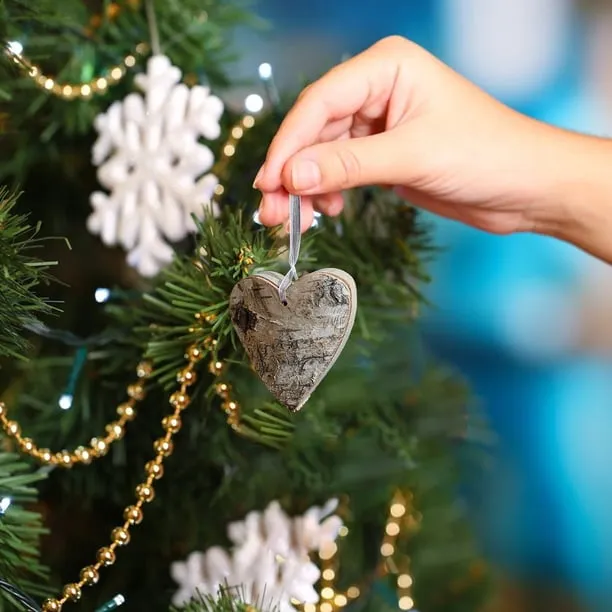
- Measure from the top of the tree down and around twice, then buy 1.5 times that length.
- Start at the top and work down in three loose loops, spaced 12 to 14 inches apart.
- Secure each loop to a branch with a small piece of floral wire — not a twist tie.
- Hang the bark hearts just under the garland line so they catch light from above.
- Finish with a few white snowflake ornaments near the branch tips.
Bark and wood crack when indoor air gets dry. Once your heat runs and humidity drops below 35 percent, expect hairline splits in thin wooden ornaments — cosmetic, not a failure, but a light rub of mineral oil once a season slows it down. Beaded garland is the fragile part: coil it loosely and expect a snapped string every couple of years.
15. Wooden Bark Hearts on Thin White Ribbon
Break it down as 60 percent natural wood, 25 percent white and cream, 15 percent warm amber light — and notice there’s no red anywhere. That’s what makes this version feel calm instead of festive. Want it warmer? Push the wood to 50 percent and add 10 percent deep green ribbon. Want it cooler? Trade the white ribbon for grey. You’re protecting the proportions, not the colors.

The ribbon width. Those hearts hang from a thin, roughly one-eighth-inch white ribbon, and that single choice is what separates them from a craft-fair ornament. A wide ribbon would make the hearts look heavy and homemade. Thin ribbon makes them look collected. If you’re restringing old ornaments, buy the narrowest ribbon that still holds the weight.
16. Console Table Vignette with Pinecone Candles
Under $120 including a budget console. A thrifted white ridged vase runs $8 to $15, Dollar Tree greenery and faux red berries total about $6, and printable pine tree artwork is free to $6 on Etsy in a $10 Walmart frame. The beaded garland is a $12 Target find, pinecone candles are the splurge at $18 for the pair, and an IKEA console covers the table for $79 — or $40 used on Facebook Marketplace.
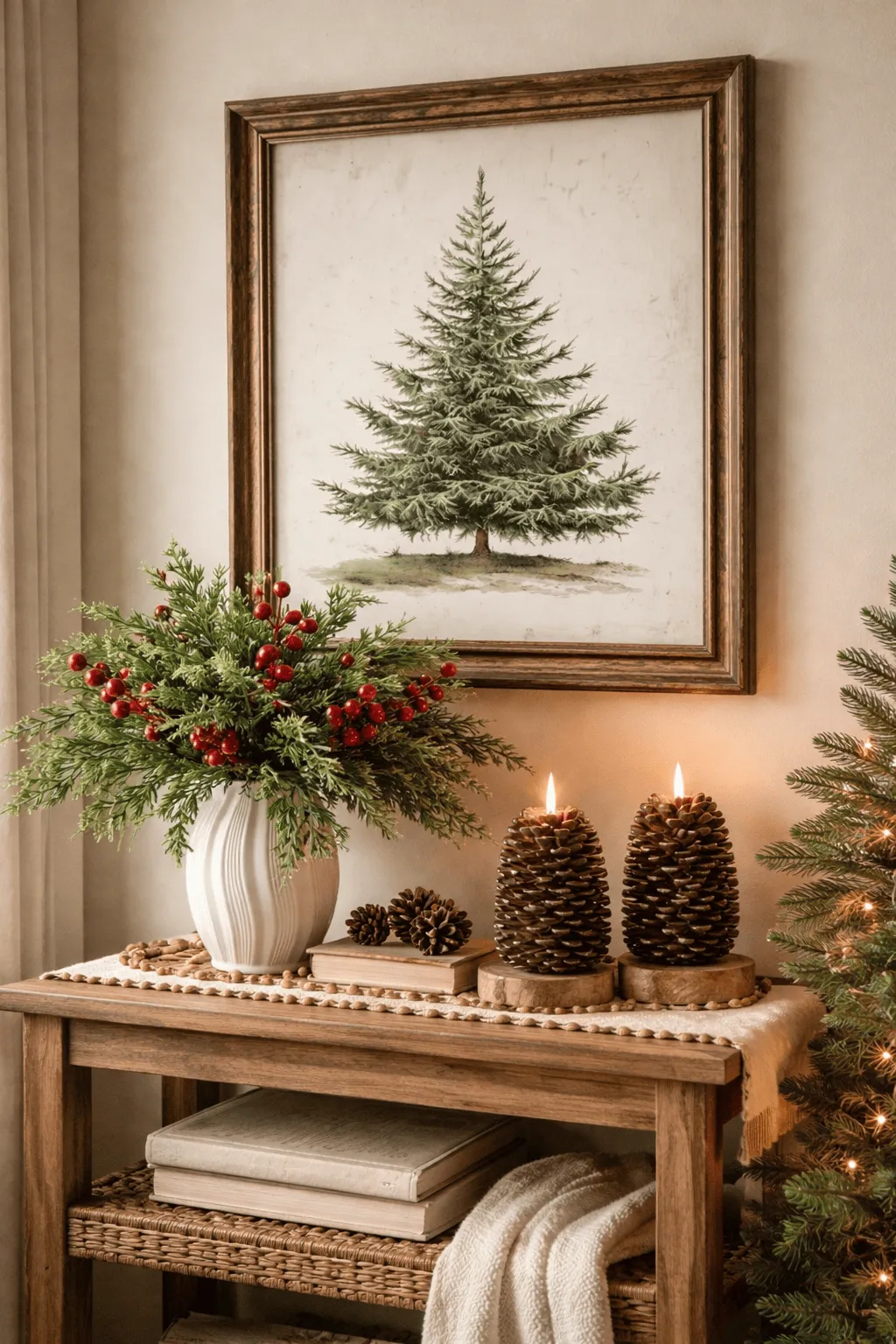
Everything sits at a different height on purpose: the framed art anchors your eye up high, the vase holds the middle, the candles step down, and the beaded garland runs horizontally to tie it together. The lit tree at the right edge is the light source. Take the frame away and the whole thing collapses into a table full of stuff.
17. Tiered Wood Tabletop Tree Against Plank Walls
There’s a real shift in 2026 toward trees with no color at all — raw wood, one carved star, a single twine bow with wooden beads. It’s the holiday version of quiet luxury, and it plays perfectly against plank walls and warm-minimal interiors that have dominated Pinterest for two years. The upside: it never dates, stores flat, and needs exactly zero ornament boxes.
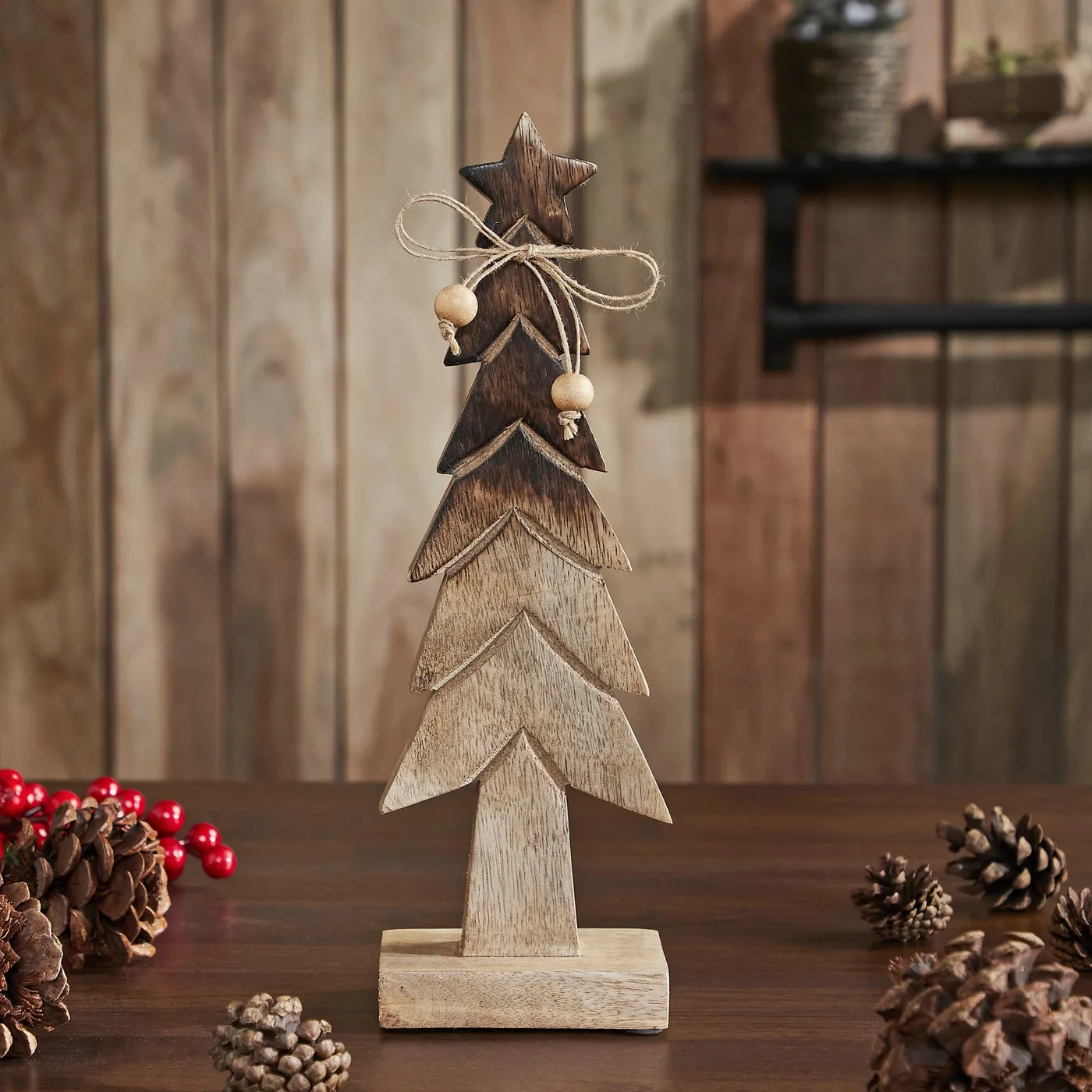
A 14 to 18-inch carved tree is the right scale for a 36 to 40-inch sideboard, and it holds up in a space as narrow as 4 feet — this is the piece for the hallway console nobody knows what to do with. Where plank walls and a full mantel already exist, go bigger or go home. For the version that works on a long, thin console, see Idea #10.
18. Dried Orange Slices and Star Lights in a Bedroom
Run through this list before you commit:

- Confirm an outlet within 3 feet of the tree — extension cords across a bedroom floor are a trip hazard.
- Measure your nightstand or dresser top; a tree over 20 inches will crowd a bed you walk past daily.
- Keep bedroom humidity between 40 and 50 percent so the orange slices don’t absorb moisture.
- Decide now where the tree lives in January, because small trees in bags get shoved into closets and forgotten.
Those orange slices are only shelf-stable if they’re genuinely dry. Anything with soft, tacky centers will mold in a warm bedroom within weeks — a 3-hour bake at 200 degrees F and a full cool-down takes care of it. Also worth knowing: bedroom trees collect dust like nothing else, so plan on a soft-brush cleaning in March before storage.
19. White Metal Houses and Wooden Trees on a Mantel
Hang the canvas 6 to 8 inches above the mantel shelf. Closer and the garland crowds it; higher and the whole arrangement disconnects from the fireplace. Then let your garland overhang the mantel ends by 6 to 10 inches on each side. That overhang is what makes a mantel look styled rather than arranged, and it’s the single most common step people skip.
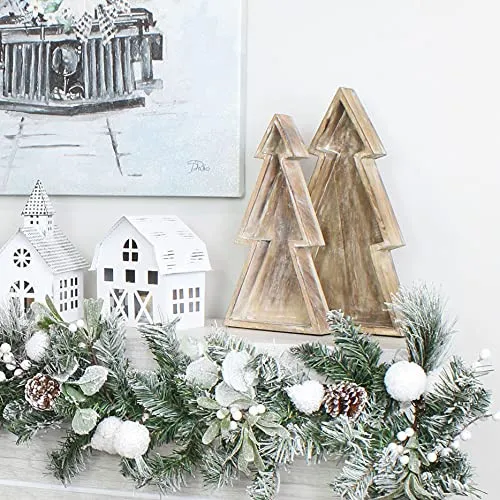
You can flock a faux garland yourself in about 15 minutes for $12, instead of paying $70 for a pre-frosted one.
- Lay the garland flat on a tarp or a trash bag.
- Hold the spray snow 12 inches away and dust in short bursts — never a continuous spray.
- Let it dry 20 minutes, then flip and repeat if the garland is visible from both sides.
- Add pinecones and white berry picks for real texture on top of the fake snow.
20. Glossy Red Baubles, Silver Snowflakes, Star Anise
Every red here is a different finish — glitter, high gloss, matte star anise — so a single color reads as depth instead of one flat block. The glossy ball with silver snowflake detailing catches light from an angle the plain ones miss entirely. And the cream knit sleeve in the frame is a clue: cream, not white, is what keeps red from looking like a sale aisle.

A 24-count set of red baubles runs about $10 at Walmart or Target, and a bag of star anise is $4 in the spice aisle — loop them on twine and they look like they cost ten times that. Red ribbon is $3 a roll, and the small star cutouts at the base are a printable. Total for a fully red-dressed tree: under $40. If the gloss feels too polished, Idea #25 gets the same red with felt and paint.
21. Red, Green, and Muted Metallics Up Close
It’s the muted metallic green bauble. Shiny red alone and shiny green alone will fight each other across a room — both fully saturated, neither giving way. That one dulled, greenish-metal ornament sits between them and absorbs the tension. Pull it out and this tree goes from collected to loud in about ten seconds.

The ratio is roughly 50 percent red, 30 percent green, 20 percent muted metal, and the metal is what makes it a scheme rather than a Christmas tree. Want less red? Drop to 40 and raise the metal to 30, but hold green at 30 so it still reads seasonal. Warm 2700K lights hold all three together; cool white lights split them apart.
22. Sparse Tabletop Tree in a Woven Basket by Bookshelves
Sparse trees dry out fast because there’s simply less trunk holding water. Expect to check the reservoir twice a day for the first two weeks, and know that a tree this small drops needles faster than a full-size one once it starts. If you line the woven basket, use a plastic liner plus a saucer — water rings on white shelves are permanent. Budget one 20-minute refresh a week.
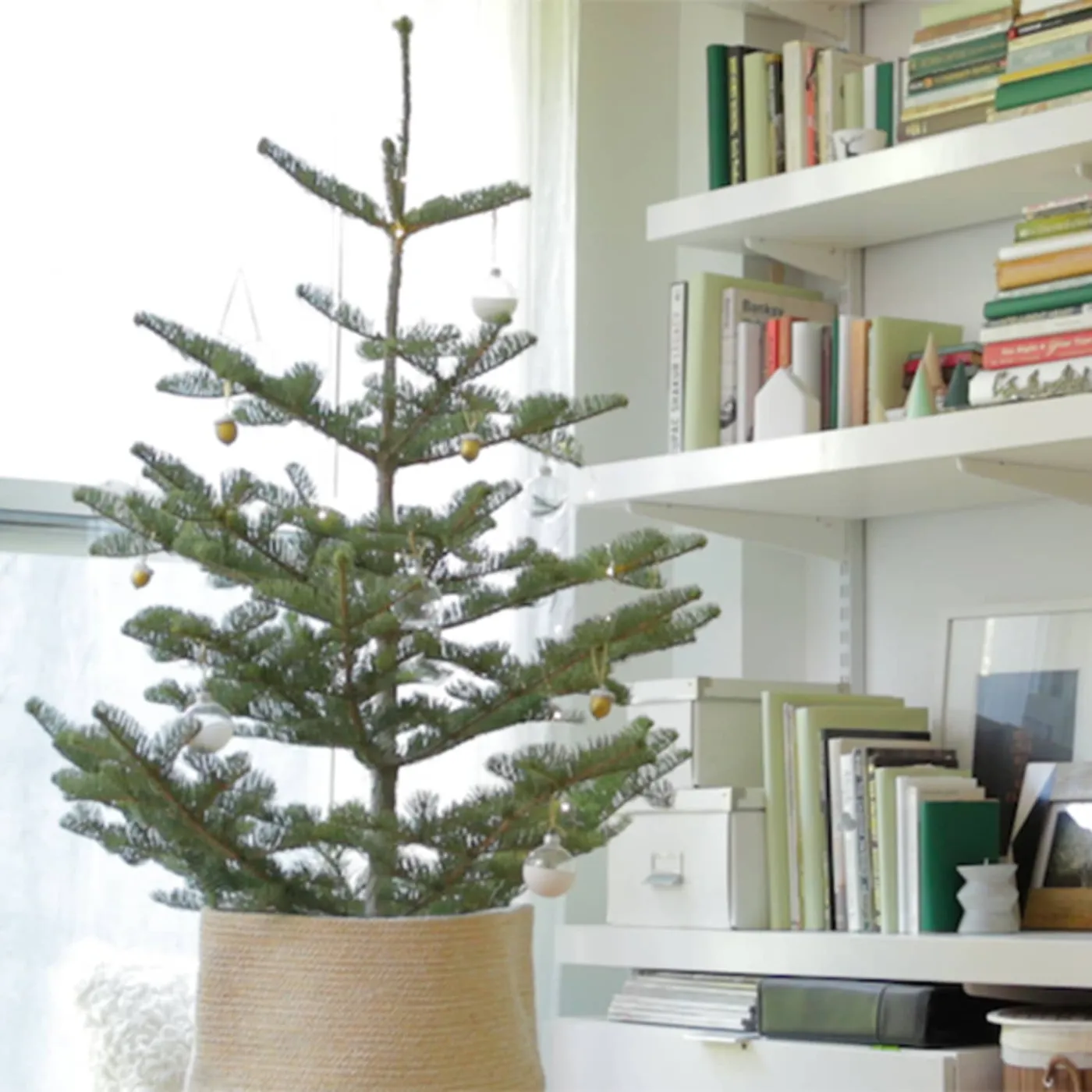
Color-coordinating your books is a real styling move, but leave about 30 percent of the spines in the “wrong” shade on purpose. A shelf of perfectly green and cream spines looks like a store display; three off-palette books make it look like a home where somebody actually reads. And don’t stack shelves to matching heights — vary them by 2 to 4 inches.
23. Laser-Etched Wooden Squirrel with a Cream Ribbon
Rough numbers for this look:
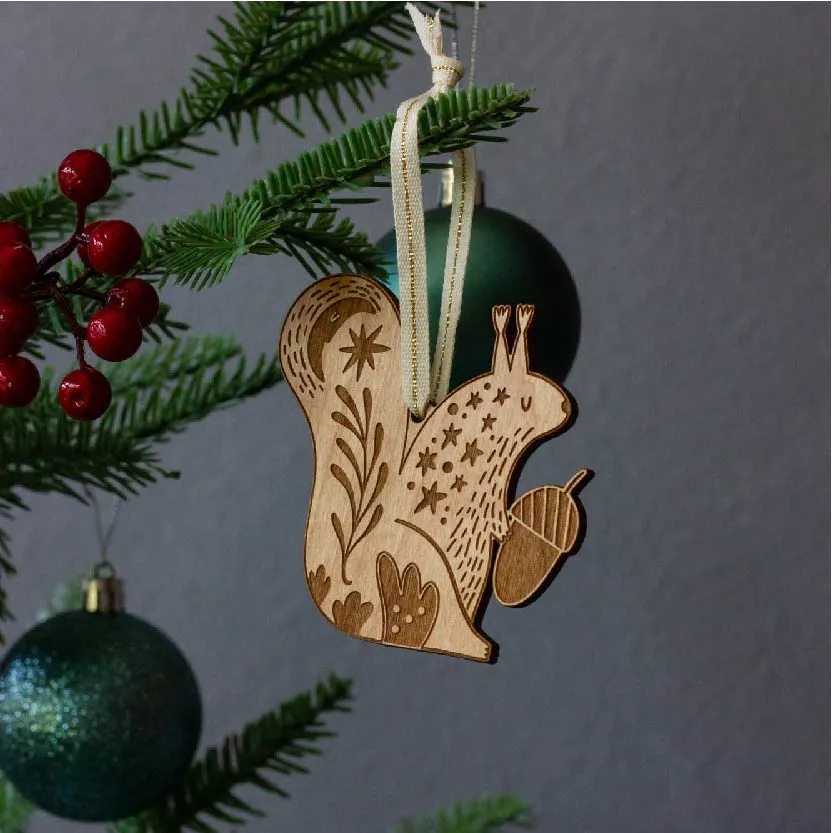
- Tree and lighting: $70-$180 for a 6 to 7-foot tree plus warm fairy lights
- Textiles: $20-$45 for a linen or burlap tree collar
- Ornaments and decor: $35-$95 for laser-cut wood figures, dark green baubles, and faux red berry sprigs
- Ribbon and hangers: $10-$25 for cream fabric ribbon in two widths
- Wall treatment: $0 — this look wants a plain wall behind it
- Total: roughly $135 to $345
Budget alternative: laser-cut shapes are $2 to $5 each at a craft store and a roll of cream ribbon is $4. Ten ornaments and one spool gets you 80 percent of this for under $40.
Small ornaments are a distance decision. A 3.5-inch squirrel reads clearly from 3 to 5 feet and vanishes across a great room. In a space larger than 16 by 16 feet, cluster this scale near the front of the branches instead of scattering it. In a 10 by 12 living room it’s exactly right — and you’ll want about 40 of them, not 12.
24. Black Wire Spiral Tree with Vintage Glass Baubles
Wire trees tip. Heavy vintage glass ornaments on a light metal frame are a bad match unless you weight the base — set it on a slab, drop river stones inside the bottom ring, or clamp it to the table. Glass baubles plus cats is the other known risk, and check the wiring on any truly vintage light strand before it goes anywhere near a plug. Small-space version: Idea #22.
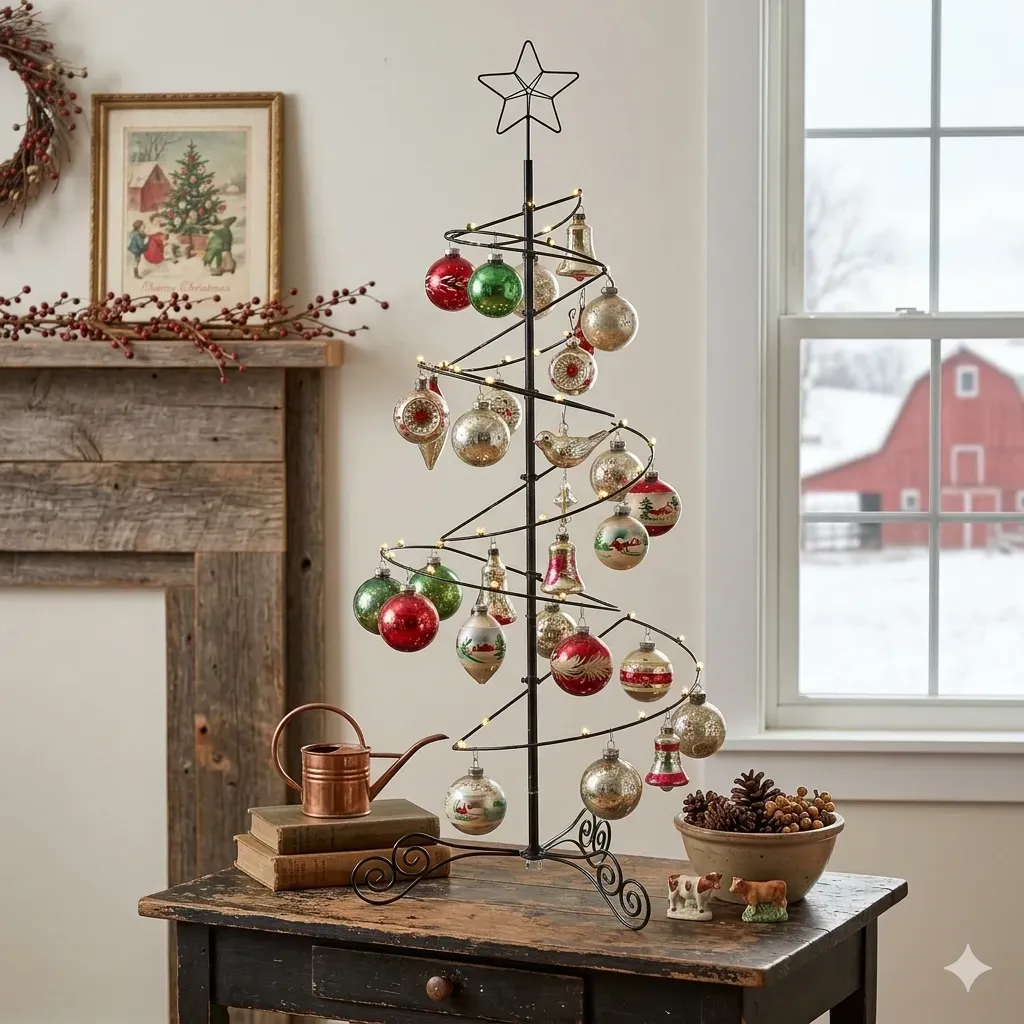
The window. Past the mantel, the berry garland, and the bowl of pinecones, what makes this vignette feel like a place instead of a display is the red barn framed in the glass. Borrowed scenery costs nothing and does more than any ornament you can buy. No barn? You have a tree, a streetlight, or a sunset. Point the table at whatever it is.
25. Folk Art Animal Ornaments and a Turquoise Tassel
Roughly 45 percent handcrafted wood, 25 percent saturated felt, 20 percent natural pinecones, 10 percent turquoise. That last 10 percent is doing outsize work — it’s the only cool note on an otherwise warm tree, and cool against warm is what makes folk art feel alive. Drop the tassel and the whole scheme gets sweeter and a little duller.
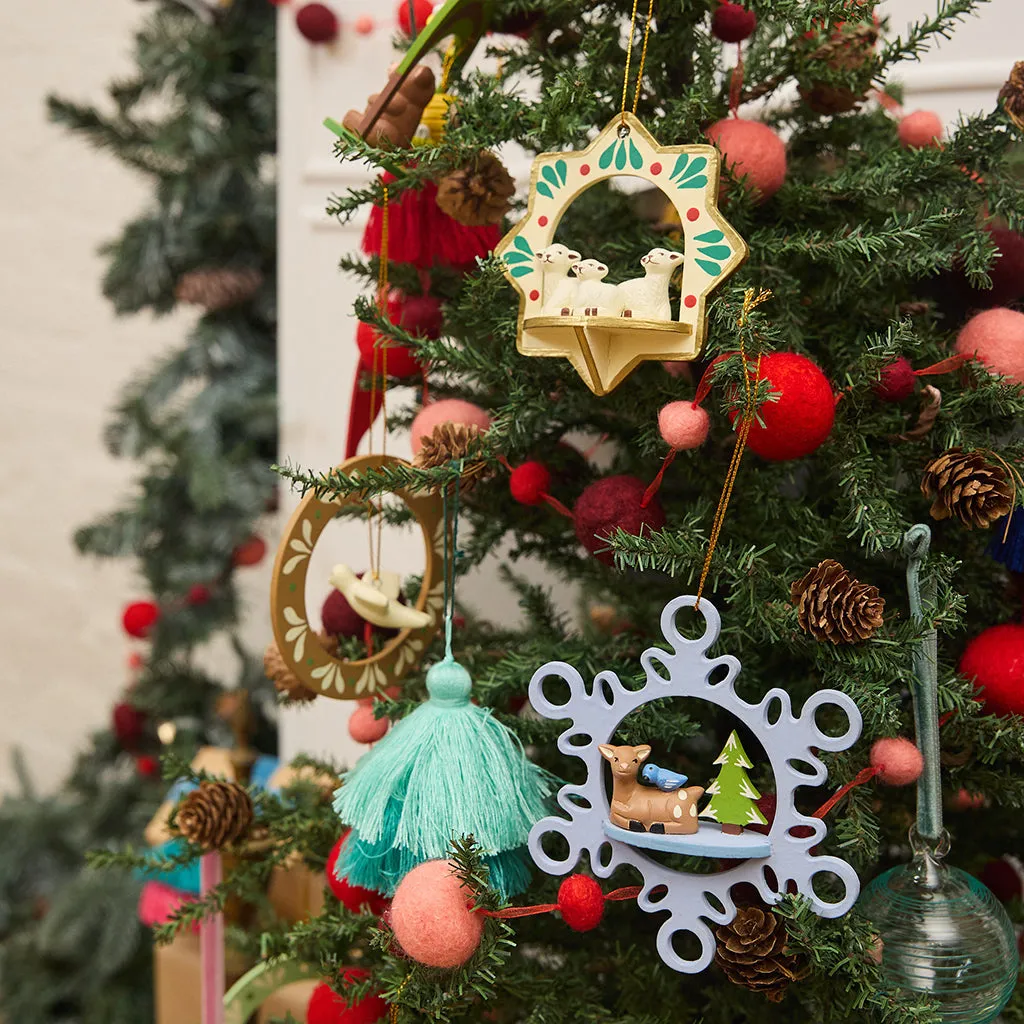
The frame ornaments repeat one shape — a simple painted wooden frame — but every interior holds a different animal. That’s repetition with variation, which is why your eye keeps circling instead of stopping. Add felt balls and pinecones at irregular intervals and the rhythm stays loose. Space them evenly and it starts to look like a craft fair booth.
Pick Your Tree, Then Pick Your Pinecones
The best rustic trees aren’t the most decorated ones — they’re the ones where wood, wool, metal, and light all agree with each other. Start with the palette formula from Idea #6, borrow one texture from Idea #14, and let the room tell you when to stop.
📌 Save this to Pinterest before you shop — and tag us when your version goes up.