
Most woodland Christmas trees fail for the same reason: they’re all brown. The ones that actually work — the ones you keep saving on Pinterest — almost always sneak in one cool note, like a blue glitter antler, a red cardinal, or a single gold cord against rough bark.
We spent serious time browsing Etsy, Anthropologie, Target, and Walmart to bring you only what’s worth your attention this year — 26 ideas ranging from a $4 birch cutout to a $215 candle-and-evergreen centerpiece. Inside you’ll find flocked and frosty trees, handmade felt animals in tiny knitted sweaters, bark and sisal ornaments, and the warm amber clip-on candle look that’s suddenly everywhere again. Budget and luxury versions sit side by side so you can see exactly where to spend and where to save. And stay until the end — we break down the most common mistakes that can ruin these looks.
Why now? 2026 is the year woodland styling got quieter: fewer glitter finishes, more raw wood, pearl, and carved faces. Save this to Pinterest for later — you’ll want to revisit these ideas.
1. Glass Deer With Blue Glitter Antlers
The body is molded glass painted brown with gold glitter and white dappling, but the antlers are blue glitter — and that single cool note against all that warm gold is what keeps the deer from sliding into full nostalgia. The animal stands on a glossy green textured base that mimics grass, which means it can hang right against evergreen and read as if it lives there. Swap those antlers for brown and you’d have a lovely but completely ordinary ornament.
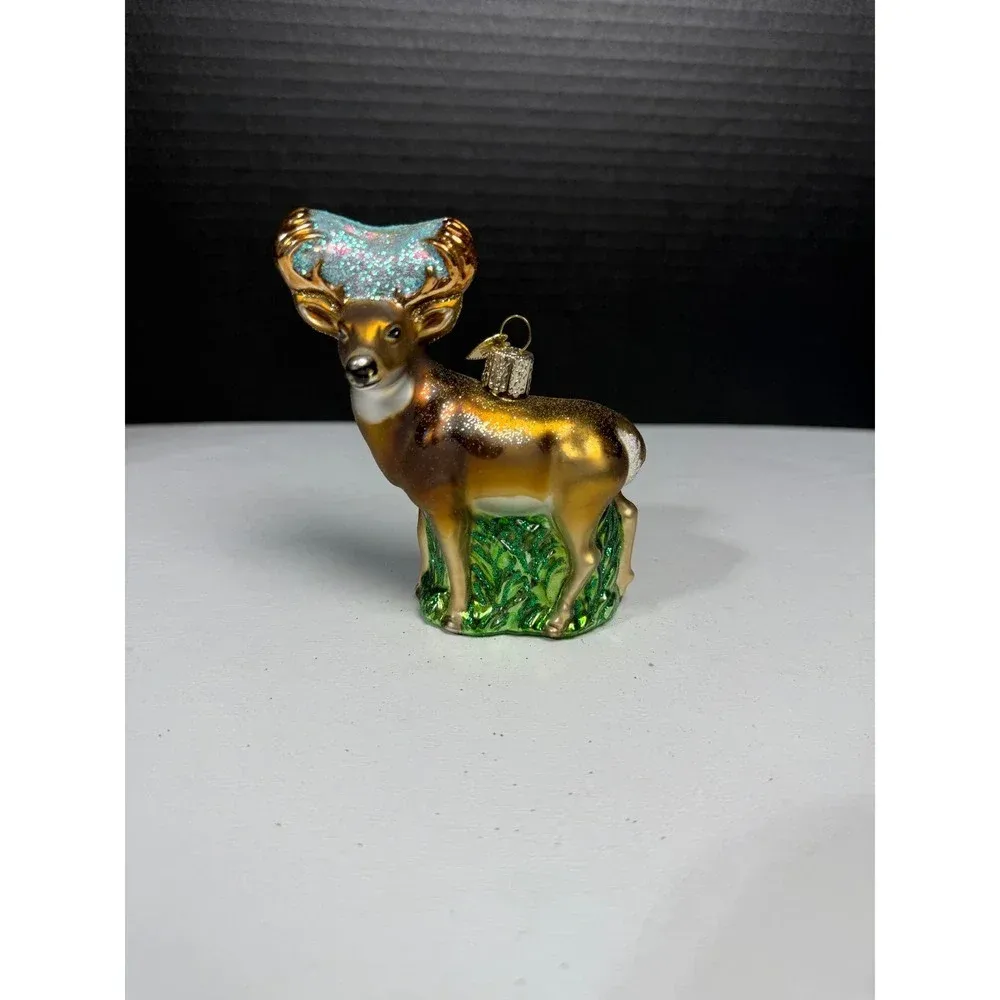
Glass figures this heavy need to hang on an inner branch, close to the trunk, where the wire is thickest — hang it near a tip and you’ll find it on the floor by December 12th. Use a 4-inch metal hook rather than a ribbon loop so it sits at eye level in the tree, and keep any other glass pieces within an 8-inch radius so the eye reads one deliberate cluster instead of scattered sparkle.
2. Felt Reindeer, a Cardinal, and a Mini Tree
Take the red cardinal off the reindeer’s back and you still have a decent felt toy. Put it back and you have a scene — an animal carrying something, going somewhere. That tiny bird is the difference between decor and a story, and it costs the maker pennies. When you’re shopping for handmade ornaments, look for the small detail that implies action; those are the pieces guests pick up and ask about.
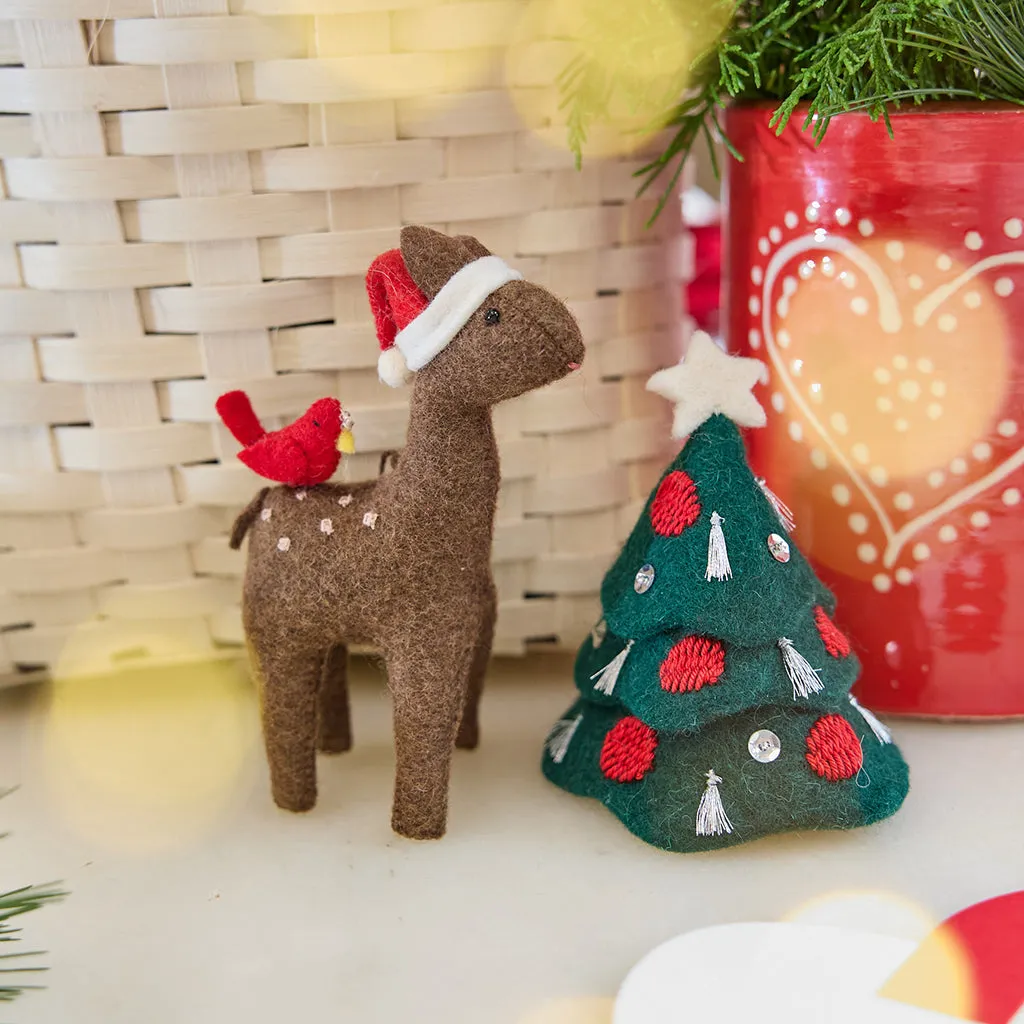
Building this little shelf moment takes about twenty minutes:
- Turn a woven basket upside down so the flat bottom becomes a riser.
- Set the tallest felt tree at the back-left, then the reindeer 6 inches forward and slightly right — never dead center.
- Place the red container at the opposite corner so the two reds balance across the composition.
- Step back 6 feet. If the three pieces read as one triangle, you’re finished.
- Leave 3 inches of empty surface behind the tallest piece so it can breathe.
Time: 20 minutes. Cost: $0 to $45 if you thrift the basket.
3. A Felt Fox Dressed for Winter
Dressed-up animal ornaments — foxes in scarves, mice in sweaters — have been quietly replacing the classic glass ball for a few seasons now, and 2026 is the year they went mainstream. It tracks with the broader shift toward small-batch and handmade: felters on Etsy were sold out by October last year. These pieces also photograph beautifully, which is exactly why they dominate Pinterest, and they’re sturdy enough for households with kids and dogs.
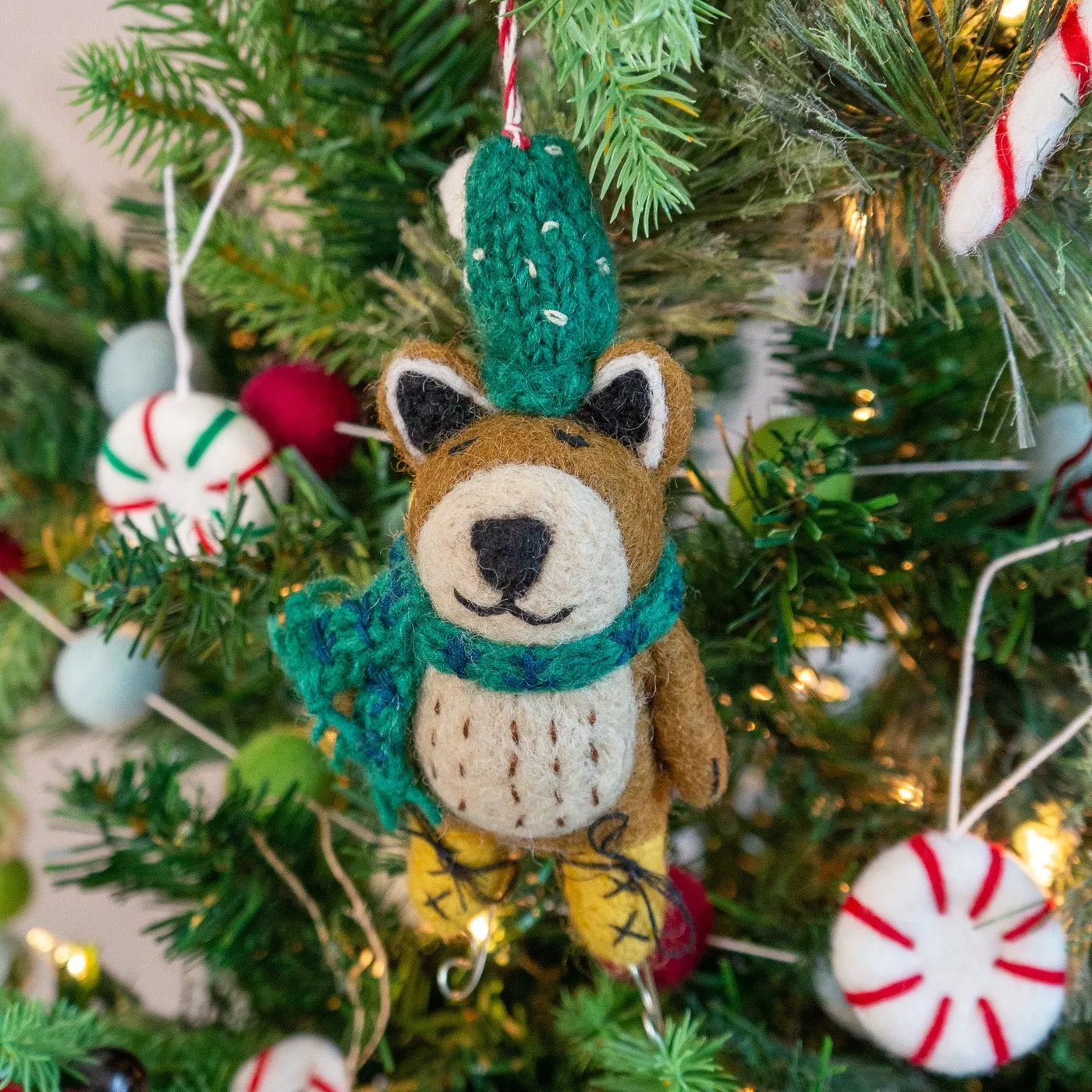
The branch formula here is roughly 50% evergreen and neutral felt, 25% red-and-white candy stripes, 15% forest green knit, and 10% warm bulb glow. Swap the candy stripes for snowflake shapes and you keep the sweetness with less whimsy. Swap the green knit for mustard and the whole thing turns vintage — same percentages, entirely different mood. Ratios matter far more than the specific ornaments you buy.
4. Flocked Tree Full of Woodland Animals
This is a 9-foot-ceiling idea. A heavily flocked tree with a cluster of branches as a topper needs 8 feet of tree plus at least 8 inches of clearance above it, so a 7.5-foot tree is the honest maximum under a 9-foot ceiling. In a room with 8-foot ceilings, drop to a 7-foot slim tree and trade the branch cluster for a single tall pick — otherwise the whole corner feels stuffed. Compare with Idea #7 for rooms with more height to work with.
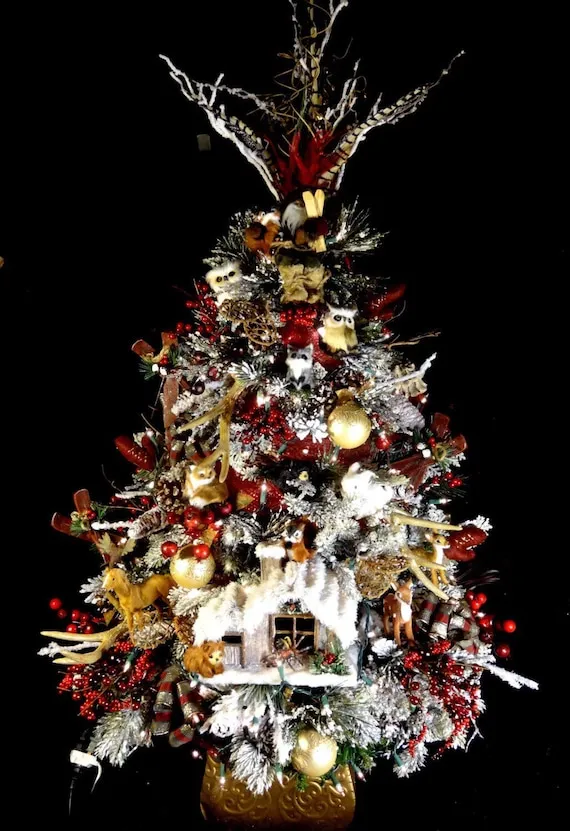
Three things are doing the work. Red berries are the only saturated color in the entire tree, so they pop like traffic lights. The figurines sit at three depths — the snowy cabin low and forward, mid-size animals tucked inside the branches, tiny ones out near the tips. And that little cabin acts as a visual full stop at the base, which is why your eye travels down the tree and settles instead of wandering back up.
5. Tiered Racks of Tiny Knit Gnomes
When you display a collection on a tiered rack, leave at least 4 inches between tiers or the pointed hats tangle every time you move the stand. Group by color family rather than size — reds together, whites together — and use odd numbers per tier, five or seven, never six. The eye wants an odd count to feel collected rather than merchandised.
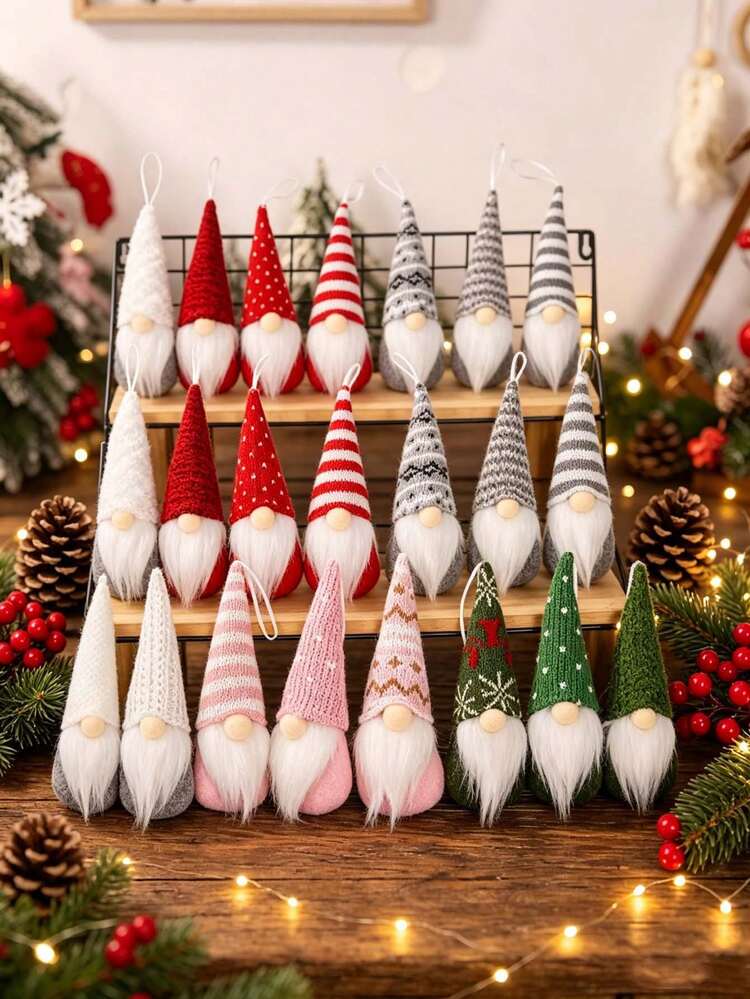
Plush ornaments are dust magnets, and a tiered rack means dusting each one individually instead of running a cloth over a tree. They’re also the first thing a dog pulls off a low shelf. With pets or a toddler, either raise the rack above 40 inches or rotate the collection monthly. Skip illuminated display stands with incandescent bulbs — those get warm enough to melt flat-back sequins and shrink knit hats.
6. A Bark Moose Ornament Hanging on Birch
You can get this look at three price points. Big-box stores sell laser-cut birch ornaments with printed grain for $4 to $8 each; they’re flat, but they read fine from across the room. Better: buy a single sheet of birch bark from a craft supplier for about $12 and cut three ornaments with a craft knife. Best: watch Facebook Marketplace in November, where woodworkers clear out last year’s stock at half price.
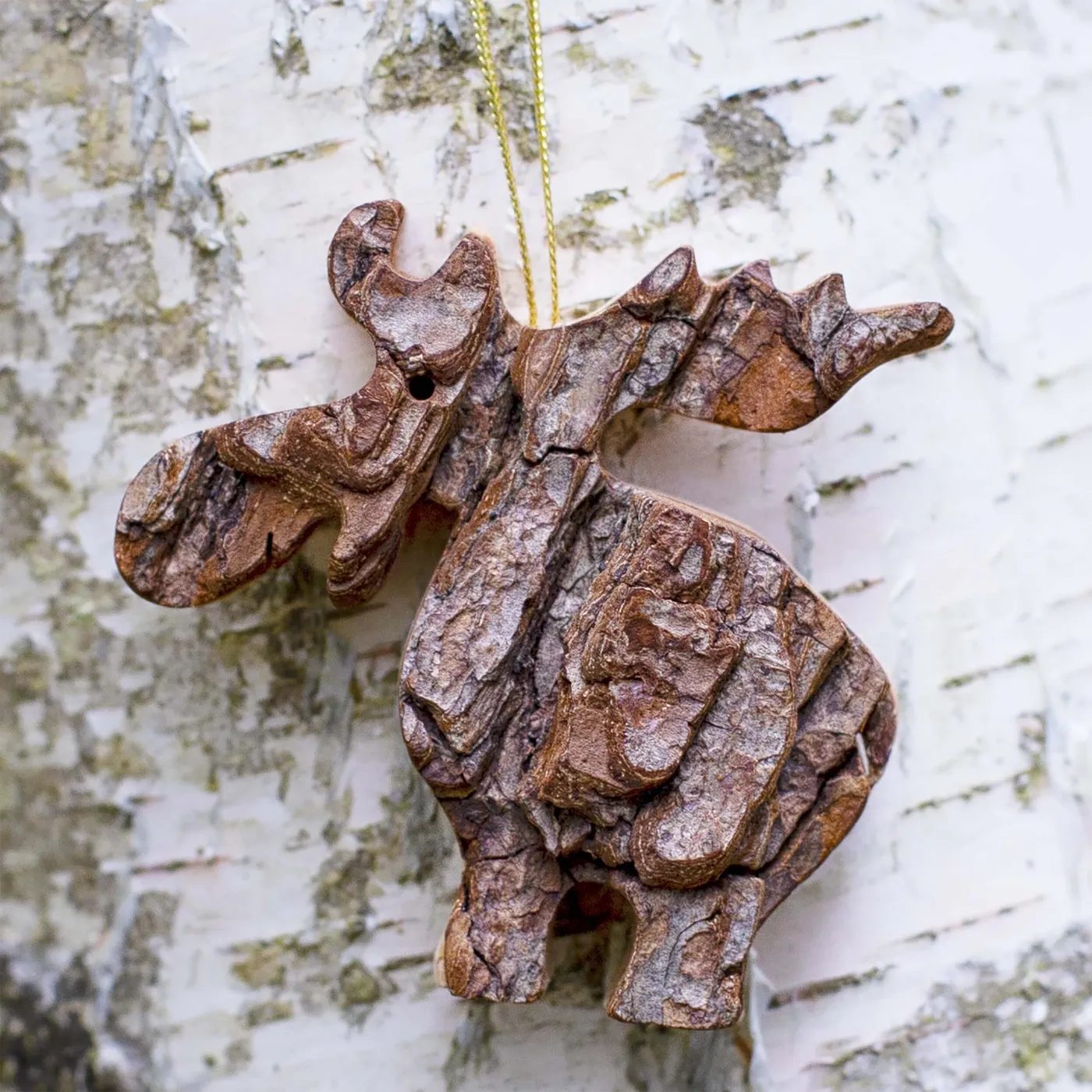
It’s the cord. A thin gold metallic string against rough brown bark is the entire point — precious meeting humble, which is what makes this read as designed rather than as driftwood. Swap it for a green ribbon and the ornament becomes generic woodland decor; swap it for twine and it just looks unfinished. If you’re making your own, spend the extra dollar on metallic cord.
7. Bells, Ribbon, and a Frosty Branch Topper
Break this tree down and you get roughly 60% flocked evergreen and neutral, 25% fabric — ribbons and floral picks — 10% metal bells and gold, and 5% red berries for pulse. Change only the fabric and the tree changes personality: buffalo plaid goes farmhouse, velvet goes glam, burlap goes rustic. Keep the flocked base and the metal at the same ratio and you can’t really go wrong. Same flocked formula, different accents — see Idea #16.
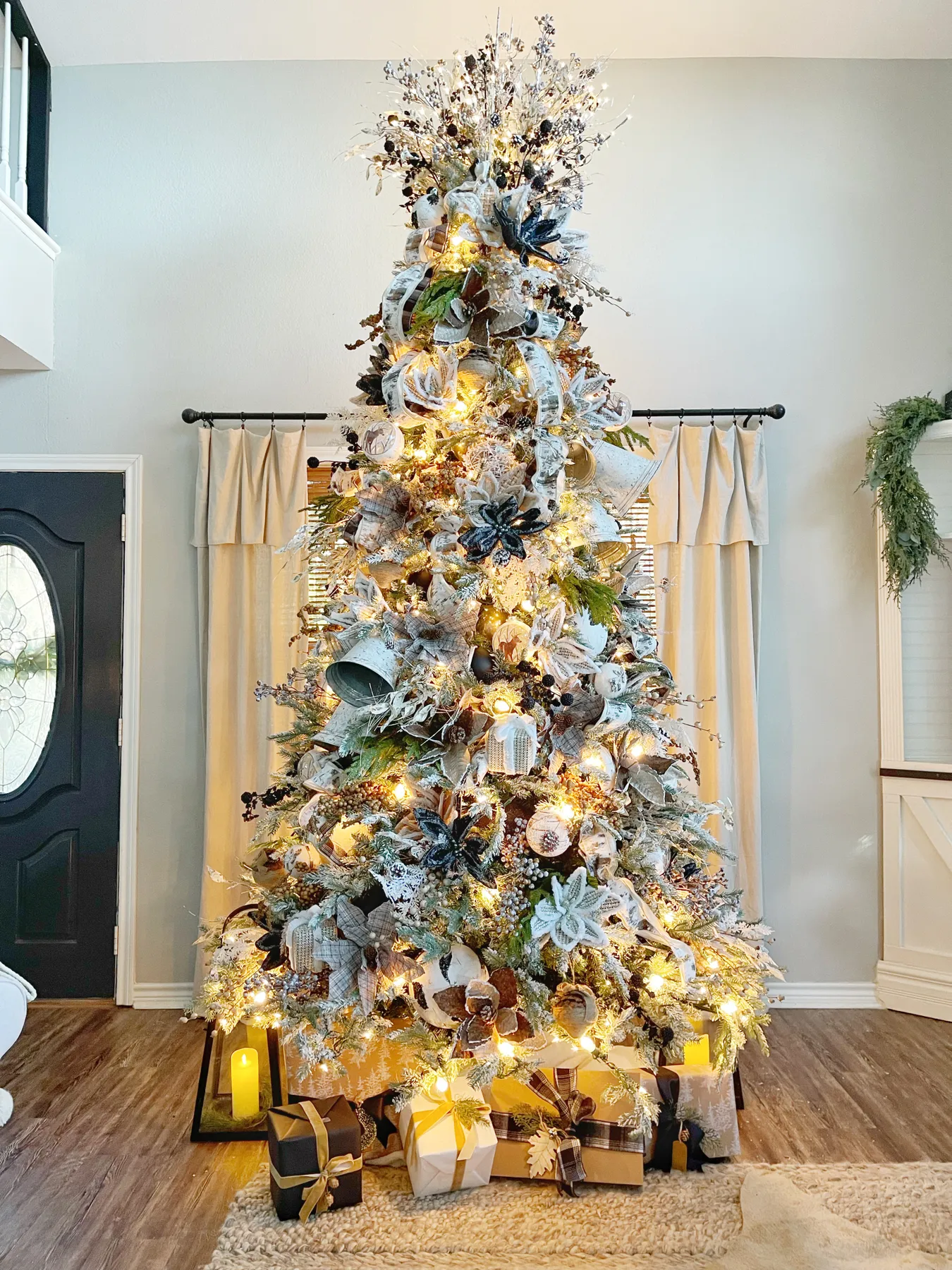
Flocking sheds. Expect a light dusting of white on the floor every time you move the tree, and vacuum with a brush attachment, never a beater bar. Store the tree in a breathable bag rather than shrink wrap so the flocking doesn’t yellow. Roll your ribbon instead of folding it, or you’ll be ironing crushed satin next November. Budget about 20 minutes of re-fluffing each season, because heavy flocking flattens in storage.
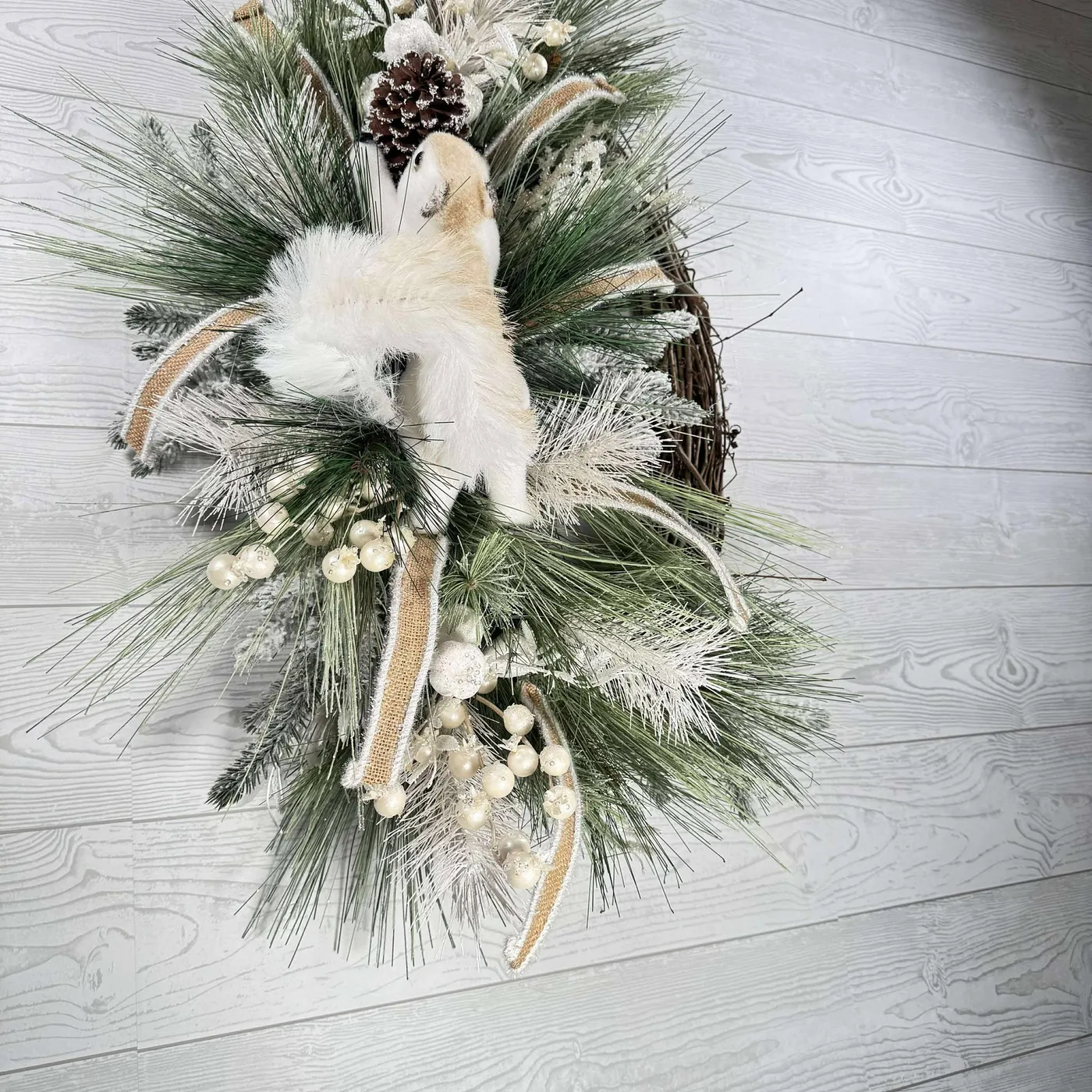
8. Frosted Garland With a Furry Climber
A convincing garland is a layering job, not a draping job. Budget 45 minutes per 9 feet:
- Start with a wired evergreen base and fluff every tip outward — flat garland looks like rope.
- Add picks in three sizes: small berries, medium pinecones, one or two oversized stems.
- Weave burlap ribbon through every 18 inches, twisting at each pass so it reads as separate loops.
- Tuck the animal figurine right where the garland bends, so it looks like it climbed there.
- Hang it, then backfill gaps with single sprigs pushed in from behind.
Material cost: $35 to $90 for 9 feet.
For a standard 6-foot mantel, use 9 to 10 feet of garland — the extra length is what creates the droop at each end. On stair rails, measure the rail and add 30% for the swags. Ceilings matter too: garland over a doorway needs 12 inches of clearance above the trim or it crowds the frame. Working with a narrow mantel under 5 feet? A single-sided swag beats a full drape every time.
9. A Lit Candle Nested in Ferns and Pinecones
An open flame surrounded by dried evergreens is a real risk, not a theoretical one — dried pine and fern ignite fast. Trim the wick to a quarter inch, keep every branch at least 3 inches from the flame, and never leave the room. If you want the mood without the worry, a battery LED candle with a moving wick gives you flicker and zero smoke. Worth knowing too: the delicate smoke wisps that make a photo like this so atmospheric will trip a smoke detector in a small room.
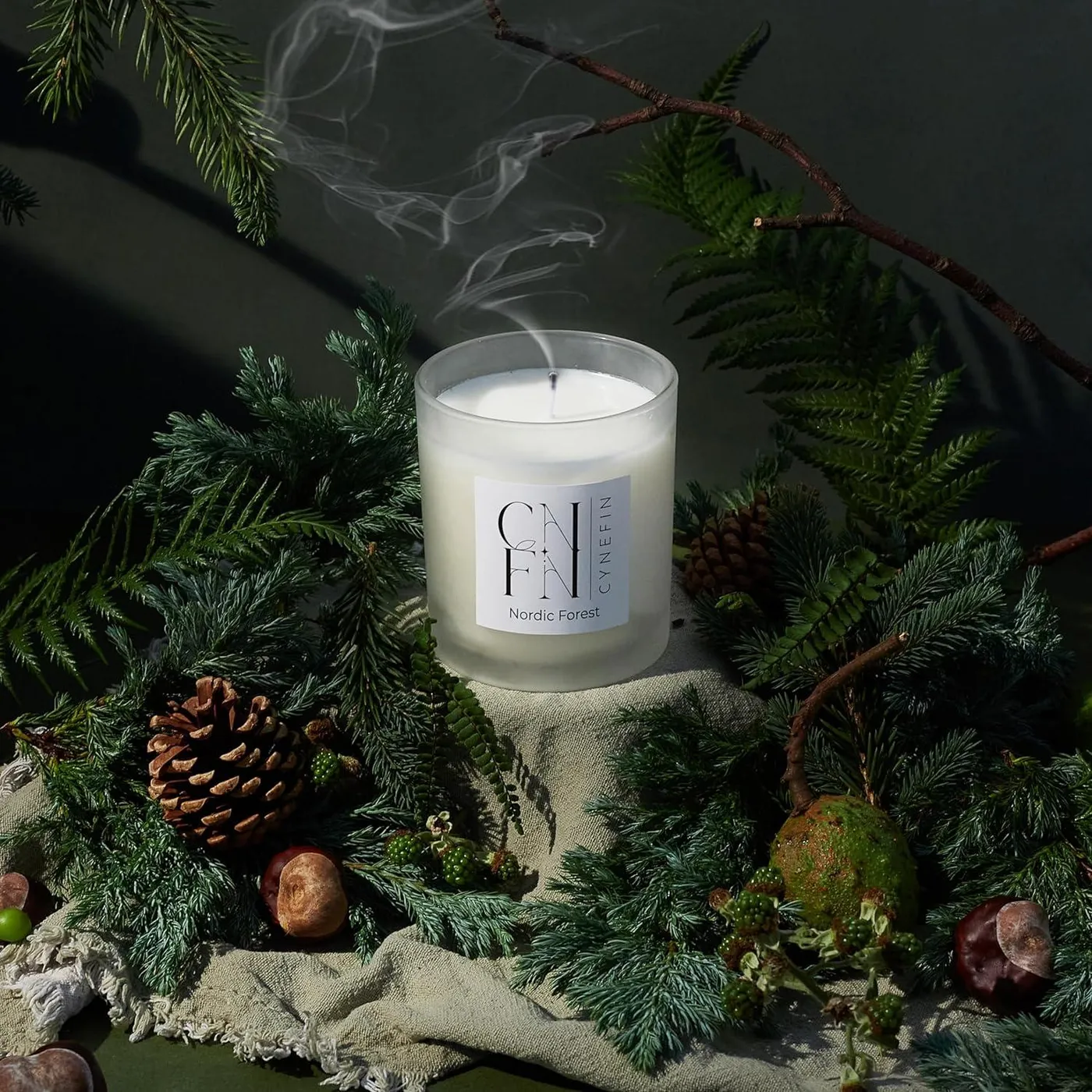
- Frosted glass candle with a simple label: $12–$45
- Fir, fern, and pine stems (fresh or realistic): $25–$70
- Muted green textile or runner as the base: $15–$45
- Pinecones and chestnuts, gathered or bought: $0–$20
- Tray or charger to corral it all: $10–$35
Total: $62–$215. Budget alternative: $40 to $90 with dollar-store greenery, a thrifted tray, and a plain pillar candle.
10. Pink Faux-Fur Owl With a Sequined Belly
Three textures stacked into a 3-inch object: matte faux fur, a wet-look sequined belly, and feathery brow tufts. That contrast is what makes you stop, and the pink works because it’s dusted and desaturated rather than candy-colored — next to green branches it functions as a neutral. The blurred lights behind it matter too. A soft, unfocused background lets one busy ornament read as the subject instead of one more thing in a crowded tree.
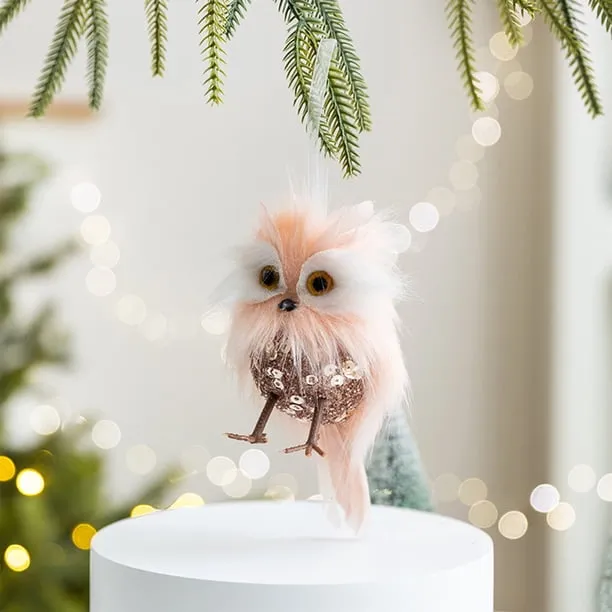
Sequin and beaded ornaments only catch light within about 6 to 8 inches of a bulb. Hang the sparkly ones inside that radius — ideally on a branch tip with the light tucked just behind — and put matte ornaments in the shaded interior where their texture can be admired up close. If your tree looks dull, the fix usually isn’t more ornaments; it’s moving the reflective ones closer to the lights.
11. Carved Santa Faces and Pearl Finials
The cream finial ornament with glittered pinecones. That’s the piece bridging the white flocking and the warm wood tones — without it, the carved wooden Santa and the pearl-beaded bauble look like they came from two different trees. If you’re building this look, find one ornament family that combines cream texture with wood, and it will hold the entire palette together. Everything else is supporting cast.
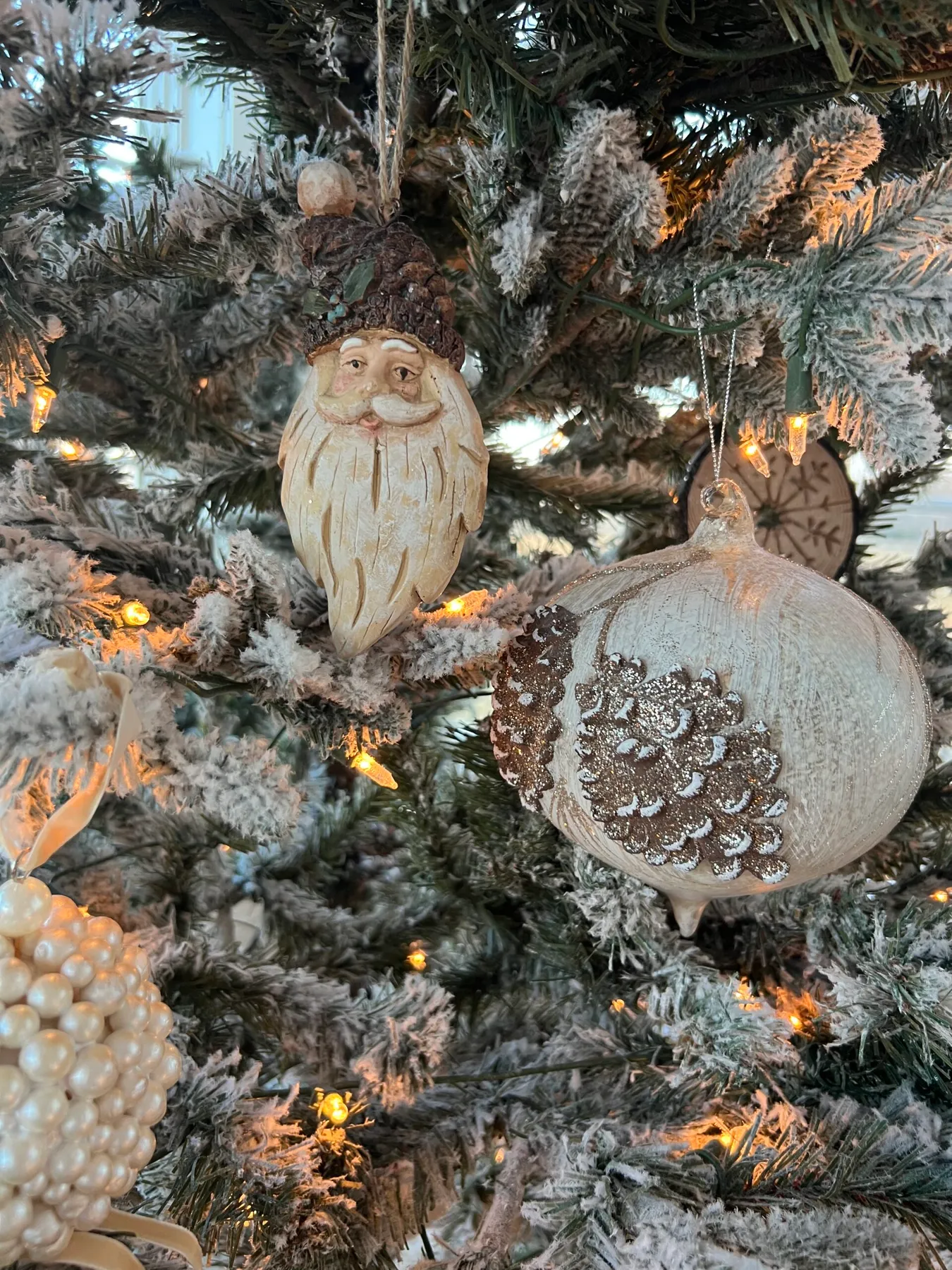
Flocked trees have been trending for years, but 2026 is where the details turned quieter: fewer glitter finishes, more raw wood, pearl, and carved faces. Designers are calling it the calm Christmas — fewer ornaments, larger sizes, a palette of three instead of seven. It’s partly a reaction to years of maximalist glitter and partly just practical, since fewer big pieces cost less per ornament and read better in photos.
12. Gold and Bronze Glitter With Squirrel Figures
- Measure ceiling height to the inch, then subtract the topper height plus 6 inches of clearance before you buy a tree.
- Count your existing ornaments by color family — a dense look needs roughly 12 to 15 ornaments per foot of tree.
- Check the color temperature of your lights; warm 2700K bulbs make gold look bronze, cool bulbs make it look green.
- Hold three gold ornaments together in daylight before buying more, since golds shift between champagne and brass.
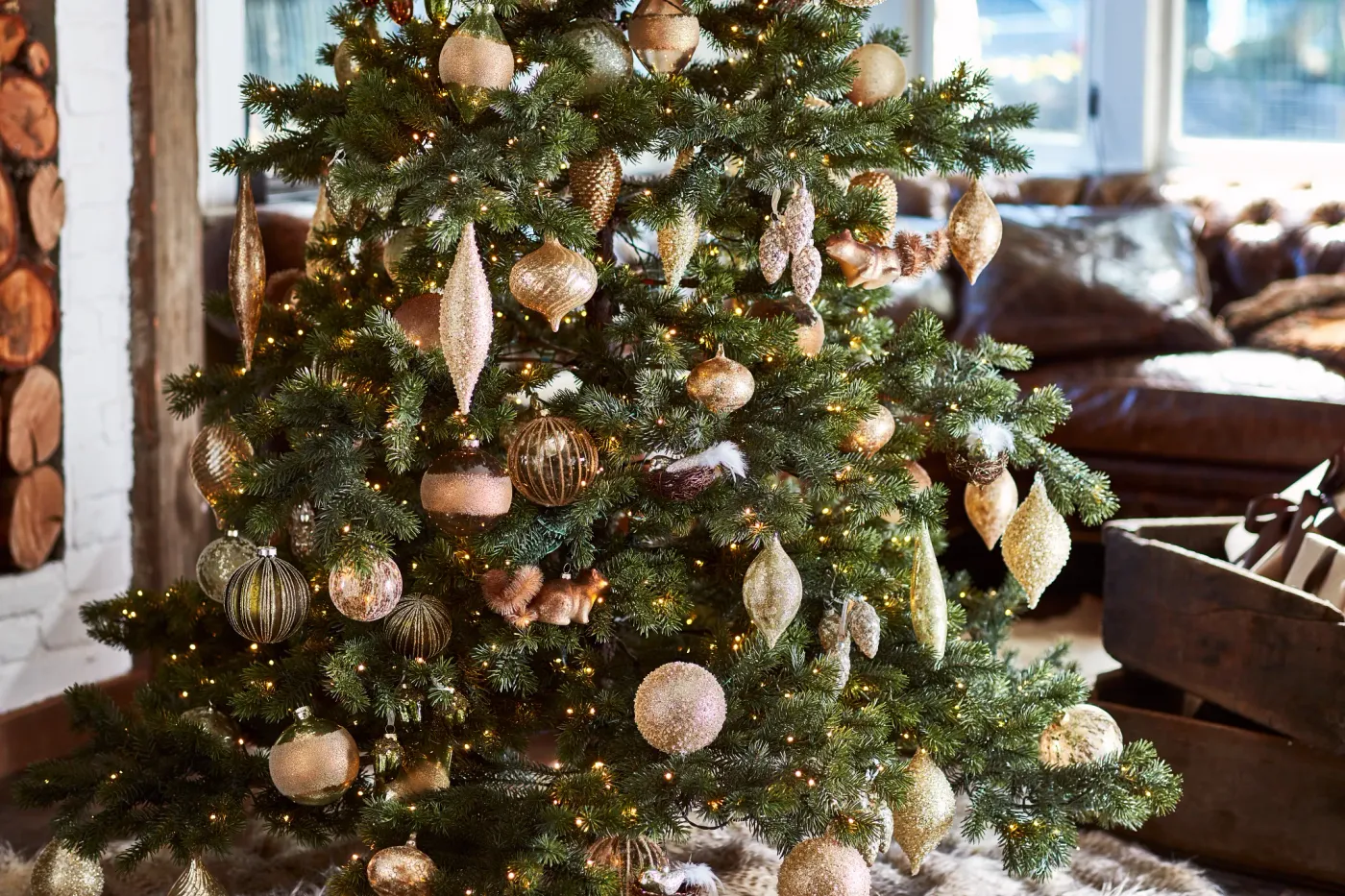
The mix is about 55% deep green tree, 30% gold and bronze metal in mixed finishes, 10% white and cream for relief, and 5% animal figures as the wink. Finish matters as much as color: a matte brass next to a chunky glitter reads richer than five identical shiny balls. Swap gold for silver and bronze for pewter and you get the same density with a colder, more northern feel.
13. Black and White Wooden Bear Silhouette
Cut-out wood ornaments are the easiest thing to fake at home. A quarter-inch birch plywood sheet runs about $8 at a craft store and yields six ornaments; a scroll saw — or even a craft knife and patience — gets you the bear shape. Paint the interior black and dry-brush the frame white for that distressed edge. Total for six: under $25. Otherwise, Walmart and Target carry similar cut-out silhouettes for $5 to $12 each in November.
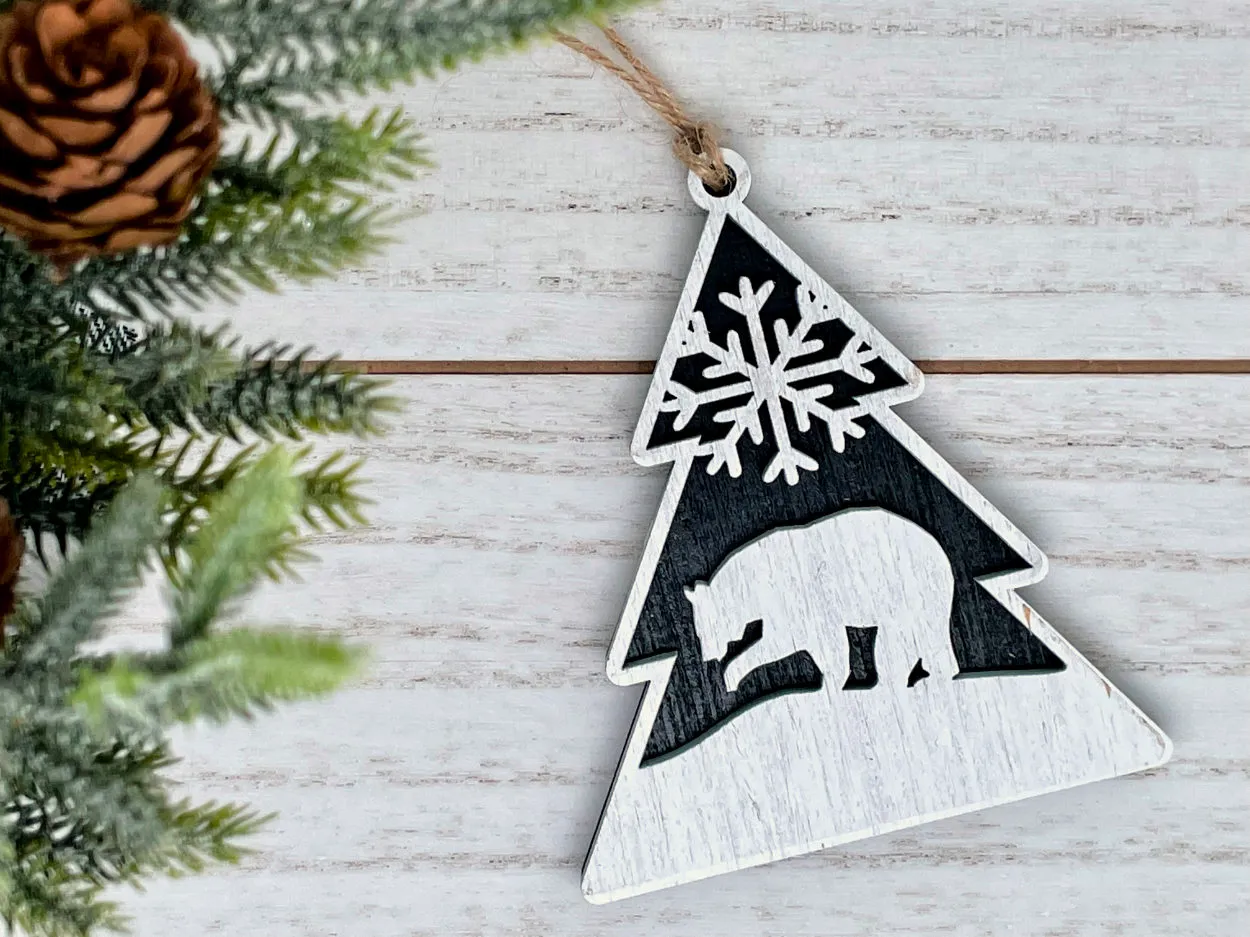
Black ornaments disappear against a dark green tree at night, and that contrast only works because of the white frame and the whitewashed backdrop. If your tree is unlit up top or you keep the lights off most evenings, this piece will vanish. Also: laser-cut wood with thin bridges — the bear’s legs, the snowflake arms — snaps easily, so skip it in a house with pets or a toddler who pulls things down.
14. Bark Snowflake With a Wisp of Gold Cord
Real bark is surprisingly fragile at thin points — those snowflake arms will crack if they hang on an outer branch where they knock against needles. Hang bark pieces on interior branches, no more than 6 inches from the trunk, and use a soft cord rather than a metal hook. Then look at it at eye level before you walk away; bark texture only reads when light hits it from the side. Compare with Idea #15 for the same material in a heavier shape.
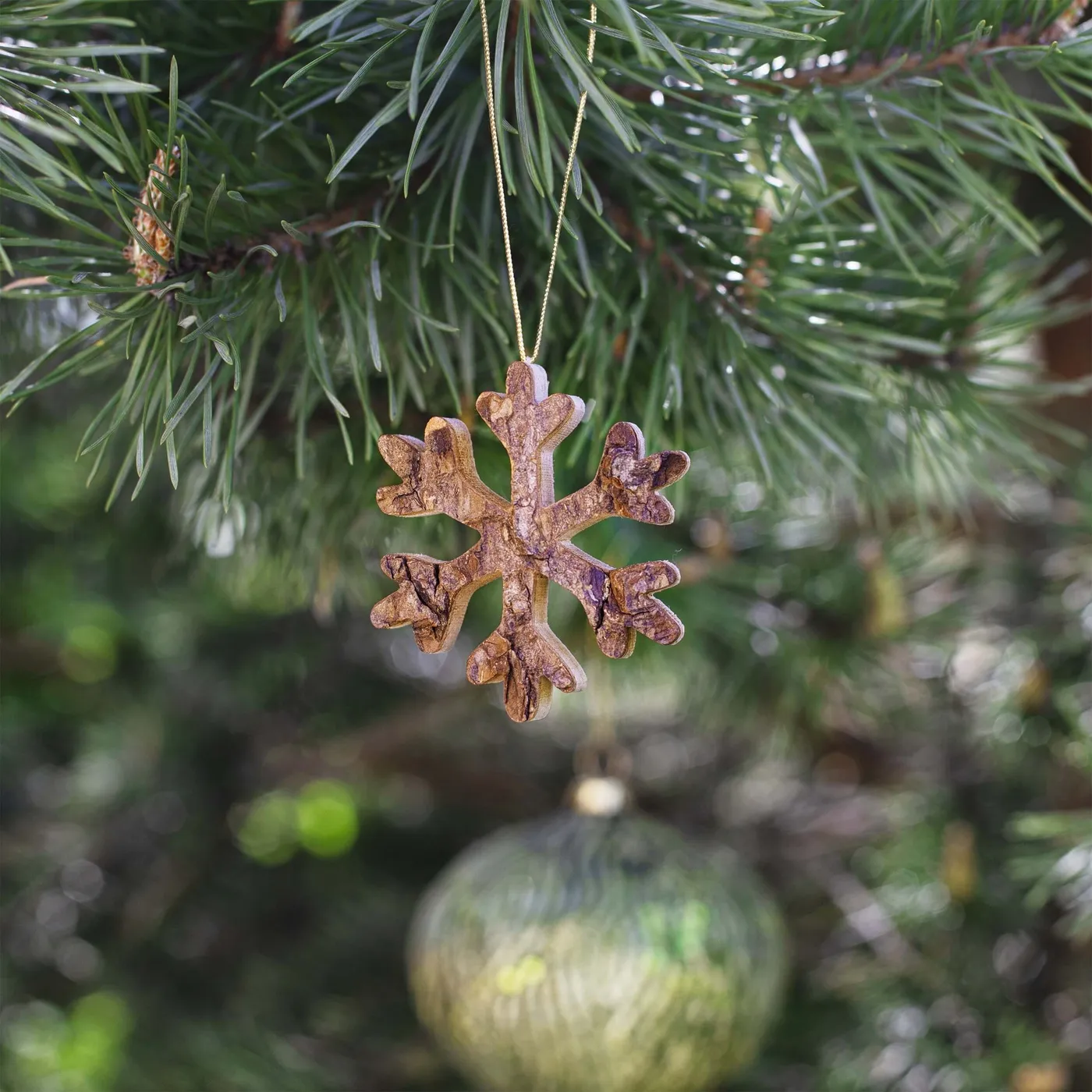
Bark ornaments live or die by how many you use. Five or six scattered across a 7-foot tree read as intentional; twenty read as a theme party. Cluster them within a 12-inch band at eye level — roughly 55 to 65 inches off the floor — so the texture is visible without leaning in. On a tabletop tree under 3 feet, one or two tells the entire story and three is already too many.
15. Bark Moose Figurine With White Wood Edges
For a handmade version, pick a bark that won’t crumble — birch and poplar peel cleanly, oak will fight you.
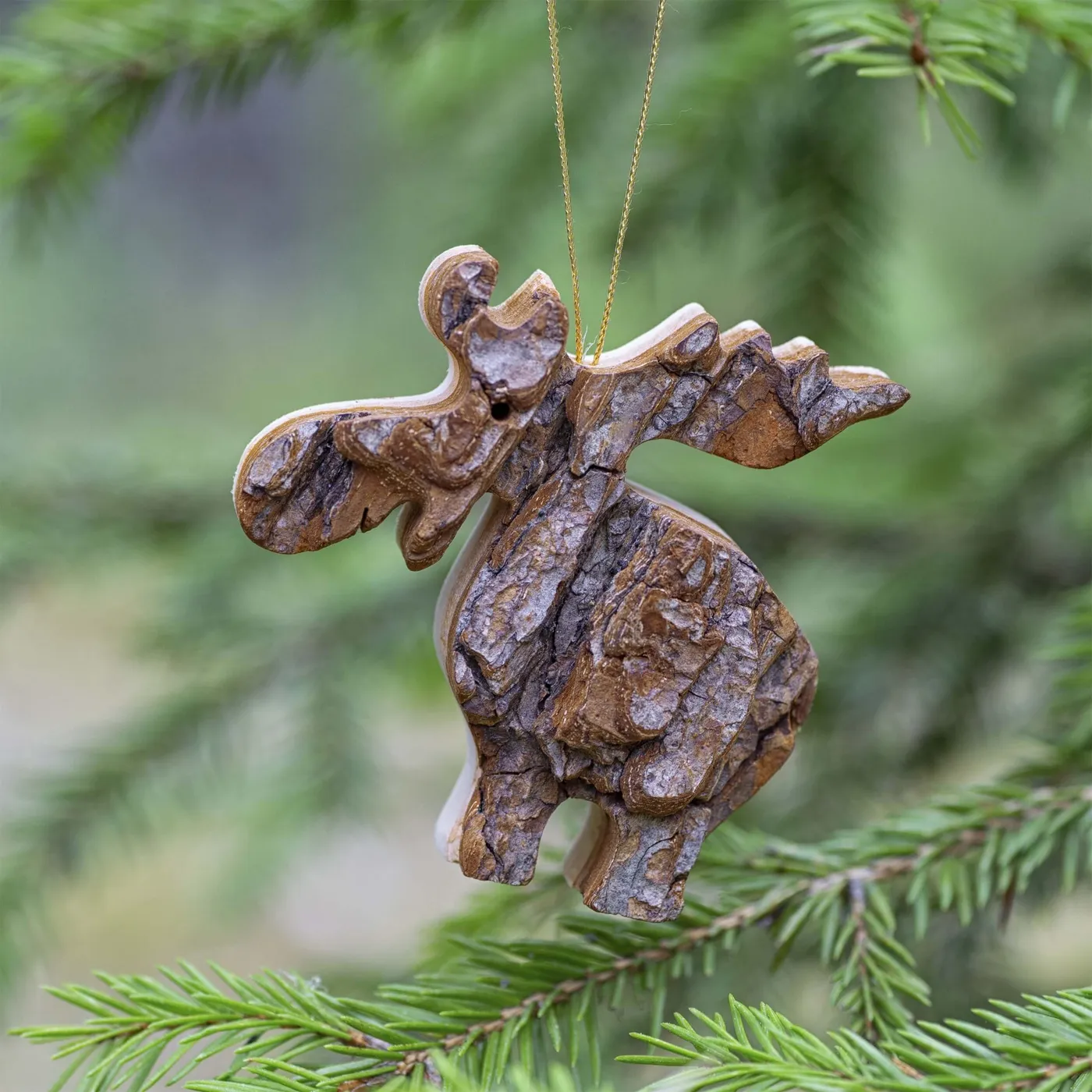
- Trace a simple moose silhouette on cardstock, legs straight and body chunky.
- Peel a 1/16-inch layer of bark and press it flat under a heavy book for 24 hours.
- Glue the bark to 1/8-inch white-painted plywood, then trim to the outline.
- Sand the edges so the white wood shows as a clean border.
- Drill a small hole at the top and thread a thin gold cord through.
Time: about 90 minutes per ornament.
The white wood edge is doing something subtle and clever: it separates the dark bark silhouette from the dark green needles, so the shape stays legible from 10 feet away. Without that border, the moose merges into the tree — same trick illustrators use with a keyline. If you make your own, never skip the painted edge. It’s the difference between a shape people notice and a blob they don’t.
16. Flocked Tree With Burlap Poinsettias and Kraft Gifts
Fabric and burlap ornaments hold dust, and burlap frays. Plan on trimming loose threads each season, and never wash them — spot-clean with a barely damp cloth and let them air dry flat. Kraft-wrapped gifts with velvet ribbon are lovely right up until a curious cat discovers the ribbon is a toy; tie a small knot close to the bow so it can’t unravel. Store fabric florals in a rigid box rather than a bin, or the petals crease permanently.
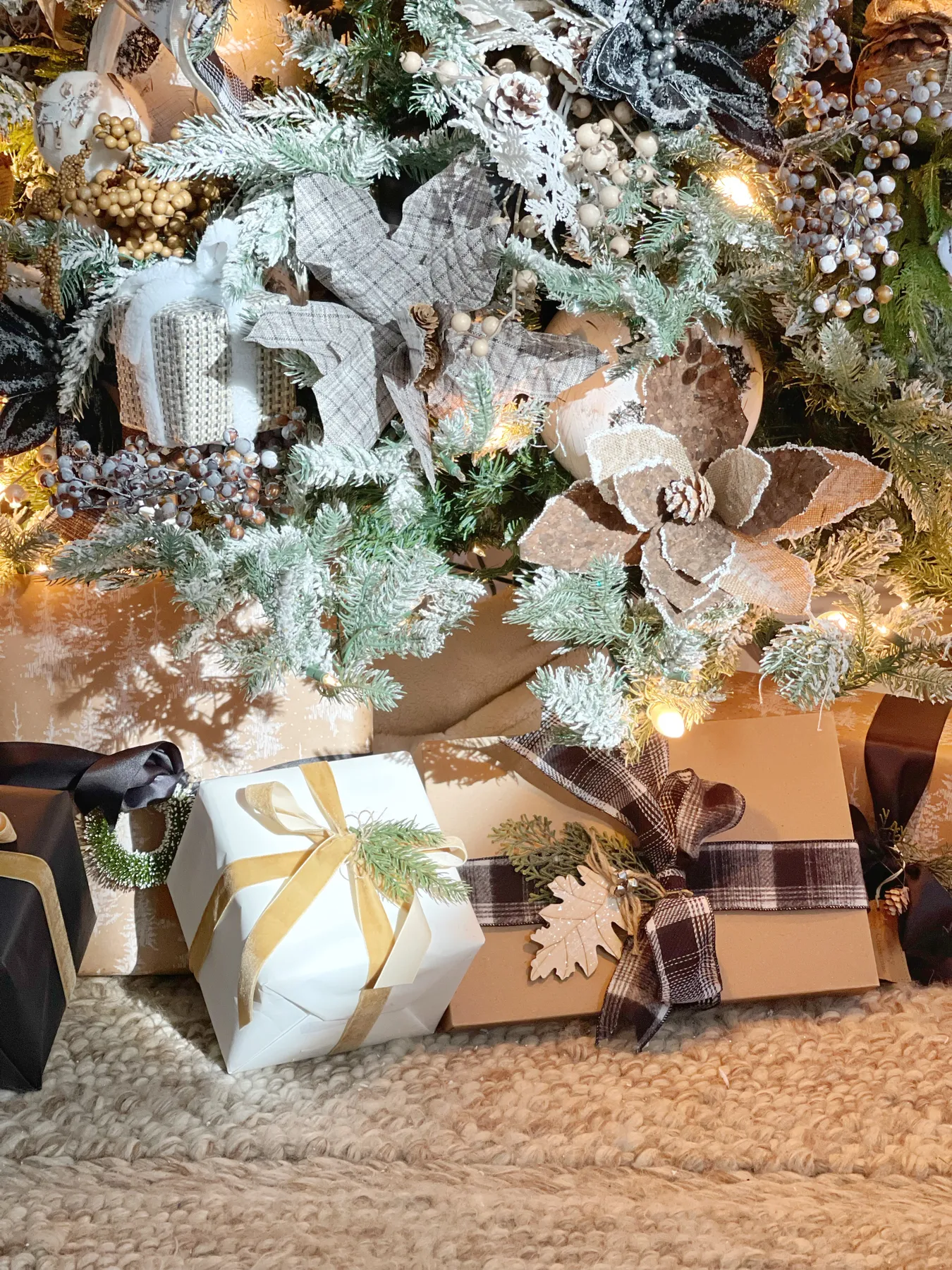
Wrapped gifts under the tree became part of the decoration itself around 2022 and it hasn’t slowed down — kraft paper, plaid ribbon, wooden leaf tags, all of it. What’s changed by 2026 is the discipline: people choose one ribbon story instead of five and repeat it on every box. It’s cheaper than a layered ribbon scheme and it photographs like a magazine spread. Compare with Idea #17 for a cooler, more wintry version of the same idea.
17. Birch Ribbon, Rusty Bells, and Berry Picks
Roughly 50% snow-flocked evergreen, 20% distressed metal, 15% birch-patterned ribbon, 10% burlap and fabric blooms, and 5% golden-brown berries. The trick is that everything here is matte or weathered — nothing shiny. Swap the galvanized bells for aged brass and the tree warms up by a full season; swap the birch ribbon for solid cream and it goes quiet. Just keep every metal finish weathered, never polished.
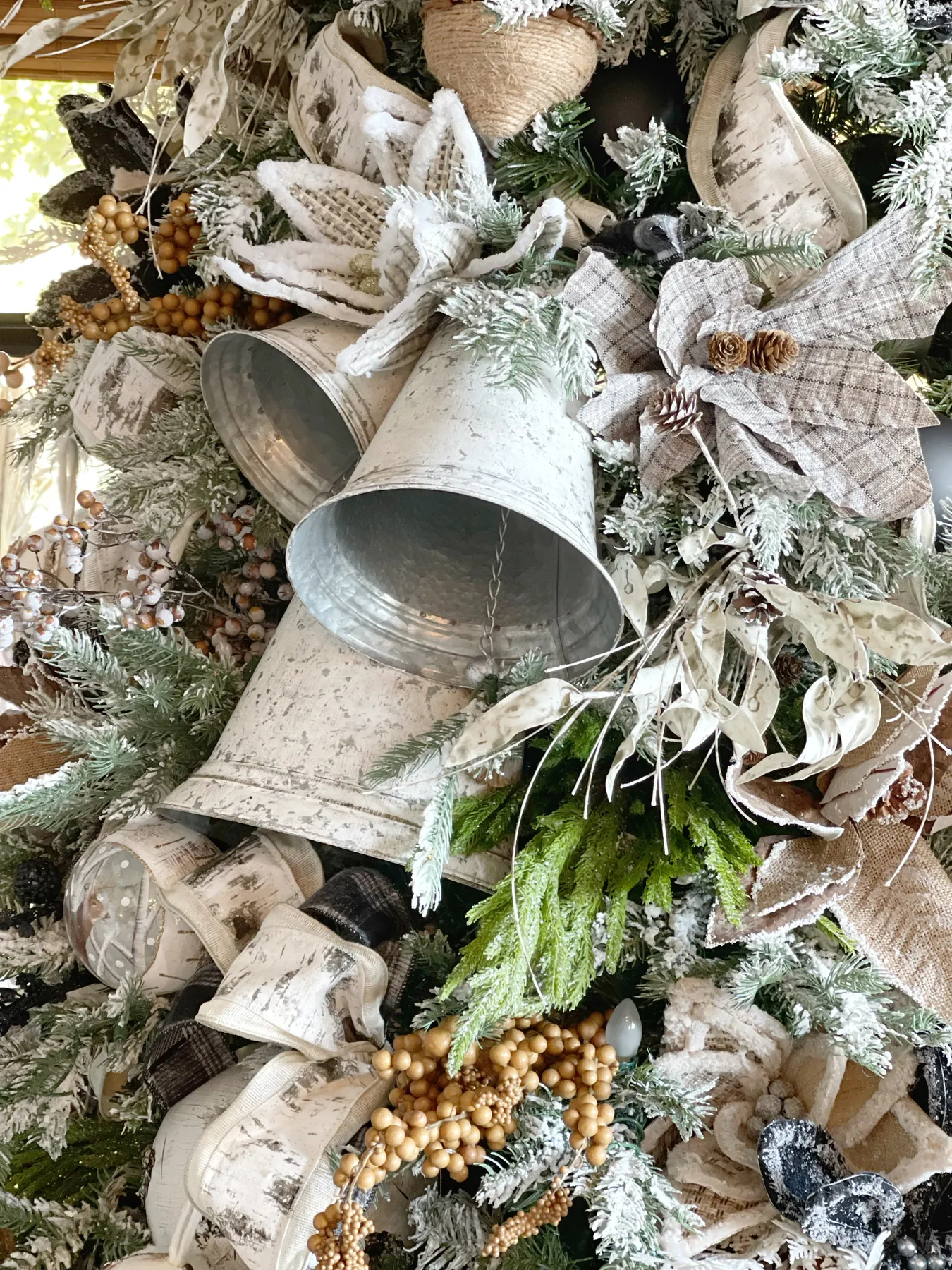
Galvanized bells are the cheapest element in this tree — a bag of six runs $8 to $14 at a craft store, and you can age them further with a vinegar-and-salt bath overnight. Birch-print ribbon is $6 to $10 a roll, and one roll covers a 7-foot tree if you cut 18-inch strips. Burlap poinsettias: buy three, take them apart, and redistribute the petals instead of clustering them. Whole tree, under $60.
18. Sisal Deer With Beaded Eyes and Twine
Sisal fiber sheds. Expect loose straw on the tree skirt for the first week, and know that the fibers flatten over time — a sisal ornament that looks plump in November looks slightly deflated by year three. It’s not washable either; dust it with a soft brush and keep it out of humid rooms or it will develop that musty smell. If you want the natural look without the shedding, look for wool-felt versions instead.
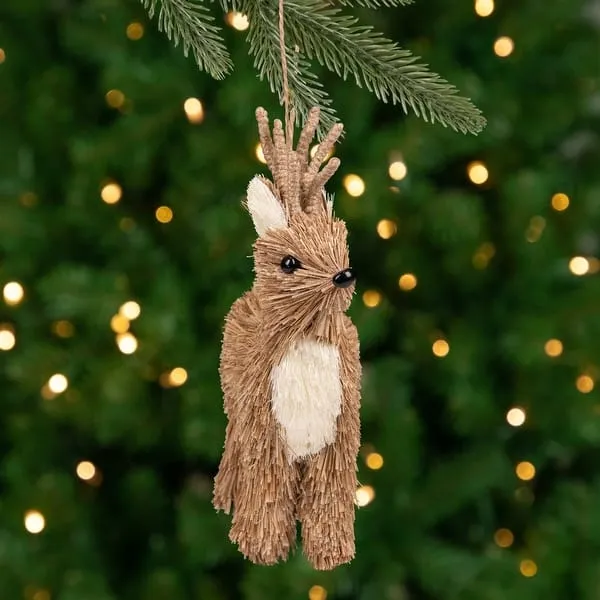
Natural-fiber ornaments need contrast to read. This deer works because of the cream belly and ears against the brown body, so when you hang a group of sisal pieces, alternate light and dark ones rather than putting all the pale ones together. Hang them at eye level, roughly 55 to 65 inches, and skip tinsel entirely. Straw texture and metallic fringe are enemies.
19. Hand-Painted Owl Bauble on a Woven Mat
Styled photos like this are staged on a textured surface for a reason — the mat gives the bauble scale.
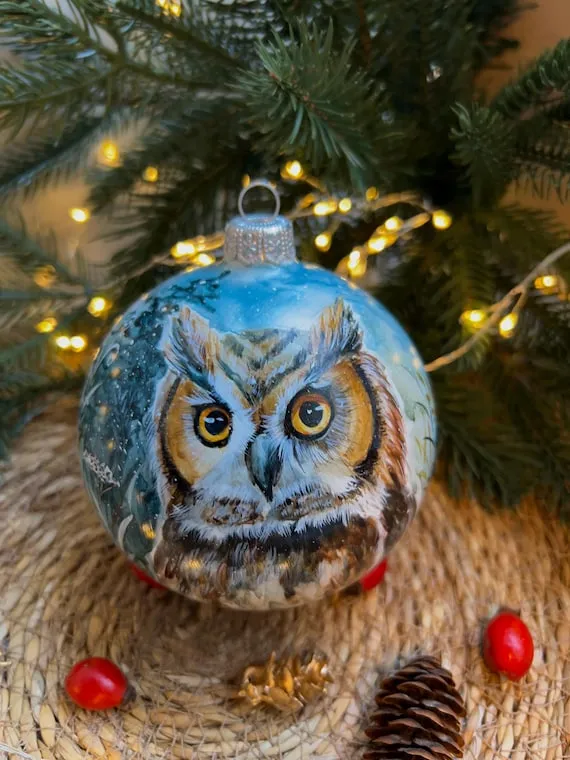
- Lay a woven straw mat or trivet on a table near a window for side light.
- Rest the bauble on the mat rather than hanging it; glass reads better when still.
- Place three small pinecones at varying distances — one touching, one 2 inches away, one at the edge.
- Add three sprigs of red berries as the only saturated color.
- Shoot from a 30-degree angle so the evergreen behind goes soft and blurred.
Time: 10 minutes. Cost: $0 if you gather your own pinecones.
This kind of vignette needs about 18 inches of table depth and a light source within 3 feet — a window or a lamp with a warm bulb. On a narrow console under 12 inches deep, drop to two props instead of five. And if your table sits in a dark corner, the hand-painted detail on the glass is simply invisible, so move the setup beside a lamp or pick a shinier ornament.
20. Felt Fox in a Knitted Christmas Sweater
- Handmade felt fox with a knit sweater: $18–$45 each
- Five-piece felt woodland animal set: $60–$140
- Twine and ribbon for hanging loops: $5–$12
- Wool felt sheets if you’re making your own: $12–$20
- Embroidery floss and needles: $8–$15
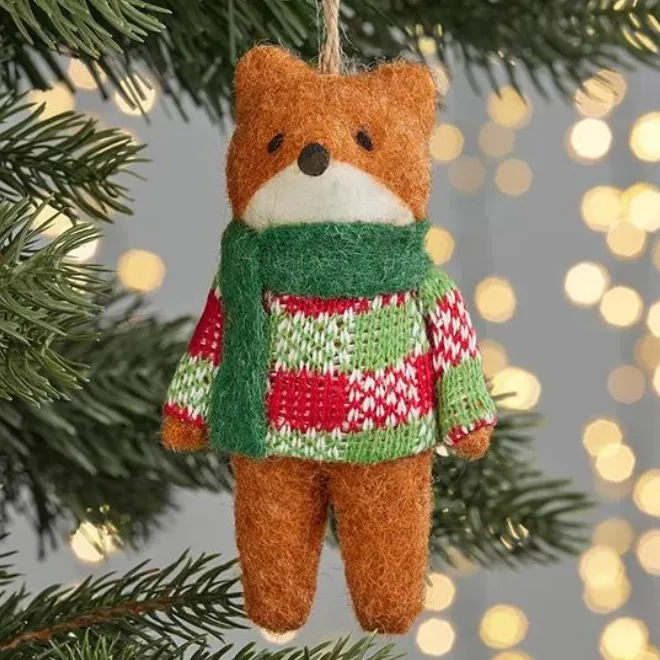
Total for a five-piece cluster: $95–$225. Budget alternative: $35 to $60 using big-box felt ornaments and a sweater sleeve you cut apart and stitch on yourself.
The sweater is the joke and the craft at the same time. Without it, a felt fox is just a fox; with a green, red, and cream patterned sweater and a dark green scarf, it has a character and a season. Notice the scale relationship too — the fox is about 4 inches and hangs near the tips where you can actually see the stitching. Large felt animals hung deep in the branches lose every detail you paid for. See Idea #3.
21. Sisal Hedgehog, Squirrel, Owl, and Deer
It’s that the set shares one material and four silhouettes. A hedgehog, a squirrel holding a pinecone, an owl, and a deer read as a collection because the sisal fiber is identical across all four — same color, same texture, same twine loops. Mix in a single ceramic animal and the whole grouping looks like an accident. When you build a themed set, buy the material first and the animals second. See Idea #18 for the single-animal version of this fiber.
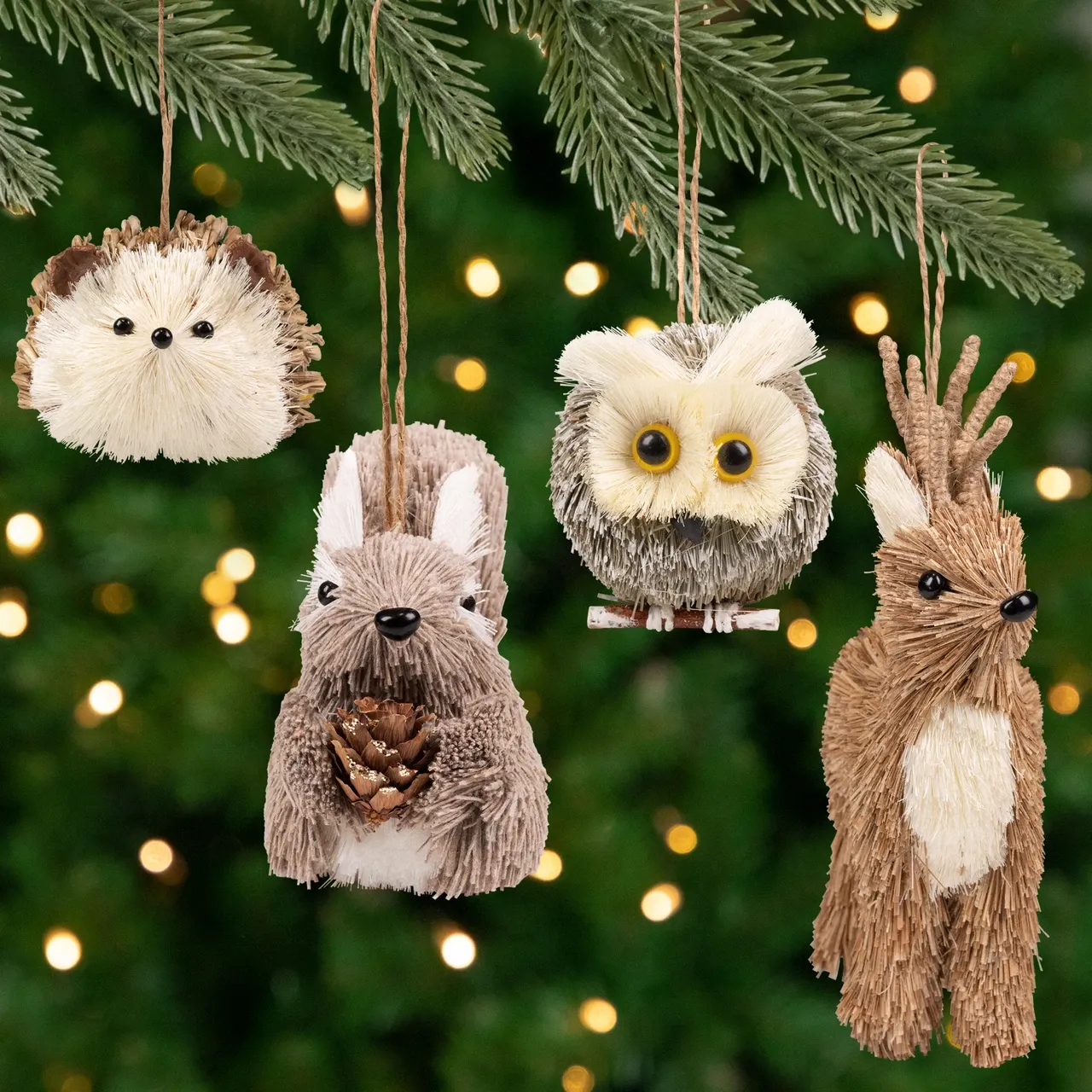
Small figurine ornaments with twig antlers or pinecone props are the first casualties of a busy household — those details snap. Budget for one broken antler per season, and don’t hang them where a door swings or a dog’s tail reaches. Sisal and twigs also catch on knitted stockings and scarves, so keep these in the upper two-thirds of the tree if you hang textiles nearby.
22. Flocked Tree With a Wooden Star and Burlap Skirt
The wooden star topper earns its place by repeating a shape that’s already in the tree — pinecones are roughly star-shaped, and the berry clusters splay outward the same way. Repetition of form is why this reads as designed instead of assembled. The burlap skirt matters for a different reason: it grounds a very white tree on a wood floor and gives the eye somewhere to rest at the bottom. Lose either one and the tree floats.
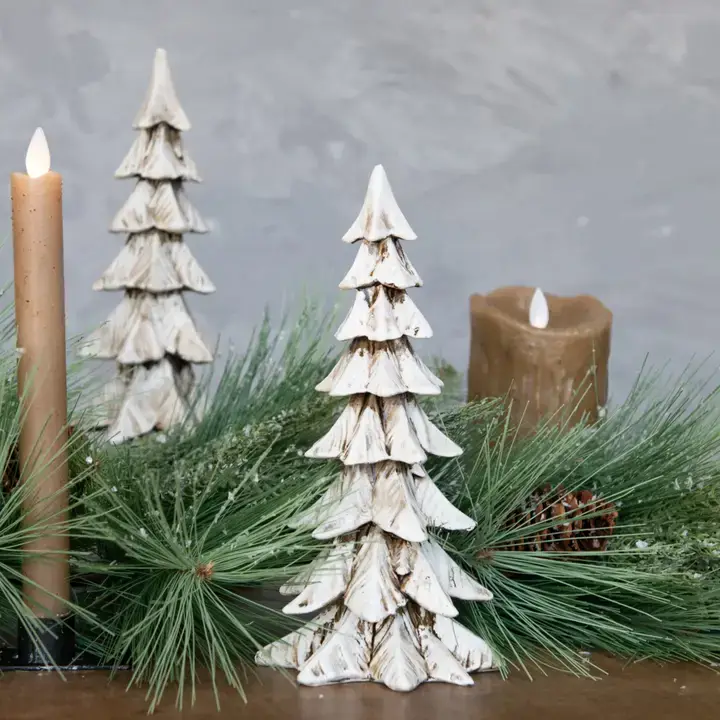
When the tree itself is the color statement, keep the skirt one step darker than the floor and one step lighter than the tree. Burlap on dark hardwood, or a linen drop cloth on pale oak. Tuck the skirt in at the back rather than wrapping it fully around — you get the same visual anchor without fighting fabric behind a wall-facing tree. Twelve to eighteen inches of visible skirt is plenty.
23. Tiny Candle Lights by a Paned Window
Clip-on candle lights are one of the cheapest ways to change a tree’s entire mood. A set of ten battery LED clip-ons runs $15 to $25 at Target; traditional wired sets go for $20 to $40. For the vintage look on a budget, buy plain white clip-ons and swap in warm 2200K bulbs — that’s the amber glow you see here. Pair them with a $12 set of pinecone picks and you’ve restyled the whole tree for under $50.
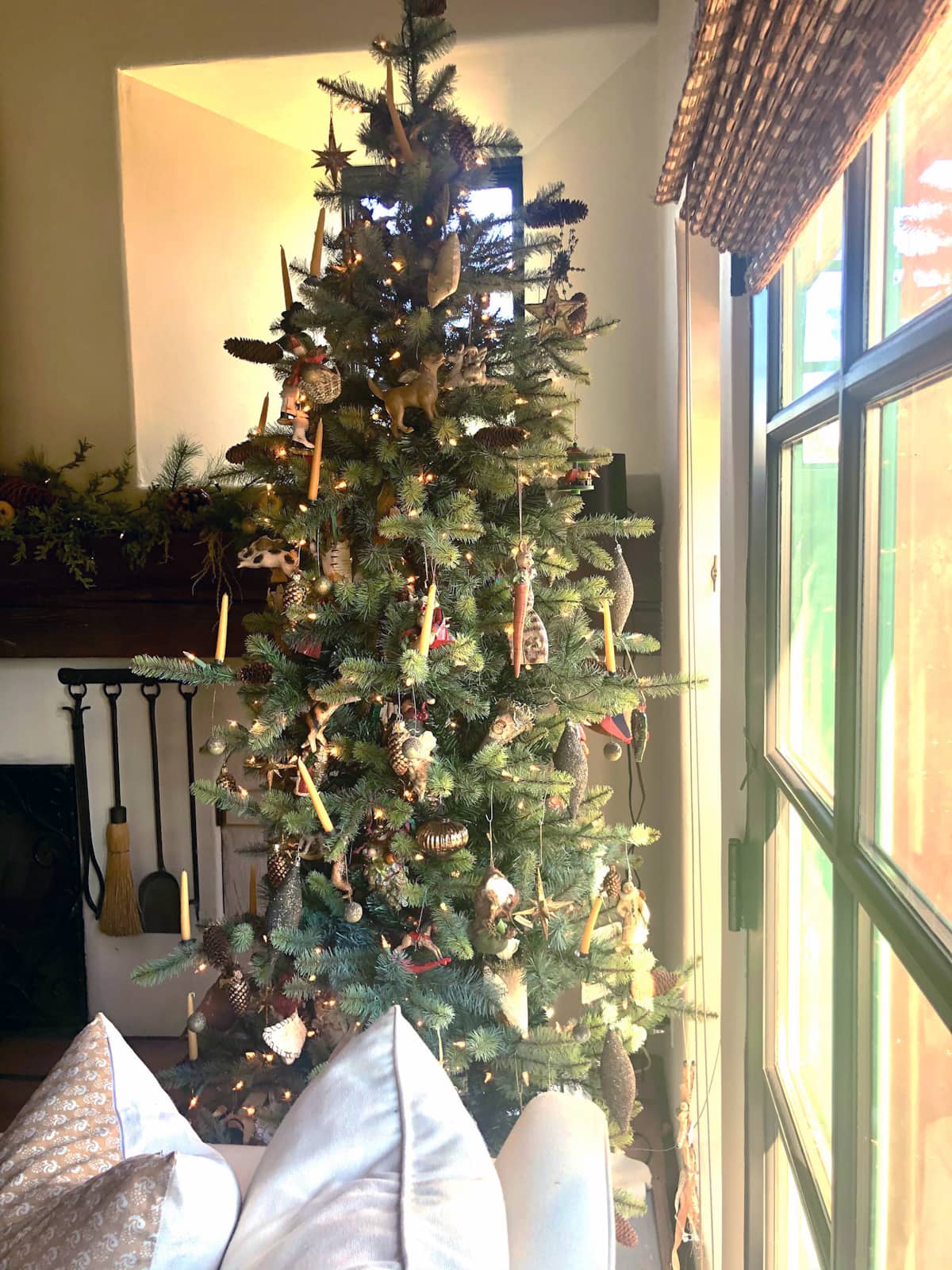
The formula is roughly 45% deep green tree and natural brown, 25% warm amber light, 20% rustic ornament — pinecones, wood, dried citrus — and 10% soft neutral from the woven shade and upholstery. Amber light is the largest single color contributor here, which is exactly why switching to cool white bulbs would break the look. Test bulb temperature before you buy, every single time.
24. Bark-Edged Star With a Nativity Cutout
Cutout wood ornaments collect dust in the interior voids, and a cotton swab is the only thing that reaches. Bark edges chip when knocked, and they darken if they sit in direct sun through a window for a full season. Store them in a rigid box with tissue between pieces — a plastic bin with ornaments piled loosely will snap the thin points. Realistically, plan on replacing one piece every three or four years.
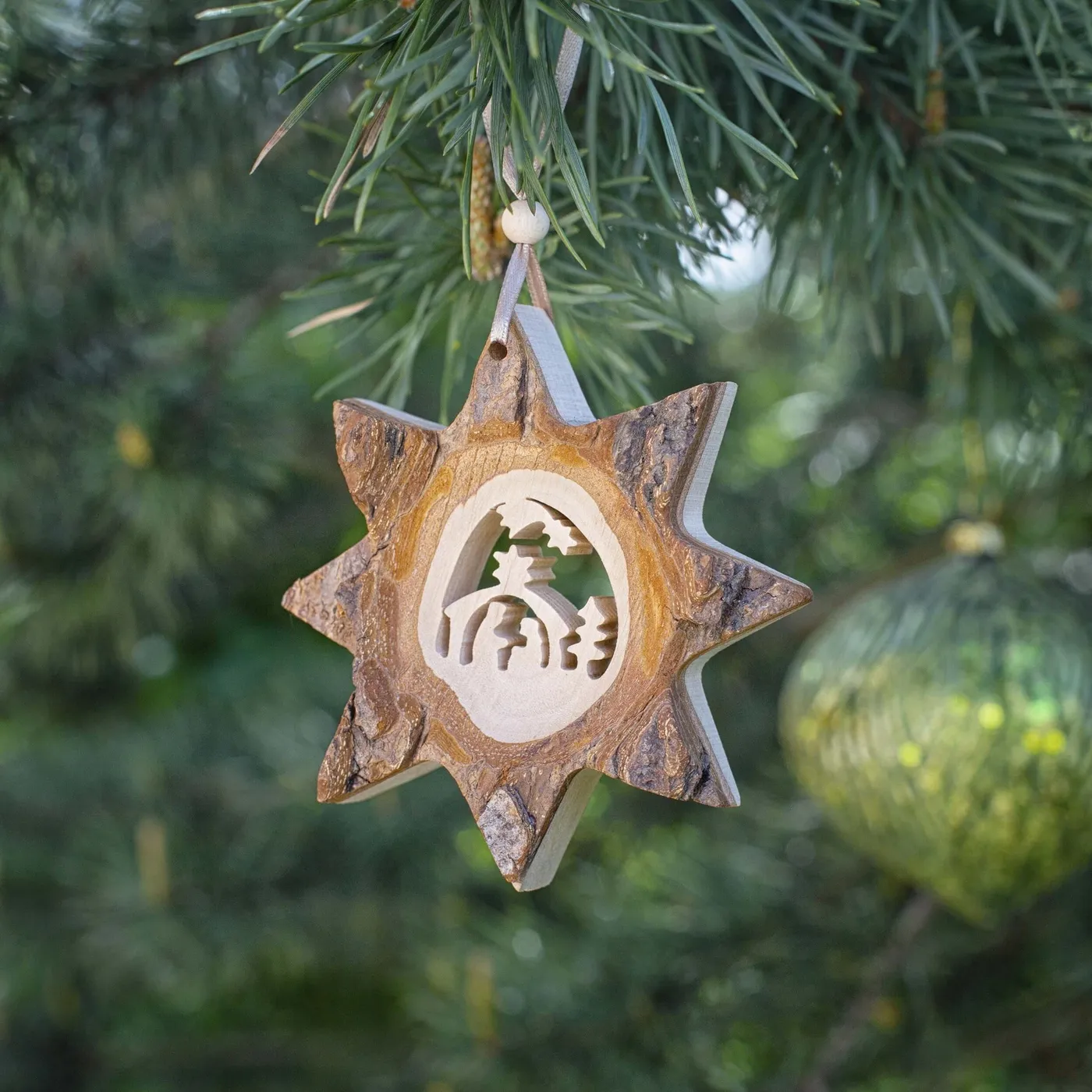
This is a large-format ornament, roughly 5 to 6 inches across, which means it needs space. Two per tree, hung about 18 inches apart, look intentional; four start competing with your topper. On a slim 6-foot tree, one is enough. Keep it in the lower two-thirds of the tree, since a large flat ornament up top reads like a second topper and muddles the silhouette.
25. Flocked Tree in a Woven Basket Skirt
A basket skirt is faster to build than to shop for.
- Choose a woven basket at least 4 inches wider than your tree stand on every side.
- Set the stand inside, then fill the gap around it with a folded towel for stability.
- Cover the towel with a square of plaid fabric, letting the corners hang loose.
- Tuck red berry picks into the basket rim so the color repeats from the tree.
- Add one wrapped box beside the basket, not under the tree, to break the perfect circle.
Time: 25 minutes. Cost: $20 to $60 for the basket.
The woven basket as a skirt is the whole idea. Burlap and fabric skirts can look like a puddle on the floor; a basket gives the tree an actual base with structure and texture, and it hides the stand completely. It solves a practical problem too — you can lift the entire thing to water or move it without undoing a fabric wrap. Compare with Idea #22, where a softer skirt does the grounding instead.
26. Carved Wood Reindeer on the Mantel
Mantel styling looks effortless in photos and takes real editing. Two dangers: candles under a wooden mantel shelf, where you want at least 12 inches of clearance above the flame, and garland hung low enough to catch on stockings or block a fireplace vent. If your mantel is under 5 feet wide, one figurine, one lantern, and a short garland is the maximum before it looks crowded. Dark wood figures also disappear against dark brick.
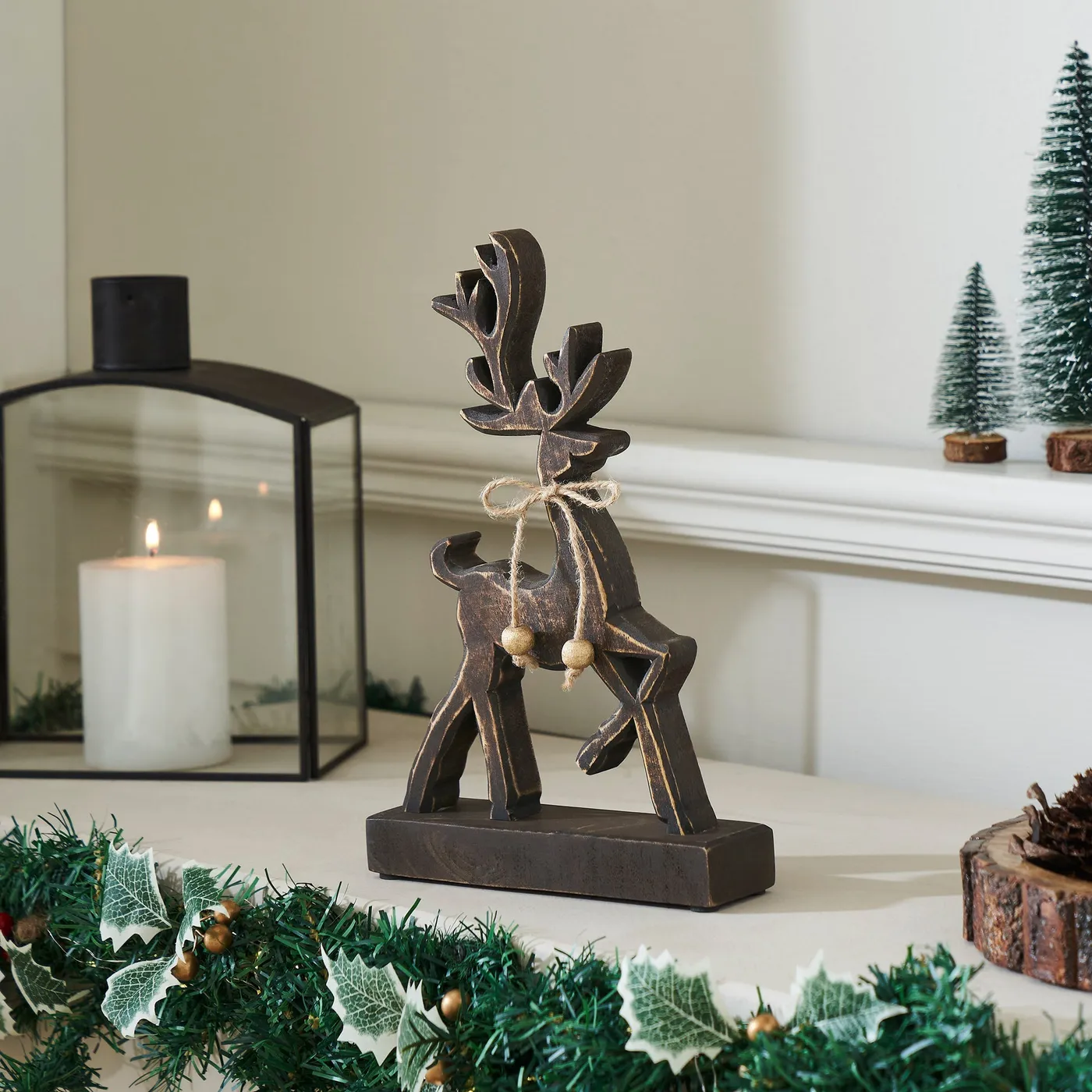
The reindeer sits slightly off-center, and its height repeats in the lantern behind it and the tallest bottle brush tree — three objects at three heights, each roughly a forearm apart. The glass lantern adds transparency, which keeps a dense arrangement from feeling heavy. The twine bow with small bead accents is the only fine detail at eye level, so that’s where your attention lands. Height, spacing, transparency: that’s the whole recipe.
Your Forest Is Waiting in the Living Room
Start with one thing you already love — a felt fox, a bark moose, a candle in a nest of ferns — and build outward from there. The woodland look isn’t a shopping list; it’s a palette of greens and browns with one small surprise of blue or red that keeps it from turning into a wall of burlap. Pin this guide, then go pull out the ornaments you already own and see which ones fit the story you want to tell this year.