
Christmas pathway lights are having a moment on Pinterest right now, and the photos people are saving look less like a single strand and more like an entire walk from the driveway to the front door.
We spent serious time browsing Lowe’s, Target, Walmart, and Amazon to bring you only what’s worth your attention — everything from $14 solar star stakes to a $400 yard-wide display. After filtering through hundreds of options, we narrowed it down to 27 ideas that actually deliver at every price point.
Inside you’ll find warm-white classics, multicolor maximalism, glowing gravel, rainbow arches, and snow-dusted forest trails — with budget and luxury versions compared side by side. 2026 is the year solar stakes finally got bright enough to carry a whole walkway, which is why so many of this year’s saves are cord-free.
And stay until the end — we break down the most common mistakes that can ruin these looks. 📌 Save this to Pinterest for later — you’ll want to revisit these ideas.
1. Emerald Pebbles That Turn a Path Into a River
Remove the glowing pebbles and you’re left with a perfectly respectable garden path — dark pavers, clipped shrubs, tidy grass. Nothing you’d photograph. Those luminous emerald stones are the entire idea, replacing the usual parade of identical stake lights with one continuous ribbon of glow. The dark grey paver border is doing quiet work too: without that hard edge, the green bleeds into the lawn and the river effect turns into a vague green smudge.
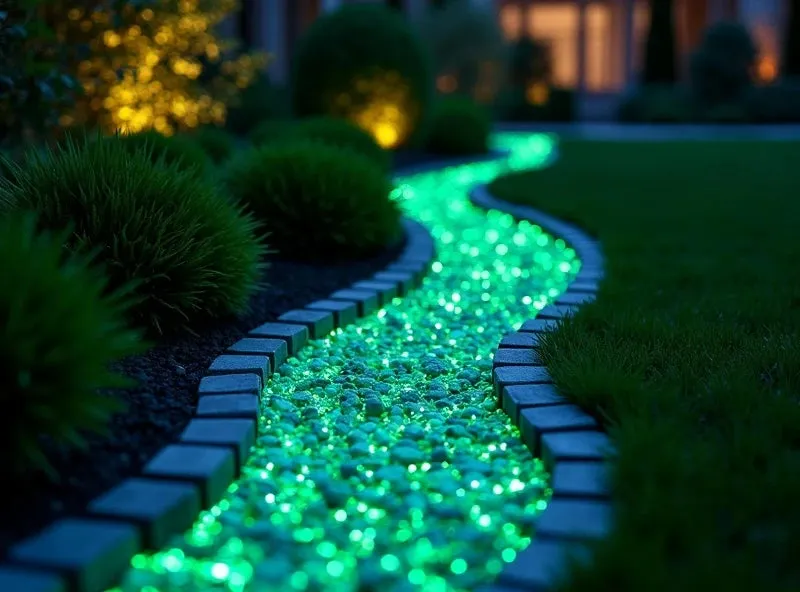
Luminous aggregate only looks intentional when it has depth. Aim for a 3-inch layer over a dark weed barrier, and keep the glowing section 18 to 24 inches wide — wider than that and it reads as a puddle of light instead of a stream. Set the border pavers flush rather than raised so a mower rolls straight over the edge, then put your warm yellow uplighting on its own timer so the ground glow can run alone after 10 p.m.
2. A Front Yard That Went Full Character Christmas
- Large light-up figures (yeti, snowman chef, assorted characters): $300–$900
- Warm white net lights for the lawn: $120–$300
- Icicle lights along the rooflines: $80–$200
- Projector for tree and star shapes on the garage door: $40–$120
- Red lit mailbox with candy cane pole: $60–$150
- Cords, timers, stakes: $60–$140
- Total: about $660–$1,810
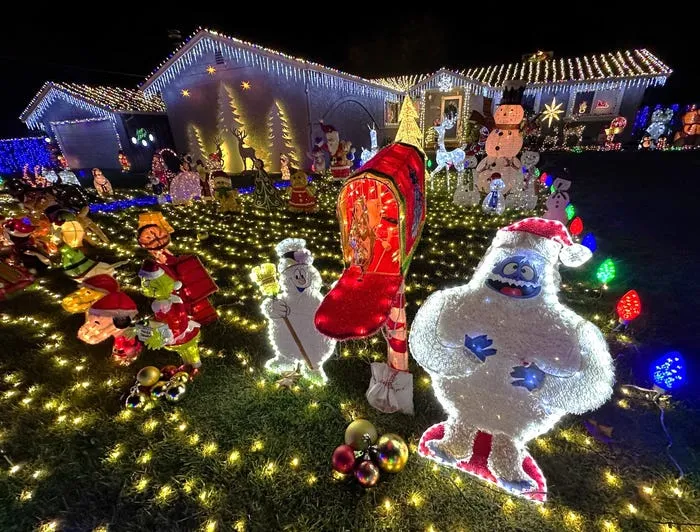
Budget alternative: two figures instead of six, no projector, ground net lights only — roughly $350–$600 for about 60% of the effect.
This is a big-yard idea. The glowing lawn alone reads best from at least 900 square feet of open front yard, with a viewing distance of 25 feet or more from the sidewalk. On a tight city lot the figures crowd each other and the whole thing tips into clutter. If your frontage is under 40 feet, look at Idea #13 — staked figures that bring the character energy without needing the acreage.
3. Palms and Stucco Wrapped in Warm White
Palm fronds are the most forgiving surface in the whole yard for string lights, because the light travels up the trunk and then catches on the underside of every frond. Wrap the trunk in a close spiral — about one turn every 6 to 8 inches — then run an S-pattern loosely through the crown instead of wrapping it. Keep the entire run at one warm white temperature, and put the rooflines on their own timer so the house goes dark before the trees do.
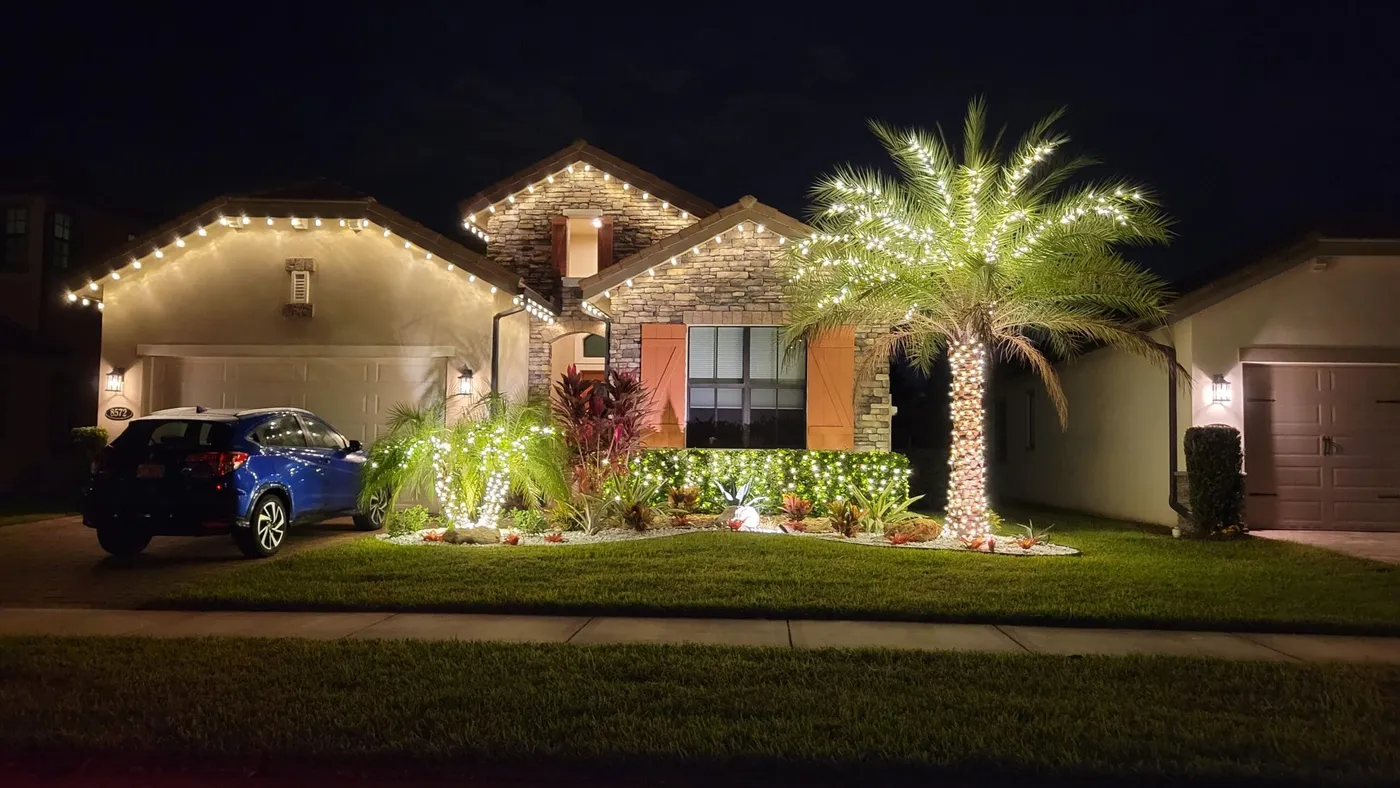
Two things make this work. First, contrast in texture: hard stone accents against soft, backlit foliage. Second, restraint in color — one warm white everywhere, so the reddish-brown shutters and the beige stucco read as part of the composition instead of competing with it. Once the trunk, the hedge, and the roofline all glow at the same temperature, the house stops looking decorated and starts looking alive.
4. Blue Arches Over a Hedged Gravel Walk
The formula here runs about 60% saturated blue, 30% warm orange, and 10% pink and green accents — a split that shouldn’t work and absolutely does. Blue carries the structure: globe lights strung overhead on bare branches and a dense tunnel of small blue strands in the distance. The warm orange on surrounding trees keeps the path from feeling like an aquarium, and the pink and green touches read as sparkle. Swap blue for green and orange for red and the same math holds.
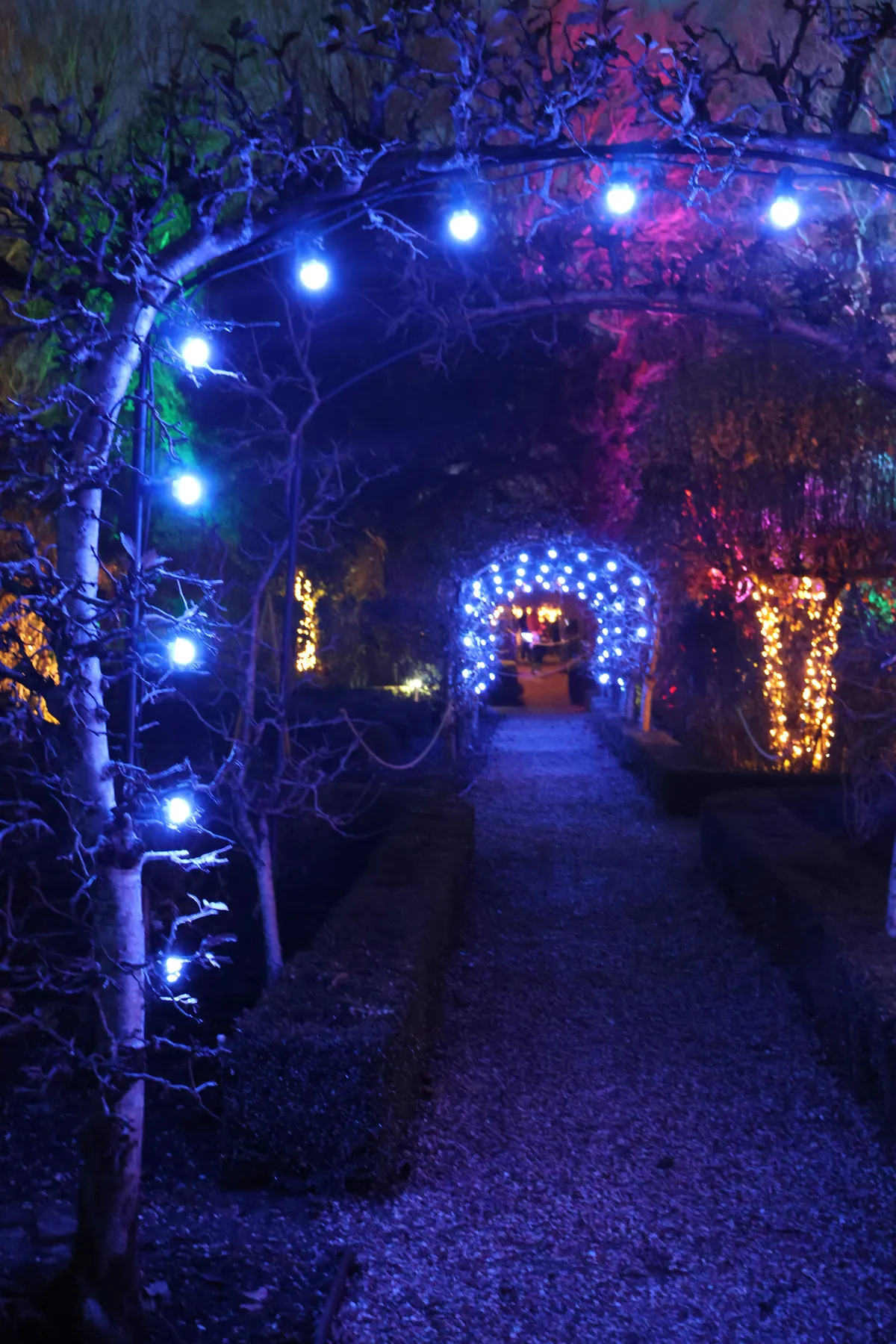
- Map the route first — the gravel path, the low hedges, any trunk wide enough for a zip tie.
- String the bare-branch arch with globe lights on a guide wire, fixtures about 12 inches apart.
- Wrap trunks and hedge tops in warm orange mini strands, keeping wraps loose and even.
- Add the pink and green accents last so they layer over everything.
- Timer check: arches on at dusk, accents off by 9 p.m.
About one afternoon for the arch, another for the wraps. Materials land around $150–$300.
5. Warm White Guide Lights Along a Curved Drive
Evenly spaced warm white stake lights on both sides of a curved driveway is the most underrated move in holiday lighting — it’s the one that makes a house look expensive at night without a single figure. It also has a size requirement. This reads best on a driveway run of at least 60 feet, with stakes every 8 to 10 feet. Shorter than 30 feet and the rhythm disappears; over 120 feet and you’ll need two separate runs so the far end doesn’t dim.
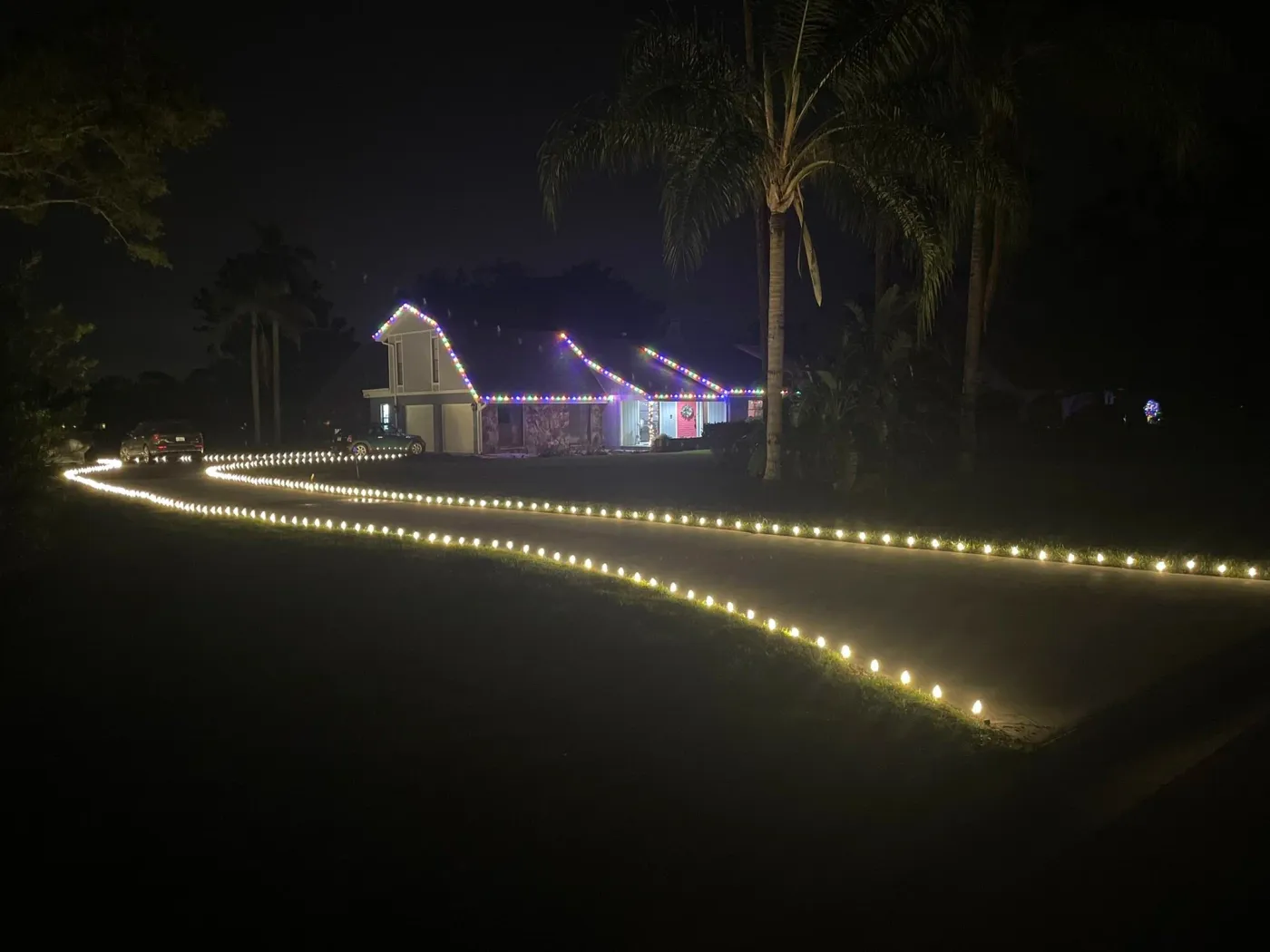
driveway stakes get hit. By cars, by plows, by a delivery van backing up in a hurry. Buy stakes with a wide, weighted base rather than the thin wire kind, and keep them 12 inches back from the pavement so tires miss them. Also check where snow gets piled — a typical plow line will bury anything under 14 inches tall for six weeks straight.
6. Bell Lights That Project Stars Onto the Snow
Here’s how to get crisp star projections instead of a blurry puddle of light.
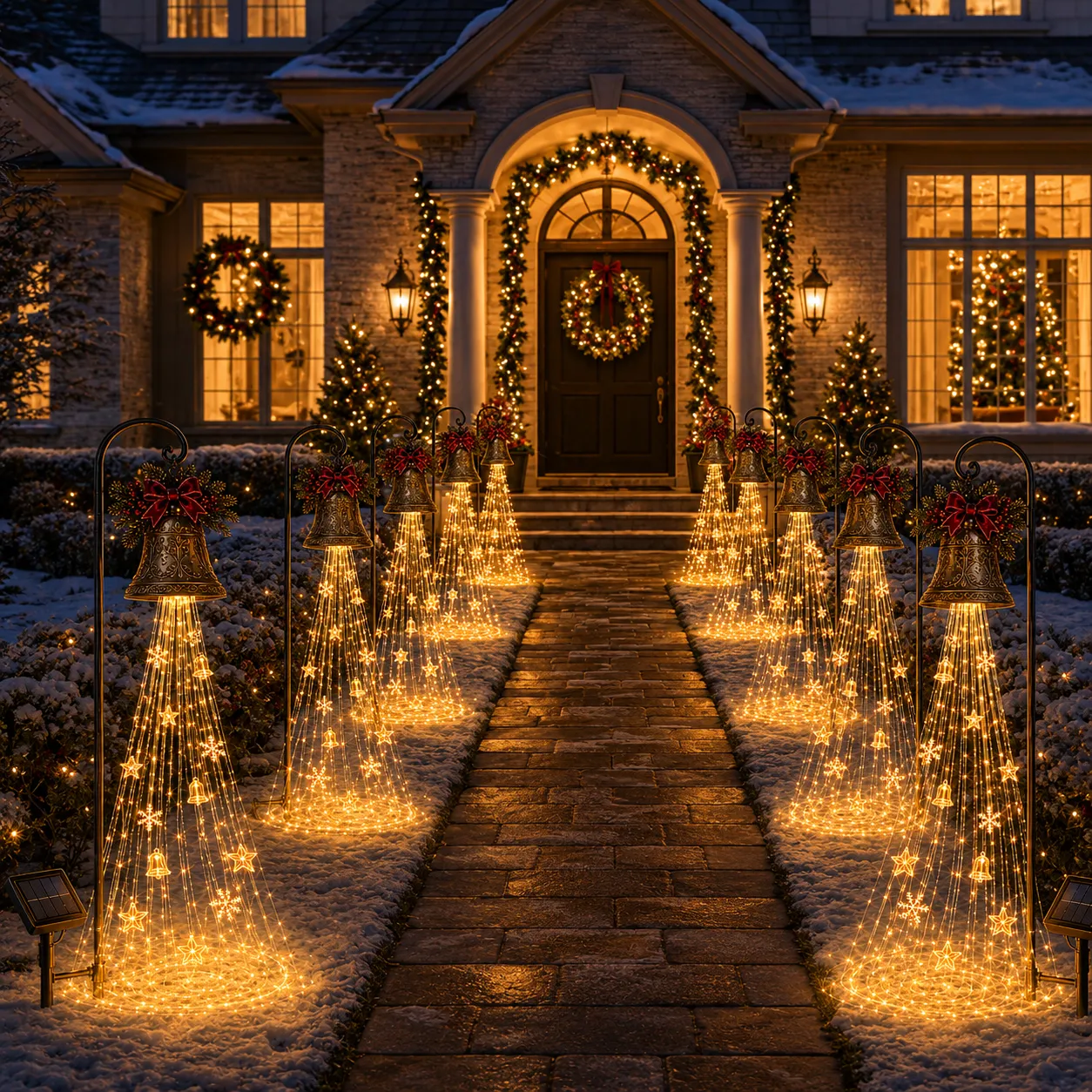
- Place bell fixtures 4 feet apart — that’s the distance where each cone of light nearly meets the next.
- Drive the stakes so each fixture sits about 2 inches above grade; deeper shortens the pattern, higher washes it out.
- Angle each cone at bare snow or stone, never at a wall where it smears.
- Tie the run to one timer and match the wreath and garland lights to the same warm temperature.
- Add the red bows last, after you’ve confirmed the spacing looks even in the dark.
Roughly two hours of setup and $120–$260 for a set of bell fixtures and stakes.
These are usually sold in sets, and the temptation is to spread them evenly across the whole walk. Resist that. Four fixtures grouped along the first 20 feet, where guests actually stand, will outperform eight spread thin across 60 feet — and you can add a second set next year once you see how the projections land on snow. Look for IP65 or better; cheap housings fog from the inside by January.
7. A Frozen Pond, Lit Deer, and Everything Aglow
What makes this work isn’t the quantity of light, it’s the mirror. A partially frozen pond doubles every strand and every deer figure, which means half the visual payoff costs nothing. Second principle: color discipline. The house outline, the icicle lights, the tree wraps, and the figures all stay in warm white, with multicolor used sparingly on the evergreens. That restraint is why a yard this busy still reads as calm instead of chaotic.
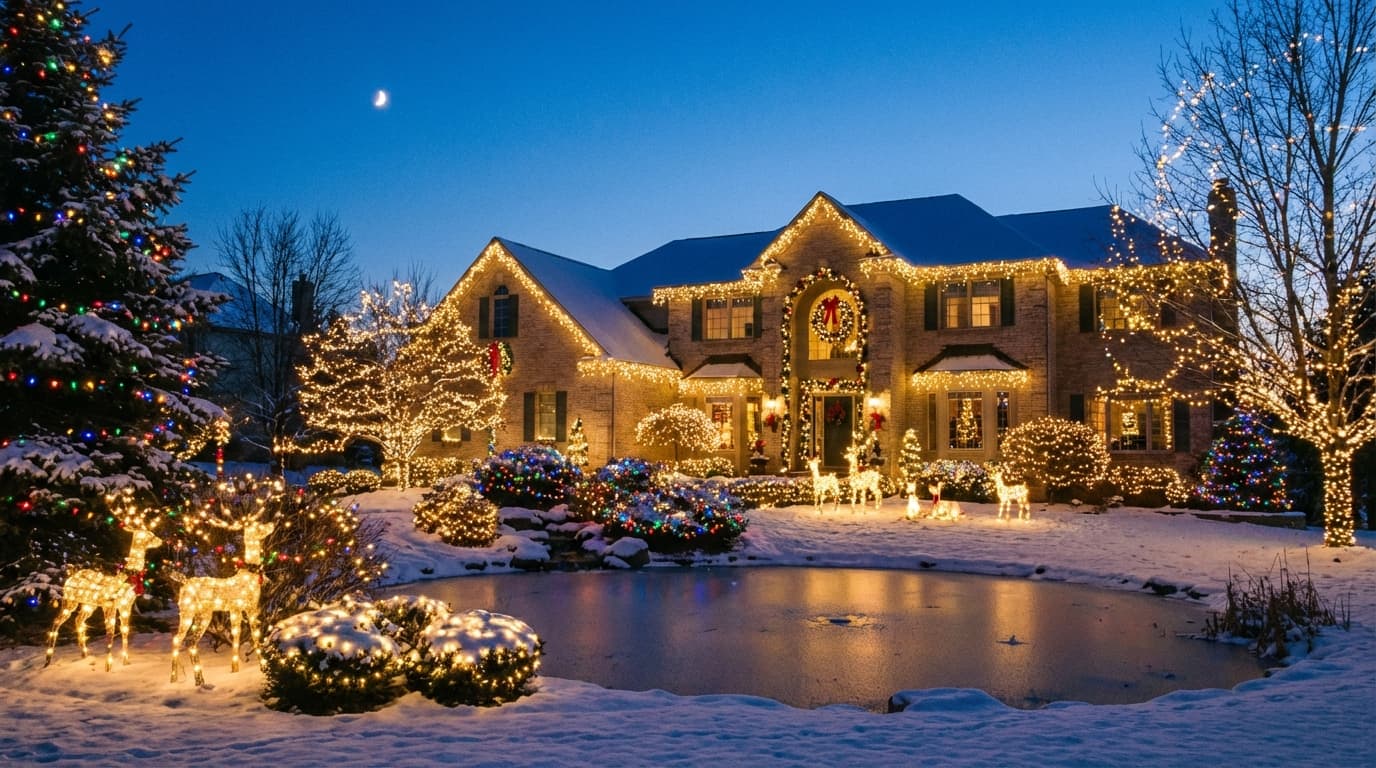
Get the look for less by putting your money into the reflection rather than the props — a $60–$120 trio of lit deer, one wrapped tree, and roofline icicles from a big-box store lands around $250–$400 total. Facebook Marketplace in early December is full of barely-used deer and snowmen at $15–$40 each, and a wrapped tree looks identical whether the strands cost $8 or $30. Compare with Idea #16 — same warm-white discipline, no water required.
8. Rainbow Arches Leading All the Way to the Door
Arched pathway lights went from novelty to genuinely good this year, and the rainbow-gradient versions are what people are saving. Part of it is practical — better sealed housings and low-voltage adapters mean these survive real winters now. It’s also a reaction to years of tasteful monochrome: after enough all-white yards, color reads as personality rather than chaos. Expect this to hold through 2027 and then settle in as a seasonal staple.
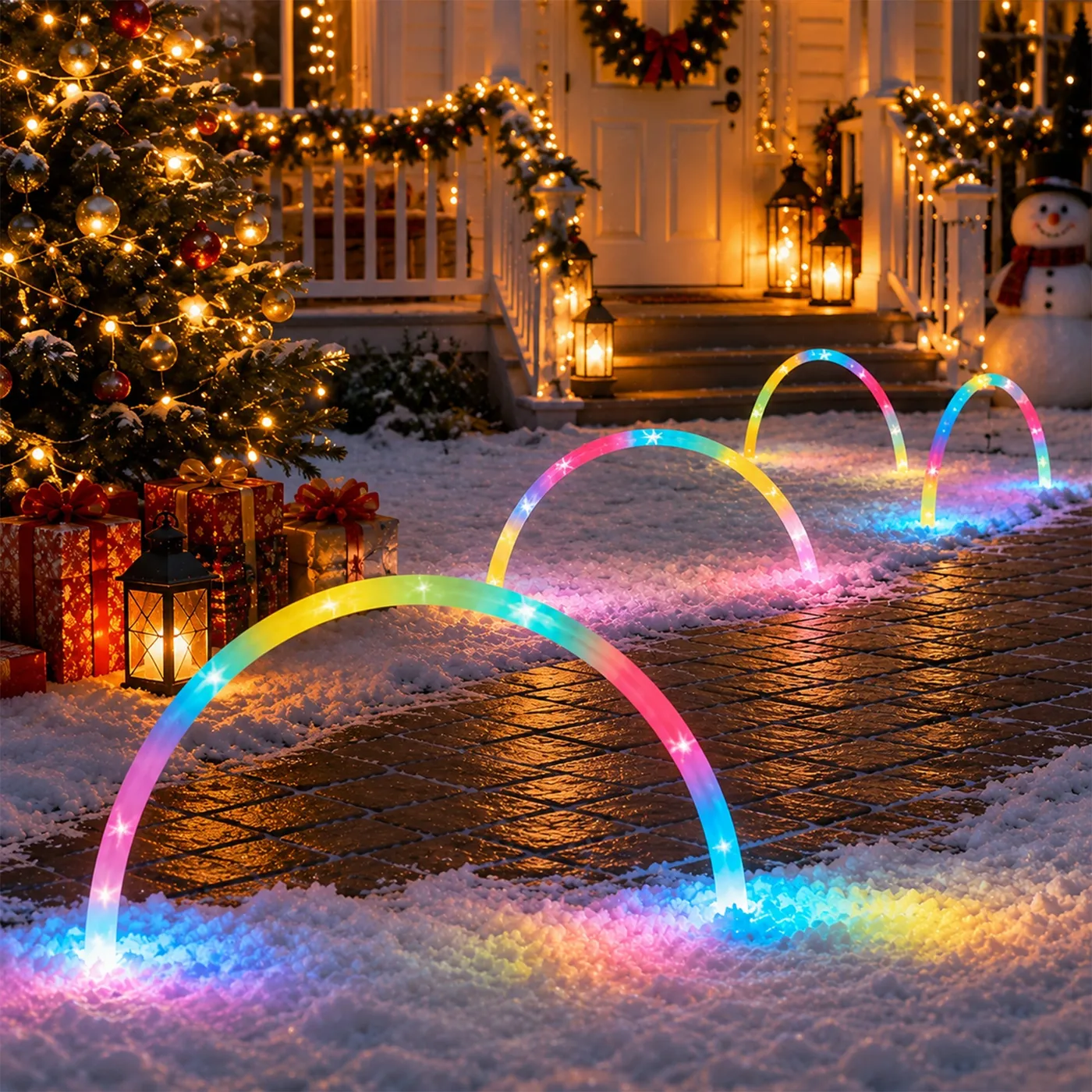
Sizing matters more than color here. Arches look best on a path 20 to 30 feet long, with each arch spaced about 3 feet apart so the lights form a genuine tunnel. What you’re really measuring is eye level, so keep the arch tops between 4 and 5 feet — go much higher and it stops feeling like a passage. Have a shorter approach? Two well-spaced arches beat five crammed together every single time.
9. Warm Lanterns Through a Snowy Forest Trail
The clean cylindrical holders on this forest path throw the softest light in the whole guide, and they’re also the most fragile. Thin glass, exposed bulbs, and freeze-thaw cycles don’t mix — expect to replace two or three a season, and buy a spare set rather than hunting down a discontinued model in January. Snow depth is the other variable: get more than 8 inches in a single storm and the shorter fixtures here disappear completely.
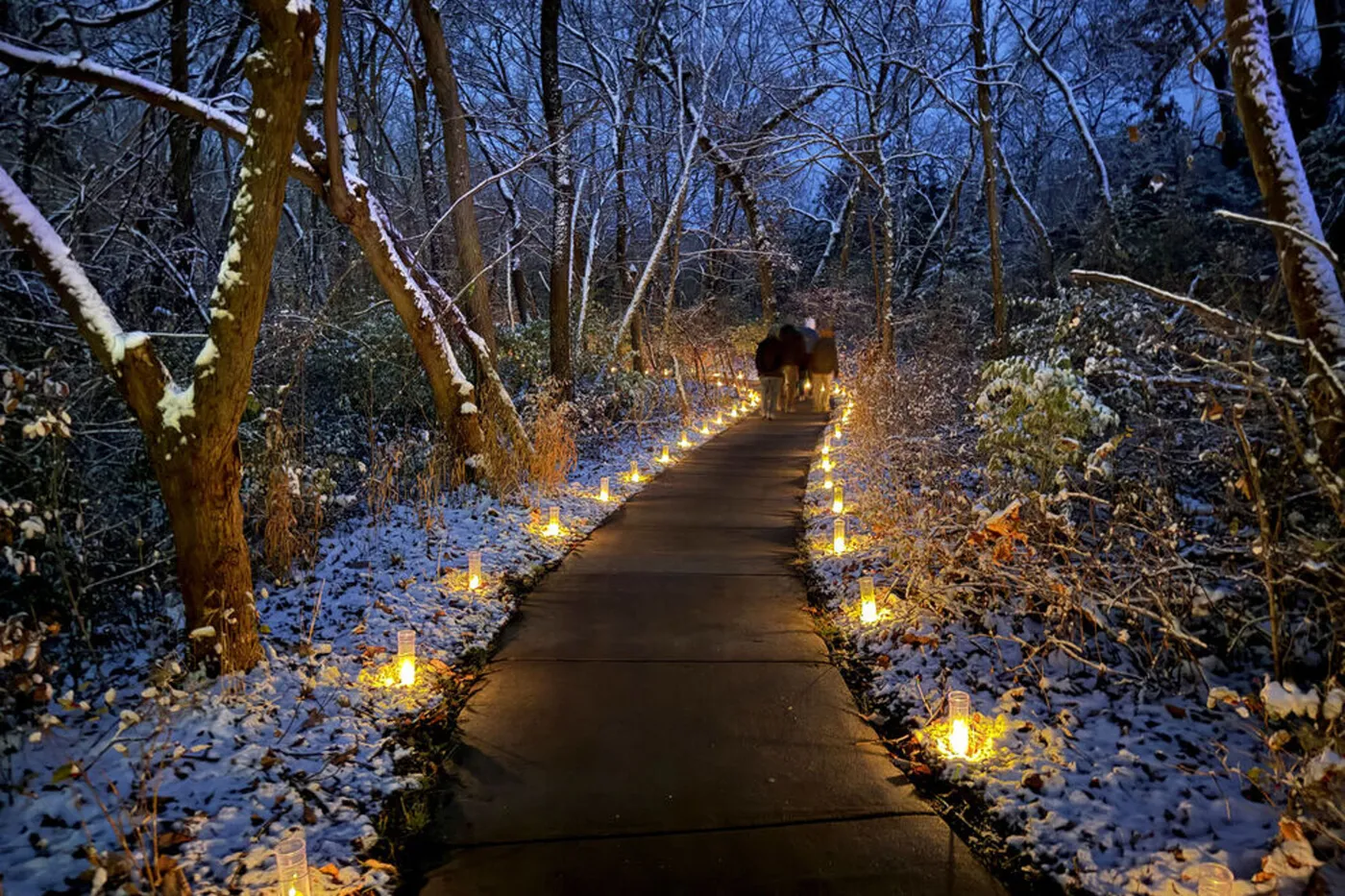
Building it for a backyard trail:
- Clear the route before you decorate — you want an 18-inch walking lane, not a guess.
- Set stakes every 10 to 12 feet, alternating sides on narrow trails.
- Keep fixtures 6 inches off the path edge so boots and sleds miss them.
- Use one low-voltage transformer per 100 feet and bury the cord along the edge.
- Run the whole thing for two nights before adding anything else.
10. Black Mushroom Caps Against Rust-Colored Mulch
Space these 6 to 8 feet apart along a mulch bed. Closer and you get a runway, farther and you get dark gaps. Cap-style fixtures throw light down and out, so keep each one 18 inches from the concrete edge or the glow lands on grass instead of path. Choose 2700K bulbs — anything cooler turns that lovely rust-colored mulch into a grey-brown puddle, and the whole reason this photo works is the warm contrast between black housing and reddish bark.
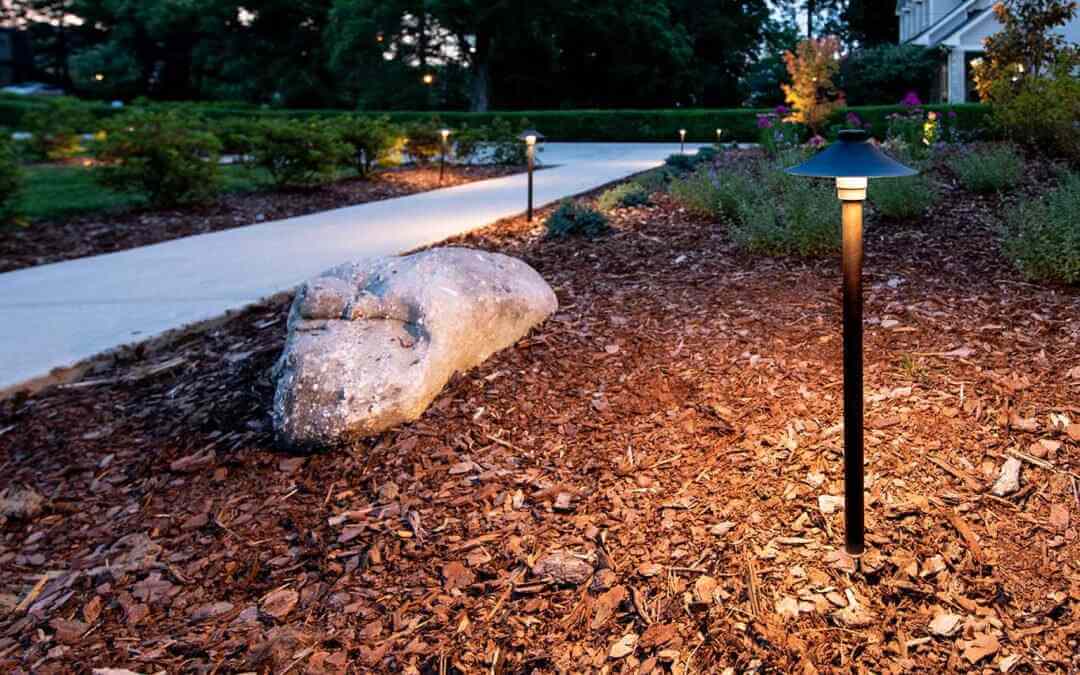
Wood chip mulch fades from rust to pale tan in about a season, and that mulch is doing half the visual work. Plan on refreshing the bed every spring for $30–$60 in bags, or switch to a dark-dyed mulch that holds color longer. Leaf litter also sits on top of chips instead of blowing past, so add a mid-November rake to the calendar. If you’d rather the ground itself glow than a row of fixtures, see Idea #1.
11. Brick Uplights and a Flowering Walkway
Warm uplights on brick do something no string light can: they show texture. The raking light catches every mortar line and every irregular face of the orange-brown masonry, so the building itself becomes the decoration. The central tree, lit from below, picks up green leaves instead of washing out, and the dark green bushes with small red flowers supply the only saturated color in the frame. Warm light, cool foliage, one accent — that’s the entire recipe.
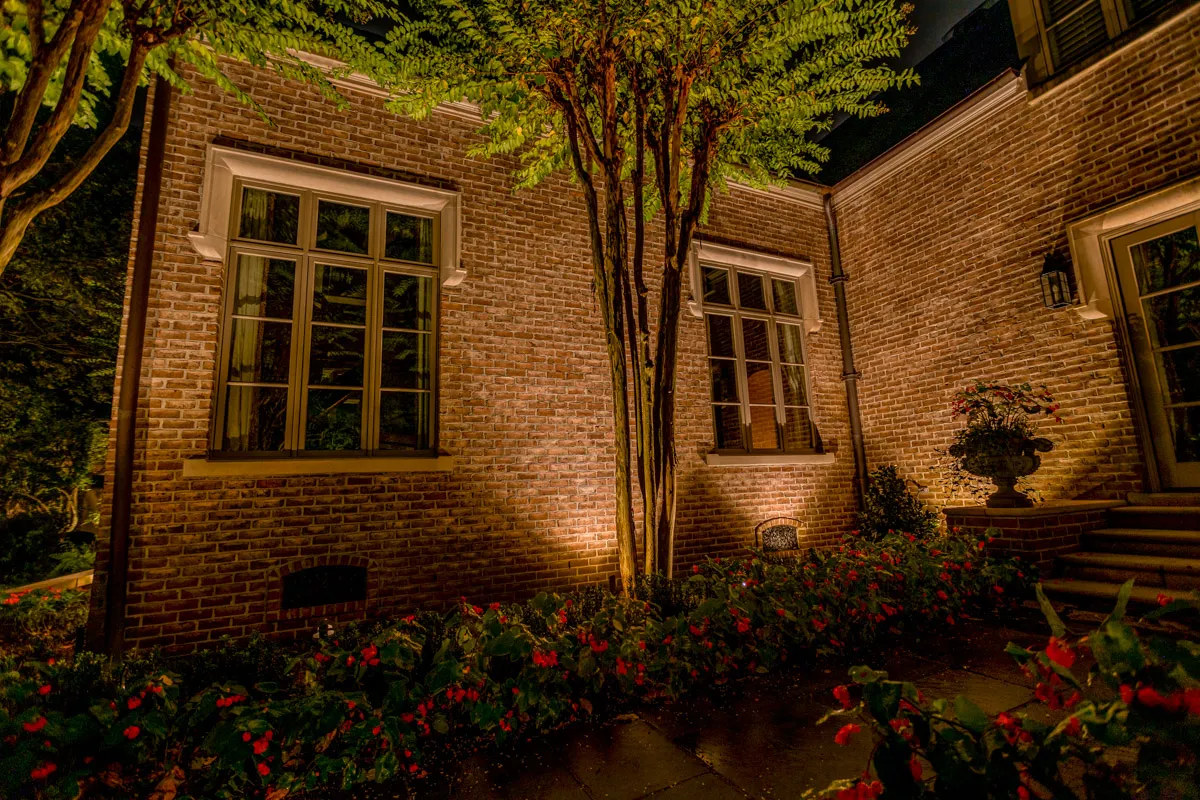
This approach suits a facade at least 30 feet wide with a walkway of 25 feet or more, and it needs a bed at least 18 inches deep to hide the fixtures. It’s also the most forgiving option for small yards: under 20 feet of frontage, use two uplights and one path light and let the walkway be the feature. In heavy snow country, the low-voltage fixtures in Idea #9 handle freeze-thaw better.
12. The Yard That Refuses to Pick One Color
The single element holding this together is the wet driveway. Every color in the yard — the green, red, and purple wrapped trees, the blue and orange bushes, the reindeer mid-flight — lands as a soft reflection on the pavement. Without that mirror you’d just have a loud yard. With it, the colors have somewhere to go and the chaos reads as depth. If your driveway is dry or gravel, this look loses roughly a third of its magic.
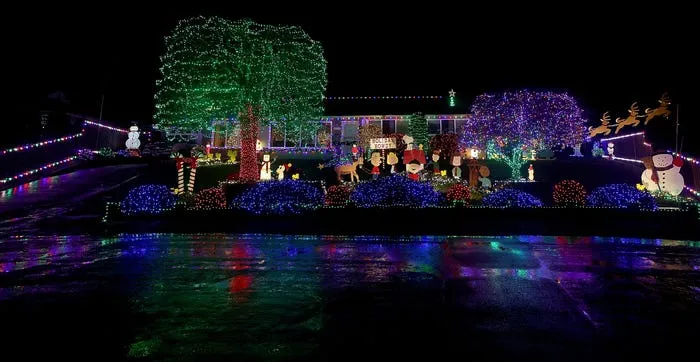
The formula is closer to 40% green and red, 25% blue and purple, 20% orange and warm white, and 15% character figures. What keeps it from becoming a fairground is that each tree is wrapped in a single color rather than strobed — groups of color, not individual bulbs. Swap the palette and the math still works: cool blues and whites for a frozen theme, red and gold for something traditional.
Two honest warnings. This level of display pulls real wattage, so budget $40–$90 a month running it four hours a night from Thanksgiving through New Year’s. And cutouts need dry, level ground; wet soil plus flimsy included stakes equals a Peanuts character face-down by December 12th. Use landscape staples on every figure and split the yard across three timers so you can kill the loudest colors after the kids go to bed.
13. Light-Up Figures Staked Into Fresh Snow
You don’t need a $2,000 yard to get the character energy. Four to six multicolored LED figure stakes — a bell, a snowman, a little tree, a Santa — run about $15–$30 each at Walmart or Target, and a set of four often drops to $45 around Black Friday. Total outlay: under $120 for a scene that photographs like a much bigger investment. Thrift stores and Marketplace in January are where the real bargains live, at $5–$10 a figure.
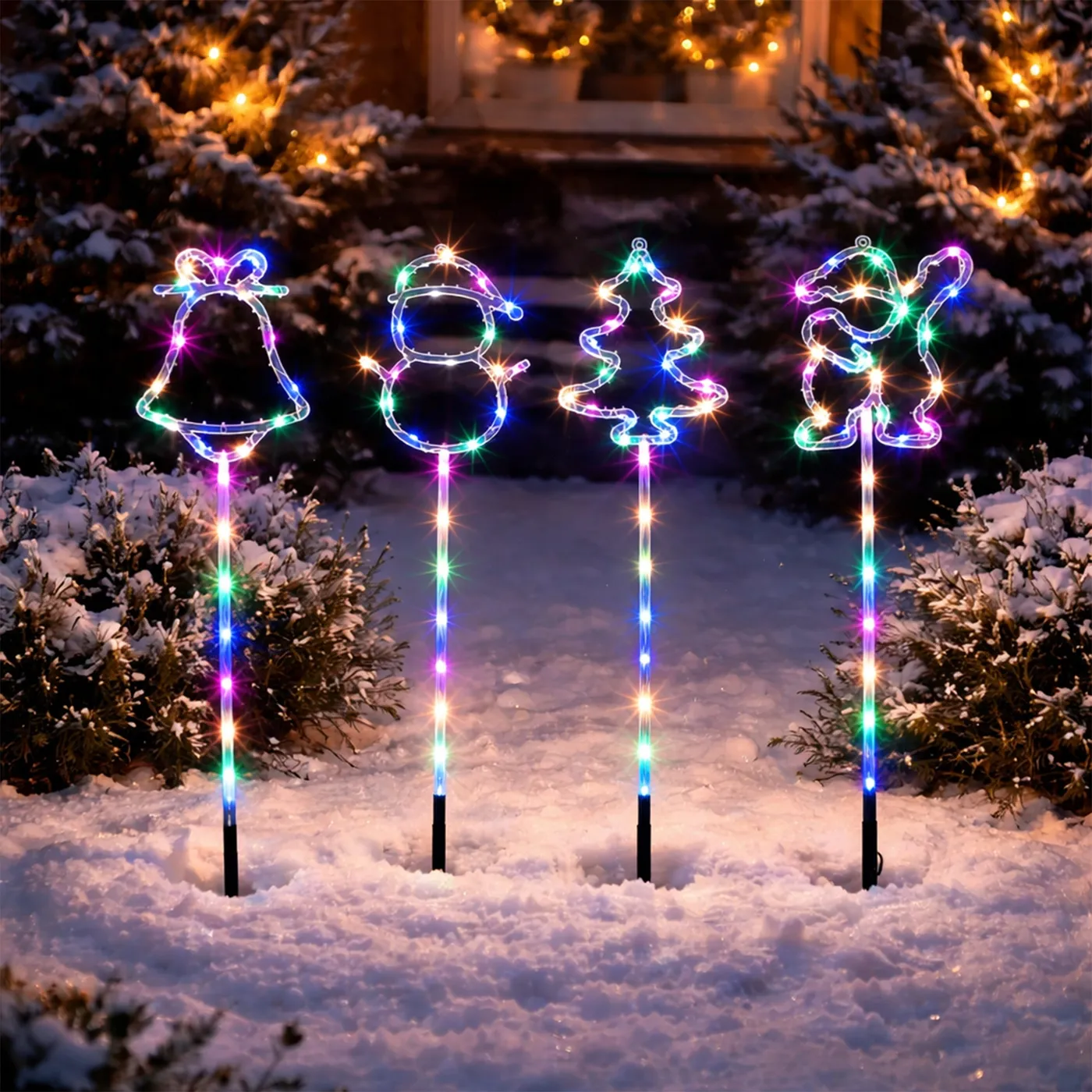
Stagger the heights or the row looks like a fence. Set the tallest figure in the middle at roughly 30 inches, flank it with 20-inch figures, and drop to 14-inch stakes at the ends. Keep a consistent 18 to 24 inches between them and place them slightly off-line rather than perfectly straight — a gentle curve photographs far better than a ruler edge. Point each figure’s face toward wherever people actually walk.
14. Every Branch and Bush Wrapped in Warm White
The thing separating this from a thousand other wrapped yards is consistency of density. The trees aren’t just touched with lights — every major branch is wrapped, and so are the manicured bushes, at the same spacing and the same warm temperature. That evenness is what reads as luxury. One half-wrapped shrub in the middle of all that and the whole yard suddenly looks like a weekend project instead of a plan. Same discipline, tropical plants, softer mood: Idea #3.
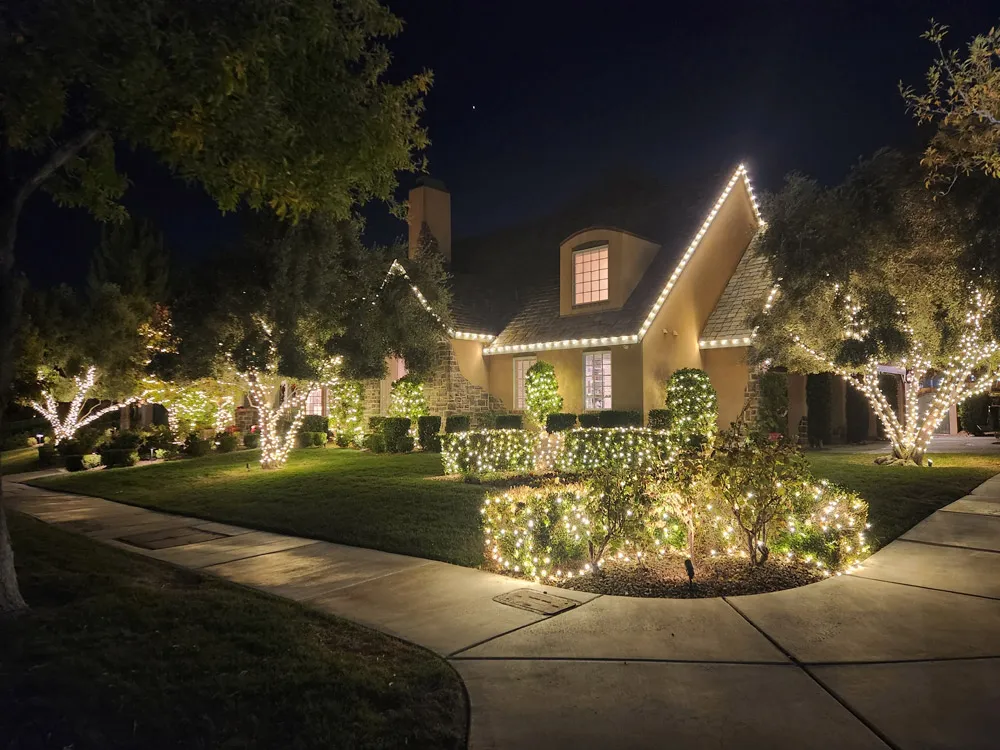
Two principles are doing the work. First, repetition — identical wrap spacing on trees of different sizes creates rhythm rather than randomness. Second, value contrast: warm white against dark roof tiles and deep green foliage gives the house a crisp silhouette, so the roofline reads cleanly from the street. Wrapping interior branches instead of only the outer canopy is what gives the light depth, which is why this yard looks three-dimensional rather than flat.
15. Green and White Trees Along a Curving Park Path
Two-tone tree wrapping is having a real moment, and it’s the most photographable trend in holiday lighting right now. Green and cool white read as slightly icy and modern — a deliberate step away from the nostalgic warm-white look that dominated the last few seasons. Park districts and botanical gardens adopted it first because it photographs beautifully on a phone, and homeowners are now copying it on front-yard trees. It’ll age well, because it’s a color choice rather than a gimmick.
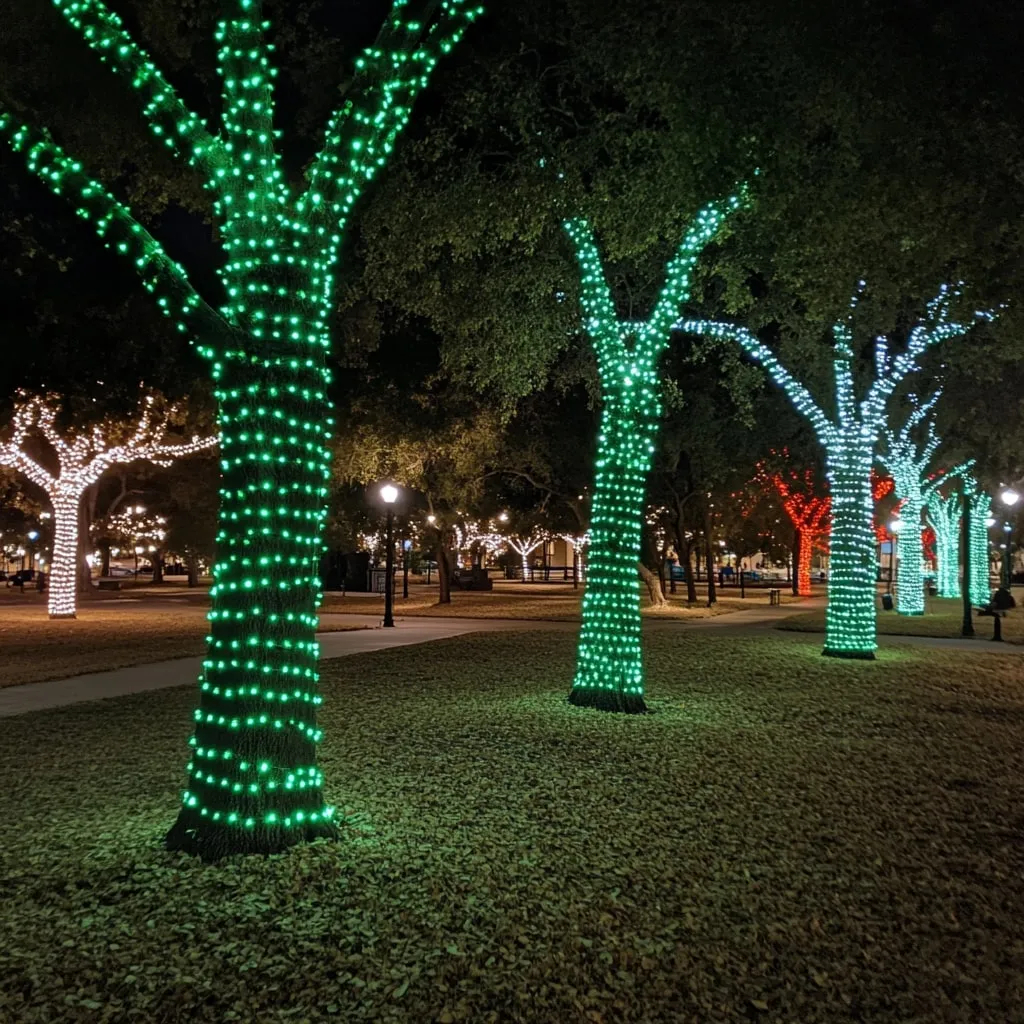
The ratio here is about 55% cool white, 35% green, and 10% warm accents borrowed from street lamps. Keep it that simple: green and white strands on trunks and major limbs, warm white reserved for the path and any nearby fixtures. Want the same structure in warmer tones? Swap green for warm white and cool white for amber and you’ll get a golden allée instead of a frosty one.
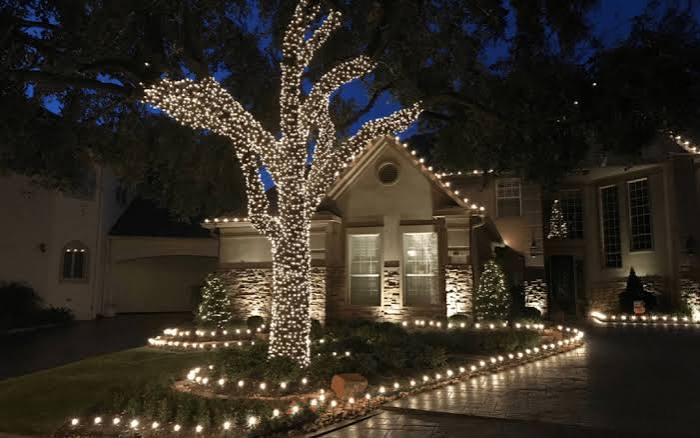
16. Rooflines Outlined on a Grand Stucco Facade
Outlining a multi-gable roofline only works if the line is unbroken. Run each strand tight against the fascia with clips every 12 inches, and hide every splice behind a gable corner where a shadow will fall. Use the same bulb count per linear foot throughout — mixing a dense strand with a sparse one is the number one reason rooflines look patchy from the street. A $20 laser level saves you an hour of squinting upward in the cold.
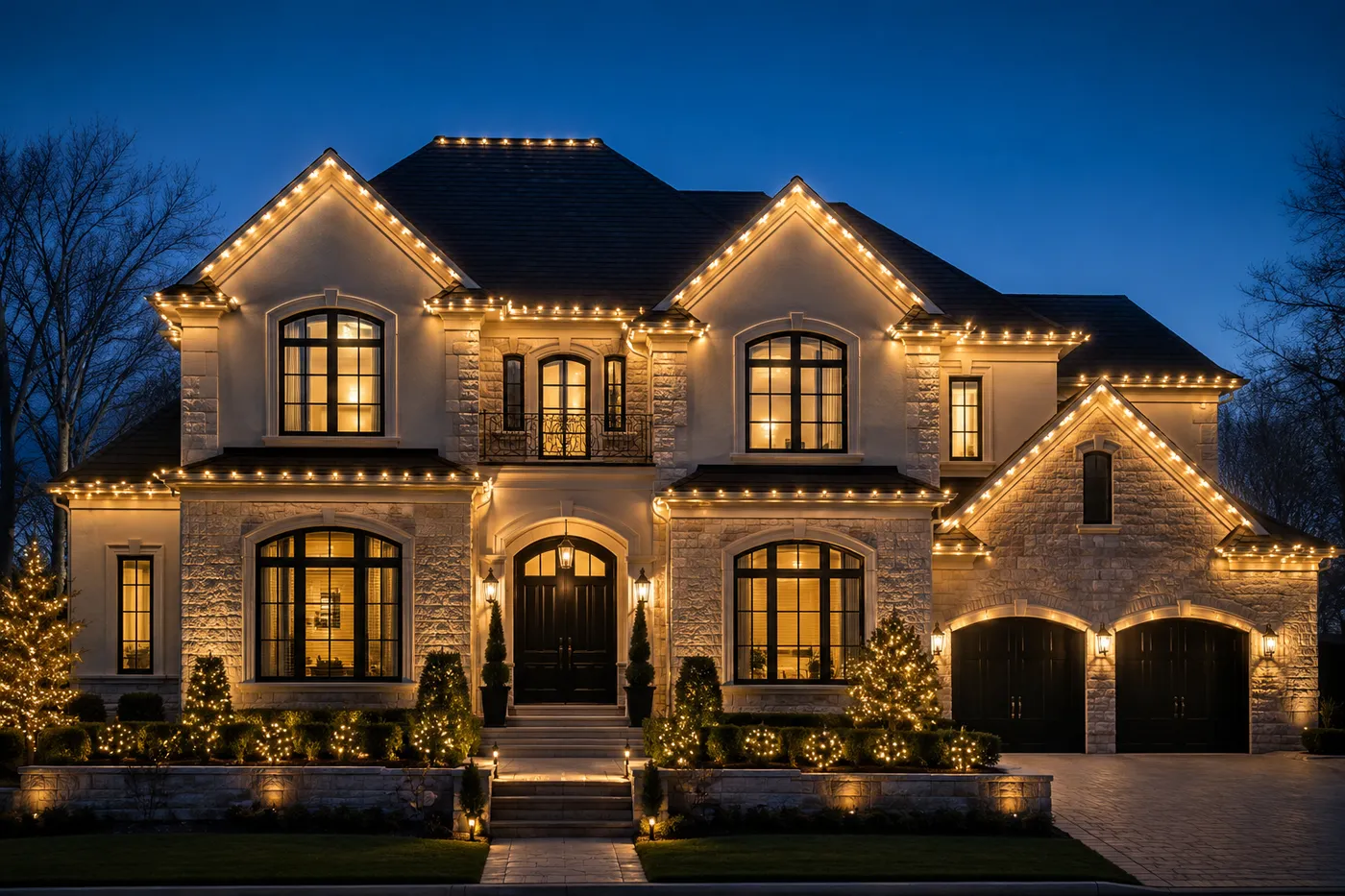
Take away the ground uplights on the stone and stucco walls and this house would still look good, but flat. The uplights are what give the facade depth, so the string lights read as a layer on top of architecture instead of a drawing on a black background. It’s the difference between a house that’s outlined and a house that’s lit. It’s also the cheapest upgrade on this entire list.
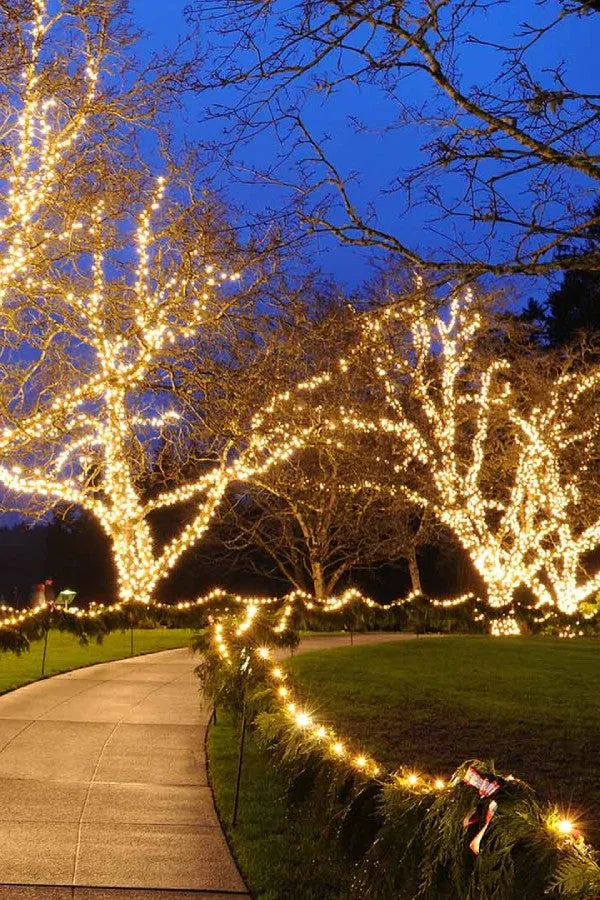
17. Bare Trees Wrapped Into a Glowing Allée
This is a pure repetition play: about 70% warm white on trunks and limbs, 25% on the small path-lining fixtures, and 5% darkness — the night sky, the bark, the shadows. Lean on trunk wrapping more than canopy wrapping, because bare winter branches hold light beautifully when strands follow the wood instead of swinging free. Prefer a warm-to-cool shift? Keep the same 70/25 split and swap the tree strands for amber only.
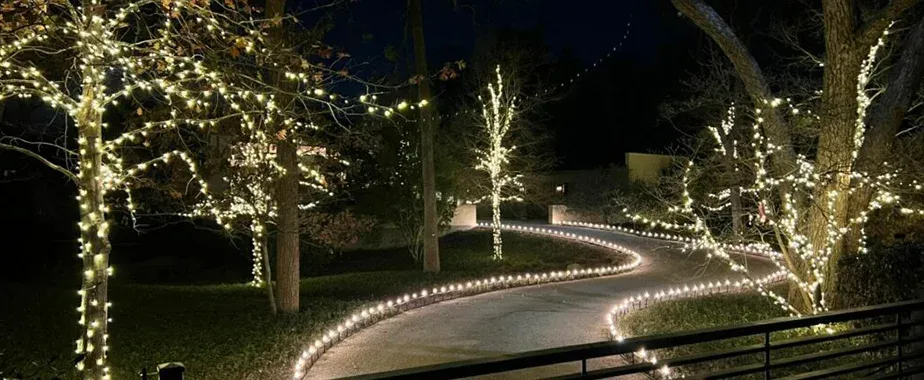
Twenty-five-foot warm white strands are $6–$12 at Walmart and Target, and a bare tree with a 6-inch trunk usually eats two or three of them. That means a full allée — six trees, both sides of the path — comes in at $120–$250 if you buy multi-packs, plus $40–$70 for low-voltage path fixtures. Skip the $60 designer tree-wrap kits; they’re the same strands in prettier packaging.
18. Poinsettias, Stars, and a Picket Fence in Lights
Red poinsettia shapes and hanging stars work here because they break the rule on purpose. In a forest of wrapped trunks, your eye needs objects — something with a silhouette — or the whole scene dissolves into texture. The white picket fence with purple lights adds a horizontal line to a composition made almost entirely of verticals, and the multicolored arches give the path a sequence: start, middle, finish. Every element has a job.
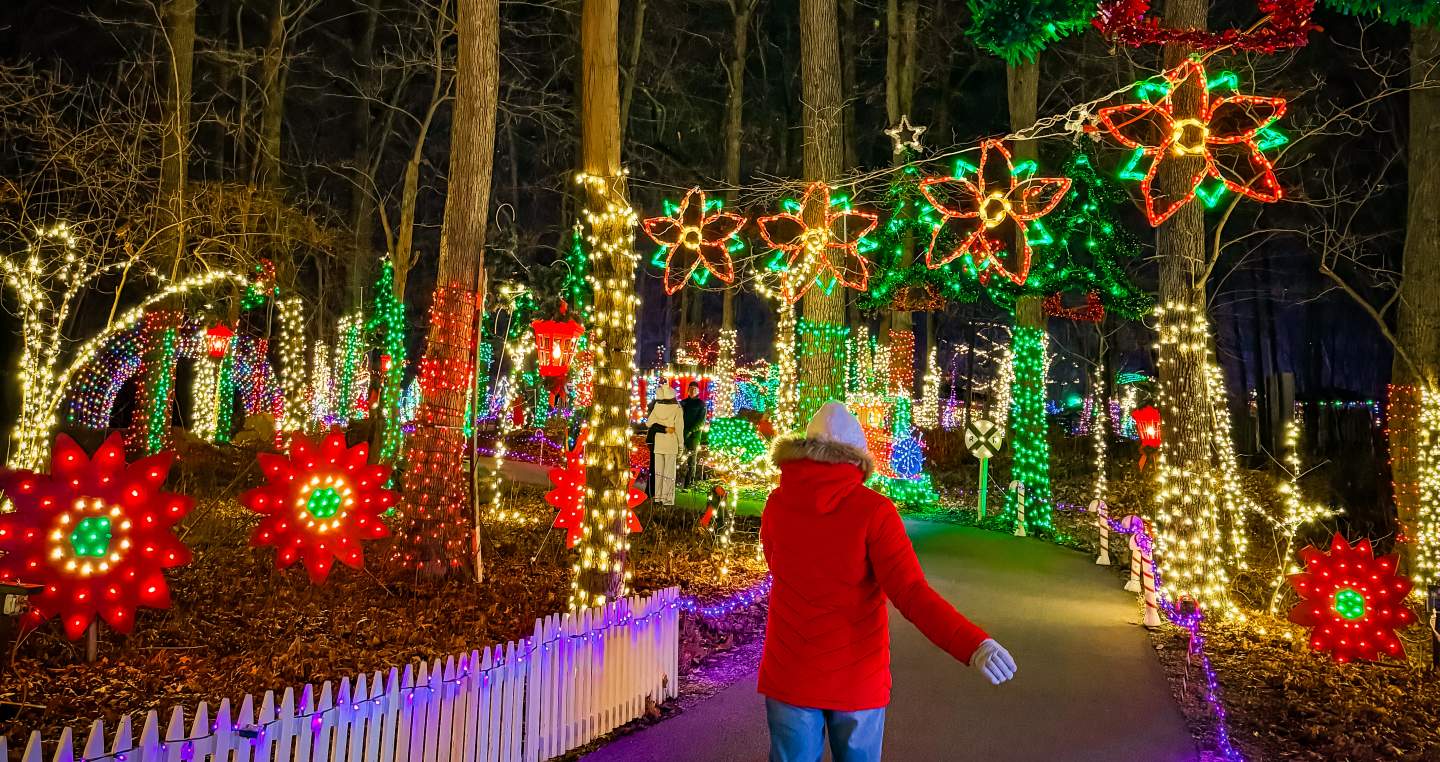
A quick check before you commit:
- Measure the path’s total run and count 25-foot strands before you buy — then add two spares.
- Confirm an outdoor outlet at both ends so you can split the run and avoid a dim finish.
- Check that fence rails, trunks, or arbors can carry shape lights with zip ties, never nails.
- Set the timer from dusk to 10 p.m. — it keeps neighbors friendly and the bill near $25 a month.
19. A Lit Christmas Tree in an Arched Window
The interior tree glowing in the arched upper window is doing more work than any strand outside, and it changes the whole size calculation. This look needs a facade tall enough that second-floor windows read from the street — think 25 feet to the eaves — plus a curved driveway or walkway of at least 50 feet so the wrapped trees and lampposts can frame the approach. On a single-story ranch, the upper-window trick simply doesn’t exist.
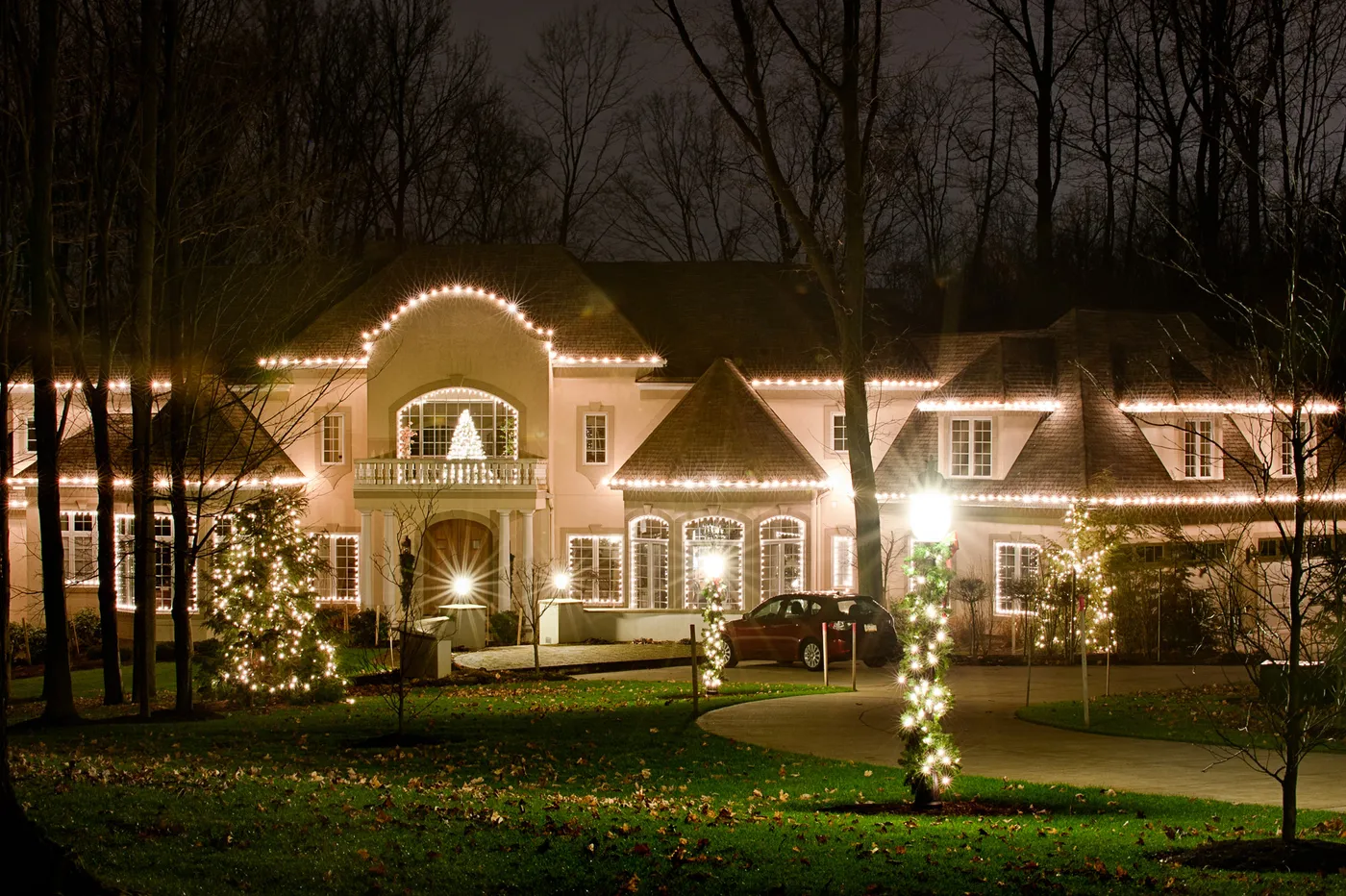
Two things people forget. Wrapped lampposts look charming until you realize the light sits at knee height, glaring at anyone standing on the porch — face post wraps toward the path, not the seating area. And running rooflines, windows, and three trees likely means two or three separate circuits. Blowing a breaker on Christmas Eve is a specific kind of heartbreak. If your facade is single-story, skip the roofline outline and put that budget into ground uplights, which do more for a low house than any strand.
20. Golden Autumn Leaves Still Holding the Lights
Wrapping a tree that still has leaves is a gamble. Those golden-brown leaves will drop, and when they do, a cluster of lights goes dark in the middle of your prettiest tree. Most deciduous trees hold until mid-December, which is fine — just be ready to re-tuck strands after the first hard wind. Leaves trapped in a strand also hold moisture against the wire, so inspect for cracked insulation before you plug anything in.
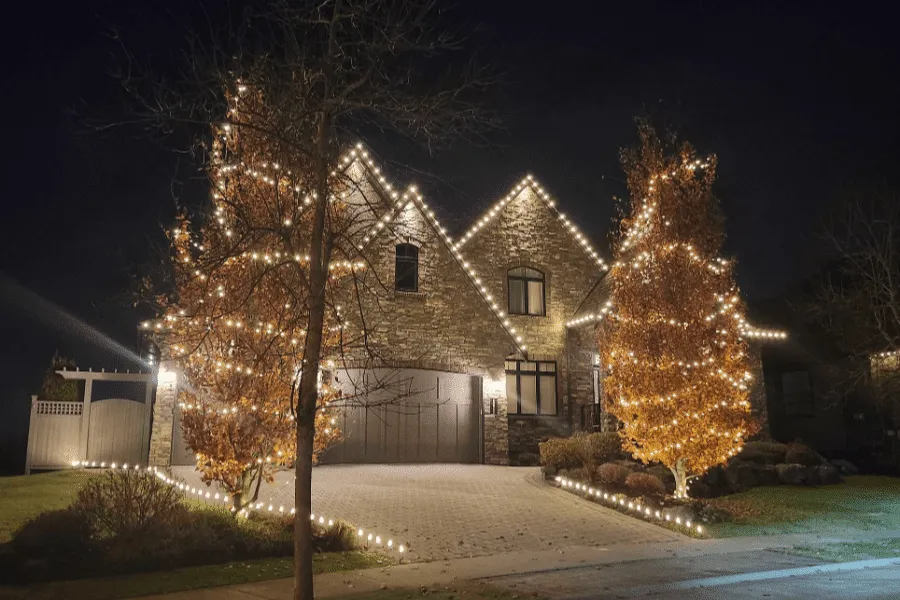
Wrap the trunk and the two lowest main limbs rather than the fine outer twigs. That’s where the leaves cling longest and where the light reads best from the driveway. Use 12-inch zip ties instead of light clips on bark; clips pop off when wood contracts in freezing temperatures. If you’re outlining the gables too, start at the highest peak and work downward so you can walk the slack out as you go.
21. A Brick Walkway With Garland at the Door
The garland at the door is what turns this from path lights into an arrival. Strands on brick are lovely, but the lit wreath and garland frame the one spot people actually look at, giving the eye a destination at the end of the walk. Pull the garland and you’ve got a nice path with nowhere to go. The dark door behind all that warm light is doing quiet work too — it makes the green and gold pop instead of blending in.
Building the doorway garland:
- Screw a cup hook at each top corner of the door frame, 2 inches in from the edge.
- Start the garland at one hook and drape it in a soft arc, not a straight line.
- Weave a warm white strand through the garland as you go, hiding the cord behind the greens.
- Anchor the midpoints with clear zip ties so the arc holds in wind.
- Hang the wreath last so its light doesn’t double up on the garland’s.
22. Holly and Berries Wrapped Around Lantern Posts
- Two pre-lit holly garlands, 9 feet each: $60–$140
- Bag of loose red berry clusters: $8–$20
- Warm white string lights for the wraps: $20–$40
- Weatherproof zip ties and cup hooks: $10–$20
- Optional amber glass lantern fixtures: $80–$200
- Total: about $100–$420
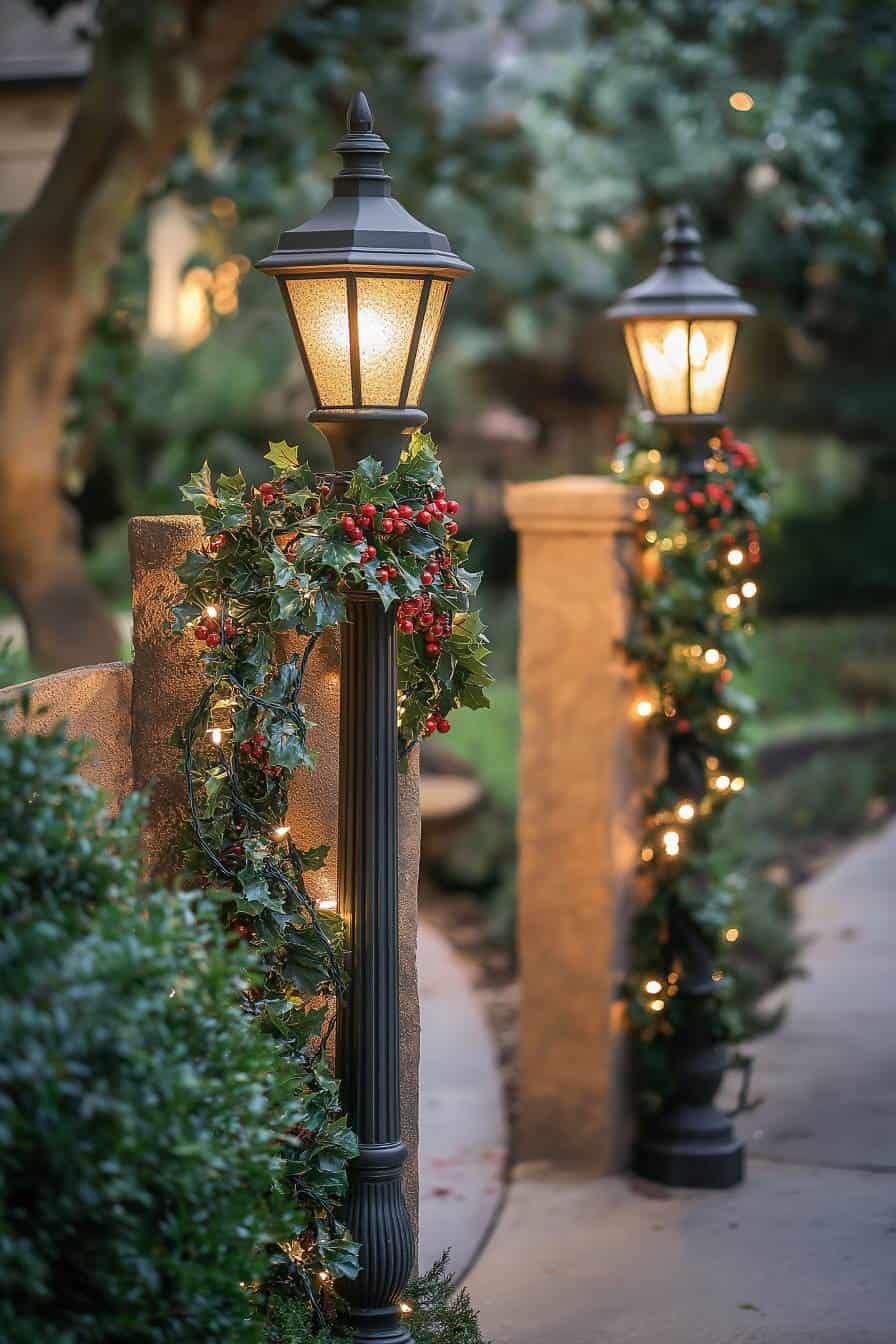
Budget alternative: skip the pre-lit garlands, buy two $15 plain evergreen garlands, and weave in a single $10 strand of lights per post. Total under $70.
Berry clusters are the first thing to fade — those cheap red foam berries turn pink by year two. Look for plastic or fabric berries, and store the garland in a labeled bin instead of a tangle in the garage. On metal posts, avoid wrapping the wire tight against painted surfaces; over a season, that friction and trapped moisture dulls the finish.
23. Evergreen Garland and Plaid Bows Along the Path
About 65% warm white strand, 25% evergreen garland, and 10% plaid ribbon. The garland should sit low — along the path edge rather than up at eye level — so it reads as ground rhythm, and the bows go on roughly every 8 feet so the pattern feels regular but not mechanical. Want it less traditional? Swap the plaid for a solid velvet ribbon in burgundy or forest green and the formula holds perfectly.
Plain evergreen garland is one of the cheapest decor items of the season: $12–$20 for nine feet at Walmart or Lowe’s, and wire-edged plaid ribbon runs $6–$12 a roll. Wrapping the trees is where the money goes, and you can skip the two farthest trees — nobody photographs the back of the yard. Realistic total for this look at a modest house: $180–$320. Compare with Idea #17, which gets the same glow with no greenery at all.
24. Candy Canes Planted in a Ribbed Planter
The planter is the whole trick. Candy cane stakes look cheap pushed into a lawn and wonderful arranged inside a ribbed container with foliage, red berries, and a layer of faux snow at the base. The container says someone styled this. Without it you’ve got four plastic canes in a yard; with it, you’ve got an arrangement that looks like it cost three times what it did.
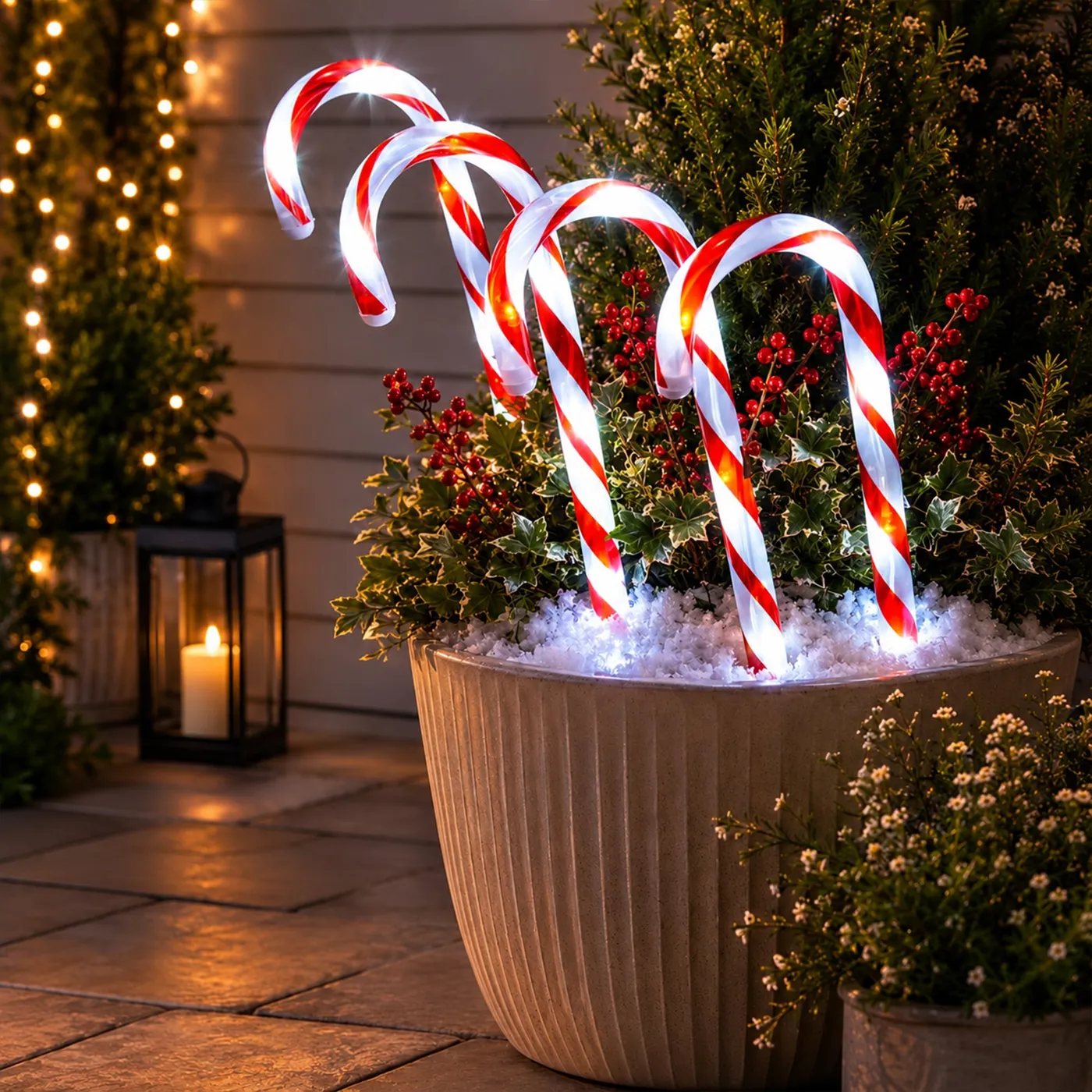
No lawn, no problem:
- Pick a planter 14 to 18 inches across with vertical ribs — the lines echo the candy cane stripes.
- Fill two-thirds with soil or a sandbag so winter wind can’t tip it.
- Push three or four canes in at slightly different heights, 3 to 4 inches apart.
- Tuck greenery and berry picks around the base, then finish with a thin layer of faux snow.
- Set a battery candle in a black lantern beside it for a warm, low glow.
25. Star Stakes With Tiny Lit Trees Inside, Solar-Powered
Solar path lights live or die by panel placement, and the panel on these star stakes is tiny. Aim it south, tilt it toward the sun, and keep it clear of shadows from the house, hedges, and — this one catches people — your own Christmas decorations. A 4-hour charge buys you roughly 6 hours of light in December, so put the most prominent stake where you’ll actually see it after dinner. Wipe snow off the panel; that’s the single most common reason these go dark.
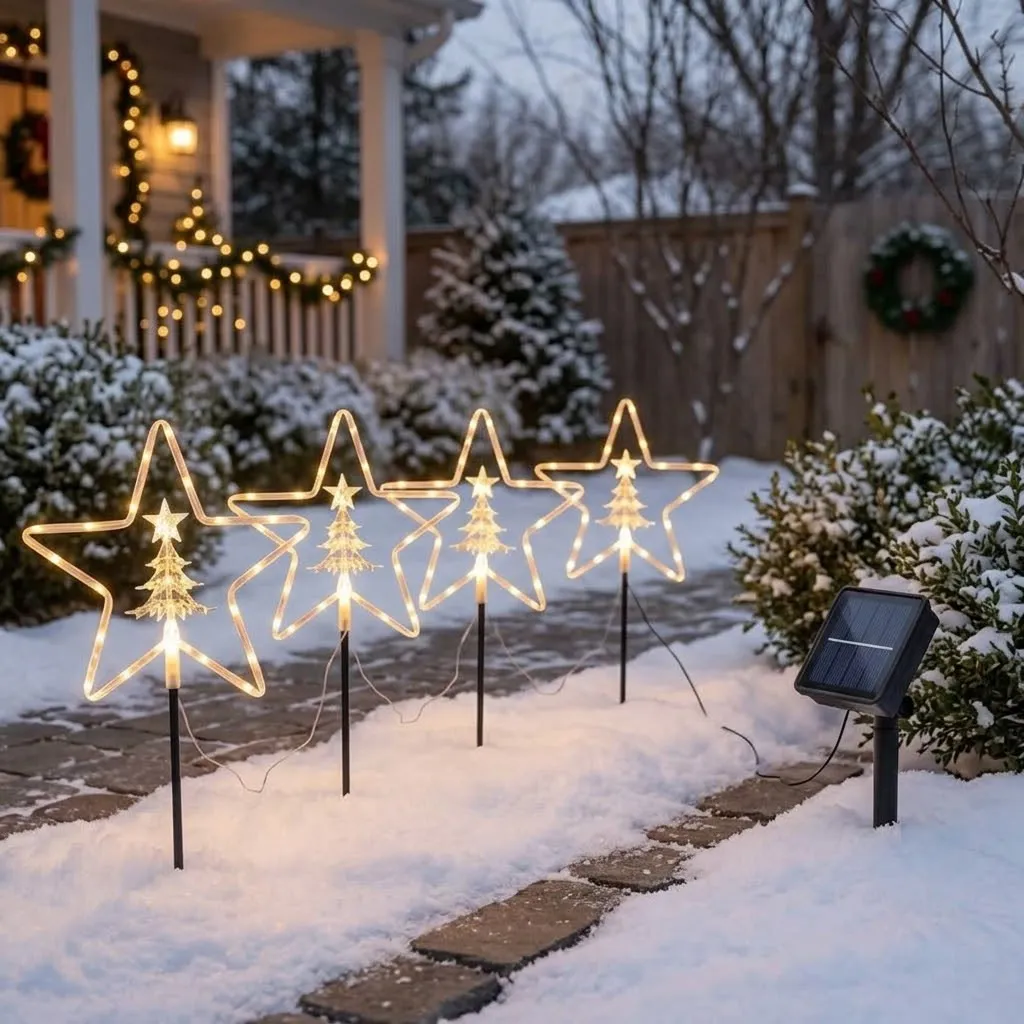
Four stakes is the right number for a walkway of 12 to 18 feet. Longer than that, buy two sets or you’ll end up with a lonely, evenly spaced row that reads as unfinished. These work best on stone or pavers rather than grass, since the light is soft and low and needs a reflective surface to feel intentional. Snow-covered paths are ideal. Past 20 feet, corded stake lights hold brightness better through a cloudy December.
26. Spiraled Candy-Cane Bases Under Glowing Stars
Two shapes, one fixture. A star on top and a spiraled candy-cane base underneath means each light reads as festive from a distance and detailed up close, and internal illumination keeps both parts at the same brightness. That consistency is what matters — most novelty stakes have one bright section and one dim one, which is exactly why they look junky. Pair them with falling snow and a lit tree in the background and the eye finishes the scene on its own.
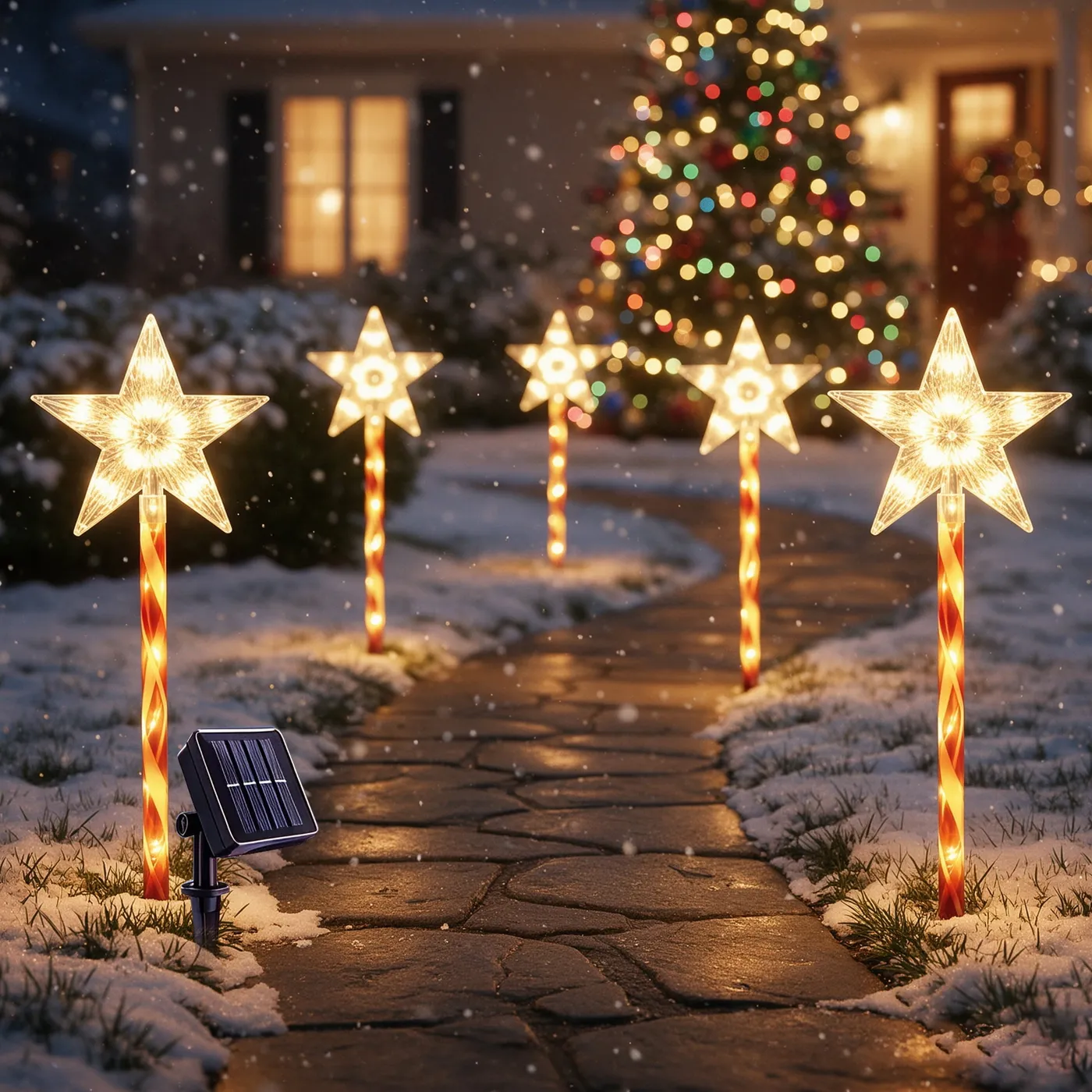
Novelty-plus-function fixtures are the quiet theme of the 2026 season. Shoppers have gotten savvy about cords and outlets, and solar stakes with shaped tops let people light a walkway without an electrician or a nest of extension cords. They’re not going anywhere — panels keep shrinking, batteries keep improving, and people keep wanting a path that glows without becoming a project.
27. Mini Lit Trees Among Multicolored String Lights
Two lit mini trees with star toppers, solar-powered, run about $25–$45 for the pair. Set them at the edge of a bed where the big trees behind them are wrapped in multicolored strands and your eye reads one continuous garden instead of three separate purchases. Multicolored 100-count strands are $8–$15 at Target, and a solar panel with a stake adds $15–$25. Whole scene, under $150, and no outdoor outlet required. Prefer all white? Idea #25 keeps the same shape in a single temperature.
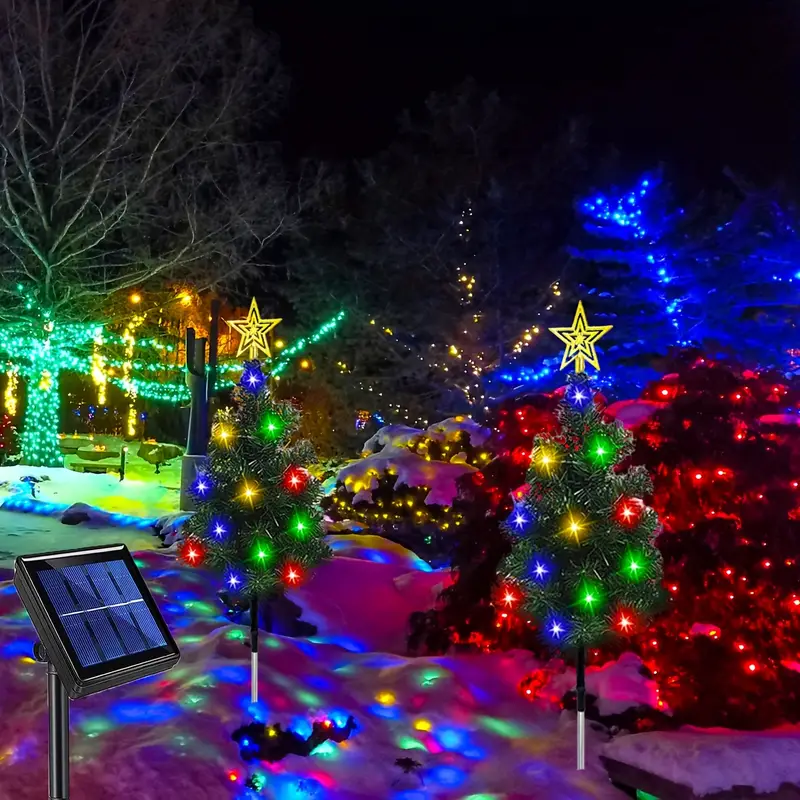
Small solar fixtures are seasonal objects, not investments. Expect the internal battery to lose capacity after two winters, which shows up as lights dying by 8 p.m. Replacement batteries are usually a few dollars, and the housing should be stored indoors and dry from January onward. Wipe the panels weekly in December — a dusting of snow costs you an hour of glow, and a frozen crust can cost you the whole night.
Light the Walk, Not Just the House
Pathway lights are the one part of holiday decorating that changes how your house feels from the street, not just how it looks in a photo. Pick one idea here, start with the walkway, and add a little more next December. 📌 Pin this guide before you shop — the spacing numbers and budgets are the part you’ll actually want at the store.