27 Stunning Cranberry Garland Decor Ideas That Will Make Your Home Shine Bright This Holiday Season

You know that feeling when you finally find the garland that looks exactly right for your space — and then realize it costs $200 and ships in three weeks? Here is the thing about cranberry garland: it is the one holiday decoration that looks expensive and costs almost nothing, whether it is a rustic log wrapped in popcorn and berries or a deep red bead strand glowing through a lit fir.
We spent serious time browsing Michaels, Target, IKEA, Etsy, and Amazon to bring you only what is actually worth stringing up this year, from $8 craft-twine projects to $450 pre-lit garland sets.
Inside you will find 27 curated ideas covering rustic foraged garlands, classic red-and-green traditional trees, frosted Scandinavian looks, and polished heritage entryways, with budget and luxury versions compared side by side and every idea shoppable with direct product links. In 2026 the big shift is toward handmade, food-based garlands that double as family projects. And stay until the end — we break down the most common mistakes that can ruin these looks.
📌 Save this to Pinterest for later — you will want to revisit these ideas.
1. Deep Red Beaded Garland Looped Through a Lighted Fir
What makes this tree feel expensive is not the tree. It is the deep red beaded garland looping through the branches in uneven, generous swags, with polished round beads that catch the warm white lights and glow like a hundred tiny berries. The string lights are woven into the same branches, so the glow comes from inside the garland instead of sitting on top of it. Pull the beads out and you have a decent lit tree. Pull the lights and the beads go flat and plastic.
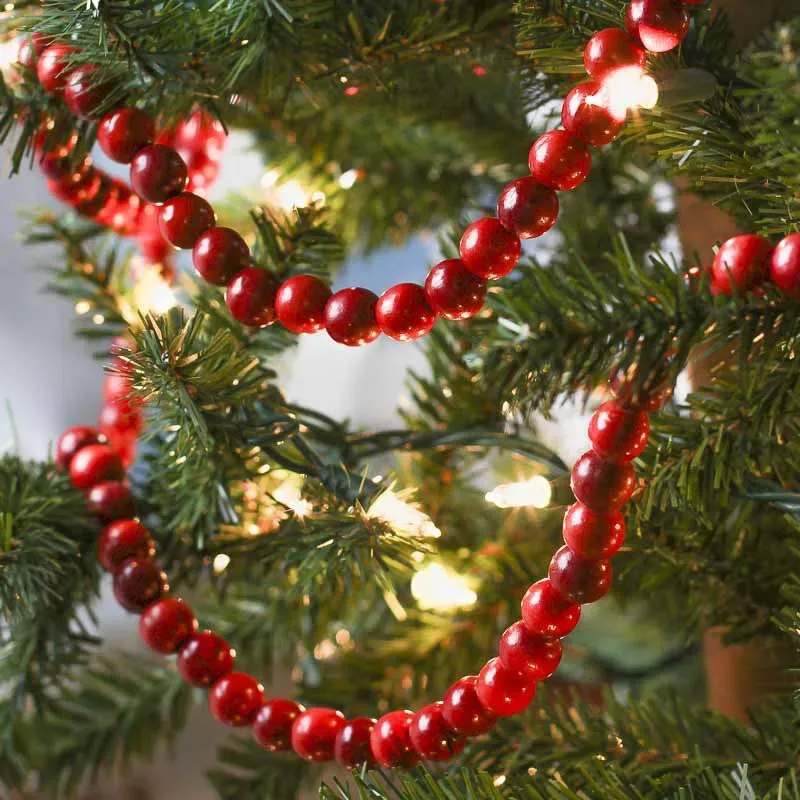
Here is what it takes to build the same look on a standard tree:
- Red beaded garland, three 9 ft strands: $30–$75
- Warm white string lights, 300–600 count: $25–$60
- Unlit artificial tree, 7.5 ft: $120–$500
- Tree skirt or collar: $25–$80
- Floral wire and spare bulbs: $10–$15
Budget alternative: a dollar-store bead garland trio plus a $30 LED set gets you most of the glow for under $70 — the beads matter more than the tree does.
2. Popcorn and Cranberry Garland on a Frosted-Window Rustic Tree
Before you thread a single cranberry: popcorn goes stale and brittle in about two weeks, and once it crumbles you are picking kernels out of the tree skirt. Cranberries dry into wrinkled little jewels that hold up for a month or more. If you have a dog or a toddler, hang edible garlands above the three-foot mark and skip the cinnamon stick ornaments on the lower branches. Nobody warns you that a natural garland is basically a snack.
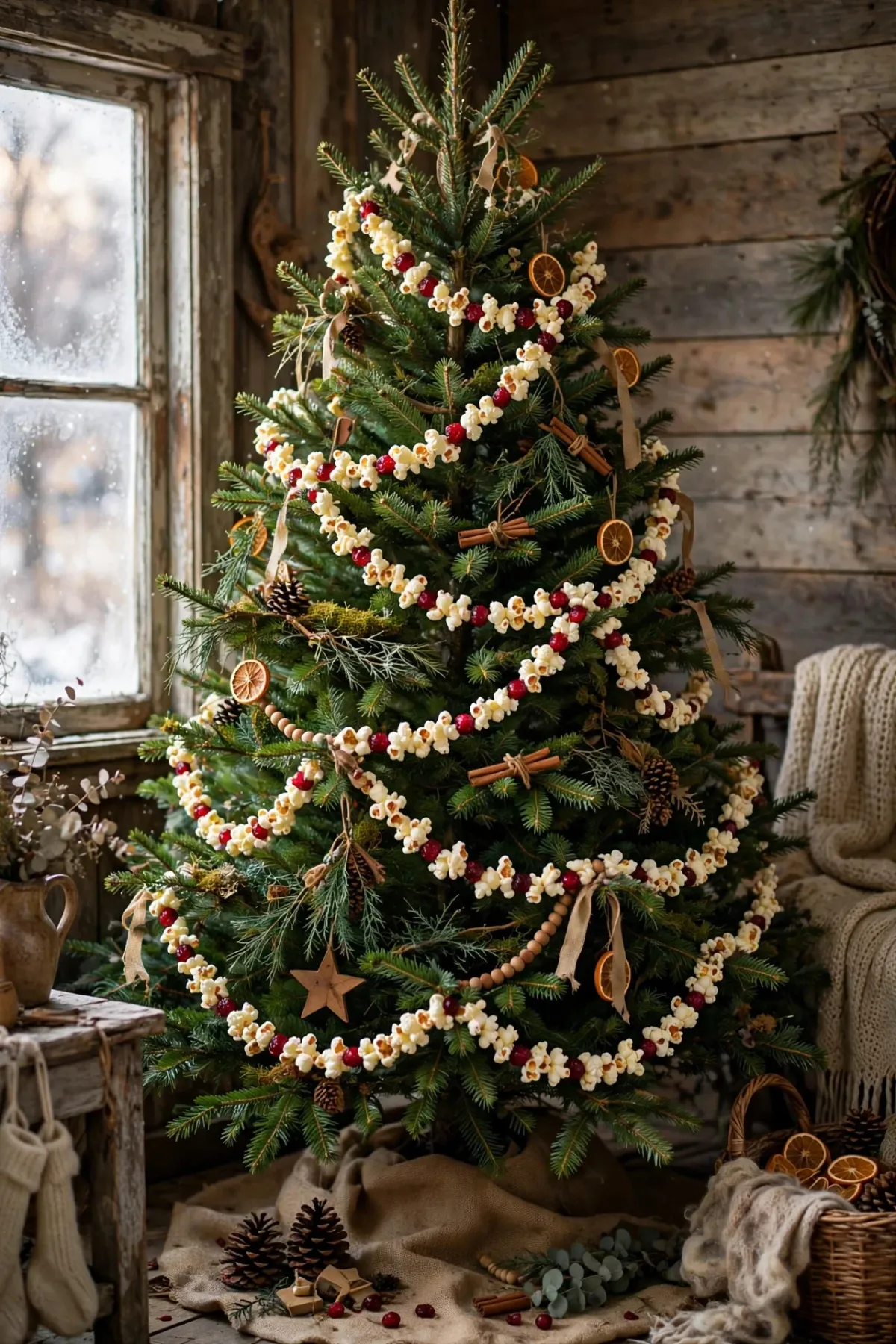
A popcorn-and-cranberry strand, start to finish:
- Pop plain popcorn the night before — no butter, no salt — and let it dry completely.
- Cut 10-foot lengths of doubled button thread and thread an upholstery needle.
- Alternate three cranberries, then one popcorn piece, and repeat.
- Tie a knot every 12 inches so one break does not dump the whole strand.
- Drape in loose swags and secure every 18 inches with green floral wire.
Time: about 45 minutes per 10 feet, and roughly $8 in materials.
3. Tabletop Garland of Fresh Cranberries, Dried Orange, and Rosemary
Rosemary is the element most people get wrong. Cut 3-inch sprigs and wire them flat against the strand, pointing in the same direction as the flow, about every 8 inches. Let them stick straight up and the garland reads as messy rather than foraged. Build the whole strand lying on the table first — stringing it in midair is exactly how you end up with uneven spacing and a tangle.
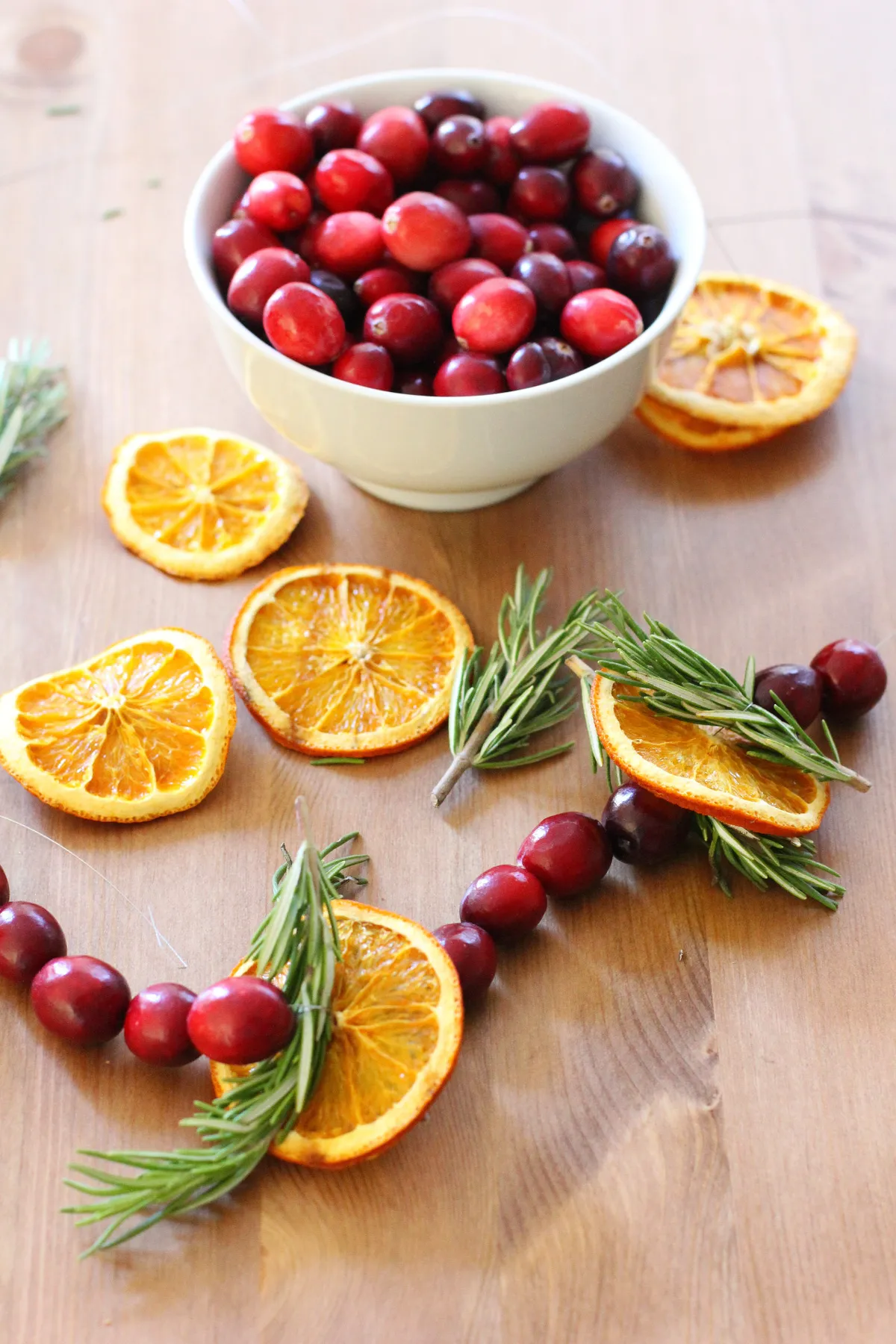
The formula behind this mix is roughly 55% cranberry, 25% dried orange, 20% rosemary. Red carries the eye, orange warms it, green keeps it from looking like a Valentine display. Swap orange for dried lemon and the whole thing turns brighter and more citrus-forward, which suits a white kitchen. Swap rosemary for bay leaves and you get a darker, more tailored strand that pairs with wood tones.
- Length: measure your surface and multiply by 1.5 — a 6-foot table needs 9 feet of garland.
- Surface protection: fresh fruit can weep onto bare wood, so lay parchment underneath.
- Timing: fresh cranberries, orange, and rosemary look best for 7–10 days.
- Tools: 22-gauge floral wire, clippers, and a tray to work on.
4. Small Red Wooden Beads Draped Close Against Evergreen Branches
The scale of the beads is everything here. These are small, well under half an inch, and they are strung close together, which is why the strand reads as a ribbon of color rather than a necklace. Big beads on a small tree look like costume jewelry. Small beads look collected. Check the bead diameter before you check the price — three strands of 8mm wooden beads will always beat one strand of 20mm.
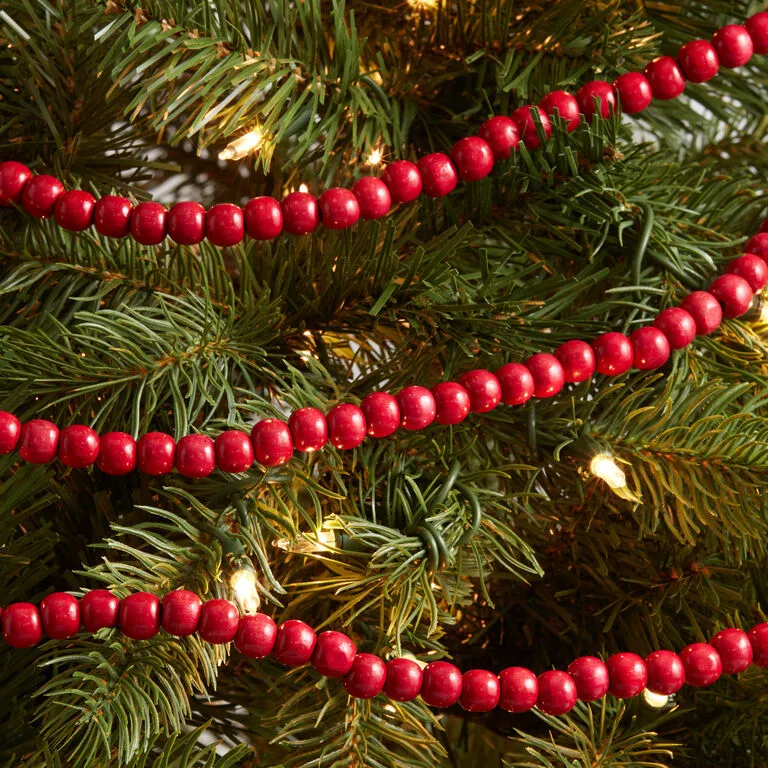
Wooden beads are the low-maintenance choice for a reason: no fading, no shattering, no smell. The real work is storage. Wind each strand around a piece of cardboard or an empty paper towel roll and secure the ends with a twist tie, or you will spend a December evening untangling 27 feet of red beads. Wipe them with a dry microfiber cloth once a season, and keep strands away from brick or stone edges, where painted beads can chip.
5. Lighted Pine Garland and Matching Wreath Across a Rustic Mantel
This one is a mantel formula, so let us do the math. Measure your mantel and add 50% — a 6-foot mantel takes 9 feet of garland, which gives you the droop and the trailing ends without gaps. Center the wreath 12–14 inches above the mantel top with an 8-foot ceiling; with 9-foot ceilings push it to 16 inches and let the garland swag deeper. In a room shorter than 8 feet, skip the wreath and run the garland alone.
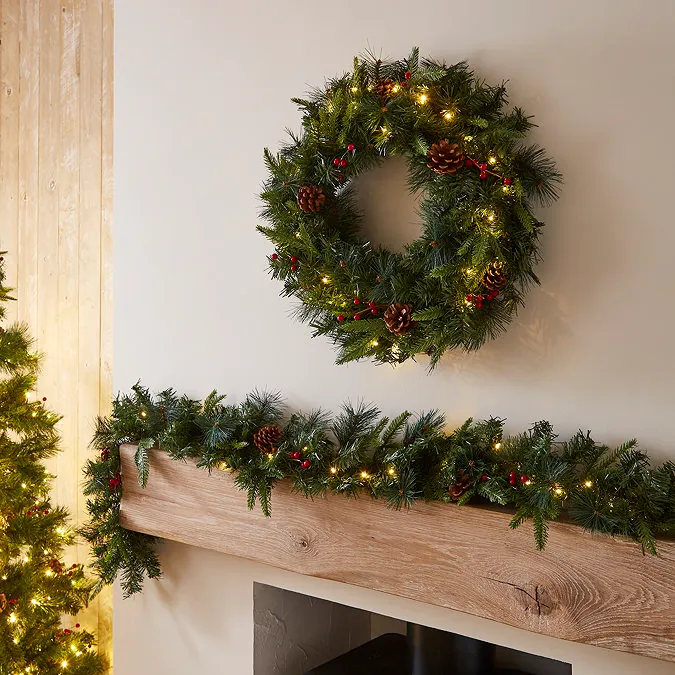
Matching garland-and-wreath sets have quietly overtaken mismatched decor in the last two seasons. Part of it is the return of a collected, classic American Christmas — deep green, real berries, brass and plaid — which reads as heritage rather than trend. Pinterest saves for classic Christmas mantels climb every October, and lighting is the reason: warm white LEDs on a denser pine strand give you that photographed glow without a single lamp in the frame.
6. Faux Pine Garland with Fabric Leaves and Glowing Red Berry Clusters
Three things make this faux strand convincing. The berry clusters are dense, five to seven berries together instead of single berries spaced evenly, which is how winterberry actually grows. The light green leaves with reddish edges break up the wall of pine needles and give the eye somewhere to land. And the mini lights sit on green wire, so the strand disappears into the garland instead of announcing itself.
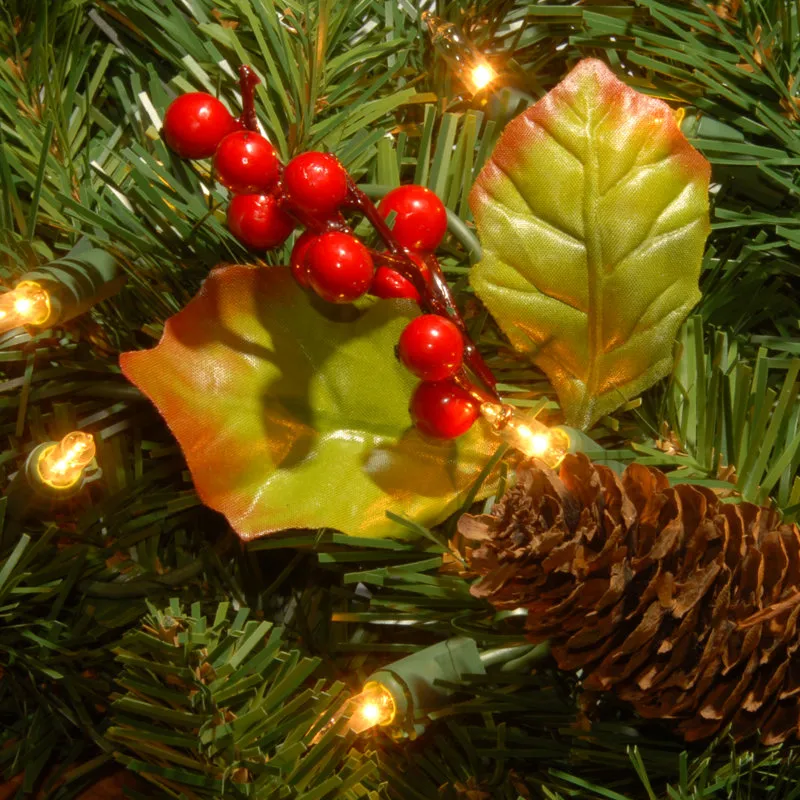
You do not need $120 pre-lit garland for this. A $25 plain faux pine strand from Walmart, a $6 bag of berry picks from Dollar Tree, and a $15 set of warm white mini lights lands near $46 — and it will look better than most pre-decorated versions because you control where the berries sit. Tuck clusters close to the bulbs so they catch the glow. If you would rather go fully handmade, compare with Idea #3.
7. Evergreen Garland Hung Vertically Along a White Door Frame
Vertical garland lives or dies by the hardware. Use two clear adhesive hooks rated for at least 5 pounds on the frame face, never the top edge — a garland hung from the top gets pinched every time the door swings. Start the strand about 4 inches below the top of the frame and let the ends flare out onto the wall. On a painted white frame, if the garland does not overlap it by roughly 2 inches per side, it will look like it is floating.
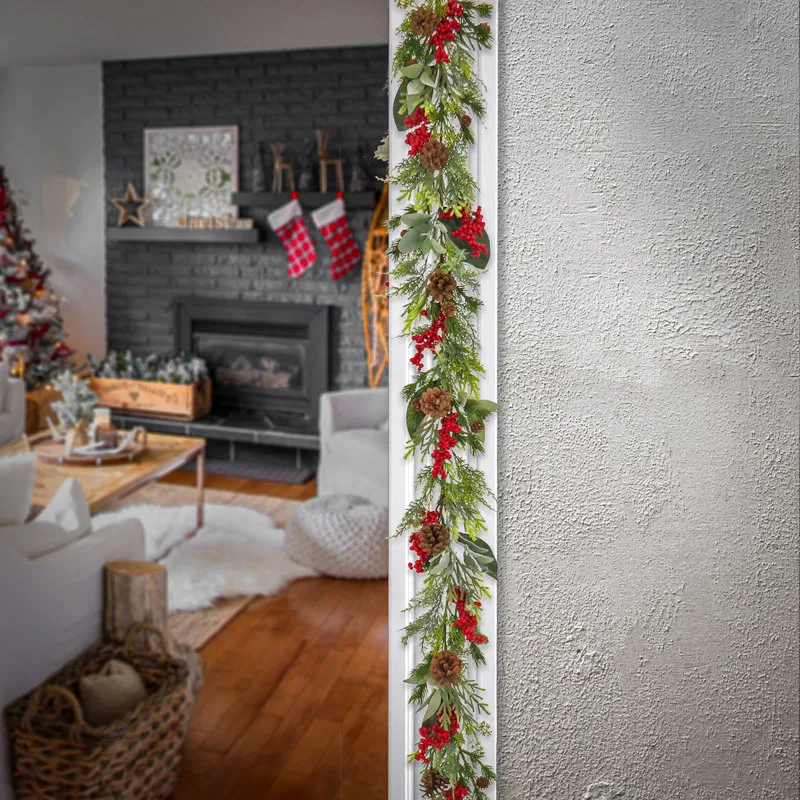
- Measure the frame height, then add 20% for the droop and flare.
- Confirm the door swings away from the garland, not into it.
- Check that berries and pinecones are wired on rather than glued if the door gets daily use.
- Test one hook with weight for 24 hours before hanging the full strand.
8. Cranberry and Popcorn Garland Draped Over a Bark-Covered Log
A log display is styling, not storage. Fresh cranberries weep a little as they warm up, and bark absorbs moisture and holds a dark ring, so lay a runner or wax paper under the log first. The popcorn softens in a warm room within a few days. Plan to build this the same week you are hosting, not three weeks out. A faux bead strand gives you the identical shot for a whole season with zero mess.
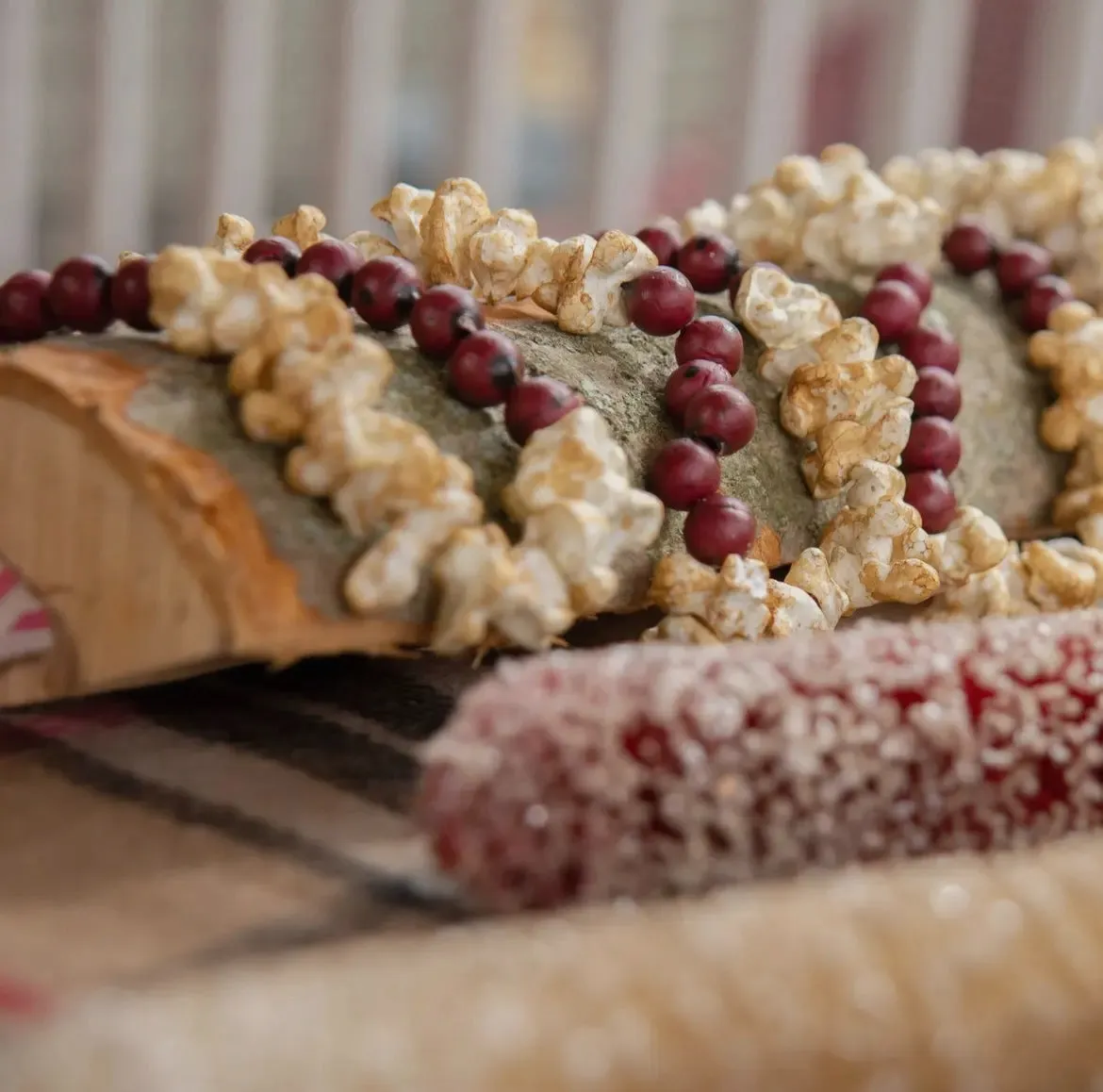
Building the log display, step by step:
- Choose a log 12–18 inches long with intact bark and set it on a tray or runner.
- Cut a 6-foot strand of garland and find its midpoint.
- Wrap the midpoint around the log once, then spiral outward in loose turns about 3 inches apart.
- Let the last 8 inches of each end pool on the surface in a loose curl.
- Tuck two evergreen sprigs into the top turn to hide the starting knot.
Time: about 10 minutes. Cost: roughly $10 plus the log.
9. Snow-Dusted Evergreen Styled with Alternating Cranberry and Popcorn
The color math here is 70% deep green, 20% cranberry red, 10% popcorn white. That ratio is why it looks calm instead of candy-cane loud. Want it brighter for a kids tree? Flip to 60% green, 25% red, 15% white by stringing two cranberries for every popcorn piece. Want it moodier? Drop the white entirely and go 80/20 green and red — that is the version that photographs beautifully at dusk.
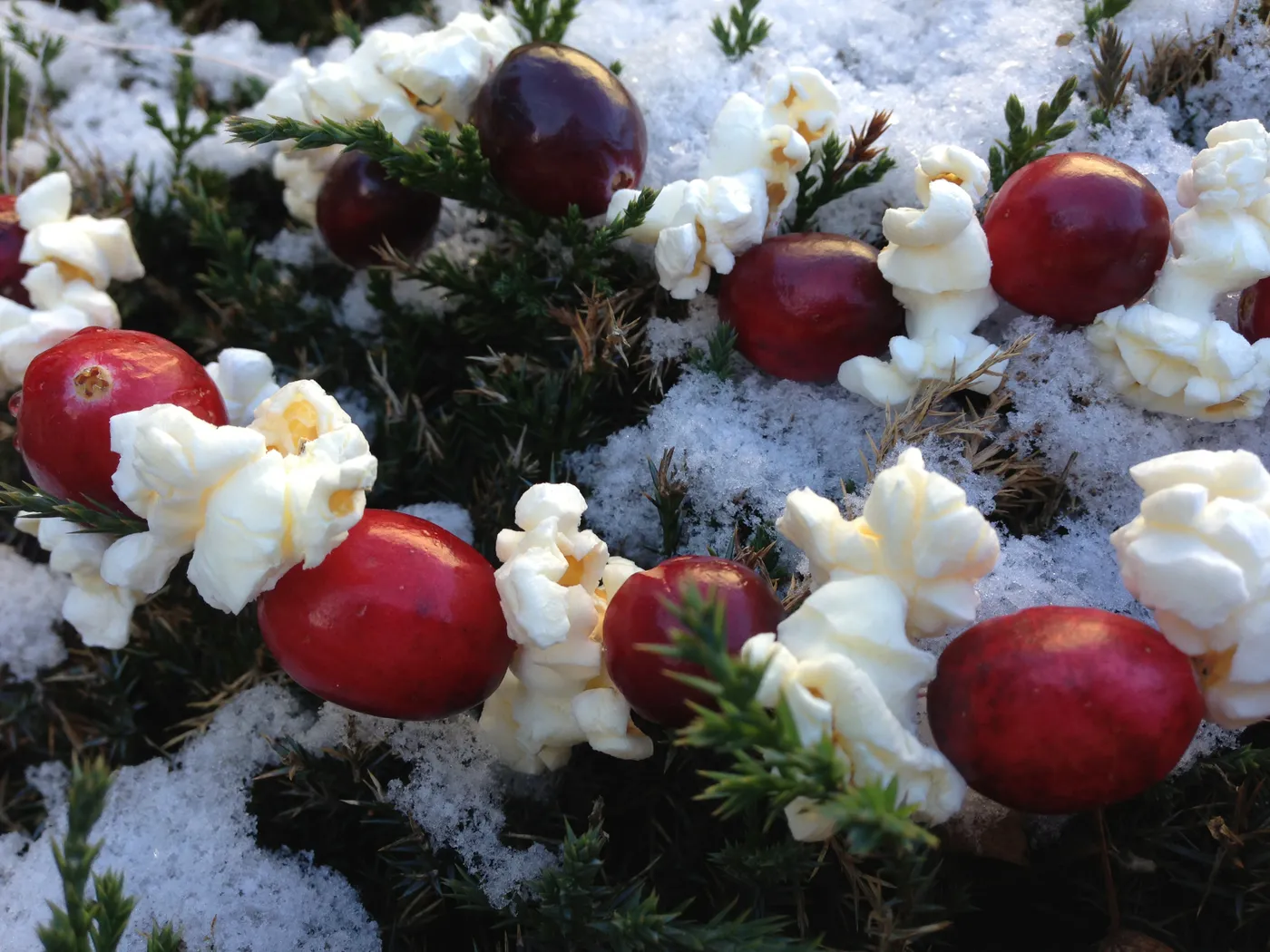
Two principles are doing the heavy lifting. Contrast: cranberry red against snow-dusted green is the highest-contrast pairing in the winter palette, so your eye reads the garland from across the room. Repetition with interruption: cranberry, cranberry, popcorn, repeat — a steady rhythm with a small surprise every third beat. That is the same pattern that makes a good stripe or a good tile backsplash feel intentional.
10. Classic Cranberry and Popcorn Strand Hanging in Front of a Warmly Lit Tree
The strand hangs in front of the tree, not on it — that is the entire idea. It sits forward of the branches, so the blurred green and the warm yellow lights become a backdrop instead of a competitor. Move that same strand onto the branches and it vanishes into the foliage. Suspended just ahead of the tree, it becomes the subject. Try it on a hook, a tension rod, or a mantel edge with the tree behind it.
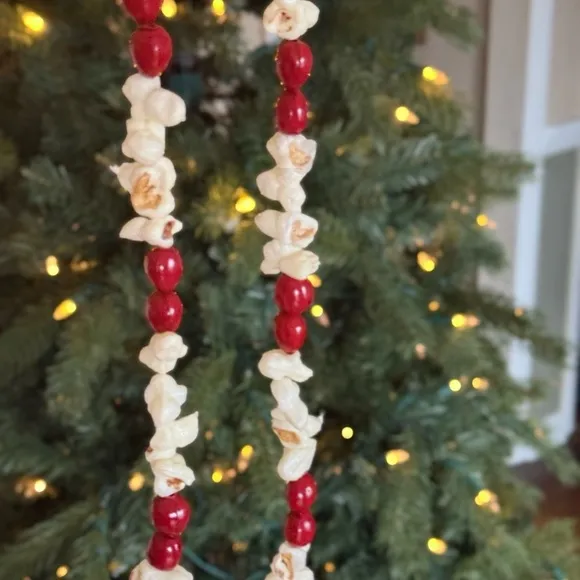
What a front-hung strand actually costs:
- Fresh cranberries, two bags: $5–$8
- Popcorn kernels: $3–$4
- Button thread or twine: $3–$6
- Upholstery needle: $2–$5
- Hook or tension rod: $8–$20
Budget alternative: skip the hardware and drape the strand over a curtain rod you already own — under $20, same layered look.
11. Cranberry and Popcorn Garland Laid Out Beside Gold Gift Bows
Homemade is the whole point, and it is cheaper than you think. Two bags of cranberries at $6, a bag of kernels at $4, and a spool of button thread at $4 covers 15 feet of garland — under $15. Dollar Tree popcorn works fine if you do not want to pop your own. Grab the gold bows in a 12-count pack for $5 instead of buying boutique ribbon, and put the savings toward a nicer bowl for the cranberries.
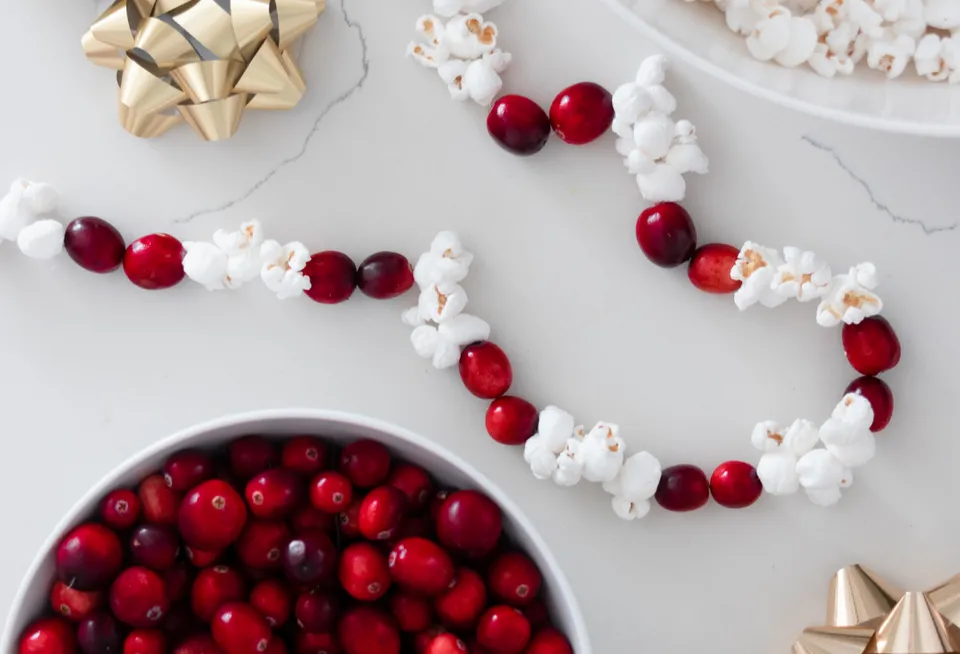
Knot discipline is what separates a strand that survives December from one you rethread on the 20th. Tie a knot at both ends and again every 6–8 pieces, and use doubled button thread rather than cotton twine — twine frays against cranberry skins and snaps under its own weight. String with a three-cranberry-to-one-popcorn rhythm; a 1:1 ratio reads like a checkerboard and makes the cranberries feel like an afterthought.
12. Boxwood Wreath with Red Bead Garlands Trailing Downward
Wreath math is simple once you know the rule: the wreath should span about a third of the width of whatever it hangs on. A 24-inch boxwood wreath suits a standard 36-inch door; for a 30-inch interior door or a cabinet, drop to 16–18 inches. The draped bead strands add roughly 10 inches of visual drop, so leave at least 14 inches of clearance below the wreath before the next element, or the trailing ribbon ends will crowd whatever sits underneath.
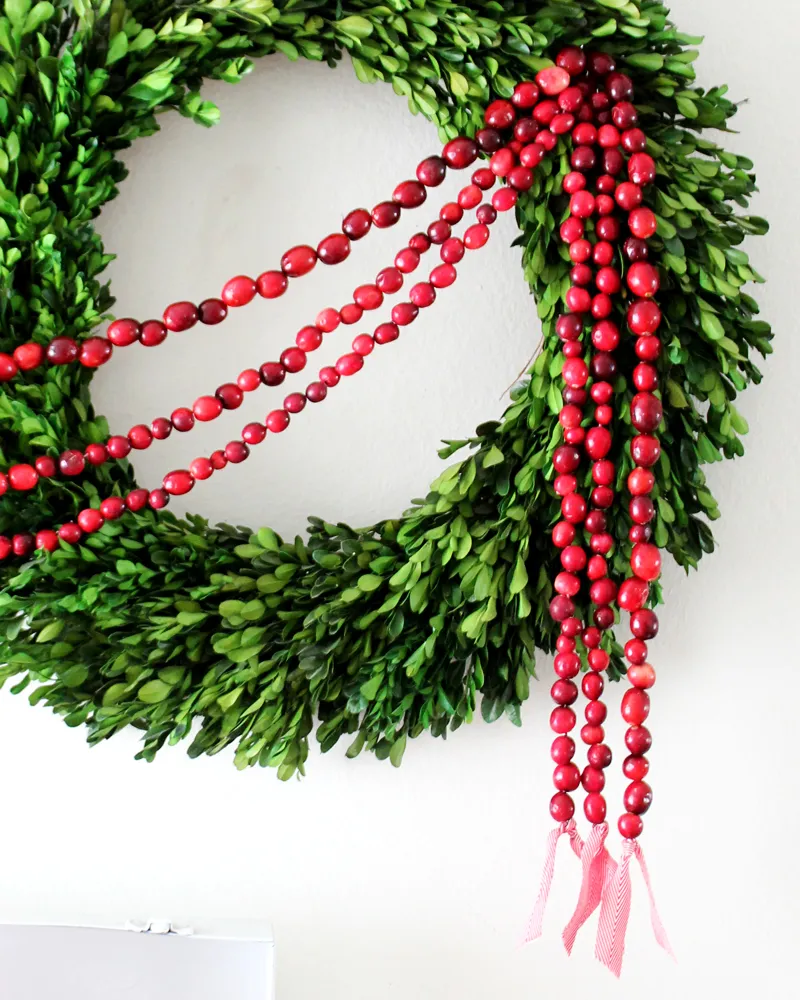
Boxwood and bead strands are having a moment because they solve a real problem: fresh wreaths drop needles and dry out by mid-December, while preserved boxwood holds its color for years. Add the drape and you get a wreath that looks styled rather than purchased. The stripe of pink ribbon is part of a wider shift away from strict red-and-green toward softer, more personal holiday palettes. If wreaths beat garlands in your book, Idea #23 takes the same idea to a paneled front door.
13. Dense Mixed-Greenery Garland with Berry Clusters and Pinecones
Variety of foliage is what makes this strand read as abundant. Dark pine needles set the base, lighter cypress-like sprigs add air and movement, and matte broad leaves give the eye a break from all that fine texture. The berry clusters are grouped rather than scattered, and the pinecones come in two or three sizes — a small detail that keeps the garland from looking mechanically uniform.
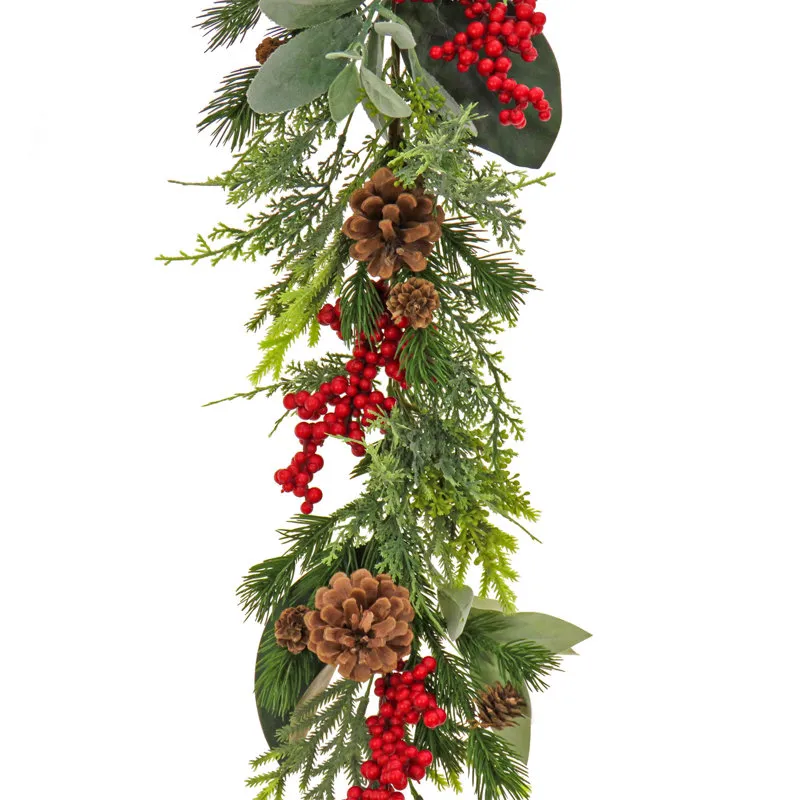
Dense garlands are heavy. A 9-foot strand with pinecones and berries runs 4–6 pounds, and lightweight hooks will let go at 2 a.m. Use metal over-door hooks or screw-in cup hooks rated at twice the weight you think you need. Also check that pinecones are wired on rather than hot-glued, because glued cones pop off the first cold week and end up behind the sofa.
14. Faux Pine Garland Hanging Against a Concrete Wall and Stone Pillar
Faux makes sense in a hallway or entry where nothing gets watered. The trade-off is dust: polyester needles grab it, and by the second season the garland looks grey instead of green. Blow it down with a hair dryer on cool, outdoors, once a year, and fluff the branches by hand when you bring it out. Warm white LED sets bundled with these strands usually last two to three seasons before one section dies, so buy a spare string now.
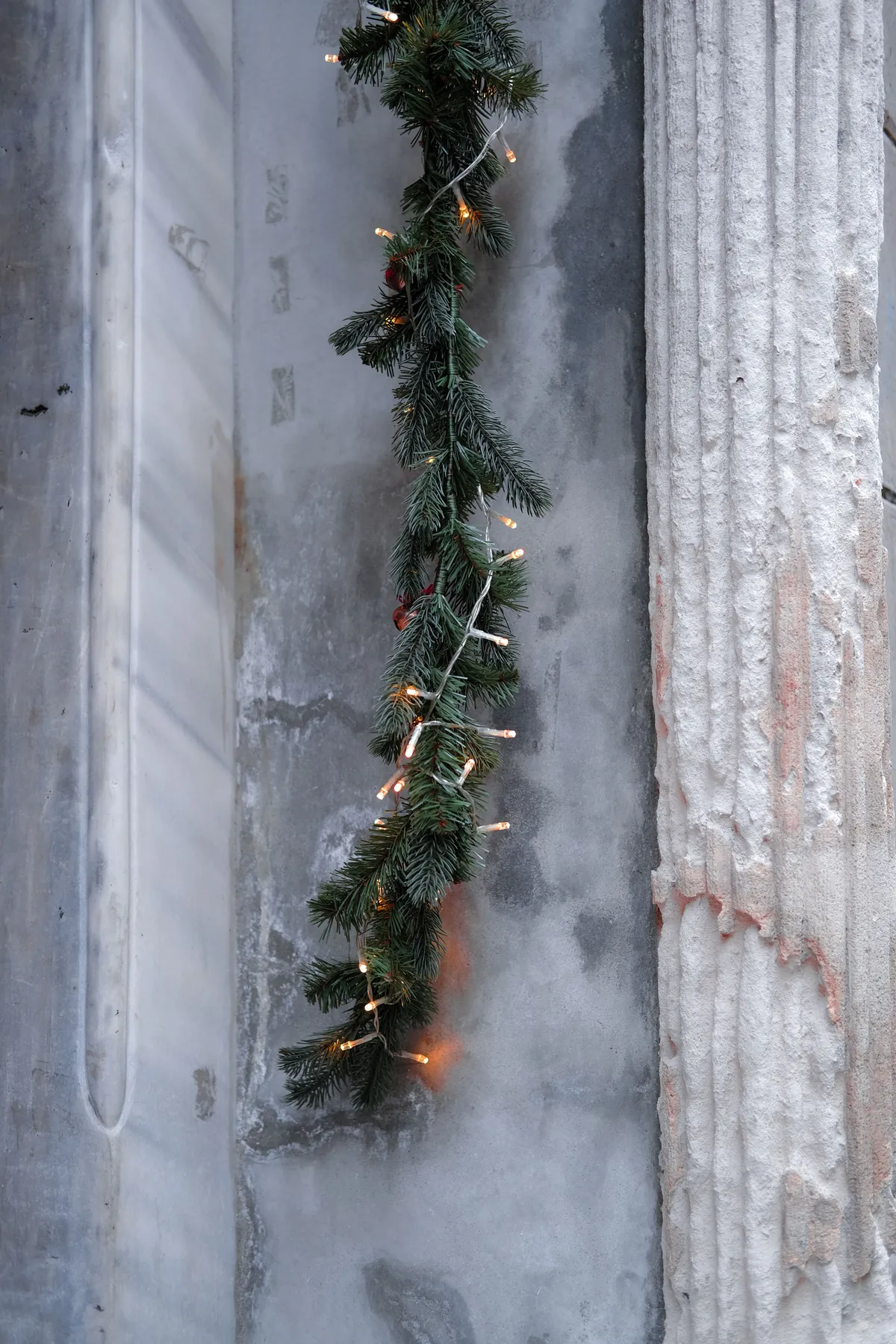
In a hard, industrial space, balance the garland with something aged. The fluted stone and raw concrete here work because they are matte and worn, not glossy. If your wall is smooth drywall, add a raw wood bracket or a slim iron rod to hang from, and keep the garland lighting warm at 2700K — cool white against grey concrete turns the whole vignette blue and cheap.
15. Wavy Cranberry and Dried Orange Garland on a Dark Wood Table
The table runner version, which takes about 30 minutes:
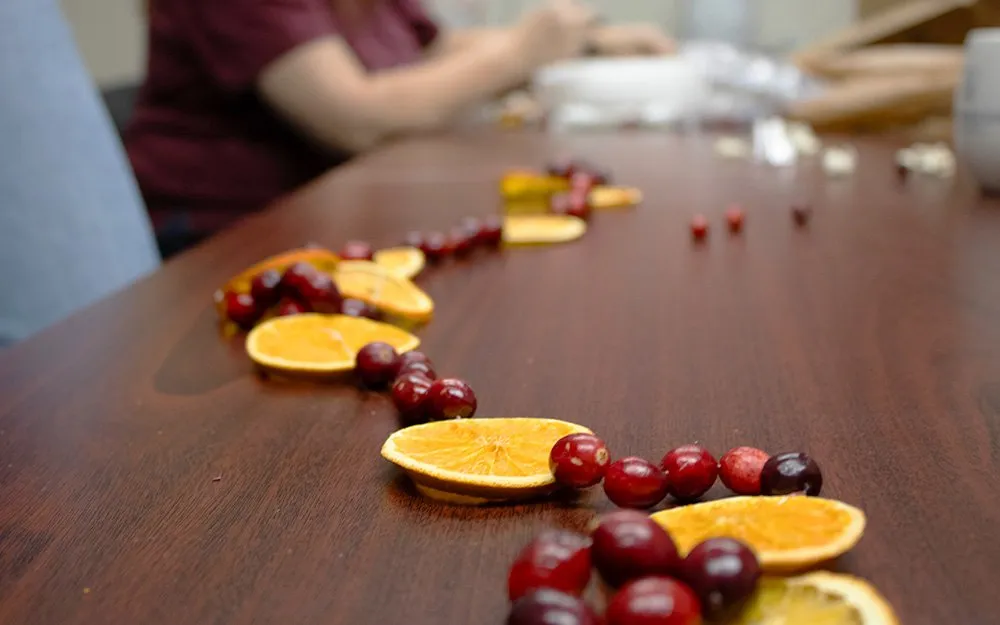
- Dry orange slices at 200°F for 3–4 hours until leathery, not crisp.
- Cut a 6-foot length of doubled thread and knot one end around a single cranberry.
- String cranberry, orange, cranberry, orange — orange slices need a slightly wider needle path.
- Lay the finished strand in a wavy S across the table rather than a straight line.
- Nestle two loose sprigs of greenery at the curves to anchor the shape.
Time: 30 minutes plus drying. Materials: about $12.
Here the mix is 50% cranberry, 40% dried orange, 10% green. Because the table is dark brown, the red reads deeper and the orange reads almost amber, which is why this version looks warmer than the same garland on a white cloth. On a light surface, flip to 60% orange so it does not get heavy. Compare with Idea #19, which uses the same fruit plus star-shaped peels.
16. Evergreen and Cranberry Garland with an Embroidered Snowflake Ornament
It is the ornament. One round, light brown disc with a white embroidered snowflake and a yarn loop, tucked into the garland rather than hung beneath it. Without it this is a pleasant natural strand. With it, the garland has a story — someone made this — and the small yellow-brown ridged elements strung among the cranberries start reading as beads rather than filler. If you own one handmade ornament, put it in the garland, not on the tree.
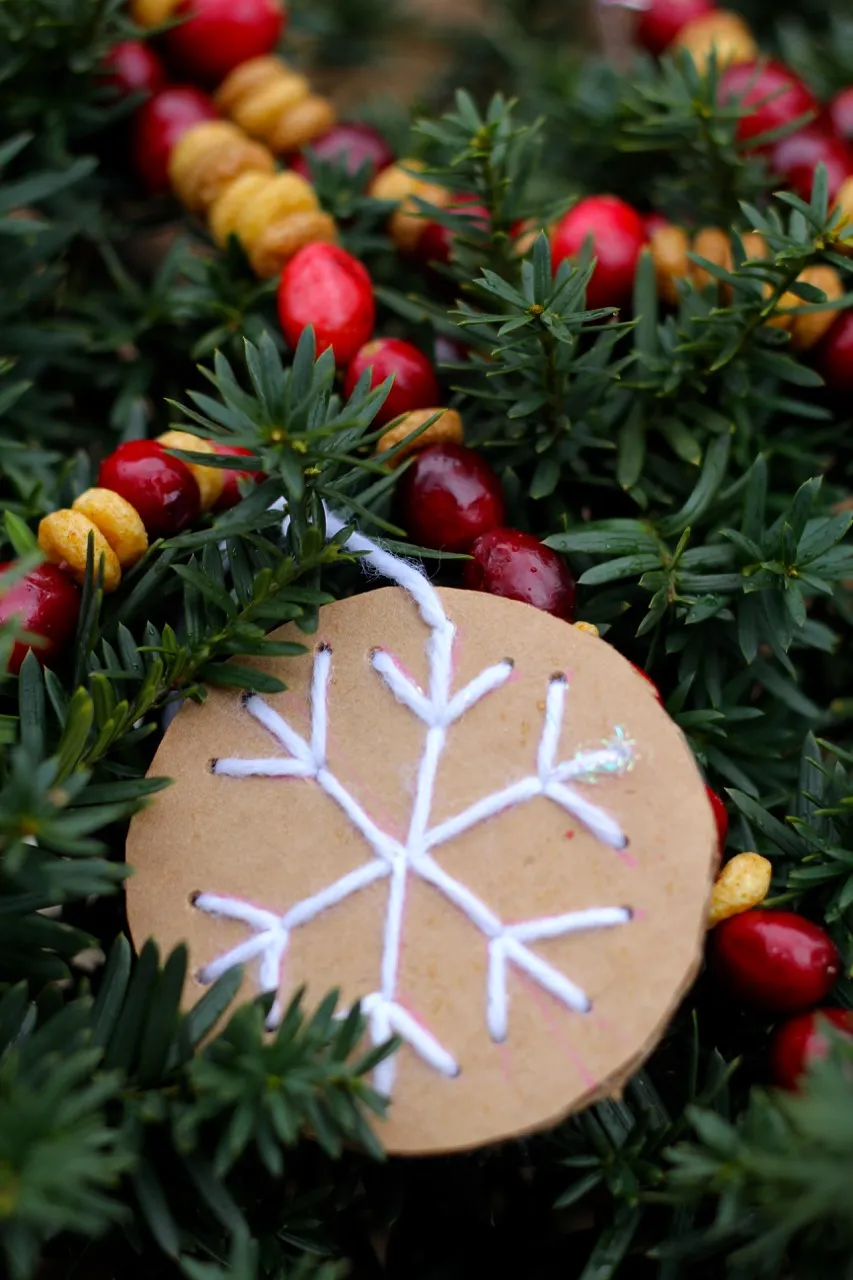
A one-ornament garland like this works best on a short run: 4–6 feet along a stair rail, a shelf edge, or a doorway. Longer spans need two or three ornaments at uneven intervals, roughly every 3 feet, with none of them centered. It is a small-space-friendly look that holds up in a hallway only 3 feet wide. For full mantel runs, see Idea #5 and Idea #22.
17. Handheld Cranberry and Popcorn Strand Against Out-of-Focus Tree Lights
This is the cheapest garland in the whole roundup and the one people photograph most. Two bags of cranberries at $6, a bag of kernels at $4, and a spool of button thread at $4 covers 15 feet, all in under $15. Dollar Tree sells popcorn in the snack aisle if you skip the stovetop, and a thrift-store glass bowl for the cranberries finishes the styling for $2. It reads nostalgic rather than cheap because every piece is hand-strung.
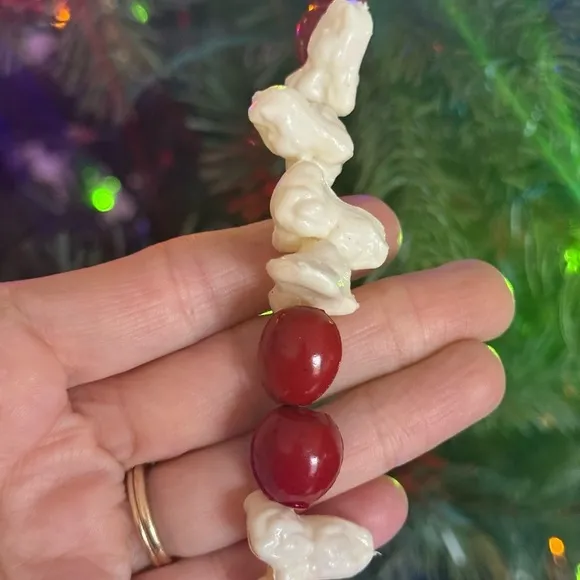
- Popcorn must be fully dry — buttered popcorn stains thread and attracts ants.
- Weigh the strand before hanging; fresh cranberries are heavier than they look.
- With kids or pets around, keep the strand above 3 feet.
- Build within a week of display — both popcorn and cranberries dull after about two weeks.
18. Heritage Cranberry Garland in a Layered Ralph Lauren-Style Entryway
Classic American Christmas is back in a big way for 2026 — the collected, heritage look of deep green, deep red, brass, and plaid rather than a single themed aisle. Cranberry garland sits at the center of that shift because it is the one decoration that is both traditional and handmade. Saves for classic Christmas entryways and heritage holiday decor keep climbing, and designers return to it because it photographs beautifully and never dates.
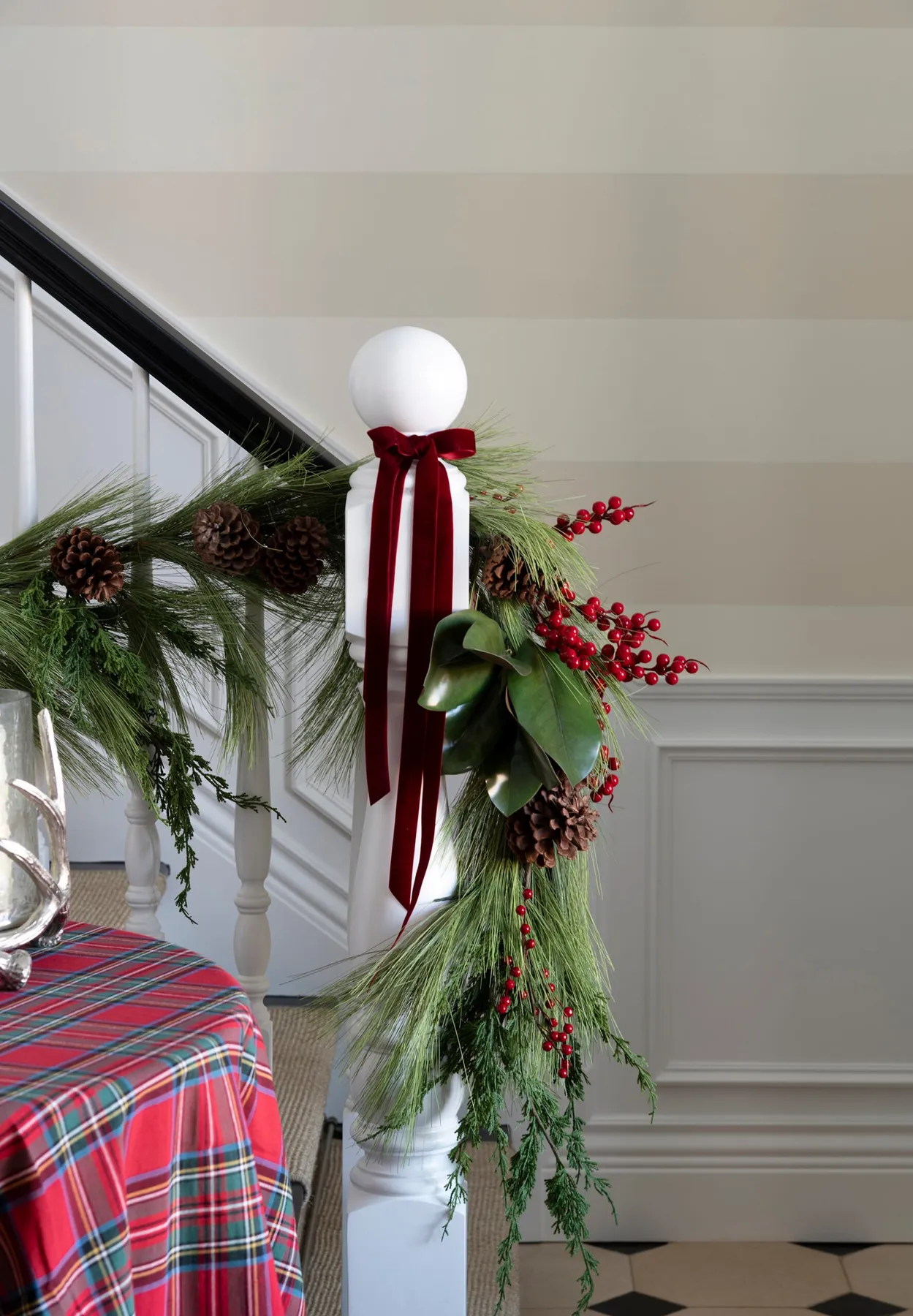
In an entryway, work in odd numbers and weight the garland toward the bottom. Three elements — a cranberry garland, a brass hook or tray, and one stacked thing — reads collected. Two of anything reads like a catalog. Entry garland also gets brushed by doors and coat sleeves daily, so wire every berry and pinecone and keep the strand at least 4 inches clear of the door swing and your coat hooks.
19. Craft Tray of Cranberries, Orange Slices, and Red Baker’s Twine
The star-peel detail, which is easier than it looks:
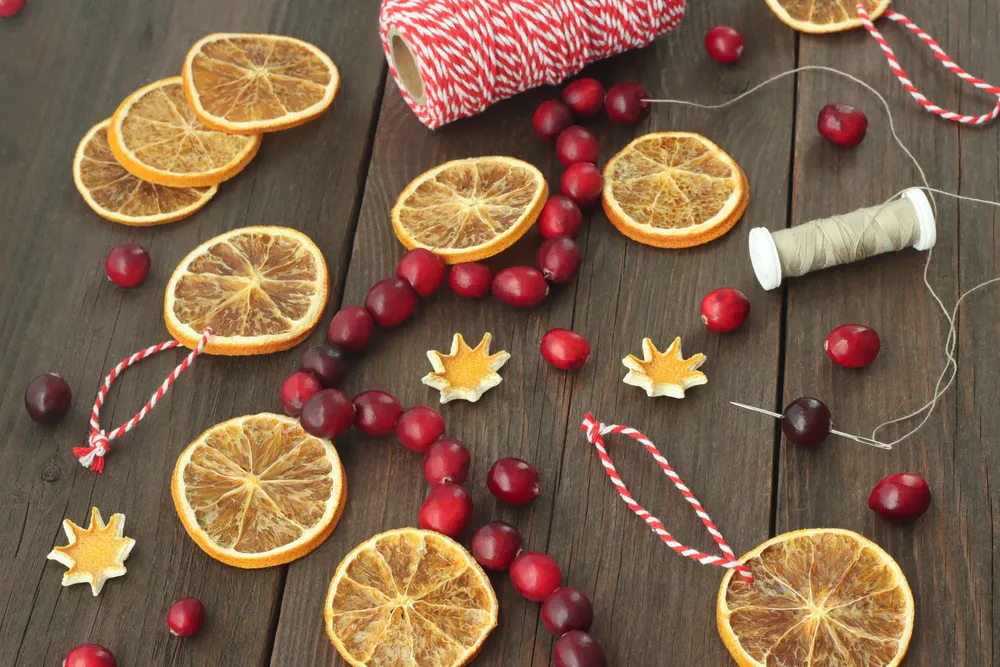
- Peel oranges in wide strips and cut star shapes with a small cookie cutter.
- Bake the stars at 200°F for 60–90 minutes until they curl slightly and feel dry.
- Thread red-and-white baker’s twine on a needle and knot the end.
- Alternate cranberry, orange slice, cranberry, then a star every fifth position.
- Finish with a loop at each end for hanging.
Time: 20 minutes of work plus drying, and about $10 in fruit and twine.
- Oranges, 4–5: $4–$7
- Fresh cranberries, two bags: $5–$8
- Red-and-white baker’s twine, two spools: $6–$10
- Needle and thread: $3–$6
- Star cookie cutter: $2–$4
Budget alternative: buy pre-dried orange slices at a craft store for $5 a bag and skip the oven. The star peels are the only step you cannot shortcut.
20. Cranberry and Popcorn Garland Wound Around a Log on Plaid Fabric
Wrapping a log is trickier than draping one. Bark catches thread, so wind slowly and keep the strand slightly slack — pulled tight, the popcorn shatters against the wood. Because it is wrapped rather than laid, the back half of the log stays bare, which matters the moment someone walks around the table. Either accept it as a front-facing display or spiral the whole log and use twice the garland.
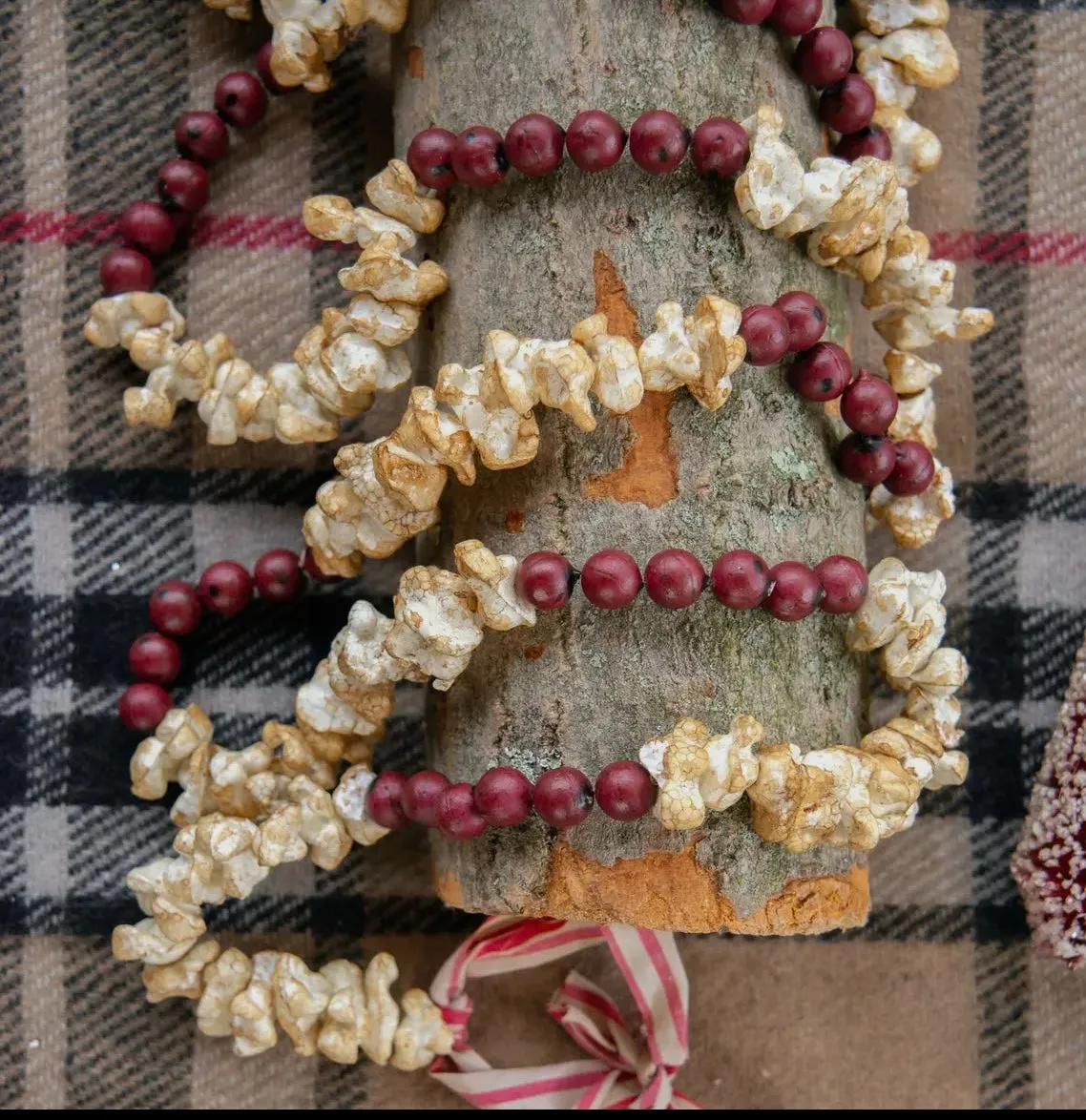
The plaid does a lot of the work here. A busy brown-and-black check behind a red-and-white garland gives the eye two patterns at two different scales, and that is why the striped ribbon at the bottom does not feel like too much. Notice the garland is the only bright element in the frame; everything else is muted. One loud thing, everything else quiet.
21. Red Berry and Pine Garland Styled Beside a Glossy Red Ornament
Count the finishes: matte green pine, shiny red berries, a glossy red ornament, a warm brown pinecone, and a textured green glass. That is roughly 60% matte, 30% gloss, 10% texture — the mix that keeps a red-and-green table from looking flat. Everything matte goes dull; everything glossy goes plastic. Swap the green glass for a clear one and the whole arrangement gets brighter and more modern without changing a single other thing.
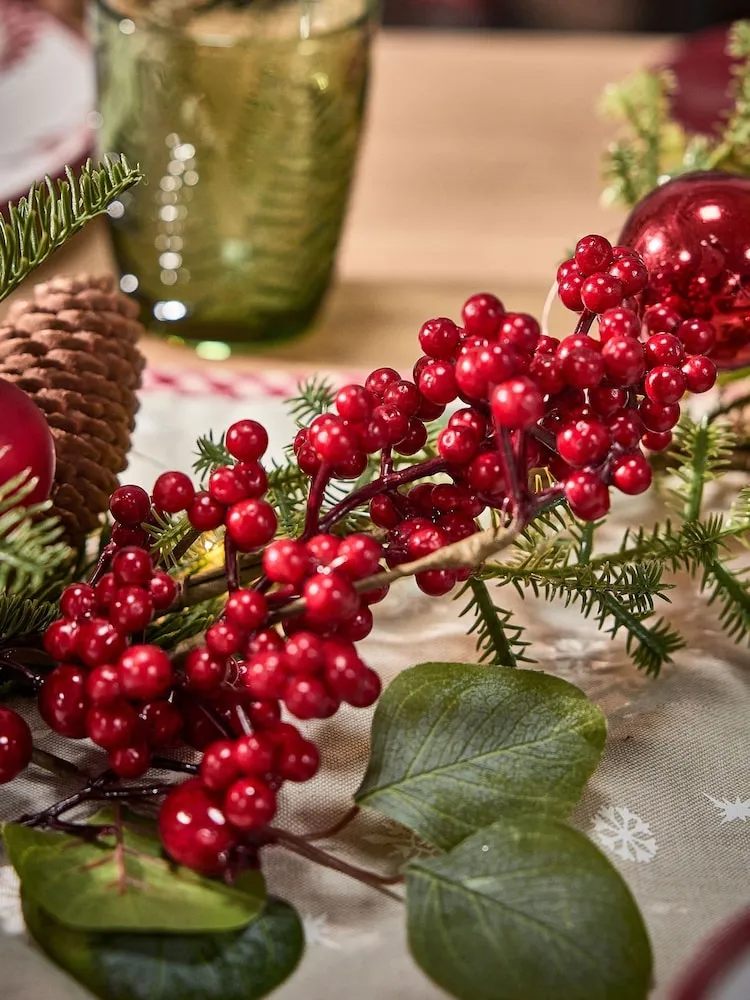
This vignette is buildable from one dollar-store run. A berry pick bunch at $1.25, a pine garland at $5 from Walmart, a two-pack of red ornaments at $3, and a pinecone from the yard lands under $12. Thrift stores are goldmines for that textured green glass — one vintage tumbler at $2 beats a $20 set of new ones. For the tree version of this palette, go back to Idea #1.
22. Fresh Cranberry and Pine Garland on a White Mantel with Candles
For candle-lit mantel garland, leave yourself room to work. A 5-foot mantel takes 7–8 feet of garland, and the candles need 6 inches of clear space on either side so heat does not dry out the pine. Keep pillars under 6 inches tall when they sit inside the garland; anything taller hides the cranberries and eats the glow. In rooms under 8 feet, use three votives instead of two pillars — same warmth, less height to manage.
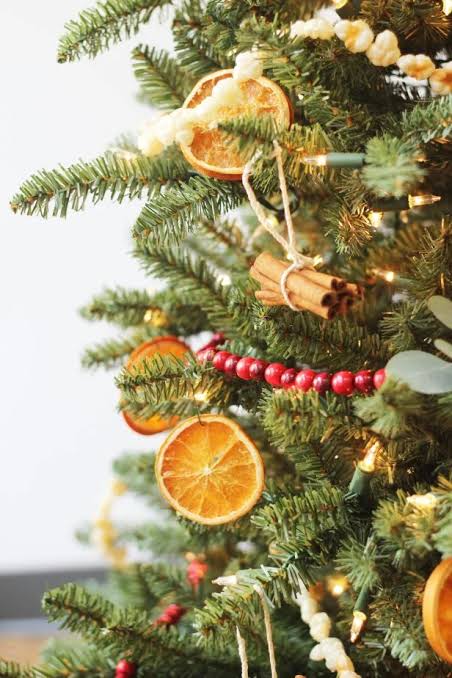
Fresh cranberry garland on a mantel has a two-week window. Berries go from glossy to dull around day 10, and pine needles start dropping by day 14, so vacuum gently rather than picking needles out by hand. Real candles also leave soot smudges on white mantels — a 2-inch glass hurricane or a silicone mat fixes it instantly. If you want this look from Thanksgiving through New Year, build it with faux beads and battery votives instead.
23. Pre-Lit Pinecone and Berry Wreath on a Paneled White Door
On a paneled door, hang the wreath so its center lands about 60 inches from the floor — eye height, not door height. Use an over-the-door hook if the door top is thick, or a magnetic hanger if the door is steel. Keep the wreath 3–4 inches narrower than the paneling on each side, because a wreath that nearly touches both edges looks cramped. If it runs on batteries, tuck the pack behind the wreath rather than letting it dangle.
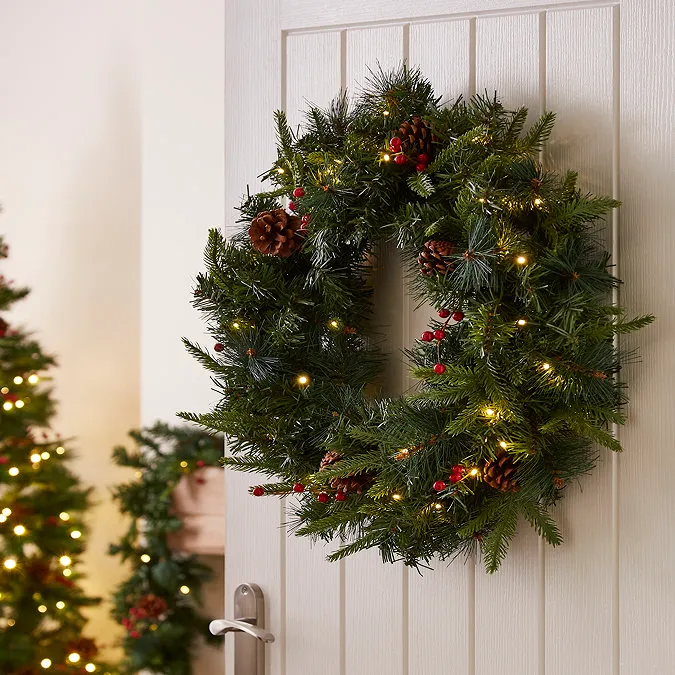
It is the lights. Take them out and this is a nice wreath; leave them in and it becomes the only thing anyone sees walking up. The trick is that the bulbs are warm white and small, so they read as glow rather than as hardware. Match that temperature to your entry fixture — if the fixture is 3000K and the wreath is 2700K, the wreath will look slightly orange beside it, and you will notice every night.
24. Frosted Tree with a White Wool Ball and Red Bead Garland
Frosted, white-tipped trees paired with textile garlands took over last season and they are not going anywhere. The reason is layering: wool balls, kraft paper stars, pale turned-wood ornaments, and candy canes all sit in the same soft, matte, natural family, which makes the red bead strand the single glossy accent. It is the opposite of a candy-colored tree, and it is why this look photographs well in daylight rather than only at night.
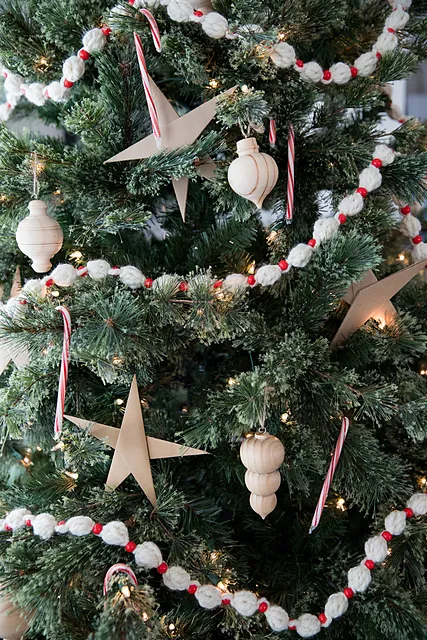
Making the wool-and-bead strand at home:
- Buy 1-inch wool felt balls in cream — about 60 for a 9-foot strand.
- Cut doubled thread 10 feet long and knot one end.
- Alternate one wool ball, then five small red beads, and repeat.
- Push the beads snug against each ball so nothing slides into a gap.
- Tie a loop at the end and drape in shallow swags rather than deep ones.
Time: about an hour. Cost: roughly $18 in materials.
25. Red Bead and Popcorn Garland Under Multicolored Tree Lights
- Red bead garland, two strands: $20–$45
- Popcorn, real or faux: $4–$12
- Multicolored LED string lights, 300 count: $20–$40
- Artificial tree, 7 ft: $90–$350
- Gold-framed art or mirror for the backdrop: $40–$150
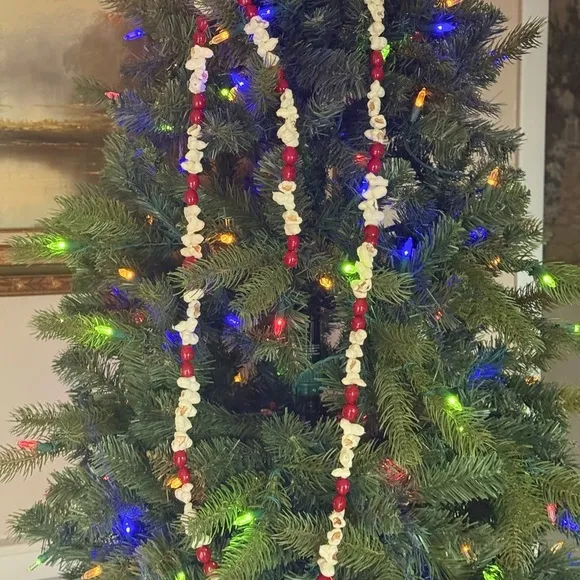
Budget alternative: keep your existing tree and swap only the garland and lights. About $25 at Walmart covers both, and the multicolored bulbs are what carry the nostalgic look anyway.
Multicolored lights and cranberry garland are a pairing people either love or argue about. The honest version: colored bulbs pull attention upward and can make red garland look slightly brown in photos, especially under warm white room light. If you want the retro feel with truer reds, use multicolored LEDs with a higher red ratio, or keep the garland on the lower two-thirds of the tree where the bulb color does not compete.
26. Cranberry and Greenery Garland Over a Farmhouse Sink Window
Three colors, one accent. White trim, dark green cabinetry, and a cranberry strand — the garland is the only warm red in the frame, so it reads instantly from across the kitchen. The brass faucet matters just as much: it is the single metallic note that ties red and green together instead of letting them sit in opposition. Dark green cabinets also make the white sink look brighter, which is why this composition feels clean rather than busy.
You do not need a kitchen renovation for this shot — you need 6 feet of garland. A $10 faux cranberry-and-pine strand from Michaels, a $3 pack of suction cup hooks, and a couple of tucked-in pine sprigs gets you the window treatment for about $15. Brass details already in your kitchen, like a faucet, a cabinet pull, or a trivet, do the tie-in work for free. The dark green cabinets are the one thing you cannot fake, but a stained wood shelf or a dark green towel on the counter nods the same direction.
27. Lush Red Berry and Pine Wreath on an Arched-Glass Door
Arched windows are the reason this wreath hangs slightly low. Center it on the door solid panel rather than on the arch — the arch is already a shape, and matching it with a round wreath creates two competing focal points. A 22–24 inch wreath on a standard 36-inch door, hung so the top third overlaps the lower edge of the window, frames the arch beautifully instead of fighting it.
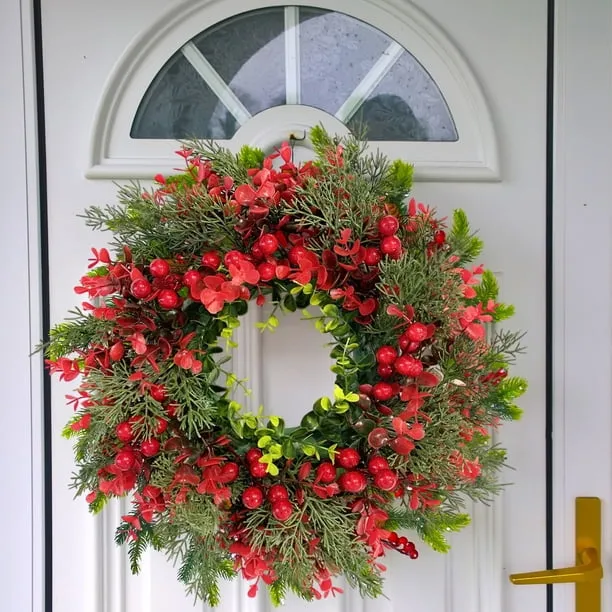
Standard 36-inch front door: use a 24-inch wreath. Taller doors, 42–48 inches: go to 28–30 inches, or hang two 18-inch wreaths stacked. Depth matters too — if the wreath is more than 6 inches thick, keep at least 3 inches of clearance from a storm door. For interior doors and tighter spaces, look at the compact garland approach in Idea #7.
Your Cranberry Garland Starts With One Handful
Whether you go with a $12 strand of popcorn and fresh cranberries or a set of red wooden beads you will reuse every December, the garland is almost never the expensive part — the layering and the light are what make it look collected. Pick one idea here, start small, and let next year be the year you add the second strand.
📌 Pin your favorite version now so you can find it when the cranberries hit the stores.