
You know that feeling when you’ve saved forty door photos and still can’t picture your own? Same. So instead of another generic roundup, we went looking for entries that actually exist — real porches, real classroom doors, real foyers with real budgets behind them.
We spent serious time browsing Etsy, Target, Walmart, and Home Depot to bring you only what’s worth your attention this year, and we priced it all out — from about $12 worth of kraft paper to a $555 foyer install. After filtering through hundreds of options, we narrowed it down to 29 ideas that actually deliver, spanning traditional greenery, natural woodland, playful paper-craft, and modern metallic. Budget and luxury versions are compared side by side throughout, so you can build the same look at whichever number feels sane this December.
The 2026 shift is clear: people want nostalgia they can assemble themselves — layered garland, paper-cut scenes, and hand-tied ribbon — instead of one glossy store-bought set. And stay until the end — we break down the most common mistakes that can ruin these looks.
📌 Save this to Pinterest for later — you’ll want to revisit these ideas.
1. Elaborate Garland-Framed Black Door With Gold Poinsettias
Strip the black door away and this is the formula: roughly 55% deep green garland, 20% gold and pink florals, 20% red and clear glass ornaments, 5% tiny figurines. The green does the framing, the gold poinsettias carry the shine, and the pink hydrangeas keep it from reading like a department store window. Swap pink for pale blue and the whole thing turns frosty; swap gold for aged brass and it goes vintage. Keep the ratios and you can rebuild this on any door color — even a white rental panel you can’t repaint. The black and white checkered tile underfoot just seals it.
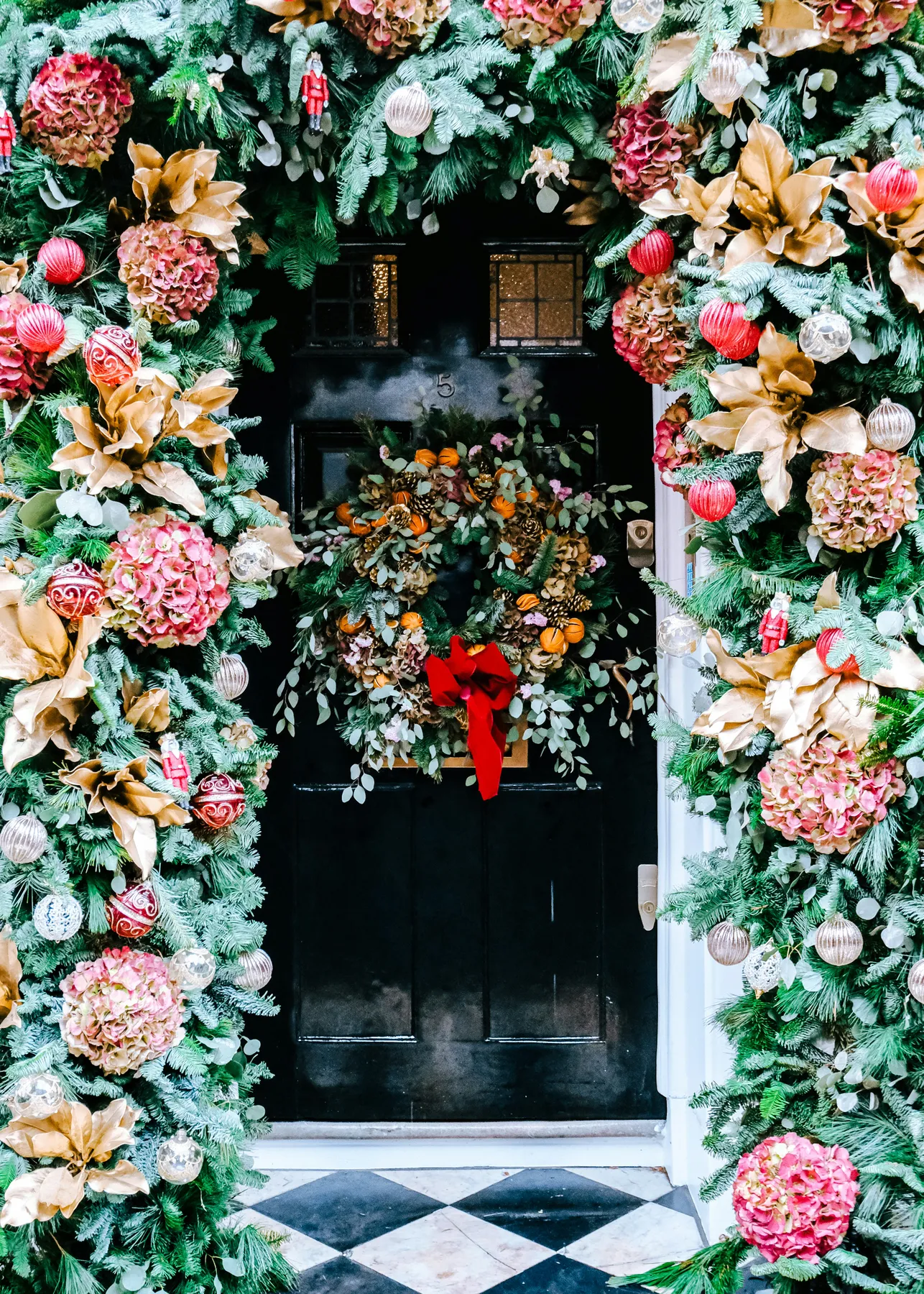
Two things make this work. First, the garland follows the doorframe like picture molding — it frames the door instead of hanging on it, so the black door becomes the artwork. Second, ornament sizes are deliberately mixed: oversized gold poinsettias, medium hydrangea clusters, small baubles, and then nutcracker and horse figurines you only notice up close. Scale layering is what separates a contest entry from a door with a wreath on it. If your display photographs flat, it’s almost always because everything is the same size.
2. Playful Library Door With Reading Reindeer Cutouts
- Sketch a seated reindeer silhouette on kraft paper — about 30 inches tall — and cut two mirrored pieces.
- Glue on a red paper nose and a simple antler band; let it dry about 20 minutes.
- Tape the reindeer to the door and the adjacent wall so they read as one continuous scene.
- Tuck a small paperback into each paper hoof with double-sided tape.
- Layer the paper brick texture and musical-note borders last, so raw seams get covered.
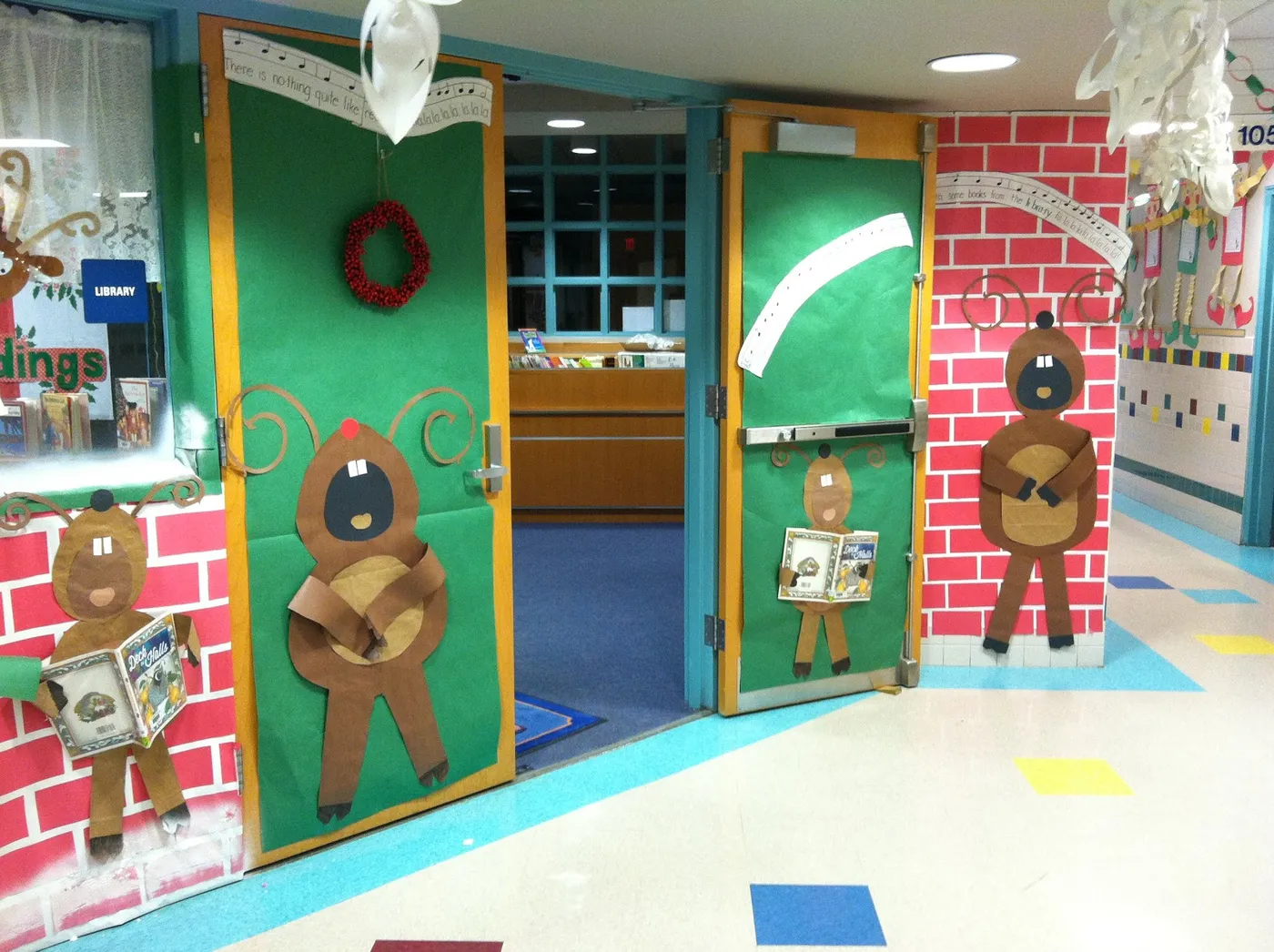
Time: about two hours. Materials: $15–$25 in kraft paper, tape, and dollar-store books.
Paper-covered doors photograph beautifully and crease the second a backpack brushes past. If this is a school hallway, check with administration before you tape anything to a fire-rated door — most districts allow masking tape and paper, but not staples, contact paper, or anything covering the door’s edge gap. Use low-tack painter’s tape on painted surfaces, too; standard foam tape lifts the finish when you pull it off in January.
3. An Ornate Contest Door That Reads Rich From the Hall
For an ornate door, work in odd numbers and thirds. Three garland tiers, three ornament sizes, three points of visual weight — the wreath, one asymmetric swag, and a floor-level cluster. Then light inside out: a warm 2700K battery puck tucked behind the wreath at the 8 o’clock position gives you shadows that read as depth from ten feet away, which is exactly how far judges stand. Flat, front-lit doors never place.
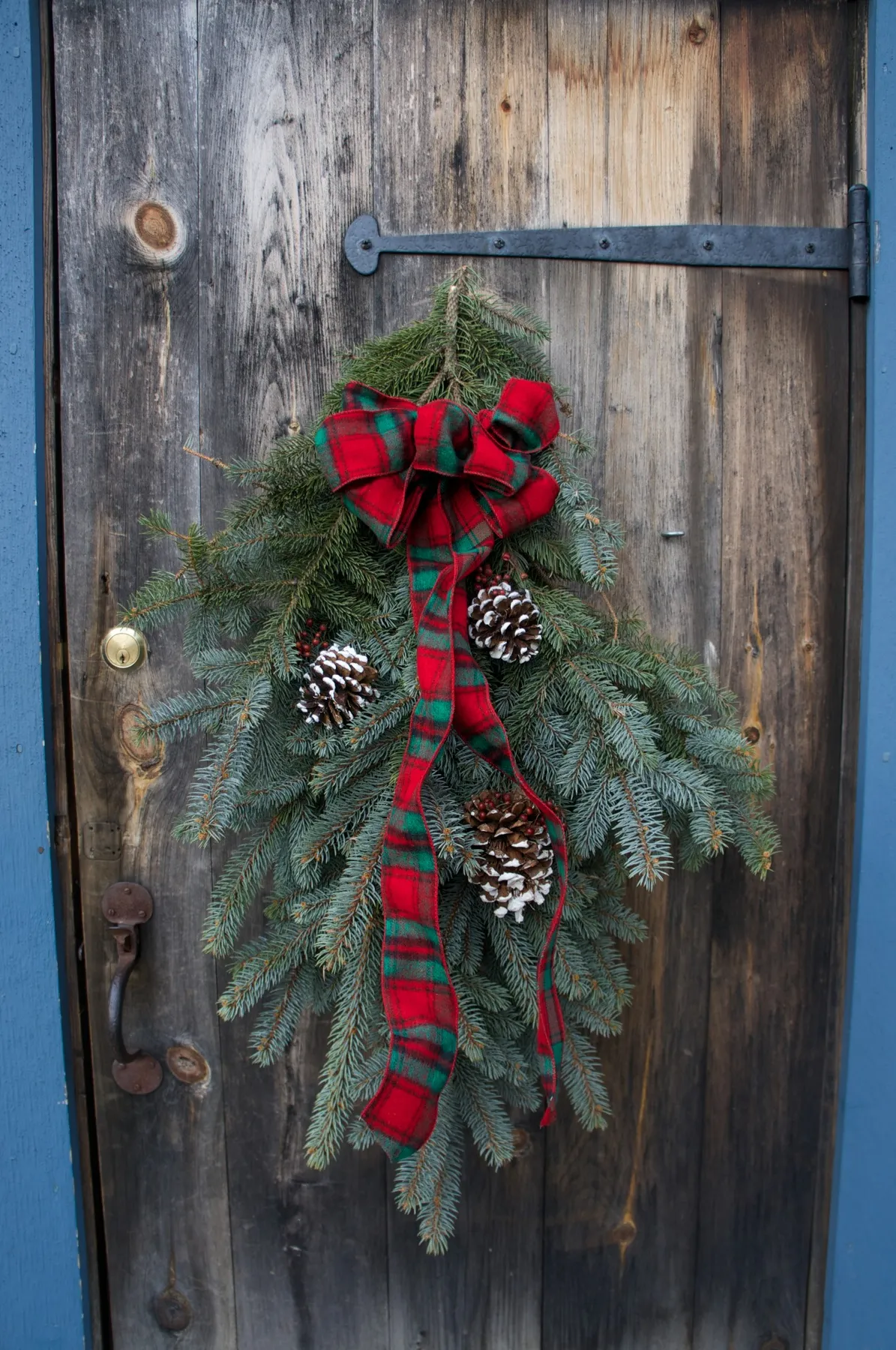
The ornate look is about 70% greenery and 30% junk-shop sparkle. Buy plain garland at Walmart or Home Depot, then bulk it up with thrifted brooches, clip-on earrings, and dollar-store blooms hot-glued onto wire picks. A $12 blow-mold ornament set from Target covers the same visual ground as a $90 designer collection. Hunt for tarnished brass and faded velvet at estate sales — real patina sells “collected over decades” far better than new gold ever will.
4. Whole-House Light Spectacular With Inflatable Nutcrackers
Extravagant yard displays have gone from neighborhood joke to genuine design category. Pinterest saves for inflatable-and-strings setups have climbed every season since 2022, and 2026 buyers are mixing blow-mold nutcrackers with modern LED snowflakes instead of choosing one era. The appeal is nostalgia with a wink — the neighbors’ kids remember it, and the grown-ups get a walkable light show. It’s high-impact, low-skill decorating, which is exactly why it keeps growing.
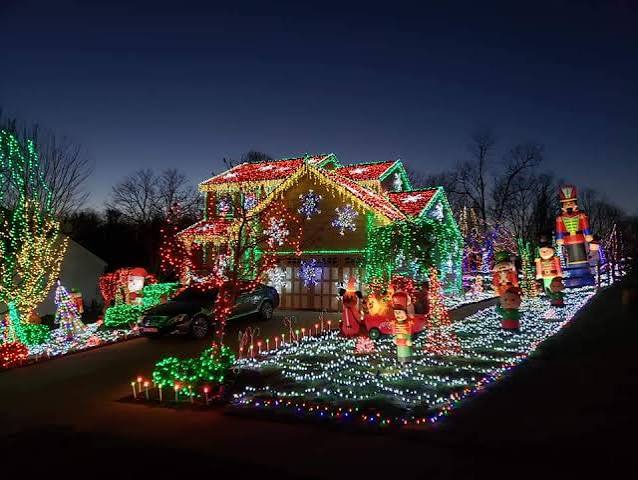
Before you cover a roofline, count your amps. A standard 15-amp outdoor circuit can safely run roughly 1,400 watts; one vintage-style C9 strand can eat 100 of those on its own. LED strings use about 90% less and let you run four times the length on the same outlet. Keep connections off the ground, plug into a GFCI outlet, and never daisy-chain more than three strands of anything. Inflatables need their own circuit — their blowers pull steady wattage all night long.
5. Green Tinsel Wreath With Glitter-Centered Red Blooms
Tinsel reads as volume from a distance, which is why this wreath holds its own on a plain white paneled door. The structure is simple: one tinsel ring, then red blooms with gold glitter centers, berry clusters, and a patterned bow placed at roughly 4, 7, and 11 o’clock. The white tree print on the red ribbon is the sleeper detail — it echoes the white door behind it and keeps the red from becoming one flat block of color.
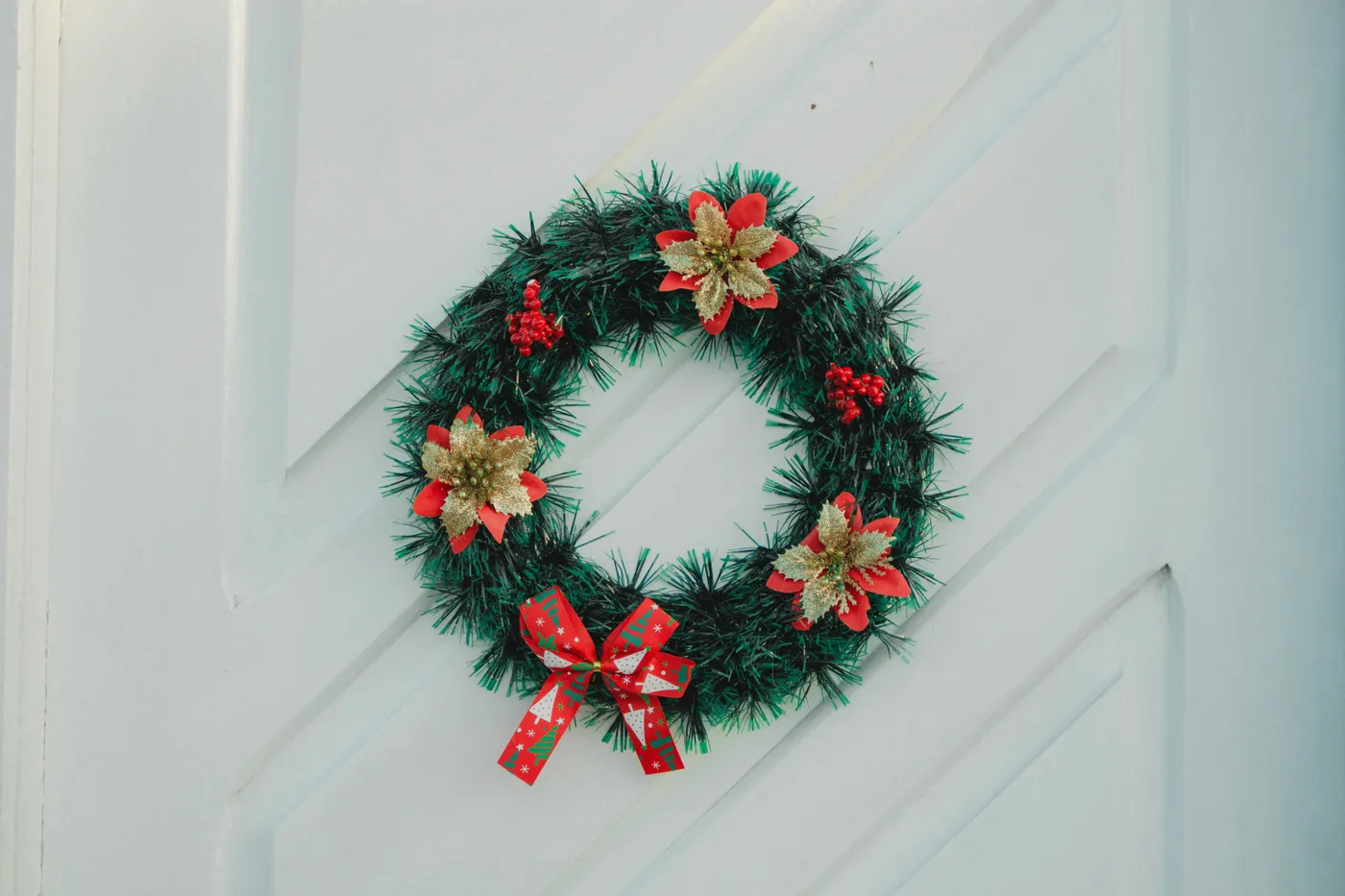
Tinsel sheds. Expect to vacuum once mid-season and again when you pack it away, and expect strands to dull after two or three years if the door faces south. Store it in a breathable bag, not vacuum-sealed plastic — crushed tinsel never fluffs back. If you want the same look with less upkeep, a tightly packed faux-pine wreath holds its shape for a decade and only needs a quick shake-out each November.
6. Snow-Dusted Evergreen and Icicle-Lit Porch
The core of this look is one big glowing evergreen and a porch rail that echoes it. A six-foot artificial tree from a Facebook Marketplace listing runs $25–$40 in November, and 200 warm-white LED lights cost about $15 at Walmart. Icicle lights on the porch trim: $12–$20 per ten feet. That’s under $100 for a scene that reads like a $400 professional install, because the trick is density, not price. Wrap tightly and double-strand the front-facing branch tips.
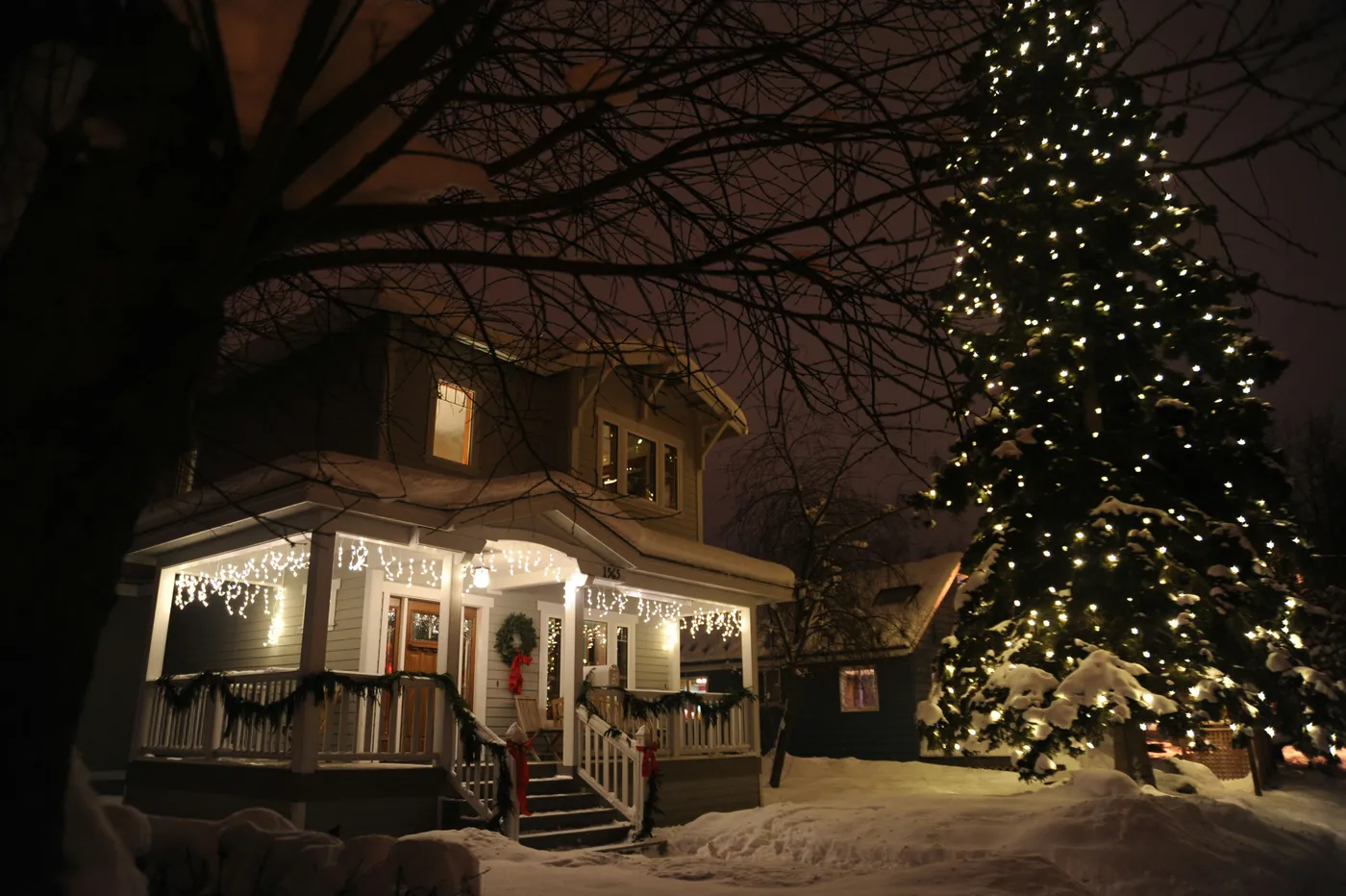
This works on anything from a 6-foot porch rail to a two-story facade, but the tree-to-house ratio matters. Aim for the lit tree to reach at least two-thirds the height of the porch roof — a small tree against a tall house reads as an afterthought. For a porch-sized version, this is the mini take on Idea #10. Fronts narrower than 12 feet should skip the icicle trim and go vertical instead.
7. Light Wood Hoop Wreath With a Flameless Candle
- Start with a light wood hoop or embroidery ring; the open shape does half the design work.
- Wire three or four evergreen sprigs to the hoop’s lower left, keeping the top third bare.
- Tuck in red berries and two small pinecones between the greens.
- Add three or four white cotton bolls for a soft, matte counterpoint.
- Hot-glue a flameless pillar candle to a gold base and center it in the greenery.
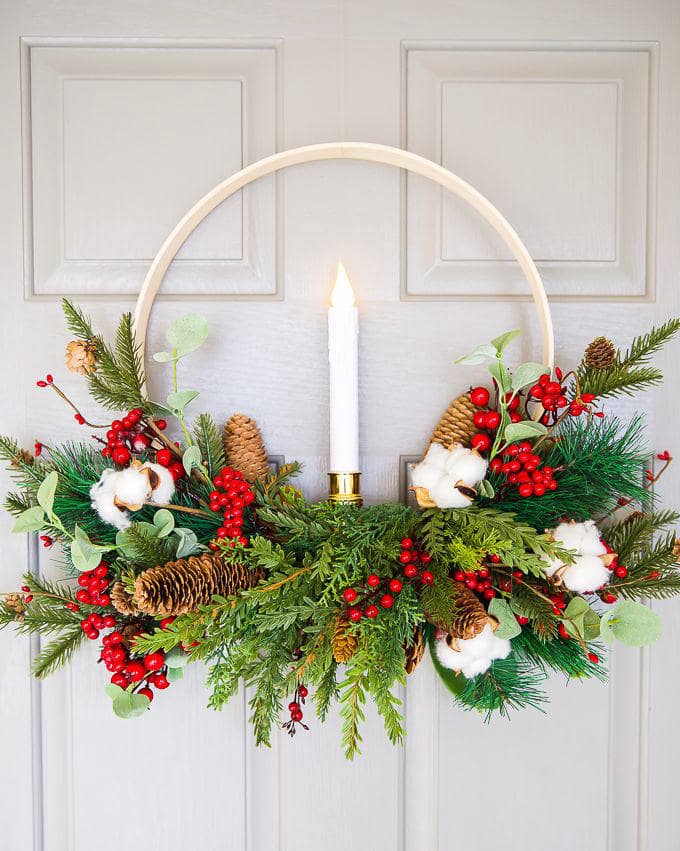
Time: 45 minutes. Cost: $20–$35, less if you forage the evergreens from a backyard cedar.
The flameless candle is the whole idea. Without it, this is a nice hoop wreath; with it, the wreath becomes a mantelpiece floating on a door. It also solves a real problem — an open hoop looks sparse from across a hallway, and one vertical element fills that negative space without adding more greenery. Buy one with a real wick and a subtle flicker, not the plastic-tipped version.
8. Vibrant Red Door With Twin Potted Evergreens
Formula: 50% deep red door and trim + 30% forest green wreath and topiaries + 15% natural tan and pinecone texture + 5% gold hardware. The tan ribbon is what keeps the red-green combination from reading as a poinsettia cliché. Change the ribbon to charcoal and the same setup turns modern; switch to buffalo check and it turns farmhouse. The potted trees on either side are the repetition element — two of anything instantly looks intentional.
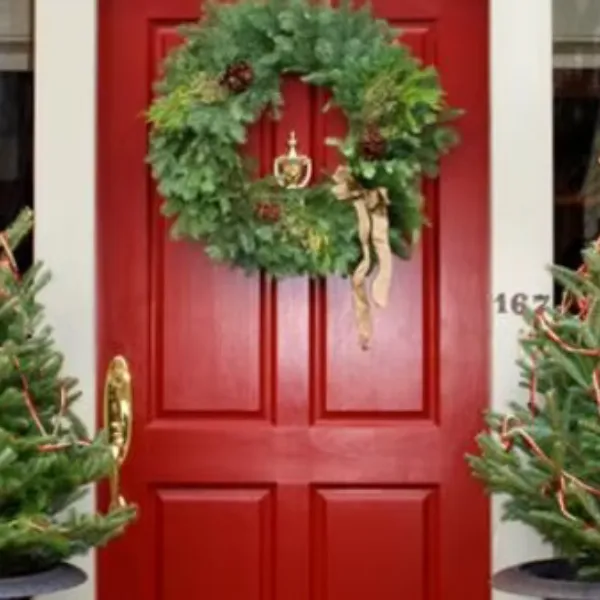
Two flanking topiaries need breathing room or the entry feels cramped. Give yourself at least 18 inches of wall on each side of the door, and keep pots under 14 inches in diameter so they don’t crowd the threshold. The setup feels best on entryways 6 feet wide or more with a covered porch — exposed doors will beat the striped ribbons to shreds in a wet climate. Smaller vestibules should copy the tighter arrangement instead.
9. Pine and Grapevine Entry With Plaid Bow and Bells
Mix two greens, not one. A pine garland looks plastic on its own, but woven with dried grapevine it gains shadow and movement — a 20-foot grapevine garland runs about $15 and you simply twist it into the pine. Then hide the light wire by taping the strand to the back of the vine and letting only the bulbs peek through the front. Warm 2700K bulbs, always. Cool-white LEDs against greenery read as hospital hallway.
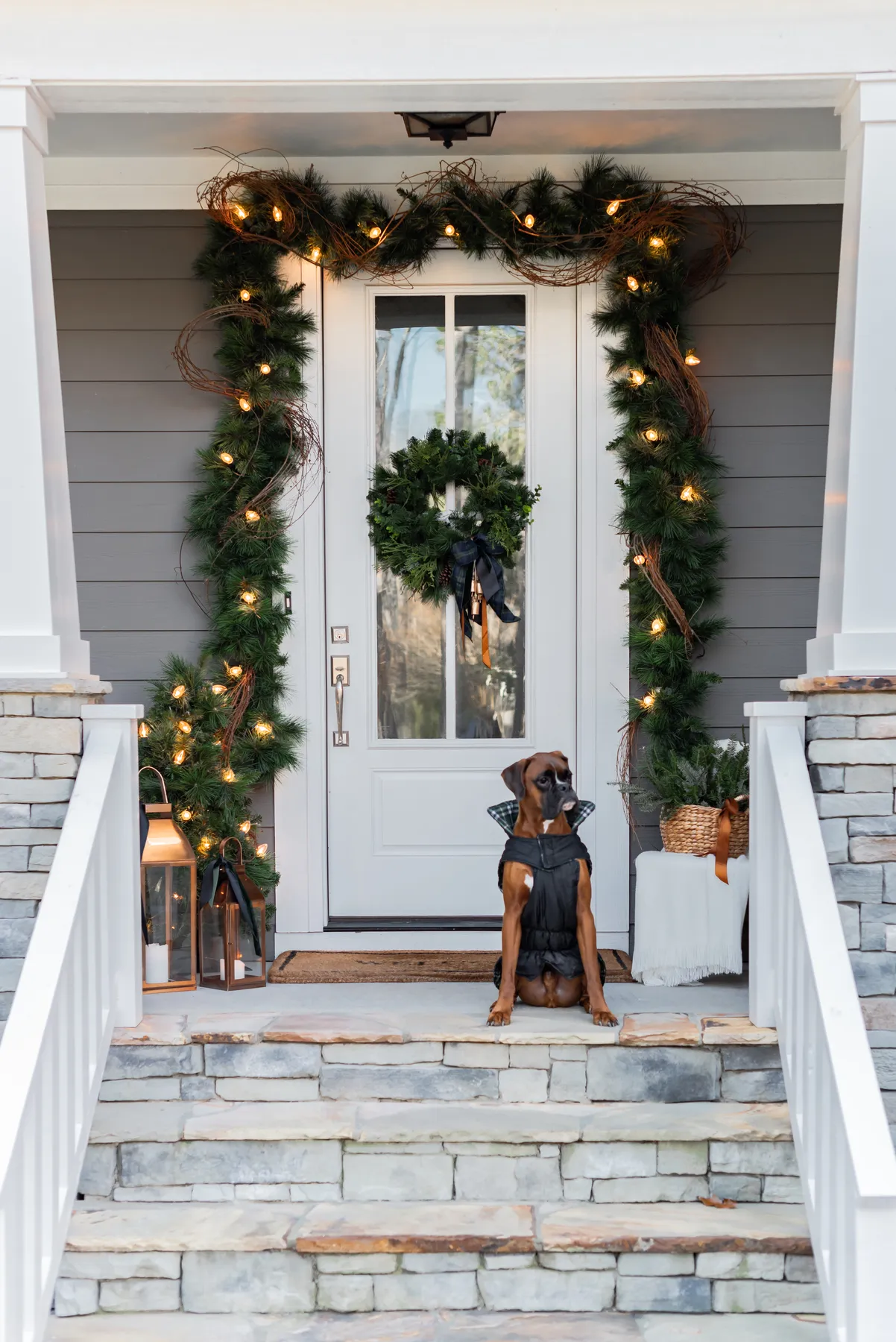
Real candles in porch lanterns are gorgeous and, on a windy night, a fire hazard. If you use them, keep them inside glass with a minimum 2-inch clearance and never leave them burning unattended — a 3-hour pillar is plenty for an evening. Battery pillars with a waxy finish fool almost everyone from the sidewalk at about $8 a pair. And if you have a dog who patrols the entry, keep garland ends above tail height or you’ll be re-hanging them weekly.
10. Oversized Gold Jingle Bells on a White Paneled Porch
- Oversized gold jingle bells (2–4): $12–$35 each
- Lighted wreath with red ribbon: $35–$70
- Two tall pre-lit artificial trees: $80–$200 total
- Grey fluted planters and mixed greenery: $60–$120
- Copper lanterns and candles: $30–$60
- Ribbon, berries, white florals: $20–$40
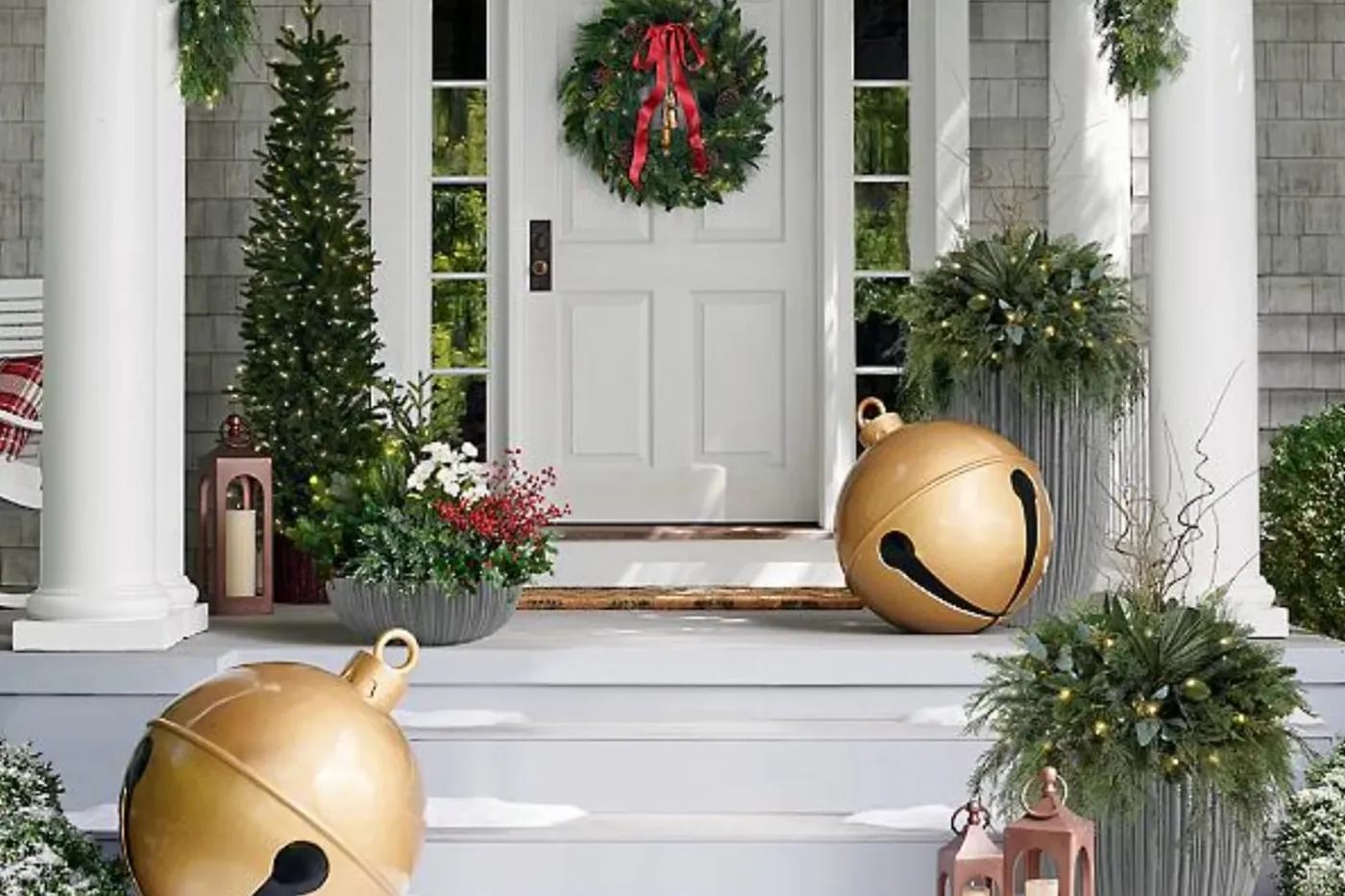
Total: $237–$525, depending on how many bells you commit to.
Budget alternative: skip the pre-lit trees and wrap two thrifted tomato cages in plain garland with a $15 strand of lights — that swap alone saves about $120, roughly 50% off the low end.
The oversized-bell look needs a porch, not a stoop. Minimum 8 feet of width and a 9-foot ceiling or roofline, or those big bells visually crush the door. Bells under 6 inches read as ornaments and disappear from the sidewalk — go 10 to 14 inches, or don’t bother. On a narrower entry, Idea #7 gives you the same festive hit without the bulk.
11. Dark Wood Door With Buffalo Plaid and Silver Bells
Buffalo plaid is doing the heavy lifting here, and it works because the scale is large. A small check would get lost against a dark wood door; this one is readable from the driveway. The silver bells on jute rope add a second metal tone that isn’t gold, which keeps the scheme from feeling too matched. And the distressed white ceramic planters break up the dark brown door and porch floor — without them, the whole entry would be one brown mass.
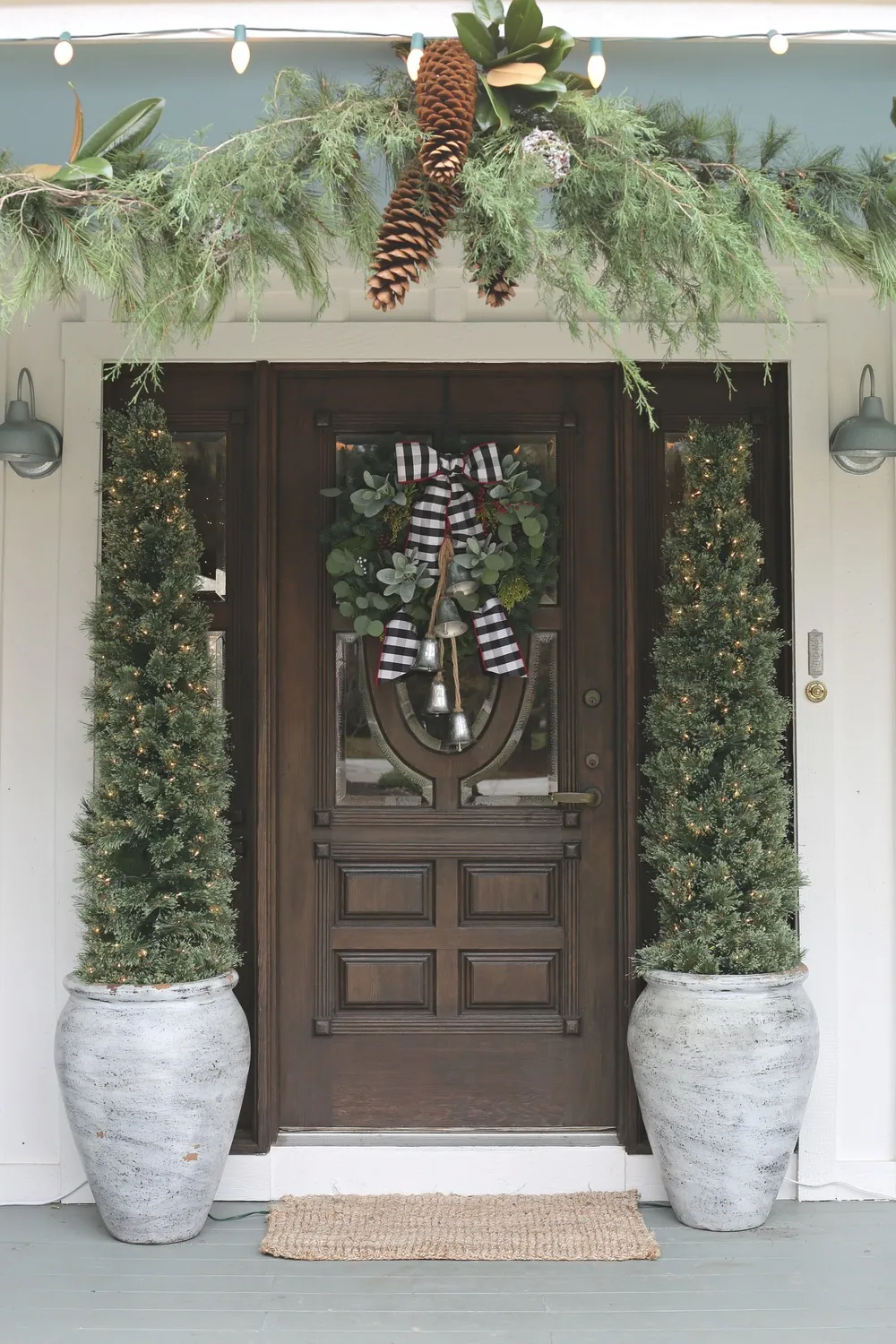
Lighted topiaries are the splurge in this setup, usually $50–$90 each. A plain faux boxwood cone from IKEA — or a thrifted topiary plus a $6 strand of battery fairy lights — gets you 90% of the effect. Buffalo plaid ribbon is everywhere: Walmart and Hobby Lobby both carry 10-yard rolls under $10, and a wreath form plus one roll covers the door. Total for a convincing version: about $60.
12. White Double Doors With Twin Berry Wreaths
Double doors love symmetry, so the formula is strictly even: 60% white door and trim + 25% evergreen + 10% red berry and ribbon + 5% warm metal. Two wreaths, two bows at identical heights, two planters — the eye relaxes because nothing competes. If you want to loosen it up, vary only the planters, as here, where a shell-encrusted urn sits opposite a woven basket. Same color story, different texture, zero chaos.
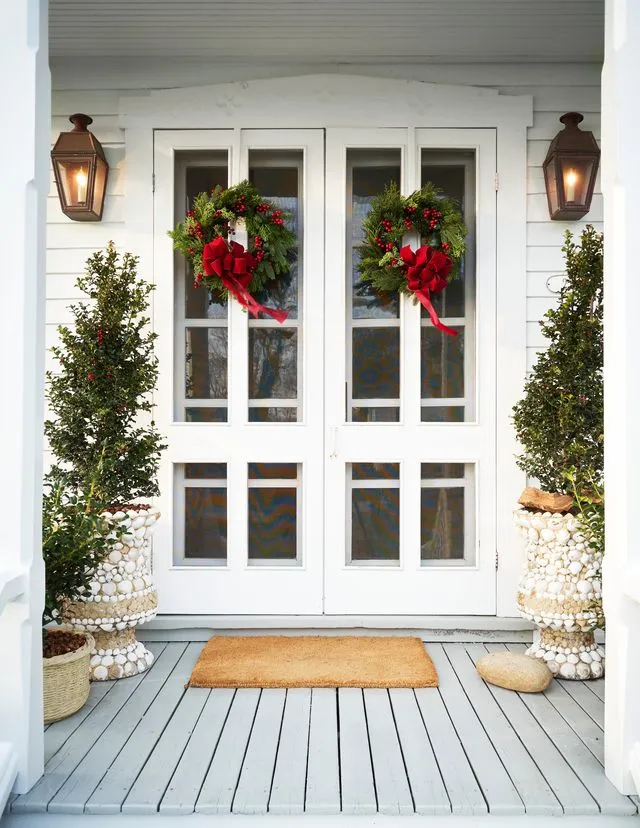
Fresh evergreen wreaths on a door that catches afternoon sun will dry and drop needles within two weeks. Mist them every other day, or soak the wreath’s back in water for an hour before hanging and let it drain. Berry sprays fade to pink by mid-December in direct sun — keep a spare set and swap around the 20th. Faux berry picks at about $4 a stem hold their red for years and are indistinguishable from the sidewalk.
- Measure between the two door handles — each wreath needs at least 12 inches of clearance.
- Check which way the doors open; a hanger on the active leaf gets knocked constantly.
- Confirm your outlet, or decide on battery lights before you buy anything.
- Set a budget line for greenery, since double doors double every quantity.
13. Lush Garland Entry With Black Lanterns and Woven Baskets
- Borrow two woven baskets or market totes, at least 16 inches wide.
- Line each with a plastic bag, then a block of floral foam if you’re using fresh greens.
- Start with the tallest evergreen branches at the back, angled outward.
- Fill the front with berry sprays and small gourds tucked low, almost hidden.
- Set the baskets on the steps and place a black lantern between them with a candle inside.
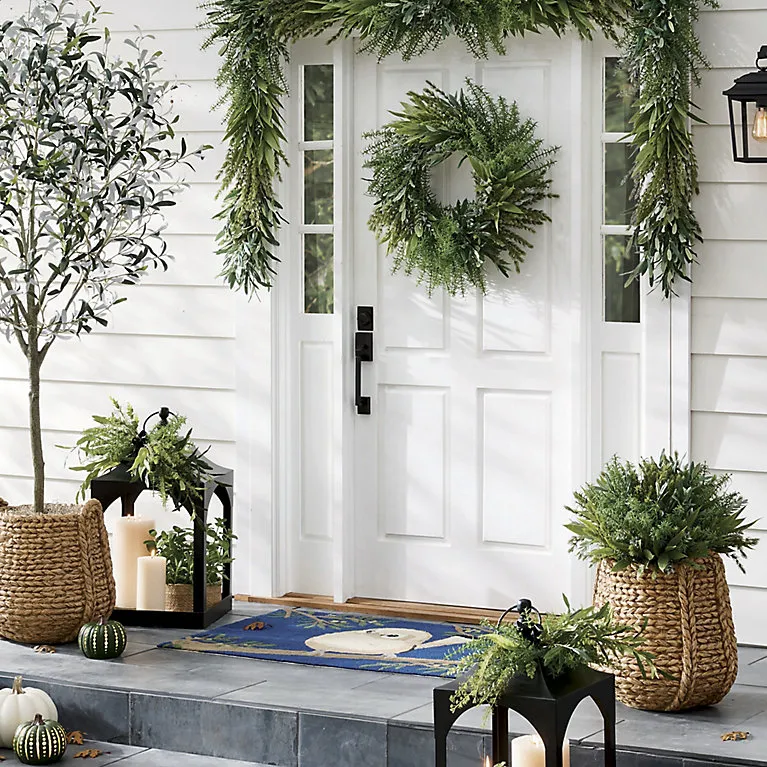
Time: 40 minutes. Cost: $35–$60 if you already own the baskets.
The gourds. Leaving a few small pumpkins and gourds in a Christmas arrangement is the detail that makes this entry feel lived-in rather than store-bought — it says the season changed and nobody panic-cleared the porch. Fall’s natural palette of tan, sage, and faded orange sits perfectly against evergreen and dark metal. Pull everything pumpkin-orange and it turns into a craft-store display; keep it muted and it reads as a real front porch.
14. Glowing Ceramic Village on a Light Gray Mantel
Build a mantel village in three depths: houses in back near the wall, cone trees mid-garland, and one taller piece pushed forward at the outer edge. Vary heights by at least 4 inches between neighbors so silhouettes stay readable. Wire everything to a single dimmer switch — a mantel village at full brightness looks like a display case, at 60% it looks like a memory. Plug the garland lights and the village into the same outlet strip behind the mantel.
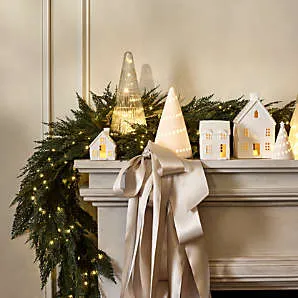
Lit ceramic villages are having a quiet renaissance. The shift is generational: millennials who grew up with a grandmother’s collection want the nostalgia without the footprint, so they’re buying small matte-white houses and mixing them into greenery instead of dedicating a table. Pinterest searches for “ceramic village mantel” climb every November. It stays because it’s flexible — three houses this year, six next year, no commitment to a full miniature town.
15. Brick House Entry With Ornament-Filled Column Garland
Garland-draped columns need height to look right. White fluted columns under 8 feet tall turn into gift-wrapped posts; at 9 feet and above, the drape reads as architecture. Keep swags between 30 and 36 inches deep so the ornaments inside stay visible from the walkway. Window wreaths should sit at doorknob height or higher — anything lower looks like it slid down. On a single-story brick front under 20 feet wide, skip the column garland and put that budget into the door itself.
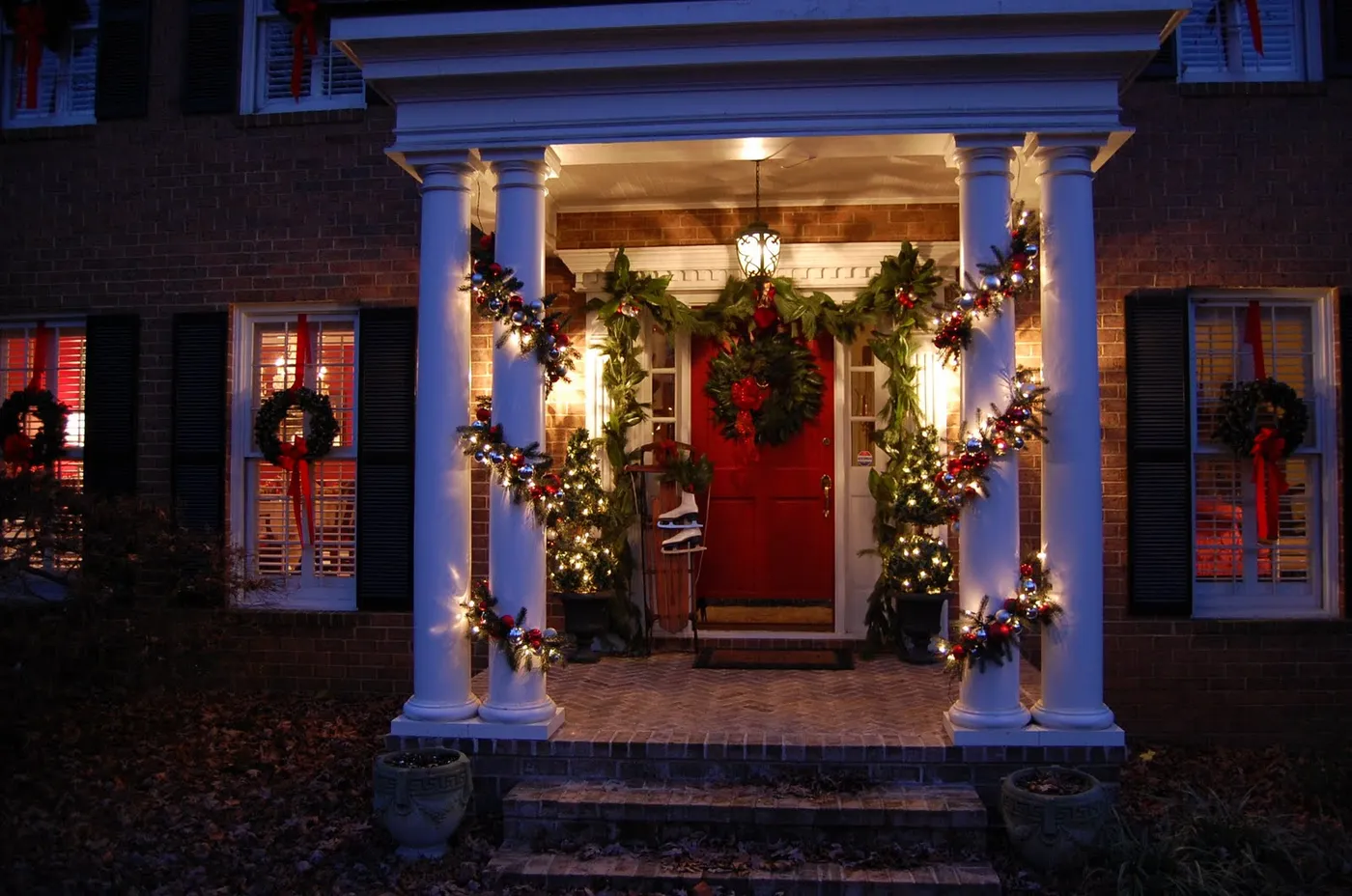
Ornaments wired into outdoor garland will fade, crack, or vanish. Use shatterproof plastic only — glass baubles that look perfect indoors become a hazard on a windy porch. Expect sun-faded reds within three seasons. And on brick, everything is harder: garland hooks won’t bite, so plan on adhesive clips rated for 5 pounds or a masonry drill with anchors you patch in spring. Budget two extra hours just for mounting.
16. Inflatable Santa and Snoopy Porch With Striped Columns
Inflatable decorating is the most forgiving budget category there is. A 6-foot Santa runs $35–$60 at Walmart or Target, a snowman about $25, and character favorites similar. Striped ribbon for the columns is $8 a roll at a craft store, and it’s reusable for years. Total for this porch, if you own nothing: about $150. Shop in early November — inflatable prices double after Thanksgiving, and the good characters sell out first.
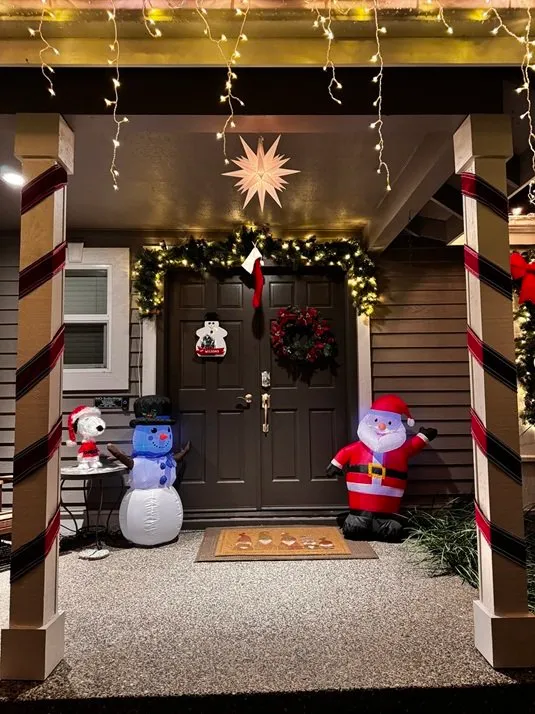
Inflatable porches used to be a punchline and are now a style choice. What changed is the quality — modern inflatables hold shape better, run on quieter blowers, and designers have started mixing them with lit garland and ribbon instead of letting them crowd alone. The look is intentionally unserious, which is precisely what people want right now. It also lets kids and adults decorate the same porch without a compromise.
17. Grand Foyer With a Red Toy Truck Centerpiece
A toy truck works as a centerpiece because it’s an object with a story, not a decoration. Scale does the rest: the truck sits low, the lighted trees rise behind it, and the garland with red and gold ornaments lifts the eye up to the pillars. On checkered marble, the red reads almost as a graphic element. The hanging white birds overhead are the wildcard — a small, unexpected pause in an otherwise formal foyer.
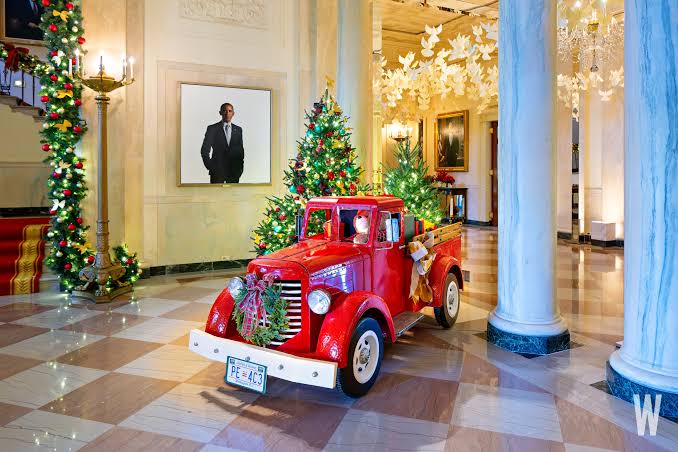
- Vintage-style red toy truck (new or thrifted): $40–$120
- Two 6-foot pre-lit artificial trees: $120–$260
- Garland with red and gold ornaments: $45–$90
- Wrapped gift boxes and a teddy bear: $25–$50
- Hanging white bird ornaments (set): $18–$35
Total: $248–$555 for a foyer that looks professionally installed.
Budget alternative: use a red wagon or a painted wooden crate instead of the truck, and you hit the same note for roughly half the cost.
18. Southwest Office Door With Papel Picado Banners
- Hang the papel picado banners first, 6 to 8 inches above the frame, with even spacing.
- Run multicolored string lights down both sides of the frame, tucking wire behind the casing.
- Center a green wreath at door height and add a simple red bow at the top, not the bottom.
- Cut cactus and sombrero shapes from cardstock and tape them flat to the door face.
- Finish with small cactus-shaped trees in the corners and a red tree skirt as a base.
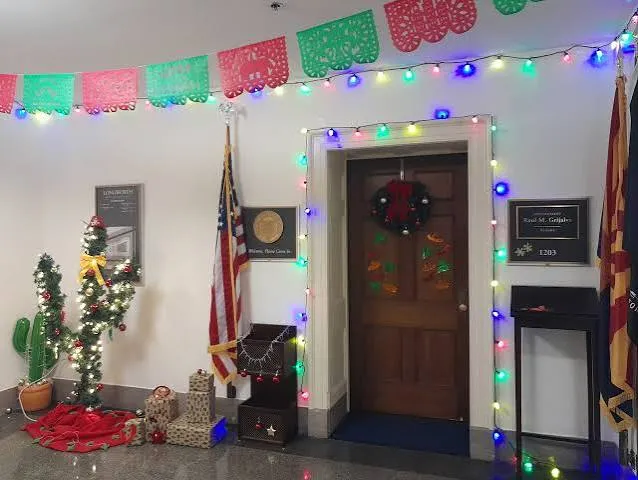
Time: 1.5 hours. Cost: $25–$45, mostly paper and lights.
Outline the whole doorway, not just the door. Lights along the frame, garland across the top, banners overhead — that three-sided framing is what makes a hallway display photograph well from 30 feet down the corridor. Keep colors to three. Here it’s red, green, and pink, with yellow as a whisper; add blue or purple and the papel picado pattern gets swallowed. On an office door, use removable adhesive hooks rated for 2 pounds.
19. Red Gift Box Processional With Slim Lit Trees
The gift boxes along the walkway are the one thing that makes this entry feel like an event rather than a door. They create a processional — you walk through the decoration before you reach it. Nothing else here is unusual: two slim trees, wreaths on the columns, red bows. Take the boxes away and it’s a nice porch. Keep them and neighbors slow down. They also solve the empty-walkway problem most decorated fronts quietly have.
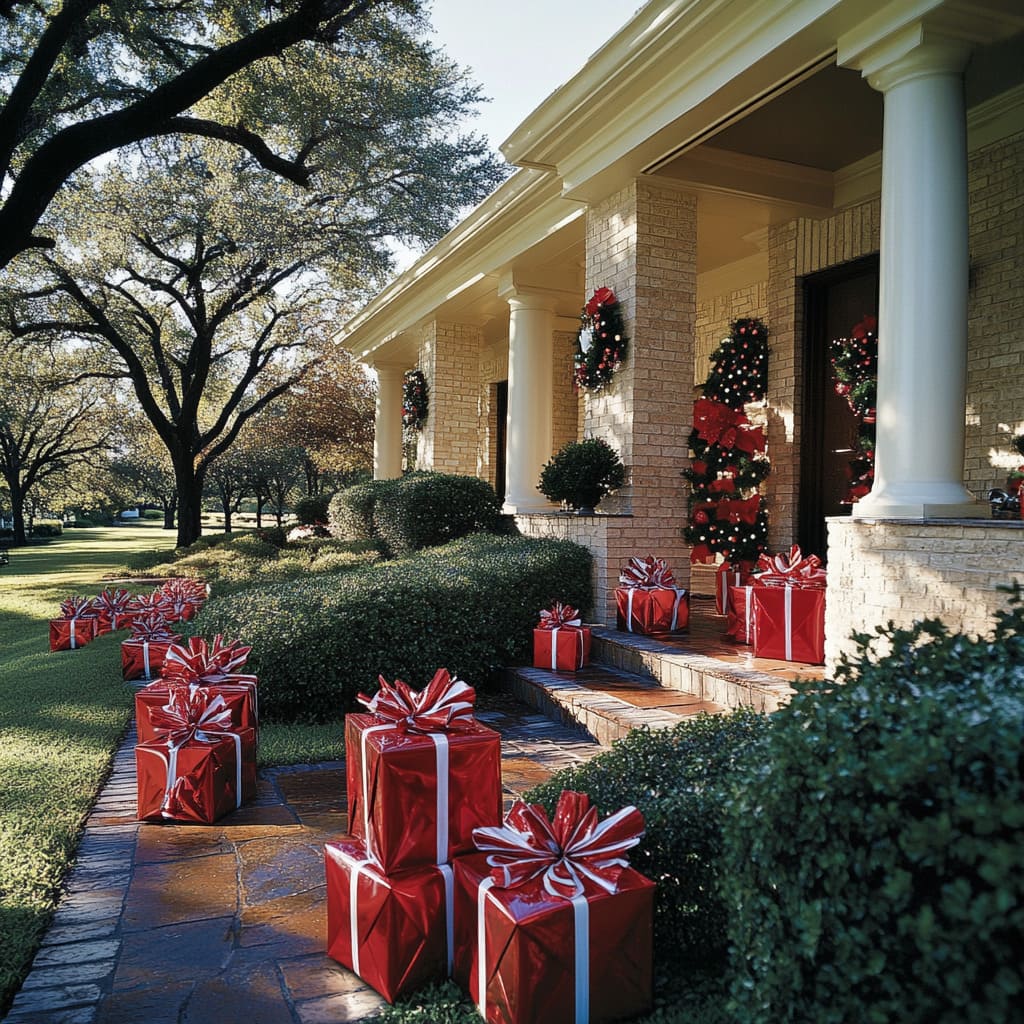
Give the boxes a walkway at least 8 feet long and 4 feet wide, or guests will be stepping around decor in the dark. Boxes should be 14 to 24 inches square — bigger and they become obstacles, smaller and they look like litter. On steps, secure them with double-sided outdoor tape so they don’t turn into trip hazards. Narrower paths do better with the ground-level greenery in Idea #13.
20. Arched Glass Door With a Silver and Cinnamon Wreath
Anything with cinnamon sticks and natural berries will shed and dull. Cinnamon keeps its scent about three weeks; after that it’s purely visual. Frosted faux branches drop their coating onto the threshold — shake them outside once a month. Real pinecones are fine but attract spiders if stored in a damp garage, so bake them at 200°F for 30 minutes before using. Silver ornaments need a dry-cloth rub each season to keep the shine from going dull gray.
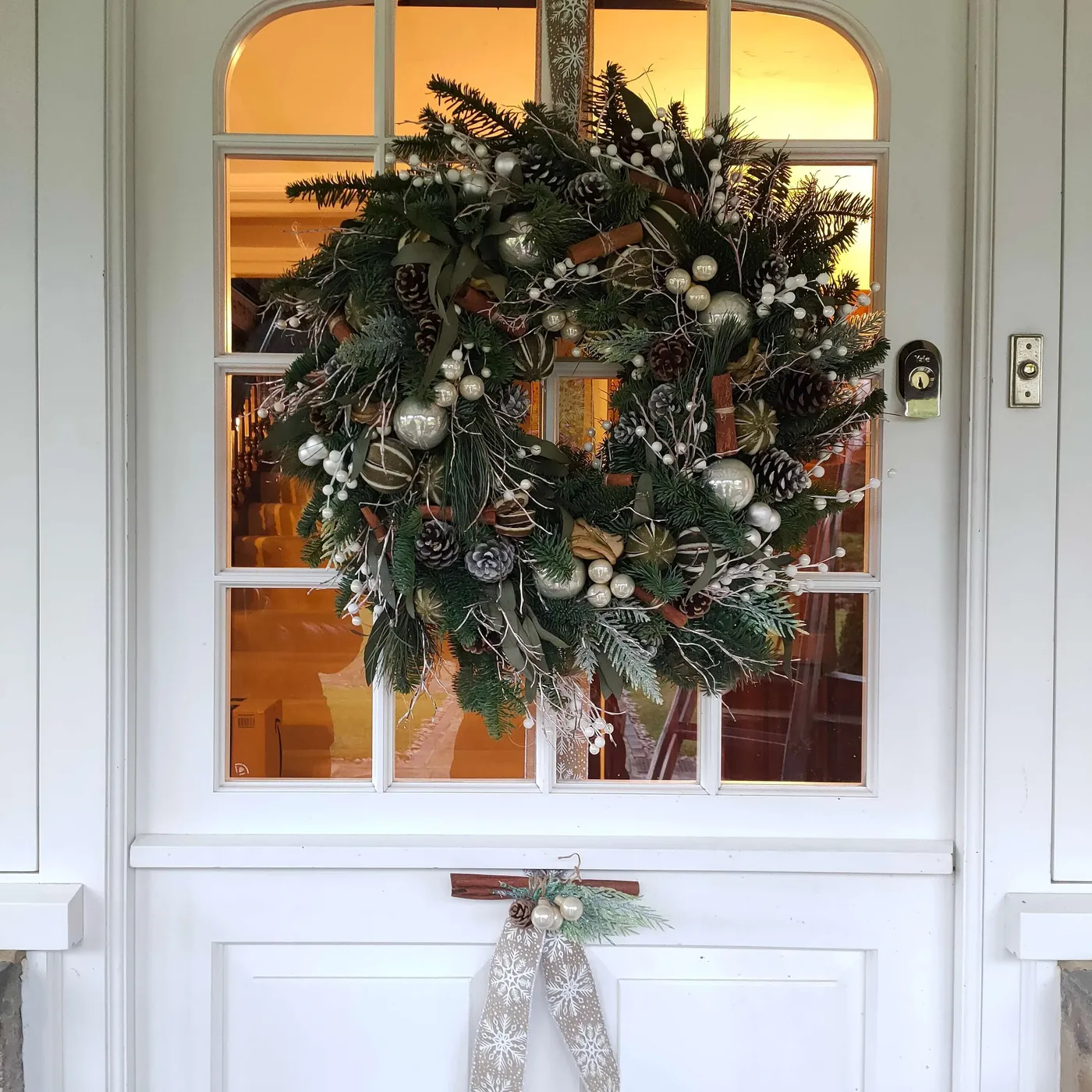
Hang the wreath so its bottom edge sits about 12 inches below the top rail of the arched window, and let the tails hang past the frame instead of centering them inside it. With arched glass or a transom, backlighting matters more than decor: a warm LED strip tucked into the door’s recess makes the wreath a silhouette rather than a flat circle. That’s the entire difference between a nice wreath and one people stop to photograph.
21. Classroom Door Turned Gingerbread House
- Cover the door with brown kraft paper, overlapping seams and taping at the top and sides.
- Cut scalloped white strips for the roofline and window trim, gluing them in layers.
- Add cutout windows with pink paper curtains and red bow accents.
- Attach paper lollipops, candy canes, and gingerbread people across the walls.
- Finish with cotton batting along the floor edge for snow, and drape string lights across the top.
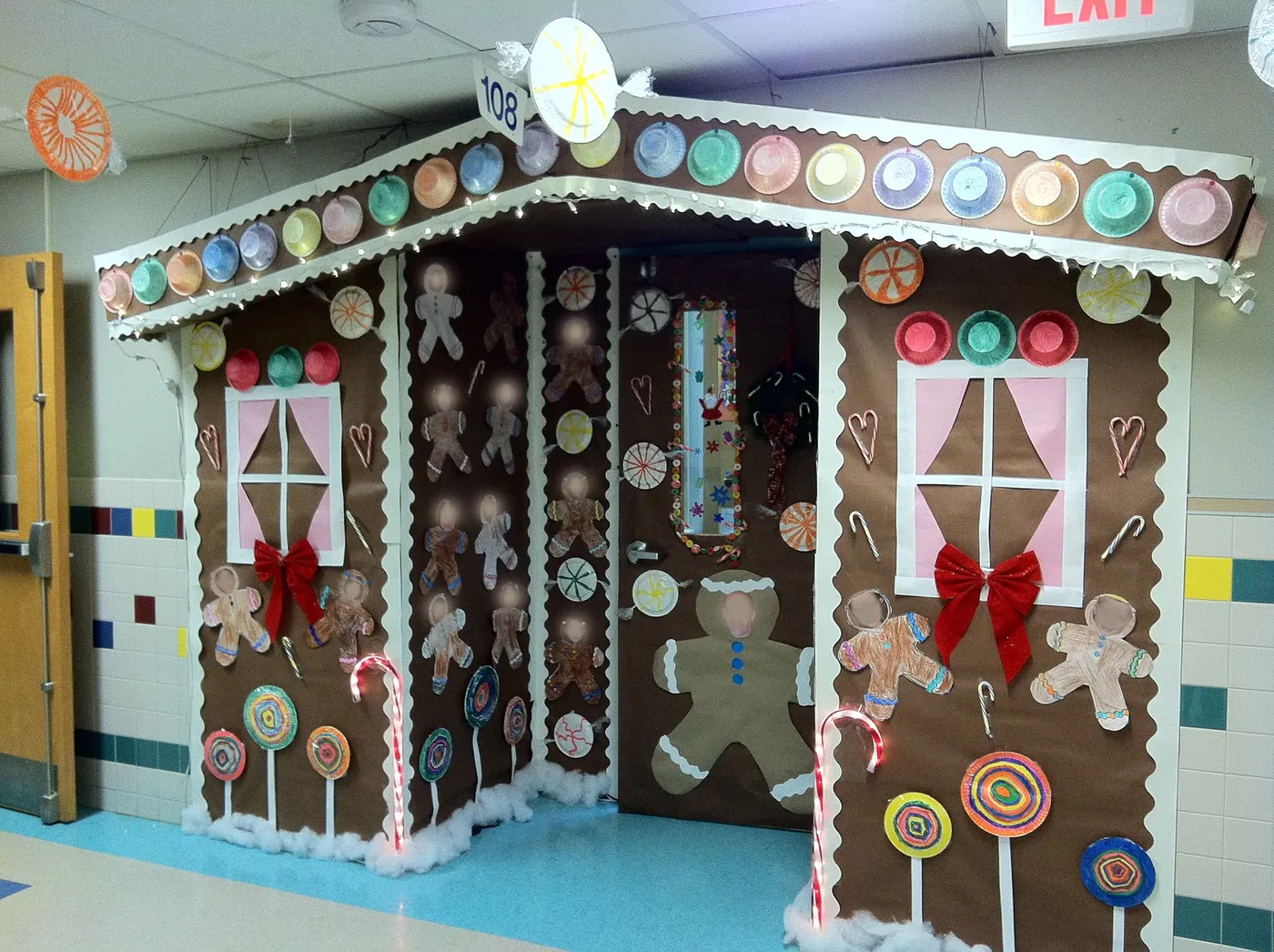
Time: 2–3 hours. Cost: $20–$35 for paper, batting, and lights.
Classroom door contests are won on paper, not products. Kraft paper is about $6 a roll, cotton batting around $5 a bag, and everything else — lollipops, candy canes, gingerbread figures — can be cut from construction paper and cardboard from the recycling bin. Total outlay: under $25. If you want dimension, ask families for paper plates and paper towel tubes; rolled and painted, they make convincing candy. Scale wins, not spending.
22. Arched White Doors With Oversized Green Velvet Bows
Formula: 65% warm white and cream base + 20% dark green velvet + 10% gold + 5% natural wood. The bows are the only saturated color in the room, which is why two of them carry the entire entry. Swap the velvet for burgundy and it turns traditional; swap it for pale blue satin and you get a cool, modern take on the same skeleton. Compare with Idea #26 — same bow-on-the-door instinct, entirely different temperature.
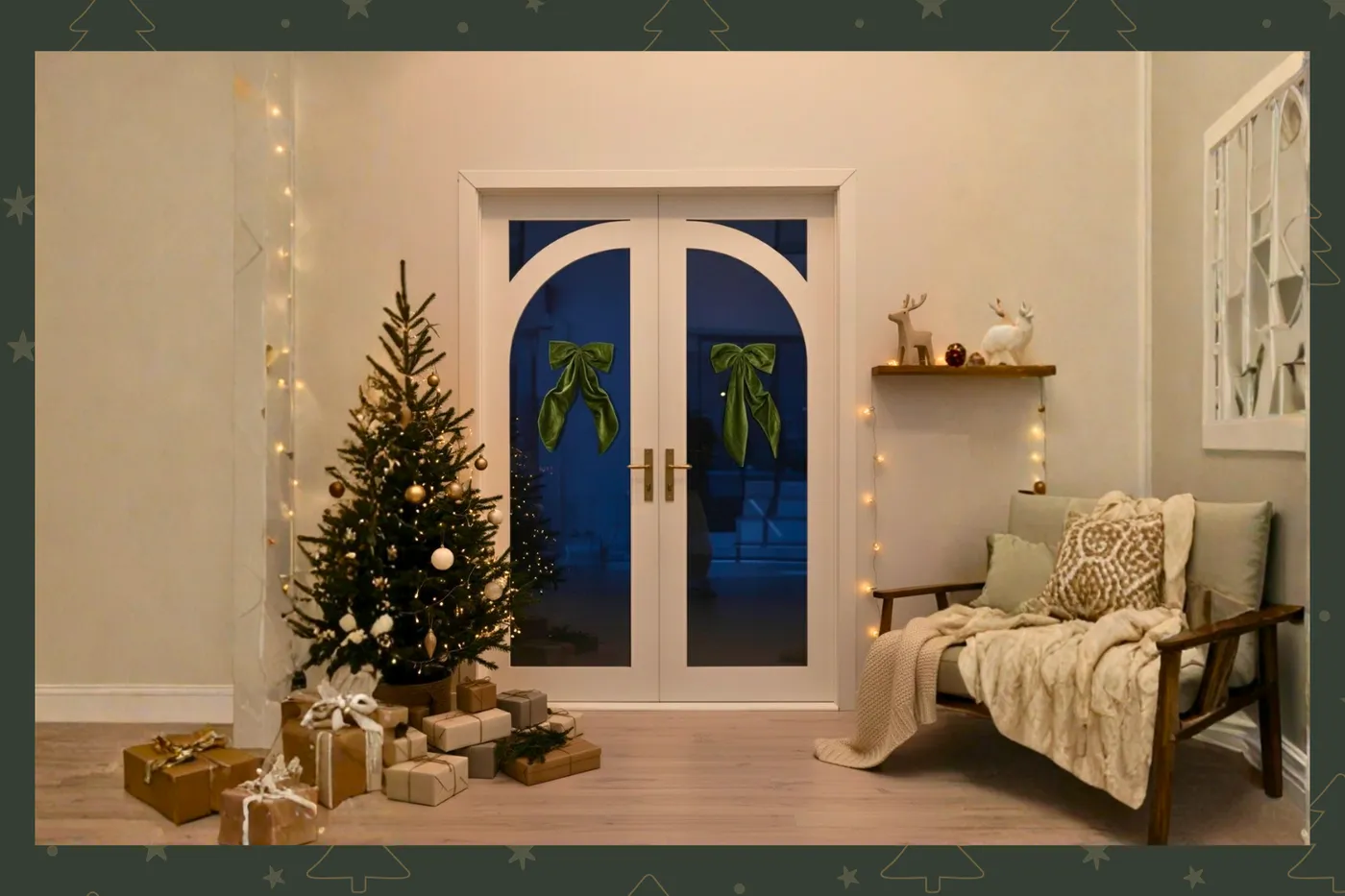
The green velvet bows. They’re oversized, probably 14 inches across, hung directly on white arched doors with no wreath underneath. That restraint is the point: most people would have added pine and berries, and it would have been fine and forgettable. Two bold bows against clean white read as a design decision. Velvet also photographs with a depth satin can’t match, and at about $12 a yard you can make both for $30.
23. Deep Red Door With Twin Pine Wreaths in Plaid
- Measure your door width — two wreaths need at least 36 inches to breathe.
- Check whether each wreath will collide when the door swings inward.
- Decide if your side windows can take garland hooks without damaging the trim.
- Confirm ribbon width: 2.5 inches minimum for bows this size.
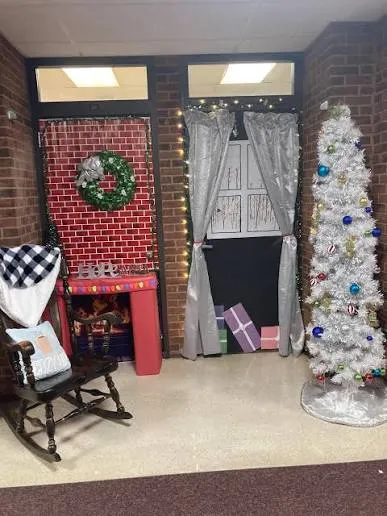
Plaid ribbon is the cheapest way to look expensive. A 10-yard roll of red-and-black buffalo check runs $6–$12, and most people only need about 6 yards for two wreaths and a run of garland. Plain pine wreaths start around $15 each at Walmart or Trader Joe’s, and a thrifted woven doormat is $5. You’re under $60 — and if you buy the ribbon in November, you’ll use it again next year and the year after.
24. Green-Trimmed Cabin With Plaid-Wrapped Chairs
The cabin look is the rural answer to maximalist holiday decor. Searches for “cabin Christmas porch” and “plaid blanket styling” have climbed steadily, driven by people who want greenery, woodsmoke, and almost no glitter. It’s the same instinct behind the broader move toward natural materials — undyed wool, raw wood, real evergreen. It has staying power because it isn’t really a trend; it’s a lean into what a snowy setting already gives you.
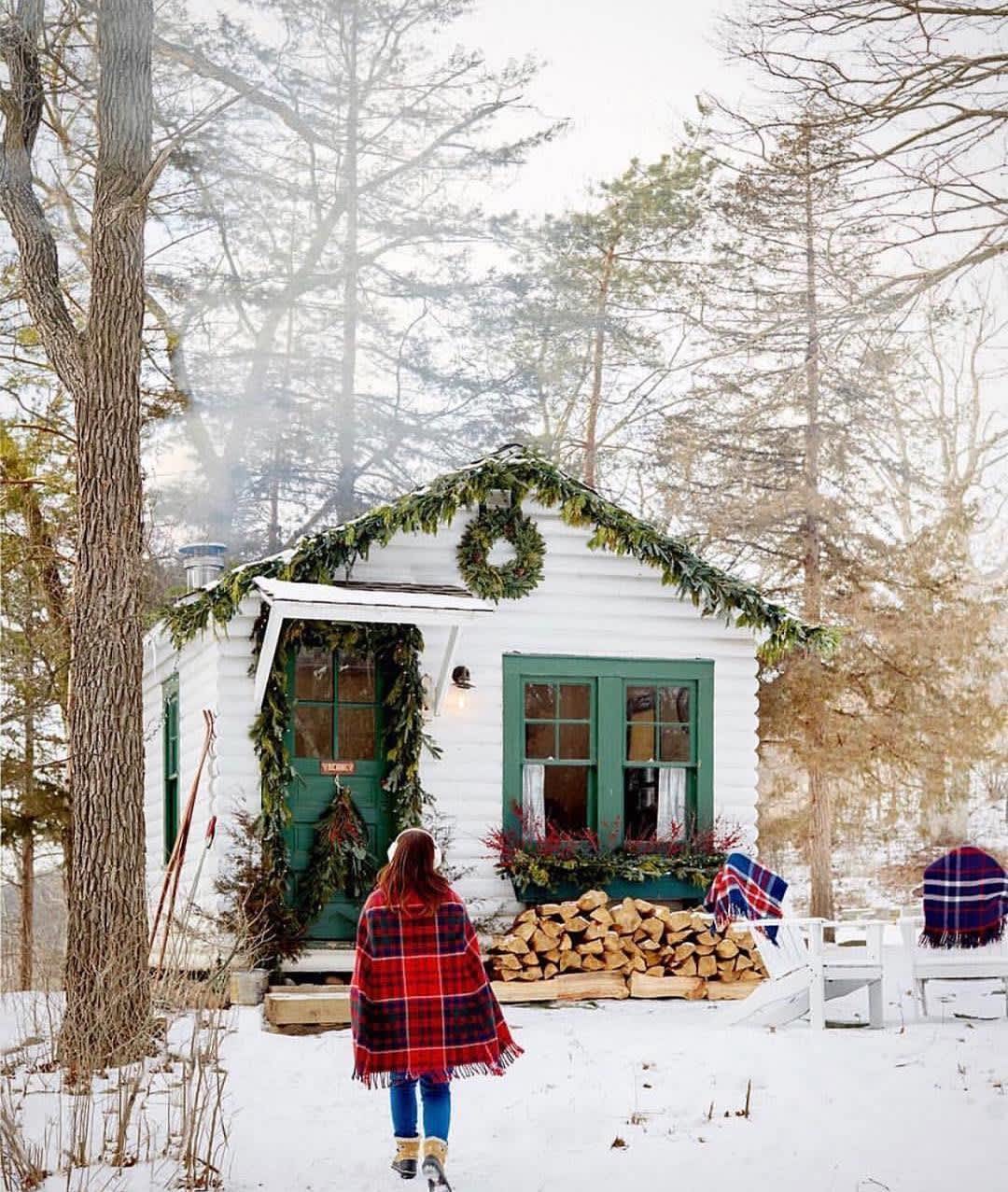
The green window trim does the work before a single decoration goes up. Because the frames and door are already forest green, the garlands merge into the architecture instead of sitting on top of it — a trick worth stealing if you’re painting anything this year. Plaid blankets draped over the chair backs are the other quiet move: they signal cold weather and warmth at once, and they cost nothing if you already own them.
25. Magnolia Garland Entry With Apple Topiaries
Magnolia leaves have a glossy dark top and a soft brown underside — flip a few leaves over in your garland and you get instant tonal variation for free. For topiaries, wire the apples on short wooden picks rather than gluing them; you can then rotate the arrangement weekly so no single fruit faces the sun and fades. Keep the magnolia garland away from direct heat sources or the leaves curl within days.
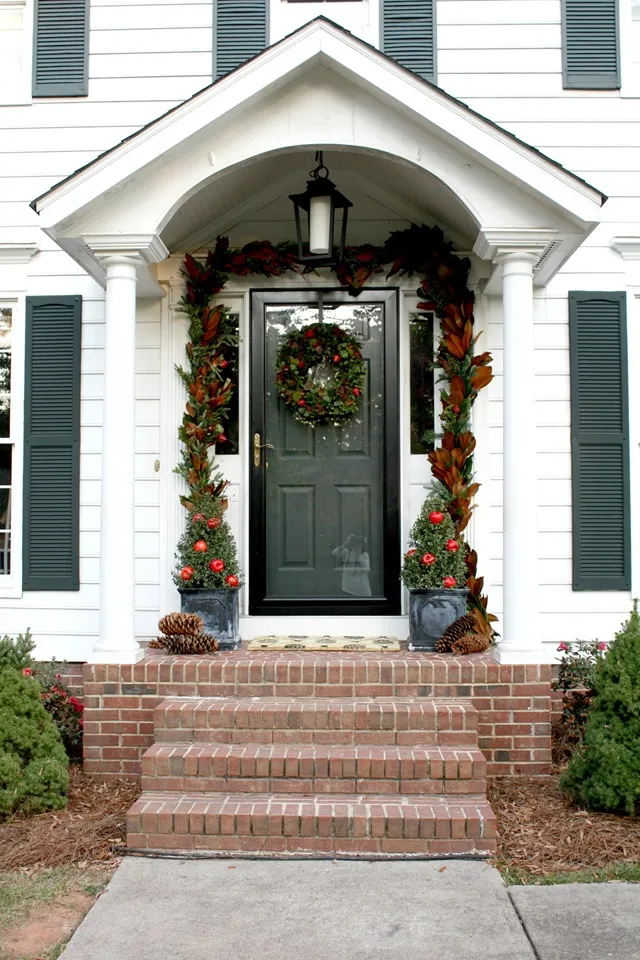
This entry wants symmetry to work: two topiaries, one centered wreath, garland outlined at equal depth on both sides of the frame. Give each side at least 24 inches of wall, and keep the topiaries under 4 feet tall so the door stays visually dominant. On a front door wider than 42 inches, add a third element or the composition floats. Entryways under 5 feet should look at Idea #12.
26. Red Door Framed in Magnolia and Poinsettias
- Two large magnolia leaf wreaths: $60–$140
- Arched magnolia and evergreen garland: $55–$110
- Red poinsettias for planters (6–8 plants): $40–$80
- Dark planters, if you don’t own them: $60–$150
- Red ribbon and floral wire: $10–$20
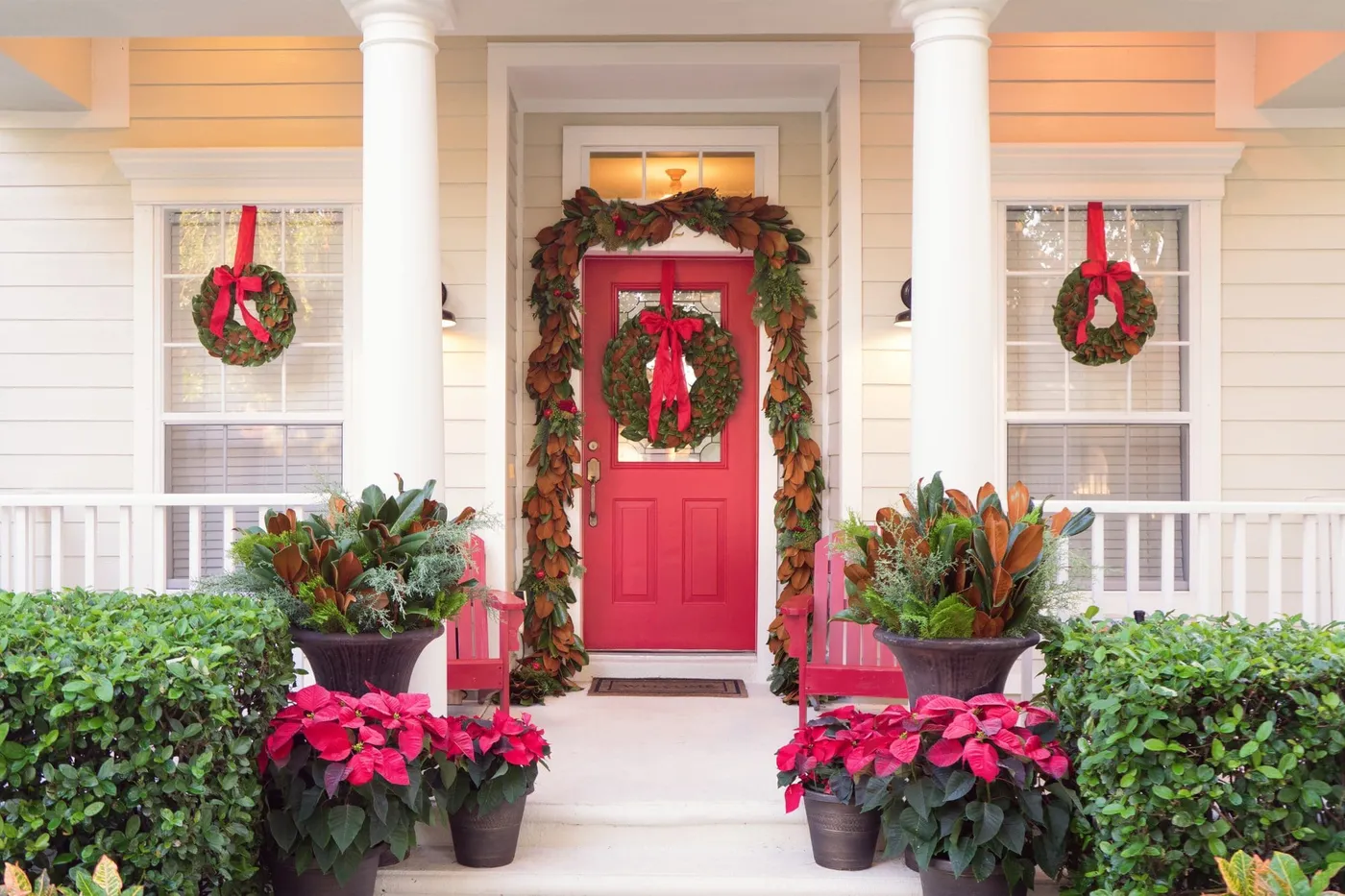
Total: $225–$500, most of it greenery.
Budget alternative: faux magnolia garland runs about $35 and grocery-store poinsettias are $8 each — that cuts the whole thing to roughly half.
Formula: 55% magnolia green + 25% vibrant red + 15% cream siding and white trim + 5% black planter and hardware. Red and green can look cheap; the magnolia’s brown underside and creamy siding are what keep it expensive. Trade cream for bright white and it sharpens; trade red for burgundy and it goes moody. This is the festive cousin of Idea #5 — same red-on-red instinct, larger scale.
27. Pre-Lit Evergreen Arch Over an Interior Door
- Set the two arch columns on fabric-wrapped bases first; they establish the footprint.
- Stand the arch over the door and check that the top clears the trim by 2 inches.
- Wrap a warm white strand up each column, then along the arch, taping as you go.
- Fluff every branch tip facing the room so the arch doesn’t look flat from the side.
- Plug into a foot-switch dimmer and tuck cord slack behind a base.
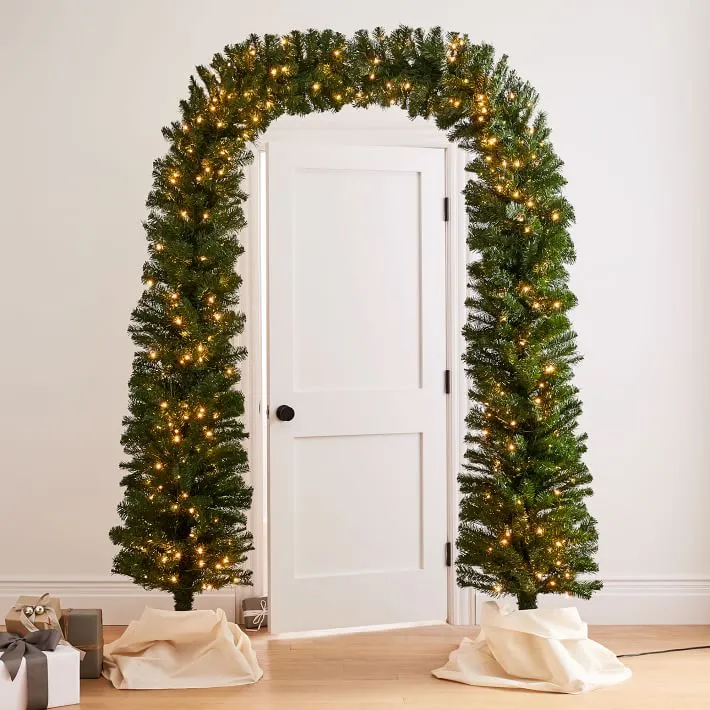
Time: about an hour. Cost: $90–$200 for a pre-lit arch, or about $50 if you build one on a metal form.
Putting an arch on an interior door instead of an exterior one. It turns a guest-room entry or hallway door into a moment, and you get to enjoy it every time you walk past instead of only when you leave the house. A pre-lit arch with fabric-wrapped bases also stores flat in a box the size of a duffel bag — no wreath hanger, no nails, nothing to patch in January.
28. Polar Express Hallway Door With a Snowflake Sky
- Measure the door plus trim — your paper backdrop should cover the full door, not just the panel.
- Confirm you’re allowed to tape or hang anything on the hallway door.
- Cut all snowflakes before you start gluing; they should vary between 4 and 12 inches.
- Test that the door still closes and latches with garland on the frame.
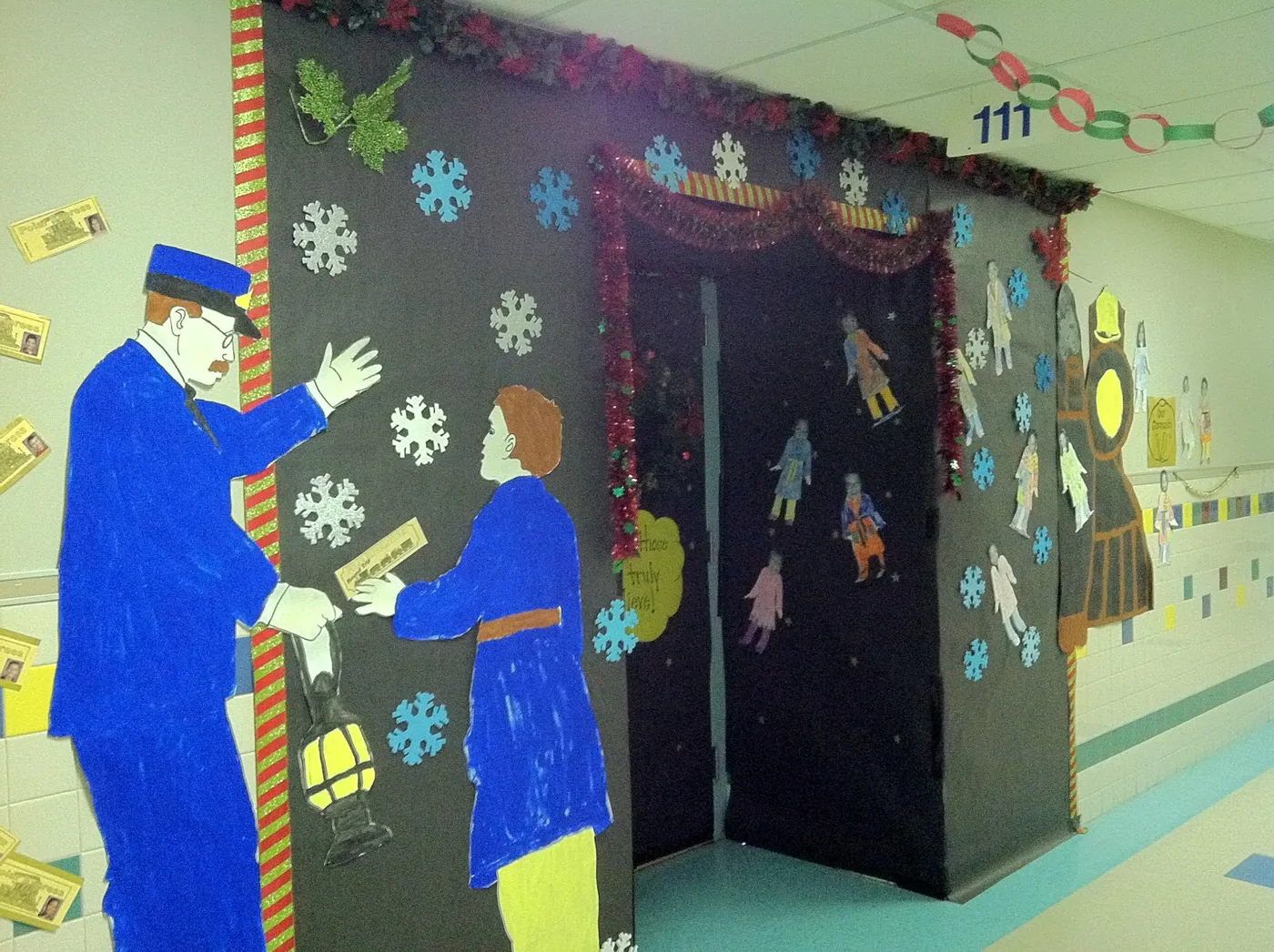
It’s a scene, not a craft project, and that’s why it reads. Dark paper turns the door into a night sky, blue and silver snowflakes build depth through repetition at different sizes, and the paper figures at the left edge tell you the story before you read a single word. Red and green tinsel framing keeps it anchored in Christmas instead of drifting into generic winter. Repetition plus one narrative element equals a display people photograph.
29. Blue Ribbon Entry With a Frosted Console Display
- Garland with warm fairy lights (9–12 feet): $30–$70
- Blue velvet ribbon, 3–4 yards: $18–$40
- White console table (thrifted or flat-pack): $60–$250
- Round wooden-framed wreath: $25–$55
- Mercury glass trees and candles: $30–$75
- Frosted greenery stems for the console: $20–$45
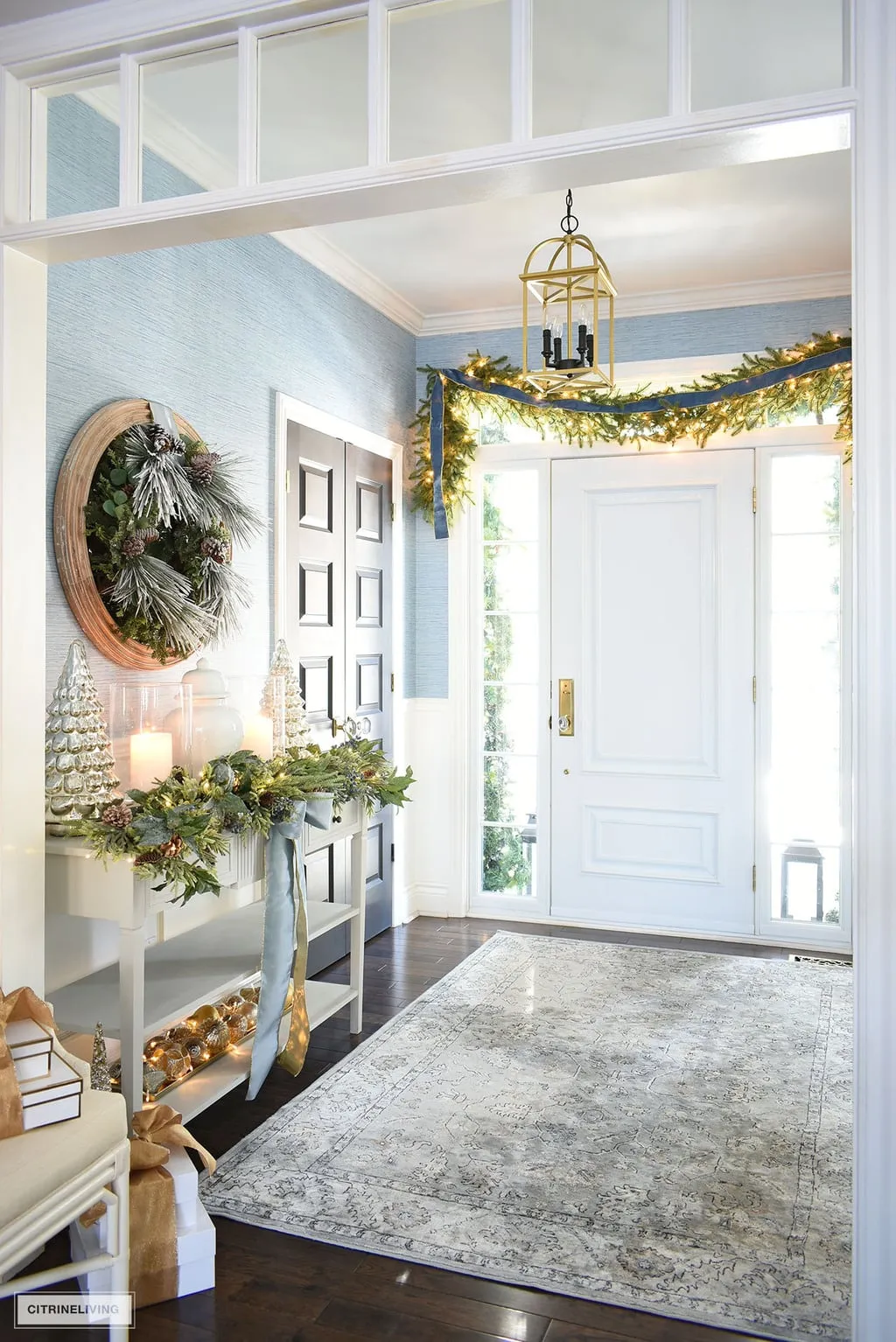
Total: $183–$535 — and the table is the piece you’ll keep long after January.
Budget alternative: use a side table you already own, trade the mercury glass for white pillar candles, and you land at roughly 45% of the low end.
The blue velvet ribbon. One cool accent in a room of white, green, and gold changes the entire mood — it’s what keeps this entryway feeling like winter rather than like a department store. Without it, the console, the frosted greenery, and the mercury glass would sit pretty but generic. Compare with Idea #20, where silver does the same job in a warmer key.
Go Hang Something — Your Door Is Already Waiting
You don’t need a designer, a deadline, or a $500 budget to win your hallway — you need one idea that actually fits the door you have, and now you’ve got twenty-nine of them. Start with the simplest one this weekend, live with it for a few days, and layer in the rest once you see how it reads from the sidewalk.
📌 Save this to Pinterest now so it’s waiting for you next November — and tag us when your door finally gets the slow-down-and-stare treatment it deserves.