
Pastel candy Christmas trees are having a major moment on Pinterest right now — and one scroll through your saved board explains exactly why. We spent serious time browsing Target, Etsy, Walmart, and Amazon to bring you only what’s actually worth your December, filtering through hundreds of options from $6 ornament sets to a $480 flocked tree.
Inside you’ll find 29 curated ideas spanning pastel candy wonderlands, classic red-and-white peppermint trees, flocked farmhouse looks, and full-on dessert maximalism — with budget and luxury versions compared side by side, and every idea shoppable with direct product links. Candy trees hit differently in 2026 because they let you go completely over the top without a single strand of tinsel in sight.
And stay until the end — we break down the most common mistakes that can ruin these looks. 📌 Save this to Pinterest for later — you’ll want to revisit these ideas.
1. Ice Cream Cone Topper on a Baby Pink Candy Tree
Two forces are doing the work here. First, scale contrast — oversized ice cream cone and striped candy ornaments read as props rather than filler, so your eye keeps climbing the tree instead of skimming it. Second, the theme escapes the branches. Woven baskets full of frosted cake and cupcake replicas sit on the floor beside a tall nutcracker, so the whole corner becomes one continuous scene. Pink poinsettia picks and turquoise ribbon keep the palette from collapsing into straight sugar.
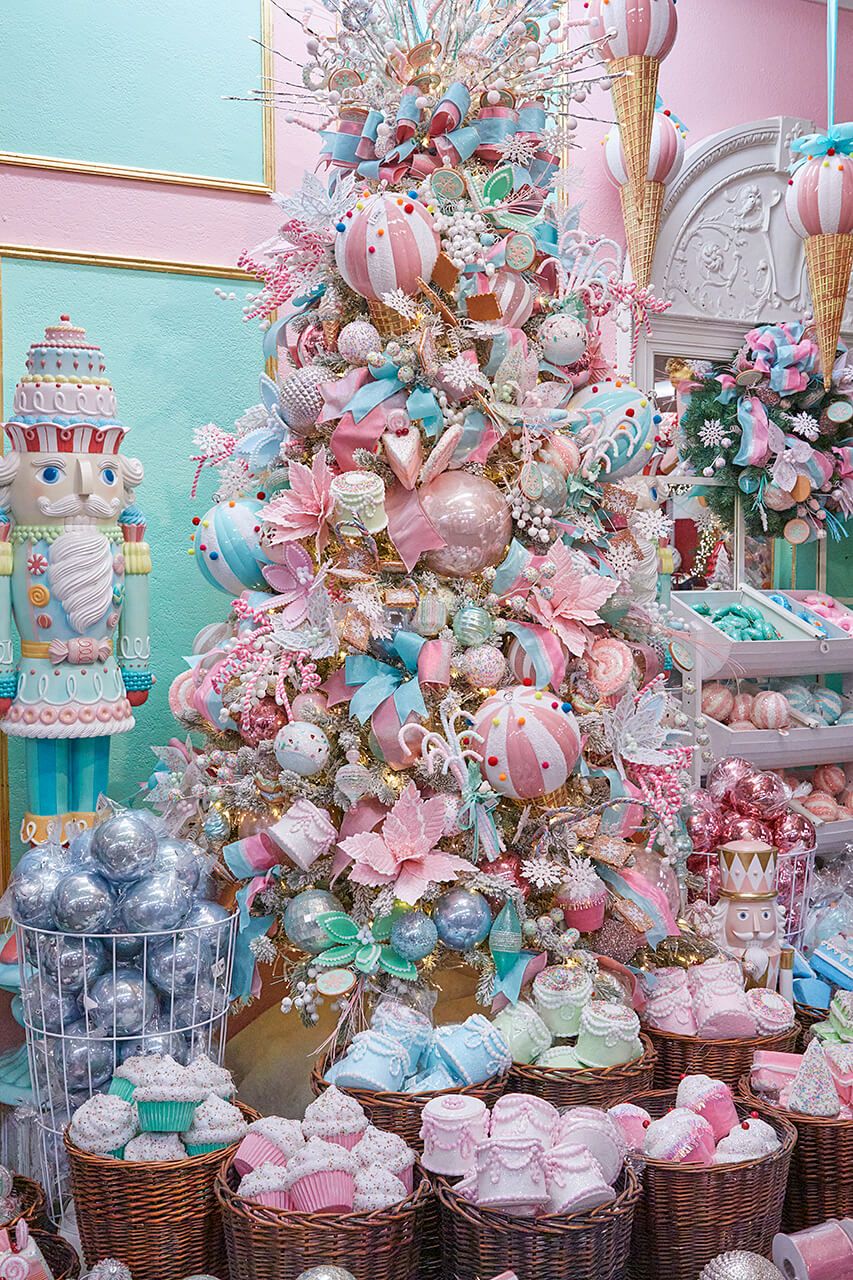
- Flocked 7.5 ft tree plus ice cream cone topper: $180–$420
- Oversized candy and striped ball ornaments: $90–$200
- Pink poinsettia picks and turquoise ribbon, 4 rolls: $35–$65
- Base decor — woven baskets, cake replicas, nutcracker: $80–$220
- Warm white string lights, 4 sets: $20–$40
- Total: $405–$945
- Budget alternative: hit Walmart and Dollar Tree for the cake replicas and basket bins, then spend where it shows — the topper. You’ll land closer to $380–$560.
2. Oversized Peppermint Discs on a Heavily Flocked Tree
Hang your biggest ornaments first, and hang them deep. The peppermint swirl discs here sit 3 to 4 inches inside the branch tips rather than at the outer edge — that’s what makes a flocked tree look packed instead of merely decorated. Rule of thumb: nothing wider than 6 inches goes on the outer ring, and leave no more than 4 inches of clear branch between ornament clusters.
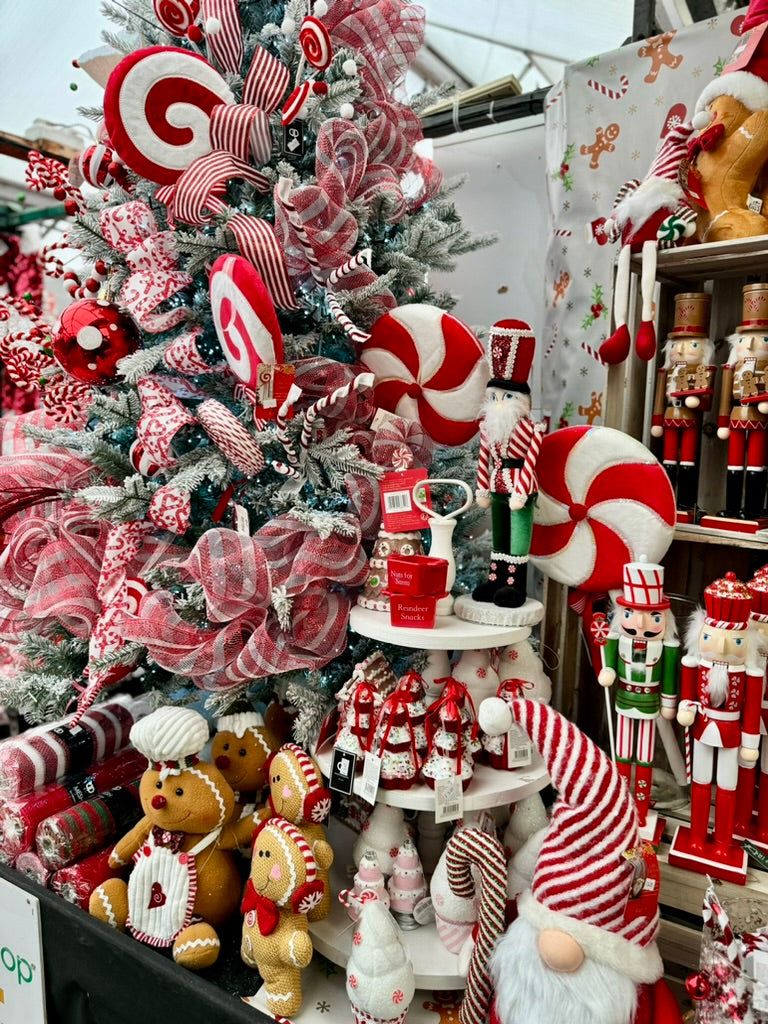
The oversized peppermint swirl discs are the whole idea. Strip every ribbon and figurine away and you still have a tree that reads candy in half a second. What makes them land is that they’re flat, matte-edged, and roughly dinner-plate sized — which forces you to space them sparsely, and that’s exactly why the tree never feels cluttered despite how heavily it’s flocked.
Peppermint is the one candy motif that refuses to date — it’s been on holiday trees since the 1960s, and the 2026 version just scaled it up. What’s new is what’s underneath: snow-tipped flocking has replaced the shiny green trees of the last decade, so the red and white pops harder than it used to. For the same candy language on a tiny footprint, jump to Idea #9.
3. Pink-and-White Flocked Tree in a Bright Modern Living Room
The formula is 70% white, 20% pink, 10% silver sparkle — ultra light. White comes from the flocking, the branch topper, the wrapped gifts, and the rug. Pink is concentrated in the baubles and stripes. Silver shows up only on ornament caps and a few glossy spheres. To swap it, hold the 70/20/10 and change one family at a time: mint instead of pink keeps the brightness, or trade silver for warm brass and the room turns cozy rather than crisp.
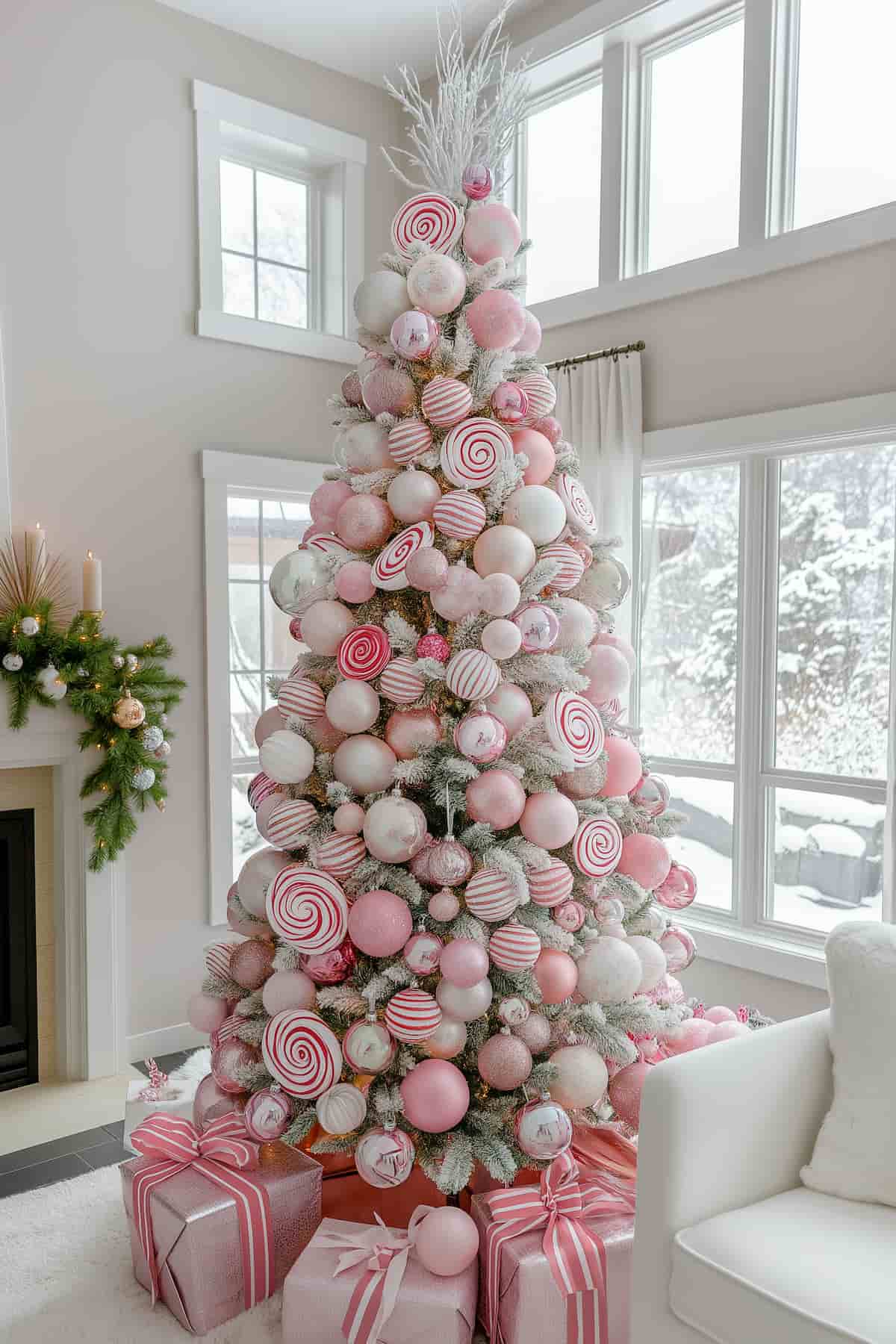
This look needs height. Under 9-foot ceilings, a tall flocked tree will feel like it’s eating the room — 10-foot ceilings or a double-height window wall is the sweet spot, which is exactly what you’re seeing with the tree climbing past high glass. Plan on at least 14 x 16 feet if you’re keeping the armchair and gift stack in frame. Working with 8-foot ceilings? Move on to Idea #10 instead.
4. Hot Air Balloon Ornaments Against a Pink Wall
The magic here isn’t the ornaments — it’s the pink wall behind them. Paint one wall in a soft rose or bubblegum pink for about $35 a gallon, then build the tree with oversized novelty ornaments you can find at Target, Five Below, and Facebook Marketplace for $3 to $12 each. The teal illuminated cabinet can become a thrifted hutch with battery puck lights taped inside. You’ll land near $180 to $340 instead of $1,400.
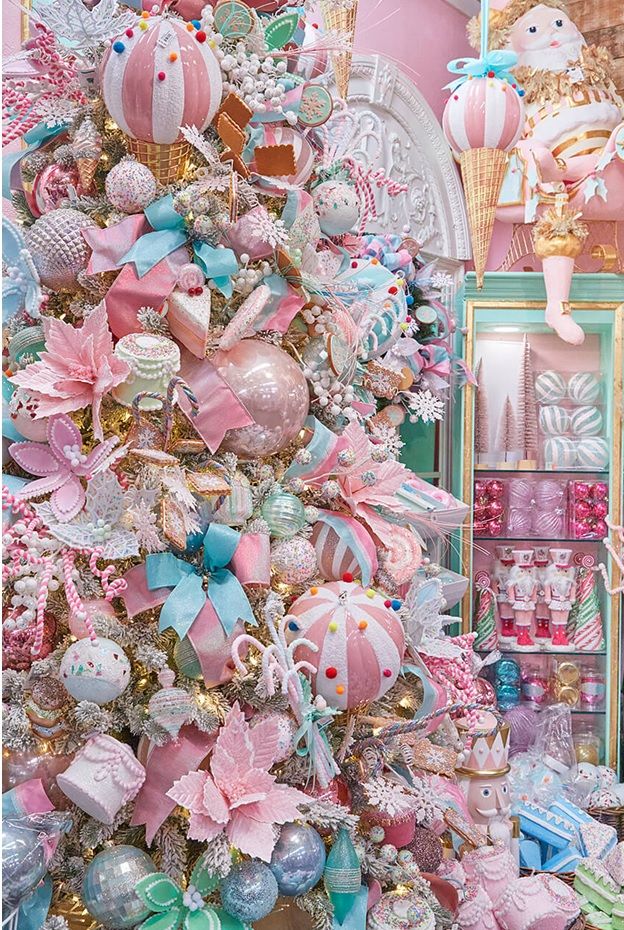
Novelty ornaments are heavy, and a tree loaded with hot air balloons and ice cream cones will tip. Wire the top third of the trunk to a wall hook, and use a wide flared metal base rather than the skinny three-leg stand. Budget for storage too — those oversized shapes need a dedicated bin, not a shoebox in the attic. And if you have a toddler, the bottom two feet of candy will be field-tested.
Fabric bows beat plastic ones every time on a pastel tree. Cut 4-inch-wide wired ribbon into 24-inch lengths, fold into a simple four-loop bow, and wire it to the branch rather than tying it — wired bows hold their shape all season instead of drooping by week two. Space them no closer than 10 inches apart so they read as accents, not as a garland.
5. Macaron and Cake Slice Ornaments in a Pink Wallpaper Nook
Building a dessert cluster that doesn’t look like a craft store exploded:
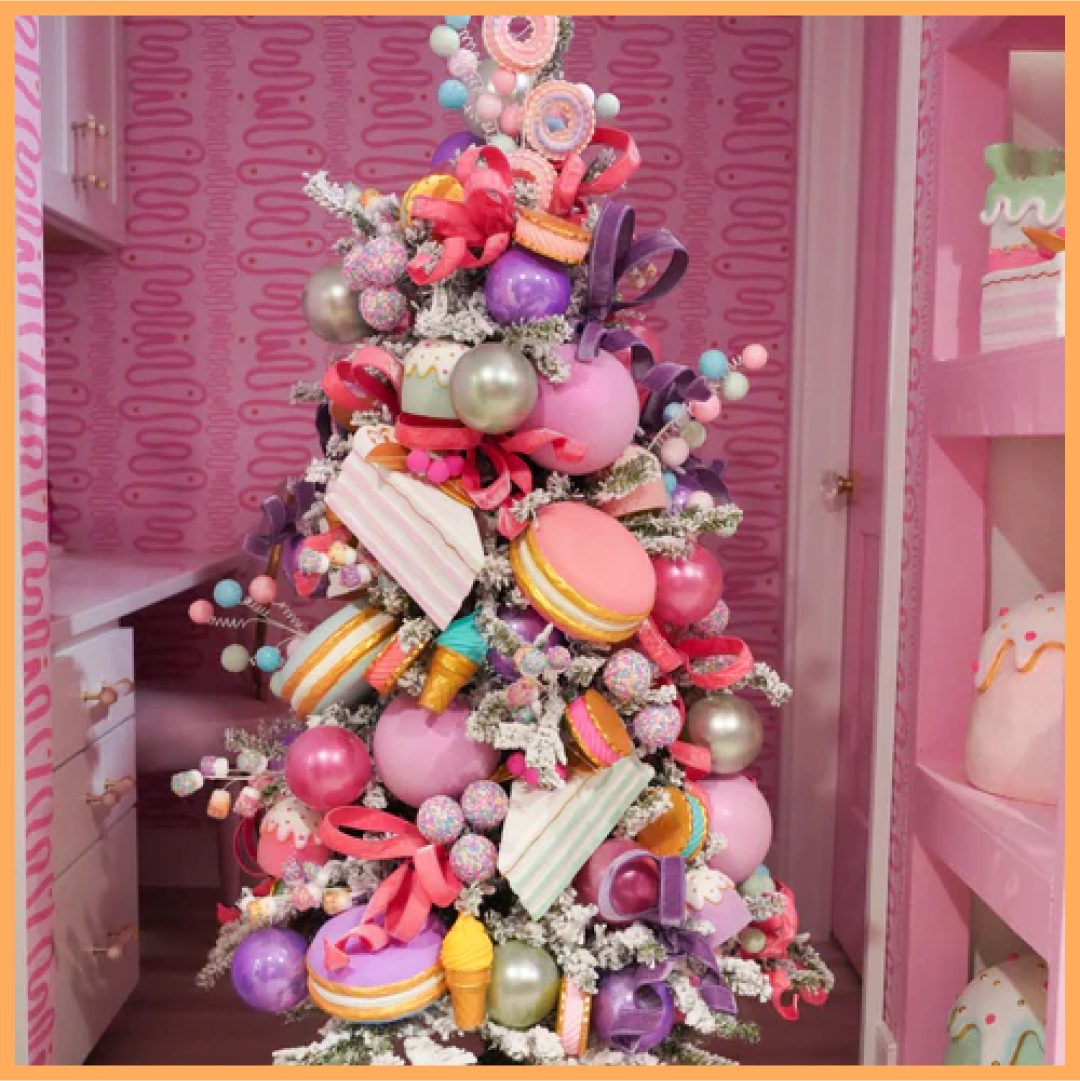
- Pick a focal branch about two-thirds up the tree, near the front.
- Hang one large item — a cake slice or ice cream cone — slightly inside the branch line.
- Add a macaron ornament 3 inches below and 2 inches to the left.
- Tuck a purple velvet bow behind both at the stem, so it frames rather than covers.
- Finish with one small gold sphere at the outer tip.
Five clusters on a 7-foot tree is plenty. Time: about 45 minutes. Materials: $60 to $120 bought individually, far less in a set.
Dessert-shaped ornaments are one of the fastest-growing holiday searches on Pinterest, and 2026 is the year they went fully pastel. Two things drove it — the bakery aesthetic running through interiors since 2023, and a general fatigue with traditional red and green. Pink patterned wallpaper and color-matched shelving turn a tree into a set piece. Will it last? The sweet-treat motif will. The hot pink probably softens toward blush by 2028.
6. White Tree, Gingerbread Ribbon, and Pink Glow
A white artificial tree is the highest-maintenance tree you can buy. Every fingerprint shows, the flocking sheds onto your floor for the first two seasons, and dust turns the branches gray by February. Keep a lint roller and a soft brush handy, and store it in a zippered bag — not a cardboard box, which yellows the branches over time. If that sounds exhausting, a heavily flocked green tree gives you 80% of this brightness for a third of the upkeep.
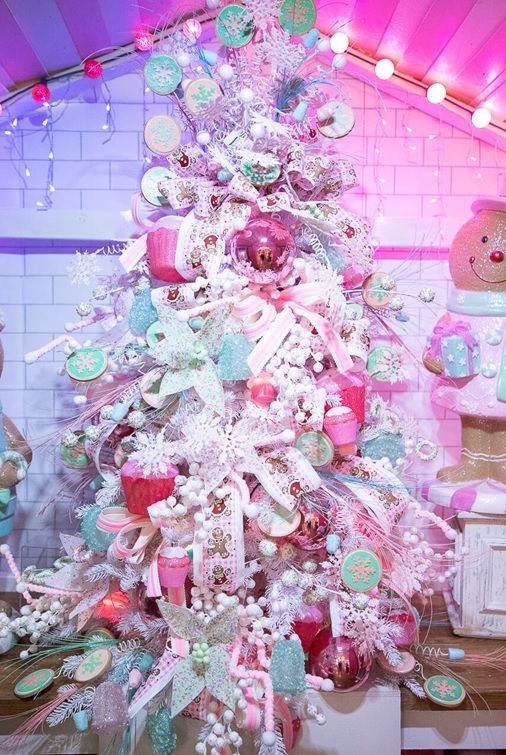
Gingerbread-patterned ribbon is the sleeper hero here — it does the work of fifteen ornaments. Run it as a wide garland in a spiral, one band every 14 to 16 inches, and pin the ends to the trunk with floral wire so it doesn’t slide down. Then let your actual ornaments act as punctuation: cupcakes, mint snowflake cookies, and one large gingerbread figure leaning at the base.
7. Cookie-Style Tabletop Tree With Yellow Ribbon Gifts
The stacked white gift boxes tied with yellow ribbon. That one accent color is what keeps this vignette from dissolving into a wash of mint and pink. Yellow is an unusual choice on a candy tree, and it’s doing real work — it gives the eye a single warm note inside an otherwise cool, sugar-frosted composition. Take the yellow away and the whole arrangement goes flat and candy-store generic.
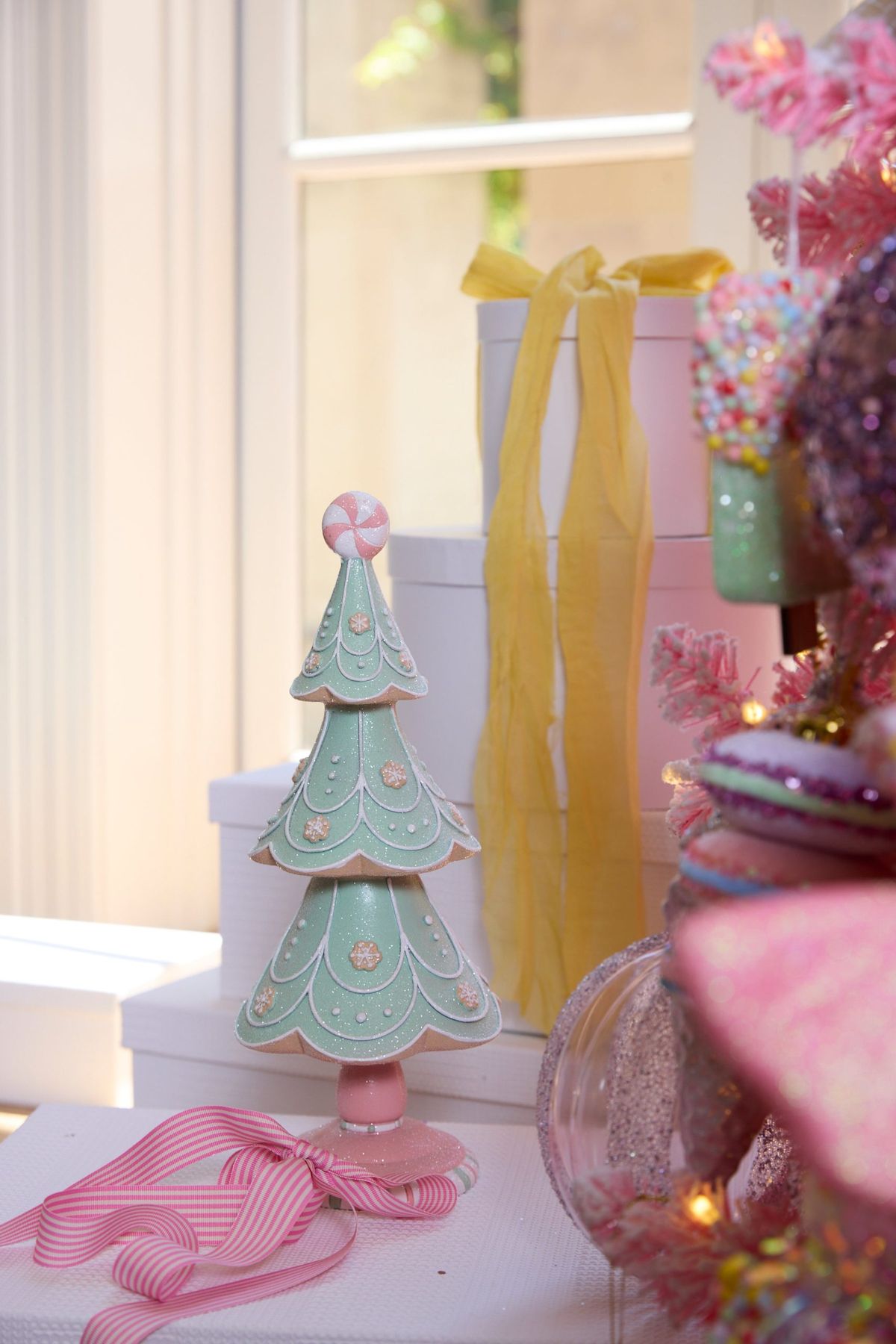
- Measure your surface — this vignette needs at least 18 inches of depth so the tree and gift stack don’t crowd each other.
- Check your light direction; a tabletop tree beside a window should face its flocked side into the room, not the glass.
- Confirm ribbon widths before buying: 1.5-inch striped ribbon for the tree, 1-inch satin for the boxes.
- Set a $75 ceiling. Small trees get expensive fast when you buy ornaments one at a time.
- Pick one accent color and commit. Two accents will kill it.
8. Glitter Candy Canes and Wrapped Candy Ornaments
Texture is doing the heavy lifting. Flat glossy ribbon, chunky glitter on the candy canes, matte flocking on the branches, and translucent wrapped candy ornaments that catch the embedded string lights from the inside. Four finishes on one tree is a lot — but because they all sit in the same red-and-white family, it reads as depth instead of chaos. The dark green under all that flocking is the fifth note, and it’s what keeps the whole thing from going chalky.
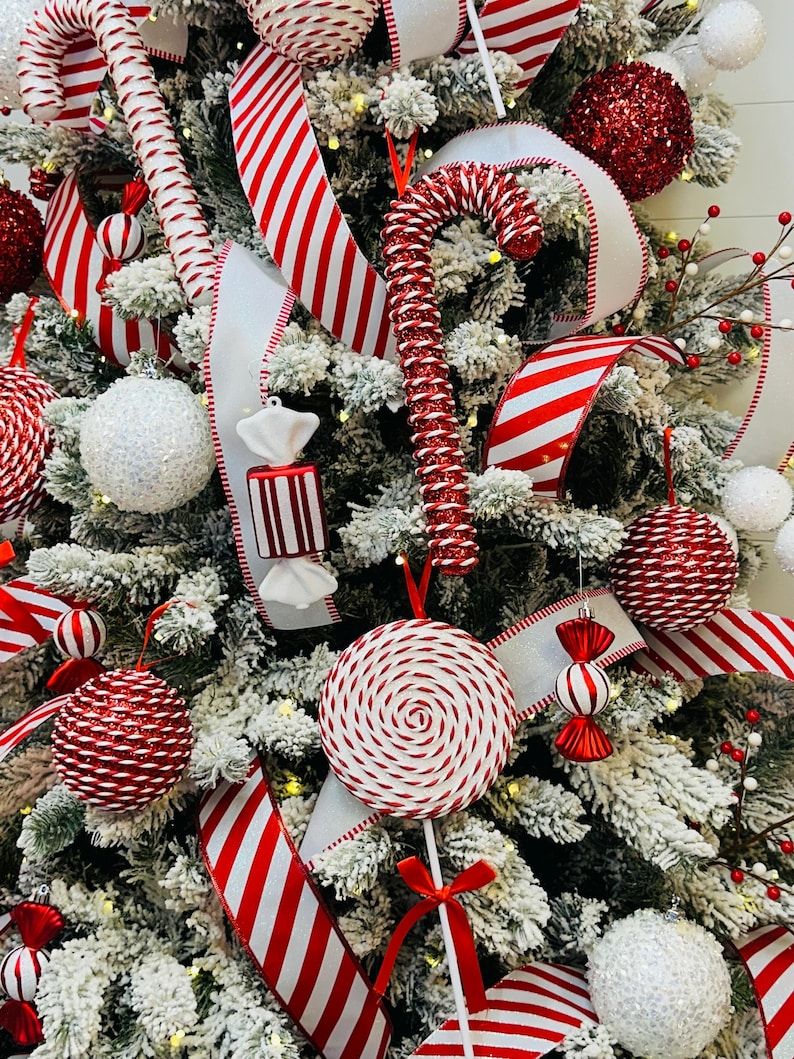
- Heavily flocked 6.5 ft tree: $160–$380
- Red-and-white striped ribbon, 2 rolls at 4 inches wide: $20–$36
- Oversized glitter candy cane ornaments, set of 6: $30–$60
- Peppermint swirl discs and wrapped candy ornaments, 18-piece set: $45–$90
- Pre-lit warm white strands with timer: $35–$70
- Total: $290–$636
- Budget alternative: buy the flocked tree secondhand on Facebook Marketplace in early November and make your own wrapped candy ornaments from Dollar Tree spheres and cellophane — roughly $150–$260.
Glitter sheds. That’s not a defect, it’s just what glitter does, so put a washable rug or mat underneath and accept that you’ll be vacuuming through January. The bigger issue is weight: flocked trees are already heavier than plain ones and these ornaments are chunky. If your stand is the standard 12-inch plastic kind, upgrade it. And skip embedded lights entirely if you have curious cats.
9. Lollipops, Finials, and Striped Spheres on Snowy Branches
Mix your ornament shapes in a 3:2:1 ratio. For every three round striped spheres, add two elongated pieces — a finial, an icicle, a lollipop on a stick — and one character ornament like a wrapped candy. Round-only trees read as beads on a string. Adding vertical shapes gives the tree rhythm. And hang the long pieces at least 6 inches from the round ones so nothing tangles in storage or on the branch.
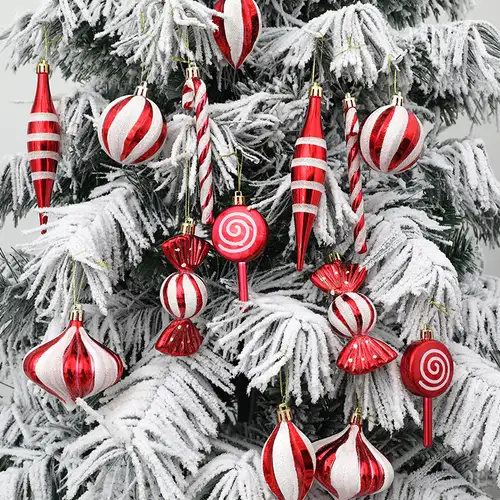
This is a classic 50% base, 40% accent, 10% metal formula, with frost serving as the neutral. The flocked green and white snow supply the base, red-and-white stripes carry the accent, and the small amount of gold on finial caps and hangers supplies the metal. Swap the accent and the tree changes personality while the structure stays identical: teal stripes read vintage-modern, pink stripes read nursery-sweet, silver stripes read icy and formal.
10. Flocked Tabletop Tree With Nutcrackers and Silver Stars
Tabletop trees live or die by the surface they sit on. You want at least a 24-inch-wide console, shelf, or counter section so the tree, ornaments, and a couple of nutcrackers have breathing room. This one is under 36 inches tall — right for an entryway console, the end of a kitchen counter, or a powder room. If you’re staring at a big empty living room wall, it will disappear. Compare with Idea #8 for the full-size version of the same candy theme.
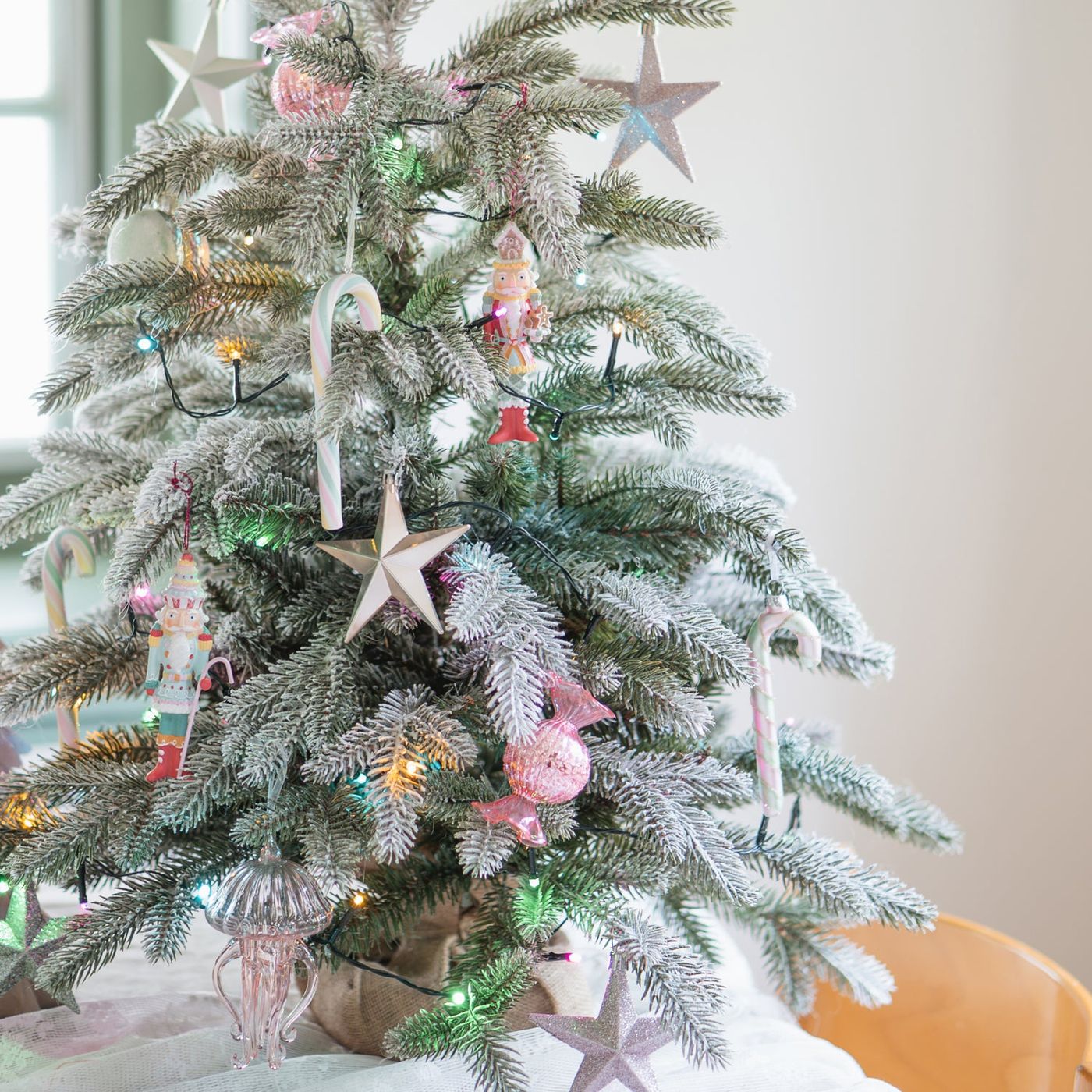
Flocked tabletop trees shed more than their full-size cousins because you handle them constantly — moving them to dust, reaching past them, resetting the lights. Set yours on a felt pad or shallow tray so the snow doesn’t grind into your furniture finish. Warm string lights are worth the extra ten dollars here, too. Battery-operated cool-white strands turn pastel ornaments gray in a way that’s genuinely hard to unsee.
11. Glossy Pink Candy Ornament and Beaded Gold Bauble
You can build this pairing for under $25 at almost any craft store. Look for a gloss-finished hard candy ornament in pink, then partner it with a plain gold or champagne sphere and add your own trim — a strip of tiny beads from the jewelry aisle and a hot glue gun gets you the beaded detail for about $4. The key is matching scale, not price. A 3-inch candy next to a 3-inch bauble reads expensive. A 3-inch candy next to a 6-inch ball reads like a discount bin.
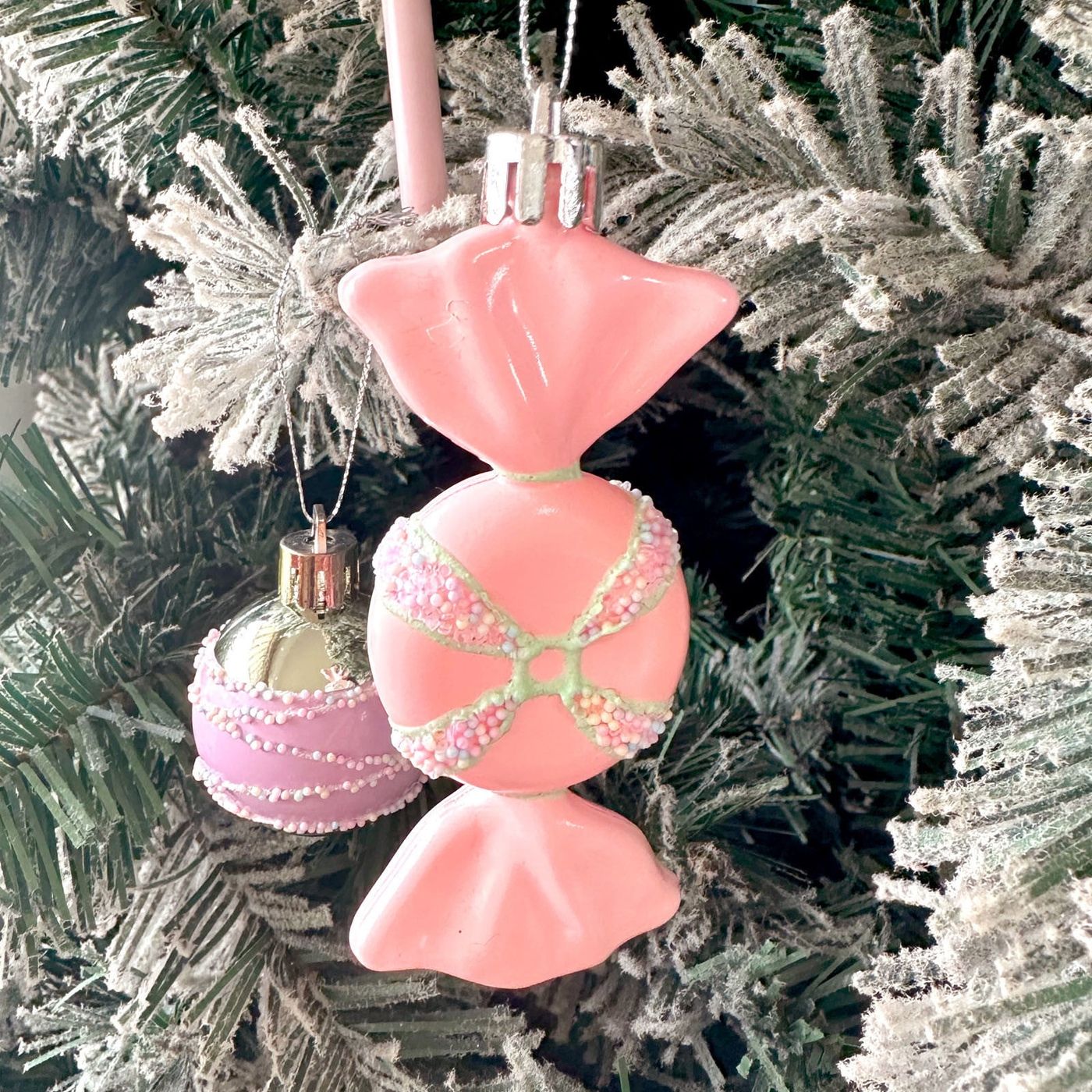
The frosted branch behind them. It’s easy to overlook, but the white flocking is what makes the glossy pink pop — the same candy ornament on plain dark green would look like a toy. The frost also ties the ornament to the tree physically, softening the silhouette so the candy seems to be growing out of the branch rather than pinned to it. If you flock nothing else this year, flock the front-facing branches.
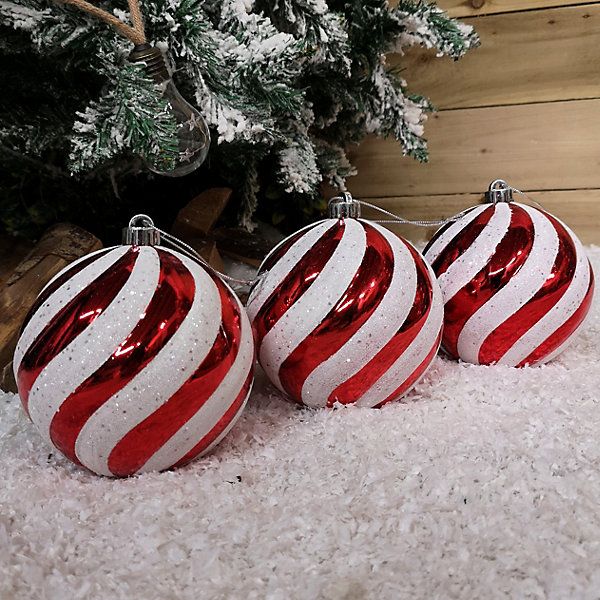
12. Red-and-White Swirl Baubles on a Wood Slat Wall
A quick faux-snow staging base for candy ornaments:
- Find a shallow tray or flat platter with a 1-inch rim.
- Pour in 2 to 3 cups of artificial snow — refined batting snow, not the chunky flakes.
- Nestle the ornaments in at slight angles so they lean rather than sit flat.
- Set the tray on a wood or warm neutral surface; the warm tone under cool snow is the whole point.
- Add one flocked branch behind the arrangement for depth.
Setup: 10 minutes. Cost: roughly $18 for snow plus a thrifted tray.
Three principles are stacked here. Contrast: glossy red and glitter-dusted white against warm horizontal wood slats — that grain is the only organic texture in frame, which makes the manufactured ornaments feel deliberate. Grouping: three, not two and not five. Odd numbers read as a composition rather than a pair. And asymmetry: the ornaments sit off-center with the flocked branch pushing in from one side instead of framing both.
13. Off-White Glitter Candy Canes on Sheer Ribbon
Sheer ribbon is why these read elegant rather than crafty. Swap standard 1/4-inch satin for 1-inch organza and hang the ornament about 2 inches lower than feels natural — the extra drop lets light pass through the ribbon between branches. Knot the ribbon at the branch rather than looping it over, and trim the ends on a sharp diagonal. Twelve of these across a 7-foot tree, spaced 6 inches apart on the front only, will outperform forty ornaments every time.
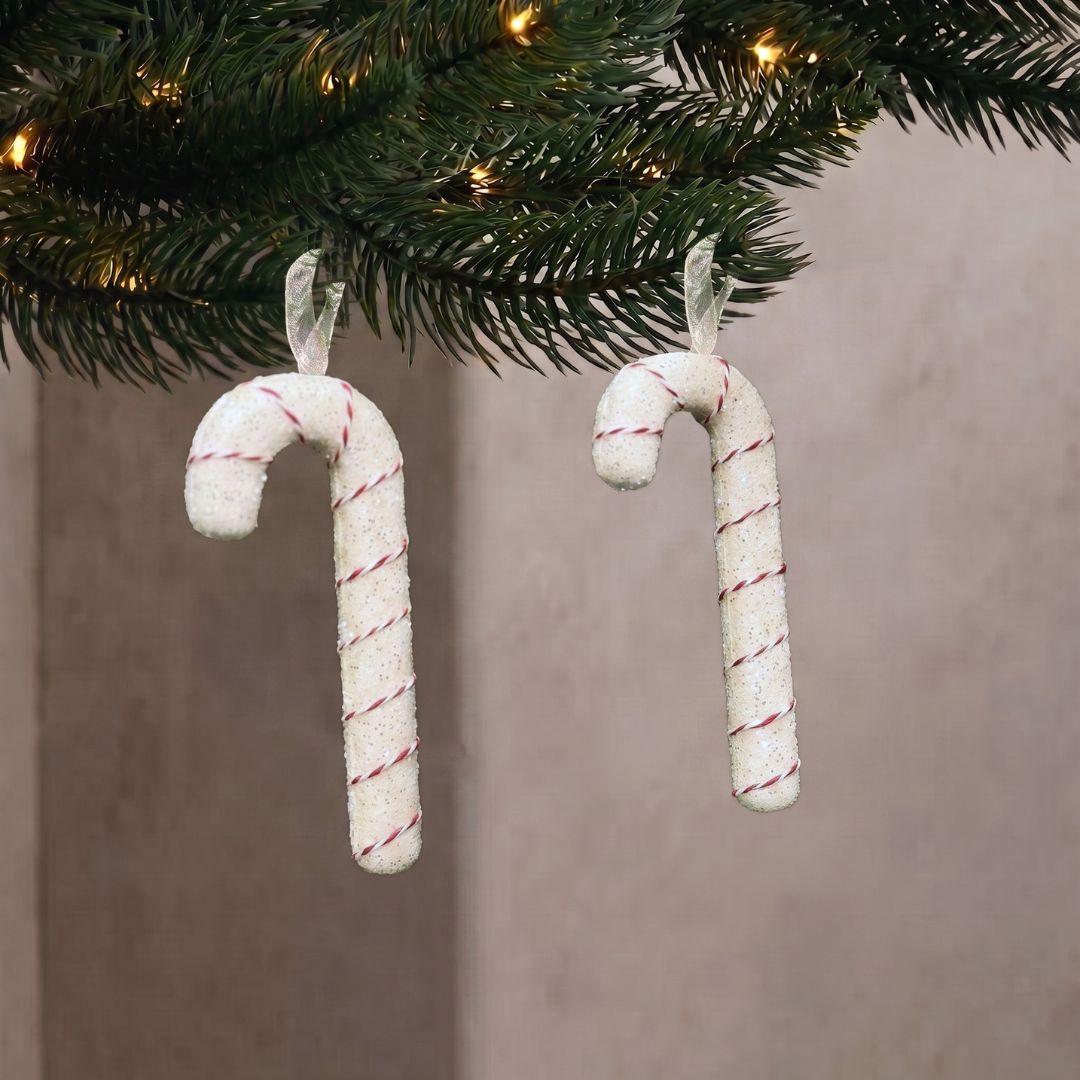
Glitter-textured ornaments are a long-term commitment. The glitter dulls after three or four seasons, especially near a window — UV exposure fades that finish faster than anything else. Store them wrapped individually in tissue rather than tossed in a bin, because glitter abrades against itself. Expect to replace them around year five. Matte ceramic lookalikes cost about the same and will outlive them by a decade.
This is the ornament for narrow spaces. Candy canes like these read beautifully on a slim 4- to 5-foot pencil tree in a hallway, beside a front door, or anywhere you have 14 inches of floor depth or less. They also work clustered along a mantel garland. In a room with 11-foot ceilings they’ll vanish completely — go big and head back to Idea #2 for that scale.
14. Oversized Plush Candy Pillows and a Hot Cocoa Station
Candy decor that isn’t a tree is where 2026 diverges from every holiday season before it. Enormous plush candy cane and peppermint pillows started showing up in staging shoots last winter and have migrated into real living rooms, because they solve a specific problem: you get the theme without committing wall space. The hot cocoa station on the counter behind them follows the same instinct — candy as hospitality rather than decoration.
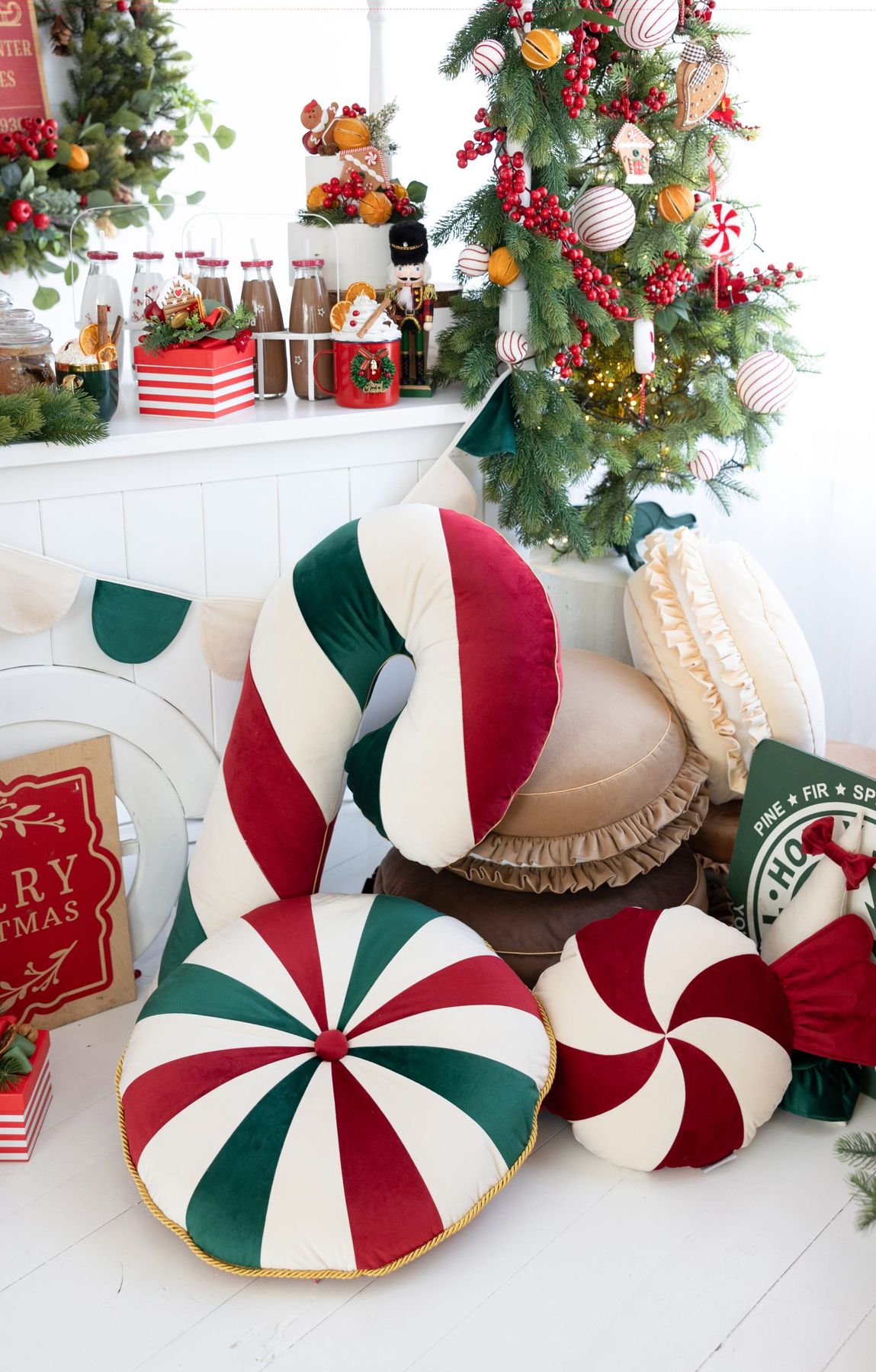
- Oversized plush candy cane and peppermint pillows, set of 3: $60–$140
- Fluted macaron-shaped pillow: $25–$55
- Red-and-white ceramic mugs and tray: $30–$70
- Mini lit tree, 24 inch: $35–$80
- Bottled drinks, cocoa mix, candy jars: $25–$50
- Total: $175–$395
- Budget alternative: sew candy cane pillows from felt and poly-fill for about $12 each, then thrift the tray and jars. You’ll come in near $85–$150.
15. Peppermint Stocking Ornament With Baker’s Twine
The red-and-white baker’s twine. It costs pennies, and it’s the reason this ornament looks collected rather than purchased. The twine wraps the hanger where the ribbon knot meets the ornament cap, hiding the mechanical part that almost everyone leaves exposed. That single detail is the difference between a decoration and a vignette. Take it away and you’re left with a stocking ornament like a thousand others on the shelf.
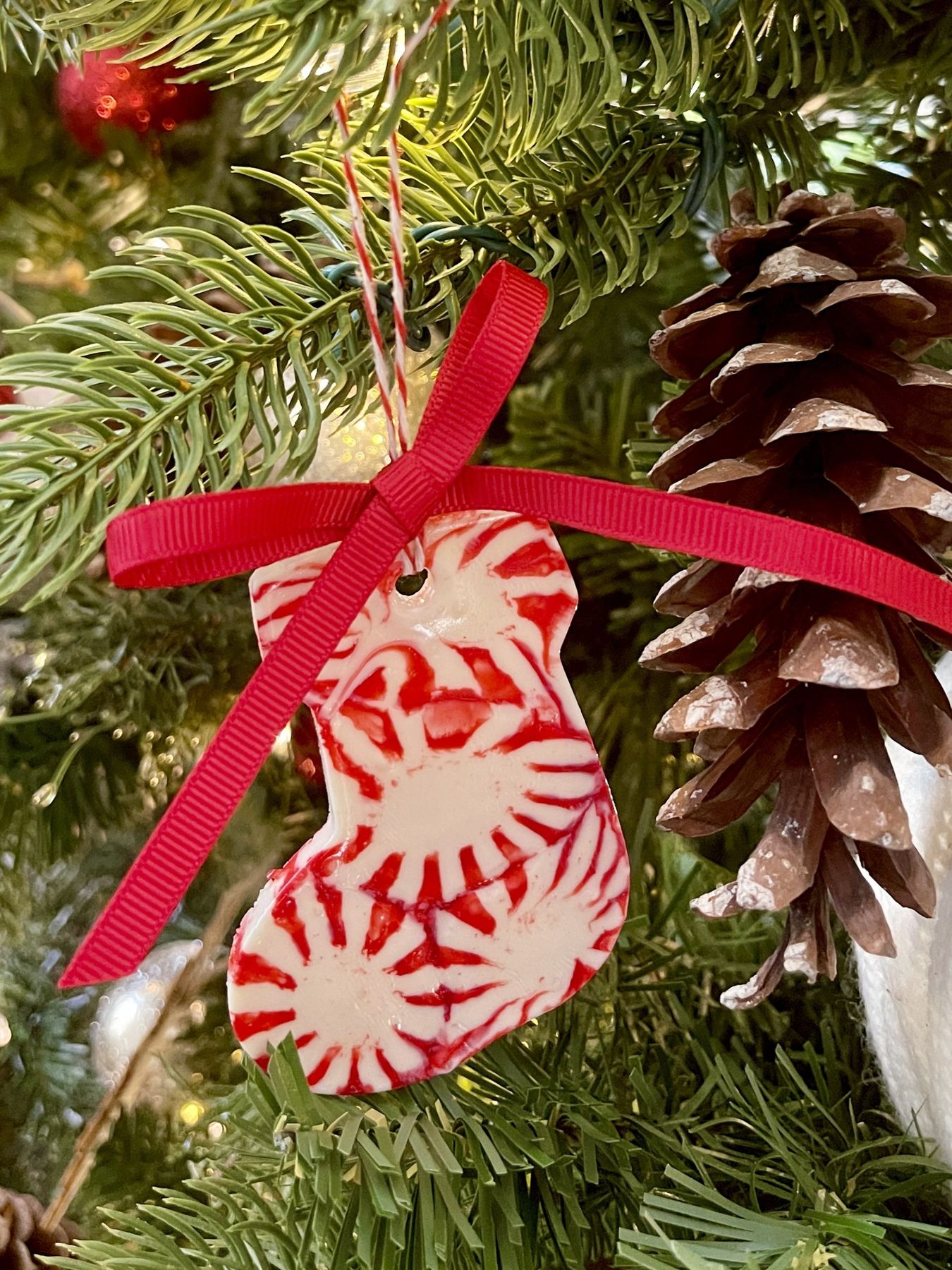
Rustic candy needs one natural element to keep it from reading plastic. Here it’s a real pinecone tucked beside the ornament — the brown is the only un-frosted, un-sugared thing in the frame, and it makes the red feel warmer. On your own tree, work in a handful of real pinecones or dried orange slices per section. Just three or four per tree. Too many and you’ve built a woodland tree, not a candy tree.
16. Foam-Beaded Candy Cane Ornament in Pastel Sprinkles
This is the most affordable candy ornament in the whole roundup, and the one worth making in bulk. Buy flat wooden or foam candy cane blanks at a craft store for about $1 each, coat them in white craft glue, and roll them in mixed pastel foam beads from the dollar aisle. Two dozen ornaments will run you under $40. Finish with a light pink ribbon hanger instead of wire — clear fishing line works too and all but disappears against the branches.
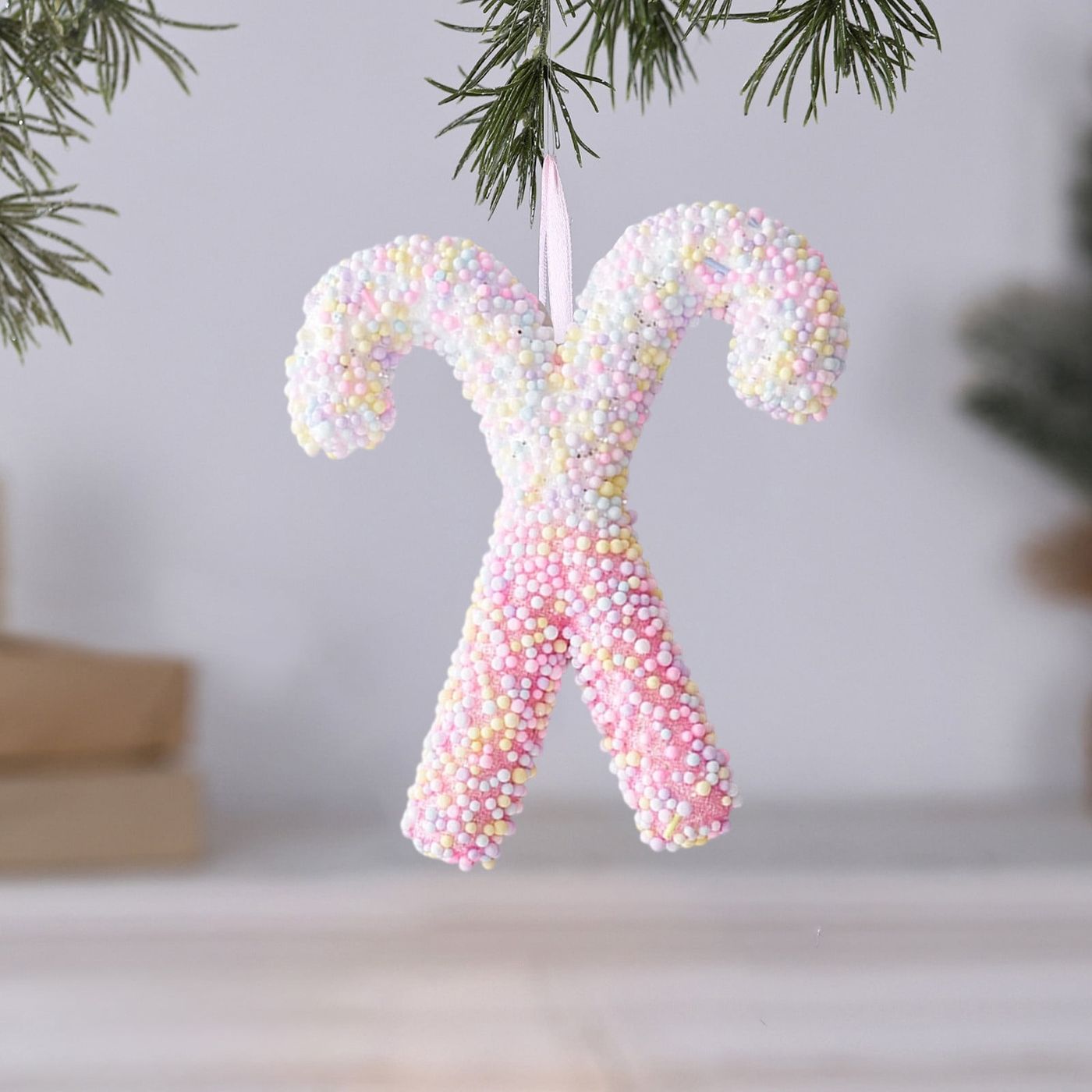
The formula is simple: white structure, three pastel bead colors, one hanger color. The white candy cane shape holds the pastels together, pink and yellow lead, and blue and white fill in as the quiet notes. Keep it to three bead colors at most — four makes it look like a craft project instead of a design decision. Swap the hanger ribbon to mint and the same ornament reads completely differently.
- Blank candy cane ornament forms, set of 24: $24–$36
- Mixed pastel foam beads, 3 colors: $9–$18
- White craft glue: $4–$8
- Light pink ribbon for hangers: $5–$10
- Total: $42–$72 for two dozen ornaments
- Budget alternative: check the dollar store for pre-beaded ornaments first — some seasons they land at $1.25 each and you’ll spend less than the DIY.
17. Fuzzy Candy Cane Picks and Snow-Dusted Pinecones
Fuzzy chenille picks are lovely and also the single most tangled ornament category on the market. Store them in a shallow box with dividers or you’ll spend an hour in December separating them. Snow-dusted pinecones are problem number two — that fake snow flakes off in your hands and onto the floor. Shake each one outside before it goes on the tree, and don’t hang them directly over upholstery. And skip the real berries entirely: faux berry picks cost about the same and won’t stain.
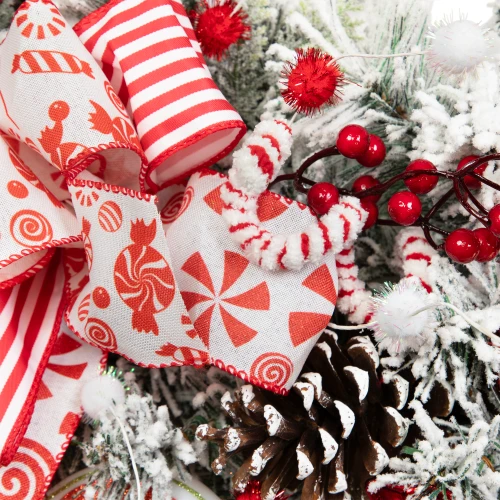
Candy-patterned ribbon and pinecone picks are the fastest way to make a small tree read full. On a 5- to 6-foot tree, use about 9 yards of 2.5-inch ribbon and 18 to 24 picks. On a 7.5-foot tree, double both numbers. If your room is under 120 square feet, keep the picks to one color family — red-and-white on green — and let the ribbon carry the pattern. Anything larger, mix ribbons freely.
18. A Tree Covered Entirely in Wrapped Peppermints
Building a peppermint candy centerpiece tree:
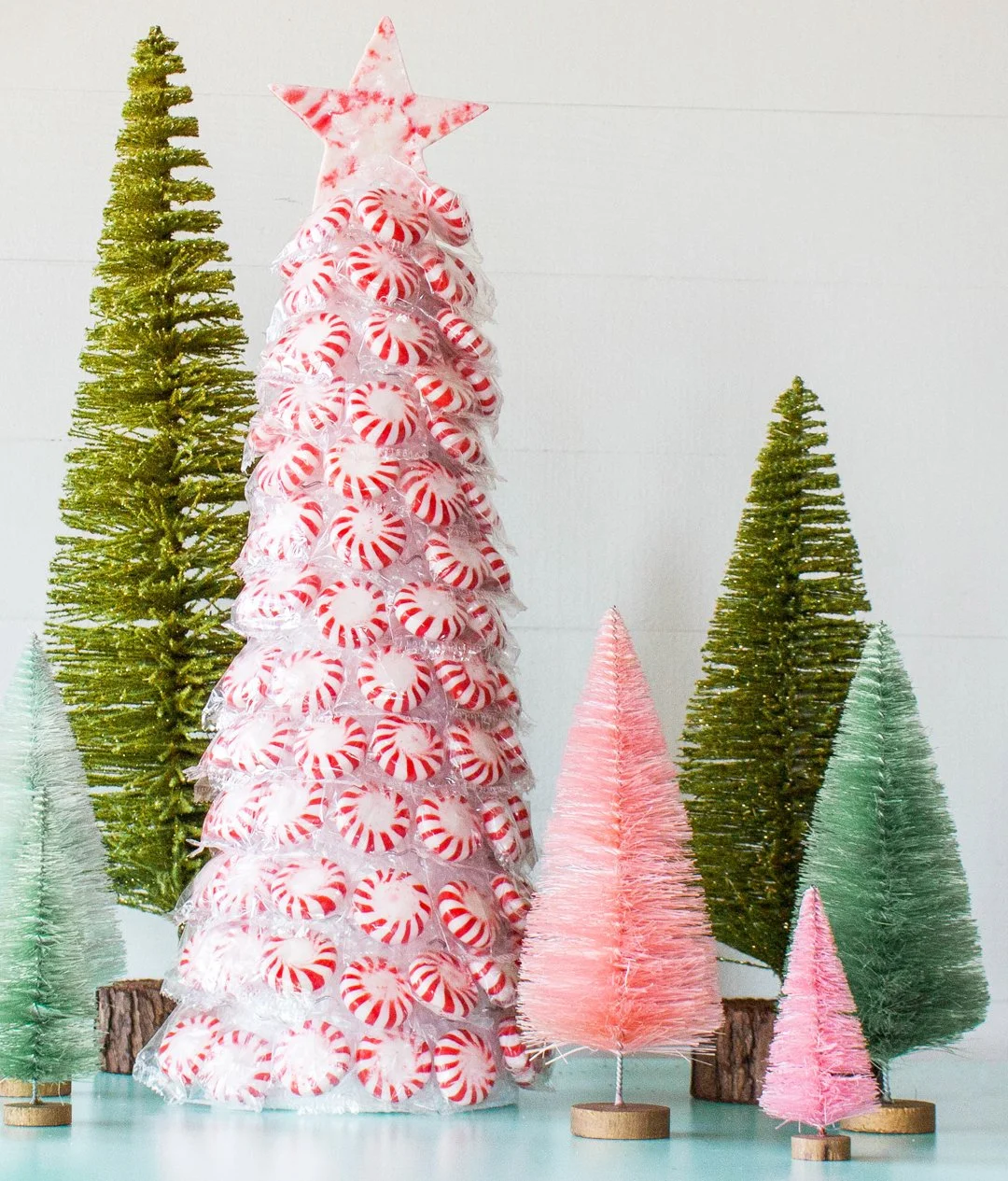
- Start with a 14- to 18-inch styrofoam cone from a craft store.
- Wrap the cone in red felt or gloss paper so no white shows through the gaps.
- Pin individually wrapped peppermint candies with straight pins, starting at the bottom and overlapping upward in rows.
- Work in one continuous spiral so the rows stay even and each candy lies flat.
- Top with a peppermint disc wrapped in cellophane and tied with red ribbon.
Time: roughly two hours. Cost: $30 to $55 depending on candy volume.
The unbroken repetition is the entire design. Every other tree in this list is a mix — ornaments, ribbon, picks, garland. This one refuses to vary. Because there’s no visual interruption, the tree reads as a single object from across the room, which is exactly why it works as a centerpiece flanked by plain bottle brush trees in green, mint, and pink. Break the pattern with one non-peppermint ornament and the whole thing falls apart.
19. Confectionery Figurine Tree With Frosting Swirls
This is scale as a design tool. The figurine is only 8 to 10 inches tall, but it borrows the full grammar of a candy tree — peppermint discs, frosting-like trim, pastel spheres, a star topper — and compresses all of it into one tabletop object. That compression is what makes it charming rather than miniature-sad. It also works because the base matches: a striped stem and decorated round base mean the figurine never floats without context.
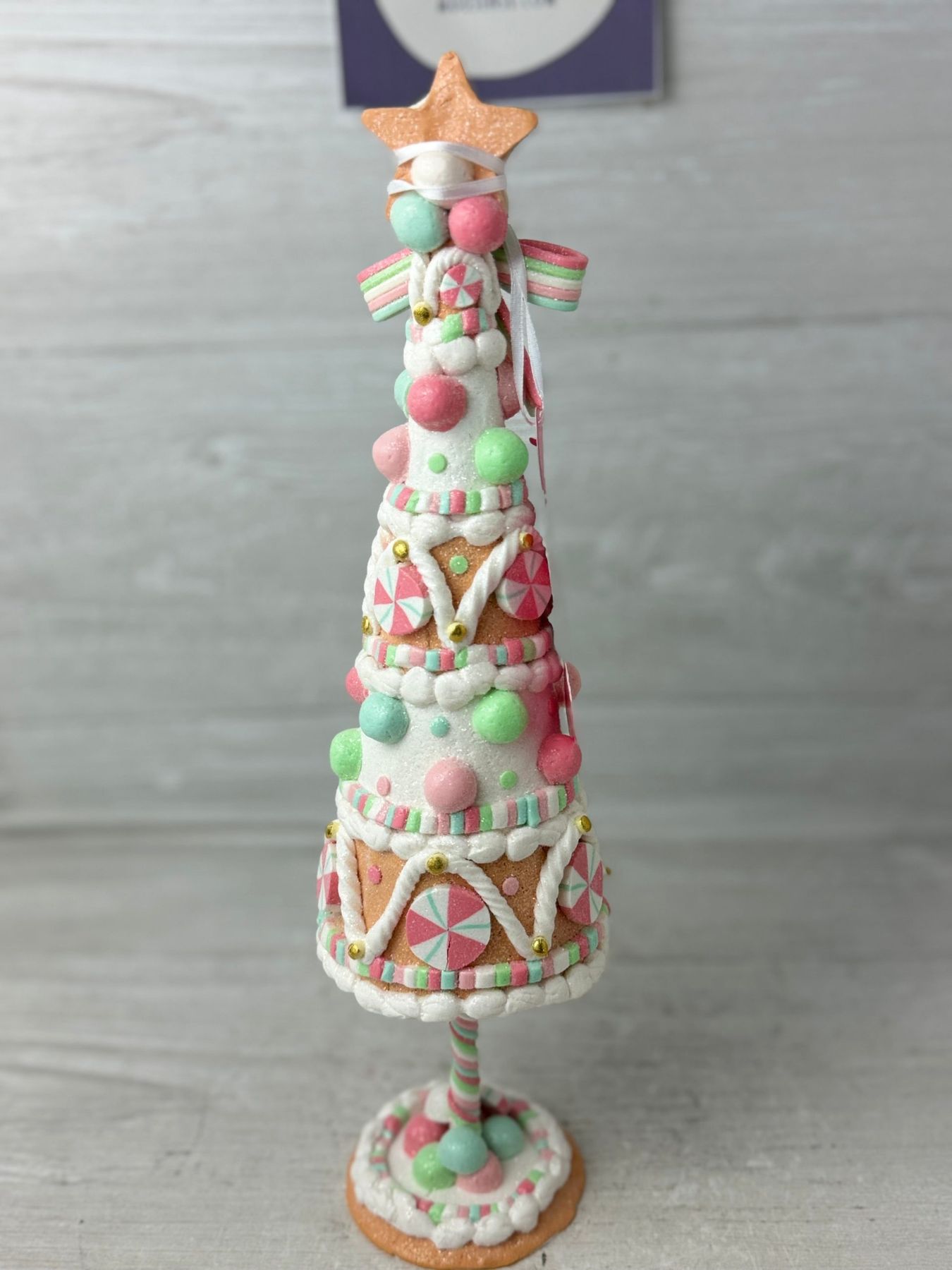
- Confirm your surface can take the weight — ceramic figurines run 3 to 6 pounds.
- Check that the star topper clears any shelf above it by at least 3 inches.
- Decide where the decorated base rim will show; it needs 360-degree clearance or a wall behind it.
- Match your surrounding palette. Pink and mint spheres will clash in a red-and-green room.
- Set a budget of $40–$90. Anything under $25 is usually resin and looks it.
20. Vintage-Style White Ceramic Tree With Pastel Bulbs
- Glossy white ceramic tiered tree, 11–14 inch: $45–$110
- Pastel replacement bulbs, pink/green/white set: $12–$22
- Candy cane ornaments for the topper: $8–$16
- Satin pink ribbon bow: $5–$10
- Total: $70–$158
- Budget alternative: vintage ceramic trees turn up at estate sales and thrift stores constantly between $15 and $40. You’ll likely need to rewire or replace bulbs, which costs about $10. Compare with Idea #19, which delivers the same nostalgia in a completely different material.
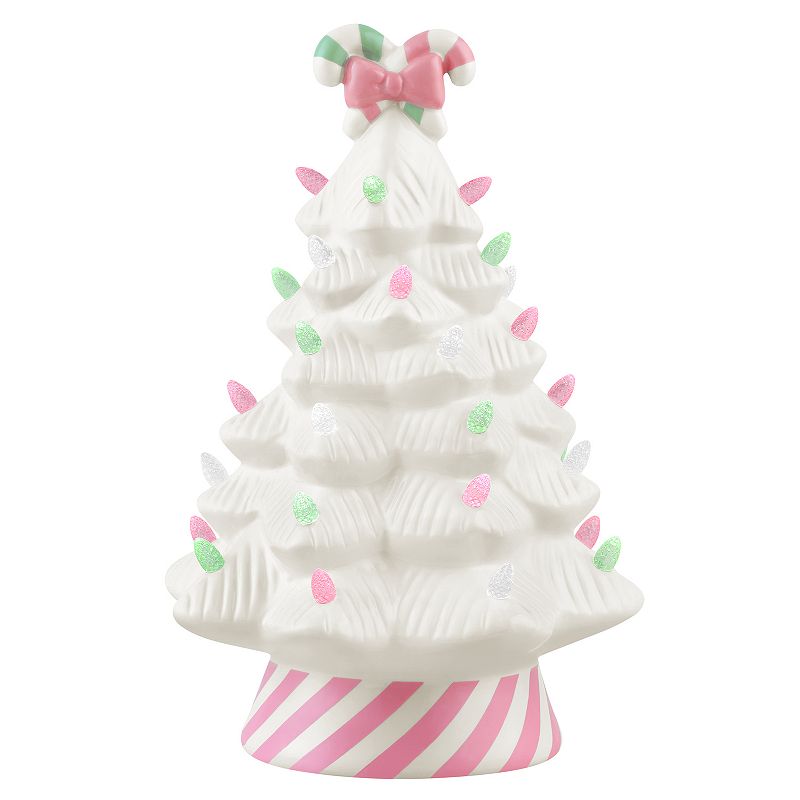
Swap the bulb colors, not the tree. The single biggest upgrade to a ceramic tree is replacing the stock multicolor bulbs with a two-tone set — pastel pink and mint, or all white — and then committing to it. A mixed-bag bulb set is what makes these look like a 1980s hand-me-down rather than a collected object. Bulb sets run $12 to $22 and take ten minutes to swap on most models.
21. Pastel Gingerbread Village on a Green Windowsill
Three tiers of scale, one palette. The gingerbread houses are the largest elements and carry the brown and pink. The nutcrackers are mid-size and bring the height. The bottle brush trees are the smallest and supply the green. That’s a 50% brown-and-pink base, 30% green, 20% white snow formula. Swap the green sill for a natural wood one and the same arrangement reads farmhouse instead of confectionery.
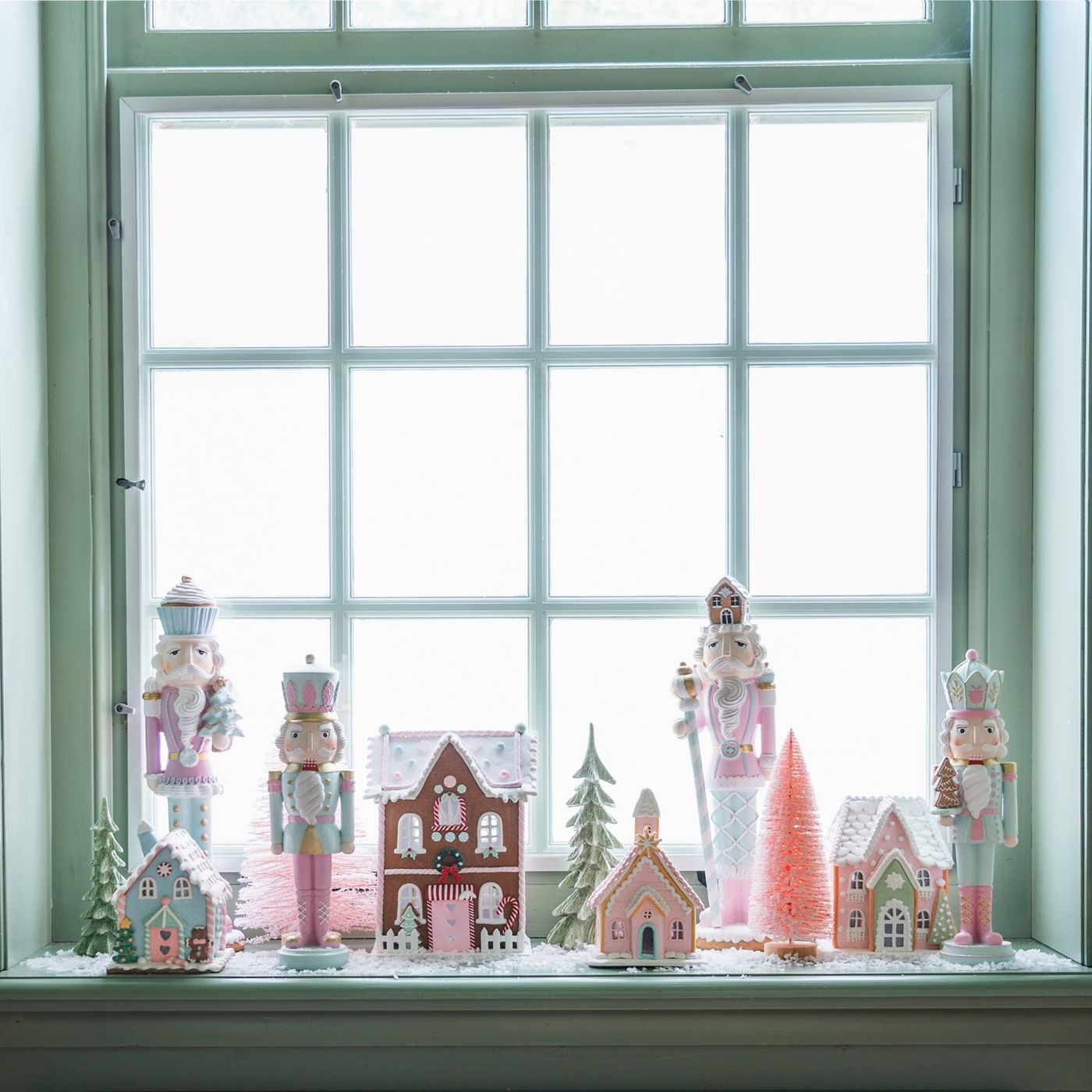
Windowsills are dust magnets, and artificial snow is a dust magnet’s best friend. Brush every piece before you store it or you’ll be scrubbing flocking out of grooves next December. Check sill depth too: these scenes need 6 inches minimum, and anything under 4 inches will send a nutcracker to the floor the first time someone leans on the sash. If the window gets direct afternoon sun, keep pastel pieces toward the back.
- Measure sill depth — 6 inches minimum for houses, 4 inches for bottle brush trees.
- Note where sun hits; pastel finishes fade fast in direct southern light.
- Confirm the window lock and latch still operate with decor in place.
- Pick one snow treatment and stick with it — loose flakes plus a spray can looks patchy.
- Decide on figurine scale before buying; mixed scales kill the village illusion.
22. Pink Mesh Ribbon With Donut and Cake Pop Ornaments
The hot pink mesh ribbon is the one thing. It’s doing something none of the ornaments can — creating a wash of color that runs through the entire tree, so the dessert ornaments have something to sit against. Without it, you’d have fifteen unrelated miniature cakes floating on green. Mesh specifically matters: it’s stiff enough to hold a twist and open enough to let pine show through, so it reads as texture rather than a painted stripe.
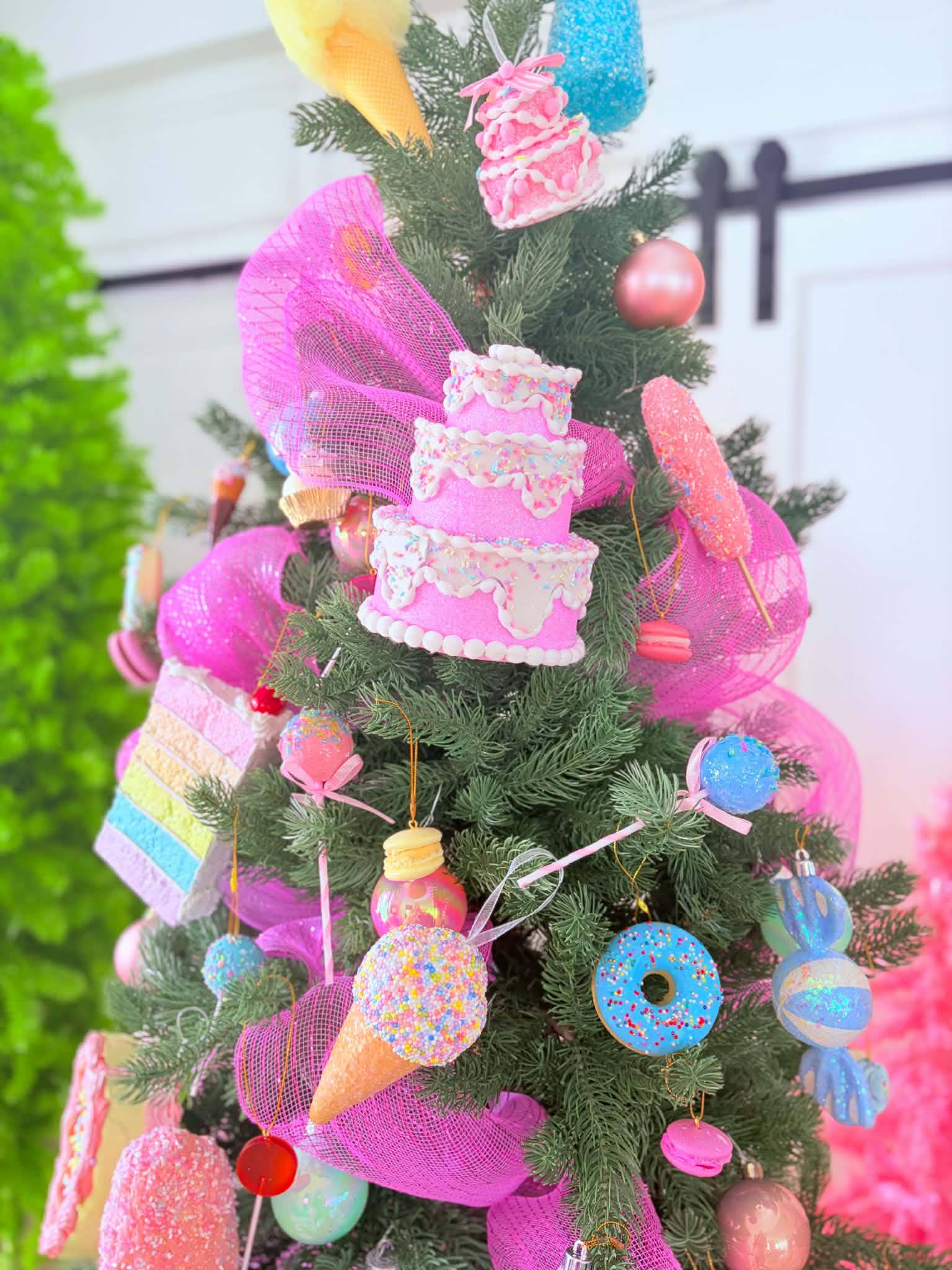
Dessert ornaments have been around for years, but 2026 is the season they got loud. The shift tracks with the broader return of maximalism in interiors — less beige, more color confidence, more why-not. The specific pairing of hot pink mesh with baby blue cake pops is very much of the moment. This is a fun tree, not an heirloom one, and that’s the point. Expect the trend to hold through 2027 before it softens again.
23. Pink Candy Cane Ornament Held in Warm Fairy Light
Candy cane ornaments are one of the few holiday items where the cheap version is genuinely fine. A gloss-finished plastic candy cane in pink and white runs $2 to $4 at Walmart or Target, and once it’s on a lit tree nobody can tell it from the $14 glass one. Put your money into the bow instead. A sparkly pink bow from a craft store costs about $3 for a four-pack and it’s the detail people actually notice from across the room.
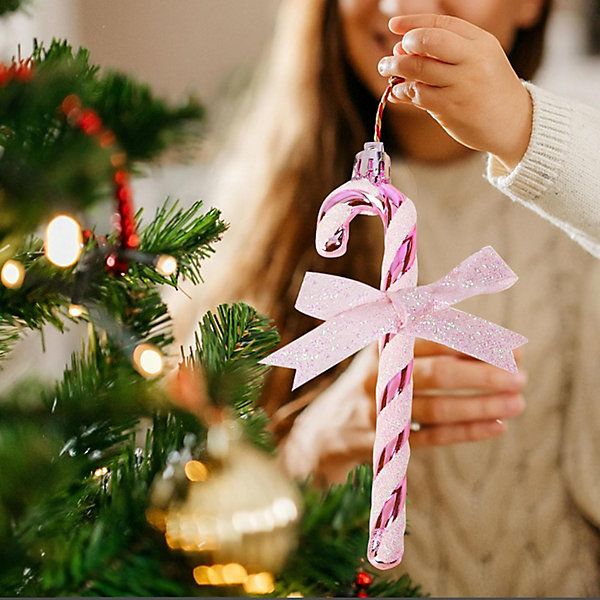
Getting a bow to hold its shape on a candy cane ornament:
- Cut 8 inches of 5/8-inch wired glitter ribbon.
- Fold into a single loop with the tails crossing underneath.
- Pinch the center and twist a 4-inch piece of floral wire around it twice.
- Fluff the loop with your fingers so it sits round rather than flat.
- Wire the bow to the ornament cap, not the candy cane body, so it stays upright.
Five minutes per ornament, about $0.75 in materials.
24. Teal Glitter Peppermint Ornaments With Blue Ribbon
Peppermint ornaments this big — 5 to 6 inches across — need a tree at least 6 feet tall to look proportional. On anything smaller they dominate the display and the tree looks like it’s wearing plates. Space them 12 to 16 inches apart on a 7.5-foot tree and place them only on the front-facing third, because there’s no point paying for scale nobody sees. Three is a statement. Six is a theme. Ten is a problem.
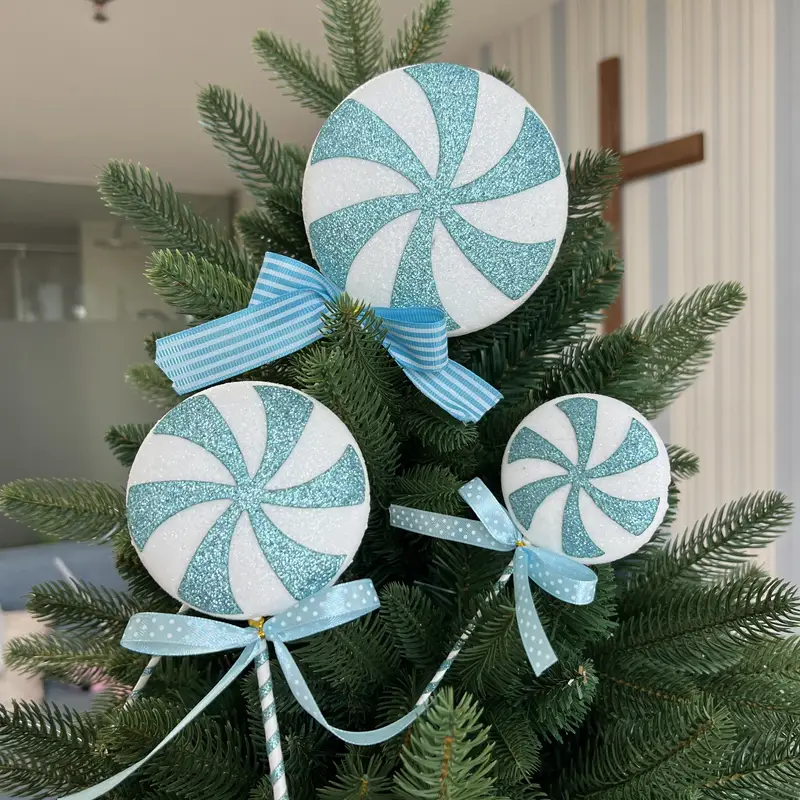
Glitter on white shows wear fast. Where ornaments touch each other in storage, the glitter rubs off and leaves bare patches, so wrap each one in tissue and store them separately in a divided bin. Teal glitter in particular tends to look dull by the third season if it hangs near a window. A quick refresh with spray adhesive and a shake of matching glitter buys you another two years for about $8.
This one inverts the usual ratio: 55% green base, 30% teal and blue, 15% white. The green tree is doing almost all the neutral work, which is why the cool teal reads clean instead of frosty-cold. To keep the formula while changing the mood, swap teal glitter for copper and keep the light blue ribbon — suddenly it’s a warm vintage tree with the exact same structure.
25. Wrapped Candy Ornaments With Gold Spheres and Berries
Glossy and matte should alternate, never cluster. On this branch, the shiny wrapped candy ornaments sit beside matte gold spheres, and small red berry clusters break up any spot where two glossies would touch. If your collection is all glossy, add one matte element between every third ornament — a berry pick, a felt ball, a wooden bead. It costs almost nothing and roughly doubles the visual depth of the whole tree.
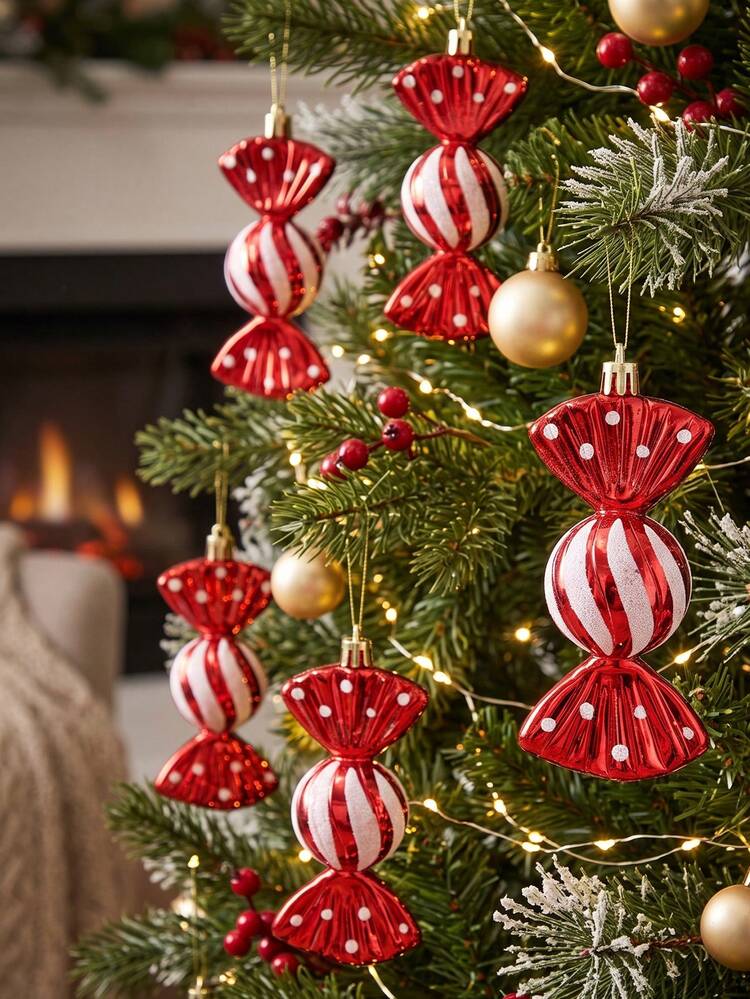
The warm string lights are the uncredited hero. Because these ornaments are glossy, warm white bulbs catch on every curve and create about four times as many visible highlights as the same ornaments would get under cool LED. That’s the difference between ornaments that sparkle and ornaments that merely glint. It’s also why the gold spheres here read as genuinely metallic instead of yellow.
26. Unicorn, Lollipop, and Wrapped Candy Ornament Set
This is a 45% pastel pink, 25% mint, 20% pale blue, 10% rose gold glitter formula, with cream as the neutral backdrop. Note that the cream surface does real work — it’s warm enough to keep the pastels from going chalky. Swap the backdrop to pure white and the same ornaments look like a baby shower. Swap it to gray and they look cheap. Backdrop color is never an afterthought on a pastel ornament set.
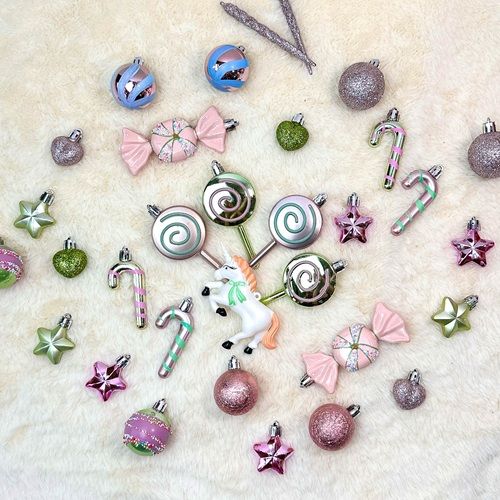
- Lollipop and wrapped candy ornaments, 12-piece set: $28–$60
- Star and heart ornaments, 8-piece set: $16–$34
- Novelty unicorn ornament: $10–$22
- Rose gold glitter accents, 6-piece: $12–$26
- Textured cream backdrop or tray: $10–$30
- Total: $76–$172
- Budget alternative: Five Below and Dollar Tree carry pastel candy ornaments from late October — build a comparable 24-piece set for $35 to $50.
27. Ceramic Tree Figurine With Tiny Pink Macarons
Miniature figurines like this are decorative objects, not toys, and the macaron and candy cane details are almost always glued on. Handle it by the base, keep it out of humid rooms, and don’t set it anywhere a cat can reach the topper — that’s the first thing to snap. Also check the pedestal. Fluted pink bases look lovely but they’re narrow, and one good bump sends the whole thing over.
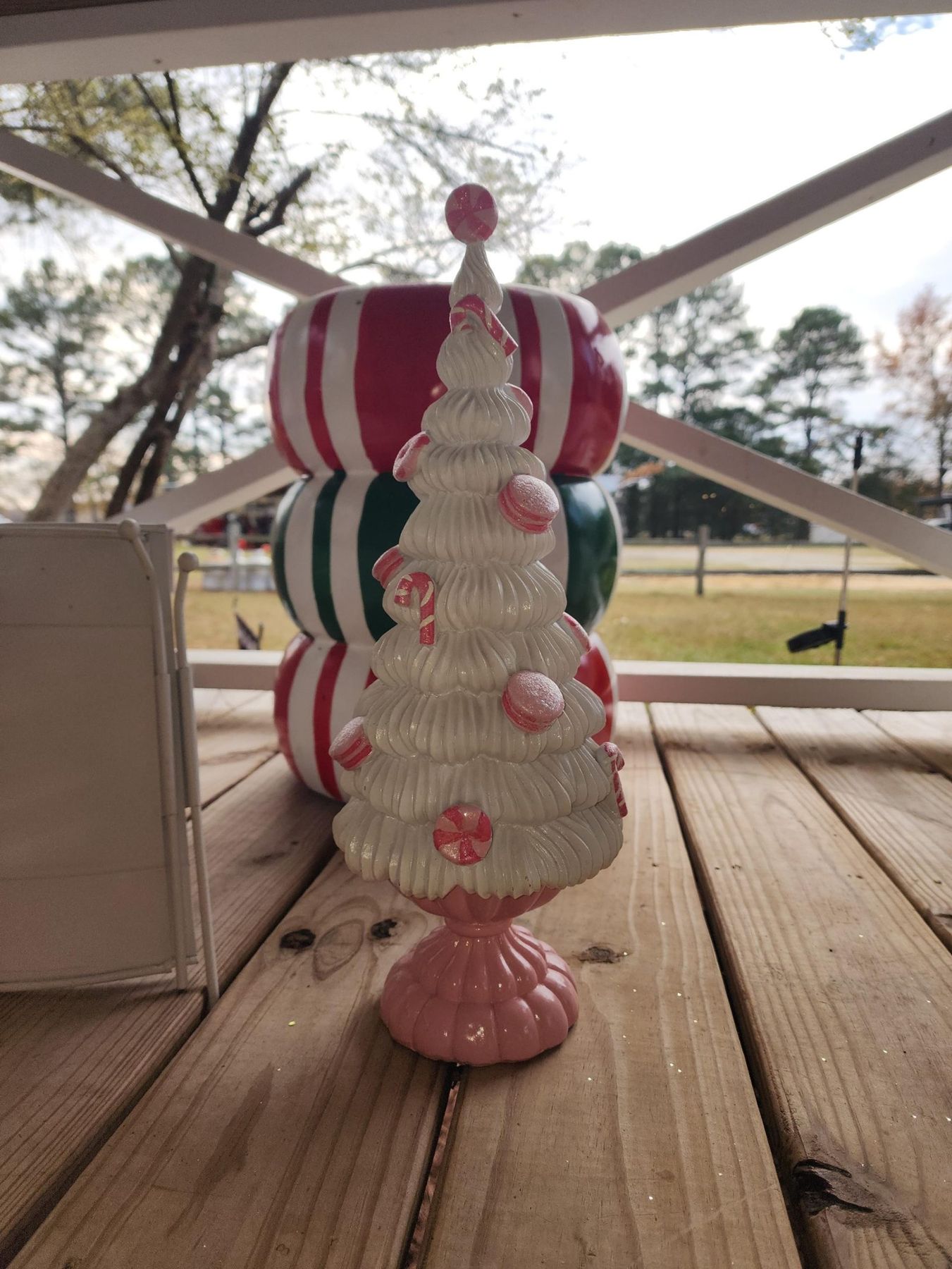
The pink fluted pedestal is the element that makes it. Without it, this is a small white ceramic tree with cute details — nice, but one of thousands. The pedestal raises it 3 inches, gives it a candy-colored base that echoes the macaron accents, and turns a figurine into a finished object. It’s also the reason the piece reads as intentional decor rather than a souvenir. Compare with Idea #20, where the base is built into the tree itself.
28. Purple Tree Topped With a Bubblegum Fairy
Fantasy-topper trees are a small but growing niche, and 2026 is their breakout year — fairy figures, feather wings, and trees in colors nobody used five years ago. The dark purple base is the real tell. Pastel candy ornaments on green read sweet. The same ornaments on deep purple read surreal and a little theatrical. This is what happens when the maximalist candy trend collides with the fantasy aesthetic that’s been running through decor for two seasons.
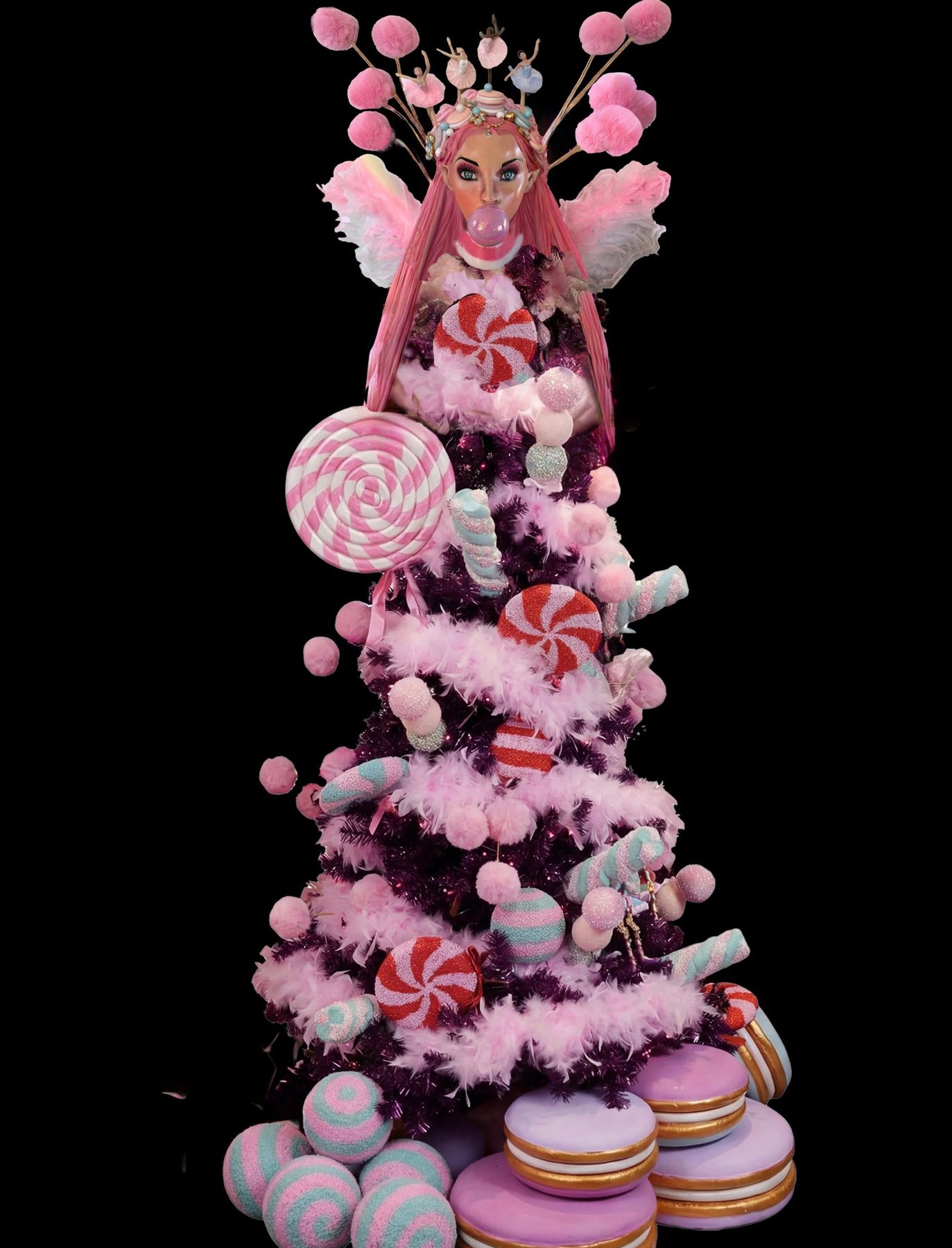
The purple tree is the expensive part, and honestly the easiest to fake. Buy a 6-foot unlit tree on clearance in January for around $45 and flock it yourself with a $20 spray can — the dark base will still read purple-black under warm lights. Feather boas from the craft aisle run $4 to $8 each, and three of them garland an entire tree. Fairy topper alternatives start around $12.
29. Hands-On Styling With Frosted Sprinkle Baubles
A three-pass method for loading a flocked tree:
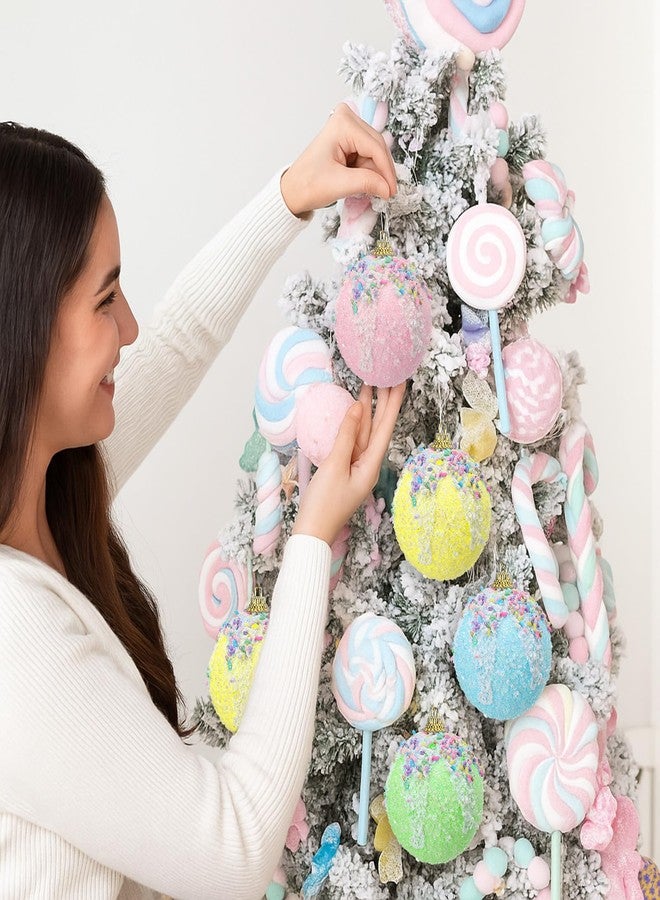
- Pass one — hang the largest pieces, the sprinkle-textured baubles and swirl lollipops, 8 to 10 inches apart.
- Pass two — fill the gaps with mid-size ornaments, keeping every piece within 3 inches of a large one.
- Pass three — tuck pastel candy canes at the outer tips only, angled down.
- Step back every ten minutes. Flocked trees look finished before they are.
A 7-foot flocked tree takes about 90 minutes this way and 60 to 70 ornaments.
Texture layering is what makes it work. The sprinkles on the baubles mimic flocking without repeating it, so the ornaments seem to belong to the tree rather than sit on top of it. Pastel candy canes supply thin vertical lines against all those round shapes. And the flocking itself blurs the tree’s outline, so every ornament reads as a soft-edged form instead of a hard-edged object.
The pastel range that refuses to commit is the quiet hero. Pink, blue, yellow, green, white — five colors, all at the same low saturation. Bump any one of them to a vivid version and the tree falls apart. That chalky, muted quality is what separates a candy tree that looks grown-up from one that looks like a toy store display.
Now Go Build the Tree Everyone Screenshots
Pick one idea from this list — not five — and give it a full afternoon. The candy trees that stop people mid-scroll aren’t the ones with the most ornaments; they’re the ones where somebody committed to a palette, committed to a scale, and then had the discipline to stop. Start with the ribbon and the big pieces, step back often, and let the small stuff fill in.
📌 Pin this guide to your holiday board before December hits — you’ll be glad you have it when the boxes come down from the attic.