
You know that feeling when a single quilted tree skirt photo stops your scroll and you can’t quite say why? Usually it’s the stitching — real quilting has a texture that printed fabric can’t fake. We spent serious time combing through Etsy, Pottery Barn, Target, and the handmade corners of World Market to bring you only what’s worth your attention this year, from $24 clearance finds to $260 heirloom quilts you’ll actually hand down. Inside you’ll find 29 ideas across traditional patchwork, farmhouse plaid, vintage scrap quilts, and modern heirloom, with budget and luxury versions compared side by side. It’s landing now for a reason: after several years of minimalist holiday decor, Pinterest is flooding with handmade texture and slow-Christmas tablescapes, and quilted cotton is the centerpiece of that shift. Save this post now — you’ll want it when you’re ready to shop. And stay until the end — we break down the most common mistakes that can ruin these looks. 📌 Save this to Pinterest for later — you’ll want to revisit these ideas.
1. A Radial Quilted Skirt With a Black Scalloped Edge
The black scalloped border is doing the heavy lifting here. Without it, you’d have a pretty red-and-cream star quilt that quietly dissolves into the shadow under the tree. That dark edge works like a picture frame — it presses the radial wedges forward and makes the gold embroidery on the snowflakes legible from across the room. If you’re reproducing this, don’t sub in gray or brown trim to soften it. The contrast is the entire point, and the little scallops give the eye somewhere to land.
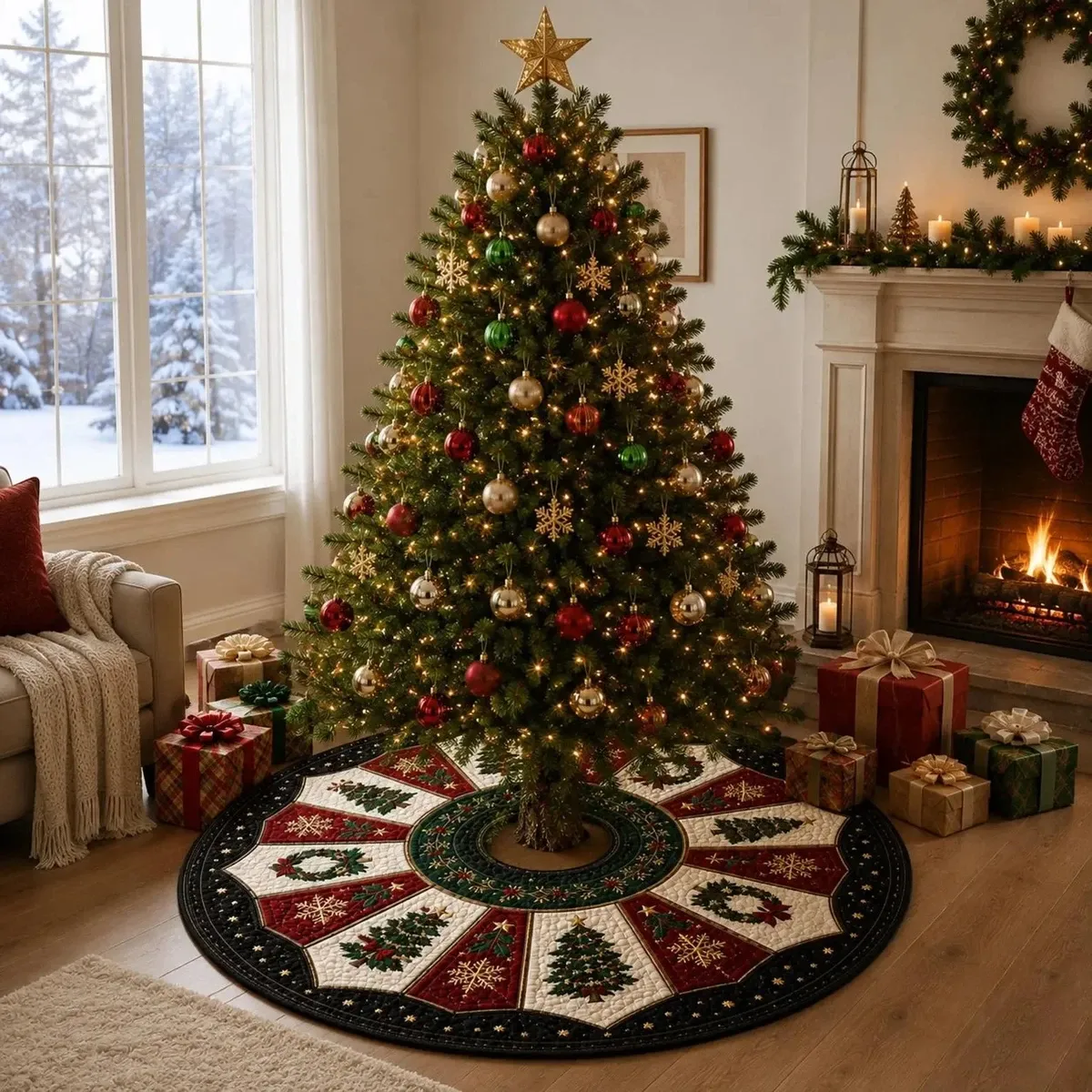
Match your quilting lines to the wedge seams before you bind the edge. Sew the radial seams first, press them open, then run decorative stitching a quarter inch on either side of each seam — that’s what creates the sunburst look instead of a flat printed feel. Cut the center opening a half inch smaller than your tree stand’s pole collar, not larger. A snug fit keeps the skirt from sliding when gifts get shoved underneath at eleven at night.
- Finished quilted skirt in a comparable radial pattern: $85–$190
- Batting, backing, and binding fabric if you’re sewing: $22–$40
- Embroidery floss plus one spool of gold metallic thread: $12–$24
- Black scalloped trim or premade bias binding: $10–$20
Total: $129–$274. Budget alternative: buy a plain cream quilted skirt and add the scalloped binding yourself — roughly 55% less, and nobody gets close enough to count stitches.
2. Buffalo Check Stars Under a Pinecone Tree
What’s clever here is that every star is the same size and shape, so your eye gets rhythm before it gets chaos. Buffalo check, reindeer, holly, and snowflake prints are all loud on their own, but repeated at an identical scale inside identical star templates, they settle down and start behaving like a pattern. The pinecones in the tree above do the same job in three dimensions — repeating one rough natural texture against all that crisp cotton.
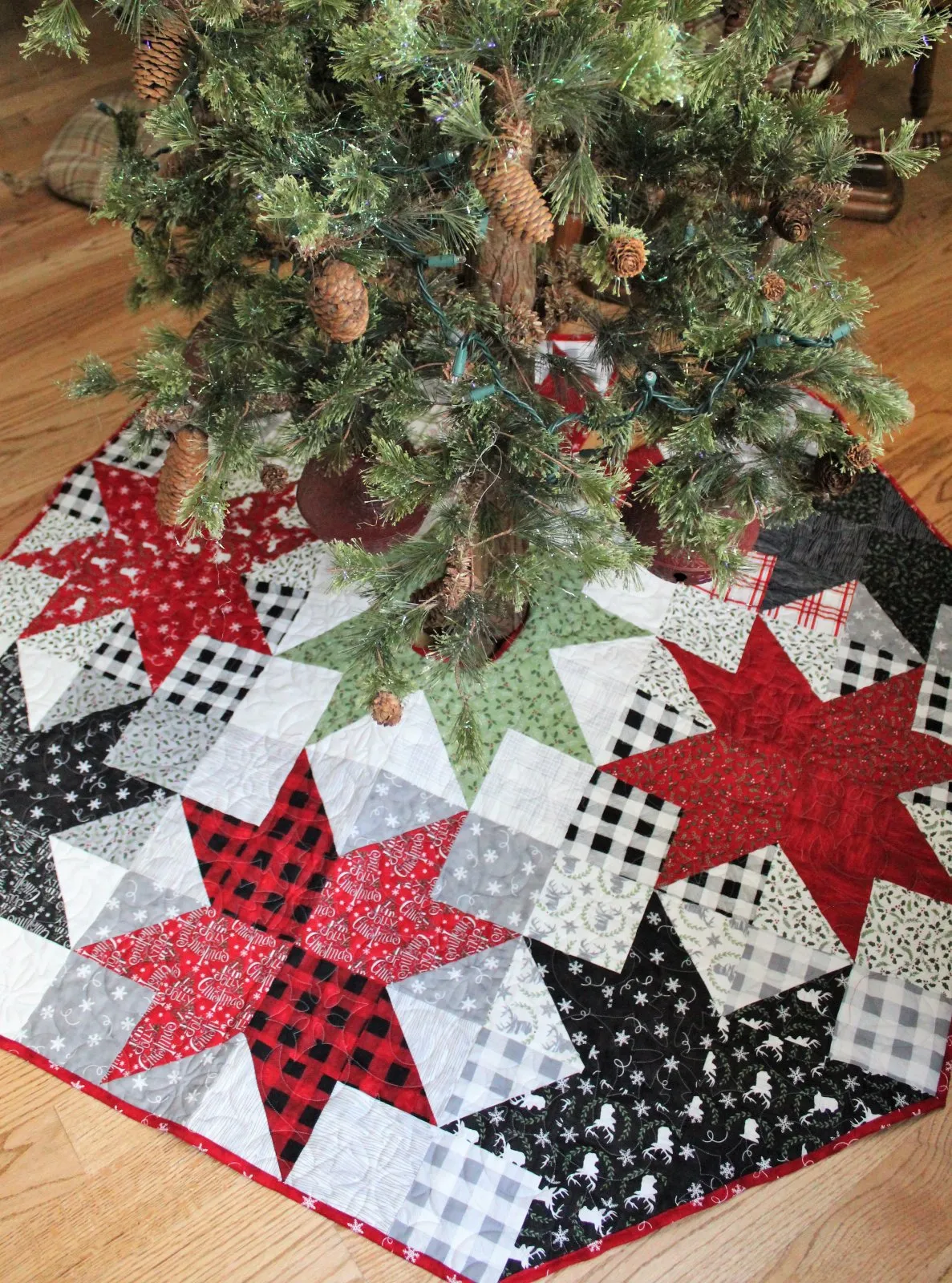
Be honest about your tree before you commit to this much print. Buffalo check plus reindeer plus snowflakes is a lot of talking at floor level, and it only stays charming if everything above it whispers. Skip the patterned tree collar, skip the novelty ribbon garland, and let the skirt be the only loud voice in the room. On a bare light-wood floor it sings. Over a busy rug, it argues.
3. Wedges of Tiny Prints, Bound in Solid Red
- Cut one paper wedge at 30 degrees and use that single template for all twelve segments.
- Fussy-cut small rectangles from each print, keeping motifs upright toward the center opening.
- Chain-piece the rectangles into each wedge, pressing seams open as you go.
- Join the wedges, true up the circle, then quilt through all layers.
- Bind the outer edge, and cut the center opening last — after quilting, never before.
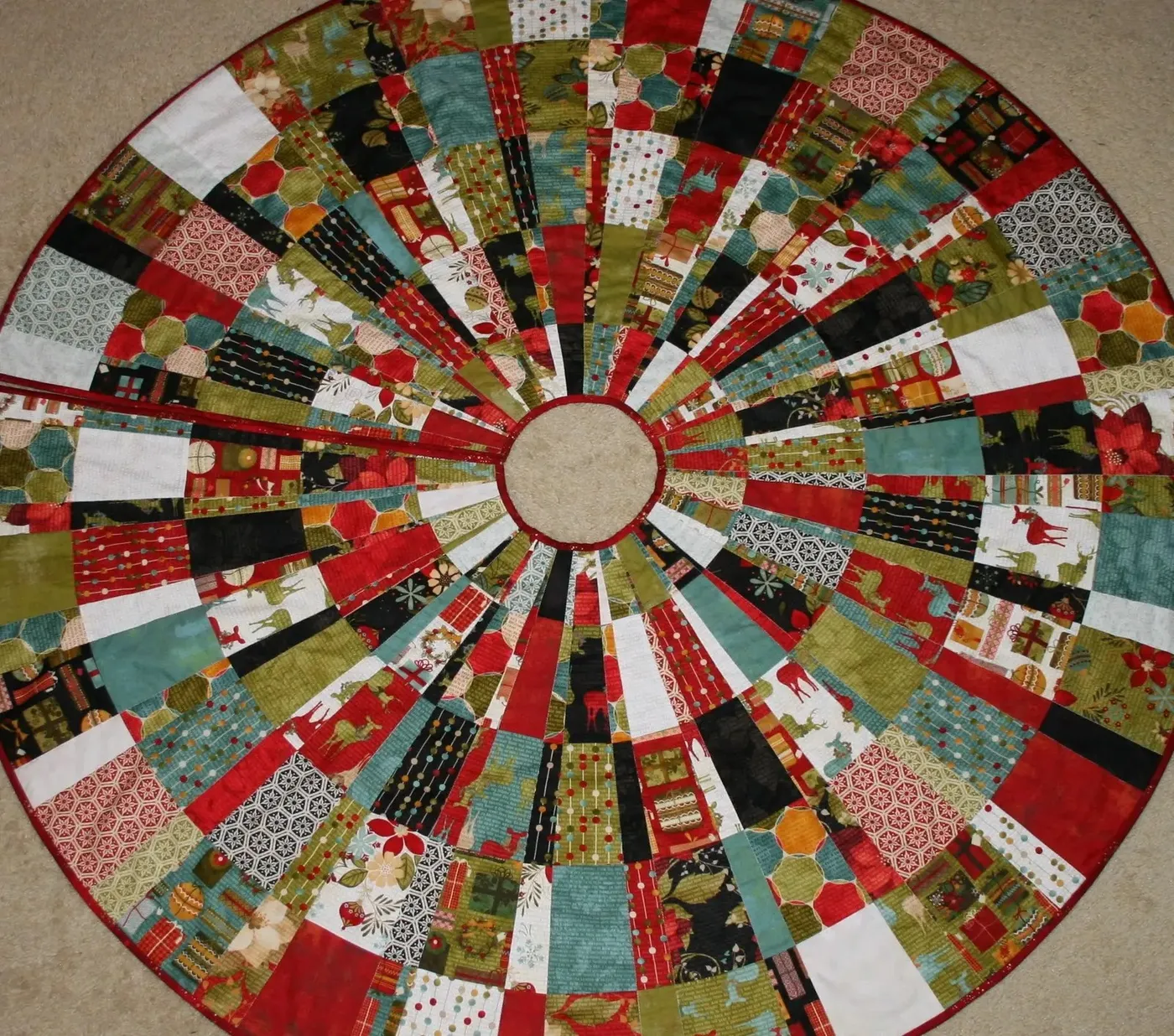
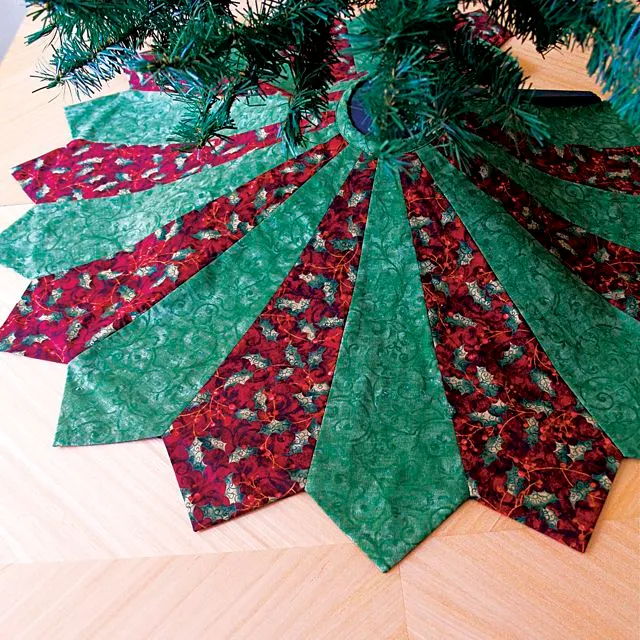
Time: 8 to 12 hours. Cost: $35 to $60 in fabric if you’re working from scraps. The red binding is what makes it look bought rather than built.
70% patterned fabric in red, green, and teal, plus 20% white breathing room, plus 10% solid red binding. The white isn’t decoration — it’s punctuation. Swap the teal for navy and you get a cooler, more wintry version; swap it for mustard and the whole thing goes vintage-market. Keep the binding in the same tone as your dominant print either way, because that’s what stops a scrap quilt from reading as leftovers.
4. Cream Quilting With a Faux Fur Hemline
Faux fur is the most forgiving and least cooperative trim on this list. It sheds for the first week, it drinks tree needles like a lint roller, and it flattens wherever a gift sits for a month. Vacuum on the upholstery setting with a brush attachment — never a beater bar. After the holidays, brush the pile back up with a soft pet brush and store it flat, because folded fur gets a permanent crease that no steamer will fix.
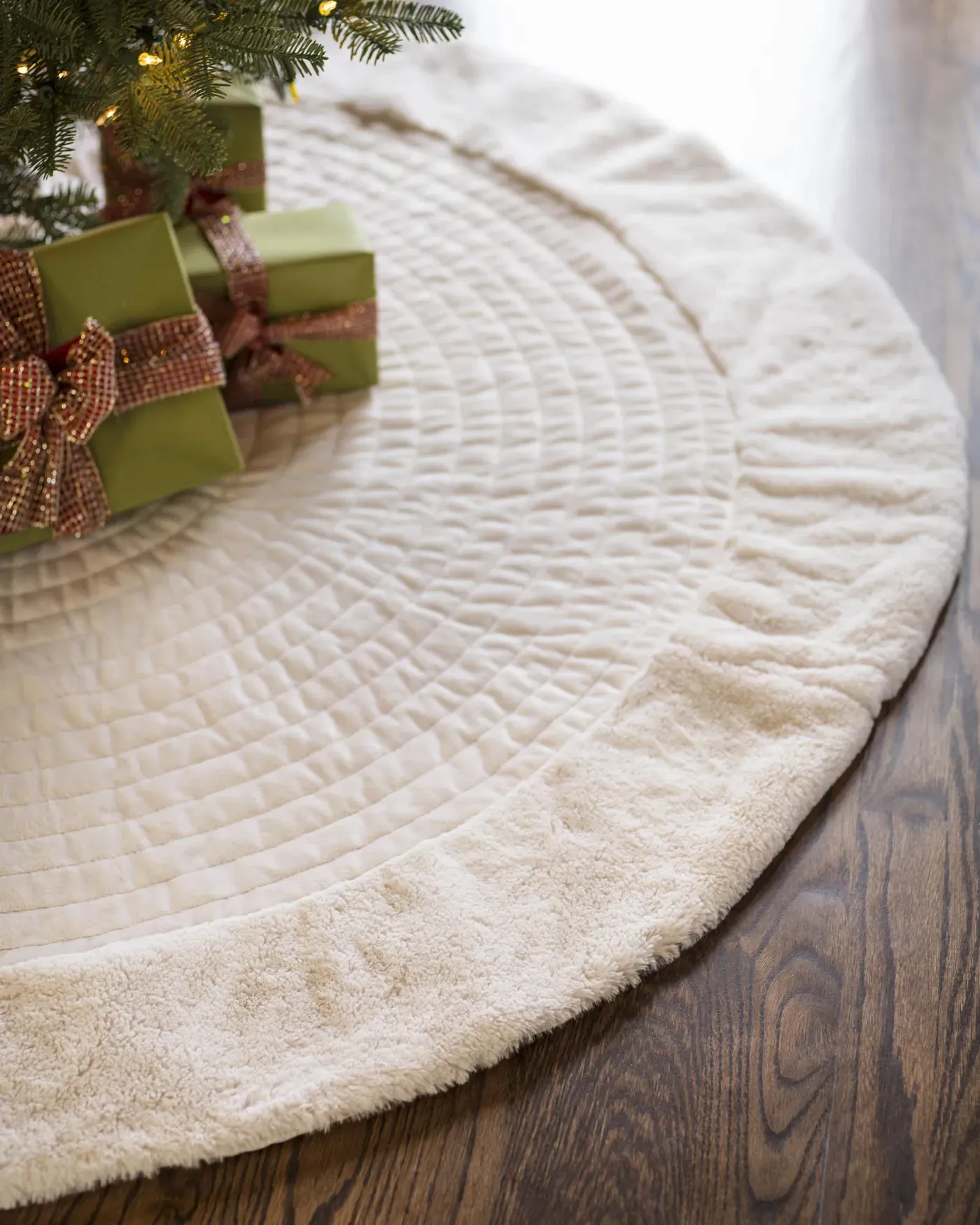
This one wants a dark floor and a tree in the 6- to 7½-foot range. Cream quilting against dark stained wood is the whole trick — on pale oak the fur border disappears and the skirt starts reading like a bath mat. Give yourself at least 18 inches of floor beyond the tree’s lowest branches so the furry edge has somewhere to sit, and measure your walkway before going wider than 36 inches across.
Concentric quilting arcs echo the roundness of the skirt and, above it, the tapering cone of the tree, so the eye follows the curve upward without being told to. Then the fur breaks that geometry with something soft and irregular. Quilting gives you structure, fur gives you softness, warm-white lights add the temperature. Three things, three jobs, no competition.
5. An Octagon Star With a Pinwheel Center
You can fake this octagon for about half the price. Buy a plain red quilted round skirt on Etsy for $45–$70, then layer two concentric bands of fabric you already love — a striped cotton and a small-print cream — as appliquéd strips stitched over the top. The pinwheel center is the only part that needs real patience; a printed panel cut into an octagon covers the same ground for under $20 and reads as intentional.
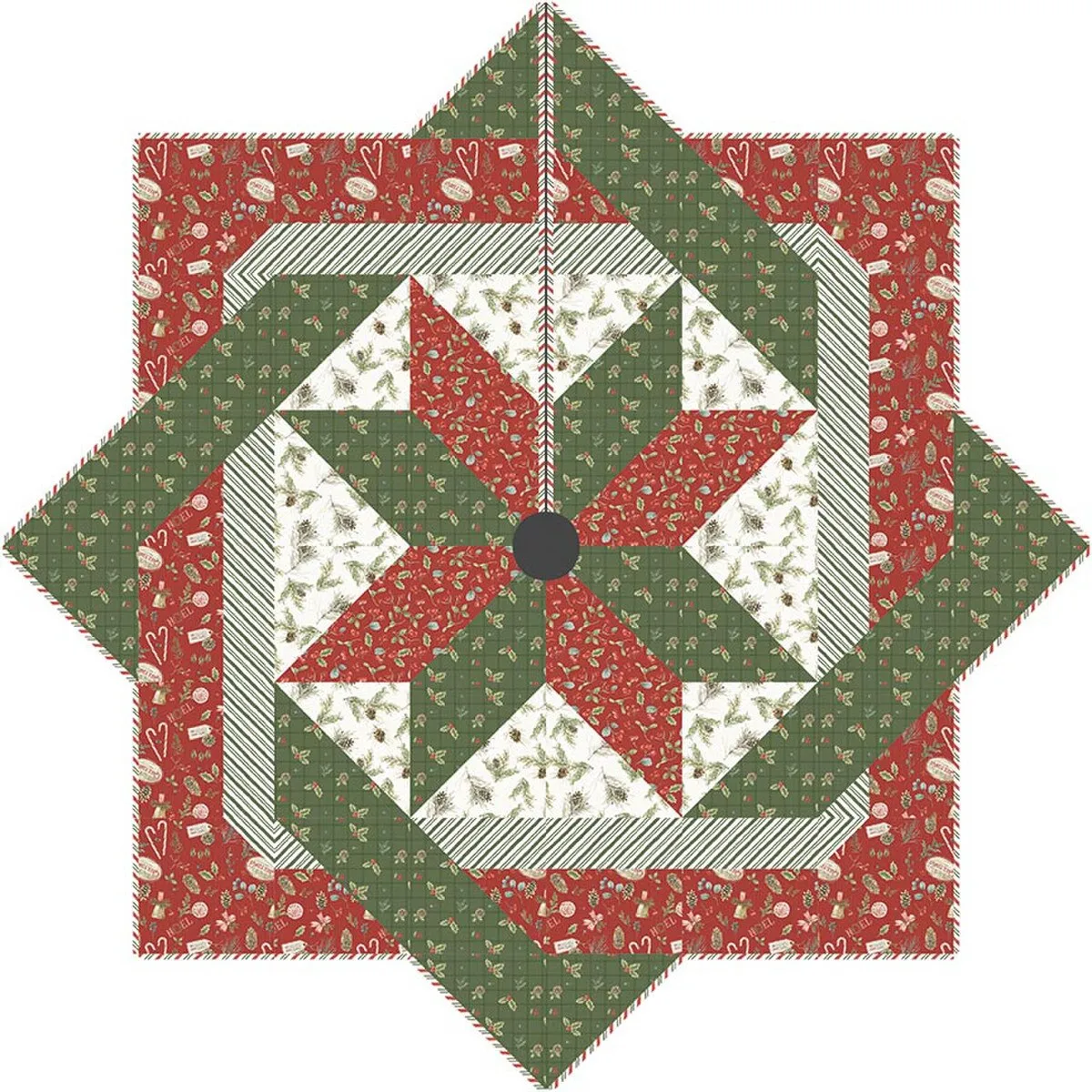
Compare with Idea #3 — same radial logic, totally different scale of pattern. Here it’s 60% warm red base, 25% cream and white, 15% green accents, with the green-and-white stripes acting as the neutral that keeps the reds from flattening each other. Push the accent from green to navy and the skirt turns winter-into-January instead of Christmas-specific. Keep that striped band under three inches wide, or it stops being a stripe and becomes a competing pattern.
6. One Skirt, Two Faces: Red Quilting and Buffalo Plaid
The fold-back is the entire point. A reversible skirt isn’t a gimmick — it solves the exact problem most of us have, which is getting tired of our own decorations by January 2. Deep red concentric quilting on one face, red-and-black buffalo plaid with diagonal stitching on the other. Same piece, completely different mood, and you can flip it between the tree and a side table in about ten seconds.
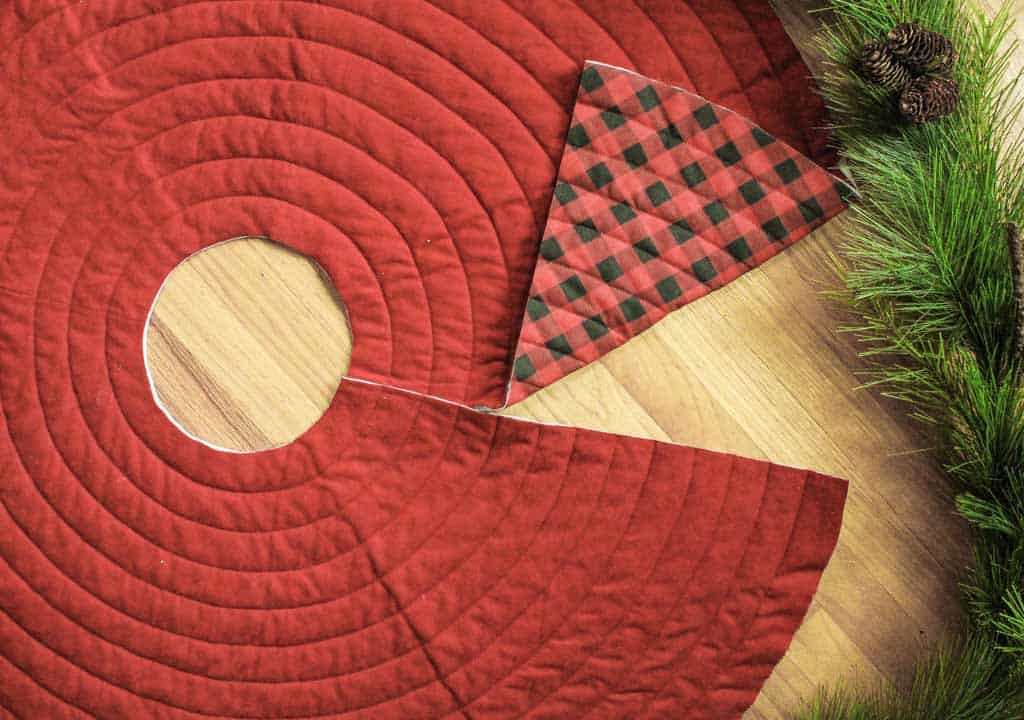
- Cut two circles — one solid red, one buffalo plaid — to the same diameter.
- Layer with batting between and baste from the center outward in spokes.
- Quilt concentric circles on the red side, then flip and quilt diagonals at 45 degrees.
- Bind both layers together with one shared edge strip so there’s a single seam.
- Cut the center opening through both layers, then add fabric ties at the slit.
Time: 5 to 7 hours. Materials: $40 to $70. Reversible everything is the mood right now — flip pillows, two-sided runners, textiles that earn their storage space. Quilted cotton is why this one works: it’s sturdy enough to be flipped and washed for years without losing its shape.
7. Scrap Patchwork Under Warm Tree Lights
- Handmade quilted patchwork skirt: $95–$210
- Kraft paper and satin ribbon in red and green: $14–$28
- Quilt-weight cotton scraps or a fat-quarter bundle: $25–$45
- Batting and backing: $18–$32
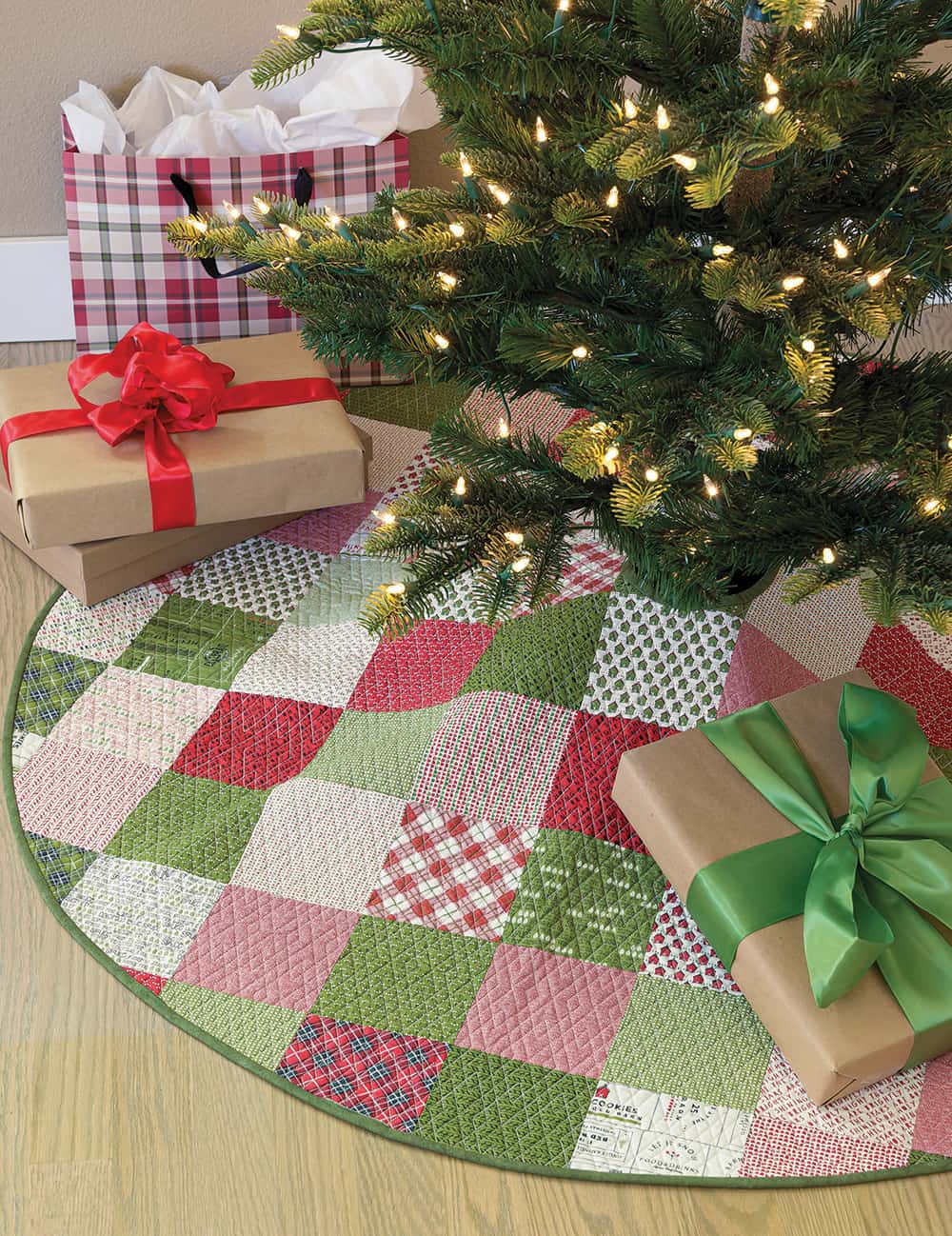
Total: $152–$315. Budget alternative: a $40 quilted throw from a thrift store, cut into a circle and re-bound, gets you 80% of this look — the kraft paper and ribbon are doing more for the scene than the skirt is.
Patchwork squares in red, green, and beige forgive real life in a way a single-color skirt can’t; a scuff or a pine-needle stain vanishes into the pattern. The catch is scale. If your squares are too small, this reads as busy from standing height and only looks good in photographs. Anything under three inches across starts to vibrate.
50% green-dominant patches, 30% red, 20% light beige — and the beige is doing the heavy lifting. Without those pale squares, red and green patchwork turns muddy under warm string lights, because the cream reflects light and keeps everything legible. Swap beige for pale gray and the skirt cools down nicely; swap for pink and you get that vintage-candy look.
8. Candy Stripe Quilting With a Ruffled Hem
Narrow stripes need a wide ruffle to look deliberate instead of accidental. Keep the striped bands under an inch and a half, then make the ruffled hem at least three inches deep and gather it at roughly 1.5 times the circumference. Tighter than that and it reads as a frill; looser and it just looks like the binding went wrong somewhere.
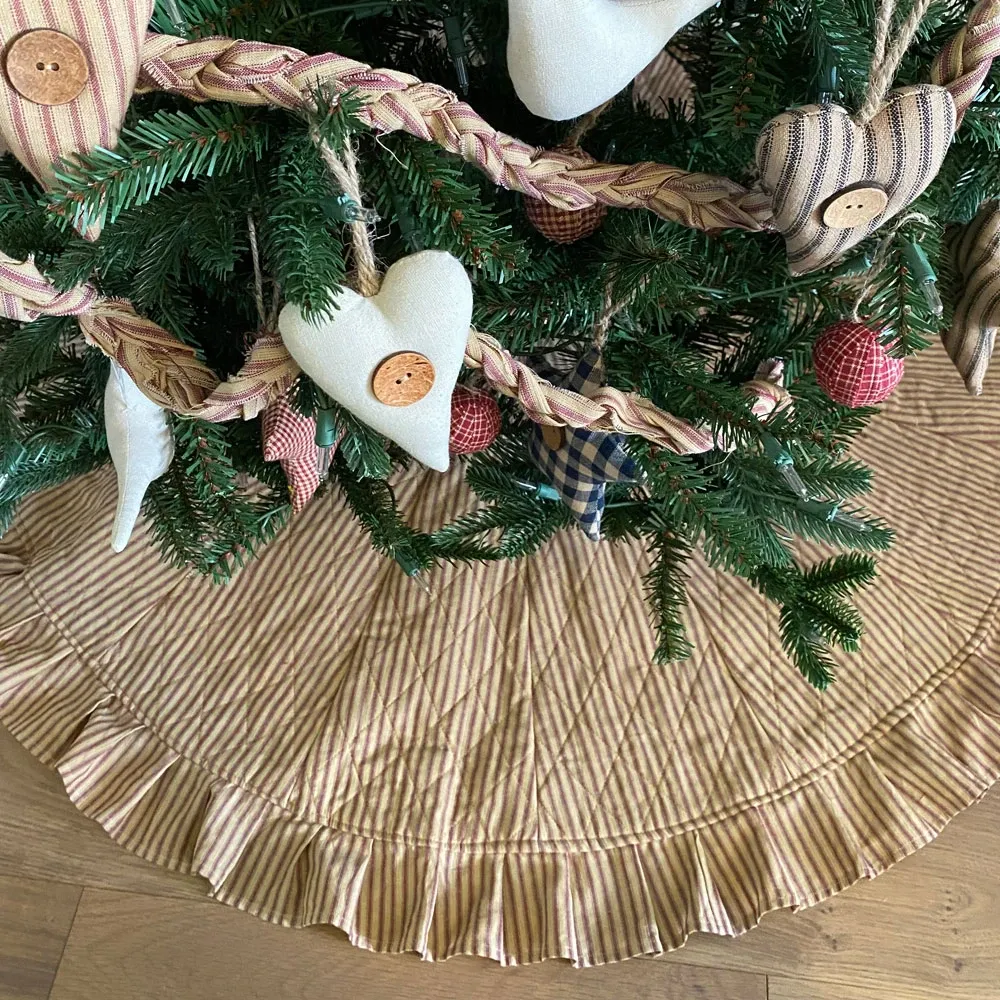
Ruffled rounds need breathing room — figure on a 40- to 44-inch diameter under a 6-foot tree, and add two inches for every foot of height above that. On a rug, stay with flat weave. A shag or high pile will swallow the ruffle entirely and you’ll lose the whole reason you bought it.
The wooden buttons on those fabric hearts are what make this arrangement feel collected rather than purchased. Take them away and you have a nice striped skirt and some fabric ornaments. Keep them and everything reads as one handmade family — same beige, same red, same little wooden punctuation marks. If you’re building this, buy buttons in bulk and use them everywhere.
9. Blue and Red Bands With Stitched Holiday Words
- Cut eight identical wedge panels, one per side of the octagon.
- Assign fabrics in a repeating A-B-C rhythm so no two neighbors fight.
- Piece the bands concentrically, outer band last, pressing every seam as you go.
- Stitch a short holiday phrase onto the cream sections before quilting — it’s easier flat.
- Quilt through all layers, bind the edge, then add the ribbon ties at the opening.
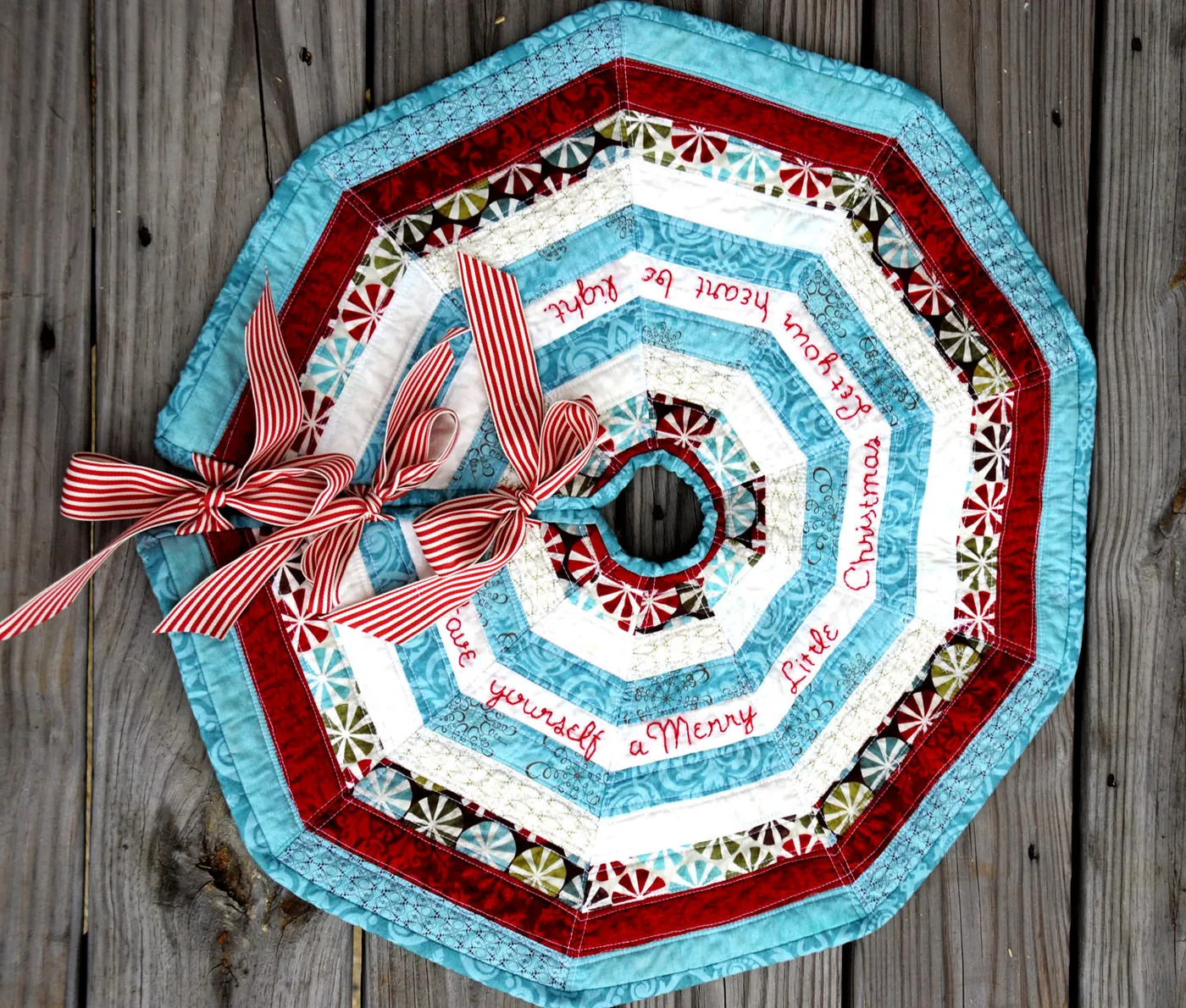
Time: 10 to 14 hours. Cost: $45 to $80 in fabric, plus $8 for the striped ribbon. Weathered wood underneath is not optional, by the way — the gray planks calm all that red and blue down.
The embroidered lettering is the expensive part if you’re paying someone else to do it. Skip it and stitch a printed holiday ribbon flat across the cream band instead — same storytelling, a fraction of the cost. Or buy an embroidered tea towel at a thrift store for $3 and cut the words out. A redwork phrase is a redwork phrase once it’s quilted down.
10. A Winter Village Stitched in the Center
A scene beats a symbol every time. A field of snowflakes is pretty; a row of tiny red-roofed houses with snow on the ground is a story, and your eye keeps returning because there’s something to read. The plaid patches and cream snowflake squares around the border do the unglamorous work of framing that scene so it doesn’t just float in the middle of a circle.
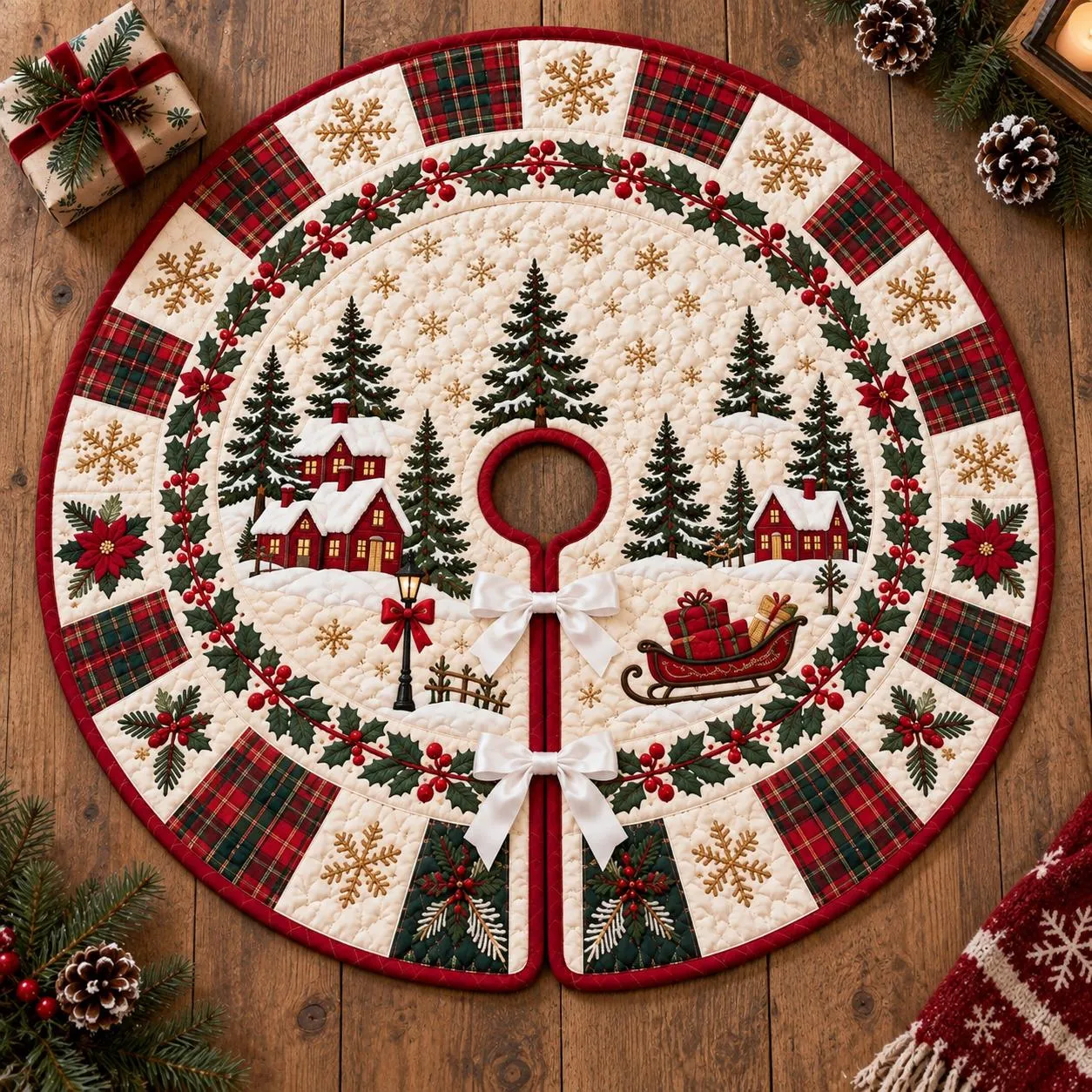
- Embroidered-scene quilted skirt: $140–$320
- Plaid fat quarters for the border: $16–$30
- Gold metallic embroidery thread: $6–$12
- White satin ribbon for the bows: $5–$10
- Batting and backing: $20–$38
Total: $187–$410. Budget alternative: buy a plain cream quilted skirt and appliqué a printed winter-scene fabric panel into the center — about 60% less, and the border does most of the visual work anyway.
11. Scalloped Red-and-White Wedges
Two colors, one job. Red and white patchwork is the most forgiving formula in this whole list because there’s no third color to argue with. Keep it at 55% white-ground prints, 35% red-ground prints, and 10% solid red for the scalloped edge. Swap that solid for green and you get Christmas; swap it for black and the skirt turns graphic and just slightly modern.
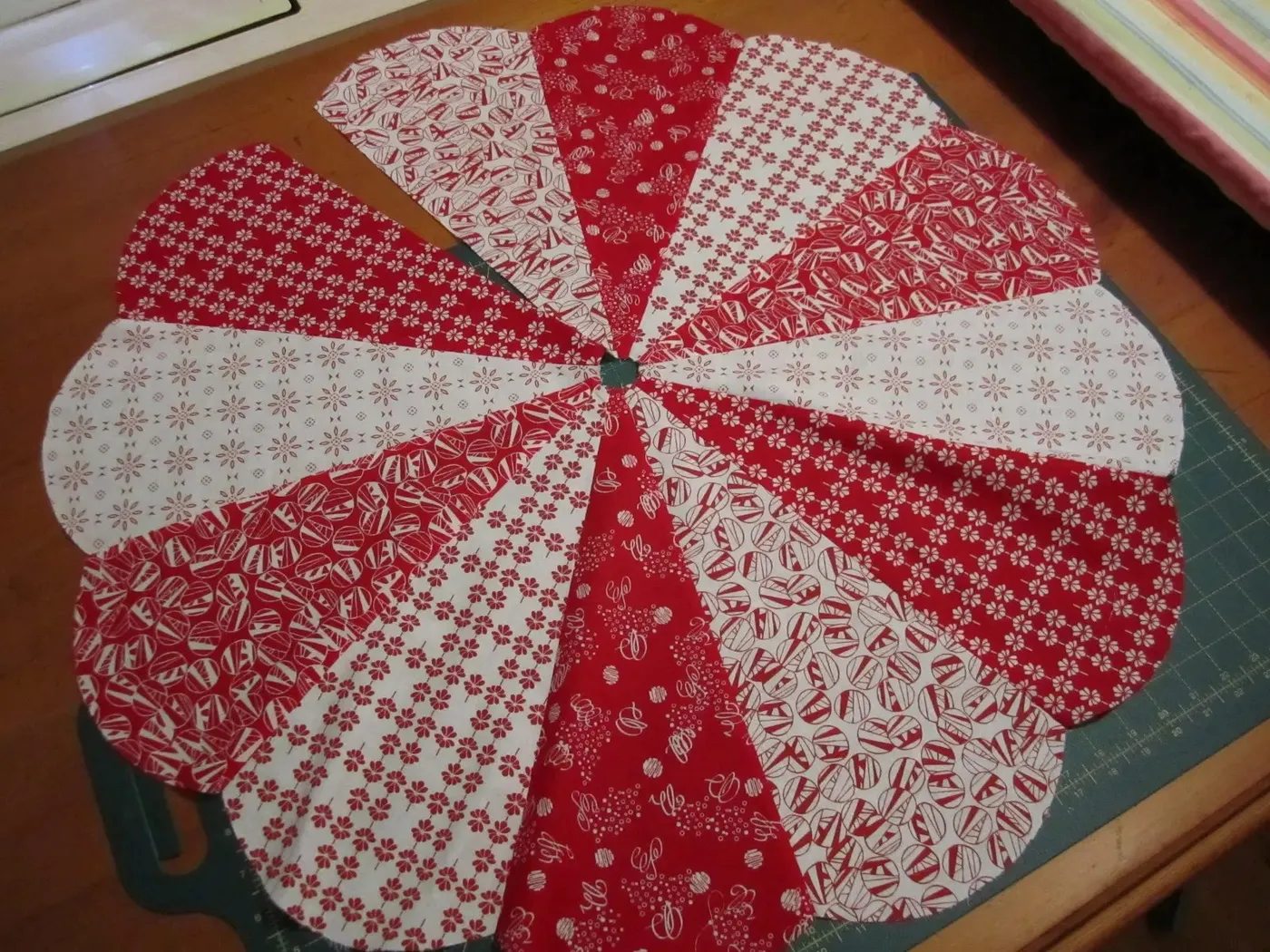
Scallops are beautiful and they are also a commitment. Every curve has to be clipped and graded before you turn it, or the edge puckers and never lies flat again. If you’re buying rather than sewing, zoom in on photos of the scalloped edge — machine-cut scallops on cheap fabric always look slightly wavy, and no amount of ironing fixes that.
Small red-and-white wedges need to stay under 36 inches across, or the pattern density gets overwhelming. This is a good pick for a 5- to 6-foot tree, a tabletop tree, or a slim pencil tree in a small apartment. If your room is under 120 square feet, it’s one of the few designs here that won’t eat your floor.
12. Felt, Appliqué, and Three Fabric Buttons
- Cut a red felt circle plus a slightly smaller backing circle.
- Trace star and organic shapes onto fusible web, iron onto white felt, and cut them out.
- Fuse the white shapes down and stitch them with a visible blanket stitch.
- Make three layered fabric buttons — circles of red cotton gathered over a shank.
- Sew the buttons along the seam, then bind the outer edge.
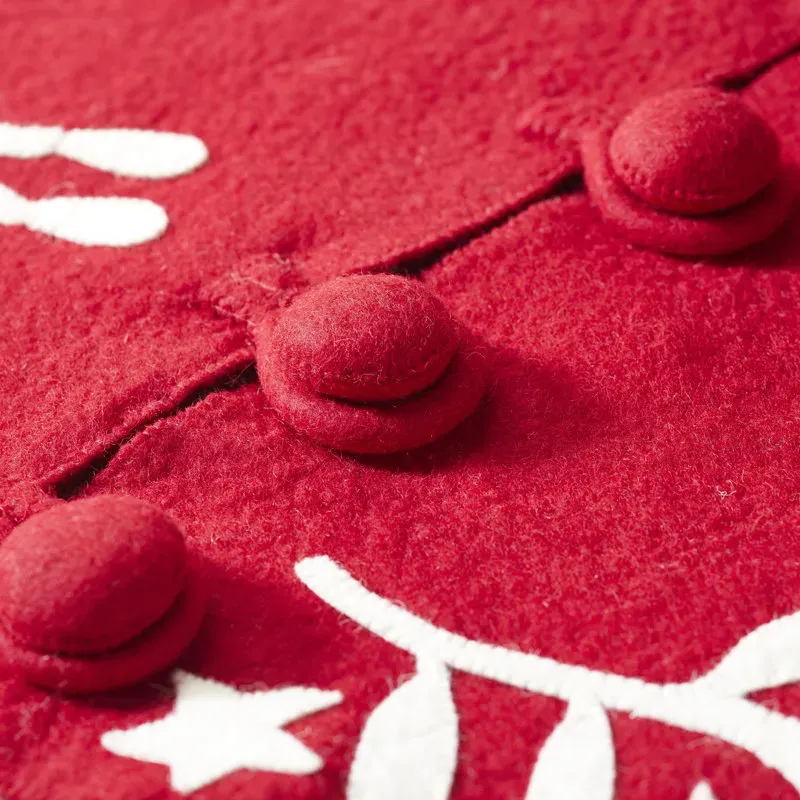
Time: 3 to 4 hours, no machine required. Cost: $18 to $30. You’ll see hand-stitching, and that’s the charm of it.
Felt pills. There’s no way around it — where gifts rub against it, you’ll get little fiber balls by New Year’s. A cheap fabric shaver fixes it in two minutes. Store felt rolled, never folded, and keep it away from anything damp, because wool-blend felt that gets wet and dries unevenly never lies flat again. The upside: felt doesn’t fray, so this is the most kid-proof option on the list.
13. Cable Knit Knots in Saturated Red
A knit skirt needs a lining, or every needle, gift tag, and stray piece of tinsel will migrate straight through the stitches. Sew a plain cotton circle in a matching red and attach it only at the center opening and the outer edge — that way the knit can still stretch. Bonus: the lining stops the skirt from catching on the metal legs of your stand.
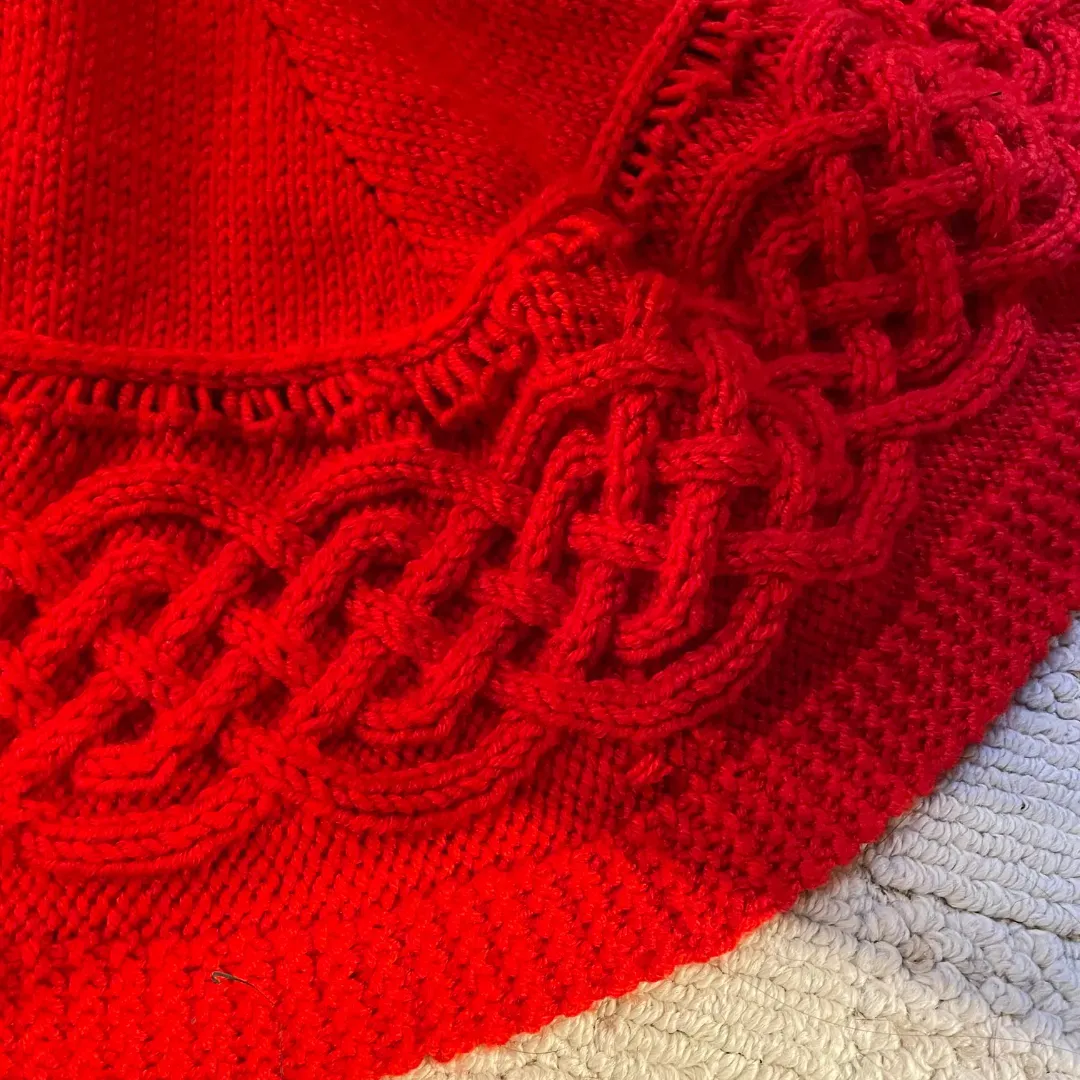
Hand-knit cable work runs $180 and up if someone else made it, which is fair for thirty hours of knitting — but you don’t have to buy that. A chunky cable-knit throw from a big-box store costs $35 to $55, and one and a half throws will circle a 6-foot tree once you seam them together. The knot pattern won’t be as intricate, but the texture reads the same from standing height.
Knitted textiles are heavy, and heavy means it needs a tree with a solid stand. This works best on trees 6 feet and under where the weight sits close to the pole. Above 7 feet the skirt starts looking thin and undersized unless you go up to a 48-inch diameter — and at that size you’re wrestling four pounds of wool.
14. Red Quilting With White Star Motifs
Red skirt, white and green stars, scalloped edge — three decisions total, and each one is legible from the doorway. The stars are quilted rather than appliquéd, so they read as shadow and texture instead of decoration, which is exactly why this can sit under a fully ornamented tree without competing with it. Quiet pattern, loud tree. That’s the arrangement, and it’s a good one.
A pure red skirt under warm string lights photographs beautifully and can look slightly flat in person, because red absorbs warm light rather than reflecting it. Test yours at night before you commit. If it goes dark and dense, add the star quilting in a slightly shiny thread, or shift your tree lights from straight warm white to a mixed set with a few cooler bulbs in the mix.
15. Peppermint Swirl in a Fireplace Living Room
Peppermint swirls have been cycling back for a few seasons, but this is the year the candy-cane motif moved off the tree and onto the floor. It’s part of a broader pull toward nostalgic, high-contrast holiday decor — the same instinct driving red-and-white checkered kitchens and vintage Santa graphics. Staying power? Solid. Peppermint reads as Christmas in any decade and never needs explaining to a guest.
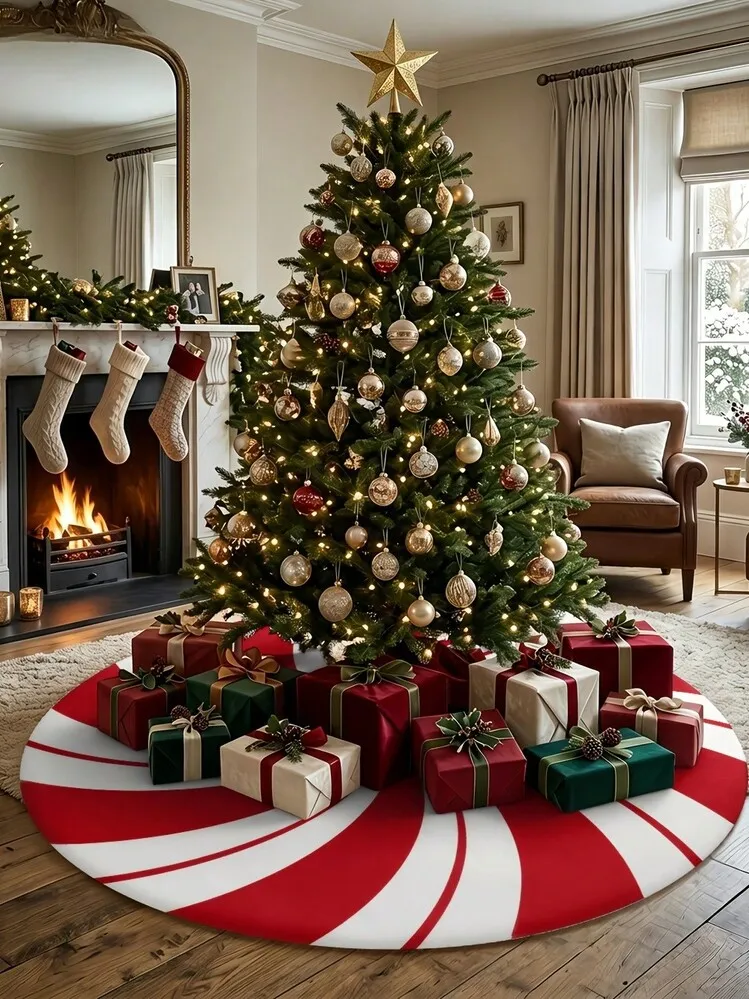
- Round swirl-print tree skirt: $28–$65
- Knit stockings, set of three: $45–$95
- Gold and red shatterproof ornaments: $30–$70
- Warm-white LED string lights: $18–$35
Total: $121–$265. Budget alternative: a plain white skirt plus red fabric paint through a cardboard template runs about $22 total — and it’s a genuinely good project for kids who want in on the decorating.
The fireplace is doing more for this vignette than the skirt is, and it’s worth admitting. What makes the swirl look good is warm, low, flickering light hitting it from the side while tree lights come from above. Move the same skirt to a corner with an overhead bulb and it loses half its charm. Light first, skirt second. If you like novelty motifs with a bit more wit, see Idea #29.
16. Plaid Squares Framing a Cream Winter Scene
When a border is made of alternating squares, the corners decide whether it works. Cut your plaid squares on the bias for the four corner positions and straight-grain for everything else — the bias pieces turn the corner without a visible seam and the pattern reads as continuous. It’s a ten-minute difference that separates handmade from homemade, and it’s the first thing a quilter will notice.
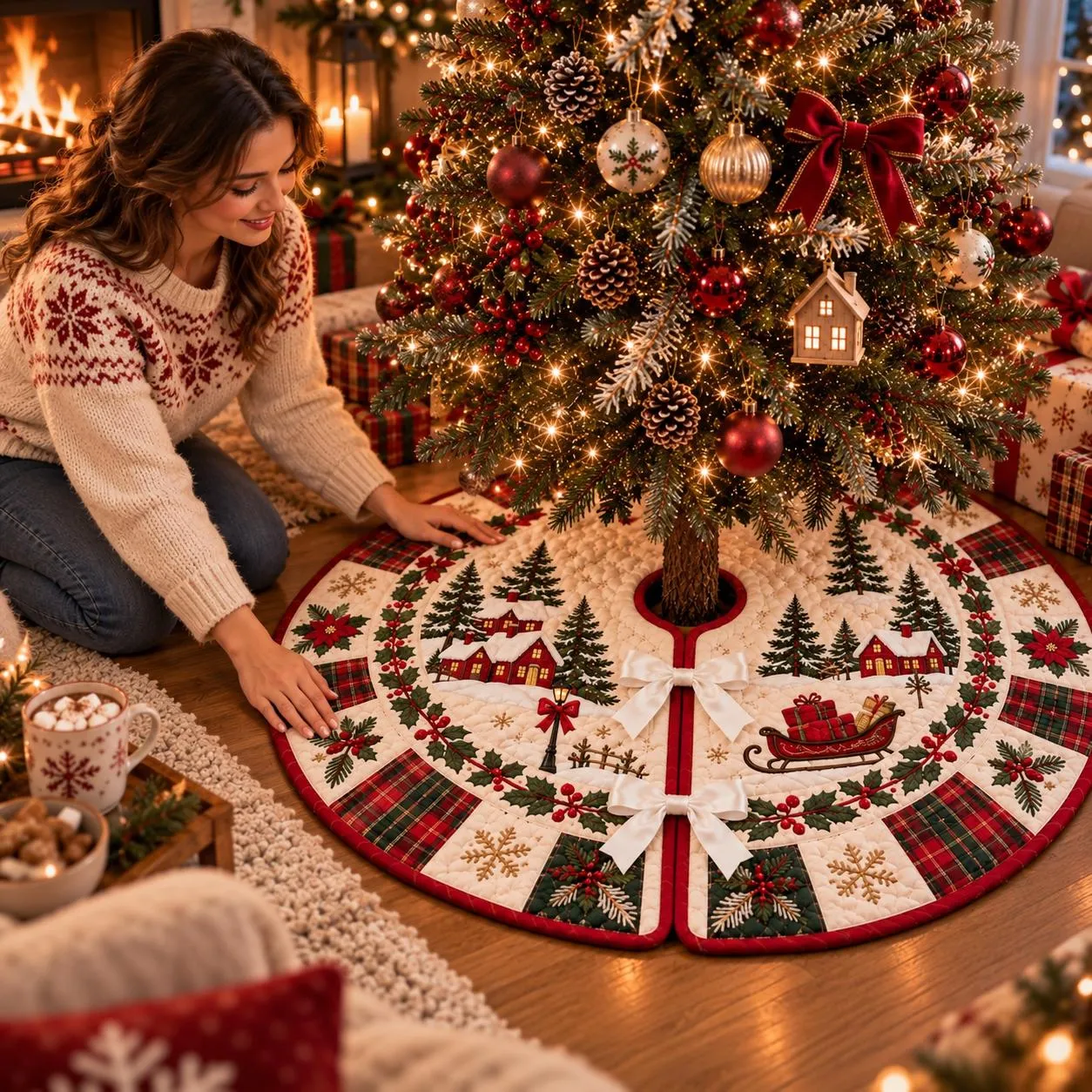
A cream center with a busy border needs a wide skirt to hold both. Forty-two to 48 inches across is the sweet spot; under 40 and the border crowds the scene until those little embroidered houses disappear. Best under a 7-foot tree with at least two feet of clearance on every side. In a tight corner, the border is the first thing that gets hidden, so consider a narrower version instead.
17. Star Blocks and Stitching You Can See
40% cream, 35% red, 25% green, with every star block containing at least one of the other two colors so no block sits isolated. That’s the rule that keeps traditional patchwork from turning into a checkerboard. Change the cream to a soft butter yellow and the whole thing warms up; change it to pale blue-gray and it reads as a winter quilt rather than a Christmas one.
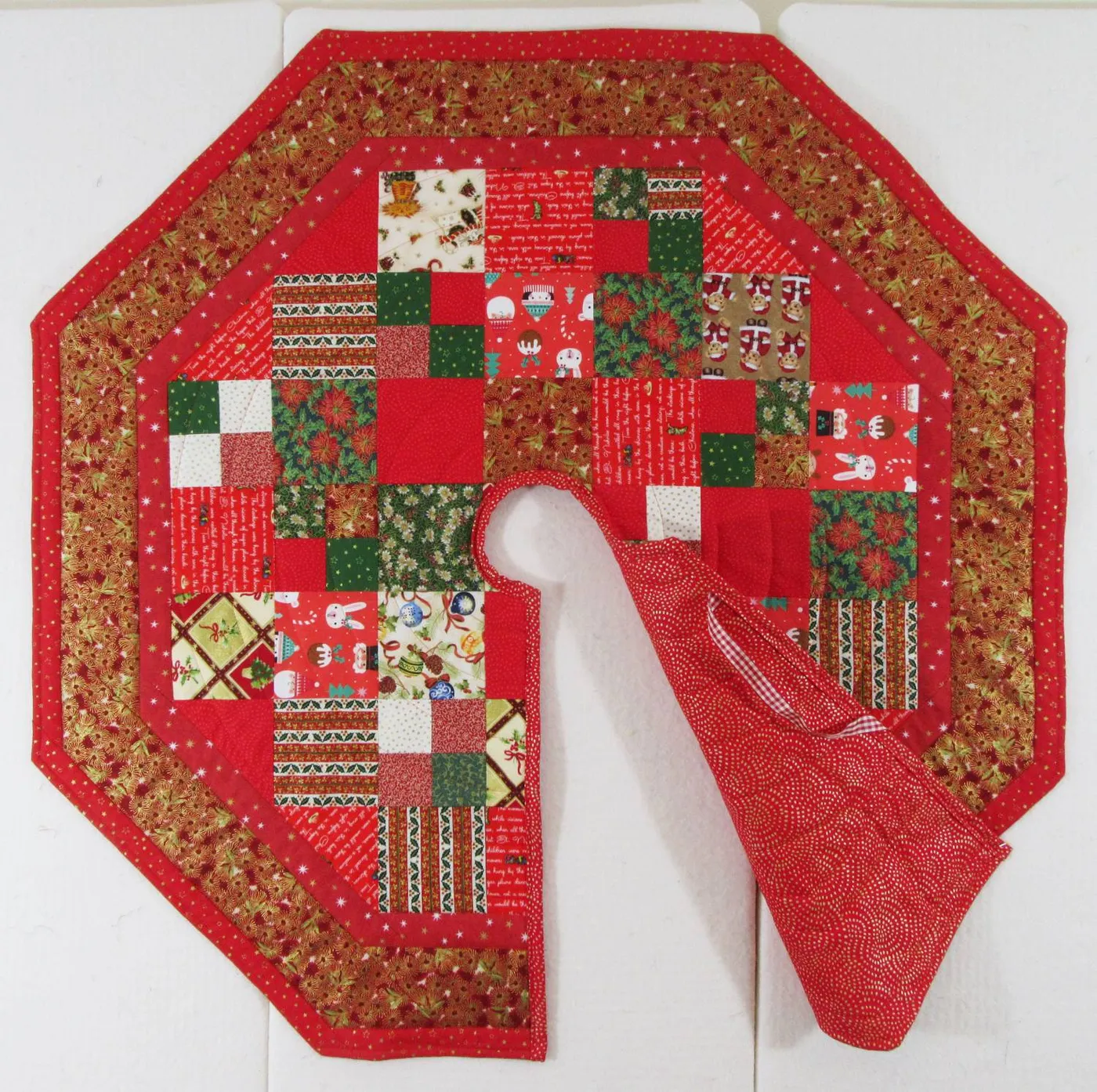
Visible stitching is free, which is the good news. A plain patchwork throw from a discount store — $25 to $40 — can be cut into a circle, bound, and quilted with three or four concentric lines of running stitch in one evening. Add the stars later as simple fabric appliqués. Nobody at floor level is inspecting your stitch length.
Red ball ornaments plus a red-and-green patchwork skirt is a lot of red-and-green in one sightline. Before you buy, photograph your tree and lay the skirt photo beside it — if the ornament colors duplicate the skirt colors exactly, one of them needs to change. Usually the ornaments are easier to swap than the skirt.
18. Pink Appliqué Trees on a Star Shape
- Draft a five- or six-point star on paper and check the points clear your gift pile.
- Cut the star base twice — once in green, once for backing — plus batting.
- Cut solid red star points and white sections, then piece them into the top.
- Appliqué small trees onto the white sections with a narrow zigzag or blanket stitch.
- Bind the center opening first, then the star’s outer edge with white piping.
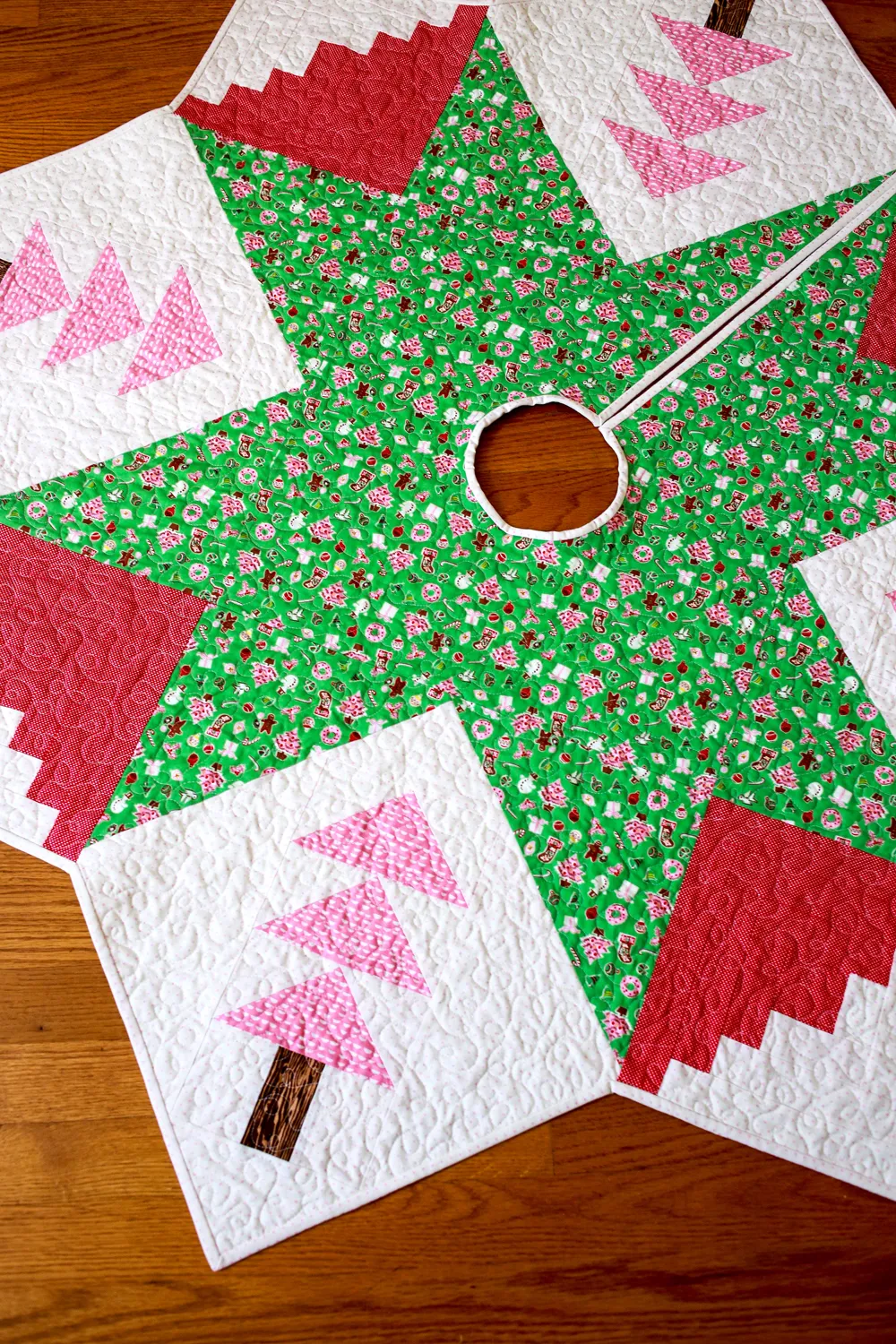
Time: 6 to 9 hours. Cost: $35 to $65, depending on how much of that green fabric you already own.
Pink trees on a Christmas skirt should not work, and they’re the best thing here. Those little appliquéd trees in soft pink are what keep the green and red from feeling like a catalog page — they add a note nobody expects, and they make the white sections look like snow at dusk instead of paper. Take them away and you have a perfectly nice, perfectly forgettable star skirt.
19. Braided Jute With a Fringe Border
Jute and raffia shed, and fringe catches on everything — tree stand legs, gift ribbon, vacuum brushes, cat claws. Shake it out rather than vacuuming, and spot-clean with a barely damp cloth; water makes natural fiber release dye and warp. Expect some flattening by the end of December. It’s a natural material, it will look a little lived-in, and that is the look.
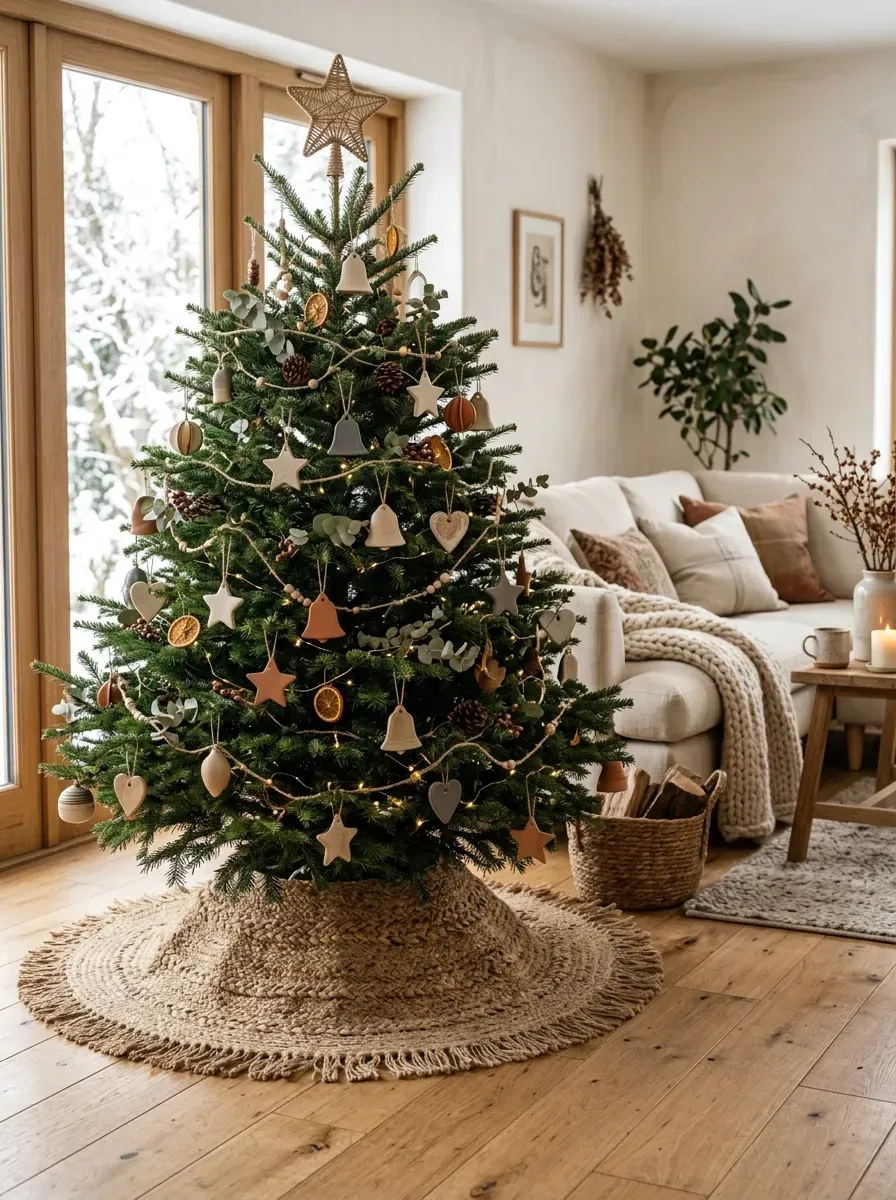
- Woven jute or raffia tree skirt: $55–$120
- Natural fiber ornaments and dried citrus: $20–$45
- Neutral linen ribbon: $8–$18
- Woven basket for tree-side storage: $25–$50
Total: $108–$233. Budget alternative: a large round jute rug, $20–$35 at most home stores, with a circle cut from the center makes a nearly identical skirt — the fringe is already there.
- Measure your tree stand’s widest point before buying anything.
- Cut the center opening one inch smaller than that measurement.
- Seal any cut jute ends with clear craft glue so they stop unraveling.
- Lay it flat for 24 hours so the weave relaxes out of its shipping folds.
- Add a hidden tie at the slit so it stays closed around the trunk.
20. Plaid Wedges and a Striped Ruffle
Patchwork plaid wedges plus a ruffled border need a mid-size tree — 6 to 7 feet — and a floor that isn’t already busy. Set this on plain wood or a flat-weave rug. Over a patterned carpet the wedges and the carpet start negotiating and neither wins. Give it 42 inches of diameter and you’ll still have room for gifts without burying the ruffle completely.
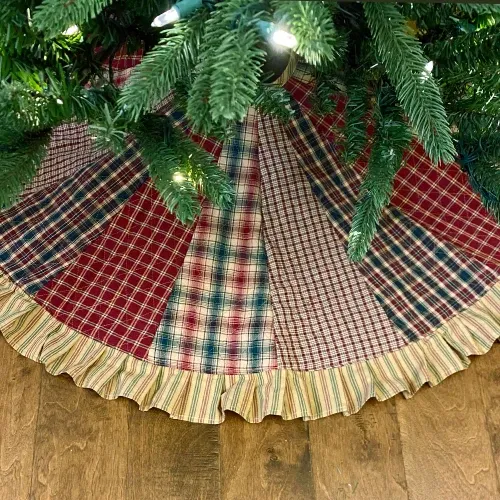
Four plaid patterns, one color family. That’s the formula: choose plaids that all contain red, then vary the scale — a large tartan, a medium check, a small gingham, a mini houndstooth. The ruffled border should be a stripe, not a fifth plaid, or the whole thing becomes a tartan explosion. Compare with Idea #8 — same ruffle idea, much quieter skirt.
21. Sloths in Scarves, Dots, and Gold Buttons
Novelty-print panels are where quilt shops make their money — a single licensed print can run $12 a fat quarter. Buy a half yard of your character print and pair it with a solid green you already have, then let the print be four wedges out of twelve instead of eight. Same wink, a third of the cost, and the solid panels give the eye somewhere to rest between sloths.
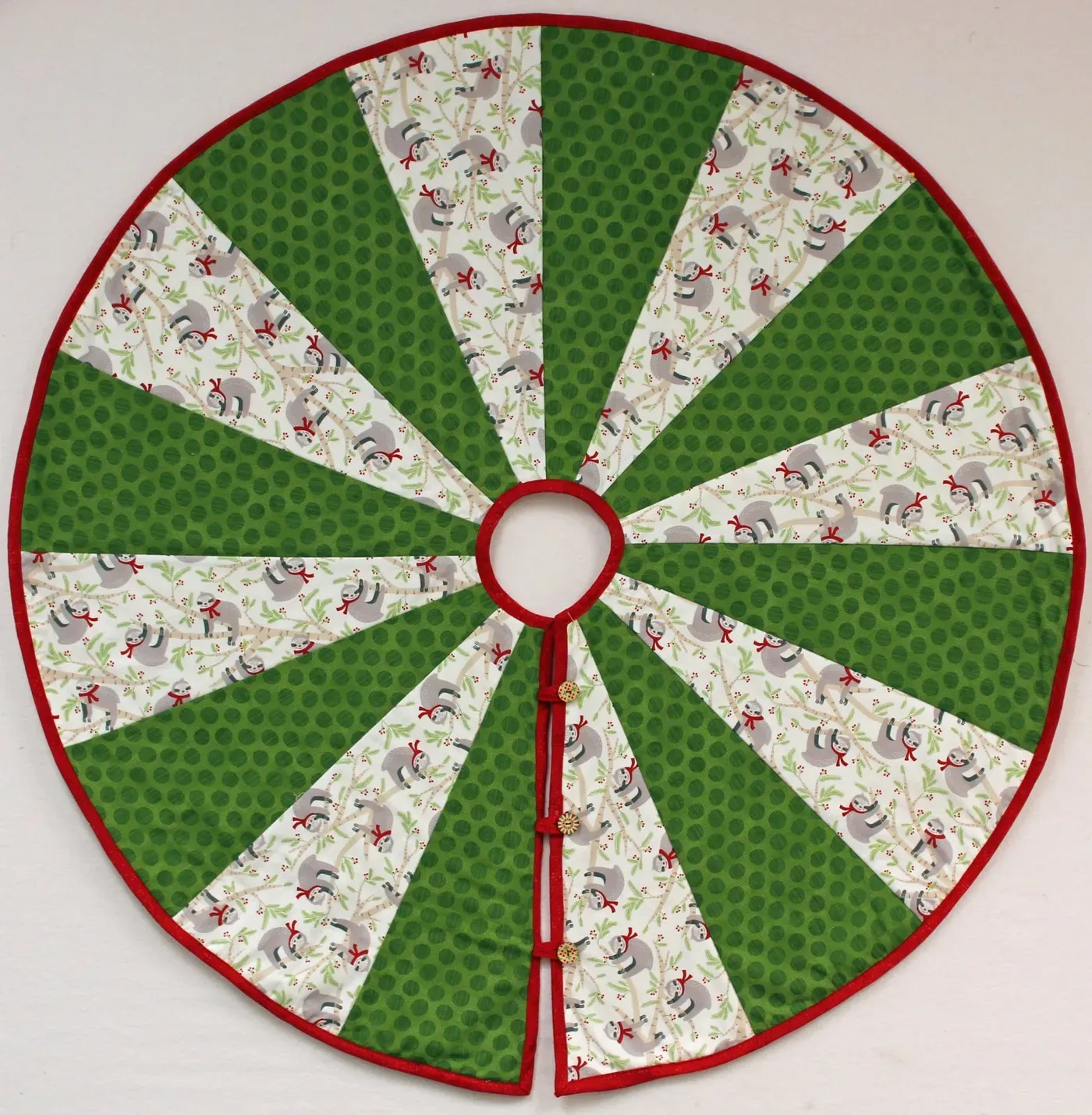
One honest warning: character-print Christmas fabric is a one-season purchase. It’s charming in December and it’s clutter by February, and it will not age into an heirloom the way a red-and-cream patchwork will. If you want a novelty skirt, treat it as seasonal decor rather than an investment, and don’t spend heirloom money on it.
Use the three-button closure the way it’s meant to be used. Buttons with fabric loops at the center opening aren’t decorative — they let you open the skirt without dragging it over the tree, which matters when you’re wrestling a nine-pound stand at ten o’clock at night. Space them at 10, 2, and 6 o’clock, and make the loops from bias tape so they don’t stretch out.
22. Scottie Dogs in Plaid Coats
The Scottie dogs are the only reason anyone remembers this skirt, and it’s because they’re appliquéd rather than printed. Those little raised bodies in plaid coats catch the tree lights at a different angle than the flat cotton around them, so they register as objects instead of pattern. If you’re making one, appliqué the dogs with fusible web plus a blanket stitch and don’t worry about matching the coats to anything — mismatched plaid is better.
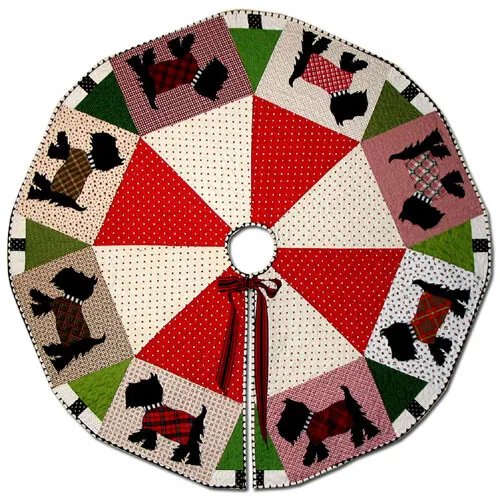
Polka dots in the center, patchwork and appliqué around the edge — the design is running a controlled density gradient. The middle stays calm because that’s where the trunk and stand live; the outer ring carries all the detail where you actually see it from the doorway. Add a red-and-white ribbon tie and the whole thing picks up a gift-wrap logic that makes it feel finished rather than assembled.
23. Floral Reds, Cream Ground, One Tassel
A single tassel on a patchwork skirt tells the eye where the opening is. It’s an old quilt trick: one asymmetrical detail marks the functional seam so the pattern doesn’t read as a closed circle, and it saves you from hunting for the slit while holding an armful of gifts. One is enough. Two makes it look like a curtain.
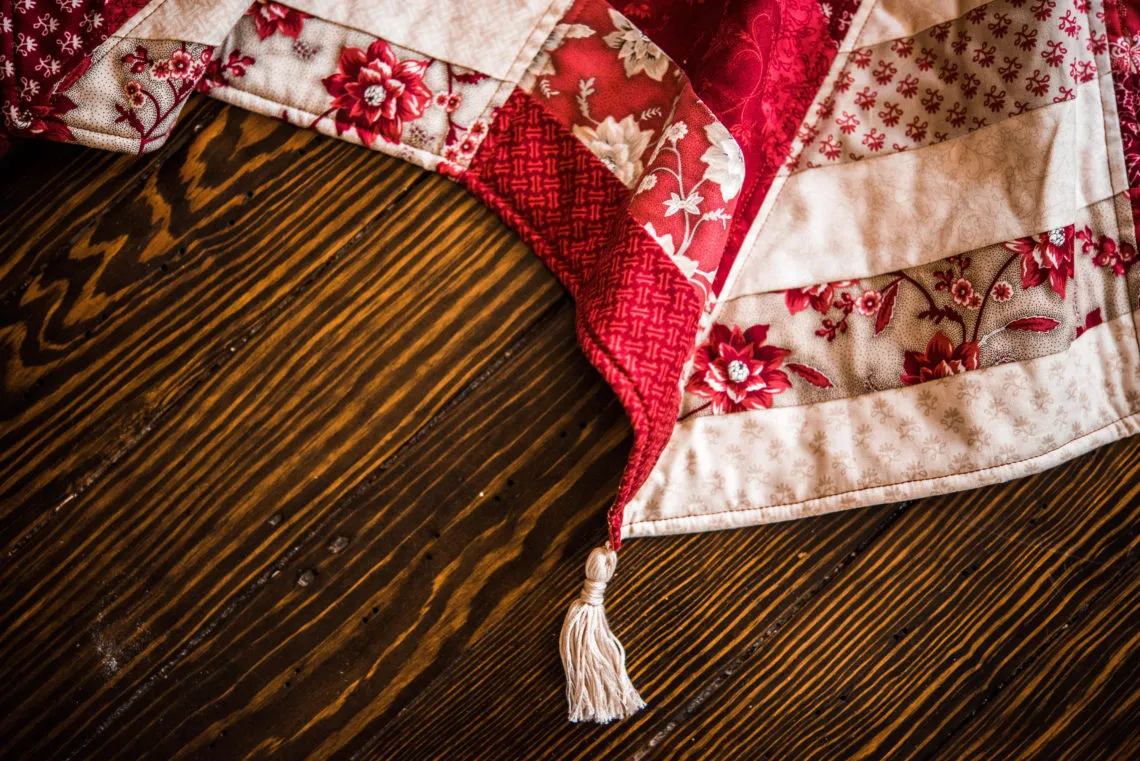
Red-and-cream floral patchwork at this density works best small — 30 to 36 inches across — under a slim tree or a tabletop display. On a full 7-foot tree those fine floral prints get lost at three paces and you’ve paid for detail nobody can see. If you want this pattern on a big tree, scale the patches up to four inches square minimum.
- Floral patchwork quilted skirt: $60–$145
- Yarn tassels or one premade cream tassel: $3–$9
- Remnant floral cottons, half yard each of four prints: $24–$48
- Batting and backing: $16–$30
Total: $103–$232. Budget alternative: a vintage quilt top from a flea market, cut and re-bound, runs $20–$45 and arrives with the fading already done for you.
24. Appliquéd Trees Ringing a Quilted White Field
- Cut an octagon base from white cotton, plus backing and batting.
- Cut eight green tree appliqués and press the edges under a quarter inch.
- Fuse and stitch one tree per side, radiating outward, then add a small gold star to each.
- Quilt swirls and snowflakes across the white background in contrasting thread.
- Set in the red patterned wedge panels, then bind the outer edge in green.
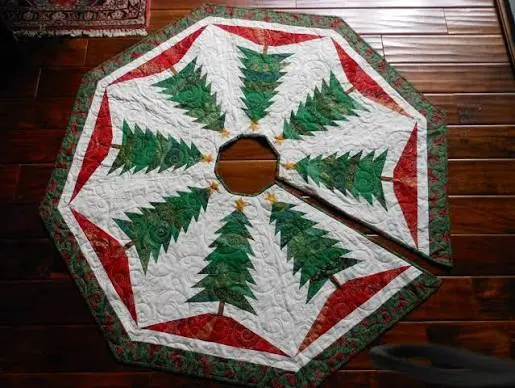
Time: 9 to 13 hours. Cost: $40 to $75. The quilting is the part nobody sees in photos and everybody feels in person.
85% white and cream, 10% red wedge panels, 5% green and gold. That’s an unusually lopsided ratio, and it’s exactly why this skirt reads as elegant instead of busy. The whites carry the quilting texture, the red panels add rhythm at the edge, the green trees supply the theme. Flip the ratio and you get a much louder, much more ordinary skirt.
White quilting plus a real tree equals sap and needle stains. Keep a lint roller by the tree and lift needles before they grind in. If something does stain, cold water and a drop of dish soap, blotted, never rubbed. Store white cotton away from cardboard boxes — the acid in cardboard yellows fabric over a few seasons.
25. Braided Chevron Segments, Tied Together
The braided ties are the detail worth copying. Each segment joins with a braid in the same colors as the chevron it meets, so the joints look like part of the design instead of a seam that had to happen. Braid three 18-inch lengths of each color, whip the ends, and use them to tie the segments together. Twenty minutes of work, and it’s the difference between a craft project and a piece.
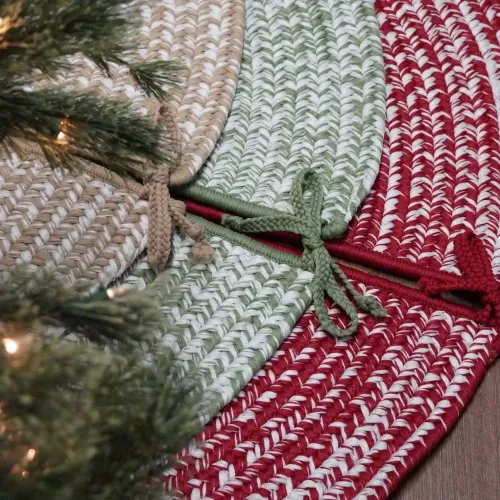
Braided segments don’t lie flat the way a single quilted circle does. You’ll get gentle bumps where the ties sit, and on a glossy floor you’ll see every one. That’s fine — it’s a handmade textile, not a printed disc. Just don’t try to press them flat with an iron, because braid takes a crease and keeps it forever.
Two-tone chevron braid reads best when the pale half is genuinely pale. If your beige sits too close to your white, the chevron turns to mush and the braid just looks fuzzy. Aim for at least four shades of contrast between the two tones, and repeat the same pairing on all three segments so the skirt looks intentional. Compare with Idea #19 for the natural-fiber version of this idea.
26. French Bulldogs in Tiny Scarves
Pet-portrait decor went from kitschy to genuinely collected over the past few years, and now it’s landed in holiday textiles. Scalloped edges belong to the same story — they soften an otherwise traditional skirt and read as slightly vintage. This is the kind of piece that gets photographed at a family Christmas and then asked about for years, which is a different sort of value than ‘trendy.’
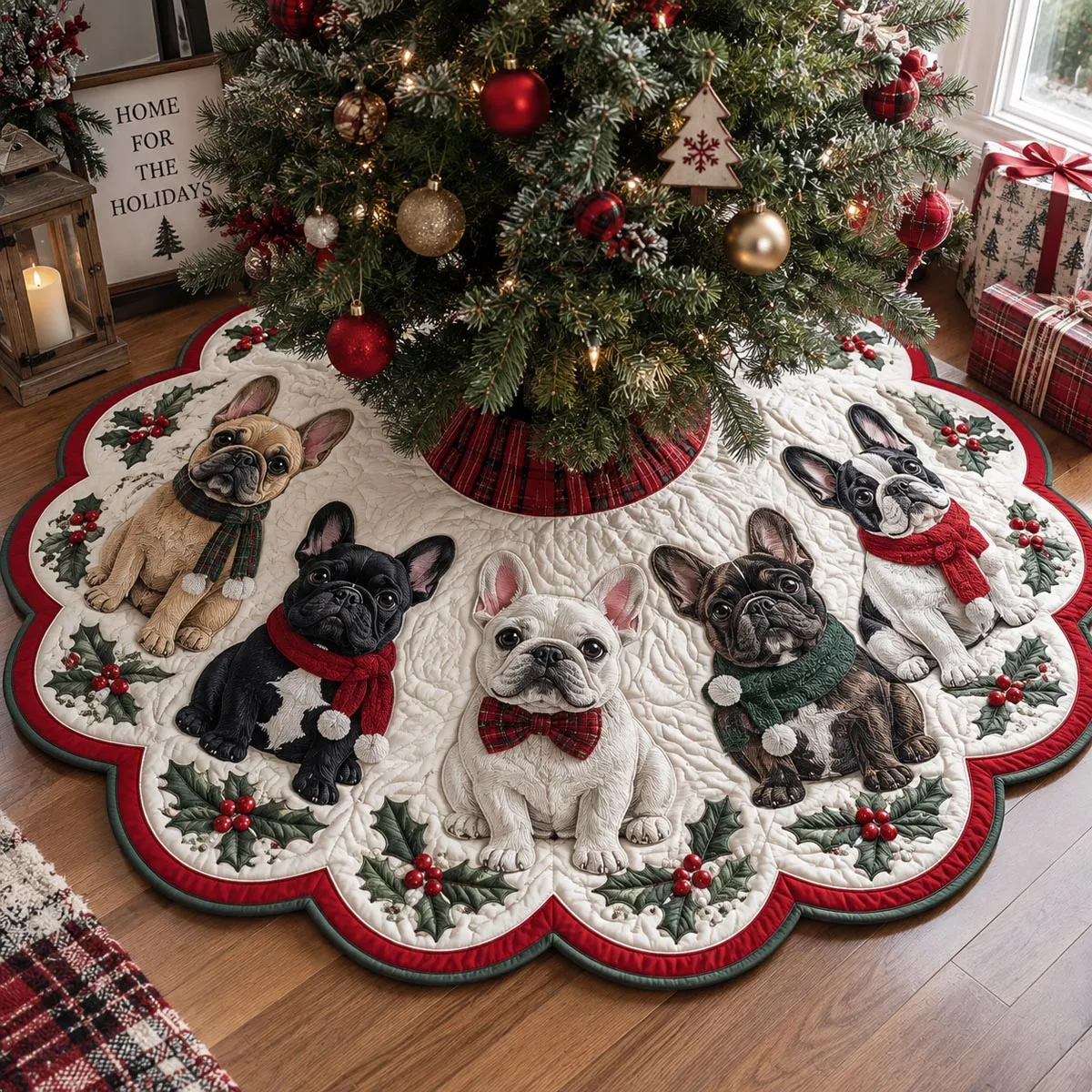
Off-white quilting, a scalloped edge, and raised dog appliqués — three levels of texture, no pattern competition whatsoever. The holly and berries are embroidered rather than printed, so they add shine without adding a fourth print to read. And the red plaid tree collar above is the only real pattern in the scene, which lets the dogs stay the star.
Custom pet appliqué is a $150-and-up project if you commission it. Do it yourself for around $45: a plain off-white quilted skirt from a home store, a pack of fusible web, and a printed fabric with the right silhouette. Trace, fuse, blanket-stitch by hand in front of a movie. The scalloped border is the only part worth paying for.
27. Hexagon Patchwork on a Small-Tree Square
- Measure your tree’s lowest branch spread — the skirt should extend 4 to 6 inches past it.
- Check the center opening clears your stand’s pole collar with a little room to spare.
- Confirm your tree’s weight; a heavy stand will drag a lightweight quilted square off-center.
- Look at the floor surface — on concrete or tile, add a thin pad so the quilting doesn’t pick up grit.
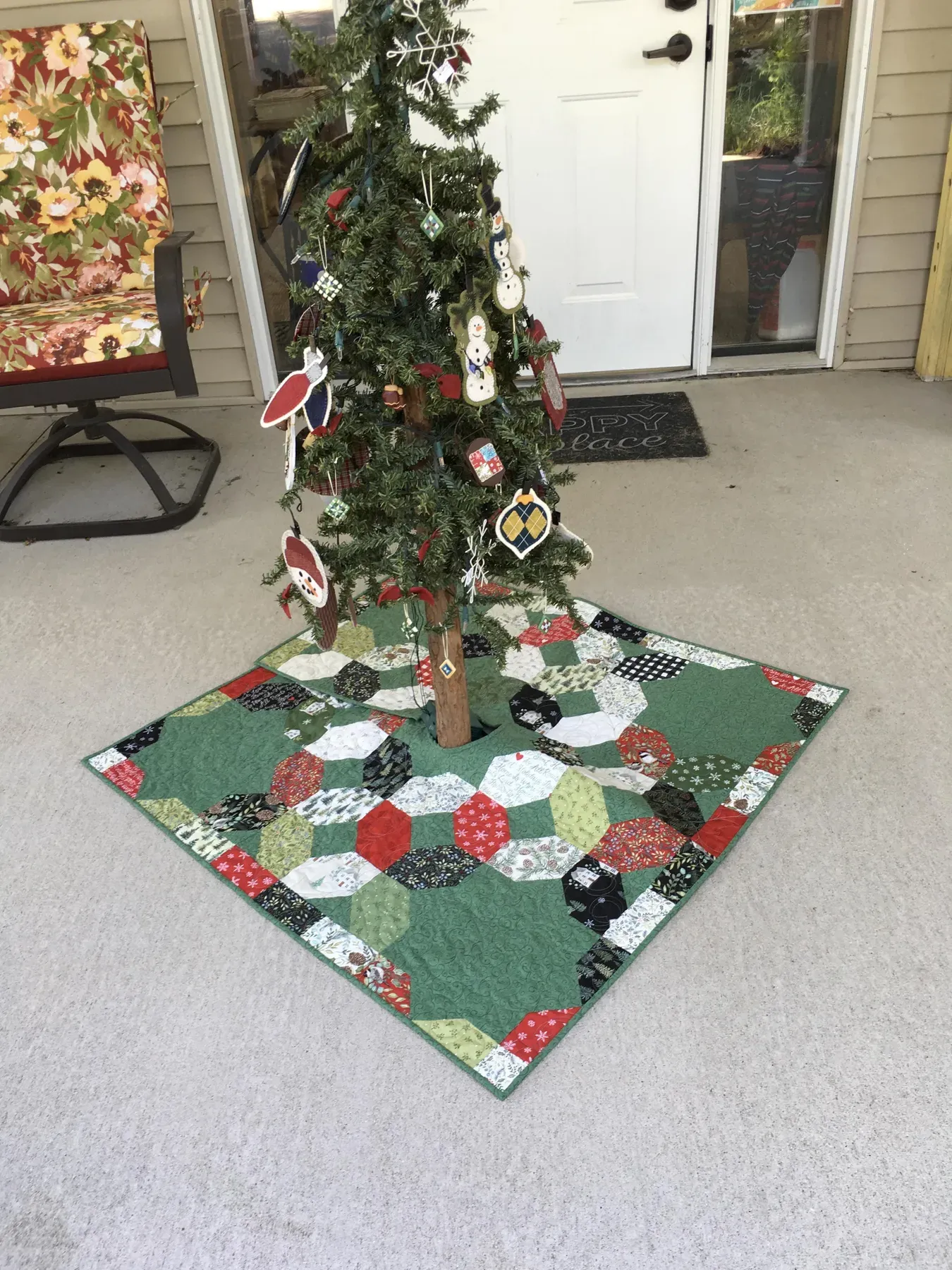
A square skirt is the right shape for a small tree — 4 to 5 feet, tabletop or entryway scale — because the corners keep the footprint looking bigger than a circle without taking up more actual room. Under a full-size tree it simply disappears. Hexagon patchwork with swirling stitch lines and a green binding reads as scrap-quilt tradition, and the handmade felt ornaments above it finish the story.
28. Navy Plush With a Faux Fur Border
Faux fur on a plush skirt works because the two piles fight each other slightly — velvet reflects light, fur absorbs it. Keep the fur border at least four inches wide, and sew it so the pile faces down toward the floor. Facing up, it collects every needle in the room; facing down, it sheds clean and looks like a snowdrift that arrived on purpose.
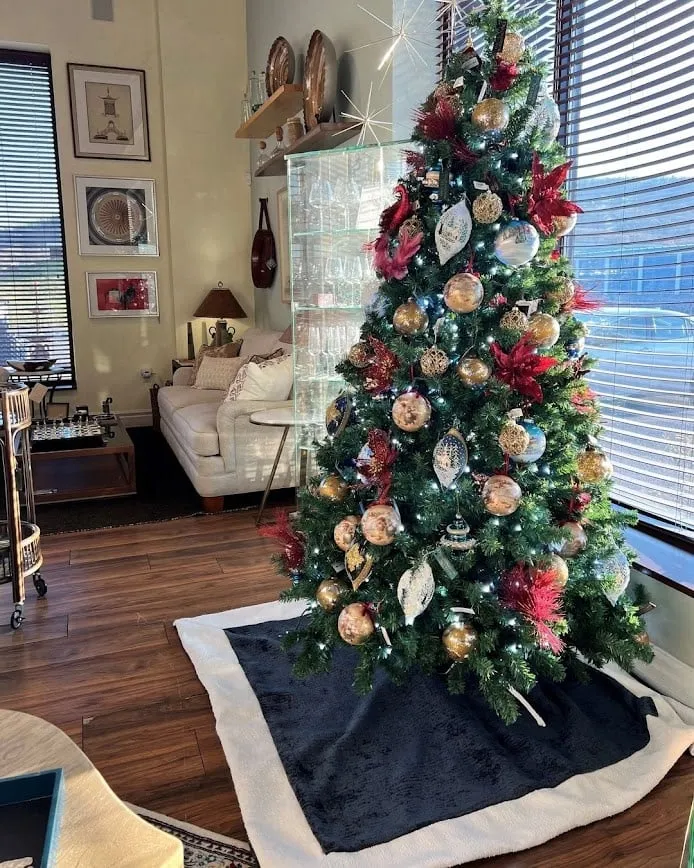
Velvet plus faux fur sounds expensive and mostly isn’t. A velvet curtain panel from a discount store costs $25 to $40 and yields enough fabric for a 40-inch skirt; a faux fur throw is $20 to $35 and gives you the border plus a couple of pillow covers. Under $80 for a look that reads like $300, especially under warm lights. It’s the plush cousin of Idea #4‘s cream quilted fur skirt.
Navy is the most underrated Christmas color, and this is why: it makes gold ornaments look expensive and white fur look like snow rather than trim. Against dark wood flooring the whole base disappears into shadow and the tree seems to float. Swap the navy for red and the same skirt becomes cheerful instead of quietly luxurious — same construction, completely different room.
29. Snowmen Grinning on Navy Quilting
- Check whether your tree sits in a corner — a semi-circle only works if one side is against a wall.
- Measure the straight edge and add two inches so gifts can actually sit on the fabric.
- Confirm print direction: snowmen should face the room, not the wall.
- Plan storage — semi-circles fold flat, which is exactly why small homes love them.
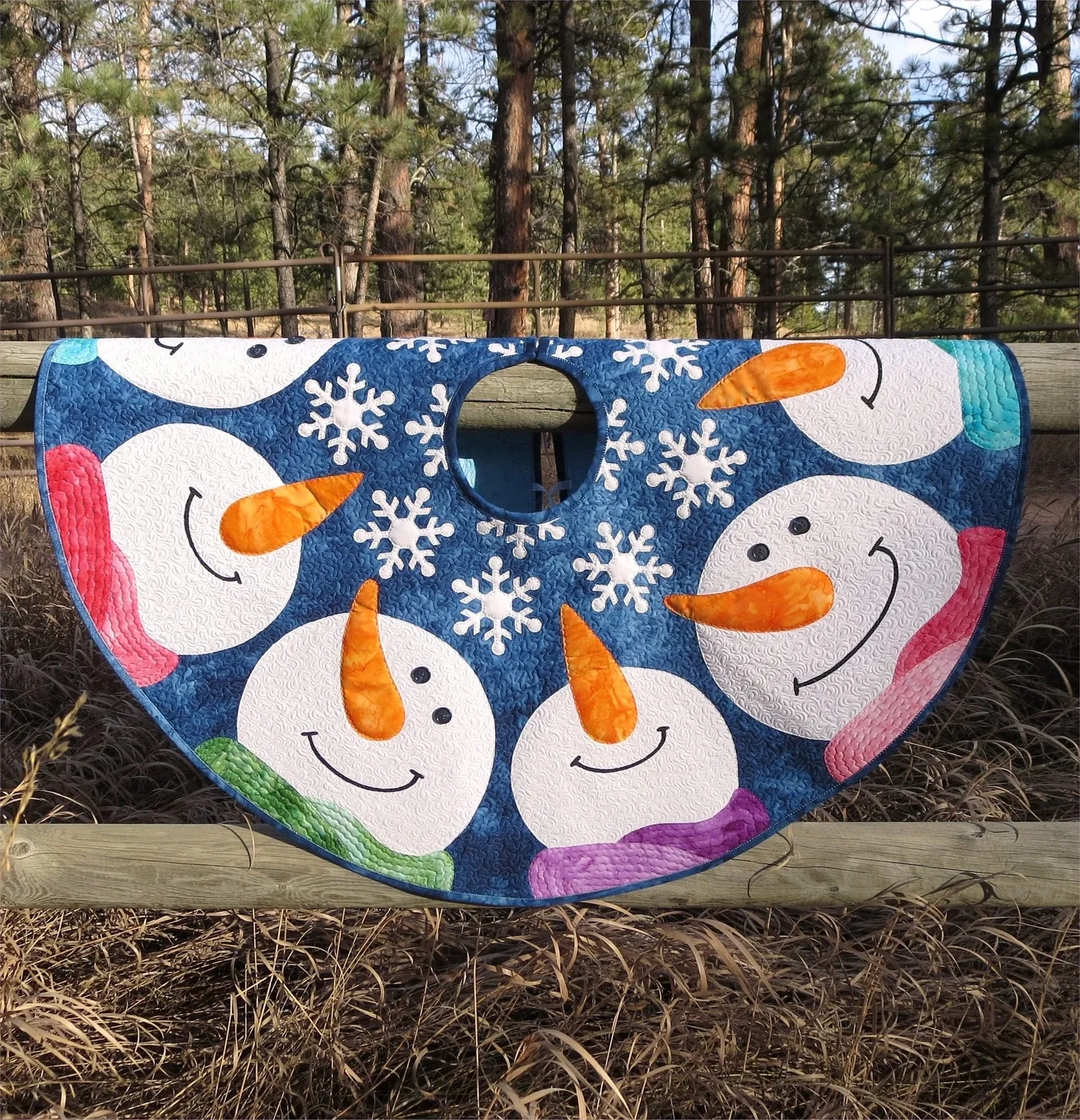
Dark blue quilting hides almost everything except pet hair and powdered sugar, both of which show up like fresh snow. Keep a lint roller in the same drawer as the gift wrap. The white snowman sections are the fragile part — spot-clean only, cold water, blot don’t rub. And store it out of direct sun; blue cotton is one of the faster-fading dyes in the business.
Those carrot noses are embroidered in orange, not appliquéd, and it’s a tiny choice with a big payoff. Embroidered noses catch a glint from the tree lights and give each snowman dimension, where appliqué would have looked like a sticker. It’s also more durable — an orange fabric nose on a floor-level textile is going to get crushed by a gift bag sooner or later. For a full-circle alternative with the same sense of humor, see Idea #15.
Your Tree Base Deserves Better Than a Burlap Sack
Start with one measurement — your stand and your lowest branches — and the rest of these decisions get dramatically easier. Whether you go handmade heirloom or $28 clearance find, a quilted skirt with real stitching does something printed fabric never will: it makes the bottom six inches of your tree look like somebody cared. 📌 Pin your favorites now, so next December you’re decorating instead of scrolling.