
You know the feeling: you’ve saved forty tree photos, you’ve committed to red velvet this year, and then you’re standing in a store aisle holding a plastic ball wondering how anyone makes this look expensive.
We spent real time digging through Etsy, World Market, Target, Anthropologie and Walmart listings — plus a lot of very good small-shop finds — to narrow this down to 29 ideas actually worth your ribbon budget. Everything here runs from about $12 to $180.
Inside you’ll find traditional red-and-gold, jewel-tone burgundy, rustic brown-and-twine, and a little whimsical pastel, with budget and luxury versions of the same look compared side by side. And stay until the end — we break down the most common mistakes that can ruin these looks.
Deep, saturated velvet is the ornament story of 2026. Pinterest searches for burgundy and black velvet baubles climbed again this fall, and designers keep reaching for texture over glitter. 📌 Save this to Pinterest for later — you’ll want to revisit these ideas.
1. Traditional Red and Gold Velvet Tree with a Flocked Wreath
Three things hold this tree together, and none of them is the ornament count. First, a ruthlessly tight palette — red, gold, forest green — repeated in the ornaments, the gift wrap, and the wreath so nothing feels random. Second, a texture contrast between matte velvet and high-shine glitter, which keeps the eye traveling instead of resting. Third, the gold beaded garland running vertically, which gives the whole thing a spine.
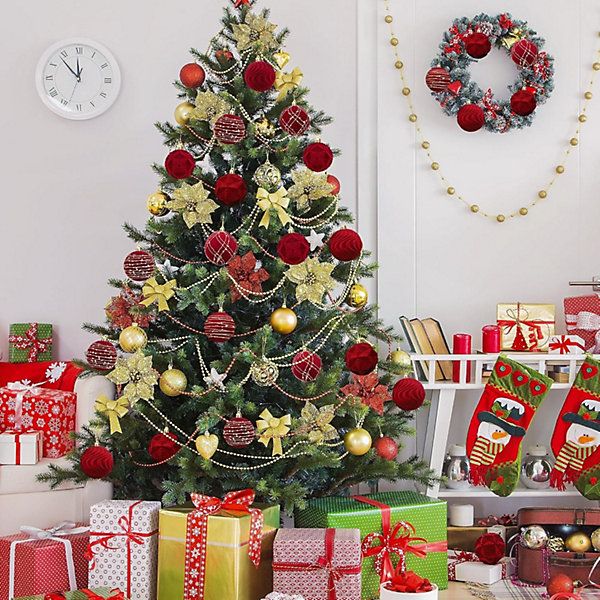
Here’s roughly what it costs to build this look from scratch, assuming you already own a stand and lights.
- 7.5 ft artificial tree: $120–$400
- Red velvet ball ornaments, 50-count: $45–$110
- Gold glitter poinsettias and bows: $25–$70
- Gold beaded garland: $15–$45
- Flocked wreath plus red velvet mini ornaments: $45–$130
- Wrapping paper, ribbon, tags: $20–$50
Total: $270–$805. Budget alternative: skip the glitter poinsettias and tie gold satin ribbon bows yourself, and buy velvet balls in a bulk 60-count set. Same read, $150–$280.
2. Deep Red Velvet Baubles with Glass Finials and Sequined Poinsettias
Velvet ornaments are heavy and matte, which means they swallow light. For a 7.5 ft tree, budget about 10 ornaments per foot of height — but only 20% of those should be velvet. Put the velvet pieces deep in the branches, where they catch shadow and look plush, and keep the glass and sequined pieces out on the tips where the fairy lights can hit them. You’ll use fewer velvet ornaments and get more drama out of each one.
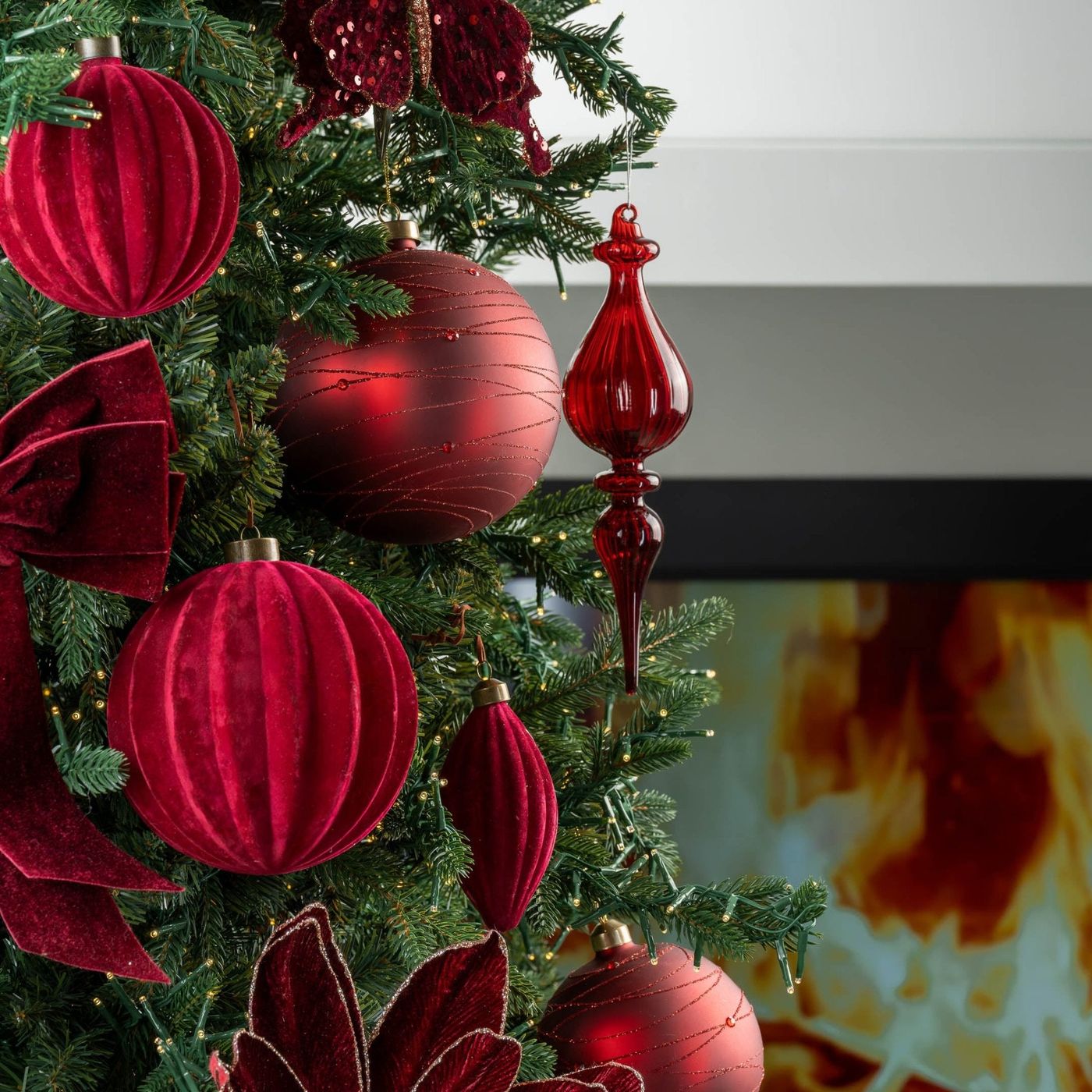
The formula here is roughly 55% deep red velvet — ribbed spheres, bows, sequined poinsettias — plus 25% matte and fluted glass in the same red family, 15% warm white light, and 5% gold. Staying inside one hue is what makes it opulent instead of busy. To swap it, hold the percentages and change the color: 55% emerald velvet, 25% smoke glass, 15% warm light, 5% antique brass is a completely different tree with zero other changes.
3. Plush Red Velvet Stars Hung on Thin Gold Cord
here is restraint — three plush red velvet stars, thin gold cords, and nothing else. No garland, no baubles, no picks. What you’d lose by adding more is the negative space: those bare green stretches between ornaments are what make each star read as an object instead of one more texture. If you’re decorating a small tree or a narrow corner, this is the styling that photographs beautifully and takes twenty minutes.
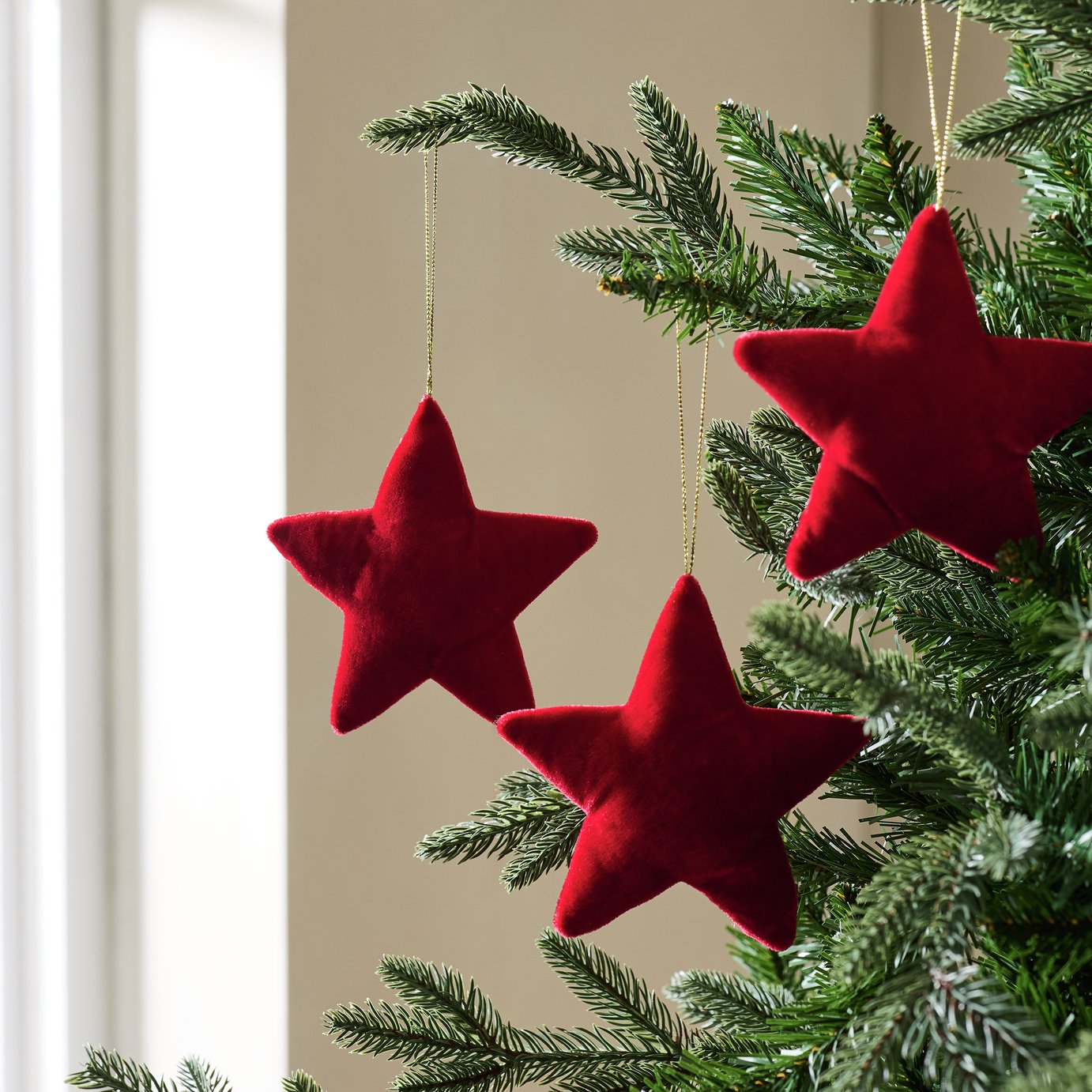
Sparse styling like this works best on trees between 4 and 6.5 feet — big enough to hold three statement ornaments without looking empty, small enough that the gaps stay intentional. In a room under 100 square feet, a 5 ft tree with a handful of velvet stars feels generous. On a 9 ft tree, the identical setup just looks unfinished. Roll it out on a tabletop, a console, or a kids’ room tree.
4. Dark Red Velvet Bow with Rose Gold and Champagne Baubles
You don’t need to spend $40 on a designer velvet bow. A yard of dark red velvet ribbon from Michaels or Joann runs $8–$12 and makes two bows with tails to spare. Rose gold and champagne baubles? Target’s Threshold line sells a 20-piece mixed set for about $15, and Walmart’s holiday aisle has matte blush spheres around $9 a box. Thrift stores are the sleeper: older glass ornaments in pale pink and gold turn up constantly for a quarter apiece, and those are the ones that actually sparkle. Same deep-red instinct as Idea #1, softer metals instead of gold glitter.
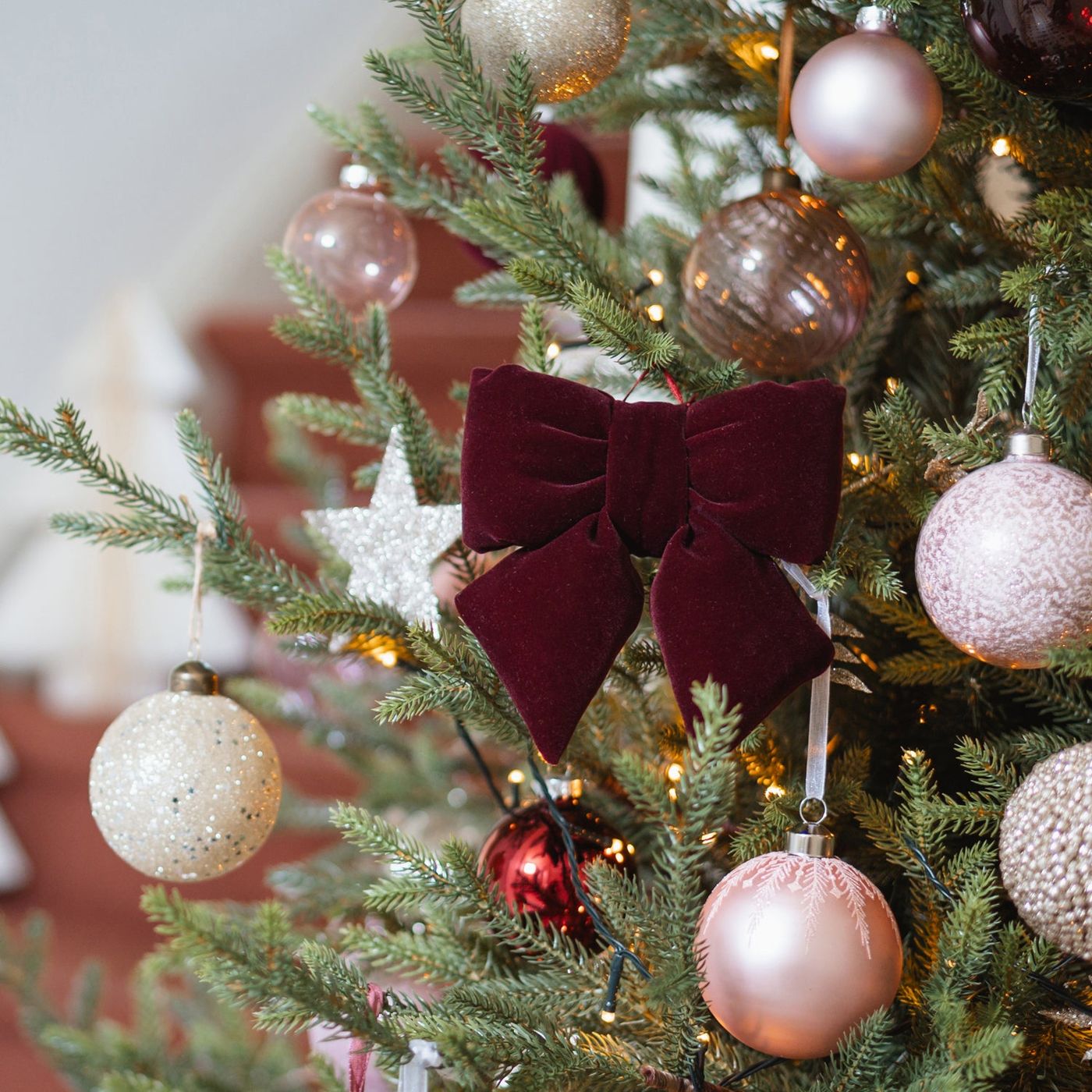
Pale pink next to deep red is a narrow tightrope. Under cool white lights, blush ornaments tip toward baby-shower pink and the branch loses its richness — the red stops looking like velvet and starts looking like plastic. Stick to warm white or amber fairy lights here, and keep the pale pieces in the minority, one in five at most. If your tree sits near a north-facing window with no lamp nearby, preview this one before you commit.
5. White Glitter Velvet Bloom Tucked Into Fir Branches
White ornaments on a green tree almost always look flat, because they’re competing with the lights on the surface. Push them in. Nestle each white velvet bloom so its face sits roughly two inches behind the outer tips — the surrounding needles then frame it like a shadow box, and the warm lights behind it create a halo. Same ornament, three times the depth. It also hides any glitter shedding, which these blooms do plenty of.
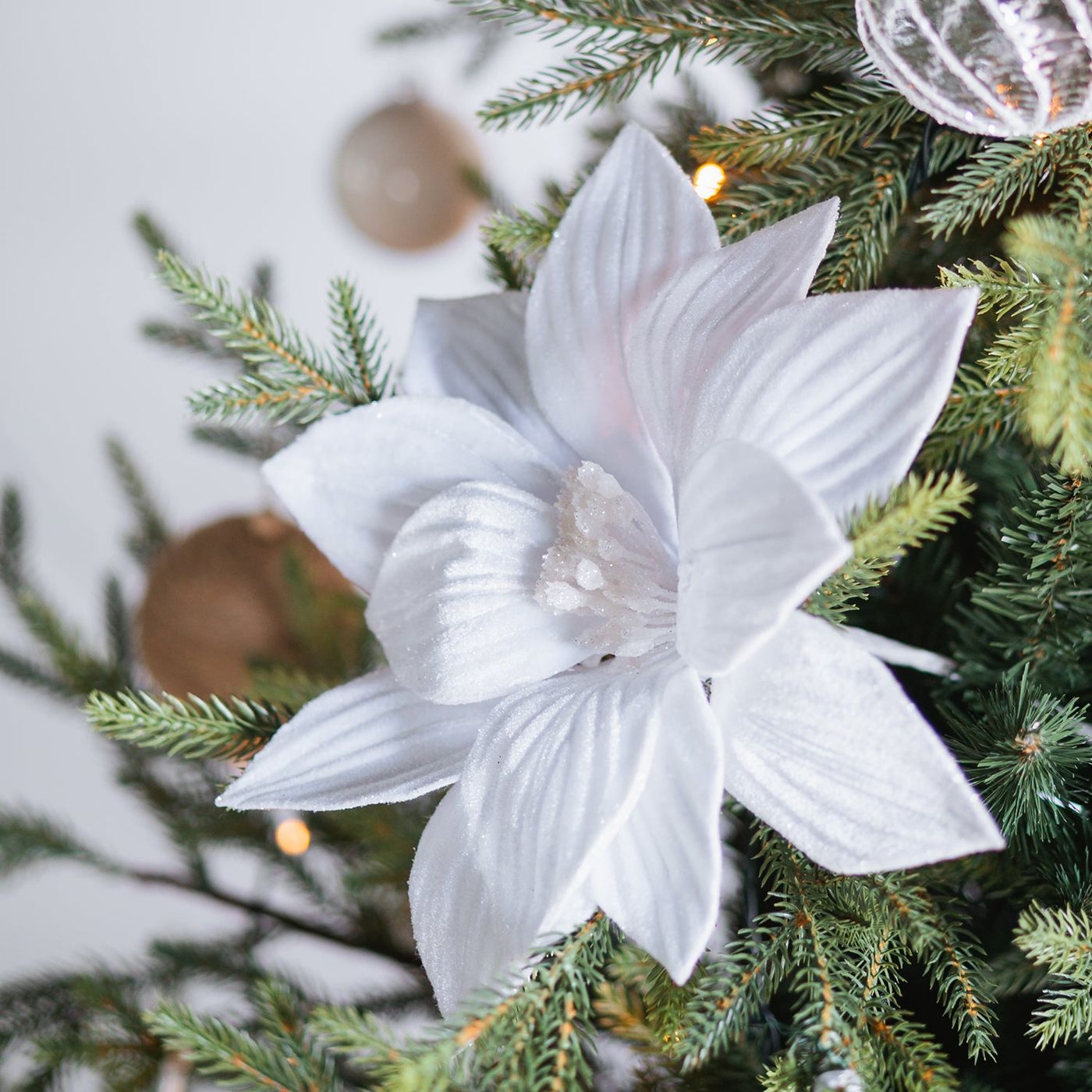
This is a value-contrast play. White against forest green is the highest-contrast pairing on this whole list — value is how light or dark something is, not its color — and the eye snaps to that contrast before it notices anything else. Because the bloom is the only white object on the branch, it reads as a focal point without being bigger or shinier than anything around it. Change the white to red and the same placement disappears entirely.
6. Deep Red Velvet Wreath and Bell Ornaments with Gold Beadwork
Bead-embellished velvet is having a moment it hasn’t had since about 1994. Blame the collective pull toward inherited-looking decorating — hand-beaded trim, wreath and bell silhouettes, ornaments that look like they came out of a grandmother’s attic in the best way. Velvet searches have climbed on Pinterest for three seasons running, and beadwork over glitter is what’s separating 2026 trees from the ones that read as last decade. It has staying power because it’s a craft look, not a color trend.
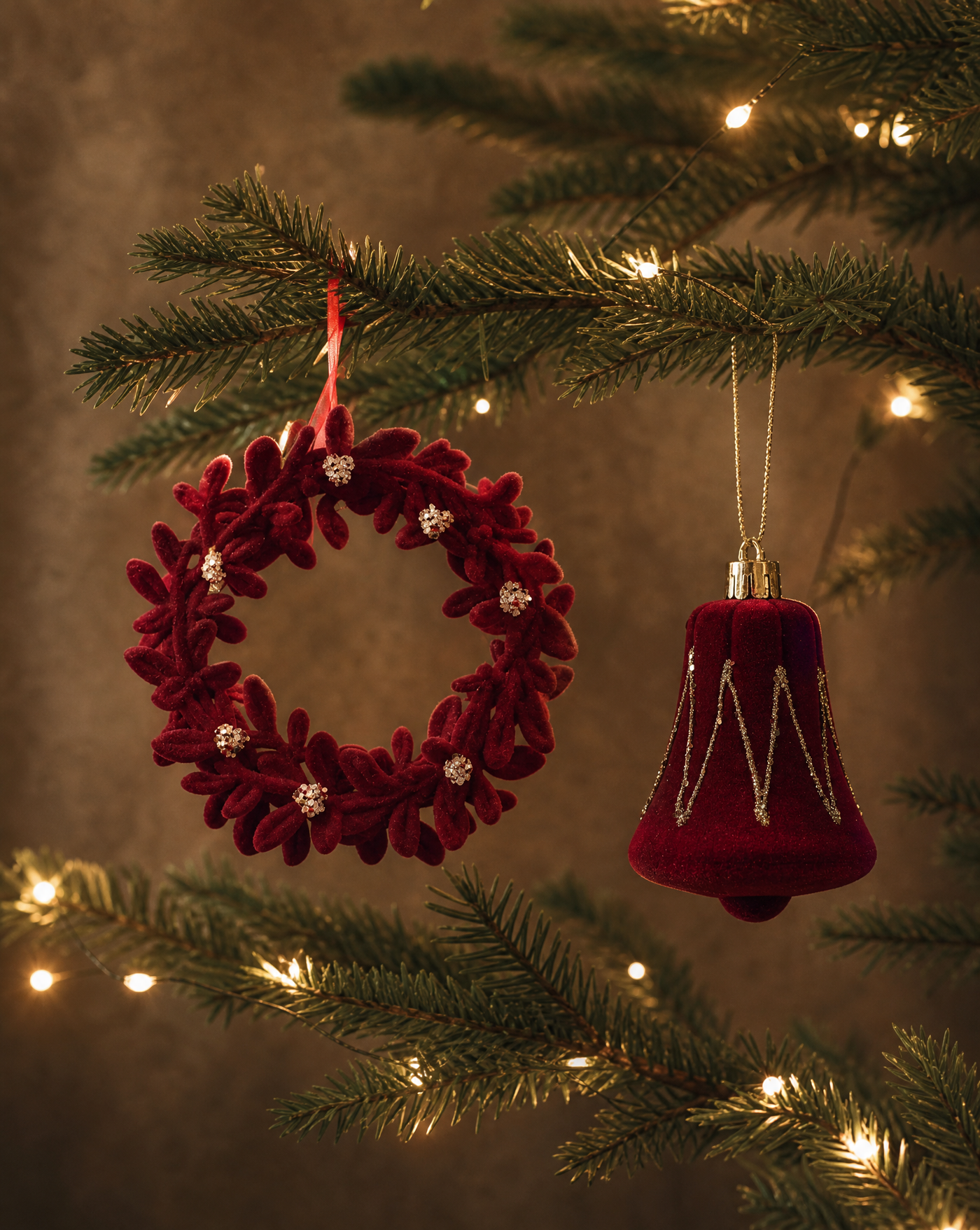
The element that makes these two work is the beadwork — small gold and clear beads tracing the outline of the wreath and the bell. Strip that away and you have two dark red shapes on a dark green tree, essentially invisible from across the room. The beads catch the fairy lights and lift the silhouette off the branches. If you’re buying embellished velvet, look for beadwork that follows the shape rather than glitter sprayed across the surface.
7. Red and Green Velvet Baubles Arranged on a Woven Mat
Read this tray as a color formula: 50% deep red velvet plus 30% forest green velvet, 15% gold caps and stems, and 5% natural tan from the woven mat and the pinecone. Two saturated colors, one metal, one earthy neutral — that’s the whole thing. It’s a formula you can rotate by season without buying anything new. Swap red for copper and green for oatmeal velvet and you have a Thanksgiving centerpiece from the same ornaments.
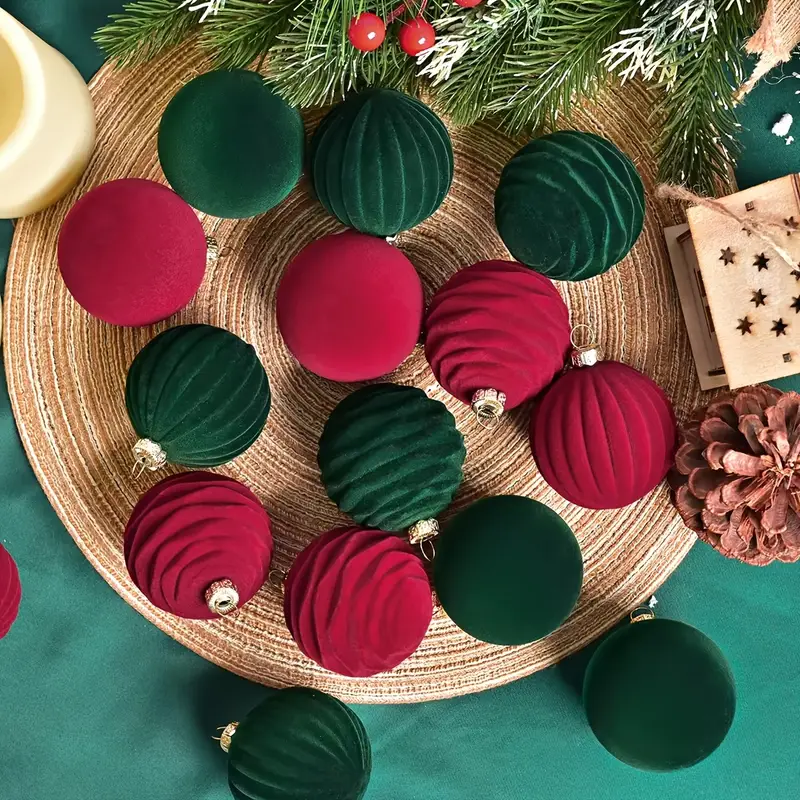
Velvet is a magnet for dust and a sponge for fingerprints, and crushed pile never fully recovers. Store these in a lidded bin with tissue between layers, never in a vacuum-sealed bag, because compression flattens the nap permanently. A lint roller handles surface dust and a soft toothbrush works on the ribbed styles. Want the same depth with none of the upkeep? Brushed metallic or matte ceramic in the same red and green reads nearly identically from three feet away.
8. Deep Red Velvet Balls Paired with Burlap Chevron Bows
Burlap bows on a velvet tree — here’s the sequence that keeps it from looking like a craft fair.
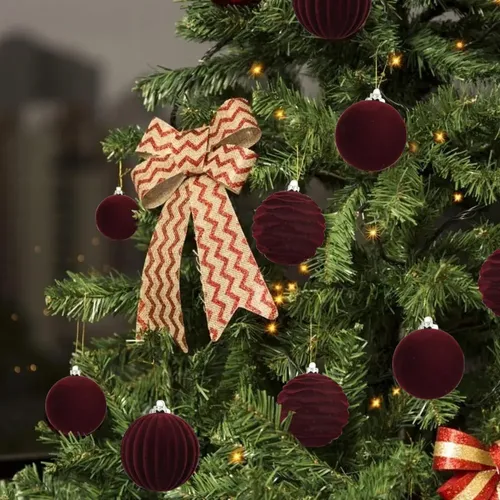
- Wire the bow: cut 24 inches of 2-inch burlap ribbon, fold four loops, twist floral wire around the center.
- Trim the tails into a 6-inch V notch so they don’t dangle past the branch below.
- Place no more than six bows on a 7 ft tree, never two on the same branch level.
- Set each bow so its center sits on the outer third of the branch — tucked bows vanish.
- Hang a velvet ball right beside each bow so the two textures read as a pair.
Time: about 45 minutes. Materials: roughly $18 for ribbon and wire.
Chevron burlap reads best on trees with some bulk — 7 ft and up, or a 6 ft tree under 9 ft ceilings, where there’s room for the bows to breathe. Below 6 ft, halve the bow count and size the ribbon down to 1.5 inches. In a low-ceiling apartment, a quiet pair of velvet balls will do more for you than bows ever will.
9. Gold-Sequin Red Velvet Snowflakes on Sheer Red Ribbon
Sequined ornaments need light to work, so placement matters more than the ornament itself. Hang every sequin-covered piece out on the tips, never inside the branches — buried sequins just look like a dull patch. Then pick one metal and commit: if your snowflakes have gold sequins, keep the hanging cords, caps, and any ribbon metallic gold. Gold sequins with silver caps isn’t a style choice, it’s a giveaway that the ornaments came from three different sets. True on every tree in this guide.
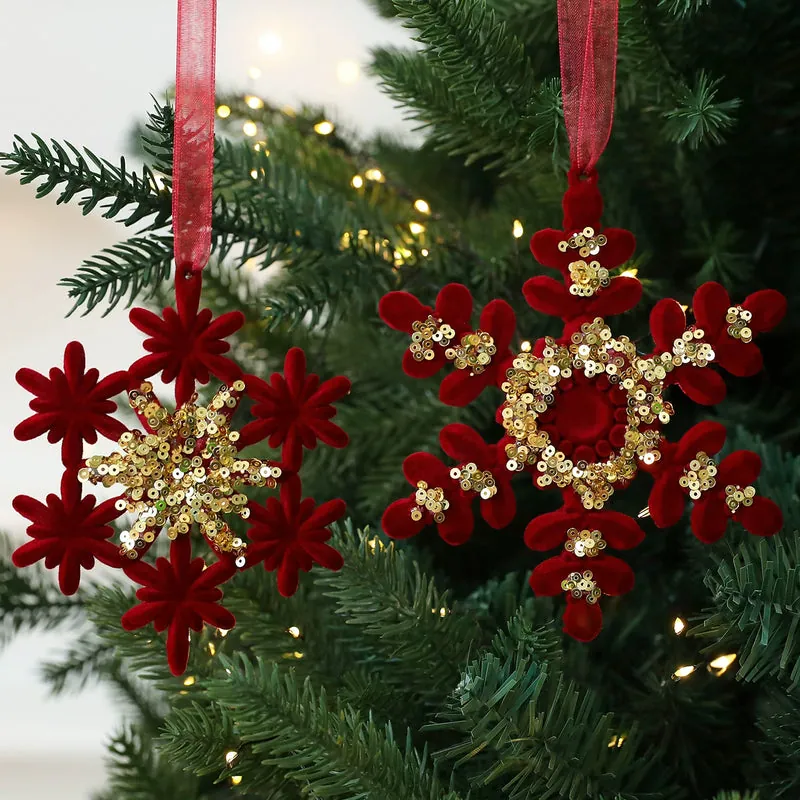
The handmade-looking sequined velvet in Idea #2 has a cheap twin. Dollar Tree carries velvet-finish snowflake ornaments for $1.25 each through November, and a pack of gold sequin trim from Joann ($4) plus craft glue will embellish six plain red velvet balls in about twenty minutes. Check Facebook Marketplace weekly too — full boxes of 1990s bead-and-sequin velvet ornaments turn up for $10–$20, which is genuinely the look this trend is chasing.
10. Two Dark Red Velvet Baubles Alone on a Pine Branch
Two ornaments on a bare branch is a styling trick that only works when the background cooperates. Against a light grey or white wall the velvet pops; against a dark wall or a busy bookshelf the same pair disappears. It also demands a real tree or a very good faux, because sparse styling exposes every bent needle and every visible wire. If your tree is older or on the thin side, this will highlight exactly what you don’t want highlighted.
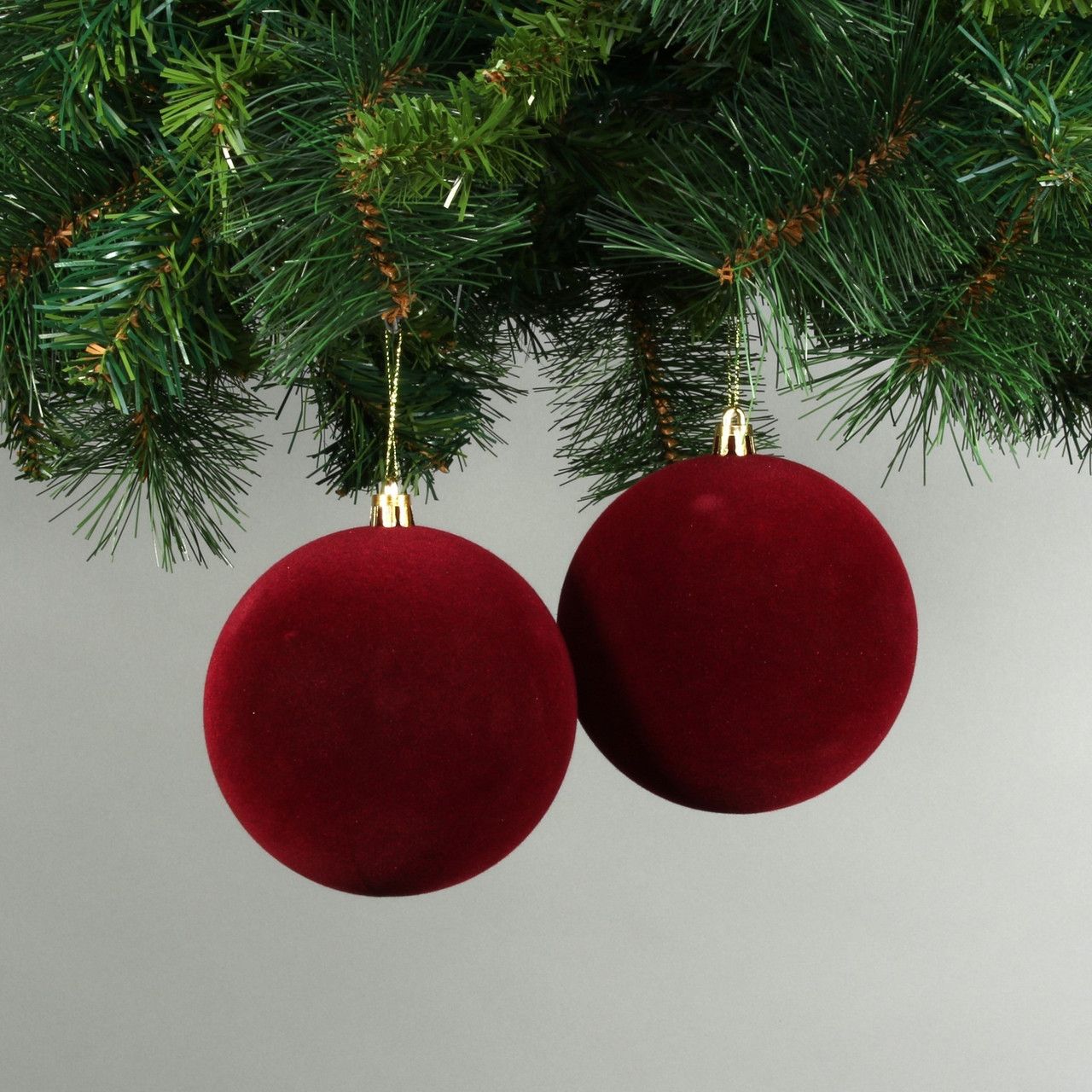
The single element doing the work here is scale. These ornaments are small — roughly the size of a clementine — and they hang alone on an otherwise bare branch, which makes them read like jewelry rather than decoration. Blow them up to five inches and the effect collapses; they become ornaments on a branch like every other ornament on every other tree. Small velvet balls used sparingly are the cheapest way to make a tree look considered.
11. Dark Blue Velvet Tree Ornament with a Wooden Bead Hanger
What makes this little tree shape work is the hanger. A grey cord and one light wood bead turn an ornament into a small object with a point of view — it reads as something made rather than something pulled from a 40-pack. The dark blue velvet also supplies a cool accent against all the red and green, which keeps a traditional tree from feeling one-note. One or two of these tucked among warm reds is plenty.
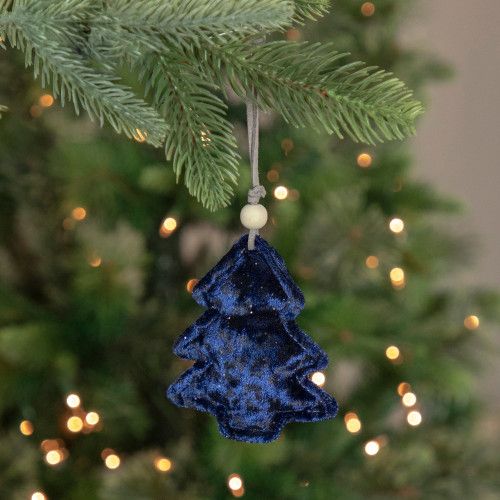
Non-red velvet is the quiet story of 2026. Navy, charcoal, and forest velvet ornaments are showing up alongside the burgundy everywhere, partly because people are styling trees for rooms that already have cool-toned walls, and partly because unexpected beats matched when something gets saved on Pinterest. A navy velvet ornament next to warm white lights photographs like a jewel. Low-risk upgrade: buy two, not twelve.
12. Twelve Red Velvet Ornaments Staged in a Kraft Gift Box
Here’s what this cozy boxed display costs to put together.
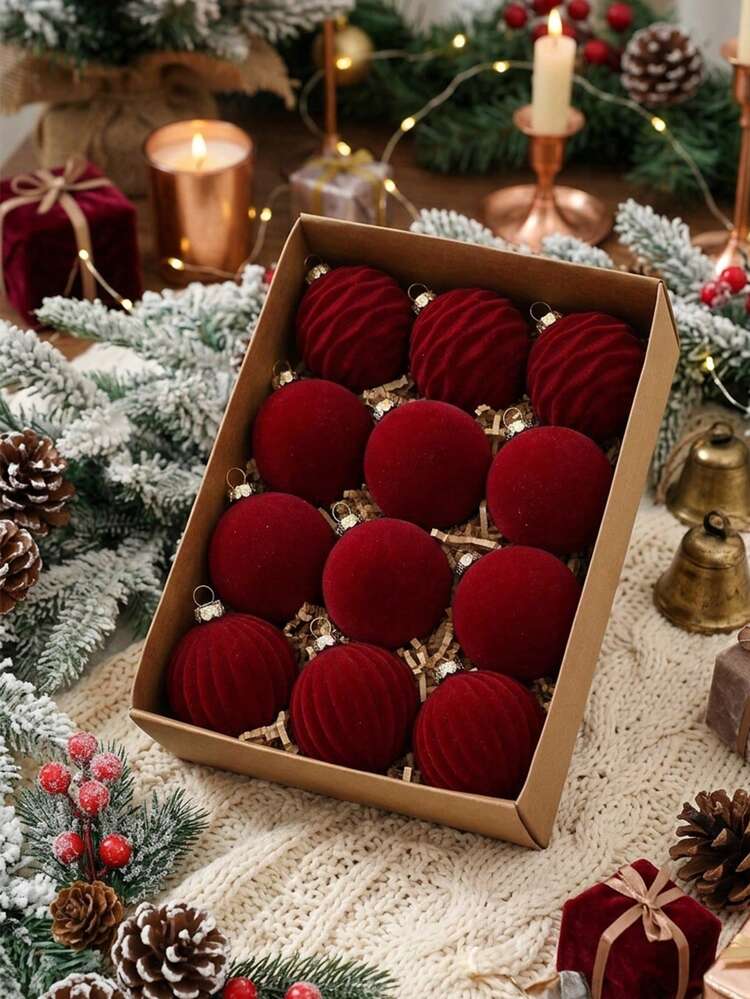
- 12-piece red velvet ornament set: $18–$45
- Kraft gift box or market tray: $5–$14
- Shredded paper filler: $4–$8
- Cream chunky knit throw or runner: $25–$60
- Frosted evergreen picks with berries: $12–$30
- Pillar candles and holders: $10–$25
Total: $74–$182. Budget alternative: skip the knit textile and use a white dish towel or cream linen napkins you already own, then raid the tree for evergreen sprigs instead of buying frosted picks. That drops you to $30–$60 for the ornaments and box alone.
If you’re gifting these, presentation is half the perceived value. Line a kraft box with two sheets of tissue, add a shallow bed of shredded paper, then nestle the ornaments so the caps face outward and no two identical shapes sit side by side. Tuck three evergreen sprigs into the corners. Total cost of the upgrade: about $6, and the box becomes something people keep instead of recycle.
13. Single Brown Velvet Bauble with a Natural Twine Hanger
Rustic brown velvet is unusually scale-forgiving — it works on a 4 ft tabletop tree and a 9 ft foyer tree equally. What changes is the count. On a tabletop tree, four or five brown velvet spheres plus real pine is plenty. On a full-size tree, brown alone goes muddy fast, so keep it to about a quarter of your ornaments and pair it with cream and deep green. Rooms with warm wood floors and beige walls are its natural home.
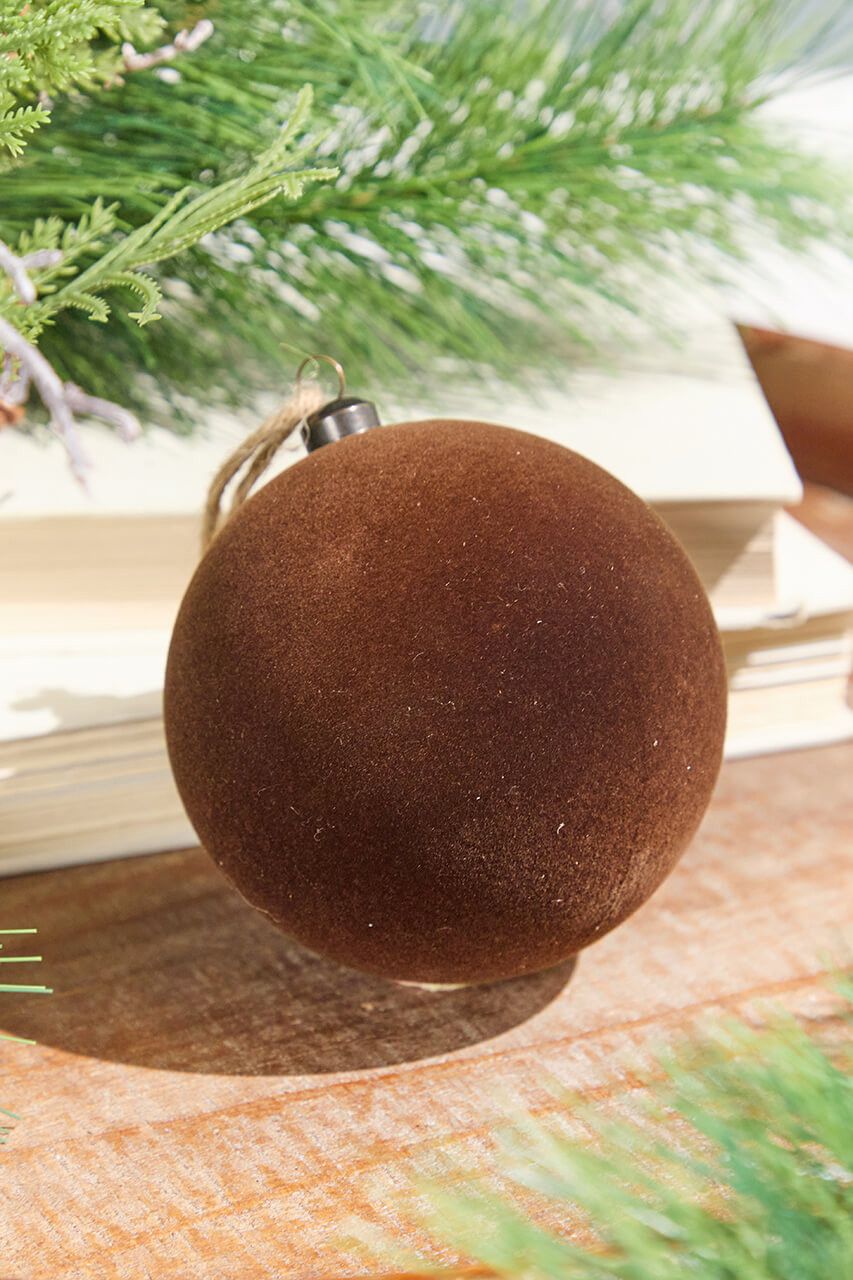
Brown velvet is the most forgiving velvet here — it hides dust, lint, and the light crushing that happens when ornaments get shoved back in a box. Twine hangers, though, dry out and fray. Replace the twine every couple of seasons with fresh jute, which costs pennies at any craft store, and check that the metal caps haven’t loosened. On a live tree, keep these away from the water reservoir — brown velvet stains permanently when wet.
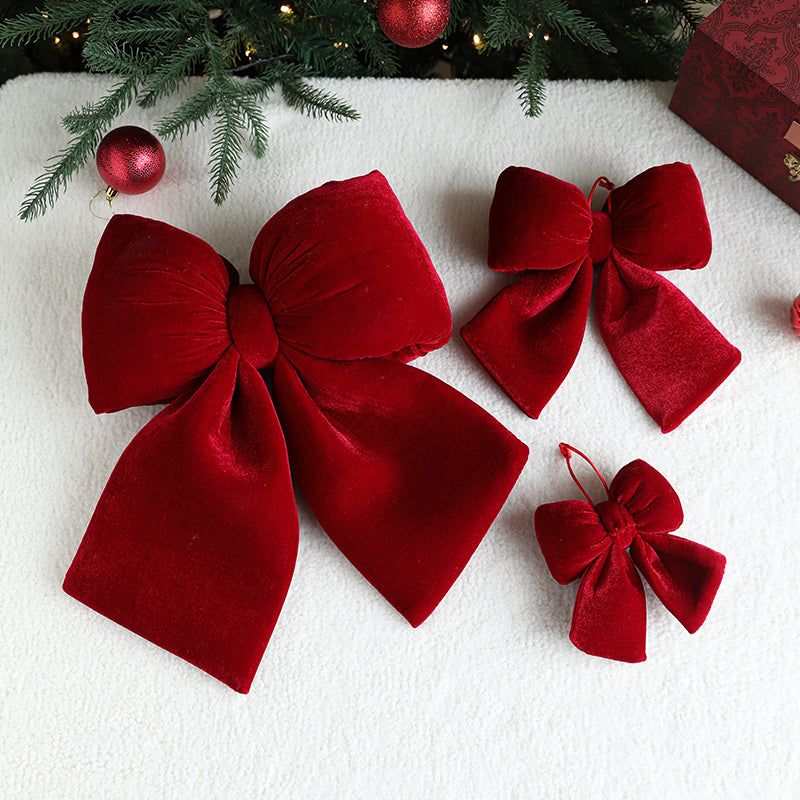
14. Three Sizes of Deep Red Velvet Bows on a White Surface
Making a velvet bow that doesn’t collapse is mostly about the wire.
- Cut 30 inches of 2.5-inch velvet ribbon and seal the ends with a quick pass of a lighter — velvet frays fast.
- Fold a center loop and pinch it, then make one loop on each side, twisting at the pinch point.
- Wrap floral wire three times around the center and twist tight, leaving a 3-inch tail to tie onto the branch.
- Fluff each loop outward with your fingers; velvet holds whatever shape you press into it.
- Hang at a slight angle, about 15 degrees off vertical, so the bows look placed rather than pinned.
Time: 30 minutes for five bows. Materials: $10–$16 for ribbon and wire.
Three sizes of the same bow is a classic repetition play, and it works because your eye reads them as a family before it reads them as objects. The white textured surface behind gives the deep red maximum contrast, and the glossy red baubles add a second finish so matte and shine never compete. Compare with Idea #8 — same move, burlap instead of velvet, much more rustic.
15. Dark Green Velvet Tree Skirt with Red Fringe over a Teal Rug
Green skirt, red fringe, teal rug, patterned ornaments — that’s four saturated colors in one square yard, and it can absolutely tip into circus. The saving grace is that the teal lives on the floor and reads as an anchor from standing height while the red and green stay up top. If you’re eyeing this combo, keep the teal matte and pattern-free and don’t add a fifth color above. Also worth knowing: red fringe and pets are a bad match. It snags.
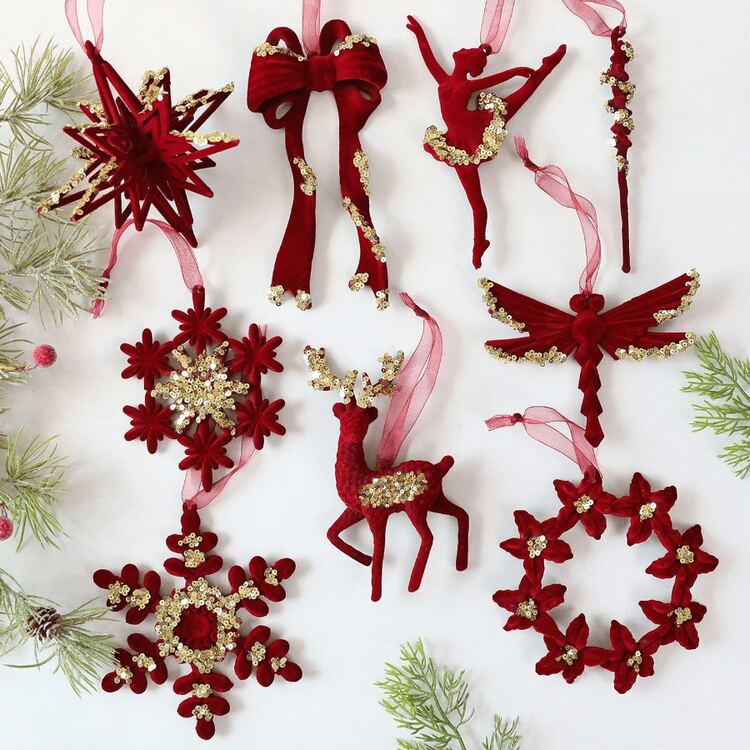
Count it as 60% dark green (tree and skirt), 20% vibrant red (fringe and baubles), 15% teal, 5% white accents. Green is the base, red is the accent, teal is the surprise. If teal feels like too much, swap that 15% for a warm oatmeal rug and you get a far quieter tree from the same skirt. It’s a floor-level formula, so it works with any ornament scheme hanging above it.
16. Red Velvet and Gold Sequin Ornaments in Every Shape
When ornaments are this embellished, the shapes have to earn their place. Six or more novelty silhouettes on one tree reads as clutter; three reads as a collection. Pick a trio — snowflake, reindeer, bow — and hang them at eye level, evenly spaced around the tree’s circumference, one silhouette per clock position. Keep everything else to plain spheres so each shape gets its own moment. That restraint is the line between a themed tree and a novelty tree.
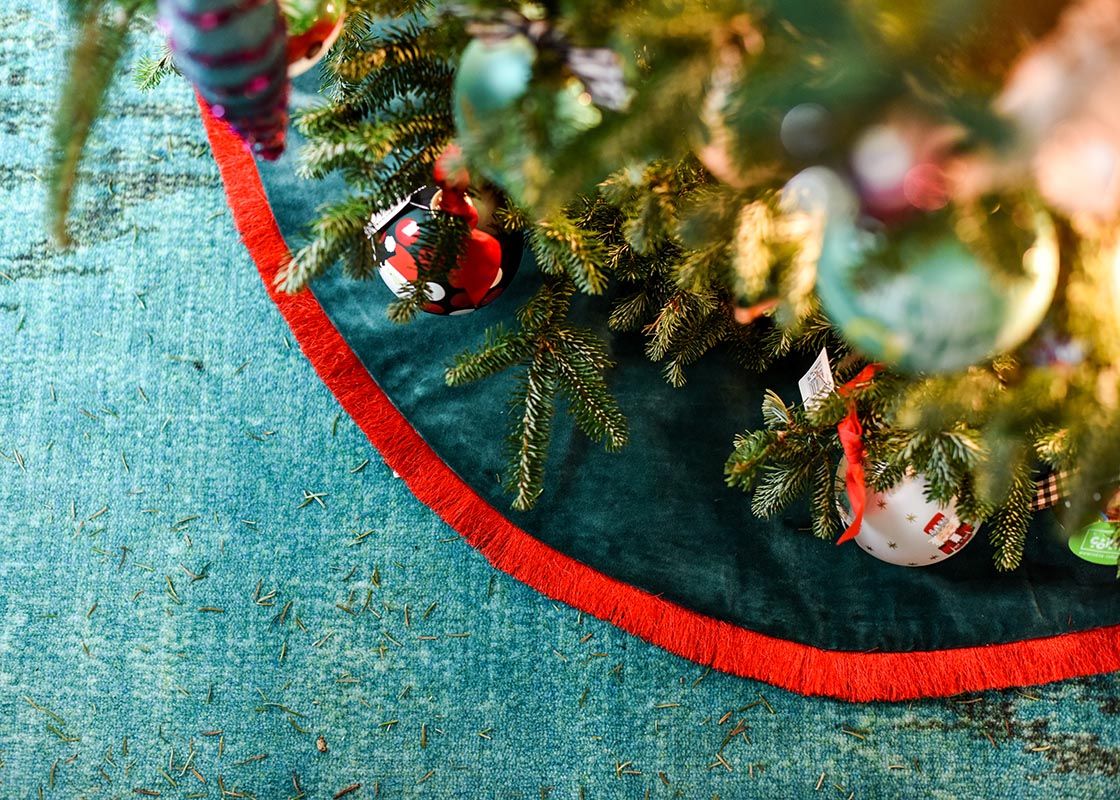
The gold sequins are the whole point. Every one of these is cut from the same deep red velvet, which means without that gold thread outlining each silhouette you’d have six red blobs. The sequins trace the edges — antlers, snowflake points, the curve of the bow — and that’s what makes the shapes legible from across a room. If you’re DIYing them, spend your time on the outlines, not the fills.
17. Pine Sprig Swag with a Red Velvet Bow and Golden Bells
Five steps and you have a swag that looks store-bought.
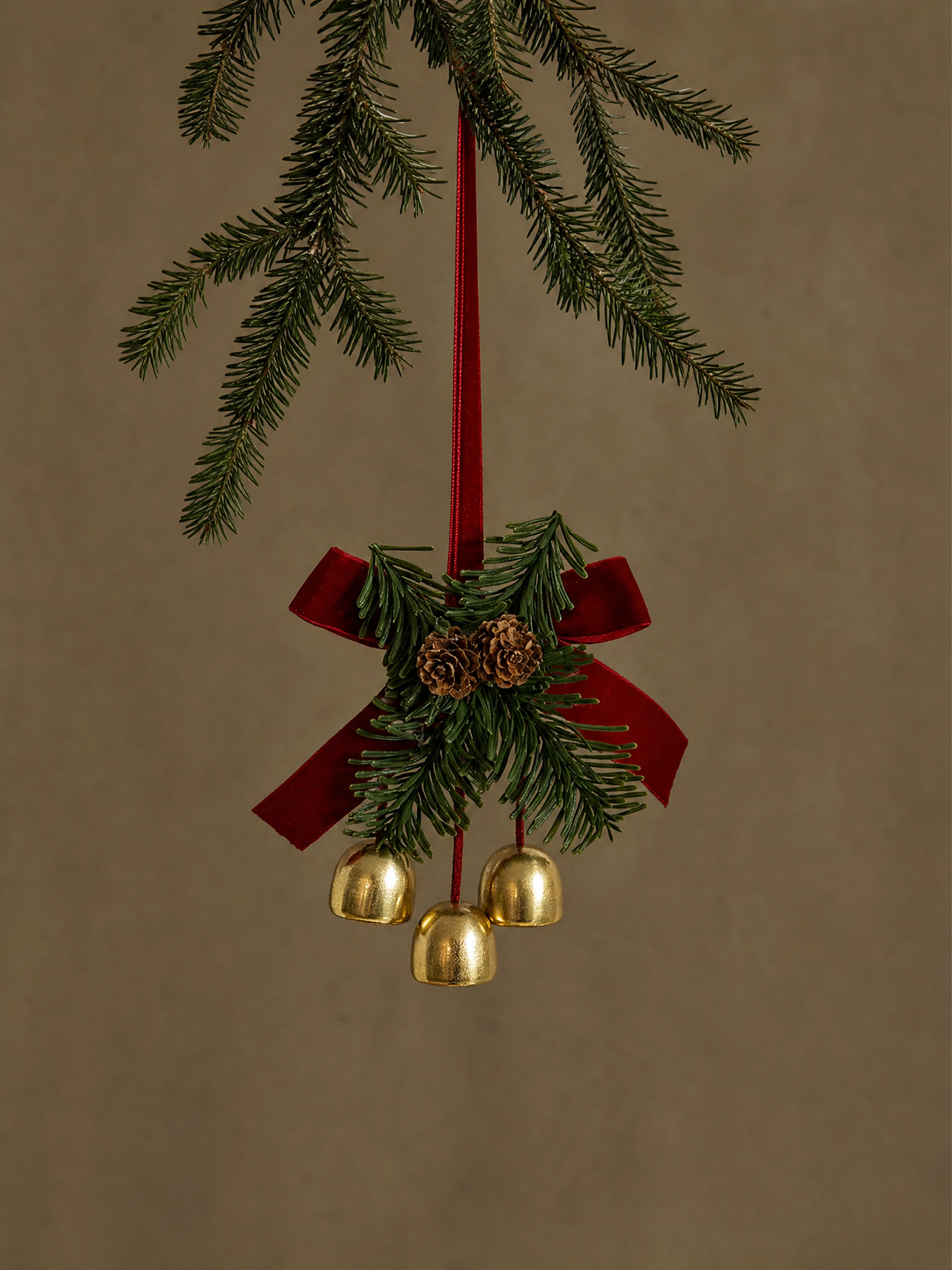
- Cut a 6-inch pine sprig and strip the bottom two inches of needles to make a stem.
- Wire three small golden bells together on a single loop of red ribbon.
- Attach a velvet bow at the top of the sprig, hiding the wire under the bow’s center knot.
- Tuck two mini pinecones and a second short sprig behind the bow for bulk.
- Hang from the stem, not the bells, so the weight doesn’t pull it sideways.
Time: 15 minutes each. Materials: $6–$12 per swag, less if you clip sprigs from the underside of your own tree.
Or build it for pocket change. Wire bells come in 12-packs for about $3 at Dollar Tree, velvet ribbon is $4 a roll at Walmart, and the pinecones you can pick up on a walk. Under $5 per swag. Swap the real sprig for a $2 faux pine pick and it lasts for years. Five of these down a stair rail is a full garland for the price of one store-bought strand.
18. Emerald Velvet Tree Skirt with a Colorful Pom-Pom Garland
Pom-pom garland has volume, so it needs room. This reads best on a 6–8 ft tree with at least a 30-inch base. On a slim 4 ft pencil tree the pom-poms bulge past the branches and look like a scarf. The skirt matters too — a 48-inch round covers most 7 ft trees, but measure your stand’s footprint first, because a skirt that barely hides the legs looks accidental. Under an 8 ft ceiling, keep the whole arrangement low to the floor.
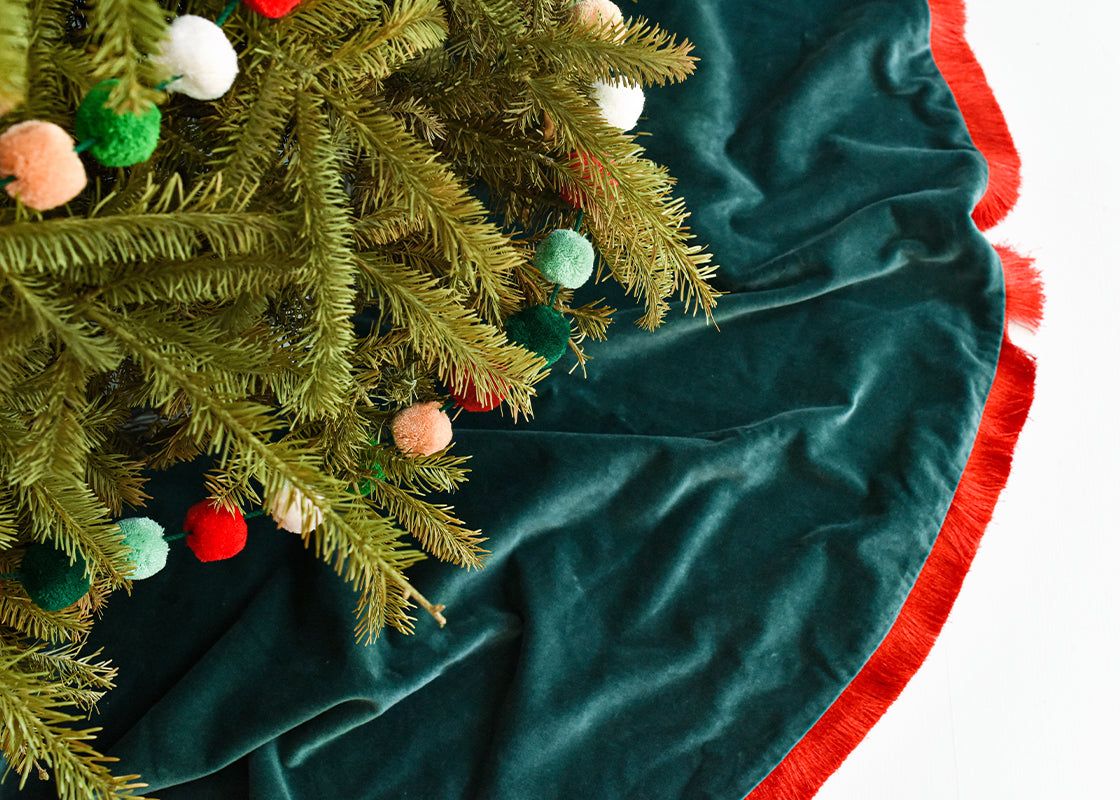
Two principles are doing the work. First, repetition: dozens of pom-poms in the same size and finish create a rhythm the eye follows around the tree, which is why this reads charming instead of random. Second, material contrast — fuzzy wool against glossy velvet against a crisp white floor. Three textures, one palette, and no glitter anywhere near it. Restraint at the base lets the pom-poms be the loudest thing in the room.
19. Teal Velvet Tree Skirt with Fluffy Red Trim on Hardwood
Teal is the riskiest skirt color on this list. It works here because the hardwood floor is warm and the trim is red, giving the teal something to push against — but put the same skirt on a cool grey floor or a blue-grey rug and the whole thing goes flat and slightly cheap-looking. Red fluffy trim also does two things you should know about: it sheds for the first season, and it’s the first thing pets chew. Vacuum before you photograph.
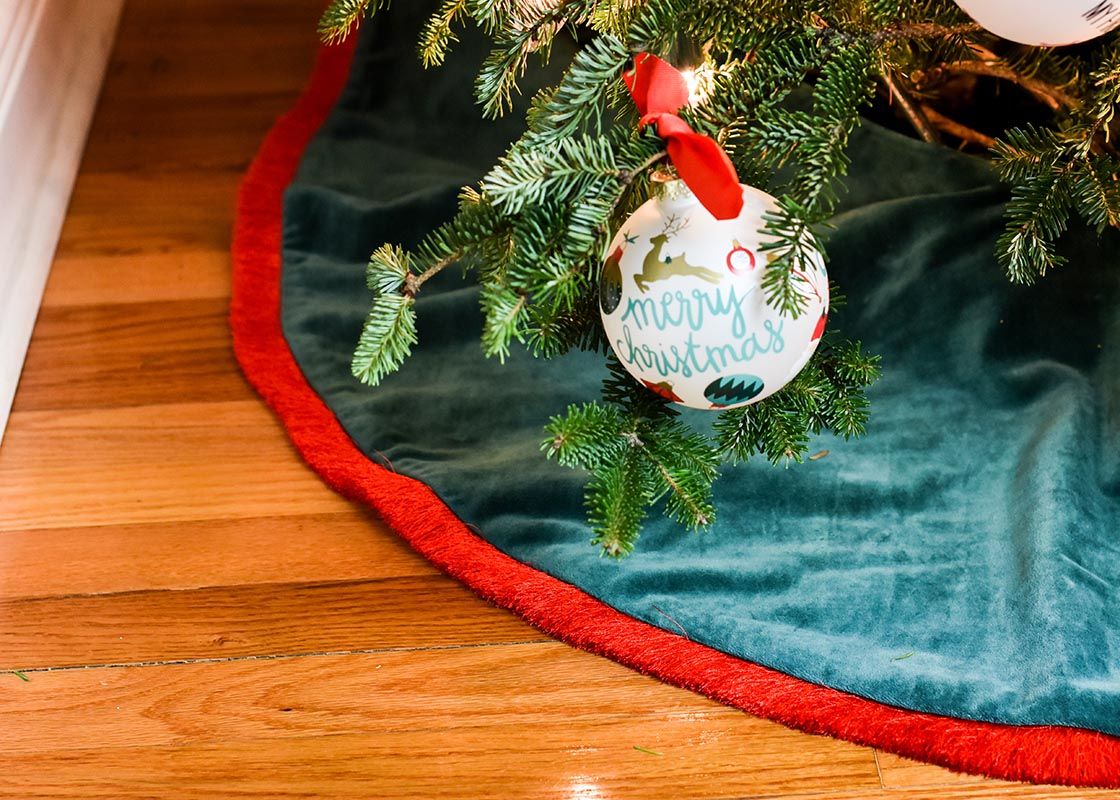
Tree skirts need to be about 12 inches wider than your stand on each side or the hardware peeks out. For a typical 24-inch stand, that means a 48-inch round, minimum. Fluffy trim adds visual width, so in a tight corner go with a flat-trim skirt instead — same color, less bulk. Always put a furniture pad or a scrap of non-slip rug liner under the skirt on hardwood, because velvet slides.
20. Cascading Deep Red Velvet Bows Woven Through Warm Lights
This is a two-ingredient tree: 70% deep red velvet ribbon (bows of varying lengths) plus 20% dark green foliage and 10% warm light. That’s it, and that’s exactly why it looks expensive. When your ornament count is one material, the only variable left is scale — bow sizes and tail lengths — and that’s where all the visual variety comes from. Swap the velvet for wide satin ribbon and you get the same formula in a shinier finish for about half the cost.
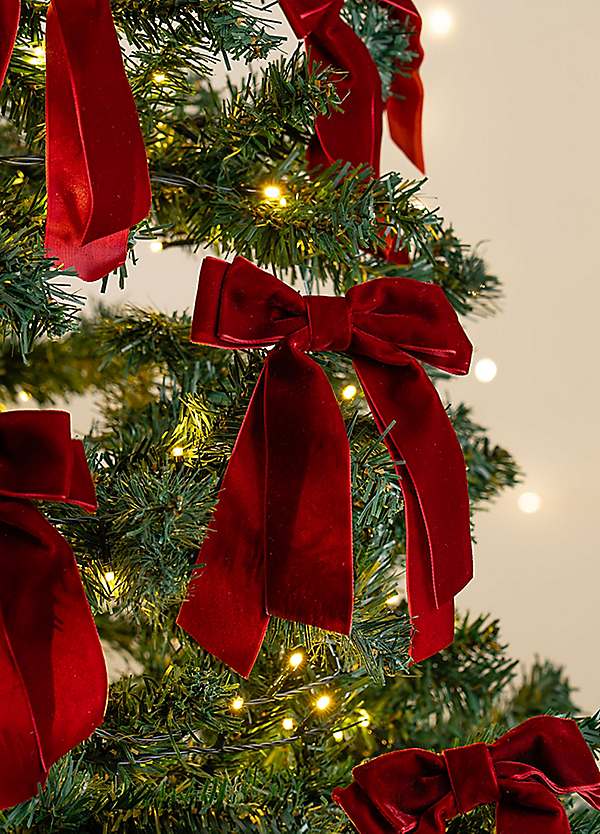
The long cascading tails are the entire effect. Short bows read as accents; long tails read as drapery, and they’re what turns a tree into something with movement. Cut tails at least 14 inches for a 7 ft tree so they fall across two branch levels, and angle each one slightly down so gravity looks intentional. The boxed presentation in Idea #12 uses the same ribbon in a very different setting.
21. A Child’s Hand Placing a Textured Brown Velvet Bauble
Family-decorated trees are back in a way they haven’t been since before Pinterest existed. The shift is real: after years of color-coordinated, editorially styled trees, the reaction has swung toward trees that look lived-in — a child’s hand mid-placement, paper snowflakes, warm light, things that don’t match. Brown and caramel velvet has become the connector shade that lets all the random stuff coexist, because it reads as neutral against green. That’s a genuinely useful design insight hiding inside a sentimental trend.
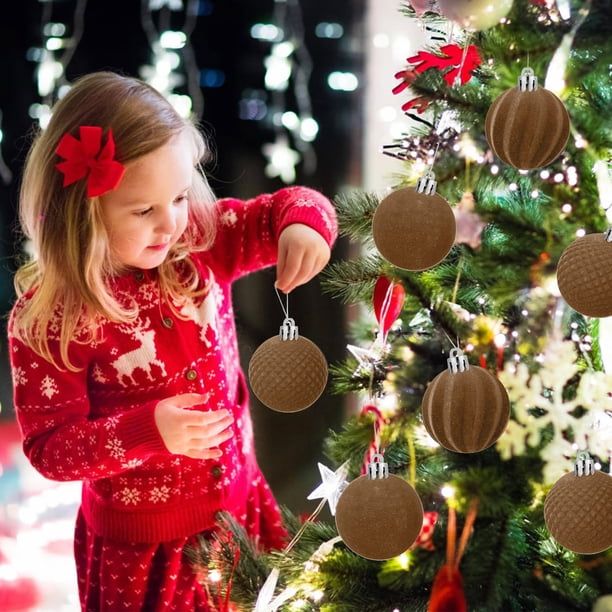
If you’re decorating with kids and still want it composed, try this order.
- Hang the lights first and turn them on — kids place ornaments where the light is.
- Do the velvet pieces yourself, spread evenly, before anyone else starts.
- Hand over the paper snowflakes and red accents with one rule: no more than two per branch.
- Leave the bottom third to the kids entirely and don’t rearrange it after bedtime.
- Photograph in daylight the next morning, before anyone adds more.
Time: about an hour with help. Cost: $15–$30 for extra brown velvet ornaments.
22. Mini Evergreen in a Red Velvet Pot with Pastel Wax Ornaments
Mini trees are where you can be genuinely cheap without it showing. A 24-inch potted evergreen runs $12–$20 at Trader Joe’s or Home Depot in early December, and the red velvet pot cover is about $6 at Target. Pastel wax ornaments are $8–$15 for a mixed box online, but thrift stores are full of vintage ones for a dime. Total build: under $40. Trade the lace doily for a linen napkin from your kitchen drawer and nobody will know.
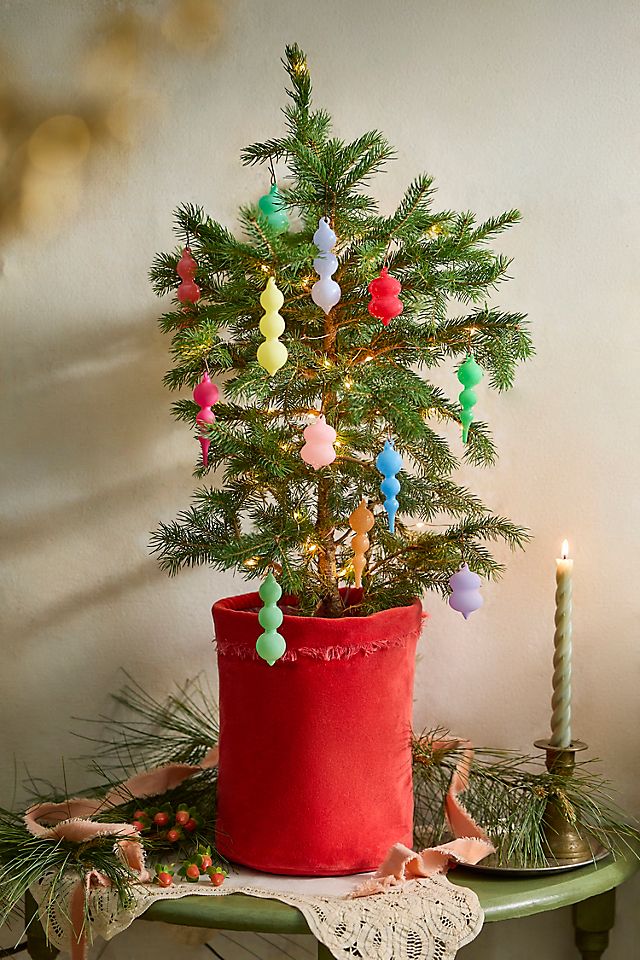
This is entryway, kitchen counter, or bathroom shelf territory — it needs about 18 inches of clear surface and roughly 30 inches of vertical space, so it fits under a standard 36-inch countertop. It’s also the answer for anyone in a small apartment with no floor space: a 24–30 inch mini reads as intentional in a way a tiny fake tree on the floor never does. For floor-level drama, the skirt approach in Idea #15 is the full-size counterpart.
23. Dark Red Velvet Finial Ornaments Against Golden Bokeh
Finial shapes are the most fragile velvet ornaments you can buy, because the narrow points crush first. Store them upright in a divided box — a repurposed wine or mug box works well — and never stack anything on top. The velvet on the spindle will eventually flatten where fingers have touched it; a soft clothes brush lifts the nap back up but won’t restore it fully. Expect two to three good seasons of regular handling before they start looking softened.
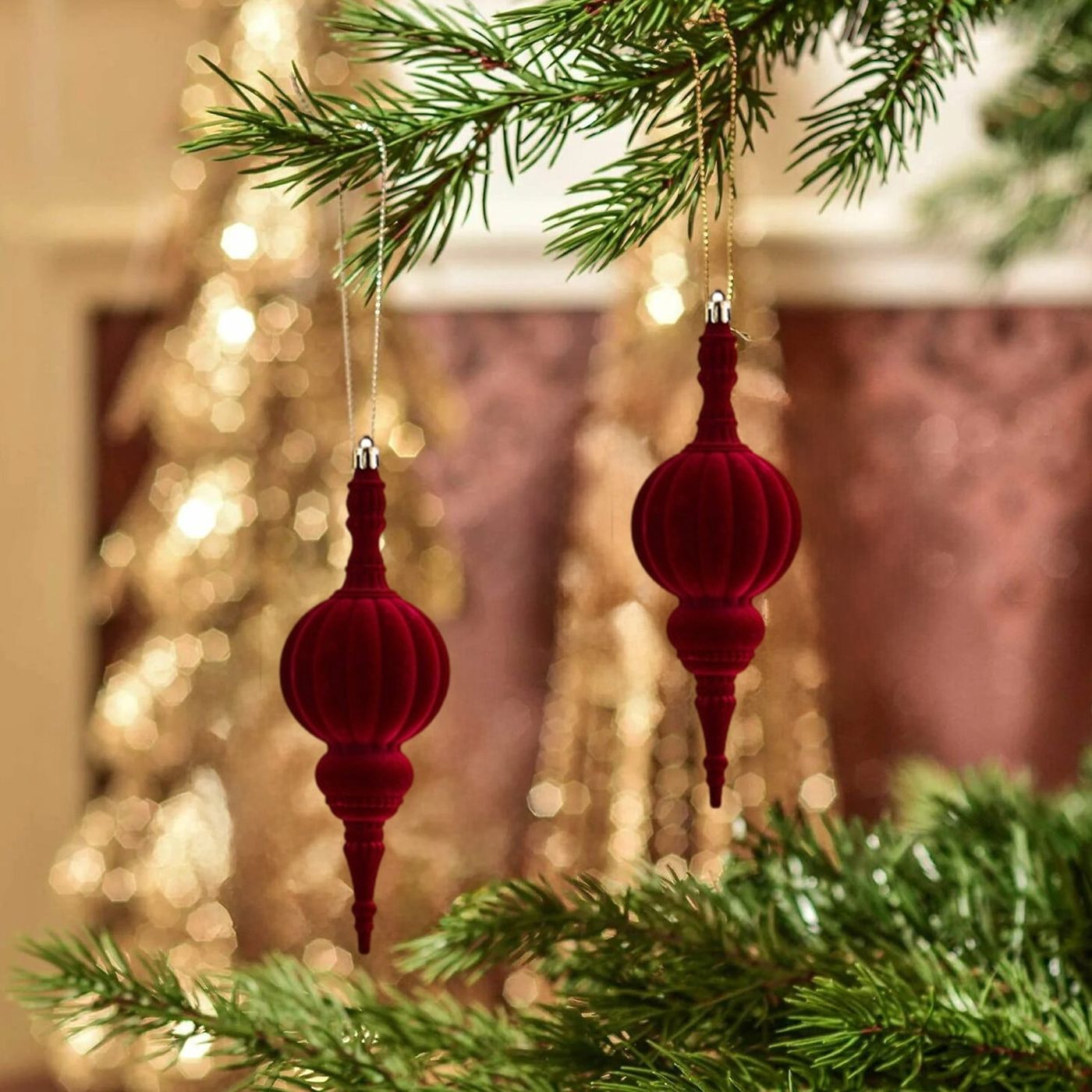
That golden bokeh in the background is doing a lot of work, and it’s worth understanding why: warm, out-of-focus light makes deep red velvet look richer and more saturated than it actually is. In a room lit with cool white overheads, the same ornaments go flat and faintly dusty. Add one warm lamp or a strand of amber fairy lights before you judge the color. It’s a five-dollar fix that changes everything.
24. Brown, Cream, and Green Velvet Baubles with Starburst Caps
Three velvet ornaments, three colors — brown, cream, green — plus silver caps with a starburst detail. It works because the colors sit at the same value: none is meaningfully brighter or darker, so nothing jumps forward and the grouping reads as a set even though the pieces don’t match. The starburst caps do the rest, repeating one small detail across all three and tying mismatched ornaments together. It’s a lesson in building a collection nobody else has.
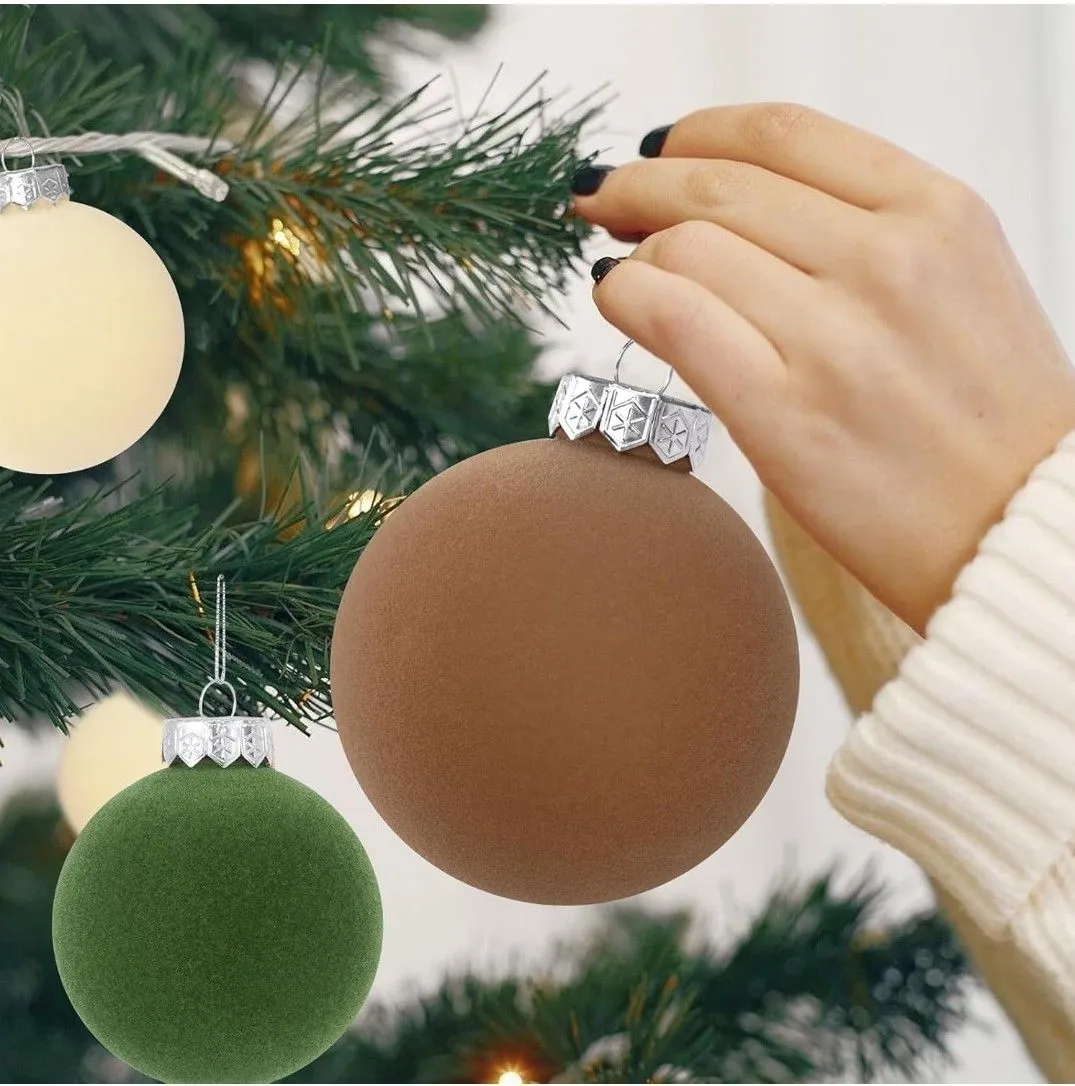
The silver starburst caps are the whole trick. They’re a two-dollar detail that changes the register of an ornament — without them, brown, cream, and green velvet spheres look like a random grab bag. With them, it looks curated. If you collect velvet ornaments from thrift stores and estate sales, this is the move: replace the caps. Bulk silver or antiqued brass caps run about $6 for fifty online, and swapping them takes one night in front of the TV.
25. Fur Pom-Poms and a Caramel Velvet Ruffle Skirt
Break this one down as 45% warm neutral (fur pom-poms in brown and white), 35% caramel velvet at the base, 15% dark green foliage, 5% warm light. It’s a tonal tree — everything sits within a few degrees of the same warm brown-green family. The velvet skirt is what makes that work: it extends the palette from the branches down to the floor so nothing feels like it stops at the tree’s edge. Swap caramel for deep teal and you’d get a much cooler, completely different tree.
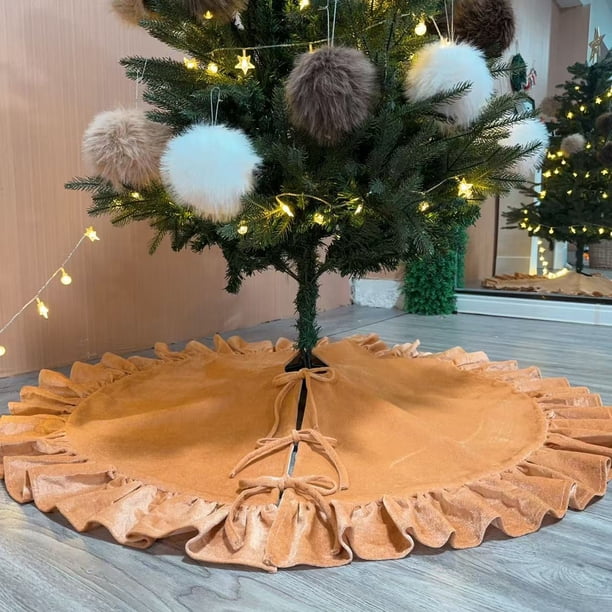
What the pieces cost, roughly.
- Faux fur pom-poms, 20-pack: $20–$45
- Ruffled velvet tree skirt: $45–$120
- Matching velvet ribbon for bows: $10–$22
- Additional velvet ornaments: $25–$60
- Extra warm white string lights: $12–$25
Total: $112–$272. Budget alternative: a plain round velvet skirt from Walmart is about $20, and you can make your own pom-poms from a skein of chunky yarn for $8 — one skein makes roughly fifteen. That puts the whole thing near $60.
26. One Oversized Red Velvet Bow as the Focal Point
An oversized bow needs to be scaled to the tree, not to your enthusiasm. Roughly: the bow’s width should be about one-fifth the tree’s widest point. On a 48-inch-wide tree, that’s a bow around 9–10 inches across — big, but not comical. Wire it rather than tie it so it holds shape against gravity, and give the tails a 20-inch drop so they cross at least two branch rows. One bow. Placed slightly off center reads as far more interesting than dead center.
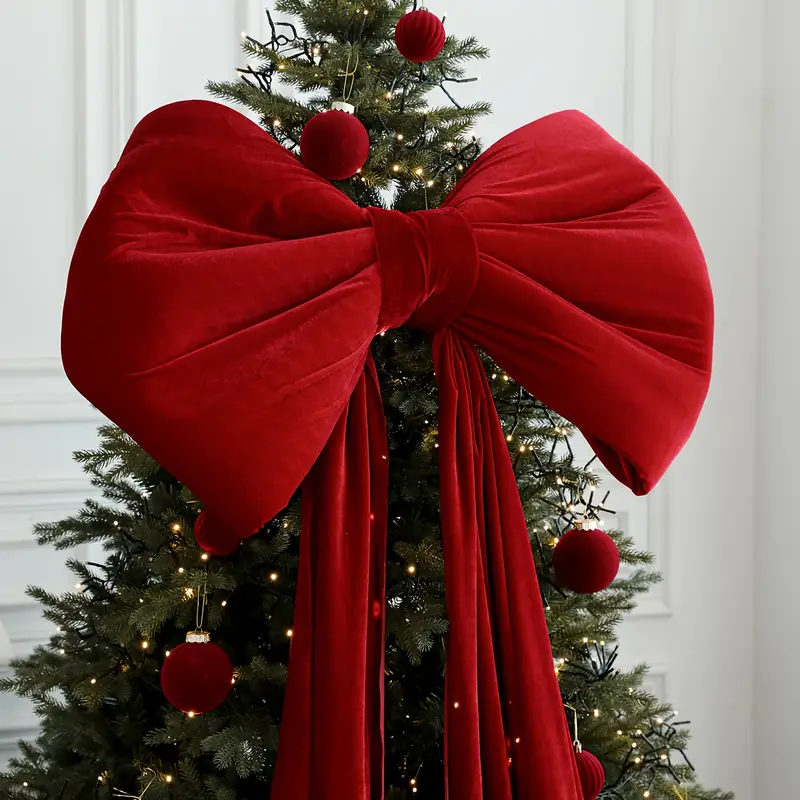
One giant bow means every other ornament is now in a supporting role, and if the rest of your tree is busy you’ll get a visual argument instead of a focal point. Strip it back to red velvet balls, warm lights, and nothing else — which is exactly what’s happening here against those clean paneled walls. Also consider weight: a wired 10-inch velvet bow is heavier than it looks, so hang it on a sturdy branch near the trunk, not on a tip that will sag by New Year’s.
27. Uniform Red Velvet Balls Against a Red and White Striped Wall
If you’ve got a bold wall like those red-and-white stripes, here’s how to keep the tree from disappearing.
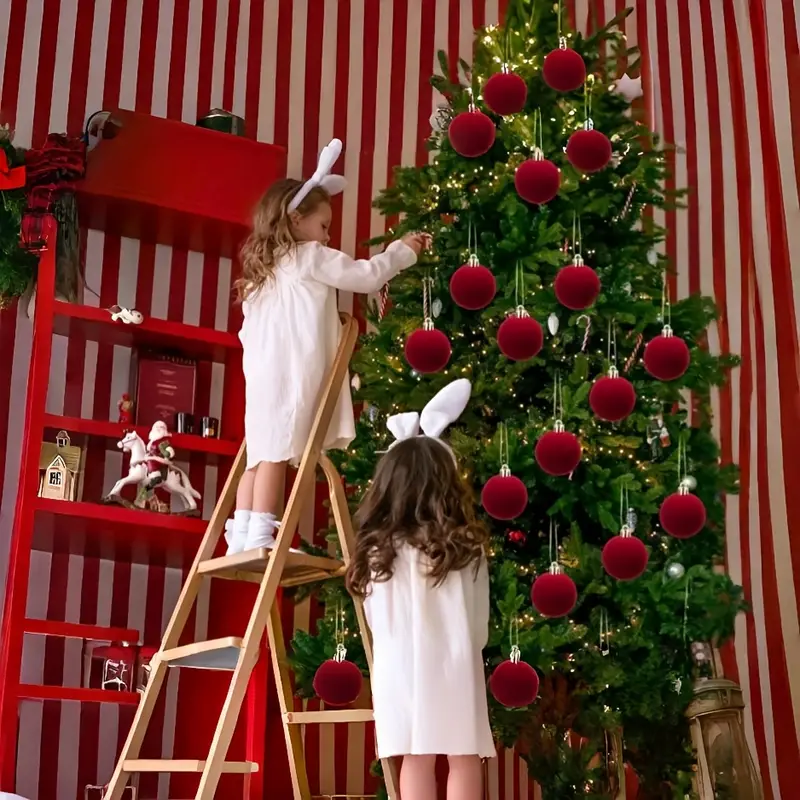
- Decide which one is the star, then quiet the other — stripes stay, ornaments go uniform.
- Buy a single shape and color of ornament and repeat it heavily; uniformity is what competes with a pattern.
- Keep the tree’s own palette to two colors, both already present in the wall.
- Add one neutral, like a white or cream ribbon, as a visual resting place.
- Put a solid-color rug under the base to interrupt the stripes at floor level.
Time: one afternoon. Cost: a 60-count set of uniform red velvet balls runs $30–$55.
Stripes this bold need distance. A vertical red-and-white wall wants at least 6 feet of clear floor space in front of it, or the pattern and the tree crowd each other and the room feels tight. This suits a dining room or wide hallway, 100 square feet and up, with 9-foot ceilings giving the stripes room to run. In a smaller room, concentrate the same red-and-green idea on a single shelf instead.
28. Red Velvet Ornaments Opened in a Teal Gift Box
The teal box is just a gift box — the kind you already have in the closet. Line it with red tissue or shredded filler from the dollar store ($1.25 a bag) and the staging is free. Spend on the ornaments instead: a mixed set of red velvet with gold glitter detailing runs $20–$40 at Target or Walmart, and Etsy sellers hand-glitter single pieces from about $12 if you only want two or three special ones. Mini trees and berry picks from the Target dollar spot fill in the rest for under $10.
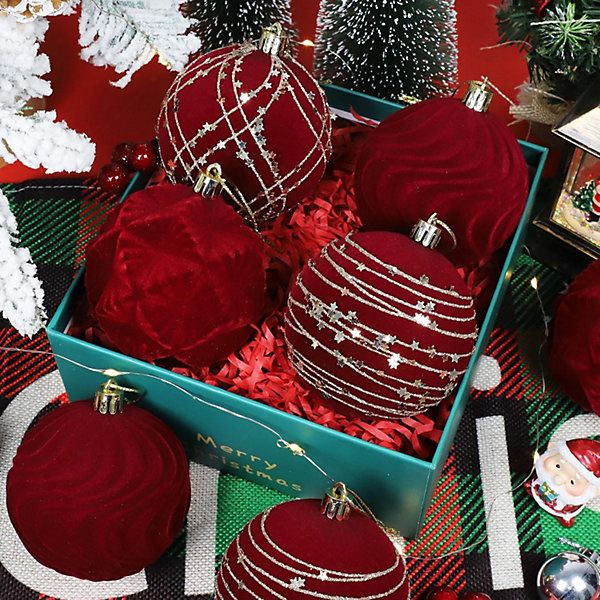
Texture, contrast, framing — all three are working here. The red shredded paper lifts the ornaments so you see each one fully, the teal box gives deep red a complementary backdrop that makes it read richer than it would on white, and the plaid fabric underneath adds a fourth pattern that somehow doesn’t fight because it’s small-scale. Big pattern up top, small pattern below. Idea #3 does the exact opposite: three ornaments, no staging, all restraint.
29. Dark Green Velvet Skirt with Pine-Printed Gift Wrap
Gift wrapping under a tree is part of the design, not an afterthought. Pick one paper and repeat it — these white wraps with a green pine-tree print read as a set purely through repetition — then vary only the ribbons. Use 2.5-inch ribbon in at least two materials, like shiny red satin and matte green velvet, and tie the bows at slightly different angles so the grouping looks collected rather than printed. Paper runs about $6 a roll; the ribbon is what makes it look designed.
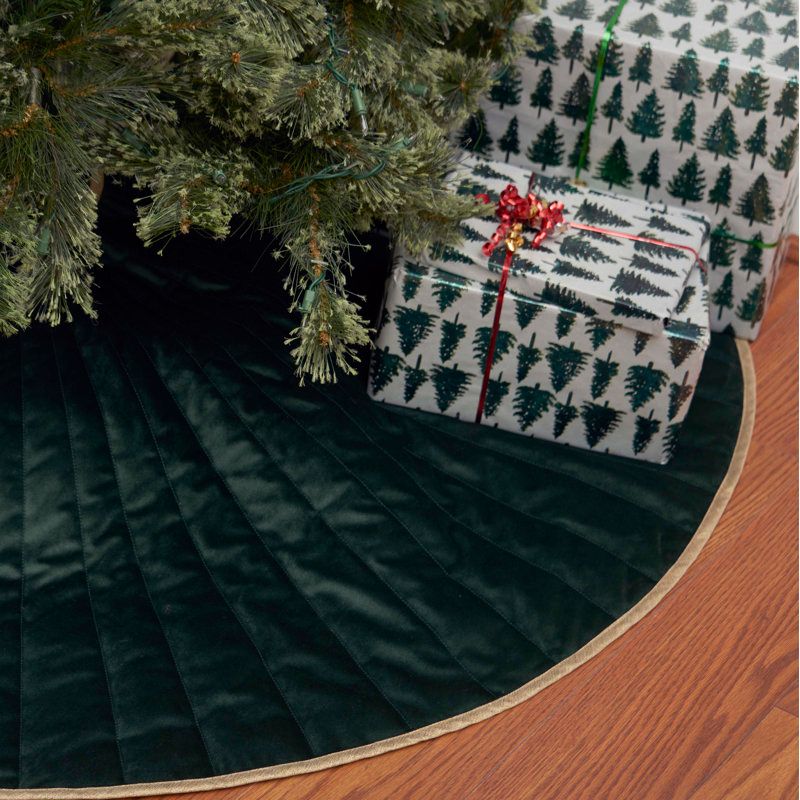
The formula at the base here is 50% dark green velvet with gold trim, 35% white and green patterned paper, 10% red ribbon accent, 5% light green. Deep green plus gold is the most traditional pairing in the book, and the white wrap keeps it from going heavy. Swap the paper for kraft brown with green twine and you get the same palette with a farmhouse feel — no other changes needed.
Your Velvet Tree Starts With One Ornament
You don’t have to rebuild your whole holiday setup to get this look — start with one idea from this list, buy three velvet ornaments, and see how they change the branch they land on. Most of these designs came from mixing two textures and one strong color, which is a thing you can do this weekend for under $40.
📌 Pin your favorite idea to your Christmas board so it’s waiting for you when the boxes come out of the attic.