
If your holiday Pinterest board is already a wall of pink flocked trees, oversized lollipops, and gingerbread houses with icing dripping down the eaves, you are in very good company — candy land Christmas is the theme everyone has quietly been building boards around for 2026.
We spent serious time browsing Target, Etsy, Walmart, and At Home to bring you only what is worth your attention this year, from $8 stocking stuffers to a $1,200 full-scale gingerbread display.
Inside you will find 30 curated ideas covering whimsical pastel candy, traditional red-and-white candy cane, glam flocked, and retro pink — with budget and luxury versions compared side by side so you know exactly where to spend and where to fake it.
Part of why candy land is everywhere right now: after several seasons of muted, minimal holiday decor, people are craving color, nostalgia, and rooms that make kids gasp out loud.
Save this post now — you will want it when you are ready to shop.
1. Pastel Gingerbread Village House Styled on a Stack of Books
The pedestal is the whole trick. Set that pastel gingerbread village house straight on the glass coffee table and it reads as one more decoration; lift it four inches on a stack of books and it becomes a sculpture with an actual shadow line. The books also solve a practical problem — they raise the smallest, most detailed object in the room up to eye level, where guests can actually see the icing. Take the stack away and the vignette flattens out instantly.
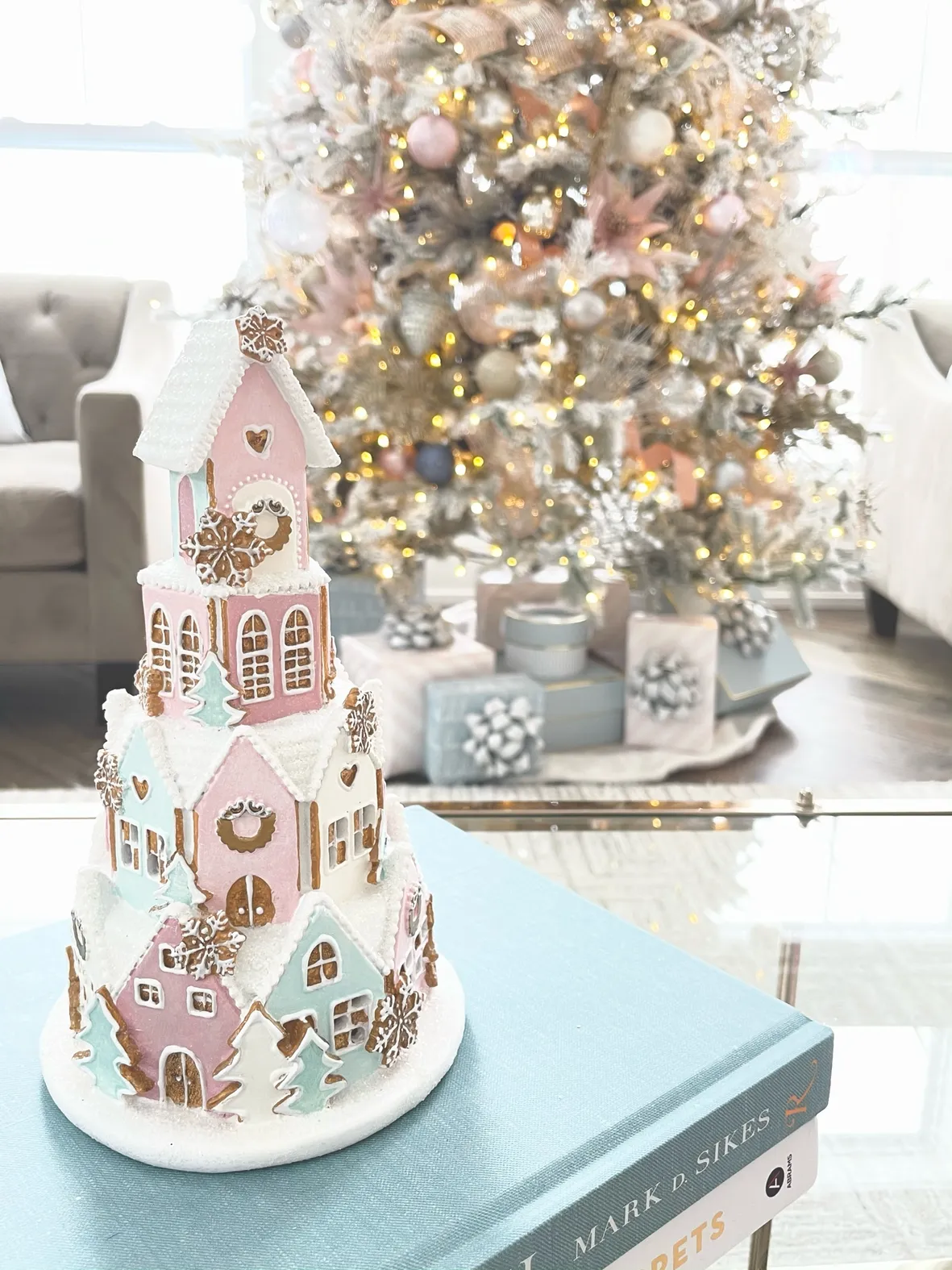
Three things make this corner work. Scale contrast: a small, intricate house against a full-size tree stays interesting instead of competing. Color temperature: soft pink, mint, and warm gold ornaments echo the house, while the cool glass and light blue give the pastels a little air. And restraint — the tufted neutral chair and wrapped gifts stay quiet so the pastel village gets to be the loudest thing in the frame.
2. A Glass Gingerbread House Ornament With Gemstone Candy Studs
Treat a detailed glass house ornament like jewelry, not filler. Hang anything with a glazed roof, icing trim, and candy-studded walls at eye level — roughly 58 to 66 inches off the floor — and place it in an odd-numbered cluster of three or five. Keep at least four inches of breathing room between it and the next glittery piece, or the shine cancels itself out and all that miniature candy work disappears into sparkle soup.
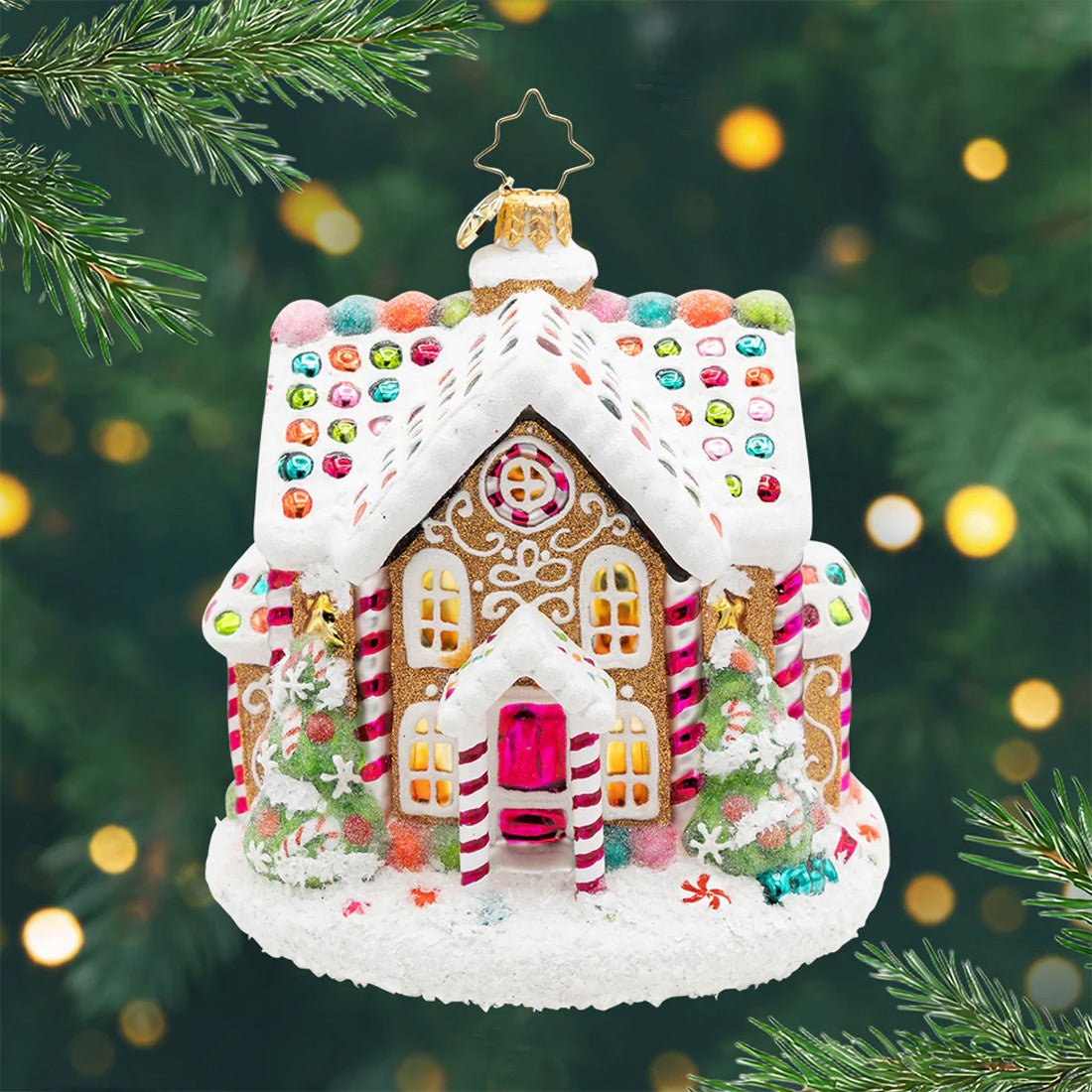
Ornament collecting has quietly become the grown-up version of a charm bracelet, and candy land houses are the star of 2026. The shift started when people got tired of buying a whole new tree theme every December and began building holiday traditions one piece at a time instead. That is good news for staying power: a glass gingerbread house you buy this year still looks right in five years, unlike the inflatable thing you will be donating in March.
3. Cupcake Slipcovers and an Ornament-Loaded Candelabra Chandelier
Read the room as roughly 60 percent pale blue and white — walls, mantel, marble table — then 25 percent red and white candy accents in the chandelier and chair styling, and 15 percent pink and green whimsy on the tabletop. Want it warmer? Swap pale blue walls for soft sage and keep every ratio. Want it bolder? Move the red onto the walls and let the candy accents go all white. The proportions are what make it feel designed rather than decorated.
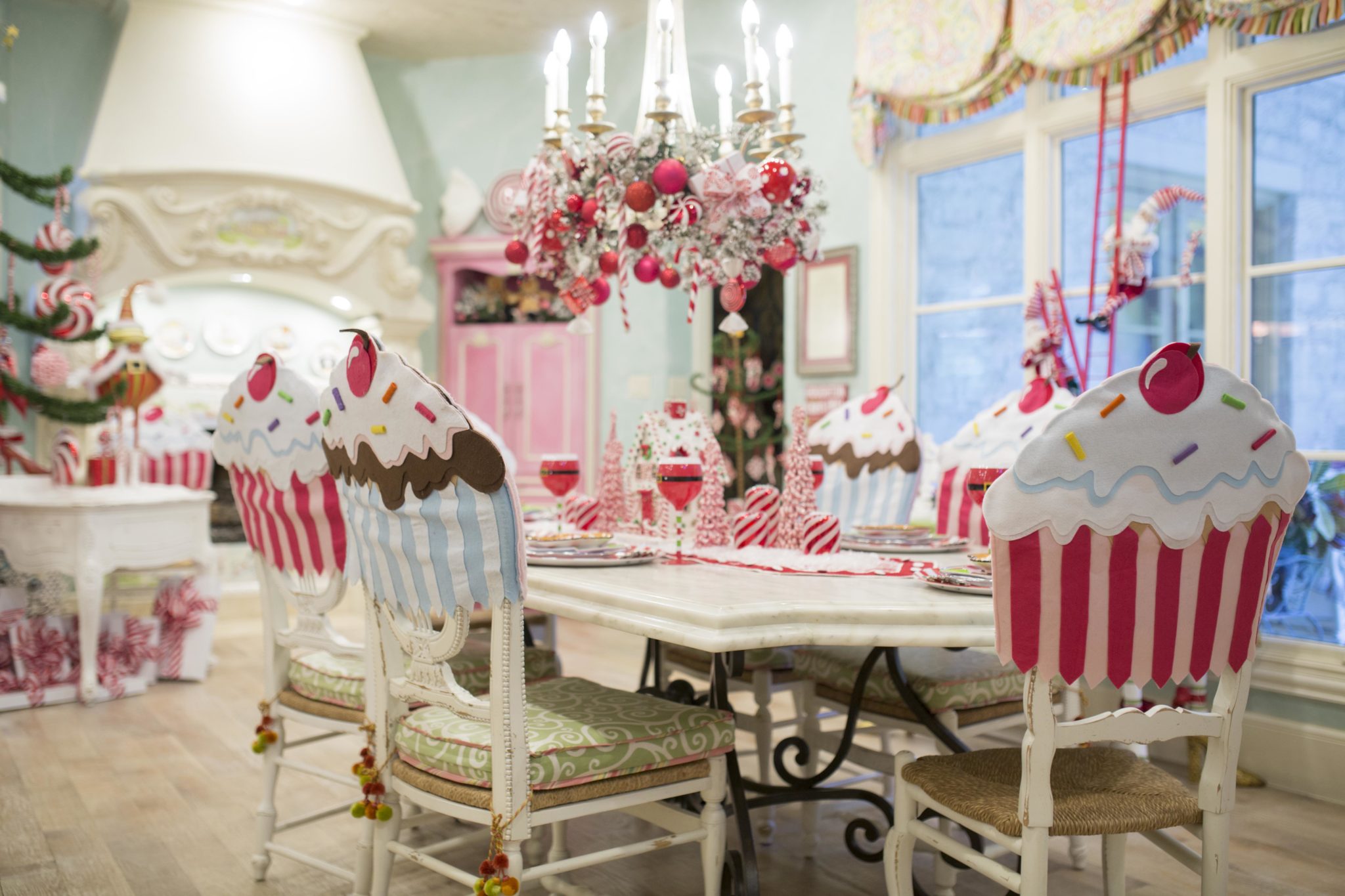
Custom cupcake slipcovers sound like a four-figure project, and honestly they can be. You do not need that. Plain white chair covers from Amazon run about $8 to $12 each, and a fabric marker plus felt scraps gets you a frosting cuff and sprinkles for another $15 total. The ornament-loaded chandelier is easier still — one bag of red and white shatterproof baubles from Walmart at around $12, plus dollar-store candy canes, gets you 80 percent of the drama for $35.
4. White Built-Ins Styled With Gingerbread Houses and Nutcrackers
- Gingerbread house figurines, three to five sizes: $30–$120
- Nutcrackers in staggered heights: $25–$150
- Peppermint swirl ornaments and candy-striped picks: $12–$40
- Flocked tree, six to seven feet, with red and white decor: $150–$600
- Gingerbread plush, signage, and shelf filler: $10–$45
- Total: $227–$955
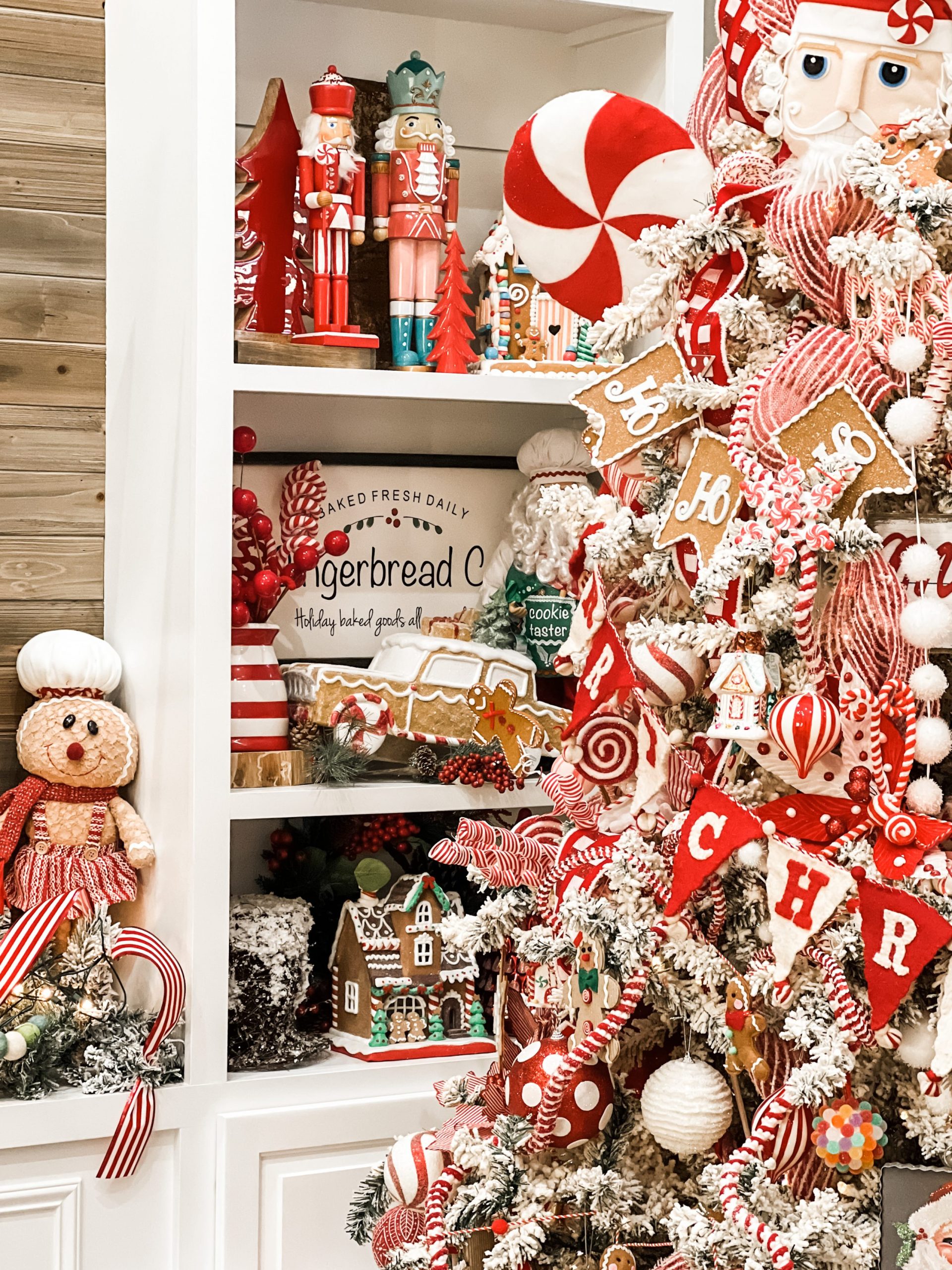
Budget alternative: thrifted nutcrackers at $5 to $15 each and dollar-store peppermint ornaments cut this down to about $160–$400.
White open shelving plus flocked greenery equals a weekly dusting job, and flocking sheds. Figure on a five-minute pass with a microfiber cloth every week, plus a soft brush on the tree skirt once a month. Nutcrackers with moving jaws and plush gingerbread men are the first things kids grab, so keep fragile figurines above 48 inches and let the plush live on the bottom shelf.
5. A Candy Cane Tablecloth Set With Woven Chargers and Red Napkins
The pattern is doing the work, so everything else stays plain. A candy cane print tablecloth usually overwhelms a table, but here the woven chargers, stacked white plates, and solid red napkins give the eye three places to rest. The oversized candy canes and wrapped gift boxes in the center are all vertical, which keeps the sightline open across the table so you can actually see the person across from you. Compare with Idea #20, where the same red-and-white logic goes pastel.
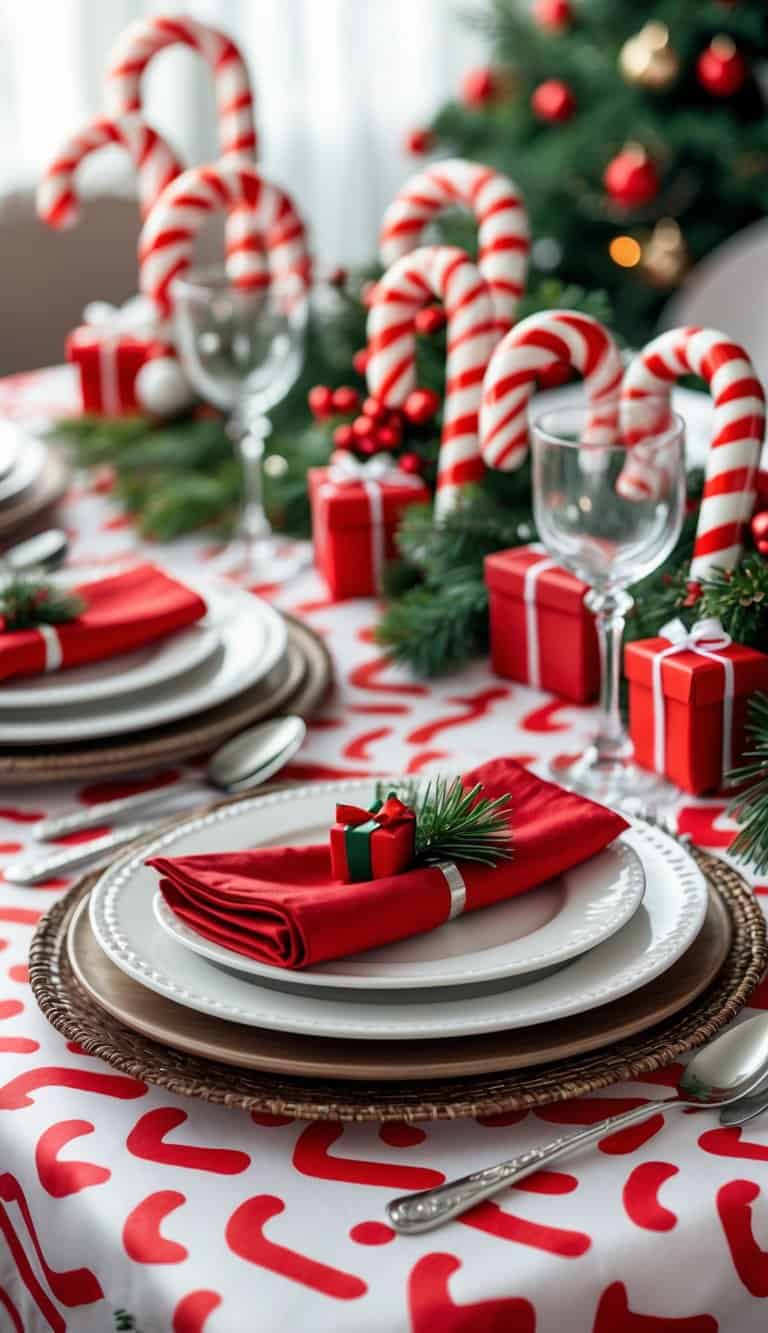
This look needs a table at least 36 inches wide — 38 to 40 is better — or the chargers and centerpiece start colliding. Allow 24 inches of table width per person and 30 inches of elbow room between settings; on a 72-inch table that is six comfortably, eight if everyone likes each other. Standard 8-foot ceilings handle the tall candy canes fine, and a narrower room just means you skip the gift boxes.
6. Pink and Floral Seating Around a Table of Faux Cakes
The faux cakes on the distressed white coffee table are the moment. Everything else in this room is doing a job — the pink and floral seating holds people, the textured rug covers floor, the fireplace anchors the wall — but the little frosted desserts on that slightly scratched table are pure delight, and they are what makes guests walk over and lean in. Without them this is a nice, bright living room. With them, it is a story.
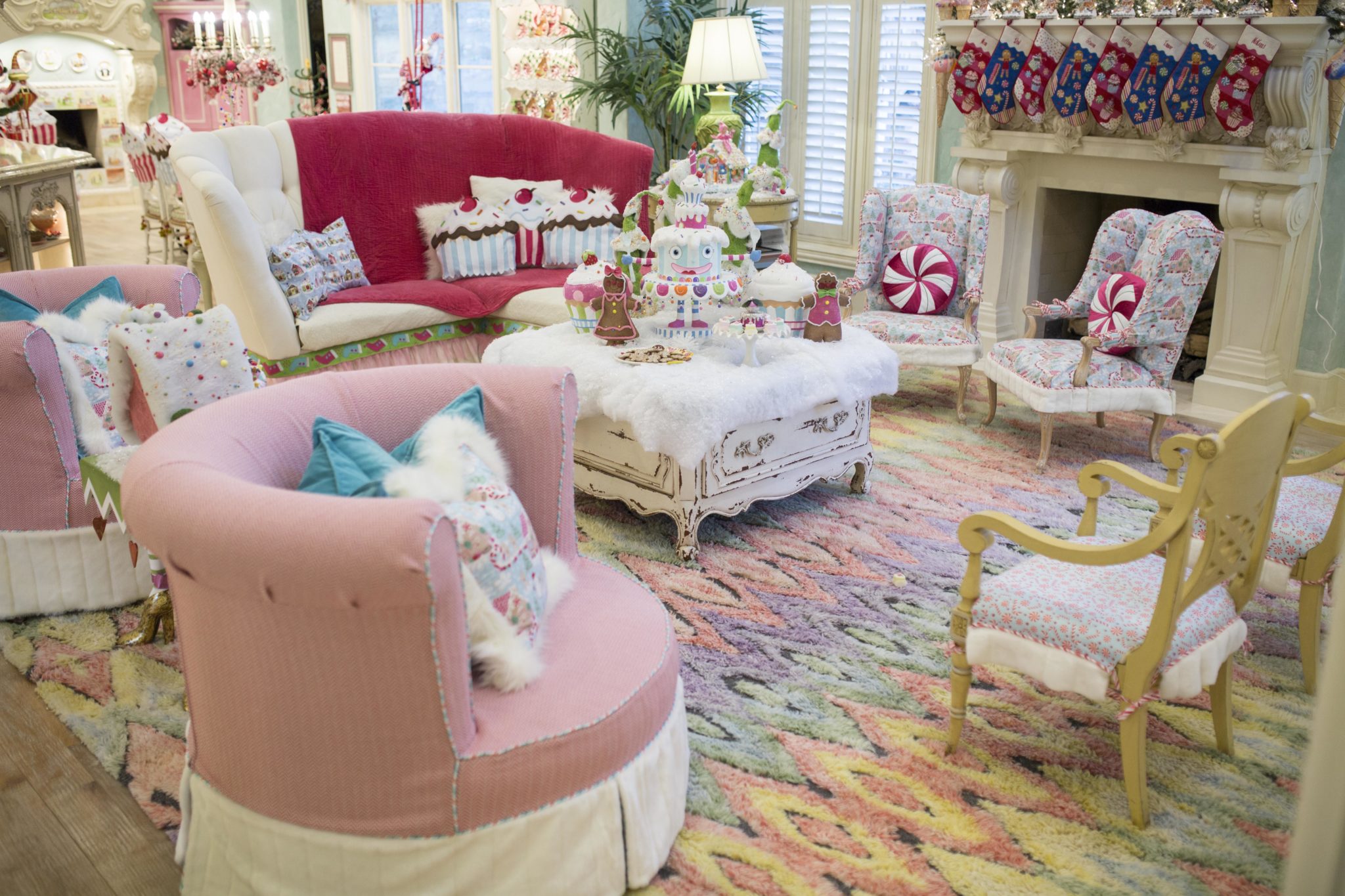
The catch with dessert decor: anything small, glossy, and floor-adjacent gets tested. If you have toddlers, dogs, or a cat with opinions, keep the faux cakes above knee height or accept that they will eventually get chewed. The multicolor patterned rug is more forgiving than it looks, but that pink upholstery is another story. Choose washable slipcovers or a performance fabric if this is the room where everyone actually lives.
7. Pale Blue Walls and Lollipop Pillows in a Candy-Colored Living Room
Read this room as 50 percent pale blue and white, 30 percent candy color in the tree and pillows, and 20 percent pattern in the rug and patterned armchairs. That is a lot of color for one space, and it works because the walls stay a soft blue and the white beamed ceiling gives everything a line to hang from. To dial it back, drop the patterned armchairs to a solid blush and let the tree carry all the color instead.
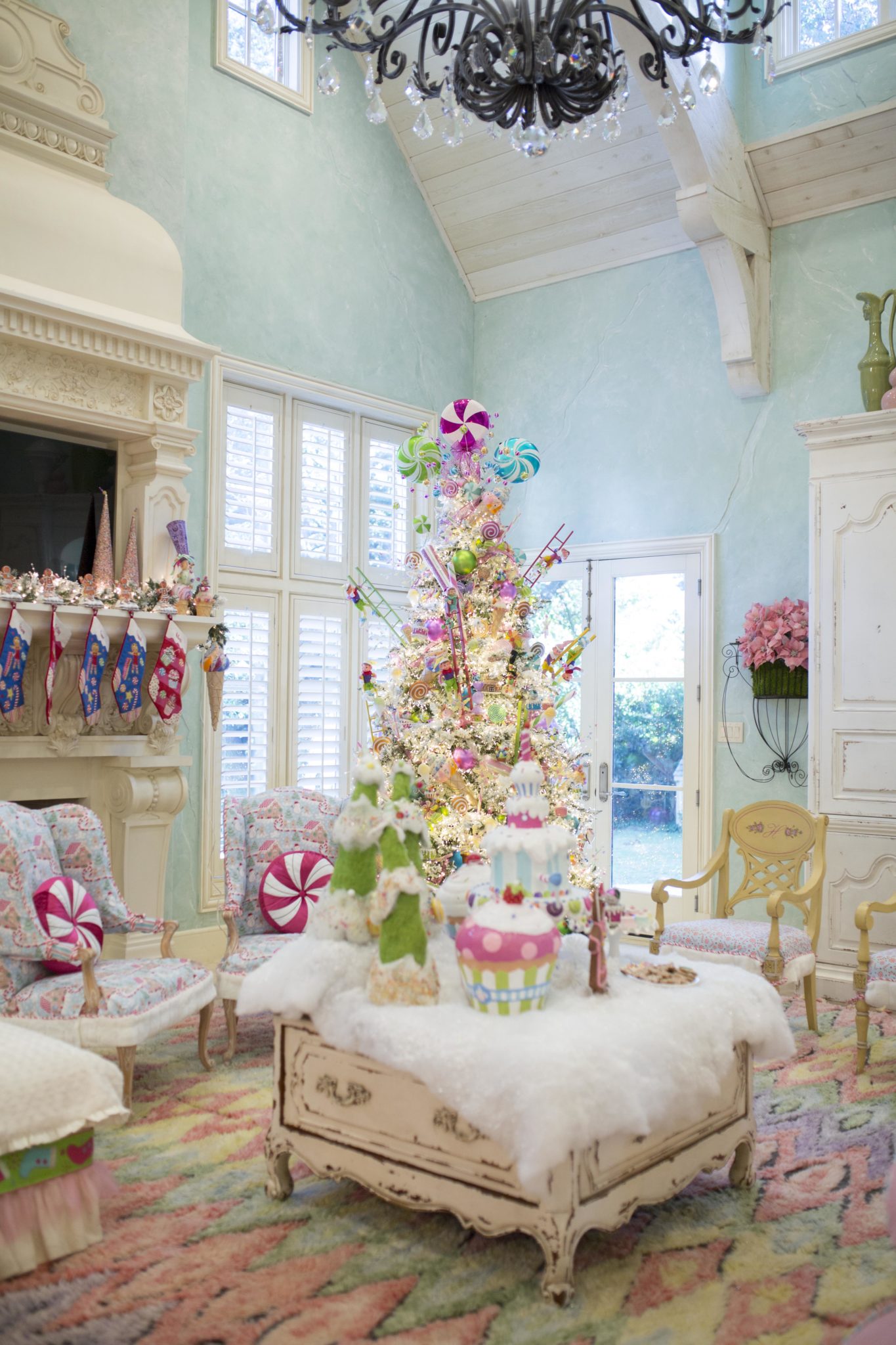
Pale blue walls are unforgiving with candy colors, so pick your bulbs carefully: 2700K warm white on the tree and in lamps, never cool daylight, or the pastels go chalky and slightly gray. Second tip — if you are painting a wall this saturated, go one shade lighter than you think. Blue reads about 20 percent stronger once the lamps are on at night, and that is when you will actually be looking at it.
8. Red Branches and Silver Glitter in a Distressed White Pot
You can build this exact centerpiece for about $28. Grab a white distressed pot from a thrift store ($6 to $12), two bunches of red faux branches from Walmart or Dollar Tree ($8), one stem of silver glitter picks ($5), and a box of dollar-store candy canes ($2). Floral foam and a little Spanish moss hide the mechanics. The whole thing takes fifteen minutes and reads like it came from a boutique, which is the entire point.
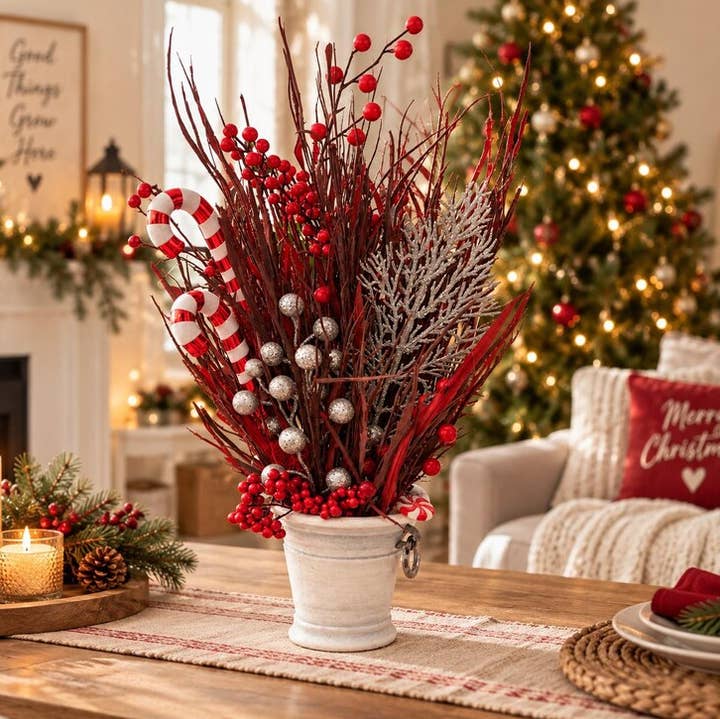
Centerpiece height should top out between 12 and 18 inches above the table for a seated dinner — tall enough to feel grand, low enough that nobody has to lean sideways to talk. The distressed pot here lands right in that window on a standard 30-inch table. If your table is a narrow 32 to 34 inches, scale the branches down by a third. For long farmhouse tables over 84 inches, use two or three smaller pots instead of one oversized arrangement, and put the candy canes in the front pot only.
9. A Flocked Tree With Red Ribbon Next to a Wooden Fireplace
Flocked trees look magical for about three weeks, then they shed on everything within a six-foot radius. Vacuum the skirt weekly, and never drag the tree across a light carpet — that white powder works into fibers and stays there. Also, real candy canes on a tree in a heated room get tacky and attract ants. Use the plastic ones for hanging and keep the edible ones on the table where you can actually eat them. For a tree with the same red-white story and less shedding, see Idea #13.
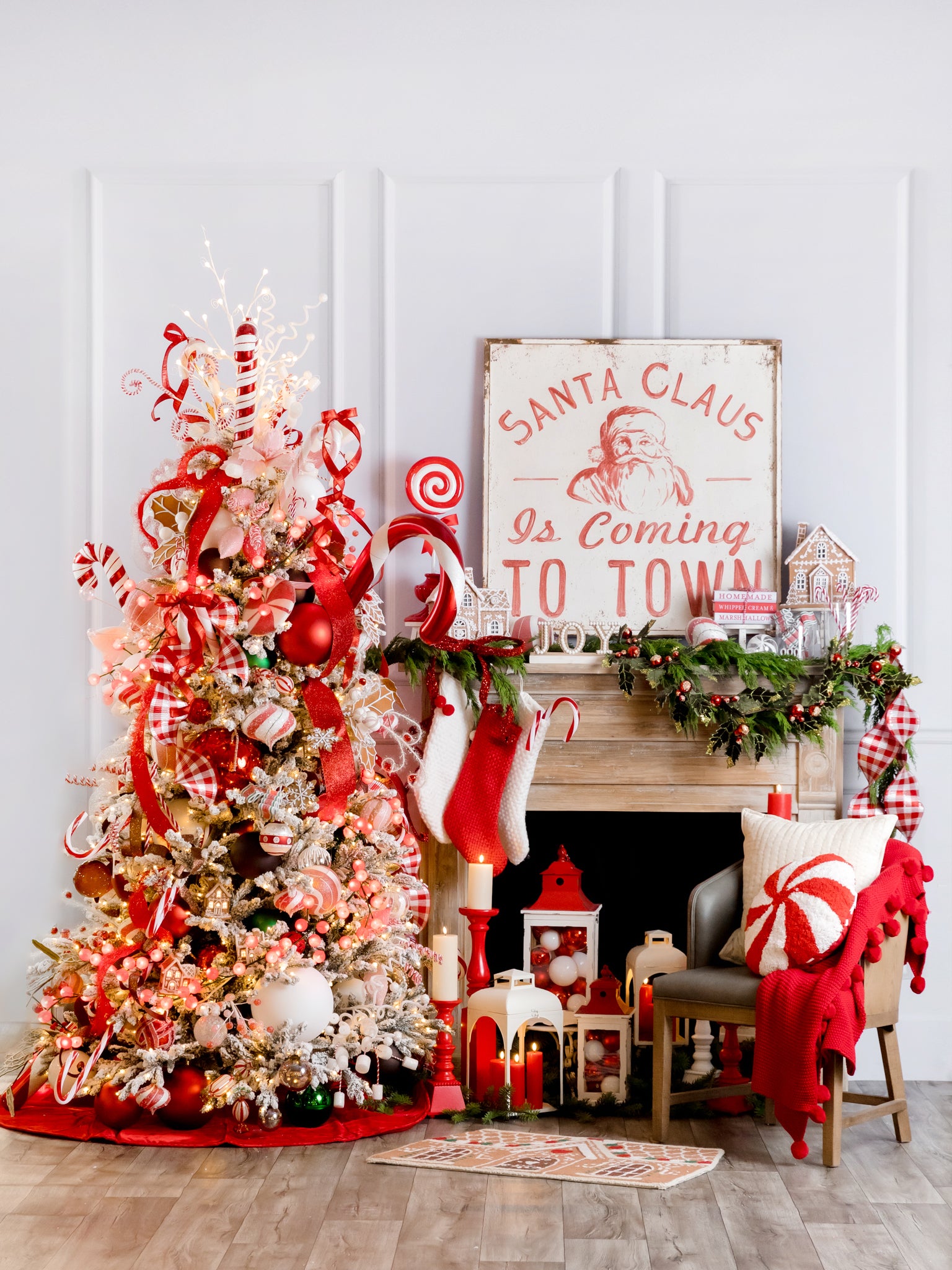
The garland over the mantel is the easiest piece to copy:
- Start with a 9-foot faux evergreen garland and fluff every branch outward.
- Wire in two stems of red berries, spacing them at thirds.
- Tuck four to six miniature gingerbread houses into the greenery so the icing faces forward.
- Add battery-operated warm white fairy lights, weaving over and under so the wire hides.
- Hang the Santa sign last, centered, at eye level when standing.
Time: about 30 minutes. Materials: roughly $35 to $60.
10. A White Play Teepee Dressed With Oversized Lollipop Props
It works because everything scales up. Oversized lollipop props, plush candy canes, and a pom-pom garland turn a plain white teepee into a walk-in storybook, and the soft forms mean nothing hurts when a five-year-old flops into it. The candy-shaped pillows give it a job beyond looking cute — it is a reading nook wearing a candy costume. And the whole thing reads as one concept because every prop is either candy or candy-colored, which is also why Idea #14 feels like the grown-up version of this room.
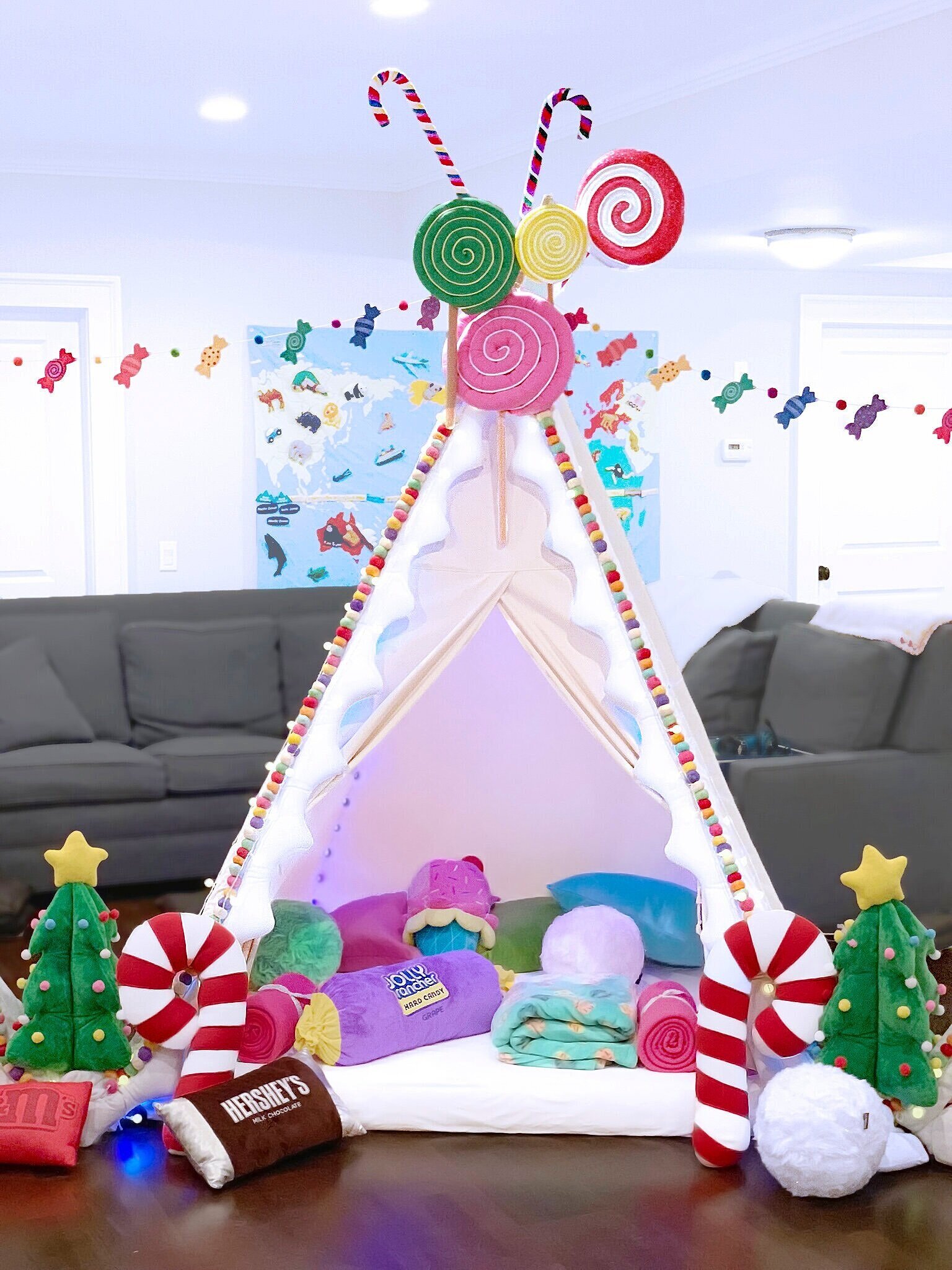
Total spend if you are smart: about $75. A plain white teepee runs $40 to $60 on Amazon; DIY lollipops are a pool noodle wrapped in red and white ribbon plus a foam circle ($8 for two), and the pom-pom garland is a pack of craft pom-poms and twine from Dollar Tree. Thrift stores are goldmines for plush trees and candy-print pillows this time of year — check the toy and Christmas aisles before you buy new.
11. An Icing-Mortar Gingerbread House With Reindeer and a Santa Mailbox
- Centerpiece gingerbread house, large scale or kit-built: $60–$250
- White wooden reindeer, two to three: $40–$180
- Wrapped gift piles in red and green: $30–$120
- Santa mailbox, sleigh, and directional sign props: $45–$200
- White fabric snow base and metallic overhead accents: $25–$90
- Total: $200–$840
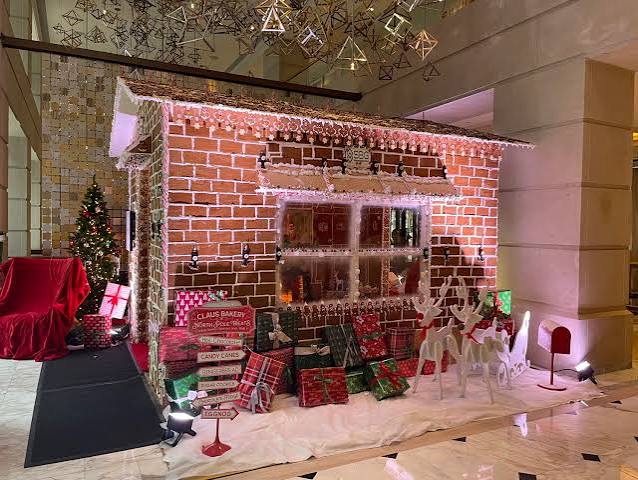
Budget alternative: build the house from a $25 kit, paint thrifted reindeer white, and wrap empty boxes you already own — roughly $150 all in.
This is a display, not a corner accent, and it needs room to breathe: a footprint of about 5 by 7 feet, with 36 inches of walkway left in front for photos. Ceiling height matters if you hang those geometric metallic ornaments — you want at least 8 feet, and 9 or 10 is better so they float well above the house. In a smaller space, go down to one reindeer and skip the overhead pieces entirely.
12. Candy Cane Vases With Evergreen, White Blooms and Red Berries
Vase proportions are everything in a glass arrangement. Choose a vessel about one-third the height of your finished arrangement, then cut your evergreen stems so the greenery is roughly 1.5 times the vase height. Odd numbers of vases — three or five — look intentional on a long table. Always start with the greenery, add white blooms second, then thread candy canes in last so they sit slightly forward and catch the candlelight.
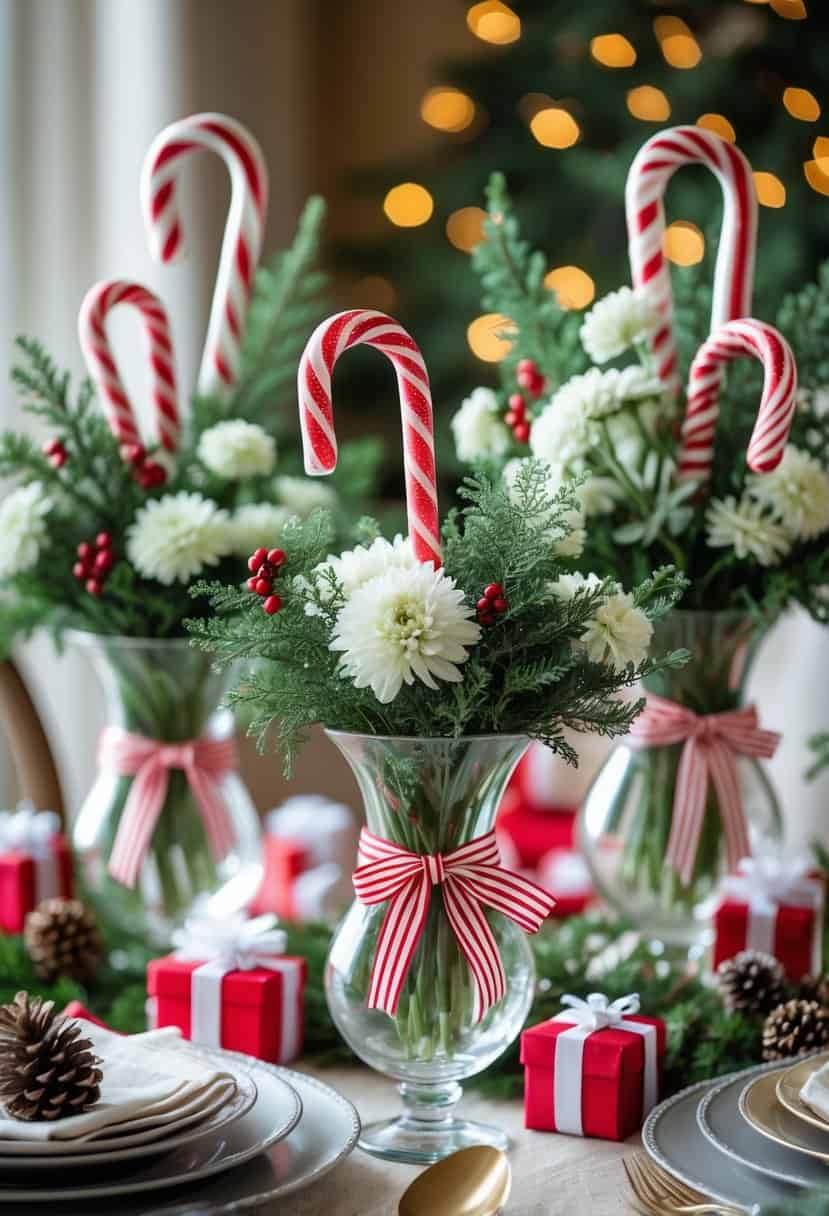
It is the striped ribbon tied at each vase’s neck. Those clear glass vases, evergreen branches, and red berries would look perfectly nice on their own — nice, festive, forgettable. The red and white ribbon is what turns a florist’s leftovers into a candy land centerpiece, and it costs about a dollar per vase. One small, cheap detail is often the difference between that looks pretty and where did you get that.
13. A Flocked Tree Loaded With Candy Canes and Gingerbread Men
The look is in the density, not the price. Buy plain red and white shatterproof baubles in bulk — a 100-count box runs $25 to $35 at Walmart or Target — then add ten to fifteen statement pieces (gingerbread men, candy canes, a couple of small gingerbread houses) at $3 to $8 each. Thrift stores and after-Christmas clearance are how you build a collection for $60 total instead of $400. A frosted tree plus one style of candy cane beats a sparse tree with expensive ornaments every single time.
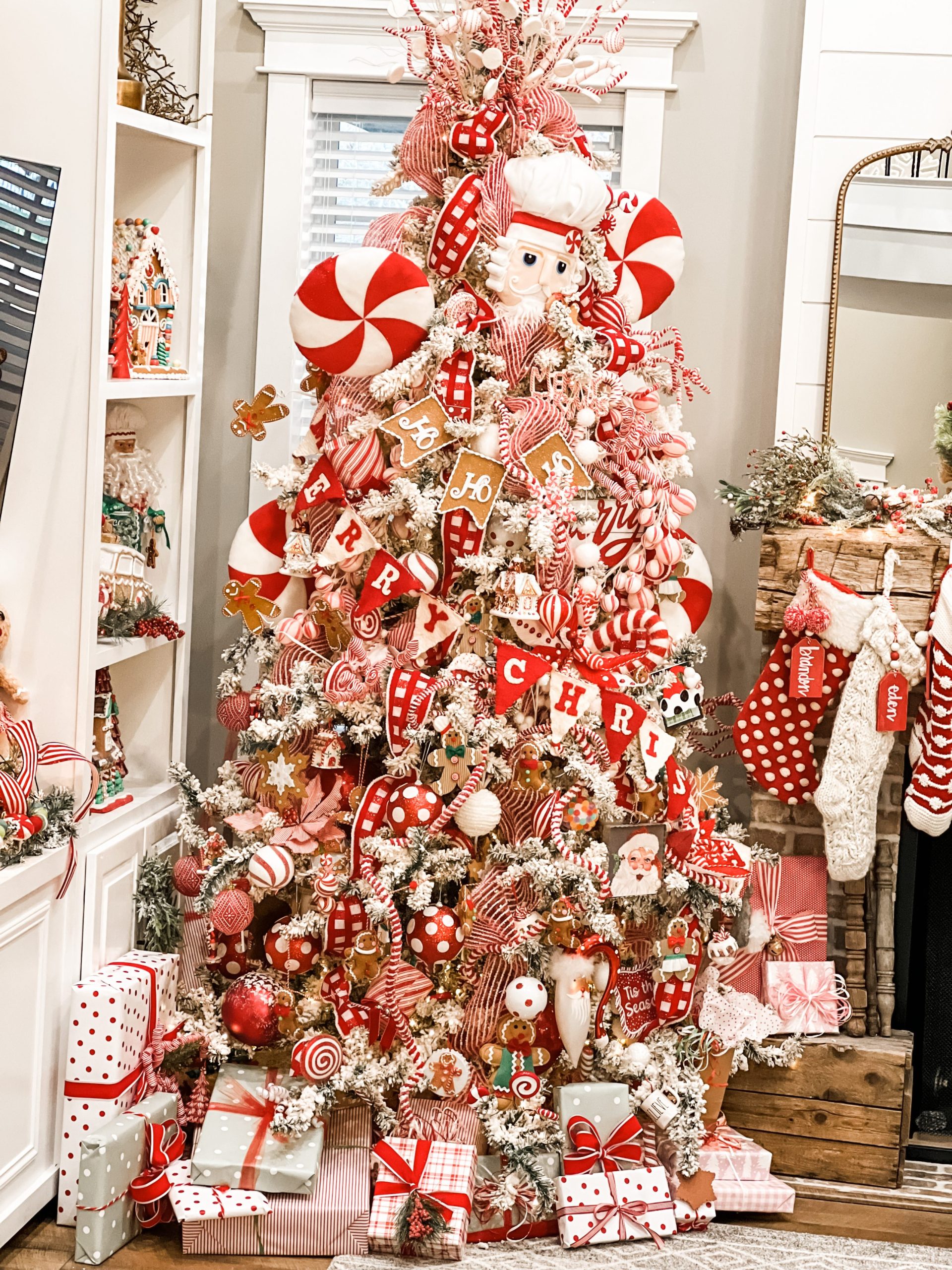
Two real problems with this tree. First, red and white ornaments on a heavily flocked tree look incredible in daylight and slightly washed out under warm night lighting — test your lights before you commit to the palette. Second, plush gingerbread men are dust magnets and they fade in direct sun. Rotate them to the back of the tree in January and store them in a sealed bin, not a cardboard box in the garage.
14. A Pink Flocked Tree With Pastel Nutcrackers and Gift Box Towers
The recipe is 45 percent pastel pink base — the tree itself — 30 percent light blue and white, 15 percent pale yellow and lavender accents, and 10 percent warm wood from the floor for grounding. That last 10 percent matters more than it sounds; without the wood and the white window frames, pastels float and the vignette starts to look like a nursery display. Swap the lavender for mint and the formula still holds perfectly.
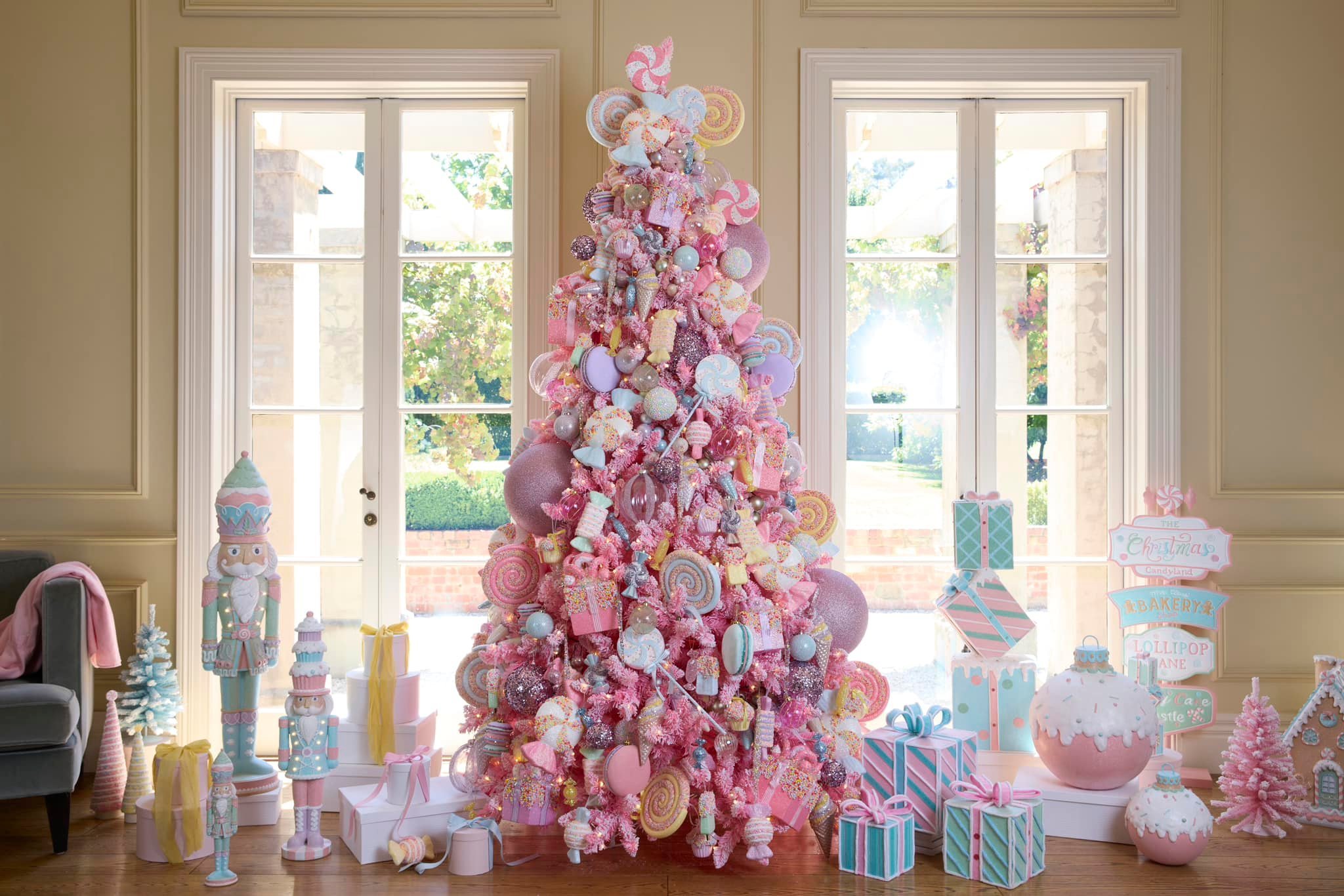
Pastel Christmas has been creeping up for a few seasons and 2026 is the year it goes mainstream. The driver is simple: people are decorating for themselves and their kids instead of for a magazine spread, and pink trees photograph ridiculously well. The risk is that pastel can read as baby shower if it is not anchored — which is why the nutcrackers, gift box towers, and candy signposts in this setup matter. It is nostalgia with a structure.
15. Cake Slice Ornaments With Glitter Icing and Microbead Sprinkles
Handmade-looking ornaments need scale variety or the tree turns into a craft sale. Mix three sizes — roughly 2, 3.5, and 5 inches — and hang the largest pieces low and slightly inward, the smallest near the top and on the outer tips. Anything with microbead sprinkles should sit at or above eye level, because that texture only reads from about three feet away. Cluster two or three cake slices together instead of scattering them across the tree.
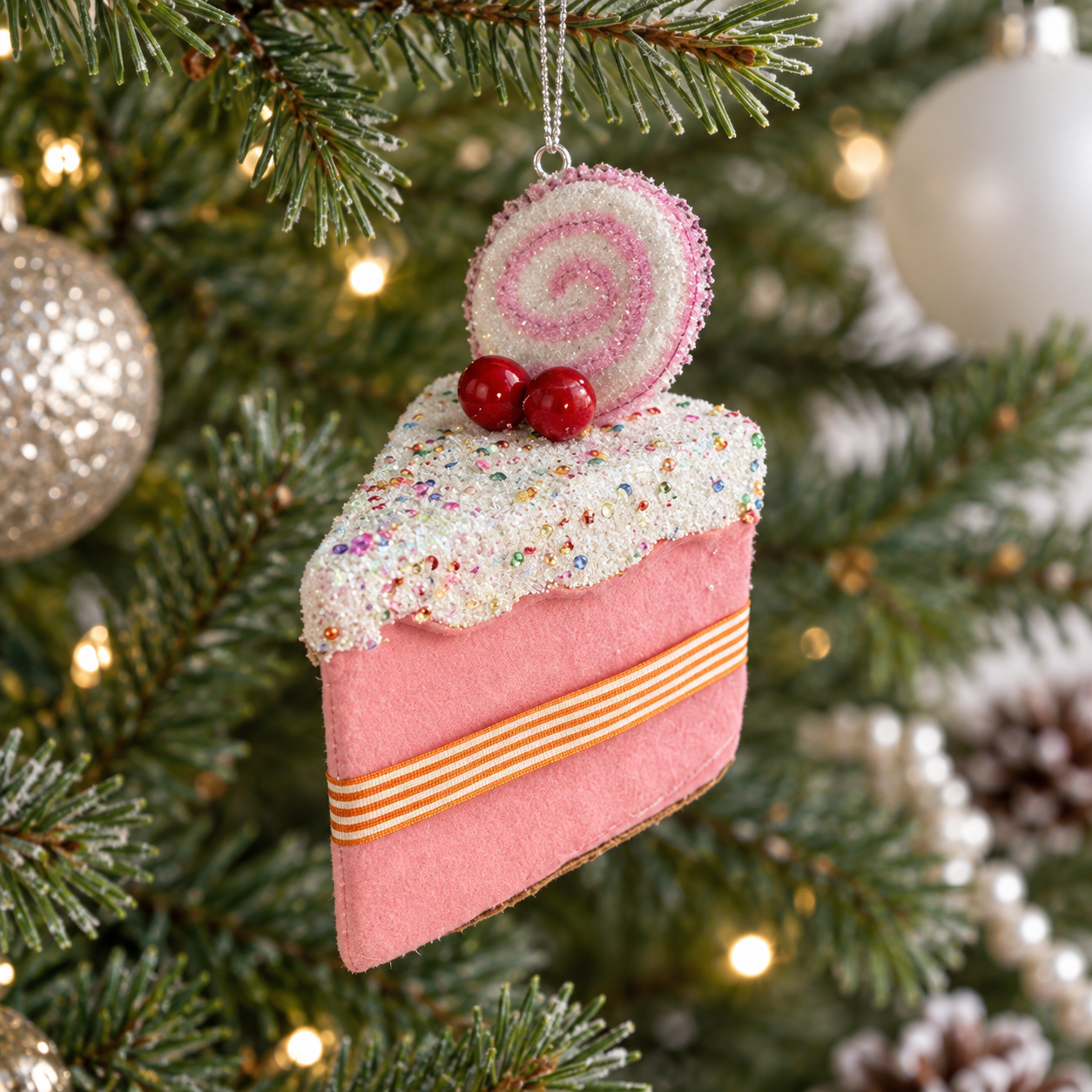
Felt and microbead ornaments are sturdier than they look — the beads are glued, not sewn — so never wipe them with a damp cloth, which loosens adhesive over time. A dry soft brush once a season is plenty. Store them in a hard-sided bin with tissue between layers, because squished felt never quite springs back. If sprinkles start shedding, a thin coat of clear craft glue over the bead clusters stops it for about a dollar.
16. Oversized Lollipop Ornaments on a Heavily Flocked Tree
The lollipops, and specifically their size. These are not ornaments that happen to be candy-shaped — they are oversized props doing a set designer’s job on a tree. Without them you would have a pretty flocked tree with red and silver balls that looks like every other flocked tree with red and silver balls. The white flocking exists mainly to make those red swirls pop, and the red glitter star up top is basically telling you where the story started.
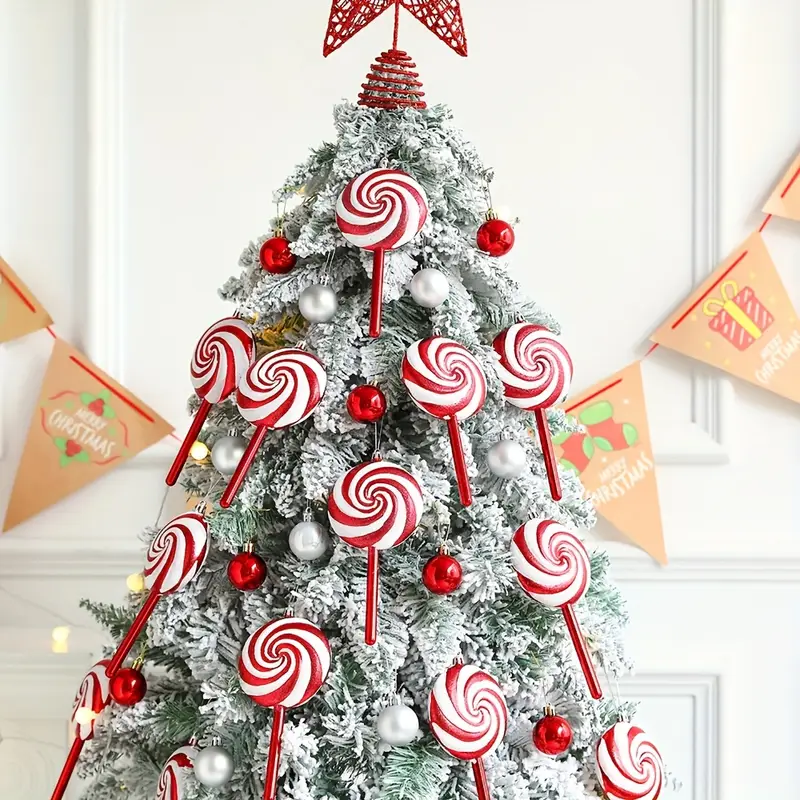
Two principles are carrying this. Repetition with variation: the same swirl shape appears many times, but each one sits at a slightly different angle and depth, which makes the tree look full rather than arranged. And contrast in finish — matte flocking, glossy baubles, a glittered star — keeps a two-color palette from going flat. Notice the kraft-paper banner behind it too; brown paper against all that red and white keeps things from feeling like a candy store display.
17. A Hot Pink Tree With Cotton Candy Puffs and Tiny Snowmen
Think of it as 40 percent hot pink, 25 percent pastel pink, 20 percent teal and red ornaments, and 15 percent white cotton-candy texture. The teal is what saves it — without a cool counterweight, all that pink gets syrupy fast. If hot pink is not your thing, keep the exact same percentages and swap the base to a rich emerald with candy-colored ornaments, which reads more classic sweetshop than carnival.
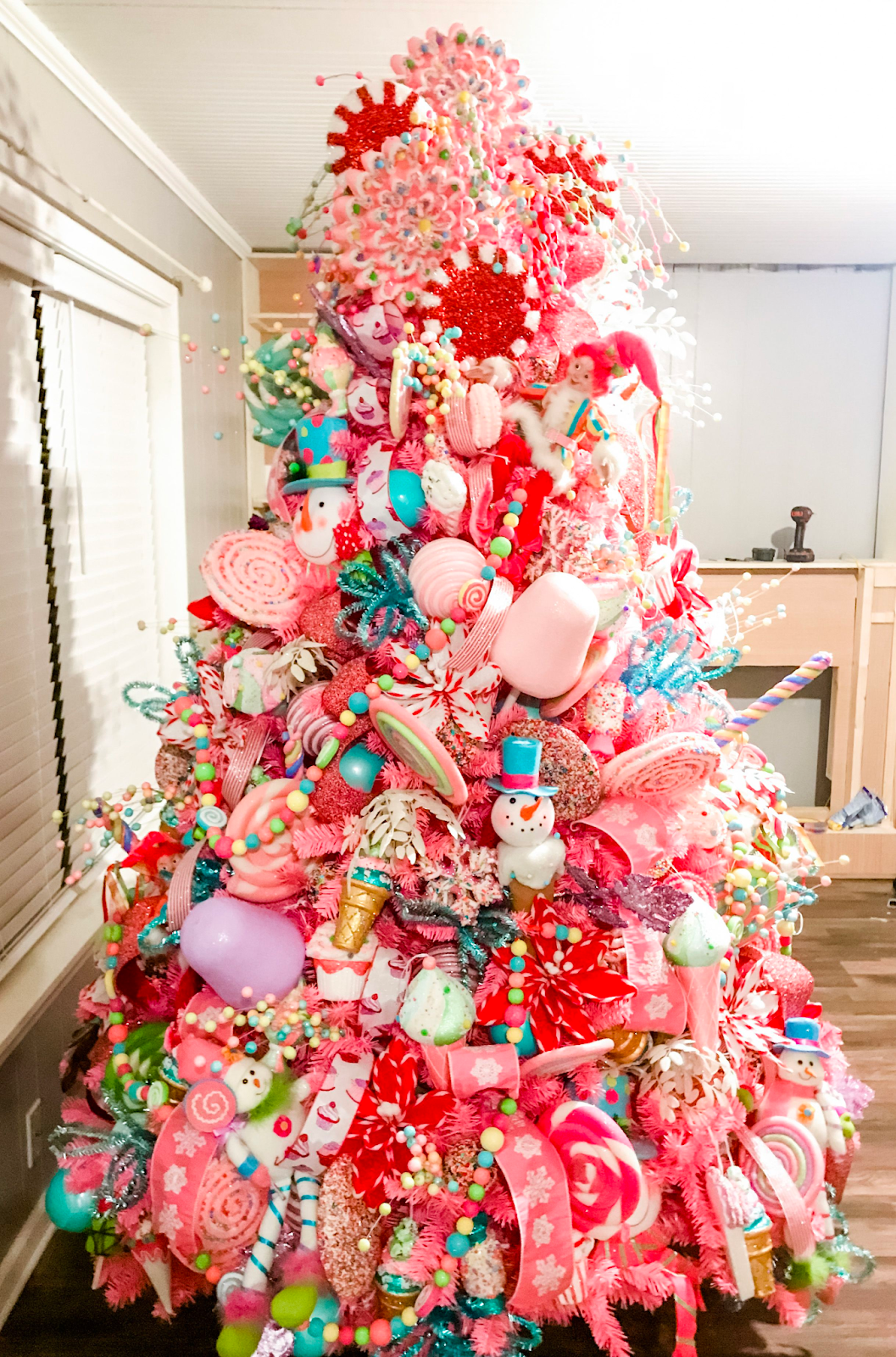
A hot pink tree is a commitment, and it is not just the tree. Pink flocking sheds pink, and it shows on light carpet, dark carpet, and everything in between. It also absorbs warm lighting differently than green — under 2700K bulbs it glows, under cooler light it goes a little neon. Budget for a storage bag wide enough that you are not crushing the branches, and expect to keep this tree for years, because nobody else wants your hand-me-down.
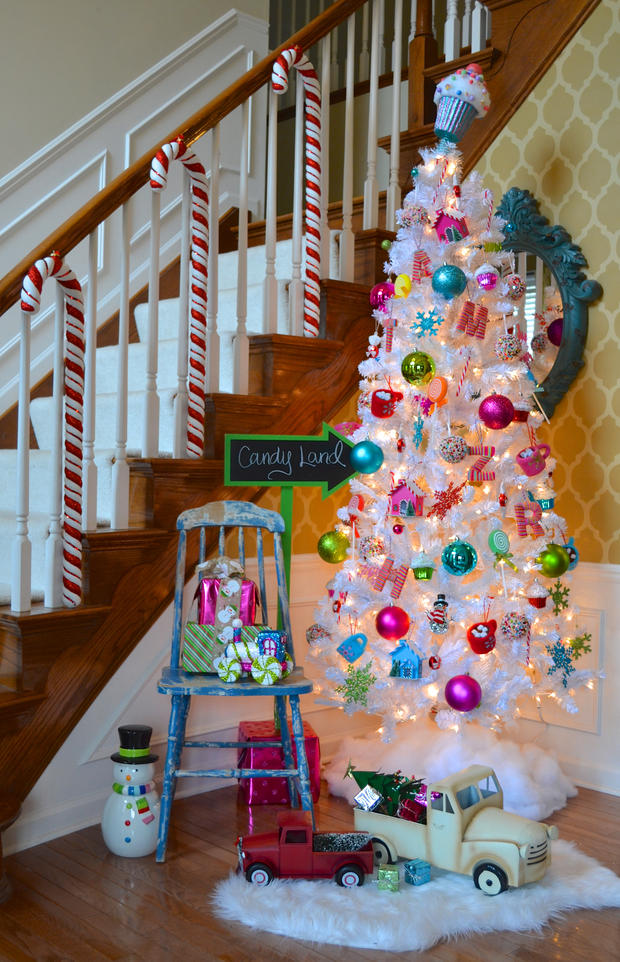
18. Candy Canes Wrapped Around the Stair Rail and a Distressed Blue Chair
Wrapping candy canes around a stair rail takes about 20 minutes and under $20:
- Wipe the rail first — tape and ribbon will not stick to dust.
- Attach a small clear removable hook every 8 to 10 inches along the underside.
- Hang oversized candy canes at alternating angles so they cross slightly.
- Secure each one with a tiny piece of clear tape at the hook so it does not swing.
- Weave a strand of warm white lights through the same hooks for evening glow.
For a mantel version of this same candy cane treatment, see Idea #28.
The rest of this vignette is thrift-store work. A distressed blue chair at Facebook Marketplace or a local estate sale runs $25 to $60, and it does not need to be comfortable — it is holding gifts. Miniature vintage toy trucks are $3 to $8 each at antique malls; check the bottom of junk bins. The Candy Land sign is a $4 craft-store plaque plus paint you probably already have. Total: about $90 for the whole landing.
19. Striped Chair Bows and Shell Pendants Over a Candy Tablescape
Ten by twelve feet is the minimum for this setup — anything smaller and the shell pendants crowd the tree. You want 36 inches of clearance between the chair backs and the wall behind them, and pendant lights hung so the bottom sits 30 to 34 inches above the table surface. With 8-foot ceilings that is plenty; with 9 or 10, drop them a little lower or they will float. Loft and open-plan dining areas handle this look best.
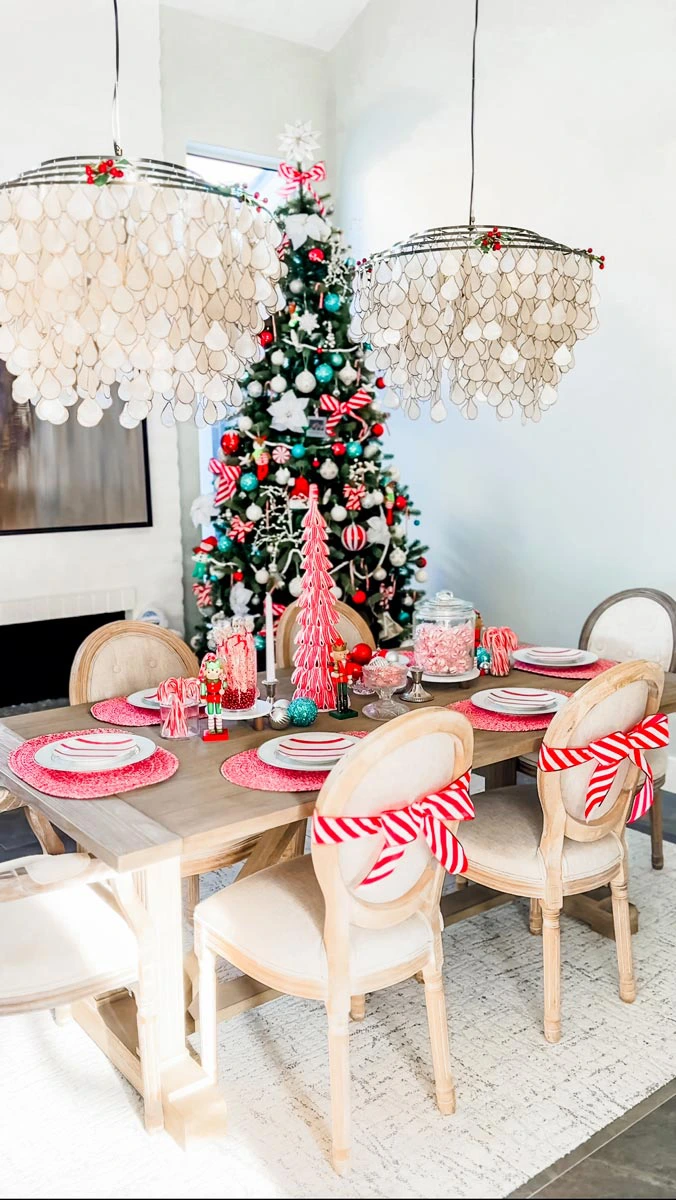
Those striped bows tied on the chair backs work because the chairs are solid beige. If your dining chairs are patterned, skip the bows entirely — they will fight. And tie them at the top third of the chair back, not the middle, so the tails fall freely and nobody sits on them. A 2-inch-wide ribbon holds its shape far better than a 1-inch one on a full-size chair; anything narrower reads like a gift tag.
20. Pastel Poinsettias and Cookie Ornaments on a Flocked Tree
Pastel poinsettias do the work of a floral arrangement without a single real flower. They are big enough to read from across the room, cheap enough to buy a dozen, and soft enough that they never fight the cookie ornaments or ribbons. The bigger principle: on a flocked tree, texture beats color every time. Pink and blue on white looks expensive because the flocking gives every ornament a soft halo, which is exactly what people are trying to buy when they pay for a designer tree.
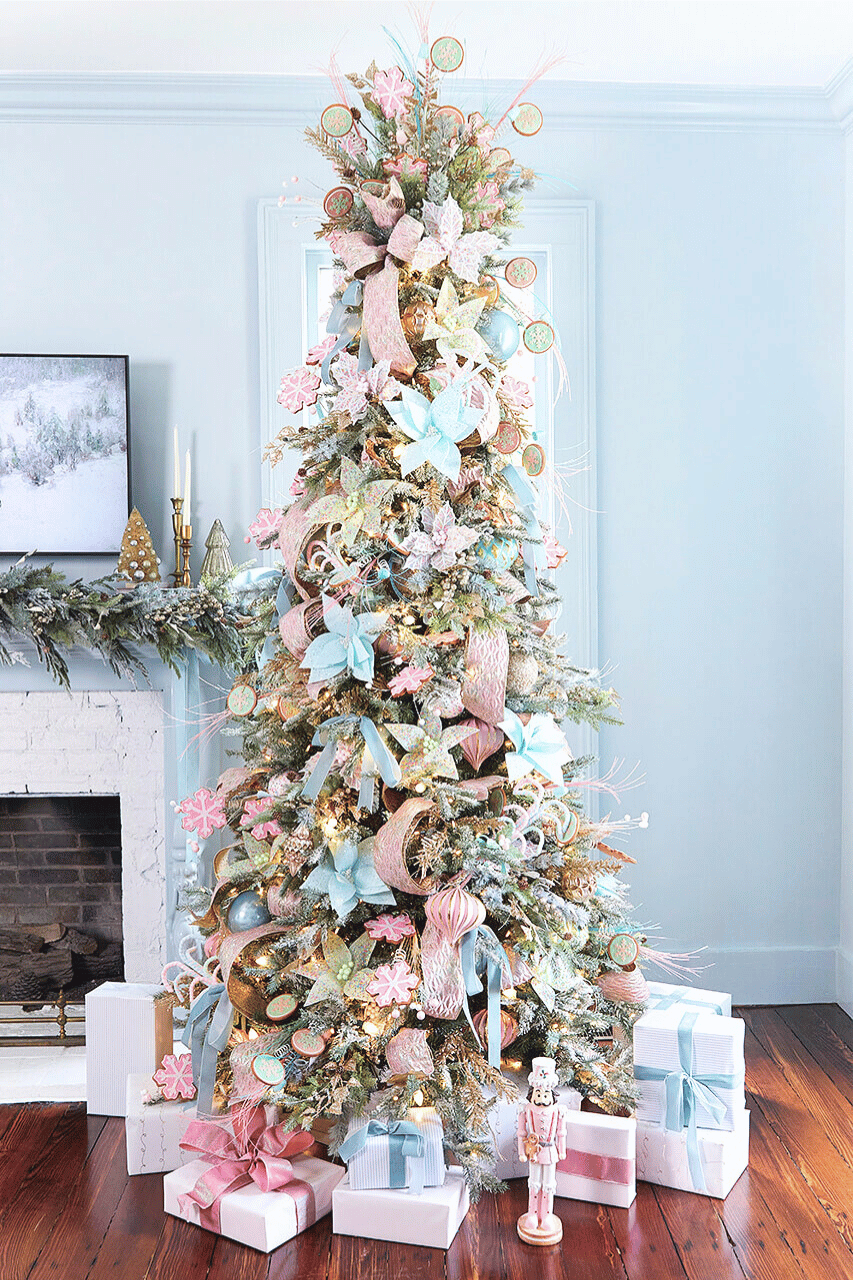
The balance here is 50 percent white flocking, 30 percent soft pink and light blue, 15 percent warm gold and natural wood, and 5 percent something dark — usually the nutcracker or a deep green stem — to keep it from looking like cotton candy. That dark 5 percent is the secret. Remove it and the tree photographs flat. Swap the gold for brushed silver to make the same palette feel cooler and more modern.
21. Two Red Gingerbread Appliqué Pillows on a White Sofa
The pillows. That is the whole idea, and it is a good one because it is the cheapest way to make a neutral sofa read as candy land. A white couch with two red appliqué pillows — one gingerbread house, one gingerbread man — costs about $40 total and does more for the room than a new tree skirt. Remove them and you have a beige sofa and a beige room. That is the test for any single element: does the space survive without it?
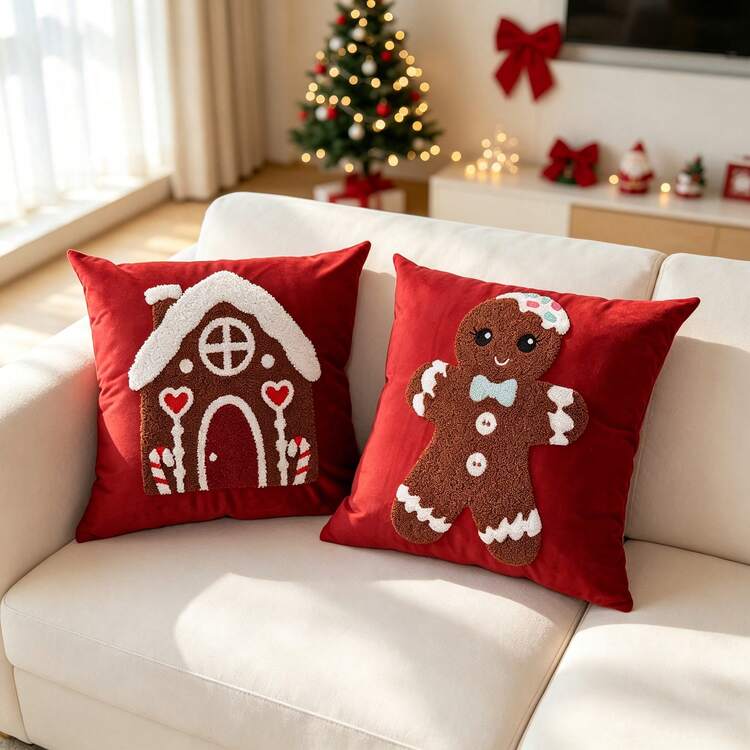
Appliqué pillows are the first thing to show wear. The dimensional felt and embroidery catch pet hair, and red fabric on a light sofa means any transfer is visible in seconds. Spot-clean with a damp cloth and mild soap, never a soaking wet sponge, and rotate the pillows weekly so the sun fades them evenly. If you have a shedding dog, look for a version where the appliqué is flat embroidery rather than raised felt shapes.
22. A Gingerbread House on a Sprinkle-Filled Cake Stand
- Gingerbread house centerpiece, large or kit-built: $25–$120
- Glass cake stand with pedestal: $18–$55
- Decorated gingerbread men and house cookies, two dozen: $30–$70
- Red tablecloth plus striped and gingerbread-patterned runners: $25–$65
- White ceramic trays and a cookie bowl: $15–$45
- Total: $113–$355
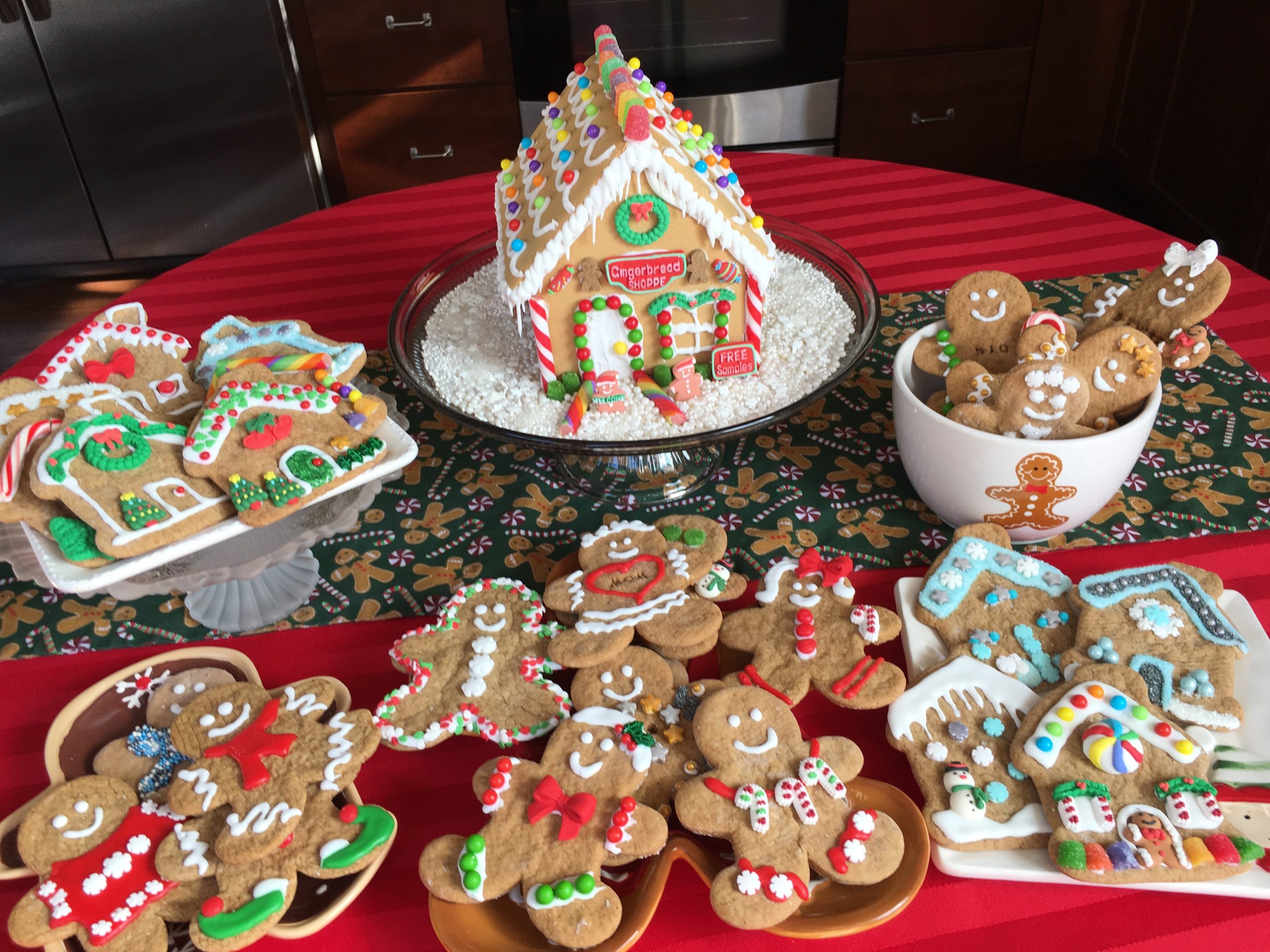
Building the sprinkle pedestal takes ten minutes:
- Set the cake stand on a rimmed tray so runaway sprinkles stay contained.
- Fill the pedestal base with an inch of white nonpareils or sanding sugar.
- Set the gingerbread house on a small square of parchment, then press it gently into the sprinkles.
- Arrange cookies on trays at varying heights — a stack, a lean, a flat row.
- Finish with two or three wrapped candies tucked in for color.
Materials: about $8 beyond what you already baked.
23. A Pink Retro Kitchen With a Ceramic Tabletop Tree
Small appliances are the easiest place to hide holiday decor, and a retro fridge is basically a billboard. Keep the styling on top of the fridge to three objects max — the ceramic tree, a cake stand, and one figurine — or the pink reads as clutter instead of charm. And check your pendant lights before you hang anything from them: ornaments clipped to a warm-white lantern look wonderful; on a cool-white LED they look like dust. The tabletop version of this cupcake-and-candy styling lives in Idea #3.
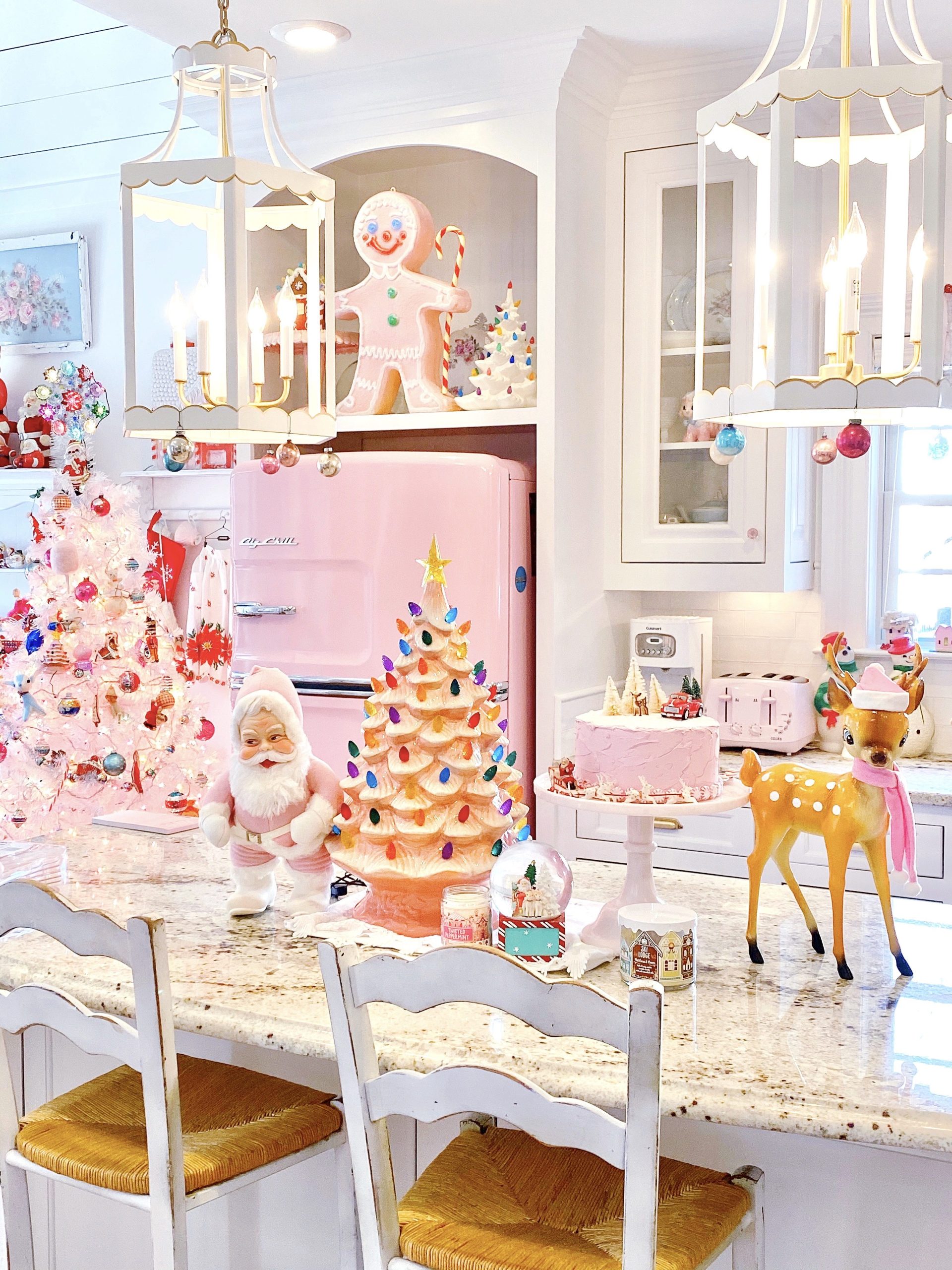
Retro pink kitchens have been building for a couple of years now, and Christmas is where the trend gets genuinely fun. Part of it is the broader pastel holiday wave; part of it is that pink appliances photograph beautifully. This is also one of the more permanent-feeling moves on the list — a vintage Santa figurine on a pink counter reads cheerful in 2026 and probably in 2032, which is more than you can say for most theme decor.
24. Pastel Village Dishes in a White Hutch and a Pink Wreath
Break it down as 40 percent white — hutch, flocked tree, tablecloth — 25 percent soft pink, 20 percent red from the checkered curtains and candy ornaments, and 15 percent mint and gold for sparkle. The red-and-white check is the boldest move in the room, and it is balanced by two quieter patterns (the village dishes and the tablecloth) so nothing competes. Trade the check for a ticking stripe and the room goes calmer with zero other changes.
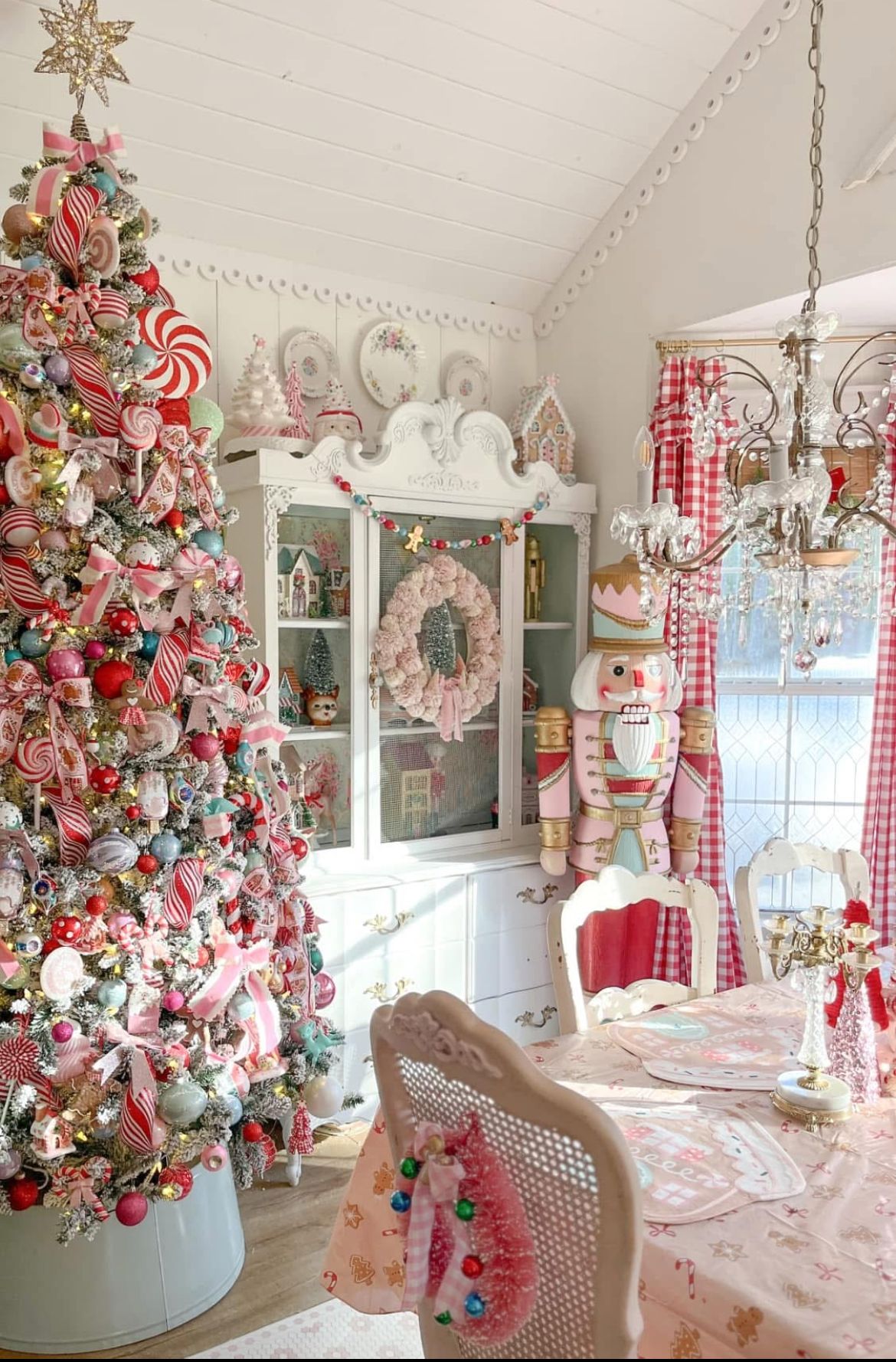
Dining rooms of 12 by 14 feet and up can carry a hutch, a full tree, and a tall nutcracker without feeling stuffed. Under 10 by 12, pick two of the three — I would keep the tree and the nutcracker and lose the hutch styling. If your chandelier hangs within 30 inches of the table and you add a tall nutcracker nearby, the sightline gets crowded, so park the figure in a corner or beside the hutch instead of in the walkway.
25. A Giant Lit Snowman Lantern and Candy Cane on the Porch
Two things about porch displays: wind and weather. A giant lantern snowman is lightweight, which is great for moving and terrible in a storm — anchor the base with sandbags or patio weights, and bring the fabric parts inside during heavy rain. The wagon should be sealed, painted wood or powder-coated metal; untreated wood will gray out after one wet winter. Also confirm every cord and string light is rated for outdoor use before you plug anything in.
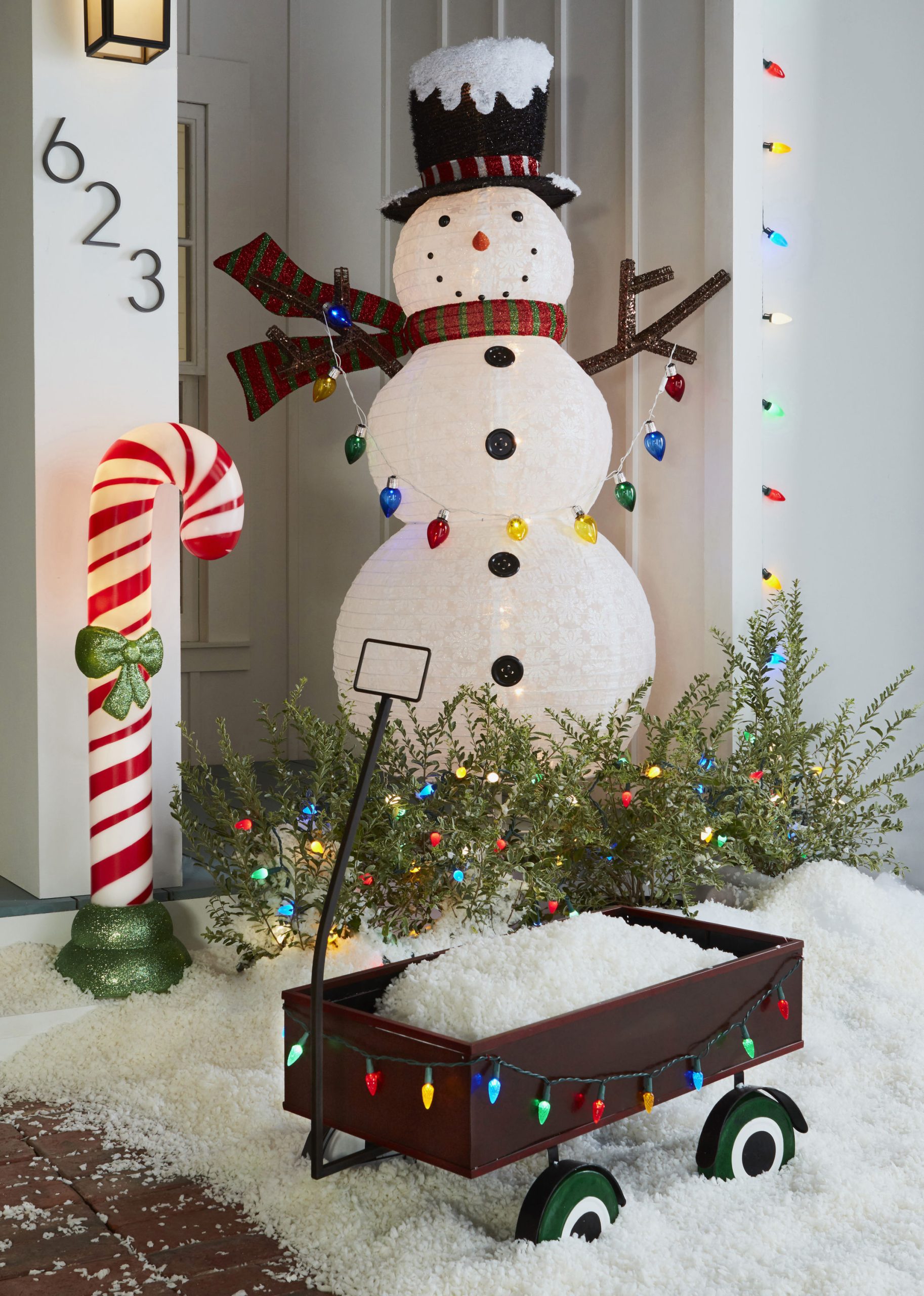
Setting the porch takes about 45 minutes:
- Clear the ground, then lay down a faux snow blanket or batting and stake the corners.
- Place the wagon first — it is the heaviest anchor and everything else arranges around it.
- Put the light-up candy cane where it frames the walkway, not behind the shrubs.
- Assemble the snowman last, facing the street at a slight angle.
- Run the multicolored string lights along the wagon edge into a GFCI outlet.
26. A Cone Tree Made of Ruffled Red and White Ribbon Candy
Ribbon cone trees live or die on ruffle density. Plan on about one yard of 2.5-inch wired ribbon per two inches of cone height — so a 24-inch tree eats roughly 12 yards. Start at the bottom with a hot-glue tack every quarter turn, overlapping each ruffle by half so no cone shows through. And buy the widest ribbon your craft store carries; narrow ribbon on a big cone looks skimpier than a cheap tree.
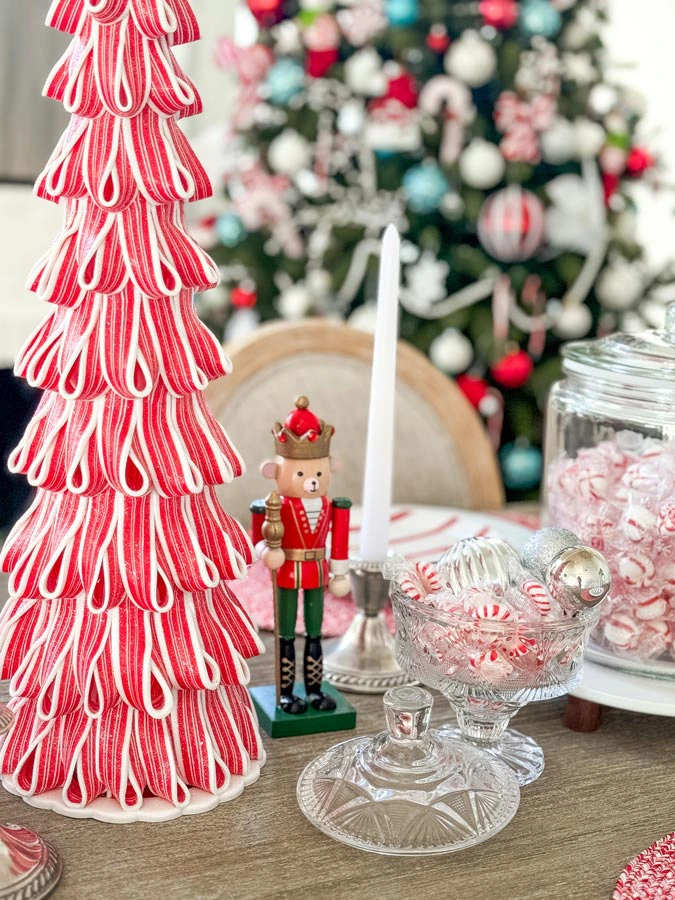
The candy jar is the one you would miss. That cone tree, the toy soldier, and the white taper candle make a nice, tidy trio — and then someone reaches into the glass jar of wrapped peppermints and the whole display becomes interactive. Candy you can actually eat is what separates a candy land tablescape from a candy shop display. Refill it mid-season; an empty jar is worse than no jar at all.
27. Plush Elf Shoe Stockings Trimmed With Faux Candy Sweets
Plush elf shoe stockings with embroidered frosting cuffs run $25 to $45 each from boutique sellers. Target and Walmart versions land at $12 to $18, and a plain stocking plus a fabric marker, felt scraps, and a hot glue gun gets you a surprisingly close look for about $10. Attach the faux sweets with safety pins rather than glue — that way you can pull them off in January and reuse the stocking next year with a completely different theme.

Before you buy, check these:
- Measure your mantel hooks or rail width — chunky elf stockings need 6 to 8 inches each.
- Confirm your fabric: high-pile plush collects pet hair, felt does not.
- Decide whether the sweets are sewn, pinned, or glued — that determines if it survives to next year.
- Match the pink and blue to your existing decor, not to the product photo.
- Set a per-stocking budget before you fall for a handmade listing.
28. A Santa Chef Topper Above a Brick Fireplace and JOY Banner
- Candy-themed tree, six to seven feet, ornaments included: $180–$650
- Santa chef topper and peppermint statement pieces: $20–$75
- Stockings, four to six, plus holders: $40–$140
- JOY banner, garland, and mantel accents: $25–$70
- Patterned wrapping paper and ribbon for gifts: $20–$55
- Total: $285–$990
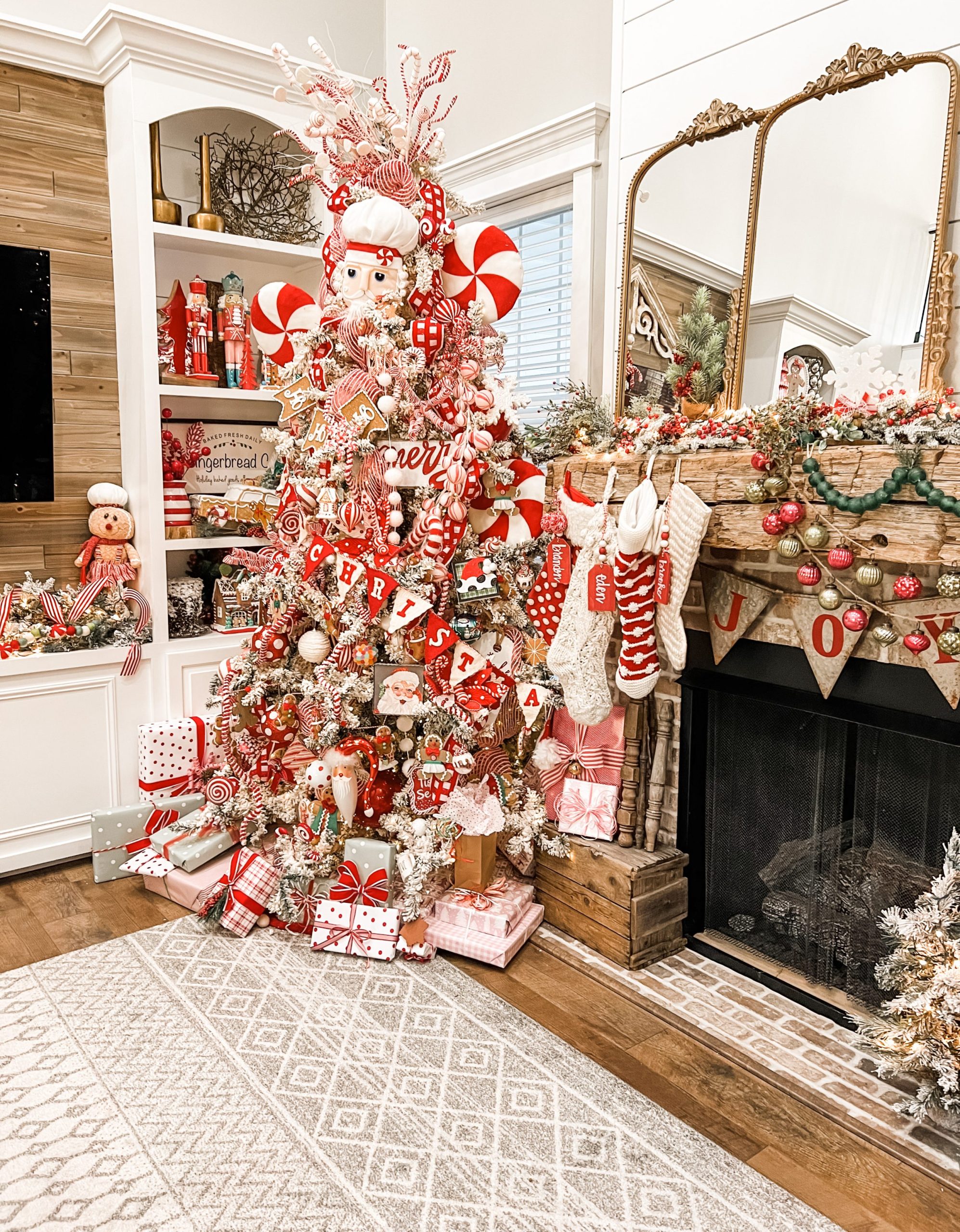
Budget alternative: thrift the nutcrackers and gingerbread figures, print the JOY banner at home, and wrap gifts in kraft paper with candy-striped ribbon — about $120 for the same mantel wall.
Three things keep this from being a wall of red. The ornate gold mirror above the mantel bounces light back down onto the stockings, so the fireplace reads lit even when it is not. The white built-ins on either side give all that color somewhere to rest. And the brick stays unpainted — that warm, rough texture grounds the glossy ornaments. Remove any one of the three and the whole chimney wall goes flat.
29. A Two-Tier Frosted Cake Surrounded by Donuts and Candlelight
Set the dessert table in 20 minutes:
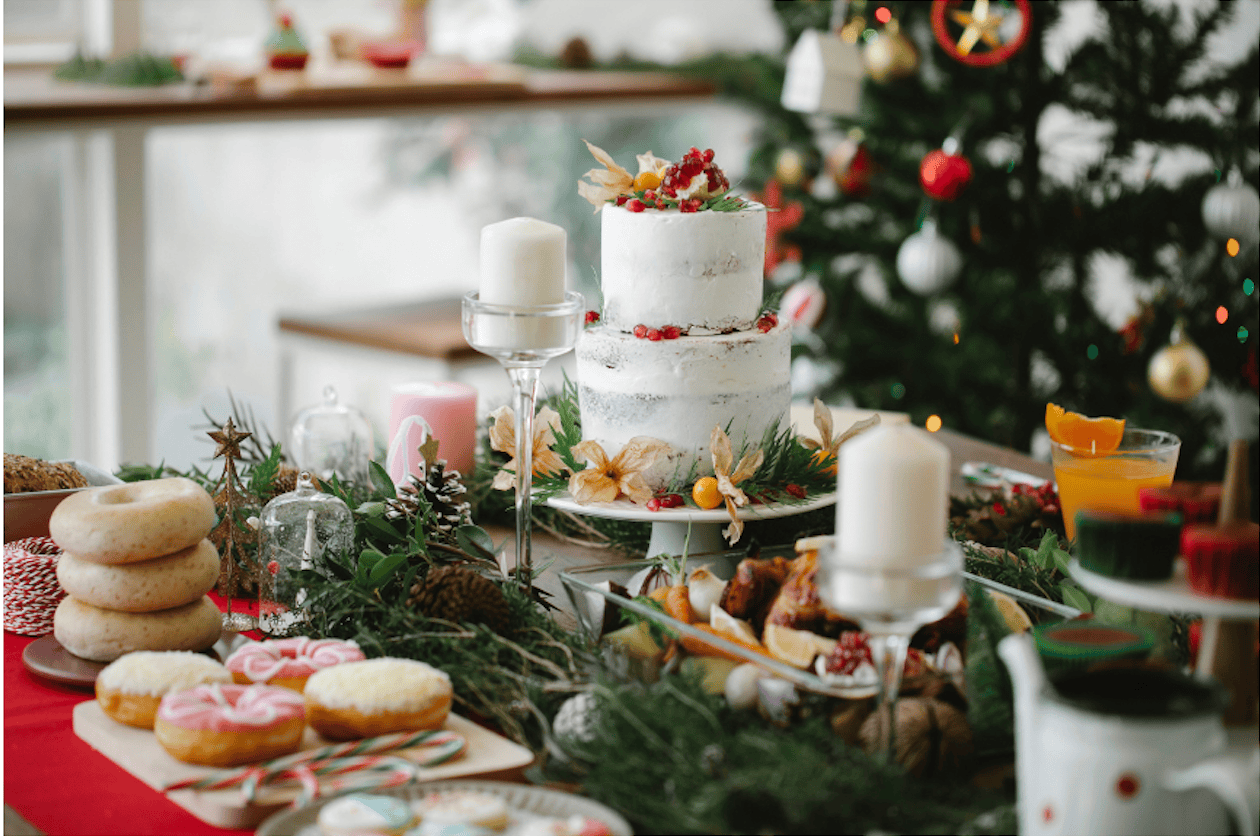
- Start with the two-tier frosted cake on a riser at center-back — height anchors everything.
- Lay evergreen branches loosely along the back edge, letting them drape over the table lip.
- Place two or three pillar candles in glass hurricanes, never directly under the greenery.
- Cluster donuts on a low platter and cupcakes on a second riser, front and slightly left.
- Fill gaps with a few small ornaments and a scattering of berries.
Real food plus real flame plus evergreen is a combination worth thinking through. Never leave pillar candles burning unattended, trim wicks to a quarter inch so they do not smoke, and keep greenery at least six inches from any flame. Frosted cakes hold up about four hours at room temperature before the frosting sweats — build the table right before guests arrive, and keep the donuts sealed until the last minute.
30. Handmade Felt Candy Ornaments Strung on an Evergreen Branch
Felt ornaments punch above their weight when you group by subject instead of scattering. Cluster the candy canes together on one branch section, the cocoa mugs on another, and the peppermint cones on a third. Garlands should run two strands — one beaded, one plain — at slightly different depths. Three to five pieces per cluster is the sweet spot; six starts to look like a shop display window. See Idea #15 for the shop-bought version of this same look.
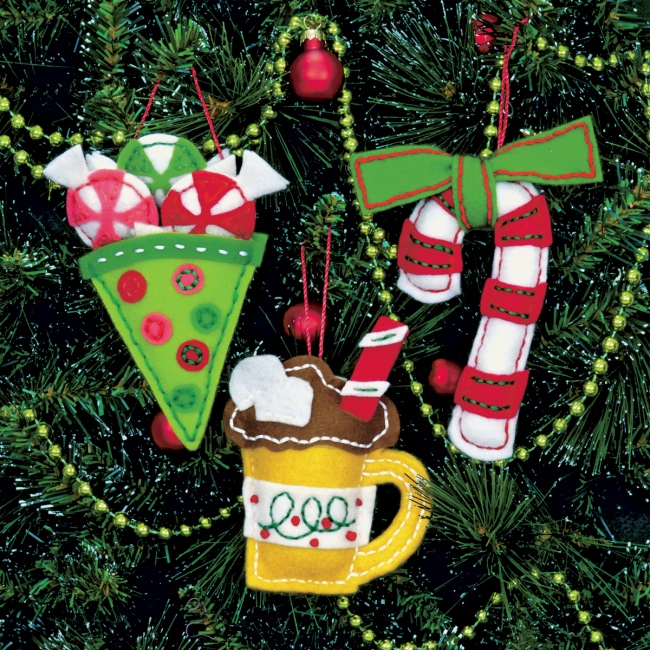
stitching:
- Confirm your tree space — handmade ornaments read small, so budget 20 to 30 pieces for a full look.
- Buy felt by the sheet in your three main colors; blends are cheaper than wool.
- Check beading thread strength — standard thread snaps on heavy beads.
- Plan for a hard bin with dividers, or the shapes crush in storage.
- Time check: figure 30 to 45 minutes per detailed ornament.
Go Build Your Own Candy Land — One Peppermint at a Time
You do not have to redo your whole house to pull off a candy land Christmas. Start with one corner, one tree, or one tablescape, and let it grow next year — that is how every good holiday room actually gets built anyway.
📌 Pin this guide now so it is waiting for you when the ornaments come out of the bin, and come back to check which idea you want to tackle first.