
There’s a reason the same six Christmas tree palettes show up on Pinterest every November — and why half of them look dated by January. The trees that survive the season are built on an actual color scheme, not a shopping spree.
We spent a few weeks digging through HomeGoods, Walmart, Target, Etsy, and Anthropologie — from $14 ornament sets to $1,200 ribbon-and-floral showstoppers — and pulled only the palettes worth your money in 2026.
Inside you’ll find 30 decorated trees: bright flocked neutrals, champagne gold, bronze and copper, saturated jewel tones, monochrome olive, and a coastal white that actually works. Every idea names the colors, materials, and quantities, with budget swaps for the ones you love most. And stay until the end — we break down the most common mistakes that can ruin these looks.
This year the shift is unmistakable: warm metals and deep, saturated color are pushing out the frosty all-white look, and flocking is being used as texture rather than a theme.
📌 Save this to Pinterest for later — you’ll want to revisit these ideas.
1. A Flocked Tree Against Floor-to-Ceiling Windows
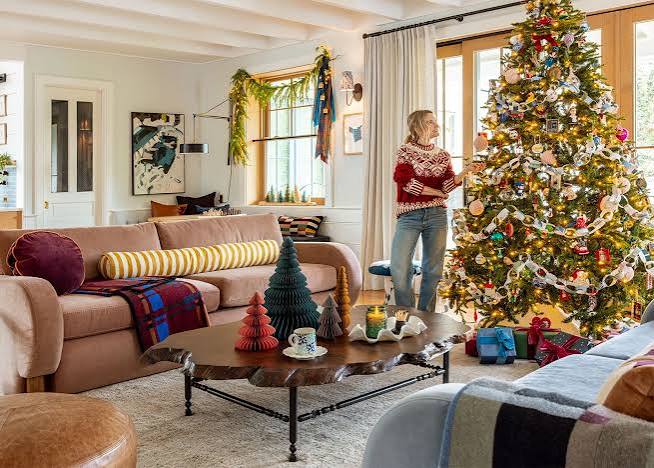
The formula here runs about 60% cream and warm white — the flocked branches, the sectional, the textured pillows — with 25% gold in the ornaments and the frame of the abstract painting, 10% soft gray borrowed from the city light pouring through the glass, and 5% natural wood on the coffee table. Swap cream for oatmeal and the gold for brushed brass and you keep the same bones at a lower temperature. Swap the gold for black and the room turns graphic instead.
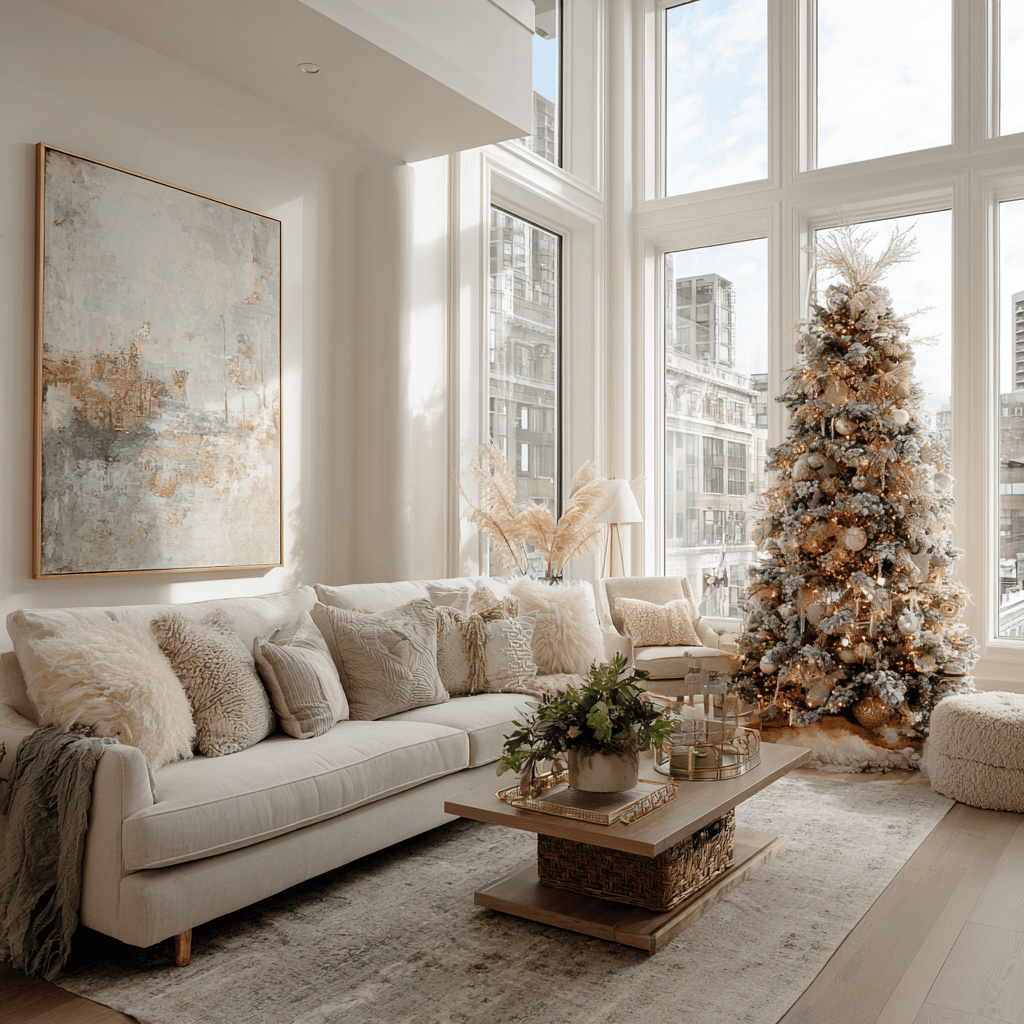
On a flocked tree, skip anything under four inches. Flocking eats detail, and a two-inch ball disappears from three feet away. Work in three sizes — four, six, and eight inches — at roughly a 5:3:1 ratio, and push the largest ornaments deep into the branches instead of hanging them on the tips. They’ll read like snow-heavy fruit rather than decorations parked on a shelf.
2. Champagne Ribbon Tree That Looks Like a Couture Gown
- Tree: 7.5 ft pre-lit flocked — $250–$700
- Main furniture: two upholstered neutral armchairs — $600–$1,800
- Lighting: crystal globe chandelier — $180–$900
- Textiles: three rolls of champagne wired ribbon — $45–$90
- Decor: oversized metallic ornaments and white floral picks — $120–$400
- Wrap: white boxes with gold borders and satin ribbon — $40–$80
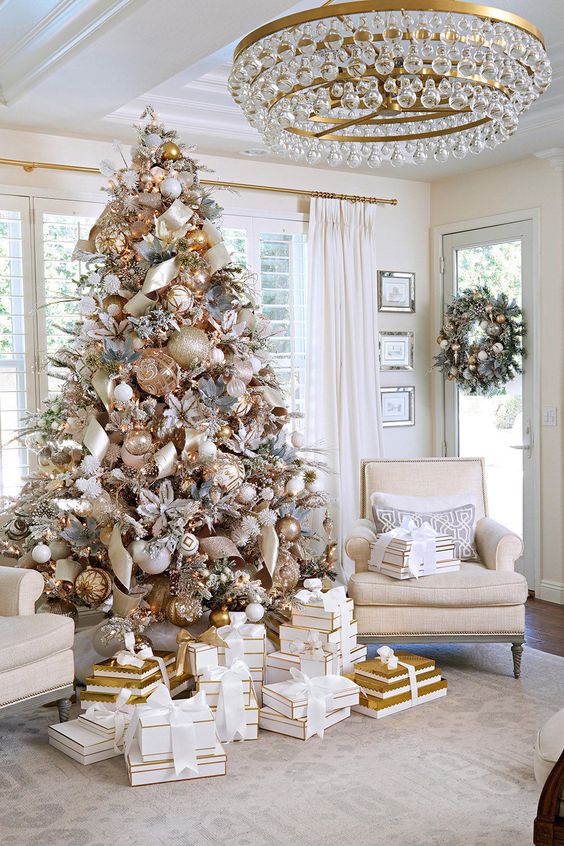
Total: roughly $1,235–$3,970. Budget alternative: skip the chandelier entirely and buy ribbon off a craft store’s spool wall at $6–$9 a roll — same shine for a third of the price.
The ribbon is the whole trick. Every branch tip gets a wired champagne length tucked into a soft S-curve instead of a stiff loop, and that single choice is what turns a pile of expensive ornaments into something that looks sewn rather than hung. Pull the ribbon out and you still have a lovely tree — just a far more ordinary one.
3. White Blooms Tucked Into Heavy Flocking
Two things are doing the work. First, texture contrast: the flocking is soft and matte, the oversized blooms are also soft, but the baubles are hard and reflective, so your eye keeps traveling. Second, repetition — white shows up three ways across the tree, which makes a busy silhouette read as calm. The flocking itself is a scale trick too, softening the fir’s outline until a tall tree stops feeling like furniture.
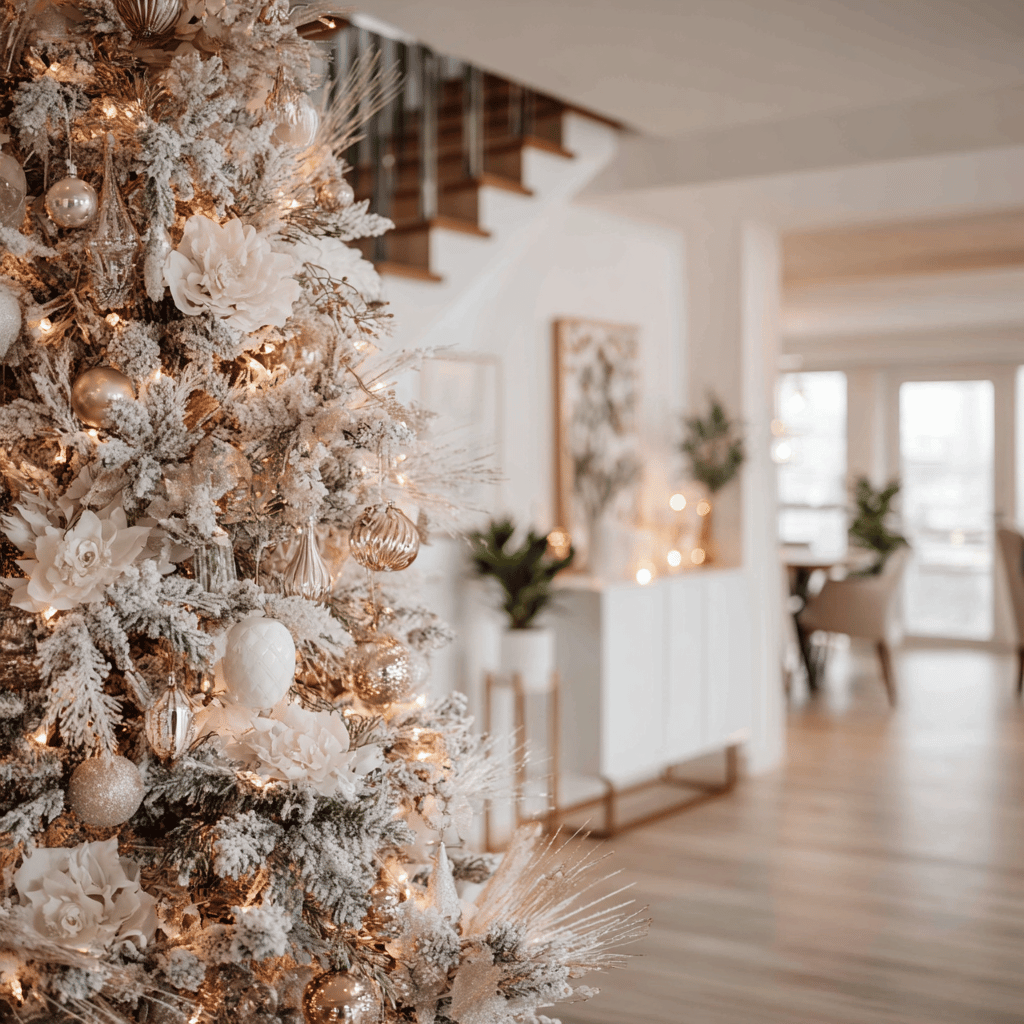
You don’t need a $60 designer floral stem. Individual white faux magnolia stems run about $6 at Walmart and Dollar Tree, and you can pull each bloom off its stem and wire it straight against the branch so it sits flush. Gold shatterproof baubles are $12 for a set of 20 at Target, and a string of warm fairy lights is $10. The whole floral-and-bauble package comes in under $80.
4. Frosted Champagne Gold With Script Gift Boxes
Flocked trees shed. Expect a fine white dust across the floor for the first two weeks — vacuum it with a brush attachment, never a beater bar. Never store a flocked tree in a hot attic or garage; the flocking yellows and flakes and there is no fixing it. And if you have a cat, know that flocking is basically confetti to them, and it will end up under the sofa.
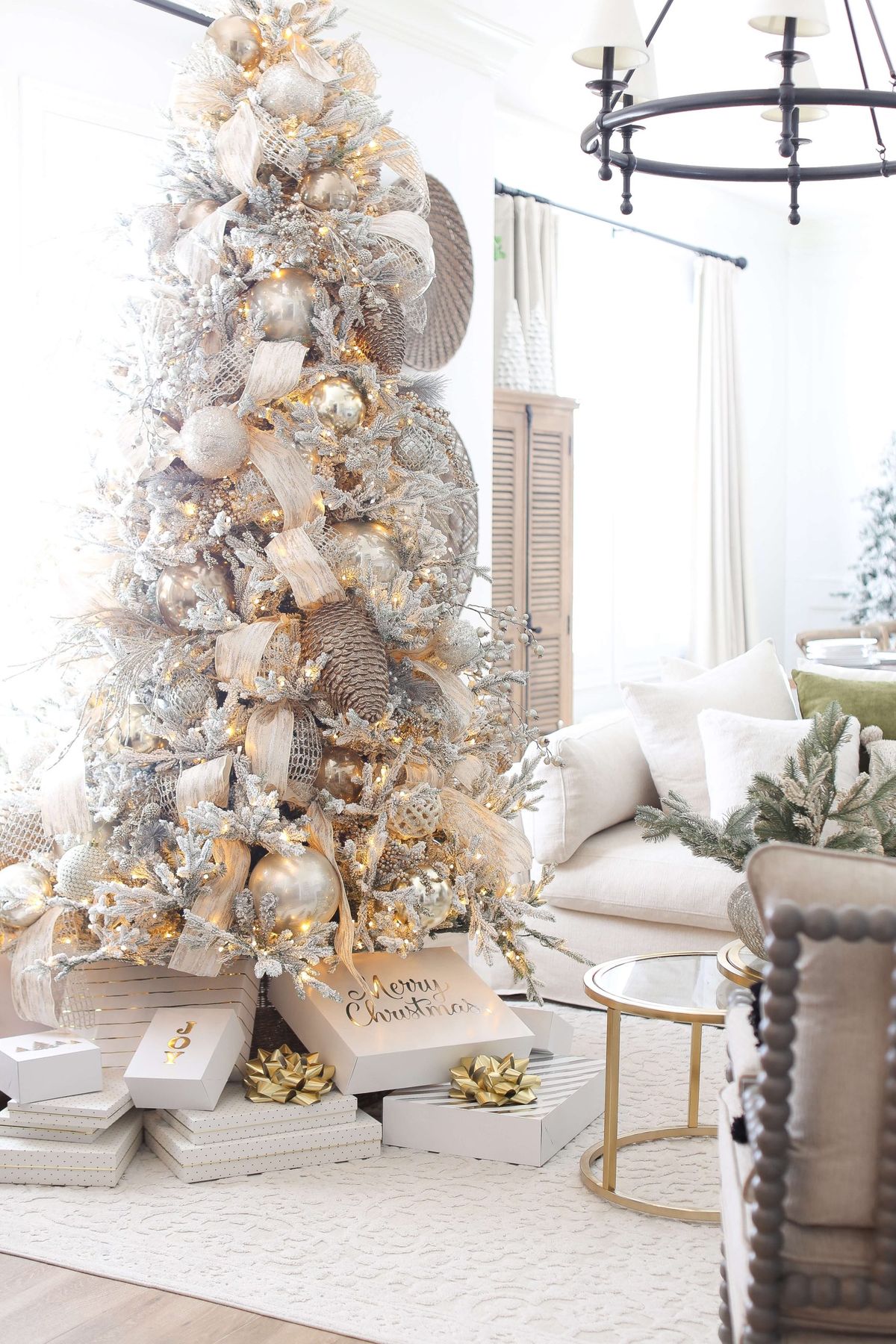
Cluster pinecones and picks in odd numbers — three or five per section, never two or four. Odd groupings read as found rather than arranged. Keep ribbon at 2.5 inches wide or wider on a 7.5-foot tree; anything narrower disappears into the branches and you’ll spend December wondering why the finish looks thin.
5. Bronze, Copper, and a Glowing Mantel
The wreath over the mantel, in the exact same palette as the tree. That’s the move. People spend their entire budget on the tree and then hang a leftover wreath that fights it, and the room reads unfinished. Here the copper, bronze, and cream carry across the wall, and with candles lit the mantel and tree act as one light source instead of two competing decorations.
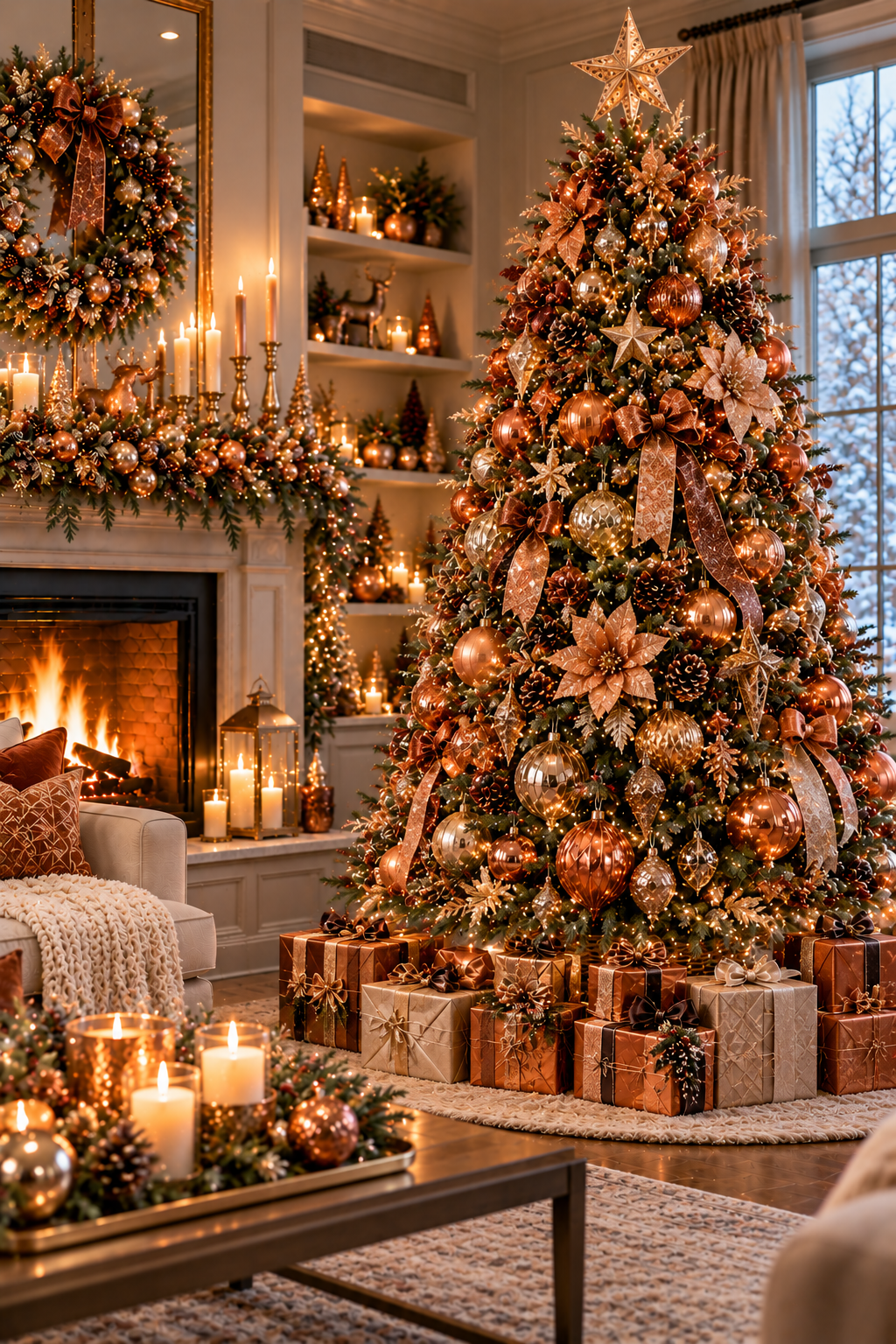
Roughly 45% bronze and copper metal, 25% cream, 20% pine green from the garland, 10% gold. It’s a warm-dominant formula, so swapping in silver turns the whole thing icy and you’d need to add white to cool it properly. Compare with Idea #1 — same neutral base, completely different temperature.
6. Natural Wood Ornaments and a Carved Star Topper
Make your own wood ornaments in about 90 minutes:
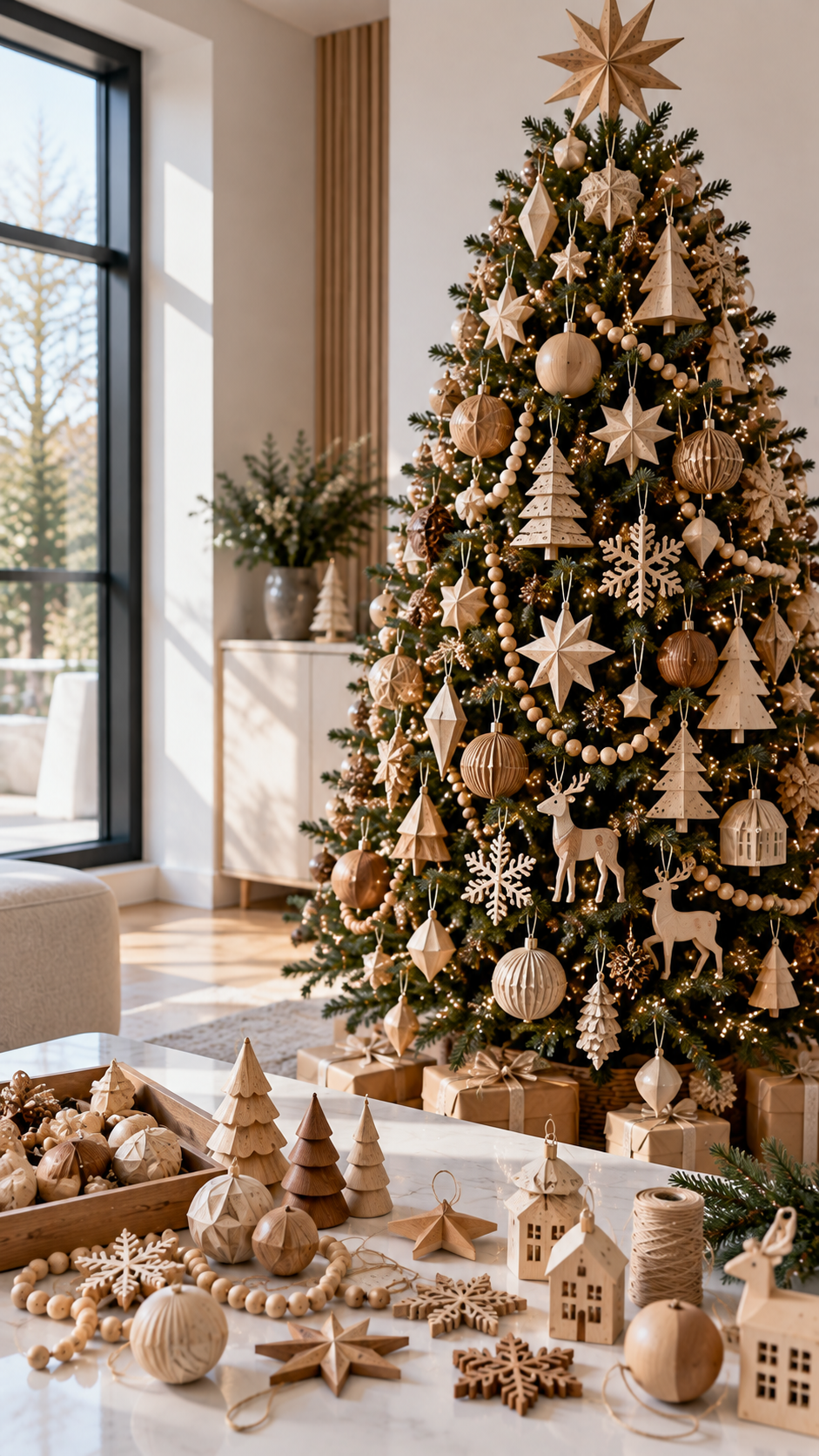
- Buy a bag of 2-inch wood slices — about $8 for 50.
- Drill a 1/8-inch hole near the top edge of each slice.
- Thread a 6-inch piece of jute twine through and knot it.
- Stamp or paint a simple star or snowflake on the flat face.
- Seal with one coat of matte polycrylic so the wood doesn’t darken.
Material cost lands around $15 for 30 ornaments, and you can wire the wooden bead garlands yourself from the same supply bag.
Wood ornaments have been quietly climbing for three seasons, and 2026 is the year they stopped being the earthy option and became the modern one. The shift tracks a broader move away from plastic-heavy decor — people are buying fewer ornaments and keeping them longer. Carved wood doesn’t date. Glitter does.
7. Monochrome Olive Velvet Bows, Top to Bottom
Cap it at nine to twelve oversized bows on a 7.5-foot tree. That’s it. Space them at least 14 inches apart vertically and stagger them so no two sit on the same horizontal line. Velvet is heavy and photographs dark, so past a dozen bows the tree stops reading as a tree and starts reading as a fabric installation.
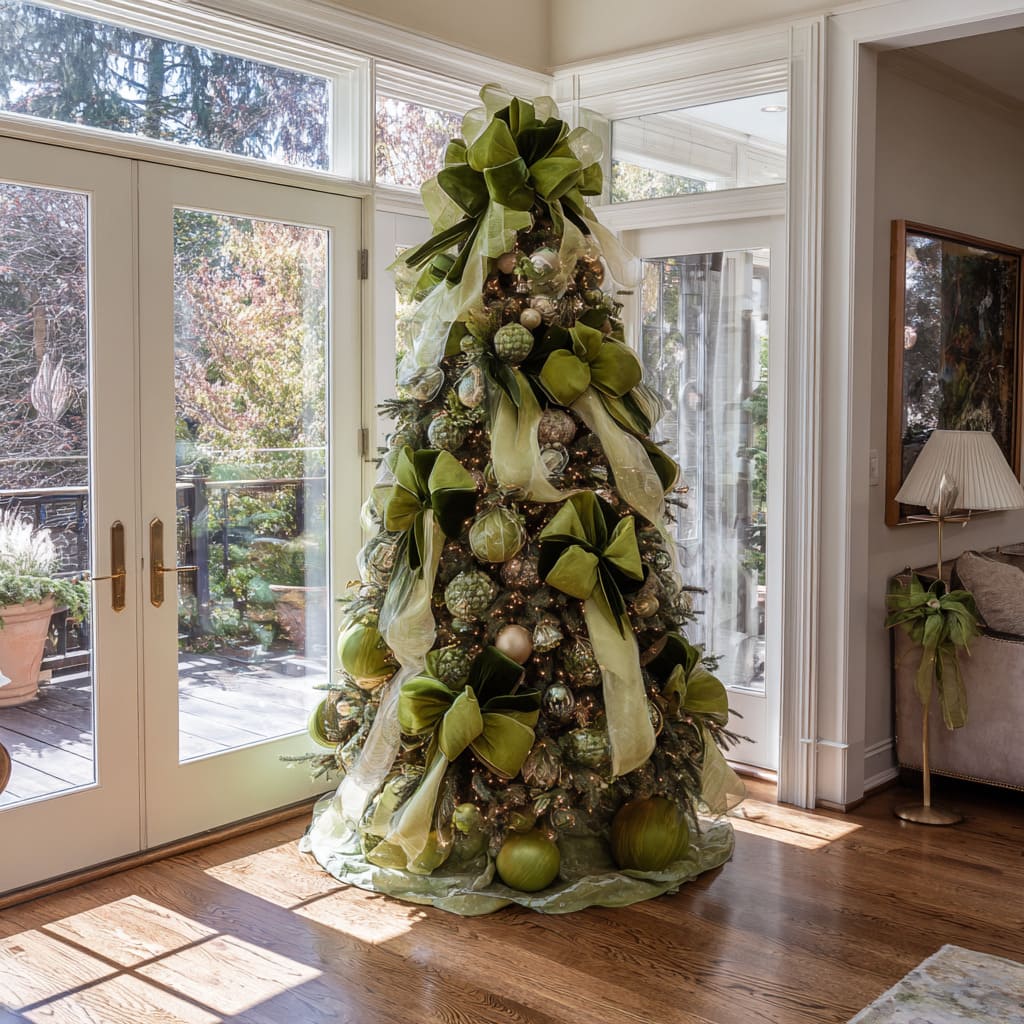
Velvet crushes, and it does not recover on its own. Store bows flat in a single layer or rolled around a cardboard tube — never stuffed in a bag. Come November, hang them in a steamy bathroom for 20 minutes or hit them with a handheld steamer. Never iron velvet directly; the pile flattens and goes shiny in the exact spot you pressed.
8. Navy Plaid, Ochre, and a Sled Full of Gifts
Navy and ochre is an unexpected pairing, and that’s exactly why it works — it reads vintage rather than seasonal. The plaid ribbons are large-scale, the fabric poinsettias are mid-scale, and the berry clusters are small, so the pattern mixing stays legible instead of turning to noise. The wooden sled under the gifts then echoes the mantel’s natural wood and ties the whole corner together.
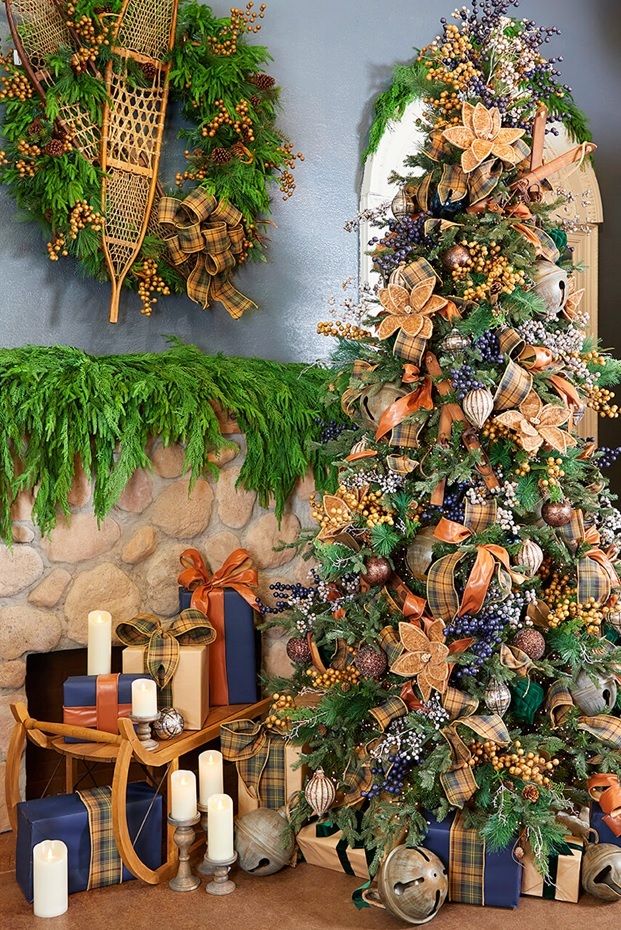
Buffalo and tartan check ribbon is $4 a roll at Walmart and does the same job as designer plaid. Metal sleigh bells are the one item worth buying well — vintage ones on Facebook Marketplace run $15–$40 and hold up far better than the new cast versions. Shop the sled secondhand too; nobody has ever paid full price for a prop.
9. Cascading Red Amaranthus and a Glowing Base Ring
The illuminated woven ring at the base. It turns the bottom of the tree into a third light source, so the draped amaranthus and gold star garlands above are lit from below as well as within. Take the ring away and the tree still looks good — it just stops looking staged, and the presents underneath go back to being a shadowy pile.
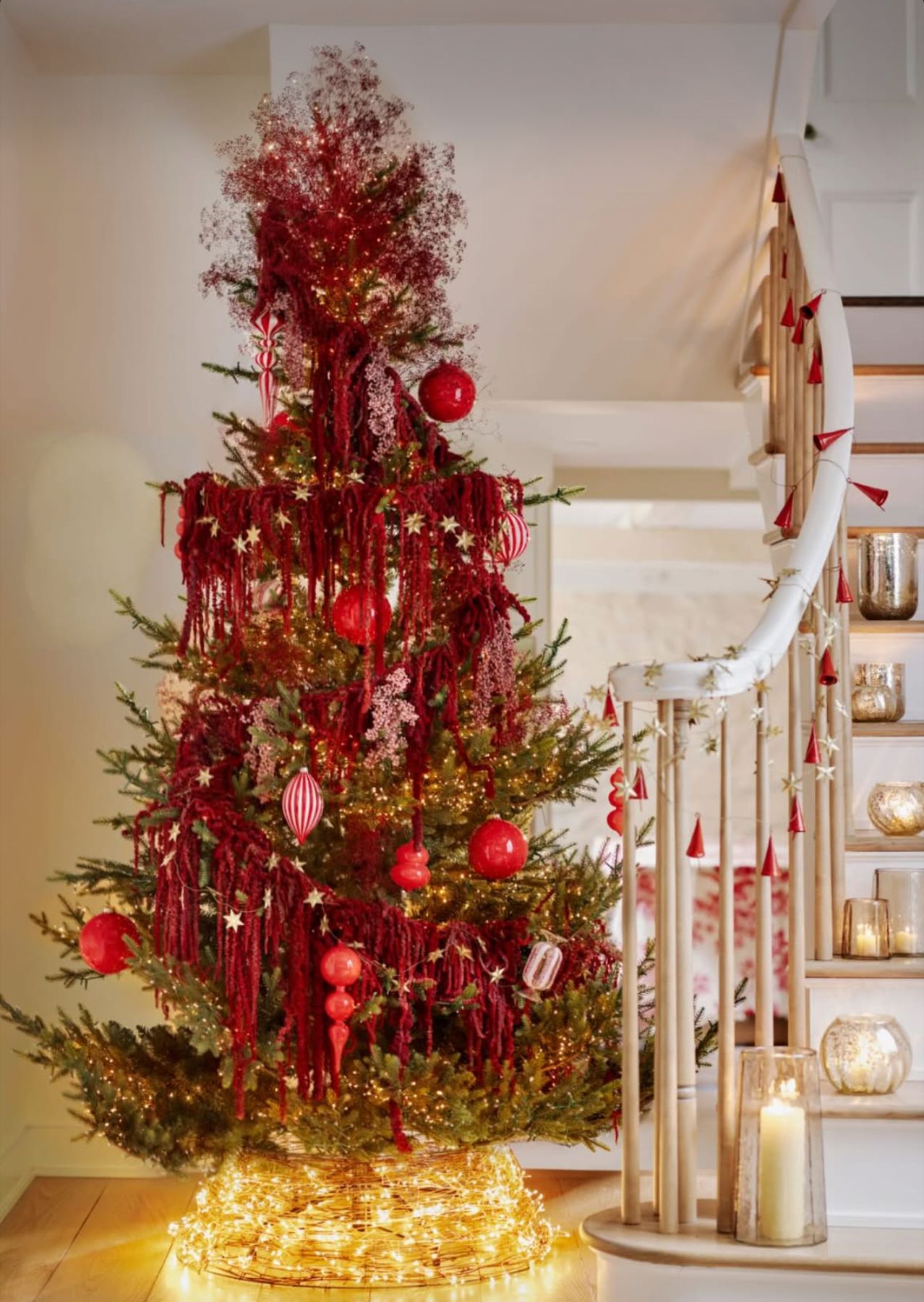
Draping amaranthus, about 45 minutes:
- Cut stems into 10-inch lengths and wire them into small bundles of three.
- Start at the bottom, tucking each bundle so it flows downward and slightly outward.
- Work upward in a loose spiral, leaving 8–10 inches between bundles.
- Cover every wire end with a red bauble so nothing shows.
Faux amaranthus runs $6–$9 per stem; you’ll want about 12.
10. Buffalo Check Tree Beside a Brown Leather Armchair
About 40% green from the tree and the check curtain, 30% red in ribbons and ornaments, 20% slate blue pulled from the curtain panel, 10% brown leather and white. That’s a four-color formula, right at the edge of what a room can hold. If you want to simplify, drop the blue entirely and the tree goes classic instead of characterful.
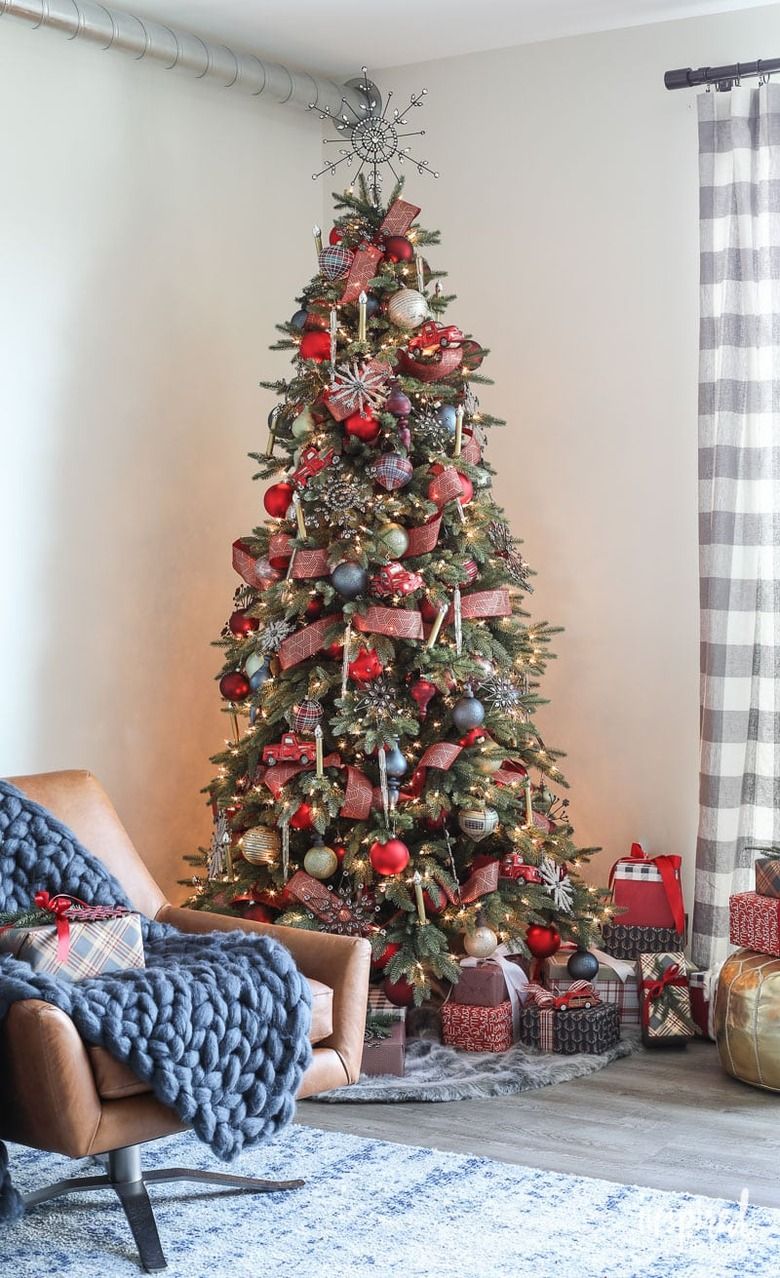
Keep a live tree at least three feet from leather. Heat dries it out faster, and pine sap is genuinely hard to remove from a finished hide — it lifts the finish along with the residue. If the only open corner is beside your good chair, lay a washable rug under the tree’s dripline and rotate the chair’s back cushion partway through the season.
11. Bright Red Baubles and Green Tinsel on Flocking
Tinsel came back, but thinner. The chunky foil garlands of the nineties are not what’s selling — it’s fine mylar strand garland that reads as shimmer rather than tinsel. Paired with flocked branches and bright red spheres, it lands somewhere between retro and modern. This one has legs: tinsel is cheap, reusable, and packs down to nothing, which is why it survived the first time around.
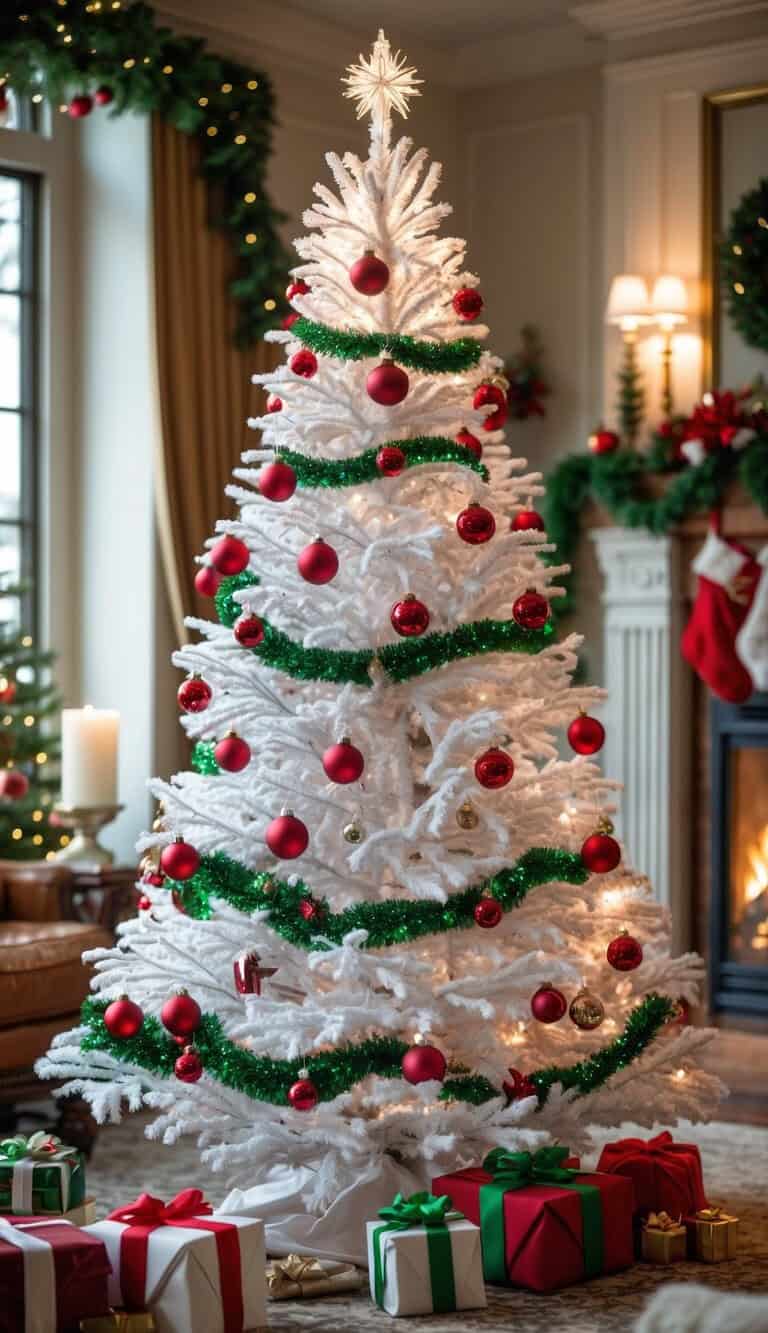
Drape tinsel in loose swags, never in a tight spiral. Two strands, each swagging 8–10 inches deep and spaced about 14 inches apart down the tree. A tight spiral compresses the tree visually and traps light; the swag lets each strand catch the string lights from a different angle so the shimmer moves.
12. Emerald Baubles on a Black Christmas Tree
It’s a value-contrast play. Matte black absorbs light instead of reflecting it, so a black tree recedes into the corner, and the glossy emerald baubles are the only things bouncing light back. The result reads sophisticated from across the room and surprising up close. Neutral beige walls and the herringbone floor provide the calm the palette needs to land.
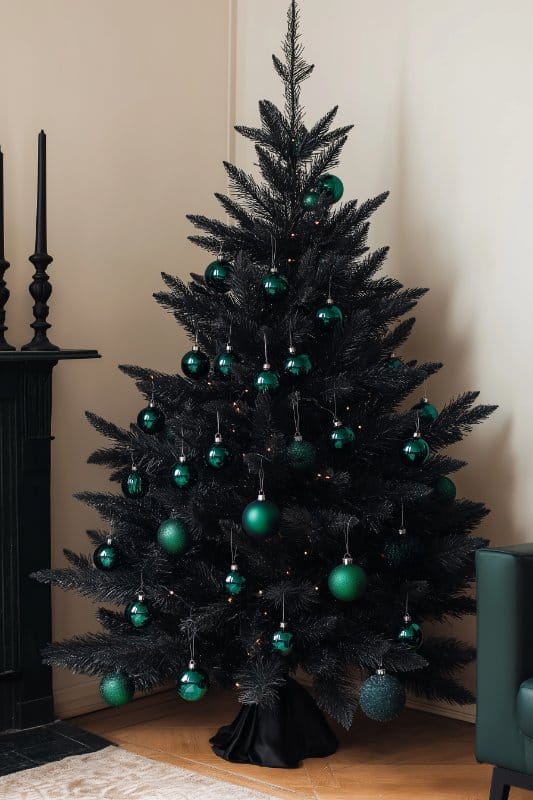
Black trees want a corner with real distance — allow about 5 feet of clearance so the silhouette stays readable, which means a room of at least 120 square feet with the tree set against a light wall. Low ceilings are fine; dark trees actually benefit from an 8-foot ceiling because the contrast runs vertical. For small, bright rooms, see Idea #1 instead.
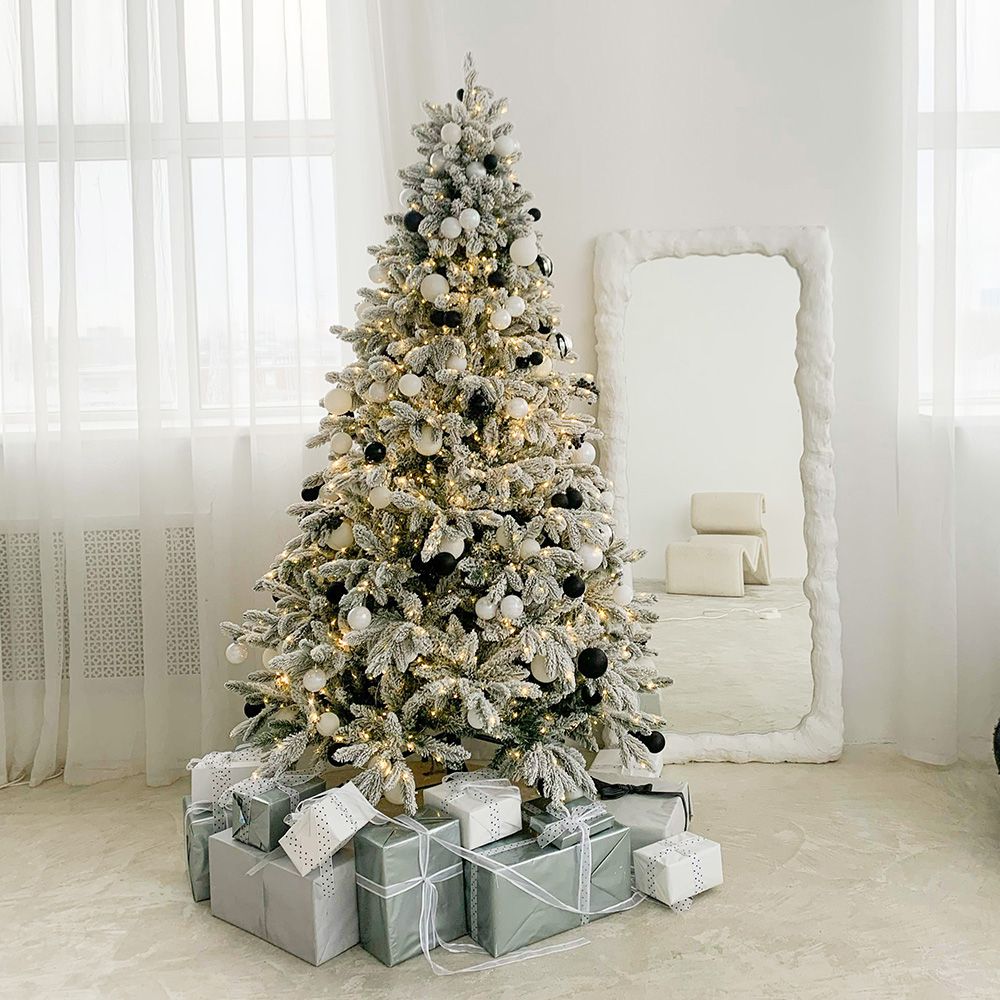
13. Black and White Ornaments in a White Minimalist Room
Check these before you decorate:
- Measure the tree’s widest point and add 18 inches of walking clearance.
- Find your nearest outlet — you want the plug hidden behind the tree, not under a rug.
- Look at your wall color in evening light. Pure white walls swallow black-and-white ornaments without a texture layer.
- Decide your gift wrap before you shop for ornaments, not after.
The irregular framed floor mirror. It bounces warm light onto the tree’s dark side, which is the one problem black-and-white schemes have — half the tree always sits in shadow. In a minimalist white room, a leaning mirror also breaks up the flatness of the wall and gives all that white flocking something to reflect.
14. Navy Glass Baubles on Lightly Flocked Green
Glass-look shatterproof ornaments run $12–$20 for a set of 20 at Walmart or Target, and from three feet away nobody can tell them from the real thing. Navy is the hardest color to find cheap, so buy it first and fill in with silver and champagne, which are everywhere. The white ribbon bows? Two rolls of 1-inch satin ribbon, about $8.
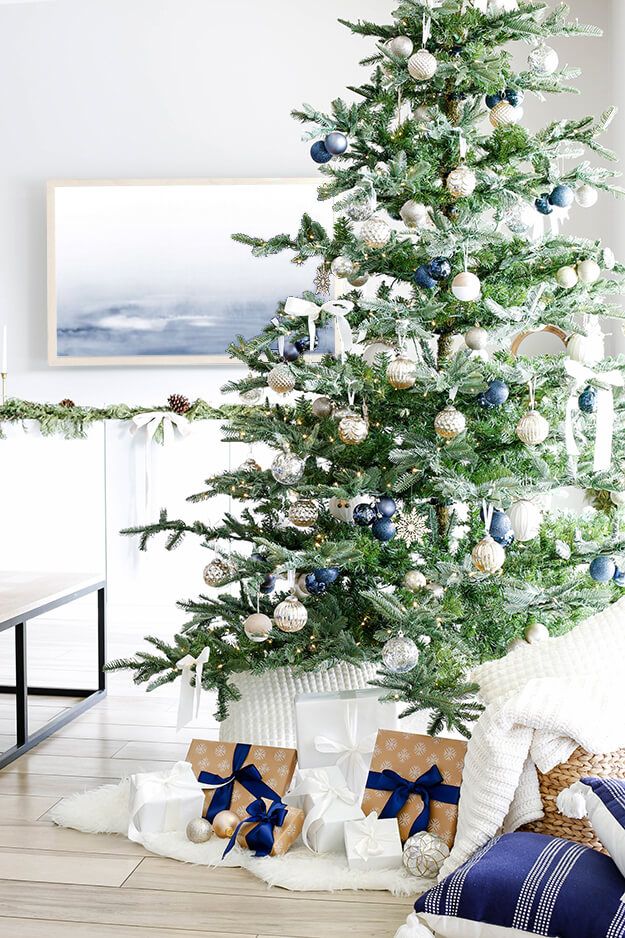
That white faux fur rug under the tree is gorgeous for about three weeks. It mats, it holds pine needles like Velcro, and it’s dry-clean only. Vacuum with the beater bar off, shake it out monthly during the season, and expect to replace it every two or three years. A flat-weave ivory wool rug gives the same pale base with a fraction of the upkeep.
15. Ribbed Glass Finials With Gold and Silver Metallics
Do the math before you shop: a 7.5-foot tree needs roughly 100–120 ornaments to look full. Split that as 60% round baubles, 25% shaped pieces, and 15% drops and finials. Most people buy all rounds and then wonder why the tree looks like a bead necklace. The odd shapes are what create depth, and they’re often the cheapest pieces in the box.
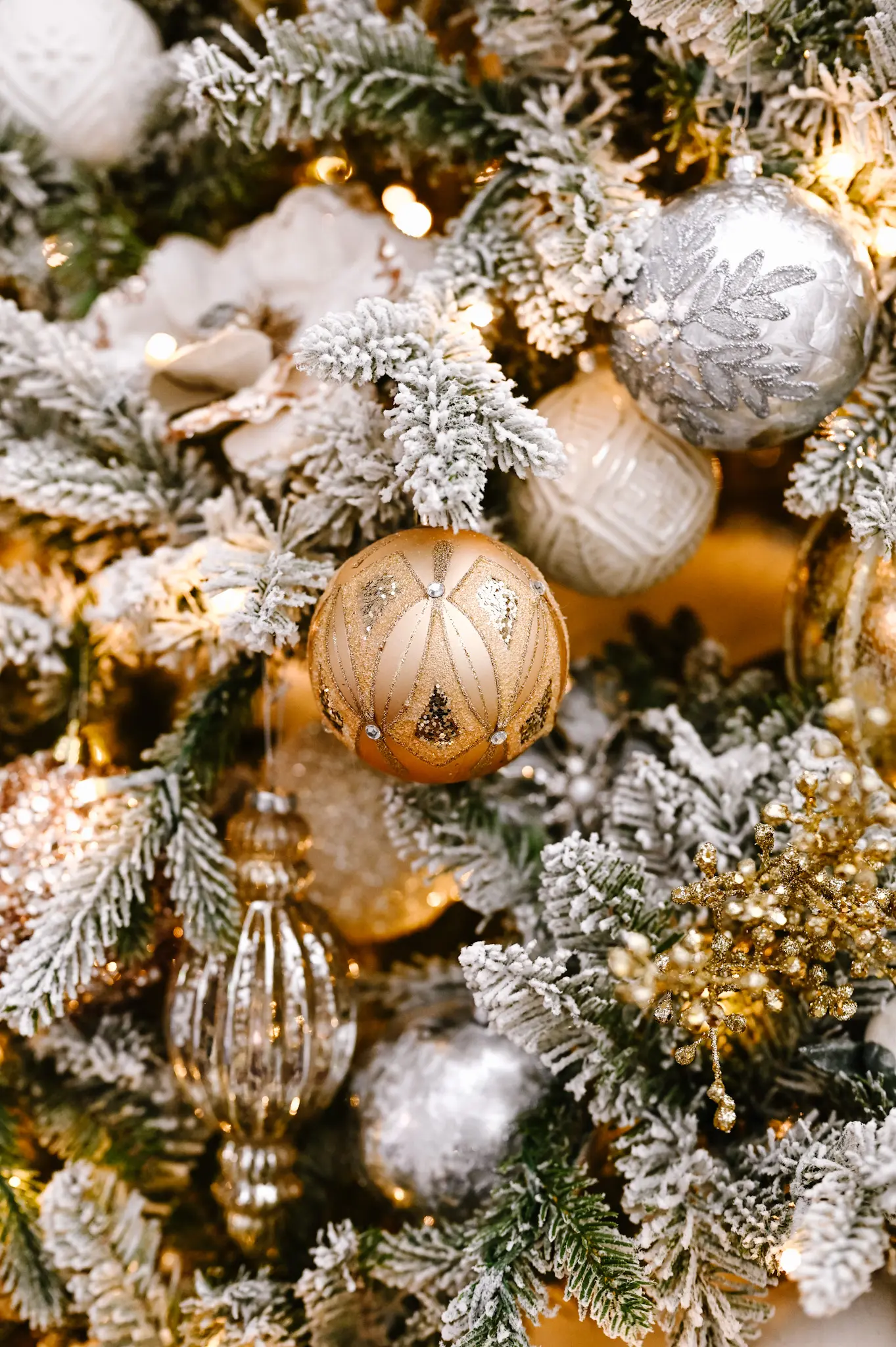
The ribbed glass finials. Round ornaments reflect light in a single bright dot; ribbed glass breaks that same light into a column. Four or five of them tucked near the center of the tree give the whole thing a glow instead of a sparkle, which is much harder to fake — and it’s the reason this tree photographs so beautifully against the flocking.
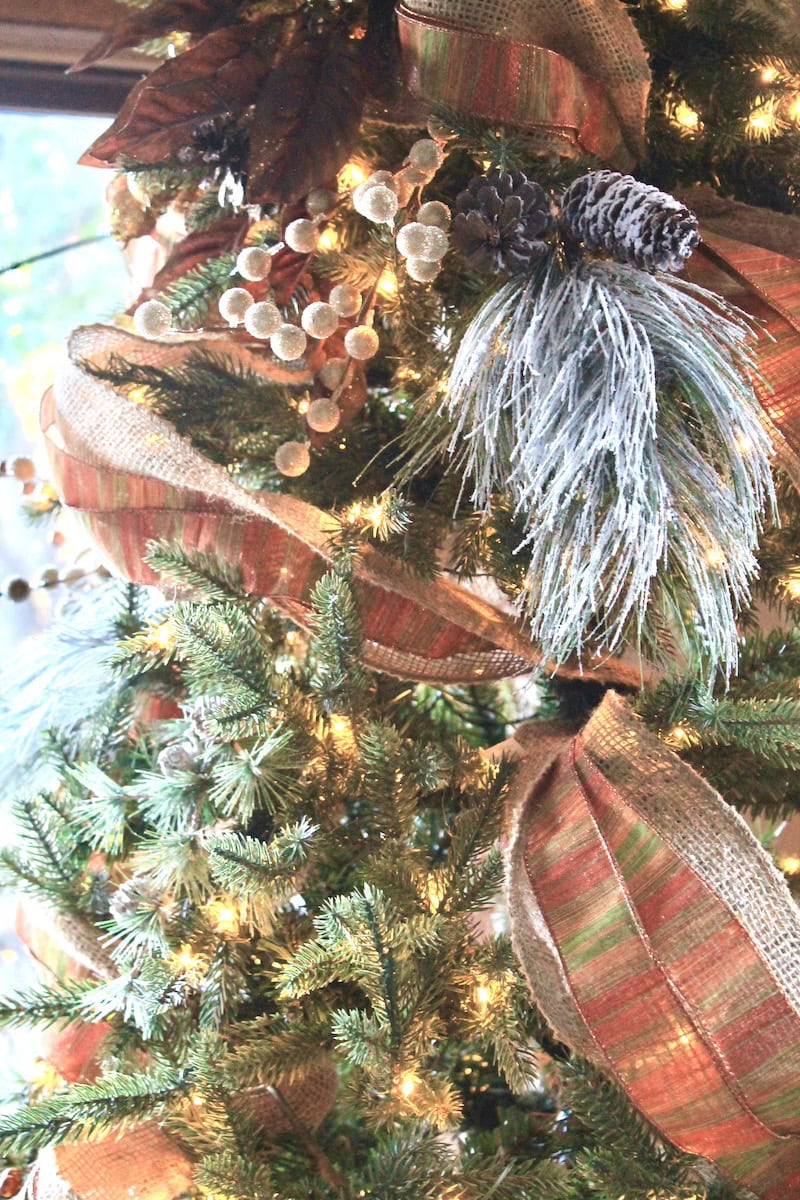
16. Burlap Ribbon and Snow-Dusted Pinecones
Wired burlap bow, about 15 minutes:
- Cut 24 inches of 2.5-inch wired burlap ribbon.
- Fold it into a figure-eight, pinching the center.
- Secure the pinch with a 6-inch length of floral wire.
- Fluff the loops and trim the tails at a slight angle.
- Wire the bow directly onto the branch — skip the clip.
Cost: about $12 for enough ribbon to make six bows. Add flocked pinecones at roughly $1 each and frosted berry picks at $2–$3.
Rustic woodland is the counter-trend to a decade of minimalist Christmas decor. After years of monochrome, flocked, editorial trees, people are reaching for burlap and pinecones — partly nostalgia, partly budget. It’s a forgiving style: thrift store finds and last year’s ribbon both blend in, and nothing has to match exactly.
17. Magenta and Gold Under a Vaulted Wood Ceiling
This look needs altitude. A 10- to 12-foot flocked tree with this much ornament density wants a ceiling of at least 12 feet and a room around 14 by 16 feet, otherwise the proportions collapse and everything feels cramped. If you’re working with standard 8-foot ceilings, see Idea #1 — that’s the same flocked-and-metallic thinking at a scale your living room can actually hold.
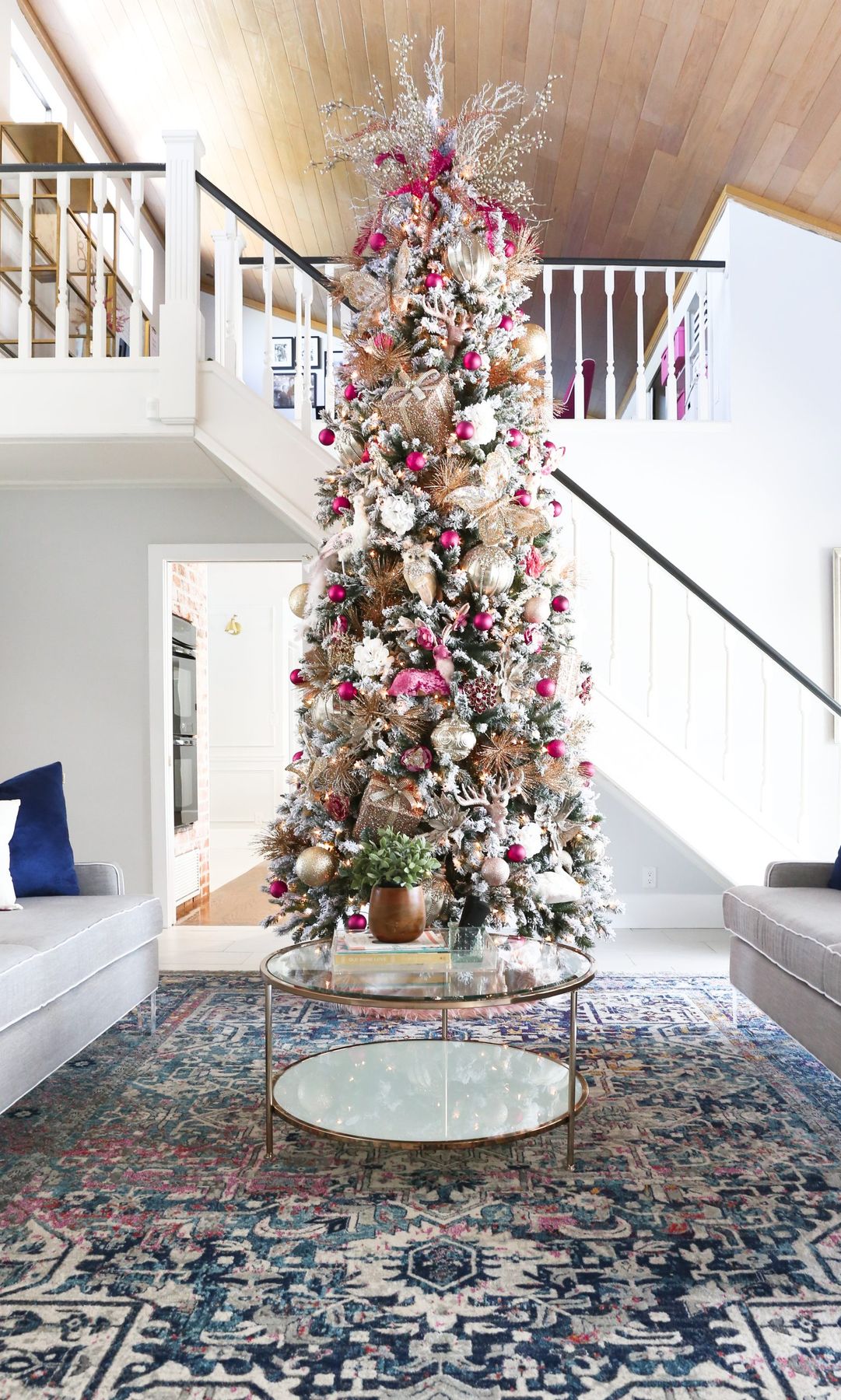
About 40% green and white flocking, 30% magenta, 20% gold, and 10% blue from the patterned rug. It’s a cool-plus-hot formula, which is exactly why it doesn’t tip into candyland — the blue and gray sofas hold the magenta in place. Swap the magenta for plum and the room goes quieter without losing any of the glamour.
18. Jewel Tones in a Grand Staircase Hallway
Repetition across surfaces. The same purple, magenta, amber, and gold that appear on the tree also wrap the staircase railing, so a massive hallway reads as one deliberate gesture instead of a tree plus decoration. The red carpet runner then does something clever — it pulls a single warm tone out of the tree’s metallic mix and amplifies it on the floor.
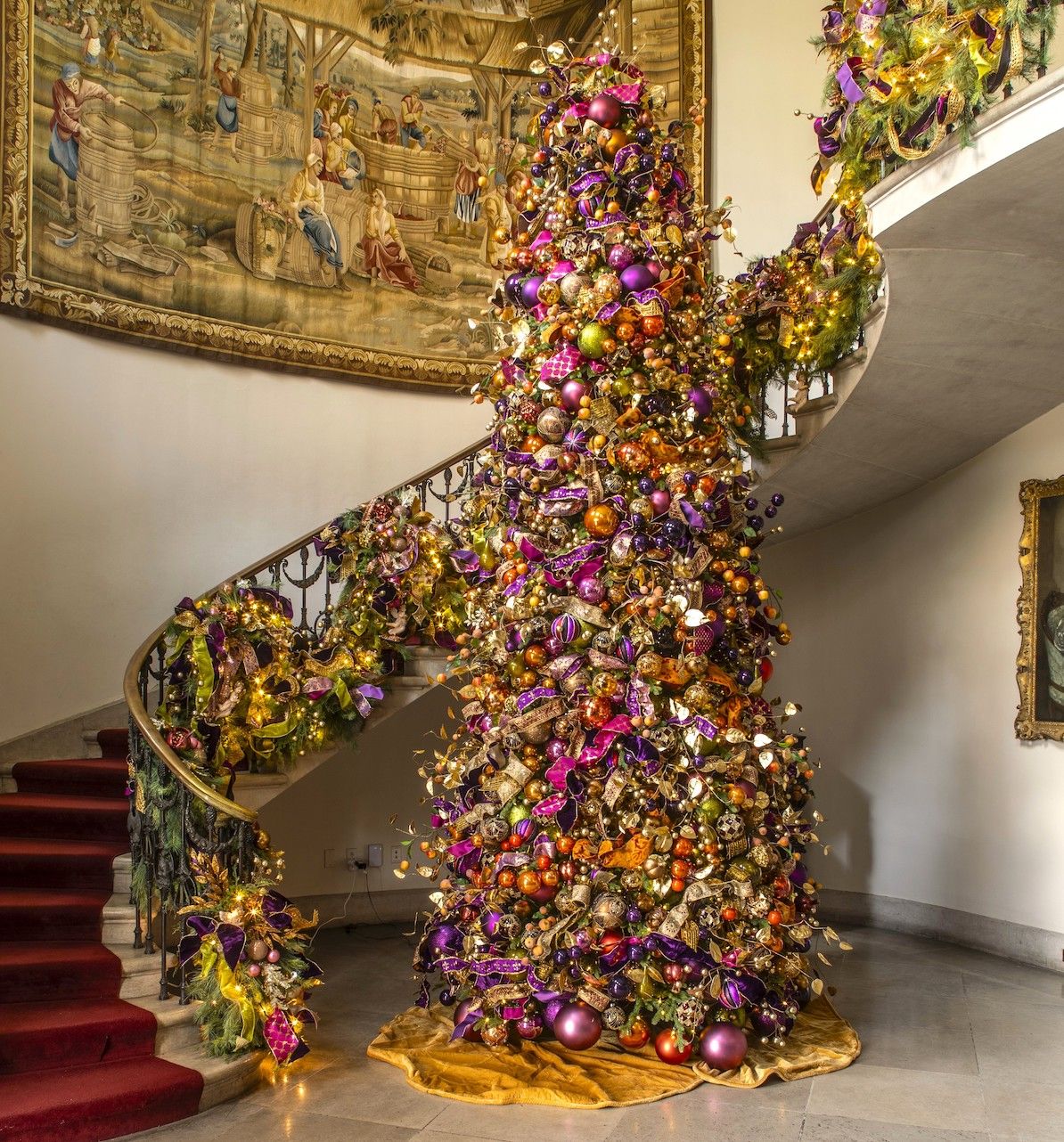
Budget two full days for a hallway this size. A 12-foot tree takes three people, a solid ladder, and five to six hours just to light and hang. Curved stair garland is slower: figure 40 minutes per section because you’re wiring, not draping. Decorating it all in one afternoon is how people end up resenting a beautiful tree by December 10th.
19. White Magnolias and Muted Blue Ribbon
Prep your stems properly. Cut faux magnolia stems into 3- to 4-inch picks with wire cutters, then wire each bloom so it sits flush against the branch rather than floating on a plastic stem. For a 7.5-foot tree, that’s 15–20 blooms total, concentrated in the lower two-thirds where they’ll actually read at eye level. Any higher and they just look like clutter near the topper.
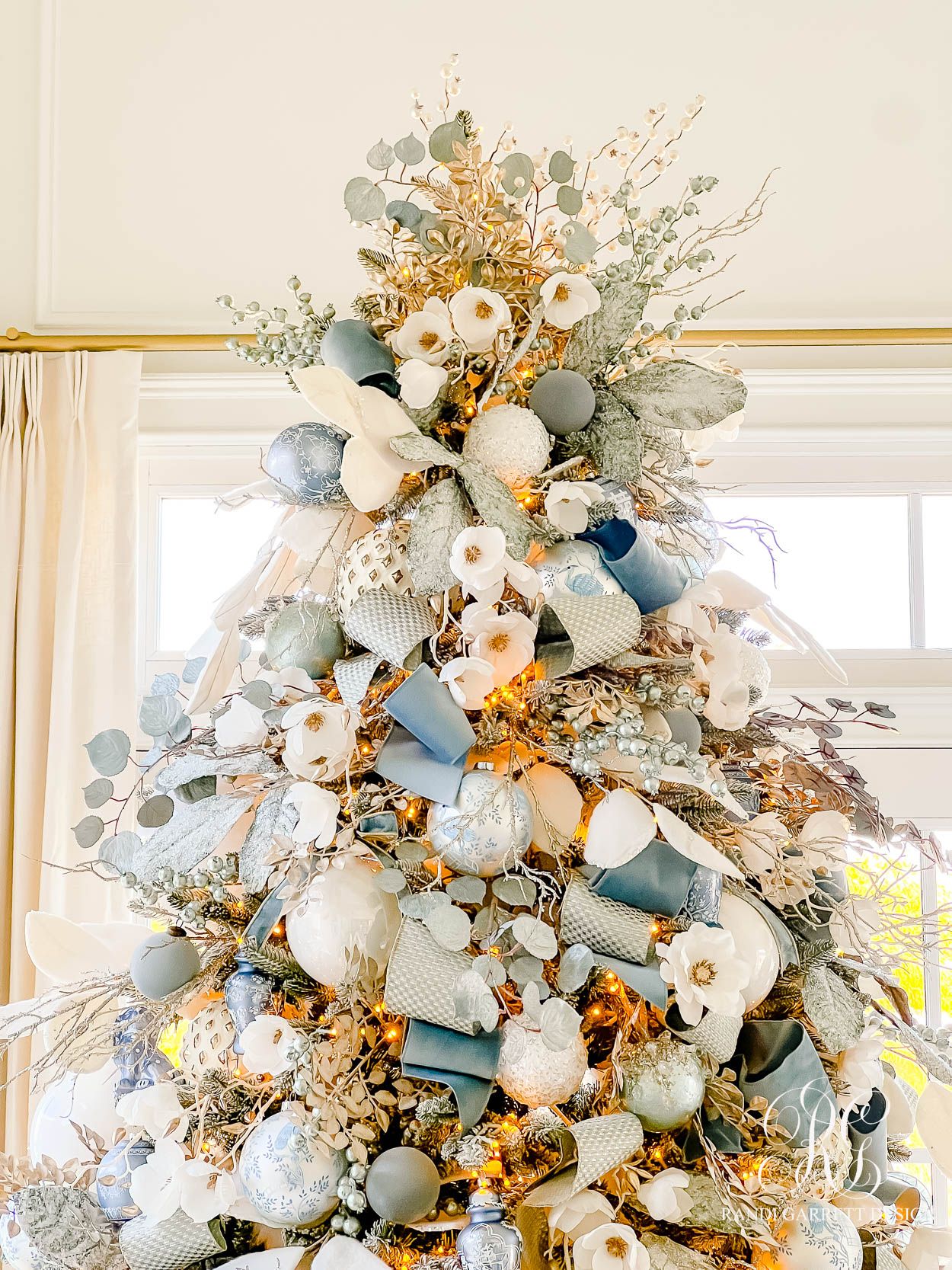
White fabric florals are dust magnets, and once they gray out there’s no bringing them back. Hit them with a hair dryer on the cool setting at arm’s length once a month through the season — that’s genuinely it, no water, no sprays. Store them in a lidded bin with tissue between layers, never in a garbage bag where they’ll crush flat.
20. Rose Gold and Copper by a White Brick Fireplace
- Tree: 7.5 ft flocked, wicker basket base — $235–$670
- Ornaments: mixed rose gold, copper, bronze, silver — $90–$260
- Garlands: two beaded strands — $30–$70
- Fireplace: matching frosted garland — $40–$120
- Wall decor: star art, paper lanterns — $20–$130
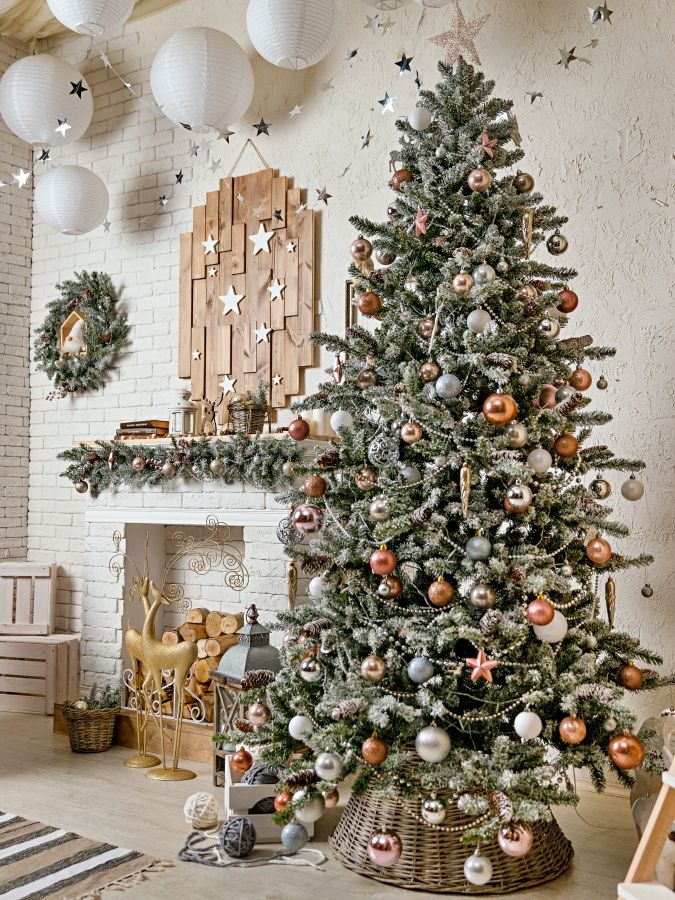
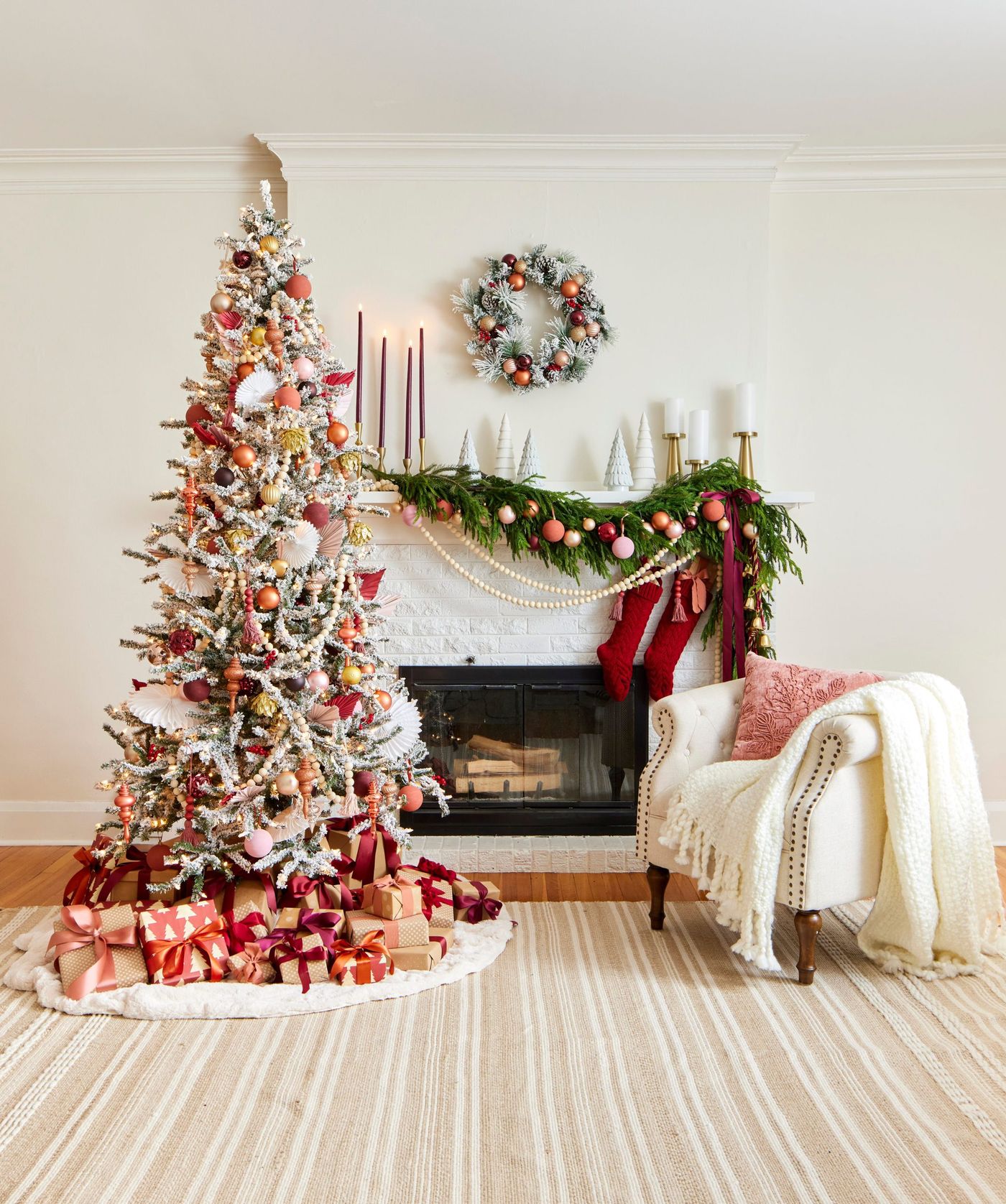
Total: roughly $415–$1,250. Budget alternative: buy copper and bronze shatterproof sets at $12 per 20-piece box and skip the fourth metal entirely — three finishes read the same from across the room.
Rose gold is the pickiest finish in the bunch. Every brand’s version is a slightly different pink, and once they’re all on the tree, rose gold can quietly turn into salmon. Buy one set first, hold it up against your copper and bronze pieces in daylight, and only then commit to the rest. Online swatches lie.
21. An All-Gold Flocked Tree and a Big Round Clock
It’s a single-metal tree. Everything is gold — ornaments, floral picks, ribbon, gifts. Restricting yourself to one finish is what makes it look expensive, because mixed metals at equal weight always read cheaper than one metal used decisively. Add silver and you’d still have a nice tree; you’d just lose the calm.
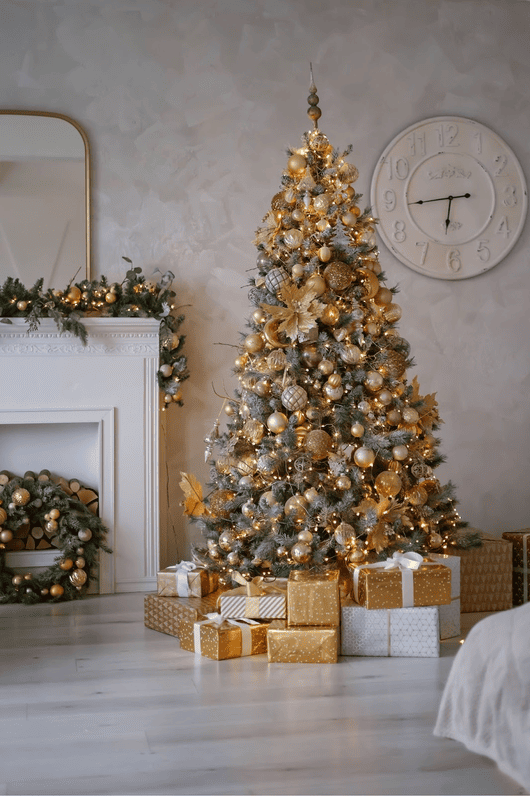
Plan for a footprint about 5 feet across, including branch spread and a little breathing room for presents. An all-gold tree needs a light backdrop — white mantel, pale wall, or a bright window — because gold against gold simply disappears. Dark rooms eat it alive, so if your fireplace wall is charcoal or deep green, that’s a different tree entirely.
22. Oversized Frosty Blue Ornaments and Silver Snowflakes
Half green from the tree, 30% frosty blue, 15% silver, and 5% warm white light. The blue and silver are both cool, so the string lights are doing all of the warming — switch to cool white LEDs and this palette goes from magical to dental office in about ten seconds. Keep the lights at 2700K and the frost reads as snow instead of ice.
Big ornaments on a cool tree. The oversized blue and silver pieces are what keep it from reading delicate — at four to five inches they hold their own against dense evergreen, and the frosted foliage gives all that reflective glass something matte to sit against. Snowflakes belong here because they repeat an idea the branches are already making.
23. Icicles, a Gold Velvet Skirt, and Tiny Trumpets
The gold velvet tree skirt is the easiest thing to fake: Amazon sells velvet-look skirts for around $30, and a yard of gold velvet from a fabric store runs $12 if you’d rather drape it yourself. Icicle picks are three for a dollar at Dollar Tree. The miniature trumpets and horns are the only genuinely hard-to-find piece — check Etsy and expect to pay $8–$15 each.
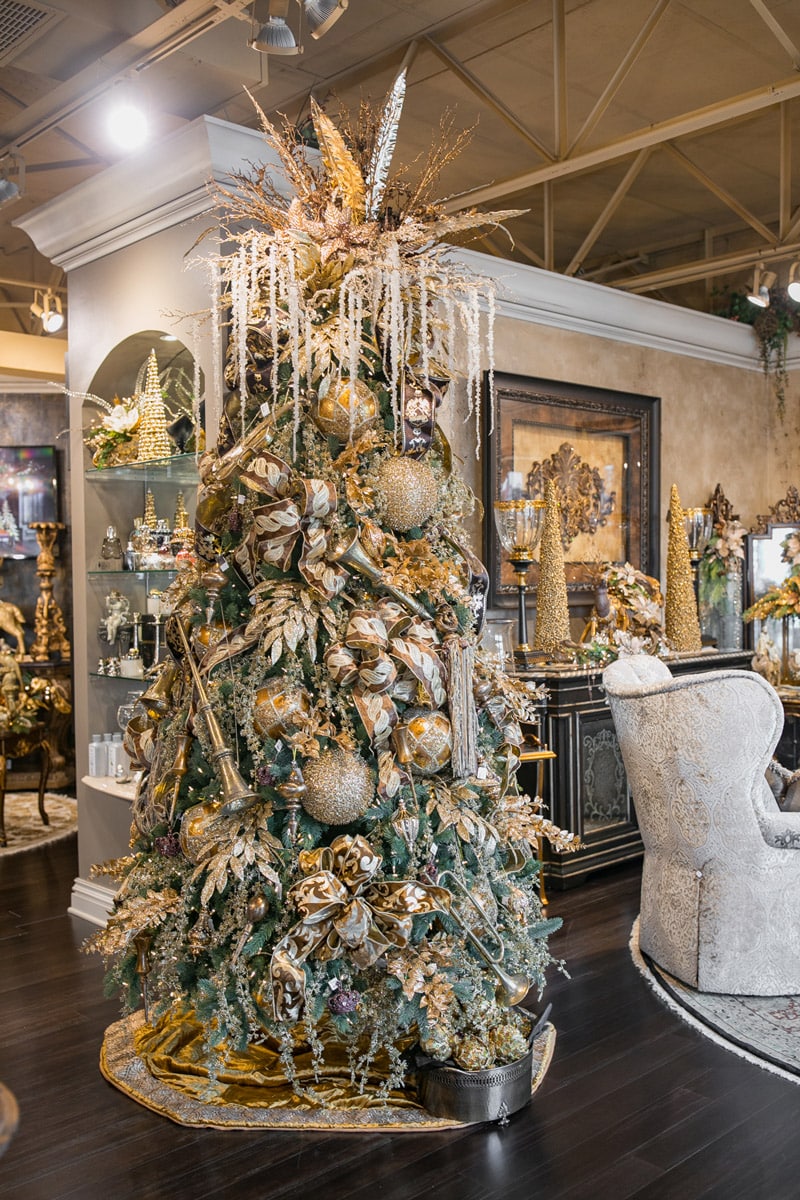
Weight by height. The bottom third of the tree gets your heaviest, darkest, and largest pieces; the middle gets the mixed sizes; the top third stays light in color and sparse. This mirrors how light actually falls and stops tall trees from looking top-heavy — the single most common mistake on anything over nine feet.
24. Rose Gold Ornaments in a Hammered Brass Collar
The hammered brass collar. It’s a five-minute swap that does more than any ornament — it grounds the tree with a solid metal base, replaces a fabric skirt that would look sloppy against the patterned tile, and bounces a little warm reflection up into the branches. Take it away and this tree looks like every other flocked fir on the block.
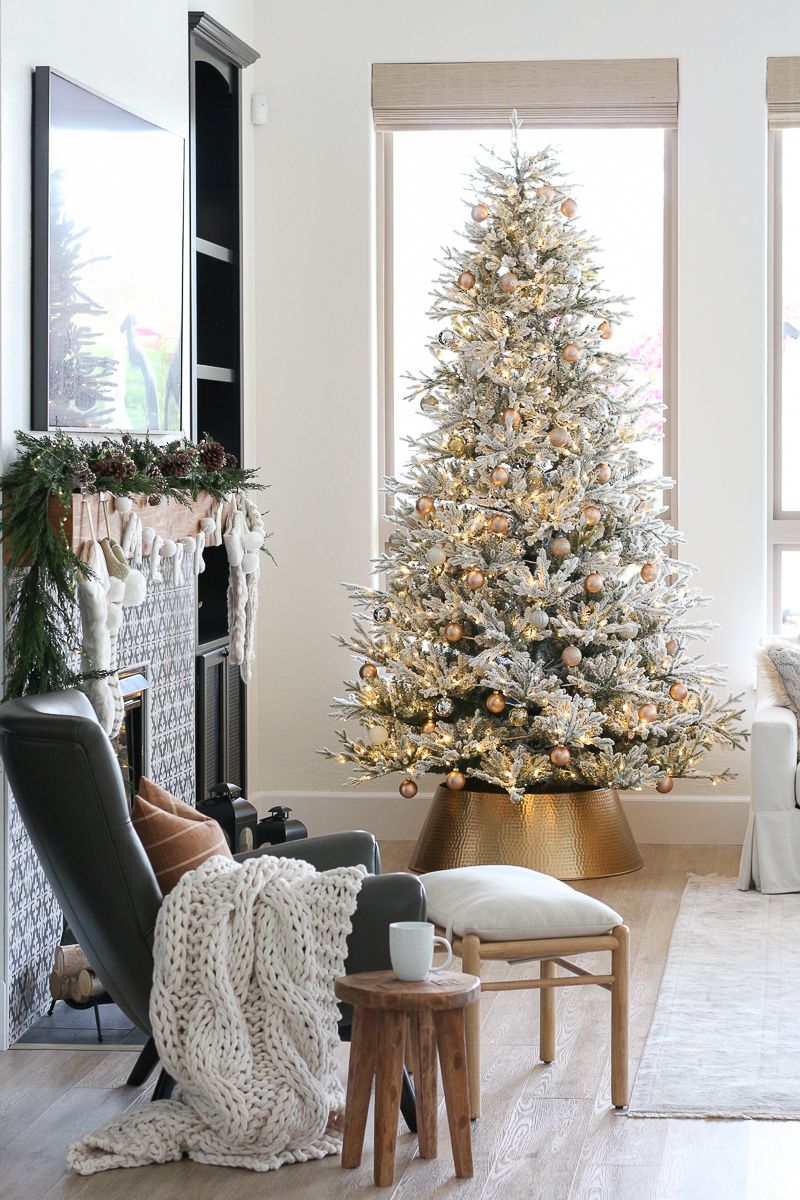
Measure your stand before you buy a collar, and measure the trunk too. Most collars fit stands up to 22 inches wide and trunks up to 6 inches across, and returning a heavy piece of metal in December traffic is a special kind of misery. Brass also scratches — the hammered texture hides it, but a polished collar in a house with dogs will not stay polished. See Idea #20 for how to mix metals without the tree going muddy.
25. Classic Red and Gold Against Carved Woodwork
Red and gold is the most traditional palette there is, and here the architecture gives it permission. Carved wooden frameworks and marble pillars are already decorative, so a restrained tree in that setting would read as a mistake — the maximal ornament density matches the maximal room. Contrast, not coordination, is the principle holding it together.
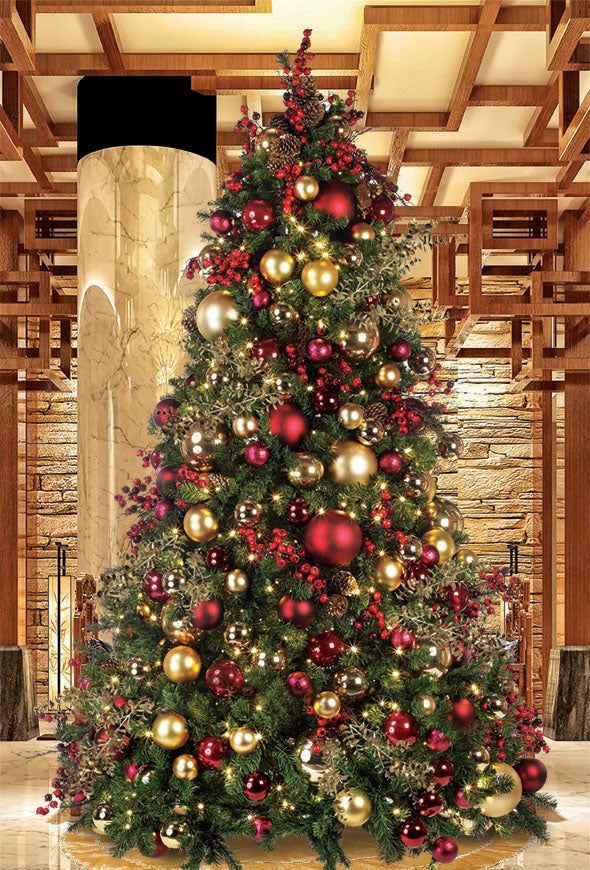
Density scales with height. A 7.5-footer looks full with 100–120 ornaments; a 10-footer needs 200–250; anything past 12 feet wants 300-plus and roughly 1,200 lights. Red and gold baubles are also the cheapest ornaments to buy in bulk, which quietly makes this the most forgiving palette to go big with.
26. Disco Balls and Paper Stars on Charcoal Walls
Mirrored ornaments have been the fastest-growing Christmas decor category two years running, and the disco ball is the reason. It’s part nostalgia, part content — they catch every light in the room and photograph like nothing else. The matte black and deep red pieces here keep it from sliding into party-store territory, and the charcoal wall does the rest of the work.
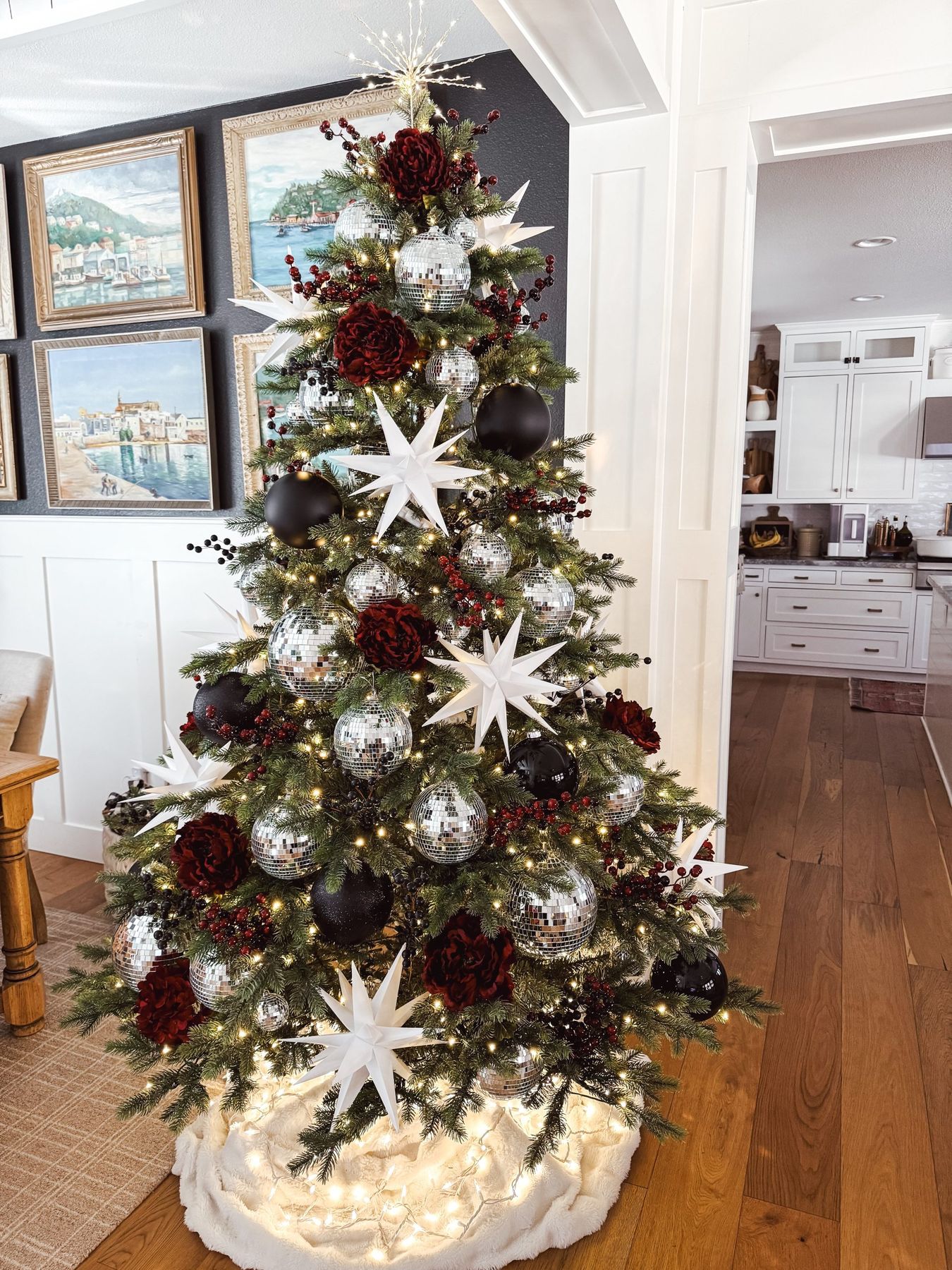
Dark walls eat tree light. On charcoal, add one extra strand of warm white lights beyond what the tree came with, and set a small uplight on the floor behind the trunk. That backlight separates the tree from the wall and gives the disco balls something real to reflect. Two hundred lumens is plenty — you’re not lighting a stage.
27. Seashells and Turquoise on a White Coastal Tree
Shell ornaments, about 30 minutes:
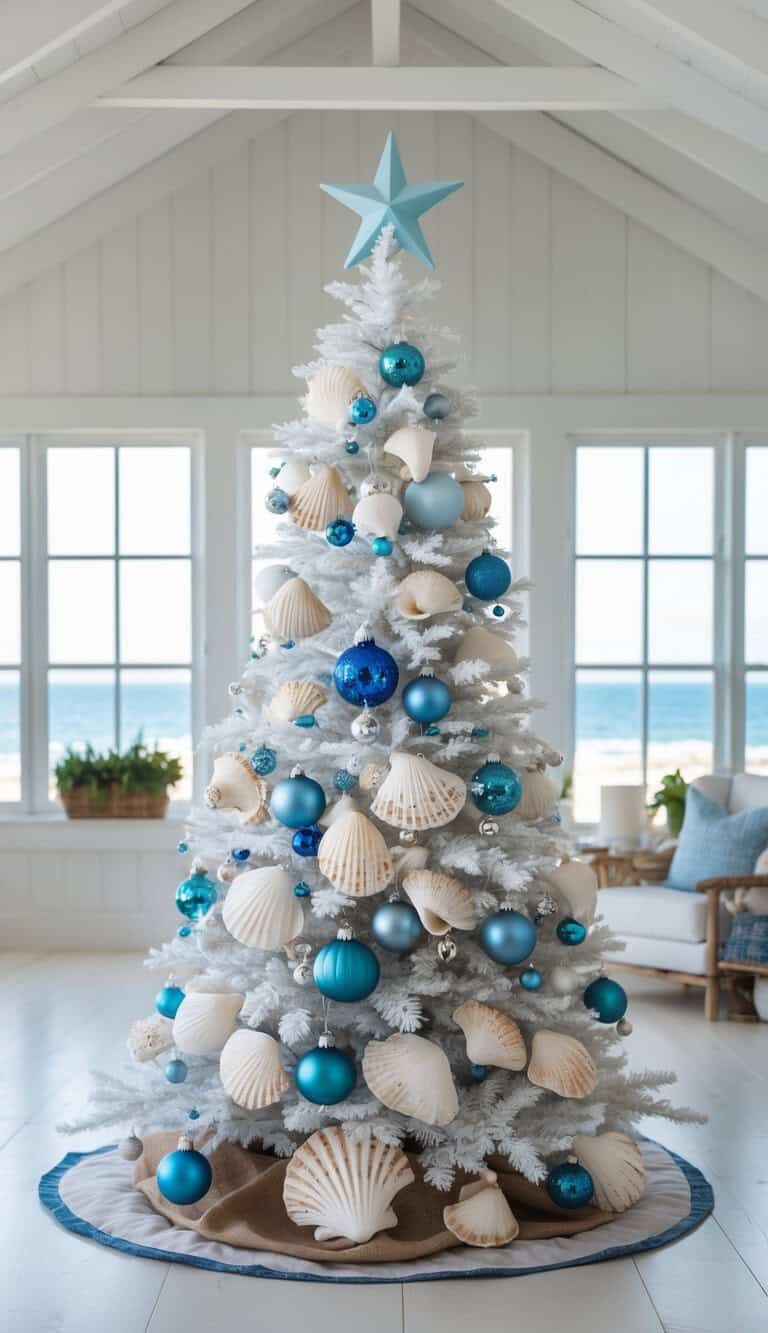
- Rinse and dry the shells; skip anything chipped.
- Drill a 1/16-inch hole near the top of each shell.
- Thread wire through and twist a small loop.
- Attach a 4-inch ribbon hanger.
- Seal with one coat of clear matte spray.
A mixed bag of shells runs $6–$10; wire and ribbon add about $8.
A white 7-foot tree is $80–$150 at Walmart, and thrift store shell bags sell for $2–$4 right after Labor Day. The cobalt and turquoise ornaments are where people overspend — Target’s shatterproof sets at $12 a box look identical to the $40 versions. Save your money for the light blue star topper, which is the piece guests actually notice.
28. Blush and Jewel Tones on a Dark Paneled Wall
Roughly 35% blush pink, 30% jewel tones split between magenta and teal, 20% gold and silver, and 15% deep purple velvet ribbon. That’s a lot of color, so the dark board-and-batten wall matters — a dark backdrop lets saturated ornaments glow instead of compete. On a flat white wall, this same formula would read as chaos.
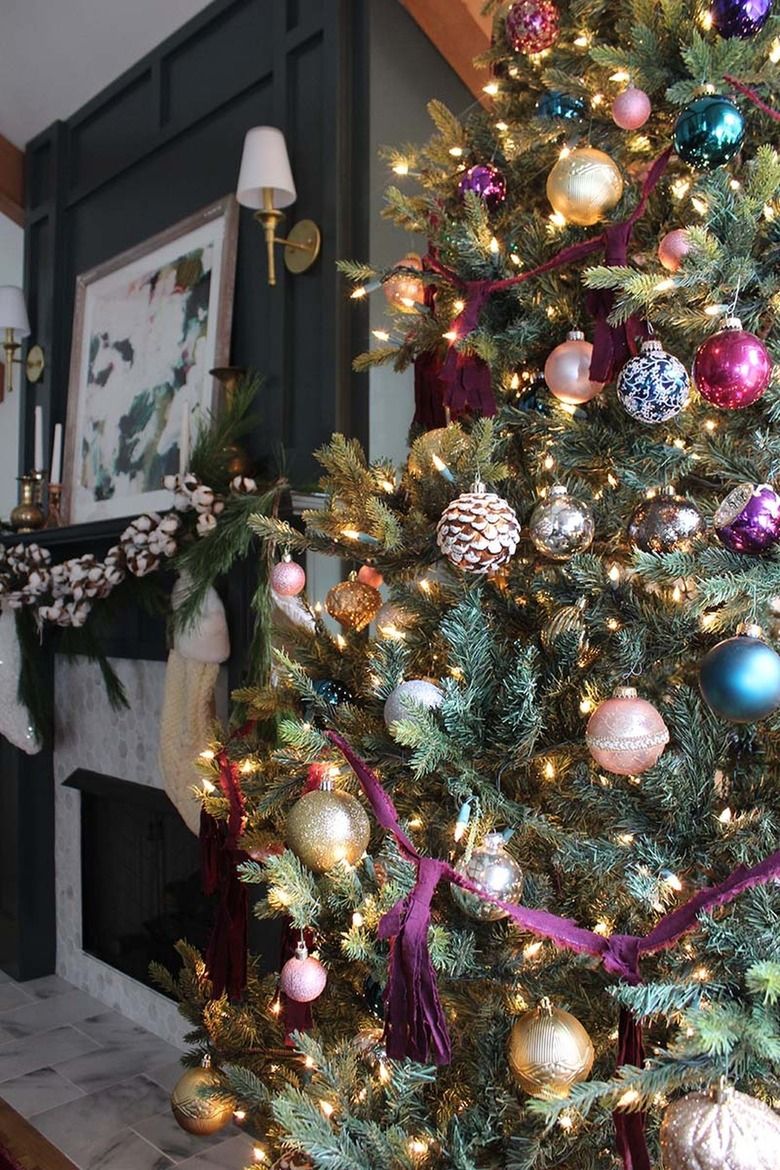
Wide velvet ribbon garland has to be re-fluffed every season; it compresses in storage no matter how carefully you pack. Roll it around a paper towel tube and it’ll come out with most of its shape intact. Expect the cotton stem garland on the mantel to shed slightly the first week, and keep it well away from any candle. Compare with Idea #7 — same velvet problem, different scale.
29. Paper Chains and Honeycomb Trees in a Cozy Corner
The charm here is nearly free. Paper chain kits are $5, honeycomb paper trees run $5–$12 at Target, and the plaid throw is a thrift store staple at $8. The one piece worth spending on is the sofa — and a mauve velvet slipcover over an existing couch runs about $60, which is a lot less than a new sofa and gets you the same warmth.
Paper chains, about an hour for eight feet:
- Cut 1-by-6-inch strips from mixed paper — leftover wrapping paper works.
- Loop the first strip and glue or tape it closed.
- Thread the next strip through and close it the same way.
- Alternate colors in a repeating sequence so it reads as a pattern.
Cost: under $8 for a whole tree’s worth, and kids can do most of it.
30. Pampas Grass and Dried Oranges on a Neutral Tree
The pampas grass topper. Without it this is a beige tree — pleasant, forgettable. The pampas adds silhouette, height, and softness, and it repeats the dried-botanical idea already running through the cotton stems and orange slices, so the whole thing reads as one thought instead of a pile of dried flowers. It’s also the cheapest part of the look: two stems, about $12.
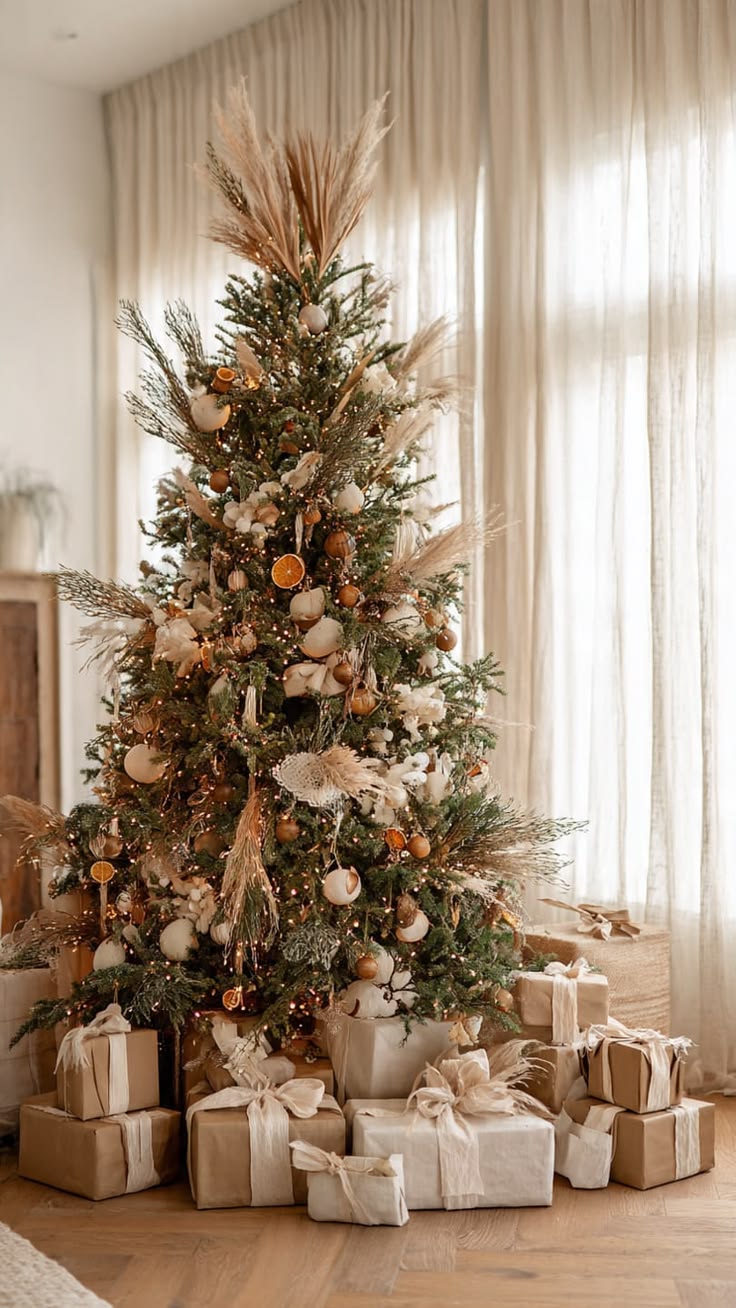
Dried botanicals moved from wedding decor into Christmas because they’re reusable, they don’t shed glitter, and they photograph beautifully against neutral ornaments. The boho Christmas look has been building for four years, and it’s now mainstream enough that craft stores stock pampas year-round. If minimalism is more your baseline, see Idea #1.
Your Palette Is Picked — Now Go Hang the First Ornament
Thirty palettes, one tree: get the color scheme right first and everything else — ribbon widths, ornament counts, light temperature — falls into place around it. Pick two or three favorites, price out the ornaments before you buy the tree, and give yourself a full weekend to decorate instead of an afternoon.
📌 Pin your favorite palettes now, so next November you’re decorating instead of scrolling.