
You know that feeling when the tree is up, the garland is hung, and something still looks… off? Classic Christmas decor is having a serious moment in 2026, and the photos saving fastest on Pinterest are not the maximalist ones — they are the rooms that look like they have been collected over decades.
We spent real time browsing Target, Etsy, Pottery Barn, and World Market to bring you only what is worth your attention this year, covering the full spread from a $6 boxwood wreath tie to a $1,200 mantel-and-entryway garland setup. Traditional red and green, vintage nostalgic, tartan plaid, and quiet neutral-with-gold palettes all show up here — and budget and luxury versions are compared side by side.
And stay until the end — we break down the most common mistakes that can ruin these looks. The 2026 shift is toward inherited decorating: real greenery, mismatched heirloom ornaments, and warmth over perfection.
📌 Save this to Pinterest for later — you’ll want to revisit these ideas.
1. Red Roses and Plaid Napkins on a White Dining Table
Run the numbers and this table is roughly 50 percent white (the upholstered chairs and clear scalloped plates), 30 percent emerald (that dense runner of evergreen), 15 percent ruby red (roses, plaid napkins, tiny bows), and 5 percent gold on the chargers and flatware. Hold those percentages and you can swap the palette entirely — navy and silver for New Year’s Eve, burgundy and copper for a December dinner party — and it still reads as the same room.
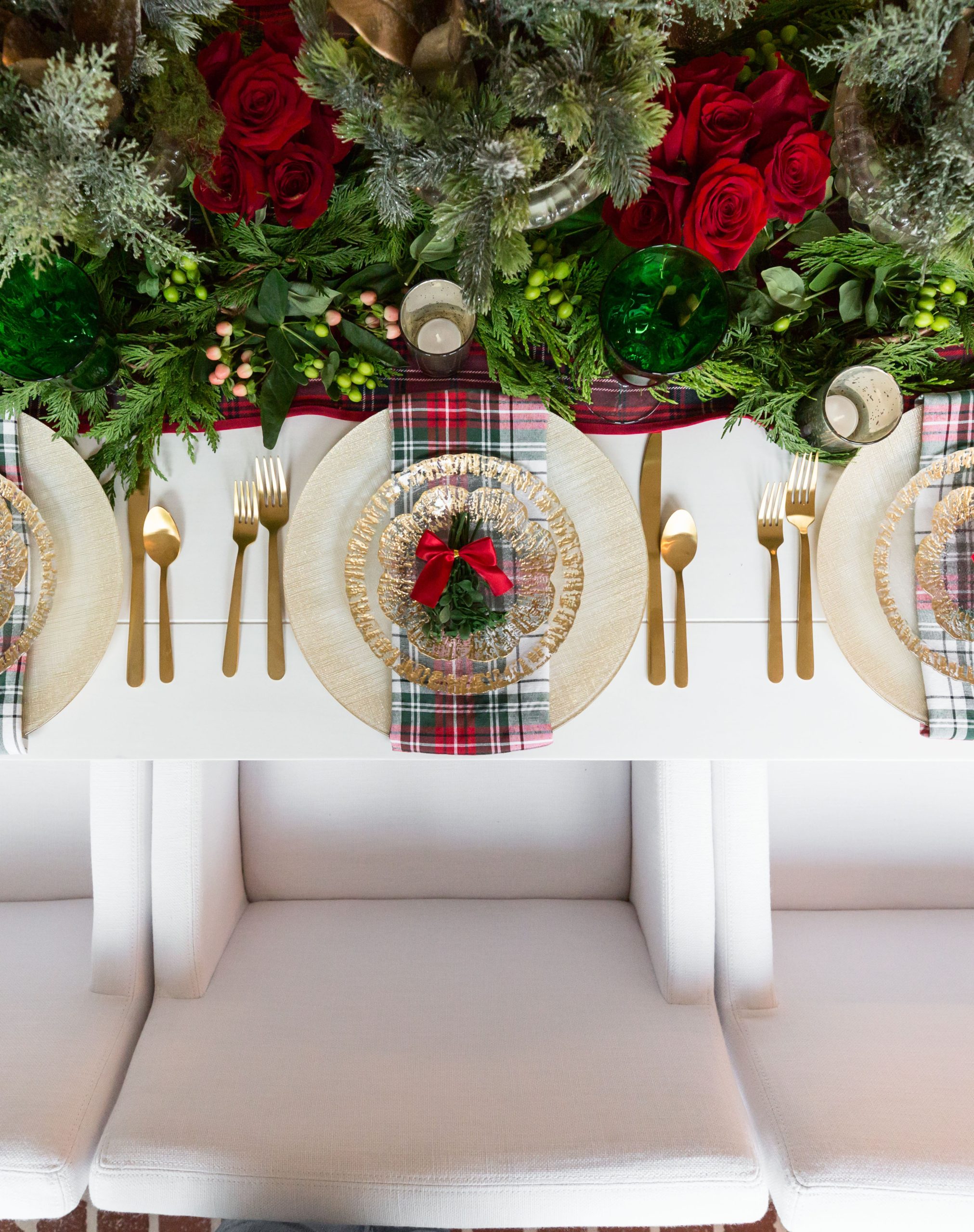
Three things are doing the heavy lifting. First, contrast: soft, messy, living greenery pressed against crisp white upholstery makes both look better. Second, repetition — round gold chargers, round scalloped plates, round votives — creates a rhythm down the table without a single matching pattern. Third, the gold thread: it is the one material touching both the red and the green, which is why the whole thing feels intentional instead of collected.
It is the little sprig tied with a red bow on each plate. Take it away and you have a very pretty holiday table. Leave it in and every guest gets a two-second moment of oh, that one is mine. That is the whole difference between decorating a table and hosting one, and it costs about $1.50 per person at a craft store.
2. A Striped Wingback Dressed in Red, Faux Fur, and Gold Stars
When you layer pillows on a patterned chair, keep the front pillow plain-ish and let the back pillow carry the print — 20 inches in back, 18 in front. The brown-and-beige stripe here is a neutral, which is why the textured red pillow does all the holiday talking. Also: faux fur reads twice as expensive when it is folded rather than draped. Fold it in thirds across the seat and let one corner fall to the floor.
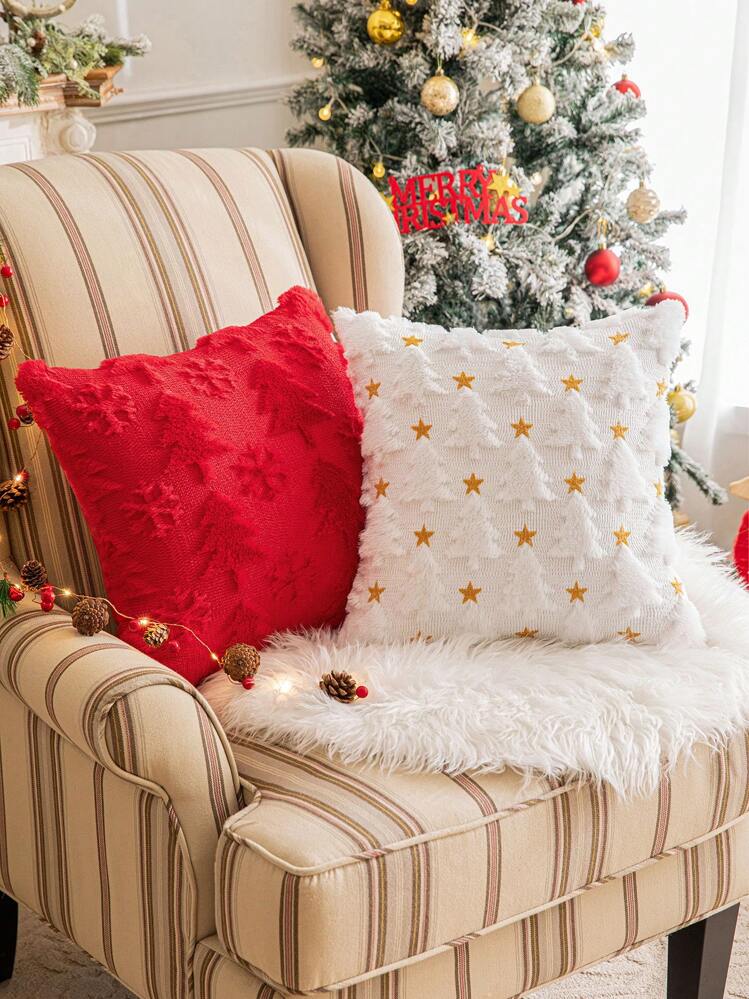
Faux fur plus a lit tree in the same corner equals static and shedding. Expect to shake it out weekly and spot-clean with a damp cloth rather than washing — most decent faux fur mats permanently. If you have a shedder of a dog, this is the chair they will claim, so buy the throw you are okay replacing in two seasons instead of the heirloom one.
- Wingback armchair (thrifted, reupholstered or slipcovered): $150–$700
- Textured red pillow plus white star pillow: $30–$90
- Faux fur throw: $25–$120
- Flocked pre-lit tree, 4–6 ft: $60–$250
- Ornaments and star topper: $25–$75
Total: roughly $290 to $1,235
Budget alternative: a $60 Facebook Marketplace wingback, a $25 Target faux fur throw, and a 4-foot unlit flocked Walmart tree with a $12 strand of warm LED lights.
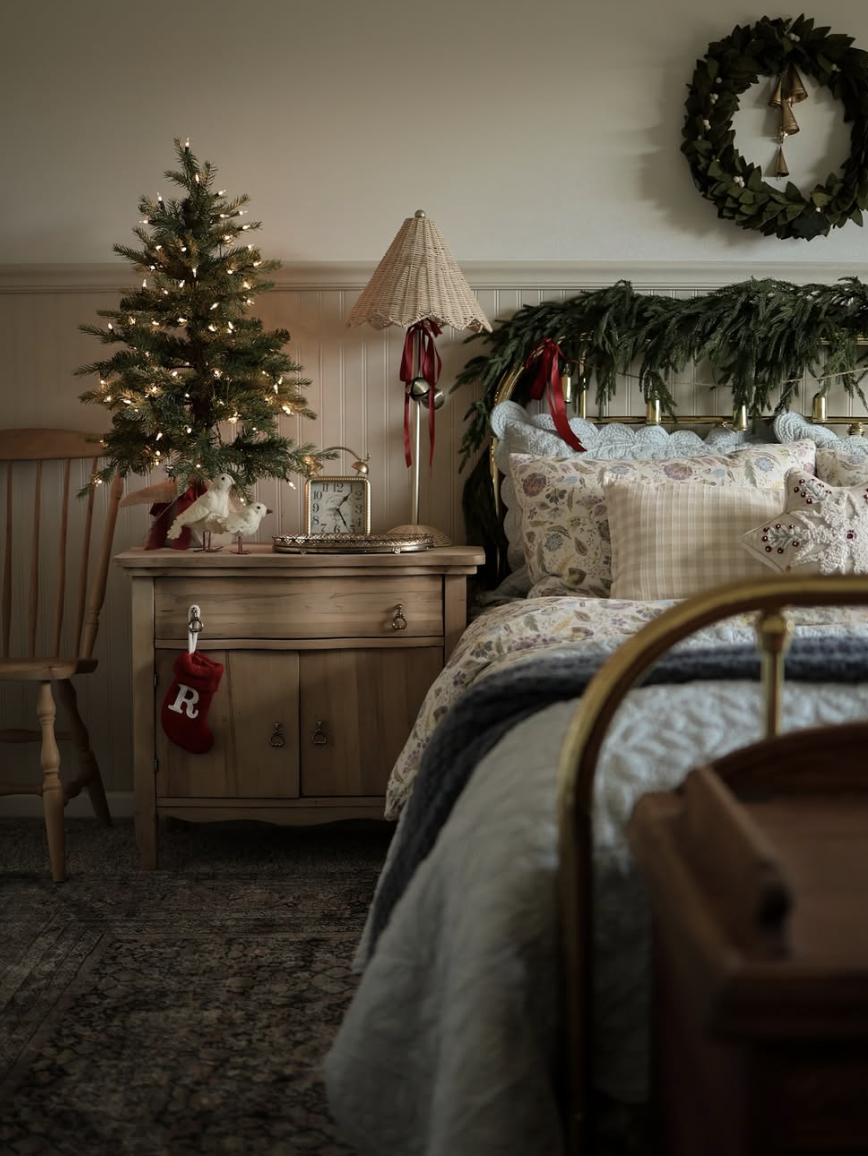
3. A Brass Headboard, a Mini Tree, and a Stocking Marked R
- Measure the top rail of your headboard — a garland under 6 feet will look skimpy stretched across a queen.
- Check outlet placement. Pre-lit garlands need power, and a cord snaking across a bedroom floor is a tripping hazard.
- Confirm the headboard can take tension without scratching; felt pads or clear zip ties, never nails.
- Pick one accent color — here it is red — and repeat it in the ribbons, the stocking, and the bedding trim.
- Start with a 9-foot unlit pine garland and fluff every branch outward. This takes 15 minutes and it is the entire trick.
- Wrap warm-white micro lights along the spine, not the tips, so light glows from inside the greenery.
- Attach to the headboard rail with clear zip ties at four points, hidden behind needles.
- Add three red satin ribbons in simple loops, spaced unevenly on purpose.
- Finish with one small ornament — the mini stocking on the nightstand lamp echoes the headboard.
About 45 minutes and $40 in materials. If you want the fuller garland treatment, see Idea #6.
Bedrooms are the quiet 2026 story. Holiday spending has shifted away from the living room toward the rooms you actually sit in — bedrooms, baths, kitchen corners — and the pre-lit mini tree on the nightstand is the poster child. It is a nostalgia play: that small tree reads like the one from your childhood bedroom, which is exactly why it photographs so well and why it is not going anywhere next year.
4. Boxwood Wreaths Tied to Faux Bamboo Chair Backs
Twelve boxwood wreaths at retail is a $300–$500 decision. Do it for $60 instead: buy six 10-inch grapevine wreaths at a craft store (about $4 each), hot-glue preserved boxwood picks around them, and tie the striped ribbon yourself. Then alternate — a wreath on every other chair — which actually looks better than a full set because the eye gets a rest. Walmart’s pre-made 8-inch boxwood wreaths run about $8 if you would rather not glue anything.
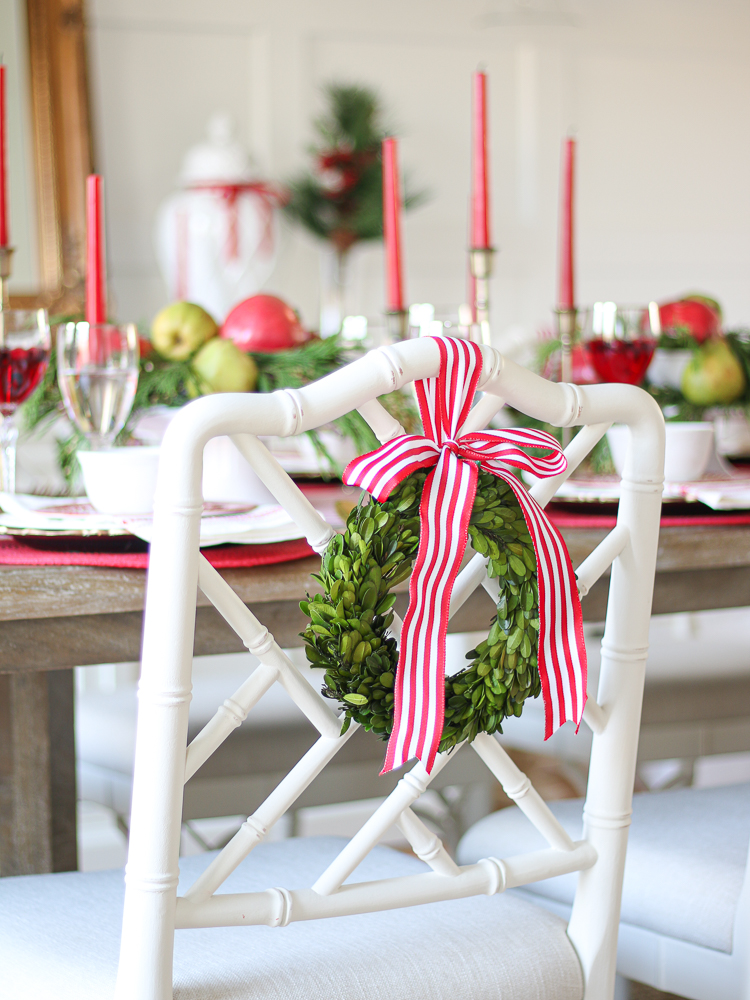
The chair-back wreath is a scale trick. A wreath on a wall competes with art, mirrors, and molding. A wreath on a chair back has nothing to fight — it is framed by negative space, which is why a $6 wreath reads like a $60 one here. The white faux bamboo frame helps too: pale furniture is basically a display stand, so green and red pop harder than they would against dark wood.
Preserved boxwood is not immortal, despite the label. It fades to olive and then brown in about two years in direct sun, and it hates humidity — one hung near a kitchen or bath door goes faster. Real boxwood is worse: it drops leaves the moment it dries out. If you want the look permanently, buy faux boxwood and spray it once a year with UV protectant.
5. White Hydrangeas and Gold Pears Down the Center of the Table
The gold pear ornaments doubling as place cards. Everything else here — the layered porcelain, the crystal, the twisted red tapers — is beautiful but generic. The pears are the reason a guest texts a photo to their sister. A hammered metal ornament with a name tag tied on costs about $4 and does the job of a $40 calligraphed place card, and you get to keep it forever.
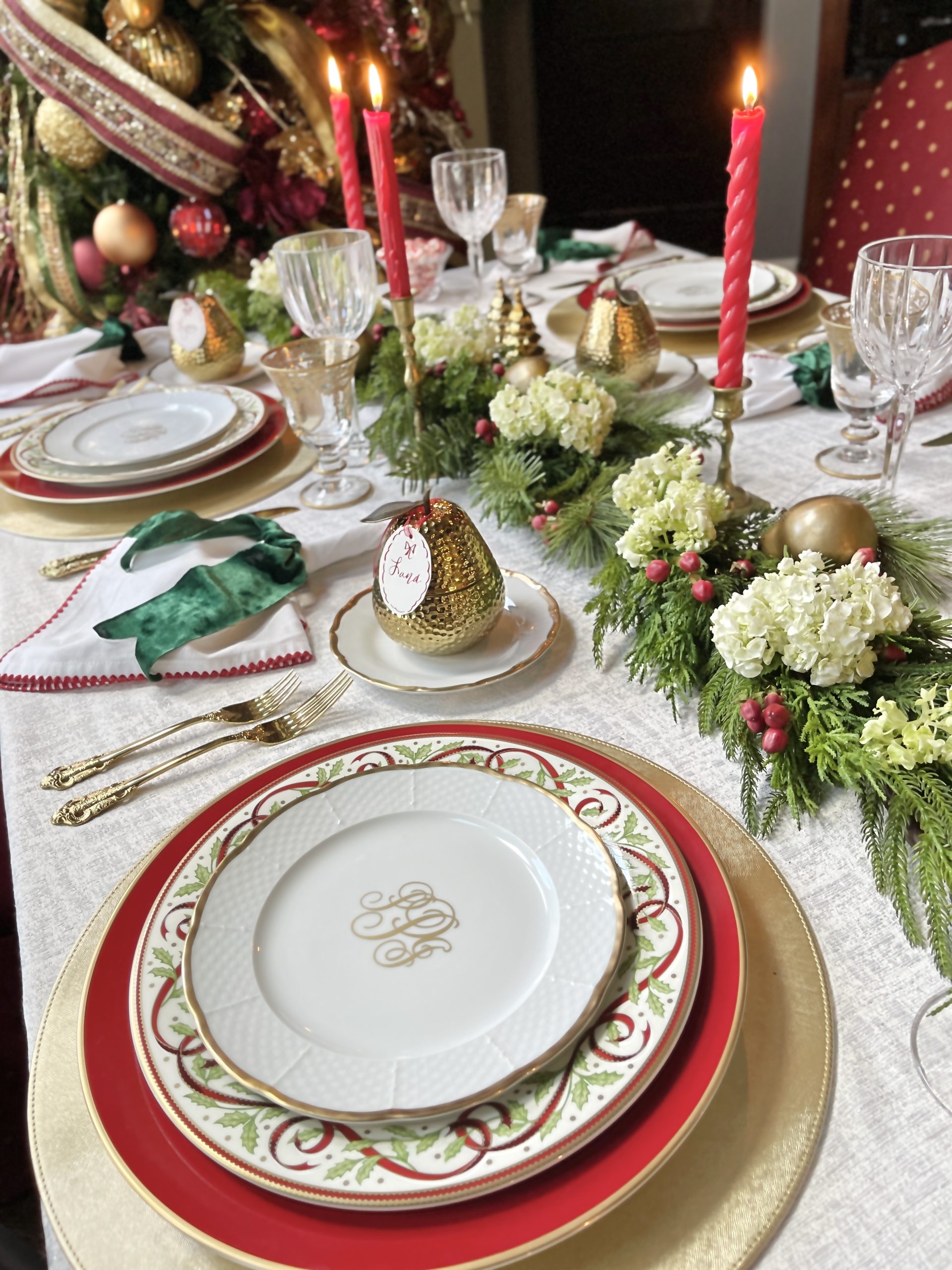
- Gold chargers, set of 12: $40–$120
- Layered holiday porcelain, 4 settings: $60–$200
- Tall twisted tapers plus brass holders: $30–$90
- Evergreen, hydrangea, and red berry centerpiece: $85–$250
- Gold pear ornaments and name tags: $35–$60
- Crystal glassware and gold flatware: $60–$300
Total: $310–$1,020 for a table that seats eight
Budget alternative: grocery-store eucalyptus and one supermarket bouquet of white hydrangeas runs about $18, and your everyday wine glasses look just as good as crystal once candles are lit.
This table wants a long, narrow centerpiece, so it needs a long, narrow table. Plan on 36 inches of width minimum so guests are not leaning over hydrangeas to reach the butter, and 28 inches of run per person. Under 60 square feet of dining space, skip the garland and use three small separate arrangements instead. See Idea #22 for the same density on a smaller footprint.
6. Carved Wood, Illuminated Pine, and a Central Wreath
Real pine garland over a bed is gorgeous for about ten days and dusty forever after. Fresh greens dry from the inside out, so you will see needles on the duvet before you see them on the branches. Plan on misting every other day and replacing it after three weeks. Faux is the practical choice for a headboard: wipe the branches with a microfiber cloth once a month through the season and it will last a decade.
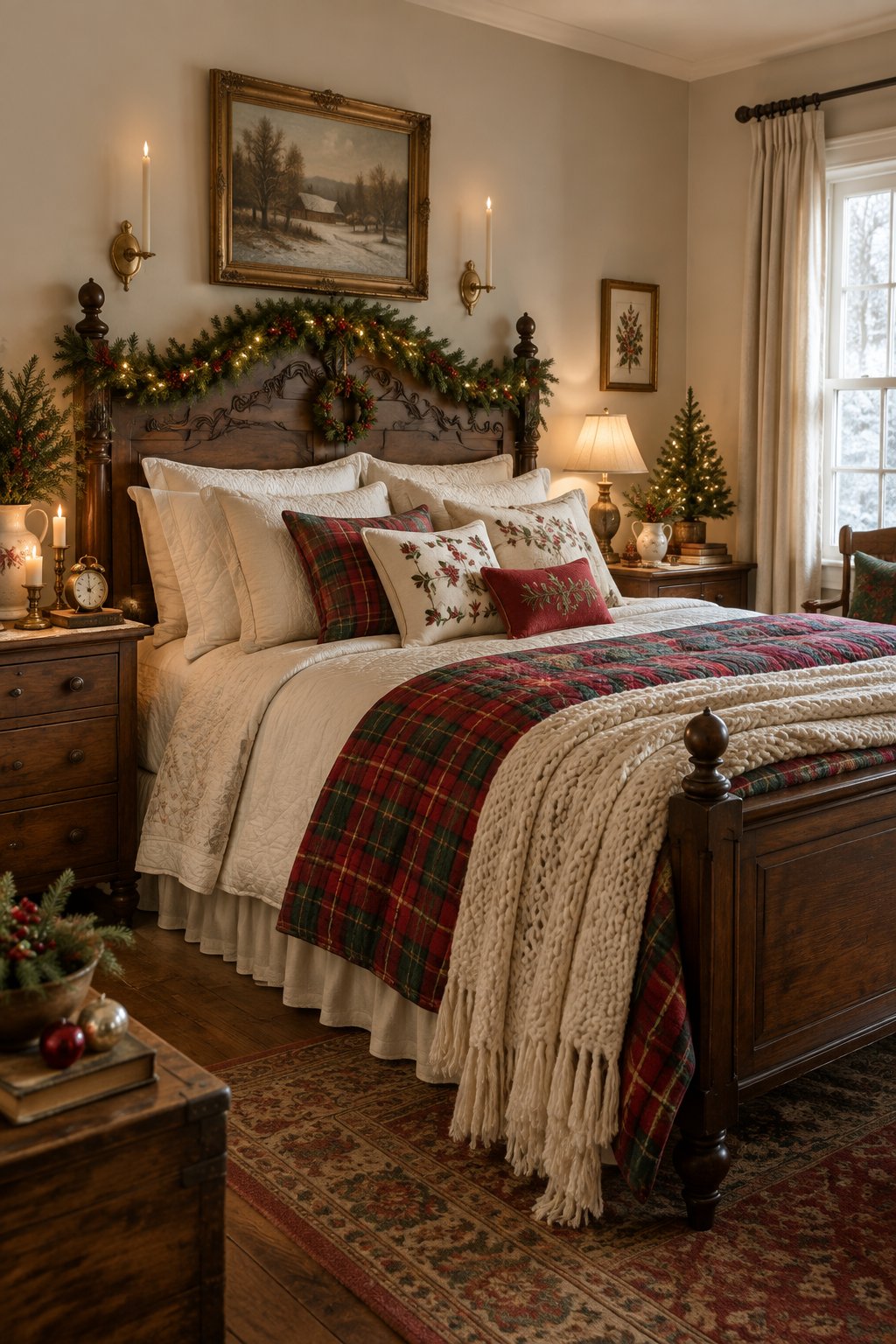
The palette holds because it is built on wood. Roughly 45 percent deep wood brown (headboard, art frames, nightstands), 25 percent cream (quilted bedding, chunky knit), 20 percent crimson and forest green split evenly through the tartan and garland, and 10 percent brass. The tartan carries both red and green at once, so you never have to decide which one leads.
Hang the wreath so its bottom edge sits about 8 inches above the top of the headboard — any lower and it reads as a wall ornament that fell. If you are hanging anything over a headboard, use one 40-pound-rated adhesive hook, not a nail, and never lean heavy greens into a sleeping position. Tartan quilted throws also show every dog hair, so tuck a lint roller in the nightstand.
7. Velvet Bows and a Nutcracker on a Deep Red Runner
The velvet bows are what sell this. Retail versions run $12–$18 each; a yard of burgundy velvet from a fabric store is about $9 and makes nine bows. Glossy burgundy ornaments? Buy a tube of unbreakable ones at Walmart for $6 and save the glass for the tree. And the nutcracker — thrift stores are full of them in November, usually $4–$10, and a mismatched one looks more collected than a brand-new set.
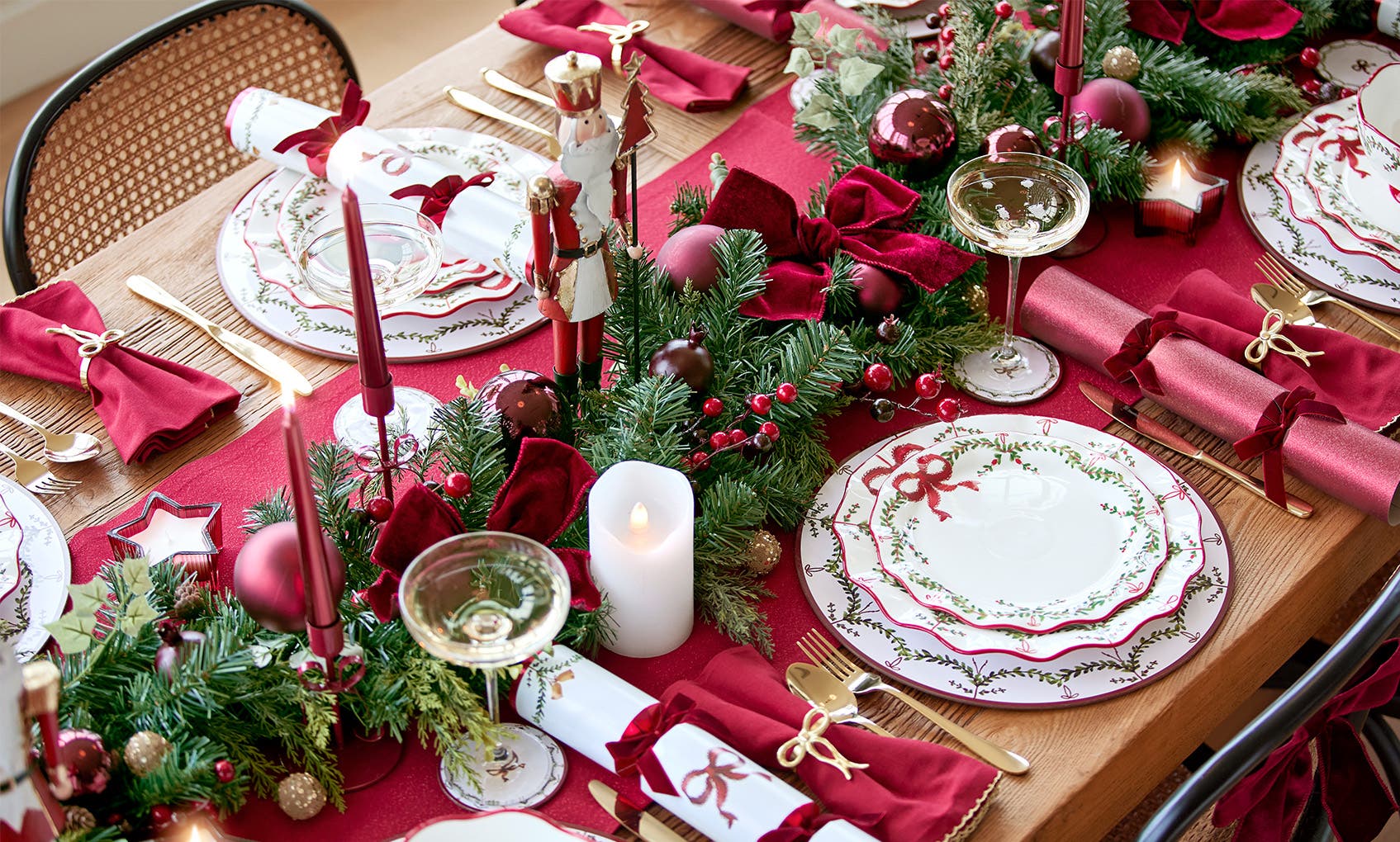
Red velvet is a magnet. It grabs lint, pet hair, and every crumb on the table, and it fades in direct sun faster than almost any other fabric. If your dining table sits in a bay window, plan on the bows looking tired by year three. A cheaper option that photographs identically is velvet-ribbon-look polyester, which wipes clean with a damp cloth.
The single lit candle tucked inside the garland. Everything else is arrangement; that one flame is the reason people linger after dessert. Real candles in dried evergreen are a genuine fire risk, so keep them in glass hurricane cups, trim wicks to a quarter inch, and never leave the room. Take the light away and this becomes a very nice, very static centerpiece.
8. A Dark-Walled Dining Room Lit Only by Tree and Candle
The dark Christmas room is the 2026 counter-trend to all-white holiday styling — searches for moody, jewel-toned holiday dining rooms keep climbing while the all-neutral look cools off. It makes sense. Dark walls plus candlelight is the cheapest drama in decorating, and it flatters everyone at the table. It also has staying power, because painting a room charcoal is not a seasonal commitment you undo in January.
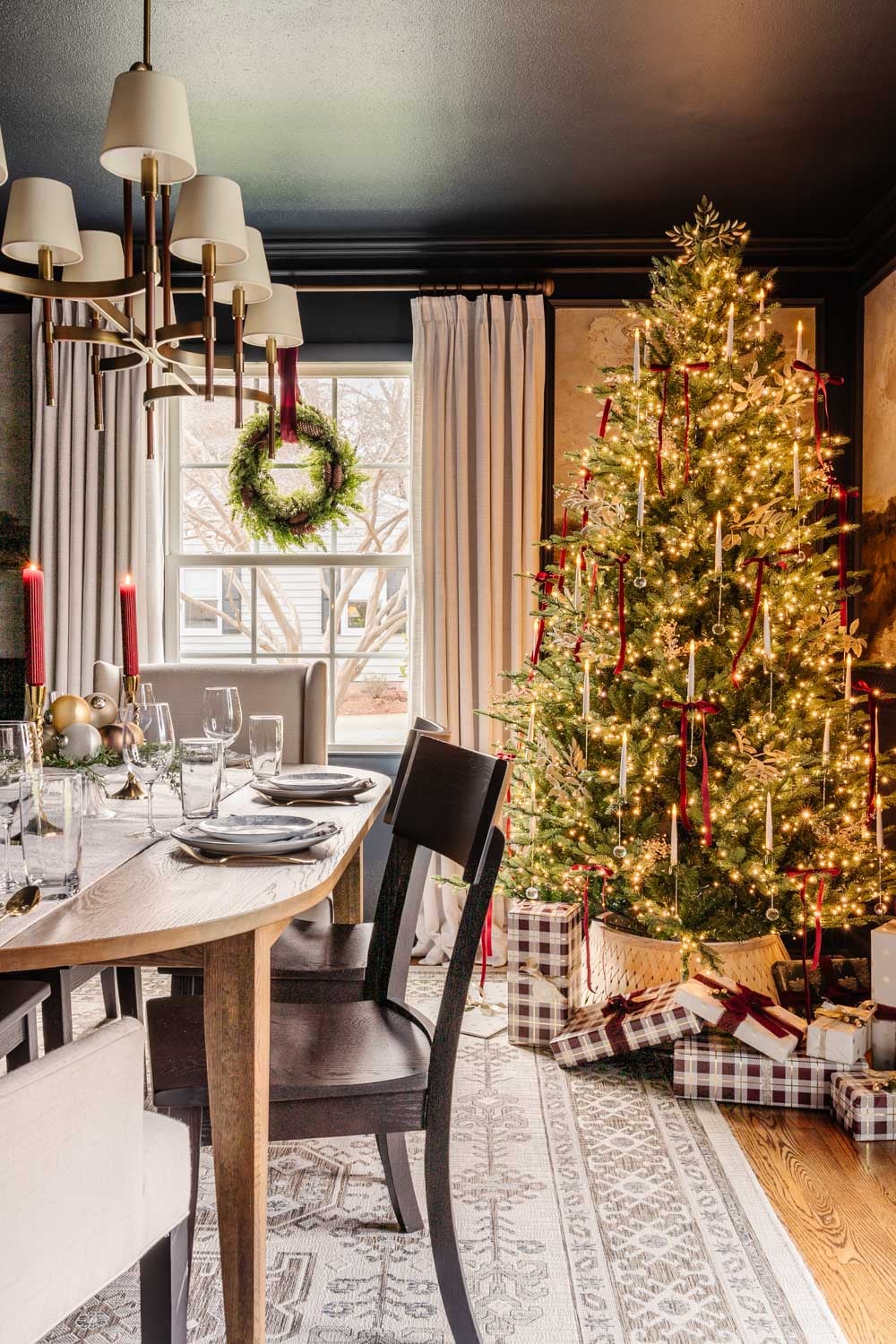
- Clip taper candles into sturdy holders with wide drip trays — you want at least six across a 6-foot tree.
- Space them in a spiral, roughly 12 inches apart vertically, offset so no two flames align.
- Wire in red satin ribbon loops at the same intervals to visually connect the candles.
- Keep the lowest candle at least 18 inches off the floor and clear of wrapped gifts.
- Light only when someone is in the room, and blow them out before you pour coffee.
About two hours of styling and $45 in candles and holders.
Candle wax on a patterned rug is a two-hour problem you do not want. Keep a scraper and an iron with a paper towel handy — that is the actual fix — and never place tapers directly under a chandelier where warm air moves. Dark walls also show scuffs from chair backs and dragged gifts, so keep a small pot of touch-up paint in a closet.
9. Knitted Stockings and Tapers on a Simple Pine Mantel
Swag rule: your mantel garland should be about one and a half times the width of the mantel, with tails hanging 12 to 18 inches below the shelf on each side. Anything shorter looks like a scarf that shrank. Zip-tie a length of floral wire along the back first so it holds a shape instead of drooping, and stick to an odd number of stockings — even numbers on a mantel always look like a spreadsheet.
Mantels under 5 feet wide can only carry three stockings and a single candle cluster; any more and the whole thing turns into a wall of felt. You want a 6- to 7-foot mantel for this look, and if yours is a shallow decorative shelf rather than a real mantel, use adhesive hooks rated for 5 pounds instead of clips. Working with a small one? See Idea #16 for a scaled-down mantel that still reads full.
- 6-foot realistic pine garland: $30–$90
- Cable-knit stockings, set of 4: $40–$140
- Brass taper holders plus candles: $25–$80
- Warm-white fairy lights, 100 count: $10–$25
- Mantel clips, wire, and hooks: $12–$25
Total: $117–$360
Budget alternative: Dollar Tree garland doubled and fluffed, thrifted stockings, and one $8 strand of warm LED lights gets you 80 percent of the look for under $50.
10. Small Wreaths on Glass Cabinet Doors with Long Red Ribbons
Six wreaths for a built-in cabinet sounds expensive until you buy 6-inch grapevine bases at $3 each, wrap them in a single $10 garland, and add one yard of ribbon per wreath. Total: about $45. Or zip-tie real cedar sprigs to a $2 wire hoop and refresh every three weeks — the scent alone is worth it. A ribbon tail should run at least twice the height of the wreath, so buy more ribbon than you think you need.
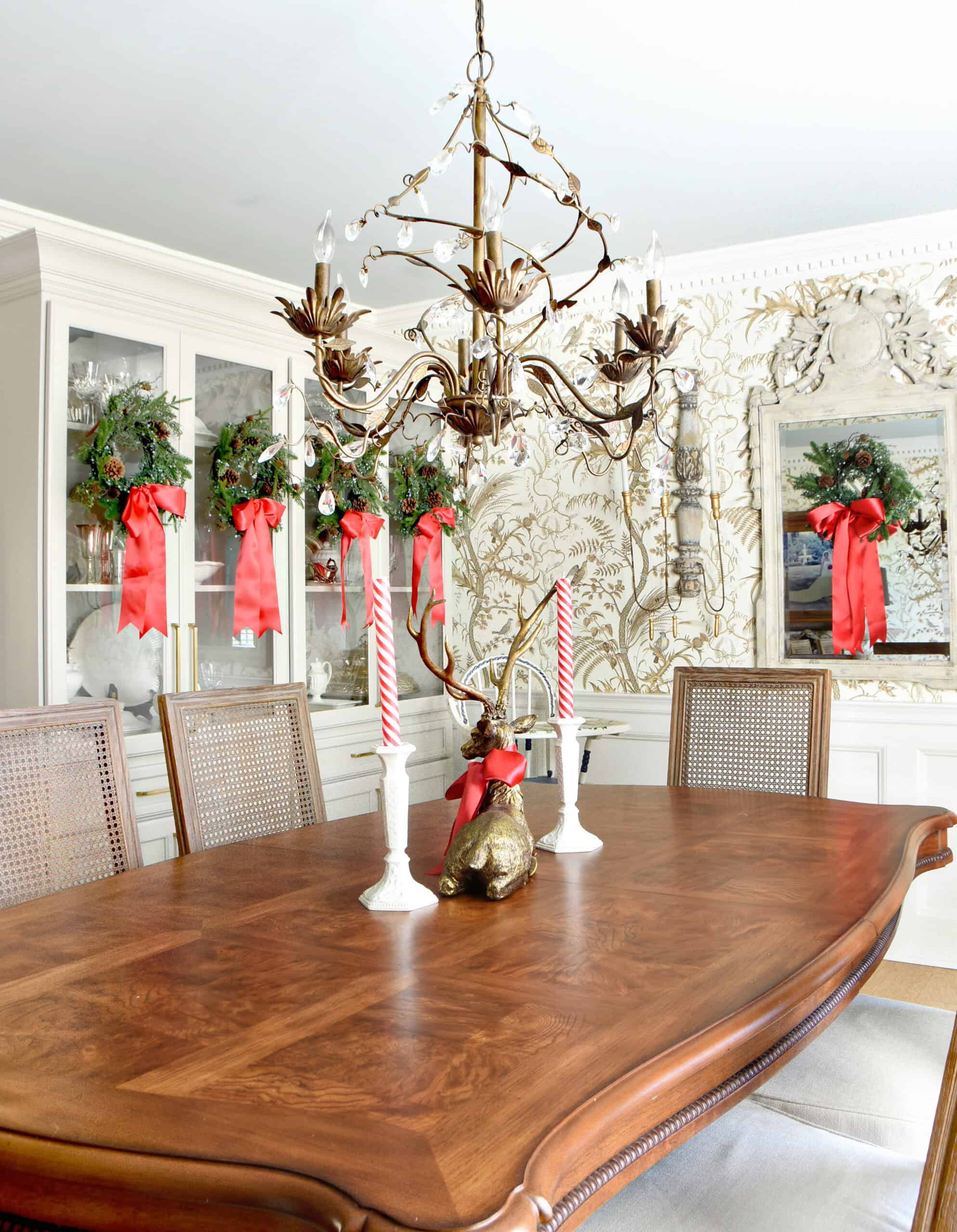
Glass-front cabinets are basically display cases, and decorating them is about vertical rhythm. The long ribbon tails do three jobs at once: they link the wreaths to each other, they pull the eye down past the shelves, and they break up the grid of the cabinet doors. Small wreaths also do not block the view of what is inside, which is the entire reason you have glass doors.
- Measure the cabinet door width — a wreath should be no more than one third of it, or the doors look crowded.
- Check door thickness and material before hanging; hollow-core doors need adhesive hooks, not screws.
- Test ribbon length before cutting. Tails should fall to about eye level, not puddle on the floor.
- If the doors open daily, use removable adhesive strips only.
11. Cathedral Ceilings, Stone, and Red Ribbon Bows
A vaulted room swallows normal decor. At 14 feet or higher, you need a tree over 9 feet or it disappears — and garland with 6-inch-wide ribbon, not 2-inch. This is a room where a 5-foot tree looks like a tabletop ornament, so either go big or cluster three smaller trees near the hearth instead. Anything under 12 feet of ceiling can stay with standard ribbon and a 7.5-foot tree.
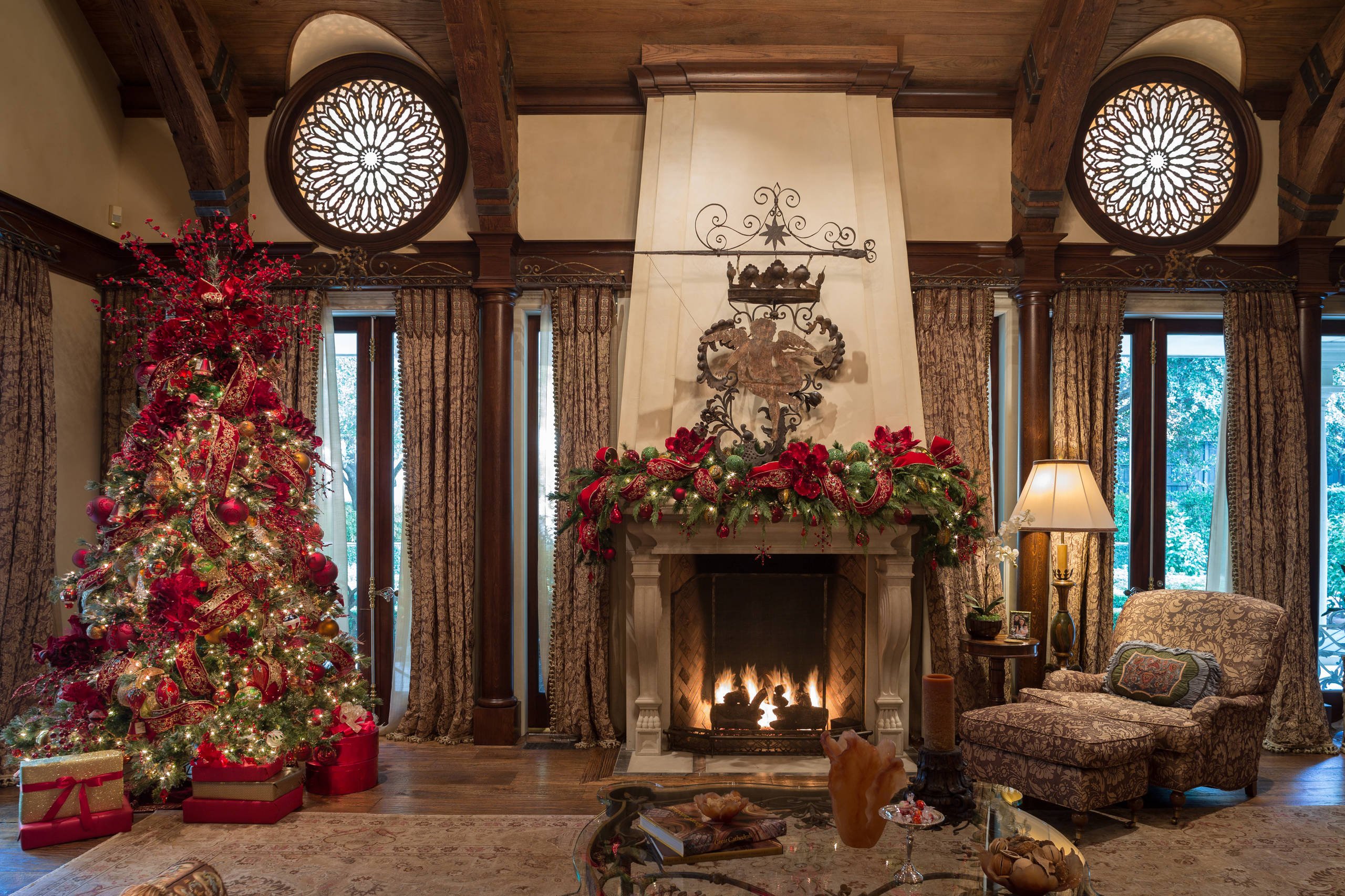
High ceilings mean heat rises, and a real tree near a fireplace dries out twice as fast — you will be watering daily and it will still drop needles by week two. Lighting a vaulted room for photos is genuinely hard, too, because light from below throws shadows up the walls. If you want that glowing look, put fairy lights in the garland and dim everything else. It is the only way.
The proportions here are 50 percent dark wood and stone (the architecture), 25 percent deep crimson through ribbons, ornaments, and bows, 15 percent evergreen, and 10 percent gold plus warm white light. In a room this size, crimson has to be saturated — dusty rose vanishes at 20 feet. Swap colors if you like, but hold the value: burgundy, deep teal, or forest green, never pastel.
12. Nutcracker Figurines and Stockings on a Wood Fireplace
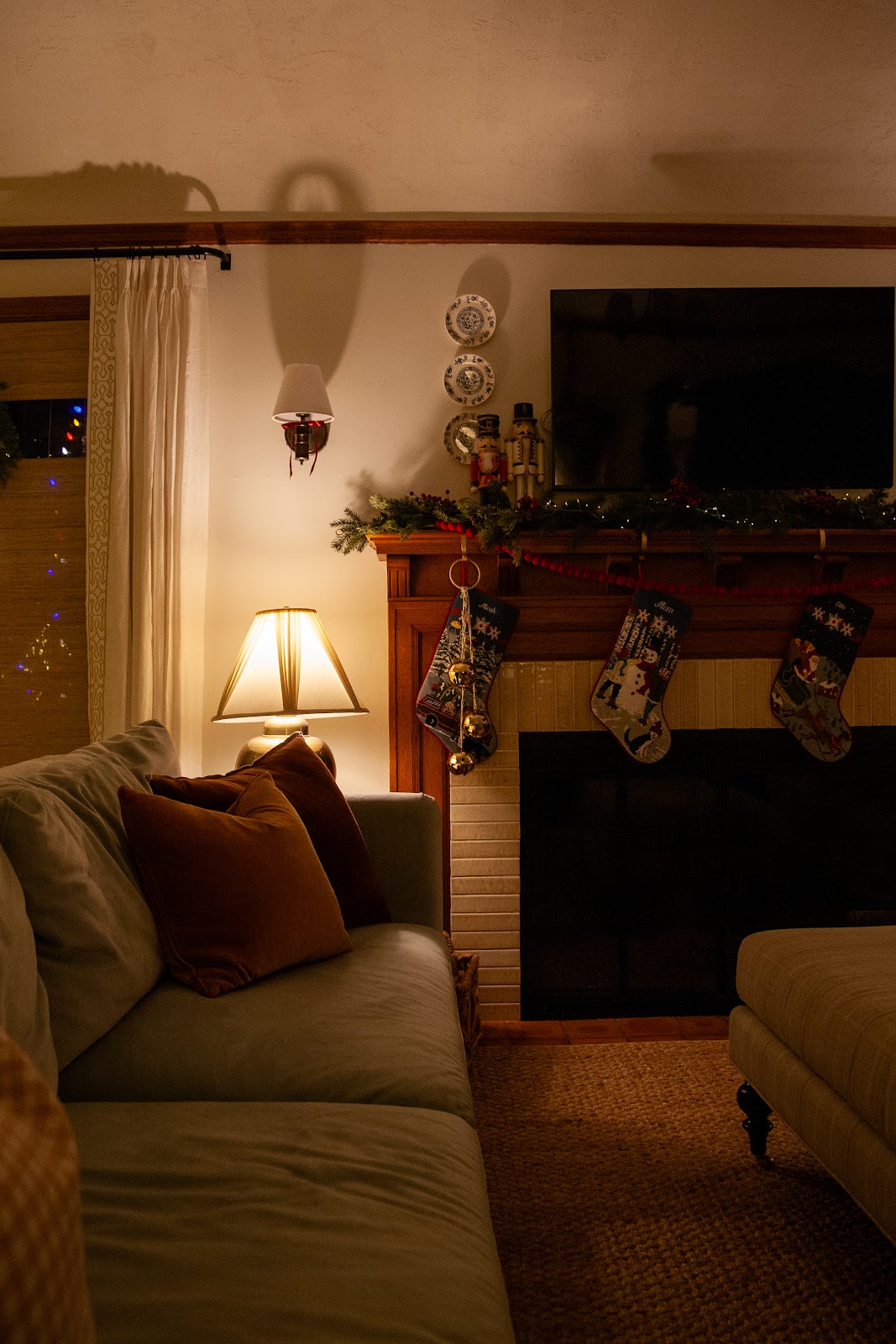
Nutcrackers are the cheapest charmers in Christmas decorating — HomeGoods and Walmart both carry 12- to 15-inch painted ones for $10–$20, and thrift stores hover around $5. Stockings and garland can come from Dollar Tree if you double the garland and fluff it out; two strands pinned together look shockingly full. Target’s felt stockings at $12 each are a solid middle ground, and your existing velvet pillows do the rest.
- Look at where your TV is mounted and how much clear space you actually have — a mantel with a screen above it only holds a low garland.
- Confirm the mantel can take weight. A wet 9-foot real garland weighs 10 pounds or more.
- Check outlet positions for lights before committing to a swag shape.
- Decide the anchoring color first: rust, green, or red. All three at equal saturation gets cluttered fast.
Keep the mantel garland under 6 inches tall if there is a TV above it, and never let greenery touch the screen — heat and needles are a bad pair. Instead of a tall garland, use a low horizontal swag and put your height on the floor: a basket of wrapped gifts or two tall candlesticks flanking the hearth. That keeps the fireplace from looking bottom-heavy.
13. A Felt Pennant Banner and a Tiny Bedside Tree in a Kids’ Room
- Cut pennants from 9×12-inch felt sheets in red, cream, and green — about 10 triangles for a 6-foot banner.
- Fold the wide edge over jute twine and hot-glue. No sewing required.
- Add peel-and-stick felt letters, or stitch them if the banner will be reused for years.
- Hang with two clear pushpins, keeping the low point at least 30 inches above the top of the bed.
- Carry the theme downward — felt garland on the mini tree, one stocking on the door handle.
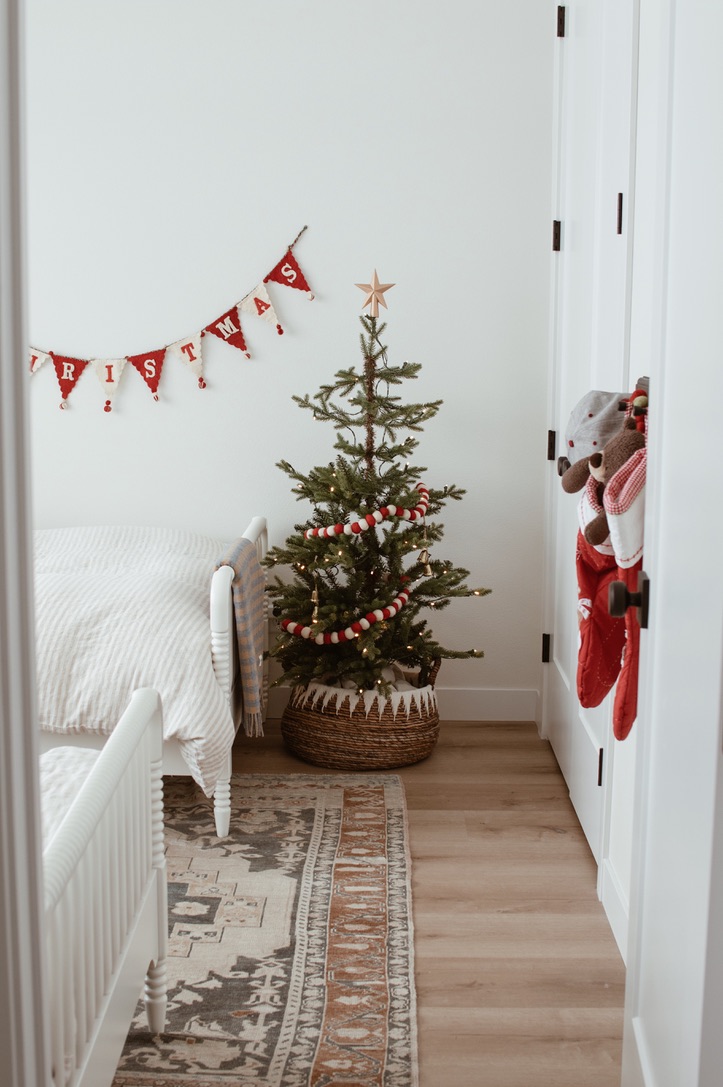
About two hours and $18 in materials.
- 4-foot pre-lit mini tree: $35–$90
- Woven basket tree collar: $15–$45
- Felt garland and star topper: $10–$30
- Felt pennant banner supplies: $12–$25
- Vintage-style patterned rug, 5×7: $60–$250
Total: $132–$440
Budget alternative: skip the pre-lit tree for a $20 unlit 3-footer with a $6 light strand, and cut pennants from felt squares at 50 cents each.
Height matters here more than width. In a kids’ room with 8-foot ceilings, a tree between 3 and 4.5 feet keeps the star below sightline and out of grabby reach. The pennant banner should span the width of the bed plus about a foot on either side. This one works best in rooms under 120 square feet; the bedroom in Idea #13 goes full-size.
14. Pinecones, a Woven Basket Skirt, and a Brick Hearth
Pinecones shed. Real ones also carry sap and occasionally bugs, so bake them at 200°F for 30 minutes before they go anywhere near your mantel. Real garland on brick looks amazing and stains the brick with resin if you leave it up past New Year’s — set a hard takedown date and dry-brush the brick afterward. A woven basket collar needs nothing but a yearly vacuum; fabric skirts need pressing.
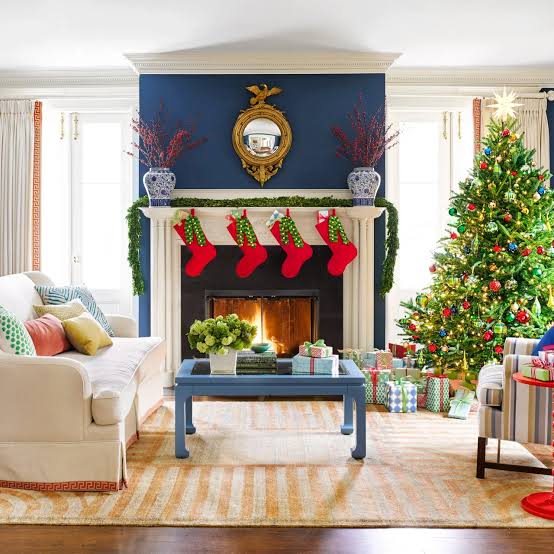
Natural materials have taken over holiday decorating because they solve the plastic fatigue buyers are feeling in 2026. Basket collars instead of fabric skirts, real pinecones, dried citrus — these read as heirlooms rather than merchandise, and they photograph with more texture. The look has staying power because it is essentially what people did before artificial trees existed. Baskets will outlast the trend.
Woven basket collars run $40–$120 in stores. Thrift and estate sales turn them up for $8–$15, and a wide woven wastebasket flipped upside down with the bottom cut out does the job for $5. Pinecones are free if you live anywhere with trees — gather in October, bake, store in a paper bag. A real tree from a local lot is often cheaper than a pre-lit artificial anyway.
15. A Black Front Door Framed in Lit Pine and Gold
Outdoor greenery takes a beating. Direct sun bleaches faux pine in a single season; wind rips zip ties and sends wreaths into the yard. Use UV-treated faux or fresh greens, and confirm your lights are rated for outdoor use — an indoor strand on a door frame is a real hazard once it snows. Topiary spheres in ceramic urns also need to come inside before the first hard freeze or the pots crack.
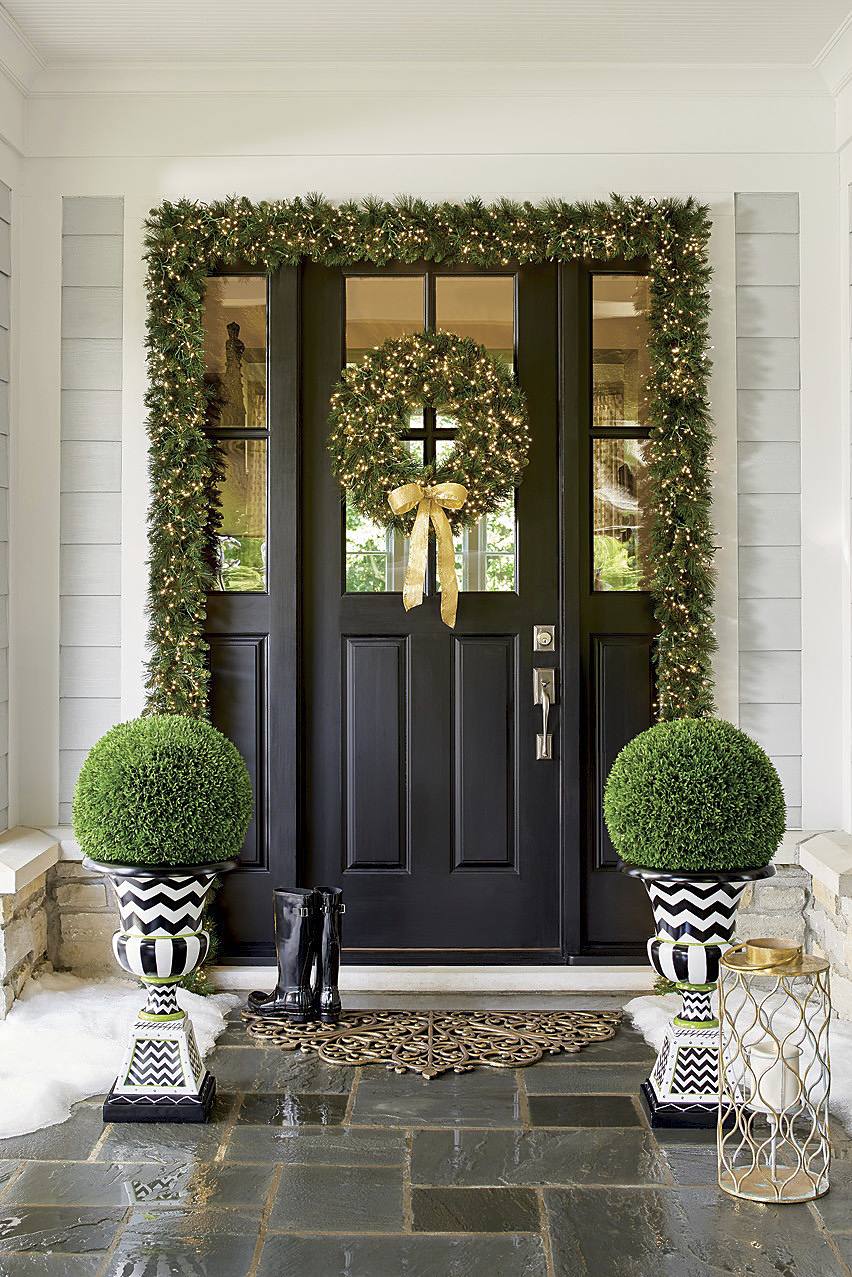
Garland should frame the whole doorway — top plus both sides — which for a standard 80-inch door means roughly 18 to 20 feet of greenery. Anything shorter and you get a haircut look with bare corners. The wreath belongs on the center pane and should be about one third the width of the door. For the same proportion rules applied indoors, see Idea #9.
- Measure door height and width, then order garland by the foot, not by the strand.
- Verify you have an outdoor-rated outlet, or use battery lights with a built-in timer.
- Check wind exposure — on an exposed wall, hang with screws and wire, never adhesive hooks.
- Confirm your urns are frost-proof if they are staying outside all winter.
16. Blue Berries and Eucalyptus for a Frosty White Mantel
This is the cool-temperature version of Christmas: 60 percent white (mantel, hearth, walls), 25 percent sage garland with dusty blue berries, 10 percent wood tones, and 5 percent glass plus candlelight. The blue is deliberately desaturated — swap it for royal blue and the whole thing gets loud. Try the same formula in silver and sage, or soft mauve and green, keeping every accent muted.
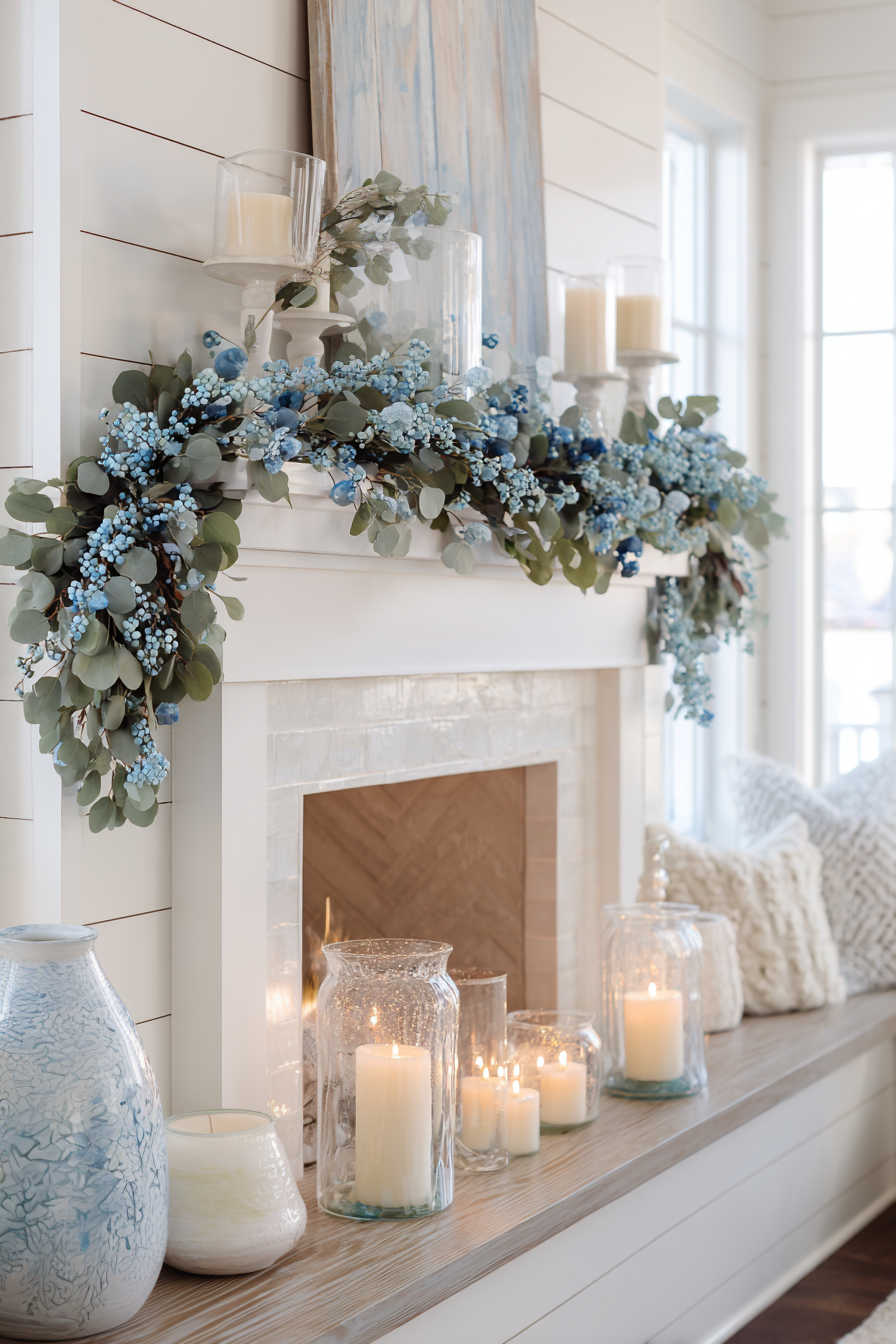
Candle heights matter more than candle count. On a mantel, use three heights — 4, 6, and 9 inches — grouped with the tallest slightly off-center to the left. Even heights read like a factory row. Glass hurricane cylinders beat open candles by a mile: no wax on the mantel and one match lights them all. Hearth bench candles should sit at least 10 inches from anything combustible.
The winter, not Christmas aesthetic keeps gaining ground because it lets people leave decor up through February. Blue berries, eucalyptus, and neutral knits read as seasonal rather than holiday-specific. It is also the palette that works best in the cooler, north-facing rooms most of us actually have, where warm reds can look muddy under gray daylight. Expect this one to keep growing.
17. Red and Gold Ornaments Against Exposed Brick
- 7.5-foot pre-lit tree: $180–$500
- Red and gold ornament set, 100-plus pieces: $60–$180
- Two 9-foot garlands: $60–$180
- Stockings, set of 4: $40–$140
- Warm-white light strands and timers: $20–$45
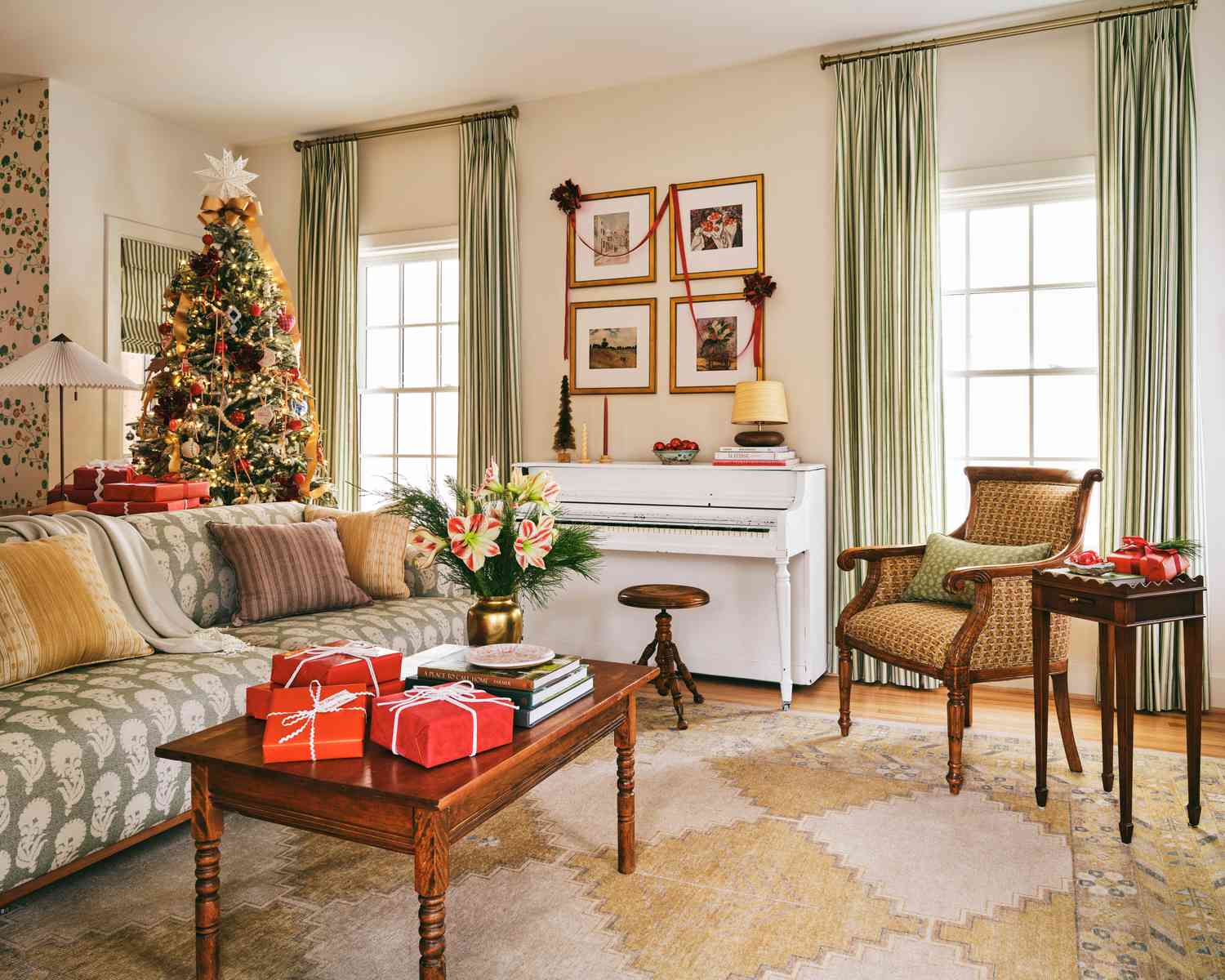
Total: $360–$1,045
Budget alternative: a $60 unlit Walmart tree, ornaments bought on post-holiday clearance the year before, and Dollar Tree garland doubled and fluffed.
Brick is warm, textured, and slightly orange, which is why red and gold sing on this wall while silver would fight it. Two more principles are at work: the tree is placed to mirror the fireplace’s triangle, so the room has rhythm instead of one heavy focal point, and warm-white lights around 2700K match the brick’s undertone instead of making it look dirty the way cool white does.
Exposed brick is porous. Hanging stockings with adhesive hooks can pull brick dust and leave a mark; use a mantel clip instead. Greenery pressed against brick for six weeks can leave resin shadows, especially on light mortar. Line the back of the garland with a strip of felt if you care about the wall — it is invisible and it saves you a scrubbing session in January.
18. Red Tartan, Gold Chargers, and a Rose Centerpiece
The crystal-bead branches. Take them out and you have a lovely, familiar holiday table. Leave them in and the whole setting suddenly sparkles without a single candle — they catch the overhead light and make the roses look like they are glowing. Pick up a set of beaded stems for about $15 and poke them into the centerpiece at three different heights so they read at eye level from a seated position.
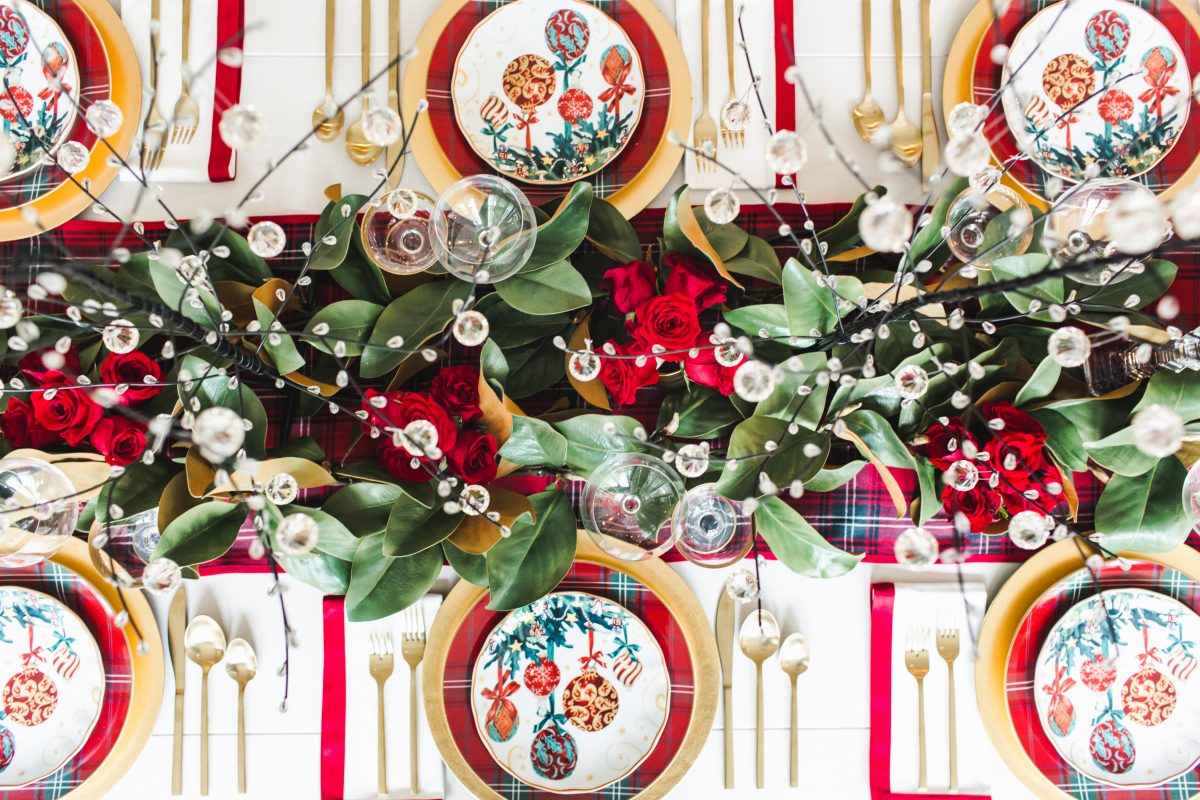
- Lay the tartan runner so it overhangs each end by 12 inches. No more, no less.
- Stack gold charger, plaid accent plate, patterned salad plate, offsetting each by half an inch.
- Build the centerpiece low and wide — greens first, then roses, then beaded stems last.
- Keep the whole arrangement under 9 inches tall so nobody has to peer around it.
- Finish with gold flatware and one extra charger leaning on the runner as a visual repeat.
About 40 minutes and $60 if you use grocery-store roses.
Skip the holiday-patterned salad plates — Target’s Threshold line drops tree-motif plates around $4–$6 each. Tartan runners are $10 at HomeGoods most Novembers, and a red-and-green plaid scarf cut to length from a thrift store works just as well. Roses from a $12 supermarket bouquet look identical to florist stems once they are in the arrangement. For a lighter take on the same red-floral idea, see Idea #20.
19. Plaid Tablecloth and Cane-Back Chairs Tied with Green Ribbon
Roughly 40 percent tartan (tablecloth and stockings), 25 percent natural stone and tan leather, 20 percent evergreen and green ribbon, 10 percent red amaryllis, 5 percent gold. It works despite being busy because the cloth and the stockings are the same plaid, and the tan leather neutral separates red from green so they never touch directly. Change the plaid to blue and the whole room shifts to a winter-cabin feel.
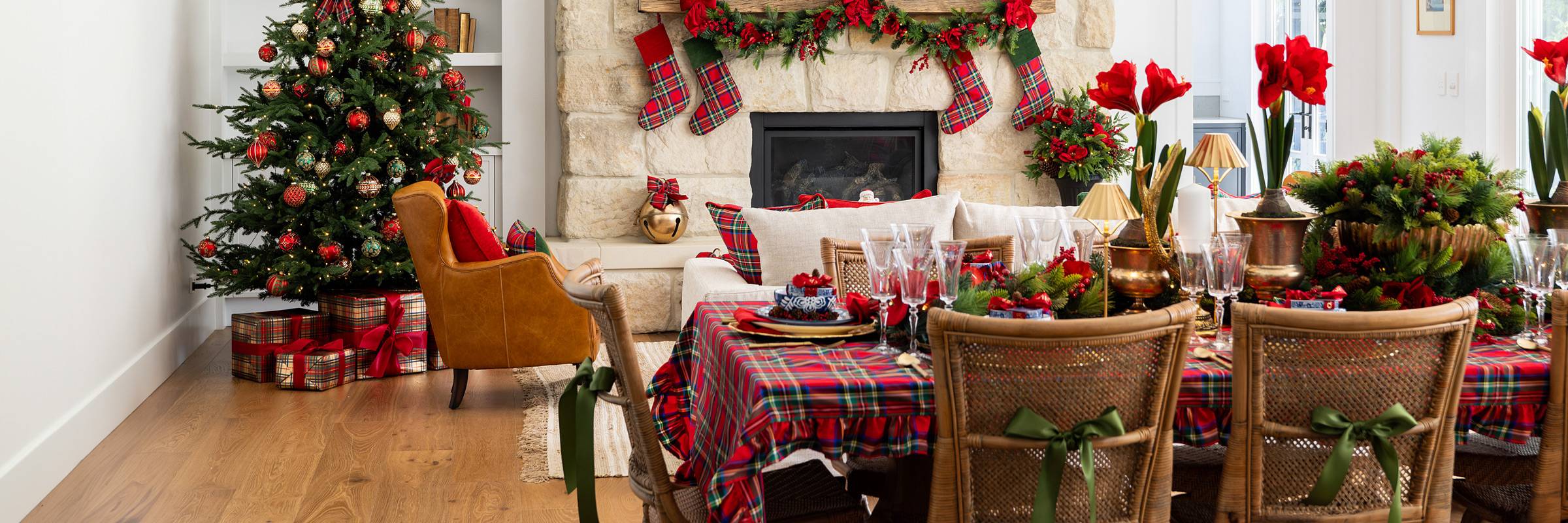
Plaid tablecloths work best on tables 60 inches or longer — on a small round table the pattern swallows the setting. You also want about 28 inches of clearance on at least two sides so cane-back chairs pull out comfortably. If your dining area is under 100 square feet, use plaid napkins instead of a full cloth. The leather armchair in this room needs an open plan of 300 square feet or more.
Ruffle-trimmed plaid tablecloths are beautiful and a nightmare. They wrinkle in storage, snag on chair legs, and any spill wicks along the ruffle before you notice. They usually need ironing before every use because the fabric is cotton-blend. If you host more than once in December, buy two — one on the table, one clean. And skip candles directly on plaid unless they are in glass.
20. Red Amaryllis and Dark Green Tapers on Grey Linen
Amaryllis bulbs are $6–$12 each at a garden center in November, and one bulb in a simple pot gives you three or four blooms that last two weeks — cheaper and taller than florist stems. The grey linen is the sleeper budget move: an unbleached cotton or linen flat sheet from a thrift store, cut and hemmed, looks like a $90 tablecloth for $6. HomeGoods glassware at $4 a stem beats crystal you are afraid to wash.
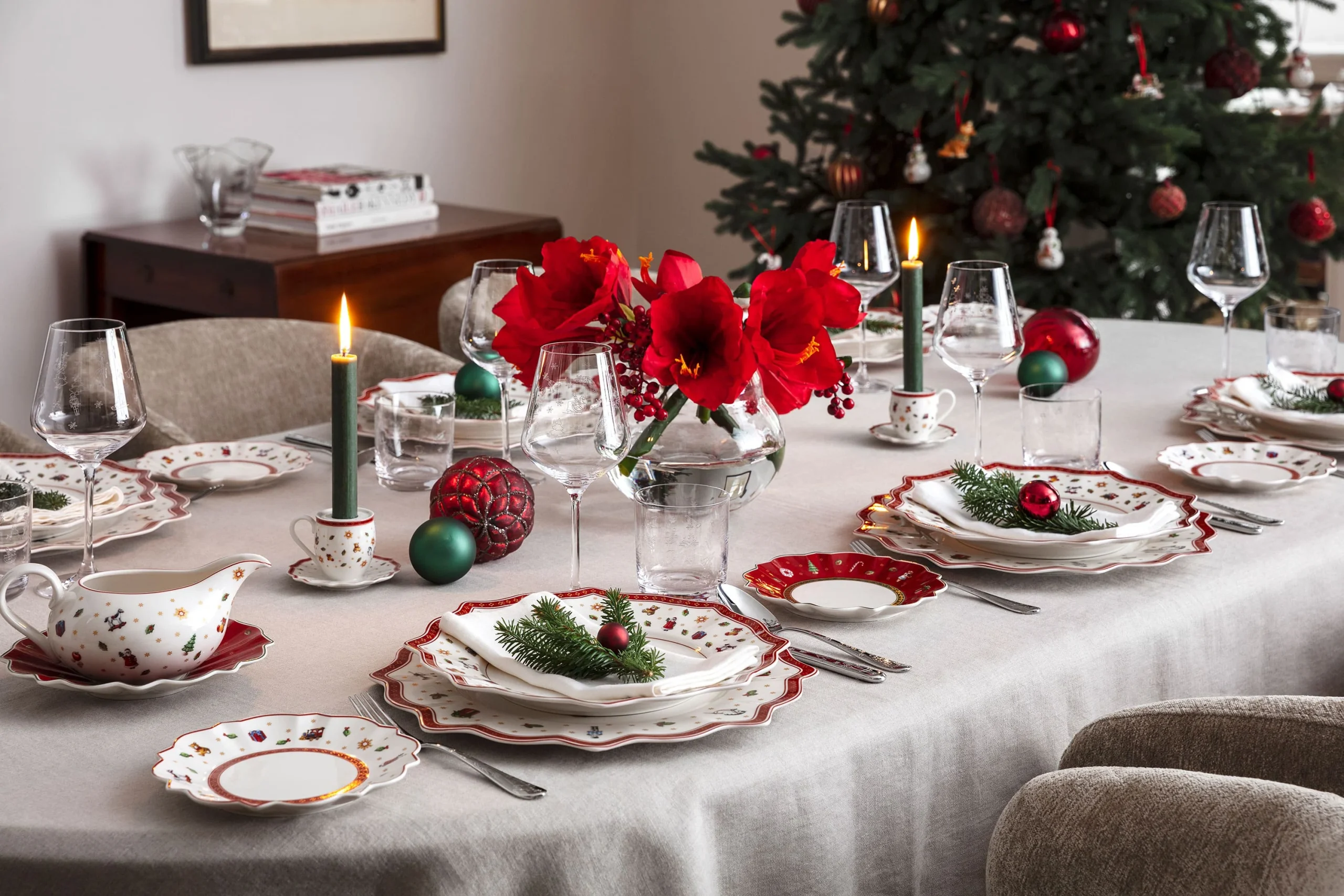
The grey tablecloth. It sounds like nothing, but it is the reason the red reads as elegant instead of loud — grey sits between red and green and quietly separates them. Swap it for white and you get something much crisper; swap it for red and the amaryllis disappears into the background. Sometimes the most important element on a table is the one you barely notice.
Amaryllis drops pollen — visible, orange, and it stains. Cut the anthers off with scissors the moment the blooms open and you keep the drama without the mess. Dark green tapers drip less than cheap red ones, but still: trim wicks to a quarter inch and use holders with a drip lip. Real linen needs ironing and shows water rings, so use coasters, always.
21. A Gold Textured Cloth with Red Poinsettias and Green-Trim China
Texture is doing the work here, not color. A plain gold cloth would look cheap; the textured weave catches light and makes the metallic read as fabric rather than foil. Meanwhile the china’s green trim and the red poinsettias deliver the Christmas palette without a single printed motif on the cloth. Pairing one shiny, high-texture element with matte greenery is a reliable formula for any holiday table.
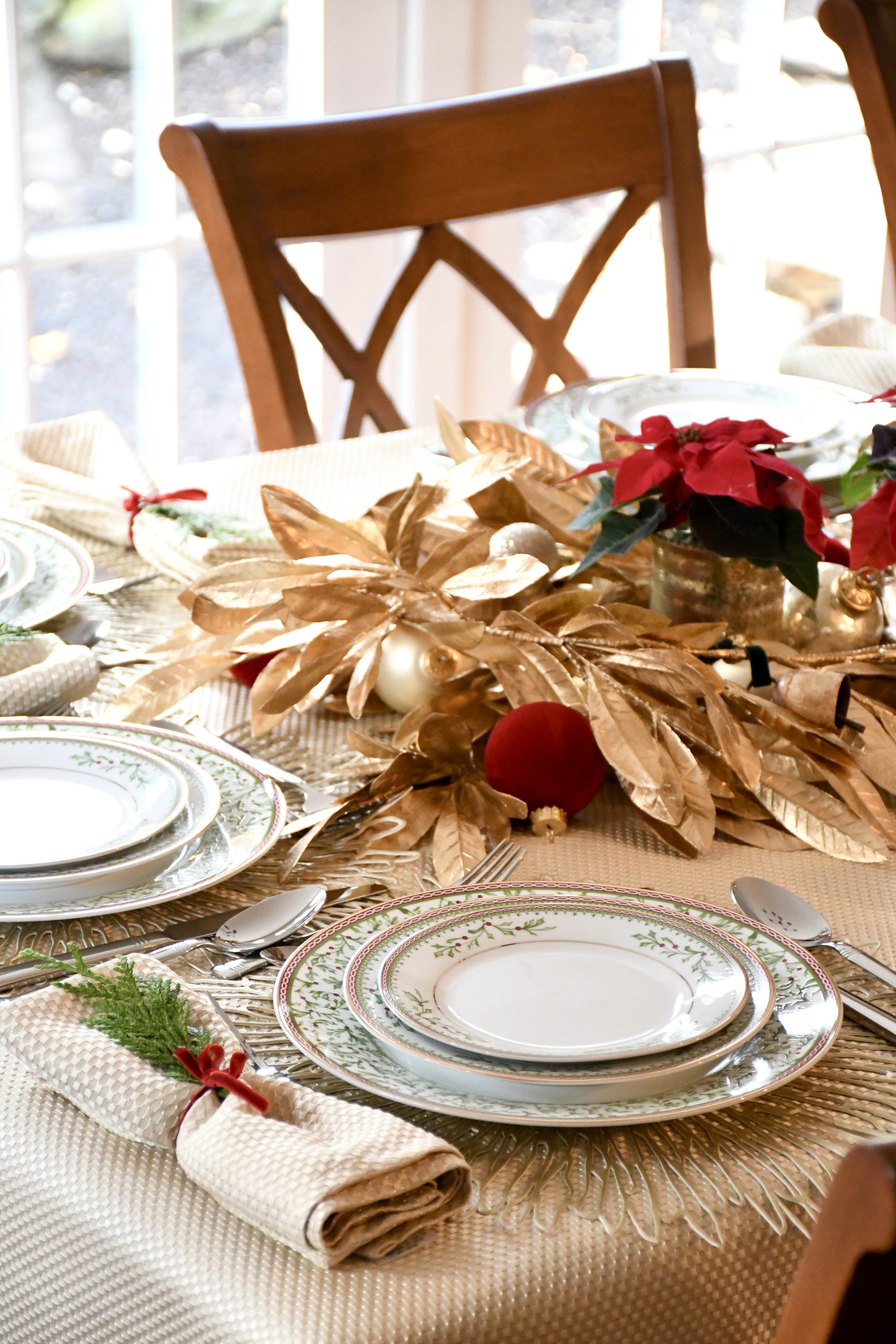
Poinsettias are the diva of the holiday table: they hate heating vents and drafts, and they drop leaves within days if they dry out. Water them in the sink, let them drain fully, then set them back in a liner so the wood does not get a ring. The colored bracts are not flowers and will not last, so buy fresh ones the week you host, not in early December.
Metallic tablecloths show every crumb, every fingerprint, and every candle reflection. If photographs matter to you, they are stunning. If four kids are eating at that table, they are stressful. Consider using the gold cloth only down the center run over a plain white base you can actually wash, or use gold chargers and napkin rings instead and keep the cloth neutral.
22. Pomegranates and Tall Red Tapers on a Striped Runner
- Cut pomegranates in half and seal the cut faces with a thin coat of clear nail polish — they hold for a week without weeping juice.
- Lay the striped runner first, then build a low evergreen base from one long branch rather than several small ones.
- Nestle pomegranate halves cut-side down among the greens, spacing them unevenly on purpose.
- Add red tapers in brass holders, 10 to 12 inches tall, in groups of three at each end.
- Keep everything below eye level so guests can see across the table.
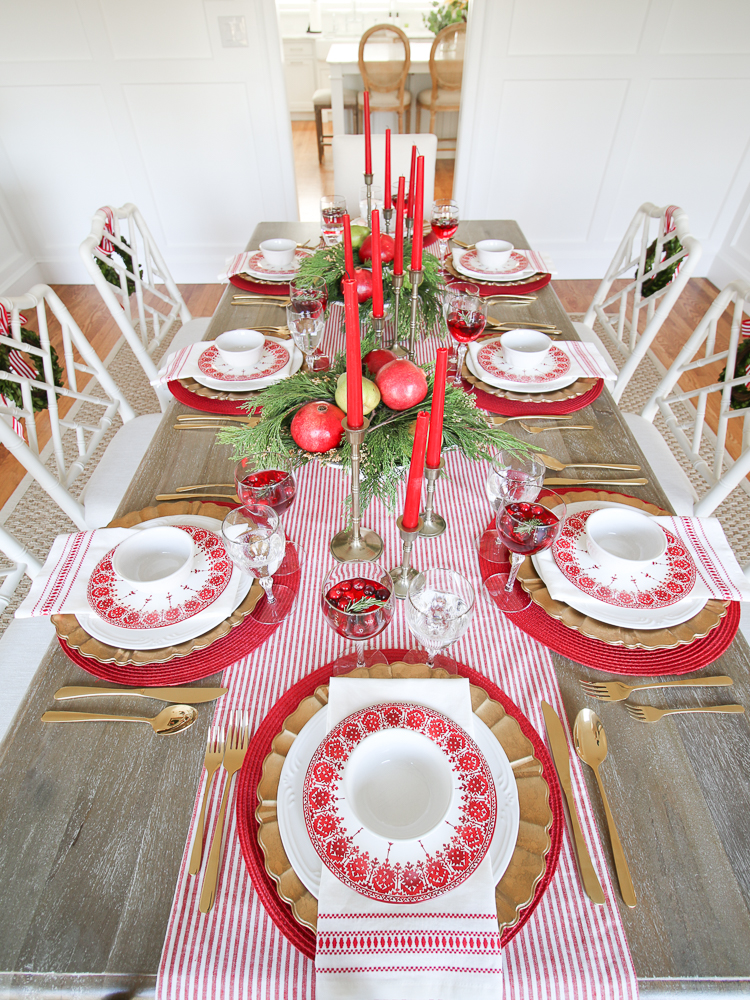
About 30 minutes and $35 in materials, plus the candles.
65 percent red and white (dinnerware, runner, placemats, tapers), 25 percent evergreen, 10 percent brass and gold chargers. That is a lot of red, which is why the striped runner matters — the white in the stripes gives your eyes somewhere to rest. To lighten the whole table, keep the formula and swap the red placemats for natural linen ones.
- Measure table length and buy tapers in proportion — a 6-foot table wants 10-inch candles, not 15.
- Check that your runner is machine-washable before it touches food.
- Test the pomegranate seal on one piece overnight before committing to the whole centerpiece.
- Confirm you have clearance for the charger-plus-plate stack at each chair.
23. Oranges, Pinecones, and White Roses for a Citrus Twist
Citrus at Christmas is a 2026 revival with real roots — it goes back to Victorian pomander ornaments and southern European holiday tables. Oranges bring a warm, slightly bitter brightness that red and green cannot, and they are the antidote to over-sweet holiday styling. It photographs especially well because orange sits opposite blue on the color wheel, so against a cool white tablecloth the whole setting vibrates a little.
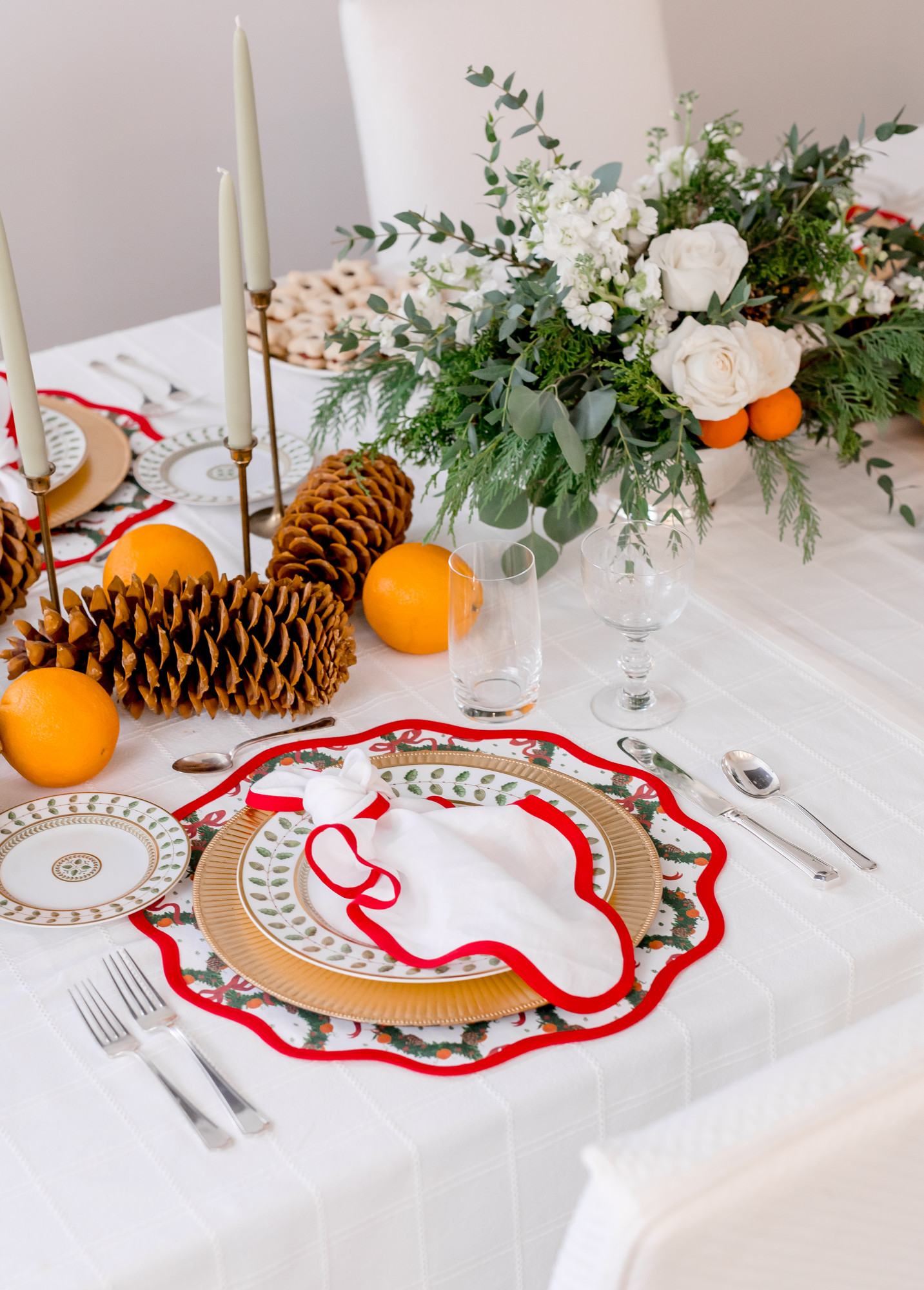
The scale of those pinecones. Not small decorative ones — the giant sugar-pine size, 5 to 6 inches across. They anchor a table that is otherwise all softness: roses, scalloped edges, delicate citrus. Big natural elements make an arrangement feel gathered rather than purchased, and they cost nothing if you know someone with pines. Everything else on this table is pretty. The pinecones make it interesting.
Oranges are $5 a bag. Pinecones are free if you gather and bake them yourself. White roses from a supermarket bouquet run about $14. Reuse last year’s gold-rimmed plates and pick up the scalloped placemats at Walmart for around $6 for four. The whole tablescape, minus plates and linens, lands under $40 and looks like a florist did it.
24. Red Pillar Candles Glowing Through Evergreen and Apples
This is the tablescape for a long table — 72 inches or more — because a continuous garland needs run. Budget about 4 feet of garland for every 2 feet of table. Pillar candles should be 3 to 4 inches in diameter so they read from across the room, and need at least 6 inches of clearance from the nearest branch. On tables under 5 feet, use two short garland segments with a gap in the middle instead.
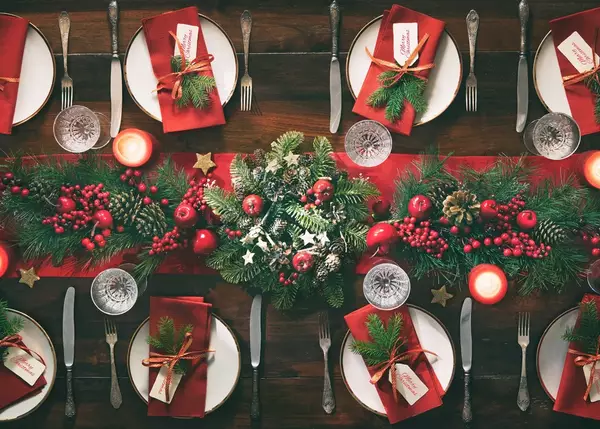
Miniature apples are usually sold as craft filler, and they look fake when clustered. The fix: mix them with real small apples or red berries so the eye reads a blend of natural and decorative, not plastic. Same trick works with faux pears, figs, and lemons. And when you set pillar candles into greenery, nestle them into a glass sleeve first — one drip and your linen is done for.
Pillar candles burn down faster than tapers and pool wax if left long enough. Inside fresh greens, the heat wilts the needles closest to the flame within an hour, so plan on re-fluffing each evening. Real berries drop and stain; faux ones are the safer call directly over a wood table. Wipe the wood with a dry cloth after each dinner, since fresh greens leave sticky spots that collect dust.
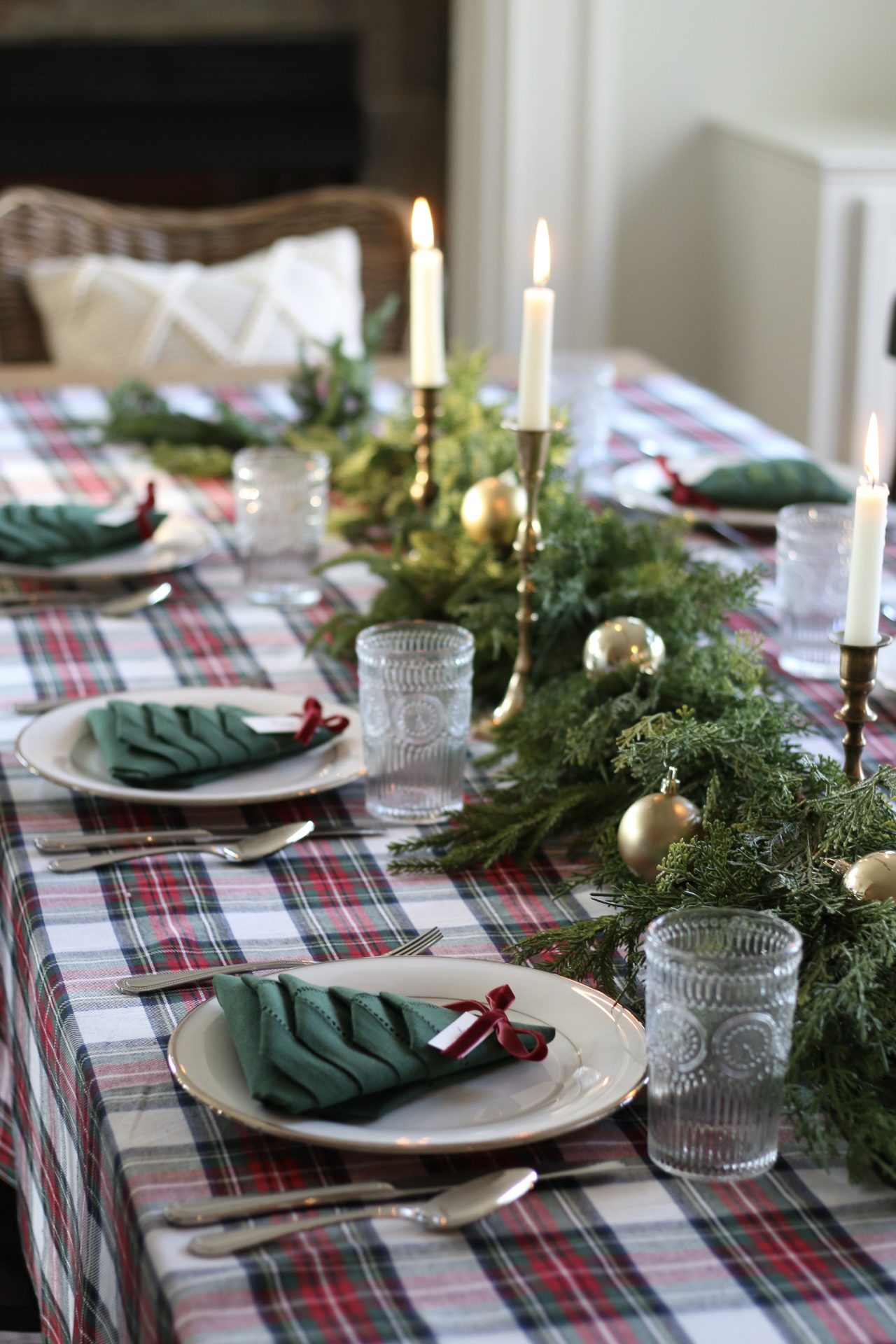
25. Tree-Shaped Napkins and Gold Balls on a Plaid Cloth
Plaid plus garland plus ornaments plus candles plus folded napkins is a lot of moves on one table. It works here only because the ornaments are all one color and one material — the moment you add two more ornament shapes it tips into clutter. Also, folded napkin trees do not survive a buffet line. If guests are serving themselves, fold them flat and set one at each plate right before you sit down. This table’s cousin is Idea #7 — same plaid-and-greens logic, different centerpiece.
- Iron the plaid cloth at least an hour before setting the table; plaid shows every crease.
- Test the napkin fold once with your actual napkins — thickness changes the whole thing.
- Count your taper holders; white tapers need matched brass for the look to hold.
- Check that the garland sits no higher than 6 inches, or guests cannot see each other.
- Iron the cloth, then lay the garland down the center and trim it to leave 10 inches of bare table at each end.
- Tuck gold ball ornaments into the greens at uneven intervals — small, medium, large, repeat.
- Set three brass candlesticks per side with white tapers, staggered in height.
- Fold each green napkin into a triangle, then roll the two outer corners inward to make a tree shape.
- Tie a red velvet ribbon around the base and set it on the plate.
Roughly 25 minutes, plus napkin practice.
26. A Slim Tree and a Pine Wreath on a White Brick Wall
- 7-foot slim pre-lit tree: $150–$400
- White and metallic ornament set: $50–$140
- 9-foot pine garland: $35–$100
- 24-inch pine wreath: $25–$70
- Jute rug, 5×8: $90–$250
- Kraft paper, twine, and ribbon for gifts: $20–$50
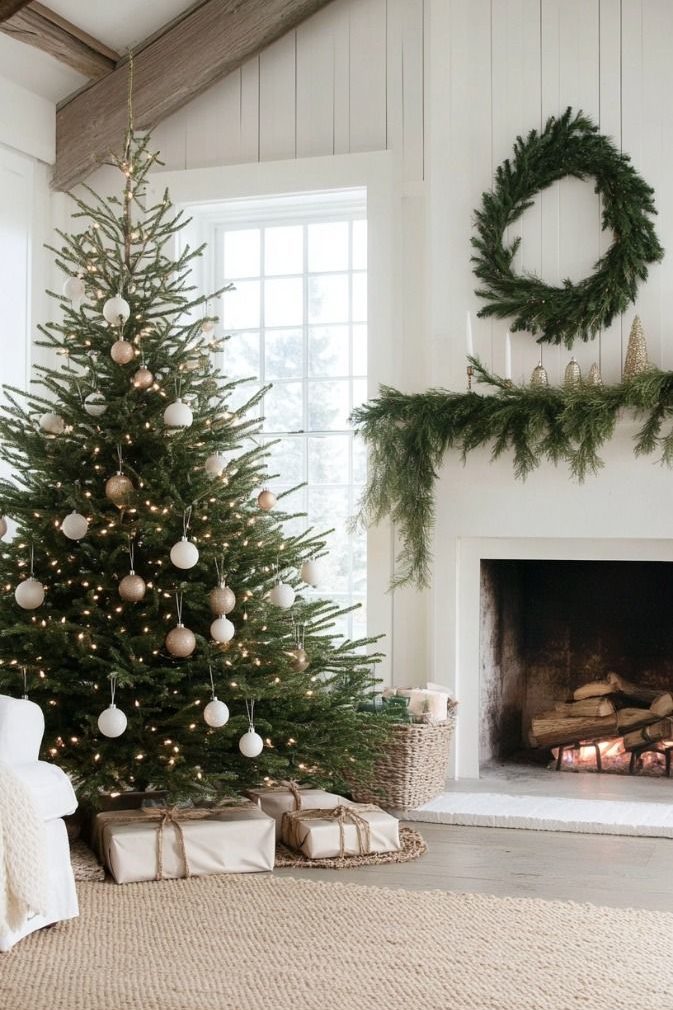
Total: $370–$1,010
Budget alternative: a $60 unlit slim tree with a $12 warm LED strand, Dollar Tree garland doubled, and thrifted ornaments. Under $120 gets you close.
Three principles are at work. First, restraint: two ornament colors only, white and metallic, so the tree reads as one texture instead of a jumble. Second, repetition — garland, wreath, and tree all speak the same green. Third, the gifts are wrapped in plain kraft and twine, which keeps a busy floor from competing with the fireplace. That is why this room looks calm even though it is fully decorated.
White decorations are unforgiving. Ornaments show fingerprints, white brick shows candle soot, and a jute rug sheds fibers for two months then traps dust in its weave forever. Vacuum weekly with a hard-floor attachment, never a beater bar. Slim trees are also top-heavy on a narrow base, so anchor it if there are kids or cats in the house.
27. A Red Front Door Wrapped Up Like a Gift
To make a door look wrapped, you need ribbon at least 4 inches wide — the 2-inch stuff disappears from the sidewalk. Run the vertical band down the center and the horizontal band one third from the top, not through the middle. Use exterior-rated velvet-look ribbon and attach it with double-sided exterior tape at four points; staples leave holes that rust. A bow with 12-inch loops reads correctly from the curb on a standard 36-inch door.
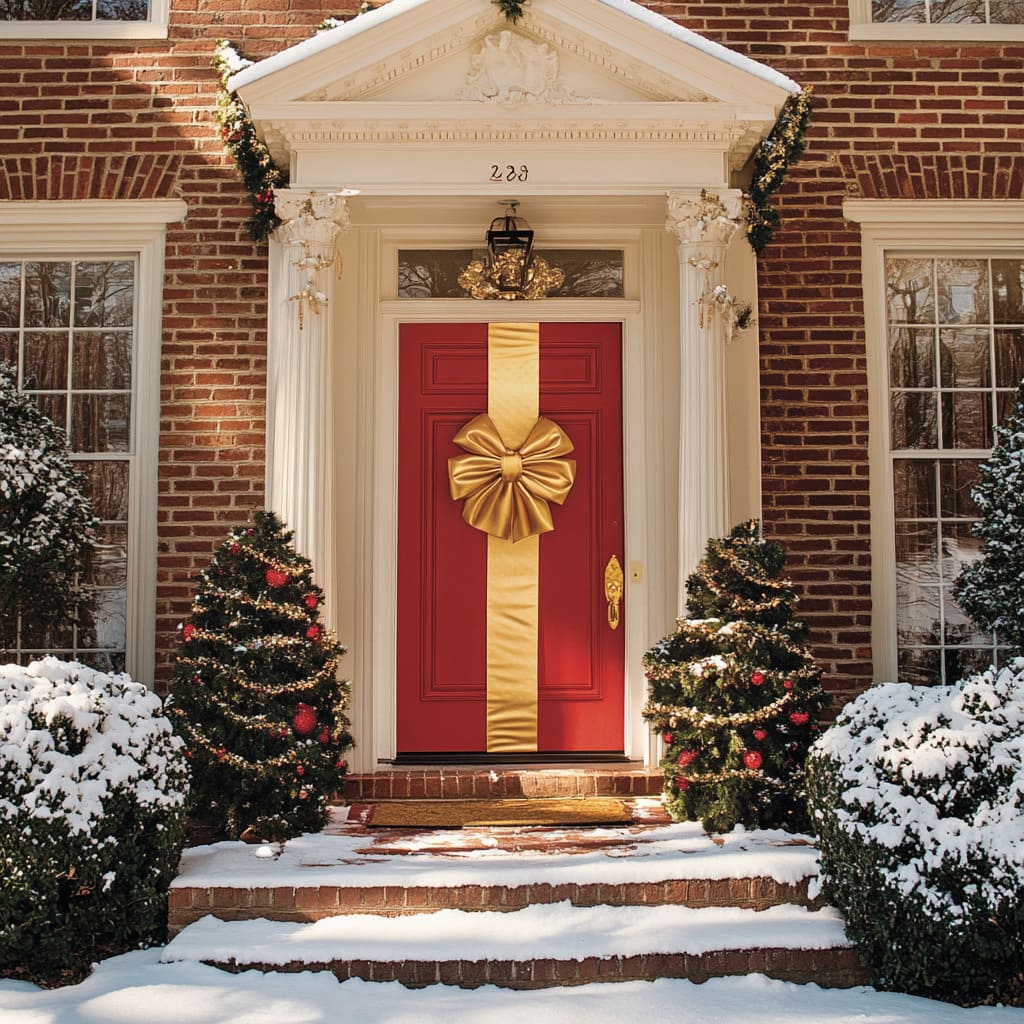
Ribbon is where the money goes — a 20-yard roll of wide outdoor ribbon runs $30–$60. Buy two 5-yard rolls instead and use them for one full wrap plus the bow. Potted evergreens can be woody nursery stock you plant in the yard in spring, which makes them a $40 purchase instead of a $120 disposable. Battery-operated lights with a timer save you an outlet headache entirely.
On a single 36-inch door, the bow should be roughly one quarter of the door’s width. With double doors or a full portico, scale up — garland across the entablature plus matching wreaths on each column, with the door kept simple. Small recessed stoops should skip the wrap entirely and use a garland plus wreath instead; there just is not enough visible surface. For a darker, more dramatic version of the same framing trick, see Idea #15.
28. Scalloped Red Chargers with a Berry and Pinecone Garland
Here it is 40 percent white (plates, napkins, cloth), 30 percent evergreen, 20 percent red through chargers, berries, and ribbons, and 10 percent gold and silver. The scalloped red charger is the boldest single element, which is why the accent plate above it is white with gold pattern rather than another red. To soften the whole table, swap the red chargers for gold and let the berries carry the red instead.
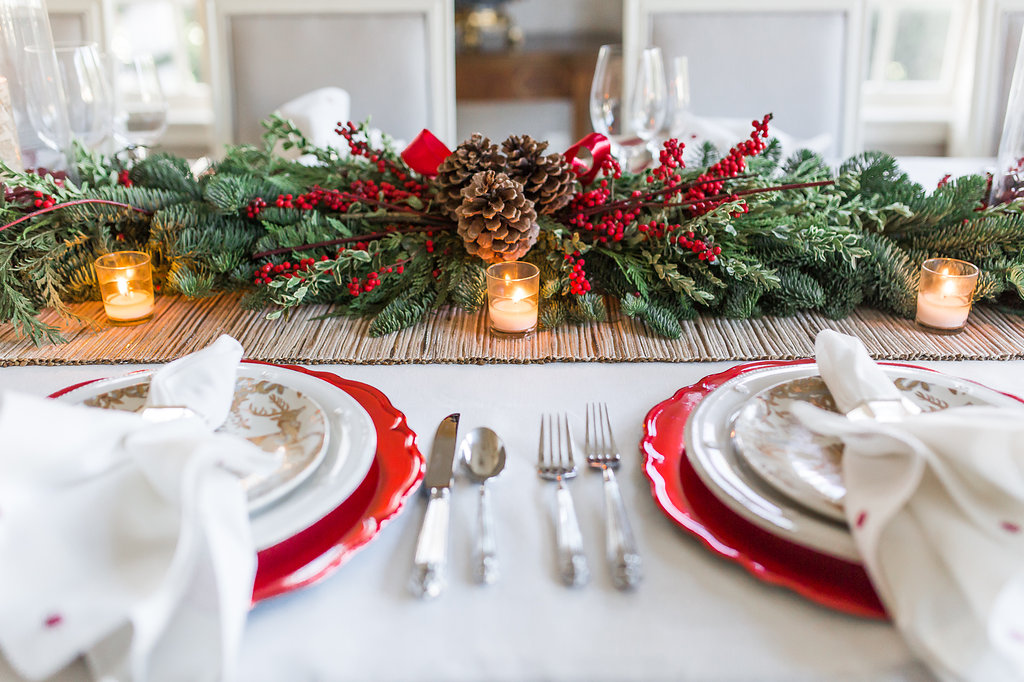
The small red ribbons tied onto the garland. They are tiny, they cost pennies, and they are the reason this centerpiece reads as decorated rather than foraged. A plain evergreen-and-berry runner is beautiful but can look like a florist’s inventory. Three-inch bows tied at irregular intervals make it feel finished and homemade at once. Buy a spool of narrow red satin and tie 15 of them while you watch something.
Red berries are deceptive. Fresh holly and winterberry drop and stain, and some varieties are toxic to pets — check before your cat decides the centerpiece is a toy. Faux berries are the safe route on a table where food is served. Votives inside a garland are also the number one way people scorch a tabletop; use glass holders with a rim and trim wicks shorter than you think is necessary.
29. Buffalo Check Bedding with a Lit Tree Beside the Bed
- Start with a solid base — white sheets and a cream coverlet — then layer the buffalo check duvet on top.
- Add toile shams behind and two holiday-text pillows in front, keeping the front pair smaller.
- Set the pre-lit tree beside the nightstand, not in front of it, so the lamp stays reachable.
- Cluster three miniature bottle brush trees on the nightstand at staggered heights: 4, 6, and 9 inches.
- Finish with a cream throw at the foot of the bed to break up the pattern.
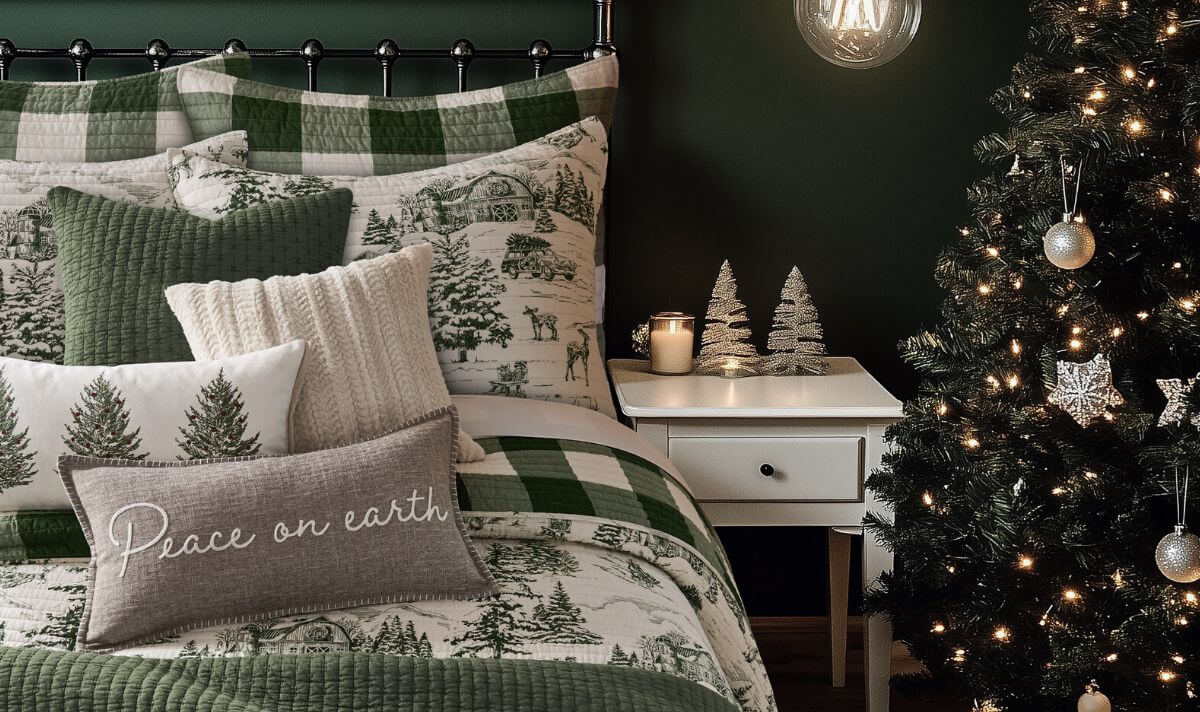
About an hour, mostly rearranging what you own.
Mixing buffalo check with toile is a distinctly 2026 move — it is the inherited-house aesthetic that has replaced matched bedding sets on Pinterest. Two traditional patterns in the same color family read as collected over time rather than bought at once. It also solves a practical problem: buffalo check alone can look like a rustic cabin, and toile softens it into something more grown-up.
Pattern-on-pattern works when the scales differ — buffalo check is large and bold, toile is small and detailed, so they never compete. Keep both in the same color family, here green and white, and add one solid so your eye has somewhere to land. Three patterns at the same scale is the fastest way to make a bed look chaotic. Two patterns plus one solid is the rule.
30. A Chandelier Wrapped in Pine and Brass Stars
The chandelier. Everything else on this table is beautiful but expected — ikat cloth, topiaries, poinsettia. The moment you wrap the light fixture in evergreen, the whole room gains a ceiling, if that makes sense. It also fixes a real problem: chandeliers above holiday tables are usually the least decorated thing in the room. Attach with floral wire, never tape, and keep greens at least 6 inches from any bulb.
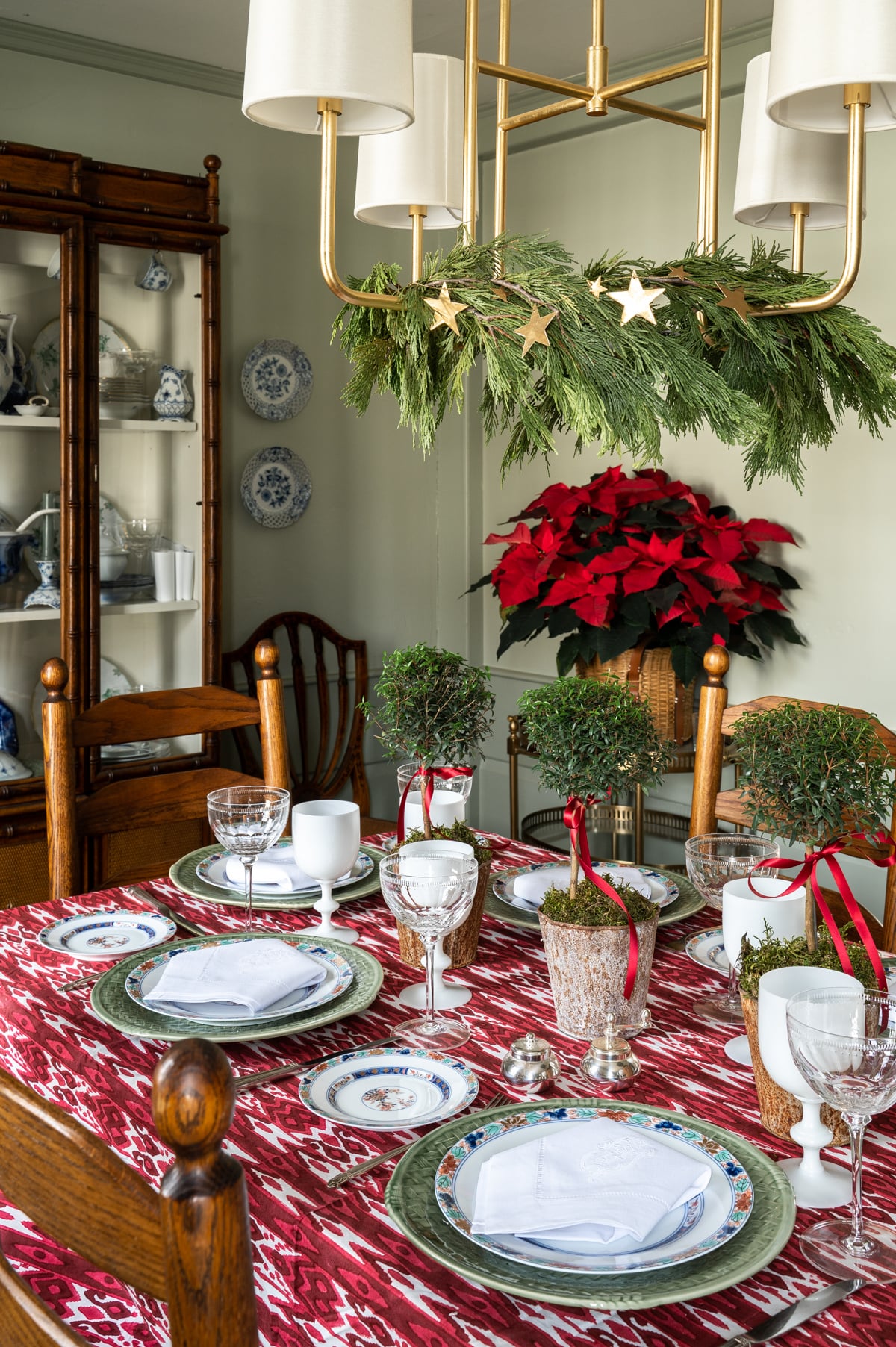
About 35 percent red and white (ikat cloth, poinsettia), 30 percent warm brass and wood, 20 percent sage and pine, 10 percent blue from the patterned plates, 5 percent red ribbon ties. The blue plates are the surprise keeping this from feeling like a theme park — a small dose of an unexpected color works when everything around it is classic. Swap blue for lavender or soft grey and the formula holds.
Topiaries: two small boxwoods at $12 each from a garden center, set in thrifted baskets. The ikat tablecloth — check HomeGoods or a fabric remnant store; the pattern is popular enough to turn up for $20. Brass stars run $4 for a dozen online. If a real poinsettia feels risky, a $25 woven basket with a red amaryllis bulb gives you the same corner presence for less.
Your Classic Christmas, Room by Room
Thirty ideas, one throughline: classic Christmas decor works when you commit to a palette and then let real greenery do the talking. Start with a single room — the table or the mantel — and let it set the rules for everything else in the house. Pin the ones you want to try this year, and tag us when you do. 📌