
You know that feeling when you finally find the Christmas tree photo that looks exactly right for your room — and then realize it’s from a house with twelve-foot ceilings and a fireplace you don’t have?
We spent serious time browsing Target, Etsy, and Anthropologie to bring you only what’s worth your attention this year, and everything here spans from about $12 for a jute-twine ornament to roughly $2,400 for a full flocked nine-footer with lights already wired in.
Inside you’ll find 30 curated ideas covering classic traditional, flocked winter white, rustic natural, and colorful whimsical styles, with budget and luxury versions compared side by side and every idea shoppable with direct product links.
What’s driving it in 2026: flocked trees finally outsold plain green in several major retailers’ holiday departments, and the textile tree — scarves, chunky knits, ribbon instead of baubles — is the fastest-growing save category we’ve tracked on Pinterest.
And stay until the end — we break down the most common mistakes that can ruin these looks.
📌 Save this to Pinterest for later — you’ll want to revisit these ideas.
1. A Lit Tree Against Deep Forest Green Walls
Dark green walls behind a green tree shouldn’t work — until you notice the trick. The tree is the brightest object in the room, so the walls visually recede and the glow takes over. That teal armchair is doing quiet heavy lifting: it sits close enough in value to the forest green that the pair reads as one continuous cool tone, which is exactly why the gold and silver ornaments pop instead of compete. There’s no busy pattern on the walls, and the ornate rug stays on the floor where your eye never fights it.
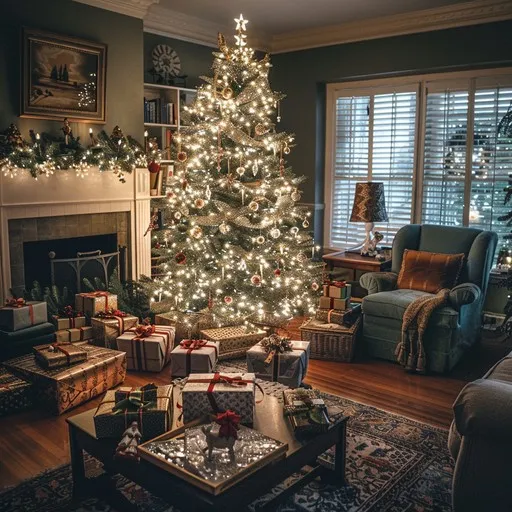
This look needs breathing room. Plan on at least a 12 x 14 foot living room with 9-foot ceilings so a seven-and-a-half-foot tree, a fireplace, and a chair can coexist without the room feeling stuffed. Smaller apartment living rooms should skip the extra chair and try the single-seat corner in Idea #17, which is built around one armchair instead of a full seating group. Ceiling height matters more than square footage here — leave at least 12 inches above the topper.
2. Red Bows, a Roaring Fire, and Skiing Penguins
The penguins. Mid-banister on the staircase garland, a small herd of skiing penguin figures is the reason this house feels lived-in rather than styled. Take them away and you still have a gorgeous red and gold Christmas — you just lose the joke. That’s the lesson worth stealing: one odd, personal, slightly silly element carries more warmth than another $200 of matching ornaments ever will.
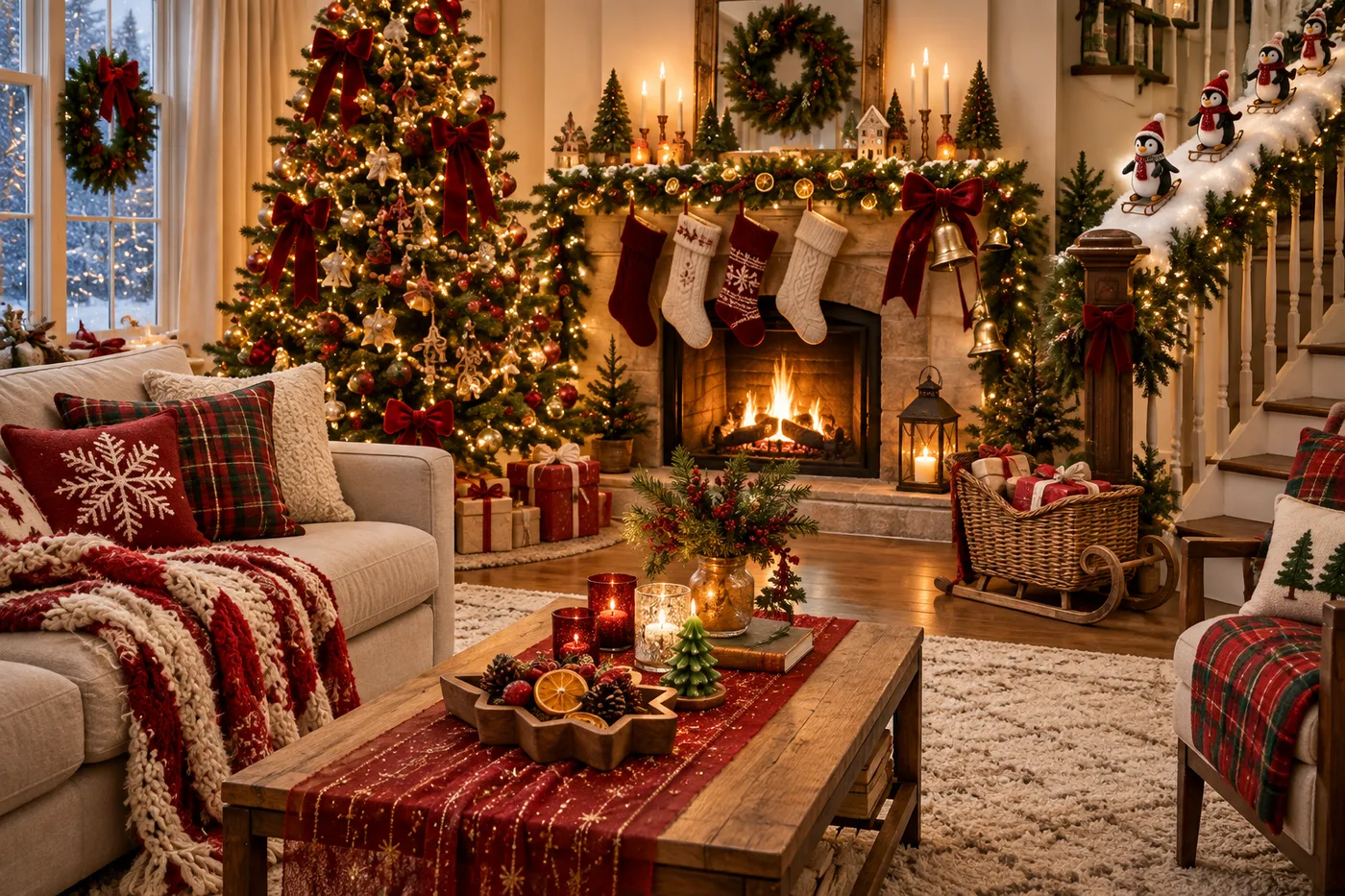
- Tree with warm string lights: $250–$700
- Red bows and gold ornaments: $80–$220
- Plaid and snowflake pillows: $60–$180
- Mantel garland, stockings, candles: $90–$250
- Stair garland and figures: $70–$200
- Wrapping paper, ribbon, sled: $50–$150
Budget alternative: buy the tree and sled secondhand in early November, use dollar-store ribbon, and one mixed bag of shatterproof ornaments instead of four sets. Realistic total: $280–$620.
3. When the Tree Goes in Front of the Big Window
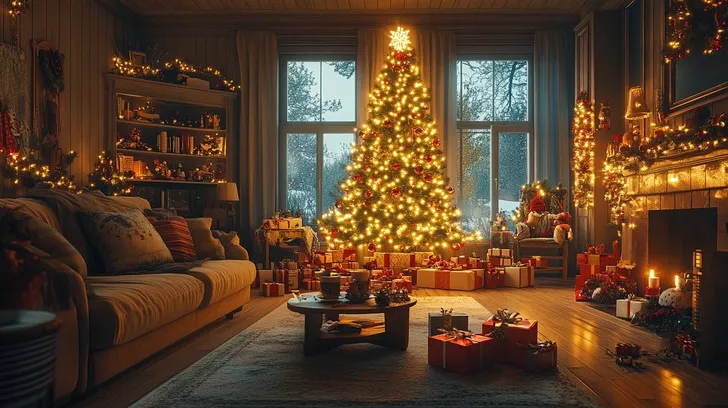
A backlit tree only reads as glowing if the room stays dimmer than the tree. Keep every bulb in the room at 2700K or warmer, and don’t put a floor lamp brighter than the tree within six feet of it — otherwise the tree flattens into a silhouette. A $15 plug-in dimmer on the lamp nearest the sofa is genuinely the best money you’ll spend on this setup.
- Measure the window width and decide how many panes you’re willing to cover — ideally one stays usable
- Confirm an outlet is in cord reach, or plan a flat extension cord under a rug
- Check the window’s orientation; south-facing glass means faded ornaments by mid-January
- Choose the skirt or collar first so you know what height tree base you’re hiding
Window-front trees want a room at least 14 feet wide so you can walk past on both sides. In a tighter footprint, the built-in styling in Idea #30 keeps the floor clear while still reading festive from the doorway. If your window wall is under 10 feet, a slender six-footer beats a full seven-footer every time.
4. A Cluster of Small Trees and Glowing Mushrooms
This room runs on roughly 60 percent warm white glow, 25 percent saturated multicolor, and 15 percent pure whimsy. The glow comes from the pre-lit trees and the orb lights pooled across the hearth; the multicolor lives entirely in the round ornaments; the whimsy is everything else — the woven star wreath, the fabric swags, the little mushrooms. Swap the multicolor for all-white and the nursery-rhyme energy vanishes. Swap the mushrooms for brass candlesticks and it turns traditional in one afternoon.
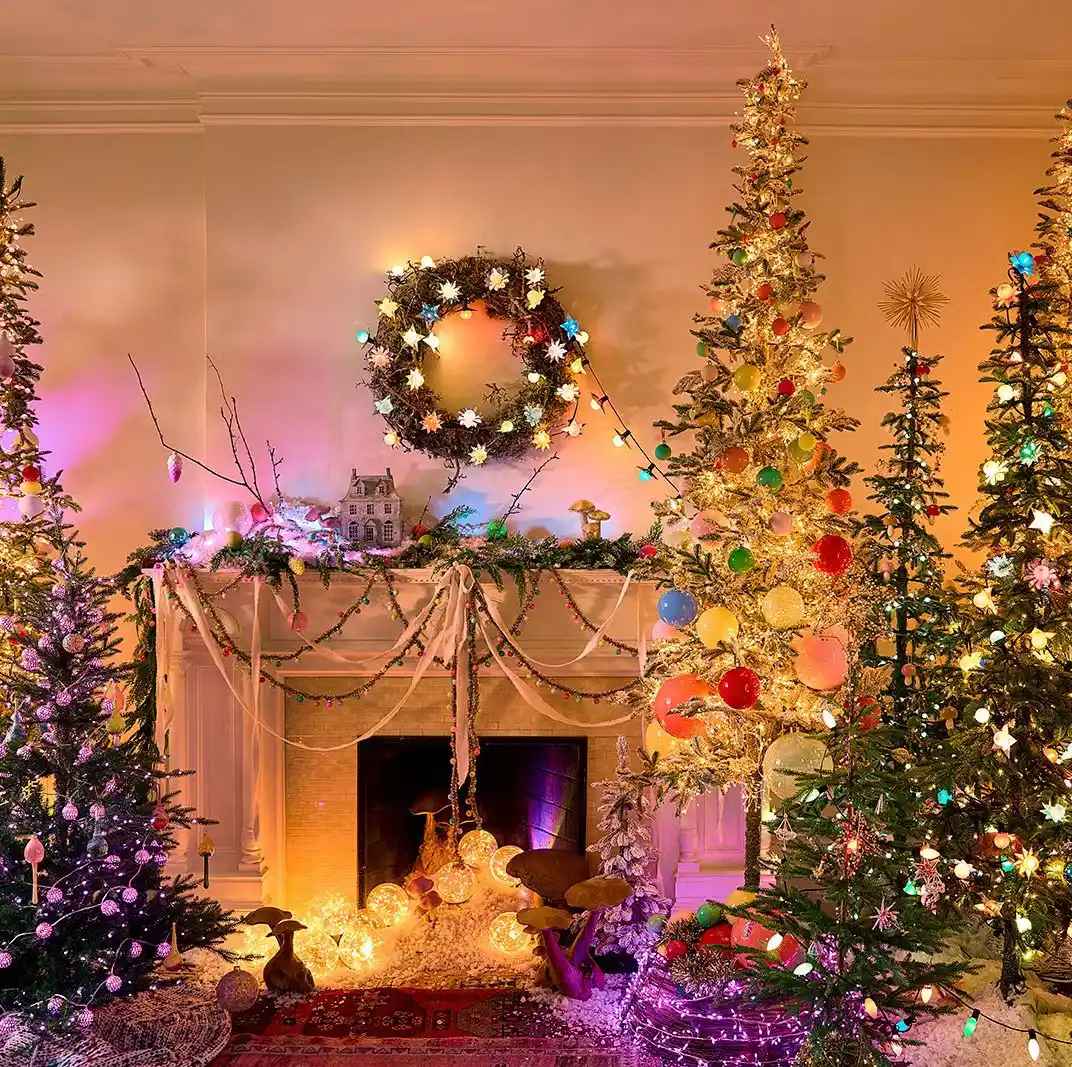
Whimsy is the story of the 2026 season. After a decade of beige Scandinavian minimalism, searches for mushroom ornaments, tiny disco balls, and paper star lanterns have climbed steadily since 2023 — and the mood driving it is simple. People want rooms that make guests laugh when they walk in, not rooms that photograph perfectly and feel stiff.
The mismatched heights are the quiet genius here. Three trees at roughly four, five, and six feet, clustered rather than lined up in a row, do something a single tall tree cannot — they create a horizon. Your eye travels up and down instead of just up. Straighten them into a symmetrical row and the entire effect evaporates.
5. Twin Trees Framing an Ornate White Mantel
Symmetry is the whole story. Two matching trees framing an ornate white mantel create a stage, and the cane-back bench becomes the audience seat. Because the trees mirror each other, your eye lands in the center — on the artwork, the garland, the stockings — instead of drifting to one corner. The red velvet stockings and pillows repeat exactly one color, which keeps the composition calm despite all that ornamentation.
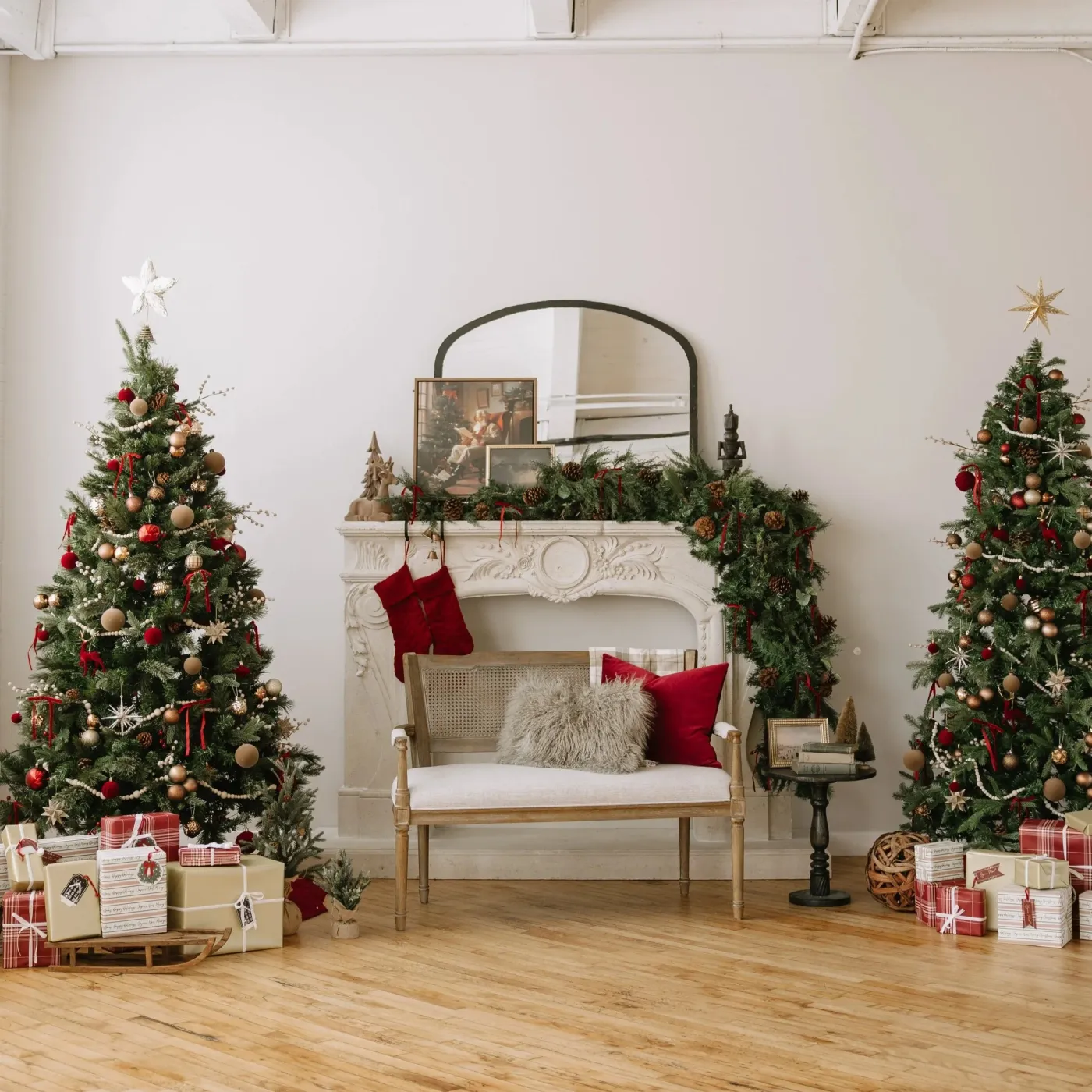
- Two 6-foot lit trees: $300–$800
- Red, gold, and white ornaments for both: $120–$300
- Cane-back bench or similar: $180–$600
- Mantel garland with pinecones: $80–$200
- Velvet stockings and pillows: $70–$190
- Wrapping paper and ribbon: $40–$110
Budget alternative: one tree plus a tall potted evergreen topiary, and thrifted ornaments by the bag. Total: $340–$780. If two trees feel like too much commitment, the looser mantel styling in Idea #29 gets a similar effect with one less tree.
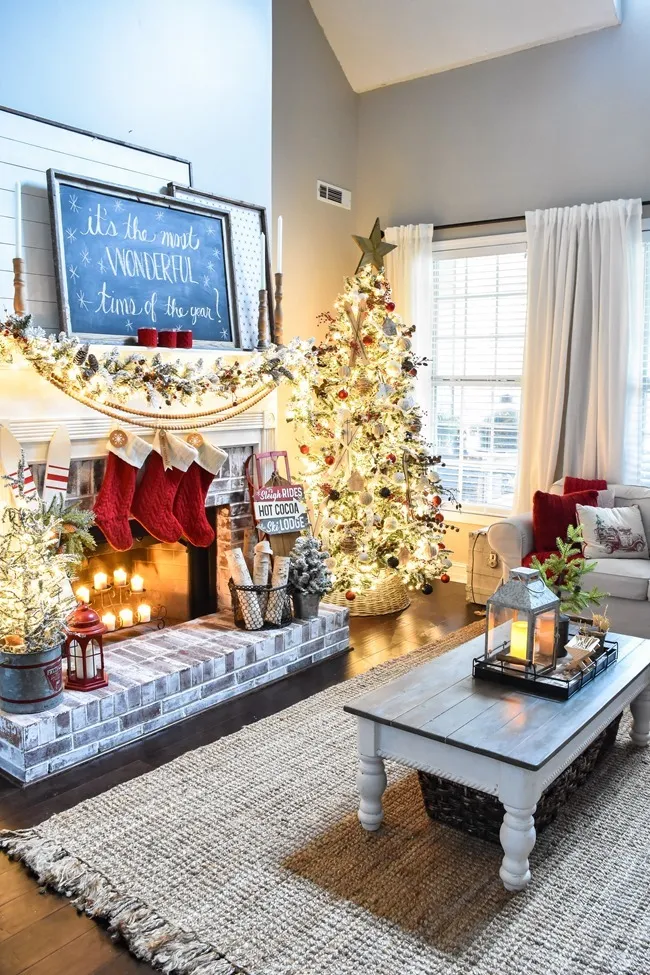
6. Whitewashed Brick, Red Knit Stockings, Jute Underfoot
Frosting a plain garland takes about 30 minutes and under $20.
- Lay a plain 9-foot faux pine garland flat on an old sheet
- Mist it lightly with spray adhesive in a ventilated room
- Sift artificial snow or fine mica powder over it from 12 inches up
- Shake off the excess outside, then let it cure for two hours
- Weave in warm LED string lights last, not first
Whitewashed brick and a working fireplace are a trickier pairing than they look. Even with a proper chimney draft, smoke carries fine soot, and whitewashed mortar grabs it. If you actually burn wood, keep the fire small and the screen closed, and wipe the surrounding brick with a dry microfiber cloth weekly. Plenty of people in this exact setup switch to gas logs and never look back.
Jute rugs shed, and faux snow sheds harder. Together they mean more vacuuming than you’re used to — plan on once a week with a bare-floor attachment rather than a beater bar, which will fray jute edges. Frosted garlands also drop a fine dust on everything below them for the first two weeks. A flatweave wool rug in a similar oatmeal tone gives you the same rustic warmth with far less upkeep.
7. A Loft Tree Glowing Against the City Skyline
The exposed brick. Everything warm in this loft — the fire, the gold and red ornaments, the candle glow, the stacked logs by the hearth — is amplified by a wall that is already warm-toned and textured. On a flat white wall the same tree would look half as rich. If you rent, a single peel-and-stick brick panel behind the tree gets you 70 percent of the effect for about $60.
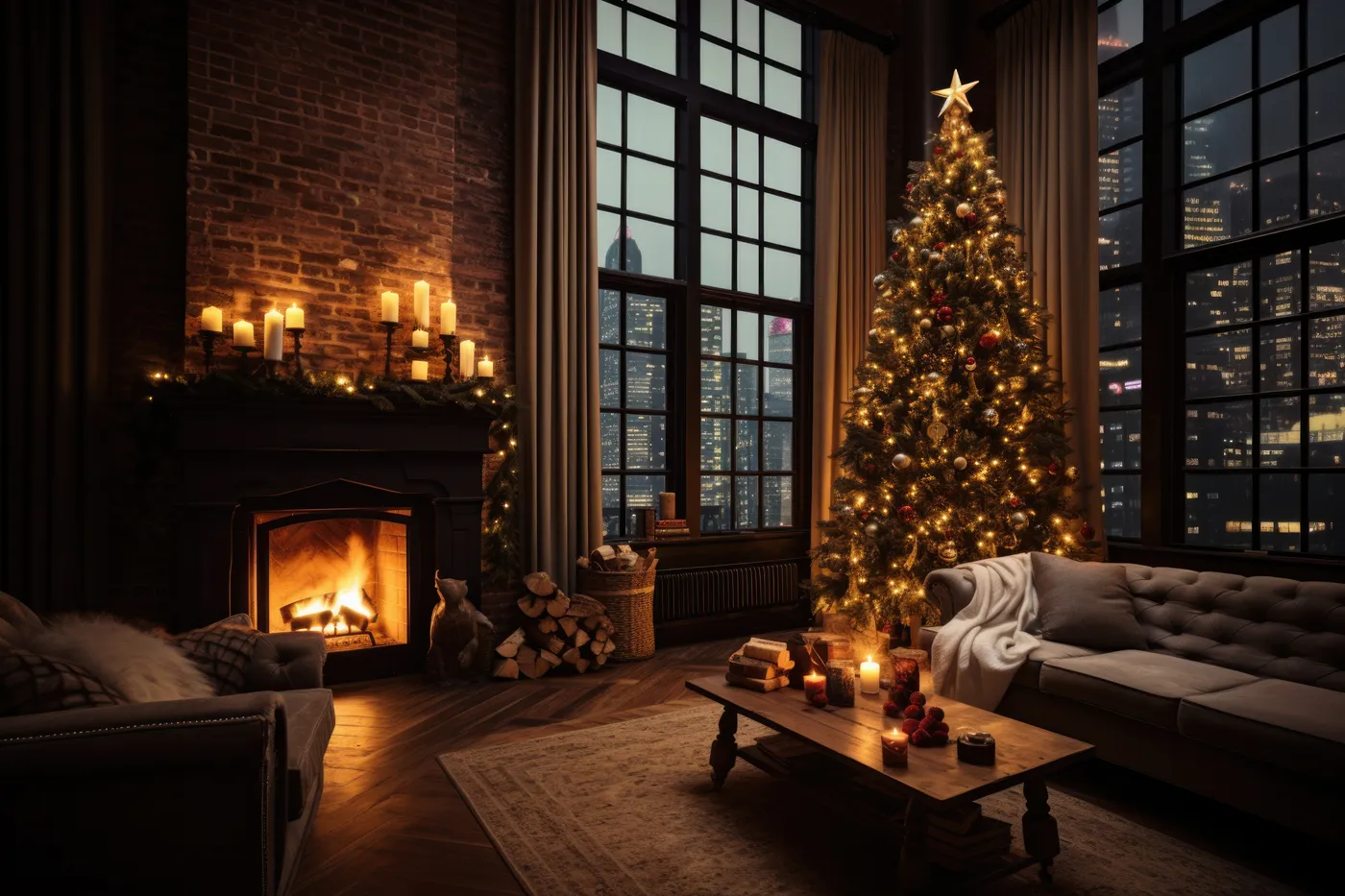
In a room with big grid windows, pull the tree about 18 inches off the glass. Closer than that and at night you get a doubled, smeared reflection of every light; farther and you lose the skyline backdrop entirely. Skip cool-white bulbs here too — against city glow, a blue-white tree looks oddly clinical rather than cozy.
8. Flocked Branches on a Matte Navy Wall
Roughly 55 percent matte navy wall, 30 percent flocked white, 15 percent brass and gold. The matte finish is non-negotiable — satin or eggshell navy throws a sheen that competes with the tree lights and makes the whole corner look plastic. The woven basket collar and the antique brass sconces sit in that last 15 percent, and they’re what keep the pairing from feeling chilly.
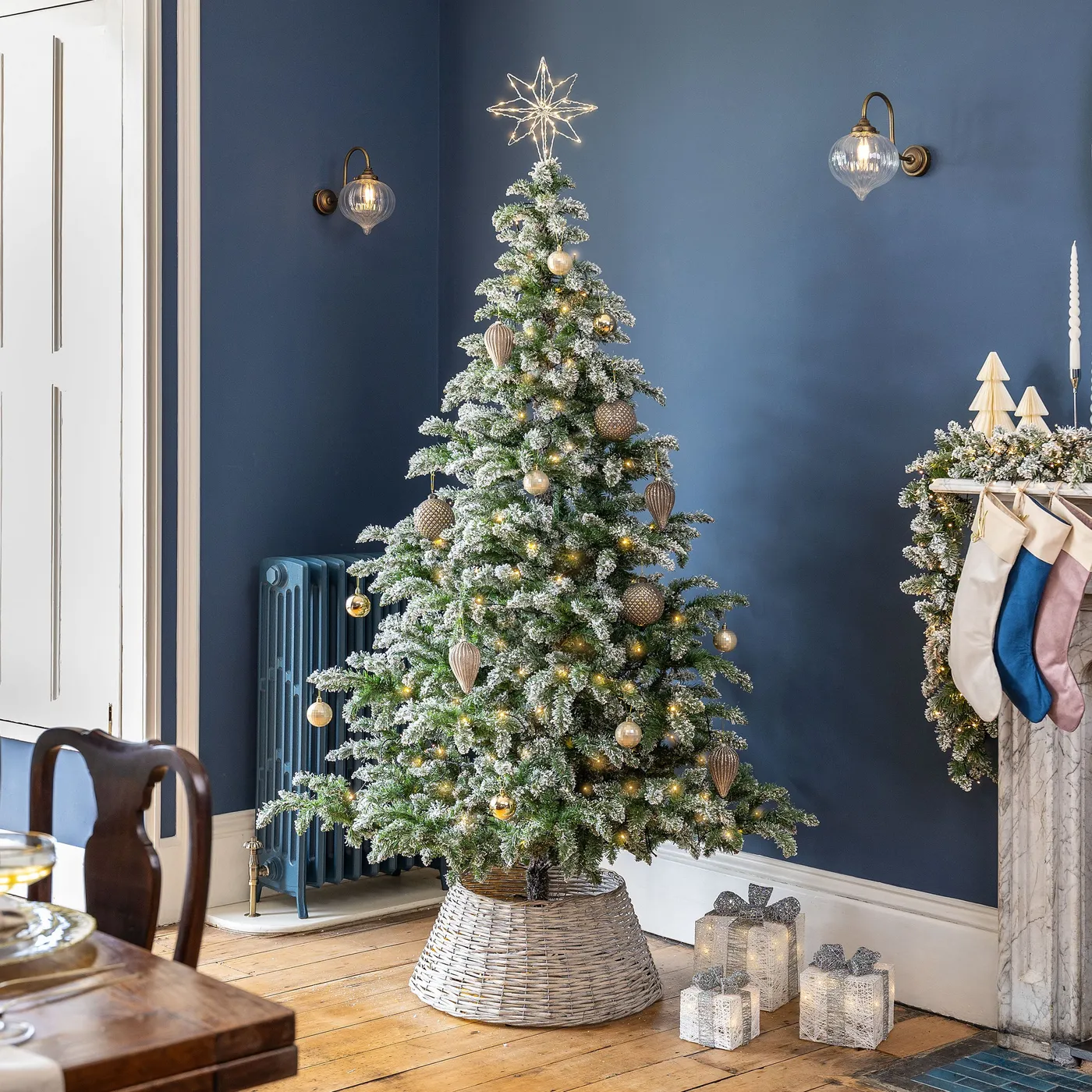
Deep matte walls absorb light, which makes the lit tree read like a lamp rather than furniture. Flocked branches add a second bounce layer, throwing the warm glow back into the room. And that teal cast iron radiator is an accidental gift: it repeats the cool family without matching the navy exactly, so the corner has depth instead of one flat color.
Navy plus flocked green has become a defining 2026 pairing for concrete reasons.
- Flocked trees finally outsold plain green in several major retailers’ holiday departments
- Deep saturated paint colors replaced white walls in rental-friendly makeovers
- Brass and gold accents photograph beautifully against dark matte finishes for Pinterest
None of those three forces is going anywhere in 2027.
9. Red Bows, a Diamond Window, and Golden-Yellow Walls
Flocking is essentially a glue-and-fiber coating, and it sheds. Expect a fine white dust on the floor and furniture below for the first two or three weeks, then again every time you move a branch. A handheld vacuum on low, twice a week through December, keeps it manageable. Packing the tree loosely in a breathable tree bag instead of squashing it into a box cuts next year’s shedding in half.
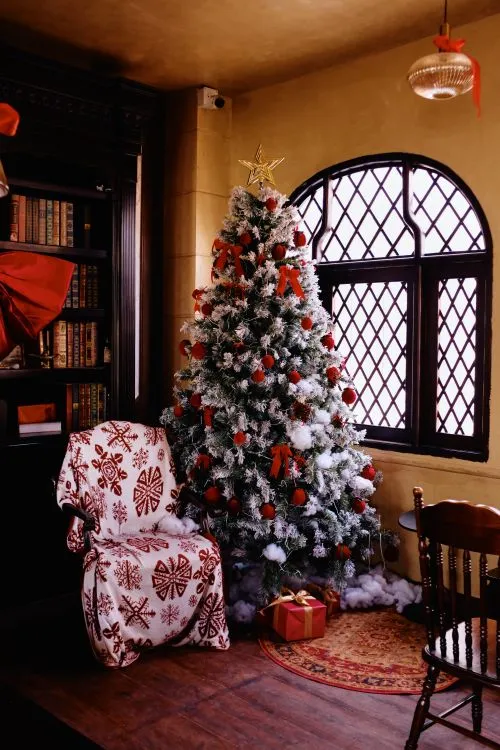
Those red bows are doing more work than the ornaments. Use four-inch wired velvet ribbon cut into 14-inch strips, fold each into a simple loop, and twist the wire tails together — no glue and no bow-tying skill required. Four rolls covers a seven-foot tree, and because the ribbon is wired, the bows hold their shape through January storage.
10. Rose Gold Ornaments and a Chunky Cream Throw
This is a corner vignette rather than a room-defining display, so it fits places a large tree never will. Budget on roughly an 8 x 8 foot footprint: the tree, one armchair angled toward it, and a small stool or bench within arm’s reach. An 8-foot ceiling comfortably handles a 6.5-foot flocked tree plus the collar underneath, with the topper clearing by a foot.
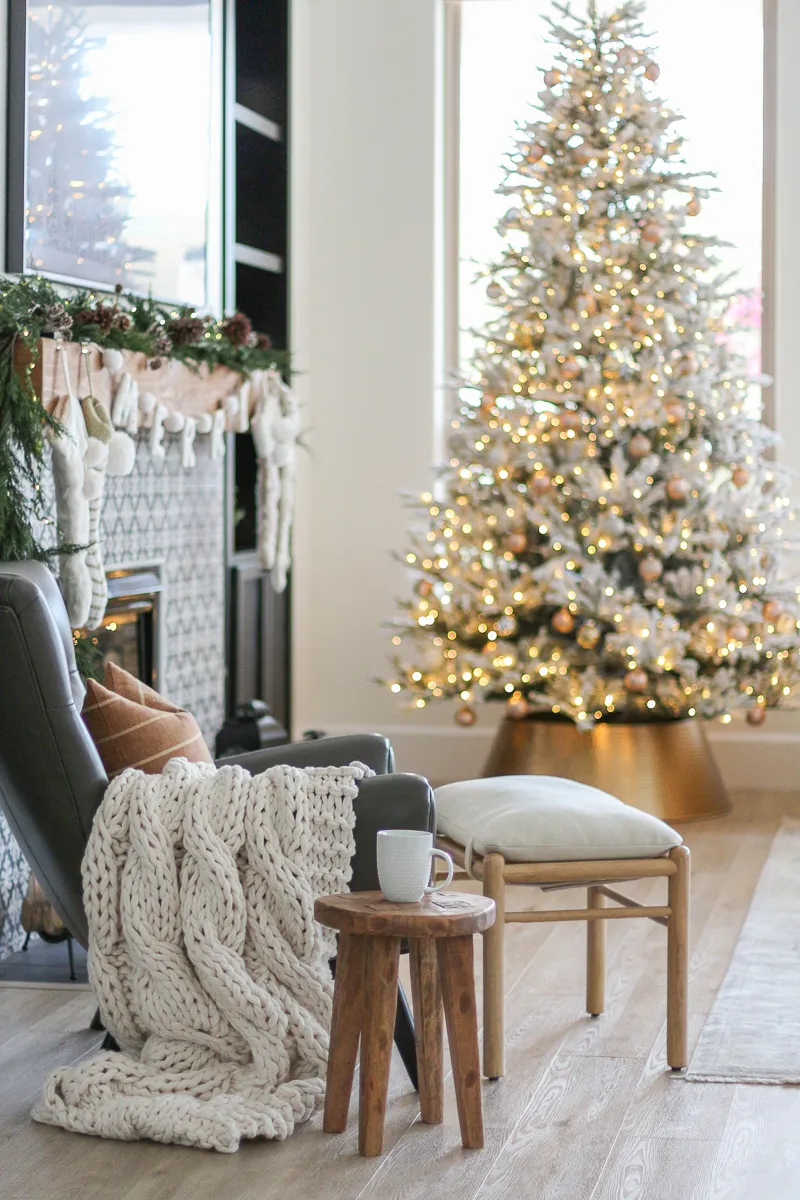
The look survives a budget because nothing here depends on brand names. A flocked 6.5-foot tree from Walmart runs $90–$130 in early November. Rose gold ornament sets at Target are $12–$18 for twelve. A woven basket collar can be a $25 laundry hamper with the handles snipped off. Facebook Marketplace is where the chunky knit throw happens — $20–$35, often still tagged.
Turning a plain woven basket into a tree collar takes about 20 minutes and $25.
- Choose a basket roughly 4 inches wider than your tree stand
- Cut the handles off flush with a utility knife
- Flip it upside down so the wider rim sits on the floor
- Trim the bottom out if the stand won’t clear, then sand the edge
- Set the stand inside and hide the cord behind the basket wall
11. Flocked Close-Up: White, Champagne, and One Grey Note
The grey. Three or four dark charcoal spheres tucked among all that white and champagne is the detail that saves this tree from being a bland white blur. Take them out and it’s pretty but flat. That tiny percentage of dark gives the eye somewhere to rest and makes the heavy flocking look intentional instead of unfinished.
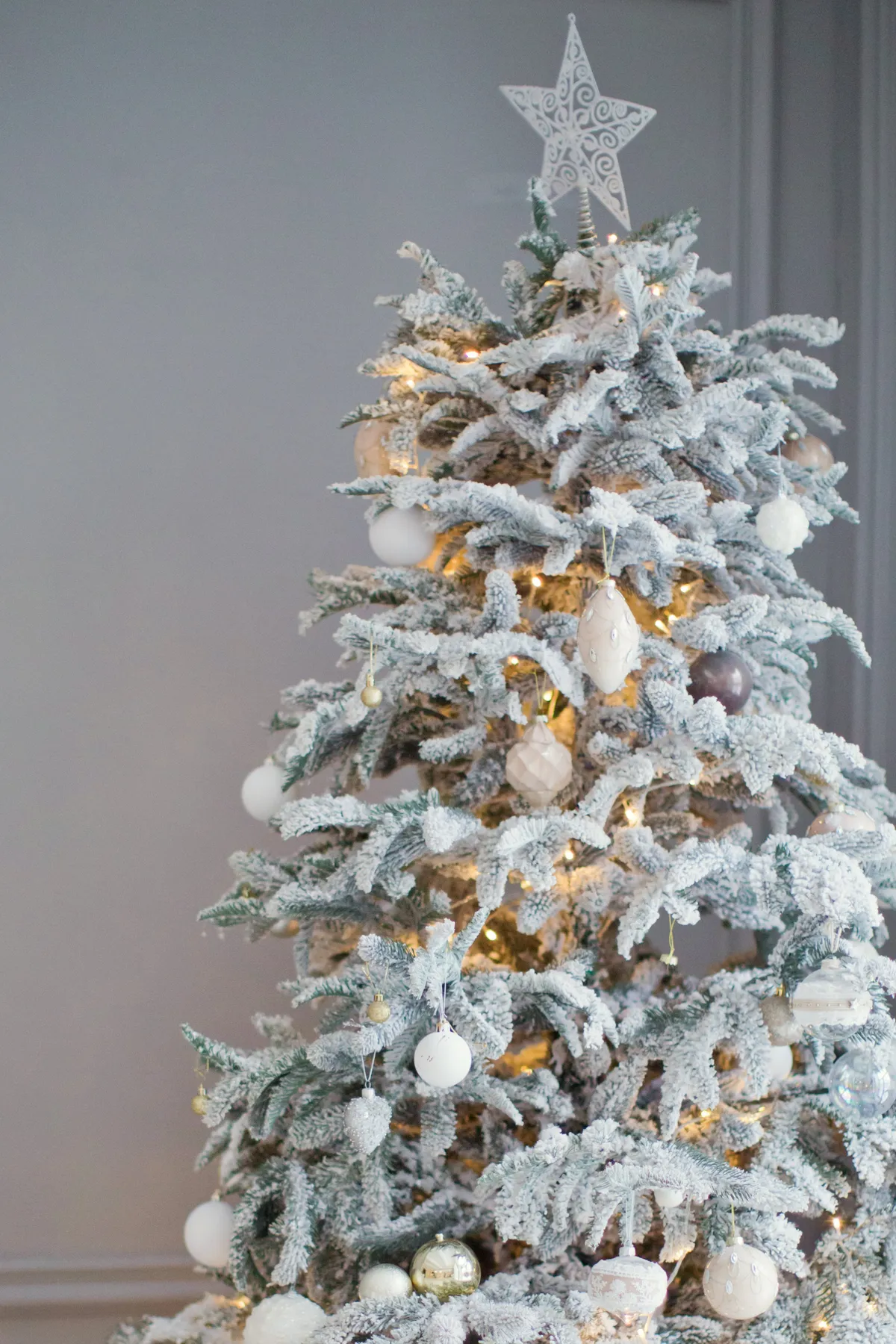
About 70 percent flocked white, 20 percent champagne and gold, 10 percent charcoal grey — and the grey is non-negotiable. Swap the charcoal for more silver and the tree goes icy and cold; swap it for red and you’ve lost the quiet entirely. The white filigree star topper sits inside that white 70 percent, which is why it reads as sculpture rather than decoration.
12. The Undecorated Tree Is a Real Look
Here’s the good news about this room: the tree is completely bare and it still works. That means your budget goes to paper, not ornaments. A roll of kraft paper is $8, jute twine is $4, and a spool of deep burgundy velvet ribbon is $12 — under $25 total for a tree’s worth of gifts that look deliberate. Thrift stores and Buy Nothing groups are goldmines for velvet ribbon in January.
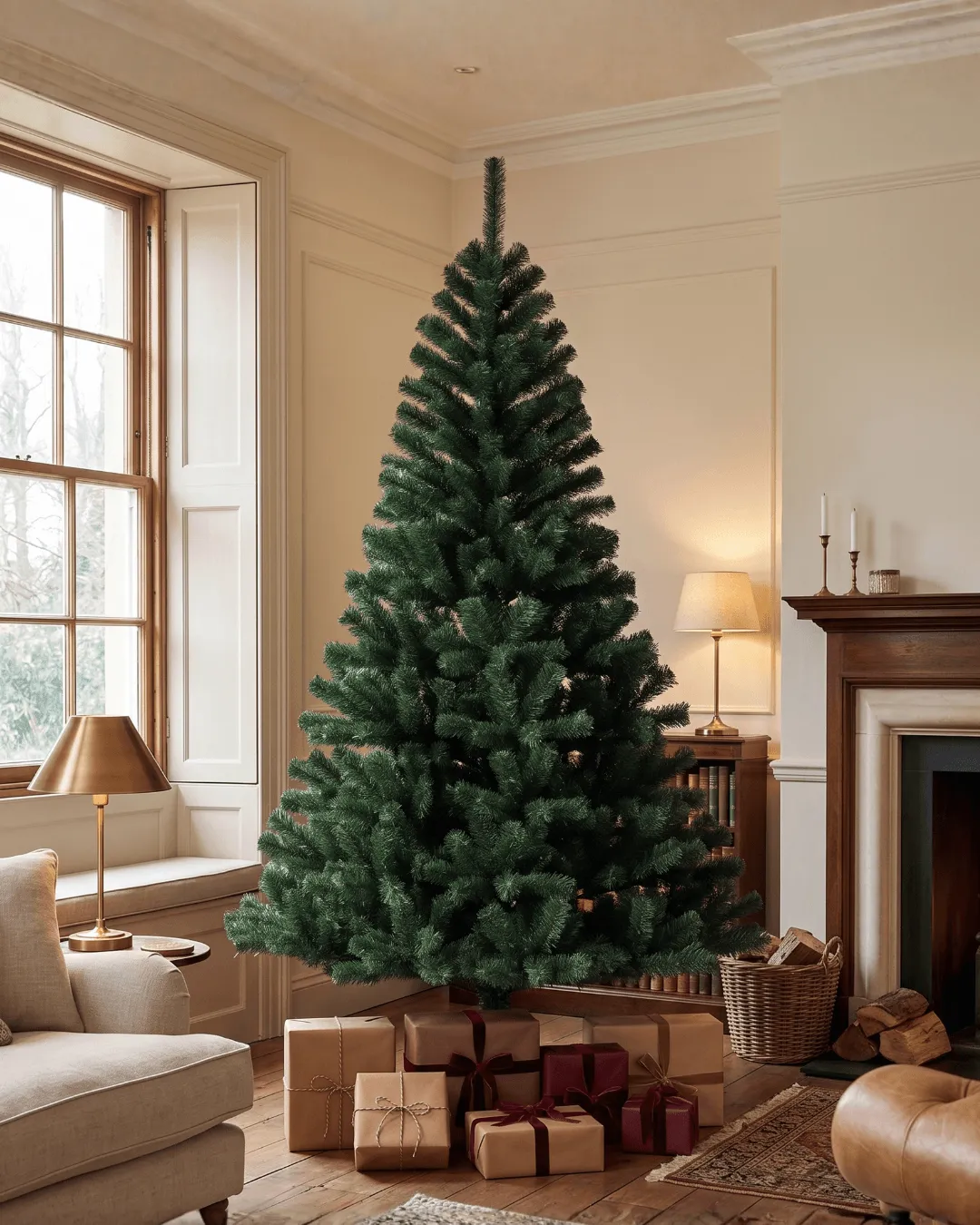
Kraft paper that looks styled instead of sloppy comes down to three habits.
- Cut paper against the roll’s edge as your straight line, not freehand scissors
- Fold the long seam first, crease hard with a fingernail, then tape
- Wrap twine four times around the box, crossing underneath
- Tuck a single fresh sprig or dried orange slice under the twine
- Skip tags — write names directly on the paper in black marker
13. Stockings Hung Straight on the Wall, No Mantel Required
- Check the wall: drywall anchors hold stockings, adhesive hooks usually don’t once they’re full
- Weigh a loaded stocking — most run two to three pounds, so plan for four
- Find the nearest outlet; most stockings are decorative, but light-up ones need power
- Keep them at least three feet from any heat source, including a radiator
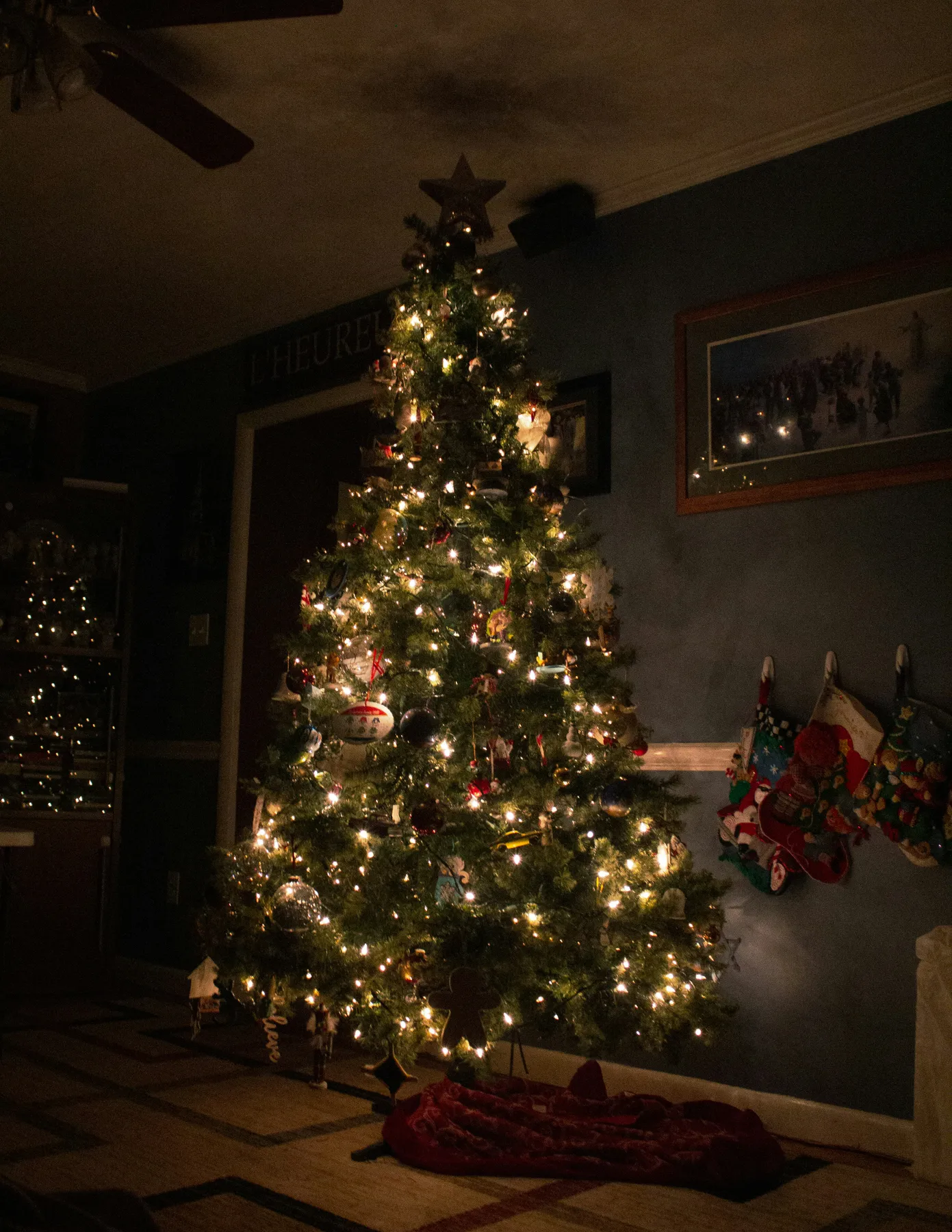
Wall-hung stockings are a charming solve for a mantel-less room, but they fail in one predictable way: weight. A stocking stuffed with an orange, a paperback, and a few small gifts will peel a cheap adhesive hook right off the paint by Christmas morning. Use a picture-hanging hook rated for five pounds, hang from the top loop rather than the cuff, and avoid doorways where people brush past.
This works in almost any room — a 10 x 10 bedroom or a narrow apartment wall is plenty. You need a clear stretch of wall roughly 30 inches wide for four stockings spaced six inches apart, plus the tree beside it. Because this tree is artificial and pre-lit, it can sit closer to a wall than a real one, which is what makes tight rooms possible.
14. Ribbon, Sparklers, and a Family Pile-In
The unposed family shot has overtaken the perfectly styled tree photo on Pinterest for two seasons running. People are saving images with real people, real slippers, and slightly crooked ribbon. Sparklers in particular became the go-to because they light a face beautifully without a flash, and they make everyone in the frame look like they’re genuinely having fun.

Wide patterned ribbon reads better than narrow at any distance. Cut 2.5-inch ribbon into 12-inch strips, pinch the middle, twist once, and wire the tails to a branch — that’s a finished bow in about eight seconds. Four rolls of 10-yard ribbon covers a generous seven-and-a-half-foot tree without looking sparse.
15. The Red-on-Charcoal Punch That Reads Across the Room
Saturated red against a deep charcoal ground is pure chroma contrast: the red has nothing competing with it, so it registers from across the room even in low light. That’s why the strongest holiday color move in a dark room is one bright accent and nothing else fighting for attention. Keep the other ninety percent quiet — charcoal, black, warm white — and let the red do all the talking.
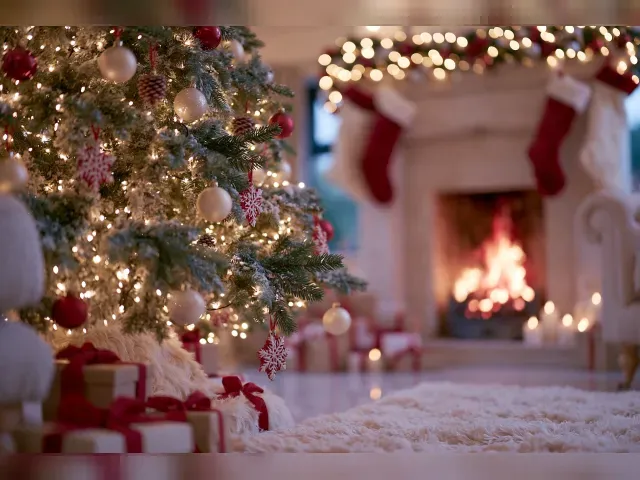
Dark walls are a real commitment in December, when daylight is scarce. A charcoal room that looks moody at 8 p.m. can look gloomy at 2 p.m., so plan on layered warm lighting and at least one lamp that stays on all day. Before you commit, check three things:
- Does the room get direct afternoon light from any window?
- Can you add a dimmer to the main fixture?
- Is the paint finish matte rather than satin or gloss?
Compare with the light blue wall in Idea #21, where the same red reads festive instead of dramatic.
16. The Scarf Tree: Textiles Instead of Ornaments
Decorating a tree with scarves instead of ornaments takes about an hour.
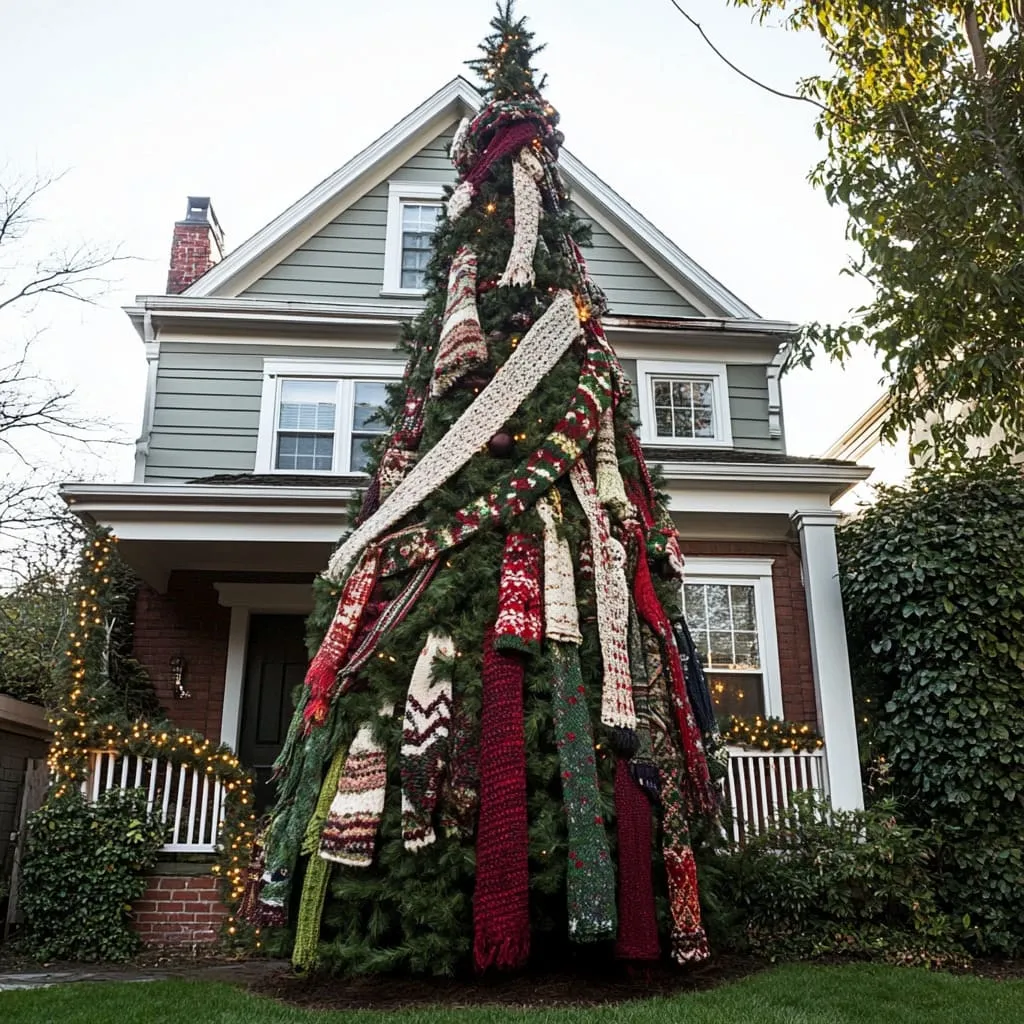
- Gather 10–14 knit scarves in red, cream, and green; thrift stores sell them for $2–$4
- Start at the bottom, folding each scarf in half and draping the loop over a branch
- Pull the tails through the loop and tighten gently so it hangs vertically
- Work upward, spacing roughly eight inches apart and rotating the tree as you go
- Weave warm white string lights through last so they peek between the fabric
- Thrifted knit scarves (12): $24–$50
- Warm white string lights: $20–$45
- Plain artificial tree: $80–$250
- Outdoor-rated extension cord: $15–$35
- Timer plug: $10–$20
If you’re borrowing this for an entry tree indoors, dial the count back — a porch tree can carry twenty scarves because you see it from thirty feet away. An indoor tree seen from six feet needs ten to fourteen, hung from the bottom third up to about eye level.
17. A White Tree, a Woven Basket, and a Mug on the Side Table
The side table. A small white table with a mug and a closed book beside the tree is what tells you this corner gets used, not just decorated. Without it, the armchair and blanket read as staging. With it, you can picture yourself there on a weeknight with the tree on and nothing else. That’s a $0 detail with more impact than any ornament.
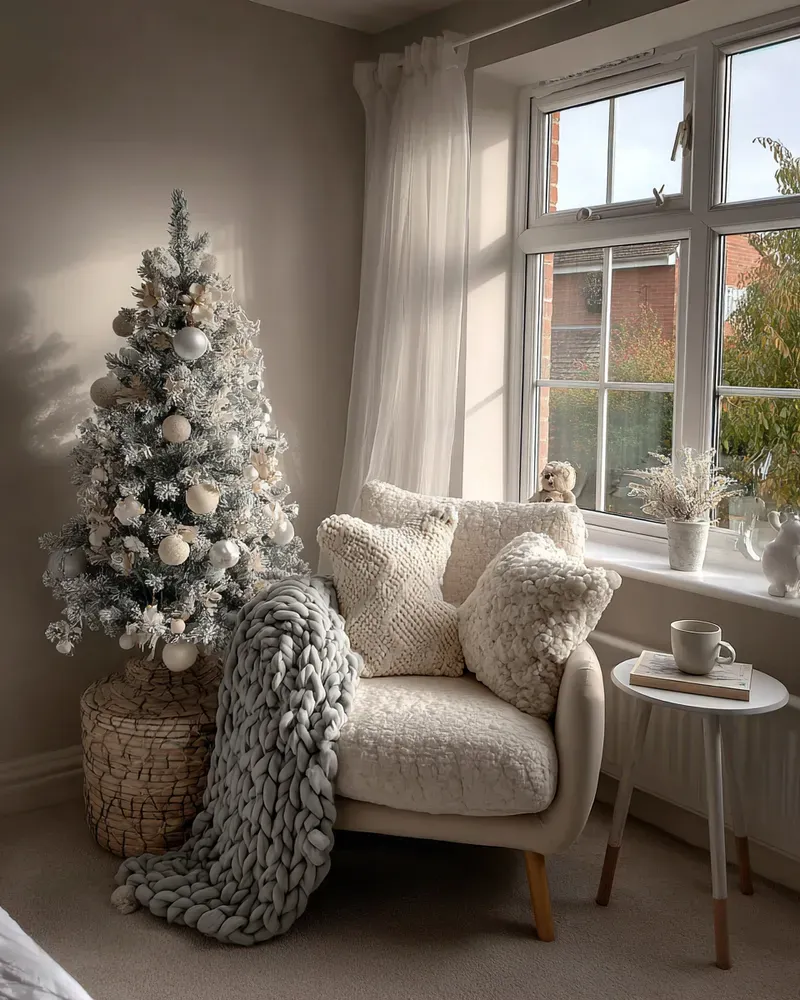
A reading nook like this needs less floor than people think — 8 x 8 feet is plenty, and it would work in an 8 x 6 bay too. You need a window for the sheers to matter, an outlet in cord reach, and 30 inches of clear walkway in front of the chair. In tight rooms, a six-foot flocked tree instead of 6.5 saves about $40 and four inches you’ll never miss.
18. Pinecones Mixed Into Red and Gold
Pinecones work when they look grown, not clipped. Push 12–15 natural pinecones four to six inches into the branches so they sit at varying depths, and wire them to the branch instead of balancing them on top. Varying the depth is what makes the tree look full from across the room instead of flat with a ring of identical decorations on the outer tips.
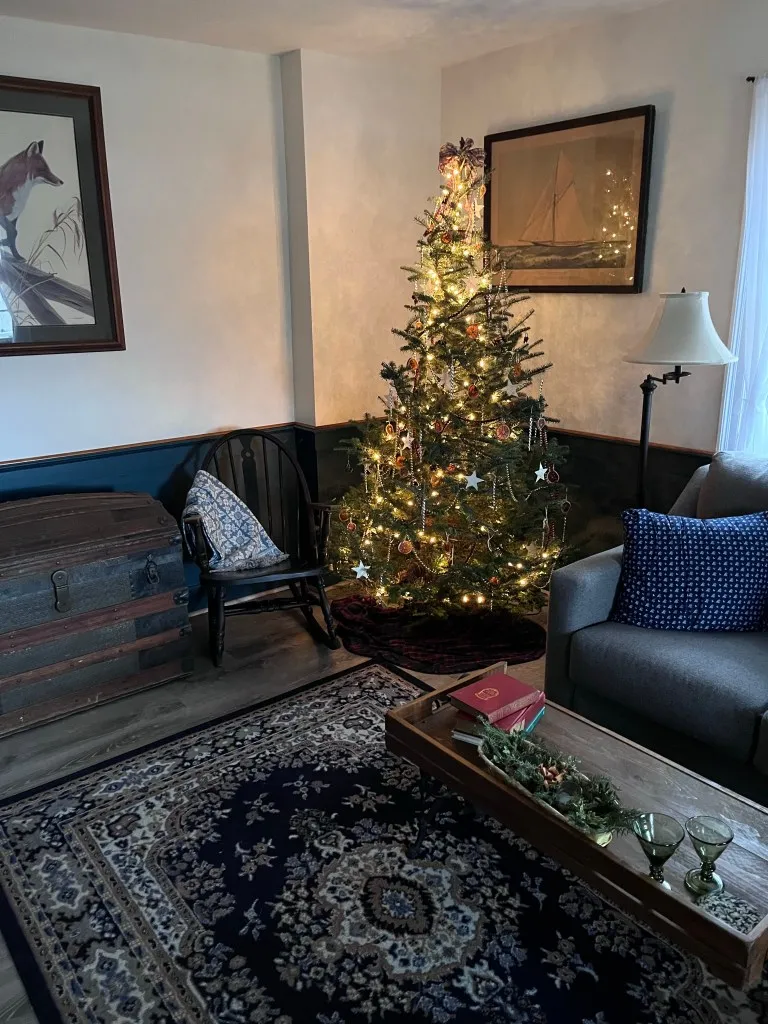
It’s a texture hierarchy. Shiny glass spheres catch light, matte red ornaments absorb it, and natural pinecones break up both so nothing looks mass-produced. Warm string lights sit underneath all of it doing the actual lighting work, which is why this tree can carry so many small ornaments without looking busy. One material always has to be the dull one for the others to shine.
19. A Mushroom Floor Lamp Meets Multicolor Lights
That mushroom floor lamp is the room’s personality, and you don’t need the designer original. Resin mushroom lamps run $55–$90 on Amazon and Wayfair, and vintage wood versions turn up on Facebook Marketplace for $40–$70 if you set an alert. Multicolor LED strands are $15–$25. Leather-look armchairs land around $250 used. The whole vibe comes in under $500.
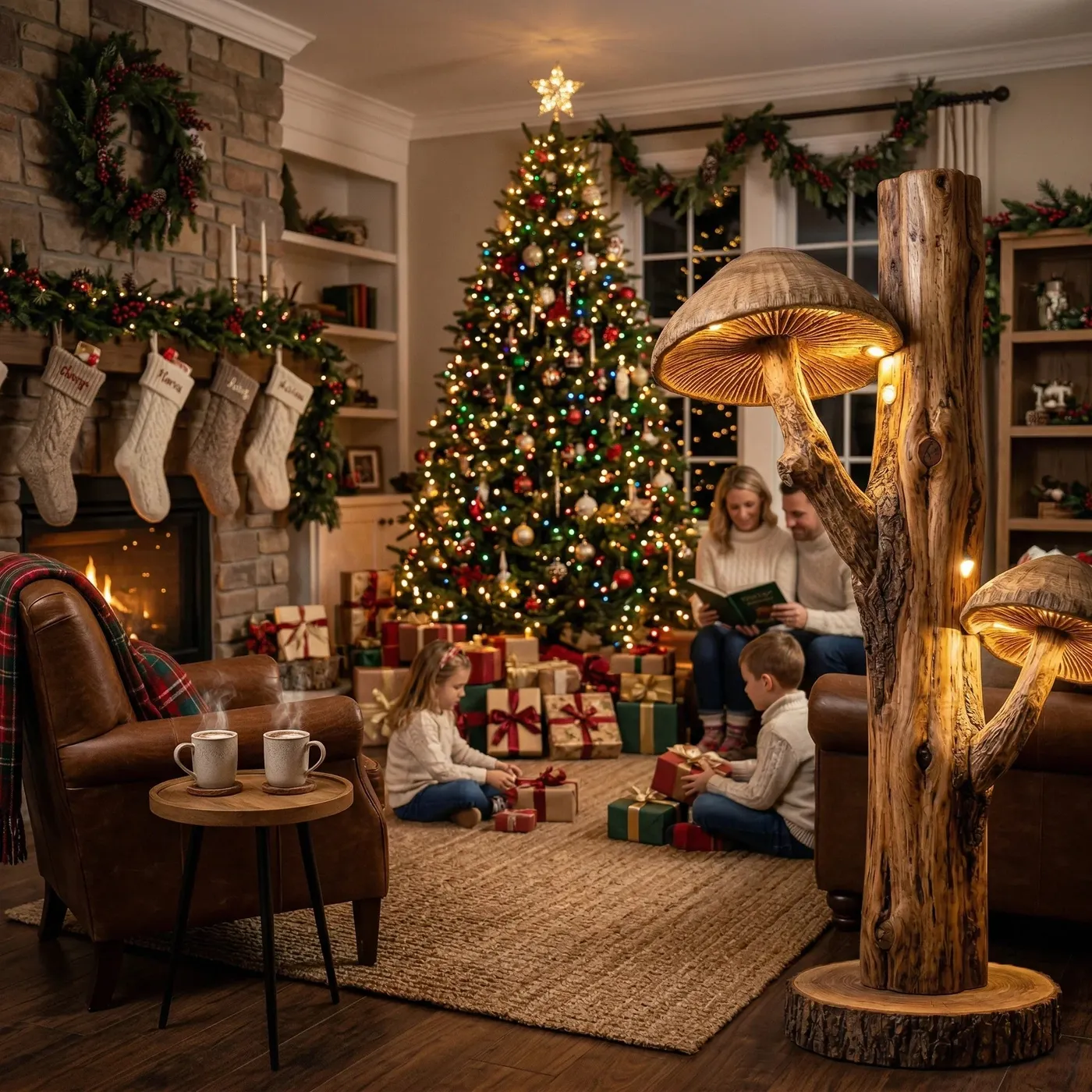
Multicolor incandescent strands burn out section by section and cost real money to run — roughly $6–$10 in electricity over December. LED multicolor is the smarter buy: cooler, longer-lived, dimmable. Dust the ornaments once mid-season with a dry microfiber mitt. And if you’re burning real wood in a stone fireplace, have the chimney swept before you light the first fire, not after. The rustic mantel in Idea #6 takes the same natural instinct into a much lighter palette.
20. Rustic Santa, Bark Wood, and a Red Snowflake
Roughly 50 percent flocked white branch, 30 percent forest green, 15 percent deep red, and 5 percent brown wood and twine. The brown is the sleeper ingredient — the bark-textured disc and the fur trim on the Santa are what make the red feel rustic instead of candy-cane. Bump red to 25 percent and the tree turns cheerful and childish; strip the brown out entirely and it goes cold.

Cluster in odd numbers at the same depth. Hang three ornaments close together on one branch plane — a Santa, a wooden disc, and a snowflake — then leave the next section nearly bare. That contrast is what makes a close-up look styled, and it’s how you stretch two dozen ornaments across a tree that really wants sixty. Groups of three, roughly eight inches apart.
21. A Light Blue Wall Changes Everything About Red Ornaments
Light blue walls are usually walls in smaller rooms, which is good news: this arrangement works in a 10 x 12 bedroom or guest room as easily as a large living space. A 7.5-foot tree needs 9-foot ceilings to clear the topper; in an 8-foot room, drop to 6.5 feet and keep the star. The dark wood box base earns its floor space — it visually anchors a tall tree in a narrow room.
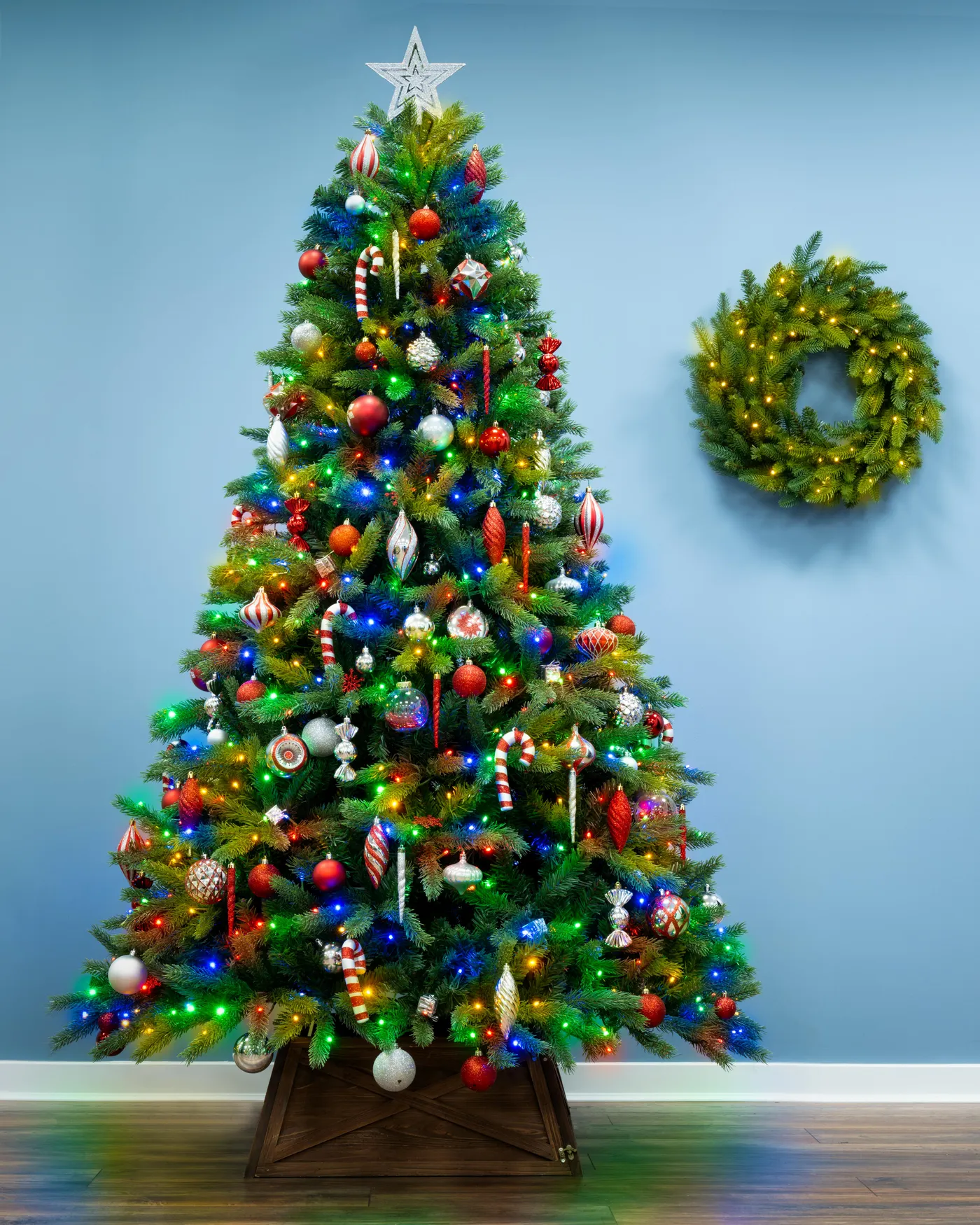
Light blue plus red plus multicolor lights is one step from a July Fourth picnic. The silver ornaments are what keep it Christmas — they bridge the cool wall and the warm red so the palette reads wintry rather than patriotic. Don’t add blue ornaments to the tree, keep the wreath plain green, and resist red-and-white striped ribbon. That’s the line.
22. Shag Rug, Beige Sofa, and the Tree Doing All the Talking
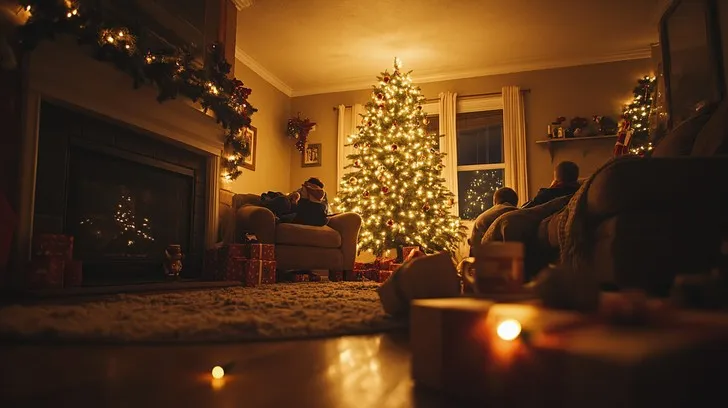
Restraint is the design. Every surface here — the beige sofa, the shaggy rug, the tan walls — is a quiet neutral, so the tree is allowed to be the only saturated thing in the room. That’s what makes a tree feel bigger than it is. The wrapping repeats the tree’s red exactly, which ties the floor to the branches without introducing a new color.
- 7.5-foot tree with warm white lights: $180–$500
- Red ornaments and ribbon: $45–$120
- Lighted mantel garland: $40–$110
- Shag area rug (8 x 10): $150–$500
- Wrapping paper and ribbon: $25–$70
Budget alternative: secondhand shag rug, discount-store ornaments, and wiring your own lights onto an unlit tree. Total: $190–$460.
23. Gray Wainscoting and a Barely-There Glow
With paneled walls, let the trim do the framing. If your chair rail sits at 36 inches and the ceiling is nine feet, cap the tree at seven and a half feet so the white crown molding stays visible as a border above it. A tree that touches the ceiling hides the best architectural detail in the room and makes the space feel shorter than it is.
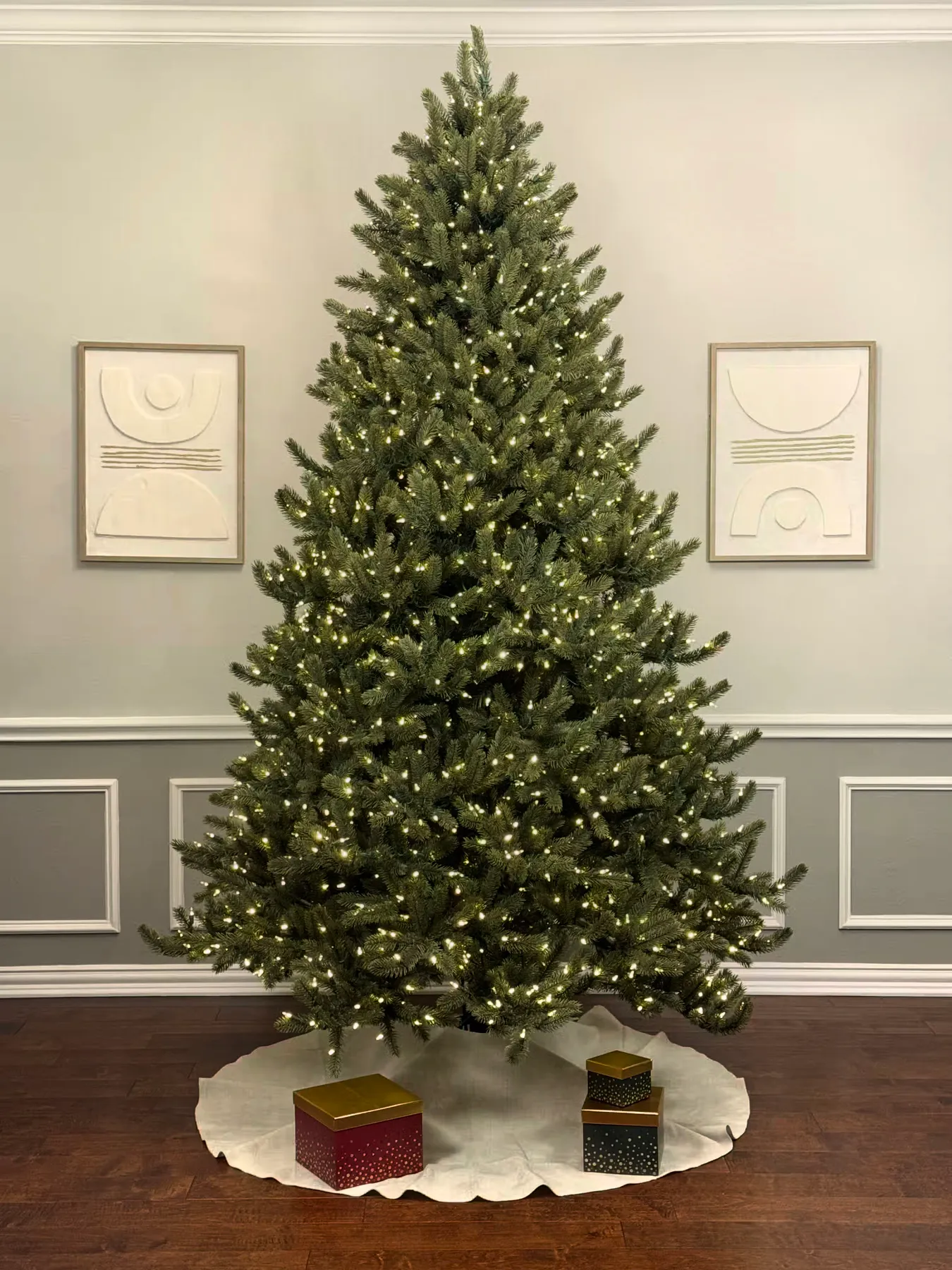
About 70 percent light gray and white architecture, 20 percent warm white tree light, 10 percent cream textile. Nothing here is dark except the floor, which is exactly why the tree reads as the focal point without any ornament doing heavy lifting. Swap the cream skirt for charcoal and the room goes modern; swap it for red and it turns traditional instantly.
24. Gold and White, Then a Blue-and-White Stripe Sneaks In
Blue and white can be done for very little. Ornament sets in gold and pearl white run $10–$15 for twenty at Target. A wide gold ribbon is $8 a roll. Woven blue-and-white throw blankets stand in for a patterned accent chair at $30–$50. And if you already own blue-and-white dishes or bedding, borrow that palette and repeat it — that’s the whole trick, and it costs nothing.
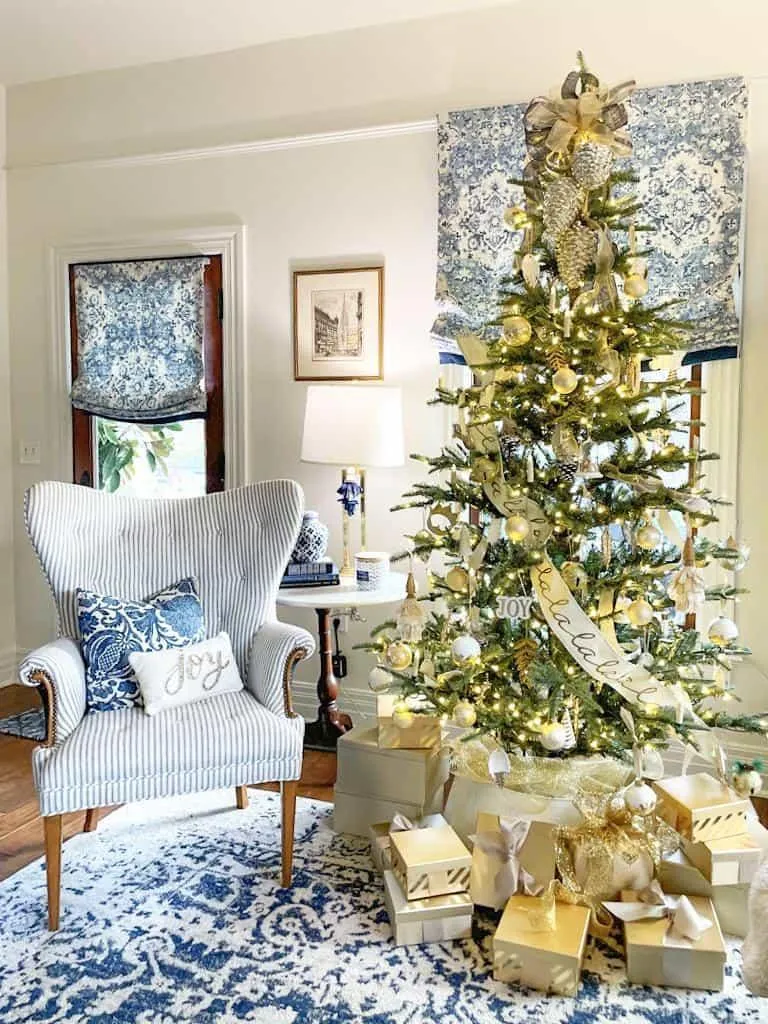
This arrangement wants an 11 x 13 foot room minimum, because the wingback plus the rug needs its own zone beside the tree. In anything tighter, drop the extra chair and keep the rug: a 5 x 7 blue-and-white flatweave under a tree does the same color work in half the footprint. Eight-foot ceilings handle a 6.5-foot pre-lit tree comfortably here.
25. Paper Star Lanterns and Dried Orange Slices
Dried orange slices take three hours in the oven and cost about $4.
- Slice navel oranges a scant quarter inch thick, discarding the ends
- Blot both sides with paper towel — moisture is the enemy
- Bake at 200°F on a wire rack for two and a half to three hours, flipping once
- Cool completely; slices should be leathery, never brittle
- Thread jute twine through a small hole and hang
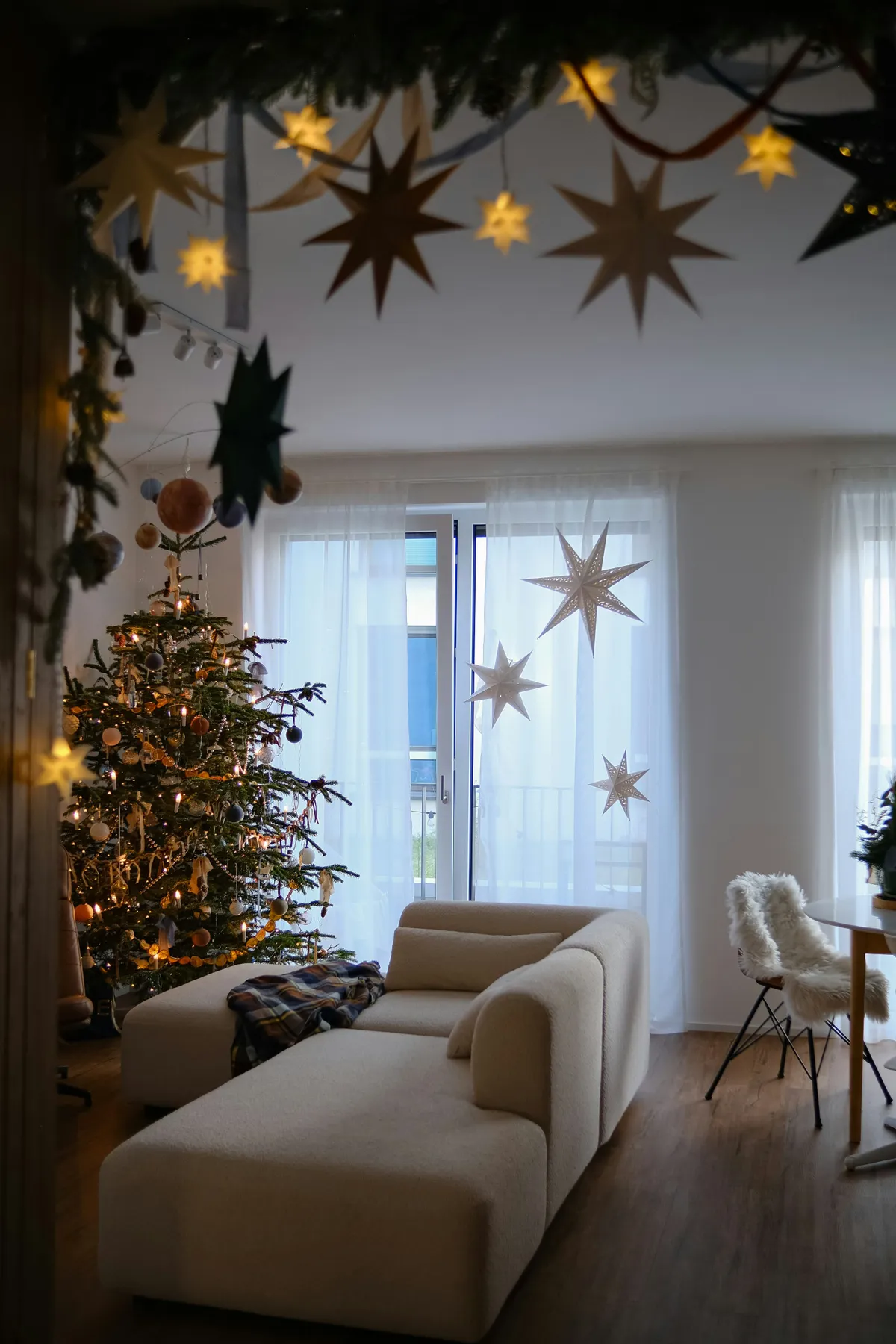
Natural, compostable ornaments have gone from niche to mainstream over the last three seasons. The driver is partly environmental and partly visual — dried citrus, pinecones, and paper stars add a texture plastic baubles can’t, and they look better in low warm light. Expect this to keep growing through 2027; it isn’t a one-season trend.
26. The Reading Chair Turned Half-Toward the Tree
Angle. The chair is turned roughly 40 degrees toward the tree rather than squared to the room, and that single rotation is what makes this corner feel like a destination instead of seating overflow. Facing the tree head-on looks staged; facing away looks antisocial. The diagonal is the only angle that says you actually sit here.
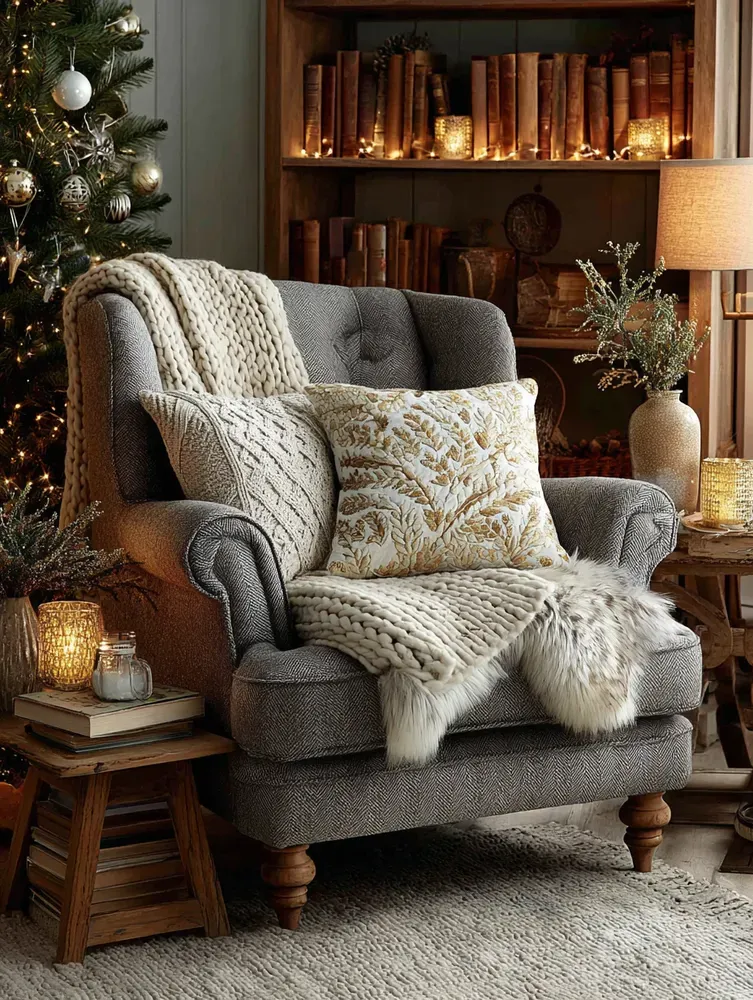
Fairy lights on a bookshelf are lovely until you think about heat and cables. Three things to check first:
- Use LED strands only — incandescent gets hot against paper and spines
- Hide the battery pack inside a hollow decorative book, not behind the shelf
- Never place real candles on a shelf above books
Dust the string lights before December too; a year of shelf dust plus warm bulbs is a smell nobody enjoys.
27. Dried Orange and Pine Cone on Jute Twine
This ornament costs about 50 cents and takes 90 seconds to assemble.
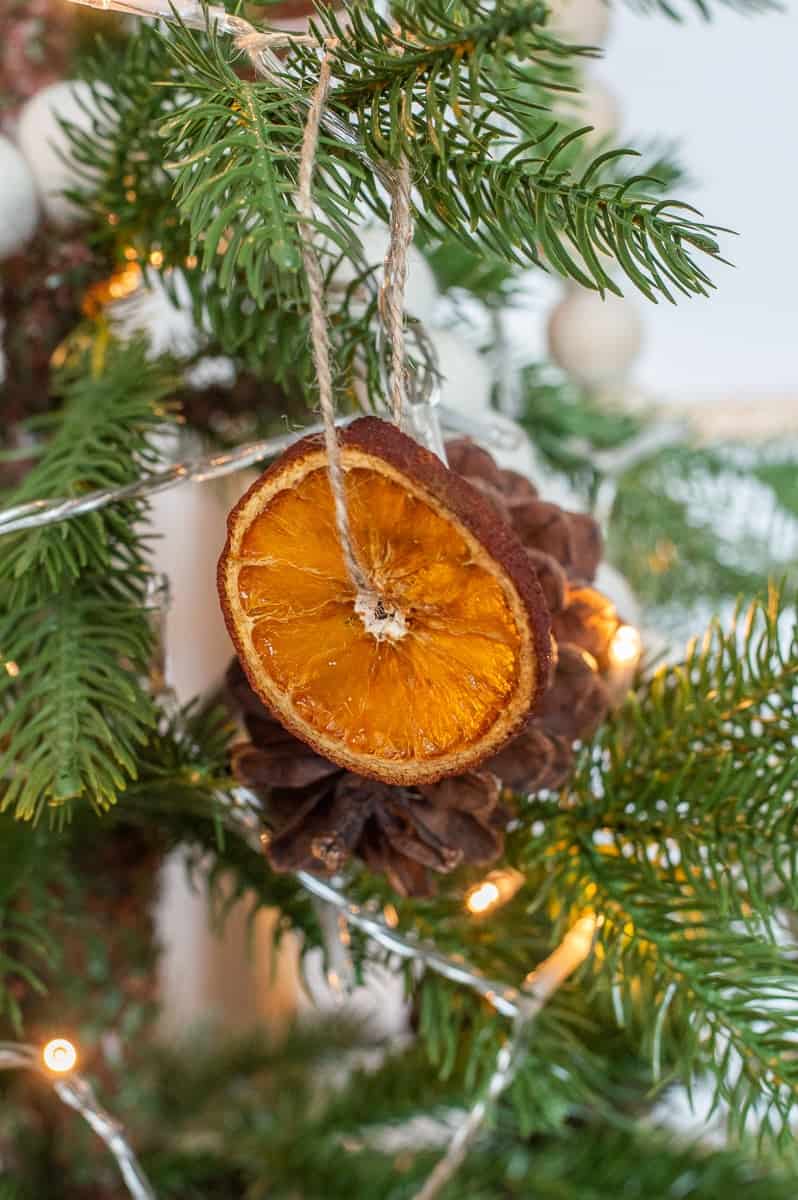
- Dry your orange slices at 200°F until leathery, then cool fully
- Pierce a small hole a half inch from the rind edge with a skewer
- Thread 10 inches of jute twine through and knot it into a loop
- Give the pinecone its own separate twine loop
- Hang the pair at the same branch depth so they read as one cluster
Dried citrus is not forever. In humid rooms the slices soften and can grow mold by late January, and pinecones brought in from outside may carry tiny insects. Bake pinecones at 200°F for an hour before hanging them, keep the oranges away from bathrooms and kitchens, and store everything airtight with a silica packet once the season ends. Plan on replacing them next year — that’s fine, they cost pennies.
28. Frosted Silver Branches Against Dark Wood Paneling
Dark wood paneling swallows light, so every warm bulb on the tree has to work harder — and that’s exactly why this room feels so enveloping. Frosted branches bounce light back into the space instead of absorbing it, and the silver star topper reads as a bright point against the paneling rather than disappearing into it. Silver and white also keep the tree from competing with the carved stone fireplace.
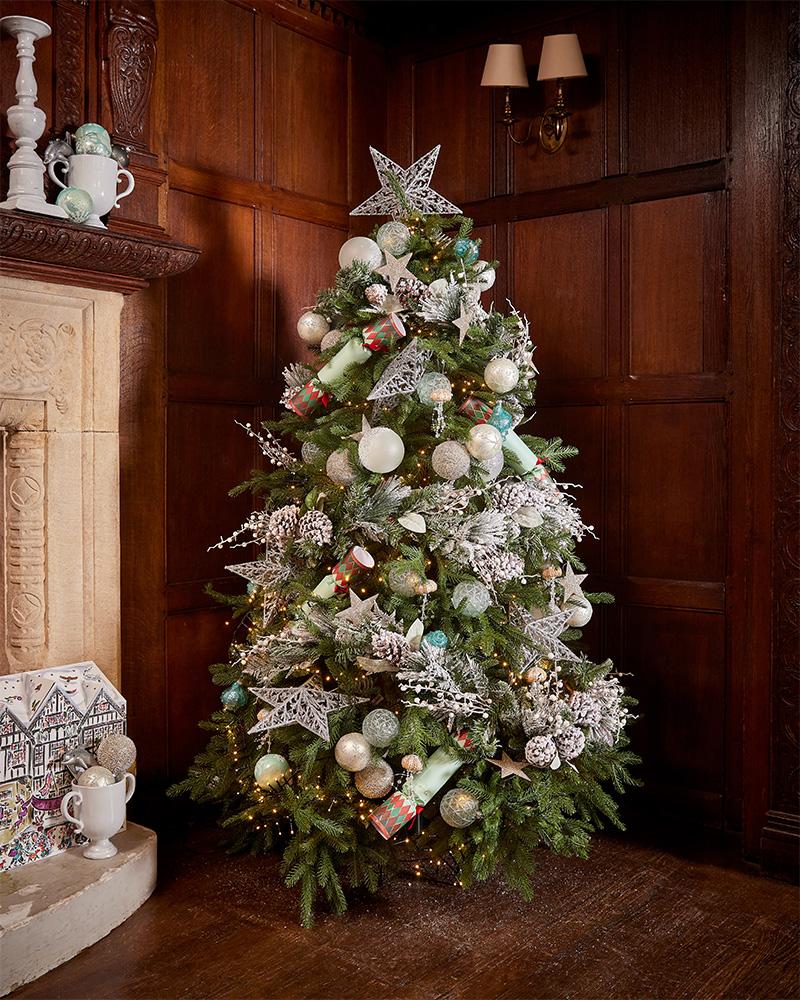
- 7.5-foot frosted tree with lights: $200–$550
- White, silver, and clear ornaments: $90–$220
- Frosted garland and pinecones: $50–$130
- Ornate star topper: $25–$70
- Silver ribbon: $15–$40
Budget alternative: buy an unfrosted tree and frost it yourself with spray adhesive and mica powder, then raid the dollar store for clear ornaments. Total: $160–$340.
29. Berry Garland and a ‘Merry Everything’ Sign
Hang the sign first and build outward. Center it, then work the garland from the sign toward each end, and keep stockings at least four inches away from the sign’s edges so nothing crowds. On a five-foot mantel, plan on five stockings maximum — more than that and they overlap, which reads messy in person even when it photographs fine.
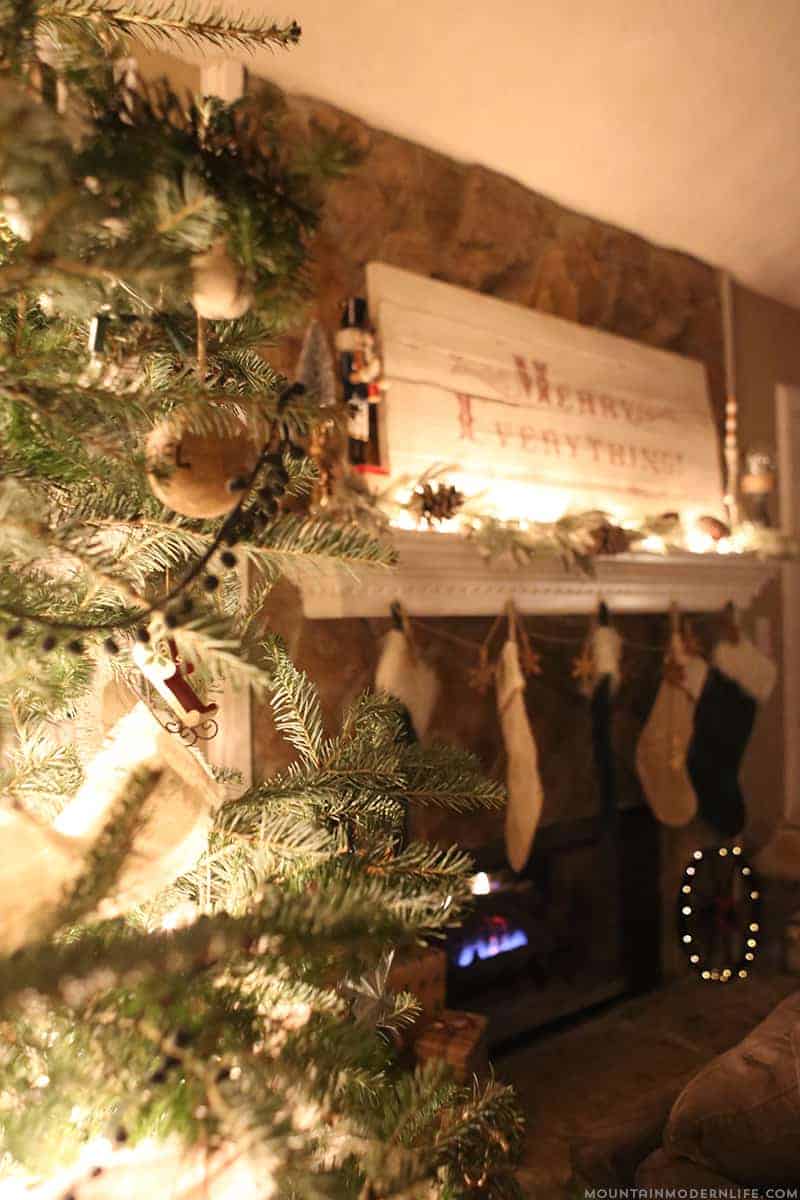
The sign. A painted wooden sign hung dead center on the mantel, with stockings flanking it rather than covering it, is what keeps this fireplace from looking like every other garland-and-stocking setup. It gives the arrangement a subject. Take it away and you have tasteful greenery and a blank white mantel — pleasant, but anonymous.
30. Arched Built-Ins Styled to Match the Tree
Styling built-ins for Christmas costs shockingly little if you treat them like a shelf, not a store display. Thrift shops and estate sales carry red velvet nutcrackers for $4–$12 each. White ceramic village houses are $6–$15 at discount stores. Red taper candles are $2 apiece. Add one frosted garland across the top shelf and a red velvet tree skirt at $20, and the whole vignette lands under $150.
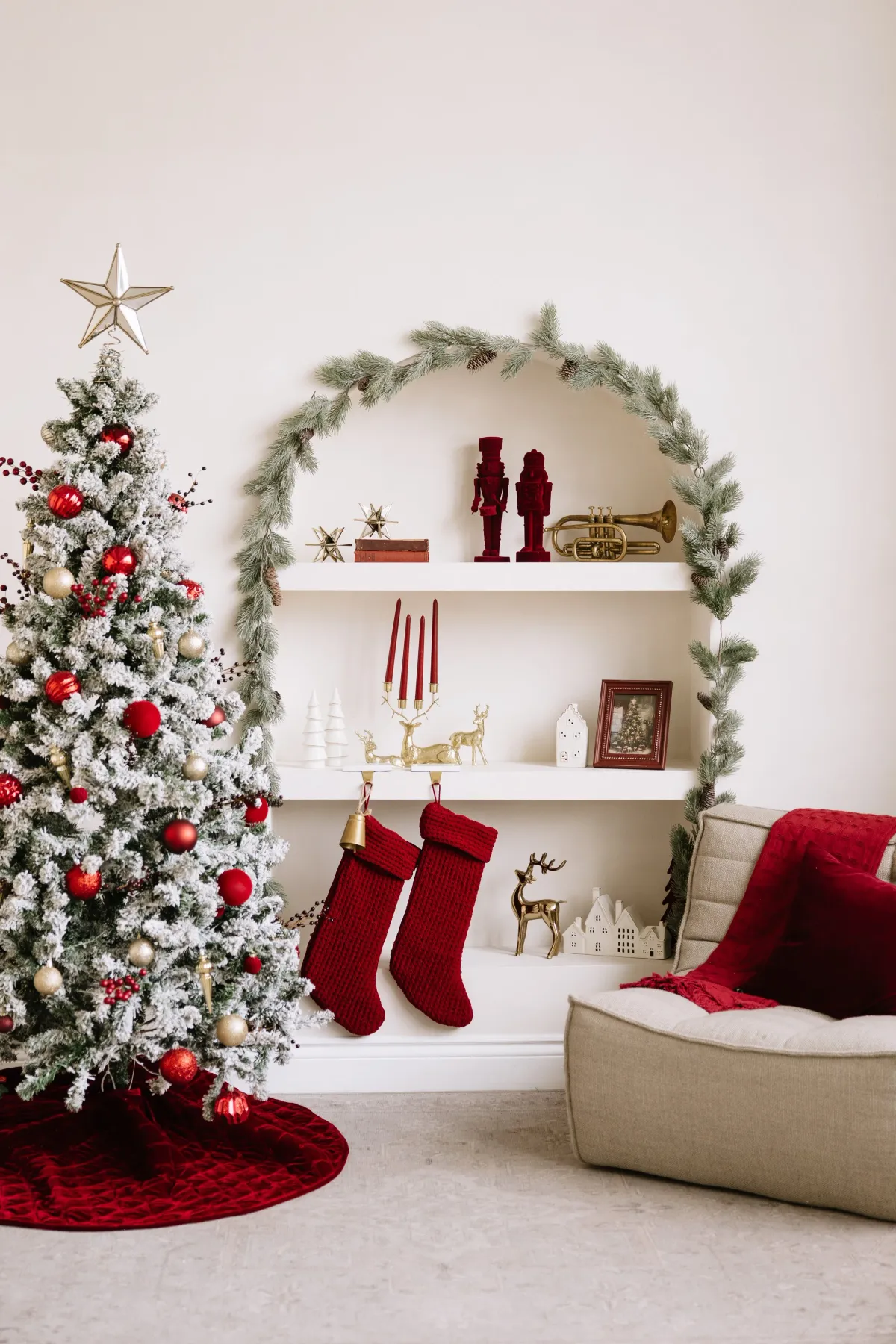
Repetition ties the two zones together. The same red appears on the tree ornaments, the velvet skirt, the nutcrackers, the candles, and the throw on the beige chair — so your eye reads one continuous celebration rather than two separate displays. The arches also echo the tree’s shape, which makes the corner feel deliberate. Soft curves, no hard edges. Just resist the urge to fill every inch of shelf — our mistakes section below covers the most common version of that.
Your Coziest December Starts With One Warm Strand
Pick one thing from this list — the basket collar, the pinecones, the red on charcoal — and let that be the star. Cozy holiday rooms are almost never the ones with the most stuff in them. They’re the ones where the lights are warm, something smells like orange and pine, and there’s an empty seat facing the tree.
If you try one of these this year, pin the photo that inspired it so you can find it again next December — and save this guide now, because you’ll want it when you’re standing in the ornament aisle in November. 🎄