
You know the feeling — you’re three hours into a Pinterest rabbit hole, saving photos of hand-beaded felt ornaments and glittery little cardboard houses, and you have absolutely no plan for how any of it lands on your actual tree. Same. So we did the sorting for you.
We spent a few weekends combing Etsy, eBay, Target, Anthropologie, and Michaels to pull together the vintage Christmas crafts actually worth making or buying in 2026. Everything here runs from about $6 for a pack of bottle brush trees up to $815 if you’re rebuilding a whole room around a nine-foot tree.
Inside you’ll find 30 curated ideas spanning vintage traditional, shabby chic, mid-century retro, and woodland rustic — and where it made sense, we put the budget version and the luxury version side by side, with shoppable links for the pieces you can buy outright. Vintage Christmas crafts are surging on Pinterest right now largely because thrifted and handmade décor sidesteps the “new theme every season” trap: you build a collection instead of buying a look.
And stay until the end — we break down the most common mistakes that can ruin these looks. 📌 Save this to Pinterest for later so you can revisit these ideas when December actually arrives.
1. Beaded Felt Ornaments Spilling Out of a Cardboard Box
Work your bead embroidery from the center outward. Anchor a size 11/0 seed bead with a single backstitch, then nestle a 4mm sequin underneath it so the bead pins the sequin flat in one pass — no glue anywhere. Keep clusters about a quarter inch apart so the felt still reads as felt between the shine. A 4-inch round ornament takes roughly 45 minutes once you find a rhythm; batch five at a time and you’ll finish a set in an evening.
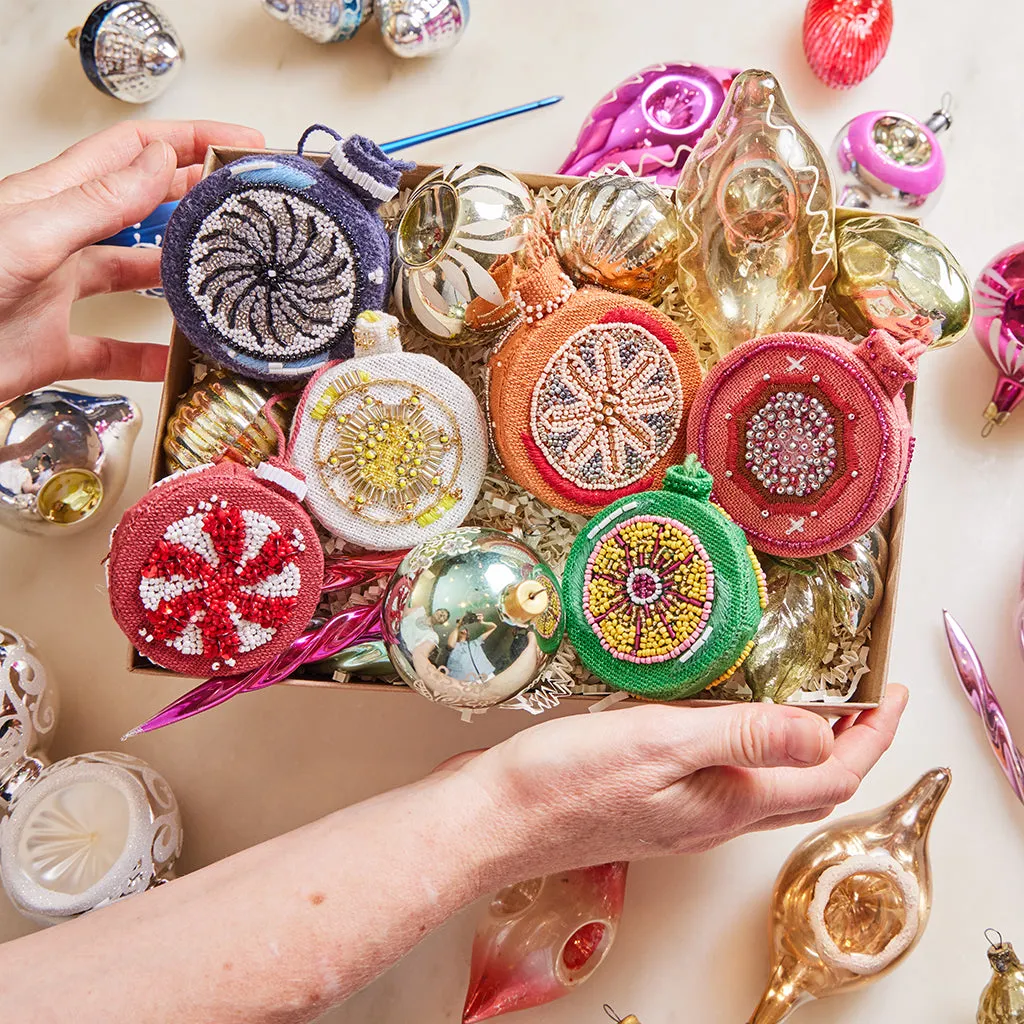
The real trick is matte against gloss. Felt swallows light, glass throws it, and when the two sit in the same box they make each other look more expensive. Notice how the vintage glass pieces are loose rather than hung — that casual pile signals “collected,” not “purchased as a set.” The cardboard box does quiet work too: it’s the least precious container imaginable, which makes the handwork inside feel like a discovery instead of a retail display.
2. White Tinsel Tree With a Gold Atomic Starburst Centerpiece
Roughly 60% white tinsel base + 30% gold (garland, starburst, fringe tassels) + 10% pops of pink, turquoise, and red. That last 10% is what keeps the whole thing from reading as a bridal tree. To shift the mood, hold the 60/30 and change the accents only: cobalt and orange for a louder 1960s feel, or mint and silver if you want it cooler and quieter. The formula survives either swap.
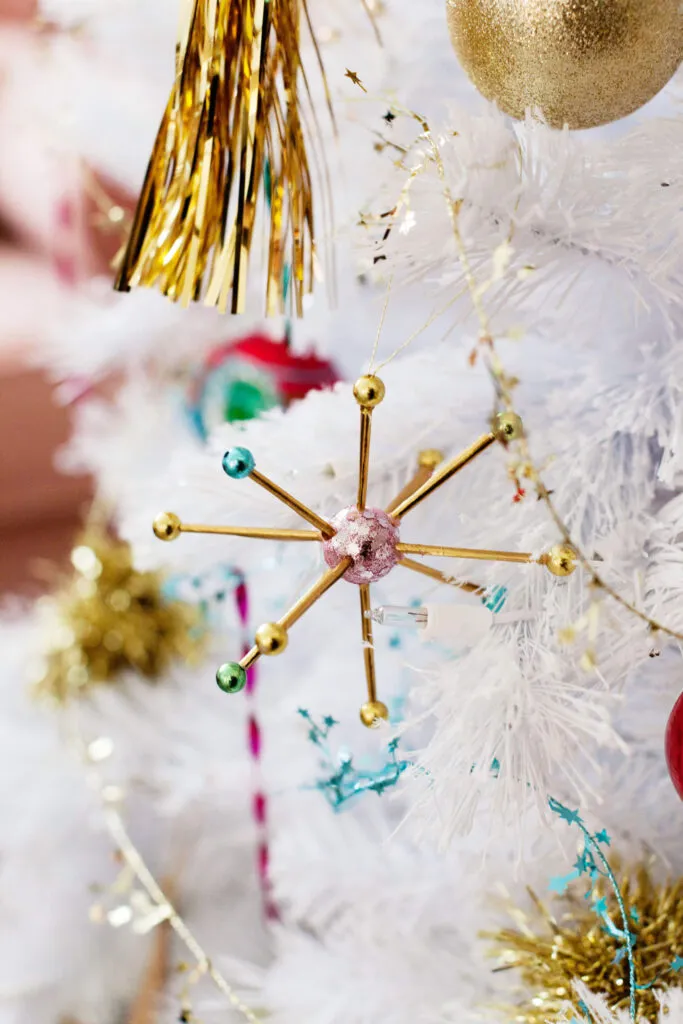
The atomic starburst is the entire idea. Take it away and you’re left with a pleasant white tinsel tree with gold garland — nice, forgettable. That single ornament is a period reference, a conversation piece, and the only shape on the tree that isn’t round or drooping. Give it the center of a sightline at eye level and let everything else orbit around it.
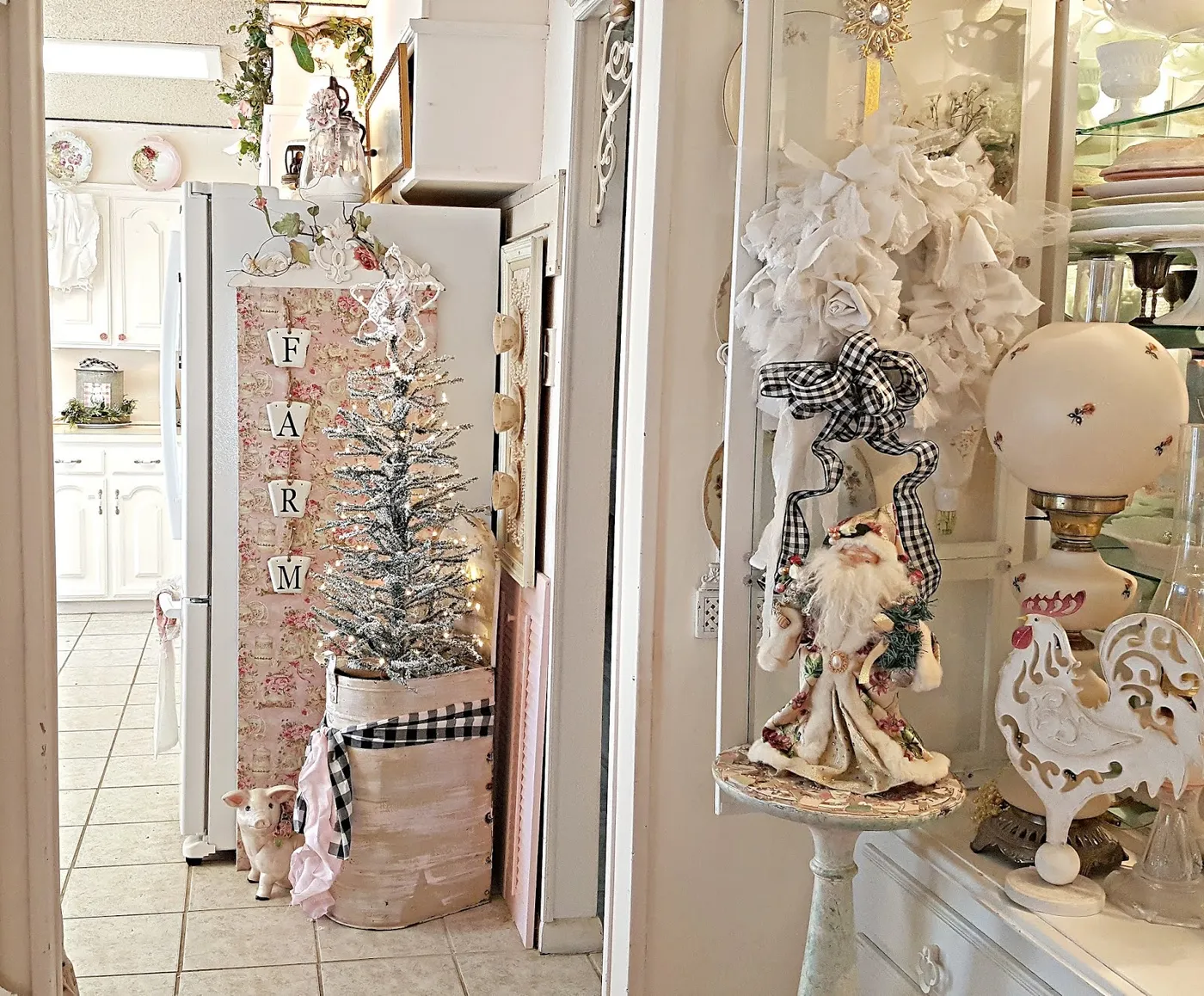
3. Flocked Mini Tree in a Distressed Gingham-Wrapped Bucket
Flocked trees shed. Not dramatically, but you’ll find white dust on the tabletop under that bucket for weeks, and pets will absolutely investigate it. Set the tree on a tray or doily you can lift and shake out. Also worth knowing: distressed wood and gingham read beautifully in daylight and can look muddy under warm evening bulbs, so check yours after dark before you commit to a spot. This vignette wants a lamp nearby, not overhead cans.
Skip the tree skirt entirely. A bucket or crock forces you to solve the base differently and instantly looks more collected. For a miniature tree 18 to 24 inches tall, choose a container about 6 to 8 inches wide — wide enough to look planted, narrow enough that the tree doesn’t swim. Weight the bottom with a bag of sand or a cloth-wrapped brick, then tuck the ribbon knot at the front so the tie reads as intentional rather than accidental.
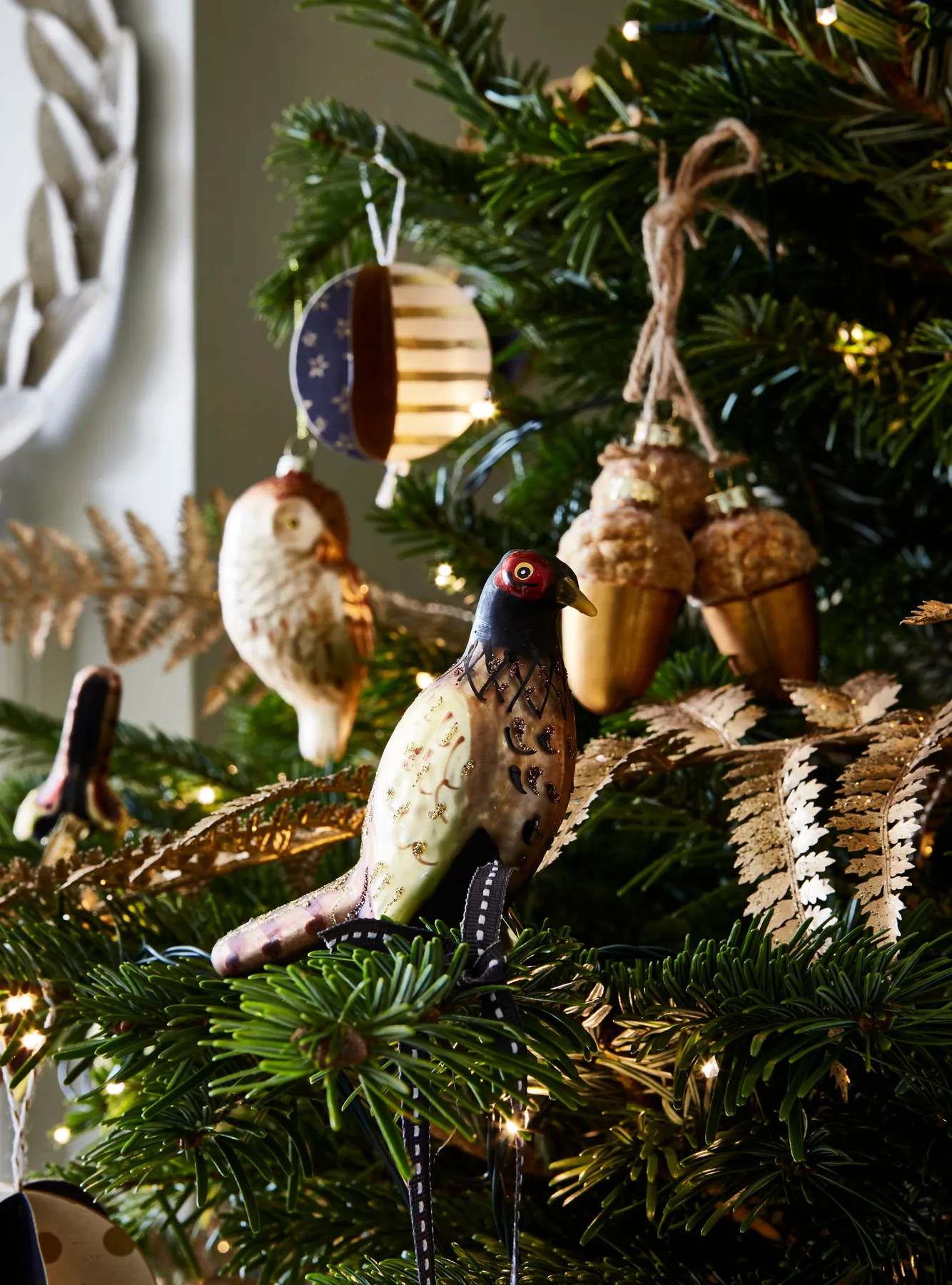
4. Woodland Tree With Pheasant and Owl Glass Ornaments
Nature-themed trees have been quietly overtaking the all-red-and-green look for several seasons, and 2026 is the peak. Blame the broader cottagecore-to-grandmillennial drift, plus a decade of birding apps making pheasants and owls feel charming rather than random. This one has genuine staying power because it isn’t a color trend — it’s a subject. You can add one piece a year and it only gets better.
Twine hangers in five minutes:
- Cut 8 inches of natural jute or baker’s twine.
- Fold it in half and thread the loop through the ornament cap.
- Pull the loose ends through the loop and cinch tight.
- Knot an inch from the ends so the loop can’t slip.
- Trim the tails at an angle, then fray each one with a fingernail.
About five minutes per ornament, and a $5 spool covers roughly forty.
5. Vintage Jewelry Cone Trees Dripping With Pearls
The cone itself is cheap — a 12-inch papier-mâché or foam form runs $4 to $8 at any craft store. The cost is in the sparkle, and that’s exactly where thrifting wins. Estate-sale jewelry lots, single broken earrings, and grandma’s costume brooches all work; you want flat-backed pieces you can pin or hot-glue. Search Facebook Marketplace for “jewelry lot” listings, which often go for $15 to $25 for a sandwich bag full. Anchor one genuinely nice brooch near the top so the eye lands somewhere deliberate.
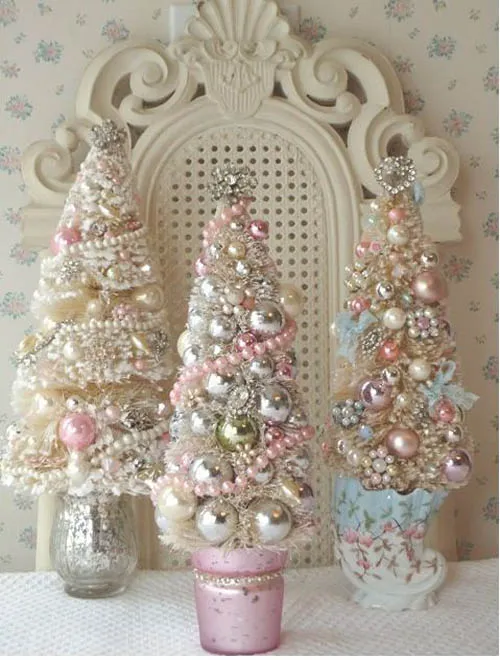
Structurally, this is a texture ladder: dense glitter at the top, satin ribbon and pearl strands through the middle, plain cone base near the bottom. Your eye climbs it without ever getting stuck. The vintage containers matter more than they should — a jadeite bowl or a chipped silver cup tells you this décor has a history, and it keeps three similar trees from looking like a store display.
6. Handmade Crafts Woven Into Fresh Evergreen Greenery
This kind of greenery-and-craft styling works in almost any footprint because it grows vertically, not horizontally. A console 14 to 18 inches deep is plenty for a swag, a few handmade pieces, and one taller element. Ceiling height matters less than wall length — give yourself at least four feet of run so the arrangement has somewhere to travel. In a small apartment, Idea #9 is the scaled-down cousin; in a large open room, go wider rather than taller.
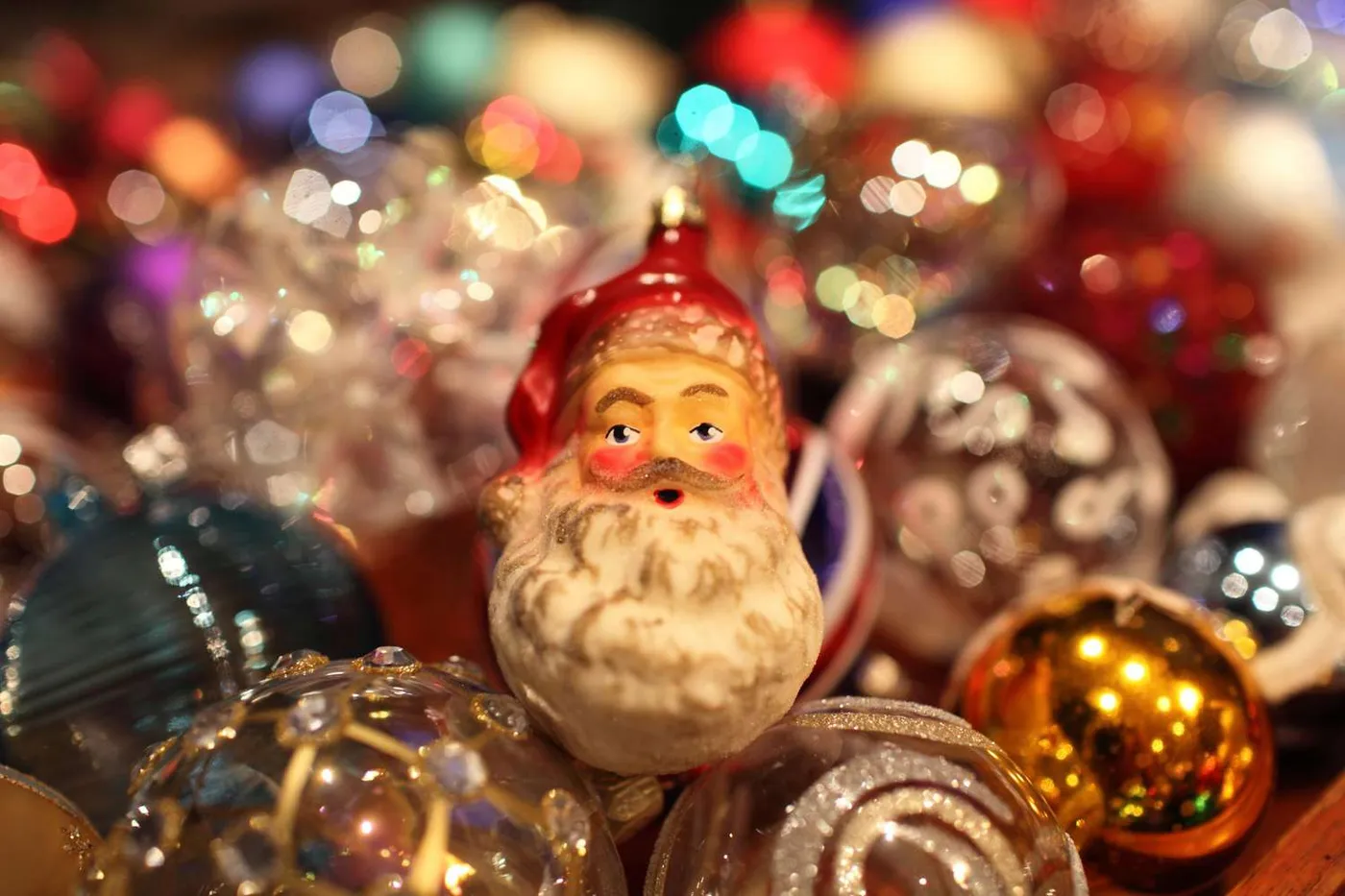
The handmade pieces have to be the loudest thing in the arrangement. Fresh greenery is beautiful but anonymous, and if your crafted ornaments are the same size as everything else, they vanish. Give them contrast: bigger than the sprigs around them, a different finish than the vintage metalware, and enough spacing that each one gets read. One strong handmade object beats six timid ones every single time.
7. Champagne Rose Tree With Sheer Ribbon Garlands
What it costs to build this look from scratch:
- Frosted artificial tree, 7.5 ft: $180–$420
- Rose and peony picks, 18–24 stems: $60–$140
- Sheer ribbon, 3 rolls: $24–$45
- Silver, white, and glass baubles, 60–80 pieces: $50–$120
- Warm white lights, 600–900 bulbs: $35–$70
- Total: roughly $350–$795
Budget alternative: buy the picks and baubles in January clearance and you’ll shave 40 to 60 percent off the entire build.
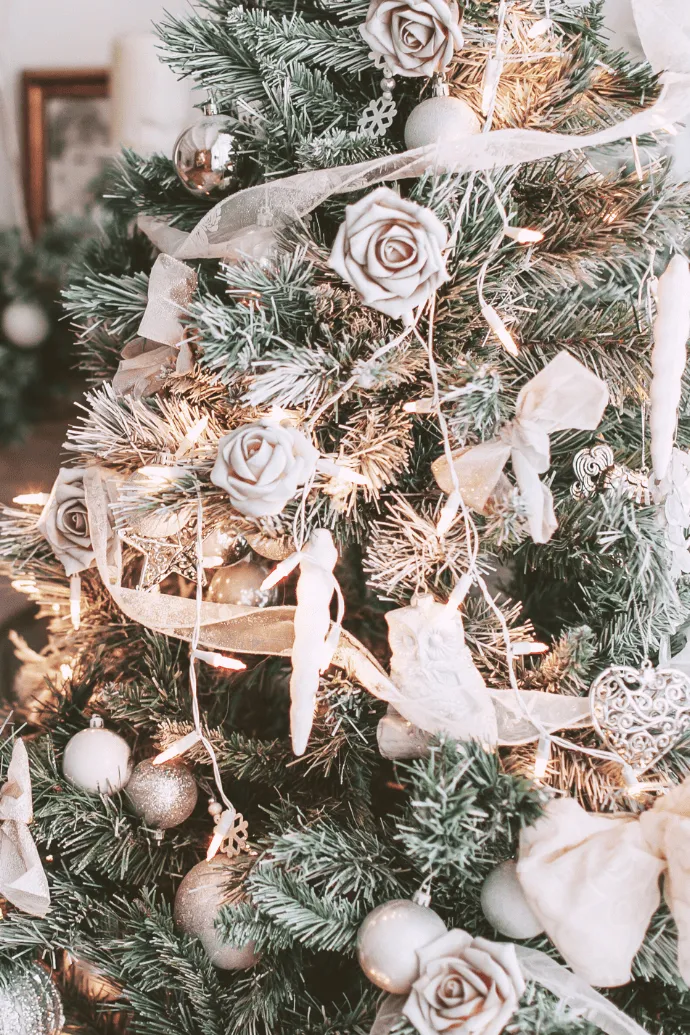
Champagne and blush are unforgiving under cool white LEDs — they turn gray. Use warm white (2700K) exclusively and check the tree in the evening before you decide it’s finished. Rose picks also look tired fast: dust settles into the petals and they flatten out. Hit them with a hairdryer on cool from two feet away once a season. And if you have toddlers, keep the glass out of the bottom third.
8. A Pink Felt Santa With Embroidered Snowflakes
Embroidering snowflakes on felt:
- Trace a six-arm snowflake in chalk on the felt front.
- Backstitch each arm using two strands of white floss.
- Add a small cross-stitch at the center to lock the arms together.
- Scatter three tiny French knots between the arms.
- Pin front to back, whipstitch the edge, and stuff lightly before closing.
About 40 minutes for the first one, closer to 20 once your hands know the pattern.
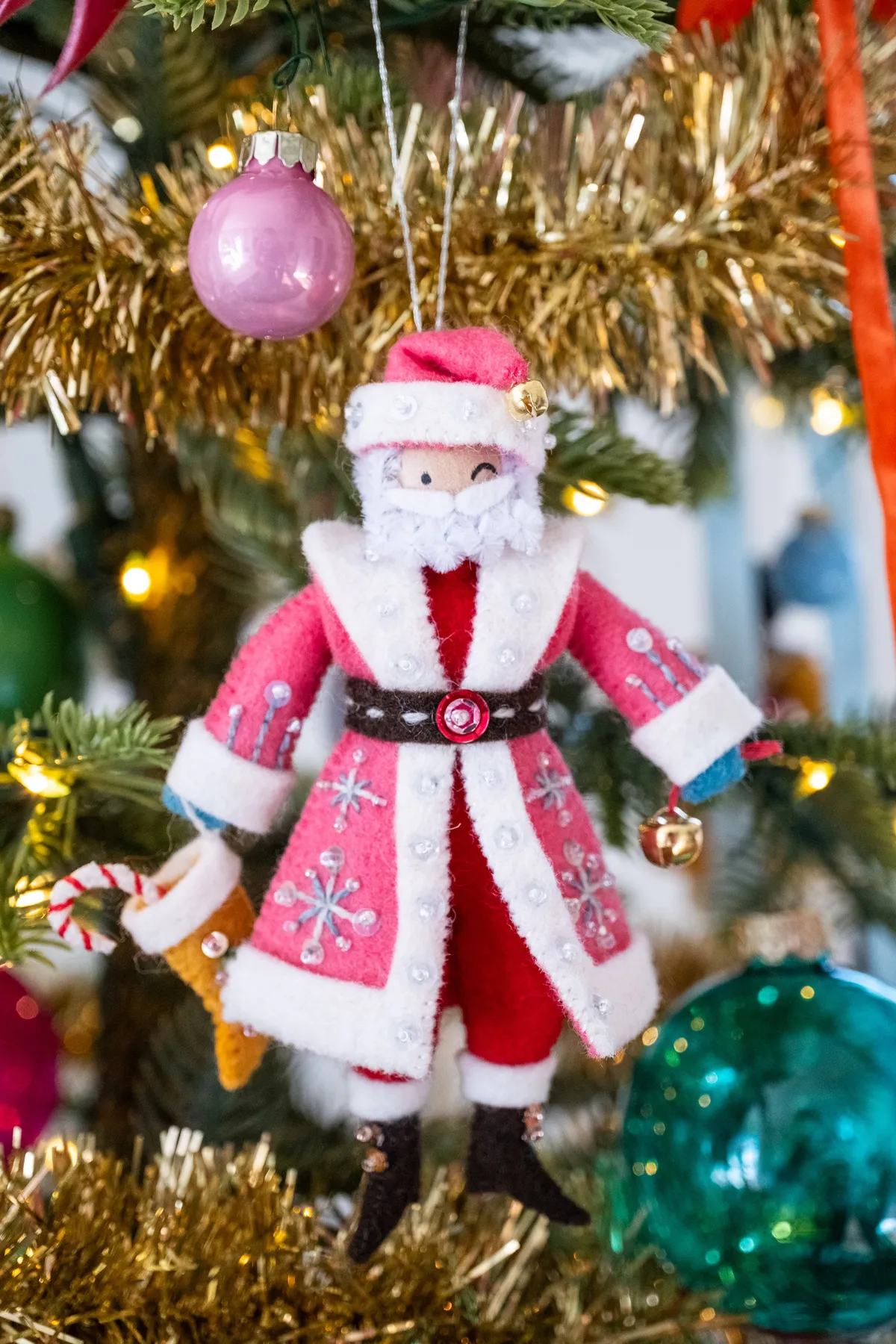
When you’re hand-sewing small ornaments, cut the felt with the grain running vertically and use wool-blend felt rather than the 99-cent acrylic sheets. It’s about $2.50 more per sheet and it holds a stitched edge without fraying into fuzz. Wool also photographs better, which matters on a tree you’ll be looking at for six weeks. Use quilting thread instead of all-purpose — it’s stronger and won’t shred on repeated passes through dense felt.
9. Stacked Vintage Suitcases Anchoring a Mini Forest
Suitcase stacks have been a styling staple for years, but pairing them with a miniature forest is a distinctly 2026 move — the same instinct as tablescape culture, just at Christmas. People are building vertical vignettes instead of spreading flat across a mantel, partly because renters want something that doesn’t require a single nail. This one also travels well: the suitcases store flat, and every tree packs into one bin.
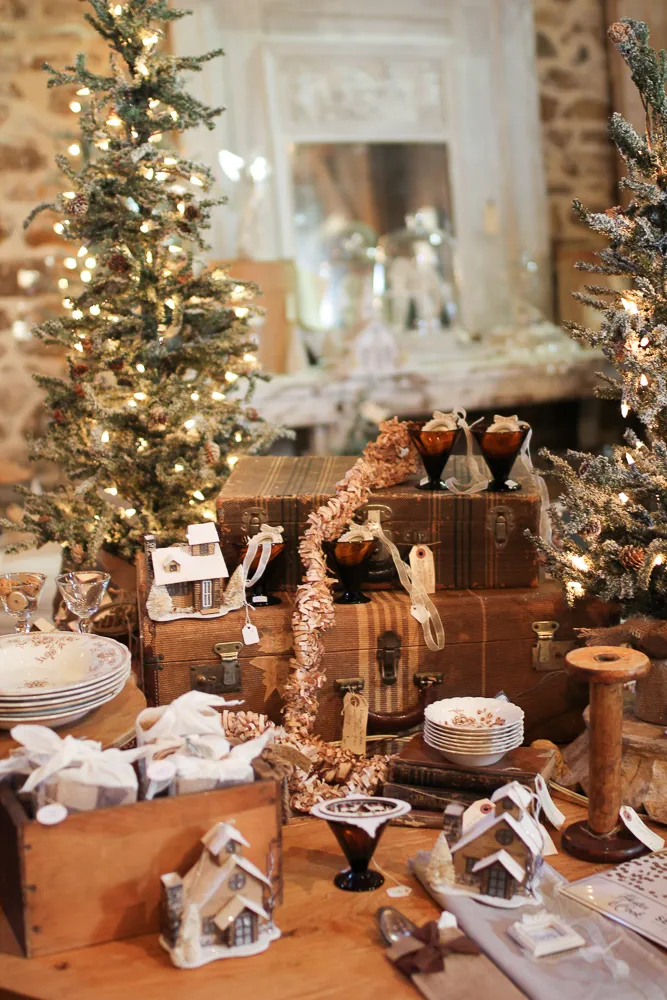
The display needs about 30 by 18 inches of surface and roughly 26 to 30 inches of height, so it suits a console, a sideboard, or the far end of a dining table. Put it against a wall rather than floating in the middle of a room — the stack reads as a silhouette and needs a backdrop. If your console is shallower than 14 inches, run the arrangement long instead, and see Idea #19 for a tree-based version of the same village feeling.
10. A Walnut Shell Diorama With Bottle Brush Pines
The silver foil lining is everything. Without it, a walnut shell looks like a walnut shell with a toy inside. That reflective interior bounces light up onto the little trees and makes the whole thing glow like a jeweler’s window. Line it and the diorama reads as a tiny world; skip it and it reads as a craft project. Line the shell before anything else goes in, and press the foil smooth with a cotton swab.
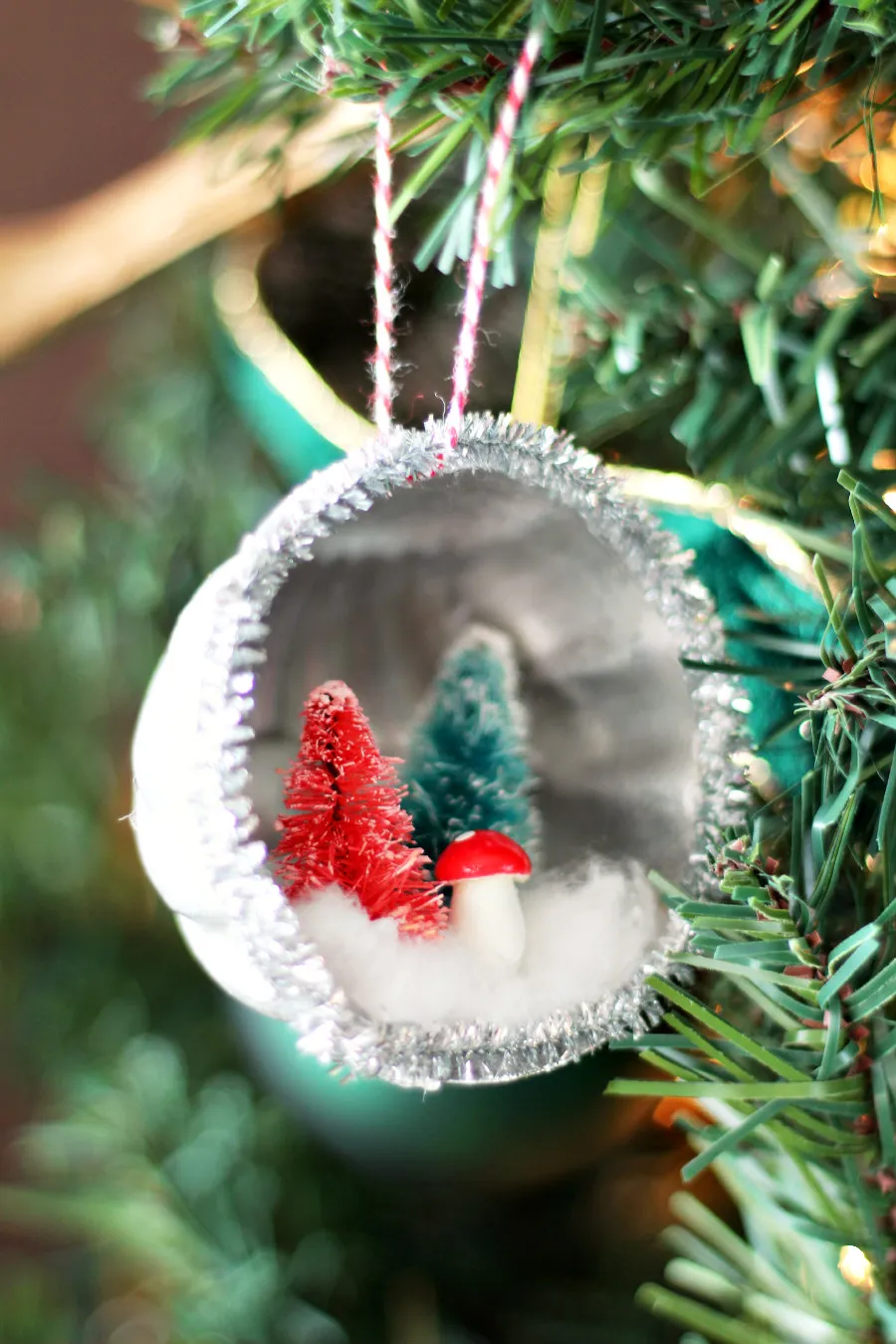
- Crack a walnut cleanly in half and pick out every bit of shell membrane.
- Line the inside with heavy aluminum foil, pressing it smooth with a swab.
- Hot-glue a dime-sized pad of cotton batting into the base for snow.
- Set two bottle brush trees — one red, one green — plus a tiny red-capped mushroom.
- Run a thin bead of silver tinsel trim around the rim.
- Loop baker’s twine through the top edge and knot it off.
Twenty minutes per shell, and the walnuts are free if you’re already baking.
11. Gold Bird Ornament Among Popcorn and Tinsel Garlands
This tree runs about 50% deep green branch + 25% metallic (the gold bird, the silver tinsel) + 20% natural texture (popcorn, that big cream bow) + 5% warm accent, here a single yellow candle. Change the accent and the whole tree shifts: burgundy turns it formal, bright orange goes full retro. Keep the naturals at roughly a fifth and it never tips into clutter.
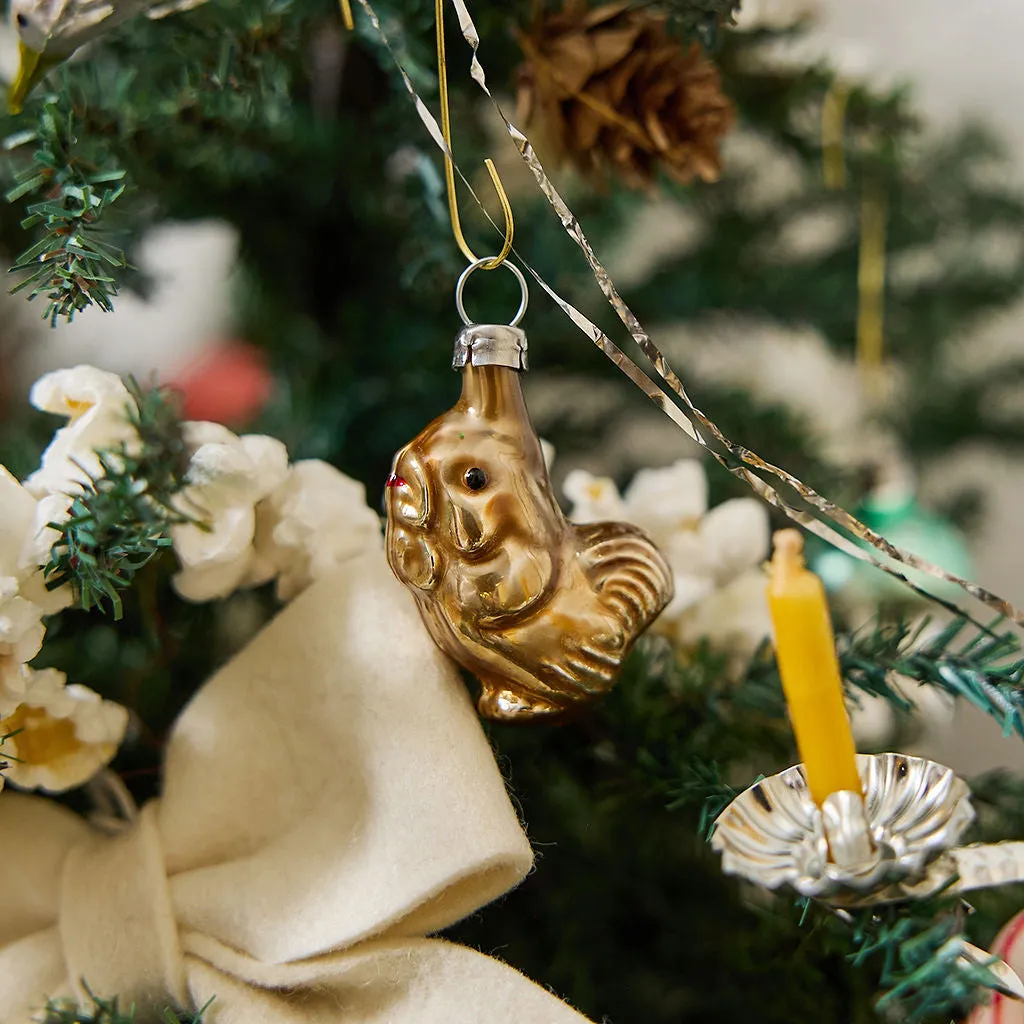
Popcorn garland is charming for exactly one season and it attracts anything with a mouth. Skip it if you’ve ever had pantry moths, and never store it in a warm garage — it goes rancid. String it fresh from day-old popcorn the same afternoon you hang it. Tinsel sheds and clings to carpet, so look for garlands with a woven core. And that clipped candle holder is a look, not a light source: never actually burn one on a dry tree.
12. Red Satin and Pearl Beaded Ornament Ball
For satin ball ornaments, pin the trim rather than gluing it. A sequin pin pushed through metallic braid and into the foam core holds better and lets you reposition when the banding doesn’t quite meet at the bottom. Work in quarters: mark the sphere at north, south, east, and west with a pin, run your bands between the marks, and the pattern stays symmetrical. Budget roughly 25 pins per band on a 3-inch ball.
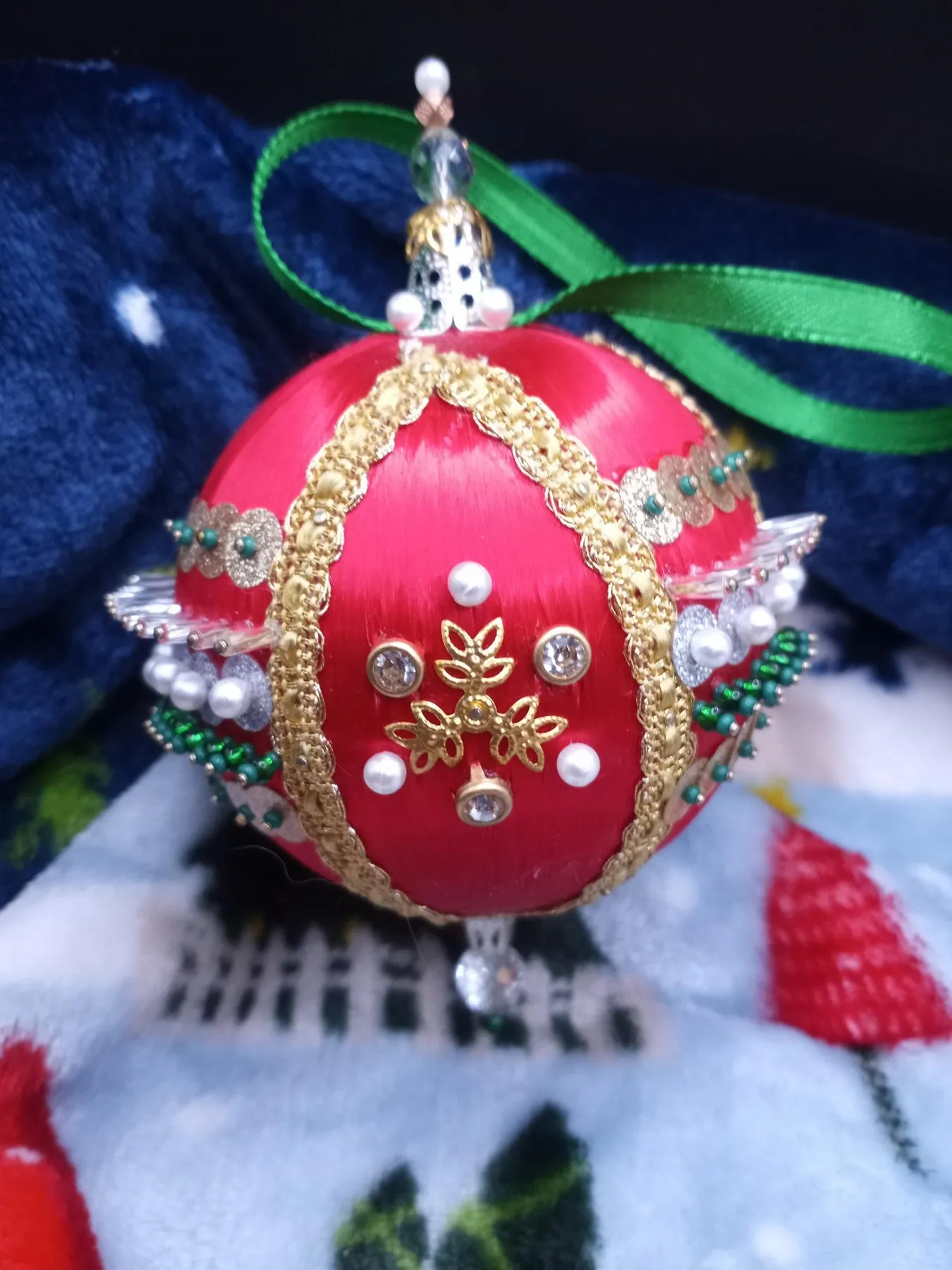
- 4-inch foam or satin-covered balls, set of 6: $12–$24
- Gold metallic braid trim, 3 yards: $6–$12
- Faux pearl strand, 1 spool: $4–$9
- Mixed sequins, 1 cup: $3–$6
- Green satin ribbon for the loops: $5–$10
- Sequin pins, 100 count: $4–$7
- Total: about $34–$68 for six ornaments
13. Felt Angel With Orange Yarn Hair and a Tiny Book
The proportions are childlike on purpose. Oversize head, short body, a book that’s really just two felt rectangles stitched at the spine. That naivety is the charm — a technically perfect angel would feel cold. The orange yarn hair is the one saturated note against all that white, and it sits high on the figure, so your eye goes straight to the face before it ever registers the wings or the halo.
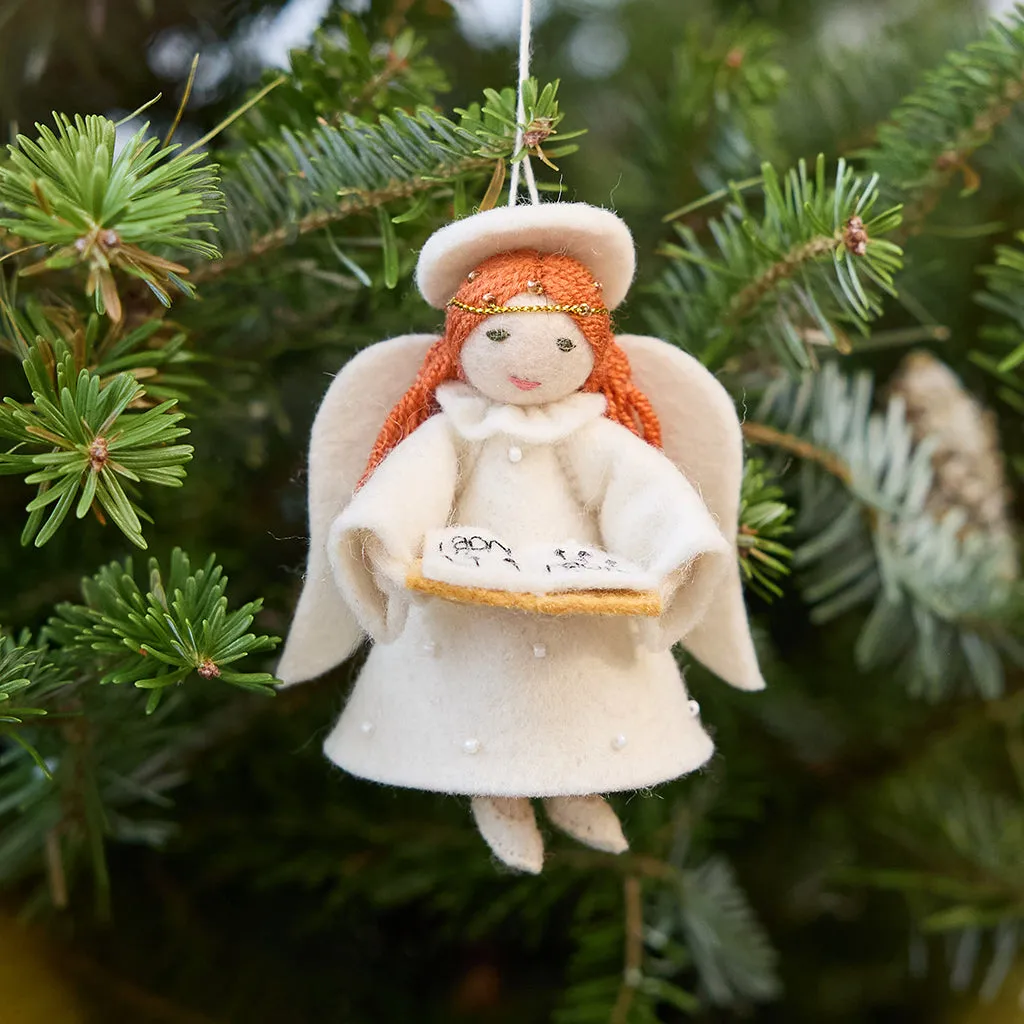
Yarn hair sheds. Wrap it around a fork, tie the center, cut the loops, trim — then seal the bundle with a thin coat of clear craft glue and let it dry completely before attaching. Otherwise you’ll find orange fibers on your tree skirt through January. Felt angels with stiff wings also break right at the shoulder seam, so reinforce the inside with a scrap of interfacing and store them flat in a box rather than hanging in a bin.
14. Purple Velvet Ornaments in a Satin-Lined Keepsake Box
The white satin-lined box. It sounds like packaging, and that’s exactly why it matters — this set displays as well open as it does hanging on a tree. Set it on a console with the lid off and you have an instant heirloom vignette that looks like it came out of a 1950s department store window. Line any gift box with two layers of satin, fold the raw edges under, and it reads as a keepsake immediately.
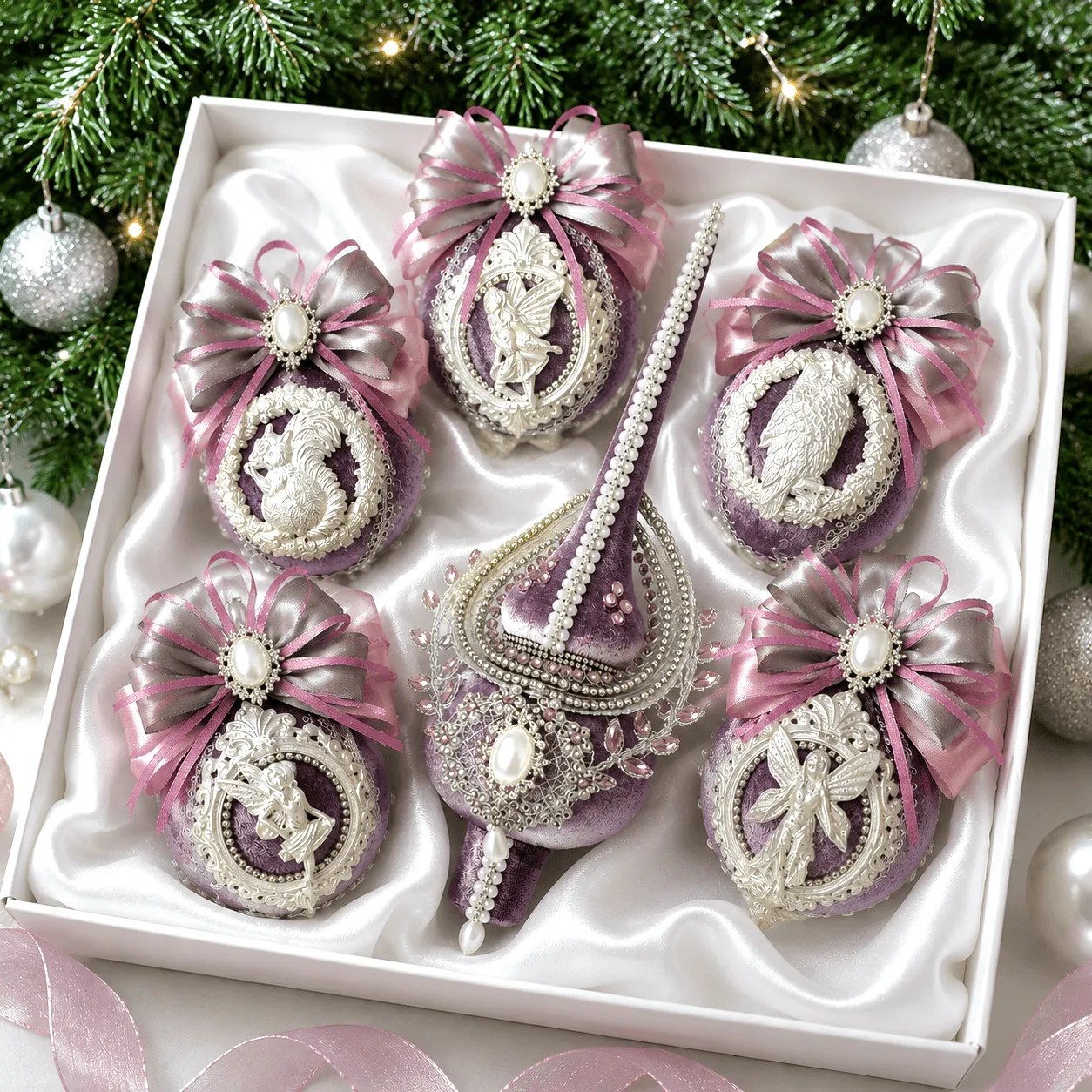
Think 55% purple velvet + 30% silver (filigree frames, pearl trim) + 15% soft pink and gray through the ribbon bows. Purple is the risky part, so the formula keeps it dominant but calm — zero pattern anywhere, all sheen and matte. To rework it in another color, hold the ratio and swap purple for deep teal or burgundy. Keep the bows a shade or two lighter than the velvet so they don’t compete.
15. Cardboard and Denim House Ornaments You Can Actually Make
This one is nearly free. Corrugated cardboard comes from shipping boxes you already have, and denim comes from jeans that blew out at the knee — thrift stores sell them for $3 to $5, and one pair covers about ten houses. A pair of blunt embroidery scissors and a hot glue gun are the entire toolkit. If you want fancier fabric, raid the remnant bin at a fabric store for quilting cotton at $2 to $4 a quarter yard, and a set of six still lands under $12.
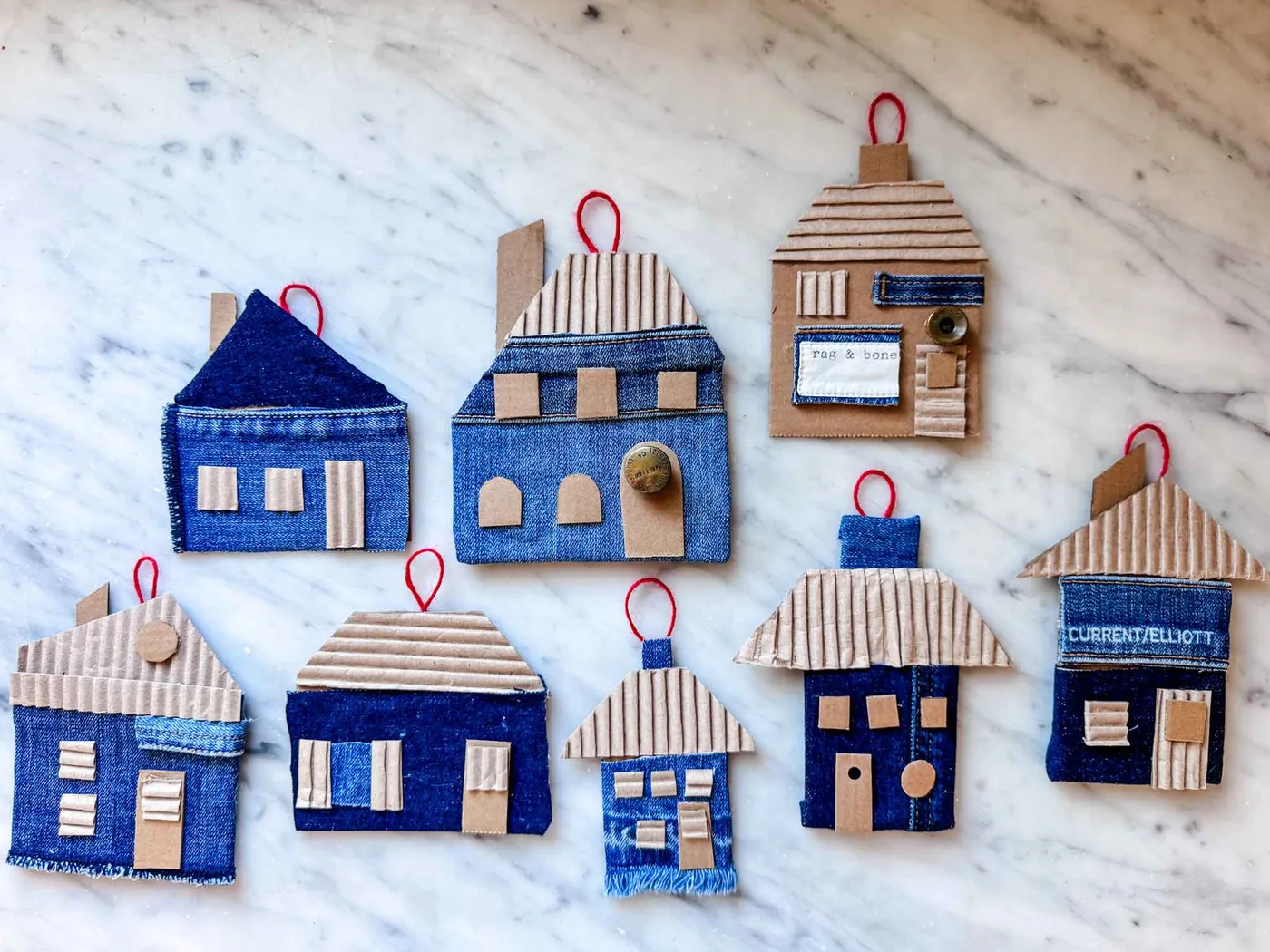
- Confirm your cardboard is single-wall — double-wall is too thick to fold cleanly at the roofline.
- Cut the denim with the grain so the fabric doesn’t ravel around the windows.
- Test your hot glue on a scrap first; low-temp keeps denim from scorching.
- Decide the hanging loop placement before you assemble, not after.
16. Flocked Bottle Brush Trees on Chubby Red Bases
Bottle brush trees read best in groups of three to nine at 3 to 8 inches tall. A group that size needs roughly a 12 by 8 inch footprint — a bookshelf ledge, a windowsill, a small tray on a side table. They’re the go-to for apartments and for filling gaps in a bigger scheme, and they look especially good lined along a narrow mantel where you don’t want foliage bulk. See Idea #22 for a pink version at the exact same scale.
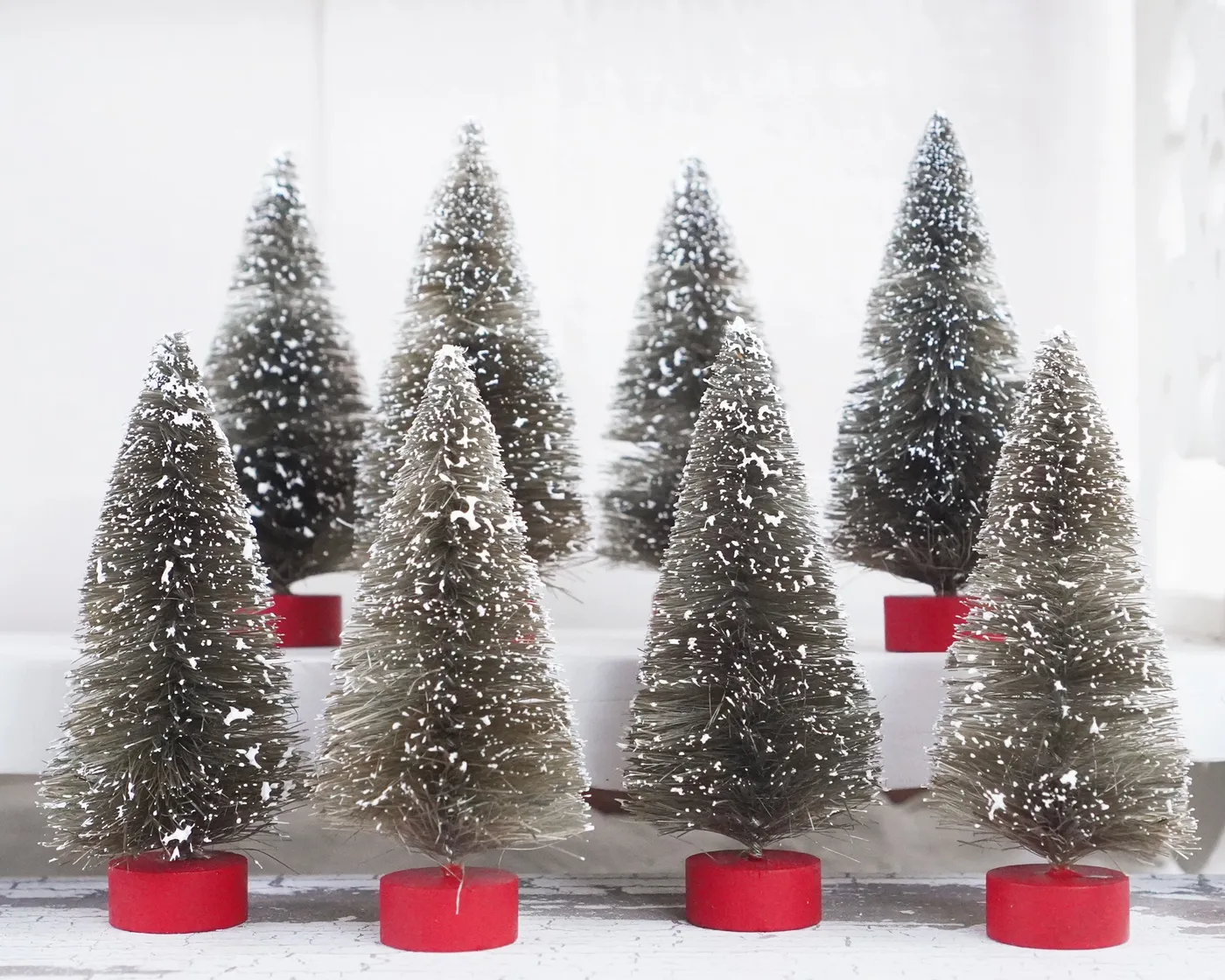
The red bases are doing the styling work, so treat them as color, not hardware. Cluster the trees with their bases almost touching and the red forms a broken line across the surface — far stronger than even spacing. Resist the urge to use a tray. On a plain white or pale surface these read as a collection; set them on a busy runner and they turn into clutter. Three is the minimum that reads as intentional, nine is the most before it looks like a shop shelf.
17. A Teacup Filled With Trees and Rhinestone Brooches
Scale contrast is the whole engine here. Three tiny trees in a human-sized teacup create a jump in size that the eye finds funny and delightful. Then the rhinestone brooches throw light off a matte bristle surface — the same trick at work in Idea #1. Gold tinsel at the base hides the mechanics, so the trees appear to be growing out of the cup rather than stuck into it.
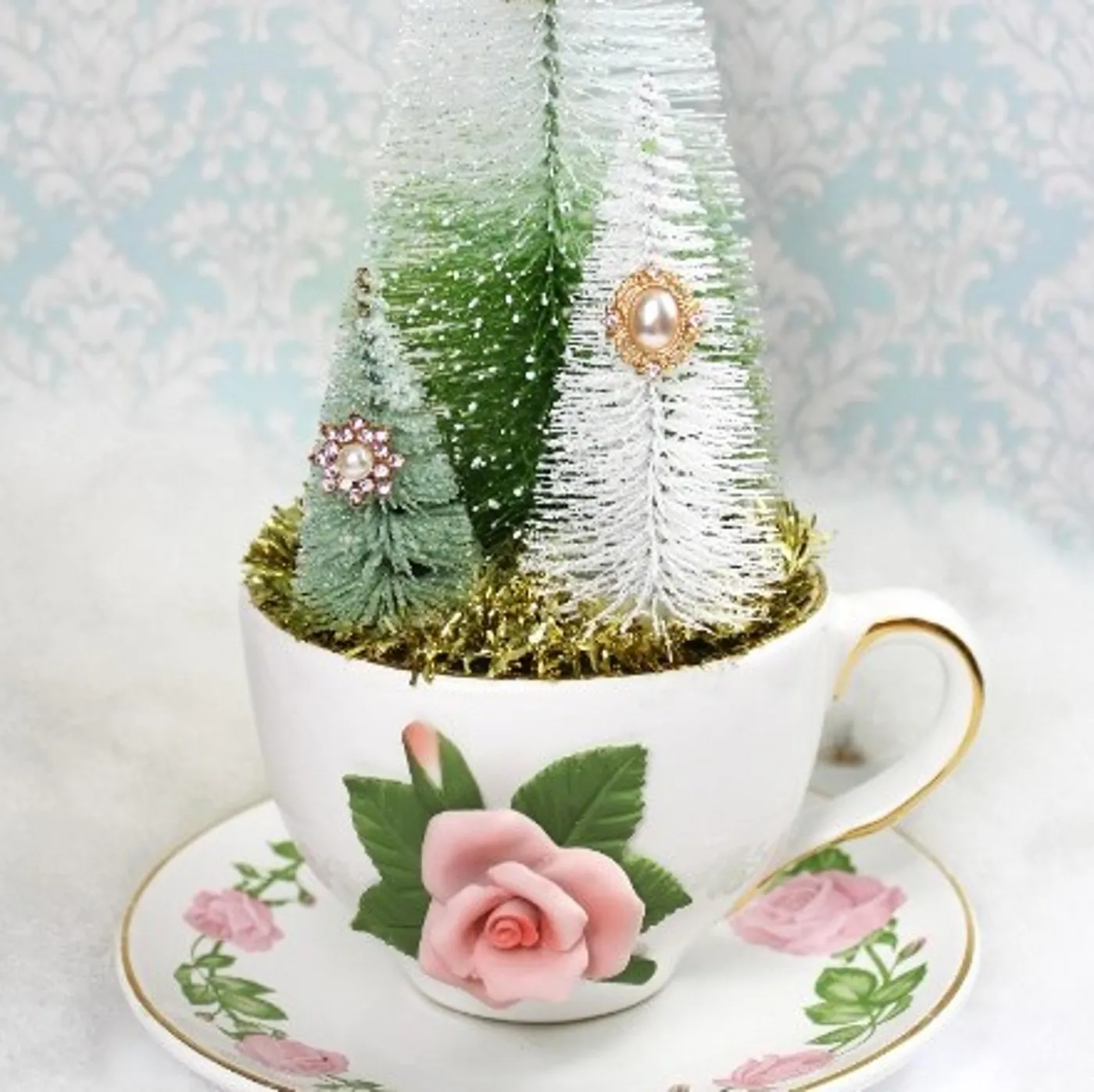
- Cut a piece of dry floral foam to fit snugly inside the cup.
- Push each tree stem into the foam, tallest toward the back.
- Fill the visible foam with gold tinsel, working in small pinches.
- Pin a brooch or single earring to two of the trees with a straight pin.
- Set the cup on its saucer and finish with a dust of faux snow.
Fifteen minutes, and no glue means you can rearrange the whole thing next year.
18. A Rustic Tabletop Vignette With Aged Paper and Berries
Aged and paper elements hate moisture. If this vignette sits in a kitchen or near a bathroom, the paper decorations will curl within a week — keep them on a table in a dry room and well away from any humidifier. Vintage glass ornaments chip when they knock together, so rest them on felt pads instead of stacking them loose. Fresh pine sprigs drop needles after about ten days, so plan on swapping them twice between Thanksgiving and New Year.
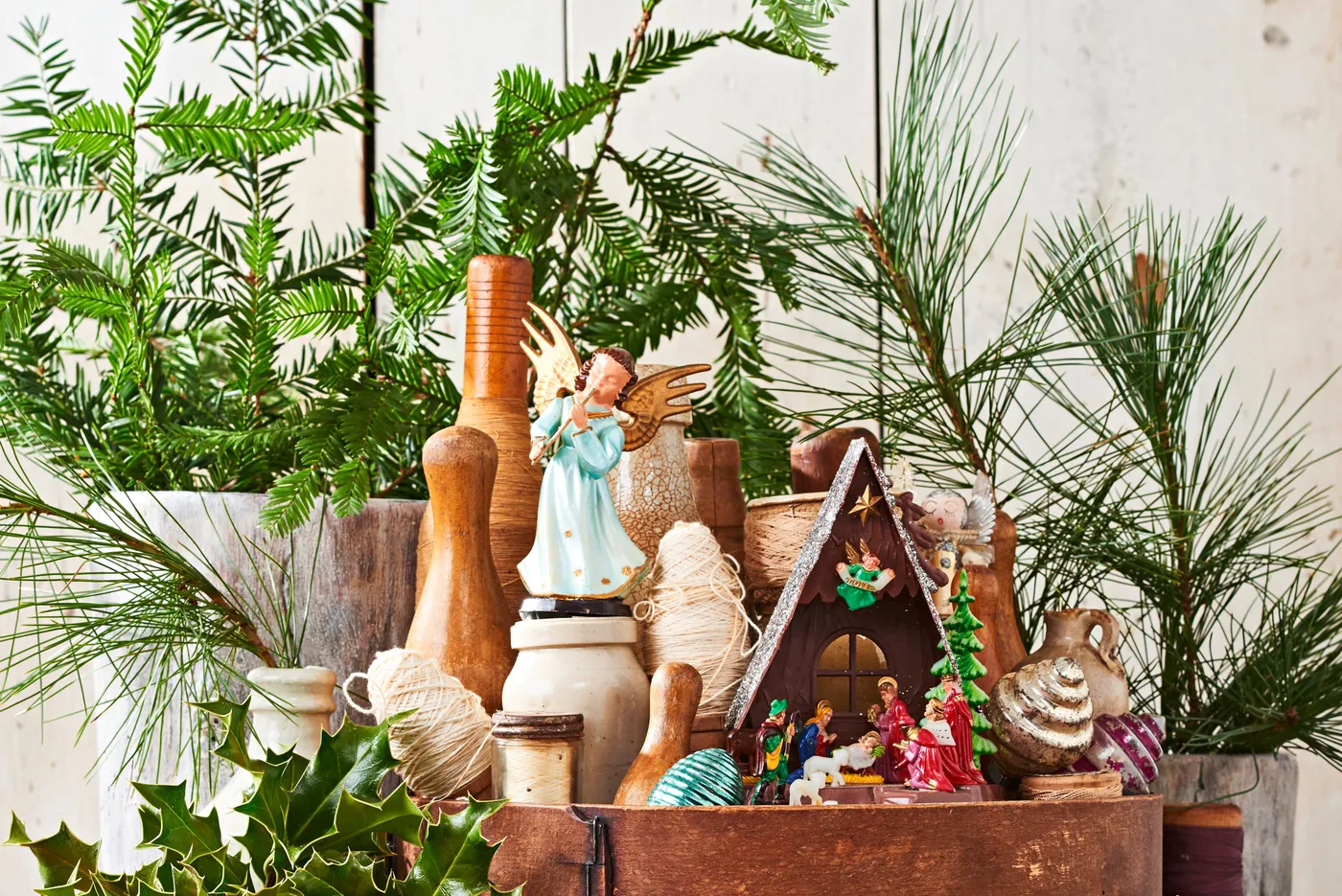
You can build this for under $40 if you shop estate sales in October, before Christmas pricing kicks in. Glass ornaments go for fifty cents to two dollars apiece in mixed boxes. Bottlebrush trees turn up at thrift stores for a dollar or two, and Walmart sells a six-pack of small ones for around $8. The aged paper decorations you can make yourself — tea-stain plain cardstock, dry it on low in the oven, and it looks thirty years old for the price of a tea bag.
19. Glitter Putz Houses Nestled in Flocked Branches
Putz houses — the little glittered cardboard villages sold in dime stores from the 1930s through the 50s — had a real resurgence around 2020 and never came back down. In 2026 the collector market is tight and new production has caught up, so you can buy a set of six for around $20 or hunt originals at $15 to $60 each. Either way people love them because they’re a village you build slowly, one house at a time.
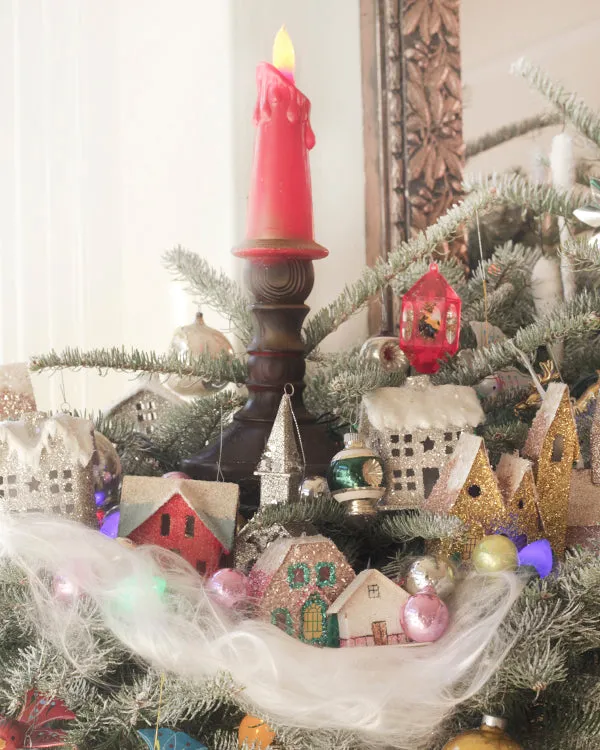
A branch display like this needs only about a square foot of shelf, but it wants depth in front of it — the houses read best with 8 to 12 inches of clear space so nothing crowds the glitter. It’s a console or sideboard piece, not a dining table centerpiece, since people lean in close to look. In a large open room, cluster three separate branch displays along one long surface rather than building one big one.
20. Mercury Glass Ornaments on a Black Metal Stand
Plum ribbon on silver mercury glass is a strong pairing and also a very specific one — add a third accent color and it collapses. Mercury glass is genuinely fragile at the neck where the metal cap meets the glass, so hang these where nothing bumps them, and skip them entirely if you have cats. Red poinsettias at the base will drop leaves within two weeks indoors unless you water carefully and keep them out of drafts.
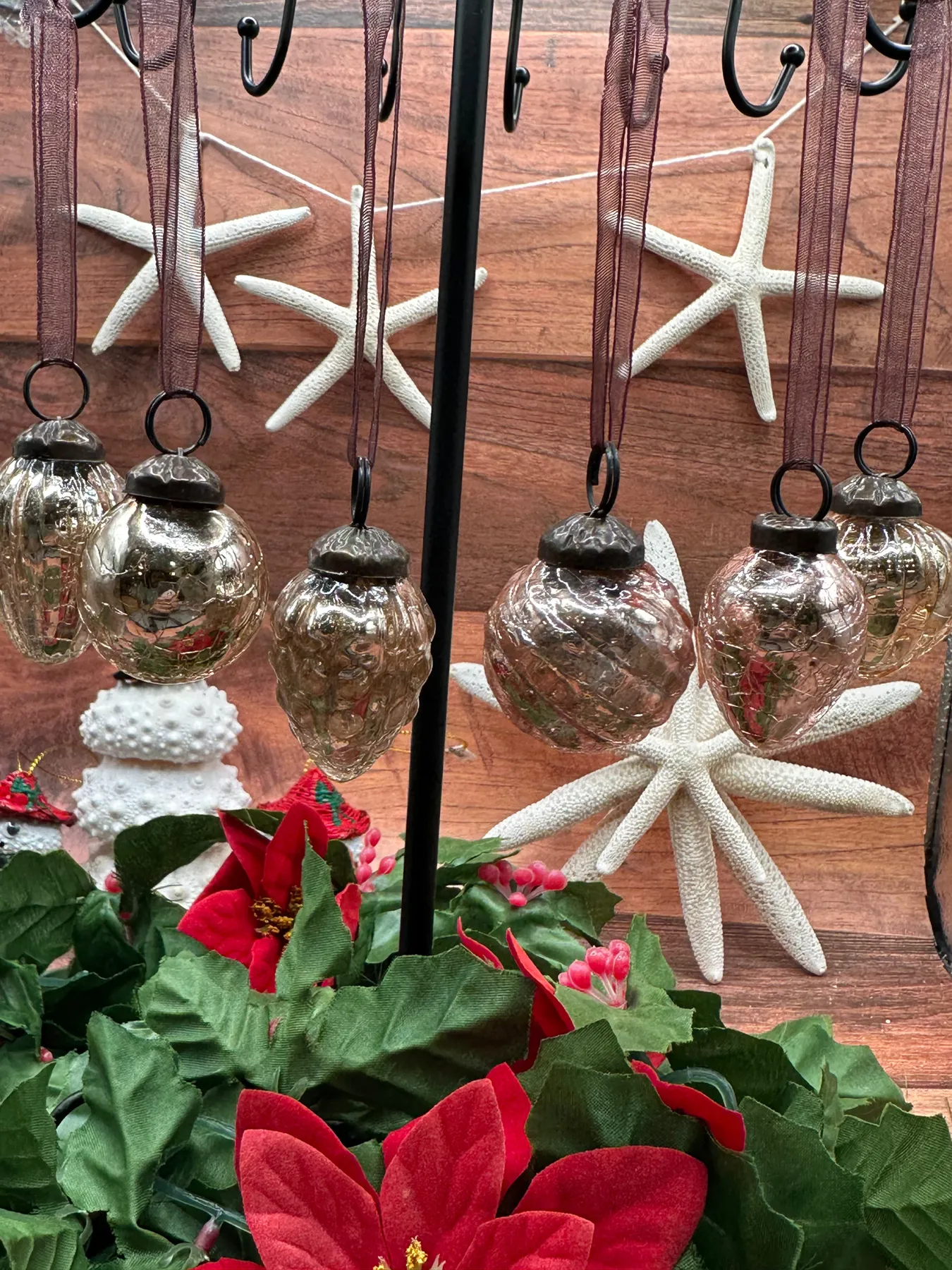
Roughly 60% silver mercury glass + 25% plum purple + 15% bright red at the base. That red is a small dose, but you need it — silver and purple alone run cold and slightly somber. The wood plank wall behind adds a warm neutral that keeps everything from feeling like a jewelry counter. To shift seasons, hold the silver and swap plum for deep green and the red for copper.
21. Wood Slice Santas Framed in Distressed Red Scallops
- Print or decoupage a vintage Santa illustration onto a 3-inch wood disc.
- Sand the edges back so the image looks worn at the border.
- Cut a scalloped frame from 1/8-inch plywood with a scroll saw.
- Paint the frame barn red, then dry-brush beige across the ridges.
- Glue the frame behind the disc and seal with matte polycrylic.
- Tie a red and white plaid bow through the drilled hanger hole.
About 35 minutes per ornament once the paint has dried.
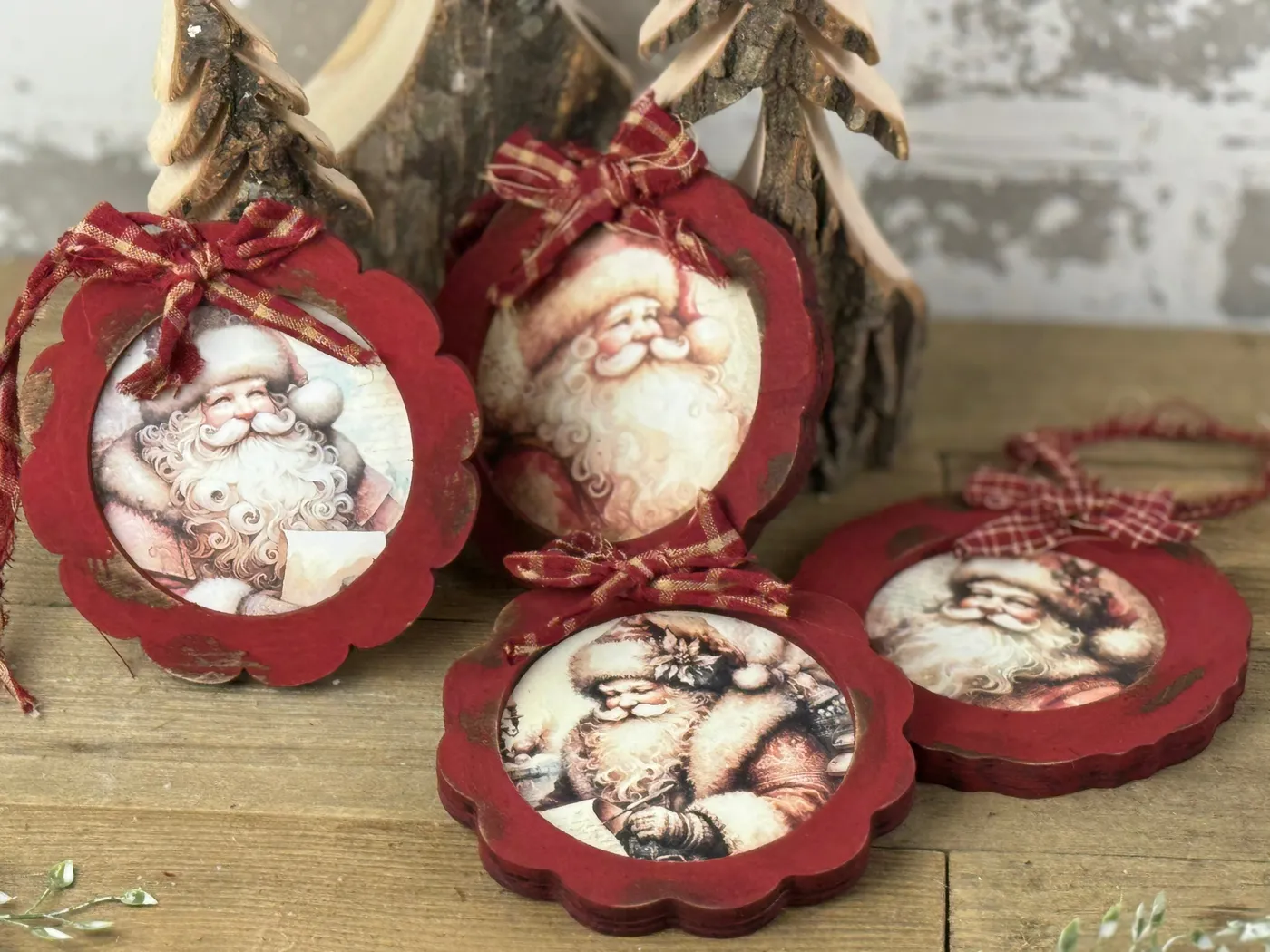
The scalloped red frame is the one element that matters. A plain round frame around the same Santa image would look like a craft-fair ornament. The scallop edge gives it a silhouette that reads from across the room, and the sanded-back red tells your brain it’s old. That’s the whole difference between vintage and vintage-style. Cut the scallops slightly irregular, too — perfect geometry is the giveaway.
22. A Pink Bottle Brush Tree Behind a Tiny Picket Fence
You can fake this entire scene for under $20. Start with a plain bottle brush tree and dunk the bristles in watered-down pink craft paint, spin it, and let it dry on wax paper — about $6 total. Silver tinsel is a dollar at dollar stores. For the fence, popsicle sticks and craft paint run about $3, and a bag of multicolor mini ornaments is $4. Set the whole thing on a mirror or a sheet of acrylic for that frozen-pond reflection.
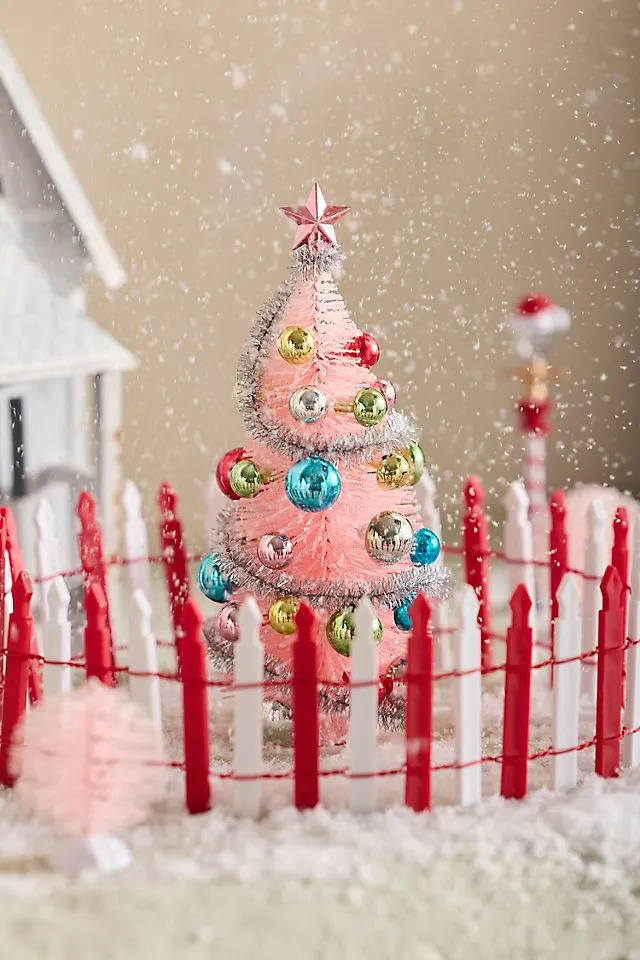
Pink trees can tilt toward nursery very fast. Keep them adult by limiting the ornament palette to three tones — here, red, silver, and white — and by letting some bristles stay bare. Density is what separates a styled tree from a toy: aim for roughly 70% coverage, not 100%. A 12-inch tree takes about 20 mini ornaments, no more. And set the fence slightly off-center so the composition doesn’t look like a diorama kit.
23. A Vaulted Room Where the Tree Shares Center Stage
The tree doesn’t try to be the whole room. The fireplace holds its own with a wreath and garland, the dining table has a separate green centerpiece, and the chandelier carries pine boughs overhead — three distinct green moments that rhyme instead of competing. The monogrammed chairs pull your eye back down to human scale. Repetition of one material across three heights is what makes a holiday room feel designed rather than merely decorated.
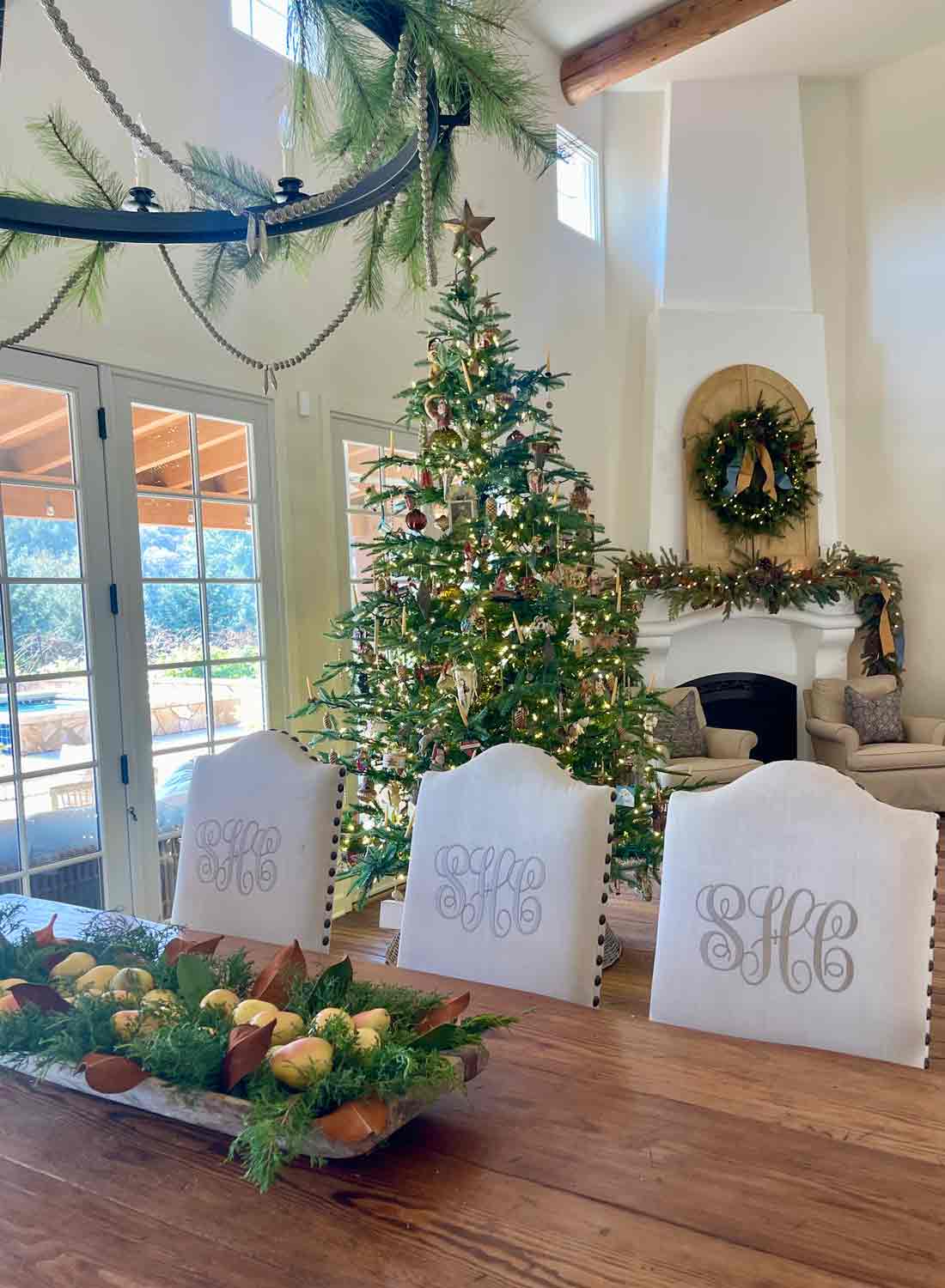
This approach needs real volume — roughly 12-foot ceilings and 300 square feet of open floor, because the tree, the table, and the chandelier all need breathing room between them. In an 8-foot room, keep the tree and the fireplace and drop the overhead greenery entirely. If you’re working with a smaller footprint, the console-scale setup in Idea #9 gives you the same warmth without the square footage.
24. Honeycomb Paper Stars and Bells on Pine Branches
- Cut honeycomb paper into 6-inch circles, then fold in half four times.
- Snip the folded edge into a fan or scallop pattern.
- Unfold and glue alternating layers of two colors at the spine.
- Press flat under a heavy book for an hour so the folds hold.
- Punch a hole at the top and thread fine cotton string.
- Hang from pine branches so each honeycomb opens fully.
Ten minutes per ornament, and the paper runs about 40 cents a sheet.
Honeycomb paper crushes — that’s the trade-off for how good it looks. Store these flat between sheets of tissue in a rigid box, never loose in a bin and never stacked under anything heavier. Keep them out of direct sun or the kraft paper yellows unevenly within a season, and note that steamy rooms make the folds droop. Fresh pine branches drop needles, so plan on replacing them every ten days.
25. Bottle Brush Trees and a Reindeer Sleigh Team
Little plastic reindeer are charming and also extremely breakable at the antlers — one knocked-over sleigh and you’re gluing. Buy extras. Keep the display above waist height on a shelf or console so it doesn’t become a toy set, and if kids are around, treat it as touchable and move the fragile bottle brush trees to the back. Charcoal and pink together look deliberate; add a third novelty color and it starts looking like a rummage sale.
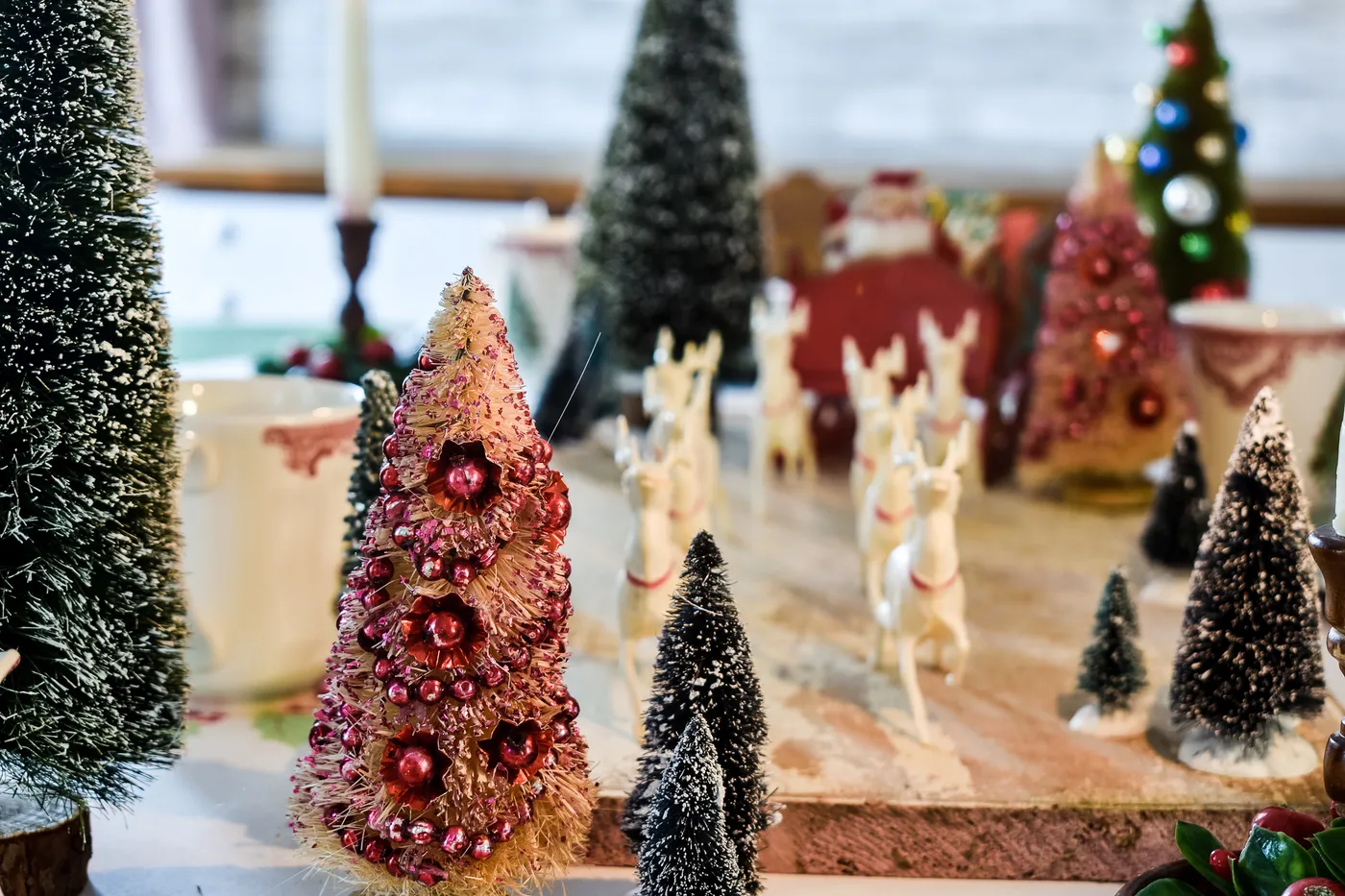
- Bottle brush trees, 8–10 mixed sizes: $20–$45
- Beaded or sequined accent tree: $12–$28
- Reindeer figurines, set of 4–6: $10–$24
- Miniature red sleigh: $8–$18
- Metallic bead garland and reflectors: $6–$14
- Total: roughly $56–$129
26. A Fabric-Covered Tree With Pompom Fringe Garland
If you’re covering a form in fabric, cut on the bias for the corners and always buy more than you think — a 24-inch tree form takes about a yard and a half of quilting-weight cotton. Spray adhesive goes tacky in roughly 40 seconds, so work in 6-inch sections. Run the pompom fringe in a shallow spiral rather than evenly spaced rings; that slight irregularity is what makes a handmade tree look handmade. Use hot glue, not fabric glue, for the trim.
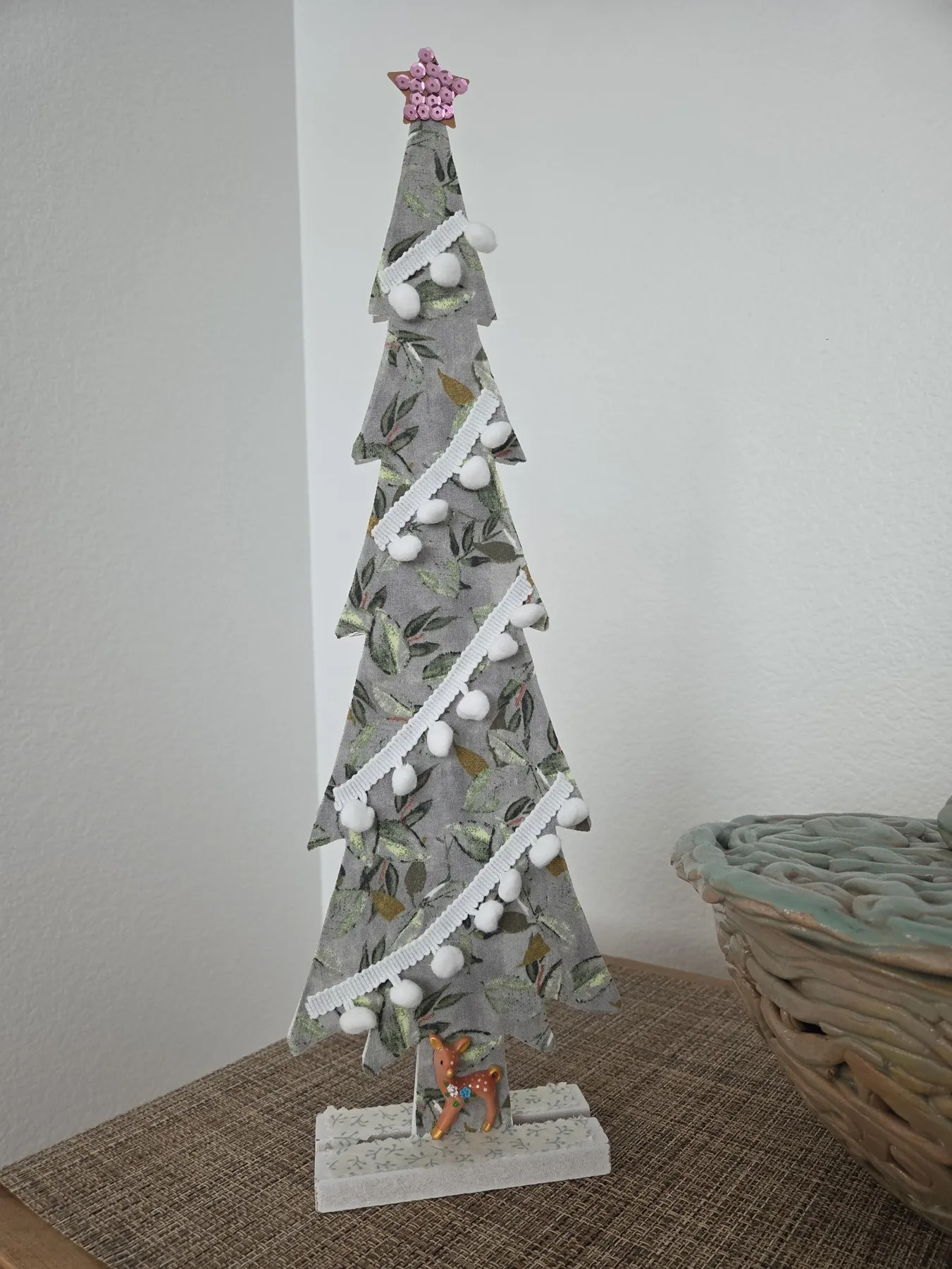
The pompom fringe is doing all the personality work. Without it you’d have a fabric cone; with it you have something that reads as a folk-art heirloom. The pink sequined star topper matters too, but it’s a period at the end of a sentence. Fringe gives the tree rhythm — a repeating texture that catches light and reads from across the room.
27. Lace-and-Button Hearts Tucked Into Frosted Branches
About 70% frosted cream and soft green + 20% silver (the star, the wire picks) + 10% muted red through the buttons and lace. That small red dose keeps the whole thing from reading as a winter wedding. Swap the red for dusty blue and it goes colder and more Scandinavian; swap for soft gold and it turns romantic. Keep the fabric ornaments in the same cream family so texture carries the variety instead of color.
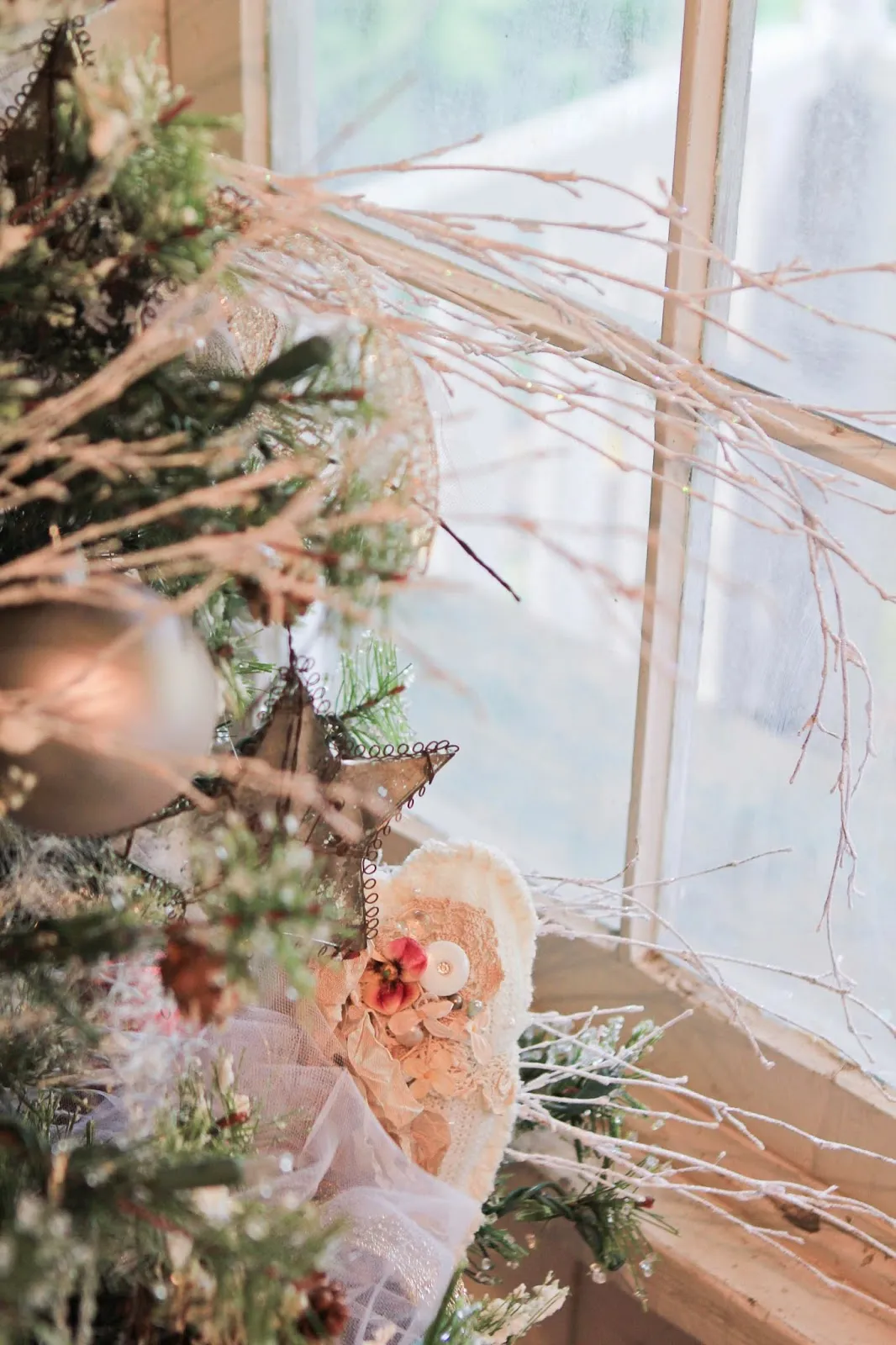
Lace over felt over tulle is a study in how many soft textures a single branch can hold before it’s too much — the answer is roughly three. The multi-pane window is doing real work too: it backlights the tree in daylight and reflects fairy lights at night, effectively doubling the sparkle without adding a single ornament. If you have a window with muntins, that’s where the tree goes.
28. A Champagne Mantel With Pompom Garland and Ruffled Stockings
- Measure the mantel’s clear height — stockings need about 16 inches below the shelf.
- Check where your outlets are; you’ll want one at each end of the garland run.
- Test bulb color against your wall paint — champagne golds go gray under cool LEDs.
- Confirm nothing on the mantel sits within 12 inches of a heat source.
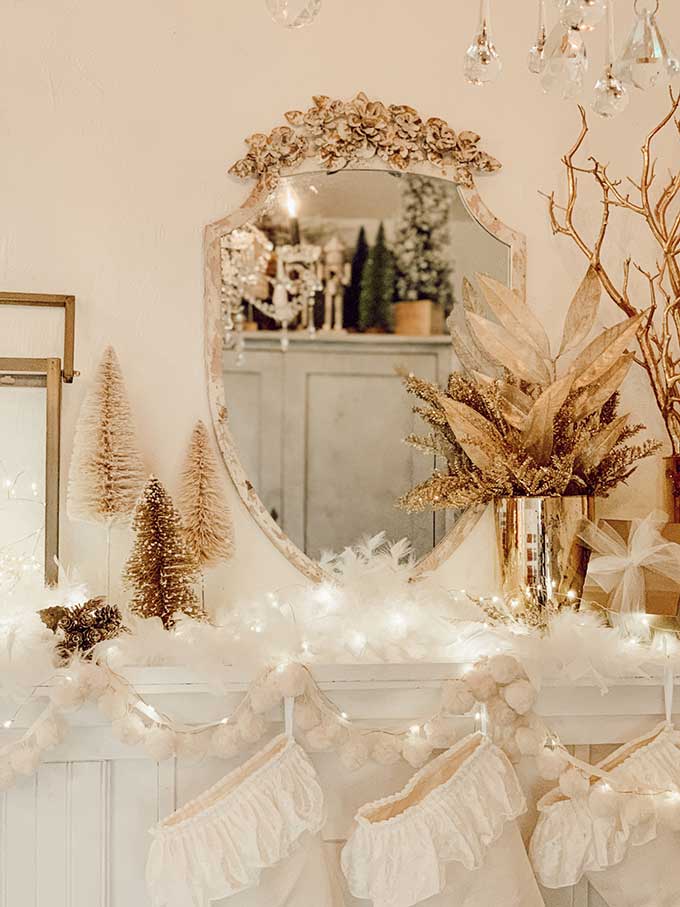
A mirror over a mantel is gorgeous and it also doubles everything — including the mess. Keep the mantel surface to three zones or it reads as cluttered in reflection. Champagne and cream look washed out against cool gray walls, so warm the bulbs before you judge the result. And ruffled stocking cuffs collect dust like nothing else, so plan on a hand wash before the season starts, not after.
29. Mercury Glass Finials, Pillar Candles, and Flocked Pine
Mercury glass finials run $8 to $35 each new, and $2 to $8 at estate sales, where they’re usually sold as “silver glass balls” with no fanfare attached. Pillar candles are the cheap part — buy plain ivory ones and wrap the bases in a strip of parchment paper for a vintage taper look, about $2 per candle. Flocked pine picks come in a 12-pack for $10 at craft stores in November, and pinecones are free if you have a park nearby.
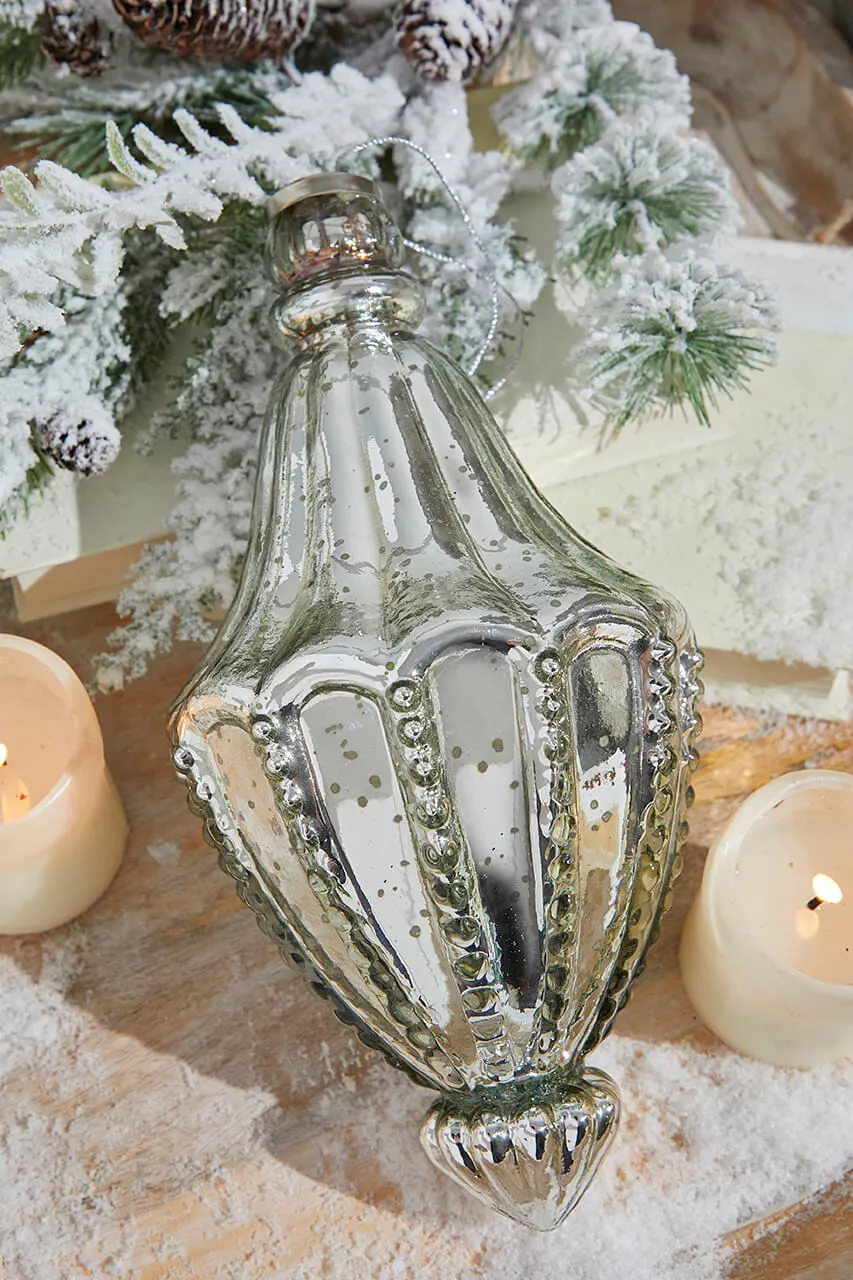
Mercury glass has been creeping back since about 2022, and finial shapes specifically are the 2026 tell — people are tired of round baubles and want ornaments with a silhouette. It’s the same drift you can see in Idea #7, where shape does the work instead of color. Candles in the mix are part of the broader unplugged-holiday mood: warm light, real wax, nothing that needs an app.
30. A Lit Tree Next to a White Brick Fireplace
- Artificial tree, 7–9 ft: $150–$500
- Warm white string lights, 800 bulbs: $40–$90
- Green mantel garland, 6–9 ft: $35–$85
- Brass candlesticks, pair: $25–$70
- Textured tree skirt: $30–$70
- Total: about $280–$815
Budget alternative: thrift the candlesticks and skirt and you’ll cut $80 to $150 without touching the look.
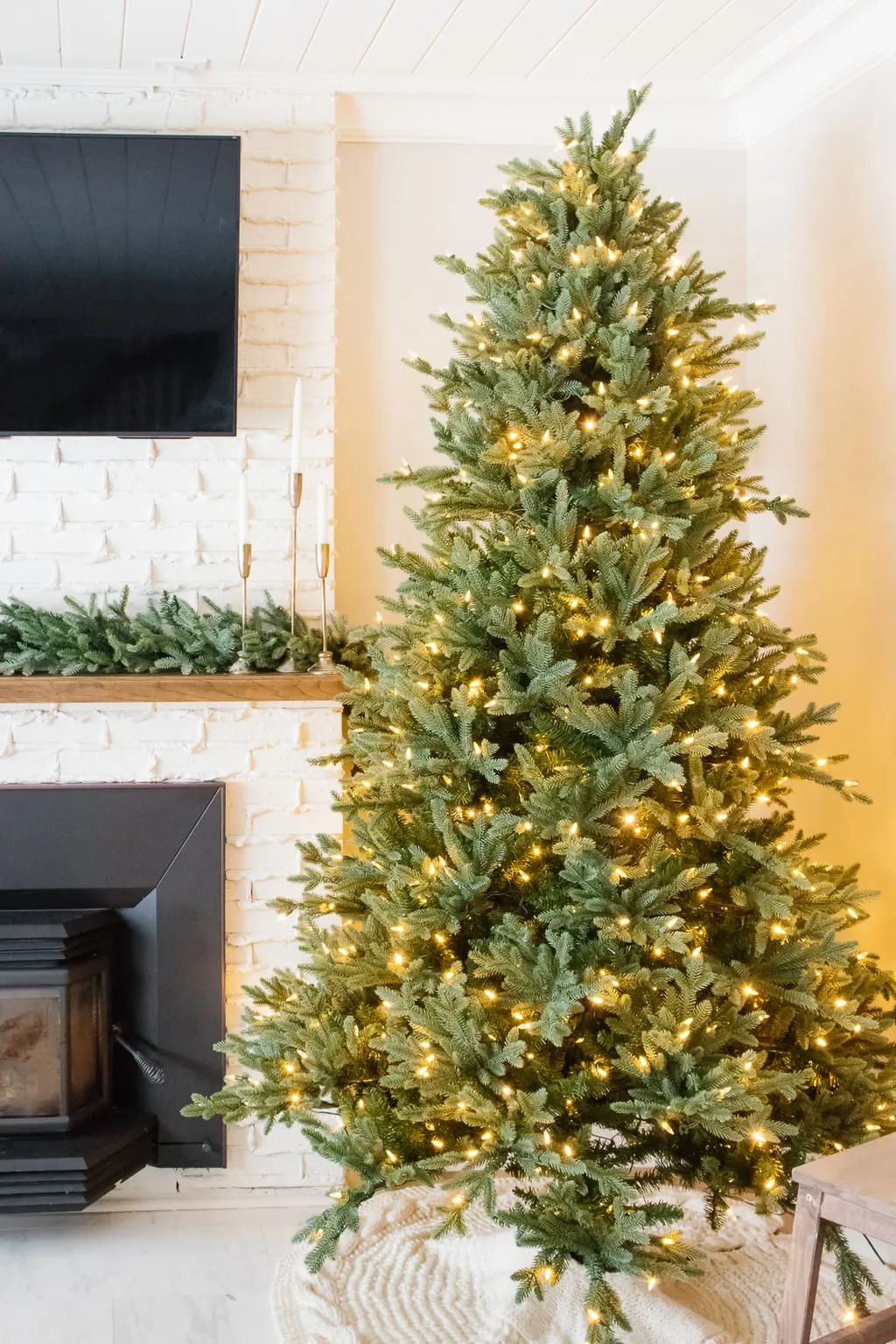
Keep the garland off the mantel’s front edge. A garland that hangs below the shelf crowds the firebox and makes the fireplace read shorter than it is. Instead, run it along the top with the tails tucked back toward the wall, and let thin brass candlesticks carry the vertical interest. If there’s a television above the mantel, keep the garland under 4 inches tall so it doesn’t fight the screen.
Start Collecting in July, Thank Yourself in December
Vintage Christmas crafts reward patience more than budget — the estate-sale brooch you found in July is what makes December’s display feel like it has a history. Pick one idea from this list, do that one thing well this year, and let the collection grow from there.
📌 Pin the ideas you love to your Christmas board now, while you can still find everything — next December you’ll be glad you did.