
You know that feeling when you’ve pinned forty tablescapes and still can’t commit to a single one? Same. So instead of adding to the pile, we went hunting for the real thing: tables actually set by real people, in real dining rooms, on real budgets.
After filtering through hundreds of options across Etsy, Target, Anthropologie, H&M Home, and Amazon, we narrowed it down to 31 ideas that actually deliver — from a $12 set of napkin rings to a $480 statement centerpiece.
Inside you’ll find lush evergreen garlands, glossy holly accent plates, gingerbread men on centerpiece duty, and black felt runners with hand-appliquéd cardinals. Budget and luxury versions sit side by side so you can see exactly where the money goes. And stay until the end — we break down the most common mistakes that can ruin these looks.
In 2026 the mood has moved toward tables that look collected rather than catalogued: layered plaid, thrifted brass, candles at eye level. A few links below are affiliate links, which means we may earn a small commission at no cost to you.
📌 Save this to Pinterest for later — you’ll want to revisit these ideas.
1. Gold-Rimmed Elegance on a Round Dark Wood Table
Round tables have a sightline problem: everything in the middle sits directly between two people. The fix is a centerpiece that stays under 12 inches tall at its peak, then rises again with candlelight above 30 inches. That tiered berry bowl works because it is wide and low at the base, while the gold candlesticks flanking it push light up and out of the conversation zone. Measure before you buy — a 14-inch vase will feel like a wall.
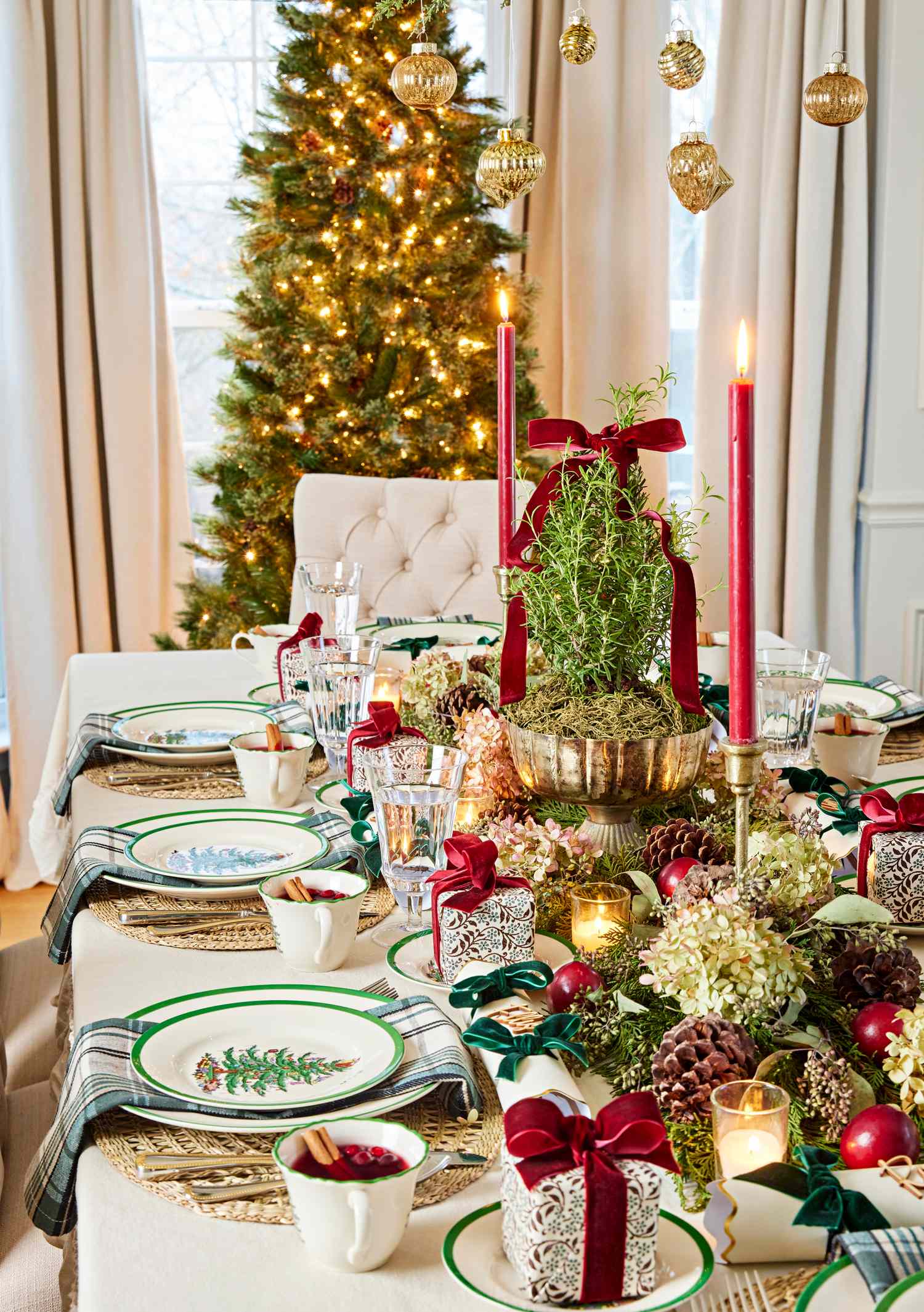
Take away the tiered bowl of red berries and green foliage and this becomes a nice set of dishes. The bowl is what gives the dark wood something to answer to: it repeats the red from the patterned plates, adds height without blocking anyone, and pulls the gold candlelight into the middle of the table. If you own one good centerpiece, make it a footed one — it does the work of three flat arrangements.
2. A Wreath Suspended Over the Table Changes Everything
Hanging a wreath above the table is a 30-minute job and about $15 in hardware.
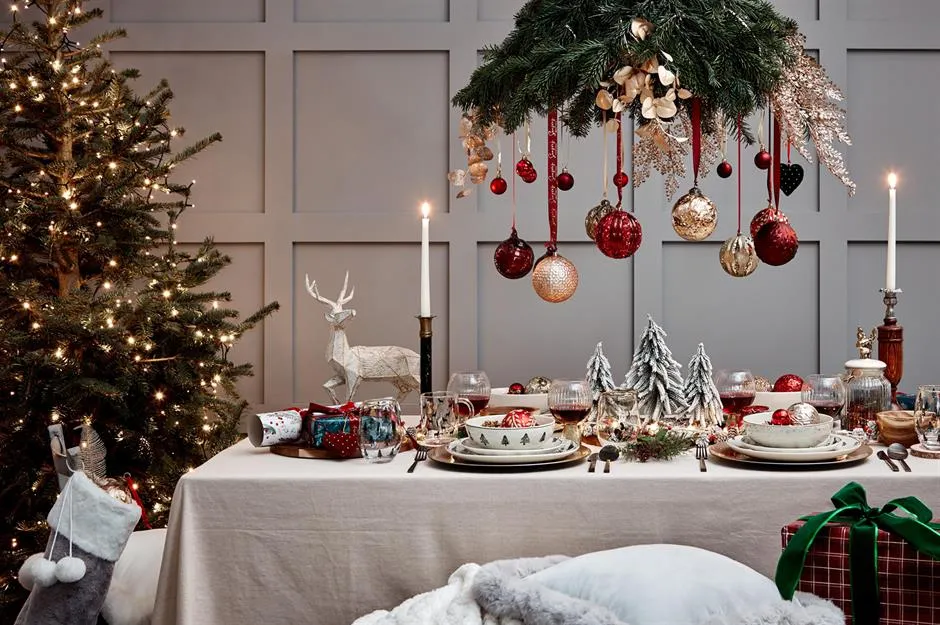
- Find a ceiling joist — or use a 25 lb toggle bolt, because a drywall anchor alone will not hold a wreath plus ornaments.
- Screw in a small white cup hook; it disappears against most ceilings.
- Loop 20 lb clear monofilament through the wreath’s wire frame at two points so it hangs dead level.
- Set the bottom of the wreath 30 to 36 inches above the tabletop: high enough to see under, low enough to feel like a chandelier.
- Wire in the red and gold baubles after it is hung — gravity rearranges them if you do it first.
The gold chargers do most of the heavy lifting and they are the cheapest part. Target and Dollar Tree sell them for $1.25 to $3 apiece; stack plain white plates on top and nobody notices the difference. A 24-inch faux wreath runs about $18 at IKEA or Michael’s on sale, and a bag of red and gold baubles is under $10. Six settings, roughly $65 instead of $300.
3. Rustic Plaid Meets Gold Candlesticks on a Raw Wood Table
The formula: 50% dark wood, 25% white linen, 15% deep evergreen, 10% gold and red combined. That last 10% does all the emotional work — the lit tapers, the berries, the skinny red bows at each napkin. Swap the evergreen for eucalyptus and the gold for aged brass and you keep the bones with a calmer mood. Swap the dark table for painted white and the whole thing turns coastal, so resist that one.
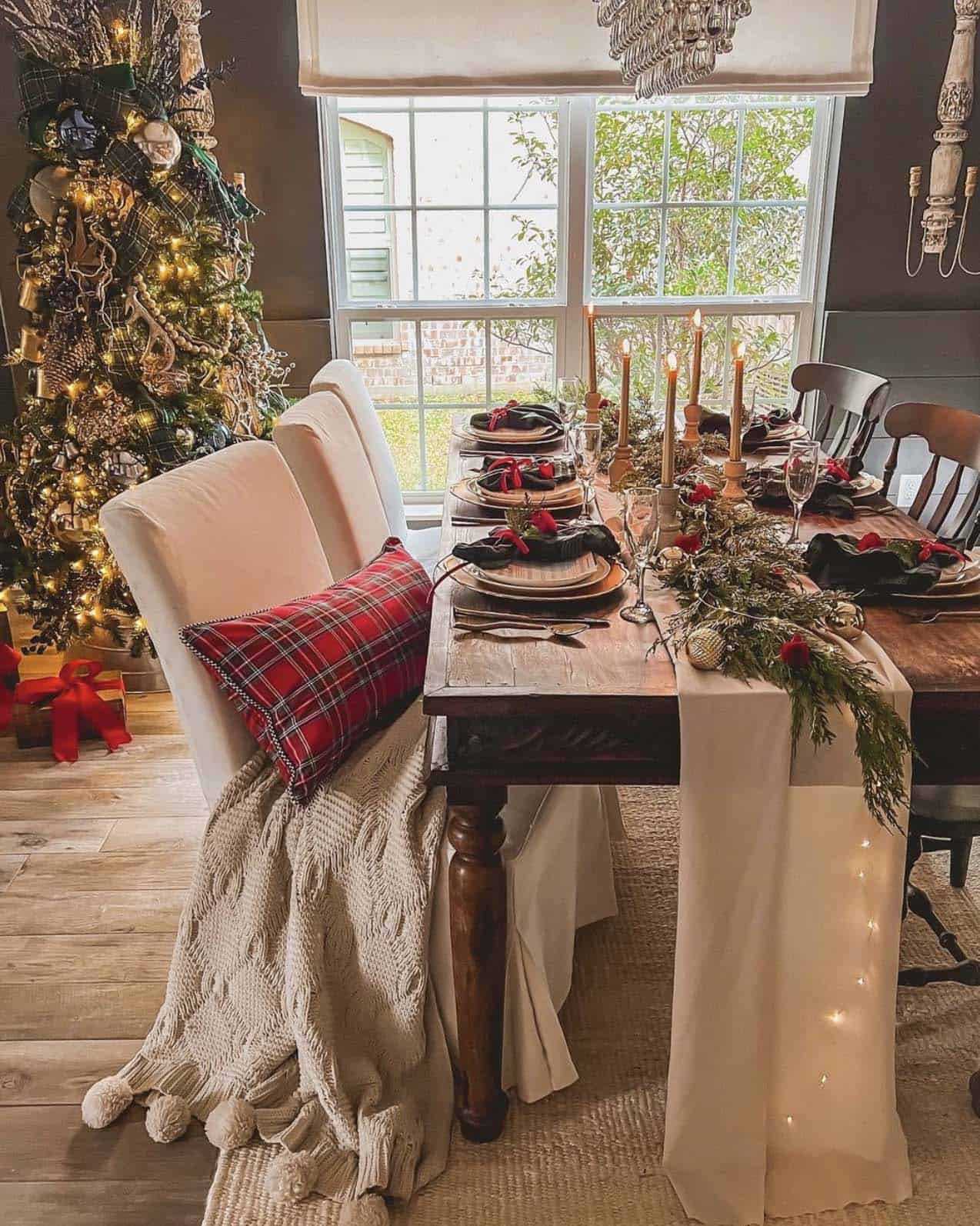
Two things to plan for. Fresh garland drops needles the moment it dries, so keep it away from radiator heat and mist the underside every other day — or buy faux and accept that you will be picking plastic sprigs out of the rug until February. And open flame plus garland plus tablecloth plus wine is a real combination. Battery tapers inside glass look 90% as good and let you leave the room. For the greenery without the upkeep, Idea #31 is the pared-down version.
4. Cardinals, Pinecones, and a Garland That Runs the Whole Table
Three patterns live on this table — plaid plates, botanical napkins, a printed runner — and it doesn’t feel chaotic because every one of them stays inside the same four colors. That’s the actual rule: pattern count doesn’t matter, palette count does. The garland earns its scale by repeating the same red berries that show up in the glassware and again in the napkins, so your eye keeps finding the same note in different keys. The cardinals are the wink.
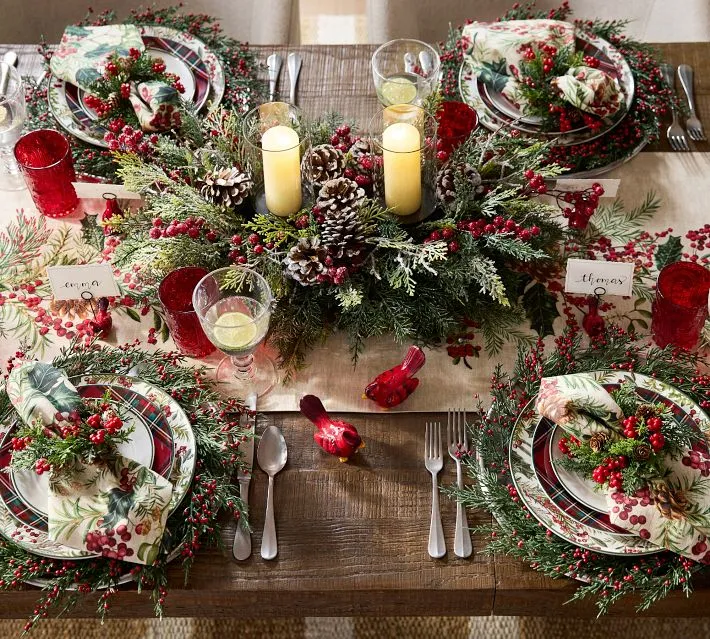
One 6-foot garland never looks like this. Buy two and twist them together, wiring every 10 inches with 22-gauge floral wire, then bend the branches outward instead of letting them lie flat. Two $25 garlands read like a $200 custom runner. Same trick with the pinecones — cluster them in threes rather than spacing them evenly, because even spacing is what makes faux greenery look faux.
5. Red Tablecloth, Illustrated Plates, and Two Fluted Glass Lamps
- Deep red tablecloth or long runner: $30–$90
- Illustrated Christmas dinnerware, 8-piece set: $60–$160
- Gold chargers and gold-toned flatware: $40–$120
- Red amaryllis centerpiece (fresh or good faux): $25–$85
- Two fluted glass lamps plus crystal glassware: $50–$150
- Total: $205–$605
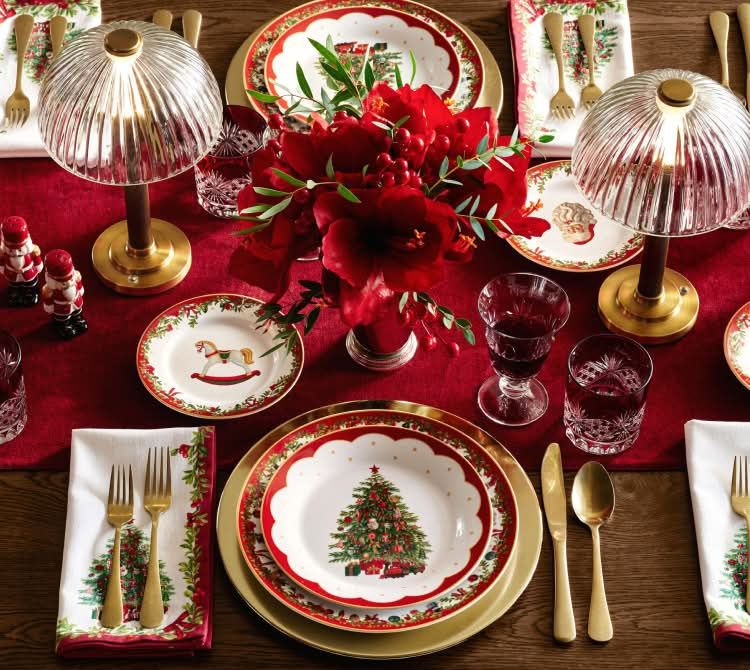
Budget alternative: skip the fluted lamps and use two pillar candles in glass hurricanes ($18), plus a $12 supermarket amaryllis. You land near $180 and keep every bit of the red.
The pendulum has swung back from five years of bleached-linen minimalism. Red is one of the fastest-growing colors in holiday tablescape saves, and searches for traditional Christmas tables keep climbing as people get tired of beige. This is the maximalist end of that shift: a full red cloth, illustration-heavy plates, actual lamps on a dining table. It has staying power because it isn’t really a trend — it’s a return.
6. Robin Placemats and Mercury Glass for a Long, Narrow Table
This setup is built for a long, narrow table: 72 to 96 inches long, 36 to 40 inches wide. The foliage runner eats about 10 inches of width, which still leaves room for 12-inch place settings on both sides. Narrower than 34 inches? Drop to a single row of candles and skip the garland entirely. If your room is small, Idea #11 solves the same problem on a 42-inch round.
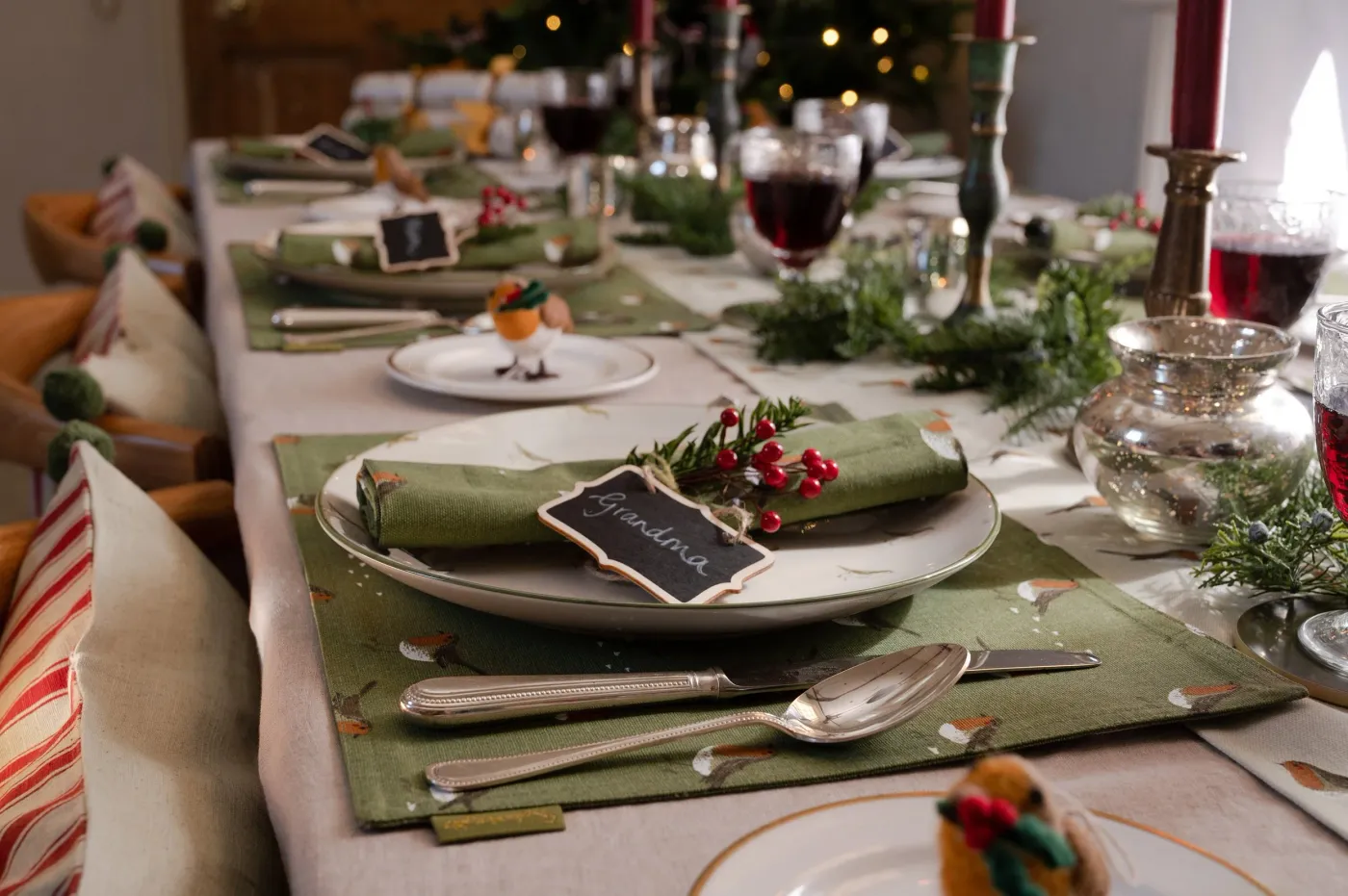
Candles read best in odd numbers with a three-inch height stagger — a 6-inch, a 9-inch, and a 12-inch holder grouped tightly beats five identical ones spaced evenly down the table. Keep the tallest flame below eye level when you are seated, or you will spend dinner squinting through a glare. Twelve inches above the tabletop is your ceiling. The mercury glass votives at each end are what stop the arrangement from looking like a fence.
7. Miniature Evergreens in a Tray of Faux Snow
Strip this table back and the thing you’d miss is the shallow wooden tray of faux snow holding three miniature evergreens. It is the only element that isn’t flat — it gives the eye a small landscape to look at between the plates, and it corrals the snow so you aren’t vacuuming polyester fluff out of the carpet in January. Contain your mess and you can be as theatrical as you like everywhere else.
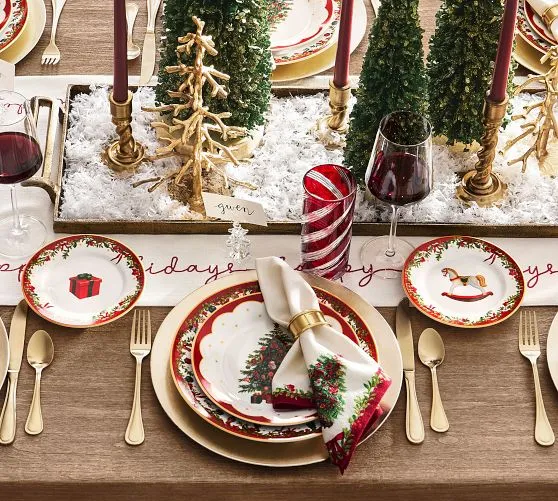
Patterned Christmas plates are where the budget goes, so buy four and alternate with plain white. Nobody counts plates from across the table. Target’s Threshold line and Walmart’s Holiday Time both run $4 to $8 a plate. A thrifted wooden tray is about $5, a bag of faux snow is $6, and three mini trees from the dollar store total $9. Under $60 for the entire centerpiece, red tapers included.
8. Gingerbread Men Standing Guard Over Red Gingham
- Measure the table’s clear center width — two large gingerbread figures plus plates need at least 12 inches.
- Check that your red dishes and red napkins are the same red; two different reds under warm light read as a mistake.
- Buy the cookies the morning of, not a week ahead.
- Confirm the miniature trees are weighted or in a holder — nothing ends a dinner party like a centerpiece face-plant.
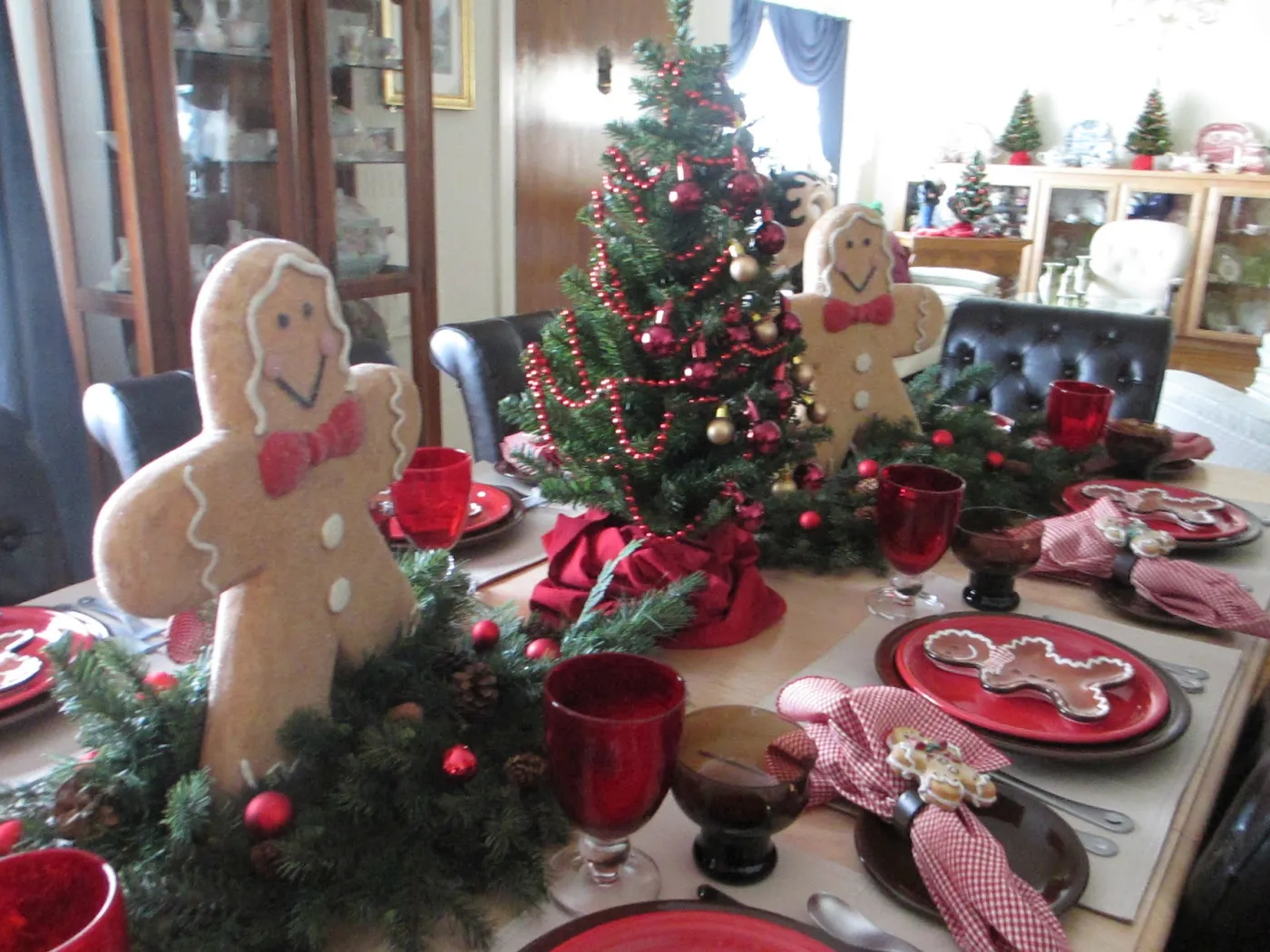
Building the centerpiece takes about 15 minutes and roughly $25.
- Start with a narrow board or tray the length of your runner so nothing rolls.
- Anchor two miniature trees at opposite ends — they frame the figures.
- Stand the gingerbread men slightly off-center; dead center looks like a store display.
- Tuck red ornaments and loose greenery around their feet to hide the bases.
- Finish with a few loose cookies on the tray so it reads edible rather than decorative.
9. Poinsettia Garland Down a Patterned Red Tablecloth
A busy tablecloth needs quiet everything else. The split here is roughly 60% patterned red, 30% green garland, 10% white and gold combined. If you want to swap the red floral cloth for a solid crimson, add the pattern back through your napkins instead — keep total pattern coverage near 60% and the table stays balanced. Push past 70% and it starts to vibrate. Compare with Idea #5: same palette, entirely different energy.
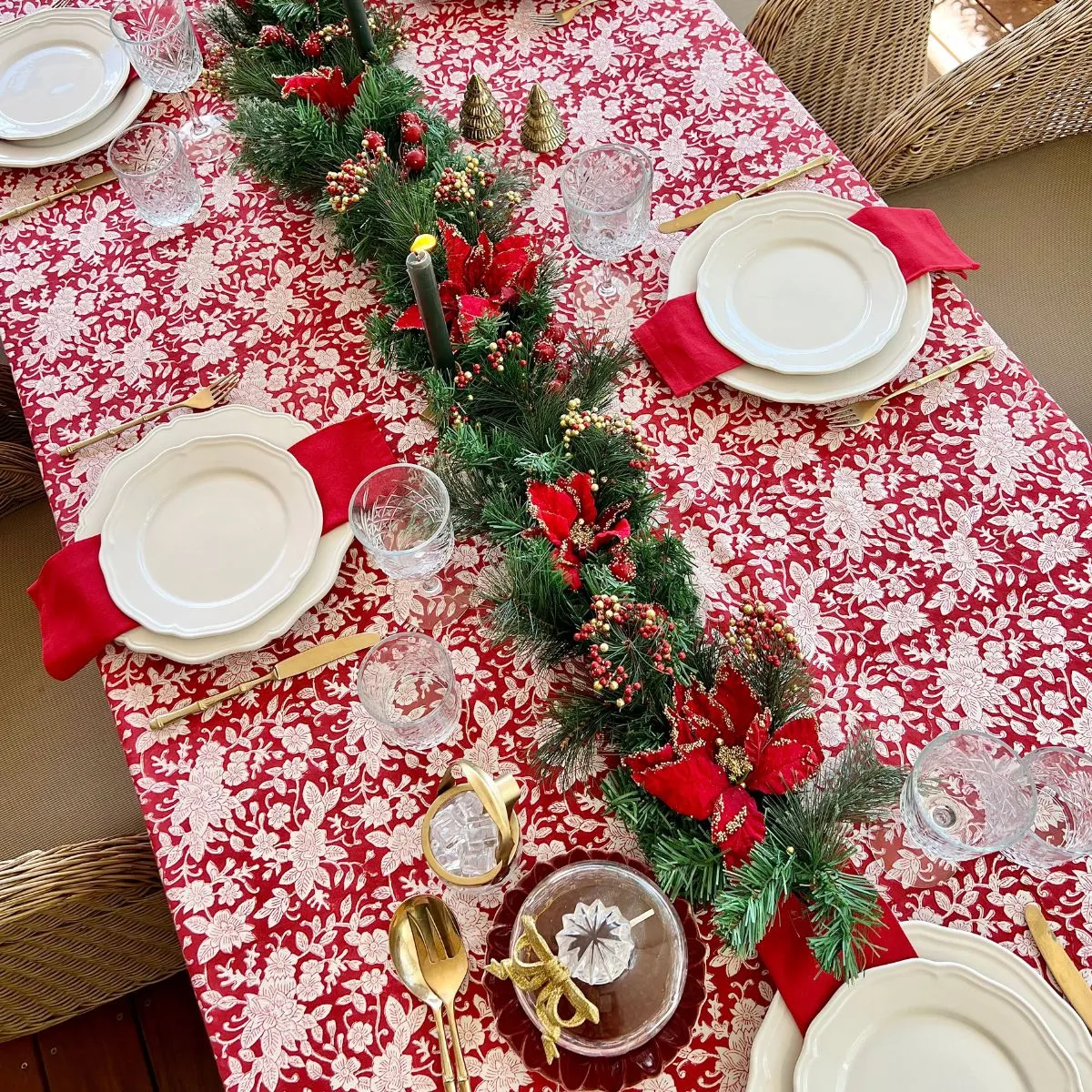
Three strong elements — a floral cloth, a decorated garland, gold cutlery — is about the most this table can carry, and it only works because the plates are plain white with a scalloped edge. If you can’t decide what to remove from a table, remove the patterned tablecloth. It is the largest surface and the easiest thing to swap for a solid. One practical note: scalloped plates don’t stack neatly, so plan the storage before you buy eight.
10. Jute, Dark Ceramic, and Fairy Lights Tucked Into Napkins
The fairy lights are the loveliest part and the first thing to die. Micro LED strands on a timer will run about three weeks on a set of AAs; buy rechargeable and stash the pack under the rolled napkin so nobody sees the wire. Jute placemats shed and stain — a butter drip is permanent, so save them for the main course and switch to cotton for dessert with the kids. Candle wax on linen comes out with an iron and a paper towel, if you catch it the same night.
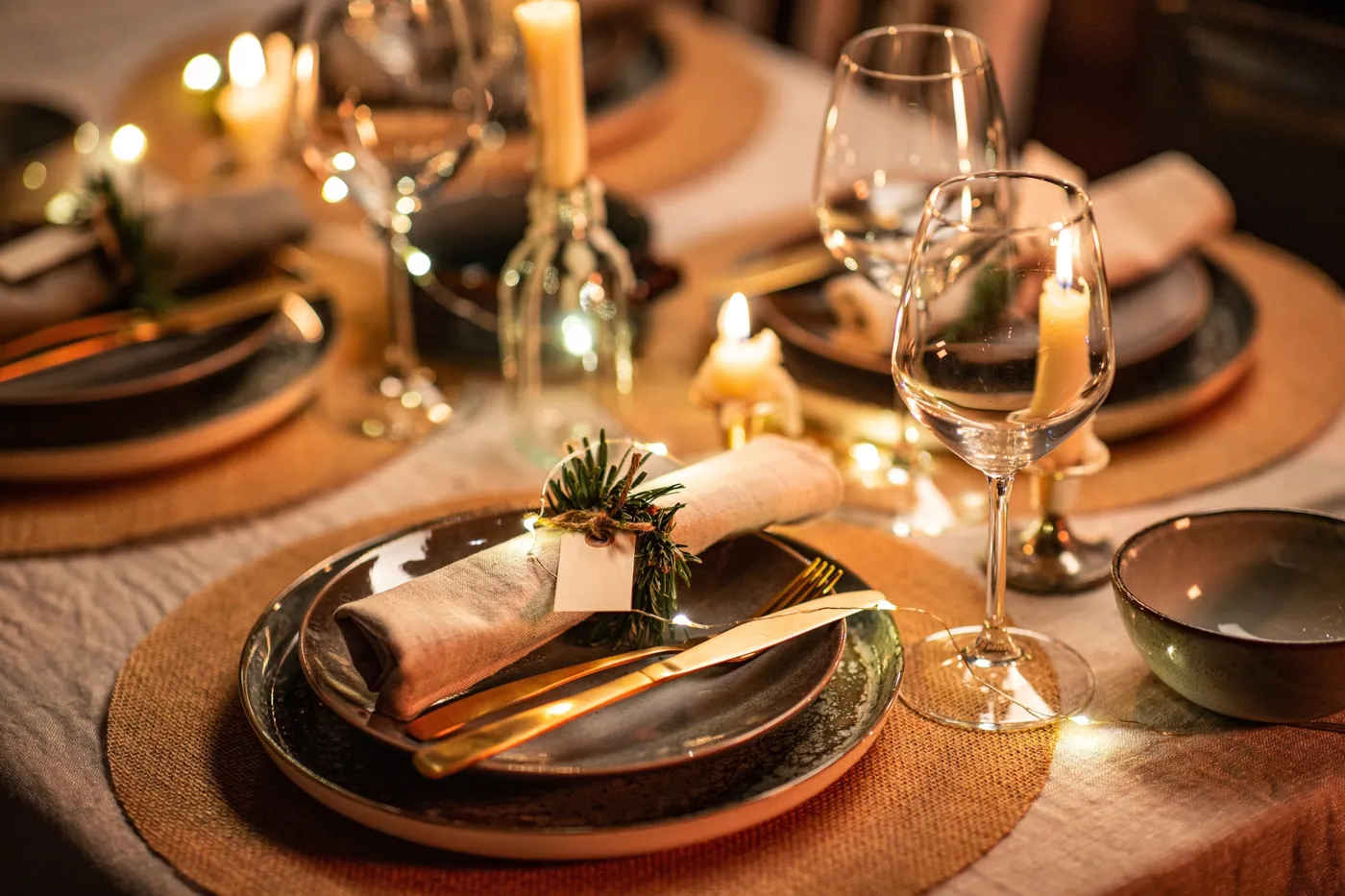
Buy fairy lights at 2700K to 3000K and nothing cooler. Anything above 4000K turns a candlelit table into a hospital corridor, and it is the single most common mistake in DIY tablescapes. Copper-wire micro strands bend around a napkin roll better than green wire, and 20 LEDs per napkin is plenty. Two strands per six settings, roughly $8 total, and they disappear completely into the linen.
11. A Sheer Embroidered Runner on a Small Round Table
- Sheer embroidered runner: $18–$45
- White dinnerware (already owned counts as $0): $0–$80
- Red plaid cloth napkins, set of 4: $12–$30
- Gold flatware, 4-piece sets: $20–$60
- Berry branches, gingerbread figure, small white candles: $15–$40
- Total: $65–$255
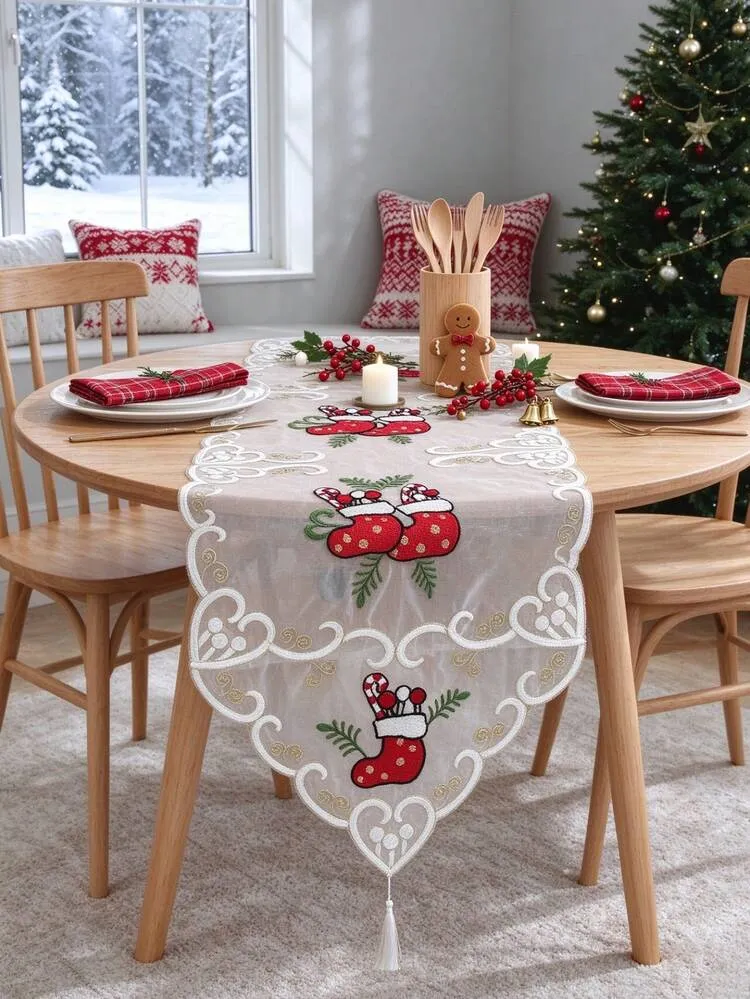
Budget alternative: buy a single embroidered curtain panel at a thrift store for $6 and hem it with fusible tape. Same sheer motif effect, one-tenth the price.
This is the answer for a 42- to 48-inch round — the size most apartments actually have. A runner should overhang about 6 inches on each side; longer and it pools in laps, shorter and it looks like an oversized placemat. Four settings need 24 inches of linear space each, so measure before you commit to wide chargers. For a longer table, Idea #6 scales the same idea up beautifully.
12. Holly Branches Suspended Over Red Roses and White Tapers
Most tablescapes stop at the tabletop. This one stacks three planes: the pine and holly garland with roses at table level, the white tapers just above it, and the suspended holly with glass votive lanterns overhead. Your eye travels up, and the table feels twice as generous without a single extra inch of width. The color plan is doing quiet work too — red roses, red berries, green holly, white candles, and not one thing more.
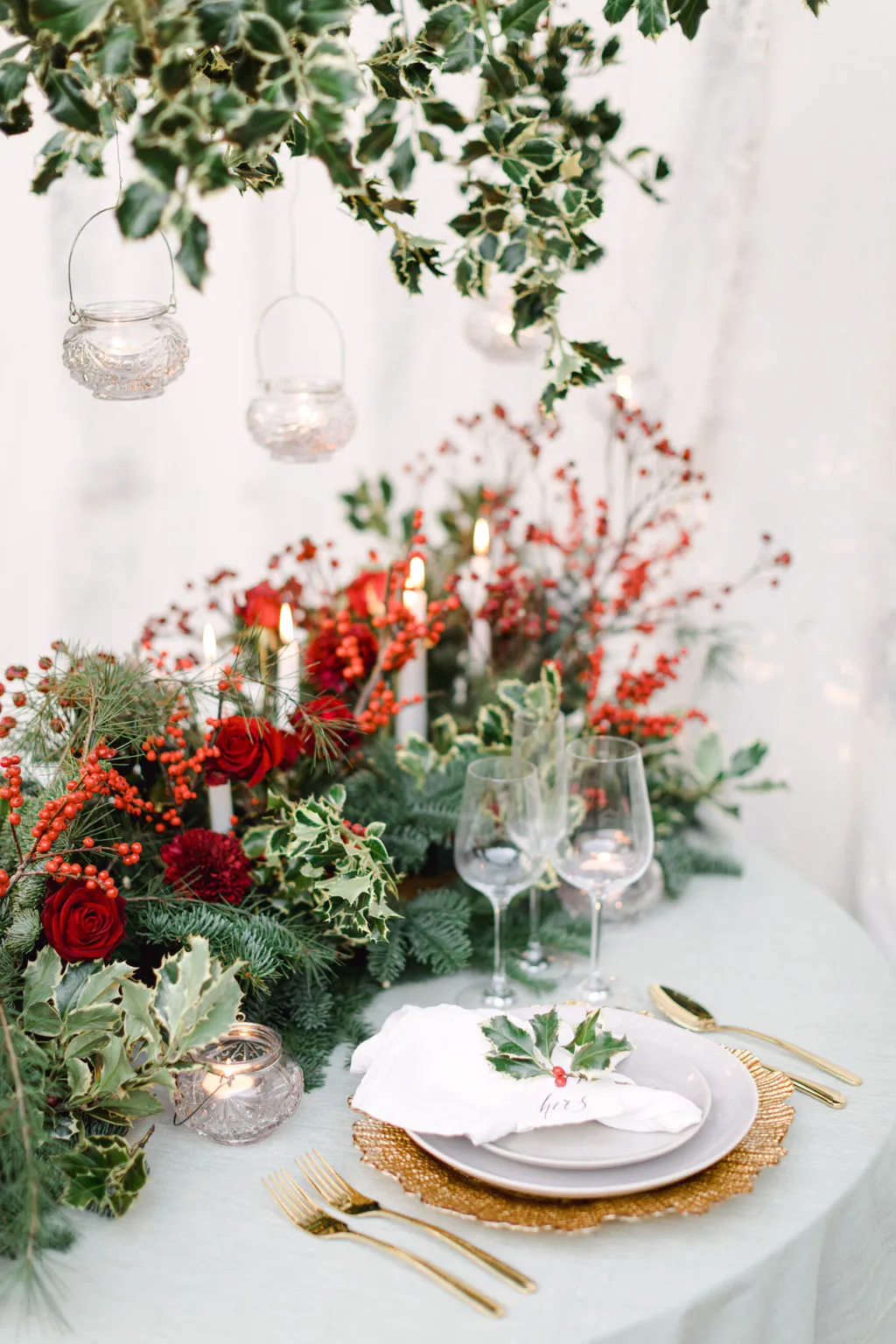
Remove the hanging holly and you’d still have a beautiful table. You’d also lose the thing people photograph. Glass votive lanterns hung 20 to 24 inches above the surface throw moving light onto the plates and make the ceiling part of the room. Use clear monofilament and glass, never open flame near the greenery. It’s the same overhead trick as Idea #2, with a warmer payoff.
13. Burgundy Runner, Plaid Napkin, One Dark Stemmed Glass
A plaid napkin and a gold ring can carry an entire table. H&M Home and Target sell gold chargers for $3 to $6; plaid napkins run $12 for four at most discount stores, and gold-toned rings are about $8 for six on Amazon. The trick that makes it look expensive is doubling the napkin — a solid burgundy under a plaid one, offset so both edges show. That single move reads like custom linen and costs nothing extra.
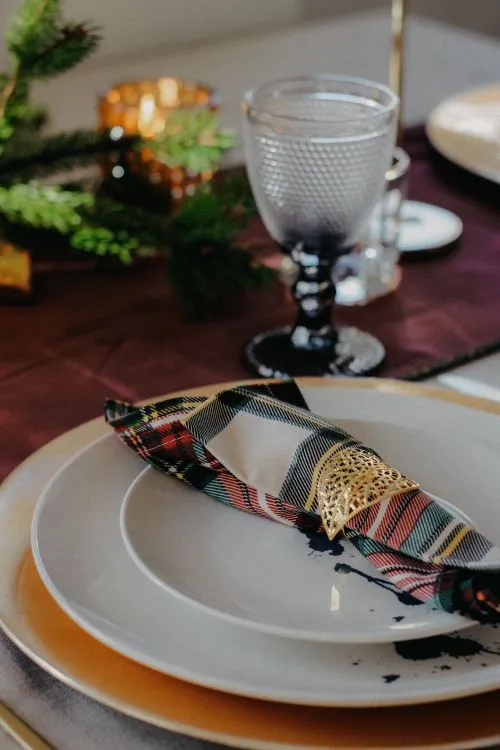
One dark glass per setting, not a matched set of eight. A single smoky or burgundy stem reads as collected rather than catalogued, and it hides red wine stains better than crystal. If you’re buying, look for a 16 to 18 ounce stem with a weighted base — anything lighter tips on a tablecloth. Mix two shapes across the table and keep the water glasses clear so the dark one stays the odd note.
14. A Glossy Holly Leaf Plate Stacked on White
Building the stack takes about ten minutes per setting and roughly $14 per person if you’re buying bows.
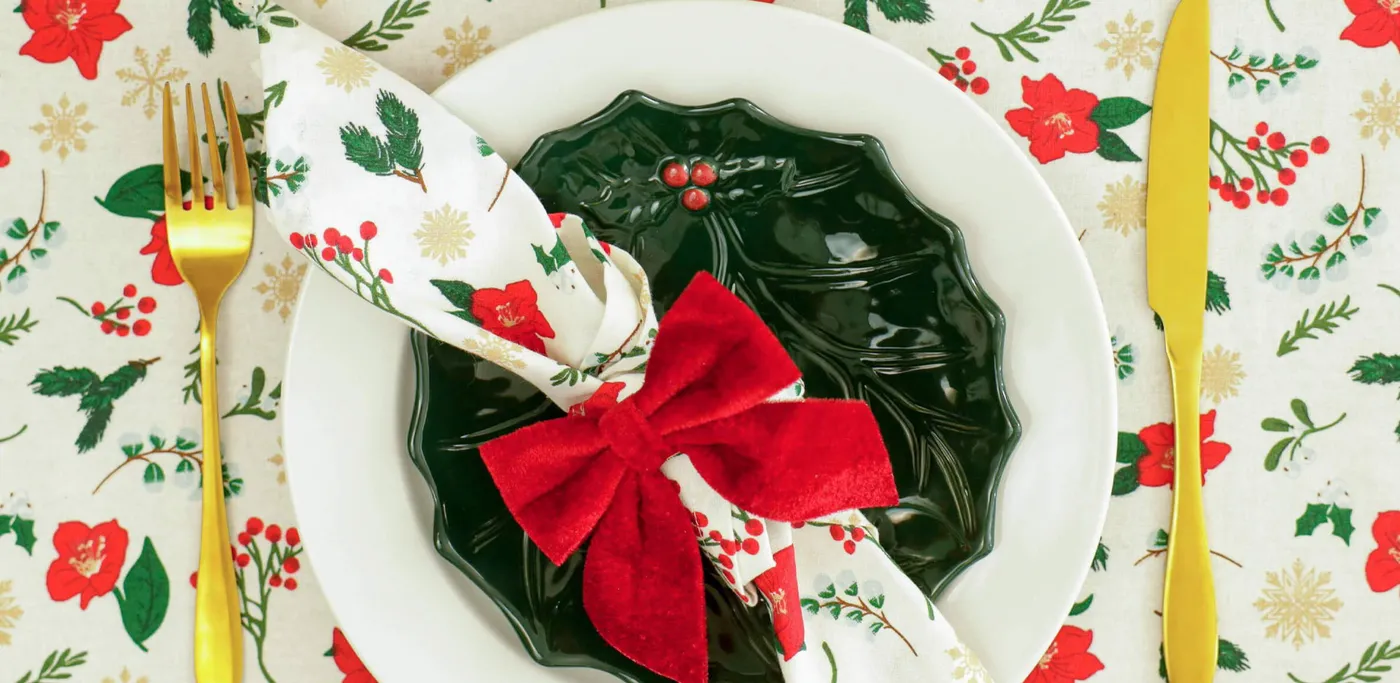
- Start with a cream or white tablecloth — the printed one underneath is background work.
- Center the white dinner plate, then offset the holly leaf accent plate about an inch toward the top.
- Fold the poinsettia napkin into a flat rectangle, not a fan; it has to lie still under the bow.
- Tie the red velvet bow with the knot at the top third and trim the tails on a diagonal.
- Set gold flatware an inch from the plate edge — fork left, knife right, blade facing in.
Accent plates — the ones that sit on top of the dinner plate and serve no food purpose — are having a moment again after a decade of plain white everything. Interest in plate stacking has been climbing since 2023, and small ceramics studios have answered with single-motif designs exactly like this glossy holly leaf. It’s the cheapest way to change a table: one accent plate per person does more than new china.
15. Let the Centerpiece Set the Height of Everything Else
A centerpiece is doing three jobs at once: it gives the table a center of gravity, it sets the color story, and it controls how tall everything else gets to be. Get the centerpiece right and the plates, napkins, and glassware can be almost anything. Get it wrong — too tall, too small, or spread so wide it touches the placemats — and no amount of nice china rescues the table. Decorate the middle first, then work outward.
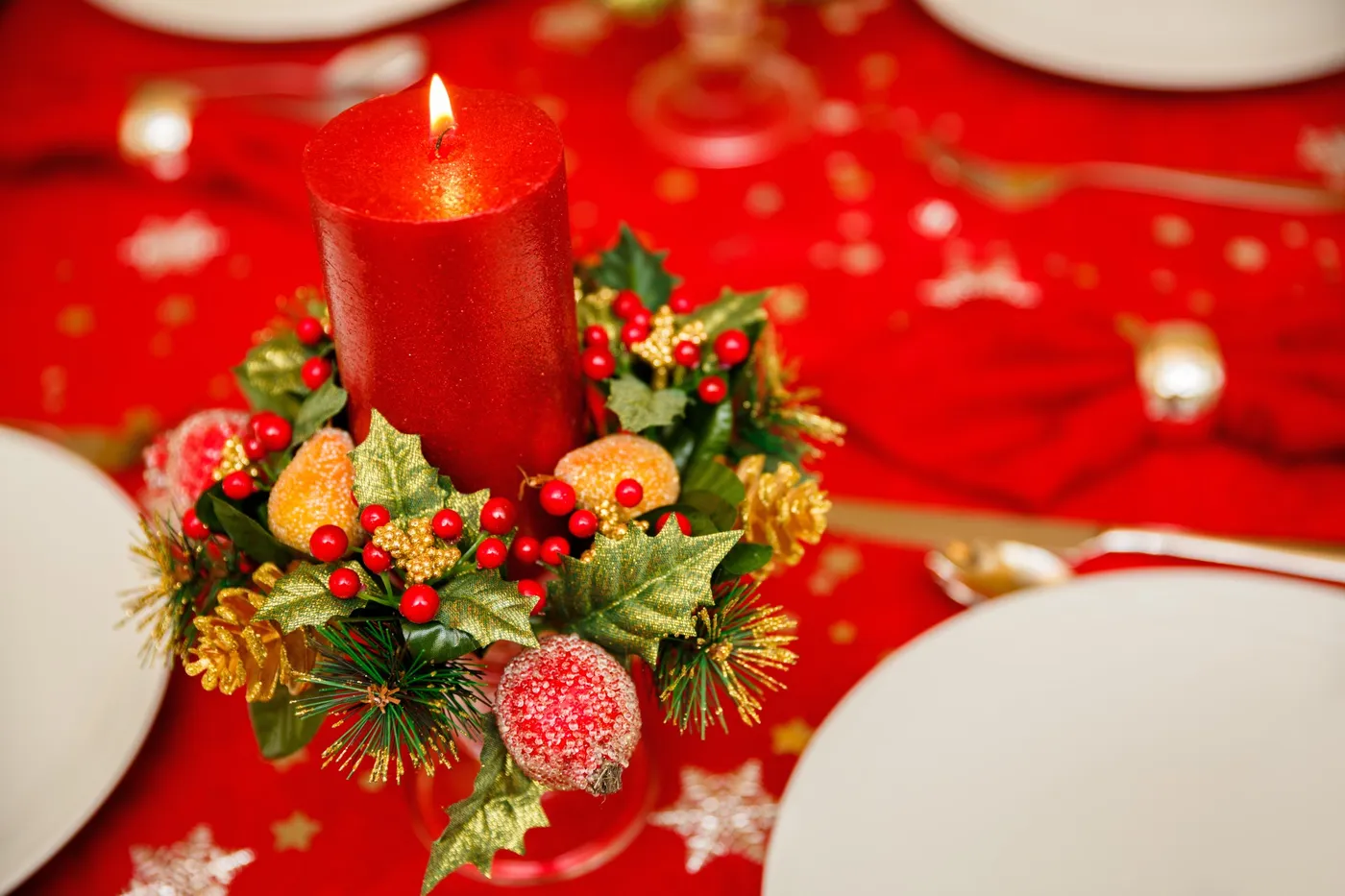
- Measure your table’s clear center width before buying anything.
- Decide the maximum centerpiece height: 12 inches for a round table, 18 for a long one.
- Photograph your existing plates and linens in daylight so you match tones, not just colors.
- Cap the candle count — one per person plus two is the sweet spot.
- Check that the centerpiece sits inside the runner, never over the placemats.
16. Black Felt, Red Cardinals, and a Scalloped Edge
Felt is the low-maintenance hero of holiday textiles — no ironing, no hemming, no fraying — right up until it meets a candle. It’s acrylic, so a stray spark melts a hole rather than scorching, and it holds lint like a lint brush. Roll the runner for storage instead of folding, spot clean with a damp cloth and a drop of dish soap, and keep candles in holders whose base is wider than the flame.
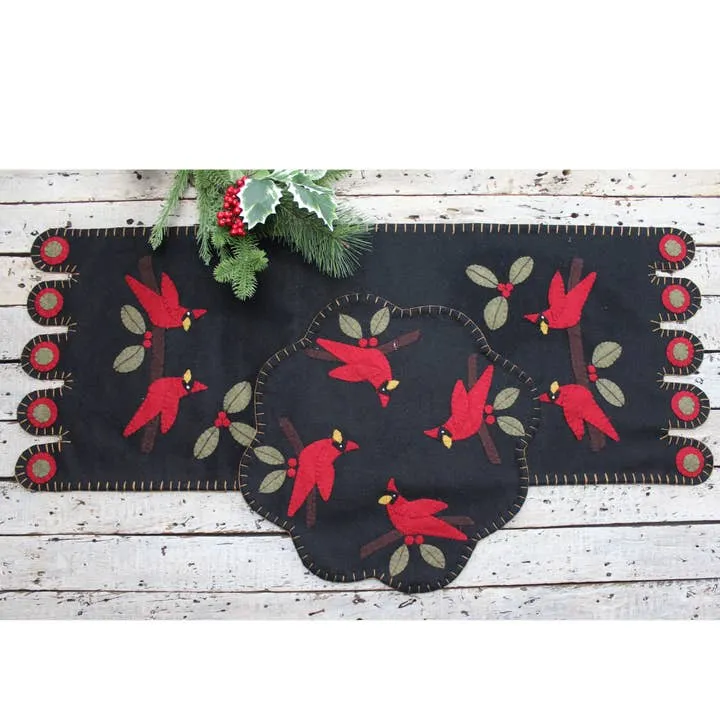
Put the same cardinal on cream linen and it disappears into the tablecloth. The black felt is the entire trick — it pushes the red appliqué and the holly green into jewel-tone territory instead of craft-fair, and it gives a distressed white table something to sit against. If black feels heavy for your room, charcoal wool gets you 80% of the effect. Swap the ground for color and you lose the drama.
17. Gray-on-Gray Trees With Unexpected Teal Goblets
This is a cool, quiet palette, and it needs two things: decent light and enough table to spread out on. On a 72-inch table the runner should be 14 to 16 inches wide — any narrower and the beaded chargers touch. Below 60 inches, drop the runner and use the beaded chargers alone. Cool neutrals go flat in a dark dining room, so if yours faces north, add one warm element or accept that it will look like a black-and-white photograph.
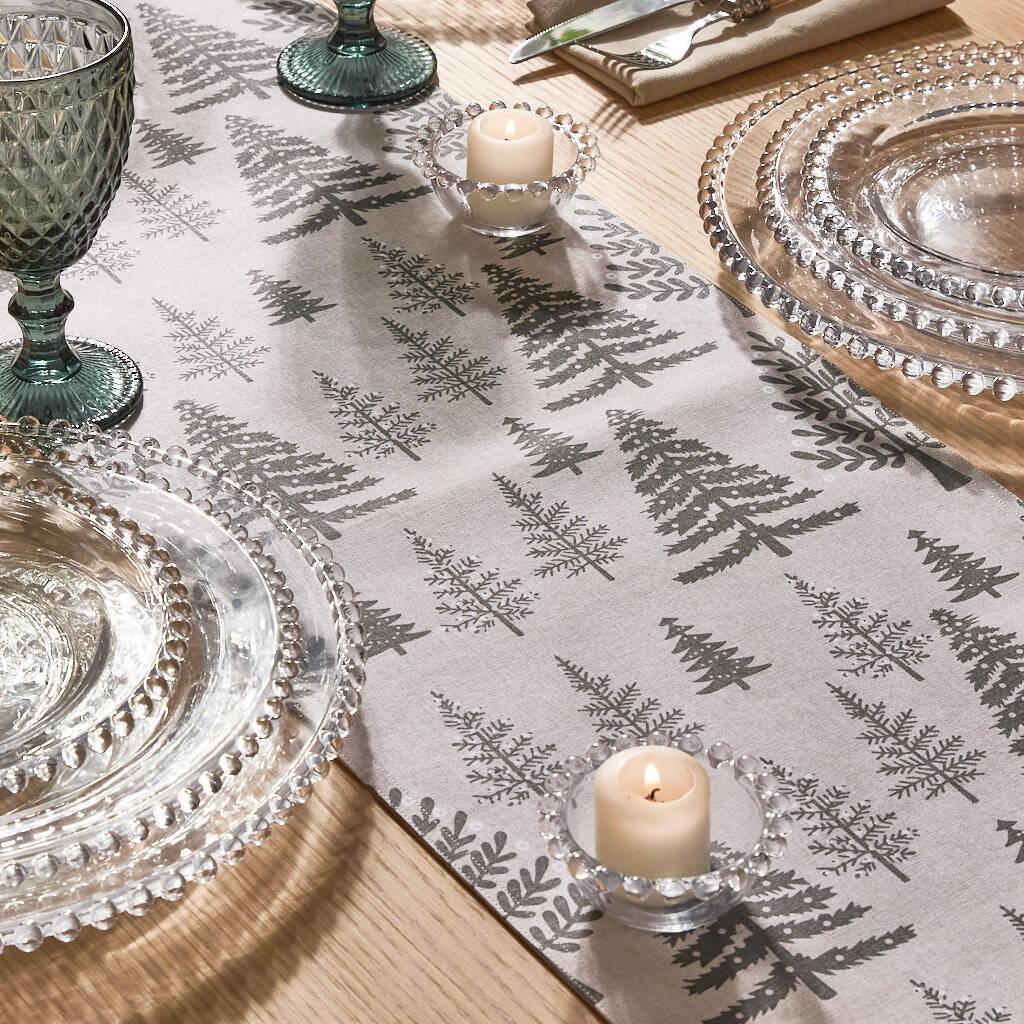
The ratio is roughly 70% neutral gray, 20% clear glass, 10% teal — and that 10% is the reason the table doesn’t disappear. Swap teal for amber and the whole thing warms up; swap it for cranberry and you get a traditional Christmas table with identical bones. Keep the runner light and the tree motif dark and the contrast stays crisp instead of muddy. Beaded glass chargers are also the most forgiving thing to eat over.
18. Snowmen on the Runner, Pinecones Down the Middle
Patterned runners are charming and slightly unforgiving. A snowman print plus a pinecone centerpiece plus woven placemats is already three textures, so keep the plates plain white and the glassware clear — which this table does. Also measure: a runner that stops short of the table edge looks accidental. Buy 12 to 14 inches longer than your table and let it hang.
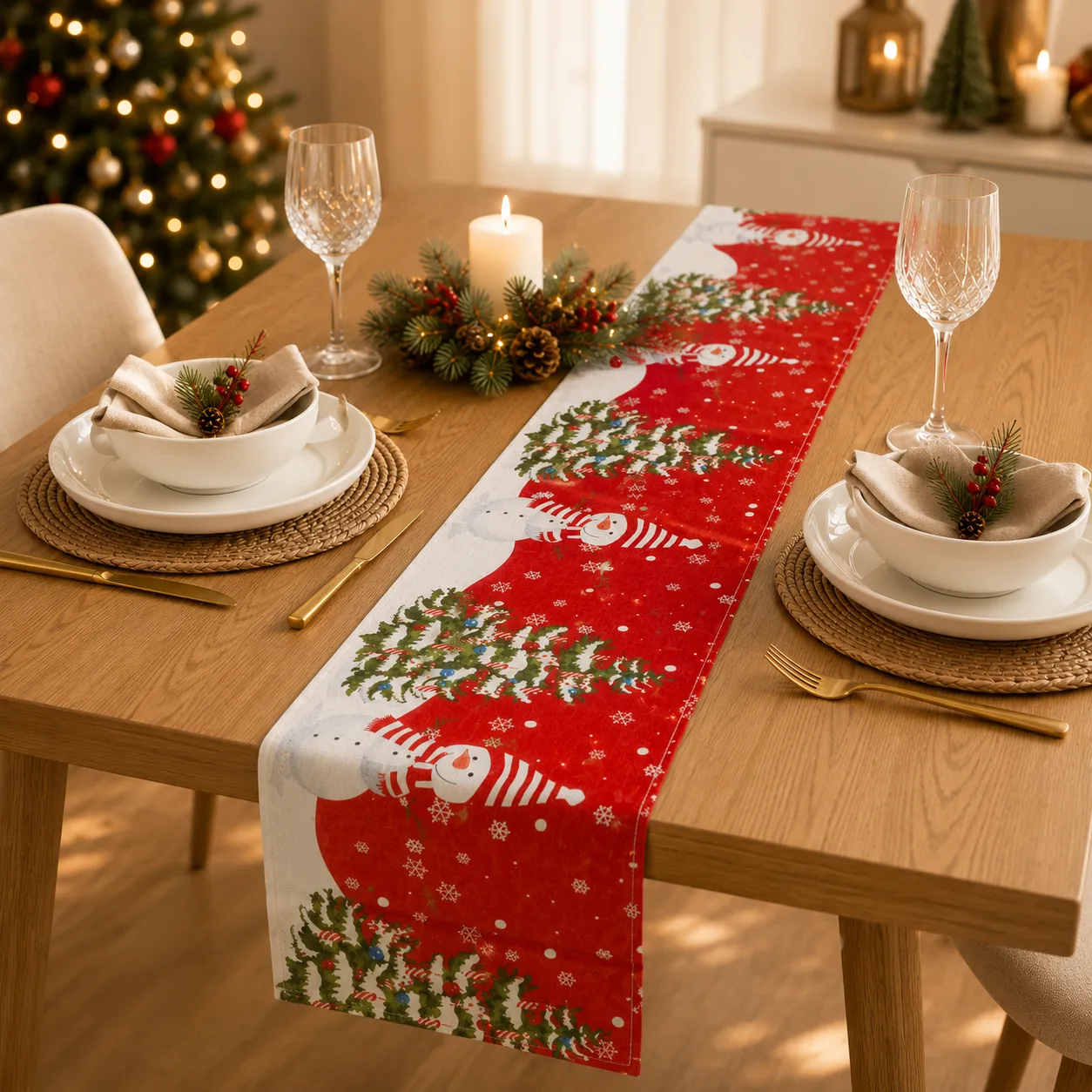
The centerpiece takes about 20 minutes and roughly $30 in grocery-store greenery.
- Lay a 4-foot length of pine garland down the center, bent into a shallow S rather than a straight line.
- Cluster three pillar candles of different heights in the middle third — never evenly spaced.
- Tuck pinecones and berry sprigs into the gaps where the garland meets the wood.
- Bookend the run with one small bowl of ornaments at each end.
19. Brass Trumpet Napkin Rings Over Sheet Music Placemats
- Evergreen garland with berries (fresh or good faux): $20–$60
- Brass trumpet napkin rings, set of 4: $18–$55
- White plates and cream napkins: $0–$70
- Gold flatware: $25–$80
- Sheet music placemats (printable or vintage): $5–$25
- Total: $68–$290
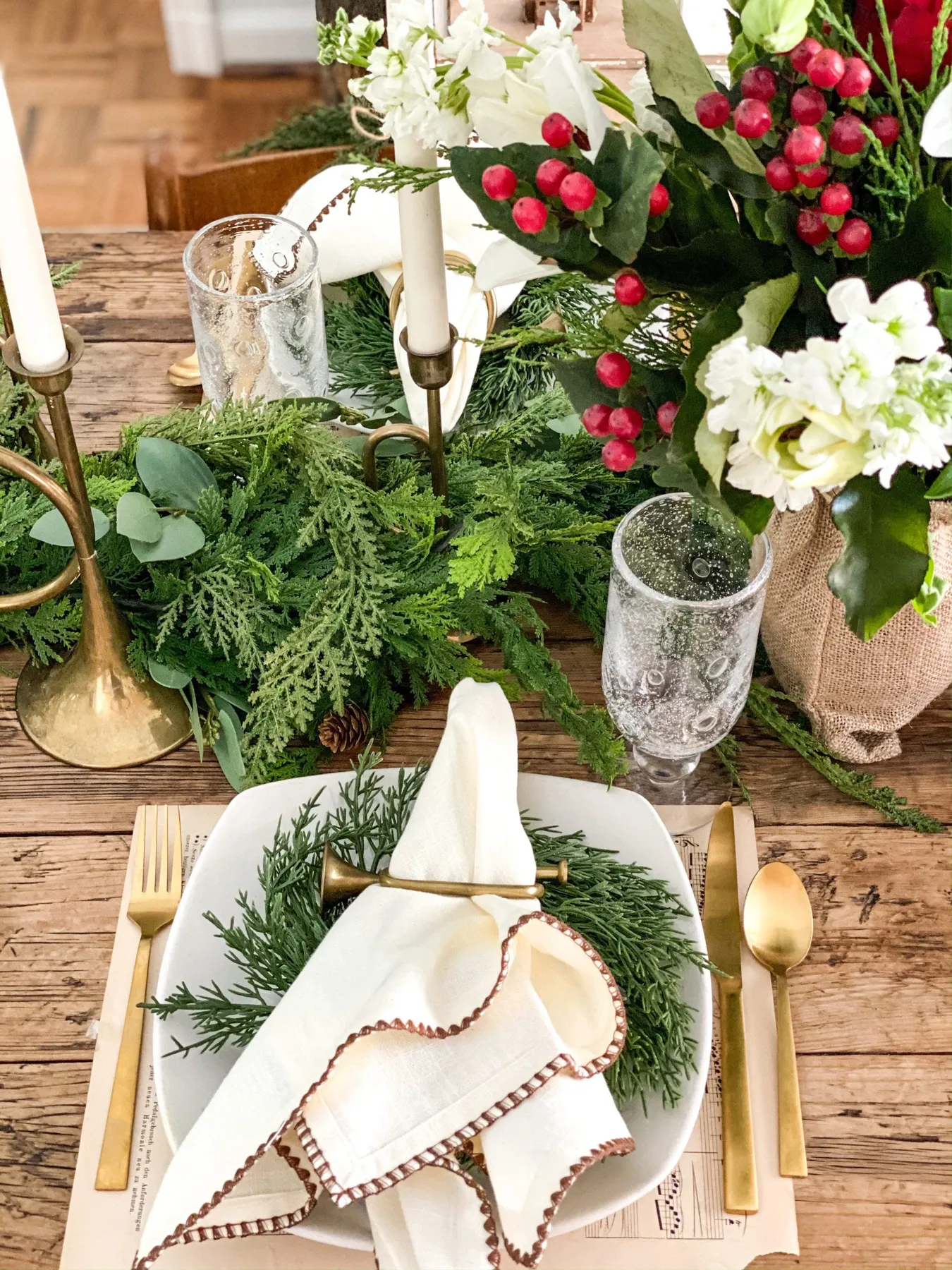
Budget alternative: print vintage carols on cream cardstock at the library for pennies, and swap the brass rings for simple ribbon loops in the same width.
The sheet music under the plates is the detail that turns a nice rustic table into a story, and it costs almost nothing. Vintage carol pages from a thrift-store hymnal, or free printable sheets, give each white plate something warm to land on. Without them this is a standard garland-and-gold table. With them, people lean in and start reading.
20. Pomegranates and Burlap Trim in Front of a White Mantel
Two things are working hard here: contrast and extension. Rough distressed wood against gold chargers and glass hurricanes gives you the tension that makes rustic décor read as elegant instead of shabby. And the mantel repeats the same palette — red, green, gold, white — so the table doesn’t end at the table. That large gold-framed mirror bounces candlelight back onto the plates for free.
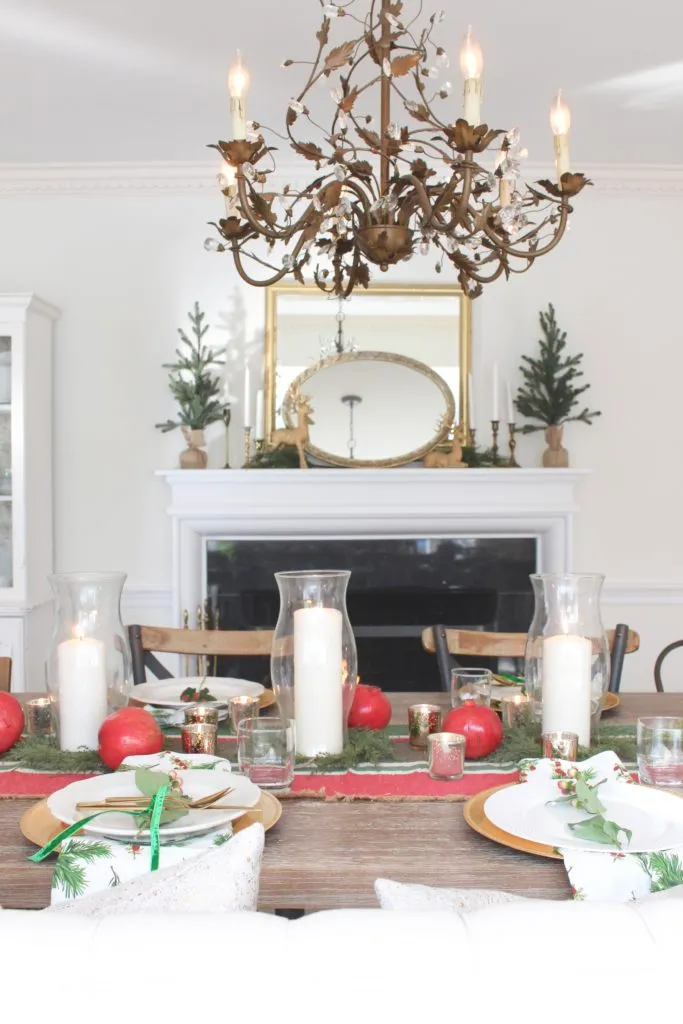
This look assumes a dining room with a fireplace or a wall you can style, plus about 8 feet between the table and that wall so the mantel reads as part of the composition. Tables of 84 to 96 inches handle the runner and hurricanes comfortably. In a smaller room, keep the garland and pomegranates but trade the hurricanes for low glass votives — see Idea #26 for how a small table handles the same palette.
21. Dark Purple Runner With Tartan and One Amber Glow
The dark purple runner is the move nobody copies. It sits close enough to burgundy to read traditional and far enough to look considered. If you want to try an offbeat runner color, stay within two shades of a color already on the table and keep everything else neutral. And keep the amber votive — one warm glow against a cool-toned table does more than a dozen white candles, because it reads as firelight.
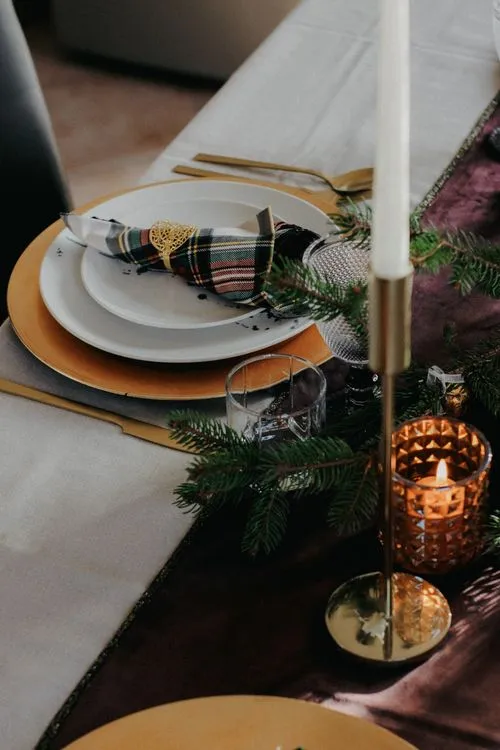
Roughly 50% white cloth and plates, 25% gold, 15% tartan, 10% deep purple. Gold appears in four places — chargers, flatware, napkin rings, candlestick — which is why it reads as a scheme rather than an accent. Swap the tartan for a striped napkin and you keep the formula but lose the holiday. Swap the purple for forest green and you get a more classic table with identical proportions.
22. Plaid Runner, Berry Garland, and Bowls of Nuts
Everything here is off-the-shelf. A plaid runner is $12 to $20 at Target or HomeGoods, faux berry garlands are about $8 each at dollar stores (buy two and twist them), and pinecones are free if you have a pine tree and an afternoon. The clear beaded bowls holding nuts are the sleeper detail — IKEA sells similar glass for $3. You can set six places for under $75 and reuse all of it next year.
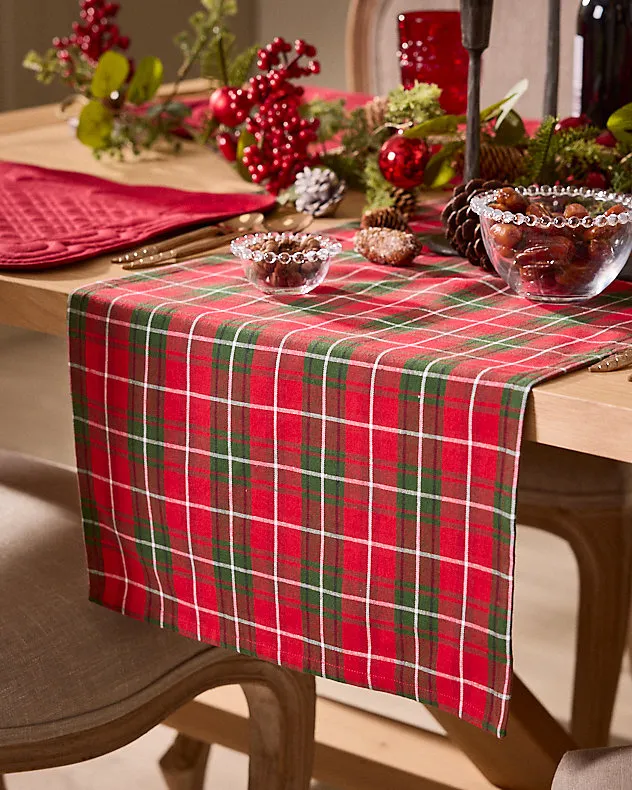
Red and green plaid is the most forgiving pattern in Christmas decorating and also the easiest to overdo — pair it with one other pattern, maximum. And if you’re using fresh greenery near a heat vent, expect it to be crispy by the 26th, which is why so many of these tables mix real and fake without apology. Nobody at dinner inspects the stems.
23. Black Tapers in a Candelabra Against Red Velvet
Black keeps creeping into Christmas décor, and it isn’t the goth joke people expected. Black candelabra, black tapers, black china cabinets — they photograph beautifully against red velvet, and Pinterest has been steadily rewarding the moodier end of traditional. It’s a trend with legs because it is really just classic holiday decorating with the contrast turned up. Nothing to relearn, just a different metal finish.
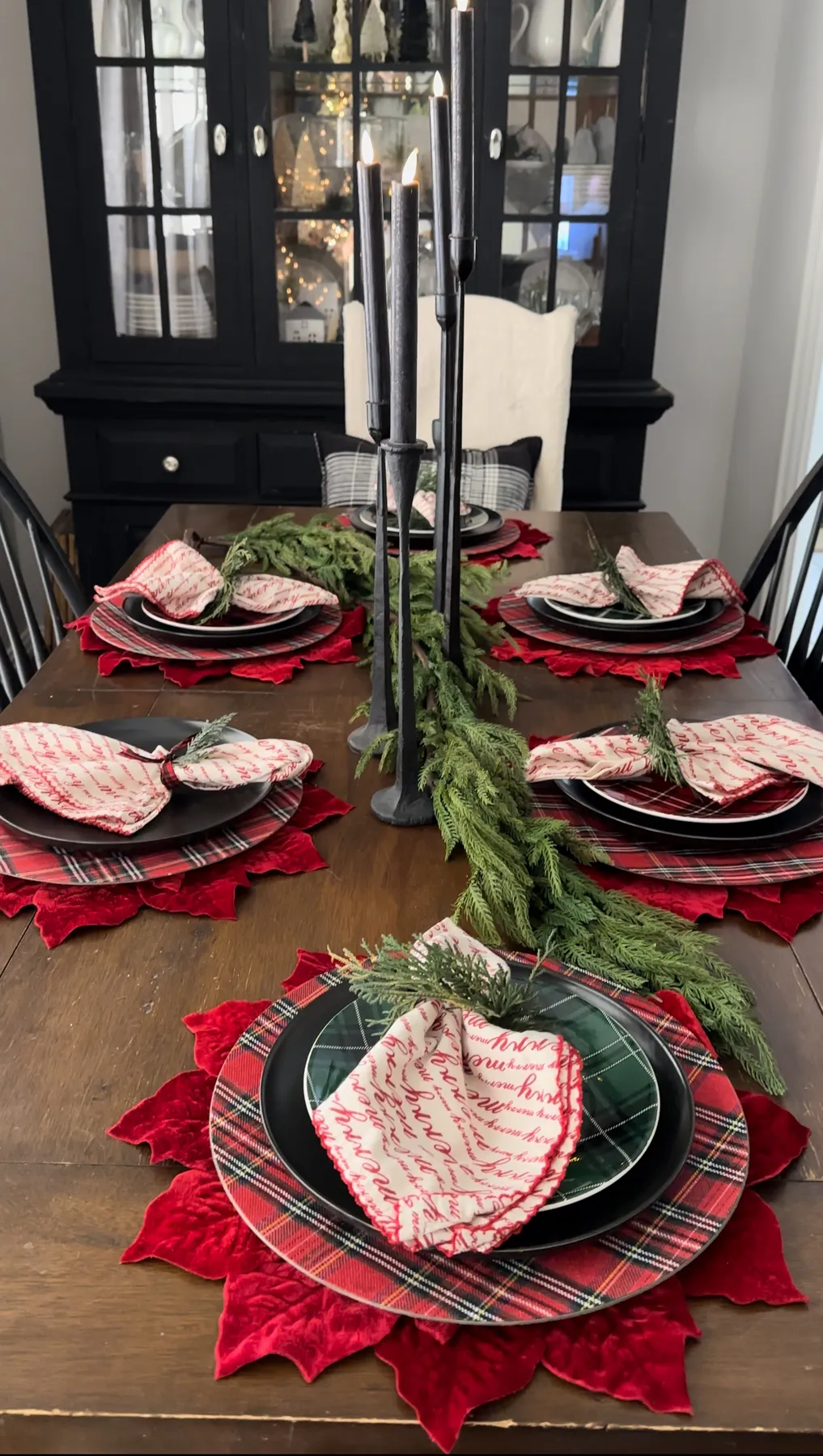
Replace that candelabra with gold and the table becomes polite. The black metal holding black tapers is what gives red velvet and green plaid a spine — it drops the value of the whole scene so the reds look richer by comparison. Black candles also burn without looking like a power outage, because the wax is supposed to be dark. A $40 decision that changes the entire table.
24. Citrus, Striped Linen, and Glass Christmas Trees
Real citrus in a garland is gorgeous for about six hours and then it starts to sweat. If you’re using fresh oranges or grapefruit, cut them the morning of, blot the cut faces dry, and keep them out of direct sun — they’ll hold through dinner and not much longer. Candied or dried slices look nearly identical and last for years. The frosted glass trees, meanwhile, are the easiest thing on the table: rinse, dry, box.
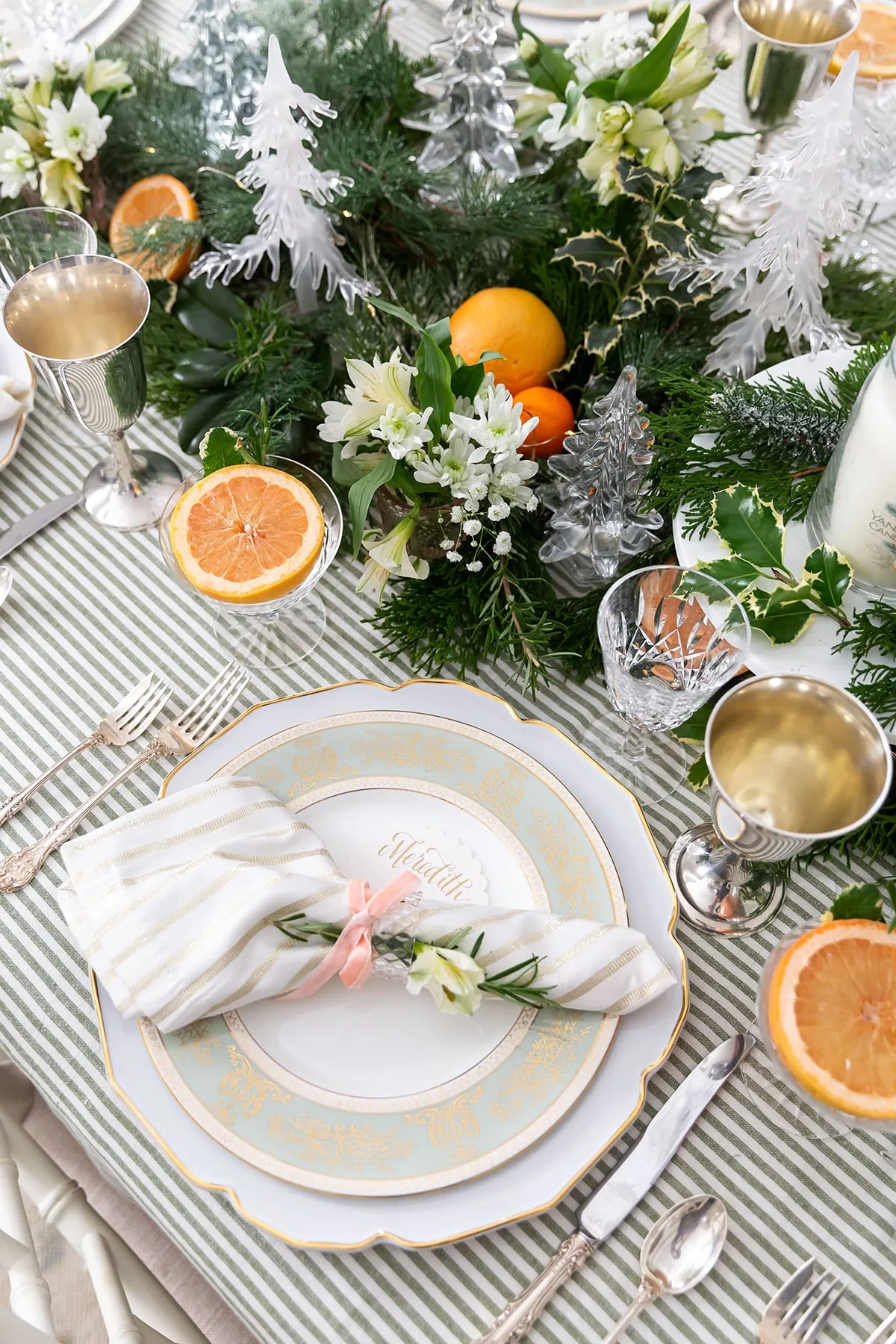
Most Christmas tables run warm — red, gold, amber. This one runs cool and fresh with white, mint, citrus, and silver, which is why it feels new even though the bones are entirely traditional. The green and white stripes give it structure; the ornate silver cutlery keeps it from sliding into garden party. Mixing metals works here because the greenery bridges silver and gold.
25. Character Plates and Candy Canes for the Kids’ Table
Anything on a kids’ table has to survive a juice box and a grabby four-year-old. Skip the heirloom china, skip open flames, and skip anything glass at the edge. A small plug-in tree in the center is safer than candles and still gives the table its glow. And cookies on the table means crumbs on the table — put them on a tray you can lift off in one motion when the plates come out.
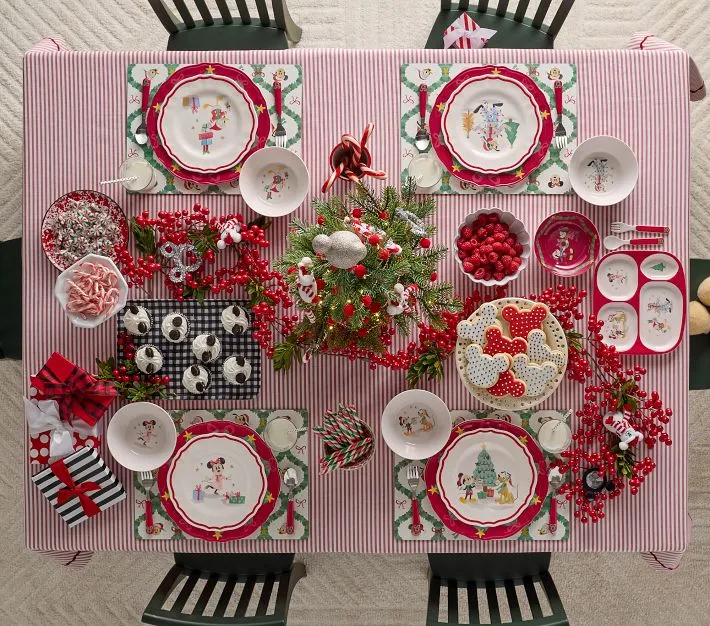
Striped tablecloths are visually loud, so give them one strong horizontal to fight against: a runner, a garland, or a tray down the center. Without it, the stripes run the full length of the table and the place settings vanish. Keep the placemats solid and the plates quiet-ish, and let the cloth be the loudest thing in the room. Same principle as the citrus table in Idea #24, opposite volume.
26. Speckled Cream Stoneware on a Round Marble Top
- Speckled cream stoneware, 4 settings: $40–$110
- Dark red cloth napkins with trim, set of 4: $16–$45
- Clear stemmed glasses: $12–$40
- Low greenery or one small arrangement: $0–$35
- Marble-look round table, if you’re buying: $150–$600
- Total (excluding table): $68–$230
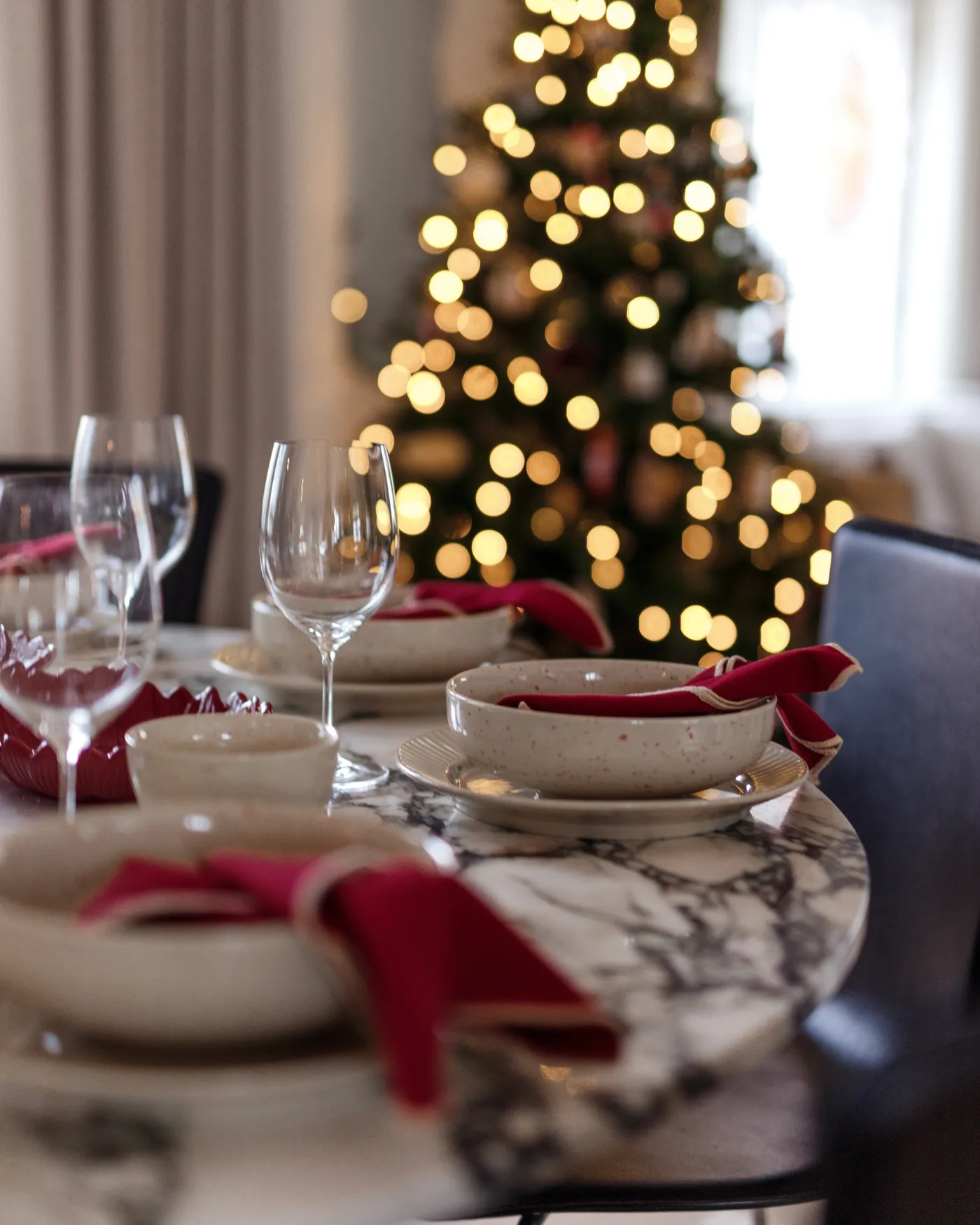
Budget alternative: skip the marble entirely and put a $15 marble-pattern contact-paper round on the table you already own. A plain white cloth photographs nearly the same in warm light.
A 36- to 42-inch marble round is the most forgiving small dining table there is, because the stone supplies all the visual interest you need. Which means the setting can stay minimal: four pieces, four napkins, four glasses. Small tables don’t need more decoration; they need better materials. Add a big centerpiece and you’ll crowd the plates.
27. Pink Tapers and Gold Deer on an Orange Runner
Pink taper candles in gold holders are the least Christmas-y element on this table and the exact reason it works. When your palette is green, gold, and white, one off-key color keeps the whole thing from looking like a catalog page. Keep it to candles only — pink napkins would tip it into a baby shower. Note the scale too: tall skinny tapers, never pillars, because height adds elegance without adding width.
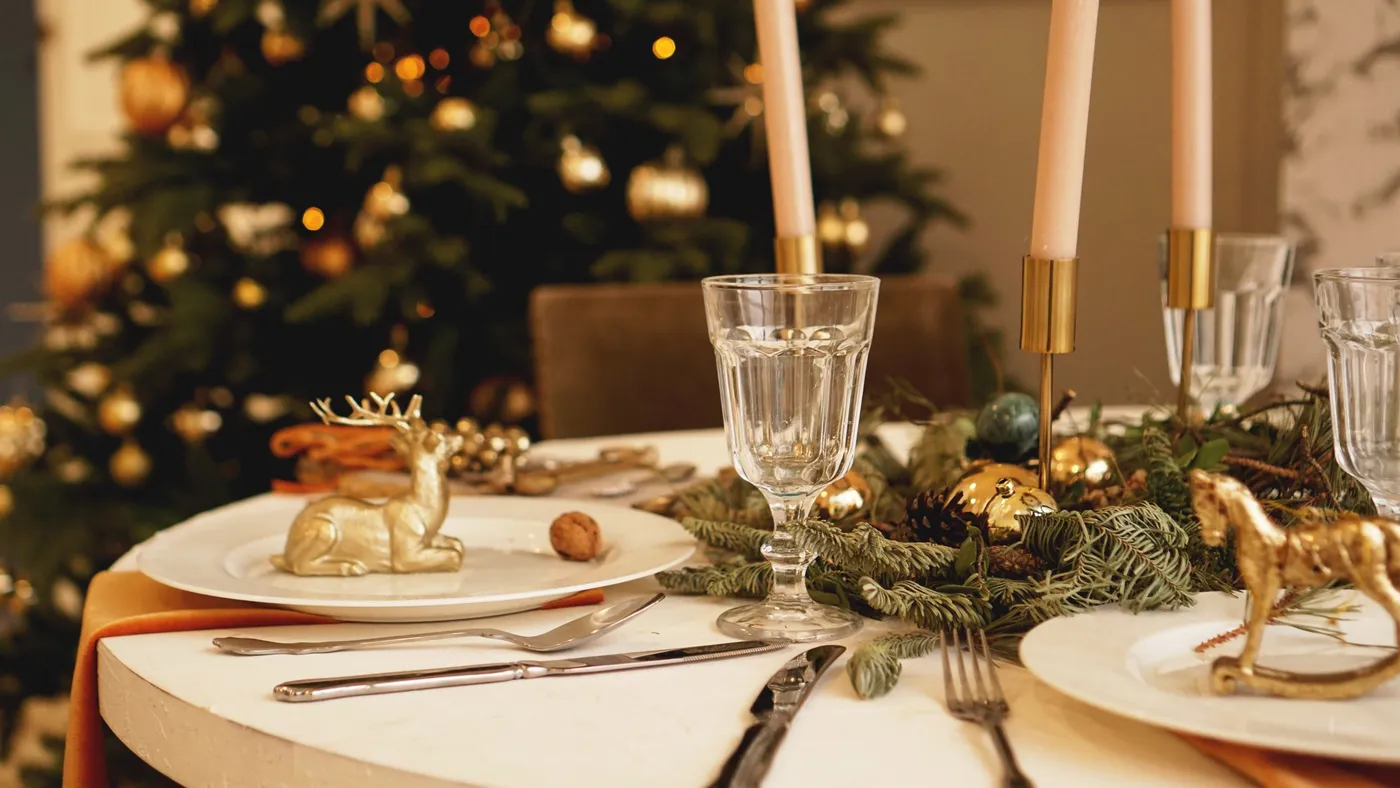
Call it 40% white and silver, 30% green fir, 15% gold, then 10% orange runner and 5% pink candles. The orange and pink are seasoning, not base. To adapt, hold the green and gold steady and swap the runner for charcoal with mustard candles, or plum with cream tapers. The 5% rule holds — whatever your off-color is, keep it under a tenth of the table and it reads intentional.
28. Red Felt Placemats on Dark Grey With String Lights
Roughly 25 minutes and $22 in lights and batteries gets you the garland glow.
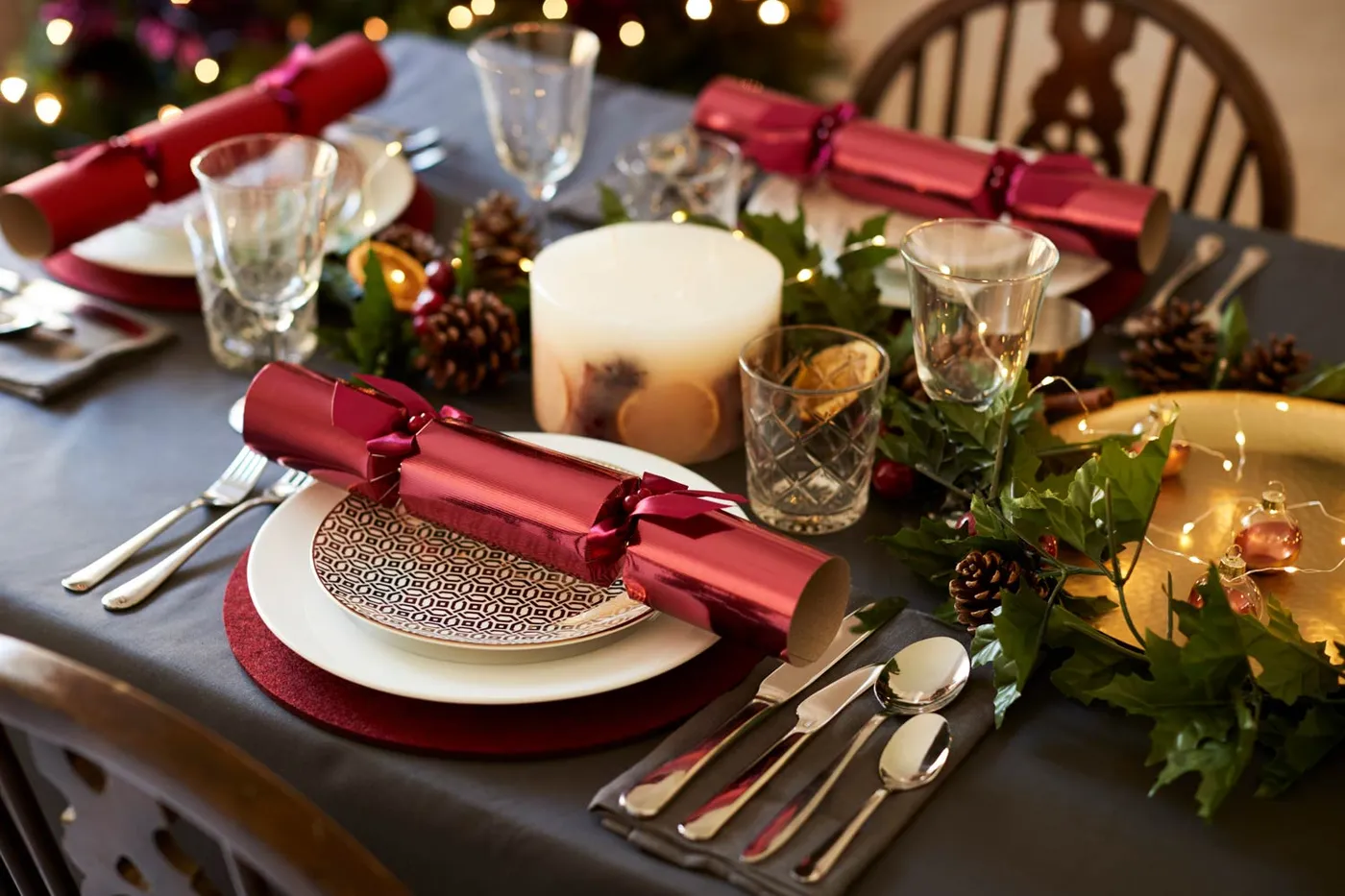
- Buy battery-operated warm white copper-wire lights — 20 LEDs per meter covers a 6-foot garland.
- Lay the garland flat and weave the wire along the underside, not the top, so the bulbs just peek out.
- Wrap the battery pack in the same dark fabric as your cloth and tape it under the garland’s midpoint.
- Cluster holly, berries, and pinecones over the wire until nothing reads as lighting.
- Put the pack on a timer so you aren’t crawling under the table after dessert.
Felt placemats are one of the cheapest ways to add color: $2 to $4 each at craft stores, or cut your own from a $6 sheet of stiff felt. Metallic Christmas crackers run $12 to $20 for six at Target — buy them the week before when they hit half price. A dark grey tablecloth hides wax and wine better than white and costs exactly the same.
29. Wooden Boards, Pinecones, and a Potted Hyacinth
- Measure the center run first — the greenery must be narrower than the gap between placemats.
- Test candle heights while seated; anything above eye level will glare.
- Check that your wooden boards are food-safe, or line them with parchment.
- Buy the hyacinth within two days of the meal — forced bulbs fade fast.
- Confirm the ornament-print cloth isn’t so busy it swallows white plates.
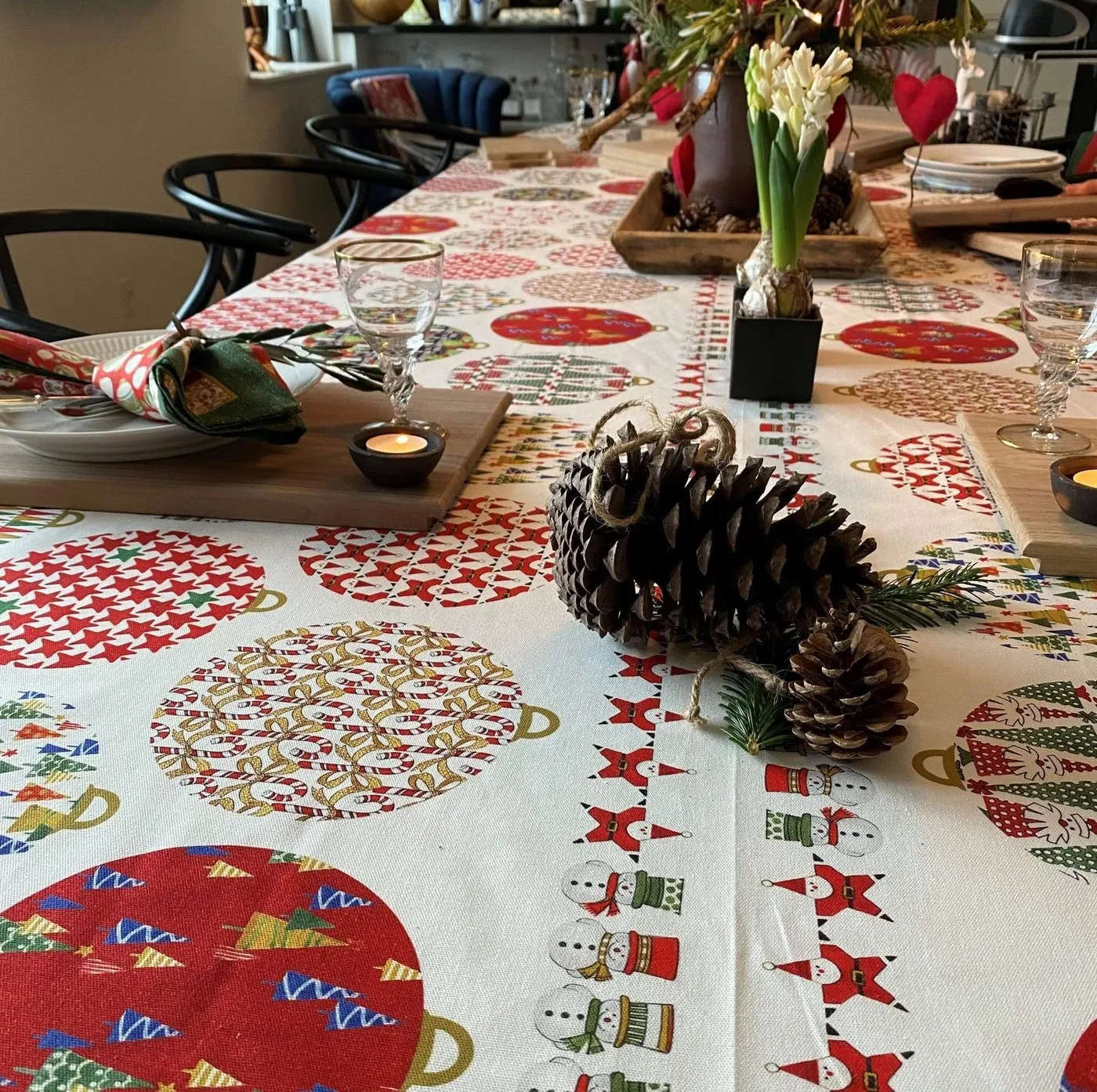
The wooden boards do something a fabric placemat can’t: they add a natural material right at eye level, where you’d otherwise have flat cloth. That small lift, plus the oversized pinecones and the potted hyacinth, makes the table feel gathered from a forest floor rather than bought in one trip. One living plant on a Christmas table is worth three arrangements, and it will still be alive in January.
30. Candy Canes and Red-and-White Tapers, Nothing More
Take away the red and white tapers and you get a pleasant white table with a red runner. The candles are what make it feel designed — two colors alternating at staggered heights, then echoed by the candy canes at every setting. It’s a simple visual rhyme and it costs about $12. Buy tapers in pairs at the grocery store and vary the heights by trimming the base with a paring knife.
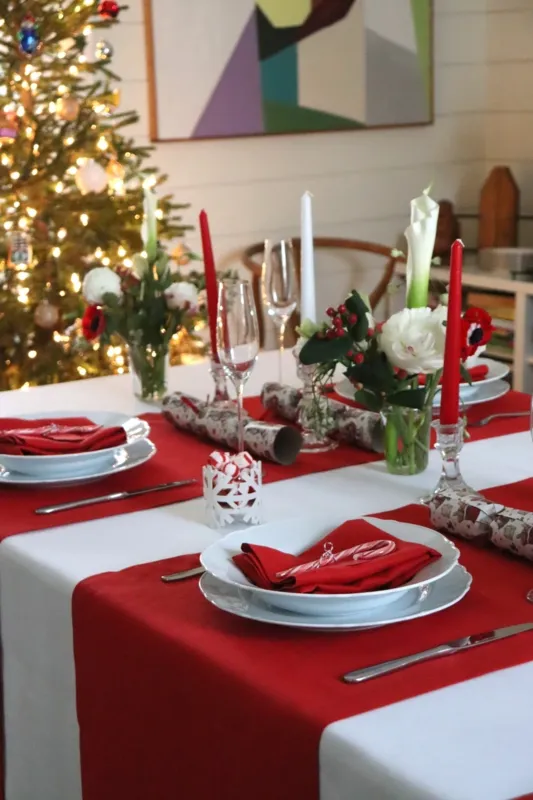
There’s a reason red-and-white keeps winning: it’s the fastest way to make a table look festive without buying anything patterned. Searches for simple Christmas tables climb every December as people realize they don’t want to store eight place settings. This is the answer — a white cloth, a red runner, some candles. It photographs beautifully and packs into one shoebox.
31. Eucalyptus and Pine Down the Middle, Candles on Repeat
- Fresh eucalyptus and pine, 4 bunches: $20–$45
- White pillar candles, set of 6: $15–$40
- White ceramic dinnerware: $0–$85
- Dark fabric placemats, set of 4: $12–$35
- Clear glass tumblers: $10–$30
- Total: $57–$235
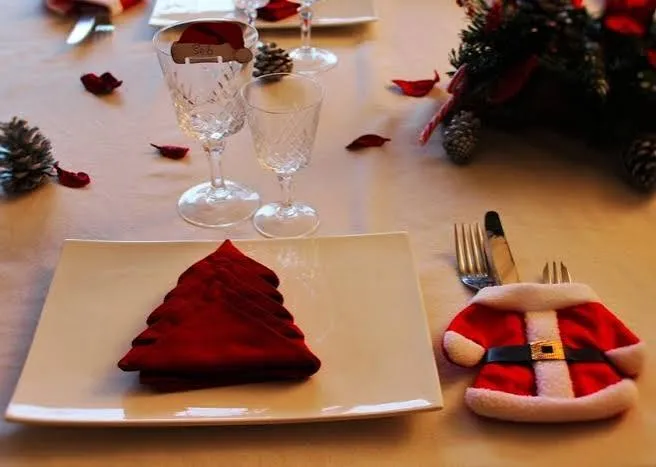
Budget alternative: grocery-store eucalyptus is about $4 a bunch at Trader Joe’s, and IKEA pillar candles are $3 each. Six settings for under $50 if you already own white plates.
Use two greens, not five. Eucalyptus gives you the soft silver drape and pine gives you the structure, and together they read as a considered runner instead of a pile of clippings. Snip stems on an angle, lay them in overlapping bundles, and repeat candles every 12 inches so the light stays even. No vase, no floral foam, no skills required — and it takes ten minutes to clear.
Set the Table, Then Let Them Eat
Thirty-one tables, one takeaway: the ones that stick with people aren’t the most expensive, they’re the ones with a point of view — a black candelabra, a hymnbook page, a bowl of faux snow. Pick one idea, borrow two details from a second, and stop shopping.
📌 Pin your favorites now so they’re waiting for you when the boxes come down from the attic.