
Most holiday centerpiece guides tell you to buy a garland and call it a day — which is exactly why so many December tables end up looking like everyone else’s. We spent weeks picking through Etsy, Amazon, HomeGoods, Target, and Walmart to find the centerpieces actually worth your December, and narrowed it down to 32 that deliver — from roughly $8 worth of homemade dried citrus to a $500 gold-and-mercury-glass spread.
Inside you’ll find natural evergreen runners, classic red-and-green florals, quiet woodland arrangements, and one very playful teal-and-pink table that shouldn’t work and absolutely does. Budget and luxury versions sit side by side, every idea is shoppable, and each one comes with either a real cost breakdown or an honest warning about candle safety and wilting lilies. Some links below are affiliate links, so we may earn a small commission if you buy — at no extra cost to you.
Holiday decorating in 2026 leans toward things you can actually touch: foraged branches, wood slices, and vintage ceramic trees rescued from estate sales rather than another box of matching ornaments. And stay until the end — we break down the most common mistakes that can ruin these looks.
📌 Save this to Pinterest for later — you’ll want to revisit these ideas.
1. A Runner of Fresh Evergreens and Dark Wood Candlesticks
Fresh garland runners either look expensive or look like a pile of sticks, and the difference is almost always length. On a 72-inch table, buy two 6-foot cedar or fir garlands and overlap them by about a foot in the middle. A single 9-foot strand runs short at the ends and leaves the wire armature showing. Lay the greenery on a narrow linen runner or a strip of kraft paper first — fresh fir weeps sap onto bare wood within two days. And keep every taper at least 10 inches from the nearest branch tip.
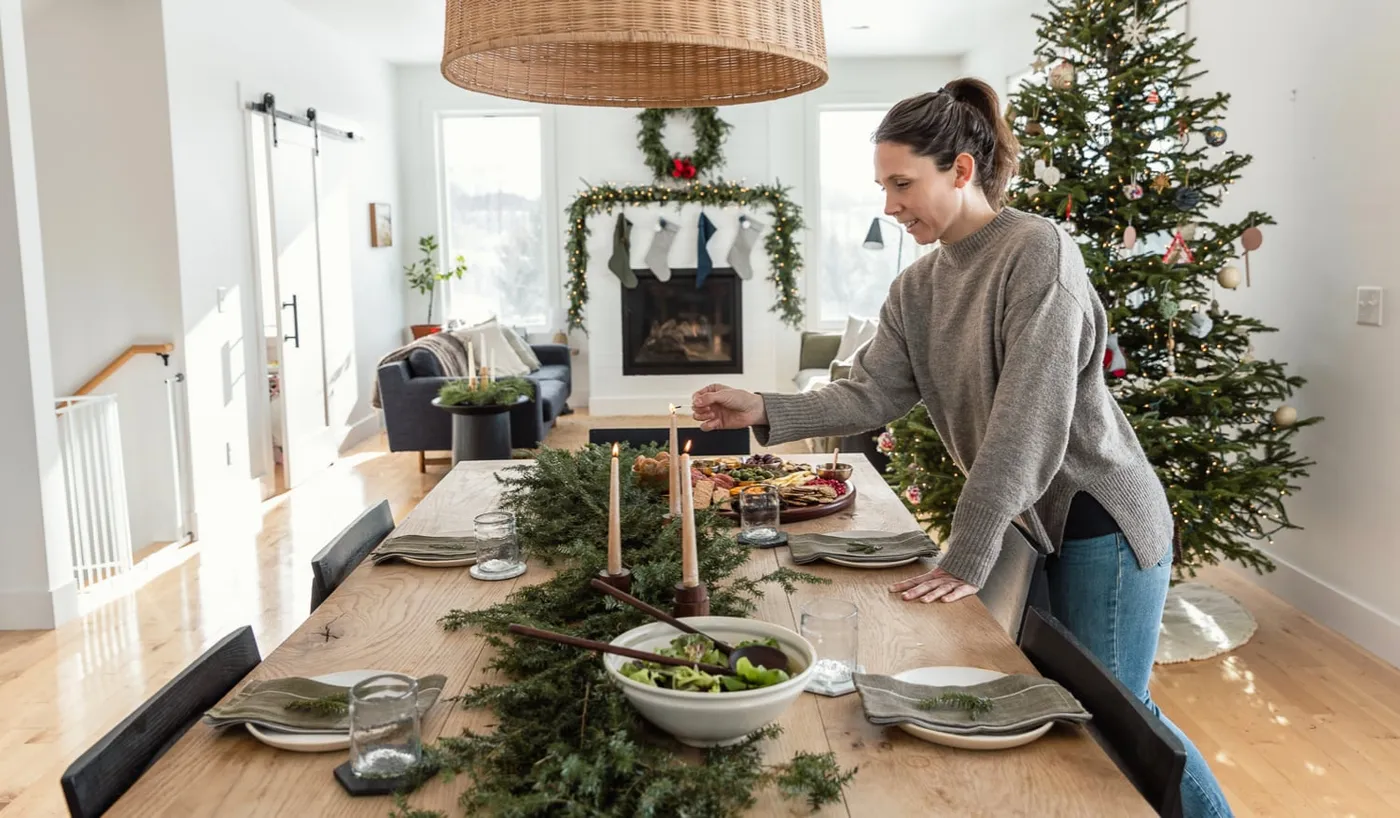
The dark wood candlesticks are doing more work than they get credit for. Strip them out and you still have a pretty table, but you lose the anchor that keeps the palette from floating. Light oak table, green garland, white plates — without those near-black holders in the middle, everything reads washed out and pale. Dark brown or charcoal wood gives the eye one place to land, and it makes the warm candlelight feel intentional rather than accidental.
2. Hurricane Lanterns, Dark Plums, and a Fireside Glow
Here’s what a table like this actually runs, assuming you already own plates and glassware.
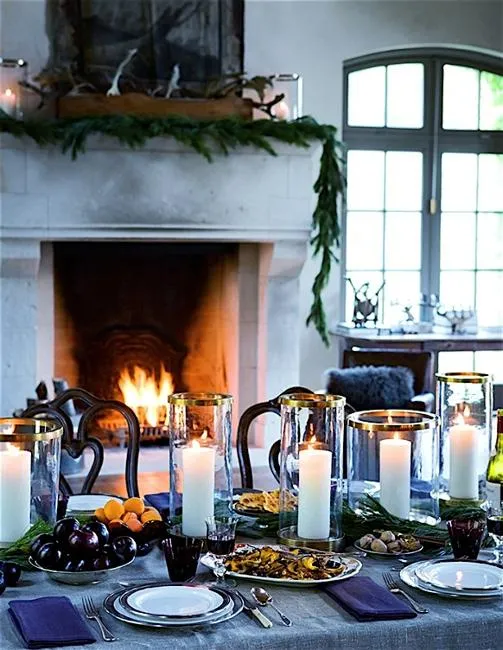
- Glass hurricane lanterns (4–6): $12–$28 each, $60–$150 total
- Pillar candles, 3 x 6 inch (6): $18–$35
- Grey linen tablecloth: $45–$140
- Fresh evergreen garland, two 6-foot strands: $40–$90
- Fruit, nuts, and two shallow bowls: $25–$50
- Mantel garland and extra greenery: $35–$80
Total: $223–$545. Budget alternative: skip the linen cloth, use shorter candle stubs, and buy hardware-store greenery instead of florist greens — you land around $110–$190.
Hurricane glass is the safest way to burn pillars, but it isn’t foolproof. A roaring fire across the room pulls a draft that makes an open flame lean, and a leaning flame against hot glass is how cracks start. Give lanterns at least three feet of clearance from the hearth and never leave the table while they’re lit. One more thing nobody mentions: cut plums and apricots in a warm room start to weep onto the cloth by hour three. Set the bowls on small saucers, or swap in faux fruit for long dinners.
3. A White Root Candle Holder Beneath an Evergreen-Draped Chandelier
The formula here is 55% light wood and cream (the table, the plates, the wicker), 30% deep evergreen, 10% black (that chandelier and the candlestick silhouettes), and 5% gold. It works because the boldest color is also the quietest in volume. Swap the evergreen for olive branches and the mood gets softer and more Mediterranean. Swap black accents for aged brass and the whole thing turns warm and traditional. Just keep the ratio — push any one ingredient past 40% and the serenity breaks.
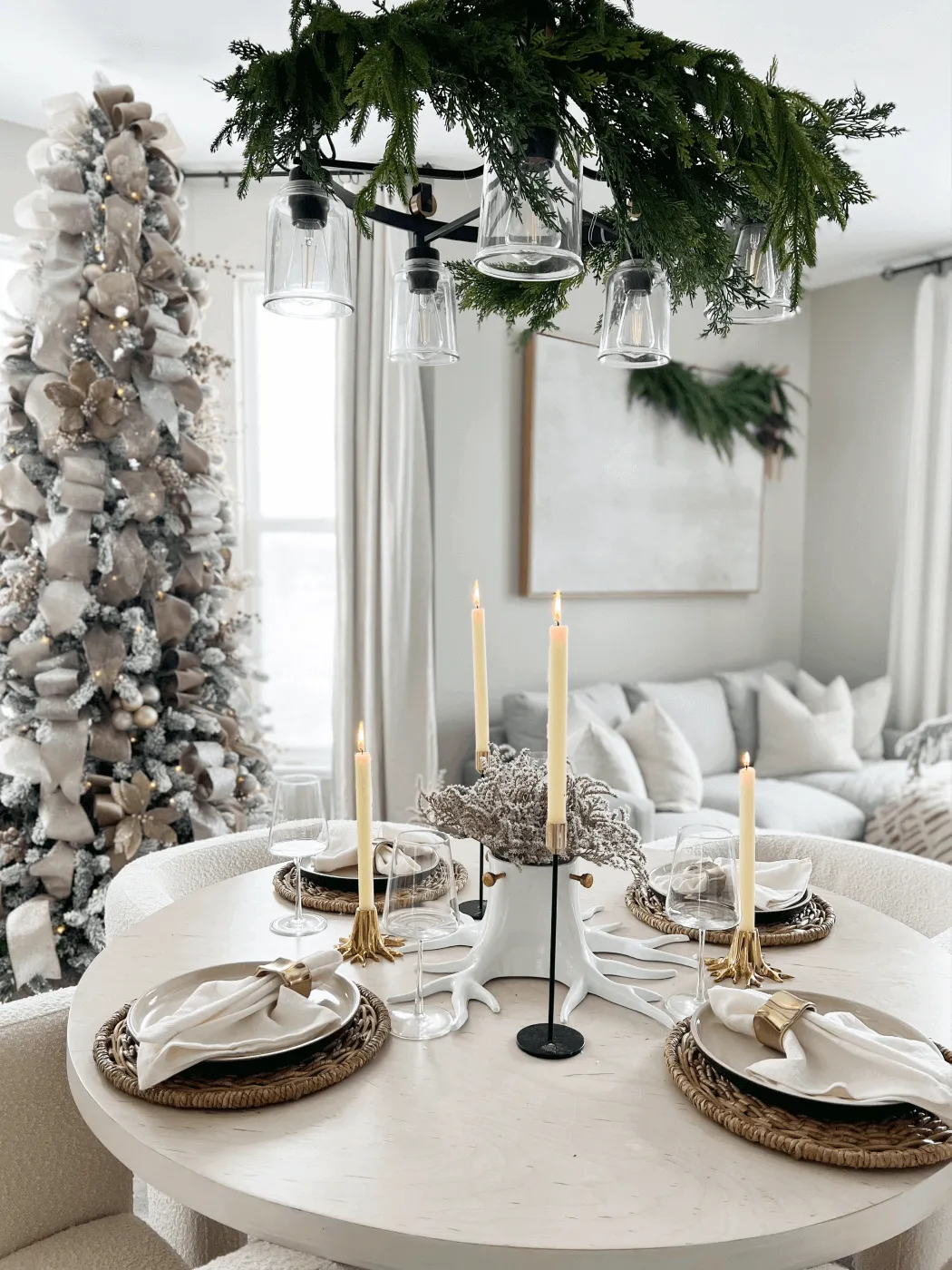
Three separate green moments, stacked vertically, all in the same tone: the centerpiece, the chandelier garland, and the flocked tree behind. That repetition is what makes a round table feel composed rather than cluttered. Round tables are tricky because there’s no head, no obvious focal point — so the eye needs a vertical throughline instead. Here it gets one, running from the tabletop up through the chandelier. The dried florals in the centerpiece repeat that same desaturated palette so nothing competes.
4. Magnolia Garland Dotted With Silver Ornaments and Gold Candlesticks
Building the magnolia garland, step by step.
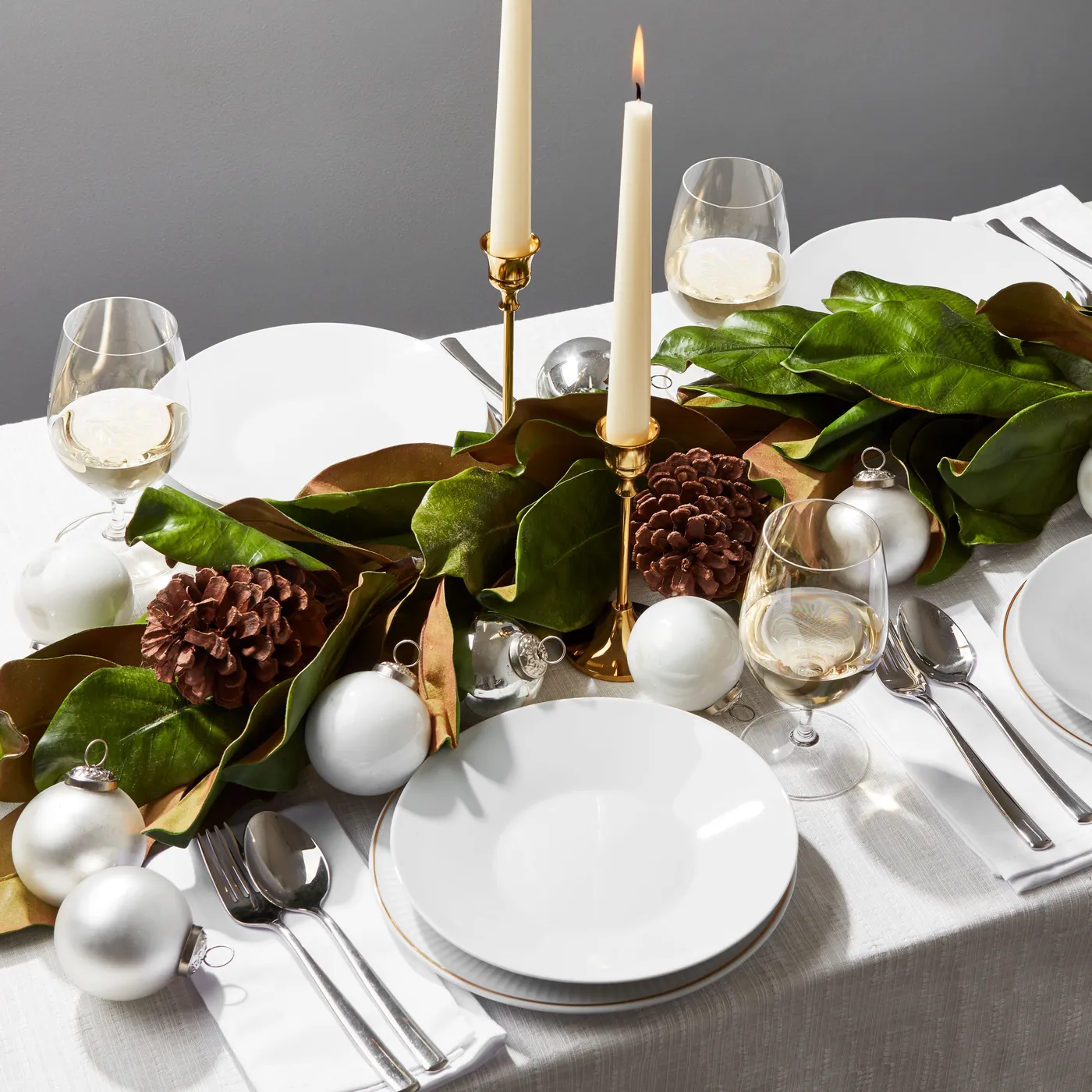
- Soak a 6-foot length of floral wire or a flexible garland base in water for 10 minutes, then shake it out.
- Cut magnolia leaves into 6-inch sprays and wire them in overlapping clusters, undersides facing out so the brown shows.
- Tuck in three pinecones every 18 inches, securing each with 24-gauge wire.
- Thread ornaments onto wire picks and push them in at staggered heights, never in a straight line.
- Float the finished garland on the tablecloth and set the two gold candlesticks at the one-third marks.
About 90 minutes and $45–$70 in materials, most of which you can reuse next year.
Real magnolia is gorgeous and expensive by the bunch. Faux magnolia garland — the kind with printed leaf undersides — reads convincingly from three feet away, which is exactly how far your guests sit. Pair it with dollar-store shatterproof ornaments in silver and white, plus two thrifted candlesticks sprayed gold. Total: about $60 instead of $250. For the same dense feel on a much longer table, Idea #9 gets there with a wooden tray and mixed evergreens.
5. A Single White Taper in a Bed of Cinnamon and Dried Citrus
Dried citrus and cinnamon look beautiful for about two weeks, then they start looking tired. Orange slices go from translucent amber to dull brown once indoor humidity reaches them, and cinnamon sticks shed their inner bark onto the tablecloth. Store the whole arrangement in a sealed bin between uses and expect one refresh per season. Real hypericum berries are the fragile part — they shrivel within four or five days in dry indoor heat. Pinecones, mercifully, last forever.
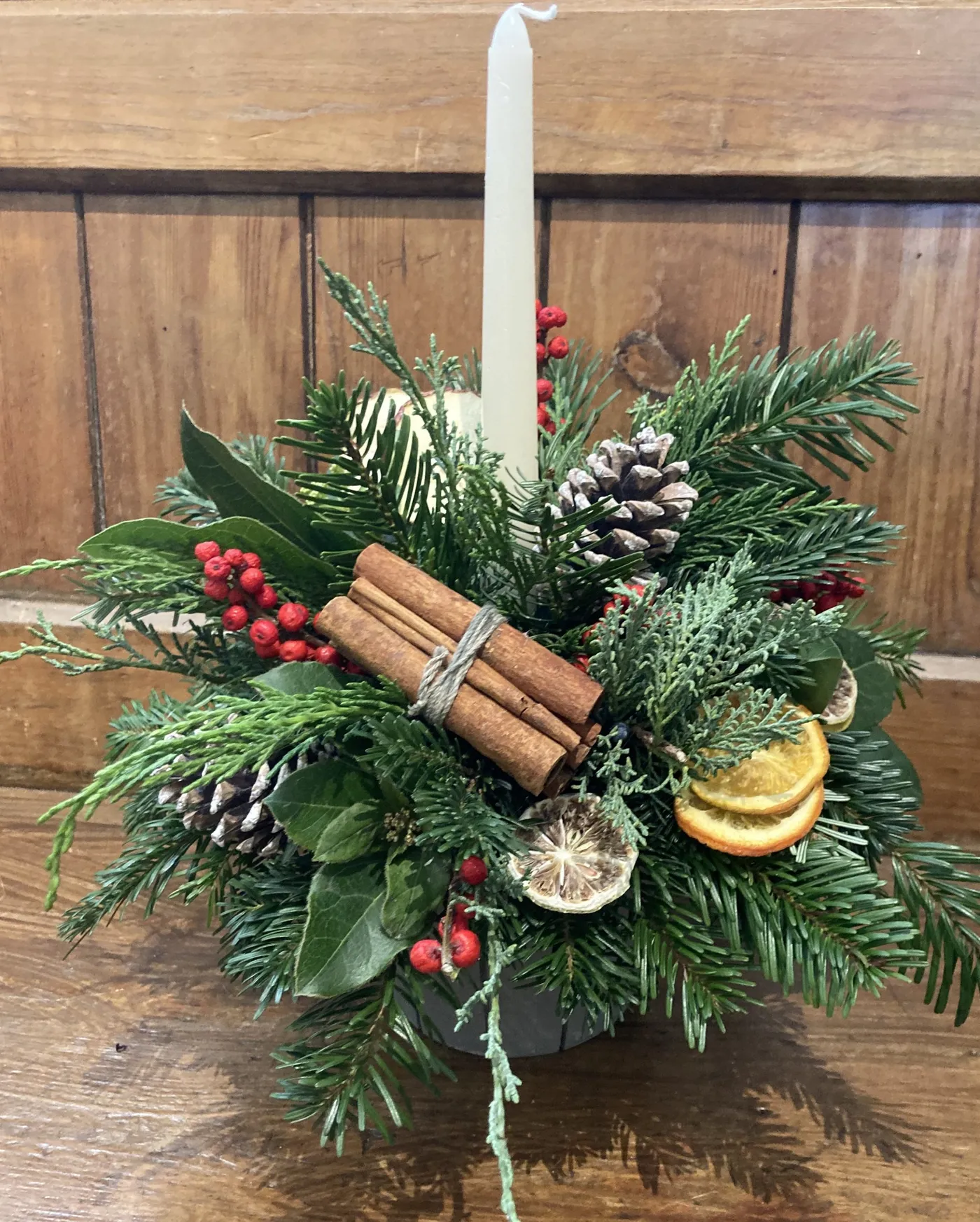
Make your own dried citrus instead of buying it, because the store-bought stuff is almost always sliced too thick and curls inward. Here’s the method that actually works:
- Slice oranges and apples 1/8 inch thick on a mandoline — thicker slices mold before they dry
- Blot both sides with a towel, then bake at 200°F on a wire rack for 2.5–3 hours, flipping once
- Cool completely before tucking into greenery; warm slices steam and fog the table
- Store in an airtight jar with a silica packet and they’ll hold for a year
A season’s worth costs about $8 in fruit.
6. A Weathered Wooden Tray of Pinecones and Christmas Crackers
The distressed grey wooden tray. Not the pinecones, not the crackers — the tray. It’s what keeps a fairly busy arrangement from taking over the entire table, and it’s what makes cleanup possible in ninety seconds when dinner is called. Trays also solve a problem most people don’t think about until they’re setting the table: a defined footprint. Nine inches wide and thirty inches long means the centerpiece knows exactly where it ends, and so do your plates.
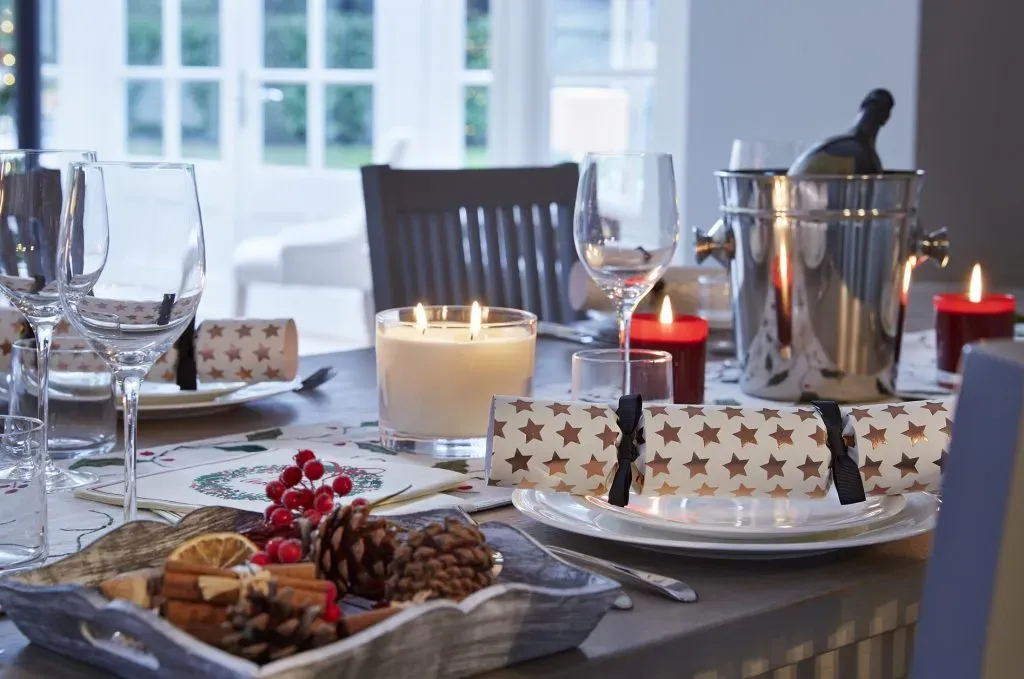
Tray-based tablescapes have been climbing on Pinterest for three seasons now, and 2026 is the year they stop feeling like a shortcut. Two things are driving it: smaller dining rooms, where a full table-length garland is genuinely in the way, and the rise of the tablescape you can lift off and park on the sideboard when the food comes out. Christmas crackers are riding the same wave — they photograph beautifully and they give a table something to do before the meal starts.
7. Mercury Glass Trees Anchoring a Gold-and-Silver Table
This look leans metal-heavy, which is where the money goes.
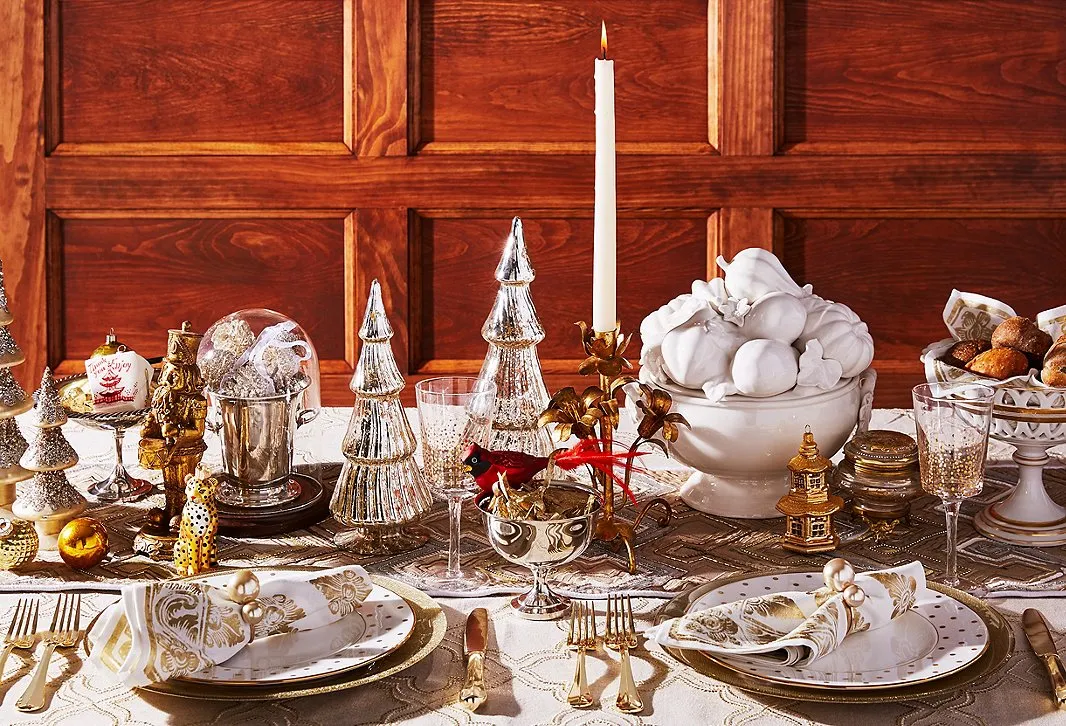
- Mercury glass trees (3, varying heights): $18–$60 each
- Gold-rimmed dinner plates, set of 4: $30–$90
- Gold flatware, 5-piece settings x4: $60–$180
- White ceramic tureen or footed bowl: $35–$120
- Candlesticks and tapers: $20–$55
- Vintage ornaments and a cardinal figurine, thrifted: $10–$30
Total: $173–$535. Budget alternative: skip the mercury glass, use a pair of mirrored candle holders and one large glass vase, and borrow the flatware. Around $85–$140.
This arrangement is built for a table that seats eight to ten. It needs a 38–40 inch wide surface so the centerpiece doesn’t crowd the chargers, and it wants a 9-foot ceiling to carry the visual weight of the tureen and the trees without the room closing in. On a 60-inch round, cut it down to one mercury tree, the tureen, and a single taper. On a 48-inch table, one tree and the tureen will carry the whole look on their own.
8. Eucalyptus and Evergreen Garland Warmed by Fairy Lights
Warm white string lights read as candlelight, not as Christmas lights, and that’s the entire trick. Green garland under cool-white LEDs looks electric and cheap; the same garland under 2700K warm LEDs looks like a fire is burning somewhere nearby. The little gold bells are the second smart move — they catch those tiny light points and throw them back across the dark wood, which is why the table reads as lit from within rather than from above. Layer the garland two or three branches deep so no wire shows.
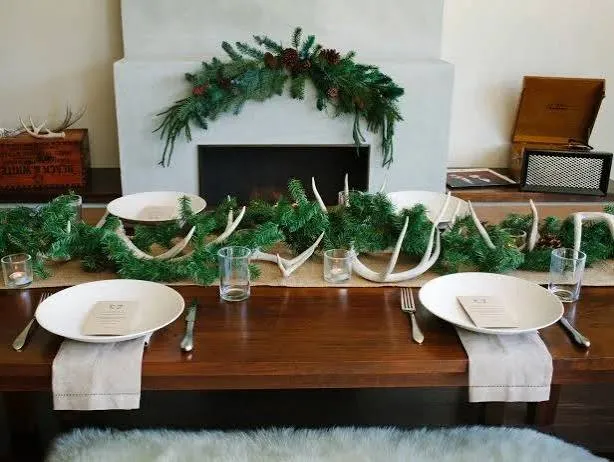
Four things to confirm before you commit to a lit garland runner.
- Measure the table and order garland at 1.3x its length — greenery compresses when you fluff it
- Make sure your lights are warm white, 2700K, and battery or USB powered so no cord crosses a walkway
- Check that your guests won’t mind low, flickering light at the table — this setup is moody by design
- Use faux garland if you’re running lights through it; fresh greenery plus warm wire is a fire risk
9. An Overflowing Dark Wood Tray With Matte Gold Baubles
An oversized wooden tray is the cheapest way to make a table look designed. Thrift stores and Facebook Marketplace have them for $5–$15 all year, and a quick sanding plus a coat of dark walnut stain gets you this look for under $25. Fill it with a $12 garland from a home improvement store, a $6 bag of pinecones, and shatterproof gold ornaments from Target at roughly $10 a dozen. IKEA pillar candles are $3 each. You’re at about $70 for a centerpiece that reads like three times that.
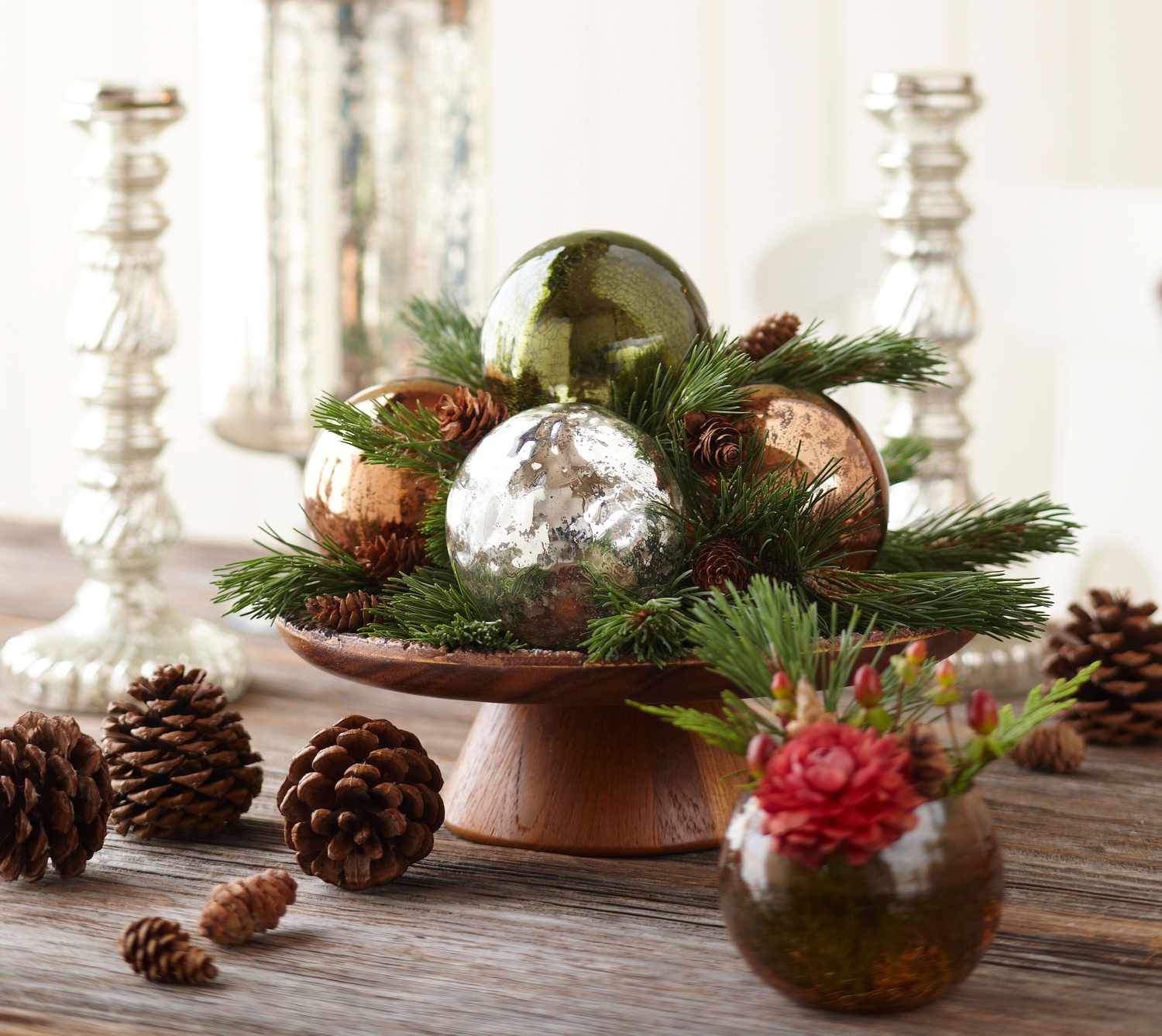
Real greenery in a wooden tray is beautiful and it is a maintenance relationship. Fresh branches shed needles onto whatever sits below them, and an unlined tray will show water rings within a week. Dried orange slices look wonderful for about ten days in a dry house and go soft and brown in a humid one. If you want zero fuss through December, this is a genuinely good place to go all-faux — nothing about the tray arrangement depends on the greenery being real.
10. Twin Pillar Candles Nestled Among Lotus Pods and Dried Apple
Candle clusters live or die on the height progression. Two pillars of the same height read as a pair of salt shakers; three at 3, 5, and 7 inches read as a composition. Wider candles belong in back, slimmer ones in front, and the tallest should sit about one-third off center rather than dead middle. Also: buy unscented pillars for the table. Two or three scented candles burning next to a roast is how a beautiful dinner starts tasting like a candle shop.
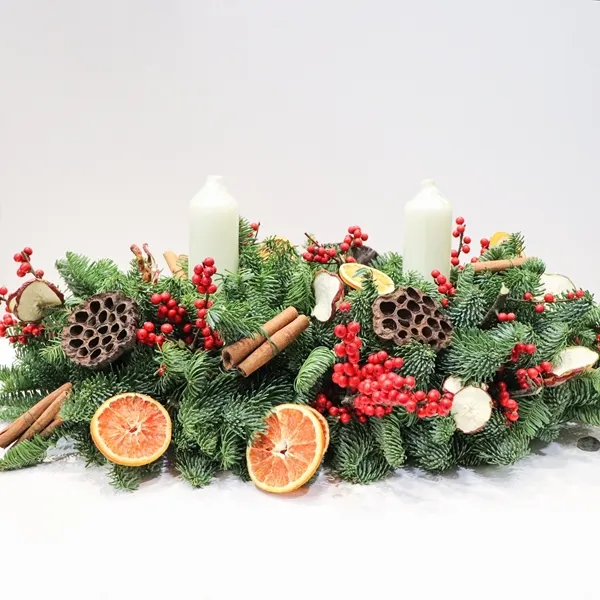
Here’s the break: 50% evergreen green, 25% red (berries plus the dried apple), 15% natural brown from cinnamon, pinecones, and stems, and 10% off-white from the candles. Note that nothing here is bright or primary — every color is muted one notch. That’s what keeps a red-and-green table from looking like a department store window. Want it cooler? Trade dried orange for dried pear and the red berries for burgundy ones. Keep the off-white candles exactly where they are; they’re the exhale.
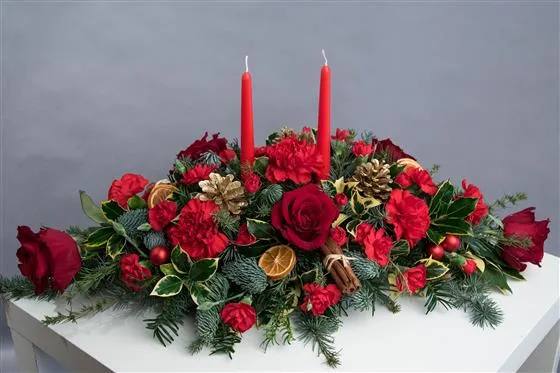
11. A Dense Thicket of Red Roses and Glittered Pinecones
Two red taper candles, and only two. Everything else in this arrangement is dense, textured, and slightly chaotic — roses, carnations, pinecones, dried orange. Without those two slim vertical red lines rising out of the middle, the centerpiece is just a mound. The candles give it a silhouette, a reason for the eye to travel upward, and a color echo that ties the flowers together. One candle would look lonely. Three would start a chorus. Two is the answer.

Glittering pinecones at home, in under an hour.
- Bake clean pinecones at 200°F for 30 minutes to kill anything living in them, then cool completely.
- Brush the tips only — not the whole cone — with a thin layer of Mod Podge.
- Hold over a paper plate and sprinkle fine gold glitter from above, rotating as you go.
- Tap off the excess and let dry 20 minutes; a second light coat adds dimension without looking crafty.
- Push a florist pick into the base and tuck into the greenery at staggered depths.
Roughly 45 minutes and about $12 for a dozen cones.
12. One Red Pillar Candle in a Hurricane Vase of Gerberas
Good news: this one is friendly to a small budget.
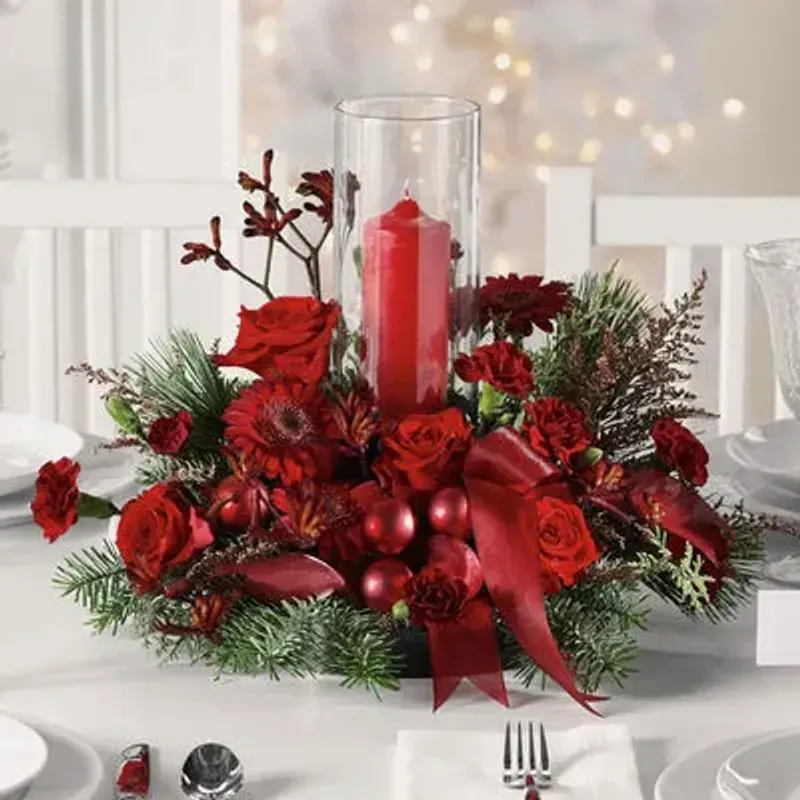
- Tall clear glass hurricane vase: $14–$40
- Red pillar candle, 3 x 6 or 3 x 9: $8–$18
- Red roses and gerbera daisies, two bunches each: $30–$55
- Pine sprigs and dried botanicals, foraged or from a florist: $0–$15
- Red ornaments and satin ribbon: $8–$20
Total: $60–$148. Budget alternative: one grocery store bouquet, a dollar-store hurricane vase, and a small cluster of red ornaments keeps the whole thing under $30. Compare with Idea #2 — same hurricane glass, three times the candle count.
Fresh flowers in a glass vase need the water checked every single day, and if that vase is clear, you’ll see every clouded moment. Change the water and re-cut the stems at an angle every other day and you’ll get five to seven days out of roses and gerberas. Red flowers are also unforgiving at the drop — a fallen petal on white cloth stains within minutes. Setting this out for a party rather than a dinner? Consider a faux hurricane arrangement and a real candle; nobody inspects the blooms.
13. A Cardinal-Embossed Vase of Roses, Holly, and Frosted Pinecones
This one is a big personality in a small container, so give it the right stage. It works on a 48–60 inch table for four, on a round table at least 42 inches across, or on a sideboard acting as a buffet centerpiece. What it can’t handle is a narrow 30-inch-wide table with place settings on both sides — the spreading pine branches will land in the salad plates. Under a low ceiling, swap the tall tapers for a single low bowl of roses instead.
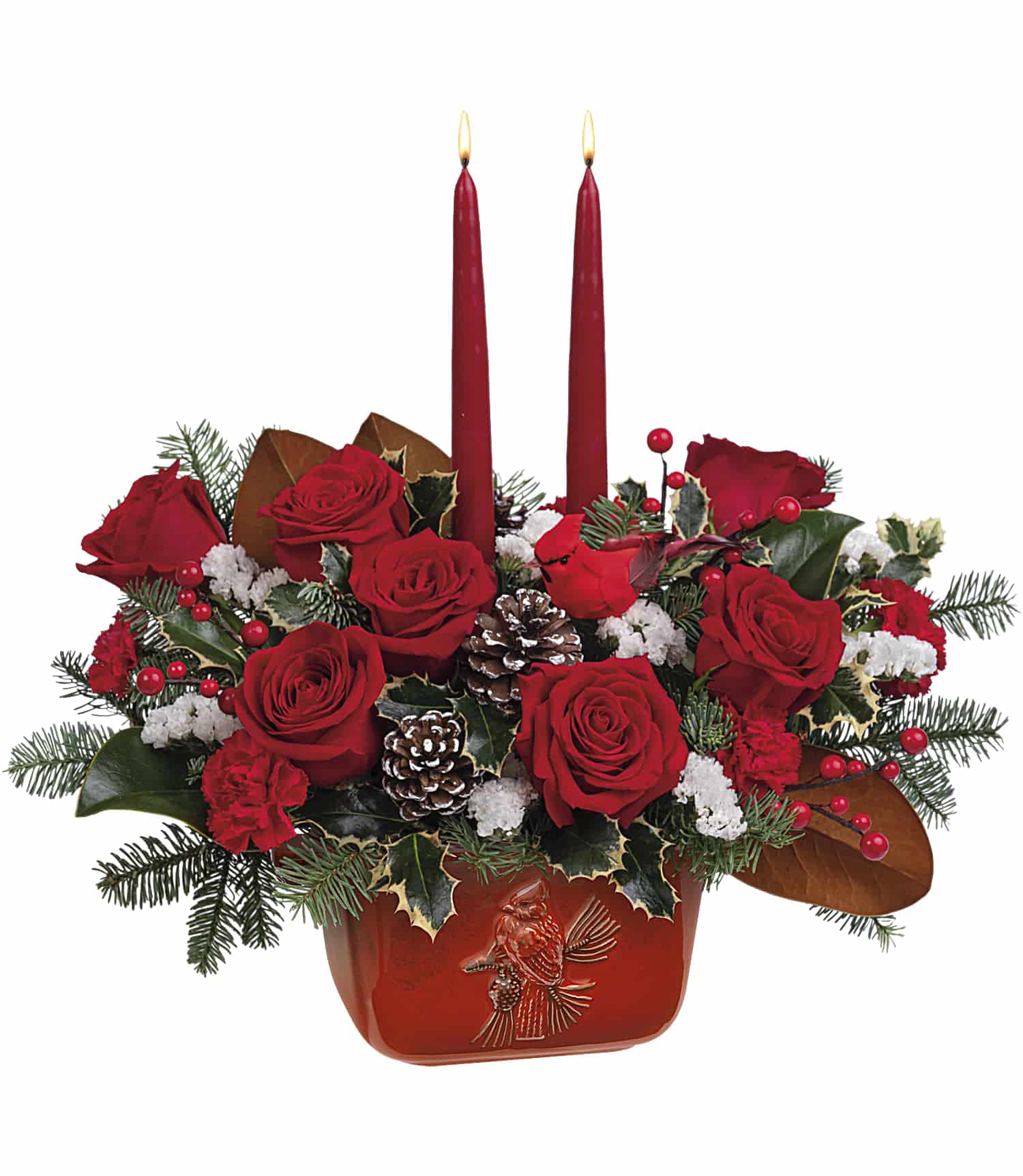
Keep your centerpiece under 12 inches tall at the dining table. That’s the number where seated guests can still see each other across the table, and it’s the most common mistake I see in photos — a gorgeous arrangement nobody can talk through. Want height? Get it from a tall, narrow element like one taper, one slim branch, or one tall vase rather than from mass. Anything wider than 14 inches in the middle of the table also needs at least 15 inches of clear space at each place setting.
14. White Lilies and Red Roses in Classic Contrast
This is complementary color at its most classic, and the reason it doesn’t look cheap is scale variation. The white lily is the biggest flower, the red rose is second, and the small white spheres are the smallest — big, medium, small, repeated. If every bloom were the same size, a bouquet turns into a blob. The green base matters too: pine and fir are dark and matte, so the red and white pop without any additional contrast work. That’s the whole engine of this arrangement.
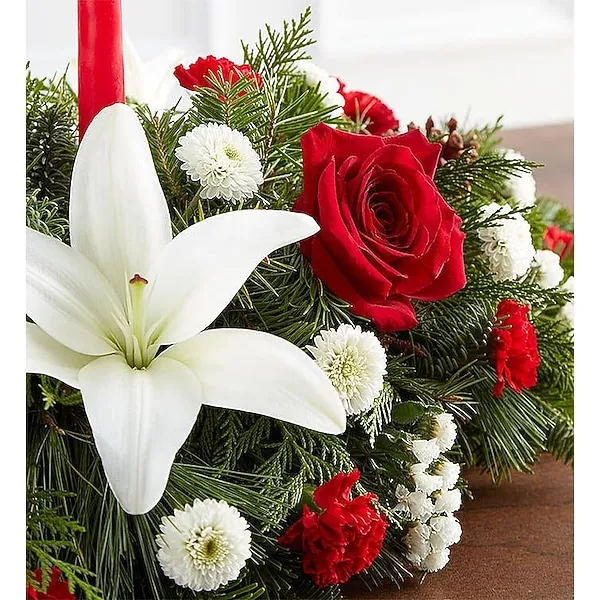
Grocery store florals have gotten genuinely good. Skip the florist for this look — a $12 bunch of red roses, a $9 stem of white lilies, and a $6 bunch of chrysanthemums will fill a centerpiece just as well as a $90 order. Add one bunch of greenery for $5 and you’re at $32 for the whole arrangement. Trader Joe’s in December is basically a florist. Buy two days before your event, not the morning of, so the blooms have time to open.
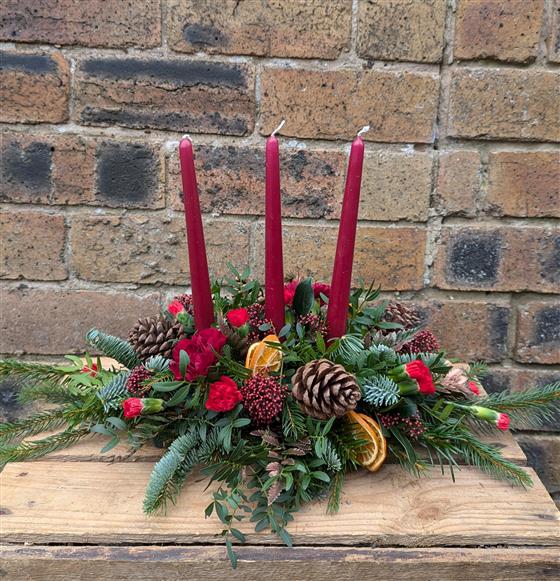
15. Three Red Pillars Rising From Rustic Evergreen
Three open flames in a pile of dry evergreen is the part of this look worth being careful about. Before you light anything:
- Trim the greenery back so no branch tip sits within 10 inches of a wick
- Trim wicks to 1/4 inch — long wicks produce tall flames that lean
- Set the arrangement on a tray or felt pad so needles never rest directly on wood
- Never leave the table with candles burning, even for a two-minute trip to the kitchen
If you want the same glow without the worry, three flameless pillars with a realistic flicker get you most of the way there.
45% green, 45% red, 10% natural brown. That’s it — this is essentially a two-color composition, and the brown pinecones are what keep it from looking like a flag. The greens are mixed on purpose: fir is darker and more needle-like, pine is softer and longer, and the contrast between them creates depth without adding another color. Swap the red pillars for cream and this becomes a completely different, much quieter arrangement on the very same table.
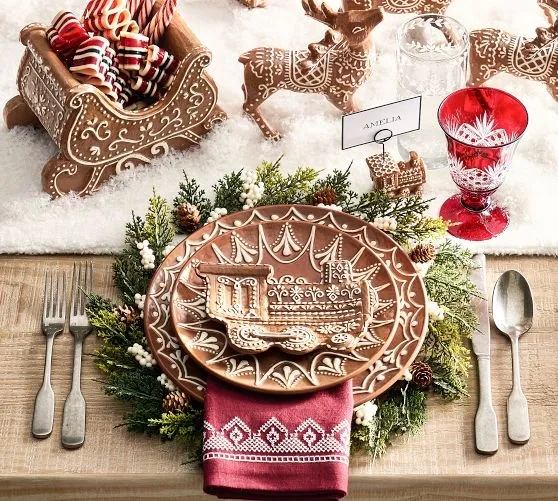
16. Gingerbread Sleighs, a Train Plate, and an Evergreen Wreath Charger
Four things to sort out before you build this setting.
- Measure your plate’s diameter and buy wreaths 1–2 inches larger so the plate nests rather than hides
- Make sure the wreaths are faux — real evergreen under a hot plate sheds and stains
- Confirm the runner is machine washable; white fluffy fabric plus cranberry candy is a short story
- Decide whether the sleighs hold candy or ornaments, because kids and adults need different answers
The wreath used as a charger. Put a plate on a plate and you have dinner. Put a plate on a wreath and you have a scene. It’s a five-dollar move that changes the entire read of the setting, and it’s the detail guests photograph. The trick is proportion: the wreath should peek out 1.5 to 2 inches all the way around the plate, no more. Too big and it looks like you couldn’t find chargers. Too small and it just looks like a mistake.
17. A Ceramic Santa Surrounded by Etched Crystal
Vintage ceramic Santa figurines are having a moment, and it isn’t nostalgia for its own sake. Grandmillennial decorating — the layered, inherited-looking, slightly old-fashioned style — has been building for several years, and 2026 is the December it fully lands on the table. Thrift shops and estate sales are where the good ones live, usually $8–$25. Etched crystal is riding along with it, partly because it’s absurdly cheap secondhand and partly because it photographs like something your grandmother actually owned.
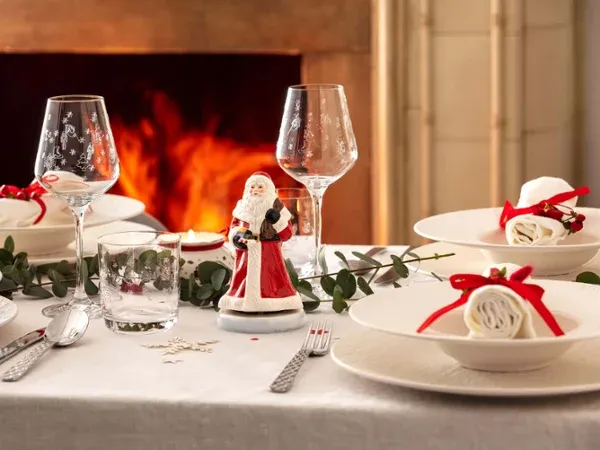
Never let a figurine sit flat on the tablecloth. A Santa placed directly on linen reads as clutter; the same Santa on a two-inch riser or a small stack of books reads as a deliberate object. Give it six inches of clear surface on either side, too. And if you’re using etched crystal, stagger the heights — short tumblers in front, stemware behind — so the etching catches light instead of disappearing into one grey cluster.
18. Ferns in a Dark Pot on a Rustic Wood Slice
Nothing here needs to be new. Wood slices come free from a Christmas tree lot if you ask nicely, or about $6 each at a craft store. A Boston fern runs $12–$18 at a big-box store and lives on as a houseplant after December. White plates you already own, twine and a rosemary sprig for pennies. The gold textured bowl and clear stemware are the only pieces worth buying new, and both turn up at HomeGoods for under $15. Realistic spend: $45–$70 for the whole table.
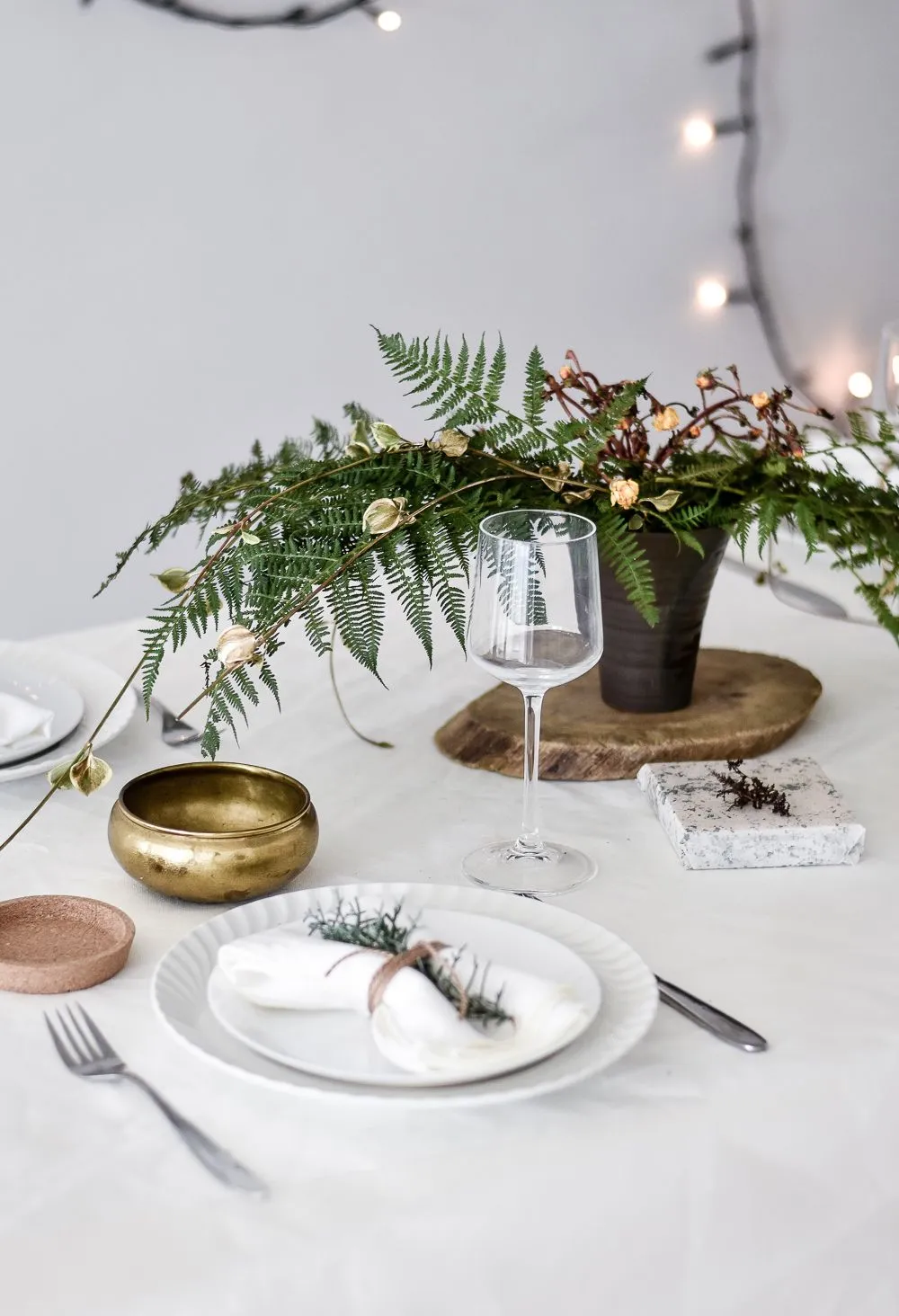
This is a small-table centerpiece, and that’s the entire point. It’s built for two to four people, on a table 30–36 inches wide and 48 inches or less. Very few holiday centerpieces are designed for that footprint — most assume a long dining table, so a narrow apartment table ends up with a scaled-down version of a big arrangement that never quite works. The wood slice base handles instability well, which matters on a small table where every bump is felt. For a longer table, see Idea #24.
19. Speckled Glass Trees and Winter-Patterned Dinnerware
Building a low, layered evergreen base that doesn’t look like a hedge.
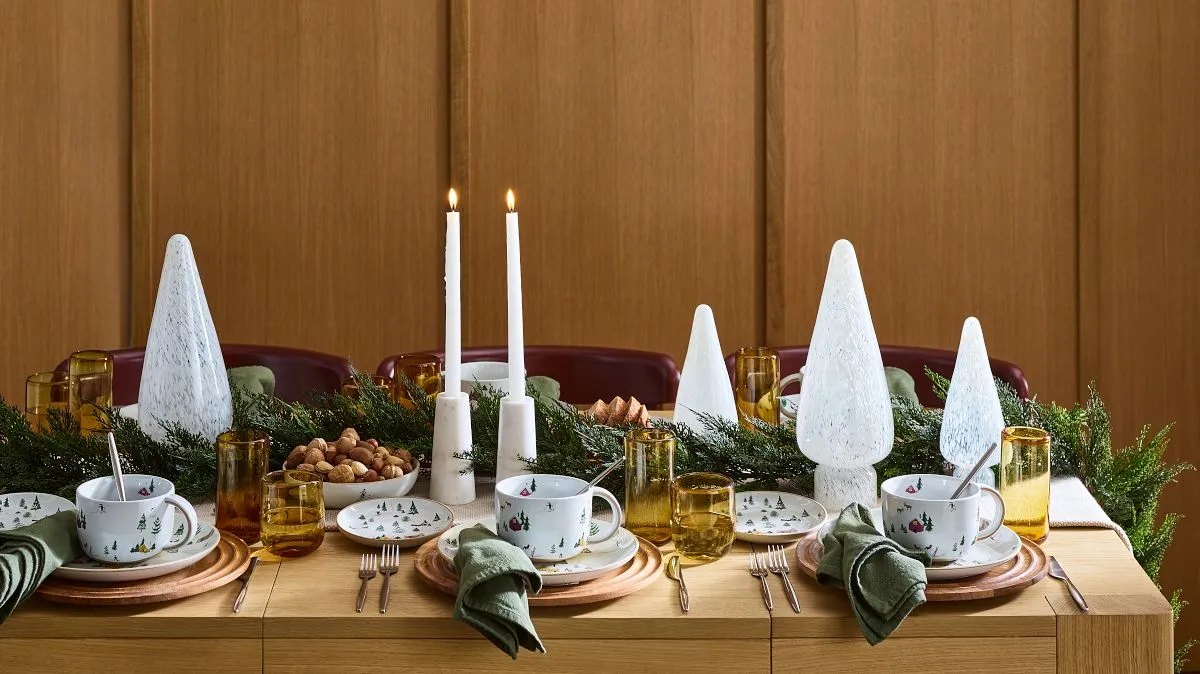
- Start with a 6-foot strand of mixed evergreen — fir, cedar, and a little eucalyptus for grey-green variation.
- Fluff it by pulling each branch outward, then lay it in a gentle S-curve instead of a straight line.
- Push in the taller glass trees first, at the one-quarter and three-quarter points, so they bracket the composition.
- Add the marble candle holders in the middle third, then the smaller trees in the gaps.
- Step back three feet and look. Anything that reads as a straight row gets moved two inches.
Twenty-five minutes, plus $0 if you already own the garland base.
Three whites, three different materials — speckled glass, marble, and ceramic dinnerware — and that repetition is what ties the table together without matching. The amber glassware is the sharp move. Most people would have chosen clear stemware, and clear would disappear against a white and green table. Amber adds warmth and a little vintage weight, and it echoes the wood chargers. The result is a table that looks collected over years rather than bought in one afternoon.
20. Burgundy Blooms and Mercury Votives Against a Log Wall
Food on wooden slices is charming and slightly risky. Bare wood absorbs moisture and picks up flavor, so anything juicy — berry-topped cupcakes, in this case — needs a liner or a coat of food-safe oil and wax. Mercury glass votives also get genuinely hot; keep them at least four inches from the yarn balls, which will scorch long before they catch fire. And if there are pets in the house, yarn pom-poms are a swallowing hazard for cats, full stop. Consider fabric balls or small ornaments instead.
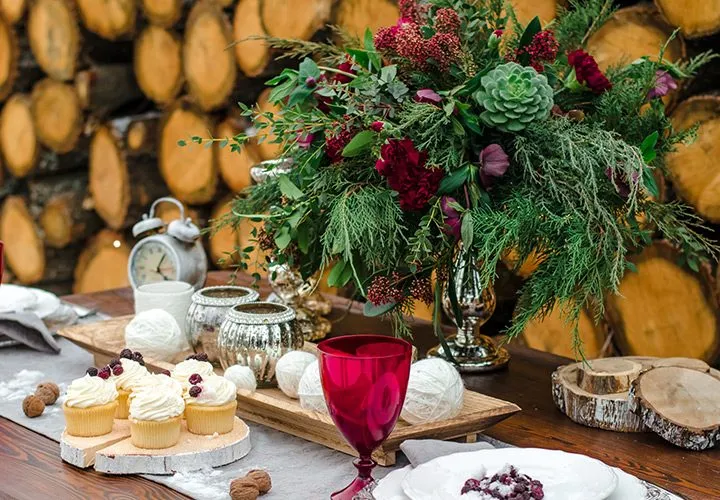
This one is more affordable than it looks because the log wall does the heavy lifting.
- Burgundy and green florals, fresh or faux: $40–$120
- Grey linen table runner: $20–$55
- Mercury glass votives and vase, set of 6: $25–$60
- Small candles: $10–$18
- Wood serving slices and a tray: $15–$35
- Burgundy glass goblets, set of 4: $28–$70
Total: $138–$358. Budget alternative: go faux on the florals, buy glass votives at a dollar store, and use your everyday goblets. Around $70–$110.
21. Roses, Orchids, and Tulip Buds on a Dark Table
40% red, 30% deep green, 20% creamy white, 10% brown wood. The white orchestrates everything — it’s the smallest color by volume and the one that makes the red look intentional rather than accidental. Orchids are the wildcard that keeps this from being just another red Christmas centerpiece; their shape is completely different from roses and tulips, and that structural variety reads as expensive. Swap the orchids for white stock and you lose the architecture but keep the palette.
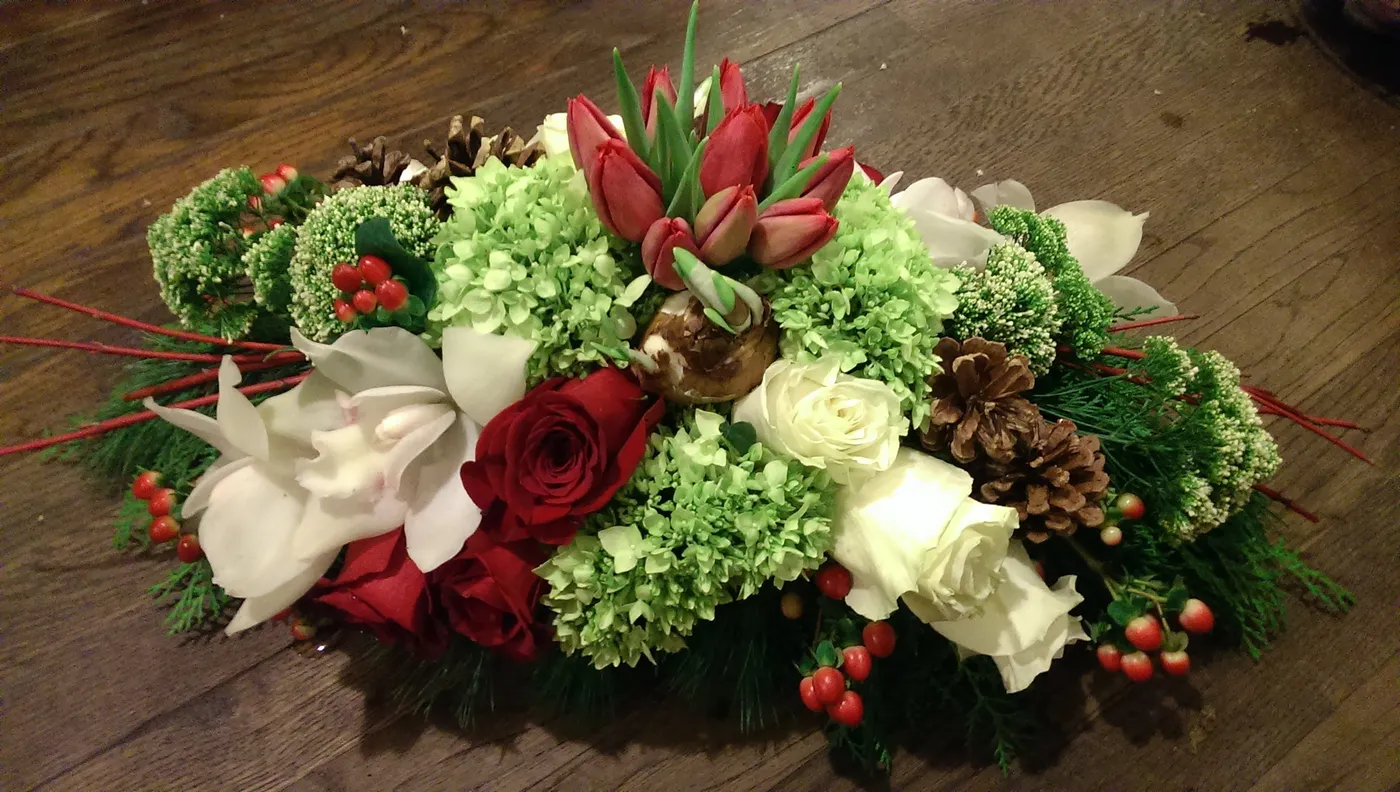
The white orchids. Red-on-green arrangements are everywhere in December, and most of them are lovely and forgettable. The moment you add a tall, arching white orchid, the composition gains a shape it didn’t have before — something reaching upward instead of just outward. They also break the density: everything else here is packed tight, and the orchid stems open up vertical space in the middle. If you cut one element, cut the tulip buds. Not the orchids.
22. Red Tapers and Gold-Dipped Pinecones on Bright White
Gold pinecones look best when the gold is only on the tips. Spray the whole cone and you get a solid metallic blob that reads cheap from across the room. Instead, brush the outer edges of the scales with liquid gilding wax or a thin coat of metallic craft paint on a small brush, then let the natural brown show in the recesses. Ten minutes for half a dozen cones, and that depth is the difference between craft fair and catalog. Dried orange slices nearby? Keep the spray can well away — overspray ruins them.
Gilding wax and spray paint both flake, and both flake onto your tablecloth. Handle the cones by the base, store them wrapped in tissue between seasons, and expect to touch them up every year or two. Dried orange slices absorb ambient moisture and go soft; a few days in a warm dry room fixes that. And taper candles burn down faster than you expect — a 10-inch taper is roughly five hours, so buy spares and swap mid-evening rather than letting one die while its partner towers.
23. Twin Pots of Camellias and Bare Winter Branches
Camellias are pricey at a florist and nearly free from a garden. If you or a neighbor has a camellia bush, you have this centerpiece already. Otherwise faux camellia sprays run about $8–$12 each and hold up for years. The pots are the real find — textured ceramic planters at a thrift store cost $4–$10 each, and the coarser the glaze, the better this reads. Bare branches can be gathered from any yard or bought for under $10 a bundle. Two complete arrangements: roughly $50–$80.
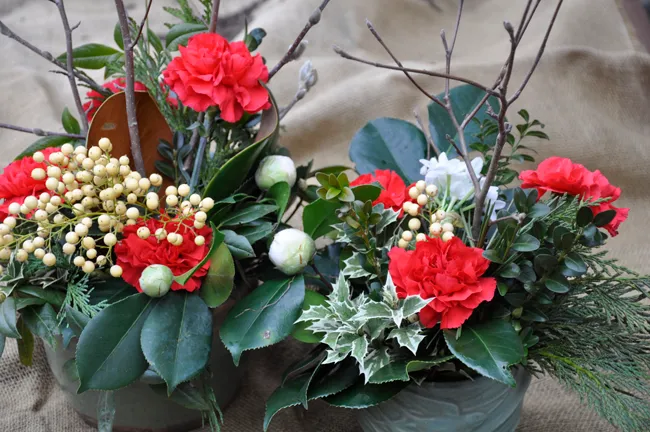
Three separate principles are stacked here, and it’s worth naming them.
- Round, dense, contained shapes read as formal; loose, sprawling ones read as casual. The pots decide the tone.
- Bare branches above flowers give the eye somewhere to travel, so the arrangement never feels bottom-heavy.
- Two matching pots create symmetry — the simplest way to make a sideboard or mantel look intentional.
This is the compact, formal cousin of Idea #29 — same red-and-green thinking, completely different scale.
24. A Lighted Ceramic Tree and Cottage on the Table
Built for narrow tables. A ceramic tree plus a small house and a few loose ornaments takes up about 20 inches of length and 10 inches of width, which means it fits on a 30-inch table with room left for real place settings. It’s also the answer for anyone whose table doubles as a desk or a homework station — nothing here is heavy or fragile, and it all lifts off in one trip. On a table longer than 60 inches, add a second grouping at the opposite end.
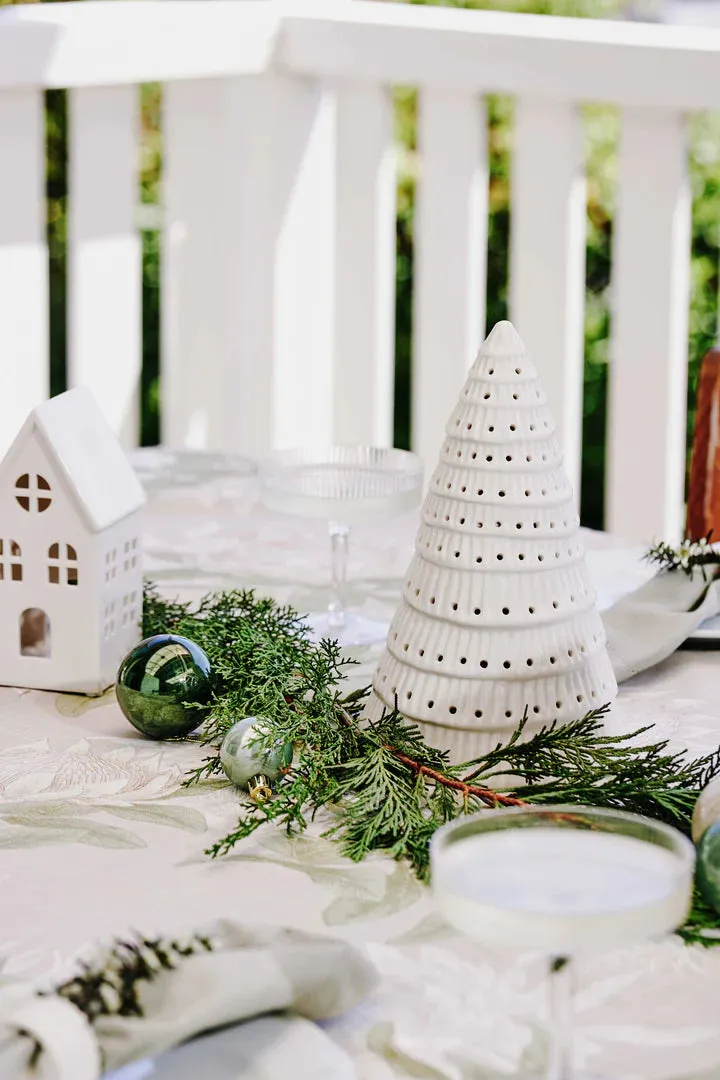
Styling a ceramic tree and a light-up house without it looking like a shelf display.
- Set the tree slightly off center — dead middle reads as a model home.
- Angle the house about 20 degrees to the tree, never square to the table edge.
- Lay fresh evergreen in a loose arc between and behind both, breaking the line in two places.
- Tuck three or four ornaments into the greenery at different heights.
- Leave the front third of the table clear so plates have somewhere to land.
Ten minutes, and $0 if you already own the pieces.
25. Roses, Mums, and Sheer Silver Ribbon
The sheer silver ribbon. Everything else here is a standard-issue red-and-white Christmas arrangement — beautiful, familiar, and honestly a little safe. The ribbon is what pushes it somewhere more interesting. Because it’s sheer, it doesn’t cut the arrangement in half the way a solid satin bow would; it softens the edges and catches light in a way that reads almost frosty. Swap it for opaque red ribbon and the whole centerpiece drops a full tier in sophistication.
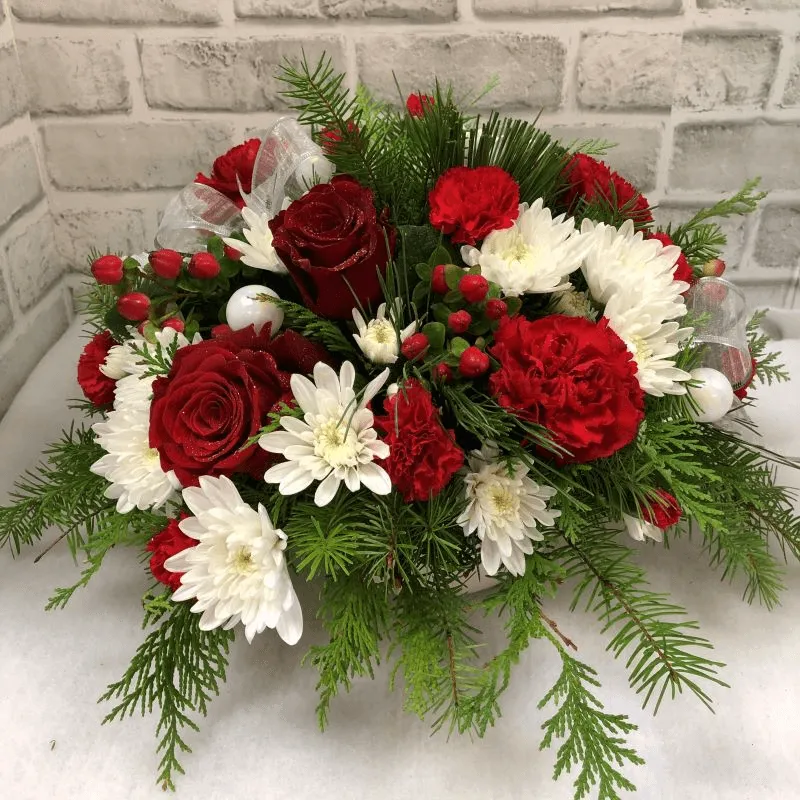
Two honest warnings. White chrysanthemums look pristine for about three days and then start browning at the petal edges — order them for the day of, not the week before. Red berries in Christmas arrangements are often hypericum, which is fine, but holly berries and mistletoe are toxic to cats and dogs. If your animals get on the table, go faux. And keep the arrangement out of direct sun and away from heating vents; nothing shortens the life of cut flowers faster than a warm draft.
26. Gold Tapers and Plaid Ribbon Above Red Fluted Chargers
Traditional red and gold gets expensive fast if you buy it all new.
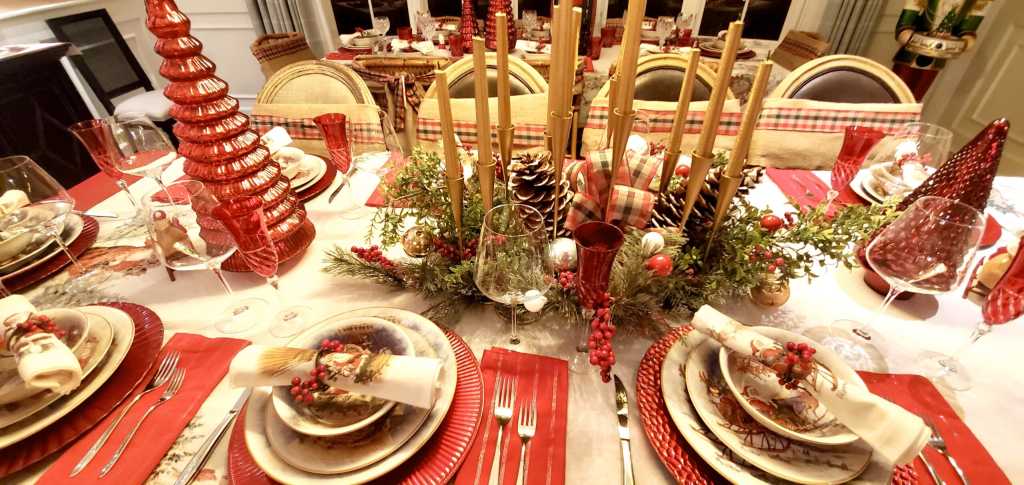
- Gold taper candles, set of 6: $12–$30
- Evergreen and pinecone garland: $35–$90
- Red fluted chargers, set of 4: $30–$80
- Red glass decorative trees (3): $20–$60
- Plaid ribbon, 10 yards: $8–$22
- Napkins, rings, and napkin accents: $25–$60
Total: $130–$342. Budget alternative: the red chargers are the one place to spend, so thrift them. Everything else can come from a dollar store and nobody will know. Around $55–$90.
40% red, 30% deep green, 20% gold, 10% cream. The gold is what makes this look traditional instead of basic — it’s a fifth of the visual weight, which is more than most people risk. If you want to modernize it without losing the spirit, hold the red and green and swap gold for aged brass or matte black. Just mind the ratio: black at 20% tips a red-and-green table dark in a hurry.
27. Red-and-White Roses Framing Two Red Tapers
Skip floral foam. It crumbles, it never breaks down, and in a low arrangement the stems only penetrate the top inch anyway. Use a crumpled ball of chicken wire in the container instead, or a grid of tape across the top. Both hold stems more securely, both let you re-cut and reinsert stems as the arrangement settles, and both cost about three dollars. The other fix for a low bowl: cut your greenery two inches shorter than you think you need, then let it sprawl outward rather than upward.
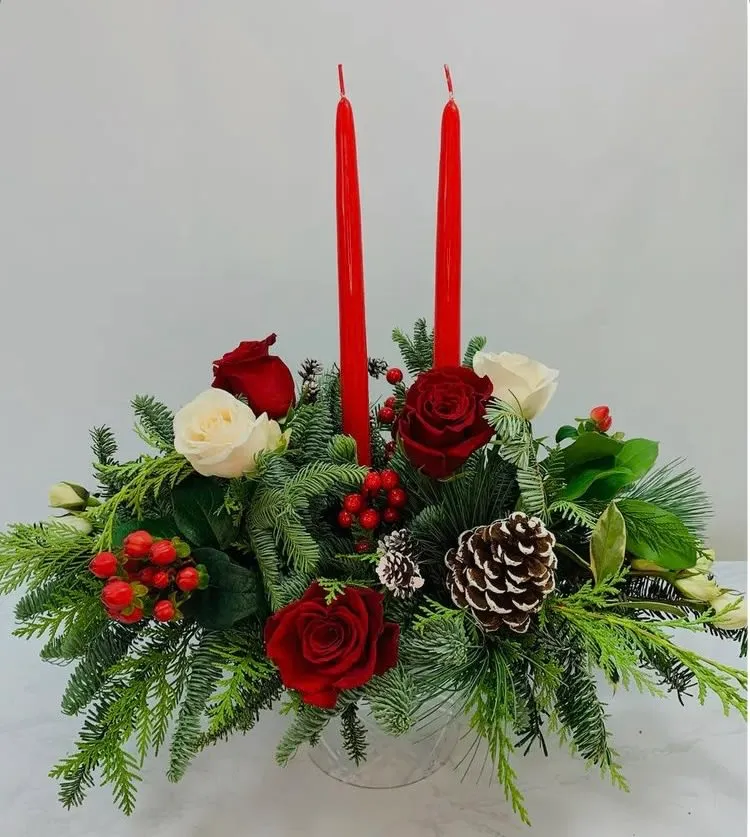
Red and white roses together look luxe, but they’re the two most common grocery store flowers in December. Two bunches of each runs about $24 at a supermarket, and a bag of faux frosted pinecones is $6 in the post-Christmas aisle. The red tapers are the only thing worth buying in a specific shade — get true red, not burgundy, or the flowers will fight them. Total build: $35–$45. For the softer version of this palette, Idea #14 trades the red roses for lilies.
28. A Brick-Built Garland Running the Length of the Table
Toy bricks on the holiday table started as a kids’ activity and turned into a genuine decorating trend. Two things pushed it: parents who got tired of setting two tables, and a wider move toward holiday decor people can actually touch instead of just look at. It photographs exceptionally well — bright orange and green pop hard against white linen. This one has real staying power, because it solves a problem no traditional centerpiece can: it gives a seven-year-old something to do during the appetizer course.
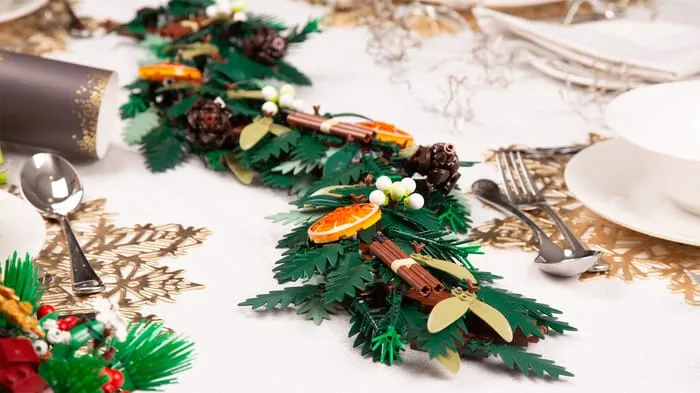
Check four things before you commit to a brick garland.
- Confirm the garland is short enough to leave 15 inches of clear space at each place setting
- Check that the pieces you need are actually in the bin — sorting always takes longer than building
- Choose a base plate or mat so nobody’s elbow scatters the whole thing mid-dinner
- Make sure the pine and citrus pieces are faux; fresh greenery on a plastic base gets messy fast
29. A Dark Woven Basket of Roses, Mums, and Lilies
The basket is the overlooked decision. A dark woven container absorbs light and gives a dense red arrangement somewhere solid to sit — a glass vase of the same flowers would read lighter and far less special. Baskets also let the greenery spill over the rim naturally, which creates that loose, gathered-from-the-garden quality. The creamy white lilies are doing quiet work too: they’re the lightest value in a very dark composition, so they give the eye an entry point instead of a wall of red.
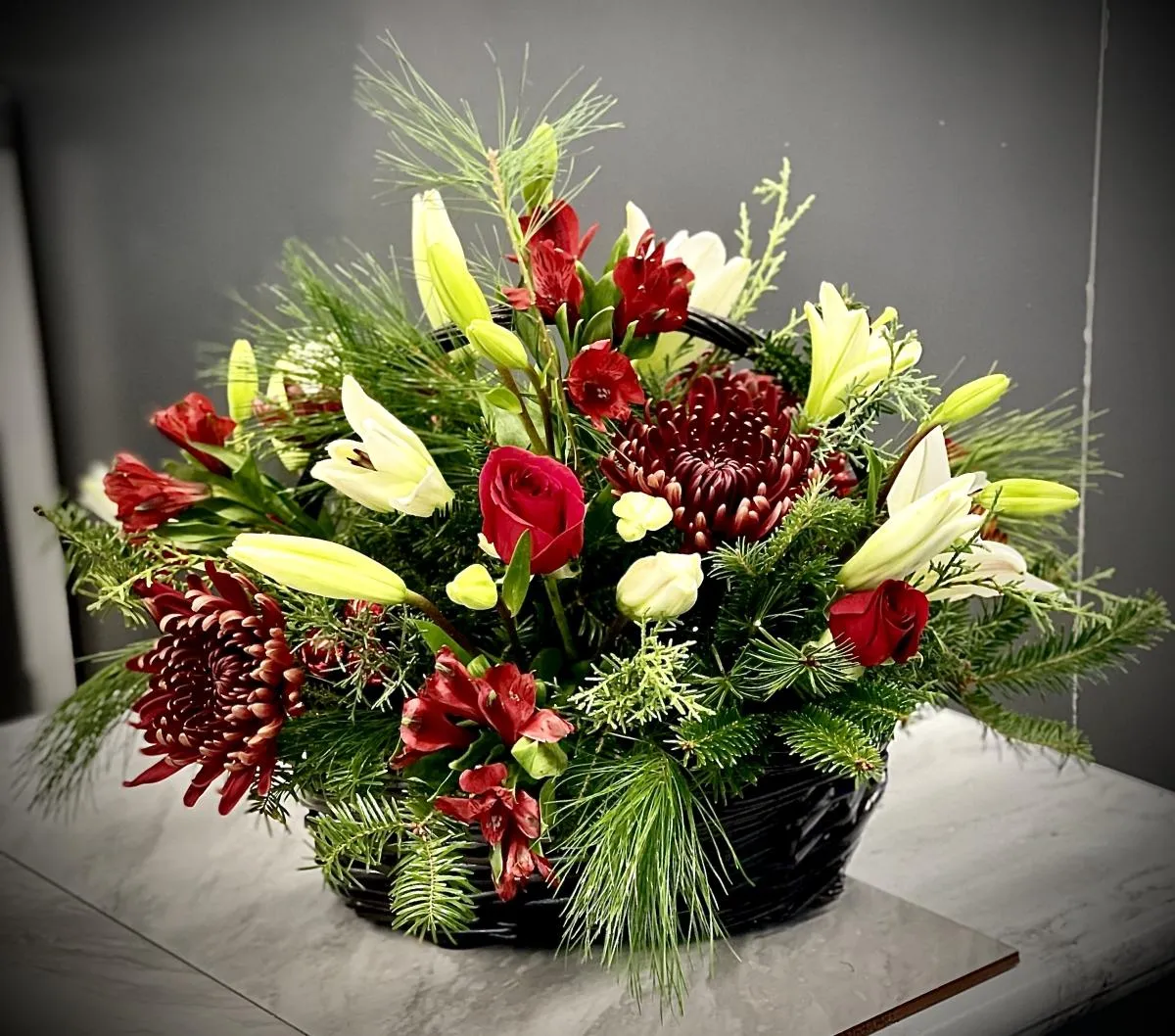
At roughly 24 inches across, this is a sideboard or buffet piece more than a dining table centerpiece — it’s simply too wide to sit in the middle of a table with place settings on both sides. It works on a 60-inch console, a 72-inch buffet, or as the anchor of a fireplace mantel. On a dining table, it suits a 42-inch round where four people sit and this arrangement is the only thing in the middle. Seating eight or more? Split it into two smaller baskets and place one at each end.
30. Wood Slices, Mr & Mrs Letters, and Fairy Lights
Making wood slice letter stands, step by step.
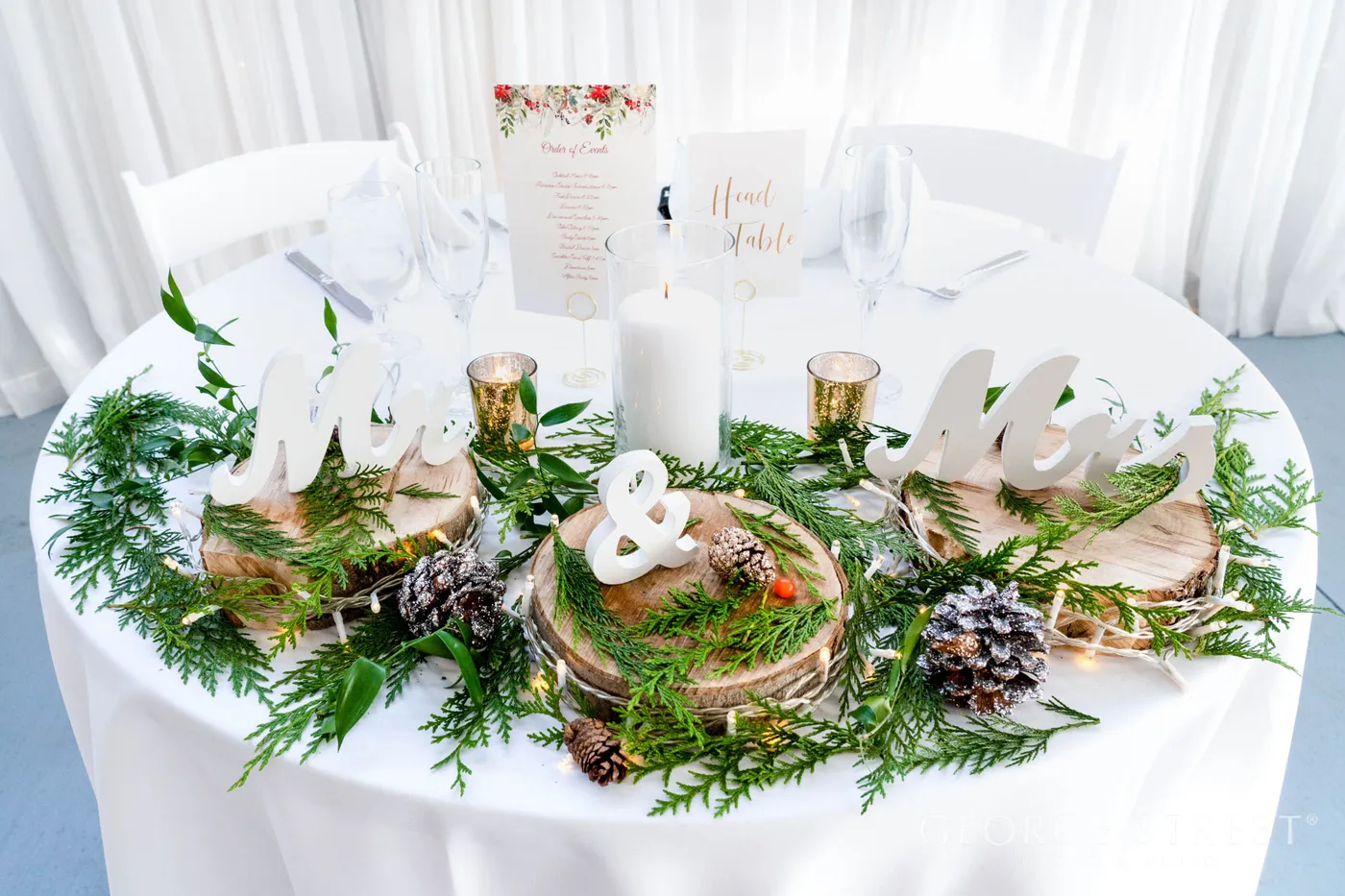
- Source 3–4 inch wood slices — craft stores sell them pre-dried and sanded for about $1 each.
- Sand the face lightly with 220 grit, wipe clean, and seal with matte polyurethane. Two thin coats, one hour apart.
- Attach wooden or painted letters with wood glue, or drill two pilot holes and use short finishing nails.
- Add a small felt circle to the underside so the slices don’t scratch the table.
- Arrange along the garland, alternating heights by using one thicker log round in the middle.
About two hours plus drying time, and roughly $15 in materials.
The lettering. Wood slices topped with pinecones would be pretty and completely generic. Wood slices that spell Mr and Mrs — or a family name, or a date — turn a centerpiece into an object with a reason to exist. That’s also why this one survives past December: most people don’t throw away something with their names on it. If you’re building this for a wedding, a shower, or a first Christmas in a new house, that small bit of personalization is the entire point.
31. A White Slatted Basket of Carnations and Lime Mums
Carnations get snubbed and they shouldn’t — they’re the longest-lasting cut flower in the cooler, often holding ten days or more. The lime green button mums are the fragile part of this arrangement; they bruise if you look at them wrong, so handle the stems at the base and never squeeze the blooms. Keep the whole thing away from radiators and heating vents, which will cut its life in half. And yes, the shiny ornaments on the table will be relocated by any toddler within arm’s reach. Plan for that.
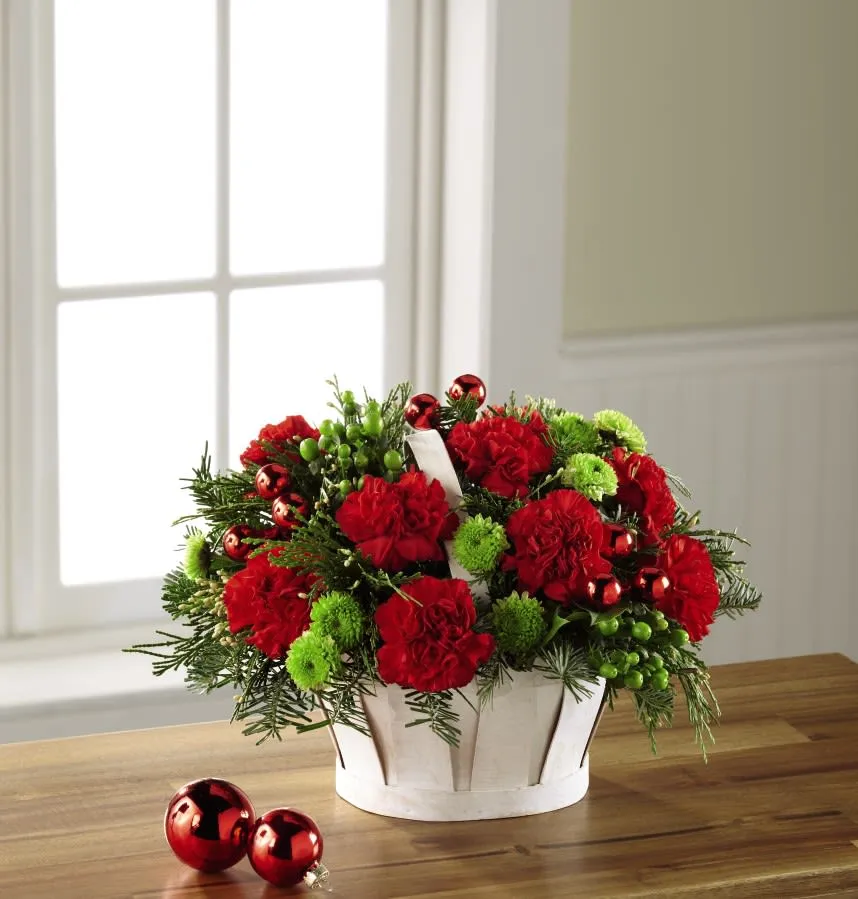
For a low, wide basket like this, build in layers rather than stuffing. Line the basket with plastic, add a crumpled chicken wire base, then work outward: dark pine first as the outer ring, then the red carnations, then the lime mums tucked in last so they sit on the surface and stay unbruised. Aim for the arrangement to rise about 1.5 times the height of the basket itself — any taller and it starts looking like a funeral piece. Twenty minutes, no foam needed. For a version that skips flowers entirely, see Idea #16.
32. Teal Napkins, Gold Beads, and a Pink-and-Teal Ornament Garland
50% green, 25% pink, 15% teal, 10% gold. The trick is that the greens and the gold do the structural work while the pink and teal sit on top as accents — flip that ratio and the table turns into a birthday party. Non-traditional color schemes need an anchor, and here it’s the greenery. Swap pink for a deep magenta and teal for navy and the formula still reads festive, just moodier. Keep the gold constant either way; it’s what makes the brights look grown-up.
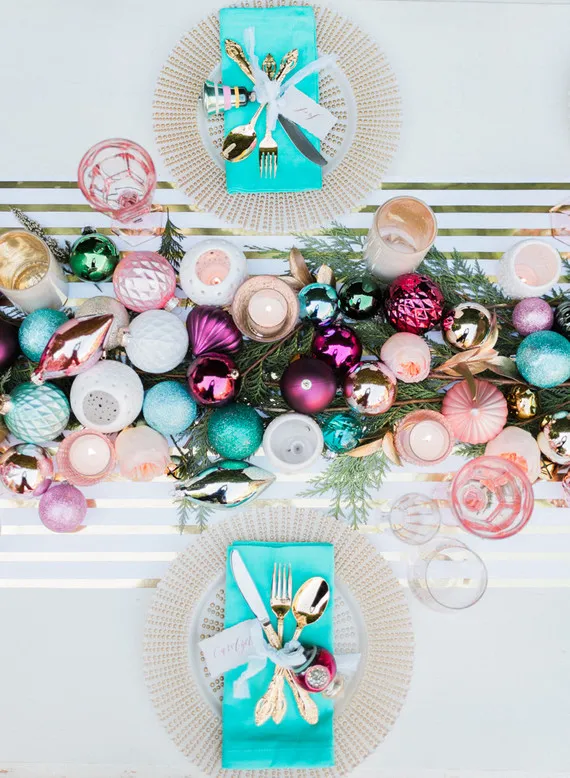
The ornaments are the whole budget line here, and you probably already own some.
- Mixed ornaments, 40–60 pieces: $30–$90
- Lit or unlit greenery garland: $25–$65
- Gold beaded placemats, set of 4: $24–$60
- Teal fabric napkins, set of 4: $20–$45
- Striped white and gold table linen: $35–$90
- Votive candles and holders, set of 12: $15–$30
Total: $149–$380. Budget alternative: shop post-Christmas sales for the ornaments, use a white cloth you already own, and skip the beaded placemats. Around $65–$110.
Your Table, Your December — Now Go Light the Candles
Start with one idea, not all thirty-two — a single garland runner or a tray of pinecones and dried citrus will change how the whole room feels, and you can layer from there next year. Most of these come together in under an hour and cost less than a dinner out, so there’s genuinely no reason to leave the table bare this December. Pin your favorites now, then go raid the yard for branches.