
33 Jaw-Dropping Bottle Brush Tree Crafts You Need to Try in 2026 That Will Elevate Your Decor

There is a reason your Pinterest feed has turned into a forest of tiny bristled evergreens — bottle brush trees are the decorating detail of the 2026 holiday season, and they are cheap enough to collect by the armful. We spent serious time browsing Etsy, Target, Walmart, IKEA and Amazon to bring you only what is worth your attention this year, from $3 single trees to $120 heirloom-style sets. Inside you will find 33 curated ideas covering rustic natural, glitter glam, vintage bottle brush and modern pastel styling, with budget and luxury versions compared side by side and every idea shoppable through direct product links. What is driving it in 2026 is the shift toward small-scale, mix-and-match decor — people want pieces they can restyle every December instead of one big display that lives in the garage eleven months a year. And stay until the end — we break down the most common mistakes that can ruin these looks. 📌 Save this to Pinterest for later — you will want to revisit these ideas.
1. Gold-Stemmed Rainbow Cluster Against a Dark Wall
The gold stems are doing more work than the bristles. Swap them for plain wire and the same red, lime, purple, and teal trees suddenly read like a grab bag instead of a styled collection. Thin metallic stems catch lamplight and bounce it up into the bristles, which is exactly why those colors look deeper than they actually are. If you are buying unfinished trees, this is the upgrade worth paying for.
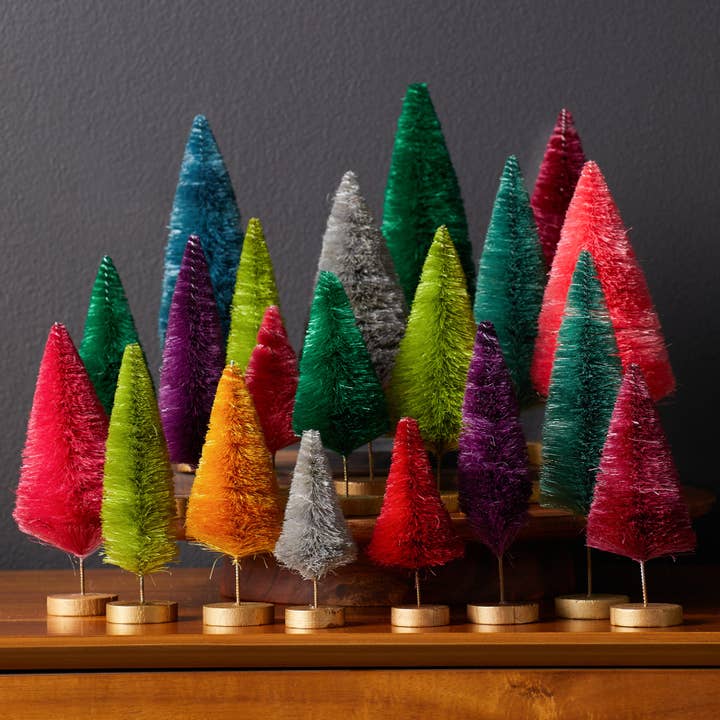
Buy in odd numbers and vary height by at least two inches between neighbors. A seven-tree cluster stepping from three to nine inches reads as a collected group; five trees at the same height reads as merchandise. The round wooden bases matter too — set them down in a loose arc rather than a straight row so the dark grey backdrop frames a composition instead of a lineup.
2. Greenhouse Table With Pedestals, Pine, and Twine
Two moves carry this whole table. The pedestals raise the red, cream, and dark green trees off the rustic wood and create a pecking order — tall red at the back, cream in the middle, dark green forward — so your eye travels instead of stalling. Then there is restraint: three trees, one saturated red, everything else borrowed from the room itself. Pine sprigs in glass jars, eucalyptus, terracotta pots, a spool of twine. It reads collected, not assembled.
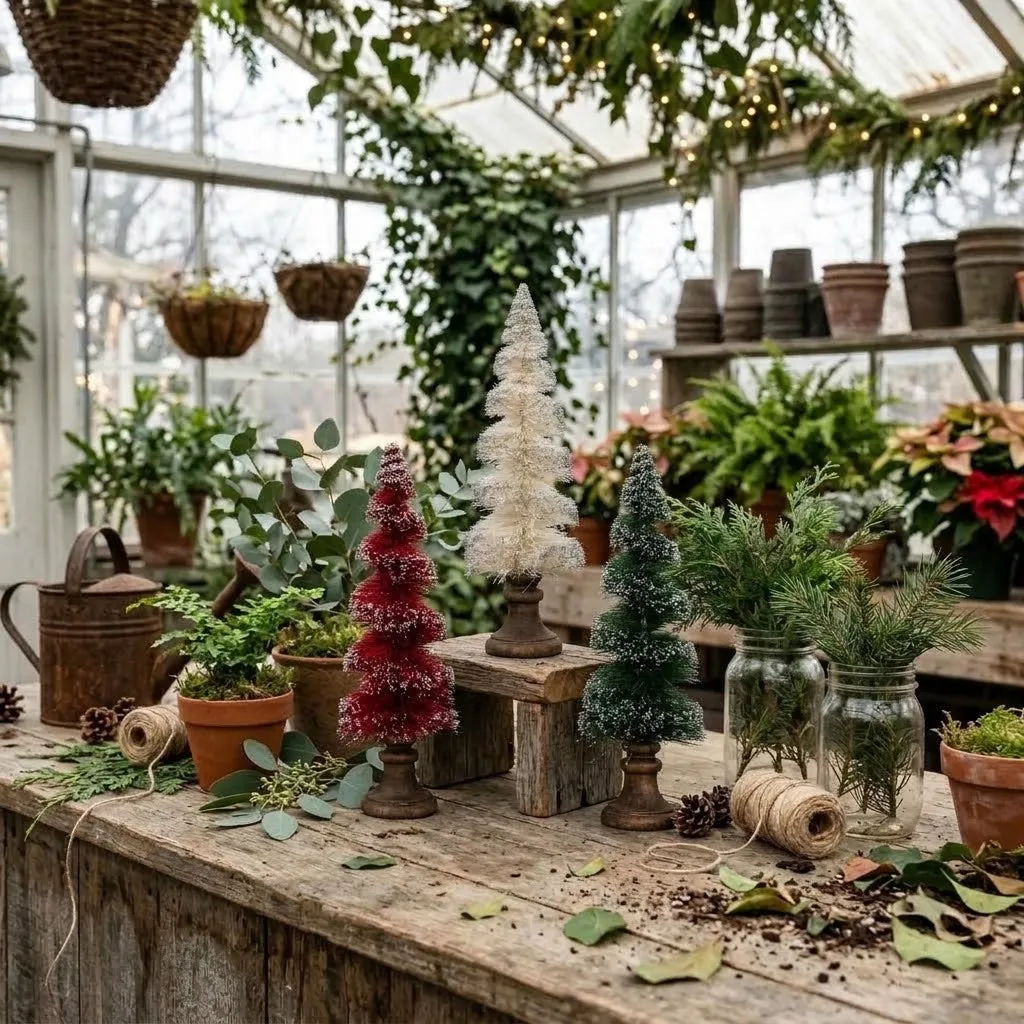
You do not need designer pedestals to get this. Flip small terracotta pots from Walmart upside down for about $2 each, raid the cupboard for thrifted brass candlesticks, or stack two hardcovers and drape a linen napkin over them. The jars are jelly jars with the labels soaked off. Risers come in under $15 total, and a $6 eucalyptus bunch from Trader Joe’s splits across three vessels.
3. A Candlelit Runner of Green and Silver Mini Trees
Build the centerpiece in layers and it takes about 25 minutes.
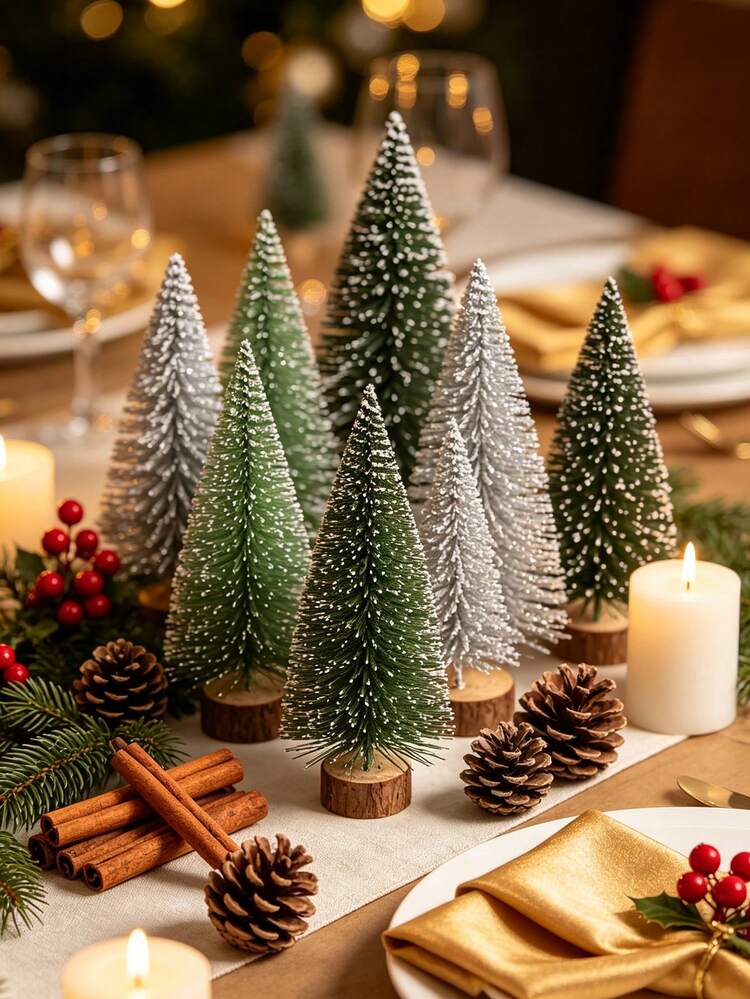
- Run a white linen runner down the center, stopping 12 inches short of each end so plates have room.
- Anchor the middle with the tallest flocked tree, then work outward, alternating green and silver so no two identical trees touch.
- Tuck pinecones, fir sprigs, and cinnamon sticks into the gaps at the base — they hide the wooden bases and add scent.
- Add three pillar candles at least 8 inches from any bristle, then scatter the red berries last.
The formula is roughly 55% natural texture like linen, fir, and wood, plus 25% green tree mass, 15% silver sparkle, and 5% red berry pop. Keep that berry number small. Swap silver for champagne gold and the runner warms up for a fall table; swap the linen for charcoal and the same trees go modern. If you love the candlelight, Idea #19 pushes it further with flickering LED flames.
4. Muted Greens Clustered Like a Forest on Dark Wood
This cluster wants a surface at least 30 inches wide and 14 inches deep, and it looks best on something with presence — a console, a sideboard, a dining table in a room with 9-foot ceilings. On a narrow entry table it will feel crowded fast. Compare with Idea #17 if space is tight, where the same muted palette works at a fraction of the footprint.
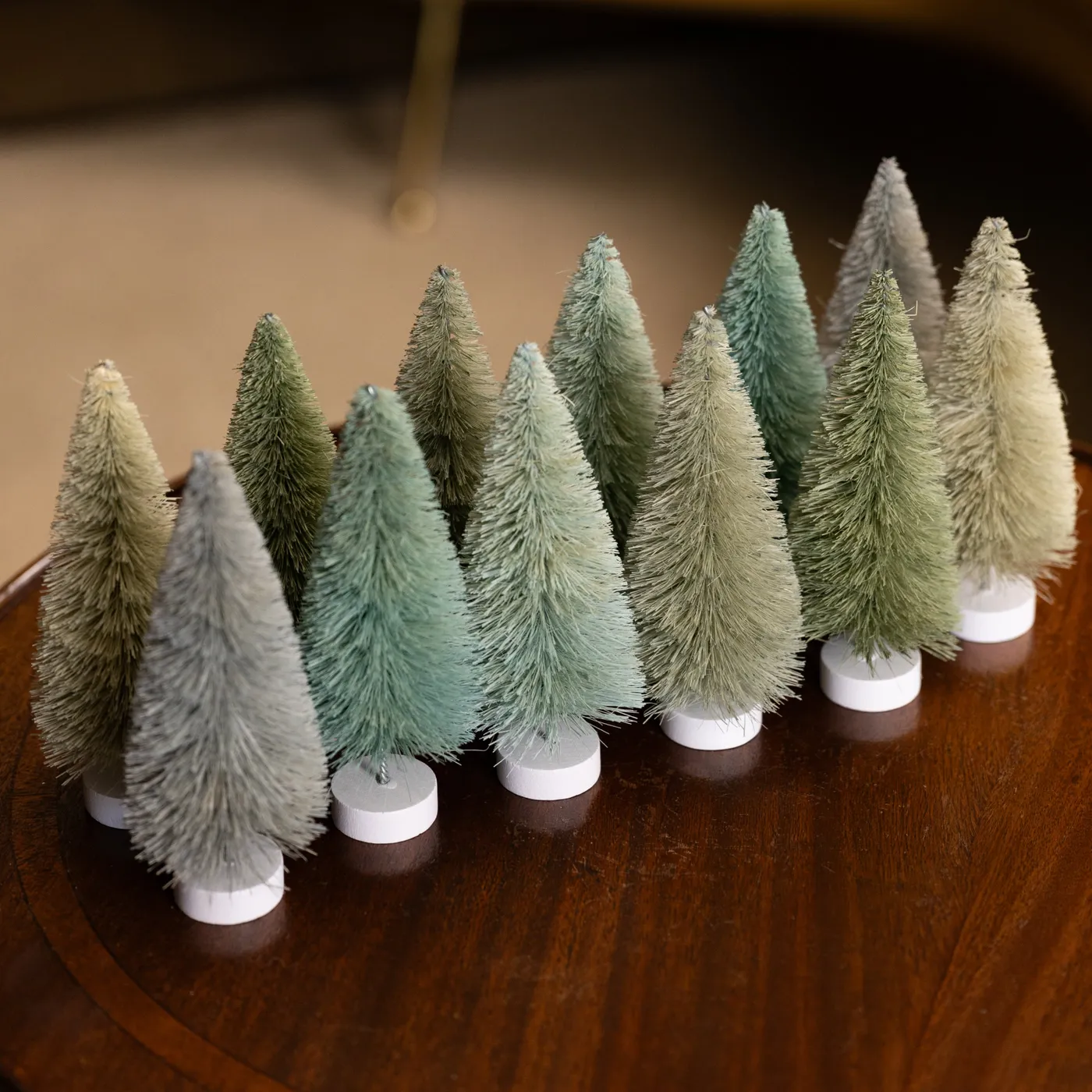
- Six to nine muted green trees: $24-$54
- Round white bases, or swap for wood slices: $0-$12
- Polished wood tray or charger as the ground: $15-$45
- Soft dusting brush and storage box: $8-$20
- Total: $47-$131, and most of it comes back out every December
5. Two Flocked Trees Wrapped in Warm String Lights
Battery fairy lights on tiny trees are wonderful for about three weeks, and then the batteries start dying and the wires show. Buy lights with a built-in timer and remote — you will actually use them. Also, that artificial snow base will migrate. It gets on the teal fabric, on the light wood, and eventually on the floor. Set the snow inside a shallow tray or a rimmed plate so cleanup stays contained to one object.
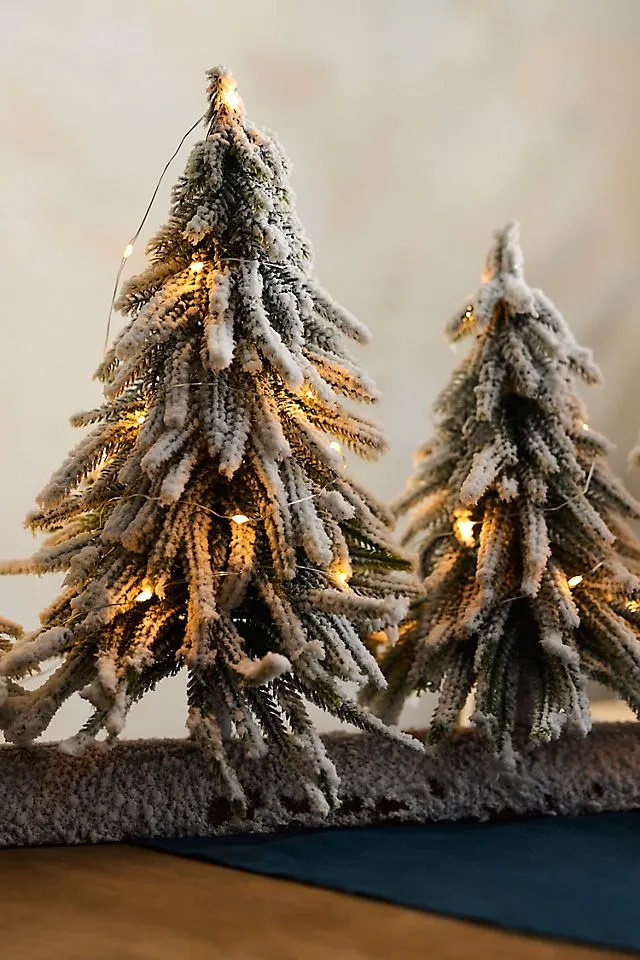
Lay the dark teal fabric down first, then the snow, then the trees. That order matters: dark fabric makes warm white lights look golden rather than clinical, and it gives two small trees the visual weight of a much larger arrangement. One yard of teal velvet from a fabric store runs about $12 and gets you three seasons of use.
6. A Kitchen Counter Village of Trees, Snowmen, and Garland
Kitchen counters became the surprise decorating surface of the mid-2020s — partly because it is the one spot everyone actually stands near, and partly because bottle brush trees are small enough to line up along a backsplash without blocking anything. The 2026 version leans on mixed materials: felt snowmen beside miniature gingerbread houses, copper trees beside silver. It reads collected over years rather than bought in one trip, which is exactly why it is trending.
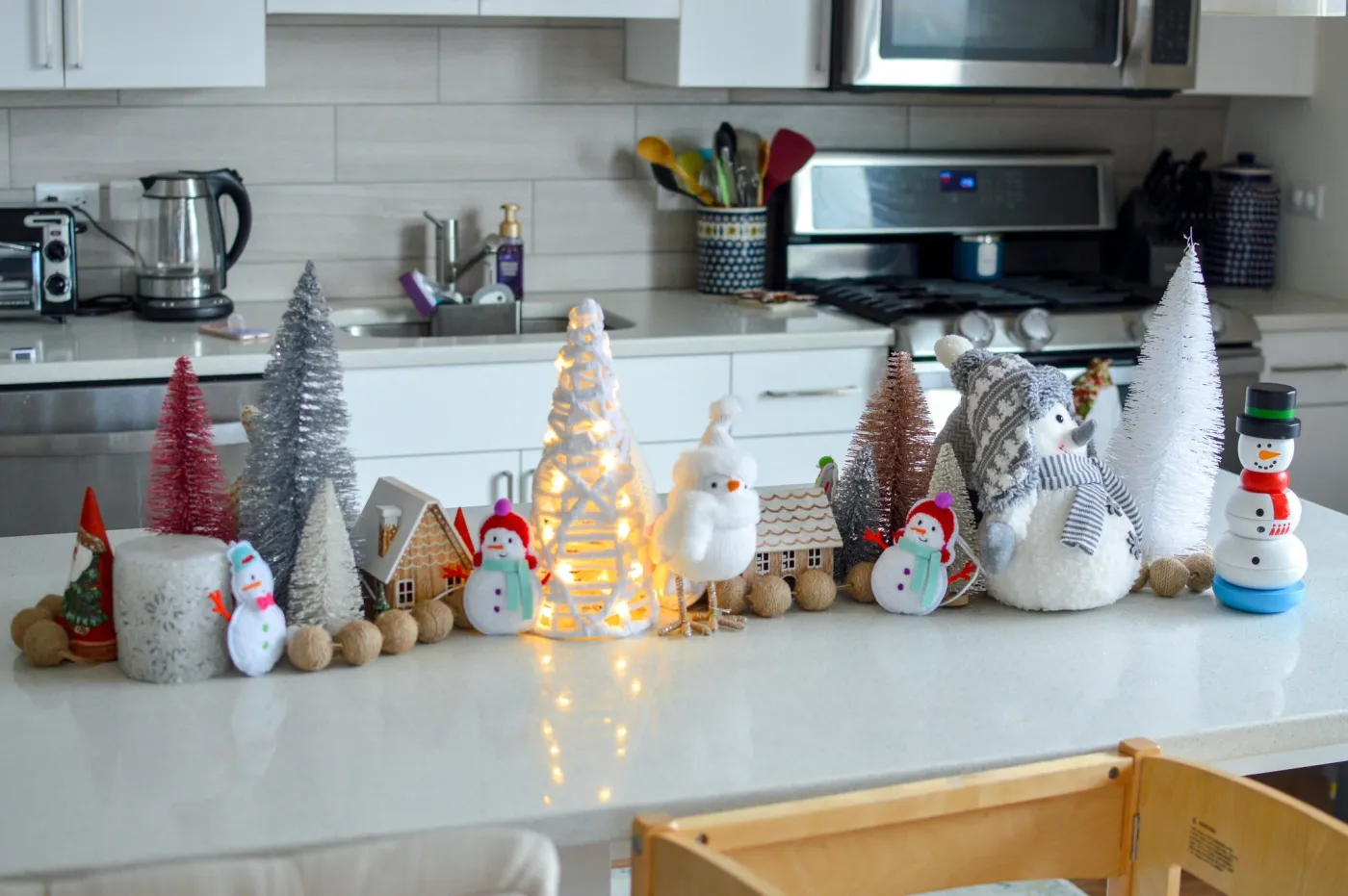
The natural woven ball garland is the thread tying this counter together. Without it you have a row of unrelated objects competing for attention; with it, the eye has a path past every snowman and tree. String it loosely, let it dip between the gingerbread houses, and keep the balls visible rather than buried behind taller pieces.
Build the whole village for under $40. Dollar Tree carries felt snowmen and miniature houses for $1.25 each in the seasonal aisle, and Target sells small bottle brush trees for $3 to $5. One nice copper tree among five inexpensive ones looks intentional; fifteen mediocre trees look like a clearance bin.
7. Gingerbread Vignette With Jute Balls in a Line
Three principles are quietly working here. Scale hierarchy — the glitter pillar is tallest, the trees step down, the jute balls sit lowest. Repetition — a line of identical jute-wrapped balls creates rhythm the way fence posts do. And color temperature mixing: warm browns, soft silver, and one red tree keep the vignette from going cold. This is the small-scale cousin of Idea #6, condensed onto a single countertop.
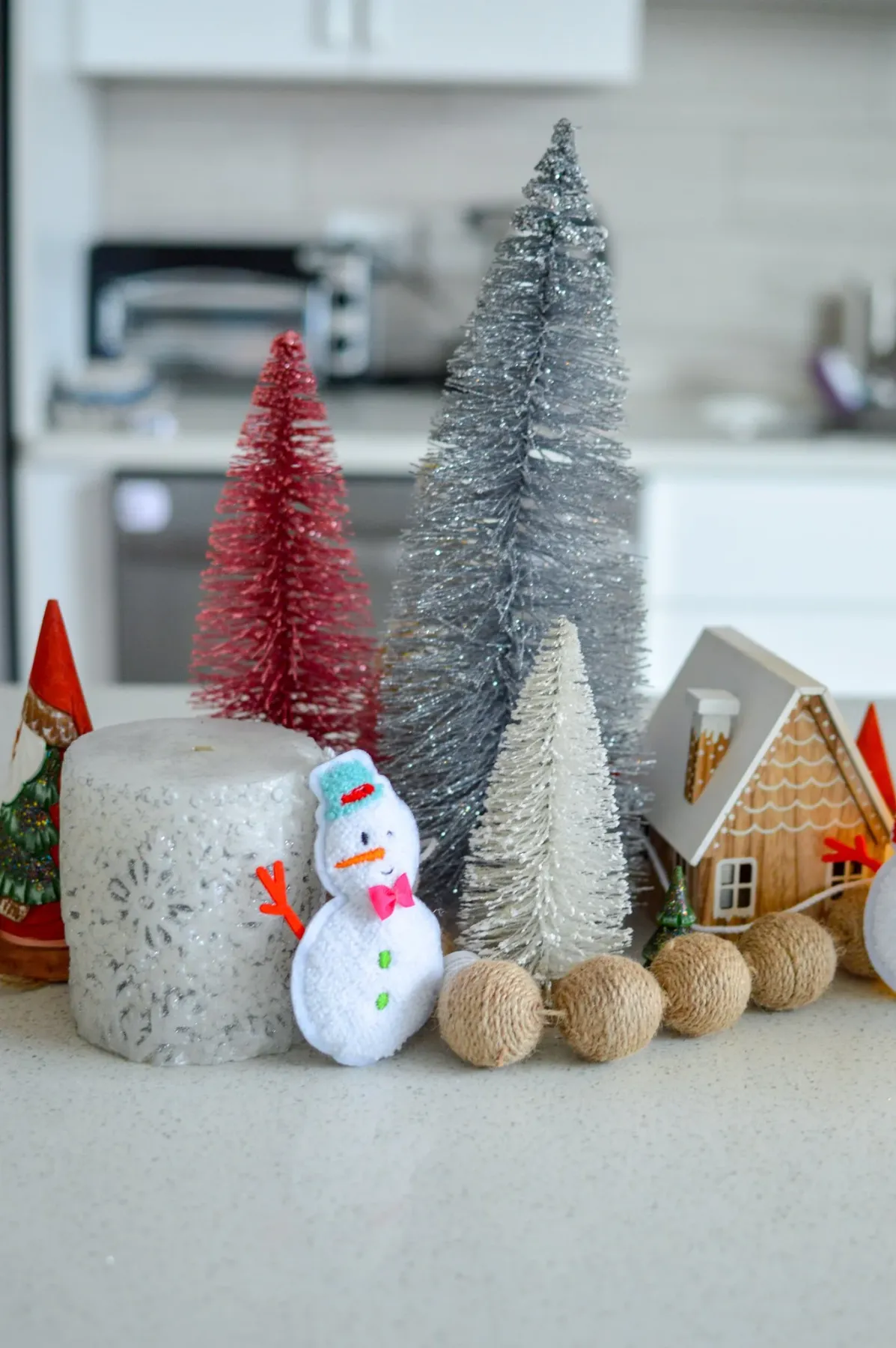
Making the jute ball line takes 15 minutes and about $6.
- Pick three or five wooden beads or small foam balls, all the same diameter.
- Wrap each one tightly with jute twine, dabbing craft glue at the start and finish so it does not unwind.
- Space them 3 to 4 inches apart in front of the vignette — close enough to read as a set, far enough to see the surface between them.
- Nudge the last ball slightly off-line; a perfect row looks like a ruler, not a decoration.
8. Flocked Trio on a Wood Slice With Red Berries
Choose a wood slice roughly one and a half times the widest tree base. Any bigger and the slice becomes a plate; any smaller and the trees look like they are balancing. Three heights in a triangle — tallest back center, medium left, short right — fill a slice faster than four trees in a row. One red ornament is the entire color story here, so resist adding a second.
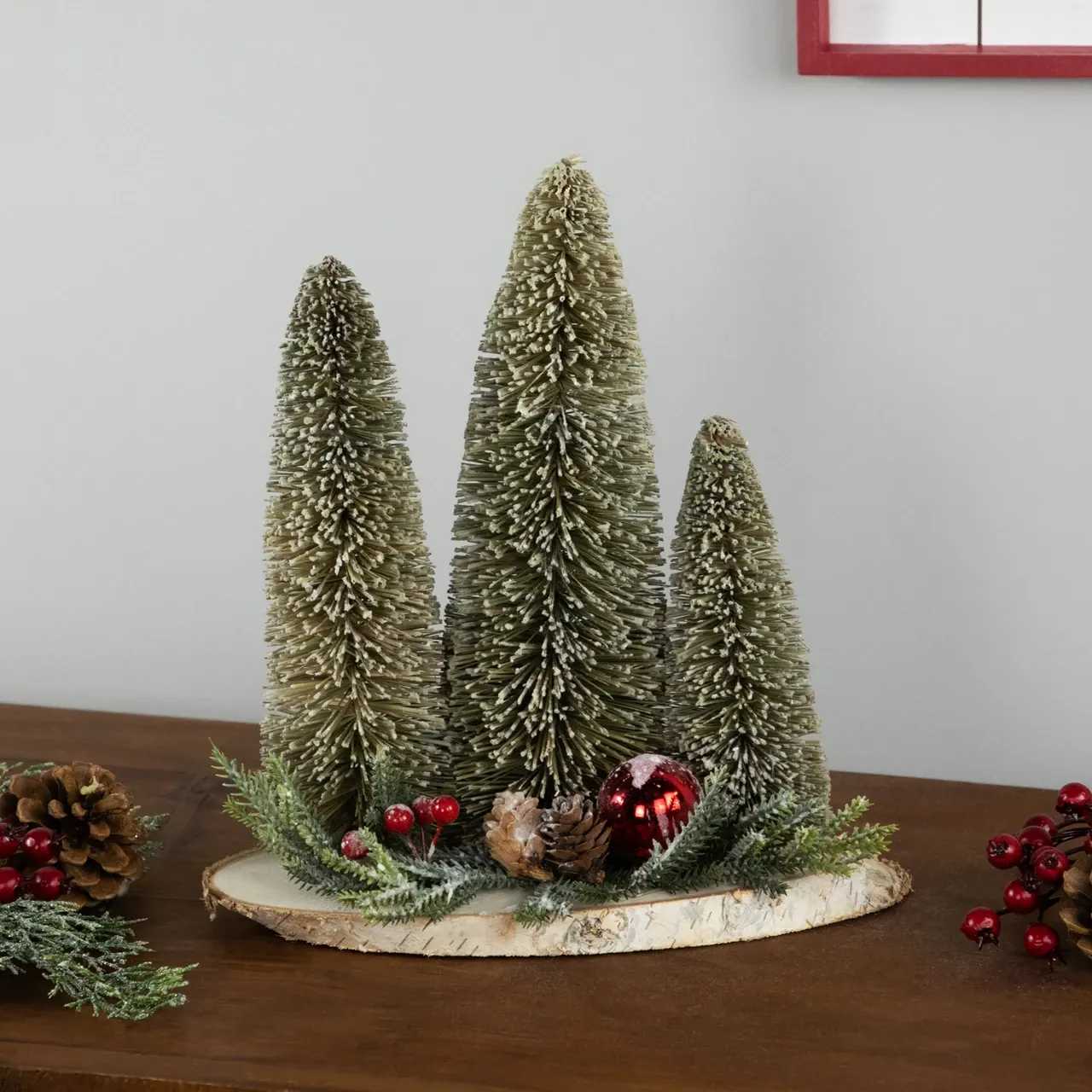
Flocking sheds. Expect a light dusting of white every time you move these trees, and keep them away from dark wood, velvet, or anything you cannot vacuum. A soft makeup brush handles dust without pulling bristles loose. Store flocked trees in a lidded box with tissue between layers rather than a plastic bag, which crushes the tips flat. Two minutes of care in January saves a ruined set next December.
9. Bright Green Tiered Trees on a Striped Cream Runner
Roughly 70% cream and white ground, 20% bright green tree mass, 10% red stripe detail. That is the entire formula, and it is why the green reads as lively instead of loud. Swap the red stripe for navy and the trees suddenly feel coastal; swap the cream runner for natural linen and the scene goes farmhouse. Same three trees, three different holidays.
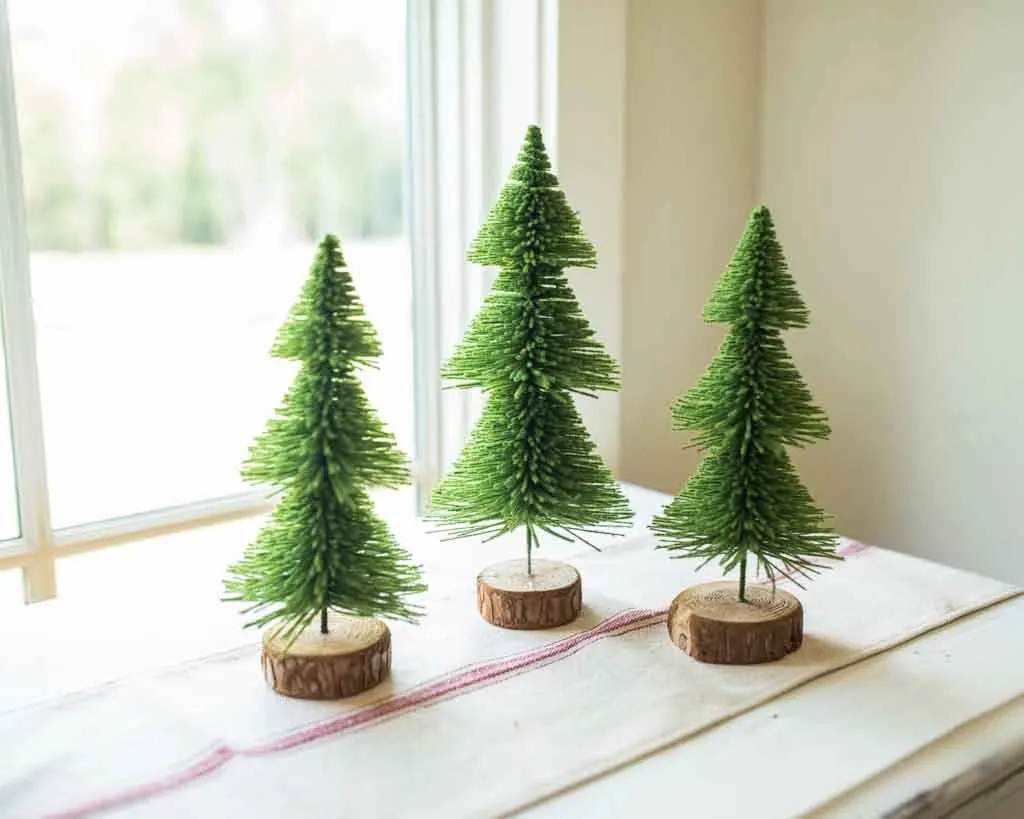
Bright green plus red stripes sits one small step from candy cane, and a bright window behind the display will bleach those greens toward yellow by mid-afternoon. If your surface sits in direct sun, rotate the trees every few weeks or accept the fade. Test the runner first, too: cream fabric with saturated red stripes shows every crumb and every bit of flocking.
10. Snow-Dusted Trees on Turned Wooden Pedestals
- Measure the tabletop depth — turned pedestals need at least 6 inches of clearance from the wall for the garland to drape naturally.
- Check that an outlet or battery pack location is reachable behind the arrangement.
- Confirm the pedestals are heavy enough not to tip when a tree gets nudged.
- Decide where the greenery garland sits before you place the trees, not after.
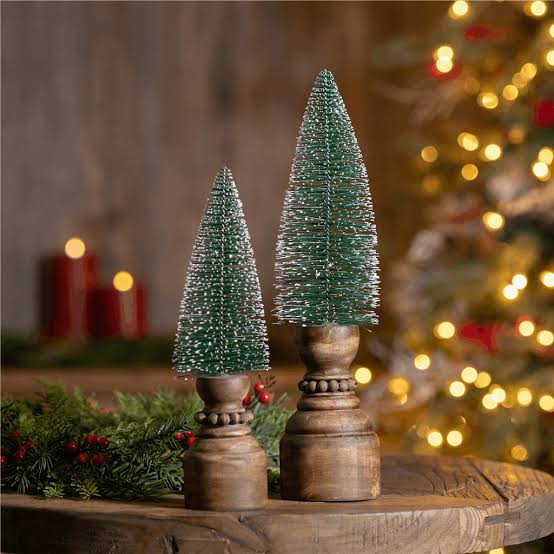
- Two flocked trees with dusted tips: $16-$34
- Turned wooden pedestals, or thrifted candlesticks: $10-$30
- Greenery garland with red berries: $12-$28
- String lights and batteries: $9-$18
- Total: $47-$110
11. Rose Gold, Silver, and Gold Glitter Trio
Most people buy three trees in one metallic finish and call it done. Mixing rose gold, silver, and gold is what makes this trio feel collected, and it works because the sizes stay close and the bases match. Remove any one of the three finishes and the group loses its shimmer-to-warm gradient. If you own only two metallics, add a champagne tree rather than a second silver one.
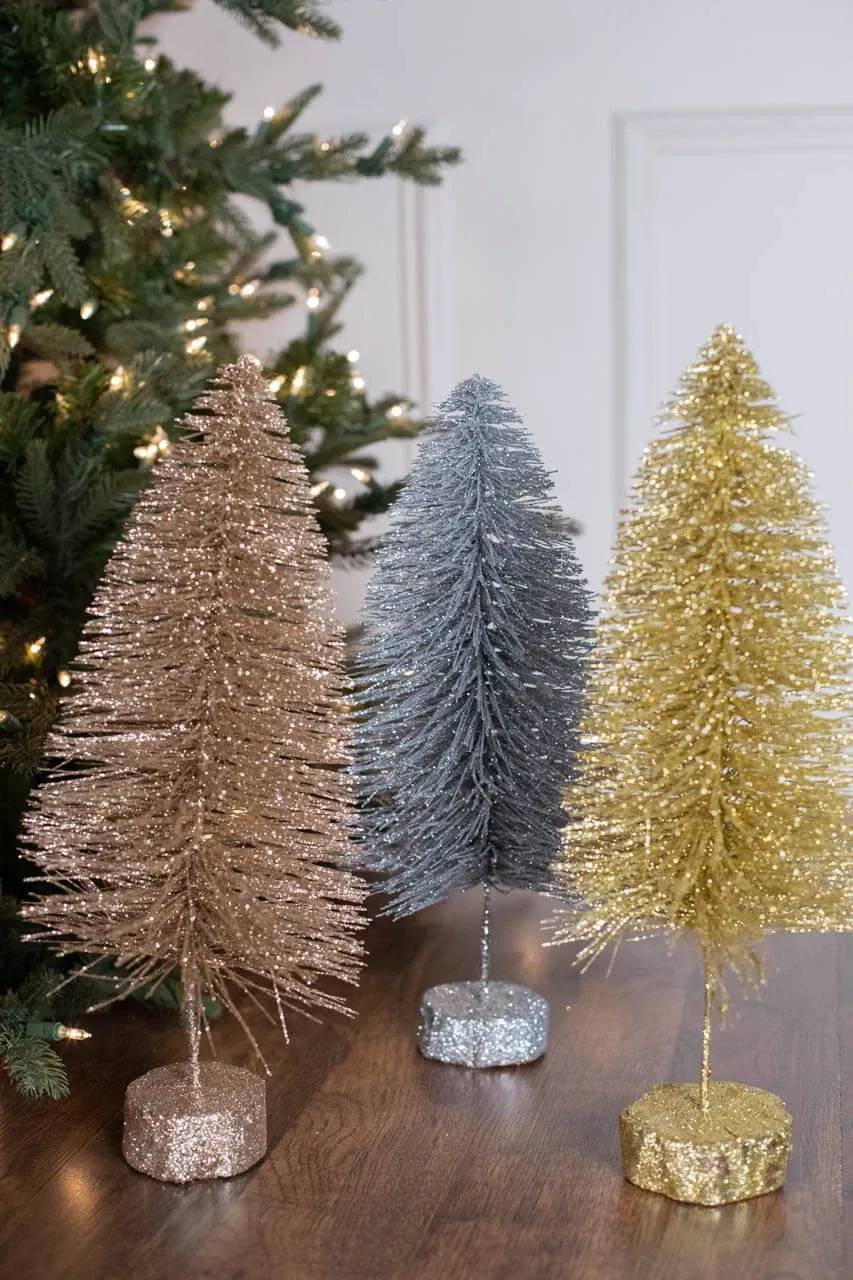
Mixed metallics moved from wedding tables to holiday shelves around 2024 and they are still gaining in 2026, largely because people stopped treating decor as a matched set. Rose gold in particular has held on longer than expected — it photographs warm without going yellow, which matters in rooms lit by LED bulbs. This is a trend with legs, since metallic finishes do not date the way novelty characters do.
12. Bronze and Gold Glitter Trees Rising Off a Book Stack
Height differentiation is the whole trick. Raising the center bronze tree three to four inches on a stack of light-colored books pushes its top above the flanking trees and turns three objects into a pyramid. Choose the book by color, not title — pale spines keep the stack reading as a riser instead of a reading pile. A hardcover with a matte jacket slides less than a glossy one. See Idea #11 for the same sparkle in cooler metallics.
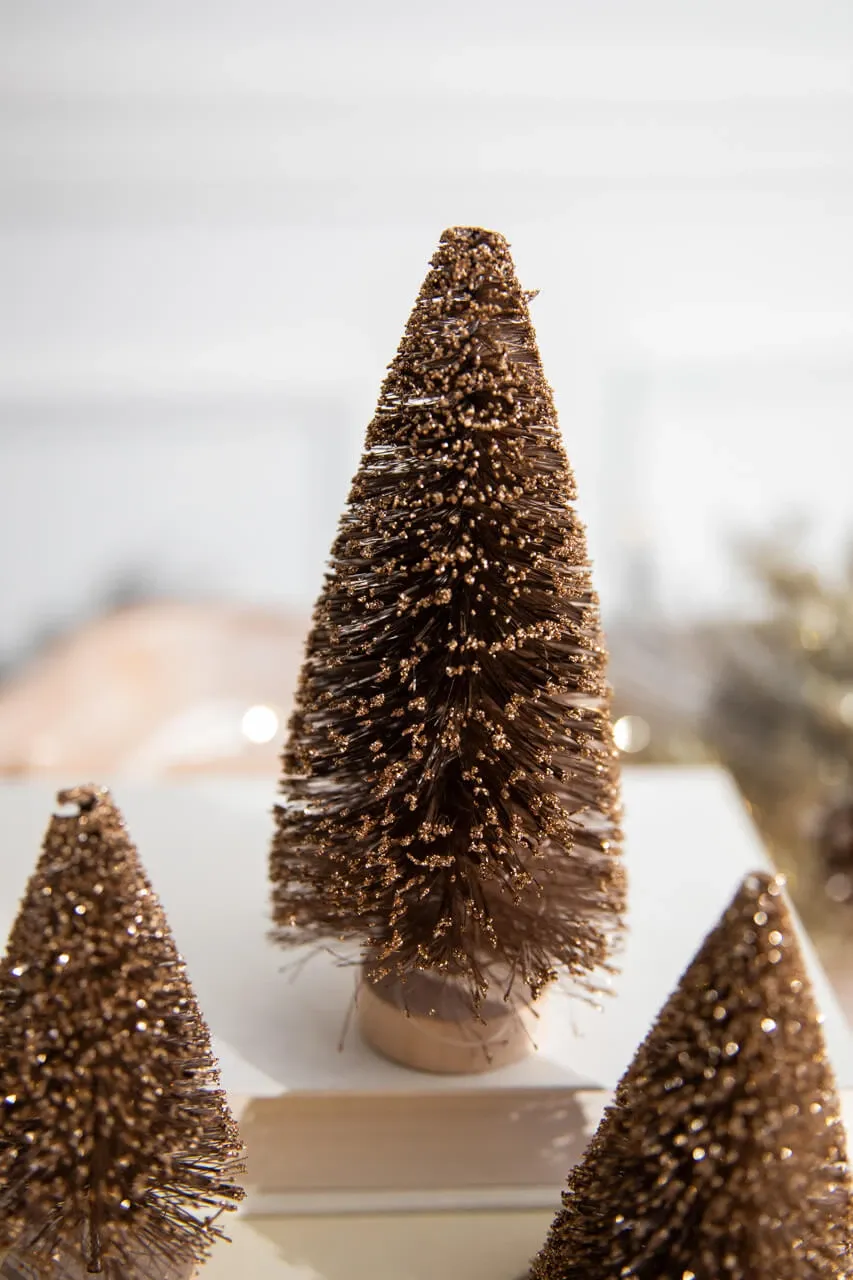
Gold glitter only reads as gold when there is warm light behind it, and the soft background bokeh here is doing real work. The glitter catches those blurred points of light and scatters them, which makes dark brown bristles look far more expensive than they are. It is also a value-contrast lesson: heavy glitter against an off-white stack and pale peach light looks luxurious at $10 apiece.
13. Four Neon Glitter Trees on a Textured Pink Ground
This is one of the cheapest looks in the whole roundup. Plain bottle brush trees run $1 to $3 at Dollar Tree and Walmart; a jar of fine glitter plus a bottle of Mod Podge costs about $8 and coats a dozen trees. Brush thinned Mod Podge over the bristles, roll the tree in glitter over a paper plate, then dry bristle-down on wax paper. Four neon trees for under $20, bases included if you cut your own from a $3 dowel.
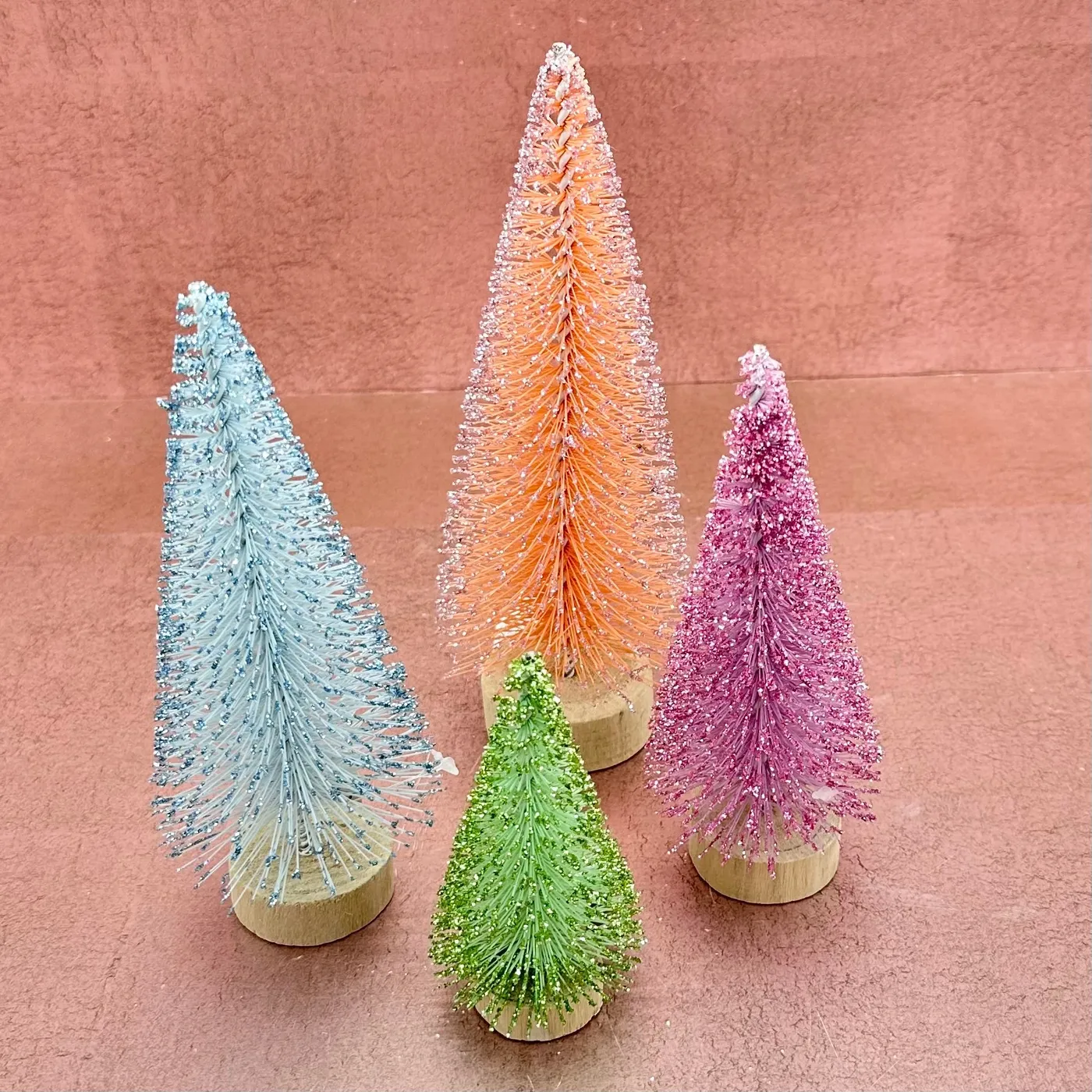
The recipe is 80% saturated color, 15% neutral wood, 5% texture from that pinkish-brown surface. The ratio only works because the bases are identical — four colors on four matching round wooden bases read as a collection. Swap the neons for dusty sage, blush, and cream and the exact same arrangement turns soft and vintage.
14. Ombre Pink Glitter Trees in a Drift of Faux Snow
An ombre tree takes about 20 minutes plus dry time.
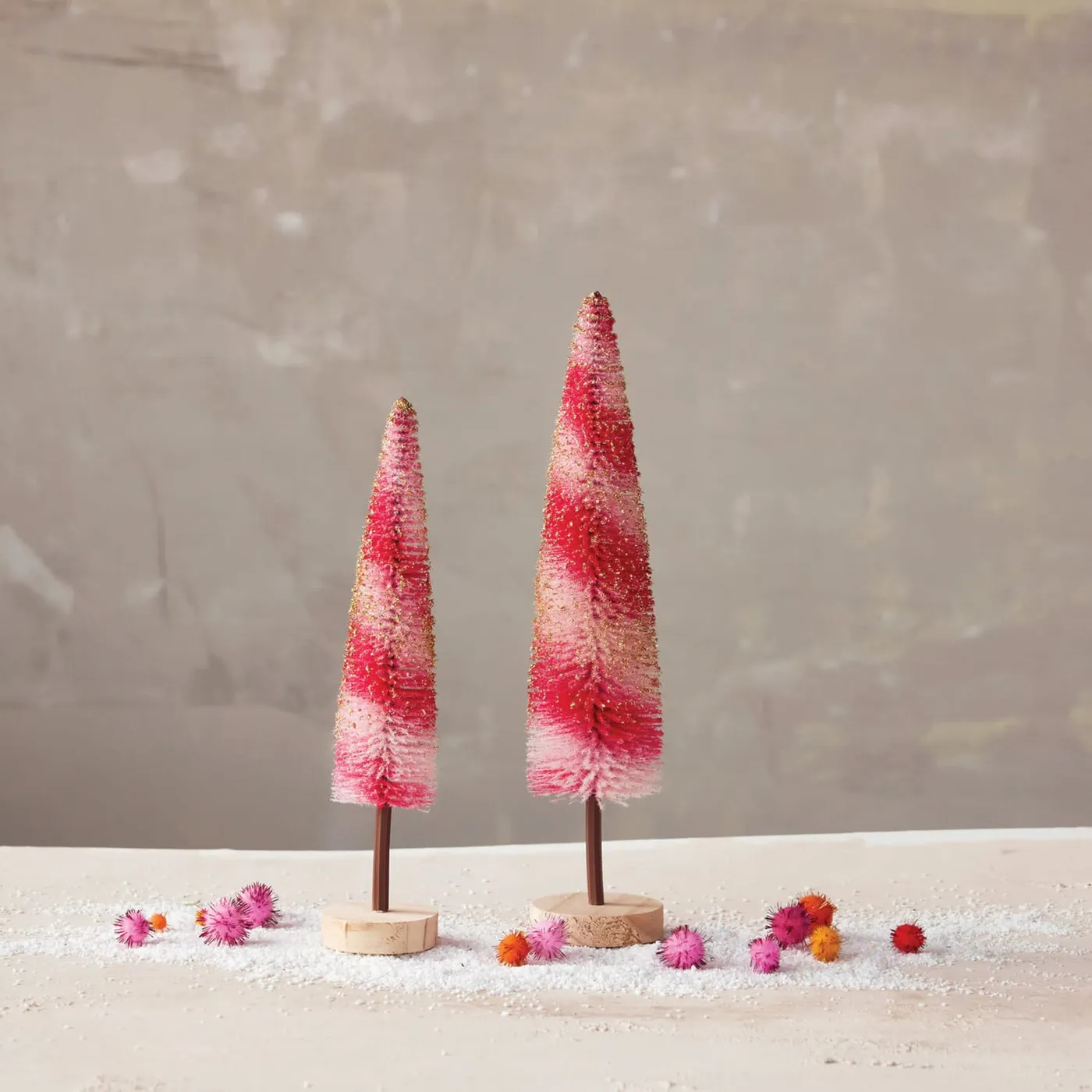
- Start with a plain light pink tree and a can of deeper pink spray made for florals or craft foam.
- Wrap the base in painter’s tape and hold the can 10 to 12 inches away, spraying the top third only.
- Work downward in short passes, letting the color fade out around the middle so the transition stays soft.
- While the paint is tacky, dust the top third with fine gold glitter, then let it cure overnight.
Materials run about $14 for two trees. The vignette itself needs a shelf between 20 and 30 inches wide and a wall that can take contrast — the greige backdrop is what makes the pink glow. Under 16 inches of space, drop to one tree and the fuzzy spheres.
15. Reds and Champagnes Lined Along a White Mantel
Glitter sheds on white paint, and a mantel above a working fireplace gets warm enough to soften adhesives on cheap bases. Keep glitter trees on a tray so you can lift the whole arrangement for cleaning, and leave at least 12 inches of clearance if you actually burn fires. If your fireplace runs hot, move the trees to an adjacent sideboard and let the mirror carry the mantel alone.
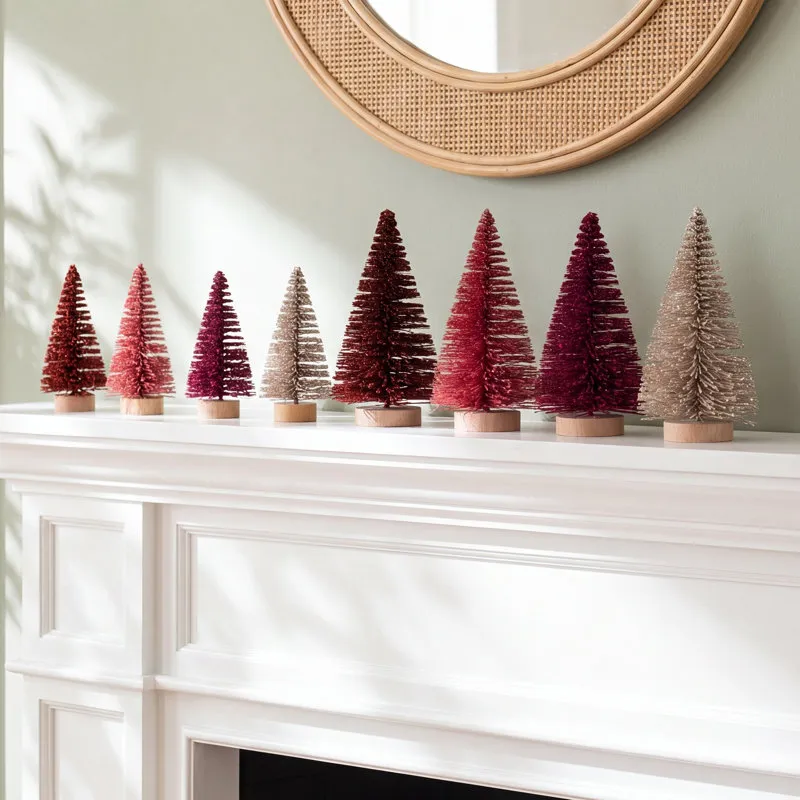
The rattan-framed mirror and the pale green wall are what make saturated reds look chic instead of seasonal-store. A woven frame adds texture that softens all that glitter, and the green undertone in the wall neutralizes red’s heat. Remove the mirror and you have trees on a shelf. Swap it for a black metal frame and the whole thing turns cold.
16. A Stepped Stand Holding the Whole Mini Tree Assortment
On a stepped stand, no two adjacent trees should share a height or a color family. The top step gets the tallest tree, the bottom step the shortest, and you alternate white, green, gold, silver, and teal as you descend. A three-step stand needs roughly 18 inches of width and 6 inches of depth, and the whole thing looks better against a plain wall than a busy one.
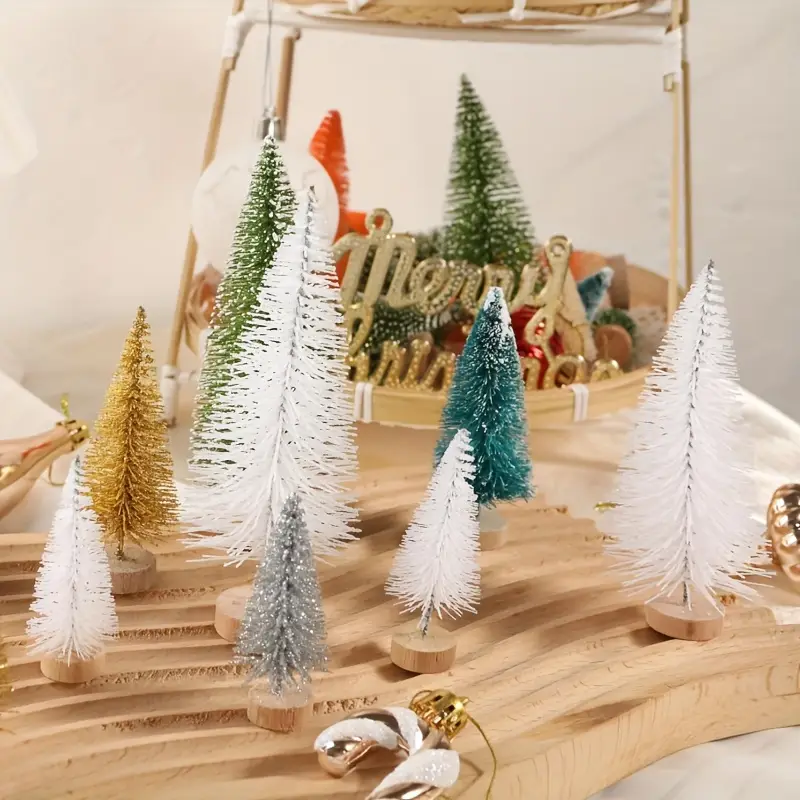
- Stepped wooden display stand: $18-$42
- Ten to twelve miniature trees: $30-$60
- Gold lettering sign or small ornaments: $8-$20
- Storage box with dividers: $10-$18
- Total: $66-$140
17. A Snow-Tipped Green Tree Held Up to the Light
Snow-tipped trees look pristine for about two seasons, then the flocking starts to yellow slightly where it contacts adhesive. Keep them out of direct sun and never wash them — a soft brush and a cool hair dryer on the lowest setting are your only tools. If the tips start looking grey, a light dusting of white acrylic craft paint applied with a dry brush revives them for about $3.

Hold a tree in your hand and the scale changes instantly — it stops being decor and becomes a miniature object, which is the entire appeal of this hobby. The color logic is simple and reliable: forest green, snow white, light wood. Those three tones appear together in nature, so the eye accepts them without effort. Add a fourth color and you have to work for it.
18. Frosted Trees Tucked Among Polka-Dot Ribbon Gifts
Roughly 50% dark green tree mass, 25% white from flocking and the fuzzy surface, 15% pale gift boxes, 10% red polka-dot ribbon. The red stays small on purpose — dotted ribbon carries more visual weight than solid, so a little goes a long way. Switch the polka dots to thin gold stripes and the setup turns elegant; switch to buffalo check and it goes farmhouse.
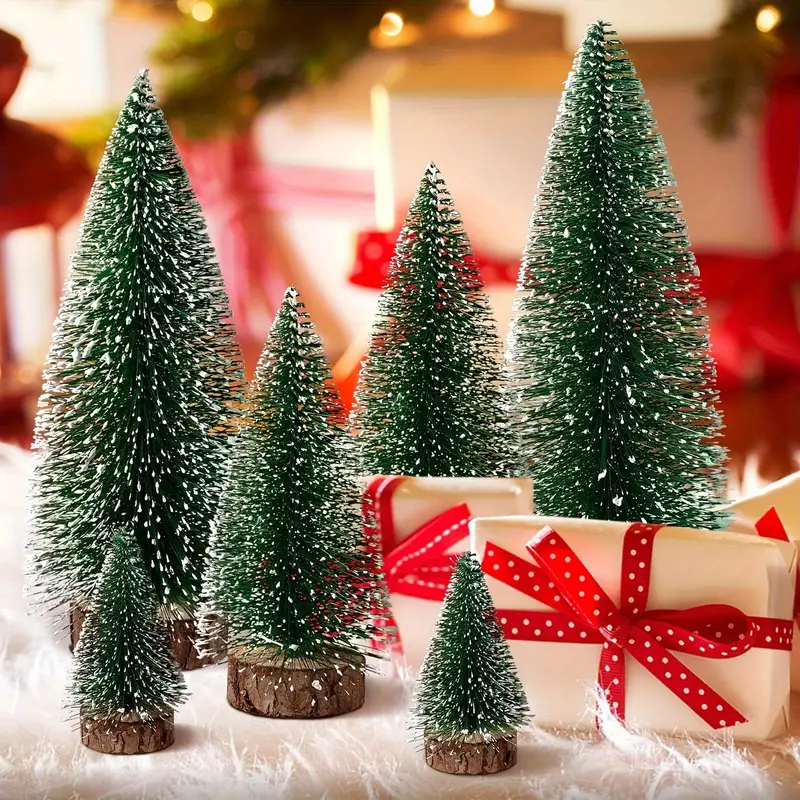
Small gift boxes are $1.25 at Dollar Tree and a roll of polka-dot ribbon runs about $3 at Walmart. The white fuzzy ground is a fleece throw from Target, roughly $10, folded rather than cut. Compare with Idea #10 — same frosted greens staged on turned pedestals, a completely different mood for about the same money.
19. Dark Red Trees With Leafy Garland and Flickering LED Candles
The cream LED candles are the element you cannot remove. Dark red trees under flat overhead light go muddy brown; the flicker of three warm LED flames gives the bristles dimension and makes the reds read deeper. They also let you skip the fire hazard entirely. Choose the wick-style flame with a built-in timer, and keep each candle at least 8 inches from the nearest tree.
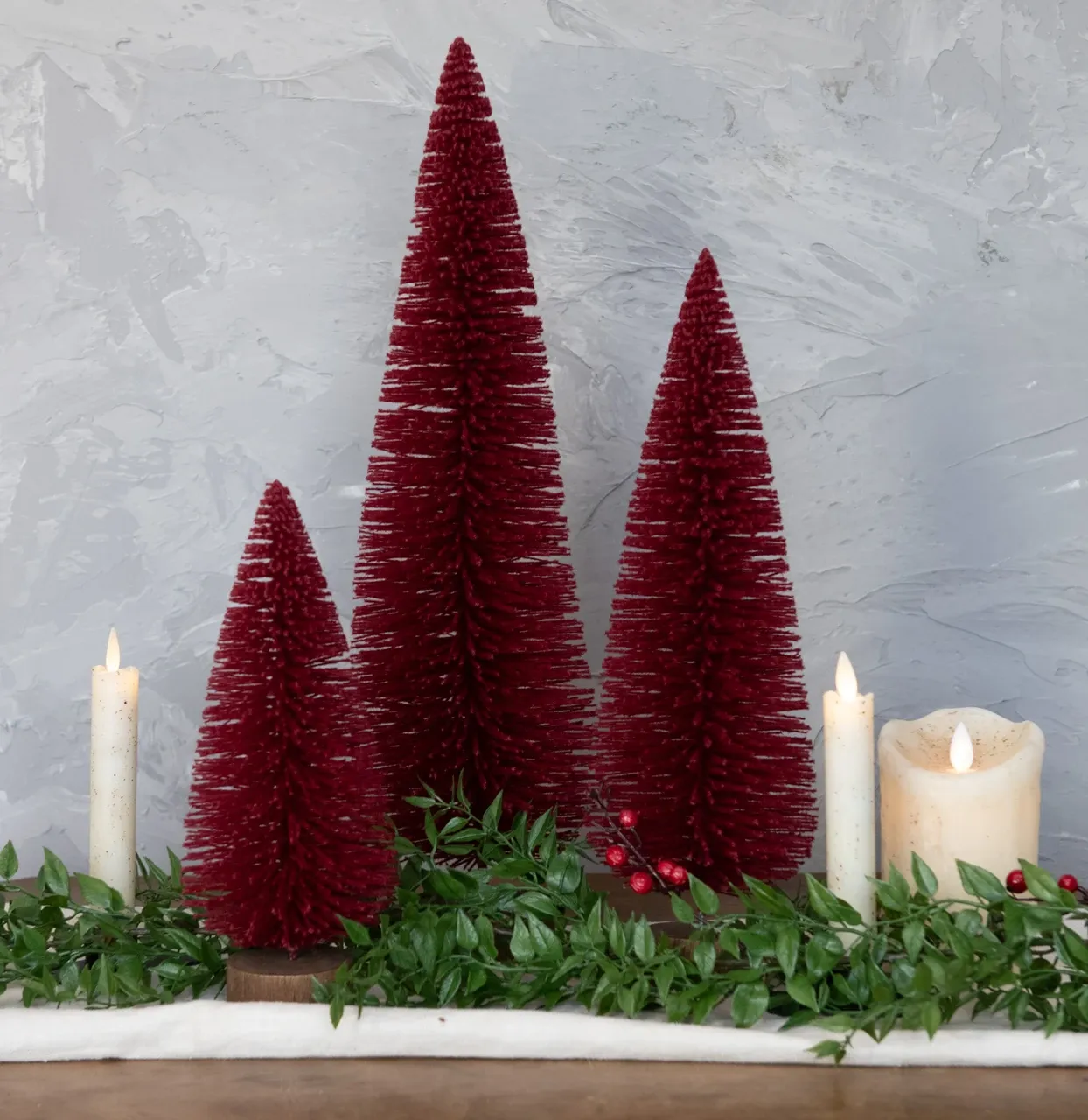
Deep red is the hardest color to light well. Against a textured grey wall in daylight, these trees may read brown — which is fine, but know it before you buy. Test them under the lamp you actually plan to use, not store lighting. And three candles on a white runner means wax drips and clutter, so stick with battery versions unless you enjoy scraping.
20. Dark Green to Silver: A Full Mini Tree Color Study
When you display a dense collection, arrange on a 2-inch grid and keep the front row shortest so nothing blocks the trees behind it. Group by tone rather than random scatter: dark greens top left, silvers bottom right, light greens in between. It sounds fussy, but a gradient reads as intentional while random placement reads as a pile, even when every tree is identical.
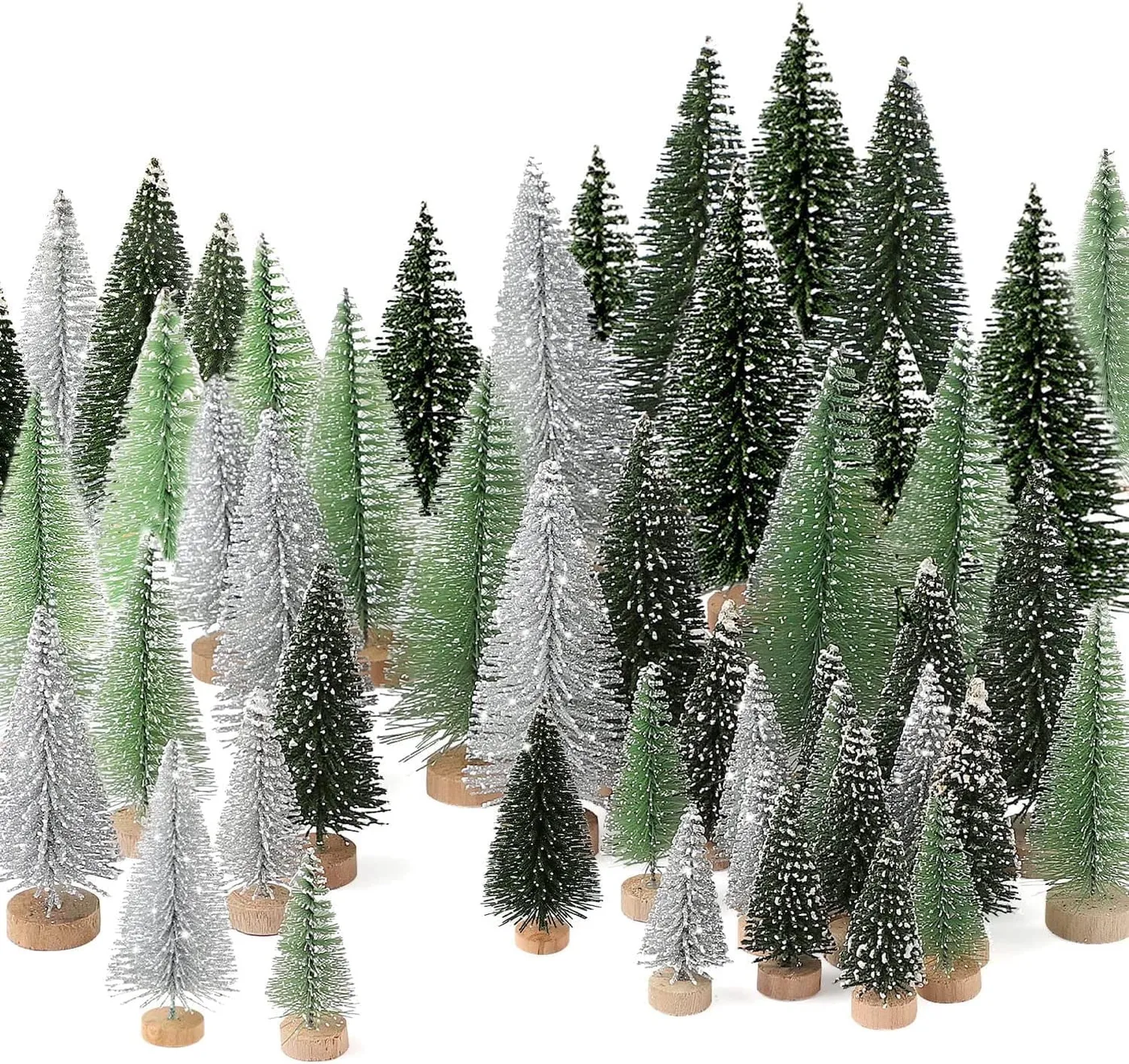
A collection this size needs a console, shelf, or mantel at least 36 inches wide with 10 to 12 inches of clearance to the shelf above. Narrower than that and the silver and green start competing instead of blending. For a 12-inch windowsill, see Idea #24, where three trees and one tiny ornament do the same job at a quarter of the size.
21. Flocked White Trees in Unexpected Candy Colors
Pastel bottle brush trees looked like a fad in 2023 and turned out to be a full color shift. Pink, mint, and cream holiday decor now sits alongside traditional red and green in the same room, sometimes in the same display. The driver is practical: pastels work with the beige and greige palettes people already live with, where bright red fights the walls. Expect this one to stay.
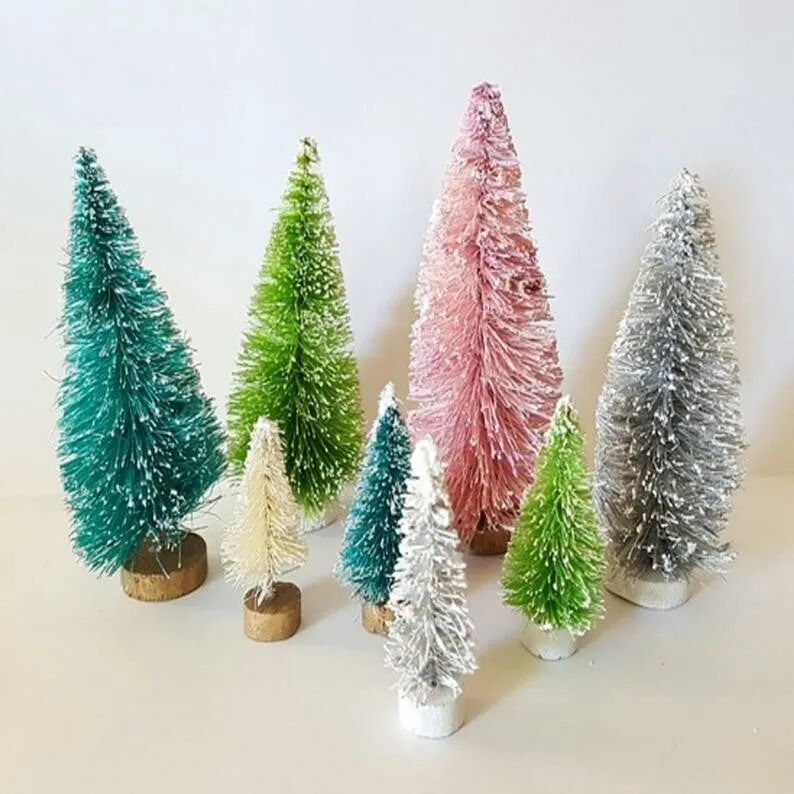
Flocking a plain tree at home takes about 15 minutes plus an hour to dry.
- Set up on newspaper and rest the tree on a paper cup to lift it off the surface.
- Spray a light coat of craft adhesive over the bristles in sections.
- Sift fine white craft snow over each section while the glue is tacky, tapping the excess back onto the paper to reuse.
- Let it dry upright for an hour, then tap gently once more before displaying. About $4 per tree including adhesive.
22. Slender Frosted Trees Wrapped Bottom to Top in Fairy Lights
Fairy lights on small trees have three enemies: heat, tangles, and dead batteries. Use LED strands only — incandescent mini lights can warm a dry bristle tree enough to matter. Wind the strand around two fingers as you remove it in January so next December takes five minutes instead of thirty. Stash the battery pack behind the tree base, not underneath it, so you can swap batteries without dismantling anything.
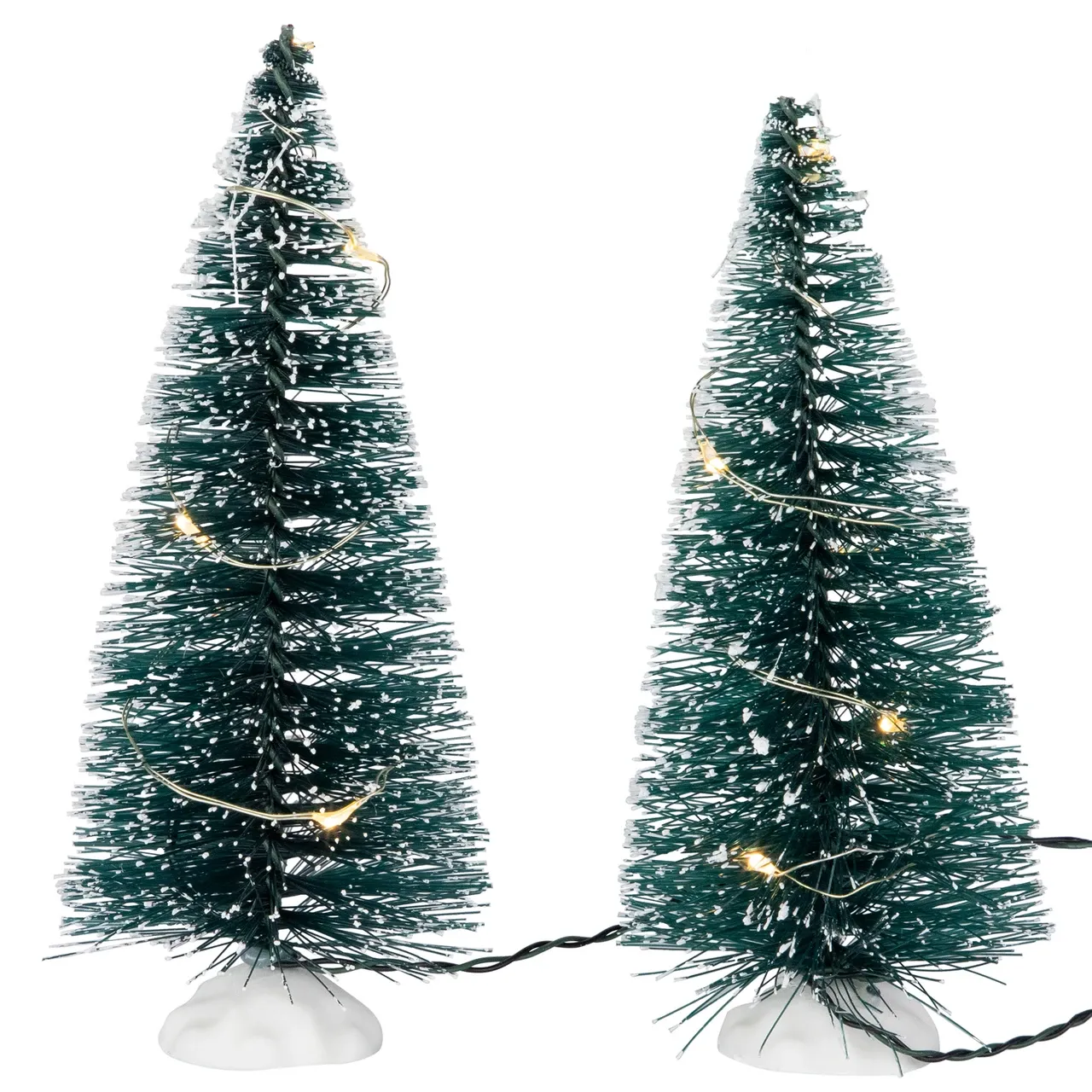
Wrap from the bottom upward and keep spacing at about 1.5 inches between passes. Tighter than that and the dark green bristles disappear; looser and you get bare patches. Two slender trees like these take roughly 12 to 18 inches of strand each from a 10-foot string, which leaves plenty of spare wire to run behind the arrangement.
23. Gold Frosted Mini Trees With Clear Star Finials
- Two lit gold trees with internal LEDs: $24-$48
- Star finials, sold separately at craft stores: $4-$10
- Batteries, if not included: $4-$8
- White cylindrical bases or candle holders as risers: $6-$16
- Total: $38-$82, and the trees come back out every year
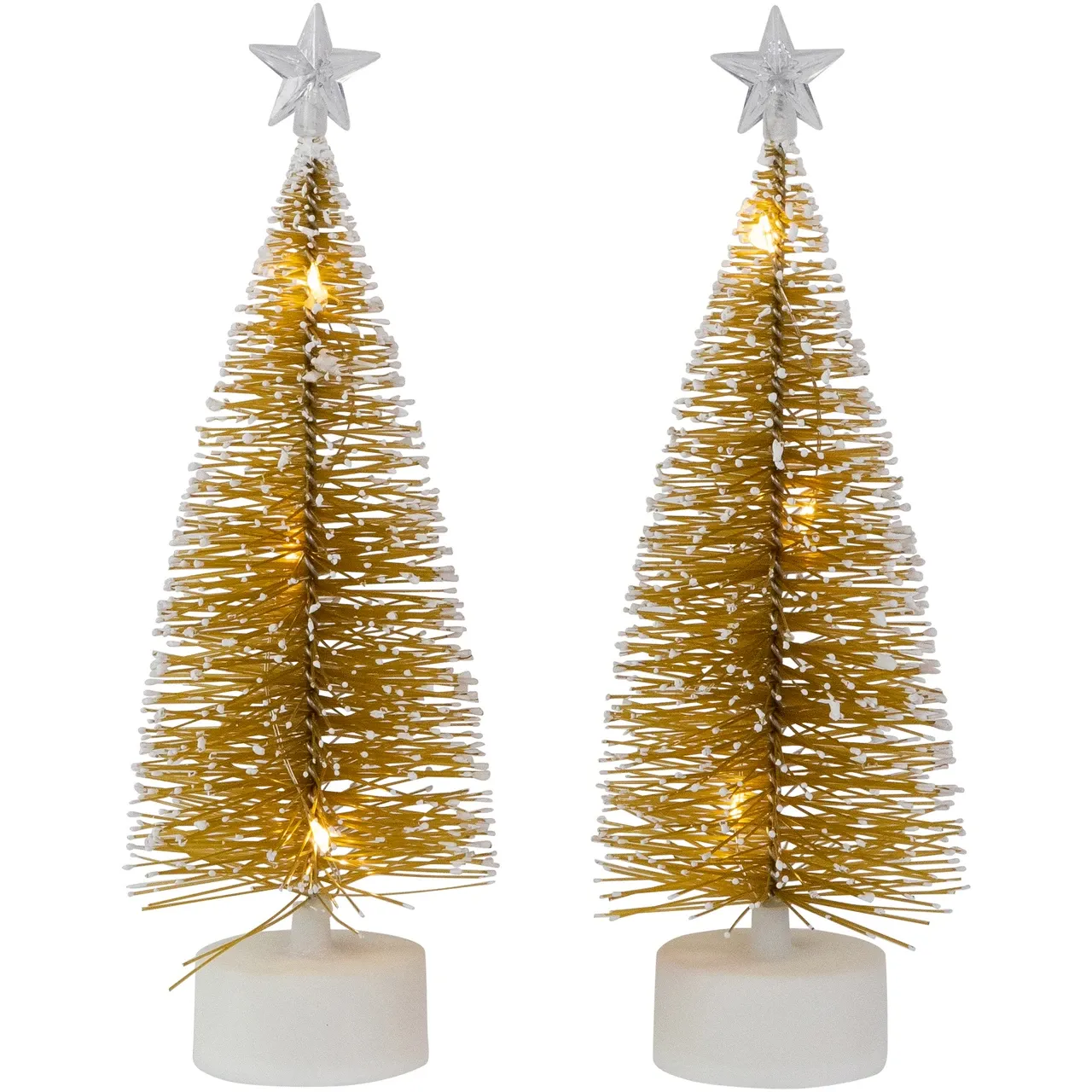
The clear star finials turn two lit trees into a matched pair instead of two random objects. Clear acrylic picks up the internal warm light and glows at the top, which draws the eye upward and makes the trees seem taller than they are. Skip the finials and the trees still work — they just stop looking like a set.
24. Three Green Trees, One Tiny Felt Ornament, One Penny
- Measure the shelf — three trees plus a small ornament need about 14 inches of width.
- Check base diameters; mismatched bases look accidental at this scale.
- Choose a background with texture, since plain white fabric flattens tiny objects.
- Display or shoot at eye level, not from above, so the miniature scale reads.
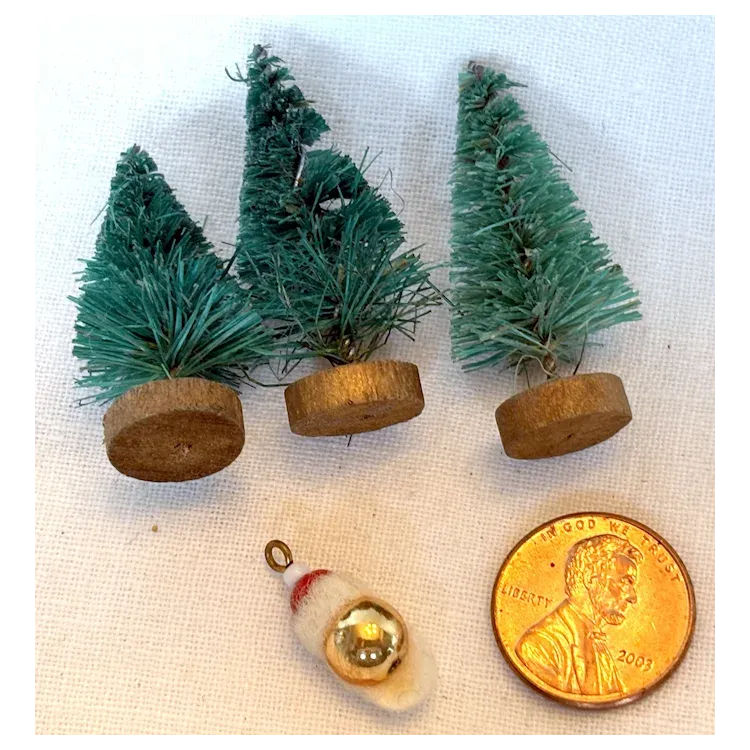
This is the smallest format in the roundup, and it belongs on a windowsill, a bathroom ledge, or a bedside table — anywhere from 12 to 18 inches wide. Any larger and the penny stops doing its job as a scale cue, which is the whole point of the vignette. With more room, move up to Idea #4, where the same green palette fills a console instead.
25. An Ornate Metal Tray Holds the Teal and Gold Crew
Teal 35%, cream 25%, metallic gold and silver 25%, dark metal tray 15%. That dark tray is the anchor — without it, six small trees on a pale surface look scattered. Swap teal for deep burgundy and the tray still works; swap the tray for a white ceramic plate and the display loses its weight and starts to float.
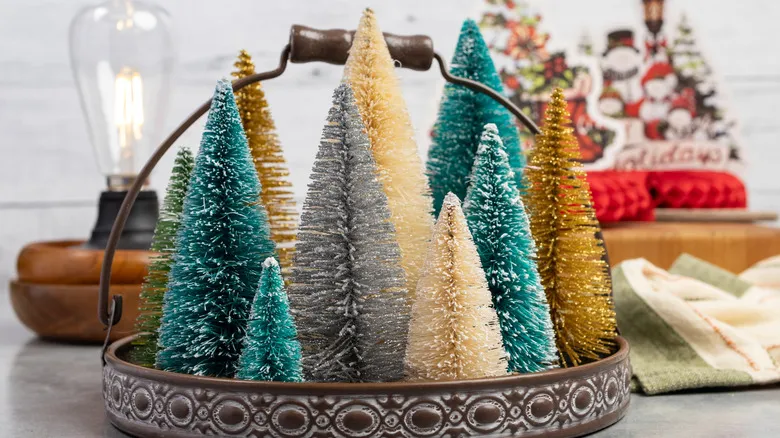
Ornate metal trays tarnish, and the crevices hold dust like nothing else. A dry soft toothbrush once a month keeps the pattern readable. Frosted trees should be brushed rather than rinsed — water breaks down flocking adhesive and leaves grey streaks. Budget about 10 minutes a month during display season, and store the tray with a silica packet to slow the darkening.
26. Silver Glitter Cones With One Raised on a Book
Raising one tree 3 to 4 inches on a book solves the problem every trio of same-shape trees has: identical silhouettes. Pick the riser by color — a dark jacket against white fluted paneling creates a shadow line that makes the lifted tree read as tallest without being largest. Keep risers under 2 inches thick, or the stack starts looking like furniture instead of styling.
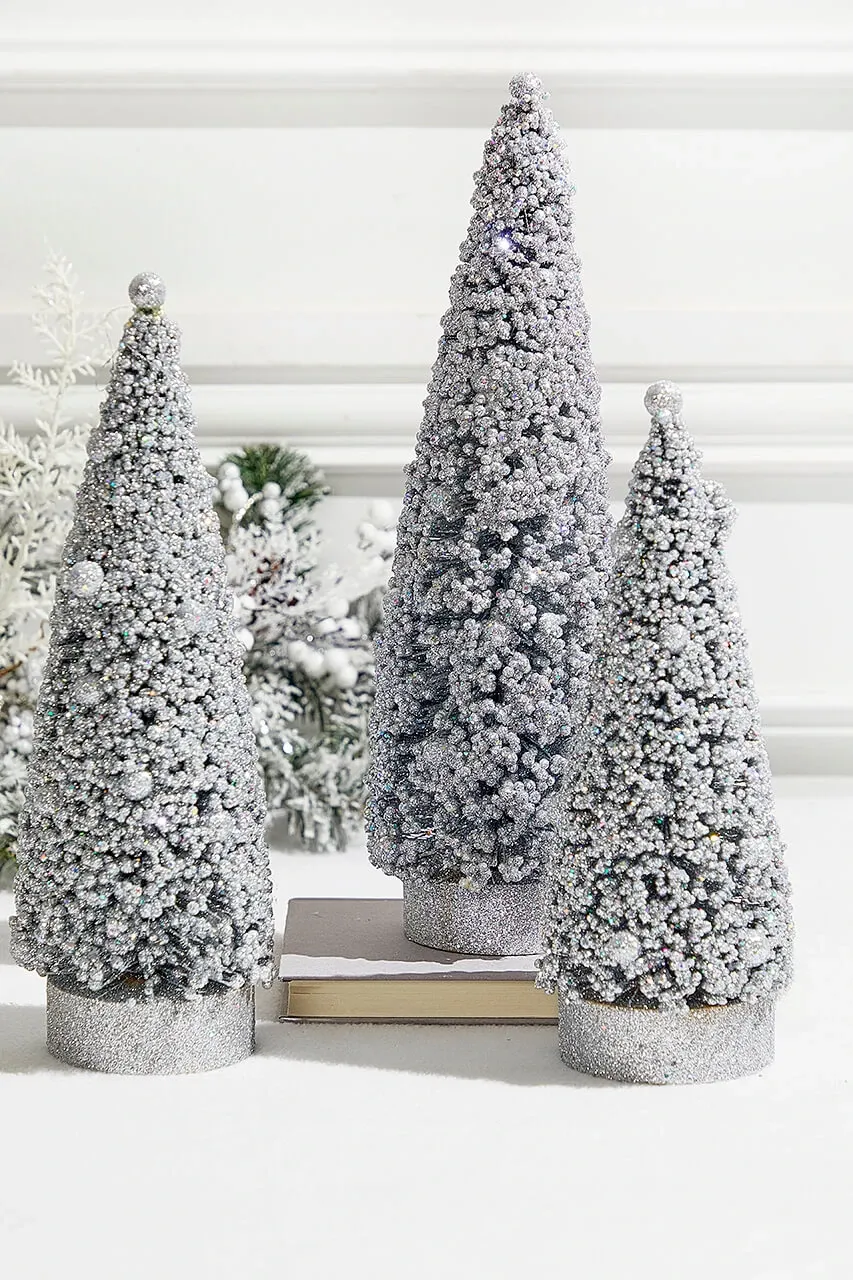
Three same-finish trees succeed purely on repetition and variation, the oldest trick in display design. Identical finish, three heights, one raised. The silver glitter reflects the white fluted paneling and the flocked greenery behind it, so the trees pick up the room rather than sitting on top of it. Change one tree to gold and the repetition breaks.
27. A Wooden Caddy Full of Flocked Trees and Jingle Bells
The wooden caddy is the hero. It gives eight or nine small trees a single footprint, which means you can lift the entire display with two hands, move it for parties, and dust underneath it in seconds. Flocked trees on their own get lost; flocked trees corralled in a caddy read as one intentional object, and the two dark jingle bells out front keep it from looking too sweet.
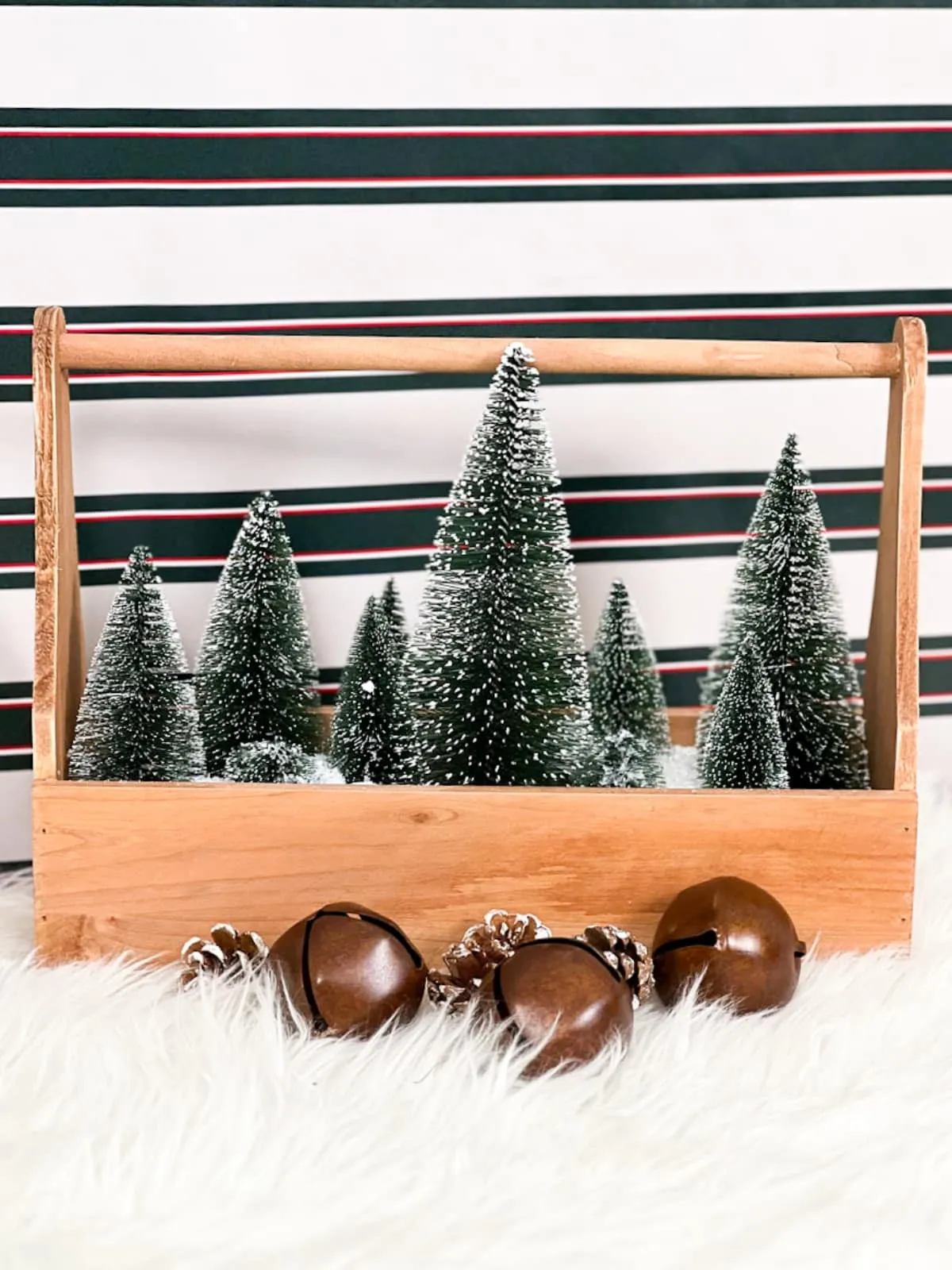
You probably already own the container. A thrifted silverware caddy runs about $4 at Goodwill, a small wooden crate is roughly $8 at Michaels with a coupon, and even a clean metal toolbox works if you line the bottom with felt. Frosted pinecones are $4 a bag at Target and jingle bells come six to a pack for under $5. Whole vignette for under $35.
28. Gradient Silver Trees Lit on a Dark Log Base
The base takes 10 minutes to build.
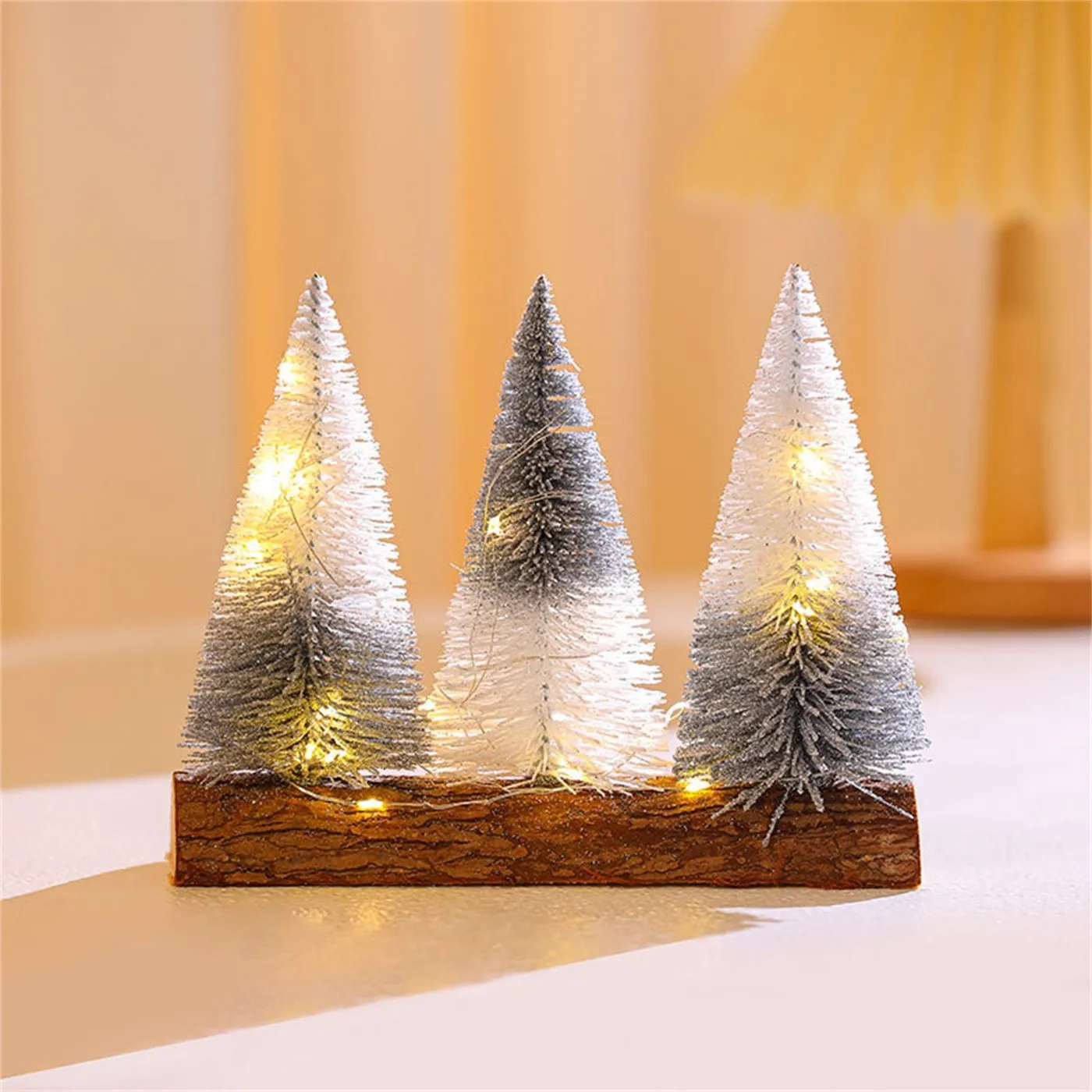
- Find a piece of dark bark or a small split log about 10 inches long and 3 inches wide.
- Drill or screw three short dowels into the top in a slight arc, spacing them 2 to 3 inches apart.
- Wind the fairy light strand through the trees first, then seat each one on its dowel so the wires hide behind the bristles.
- Run the battery pack behind the log and hide it with a scrap of bark. Materials: about $12.
Gradient trees with built-in lights look magical and behave like electronics. The batteries usually last one season of nightly use, the wires are thin enough to break if you pull them, and frosted bristles attract dust that shows under the LED glow. If you have a cat, this display will be investigated.
29. Green Trees Styled With a Lattice Panel and Wrapped Gifts
This one needs real estate: a console or sideboard at least 60 inches wide, with a dark wooden tiered stool as the backdrop and a lattice panel behind it. Ceiling height is not a factor, but wall width is — the panel needs about 24 inches to sit comfortably behind the arrangement. Smaller rooms should borrow just the tiered stool idea and skip the panel entirely.
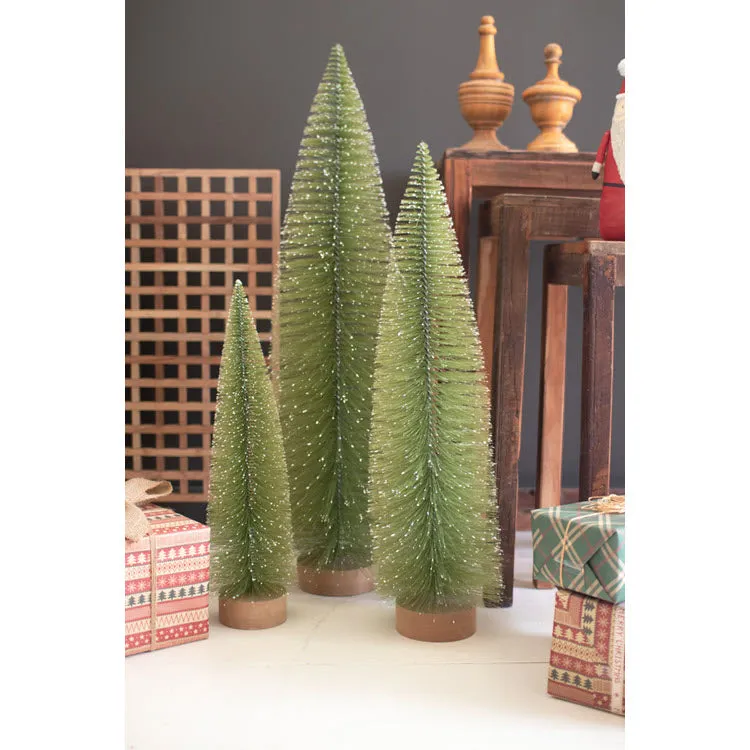
Hide every cord behind the lattice panel and secure the panel to the wall with removable adhesive strips rated for at least 5 pounds. The green trees only need small round wooden bases here, because the dark stool and wrapped gifts behind them provide the visual weight. For the tighter tabletop version of this palette, see Idea #30.
30. Muted Green and Bronze, Four Trees in a Row
Two muted greens and two bronze-browns, four identical light wood bases, one beige background. Call it 50% green, 50% warm metallic-brown, with the beige ground doing nothing but staying quiet. Swap the bronze trees for charcoal and the lineup gets modern; swap the beige for deep olive and you have a moodier, richer version of the same idea.
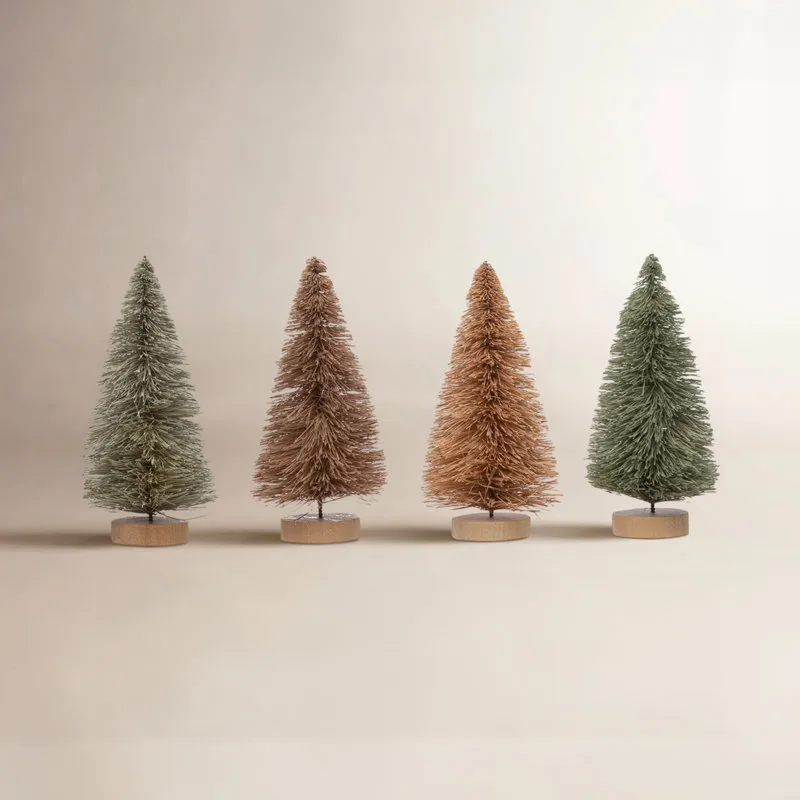
The identical circular wooden bases are the quiet hero. Four different tones on four matching bases read as a deliberate set, and that consistency is what separates this from a shelf of leftovers. Lose it and the lineup becomes four unrelated objects competing. If your trees have mismatched bases, a $6 dowel and a hand saw will fix that in an afternoon.
31. A Craft Table Still Life With Yarn, Mug, and Pinecone
- Five to seven small trees in mixed colors: $12-$30
- Bead or bell ornaments for one tree: $3-$8
- Plain wooden bases, or cut your own: $4-$14
- Styling props you likely own — mug, yarn, pinecone: $0-$10
- Total: $19-$62
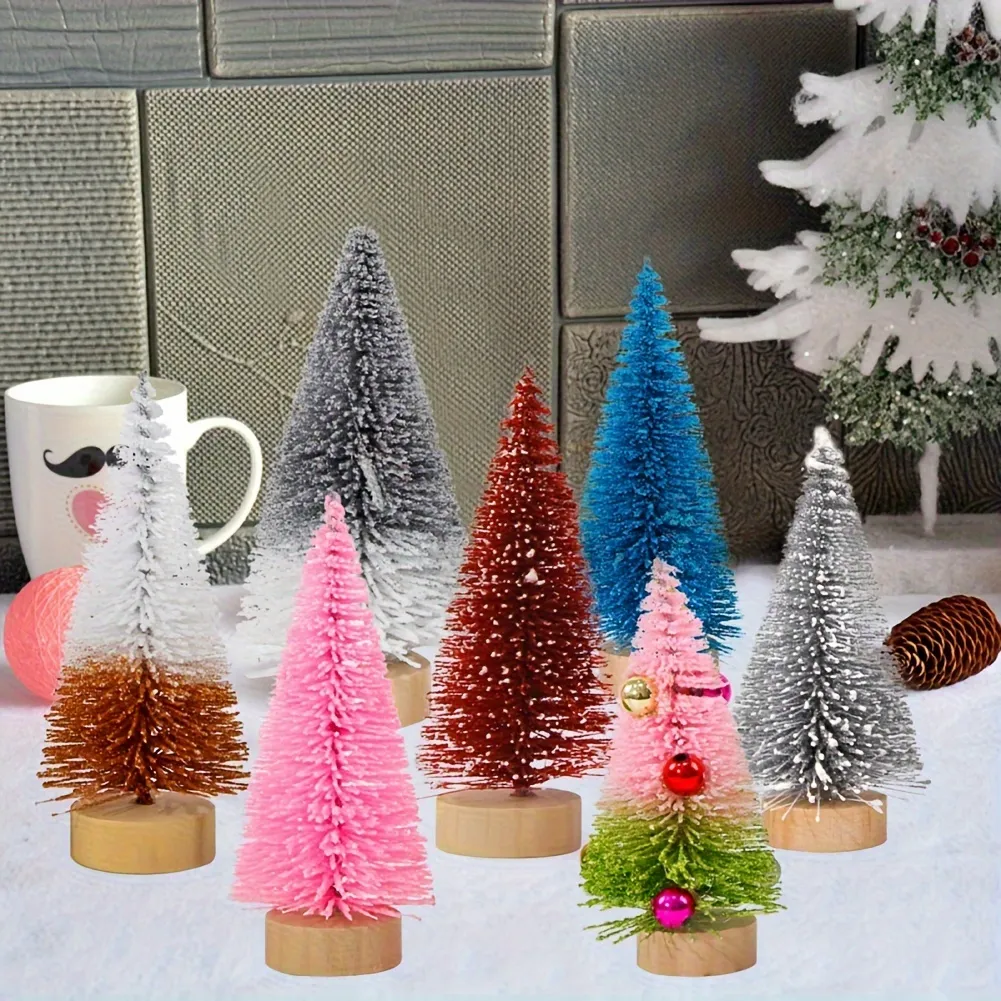
- Choose the backdrop first; a textured grey wall flatters cool blues and pinks far better than white.
- Work near a window and turn off overhead lights to avoid yellow casts.
- Limit yourself to three colors across the trees — a fourth turns playful into chaotic.
- Check that yarn and pinecone props do not out-scale the smallest tree.
32. Ten Trees, Ten Colors, One White Surface
Ten trees is the point where arrangement starts to matter. Group them in threes of related tone — black with lime, purple with orange — and keep every base the same light wood so color is the only variable. Space the groups 4 to 6 inches apart. A straight row of ten looks like a store display; three loose clusters look like a collection.
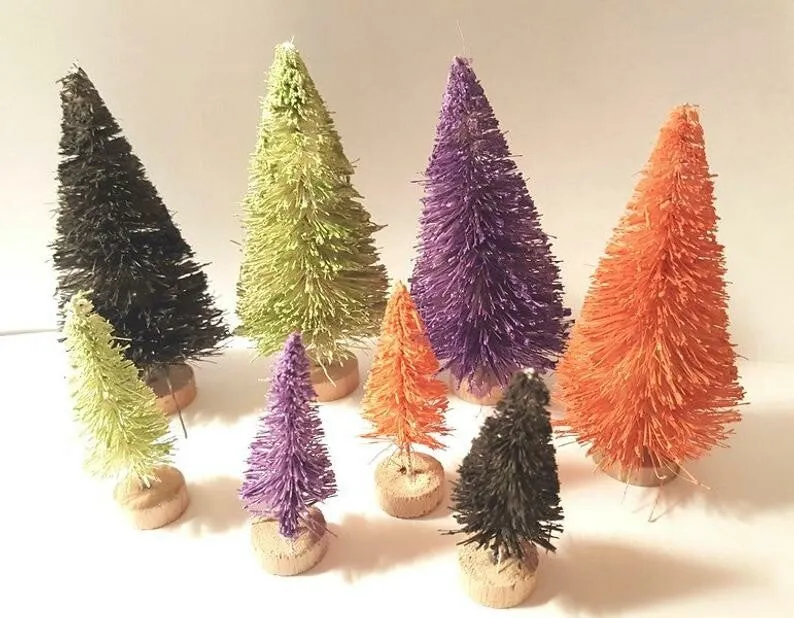
Collecting bottle brush trees, rather than buying one nice set, is the behavior driving this whole trend in 2026. Trees are cheap, small, and stackable, which makes them perfect for the way people shop now: one at a time, at thrift stores and dollar aisles, until a shelf quietly becomes a collection. The upside is personality; the risk is that without a display habit, ten colors becomes ten cluttered surfaces.
33. A Heavily Flocked Green Tree With a Hint of Tinsel
Two details do the work. The silver tinsel is sparse enough to read as light rather than sparkle, so the green bristles stay the main event. And the dark reflective surface below doubles the tree, giving one small object the presence of a much larger one. That trick works with any dark surface — a black tray, a polished table, even a piece of dark glass.
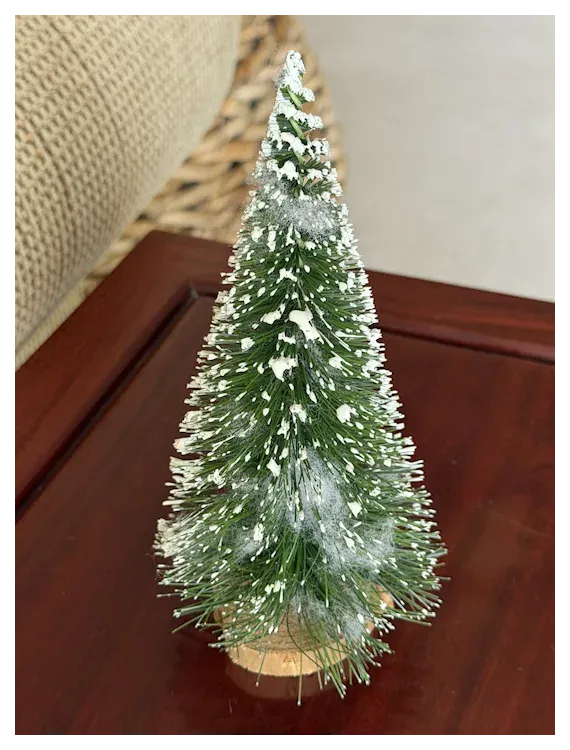
Loose tinsel strands migrate, and they eventually end up on the floor, your socks, and in the vacuum. Expect a light shed every time you move the tree, and do not store it in a bag where the tinsel presses into the flocking. A lidded box with tissue paper keeps it intact, and compressed air clears dust without disturbing the finish.
Little Trees, Big Personality — Go Build Your Forest
Thirty-three ideas, one obvious truth: bottle brush trees are the rare piece of holiday decor you can start with three and end up with thirty without ever blowing a budget. Pick one cluster that matches the surface you actually have, buy the first few trees, and let the collection grow next December. Pin your favorite version now so it is waiting for you when the seasonal aisles fill up again.