
You know that feeling when you finally find the felt ornament tree that looks exactly right — and it’s a photo someone snapped in their own living room, not a styled catalog set? That’s the whole mood of felt ornament tree decor right now.
We spent serious time browsing Etsy, Target, Anthropologie, World Market, and Crate & Barrel to bring you only what’s worth your attention this year, covering everything from $8 single ornaments to $120 heirloom sets.
Inside you’ll find 34 curated ideas across handmade folk, cozy maximalist, woodland rustic, and Scandi-neutral styles — with budget and luxury versions compared side by side, so you can see exactly what your money actually buys.
Hand-stitched wool felt is one of the fastest-rising home searches on Pinterest right now, and it makes sense: felt is soft, unbreakable, quiet against the lights, and it reads as handmade even when it came from a shop.
And stay until the end — we break down the most common mistakes that can ruin these looks. 📌 Save this to Pinterest for later — you’ll want to revisit these ideas.
1. Felt Birds and a Yellow Paper Garland on Green Branches
Three birds, three completely different silhouettes. A dark blue peacock fanning its green tail feathers, a light blue bird caught mid-flight, and a round white spotted duck. Same material, same tree, entirely different shapes — that’s repetition with variation, and it’s why your eye keeps moving instead of stopping. The yellow accordion-folded garland underneath adds one hard geometric line against all that softness, and it’s the cheapest thing on the tree.
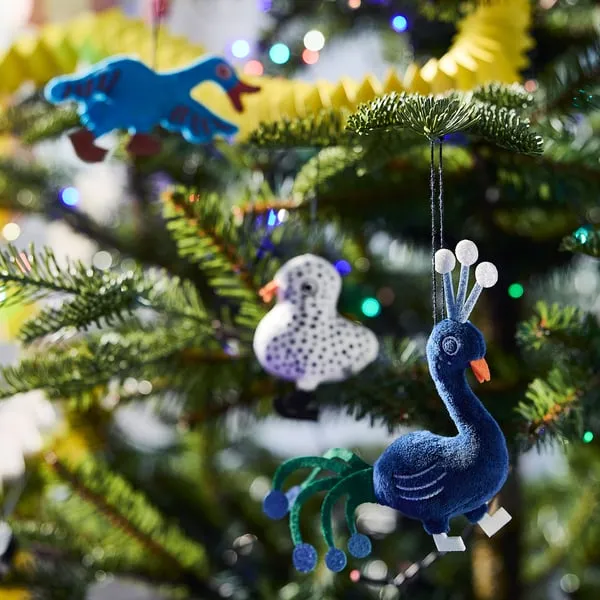
Hang felt ornaments in odd-numbered clusters of three or five, and leave at least three inches of bare branch between each cluster. Felt is matte and light-absorbing, so it disappears into itself when it’s crowded — the gaps are what make the birds read as individual characters rather than a blob of color.
Felt birds this size — roughly four inches tall — want a tree that’s 6 feet or taller, and at least 8-foot ceilings if you’re using a slim profile, since the peacock’s fanned tail adds close to two inches of width on its own. On a 4-foot tabletop tree, cut the count to eight or nine pieces and let the yellow garland carry the rest of the visual weight. Anything under three inches will read as confetti from across the room.
2. Hand-Stitched Snowflakes, Reindeer and Stockings — Stitching Showing
- Cut two identical felt shapes and pin them together — the doubled layer is what keeps the ornament stiff enough to hang flat.
- Thread embroidery floss in a contrasting color and knot the end between the layers so it stays hidden.
- Push the needle up through both layers about 1/8 inch from the edge, loop the thread under the needle point, then pull it tight.
- Repeat every 1/8 inch around the shape, tucking in a pinch of polyester fill before you close the last inch.
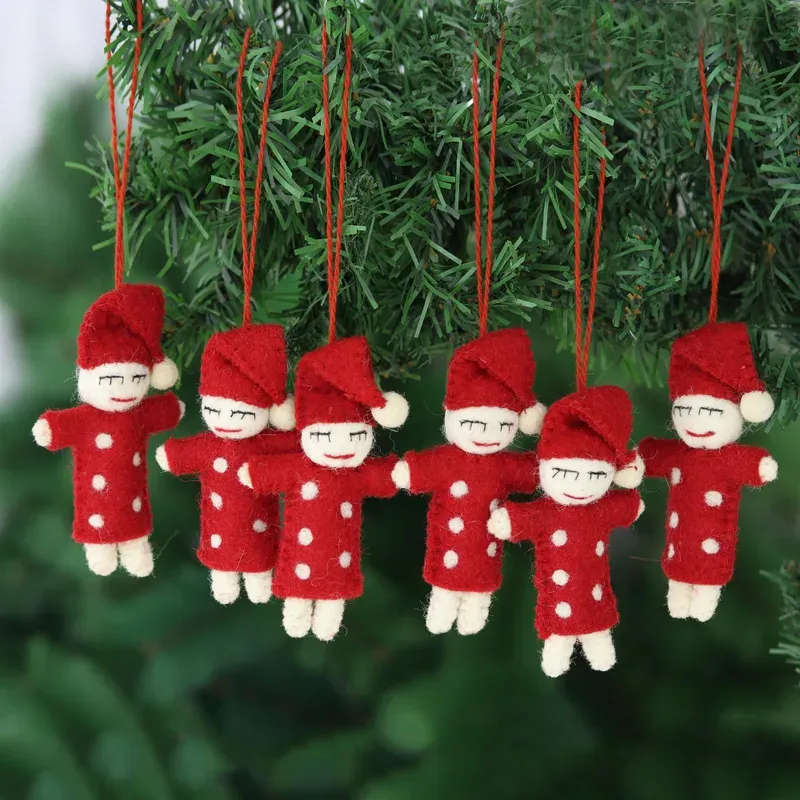
About 20 minutes per ornament, and roughly $1.50 each in floss and felt.
60% red and white felt + 25% forest green + 15% natural twine and wood. That’s the formula holding these snowflakes, reindeer and stockings together. Swap the red for mustard and the green for charcoal and you get the same holiday feeling at an entirely different temperature. The thing people miss is that the stitching thread counts as part of the 60% — that’s exactly why the contrast reads so loudly.
3. A Felt Mouse in a Green Jacket, Holding Two Candy Canes
The candy canes. Take them out of the mouse’s paws and you have a nice felt animal — put them back and you have a character with a story, mid-stride, clearly up to something. The green felt jacket and red skirt are charming, but they’re costume. The prop is personality, and it’s the one detail you can’t replace with a color change. Beside it, a dried orange slice, a few red berries and a pinecone do the same job in miniature.
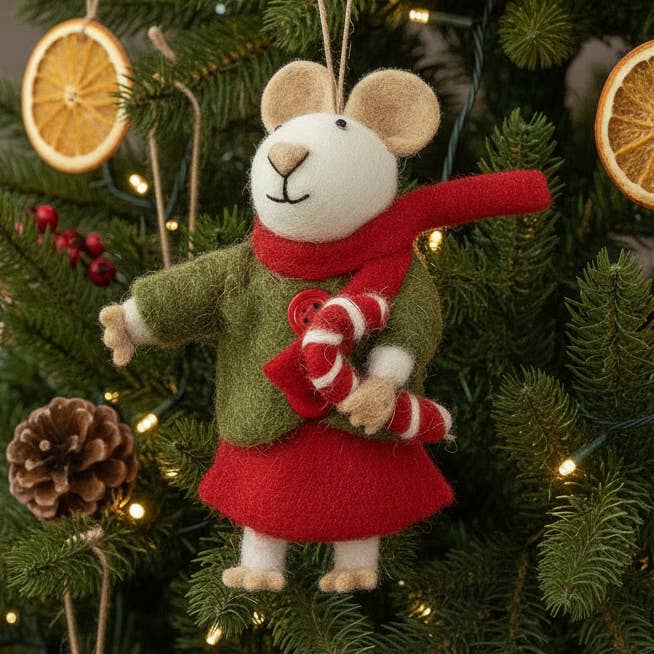
Two things to know before you buy or make one of these. Ornaments with props — candy canes, berries, tiny hats — are the ones small kids pull off first, and those pieces are genuinely choke-sized. Second, felt is a dust magnet, wool felt especially, so a soft brush or lint roller once a month keeps it from going grey. Warm white lights will also fade cheap acrylic felt within a season or two.
4. Gingerbread Man in a Striped Knit Hat, Warm Light Behind Him
Skip the sewing machine for details like the white zigzag icing — cut the felt slightly smaller than the shape, glue it with fabric glue, then run a single line of backstitch over the top. The glue holds it flat while you stitch so nothing puckers. Keep the pom-pom at about 12mm on a four-inch ornament; anything bigger swallows the face. And look for wool-blend felt around 1.2mm thick — it holds a crease without fraying at the edges.
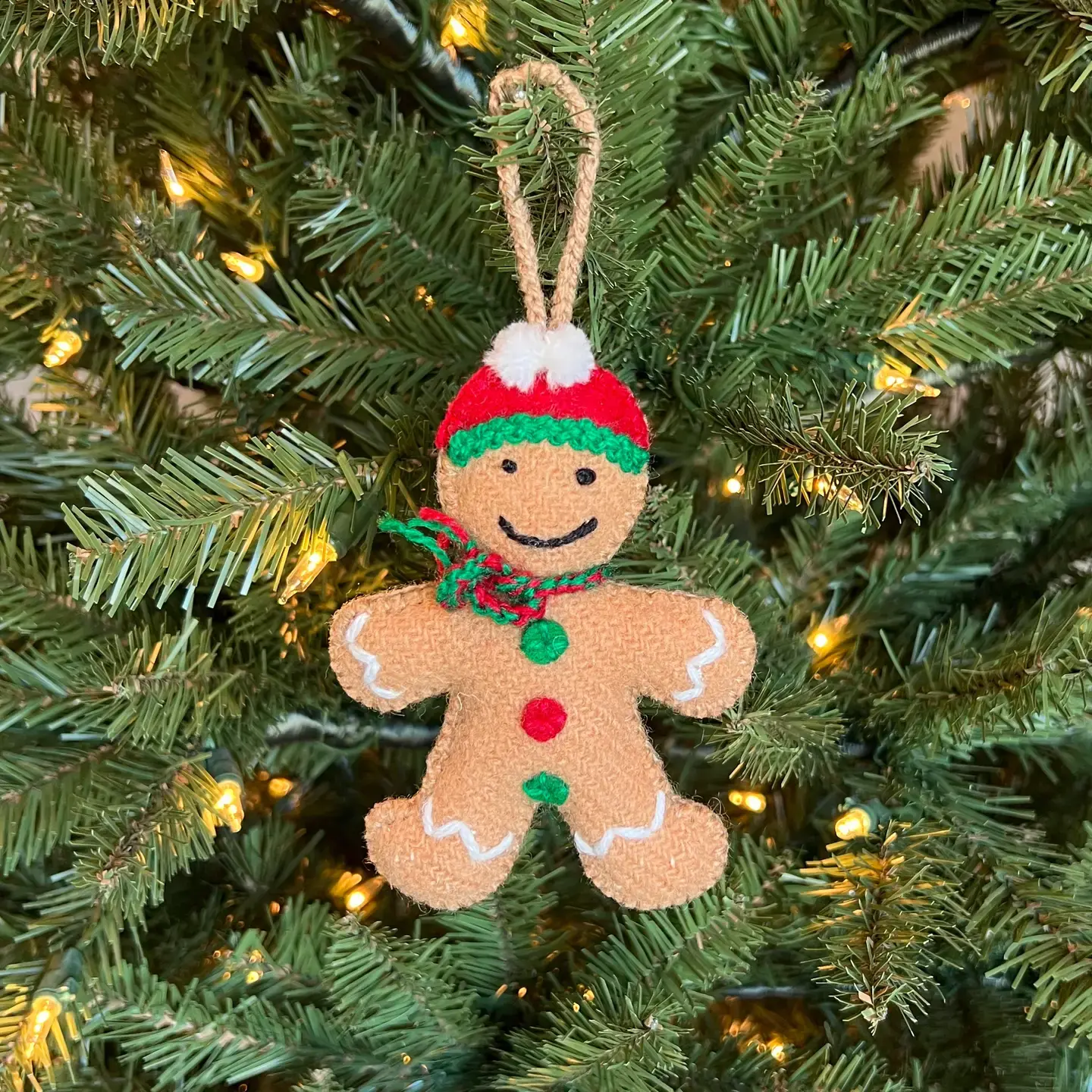
Target and Walmart both sell knit baby booties and preemie hats for around $4 — cut the cuff off and you have a miniature hat and scarf set that looks hand-knit. Dollar Tree carries felt sheets at three for $1.25, and a bag of 100 tiny pom-poms runs about $5. Facebook Marketplace is where old wool sweaters and jute twine live for almost nothing. Six ornaments, about $12 in materials.
Wool felt is a protein fiber, which means moths love it as much as you do, and it pills anywhere a hanger rubs. Store these in a cotton bag with a cedar block, not a plastic bin — plastic traps moisture and felt will mildew. Plan on replacing jute hanging loops every couple of years; they dry out and snap. Same craft tradition as Idea #1, just a different character.
5. A Felt Bear Wearing a Christmas Tree Costume
The dressed-animal ornament is having a real moment. Pinterest searches for hand-stitched folk ornaments have climbed steadily since 2024, and animals-in-costumes is leading the category. Part of it is the kitsch-cute revival; part of it is that a bear in a tree costume is an instant conversation piece on an otherwise polite tree. It has staying power because it isn’t tied to a single palette — you can hang it on red-and-green or on all-cream and it still works.
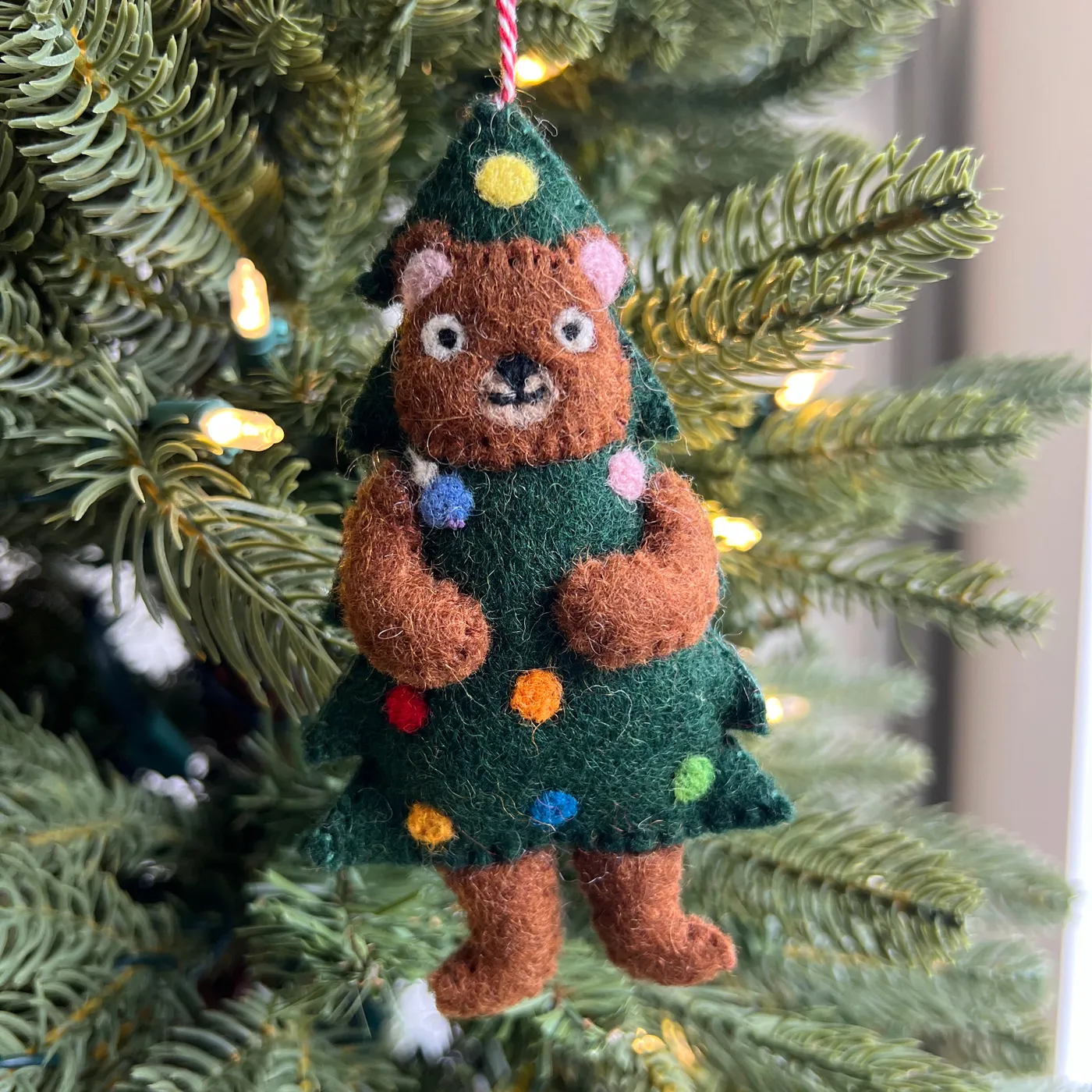
The little multicolor felt circles scattered across the green costume. They’re doing three jobs at once: they read as ornaments on a miniature tree, they echo the real tree behind them, and they give the eye something to land on inside an otherwise solid green shape. Without them, the costume is just a cone. It’s the same logic as decorating a full-size tree — scale the idea down and repeat it.
6. Red and Mustard Felt Stars With a Yellow Turtle
Two warm stars and one cool silver ball. That’s a color-temperature play, and it’s why this cluster reads as designed rather than collected. The mustard yellow star sits beside warm yellow string lights, so it almost glows; the red star is the only true red in the frame, which makes it the anchor. The turtle — soft, round, low-contrast — gives your eye a place to rest between all that brightness.
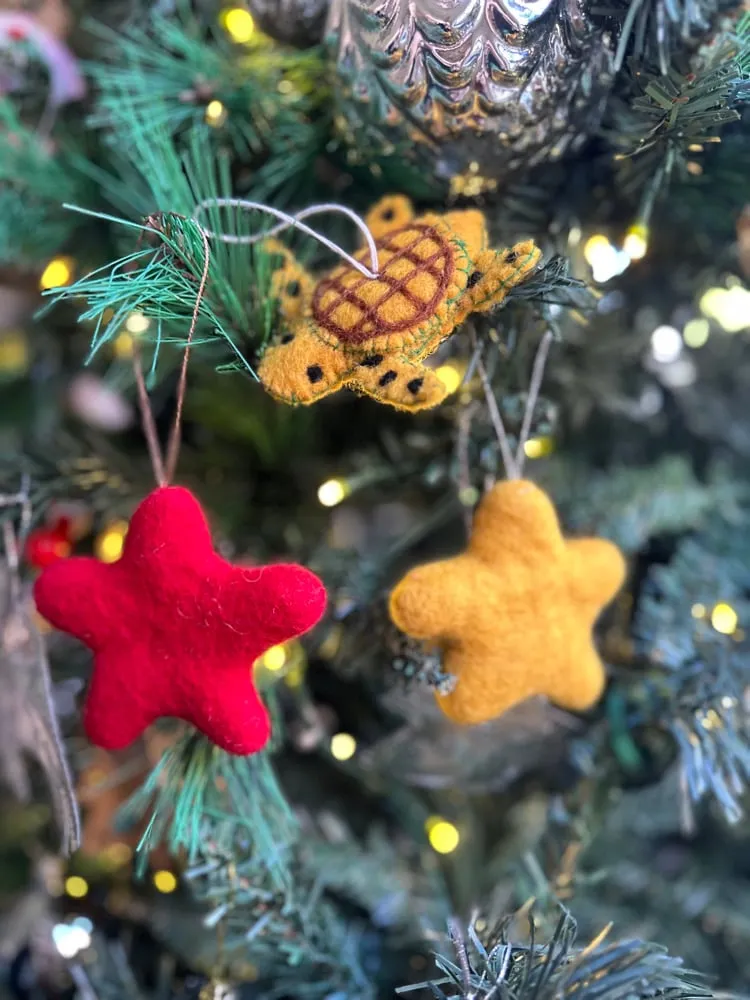
A silver ornament this reflective needs about 18 inches of open branch around it or it turns into a mirror for everything else. These felt pieces are small, roughly three to four inches, so they work on a 5-foot tree as well as a 9-footer — just keep star-to-star spacing at six inches minimum, or the points tangle the moment the tree settles in a warm room.
7. A Felt Bee Hanging on a Snow-Flocked Branch
Flocked trees are gorgeous in photos and dramatically messier in person. That white powder sheds every time you brush past it, and it will dust everything underneath — including any felt ornament with dark sections. Put a plain white sheet under the tree before you decorate, and hang the bee high enough that it isn’t sitting in a drift of snow by December 15th.
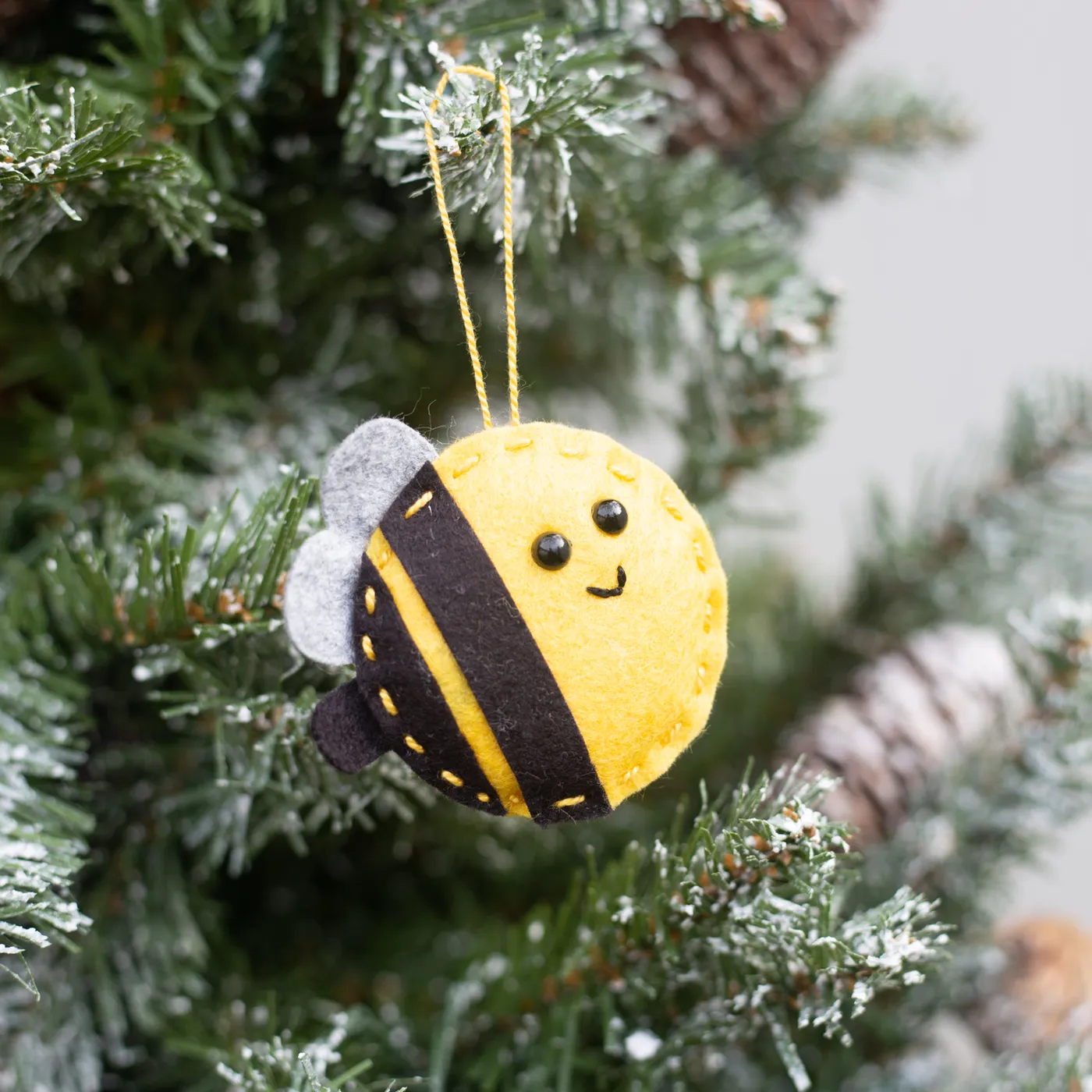
Flocking holds up for about three to four seasons before it starts looking patchy, and you can’t spot-clean it with water — the powder clumps. Felt itself needs a monthly pass with a soft brush; the bead eyes on this bee are glued rather than sewn, so avoid pressing them. Budget about $15 for a flocking touch-up kit every other year if you want the snow look to actually last.
8. A White Felt Cow With Black Spots and a Pink Snout
The pink udder. It’s tucked under the body, most people won’t notice it on a first look, and it’s the single detail that turns a generic farm animal into something a person actually designed. The red-and-white striped string hanger does the same thing on a smaller scale — it keeps the ornament from reading as an afterthought next to a plain loop. Take away the spots and the snout and you’d still have a cow; take away that little pink moment and it’s a shape.
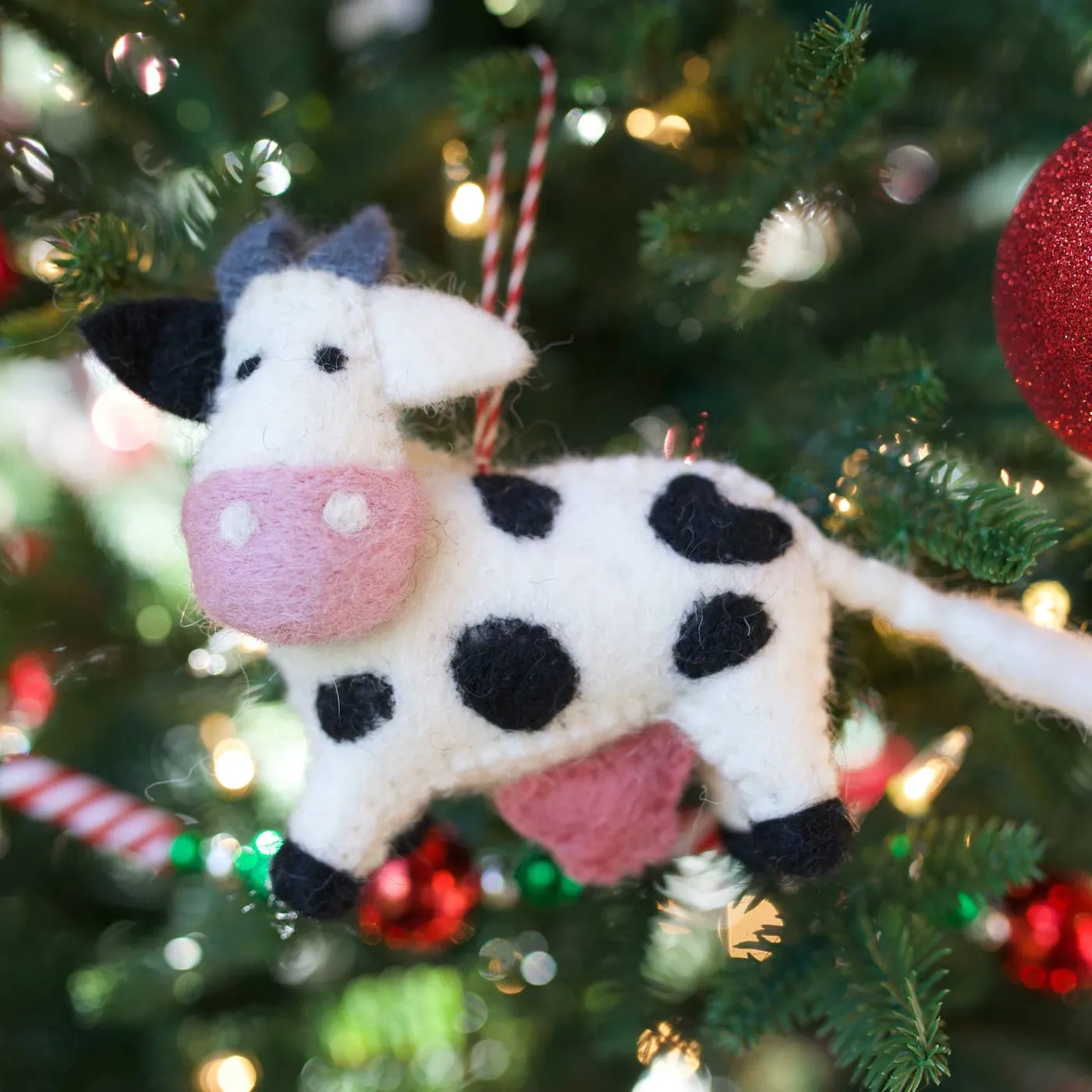
White felt, black felt, and a scrap of pink for the snout and udder — that’s about a $4 ornament if you’re cutting it yourself. A downloadable pattern runs about $6 on Etsy, felt sheets go three for $2 at Michaels on sale, and the floss is probably already in a drawer. Thrift stores are goldmines here; most donated felt craft kits are still sealed.
9. White Embroidered Felt Spheres With Brass Bells
70% warm white + 20% dark red and olive green embroidery + 10% metallic gold. Keeping the ornaments white and pushing all the color into the thread is what makes this set look expensive — the eye reads texture, not pattern. Swap the dark red for dusty blue and the brass bells for matte black, and the same formula turns cool and modern without touching the base color once.
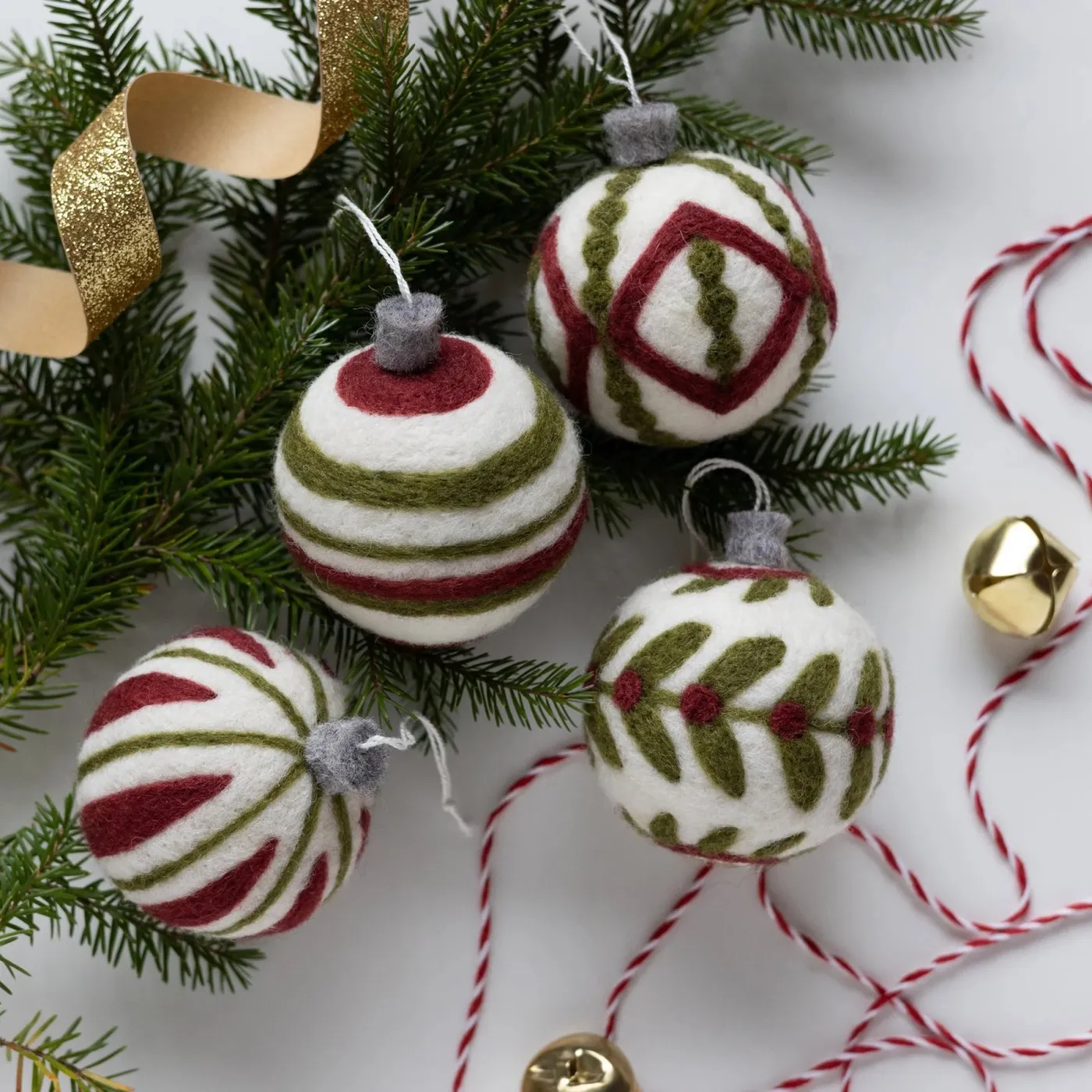
Fresh pine branches and white felt are a risky pairing. Pine sap is sticky, translucent, and it will not come out of wool; same goes for the moisture that beads on needles in a warm room. Either keep felt ornaments on artificial branches, or tuck them toward the outer tips where they won’t brush the needles. The brass bells will tarnish — fine if you like that, less fine if you don’t.
Every ornament here is a sphere: same size, same base color, and all the variety comes from the embroidery plus the textures around them. That’s the most reliable way to make a handmade set look cohesive — one shape, one material, infinite thread patterns. It’s also why the textured gold ribbon and the red-and-white baker’s twine work. They’re the only other textures in the frame, so they get to be loud.
10. Fuchsia Felt Balls With Snowflakes on Thin Silver Cord
- Felt balls, 3cm, set of 24: $12–$18
- White embroidery floss, 4 skeins: $3–$6
- Thin silver cord or metallic thread, 10 yards: $4–$8
- Embroidery needle and small hoop: $5–$9
- Total: $24–$41 for two dozen ornaments
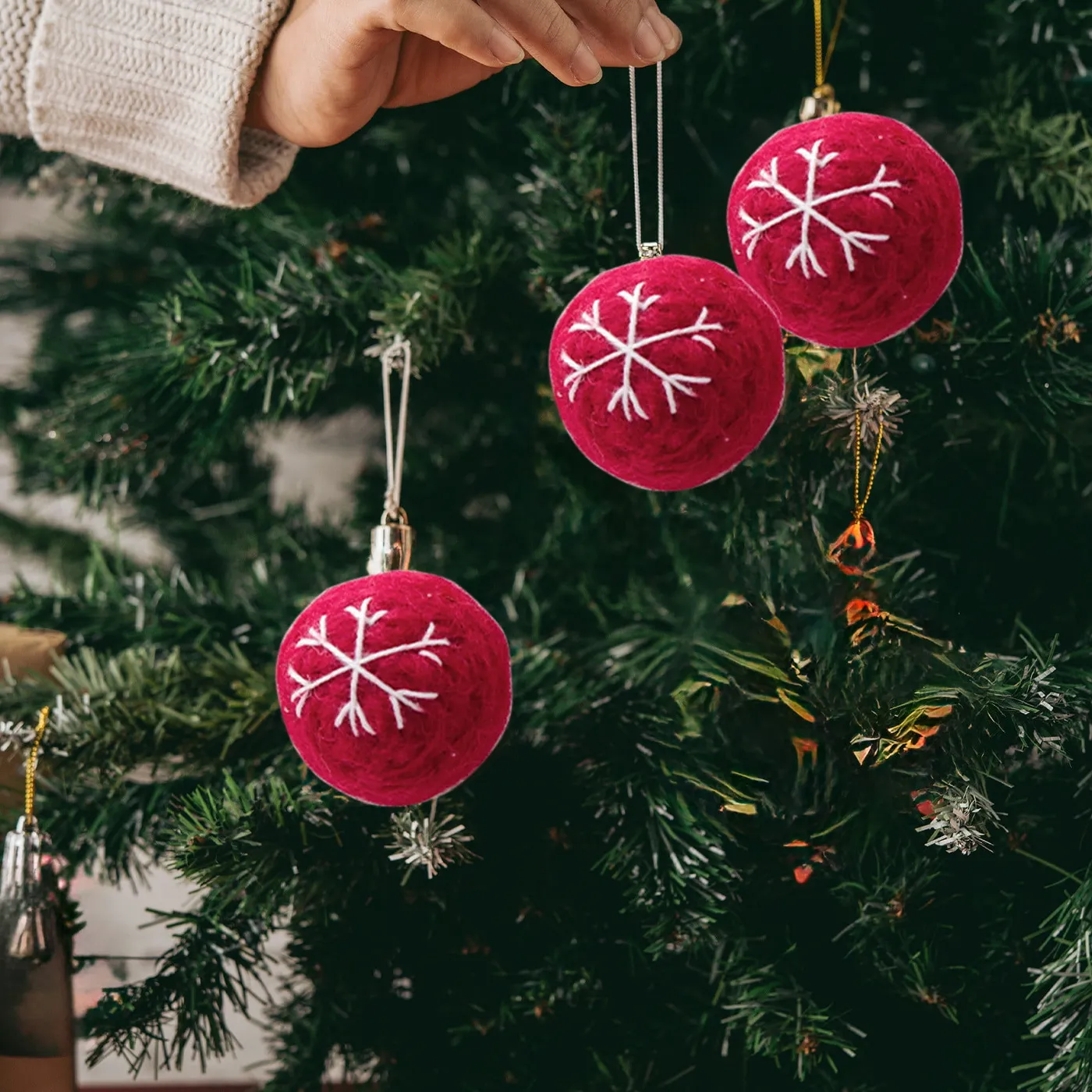
Budget alternative: buy plain fuchsia balls in bulk for around $8 and stitch three snowflakes per ball instead of a full pattern — same impact, half the time.
Hang felt balls on thin silver cord rather than ribbon or twine, and clip each one to its branch at a different drop length. Two to four inches of variation is enough. A perfect row of same-height balls looks like a store display; uneven drops look like a tree. Mixing 3cm and 4cm balls across the tree adds depth without adding a single new color.
11. A Felt Popcorn Box With Embroidered Lettering
- Cut the box body from off-white felt, roughly 2 x 3 inches, then cut four red stripes and glue them down before you stitch anything.
- Blanket-stitch around all four edges in red floss — the border is what makes it read as a box instead of a rectangle.
- Roll eight to ten small white felt balls between your palms with a little water; damp rolling tightens the wool so they hold their shape.
- Stitch the balls in a loose cluster above the box, then embroider the label text with two strands of floss.
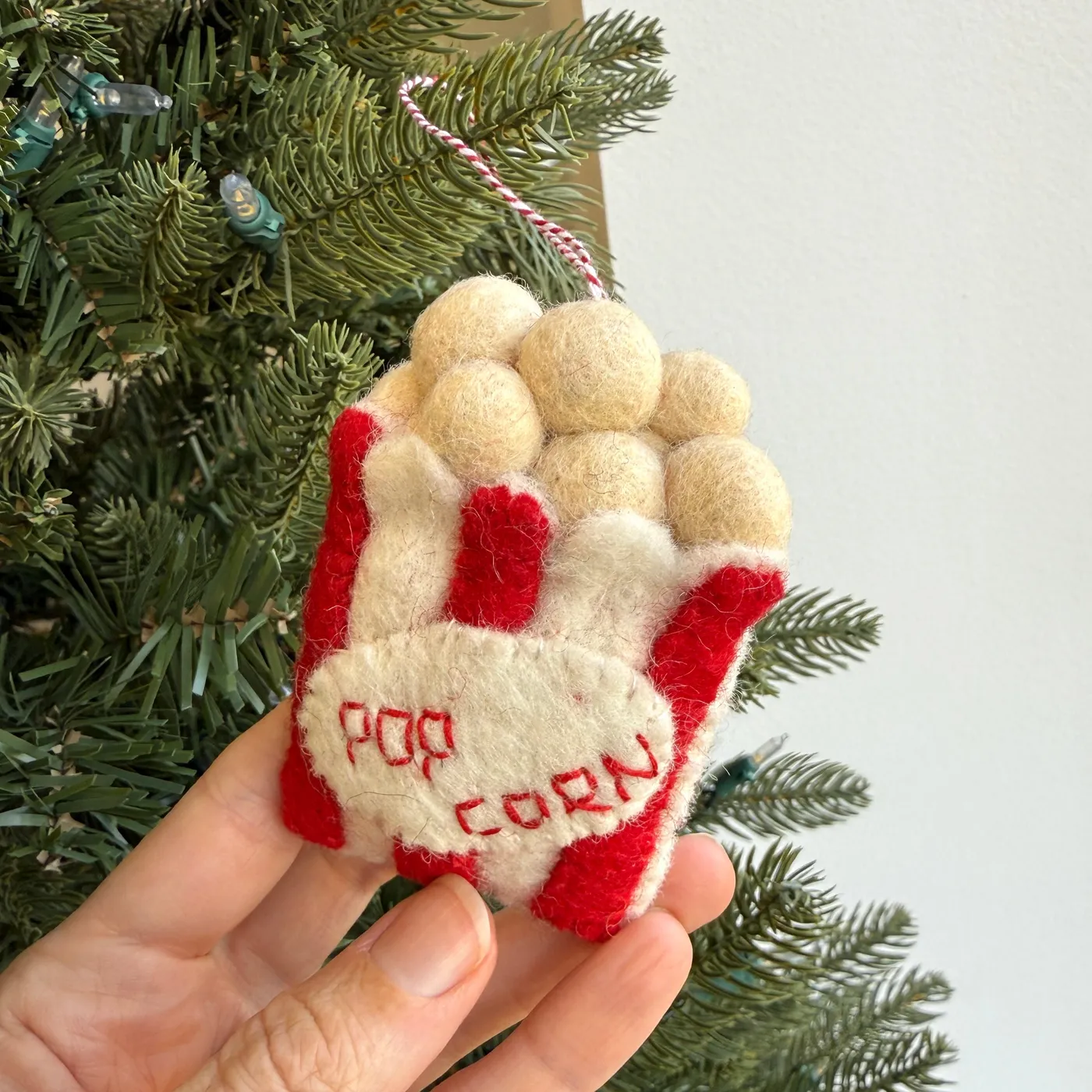
About 45 minutes total, and materials come in under $3 per ornament.
Retro movie-night decor is everywhere right now, and this is the handmade version of it — the ornament equivalent of a vintage popcorn tin. It’s popular because it’s funny without being loud, and because it photographs beautifully on a plain tree. Unlike a lot of novelty ornaments, it doesn’t date itself; popcorn has been a Christmas symbol since the 1800s.
12. Plaid Felt Alphabet Letters Paired With Tiny Wool Animals
These are small — letters around two inches tall, animals closer to one and a half. That scale wants a 4- to 5-foot tabletop tree or a wall-hung branch arrangement, not a 9-footer where they’ll vanish entirely. If you’re spelling a name across a mantel instead, keep the total span under 24 inches and space the letters two inches apart on a single strand, so they read as one word rather than five separate objects.
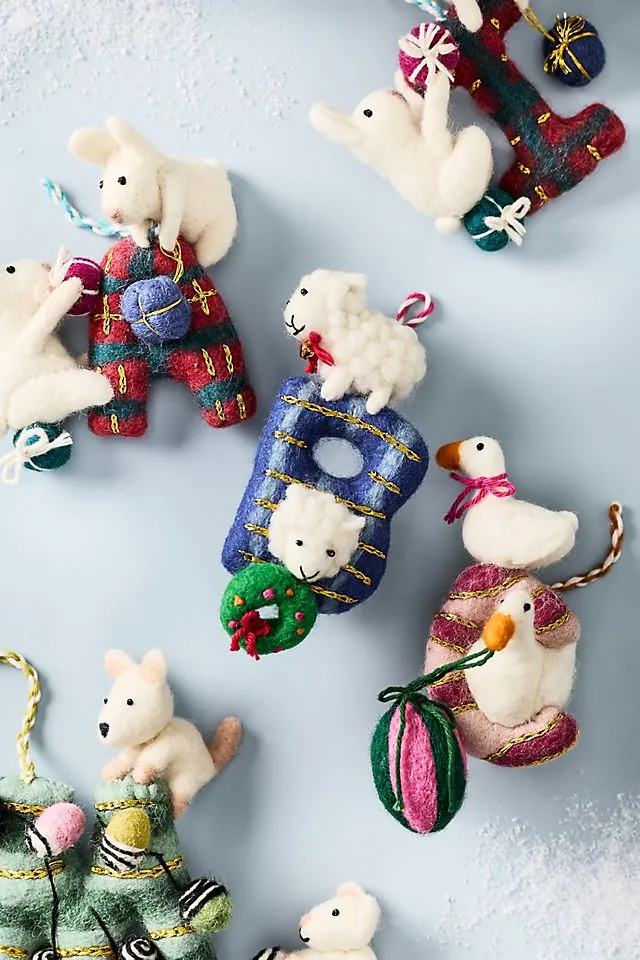
Felt alphabet dies and a die-cut machine are the fast route, but scissors work fine — download a printable letter template, trace in chalk, cut on the line. Sheets run about $1 each at Joann on sale, and gold embroidery floss is roughly $2.50 a skein, enough for a dozen letters. The tiny animals are the splurge; buy two instead of five and let the letters carry the set.
13. A Red Felt Heart With an Appliqued White Dove
The dove is white on red, which is the loudest contrast in the whole palette, and it’s placed off-center — slightly up and to the left. That small asymmetry is what keeps the heart from looking like a greeting card. Blanket stitch around the dove’s wing plus a handful of white French knots add texture exactly where the eye already is, so the embellishment never fights the shape underneath it.
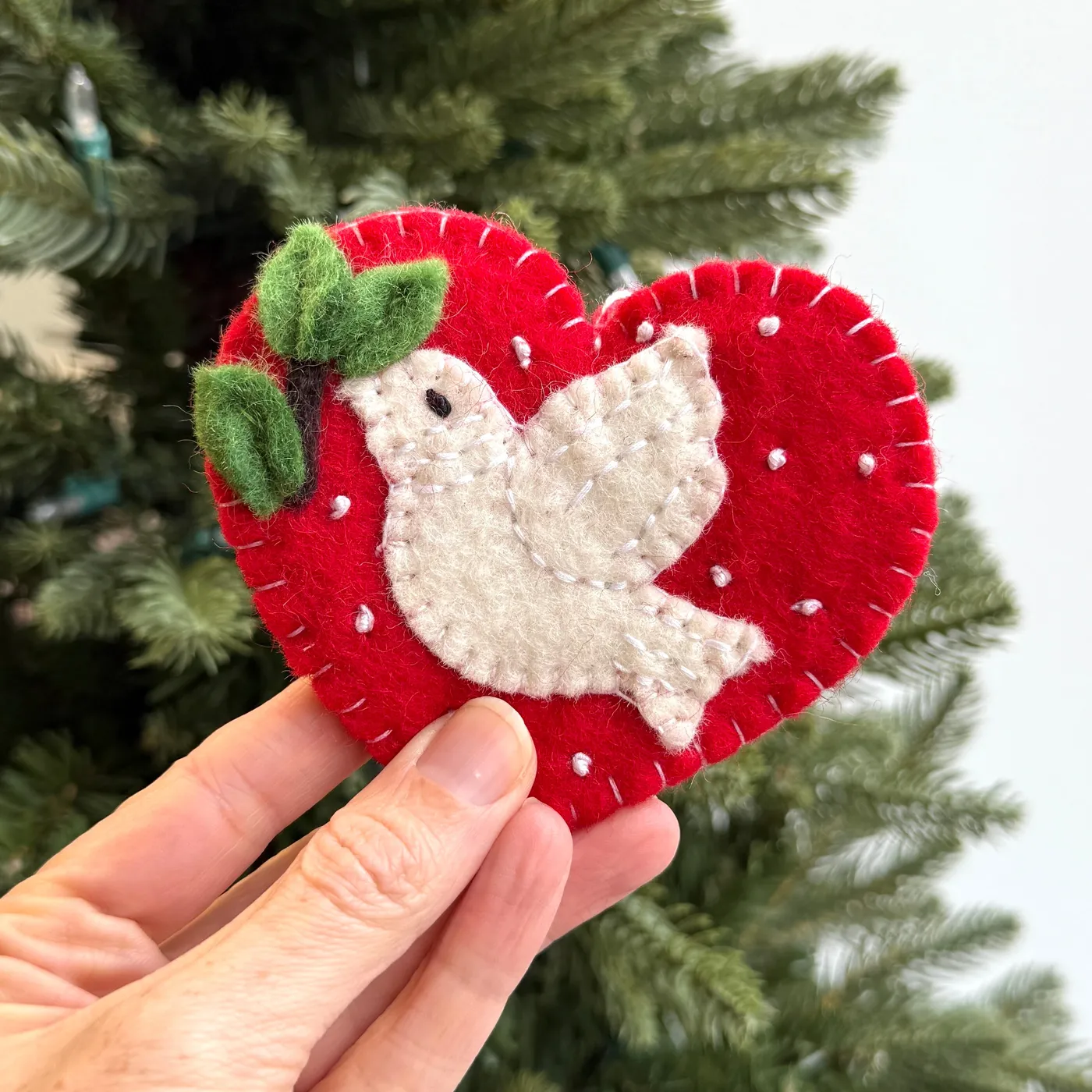
80% red + 15% white + 5% green. That’s it, and it’s a tougher formula than it looks, because the green only shows up in the leaves the dove carries. Pull the green and the ornament goes flat and patriotic; add more and the dove stops being the subject. It’s the same blanket-stitch technique behind the snowflakes in Idea #2, just pushed into a bolder color.
14. Hand-Stitched Australian Animals in Miniature Santa Hats
There’s a real collectors’ market forming around regionally specific ornament sets — Australian animals, Pacific Northwest wildlife, specific farm breeds. It’s partly a reaction against the same twelve snowmen in every store, and partly people wanting their tree to look like their actual life. Search interest in animal-specific ornaments keeps climbing, and handmade sellers are filling the gap faster than the big-box brands can.
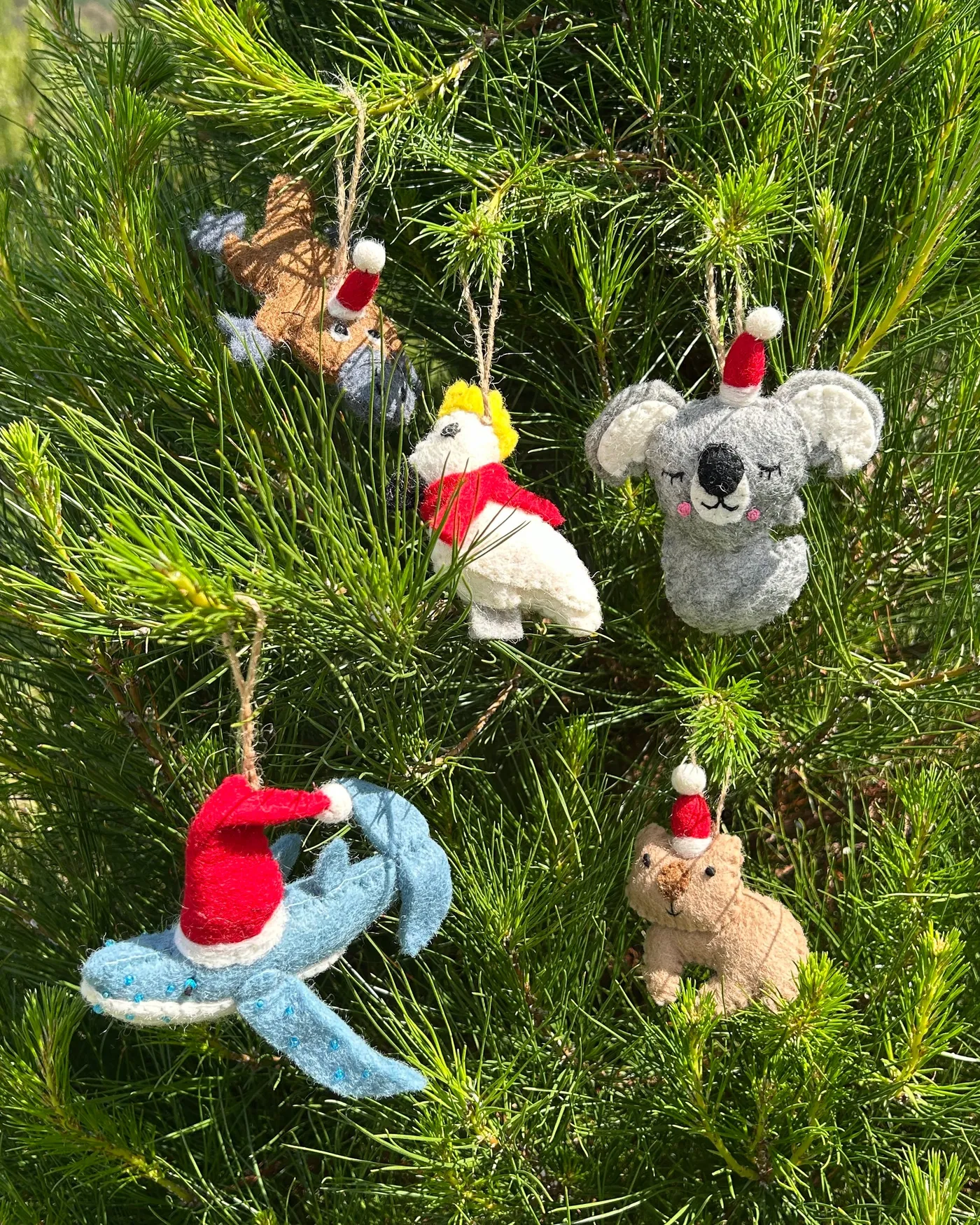
The Santa hats. Every one of these animals — koala, wombat, platypus, blue whale, cockatoo — is recognizable on its own, but the uniform holiday hat is what turns five unrelated figurines into a set. It’s a binding device, and it’s why you can hang a whale next to a cockatoo and have it look intentional instead of random. If you’re mixing sets, pick one shared accessory and repeat it relentlessly.
15. A Red Flag on Black: When Too Much Felt Ruins the Tree
It’s just a red exclamation point on a black field, and it’s honestly the most useful thing in this guide. Felt is matte, low-contrast and soft-edged, which means that past a certain density the ornaments merge into one fuzzy mass — you lose every individual shape you paid for. If you can’t count your felt pieces from the doorway, you have too many. Cap them at roughly a third of your total ornaments.
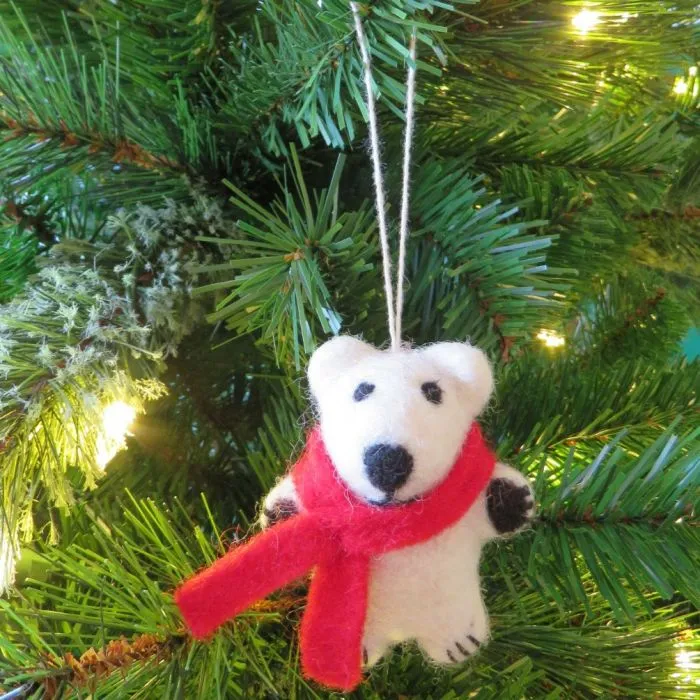
Keep at least 18 inches between dense felt clusters, and give every handmade piece a glossy neighbor — a glass ball, a metallic star, a brass bell. Felt only reads as texture when something reflective sits beside it. One more rule worth taping inside the ornament box: never hang two same-silhouette felt pieces within a foot of each other, even in different colors. Your eye groups by shape before it ever groups by color.
16. A Felt Dog in an Orange Knit Sweater, Football in Paw
The sweater is the whole trick. Buy a $3 pair of knit baby socks from Walmart, cut the foot off, and slide the cuff over the felt body — you get an orange ribbed sweater in about ninety seconds. Felt sheets are three for $1.25 at Dollar Tree, and the mini football is a scrap of brown felt wrapped around a cotton ball with two stitches of white floss. Total: under $6 per dog.
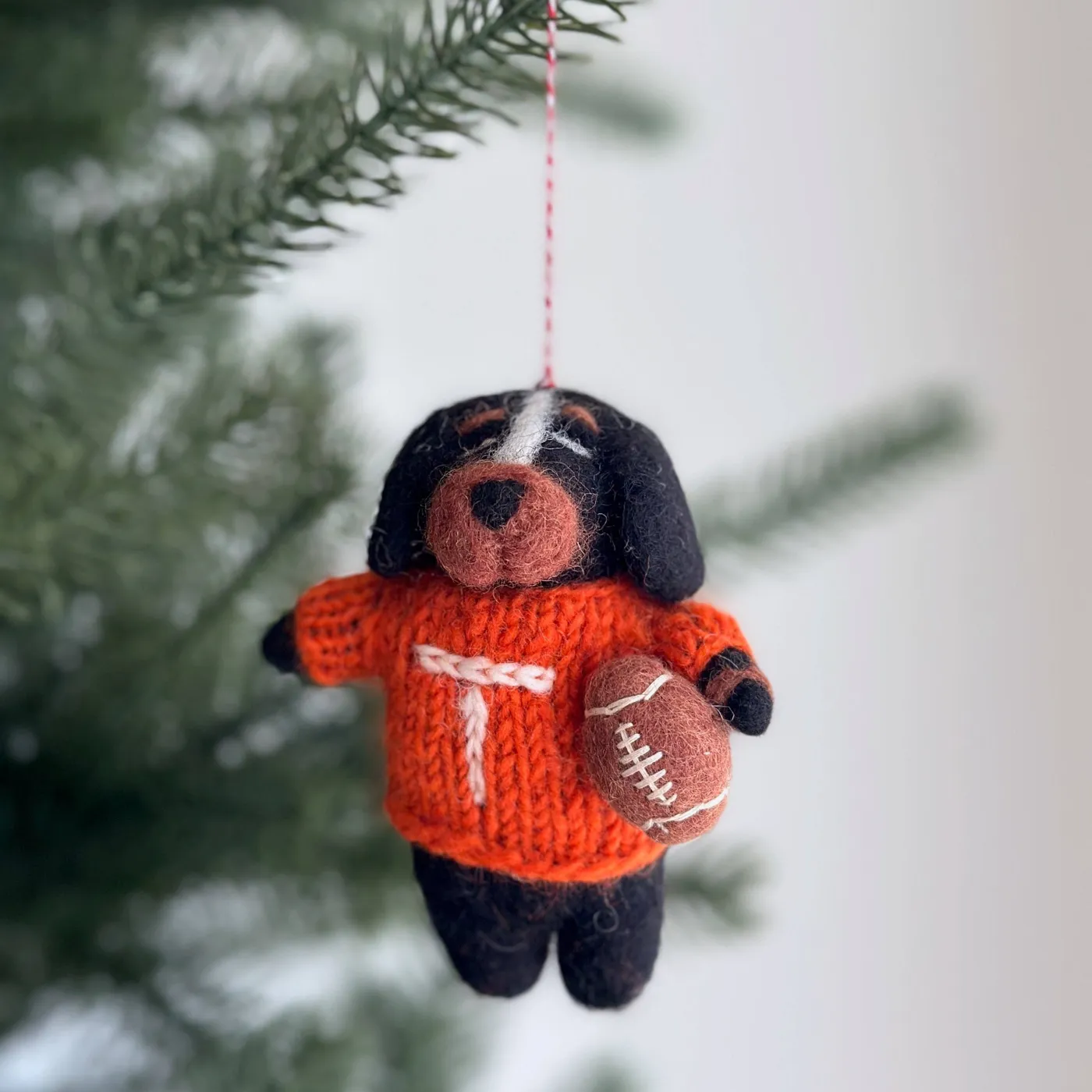
The white letter T. It’s one stitched character, and it changes the object from a decoration into a personal story — a team, a name, a specific person. That’s the difference between an ornament someone keeps for a season and one that gets passed down. If you’re making a set, give each animal one identifying detail instead of a uniform look. You’ll remember which is which, and so will everyone else.
17. A Needle-Felted Schnauzer With a Fluffy White Muzzle
Needle-felted pieces are dense and heavy for their size — this schnauzer is barely three inches tall and still outweighs a glass ball twice its size. That means it wants a branch close to the trunk on a real or well-wired artificial tree, and a tree at least 5 feet tall so the weight disappears visually. On a tabletop arrangement, hang it from a fixed arm rather than a loose branch that will sag overnight.
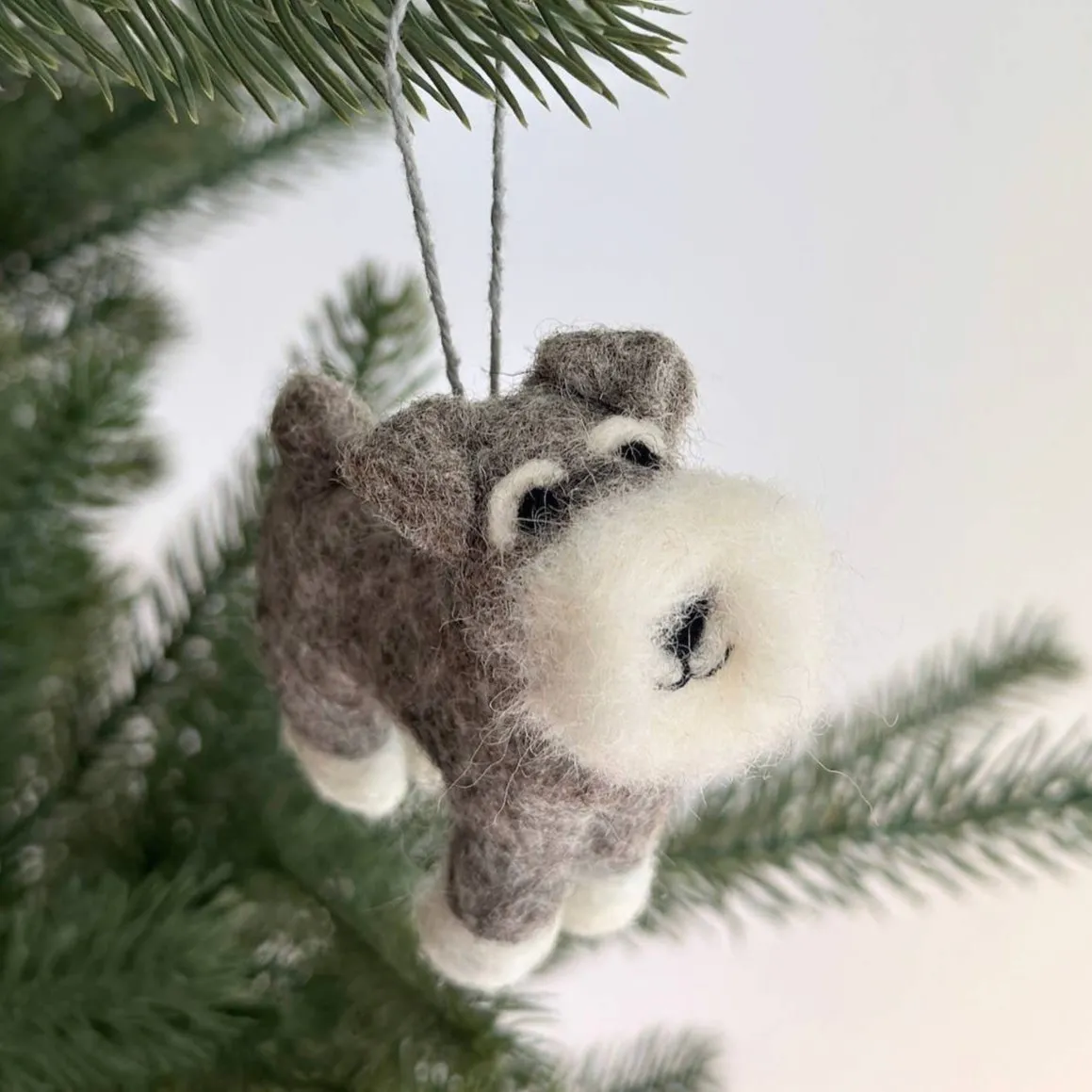
Uncarded wool is fragile. It pills where the hanger rubs, it grabs every loose thread and pet hair in the room, and it slowly fuzzes if you handle it a lot. Give it a light pass with a clean soft toothbrush every few weeks, keep it out of direct sun, and store it in a tissue-lined box — not a plastic bag. A needle-felted ornament will last decades if it never gets crushed.
18. Four Sweater-Wearing Animals Packed in a Gift Box
The packaging is doing as much work as the ornaments. A plain kraft gift box runs $2 at any craft store, a big bag of shredded paper filler is about $4, and a red satin ribbon costs $3. Add red-and-white baker’s twine hangers and the whole thing looks like it came from a boutique. Under $40 all in, if you’re making the ornaments on dollar-store felt.
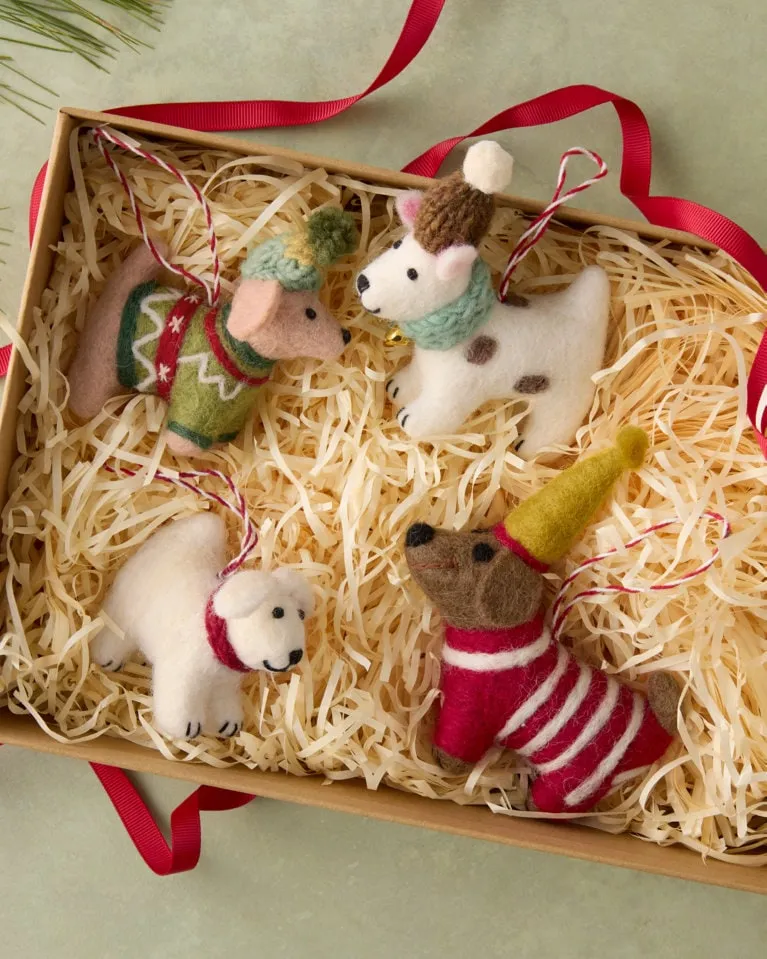
- Line the box base with a half-inch of shredded filler and press it down flat — a loose bed lets the ornaments shift in transit.
- Nest each animal so its sweater faces up and no two hats touch.
- Tuck a small care card on top, then add one more handful of filler around the edges.
- Tie the lid with baker’s twine and leave the ends long enough to double as a gift tag.
Ten minutes, and no cost beyond materials. Handmade gift sets are the fastest-growing category in holiday decor right now, mostly because they solve the what-do-I-get-someone-who-has-everything problem with something that took actual time. On Etsy, boxed felt sets routinely outsell singles. Buy one good box and refill it with a new animal each year.
19. A Pom-Pom-Draped Llama and a Saddled Sheep
Hanging a pair like this against a tree in the background works because of depth, not size. The llama and sheep sit close to the camera with furniture and a lit tree blurred behind them, so they read as larger than they are. Recreate it by hanging the pair at the outer edge of the tree at eye level and letting the room stay visible behind them. In a small living room, that’s a better look than a densely packed tree.
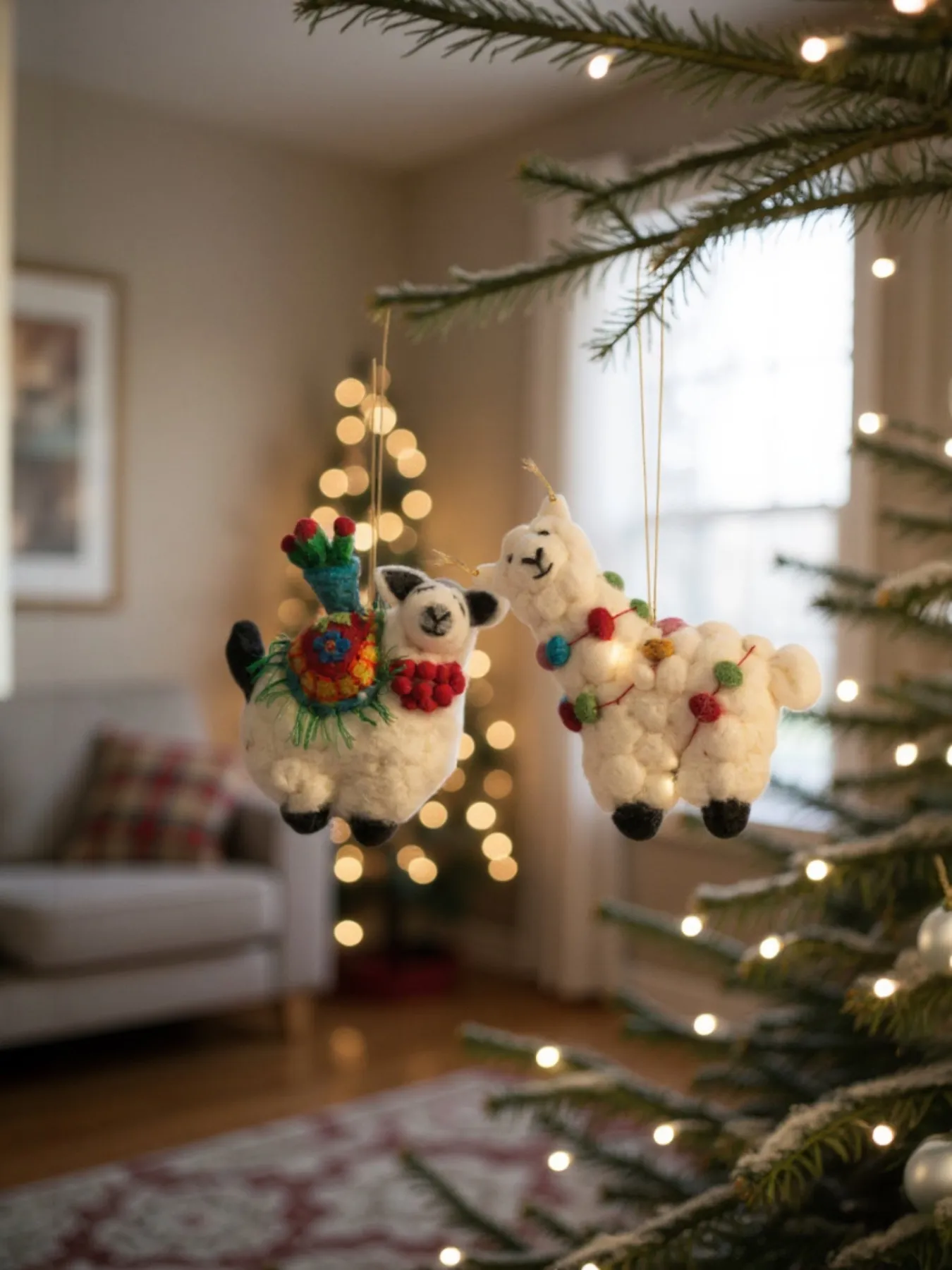
The pom-pom garland draped across the llama. It’s rowdy, colorful and slightly ridiculous, and it’s the reason the ornament is memorable instead of merely tasteful. The sheep’s multicolor saddle plays the same tune at lower volume. Pick one piece on your tree to be the funny one — if everything is charming, nothing is.
20. A Tan Felt Dog in a Tree-Shaped Hat With a Star
- Cut two identical triangle shapes about 1.5 inches wide at the base from green felt.
- Blanket-stitch the sides together, leaving the bottom open, and stuff lightly with wool before you close it.
- Cut a star about a quarter-inch across, stitch it to the tip with one anchoring stitch, and let it wobble slightly.
- Stitch a red pom-pom on each side of the hat brim, then glue the hat to the head with fabric glue and let it cure overnight.
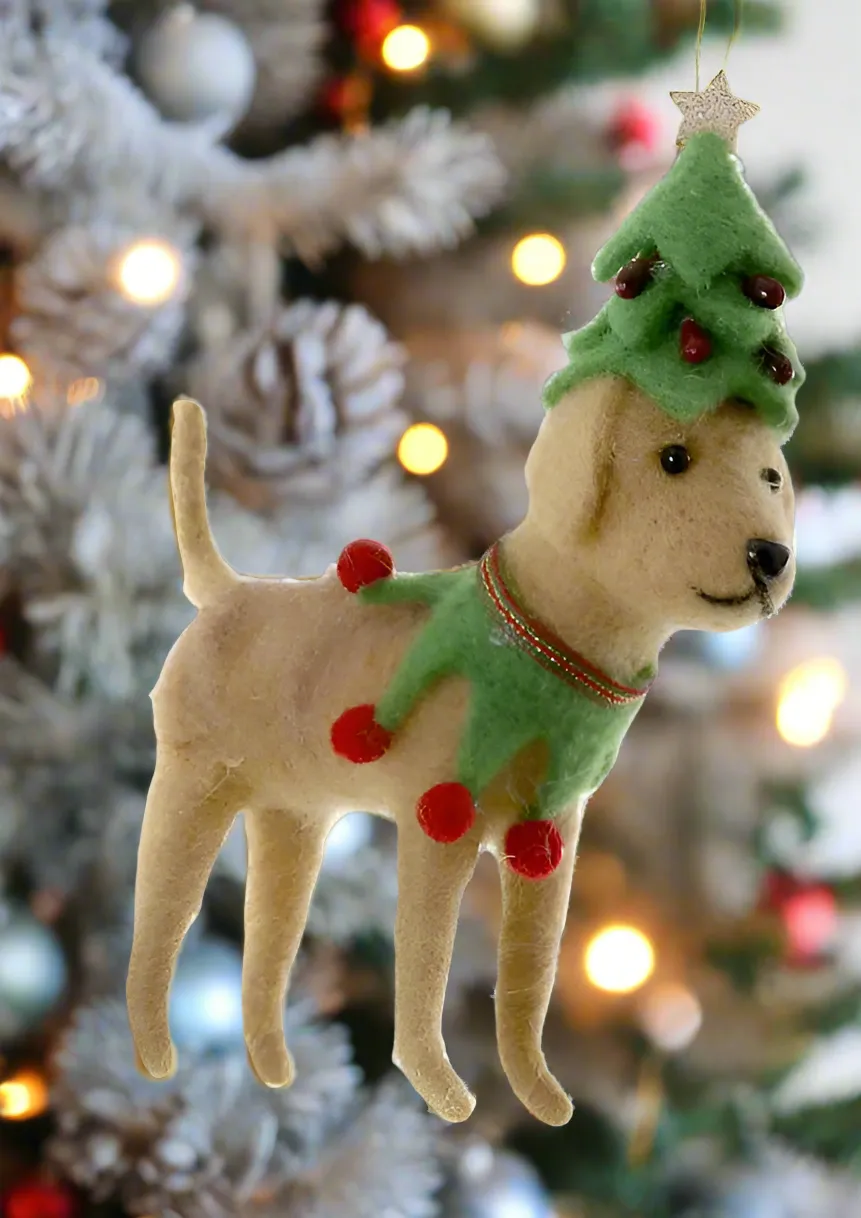
Roughly 25 minutes, and under $2 in materials.
Pom-poms carry a lot of visual weight at small scale — an 8mm pom on a 2-inch hat is right, while a 15mm one turns the whole ornament into a red blob. Buy one mixed bag of micro pom-poms (under $6 for 200) and match size to the detail, not to your mood. And always glue rather than stitch when the felt underneath is already stuffed.
21. Red Felt Lobsters Wearing a Pearl Necklace and a Tiny Hat
- Red wool-blend felt, 4 sheets: $6–$10
- Cotton twine for hangers: $3–$5
- Tiny pearl beads, 50-piece pack: $4–$7
- Miniature dollhouse hat: $3–$8
- Embroidery floss and needle: $3–$6
- Total: $19–$36 for the pair
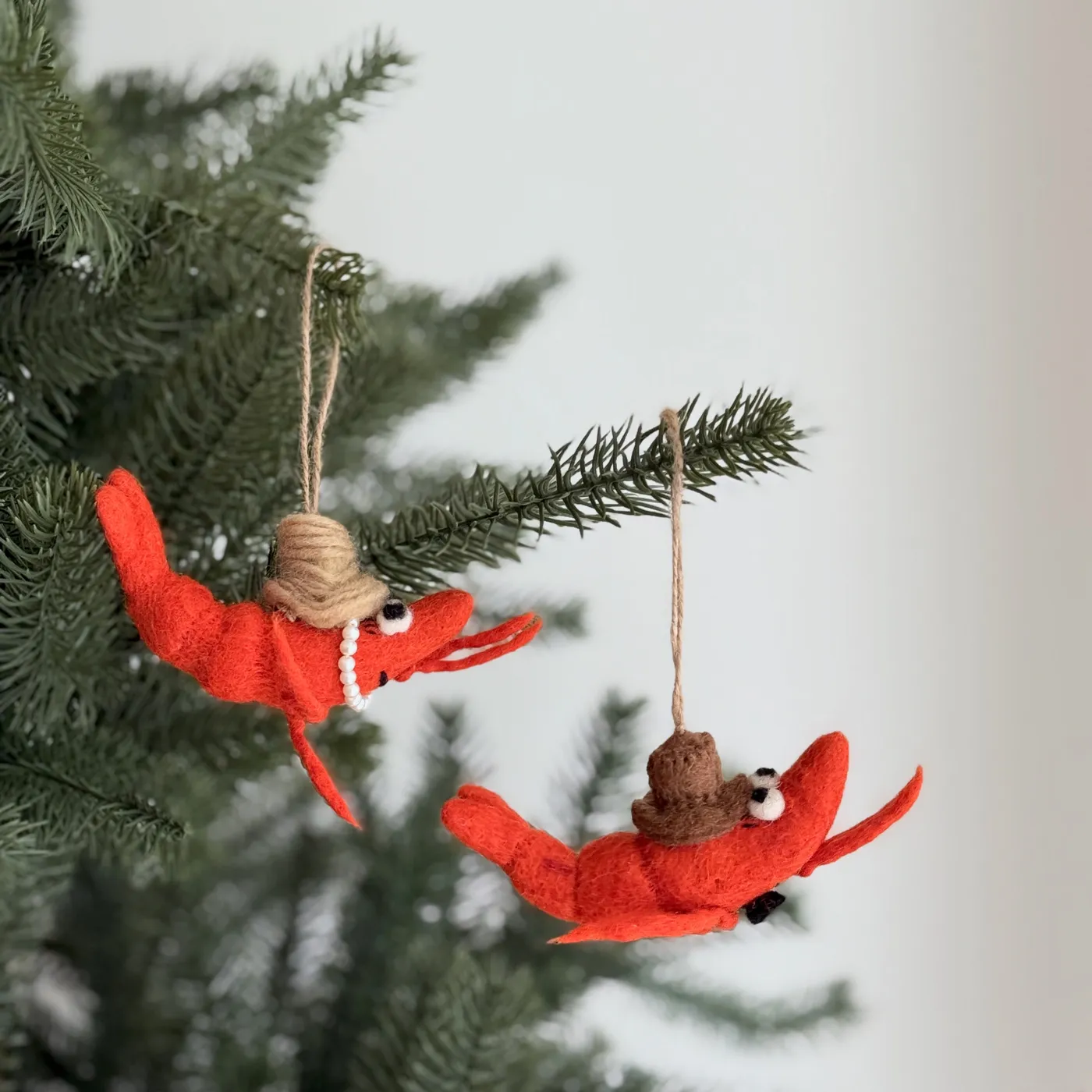
Budget alternative: skip the dollhouse hat and shape one from brown felt scraps for pennies — the absurdity lands either way.
Nobody needs a lobster on a Christmas tree, which is exactly the point. The weird-ornament collector market has been growing for a few years now, and it’s a direct pushback against matchy-matchy trees. These pieces also tend to be the ones guests actually pick up and ask about. A tree with three genuinely strange ornaments beats a tree with forty polite ones. If you’re into unusual pieces, the boxed set in Idea #18 is the tame version of the same instinct.
22. Felt Horses With Yarn Manes on Real Evergreen Branches
55% white felt + 30% tan and brown yarn + 15% green pine and brown twine. The yarn is what carries the warmth here, and it’s doing double duty as mane, tail and hanging loop. Swap the tan yarn for black and metallic silver thread and the whole set turns much more formal without changing a single felt shape. It’s the cheapest way to shift a set’s personality.
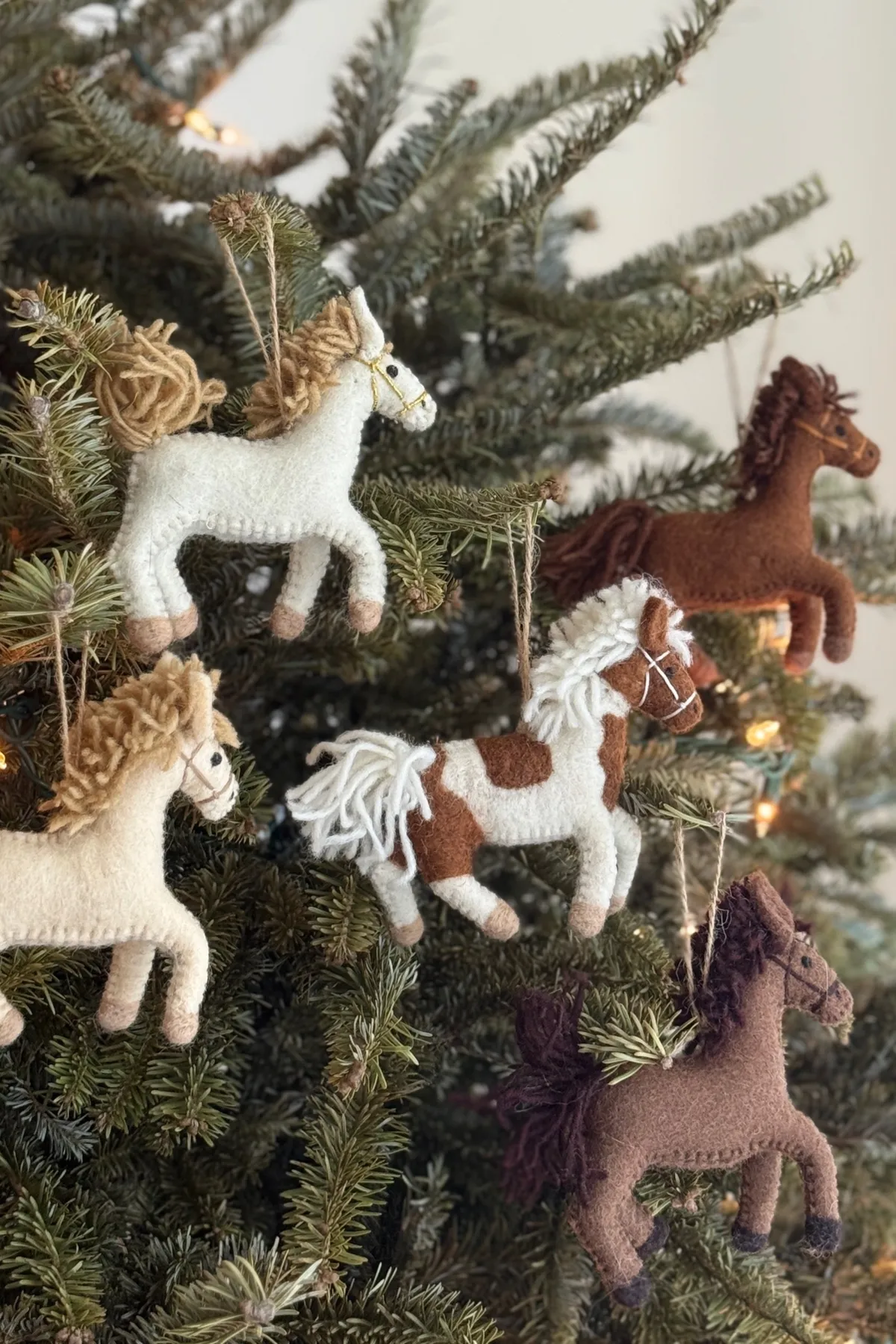
Yarn manes are the first thing to go — they snag on pine needles, they frizz, and pets find them irresistible. Comb them gently with a wide-tooth comb instead of pulling. And if you’re hanging these on a real tree, keep them off the inner branches: pine sap on white felt is permanent, and the moisture from fresh greens will eventually mark the wool. Artificial branches are the safer home.
23. A Red-Hatted Gnome With a Long White Yarn Beard
Gnomes have been on the rise since around 2020 and they haven’t slowed down, which is unusual for a novelty shape. The reason is simple: they’re a cheap way to add red without adding another Santa, and they photograph beautifully at small scale. The felt version is also more durable than the knitted ones and holds its pointed hat shape — which is the first thing most knit gnomes lose within a season.
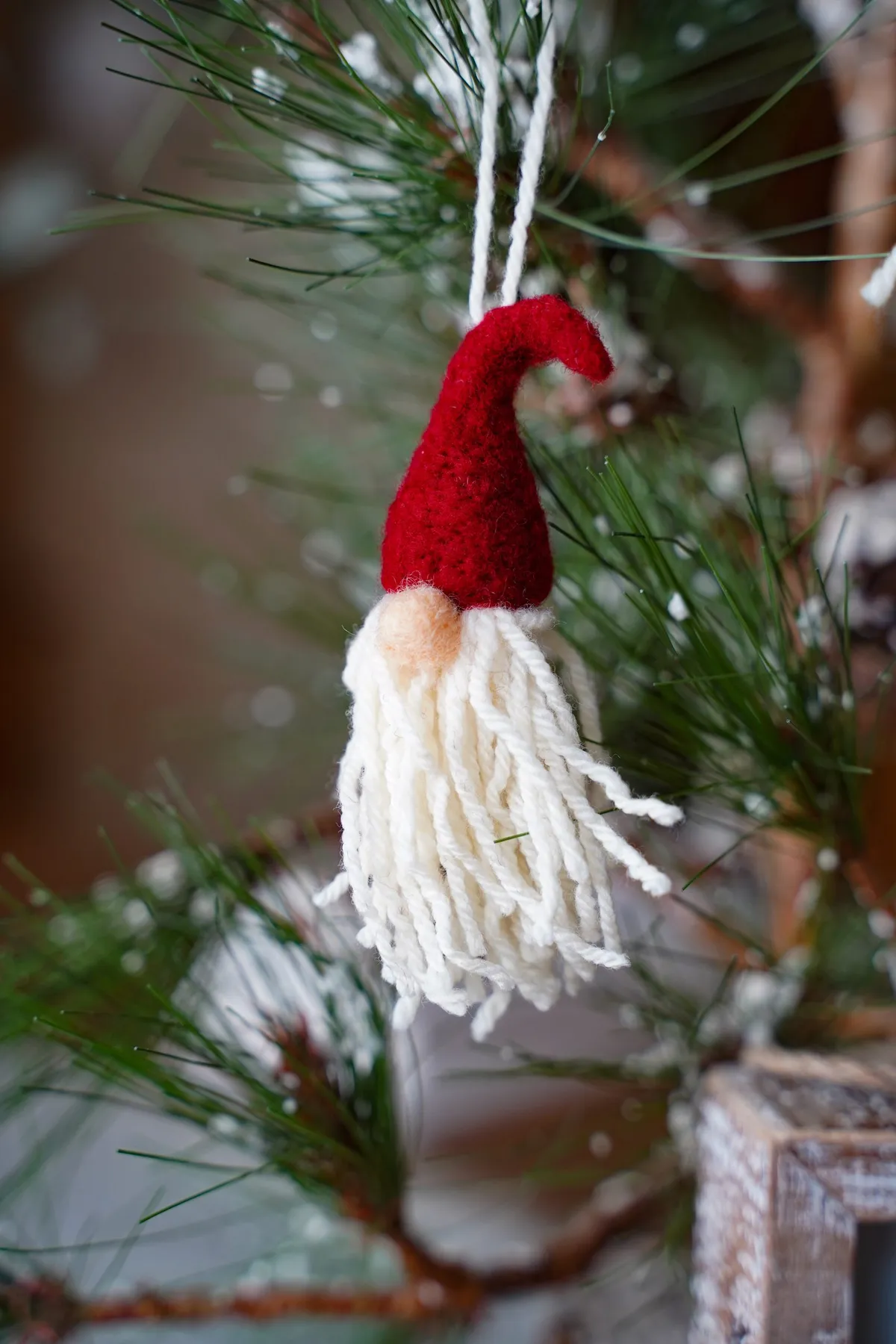
A gnome is about the easiest felt ornament to make from scratch: one cone for the hat, one half-circle for the body, one small circle for the nose, and a bundle of white yarn for the beard. Felt sheets are $1 each on sale, yarn can come from a thrifted skein for $2, and the whole thing takes twenty minutes. Five gnomes for the price of one store-bought one.
24. Felt Chickens With Red Combs and Tiny Wire Feet
- Cut two body shapes and stitch them together with a ladder stitch, stuffing lightly as you close the seam.
- Attach the red comb and wattles with three tiny anchoring stitches each — they take the most abuse of anything on the ornament.
- Cut a 1-inch piece of 20-gauge orange craft wire, bend it into a three-toed foot, and push it through the base of the body.
- Secure the wire inside with a dab of craft glue and let it dry fully before the ornament goes anywhere near a tree.
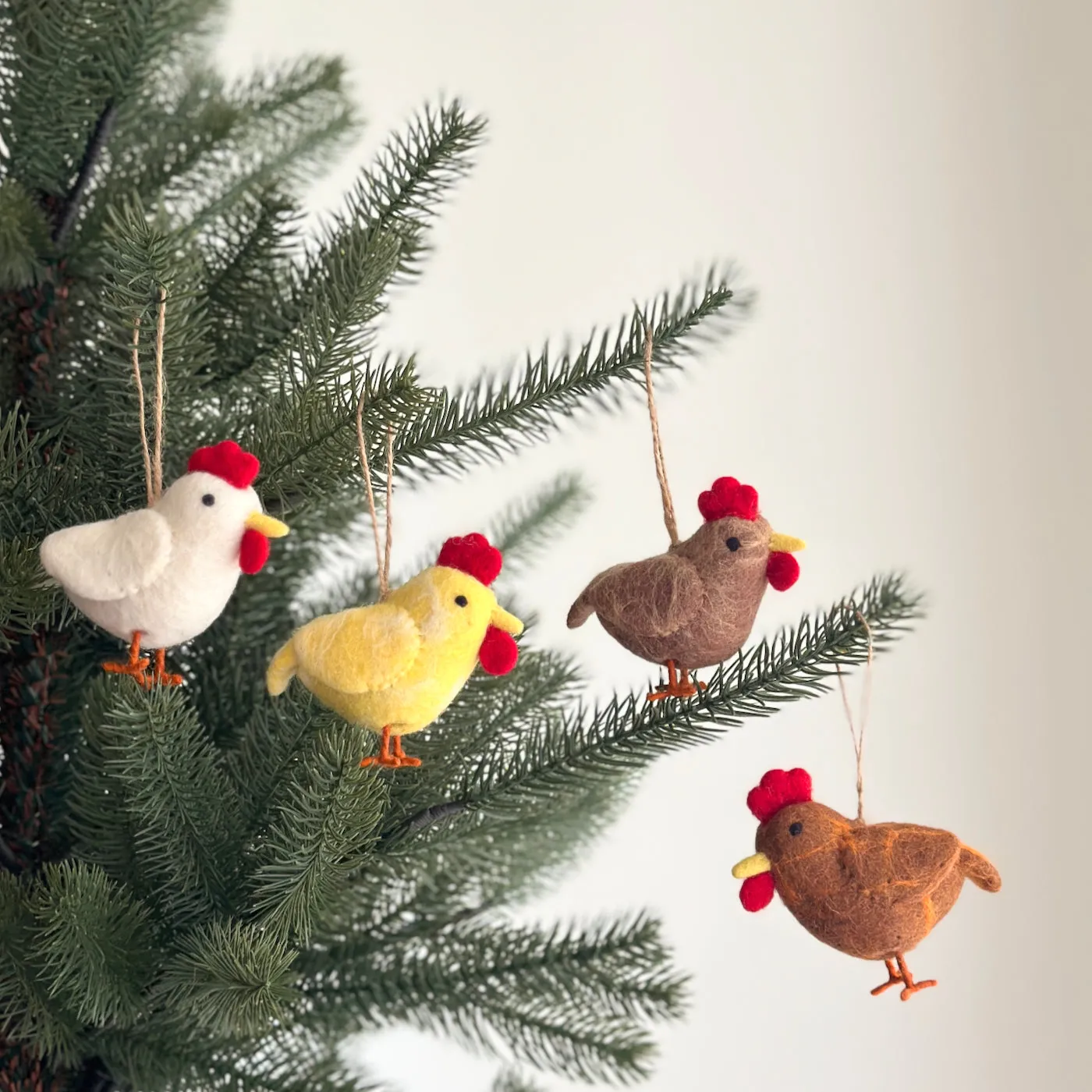
About 30 minutes and under $3 each.
Those wire feet are charming and they’re also the reason to think twice if you have toddlers or a dog who investigates the tree. They’re stiff enough to scratch and thin enough to bend. With kids around, hang these above arm’s reach — or leave the feet off entirely and let the chickens sit on a mantel. Felt is a great choice for young families; it’s the accessories that aren’t.
25. A Gray Felt Owl Beside a Miniature Felt Pinecone
The owl is gray wool against a gray-brown felt pinecone, and the only bright things in the frame are the eyes and the white facial accents. That’s deliberate restraint: by keeping the body low-contrast, the face becomes unmissable. The tiny sprig of green foliage behind it does the same thing a gallery wall does — it frames the subject. Texture-on-texture works when the values stay close and one detail goes bright.
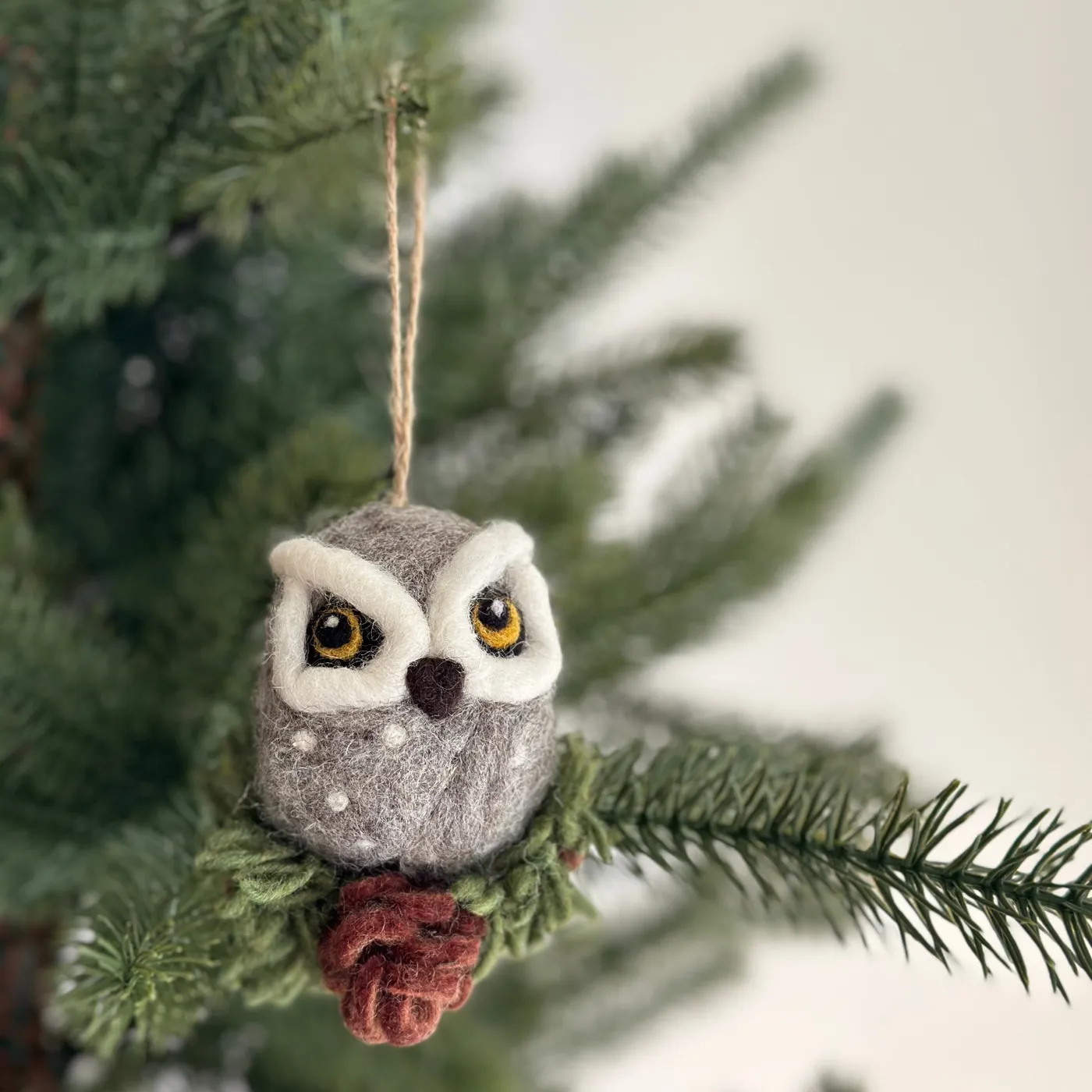
Build the belly in layers. Cut three overlapping scalloped strips with pinking shears, stack them from the bottom up, and stitch only the top edge of each one — the cut edges stay free and catch the light. A two-millimeter difference in width per layer is plenty. It’s the same trick quilters use, and it costs nothing but five extra minutes per ornament.
26. Woodland Animals on Baker’s Twine: Eagle, Fox, Moose, Fawn
Regional and wildlife sets are the antidote to generic holiday decor, and buyers are gravitating toward ornaments that reflect where they actually live. A bald eagle, a moose, a mallard, a black bear and a spotted fawn tell a specific story about a specific place. It’s the same impulse behind the Australian set in Idea #14 — a tree that looks like a life, not a catalog page.
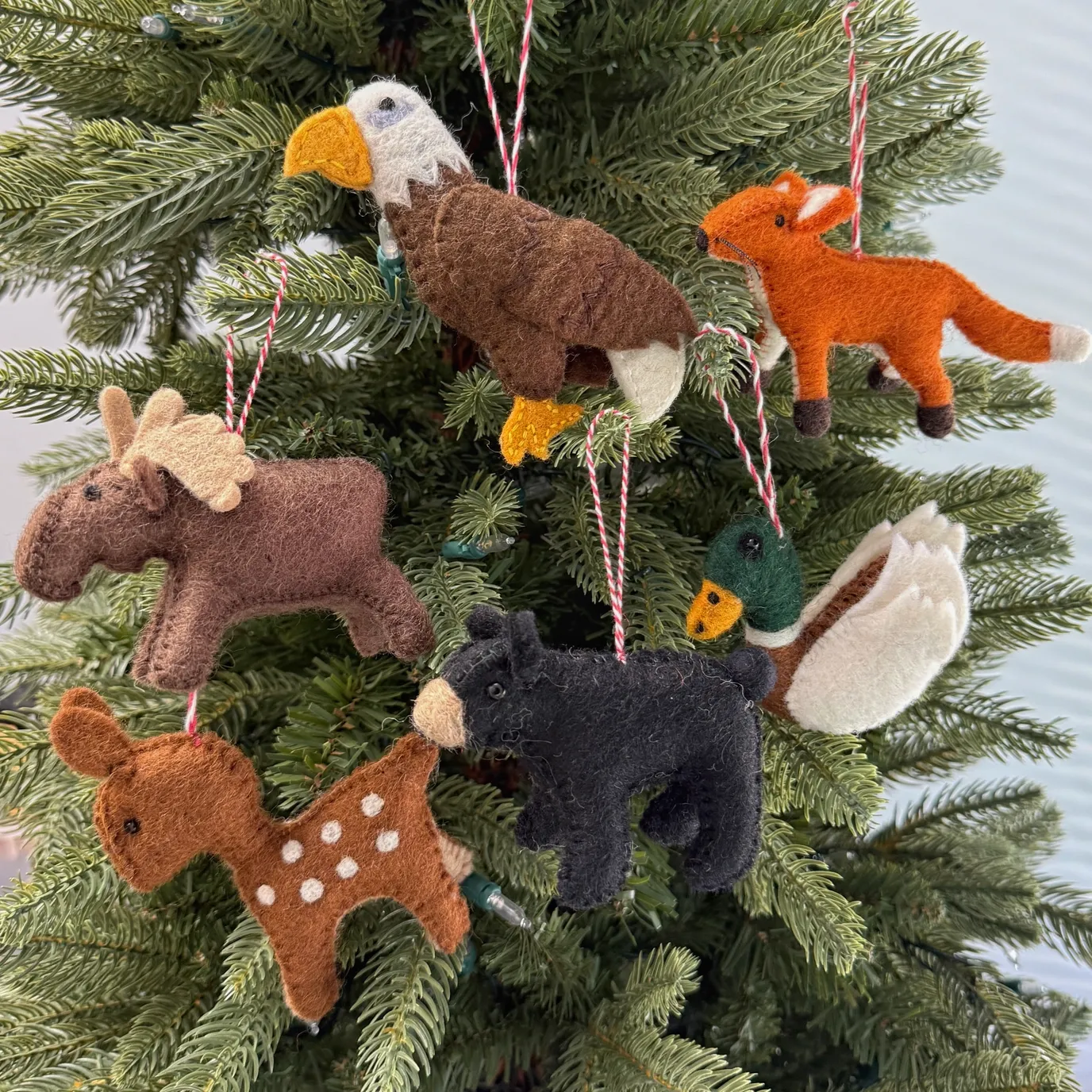
Six animals hanging together on red-and-white twine form a set the eye reads as one unit, so keep them within a two-foot band on the tree rather than scattering them at random. And because they’re all roughly the same three-inch size, they need at least a 6-foot tree to feel generous. On anything smaller, hang three and rotate the rest in next year.
27. A Floral Fabric Bird Holding a Green Sprig
The sprig in its beak. It’s a half-inch of green felt, and it converts the ornament from a decorative object into a tiny narrative — the bird is doing something. Without it, the floral-print body and brown felt wings are pretty but inert. It’s the same reason the mouse needed its candy canes back in Idea #3.
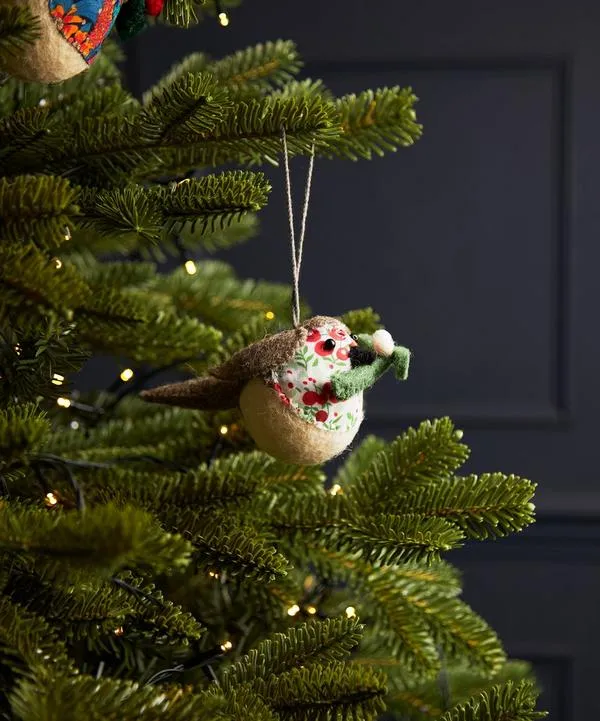
Mixing printed fabric with felt is riskier than it sounds, and this works because the print is small and the felt is matte and plain. A large-scale print would fight the flat brown wings; a shiny fabric would fight the wool entirely. The print also brings four colors into play at once without needing four pieces of felt. If you’re new to fabric ornaments, start with a tiny calico print like this one and let the felt stay quiet.
28. Round Felt Penguins in Knit Scarves, Arranged in a Dark Vase
Branches in a vase change the rules completely — there’s no tree to hide behind, so the arrangement has to work as a tabletop object. A vase about 8 inches tall holding 12- to 15-inch branches gives you a composition roughly 24 inches tall, which is right for a sideboard or dining table. Put it on a surface at least 14 inches deep; anything narrower and a warm room will tip it.
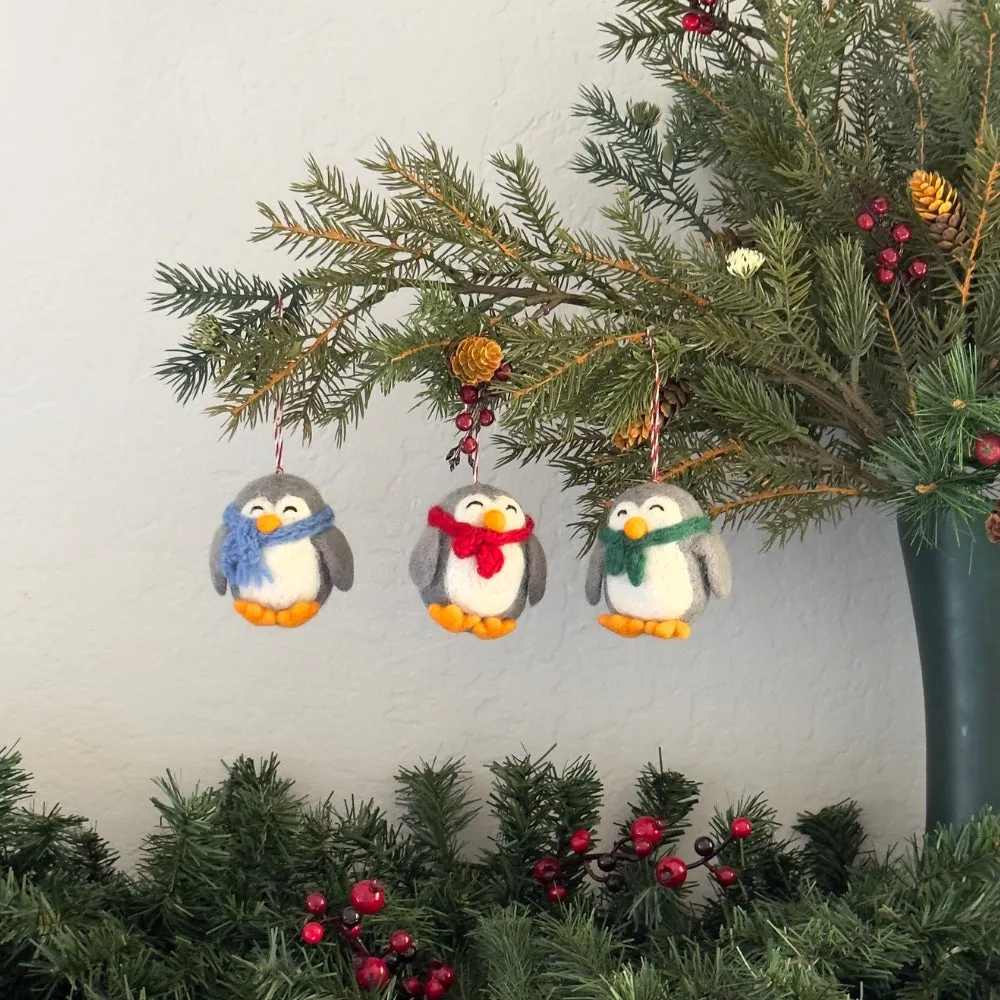
60% evergreen + 25% gray, white and blue felt + 15% red accents. The pine does the heavy lifting, the penguins stay monochromatic, and the red berries and scarves are the only saturation in the frame. For a warmer version, swap the blue-gray penguins for brown felt and the berries for dried orange slices — the ratio holds exactly the same way.
29. Matching Knitted Hats and Scarves on a Pair of Felt Animals
Miniature knitwear is a whole subgenre now — doll-scale sweaters, thumbnail hats, scarves the length of your finger. It works because it hits two trends at once: the handmade look and the miniature obsession that’s been driving decor for a few years. It also happens to be the cheapest way to make a plain felt shape look finished.
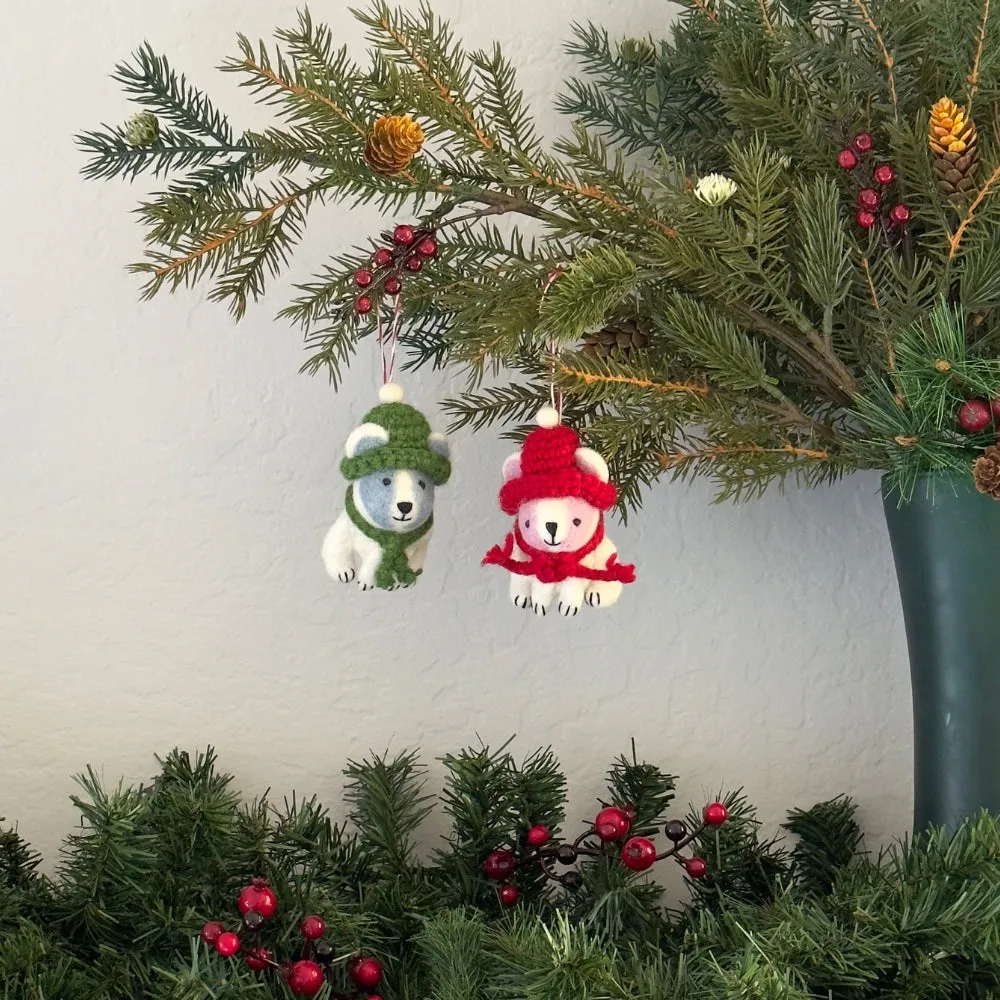
Miniature knitwear is the easiest thing to fake. Baby sock cuffs make scarves, preemie hats make hats, and a thrifted wool sweater sleeve will dress about eight ornaments. Walmart sells knit baby socks in multi-packs for around $6, and a single skein of sock yarn at a thrift store costs $2 and covers a dozen. You’re paying for texture, not size — nobody looks closely.
Tiny knit items unravel. The cuffs fray, the yarn loops snag on pine needles, and if a hat is glued rather than stitched it will work loose in a warm room. Check them at the start of every season and dab frayed edges with clear fabric glue before they travel. Compare with Idea #28 — same vase trick, warmer palette, identical maintenance list.
30. A Felt Ball Wreath Ornament With a Gold Jingle Bell
- Count your felt balls first — a wreath this size needs 18 to 24, and running short mid-build is the most common failure.
- Check your ribbon width against the ring; anything wider than the wreath looks like a bow instead of a hanger.
- Decide on the bell before you string anything — a jingle bell adds weight and the wreath hangs crooked if the loop isn’t centered.
- Test your wire on a scrap first; 20-gauge holds a circle, 26-gauge will not.
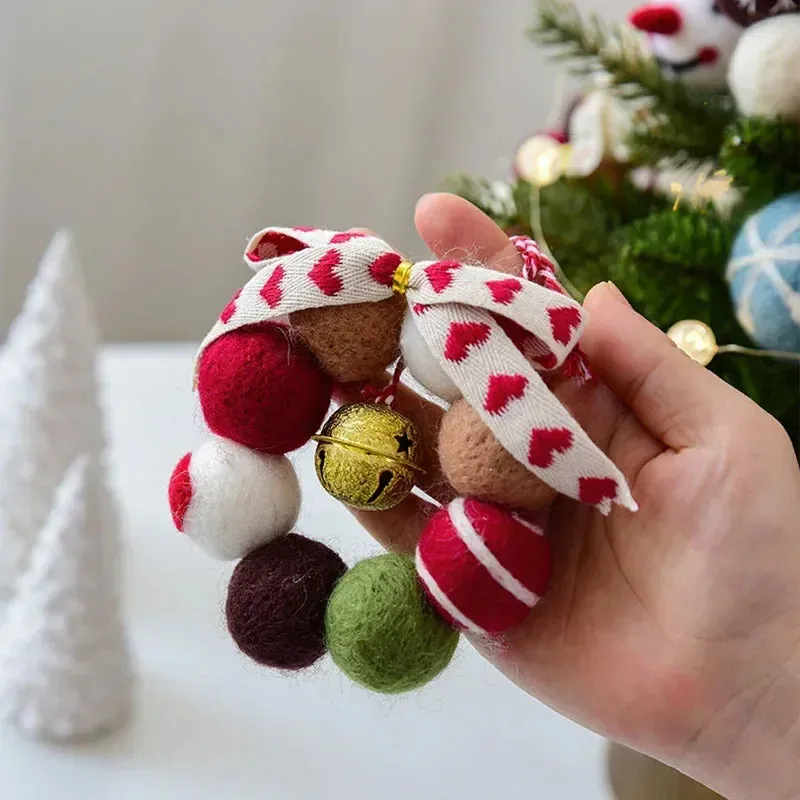
- Bend 20-gauge craft wire into a 3-inch circle, twist the ends together and trim the tail flat.
- Thread felt balls onto the wire with a long needle, alternating sizes and colors as you go.
- Keep pushing until the wire disappears, then twist the final end down so nothing can poke through.
- Loop a cream ribbon through the top, tie a knot, and attach the jingle bell with a single thread at the bottom center.
About 40 minutes and roughly $12 in materials.
31. A Layered Green Felt Tree With Pom-Pom Ornaments
Three stacked green triangles with visible depth between them. Layering is what makes this read as a tree instead of a flat shape — the front layer catches light, the back layer casts a small shadow, and the eye gets a real sense of thickness. The pom-poms sit at the edges of each layer rather than the middle, which pushes the silhouette outward. The yellow star stays small on purpose.
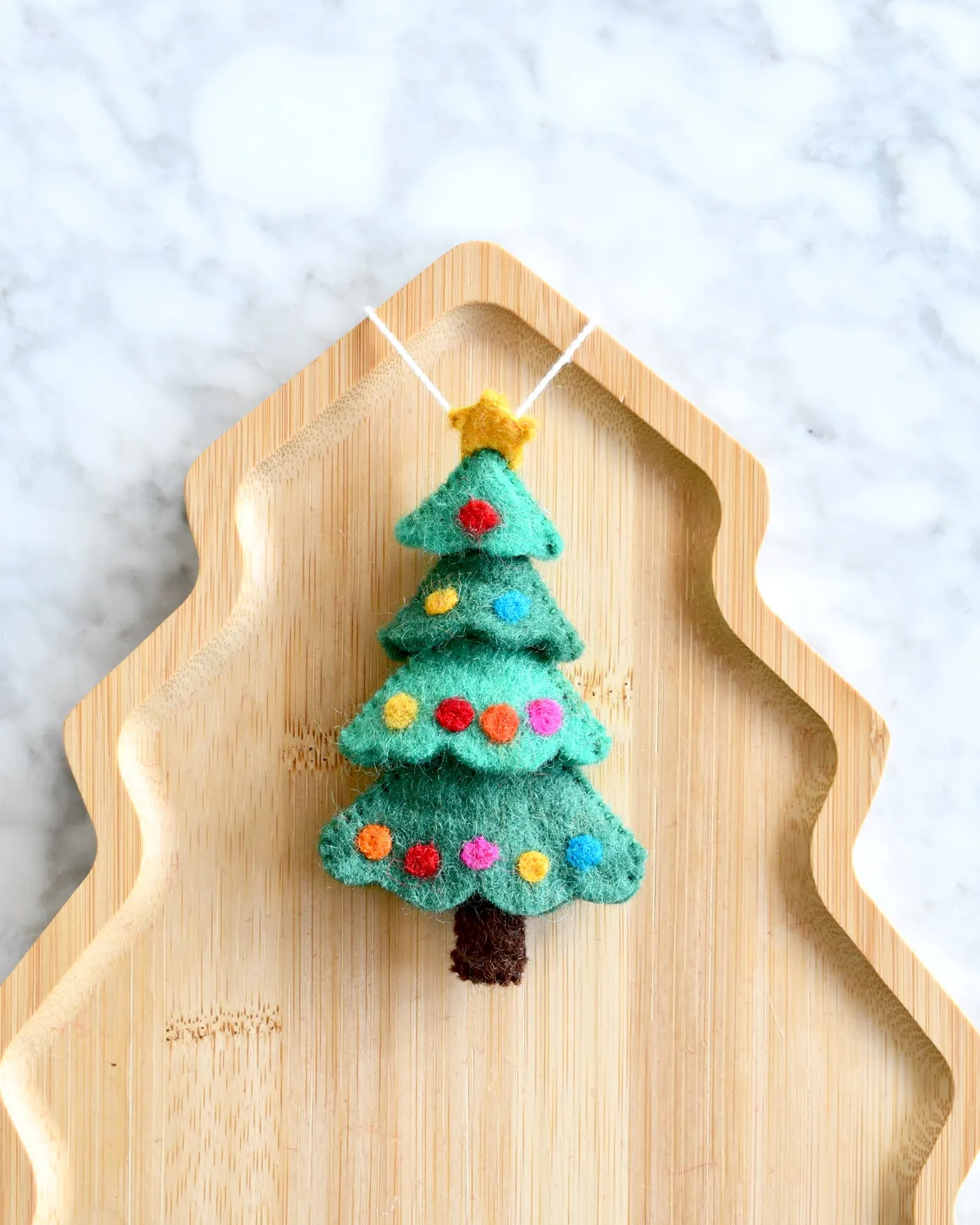
A pack of felt sheets is about $5 for 20 at most craft stores, and a bag of 300 multicolor micro pom-poms runs around $6 online. Add a dollar-store embroidery hoop for the hanging loop and white craft glue you already own, and you’re making a dozen of these for the price of two boutique ones. The wooden tree tray underneath? A thrifted bread board works just as well.
32. Felt Cookie Ornaments With Beaded Sprinkles
Sew the beads, don’t glue them — and sew through to the back layer so the icing stays flat. Bring the needle up through the white felt, thread one seed bead, then push back down through both layers. Six to eight beads per cookie is plenty; more and the icing reads as bumpy instead of frosted. Use a single strand of white thread so the stitch itself disappears.
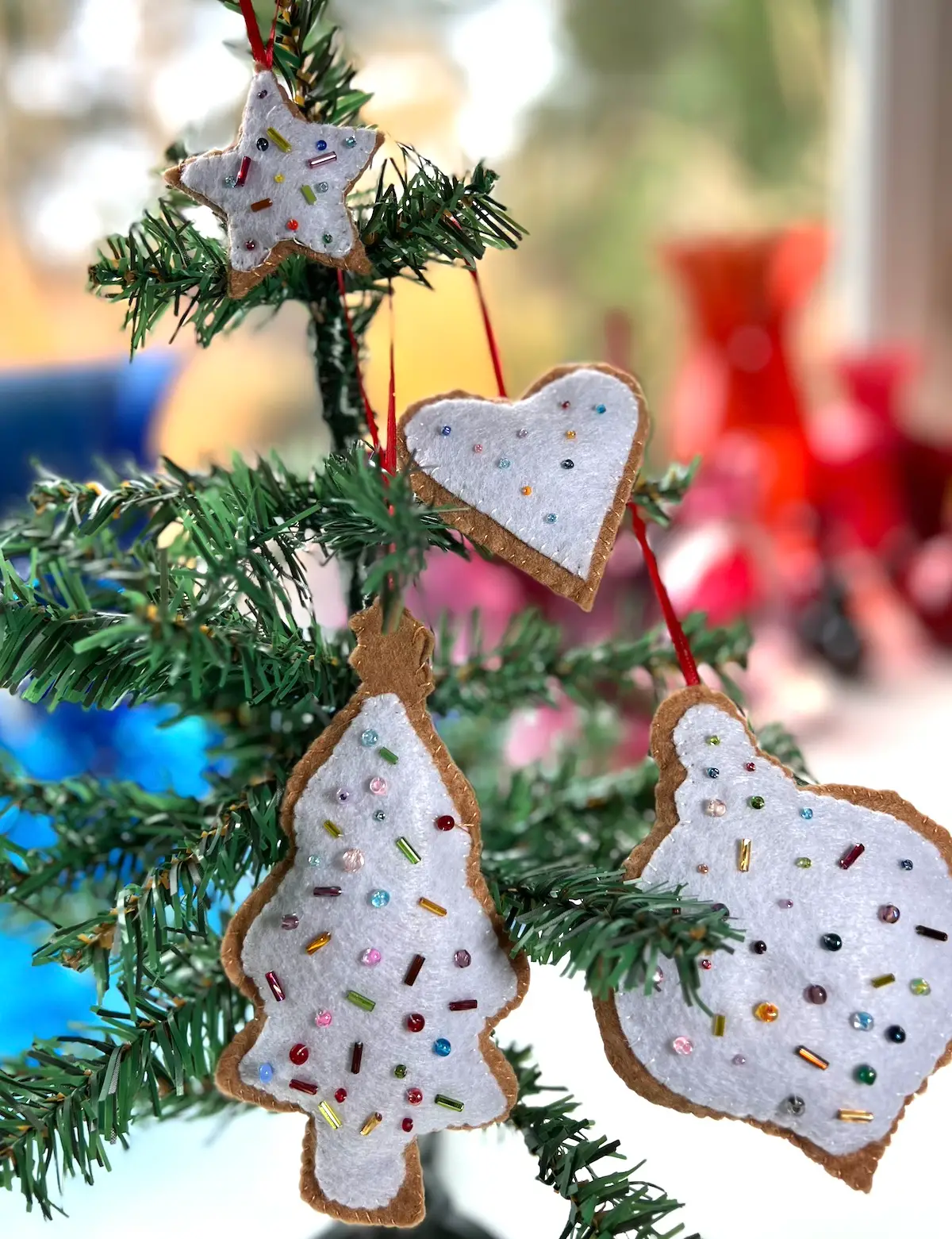
- Cut a brown felt base in a star, heart or tree shape, then cut a white icing layer slightly smaller and glue it down.
- Let the glue cure for an hour before you touch it — beads stitched into wet glue will pull the layers apart.
- Thread a beading needle with white thread and stitch seed and bugle beads in clusters of three, leaving gaps on purpose.
- Finish the back with a plain brown felt layer and a red ribbon loop stitched between the two.
Roughly 25 minutes each, and about $0.80 in materials.
Keep the beads under 20% of the total surface — they’re sprinkles, not the cookie. If you go with a dark chocolate brown felt instead of tan, cut the bead count in half; the contrast does the work for you.
33. A Felt Penguin in Green Earmuffs and a Red Scarf
The earmuffs. They’re the smallest element in the frame and they’re the entire personality of the ornament — take them off and you have a penguin, which you’ve seen before. The embroidered eyelashes do something similar at a lower volume. When you’re choosing or making felt animals, look for the one accessory that isn’t standard. That’s the piece people will pick up and point at.
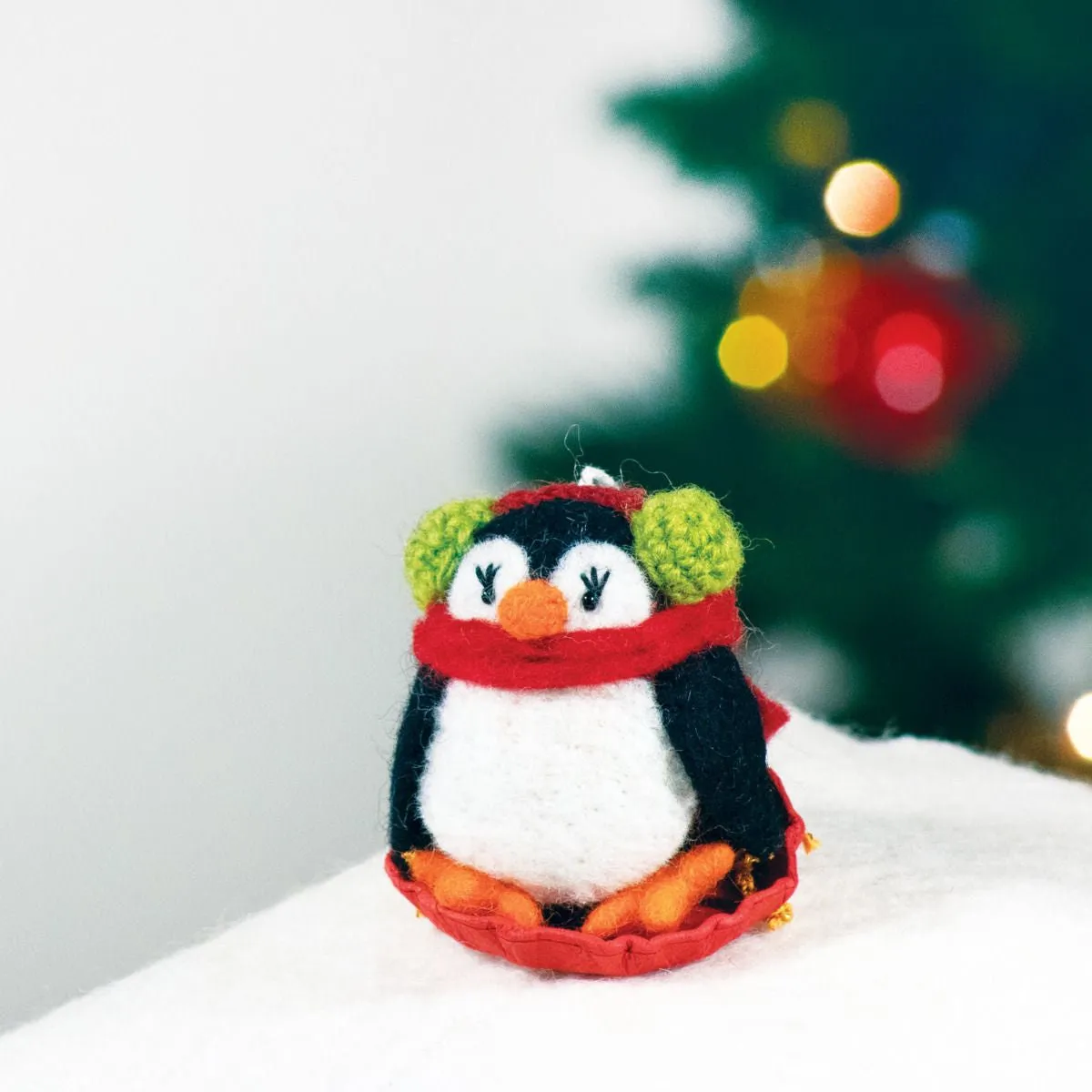
This is a tabletop-scale piece, around three inches, and it works best on a small tree, a shelf, or tucked into a bowl of greens. On a 7-foot tree it will disappear, so if that’s your setup, cluster it with three or four similar pieces at the same height. Soft background lights do more for it than any tree position will — put it somewhere a warm bulb can sit right behind it.
34. A Felt Mouse on a Pipe Cleaner Snowflake With Crystal Gems
Three pipe cleaners, twisted together at the center, give you six even arms. Trim each arm to about an inch and a quarter and bend the tips into small loops so nothing pokes. Hot-glue the faceted gems at the tips after the shape is set, not before — glue first and the arms sag while you work. The whole snowflake takes about five minutes.
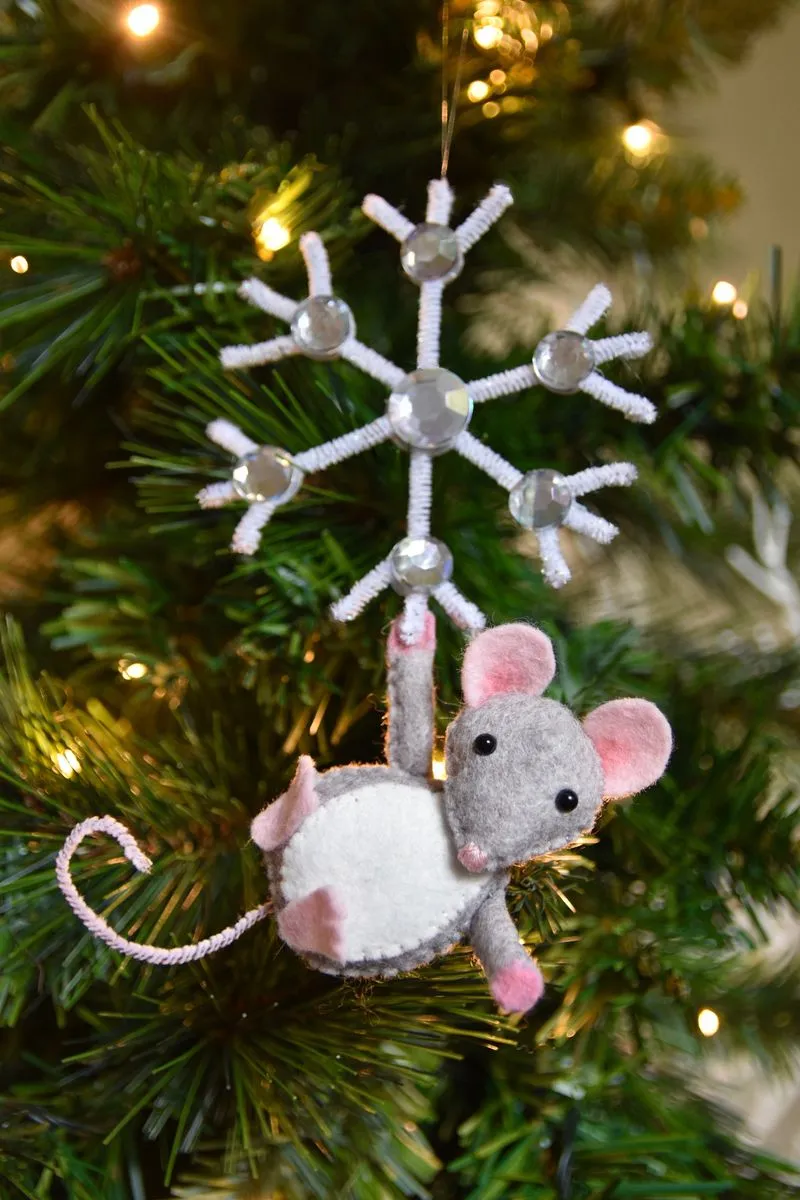
Mixing materials is the direction ornaments are heading: felt bodies, pipe cleaner structure, plastic gems, yarn, beads, all in one piece. It’s a rejection of the perfectly coordinated tree in favor of something that looks genuinely made. It’s also a smart use of leftovers — the figure and the structure come from two different craft boxes, and nobody notices the seams.
Pipe cleaners run about $3 for 100. Faceted craft gems are $5 for a bag of 200, and plain felt balls are cheaper than shaped ornaments every time. Facebook Marketplace and Buy Nothing groups are full of half-used craft stashes from abandoned projects, and an ornament like this needs so little material that one donation covers a dozen.
Time to Hang Your Felt Menagerie
Start with one piece you genuinely love — a bee on a flocked branch, a lobster in a pearl necklace, a gnome with a ridiculous yarn beard — and let the rest of the tree grow around it. Felt is forgiving that way: cheap enough to experiment with, soft enough to survive kids and pets, and handmade enough that nobody minds if your snowflakes are a little crooked.
📌 Pin this guide now so it’s waiting for you when the ornament box comes down from the shelf.