
You know that feeling when the tree you pictured and the tree in your living room turn out to be two completely different trees? Same. Nine times out of ten it isn’t a decoration problem — it’s a color-theme problem. So we combed Anthropologie, Etsy, World Market, and Target to pull 35 Christmas tree themes and color palettes worth copying in 2026, from $12 filler ornaments to a $1,850 statement tree.
Inside you’ll find traditional red-and-gold, icy flocked white, monochrome modern, and gleefully eclectic whimsical trees — with budget and luxury versions of the same look compared side by side. This year’s shift is warm and layered: bronze, terracotta, dusty blue, and amber are quietly replacing the flat red-and-green of the last decade.
And stay until the end — we break down the most common mistakes that can ruin these looks.
📌 Save this to Pinterest for later — you’ll want to revisit these ideas.
1. Red Velvet Ribbon and Gold Beaded Classic
What sets this tree apart is the wide red velvet ribbon printed with ‘Merry Christmas’ script, running in loose vertical bands through the branches. Strip it away and you still have gold beaded garland, red and green baubles, and glittering red floral picks — a perfectly nice tree, but a generic one. The ribbon is the spine. It gives the whole thing a point of view, and it costs less than the ornaments do.
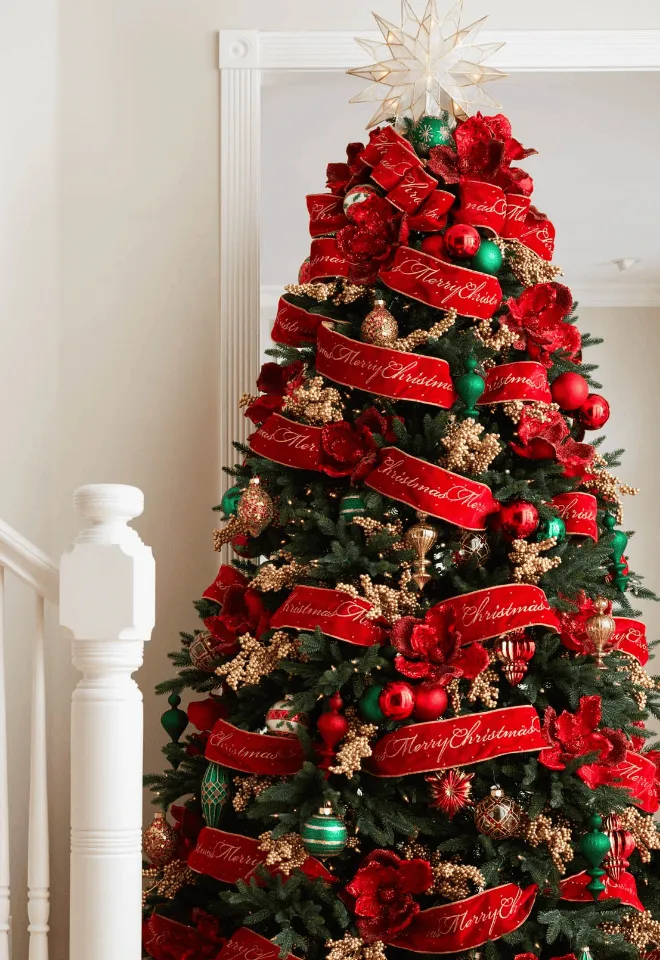
- Artificial evergreen tree, 7.5 ft, unlit: $180–$450
- Red velvet script ribbon, 2 rolls: $30–$70
- Gold beaded garland, 3 strands: $25–$55
- Red and green baubles, mixed finishes, 60–80 pieces: $80–$200
- Glitter red floral picks, 6–8: $30–$70
- Illuminated gold star topper: $25–$60
- Total: roughly $370 to $905 for the full dress.
Budget alternative: use plain velvet ribbon at about $12 a roll instead of the printed script, and buy baubles by the bin at after-Christmas sales. You’ll land the same density for under $400.
2. Cranberry, Gold & Cream With a Mantel to Match
The formula here is roughly 45% deep forest green, 30% cranberry red, 15% warm gold, and 10% cream. The green is your base — the tree itself, the dark green spheres, the knit stockings — which is exactly why it never feels loud. Cranberry carries the drama in the velvet ribbon and matte ornaments. Gold and cream are the brightest notes, so they get the smallest share. Swap cranberry for plum and gold for antique brass, and the identical math works in a moodier room.
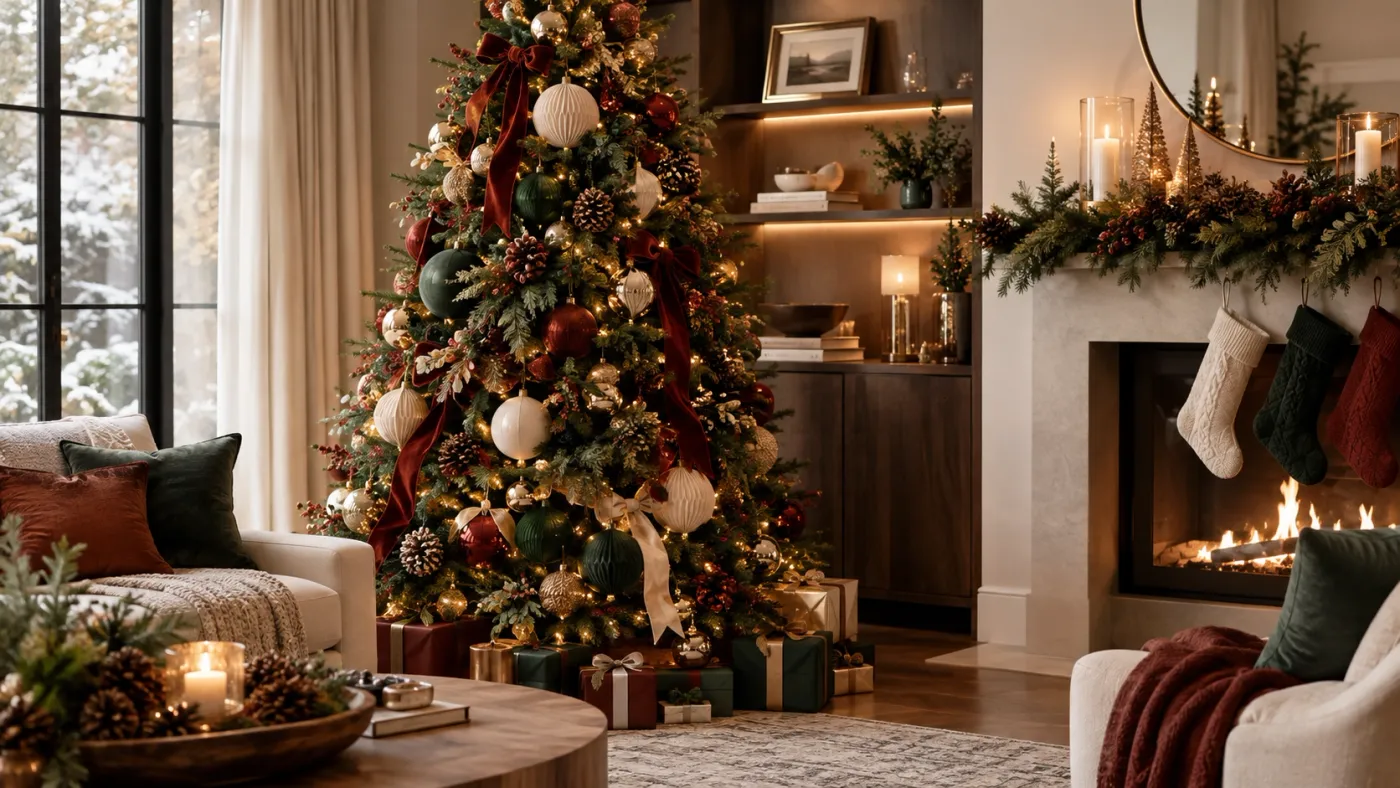
Hang the cream pleated ornaments in the innermost layer, close to the trunk, and push the deep reds and greens out toward the branch tips. Saturated colors read at a distance; pale, textured pieces read up close. Doing it backwards — pale ornaments on the outside — flattens the whole tree into one bright blob from across the room.
3. Blue and Silver Grandeur for Tall Ceilings
This is a tree built on volume, and it wants a ceiling of at least 12 feet plus a clear footprint of about 6 by 6 feet once you count the gift boxes and lanterns ringing the base. In a standard 8- or 9-foot room, the same blue-and-silver palette reads heavy instead of grand. Go shorter and narrower — Idea #22 runs dusty blue at a height that actually fits a normal living room.
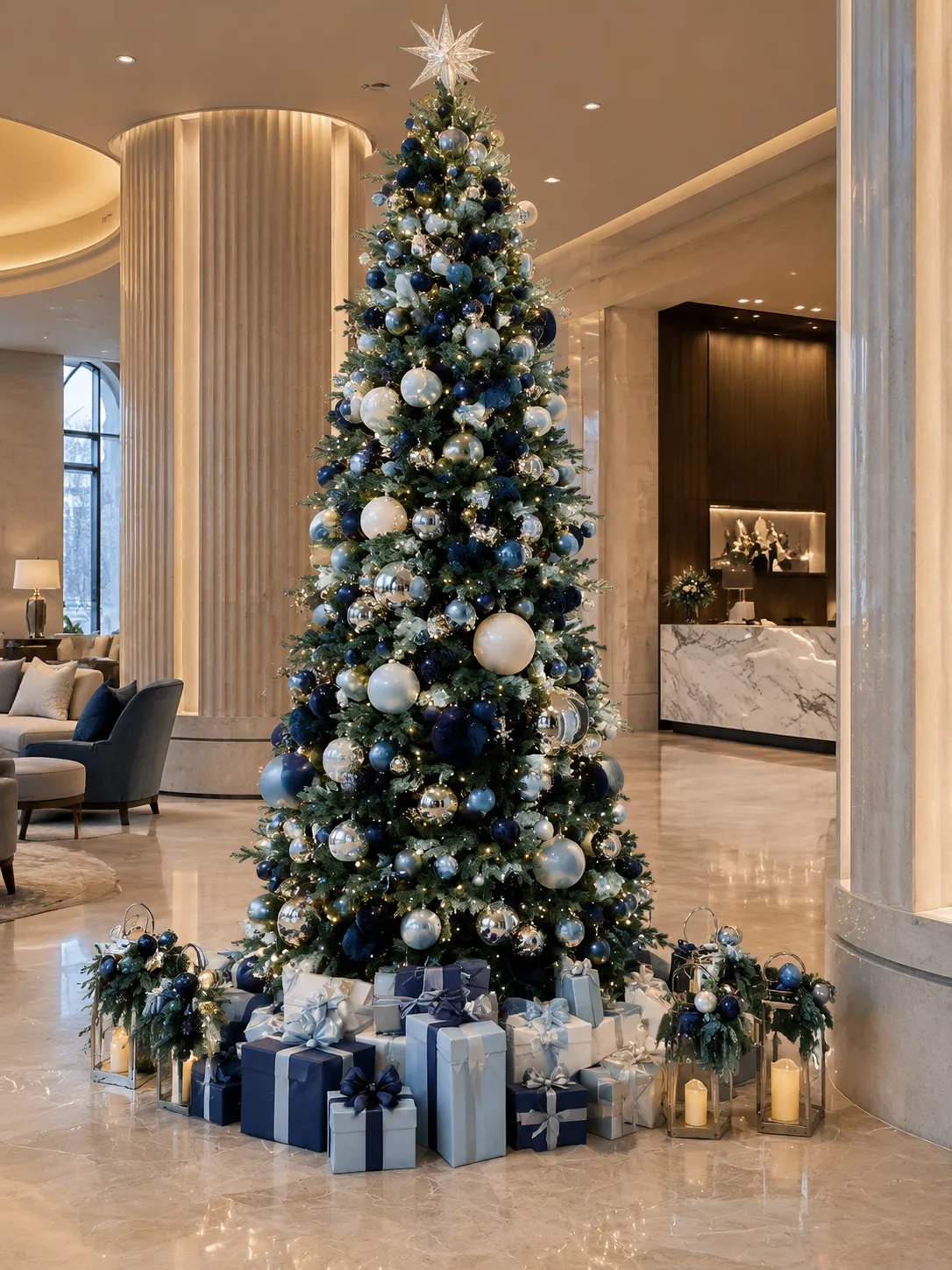
- Tall pre-lit tree, 9–12 ft: $600–$1,800
- Blue, silver, and white baubles, 100+ pieces: $150–$400
- Lighted star topper: $40–$120
- Metal lanterns with candles, pair: $60–$180
- Blue and white gift wrap and boxes: $50–$120
- Evergreen arrangements with blue picks: $60–$150
- Total: about $960 to $2,770.
Budget alternative: buy the tree unlit and add your own warm white strands for roughly 40% less, then shop the January clearance for blue baubles — they’re almost always the last color left on the shelf.
4. Flocked Branches With Dark Green Pom-Poms
Three things are doing the work. First, texture contrast: fuzzy dark green pom-poms sit right beside glossy silver spheres, so the eye keeps traveling. Second, the flocked branches give every dark ornament a white halo — dark green on a green tree would vanish otherwise. Third, the plaid armchair and dark green velvet pillow repeat the tree’s palette out into the room, which is why this corner feels styled rather than merely decorated.
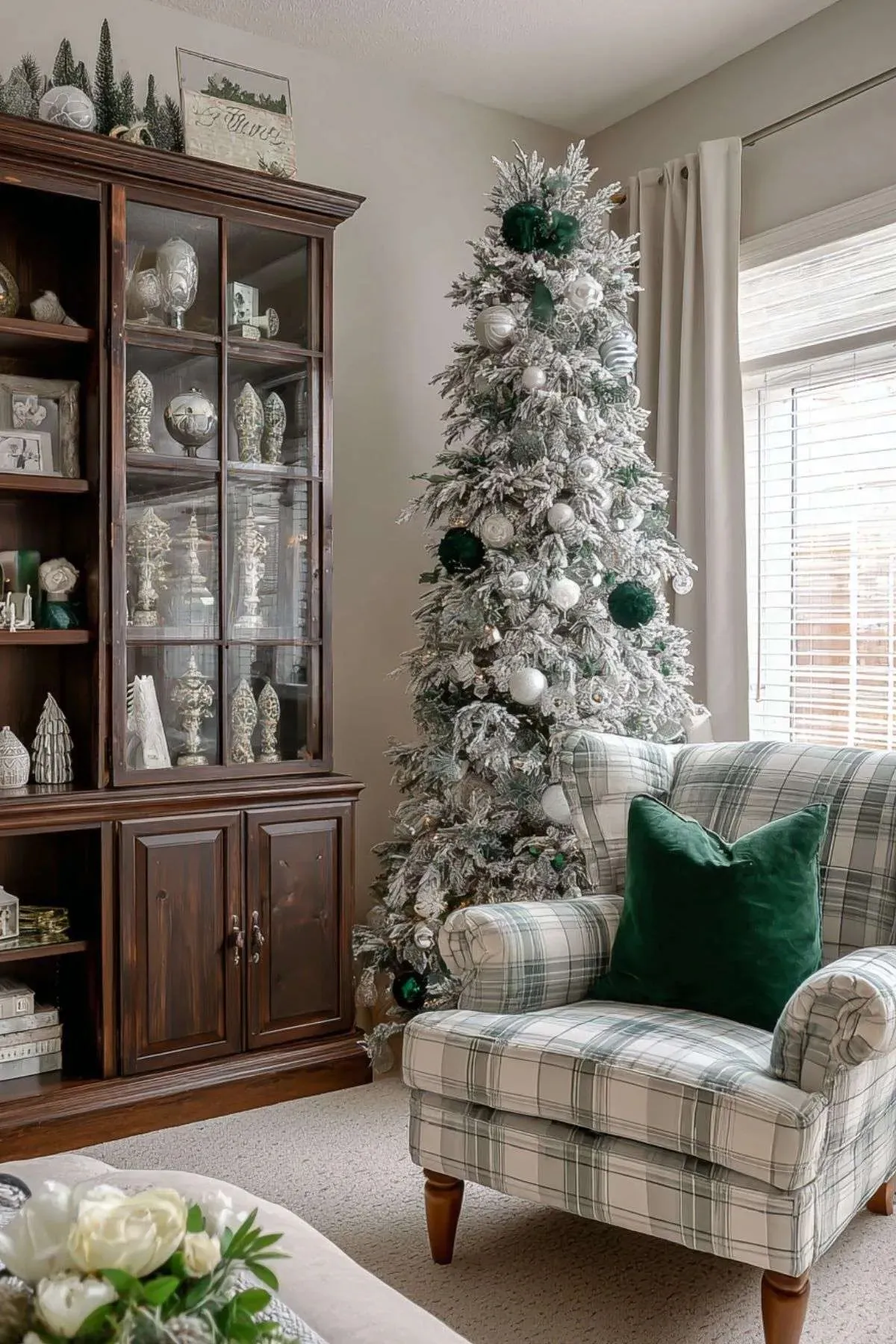
Flocking sheds — more than anyone warns you about. Expect a fine white dust on the floor for the first two weeks, and vacuum gently with a brush attachment rather than a beater bar. If you have pets or toddlers who grab branches, a lightly frosted tree is the safer bet; same wintery effect, far less cleanup. And flocked trees can’t get rained on, so this one stays indoors or on a covered porch.
5. A Cone of Warm White Light and Cool Snowflakes
Outdoor displays live and die by their connections. LED strands last around 25,000 hours, but water in the plugs finishes them off first — tape every connection facing upward and run everything through a grounded outdoor timer. The snowflake motifs are the expensive part, so store them flat between sheets of cardboard, never in a tangled bin. Budget $60 to $120 a season in replacement strands and clips if you go this dense.
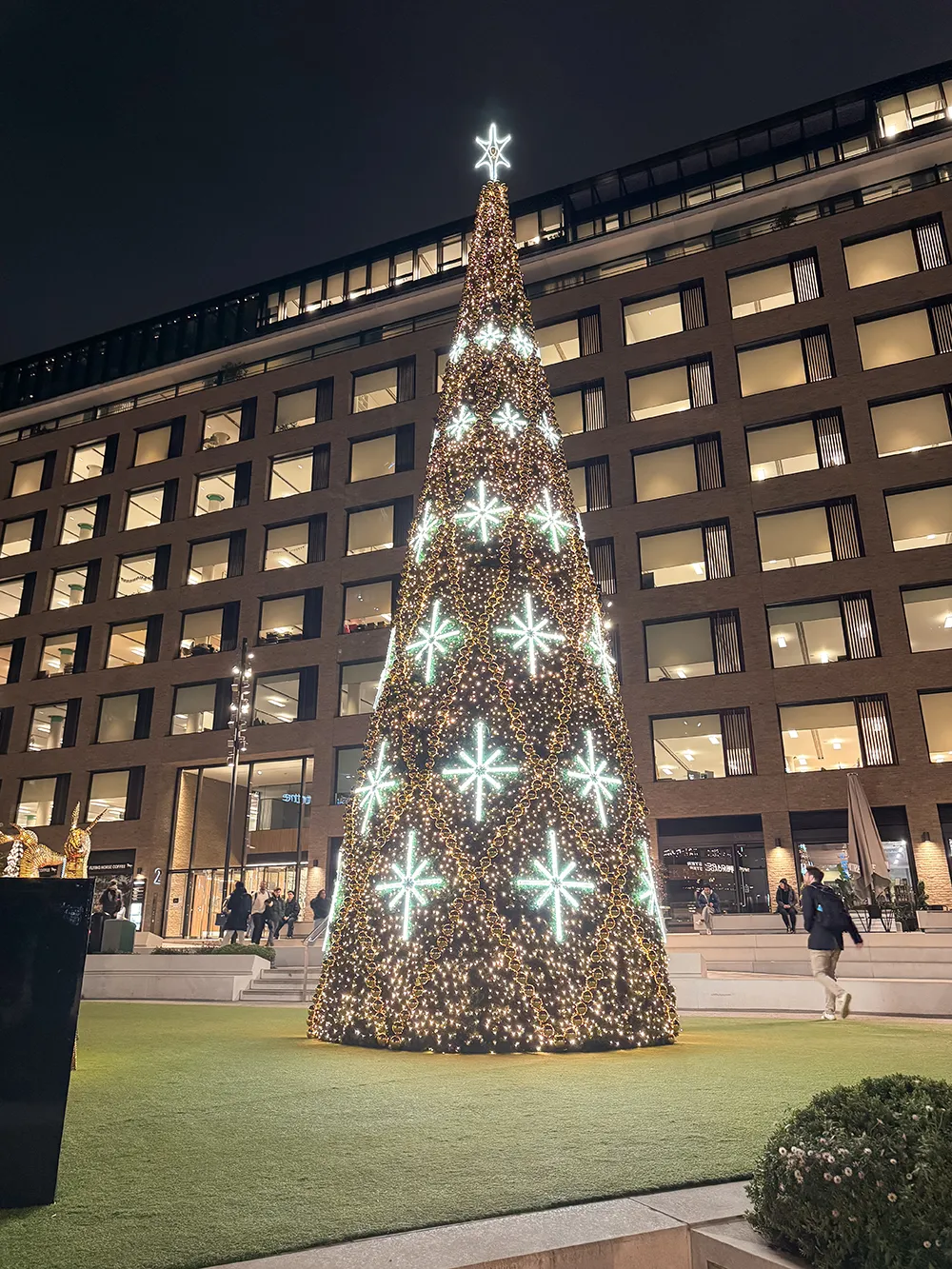
Big architectural light installations migrated out of shopping centers and into private yards a few years ago, and 2026 is peak. The reason is simple: a handful of oversized motifs photograph far better than a thousand tiny lights, and they read from the street. Warm white outlines with one cool white accent is the current formula, and it’ll age well — it’s essentially a winter lighting scheme, not a Christmas one.
6. All-Black Tree, All-Silver Finishing
On a black tree, matte black ornaments disappear entirely. Use gloss black, gunmetal, and clear glass so the shapes still register, and keep every strand a single warm white temperature — mixing whites turns a chic tree gray and muddy. One more: keep the fur and knit textures at eye level or lower, never up top, or the whole thing reads like a fuzzy animal.
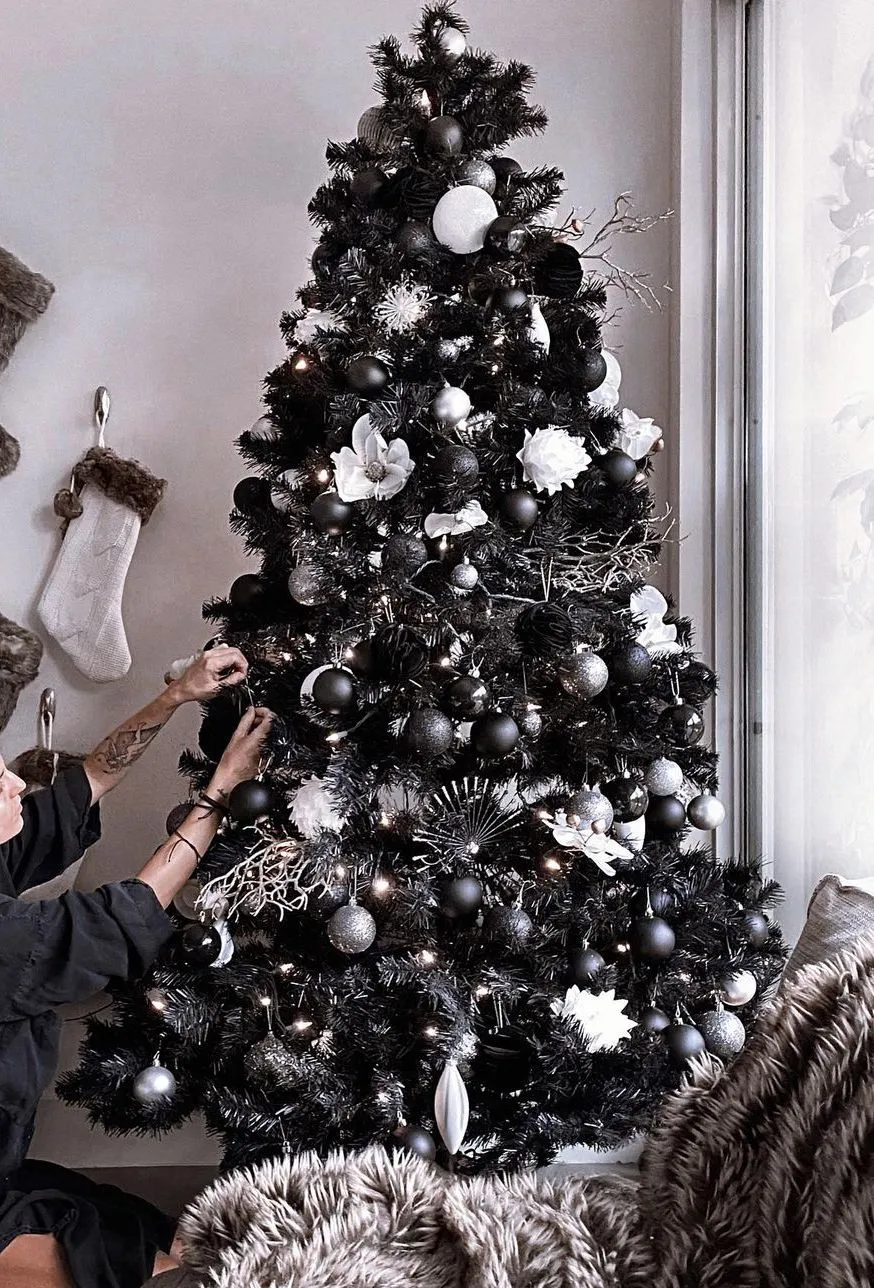
The real budget win here is the tree. A thrifted green artificial tree plus two cans of matte black spray paint (about $20) gets you 80% of the way, and it’s a weekend project. Black and silver baubles are consistently the cheapest colorway on clearance in January — buy a year ahead and store them in egg cartons. Plain black satin ribbon works fine if velvet feels steep. Idea #18 takes that same restraint into frosted white and olive.
7. Cable-Knit Stockings and Frosted Gold-Green
Layering a mantel garland so it looks collected instead of purchased:
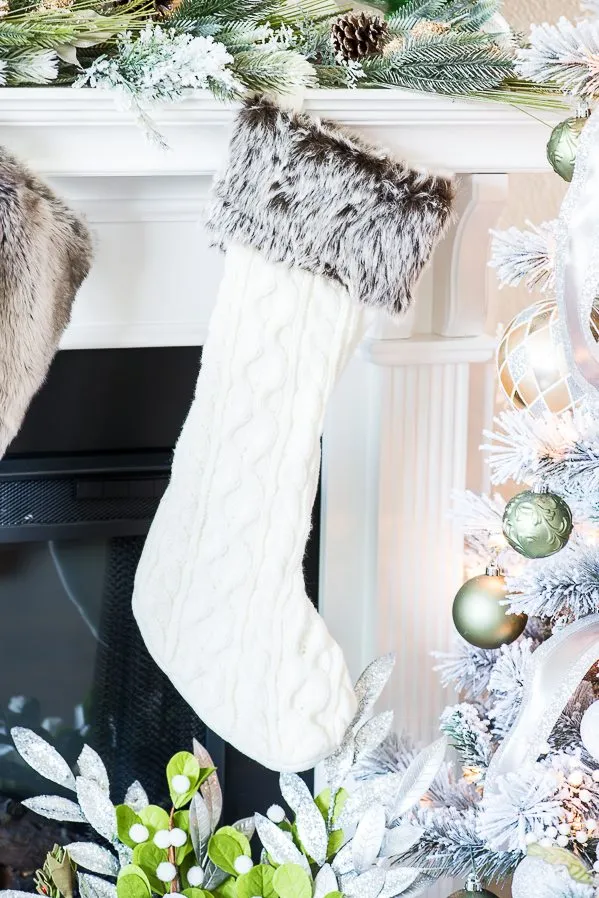
- Start with a plain faux-pine garland as the base and fluff every branch outward.
- Weave a second, frosted garland through it so the white sits in the gaps.
- Tuck in pinecones and white berry picks at uneven intervals — odd numbers, never symmetrical.
- Add glittery silver foliage and green leaves with white pom-poms last, letting them fall forward over the mantel edge.
- Finish with two or three pillar candles of varying height.
About 45 minutes and $70 to $150 in materials.
What makes this corner work is that every element repeats the same three notes: white, gold, muted green. The stocking, the garland, the ornaments — nothing introduces a fourth color. That restraint is what separates a styled mantel from a crowded one, and the cable knit and faux fur give the eye somewhere to rest that shiny ornaments never can.
8. An Orange Tree Against Charcoal Brick
The orange tree. Everything else — the multicolored fabric garland, the silver baubles, the gold star — is standard-issue holiday decorating. The tree is the entire personality of the room, and it works because the dark gray brick behind it is a genuinely neutral backdrop. Remove the orange and you have a pleasant, forgettable corner. Keep it and guests will ask about it before they’ve taken their coats off.
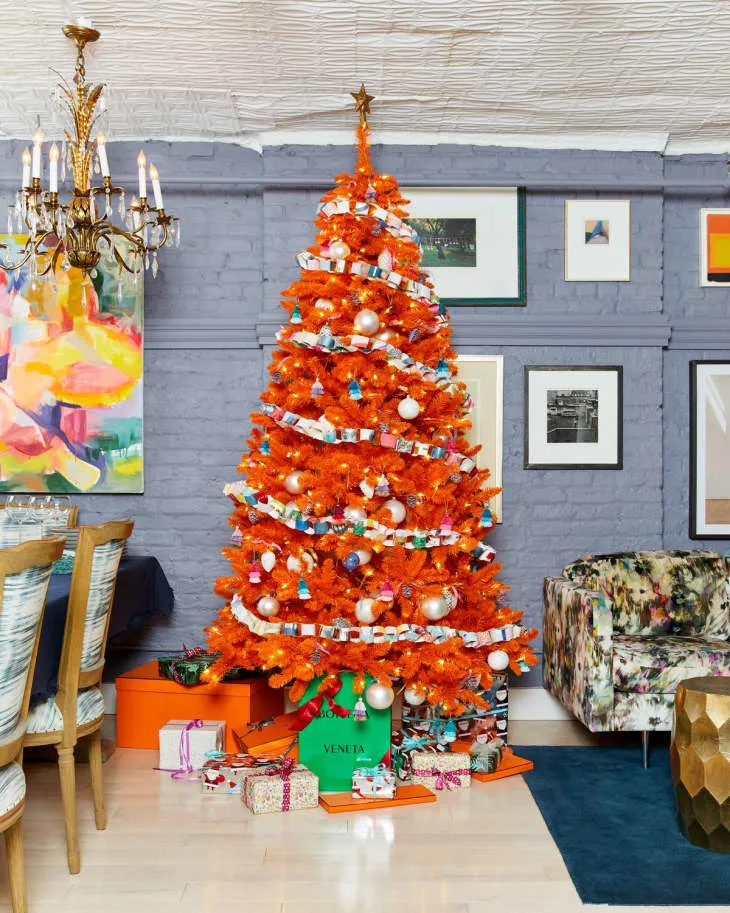
Colored artificial trees are trendy, which also means they’re the first thing to feel dated. Before you commit, look hard at the wall behind it: orange against red brick, warm beige, or tan wood fights badly. Cool gray, charcoal, white, or deep green are safe. Also check the bulb count — pre-lit colored trees often ship with far fewer lights than green ones, so plan on adding a strand or two yourself.
9. Gathering Ornaments: Gold, White, and Pastel
- Measure your tree’s usable branch depth — a dense display needs 12 to 16 inches of clearance from the center pole.
- Count your existing ornaments by color before buying anything new; most people own far more than they think.
- Test your light strands in the room, not from the box, so you can judge the color temperature against your walls.
- Choose one focal ornament family — here it’s the baby-themed pieces — and give those the best-lit spots.
- Set a hard ornament budget; dense trees are dangerously easy to over-buy for.
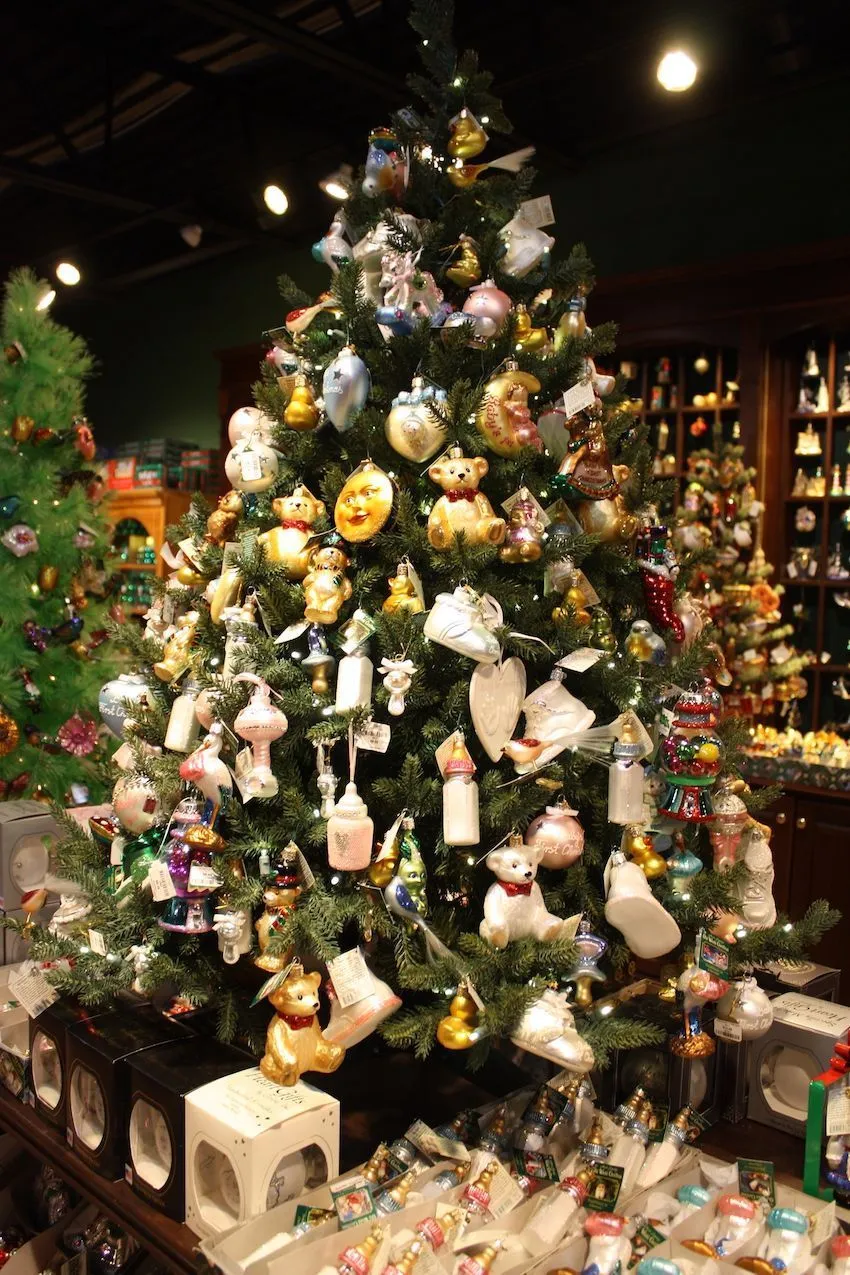
Maximalism came back hard, and the gathered-ornament tree is its holiday expression. Instead of a tight three-color scheme, this approach treats ornaments as a collection: travel finds, first-baby keepsakes, hand-me-downs from a grandmother’s attic. Keeping them all inside gold, white, and pastel is what holds it together. This style has real staying power because it’s personal rather than purchased.
10. Deep Red, Gold, and Oversized Nutcrackers
- Large artificial tree, 9–10 ft: $450–$1,200
- Deep red and gold ornaments, 120+ pieces: $180–$420
- Warm white string lights, 800–1,200 bulbs: $60–$140
- Oversized nutcracker figures, 3–4: $150–$600
- Red and gold gift boxes and wrap: $60–$150
- Illuminated geometric light forms: $80–$250
- Total: roughly $980 to $2,760.
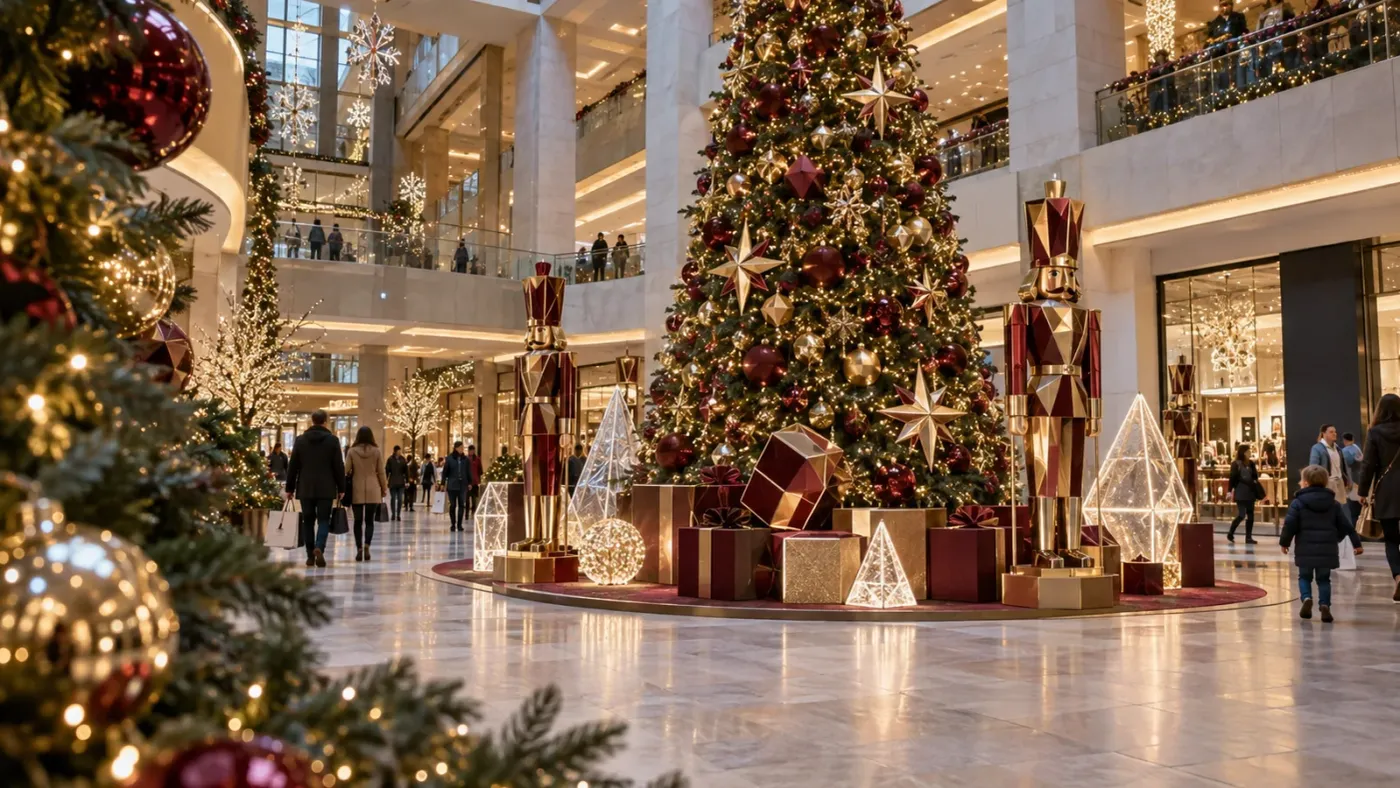
Budget alternative: rent the nutcrackers from a local event company for the season, or repaint flea-market finds in red and gold. Same look, a third of the price.
This display needs floor space more than ceiling height. Give the tree a 4-by-4-foot clear footprint, plus another 2 feet in front for the figures and light structures, and keep walkways at least 36 inches wide so nobody clips a giant wooden hat. In a smaller room, trade the oversized figures for two tabletop nutcrackers on a side table.
11. A Grove of Glowing Tree Lights in Rustic Neutrals
The trick is that the light sources are the decoration. Twenty-odd glowing tree silhouettes at different heights create repetition, and the eye reads repetition as rhythm. Warm white keeps it cozy instead of showroom-bright. The rope-wrapped poufs, shaggy rugs, and raw wood paneling all sit at much lower contrast than the glow, so nothing competes with it. Those dim, muted walls are doing quiet, essential work.
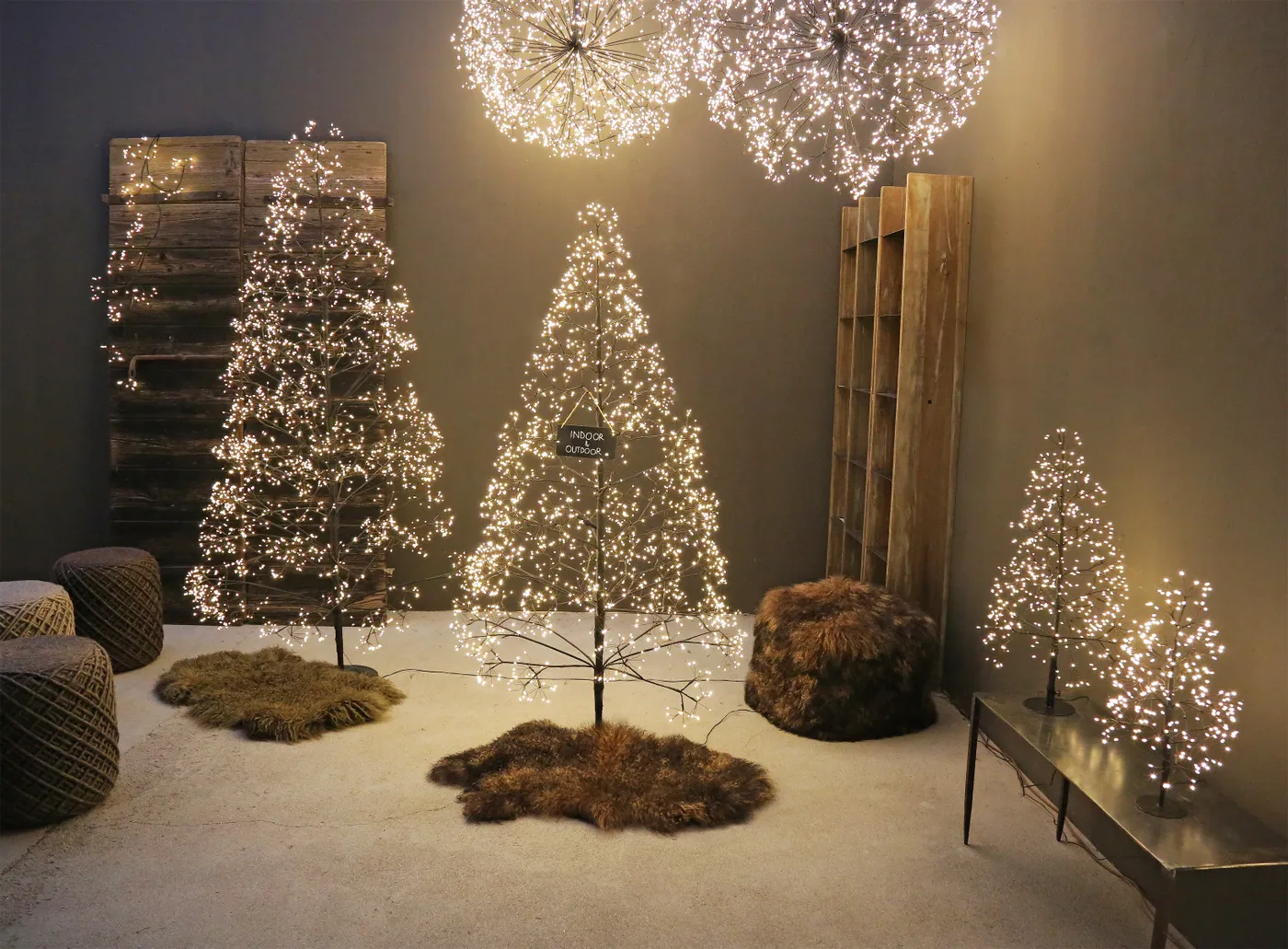
Roughly 55% muted neutral base — taupe wall, concrete floor, dark metal — 35% warm white glow, 10% brown texture in fur, rope, and wood. The percentages matter more than the objects. Swap the taupe wall for bright white and the glow loses its punch entirely. Change the brown fur to cream wool and the balance still holds, because the ratio didn’t move.
12. Frosted Branches in Champagne and Slate Blue
Flock plus champagne plus slate blue works because slate blue is cool and champagne is warm — that small temperature clash keeps the tree from washing out. Keep the ratio honest: for every beaded champagne piece, hang three white or silver ones. Champagne is the accent, never the base. Vary the shapes too — spheres, snowflakes, starbursts — since heavy flocking swallows subtle texture and leaves you with a soft blur.

Flocked trees need one careful vacuum per season and a lint roller for any branch you touch. Snowflake and starburst ornaments are light and prone to dropping; hang them deep on sturdy branches rather than at the tips. Champagne finishes can tarnish where the hanging loops contact them if they’re stored damp, so wrap them in acid-free tissue and keep the bin genuinely dry.
13. A Real Evergreen With Nothing But Red Balls
A real evergreen is a commitment. A cut tree starts dropping needles the moment it comes inside, so water it daily — a 7-footer can drink a gallon in the first 48 hours — and keep it well away from the wood stove, which will dry it out fast. Real trees also sag: heavy ornaments pull branches down over three weeks, which is exactly why small, light red balls are the right call here.
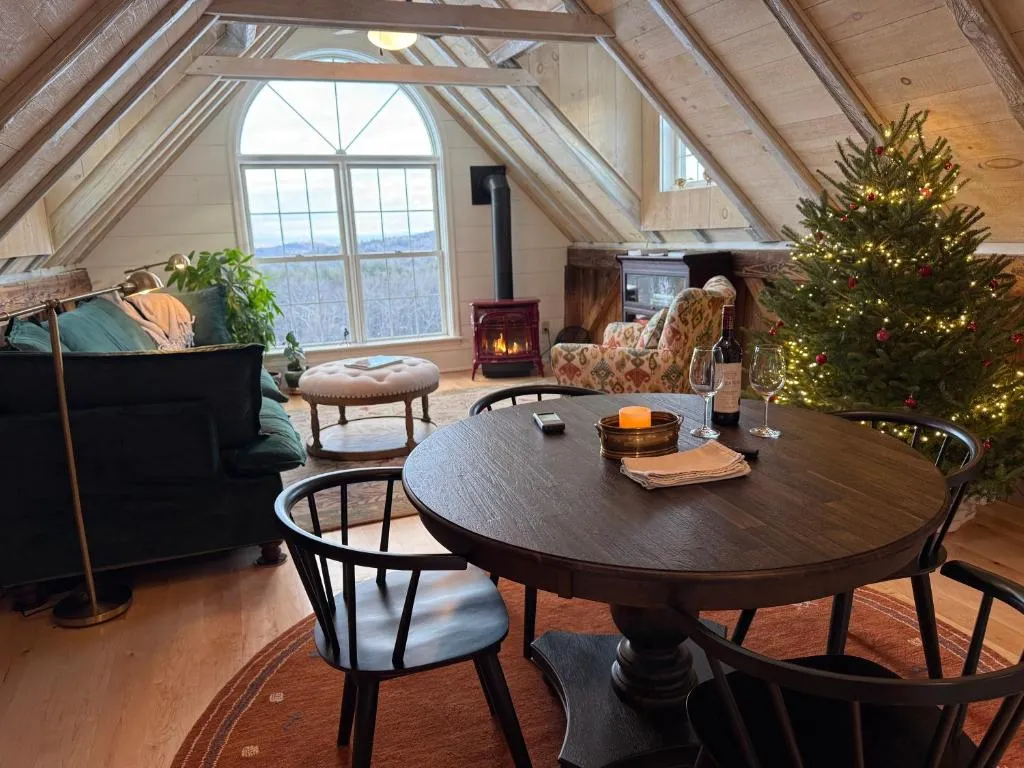
This is the pared-down version of Idea #1, and it’s the cheapest look in this guide to copy. One tree, one strand of warm white lights, forty small red balls. Under $100 if you cut your own tree from a farm, and red balls are the single most common thrift-store ornament find in December. Skip the ribbon, skip the garland, skip the topper if you want.
14. White Tree, Colorful Characters, Black Piano
The character ornaments. A white tree is practically a blank canvas, and these small, mismatched, colorful figures are the only thing giving it a subject. Lose them and you have a bare white conifer with lights on it. Everything else in the room — the black piano, the red armchair, the pile of gifts — exists to frame those characters.
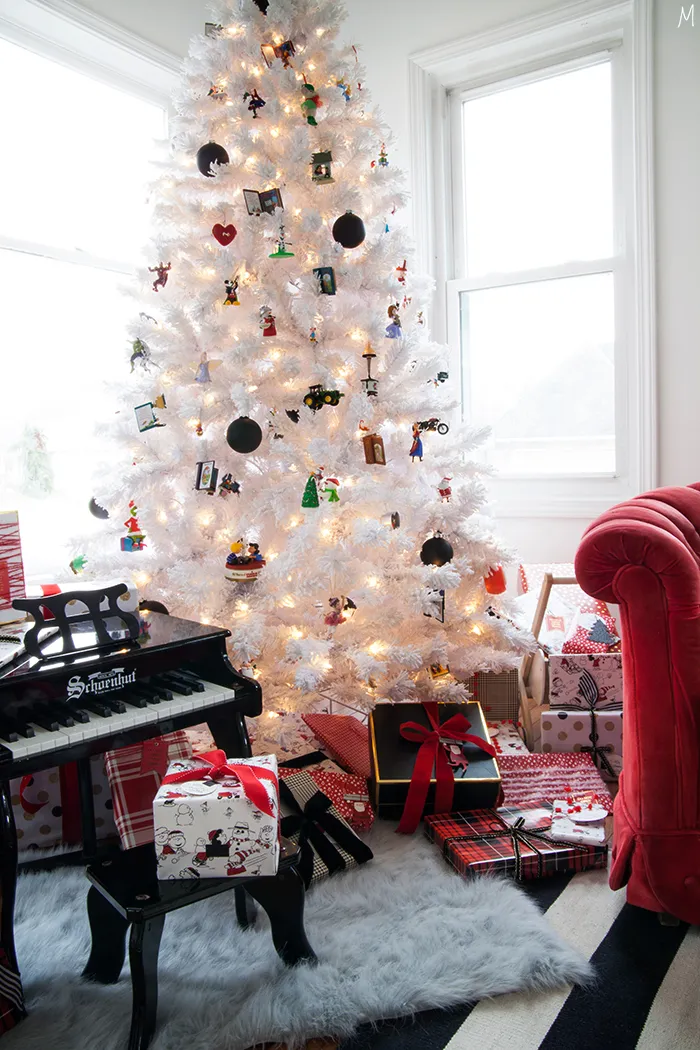
Hanging small character ornaments so they actually read:
- Group them at eye level, roughly 40 to 60 inches off the floor, instead of scattering top to bottom.
- Face every figure forward and slightly outward, never sideways.
- Leave 3 to 4 inches between characters so each silhouette stays visible.
- Fill the gaps behind them with plain white balls so the color pops forward.
- Give your two favorites the best-lit spots on the tree.
About 30 minutes, no extra cost.
15. Bronze and Dark Brown, Warm as Toast
The palette is narrow and warm: 60% bronze, 25% dark brown, 15% cream and beige. No silver, no red, no green ornaments at all — the tree’s own needles supply the green. That restraint is what makes bronze read as elegant rather than rusty. If you want to shift the mood cooler, swap bronze for antique brass and dark brown for charcoal, and the same proportions still hold perfectly.

Mixing finishes is what keeps bronze from becoming one flat metallic mass. For every three ornaments, use one ribbed, one smooth, and one with a rough or paper-like surface — that folded brown paper ornament in this tree is doing more than it looks. Hang the matte pieces deeper in the branches; matte surfaces catch less light, so they need to sit where the warm bulbs can graze them.
16. Dusk, Warm White, and a Wrought Iron Fence
Outdoor lighting is really a spring project disguised as a winter one. Buy commercial-grade strands with sealed sockets if the tree stays up more than six weeks, and count on replacing 5 to 10% of the bulbs every year. Don’t coil strands tightly at the end of the season — that’s what breaks the wire inside. A $40 storage reel will save you re-buying strands every other year.
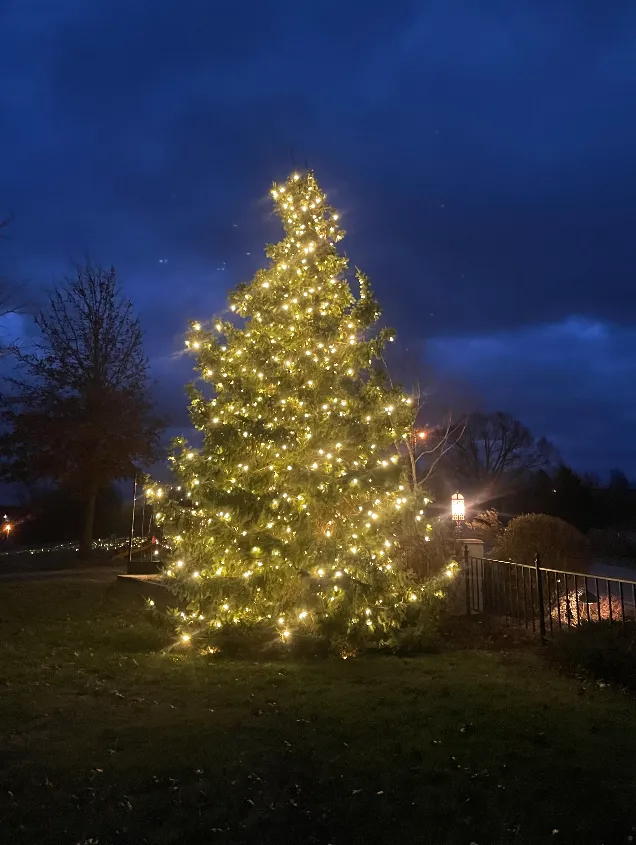
To look like this from the street, the tree should be at least 10 feet tall for a typical front yard, and 14 feet if it sits more than 20 feet back from the road. Anything shorter reads as a shrub with lights. Leave 3 feet of clearance from the fence, and confirm no branch touches a power line — this is the one holiday project genuinely worth hiring out.
17. A Feathery White Tree on a White Metal Base
Feathery trees are pricey and a little fragile, so here’s the workaround: a slim, inexpensive white tree plus long white ostrich-feather picks tucked into the outer branches gives you 90% of the shimmer for about $120 total. The black metal shelving is the other easy win — basic IKEA units and light wood-look planks get you there for under $100, and thrift stores are permanently full of white pillar candles and wooden deer figurines.
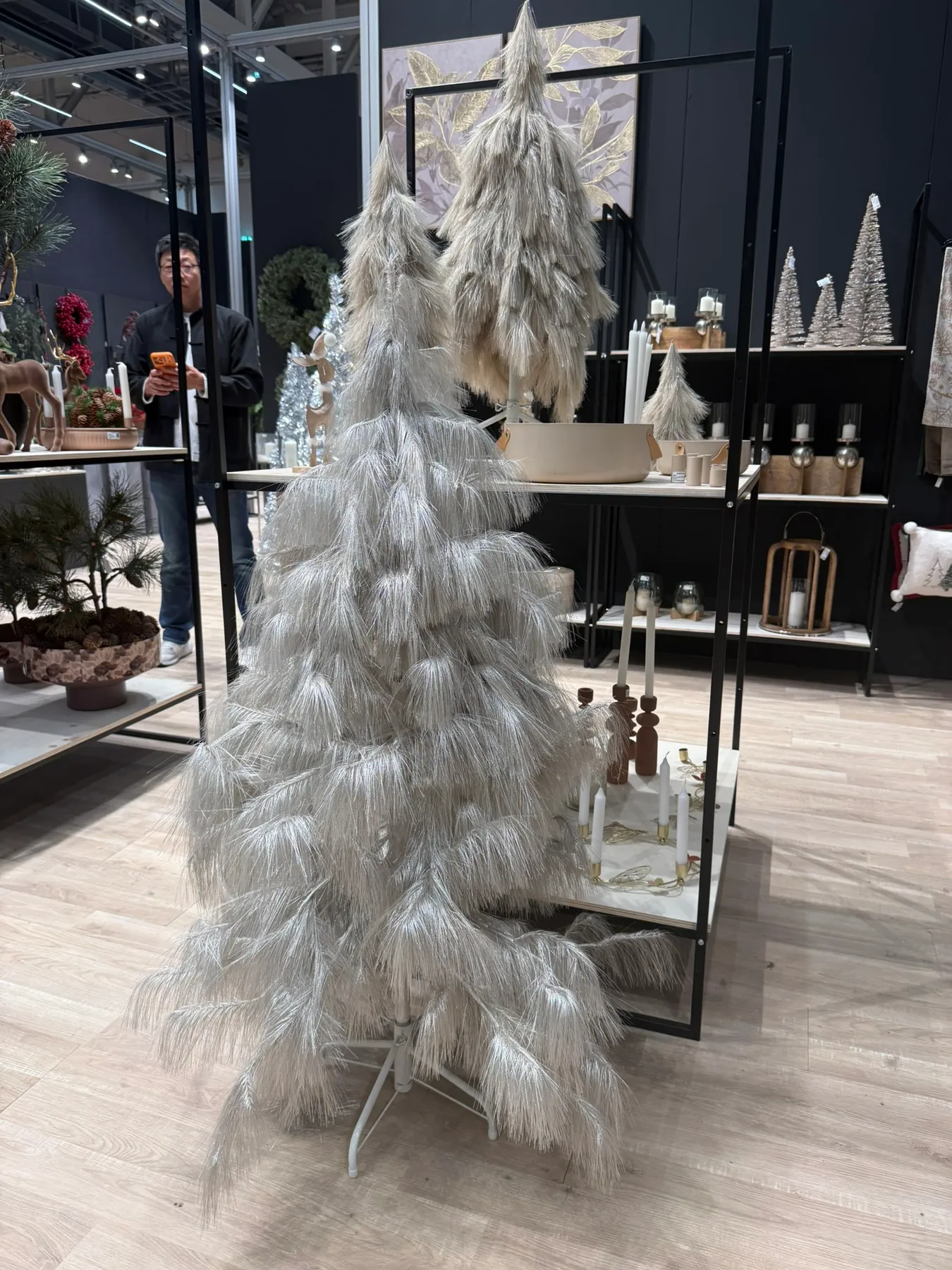
The near-total absence of color is the entire point. White, silver, pale wood, black metal — that’s the whole palette, which means the eye reads shape and height instead of decoration. The mix of tree silhouettes, some conical, some feathery, creates a small collection rather than one centerpiece, and the black shelving gives all that white somewhere to sit. It’s a display, not just a tree.
18. Snowflakes and Matte Olive on Flocked Pine
Matte olive is the secret weapon on a flocked tree. Glittery silver snowflakes and white flocking are both high-shine or high-contrast, so the eye needs somewhere soft to land — that’s the ribbed olive baubles. Budget one matte piece for every two glittery ones. And hang the large snowflakes flat against the branch rather than dangling off the tip, so they read as shape instead of as visual clutter.
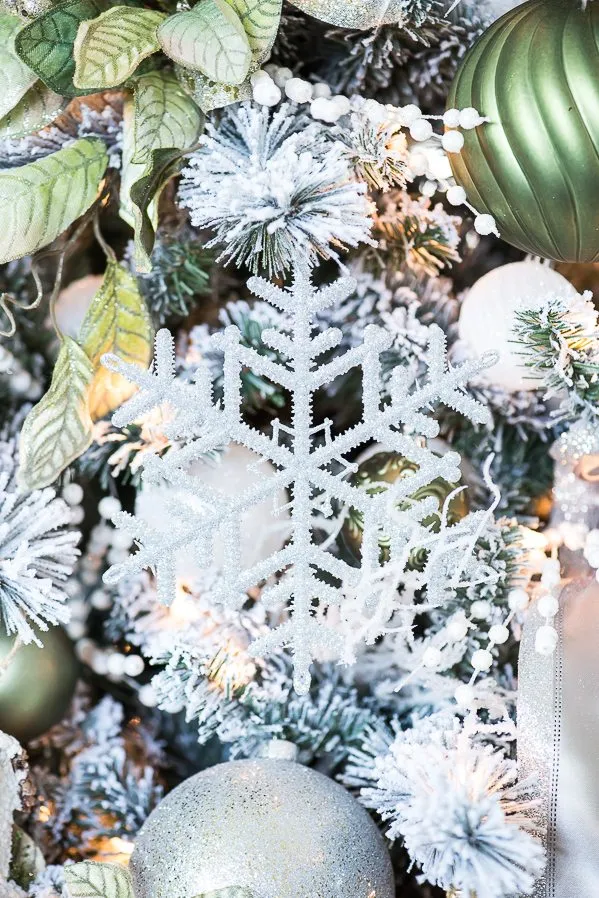
Heavy flocking is genuinely messy and genuinely fragile. It flakes when you move the tree, it can’t be stored in a hot attic, and it won’t survive a second season if you bend the branches carelessly. Compare with Idea #12 for a similarly frosty mood — both of these demand careful packing in January, and both are worth the trouble.
19. A Lit Star Topper and a 2026 Snowman
Personalized and dated ornaments have been climbing for years, and 2026 is the year the year itself became the ornament. A dated piece hanging front and center turns a display into a marker — this is the tree you’ll photograph every December. Expect to see more of it: custom and dated ornaments are one of the few ornament categories that never go on clearance.
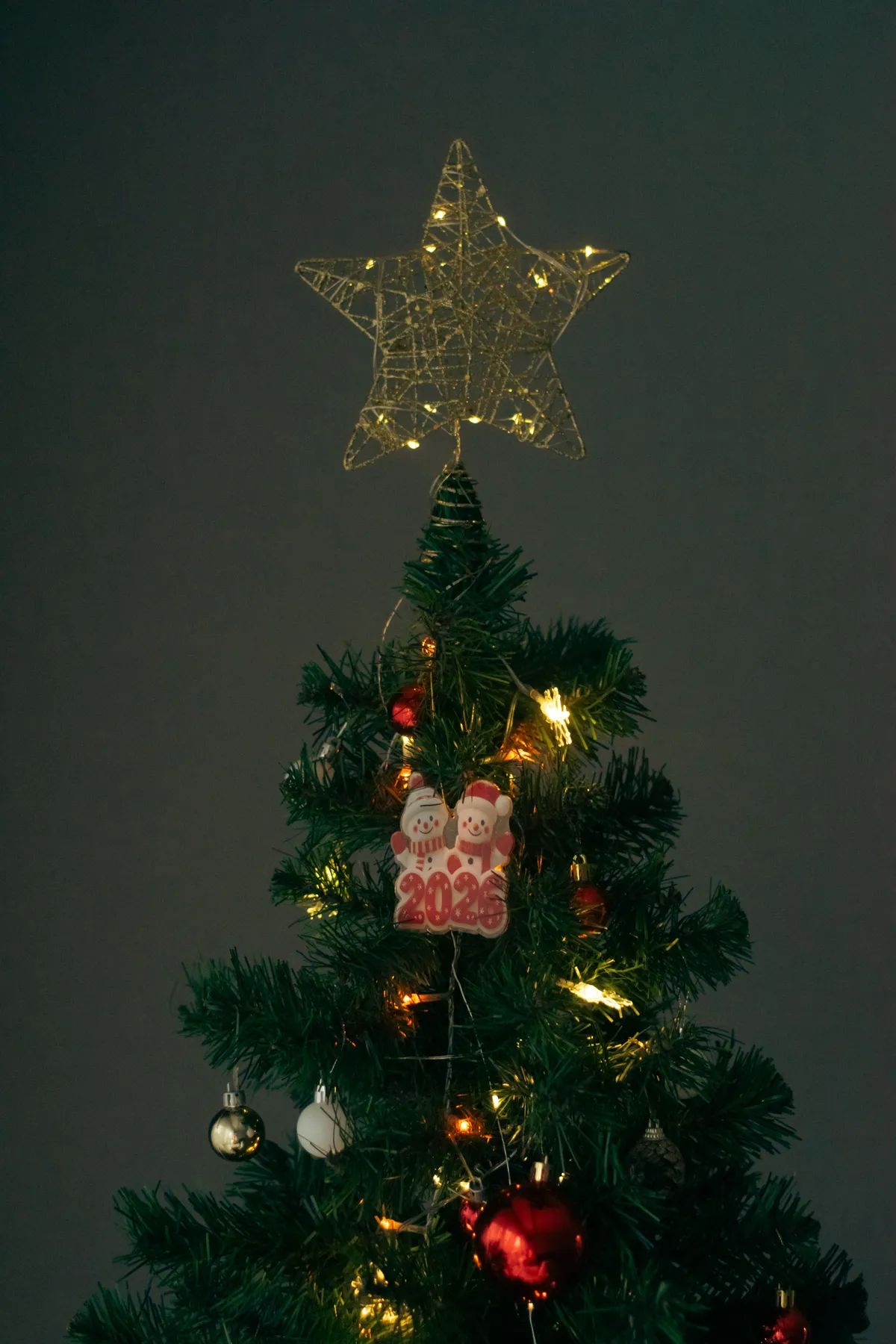
The lit wired star topper. The red, gold, and white baubles are classic and replaceable; the star is what makes the tree feel finished from across the room. A star that lights up does double duty as a light source and a focal point, and it’s the element people notice first when they walk in. If you spend real money on one thing here, spend it on the top.
20. A Corner Tree Backlit by Blue Fairy Strands
The best part of this look is that the drama lives on the wall, not in the tree. Vertical strands of blue-white fairy lights run about $15 for 30 feet, and hanging them in four or five uneven runs against a gray wall takes 20 minutes and a handful of clear hooks. A small flocked tree at $40 to $90 plus a thrifted frame around a printed abstract finishes the scene for under $150 total.
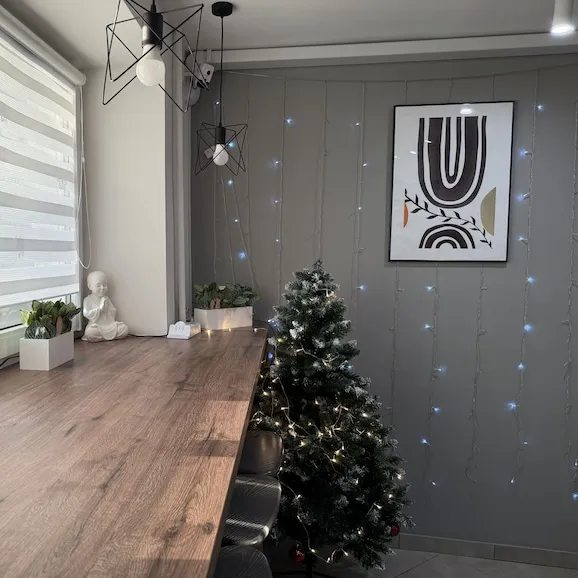
It’s a two-temperature formula: warm white on the tree, cool blue-white on the wall. That contrast is what stops the corner from reading as one glowing blur. Roughly 60% cool, 40% warm, with the gray wall as a neutral base and one black or wood element for weight. Reverse the ratio and it turns cozy rather than modern — both work, just pick a direction and commit.
21. Glitter Red and Green on a Snow-Dusted Tree
- Flocked tree, 7–7.5 ft: $200–$500
- Red and glitter green ornaments, 90+ pieces: $120–$300
- Red velvet bows, 8–12: $30–$80
- Snow-dusted garland: $40–$100
- Silver tinsel wreath: $35–$90
- Red glitter stockings, set of 3: $30–$70
- Total: approximately $455 to $1,140.
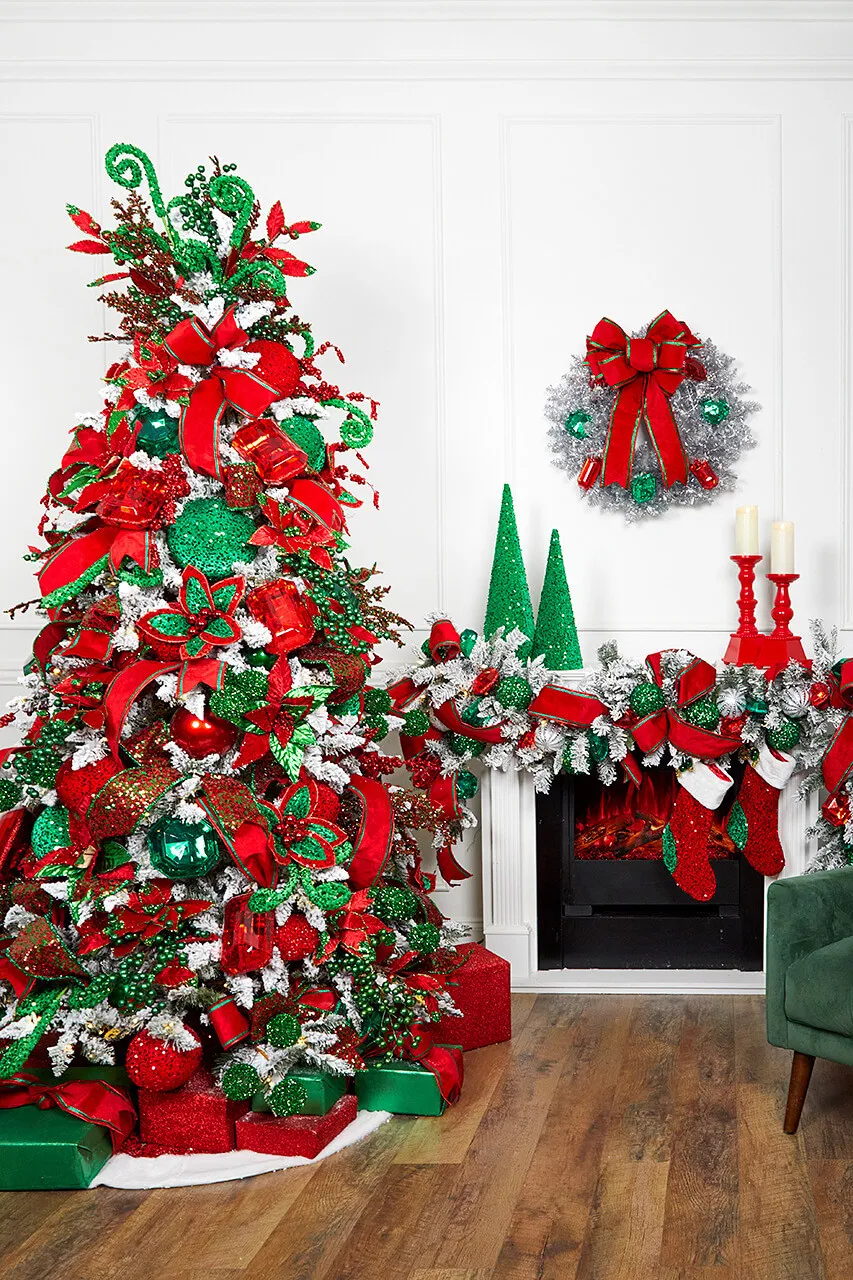
Budget alternative: buy flocking spray at about $15 a can and frost a plain green tree yourself — it takes an afternoon and a well-ventilated room. Red velvet bows are one of the easiest things to make from a $10 bolt of ribbon.
Making bows that actually hold their shape:
- Use wired velvet ribbon at least 2.5 inches wide; unwired satin collapses within a week.
- Cut lengths three times your finished bow width instead of looping straight off the spool.
- Pinch the center and wrap a short piece of wire around it tightly.
- Fluff each loop outward with your fingers so they don’t stack flat.
- Trim the tails on a diagonal so they don’t fray halfway through December.
About 15 minutes per bow, roughly $3 each in materials.
22. Dusty Blue Ribbon and a Wooden Chair
This one is built for normal rooms. A flocked tree between 6 and 7.5 feet, a wooden chair beside it instead of a second display, gifts stacked on the floor — the whole vignette fits in roughly a 5-by-5-foot corner. That makes it one of the few formal palettes in this guide that works in an apartment or a narrow living room without blocking a walkway.
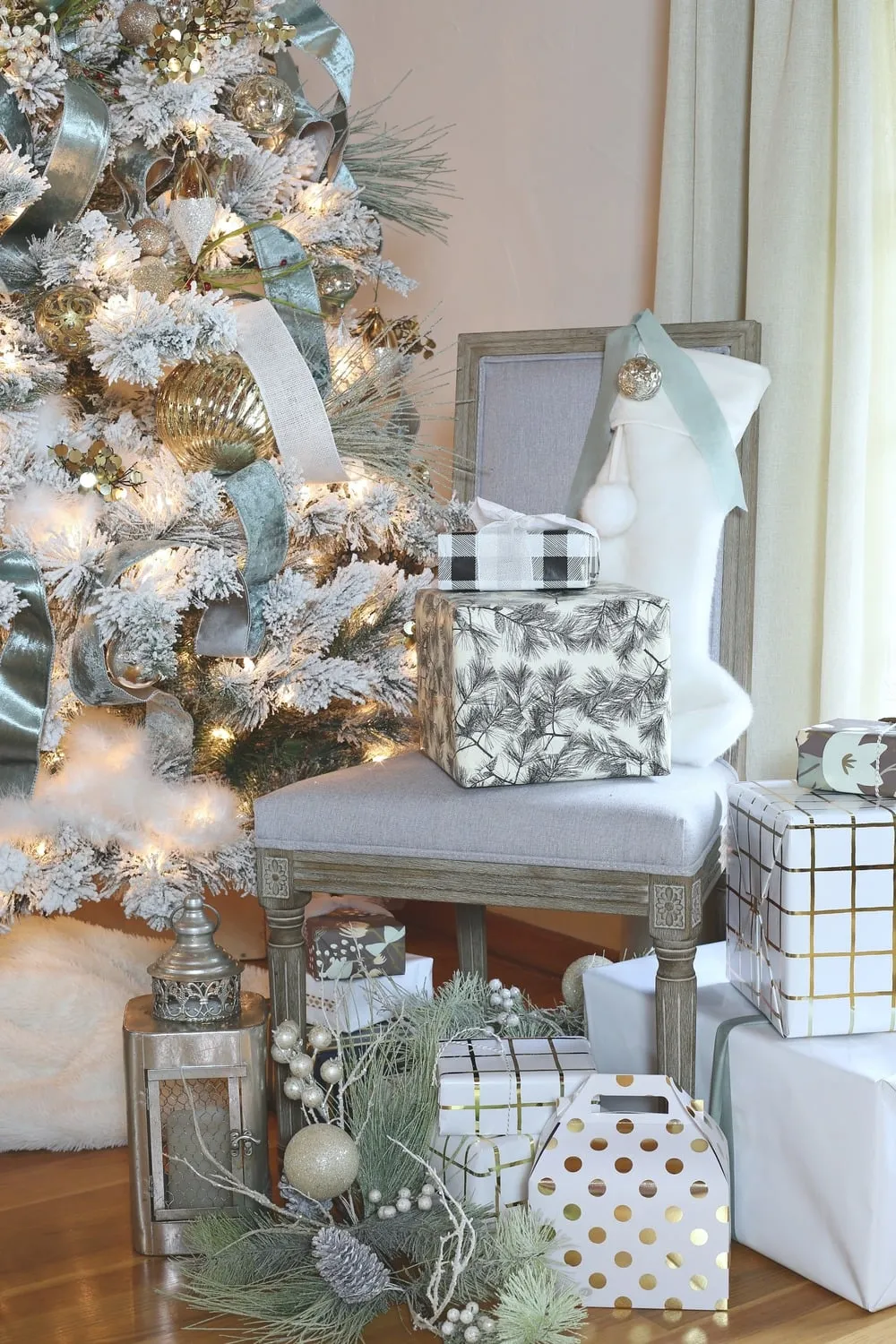
Dusty blue is a hard color to match from a photo, so buy your ribbon and ornaments together or not at all. The safest pairing is a gray-leaning dusty blue with warm gold, and never silver and gold in equal amounts — pick one metal as the lead and let the other appear only on ornaments. Use velvet ribbon rather than satin; velvet holds a soft fold against flocked branches instead of skidding off them.
23. Green Baubles, Silver Stars, One Small Red Bow
Hanging ornaments so a small detail still reads in photos:
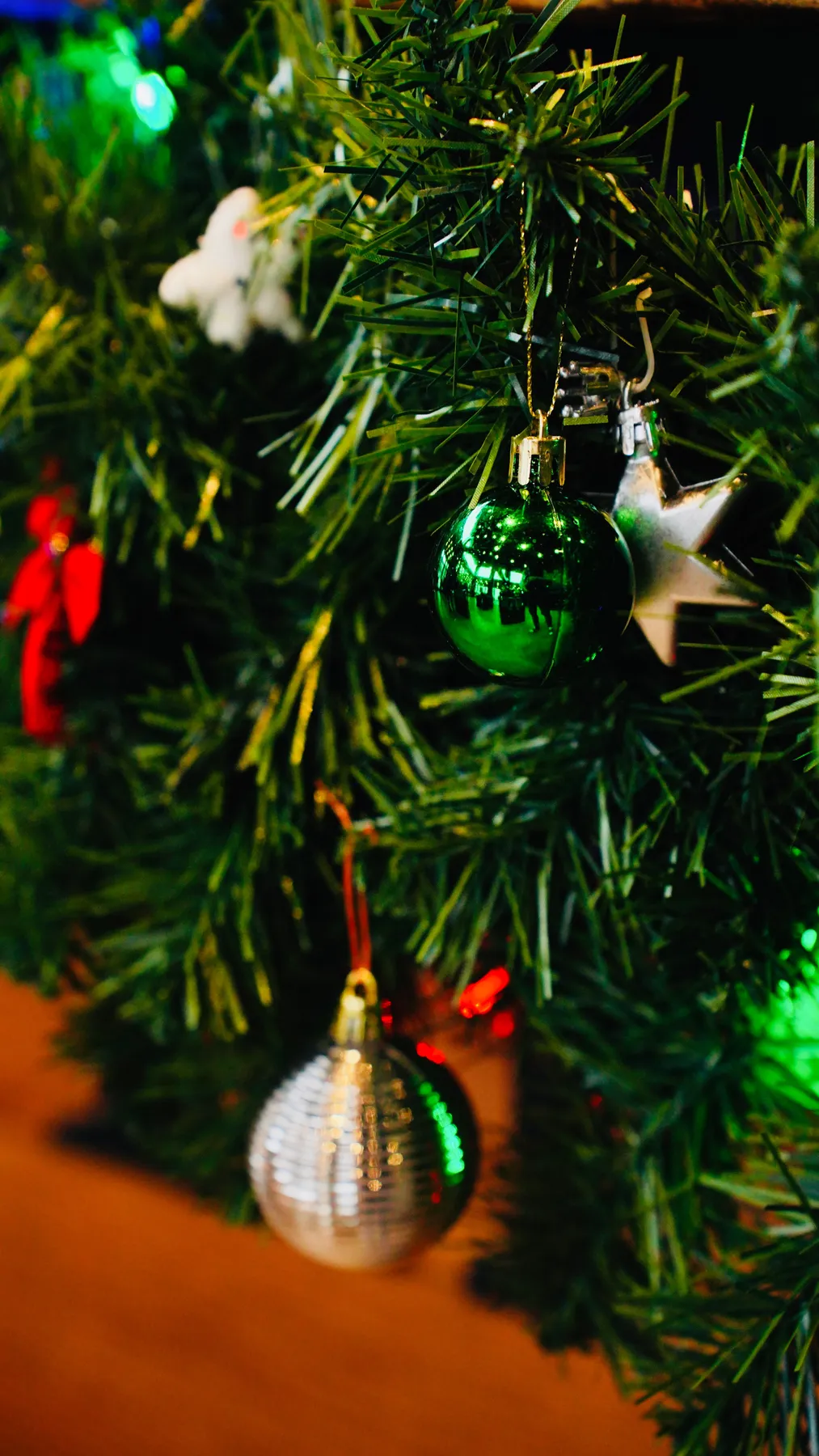
- Place your largest ornament slightly off-center, about a third of the way up the tree.
- Build outward from it in an irregular triangle rather than a symmetrical grid.
- Alternate shiny and matte finishes on adjacent branches.
- Add one odd shape — a star, a small fabric bow — to break up the sphere rhythm.
- Step back eight feet and squint. Anything that disappears comes off.
Ten minutes, no cost.
This branch is basically a study in 50% deep green, 30% silver, 15% red, and 5% white. Silver is the connective tissue — it shows up on the star, the faceted ball, and every light reflection, which is why one small red bow can carry so much weight. Swap silver for gold and the tree warms up instantly. Swap it for black and it turns modern.
24. Pink Petals and Gold Crescent Moons
The illuminated village tree skirt. Pink, purple, and mauve flowers and gold celestial ornaments are lovely, but a glowing miniature village at the base is what turns this from a themed tree into a scene. It also solves the hardest problem with flower-heavy trees — a bare, awkward base. That skirt is doing more visual work than any single ornament on the branches above it.
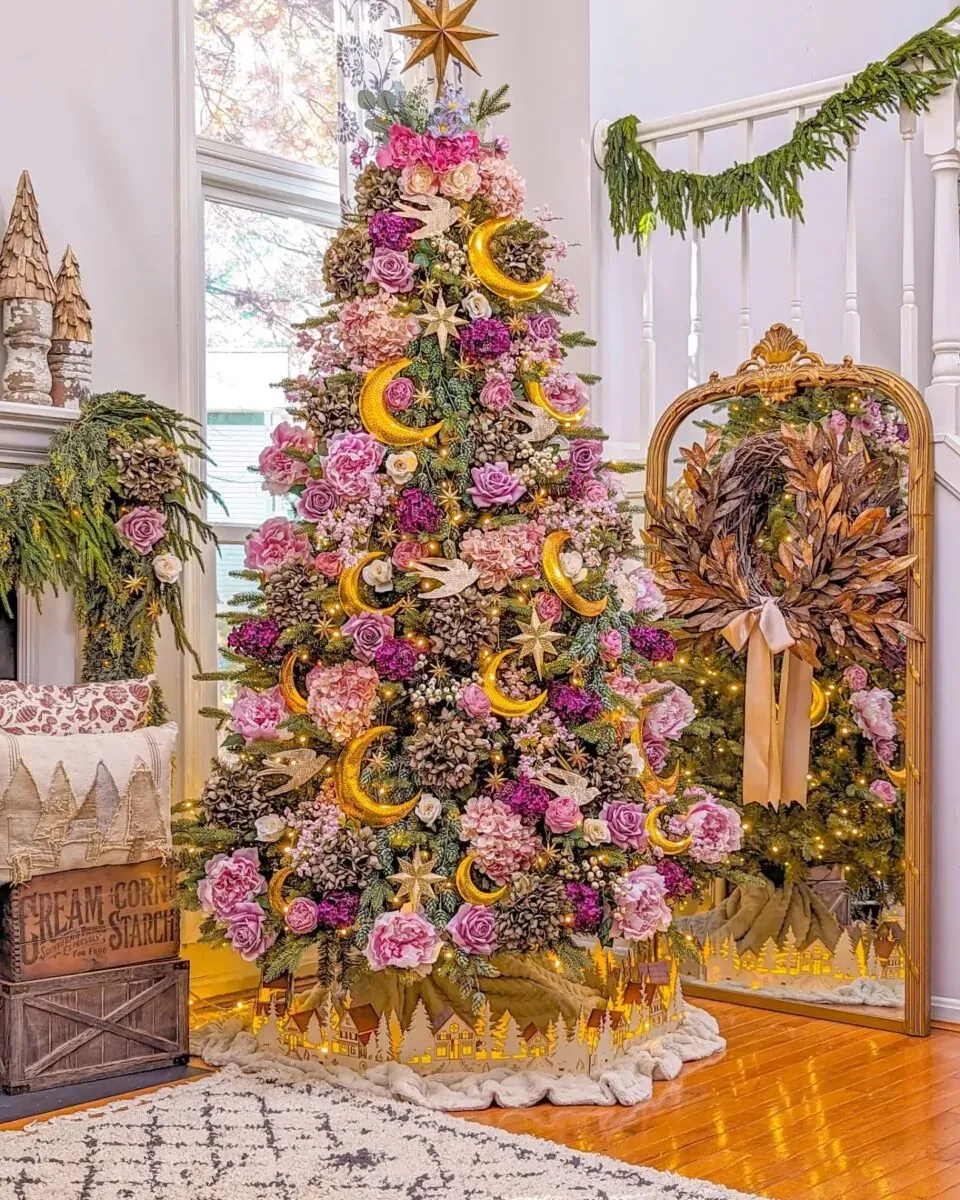
- Full artificial tree, 7–8 ft: $200–$550
- Artificial pink, purple, and mauve stems, 20–30: $120–$300
- Gold moon and star ornaments, 40–60: $60–$160
- Warm white string lights: $25–$60
- Illuminated village tree skirt: $80–$220
- Ornate gold-framed mirror: $150–$500
- Total: roughly $635 to $1,790.
Budget alternative: borrow a mirror from another room and skip the village — a plain white fabric skirt with a strand of fairy lights tucked underneath gets surprisingly close. Idea #29 shows how one deep backdrop color does similar work for far less.
25. Ballerinas, Lollipops, and a Shelf of Dolls
Pastel and whimsical themes are having a genuine moment, and it’s being driven by families who want a tree their kids feel ownership of. Ballerina, lollipop, and iridescent snowflake ornaments — often displayed in shops alongside picture books and rag dolls — turn the tree into a storybook object rather than a color scheme. This one is hard to date, which is the real mark of a keeper.
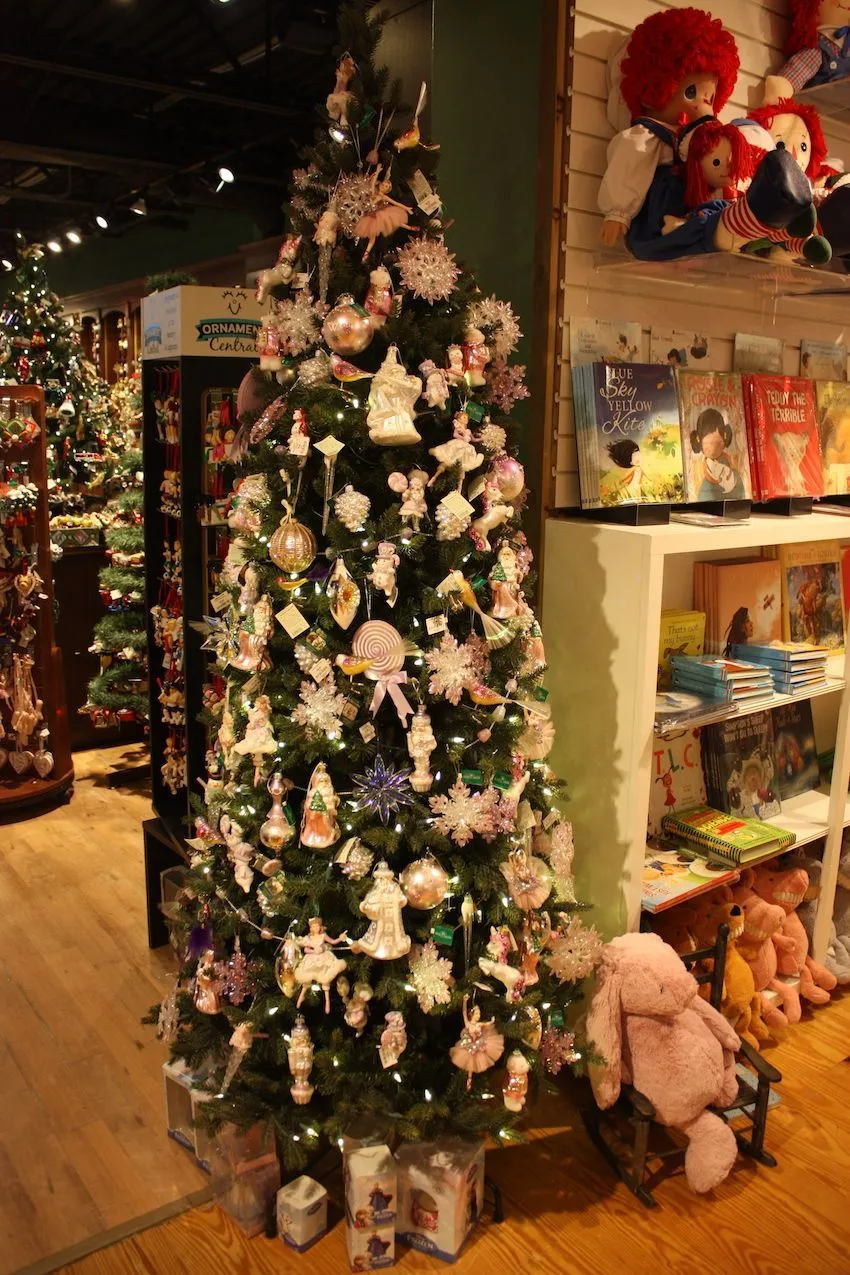
You almost never need to buy a themed set. Craft and thrift stores sell plain ballerina and snowflake blanks for $2 to $5 each, and a $10 bottle of pink craft paint plus a roll of iridescent ribbon turns a dozen of them into a collection for under $60. Dollar-store lollipop ornaments are shockingly decent. Buy one $20 coordinating garland and call it done.
26. Amber Glass and Persimmon Branches
This is a warm analog palette: 40% amber, 30% mustard, 20% terracotta, 10% gold, with the green needles as the base everything sits on. It works because every tone lives between orange and brown on the color wheel — no cool color interrupts the warmth. Cool it down by swapping mustard for soft olive and the amber glass for smoked glass, keeping the same proportions intact.
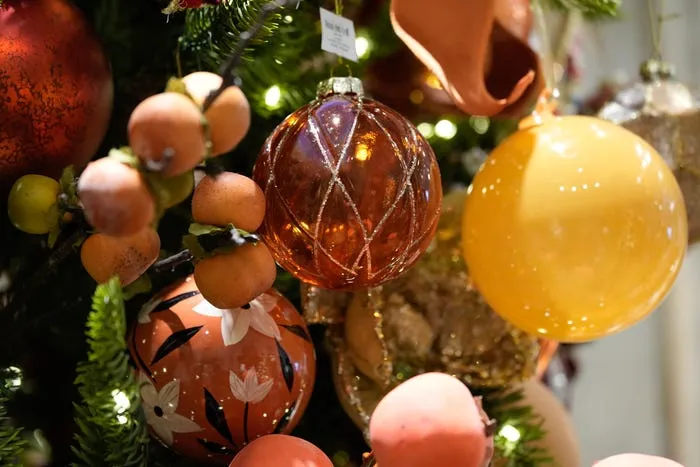
Hand-painted and translucent baubles scratch and chip, especially the amber glass with the gold lattice pattern. Hang those inside the outer layer rather than at the tips, and store them individually wrapped. Persimmon and fruit picks are also the most likely thing in this guide to get chewed by a pet — check the label before you buy, since many artificial fruit stems are treated.
27. Circus Stripes on a White Tree
On a white tree, saturated colors need a buffer or they vibrate. Hang a small white or clear ball between every two colorful pieces and the whole thing settles down. Keep the finials and character figures at different heights, too — the striped drops hang from the upper third, the animal figures occupy the middle band — so the eye travels down the tree instead of stopping dead.
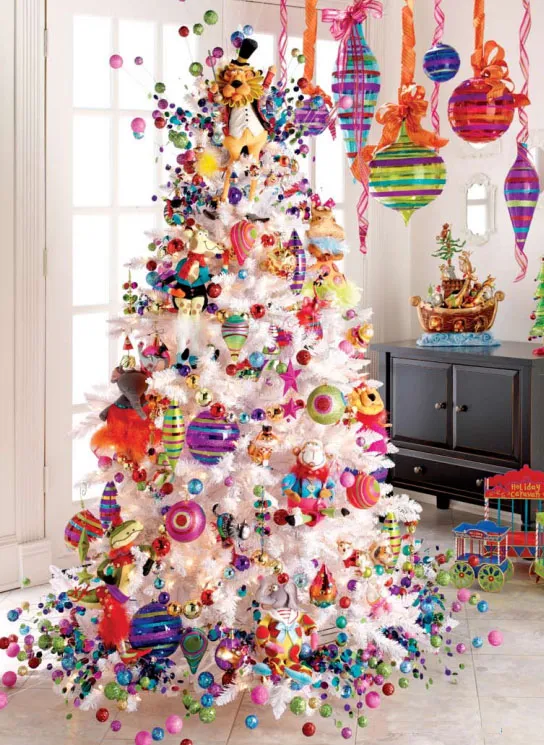
It’s a color-saturation trick. A white trunk makes magenta, lime, royal blue, and orange read at full strength, which would be overwhelming on a green tree. The floating spheres add depth, and the light neutral background keeps the whole thing from tipping into chaos. That black console in the background is doing quiet work as well — it gives all those bright colors an anchor to hang from.
28. A Red Tree in a Botanical Wallpaper Room
Bold rooms punish clutter. With botanical wallpaper, green wainscoting, a zebra-print rug, and a red tree all in one frame, one more pattern anywhere and the whole thing collapses. If your walls are already busy, pick a quieter tree. Worth knowing too: red artificial trees fade unevenly near windows, so rotate yours a quarter turn every couple of weeks and keep it out of direct sun.
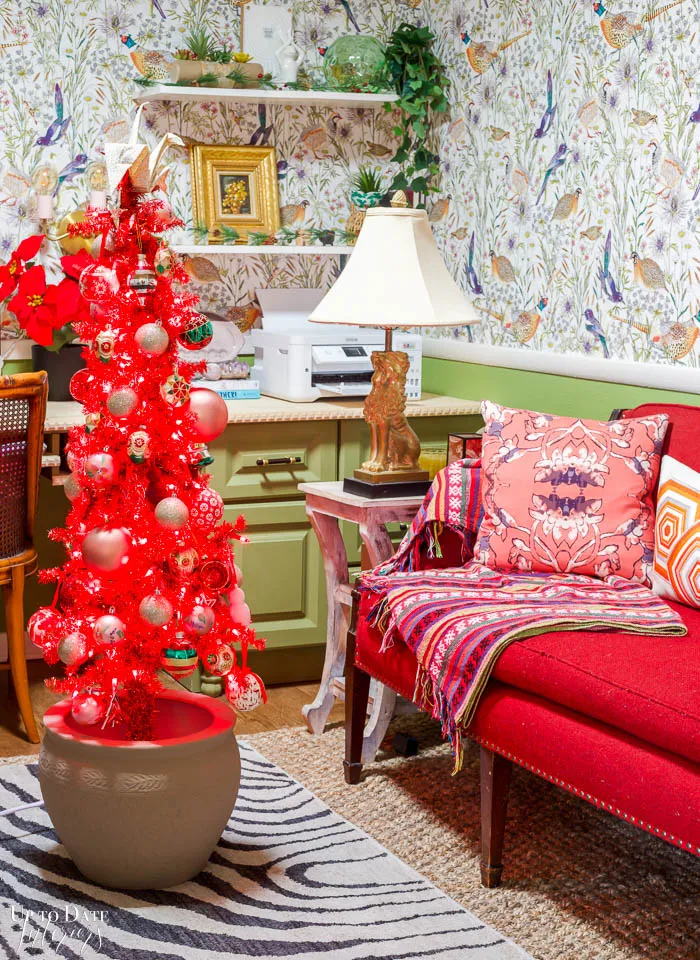
This is a room where a thrifted tree pays off enormously — colored artificial trees sell for $40 to $90 at estate sales and on Facebook Marketplace because most people can’t picture them in a living room. The wallpaper is the real investment, so if you rent, hang a single bold botanical panel behind the tree in a $30 frame for the same energy. Patterned throws and zebra rugs are everywhere secondhand.
29. A Monochrome Green Room Hung With Fruit
The monochrome shell does the heavy lifting. When walls, built-ins, and backdrop are all deep green, the tree stops needing to be the loudest object in the room — the fruit ornaments and plum-ribboned gifts just add a warm pulse. It also makes the warm fairy lights read twice as bright, because there’s nothing pale for them to compete against. Color the room, and the tree can relax.
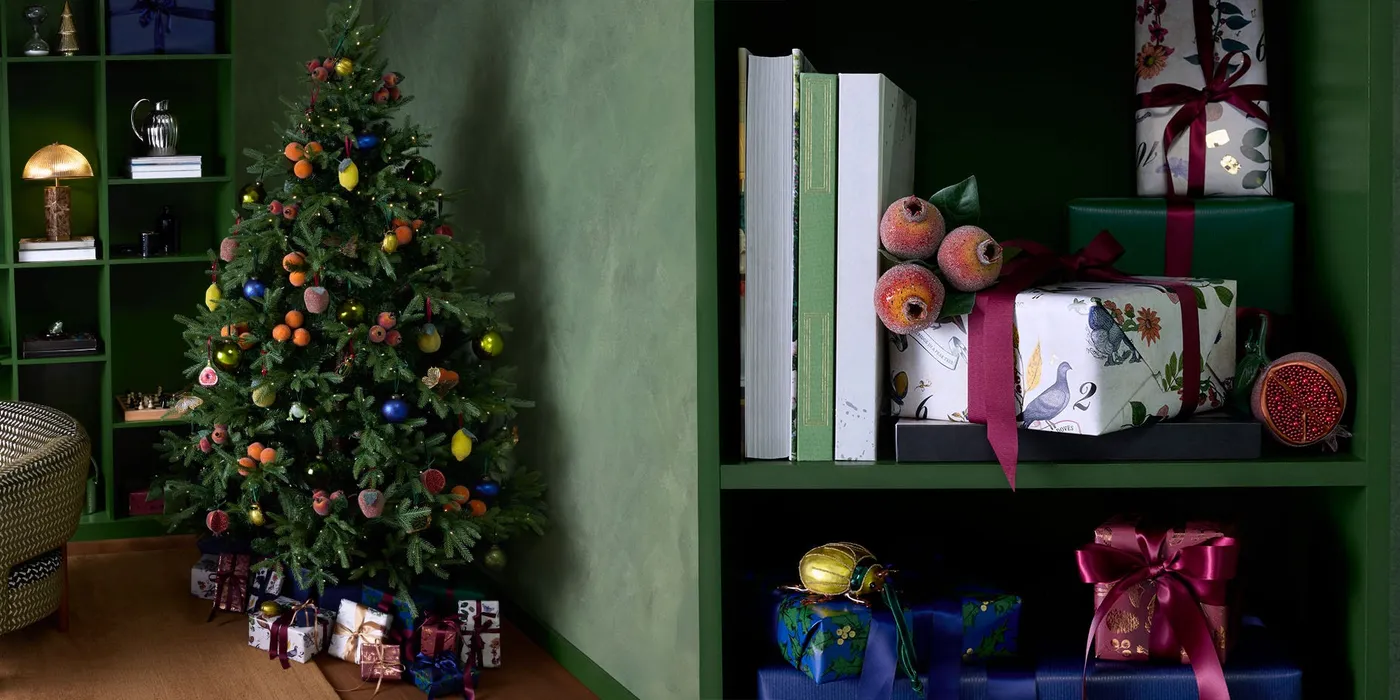
Dark green walls show every scuff and fingerprint, and they’re genuinely harder to touch up than white. Keep a labeled can of the exact paint. Fruit ornaments collect dust in their crevices, so a soft brush once a season is worth it, and frosted faux fruit can shed its coating onto shelves — set those on felt pads if they’re displayed rather than hung. See Idea #24 for the same base-is-the-star logic in pink.
30. Red Bows, Bead Garlands, and a Faux Fireplace
- Pre-lit evergreen tree, 7.5 ft: $180–$500
- Deep red baubles and velvet bows: $90–$220
- Beaded garland, 2–3 strands: $30–$75
- White faux fireplace mantel: $250–$800
- Stockings, set of 4: $60–$160
- Faux log set with LED glow: $60–$180
- Total: roughly $670 to $1,935.
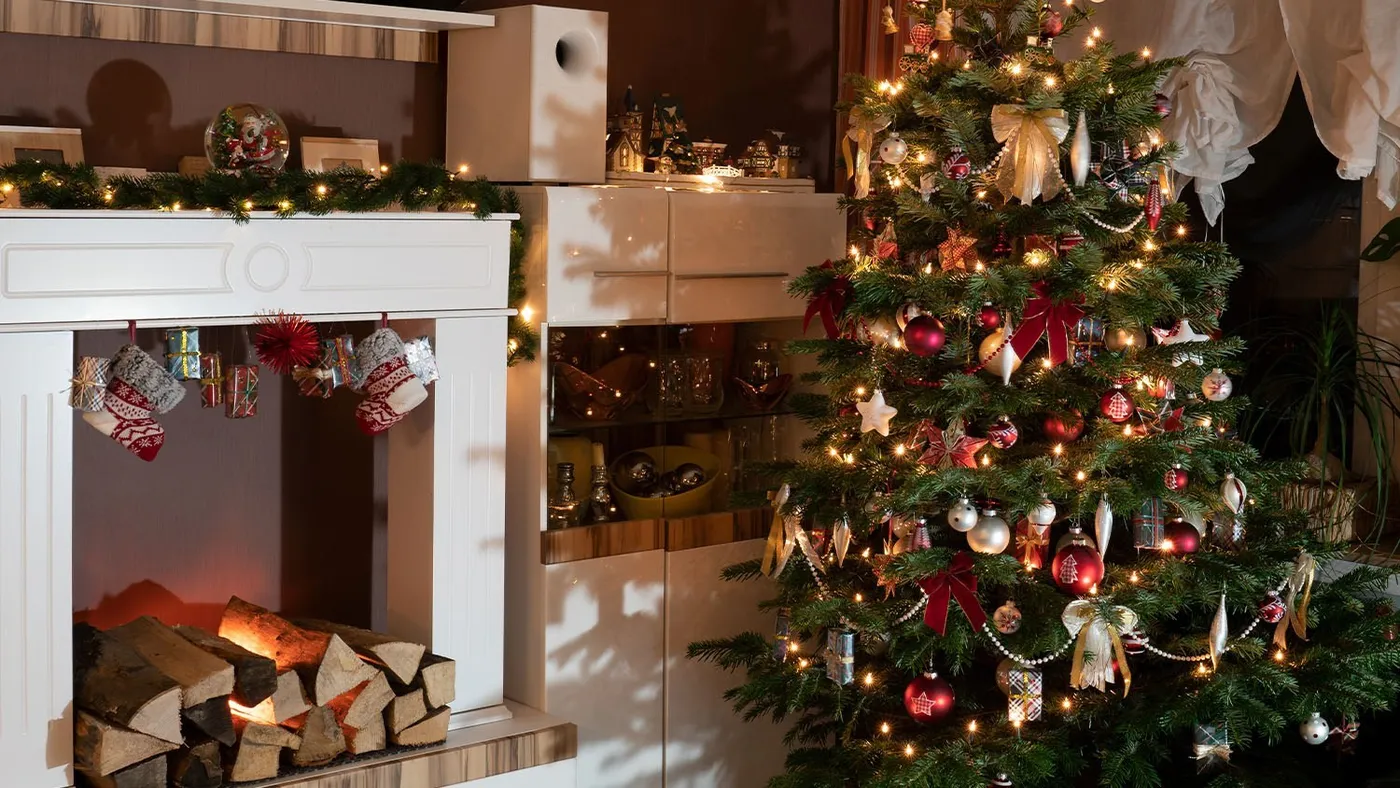
Budget alternative: skip the faux mantel and build a shelf-and-bracket mantel from two boards for about $60 in lumber and paint. Stockings are the easiest thing in this guide to sew or buy used.
- Measure the wall before buying — a 60-inch faux mantel needs about 10 inches of clearance on each side to look built-in.
- Check the nearest outlet; a pre-lit tree and a faux fire together can pull more than one power strip should handle.
- Confirm your stocking hooks can take weight if you plan to fill them with small gifts.
- Decide where ornaments will be stored before you buy more — this look uses a lot of them.
- Check that the mantel surface is level; deep red baubles roll.
31. A Family, a Glowing Tree, and Framed Paintings
For a tree this dense to feel generous rather than crowded, it wants open floor in front of it — at least 10 feet from trunk to the opposite seating, so people can actually stand back and take it in. Ceilings of 9 feet or more let a 7.5- to 8-foot tree breathe. In tighter rooms, choose a slimmer profile and skip the extra layers of ornament instead of shrinking the tree.
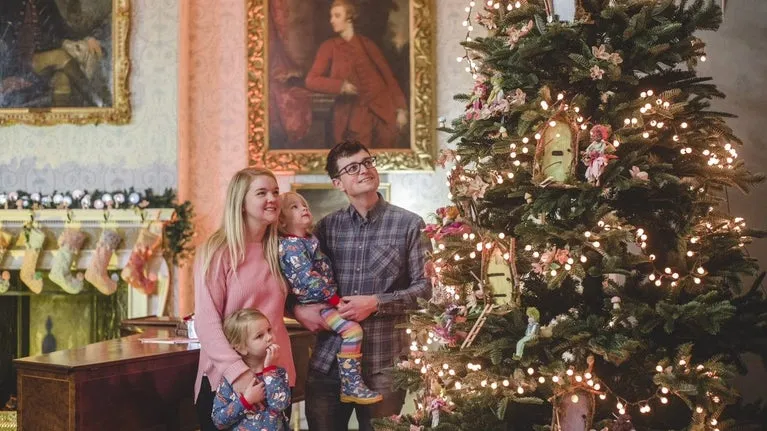
The lights, not the ornaments. Every whimsical ornament on this tree is replaceable; the warm white glow is what makes people stop in the doorway. Under-lit trees always look like a store display, and well-lit trees look like a memory. Run your lights down the trunk and along the interior branches before you hang a single bauble, and this whole corner takes care of itself.
32. Handwritten Red Baubles and Tiny Presents
A tree full of text ornaments reads best when you plan the placement:

- Group five to seven message baubles in one band at eye level instead of scattering them.
- Turn each one so the script faces outward and slightly down.
- Set the tiny wrapped-present ornaments near branch ends, where they can dangle freely.
- Tuck red berry clusters between message baubles to separate them.
- Reserve the white-and-green painted pieces for the lower third of the tree.
About 40 minutes, no extra materials.
Handwritten ornament collections only work if the lighting cooperates. Warm white is fine, but keep every strand at a single temperature and aim for a bulb every 4 to 6 inches of branch — sparse lighting makes thin script impossible to read from more than three feet away. If your tree is pre-lit and thin, add a second strand across the front half only.
33. Striped Spheres and Snowflake Cutouts
Textured ornaments are the cheapest way to make an inexpensive tree look expensive, so buy by shape rather than by set. Plain striped spheres run $1 to $3 each at craft stores, and white snowflake cutouts are often sold in packs of 20 for under $10. Teal drops and a few real glass pieces mixed in give you the same variety for around $60 total instead of a $200 coordinated collection.
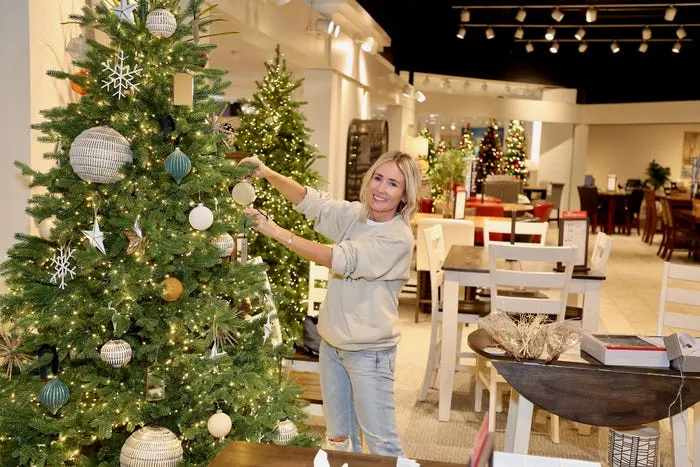
In a showroom, ornaments get handled constantly — at home you’ll mostly fight dust and drooping branches. Warm string lights generate a little heat, which softens lightweight plastic ornaments over a long season; if you notice warping, spread the strands out rather than coiling them. White snowflake cutouts also yellow quickly, so store them away from sunlight.
34. Tree Beside the Brick Fireplace
- Check hearth clearance — real or faux, a fireplace needs 3 feet of unobstructed space in front of it.
- Measure mantel width against your tree; a tree wider than the mantel will visually swallow it.
- Confirm your floor can take a stand with a wide base if the tree sits on hardwood.
- Plan the cord route from tree to outlet before you decorate, not after.
- Test your light strands in the room so you can judge the glow against brick.

This is a room for a 7- to 9-foot tree with at least 3 feet between it and the fireplace, plus 18 inches of walkway on the outside edge. Ceilings of 9 feet or higher let you go taller without crowding the mantel line. In a smaller living room, trade the full tree for a slim 6-footer and let the mantel carry the decorating.
35. An Elf in Striped Tights Among the Branches
The elf. A tree full of red ribbon, glitter present boxes, and classic glass baubles is charming but familiar — the little figure in striped tights is what makes people lean in for a closer look. Place it where a child’s eye level lands, roughly 30 to 36 inches off the floor, and let it sit on a branch rather than dangle. Character figures need a perch, not a hook.
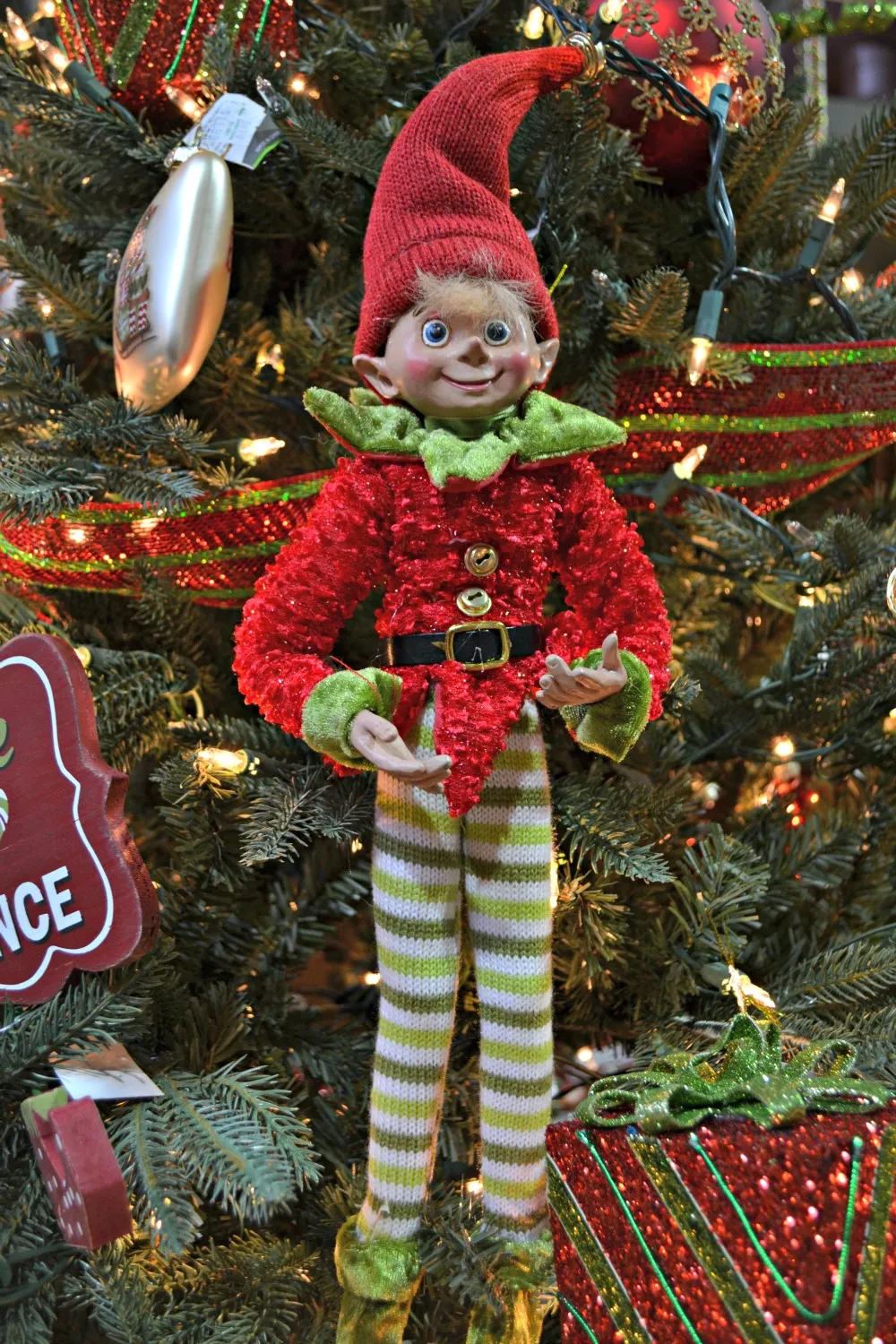
Figurine ornaments are heavy, and heavy ornaments bend branches. Hang this one on a branch within 8 inches of the trunk, then check it after a week — the branch will have relaxed. Think about pets too: elf legs and striped tights look exactly like a cat toy, and fabric-and-resin figures rarely survive a fall onto hardwood.
Pick Your Palette, Then Let the Tree Do the Talking
Thirty-five trees, and the lesson lands the same way every time: the theme isn’t the ornaments, it’s the discipline behind them. Choose two or three colors, decide which one leads, and repeat it in the room — not just on the branches.
Start with the one that made you stop scrolling, screenshot it, and match your ribbon and baubles to it before you buy anything else. Then pin the rest — December arrives faster than you think. 🎄