
25 Jaw-Dropping DIY Holiday Decor Ideas You Need to Try in 2026 That Will Transform Your Home

DIY holiday decor is having a major moment on Pinterest right now — and it’s the handmade, slightly imperfect kind that actually photographs well in a real living room, not a showroom.
We spent weeks combing through Etsy, Target, Hobby Lobby, Michaels, and Amazon to bring you only the ideas worth your hot glue gun this year, from $4 twine-and-dried-orange sachets to a $300 garland-and-lighting setup for a full staircase. After filtering through hundreds of options, we narrowed it down to 25 ideas that actually deliver.
Inside you’ll find rustic natural mantels, traditional red-and-green maximalism, soft neutral corners, and a few genuinely playful projects — budget and luxury versions compared side by side, so you can see exactly what an extra $40 buys you. And stay until the end, because we break down the most common mistakes that can ruin these looks.
The 2026 shift is toward decor you can make in an afternoon from dried citrus, yarn, tape, and wooden dowels — pieces you’ll keep for years instead of tossing in January. 📌 Save this to Pinterest for later — you’ll want to revisit these ideas.
1. Frosted Mason Jar Candles on a Weathered Wood Mantel
You can pull off this entire mantel for less than a decent dinner out, and most of it comes from your kitchen.
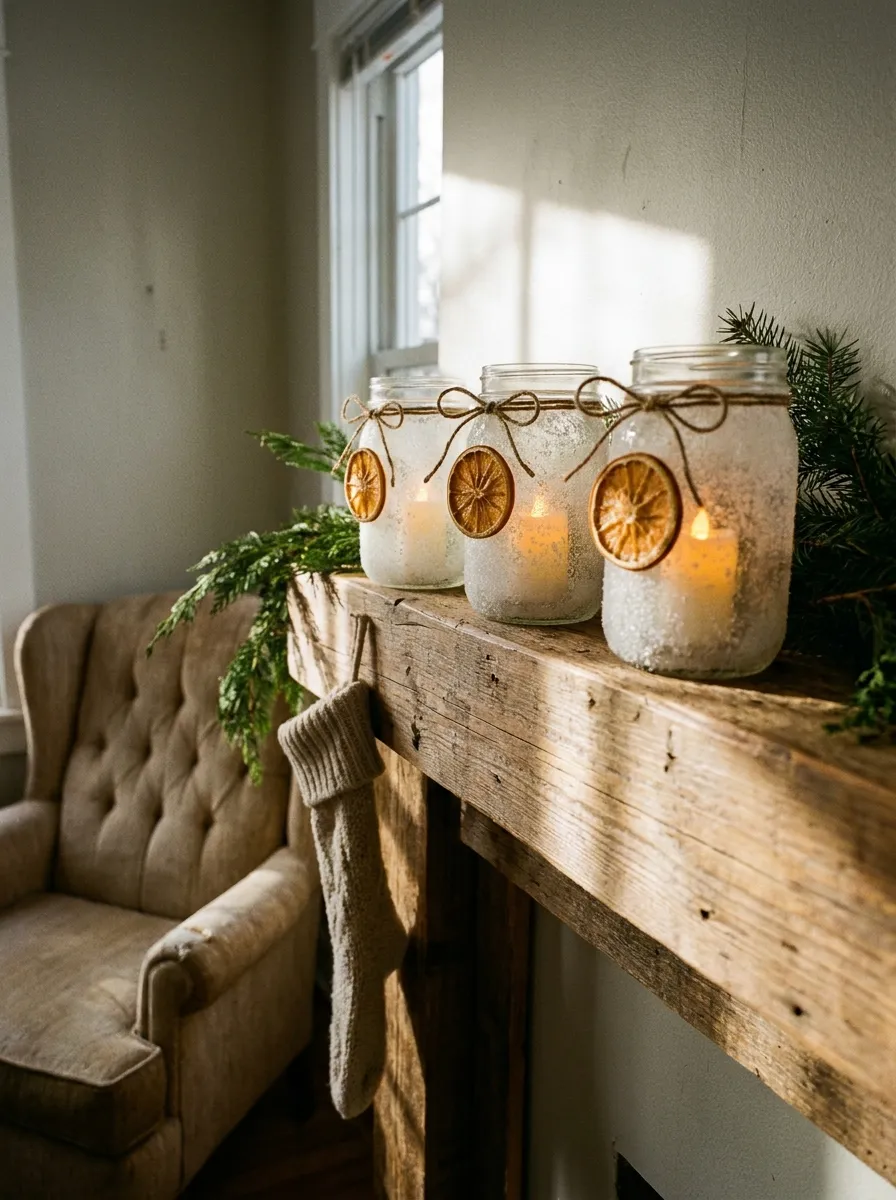
- Three mason jars with LED candles: $12–$25
- Dried orange slices, homemade or bagged: $4–$9
- Twine, ribbon, and greenery picks: $8–$15
- Fresh pine or faux cedar stems: $10–$22
- Knitted stocking, thrifted if you can: $8–$30
Budget alternative: skip the frosted glass and coat plain jars with Mod Podge and Epsom salt — saves about $15 and reads nearly identical once the candles are lit.
Frosted glass is about glow temperature, not jar count. Group three jars in odd heights varying by 1½ to 2 inches, and set the tallest one 8 inches from the wall — closer and the light smears flat, farther and the jars look stranded on the mantel. Also remember: twine is a wick. Keep real flames away from anything wrapped in fiber and use glass-housed LED candles instead.
2. A Twig Wreath Loaded With Berries, Rose Hips, and Tiny Pumpkins
- Start with a plain grapevine or twig wreath — 12 to 14 inches for a standard front door.
- Wire in the heaviest elements first: mini pumpkins and dried hydrangea clusters. They set the rhythm.
- Tuck dried oak leaves between them, angled outward rather than pressed flat against the vine.
- Finish with berry sprays and rose hips, clustered in threes instead of spaced evenly.
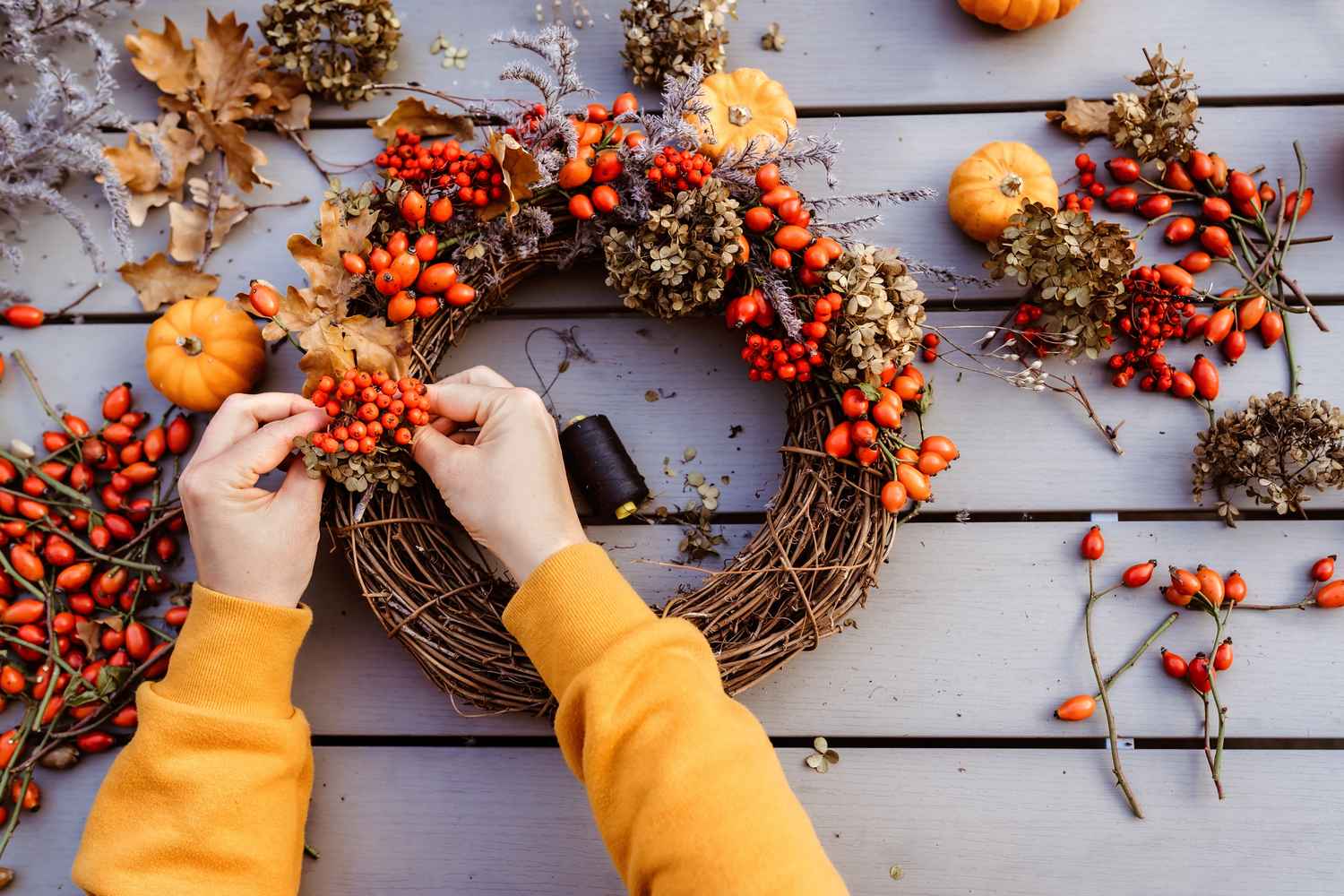
Time: about 90 minutes. Materials: $18–$35, less if you dry your own leaves and hips.
The formula here is 55% neutral base (twig, dried hydrangea, oak) + 30% warm orange and red (berries, rose hips, pumpkins) + 15% texture pop (white pumpkin, eucalyptus). Keep those percentages and you can swap the whole palette — burgundy and blush for February, silver and blue for January — without rebuilding the shape.
3. An Entryway Dressed in Flocked Garland and Gold
- Measure the banister run first — under 9 feet, garland reads skimpy on a standard staircase
- Check the door swing before hanging a wreath, or you’ll hear it bang every single time
- Count outlets; two lit strands usually want one power strip near the base of the stairs
- Keep the console 30–36 inches wide so the entry stays walkable in boots and coats
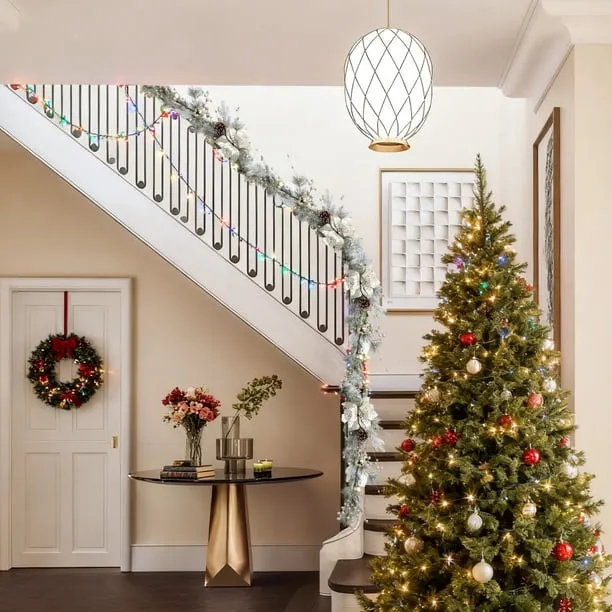
Flocked greenery and true red-and-white are back in a big way for 2026 — call it the grandmillennial Christmas effect. After years of muted, all-neutral trees, people are reaching for color again, and a gold pedestal console gives it a dressier finish than the pine-and-plaid version of the same look. For a calmer take on the same entryway, see Idea #19.
4. A Real Tree Where Every Ornament Is a Frosted Pinecone
A pinecone-and-burlap tree is gorgeous for exactly one season if you don’t plan ahead. Pinecones are heavier than glass balls and will bend lighter branches, so hang them on the interior frames rather than the tips. And if you’re using a real tree, keep it watered daily — dry needles plus warm lights plus a dozen resin-rich cones is the one combination worth being genuinely careful about.
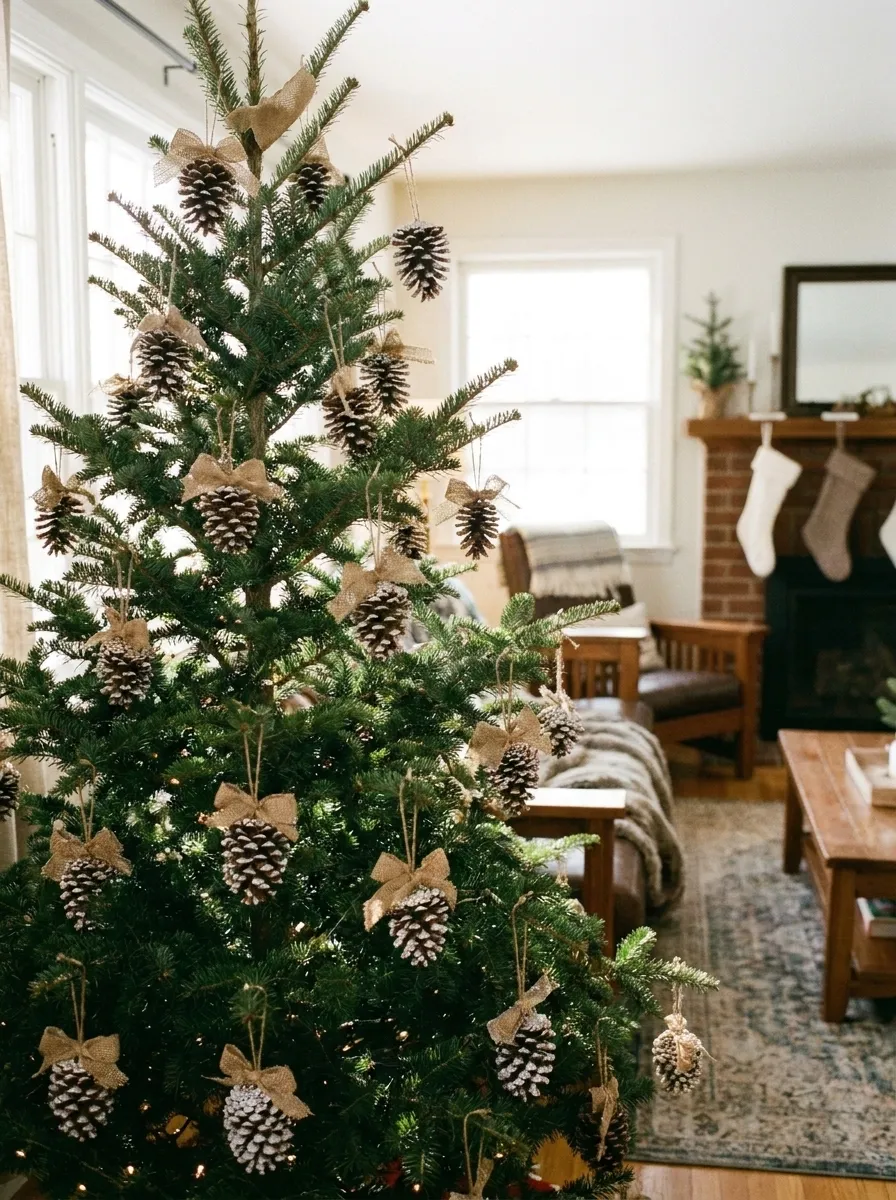
Then budget for shedding. Burlap fibers and pinecone scales drop every time you move the tree, and cones gathered outdoors can carry sap and tiny insects — bake them at 200°F for 30 minutes before they touch your decor. Store them in a sealed bin with a cedar block so they don’t crumble by next December. Annual upkeep: about 20 minutes of vacuuming a week, which is honestly what any tree costs you.
5. A Brass Chandelier Wearing Greenery and Red Berries
The thing that makes this chandelier work isn’t the greenery — it’s the clear glass shades. Because you can see through them, the foliage reads as a wreath orbiting the light rather than a mass of vines swallowing it. Swap in opaque shades and the whole installation turns into a heavy green blob. If you already own opaque shades, keep the garland below the shade line and let the light spill upward instead.
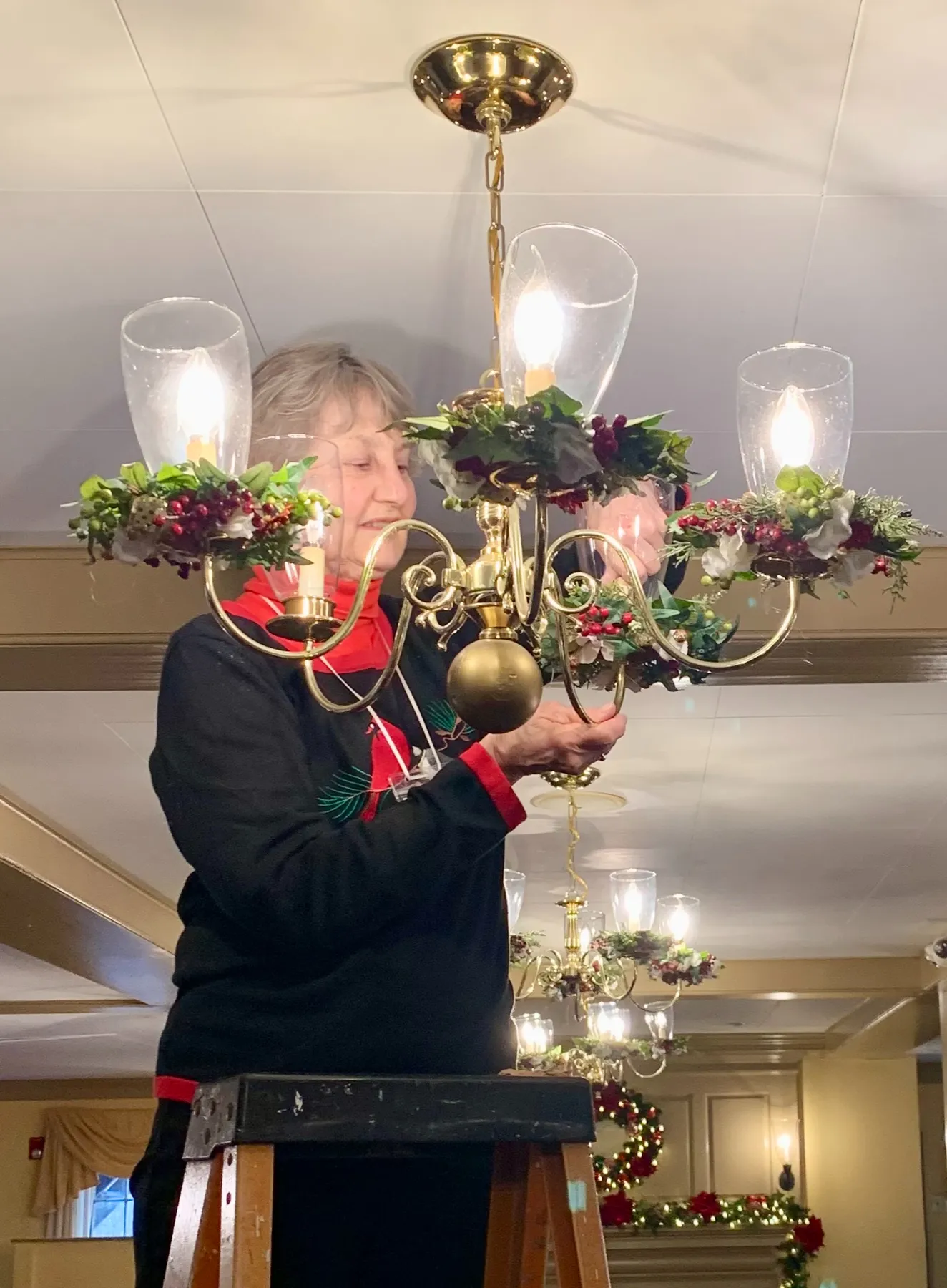
This treatment needs a dining room with at least 10-foot ceilings, or a chandelier hung over a table at least 8 feet long so the greenery doesn’t crowd anyone’s head. In rooms under 9 feet, wrap a small swag around just the canopy and skip the full ring. Small greenery accents like this also read beautifully on the entry banister concept in this collection.
6. A Macrame Christmas Tree in Dark Green and Cream Yarn
- Cut 24 strands of yarn, alternating dark green and cream, each about four times your finished tree length.
- Fold each strand over a wooden dowel and knot it with a lark’s head, keeping the color pattern regular.
- Work downward in rows, trimming each row progressively narrower to build the triangle.
- Thread wooden beads, small bells, and star shapes onto a few strands, then knot them at varying heights.
- Add a wooden star at the top and a deep burgundy accordion fan for depth.
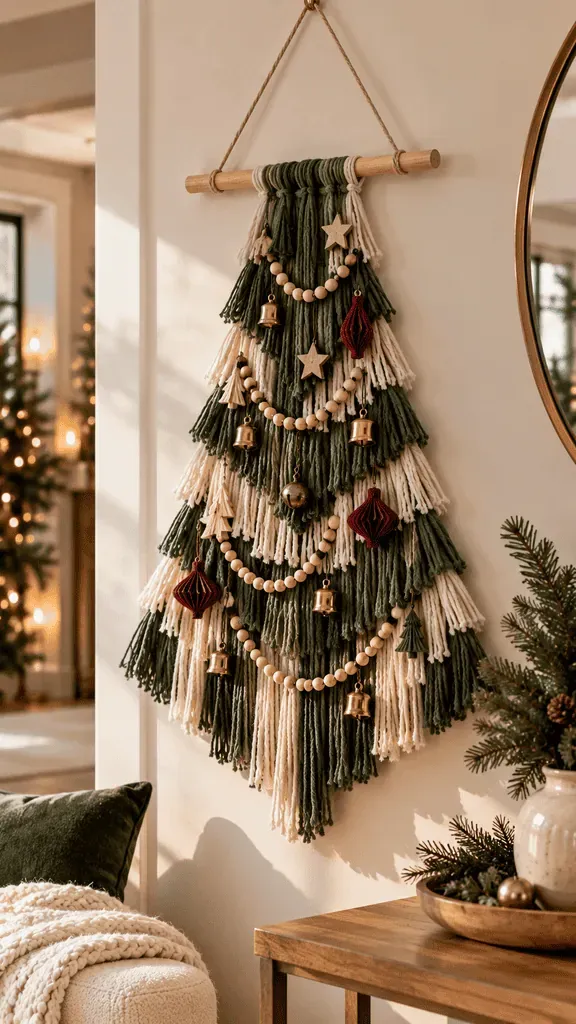
Time: three or four evenings. Materials: $12–$20.
Two things do the heavy lifting: repetition and an uneven edge. The alternating yarn colors create a rhythm your eye reads as texture, while the hand-trimmed rows keep the triangle from looking machine-perfect. Hanging it beside a round mirror adds a soft circle next to a sharp triangle, which is why the corner feels composed rather than crowded.
7. A Vintage Tree Lit With Clip-On Candles and Beaded Garlands
Layer ornaments by depth, not by size. Push the largest, least precious pieces 3 to 4 inches inside the branches, hang mid-size ornaments at the outer third, and reserve the smallest, sparkliest ones for the very tips. That single move makes a tree read twice as full. Stagger your beaded garland in a loose spiral rather than a tight coil, and let it dip between layers instead of hugging the same line all the way down.
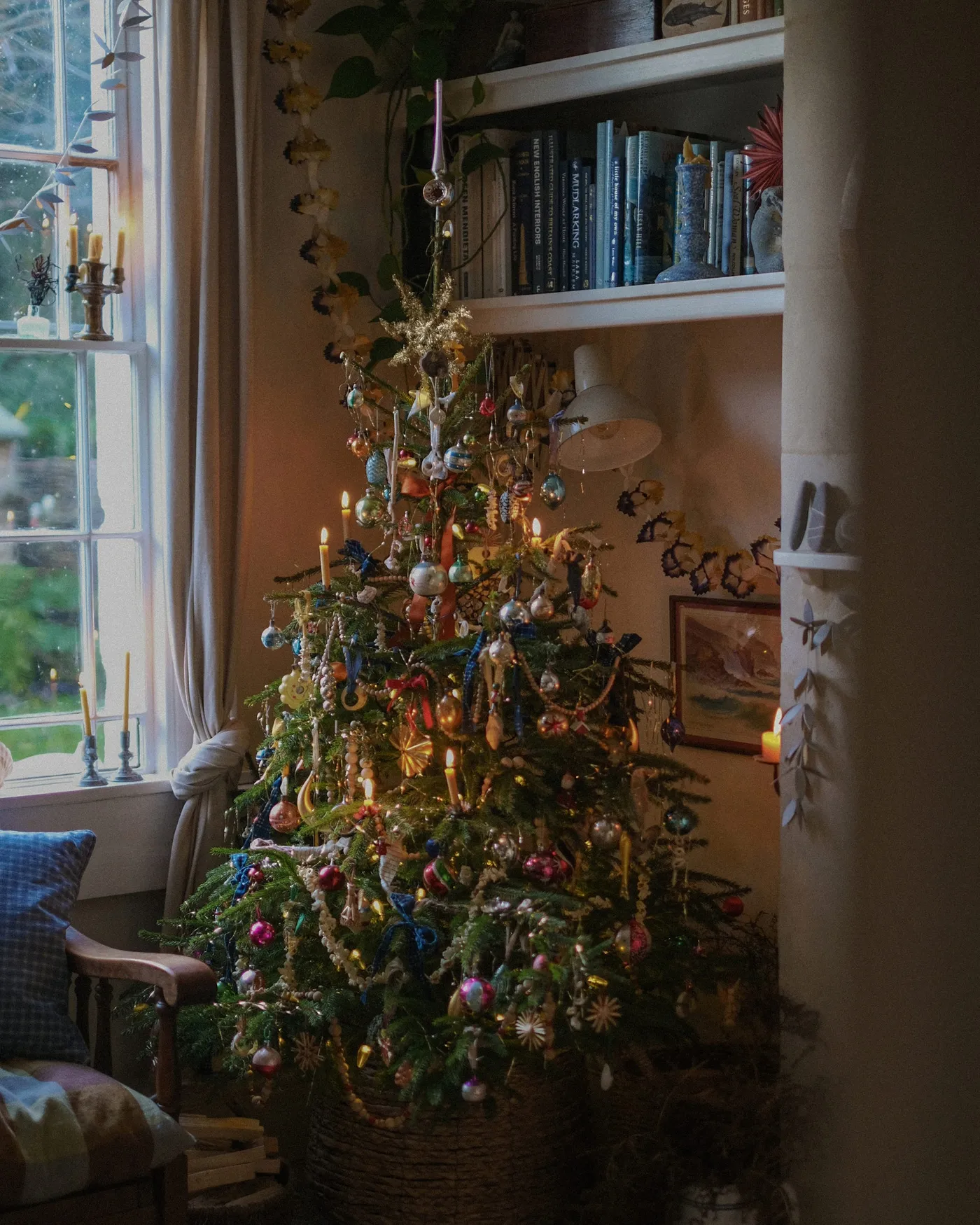
A loaded tree like this needs room to breathe — at least 30 inches of clearance on the sides and 12 inches from the wall, so candlelight and glass catch light from both directions. Room minimum: about 9 by 11 feet. Working with less space? Scale down to a 6-foot tree and use the tabletop version in Idea #13 instead.
8. Candle-Style Lights and Icicles Against Red-and-Brown Wallpaper
Candle-shaped clip lights feel vintage because they are — but you don’t need antiques. Warm white battery clip-ons run about $14 for a set of 20 at Target or Walmart, and dollar-store icicle strands cost $3 a box. Mix in a bag of gold spheres from Facebook Marketplace, usually $5 to $10 for 50, and you’ve built the same layered old-fashioned glow for under $40 instead of the $200 a curated set would cost.
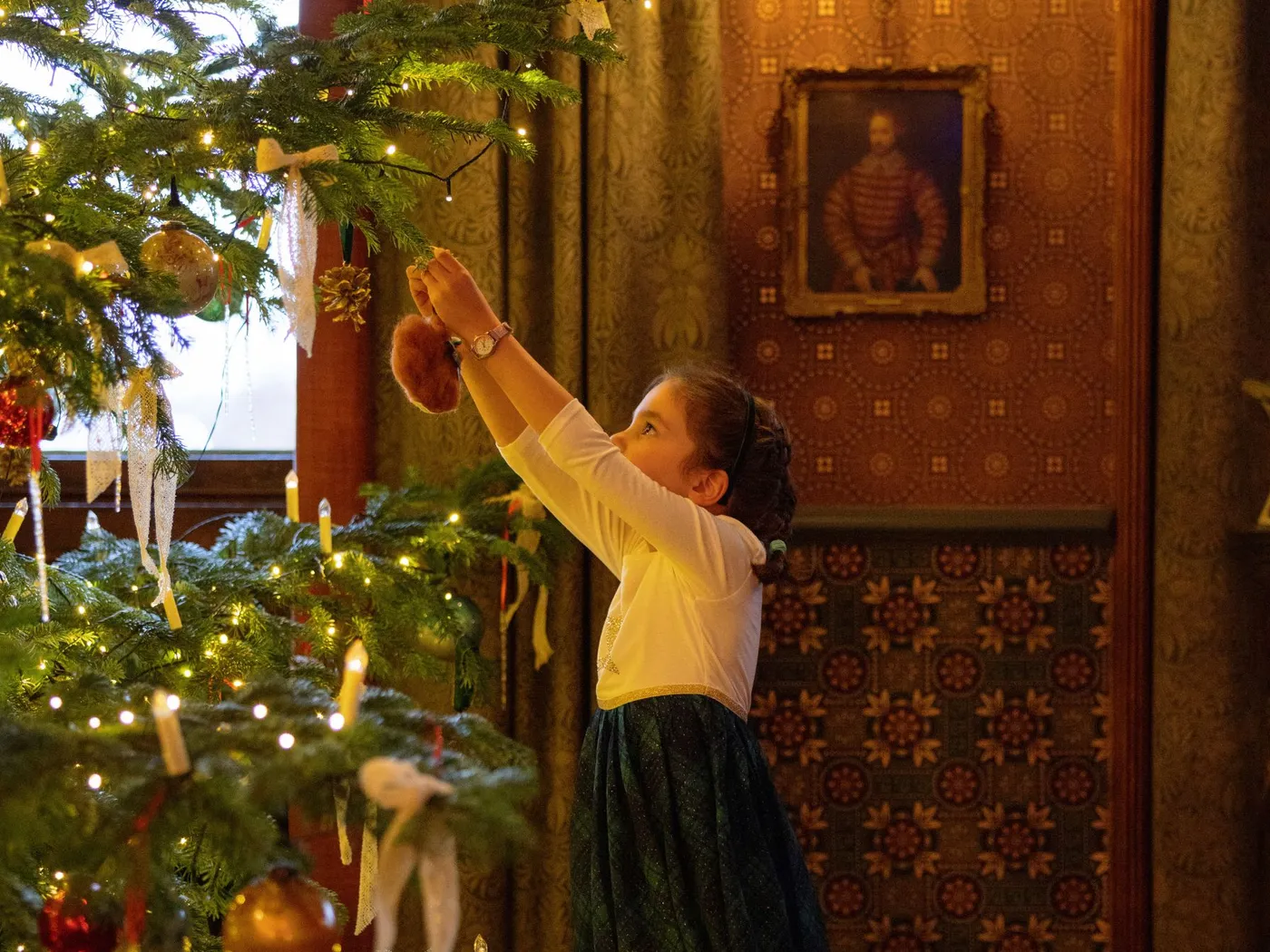
Two cautions, though. Candle-style lights are the most knocked-off ornaments on any tree, so if you have a toddler or a cat, clip them to the upper third only. And icicles plus glass balls show every fingerprint, while patterned wallpaper shows every scuff. If your room already carries that much pattern, keep the tree relatively simple and let the walls do the talking.
9. Colored Tape Christmas Trees on a Sliding Glass Door
- Clean the glass and let it dry fully — tape will not stick to a smudged door.
- Use removable vinyl or washi tape; painter’s tape works but curls at the edges within a week.
- Build each tree as a zigzag: one side of the triangle, then the other, then the trunk.
- Add a star from two overlapping triangles and press every corner firmly with a fingernail.
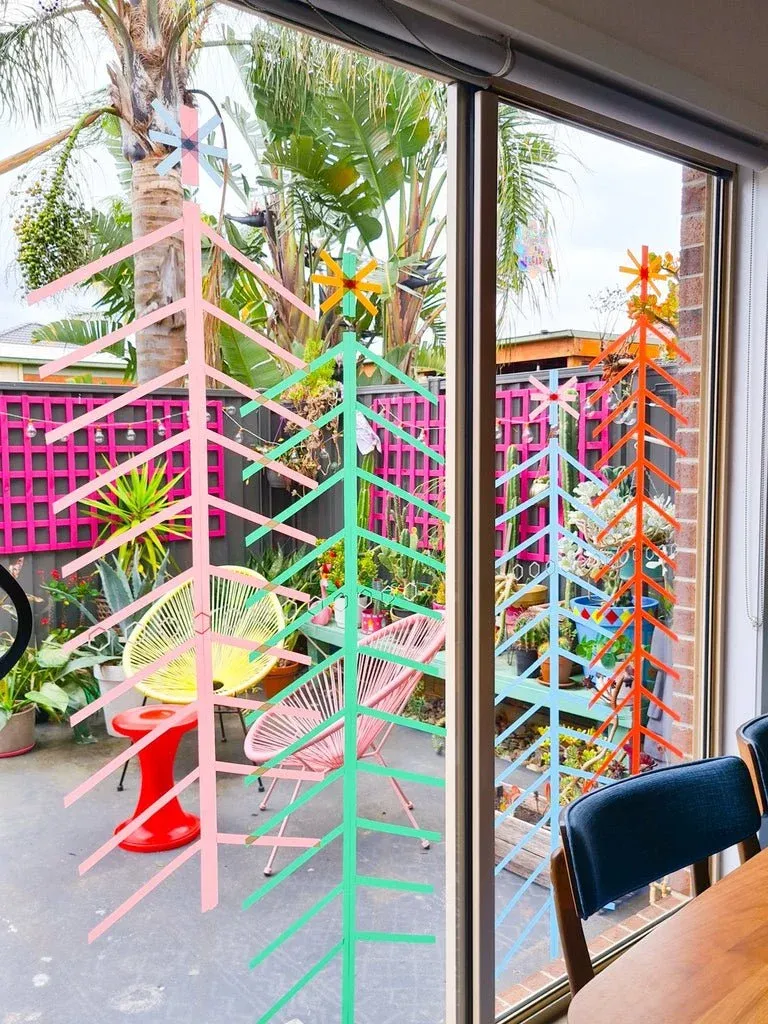
Time: 45 minutes for three trees. Materials: $8–$15, and it peels off clean in January.
Tape-on-glass decor is having a real moment because it solves three problems at once: it costs almost nothing, it works in rentals, and it lets kids help without risking a single heirloom ornament. The saturated pink-and-green palettes trending in 2026 borrow directly from the Memphis revival happening in furniture right now — playful by design, and gone without a trace.
10. Red Glitter Strawberries Tied With Velvet Ribbon
- Glitter-dusted strawberry ornaments, set of 12: $18–$35
- Red velvet ribbon, 10 yards: $6–$12
- Pre-lit 7-foot tree: $90–$200
- Extra warm white lights, if yours isn’t pre-lit: $18–$30
- Light grey woven wicker tree collar: $40–$80
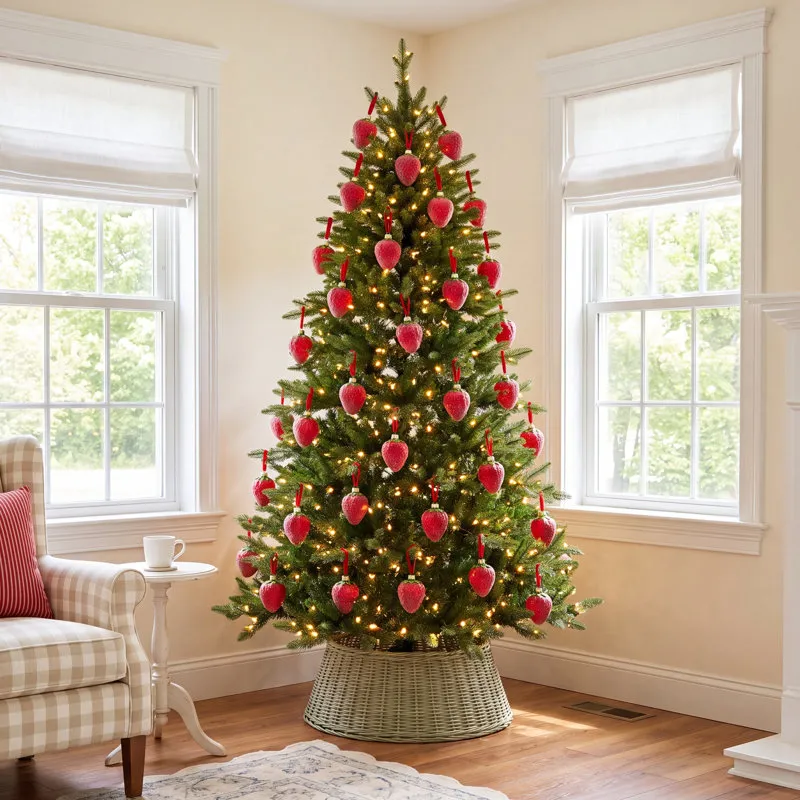
Budget alternative: buy plain red ball ornaments at a dollar store and glue a small felt strawberry cap on each — about $12 total, and nobody is going to inspect them that closely.
Strip away everything but the velvet ribbon and this tree still works. That’s the test. One repeated ornament in one saturated color, tied with one consistent ribbon, does more than five mixed collections ever will, because repetition creates confidence. The woven collar matters too — it grounds a bright tree better than a fabric skirt, which tends to puddle under all that red.
11. A Cream and Faux Fur Christmas Corner With Yarn Ball Ornaments
This corner works because the texture changes at every level: knit, faux fur, woven basket, raw wood, matte yarn. When your palette stays inside one narrow family — cream, light wood, deep green — texture becomes the only way to create contrast, and that’s exactly what keeps a neutral Christmas cozy instead of clinical. Notice the single deep green tree anchoring five shades of off-white. That one dark value is the punctuation mark.
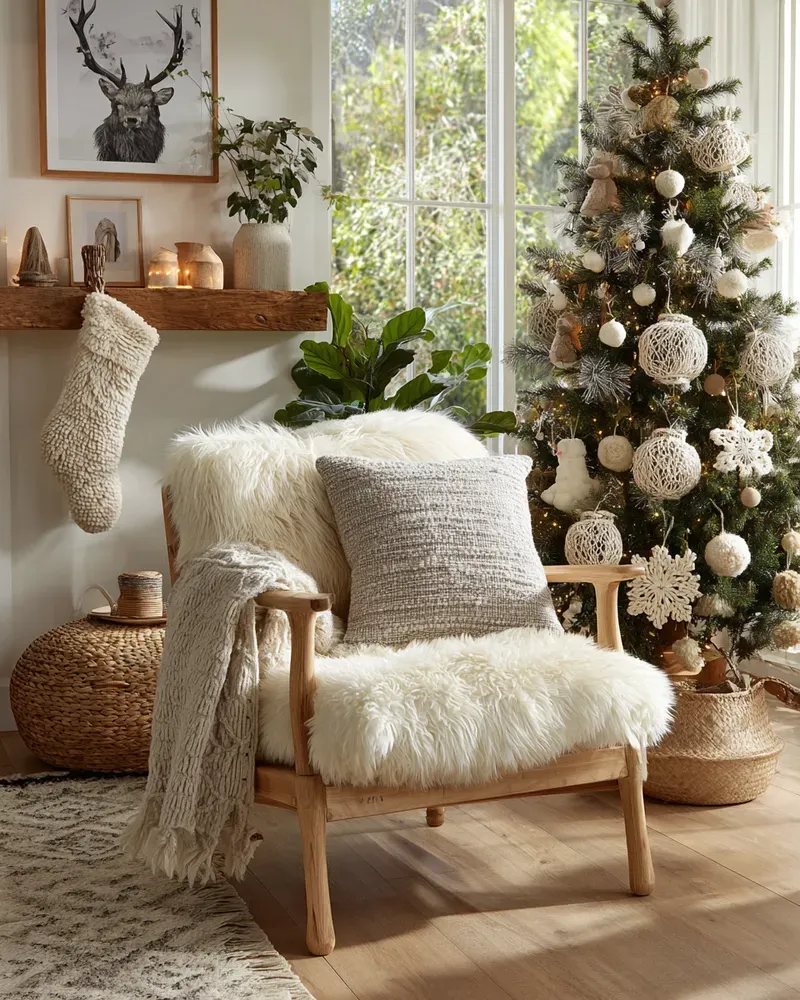
Faux fur and knitted ornaments are the low-maintenance dream of holiday decor: nothing to break, no glitter to vacuum out of grout, machine-washable in most cases. The trade-off is storage — anything fuzzy or woolen needs a sealed bin with a cedar block, because moths adore cream wool. Expect about $15 once for bins and ten minutes a year checking for damage.
12. Dark Grey Walls, a Deer Triptych, and Branches Overhead
Branch installations look effortless in photos and take a real afternoon in practice. Anything overhead needs anchored points — find studs or use toggle bolts rated for at least double the weight of your branches. Keep the lowest hanging piece at least 7 feet above the floor, or you’ll be ducking through your own living room by week two. Skip it entirely if you have low ceilings or a ceiling fan in the path.
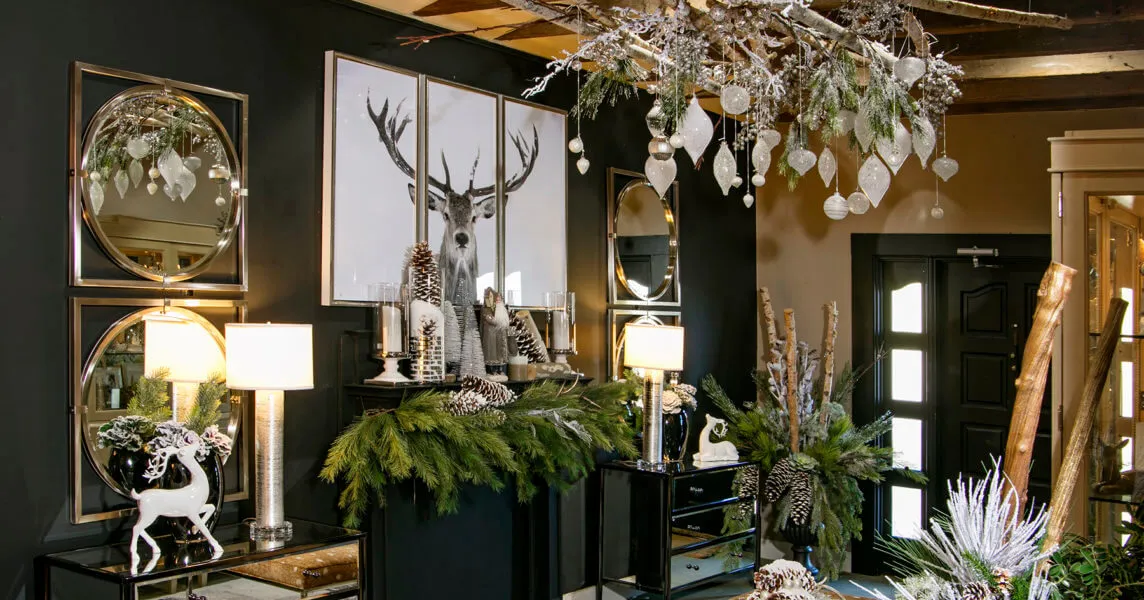
On dark walls, lighting direction changes everything. Point two uplights or picture lights at the deer triptych from below and the black-and-white art will look like it’s floating off the wall. Keep the frosted garland below the artwork instead of draping across it, and leave about 4 inches of bare dark wall on each side — negative space is the difference between moody and muddy.
13. A Tabletop Tree With Red Berries, Gold Baubles, and Wrapped Gifts
A 24- to 30-inch tabletop tree is the right call for rooms between 60 and 120 square feet, or any surface at least 18 inches deep — a console, a nightstand, a kitchen counter. Wrapping the base in burlap makes it visually read a full size larger than it is. Working with a big room instead? The grand ceiling display in Idea #23 fills volume the way this one fills a corner.

Here’s the honest math: a small artificial tree is $25–$45, a red bauble and berry set is $10–$20, and the gifts cost whatever you were spending anyway. The trick is the wrapping. Gold ribbon from a dollar store, kraft paper from an office supply aisle, and burlap left over from another project gets you the same styled look for about $35 total. Those vertical string lights behind it? Two strands of warm white, about $14.
14. A Flocked Tree With a Lobster Ornament and Cable-Knit Stockings
Coastal Christmas math: 50% white and cream base (flocked tree, cable-knit stockings, white mantel) + 30% classic red and green + 15% navy blue nautical accents + 5% brass. The navy is the ingredient most people skip, and it’s the one that makes the whole thing read coastal instead of just traditional. Trade the lobster for a sailboat in a landlocked house and the formula still holds.
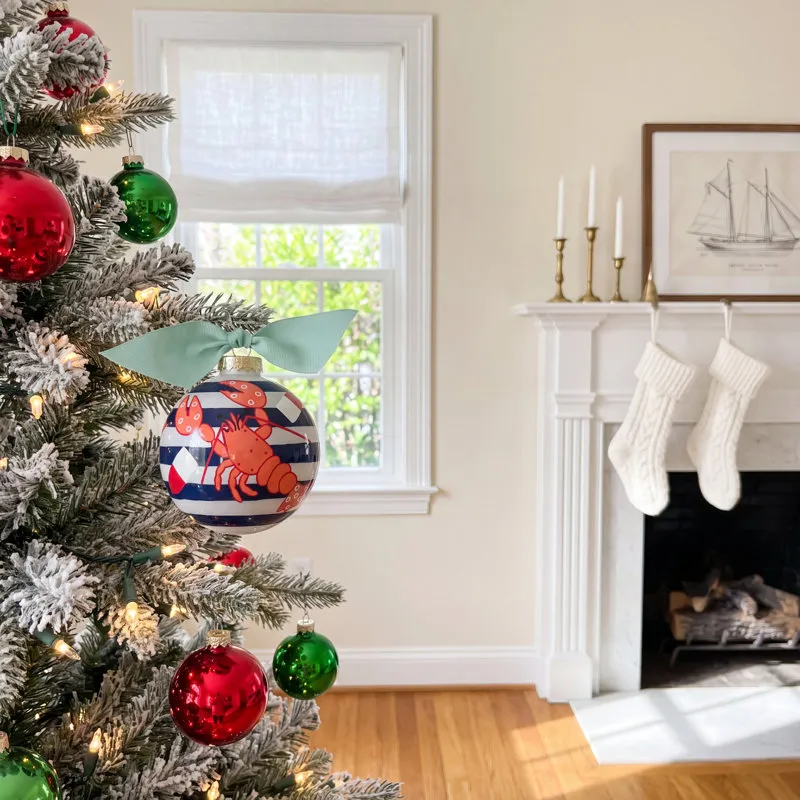
Flocked trees shed — expect a light dusting of fake snow every time you move it, and never vacuum it with a brush attachment unless you enjoy unclogging hoses. Cable-knit stockings wash on gentle without complaint, but flocking yellows in a hot or humid storage space. A dry, climate-controlled bin keeps it white for six to eight seasons. After that, a fresh can of spray flock costs about $12.
15. Red Taper Candles and a Pink Paper Chain by the Dining Table
It’s the paper chain. Everything else on this table — the tree, the candles, the turned-leg wood — is traditional, and the pink-and-white chain strung across the window is the one element that says someone made this by hand in this century. Remove it and you have a nice holiday table. Keep it and you have a room with a personality. Paper chains cost about $3 in materials and they photograph better than anything you can buy.
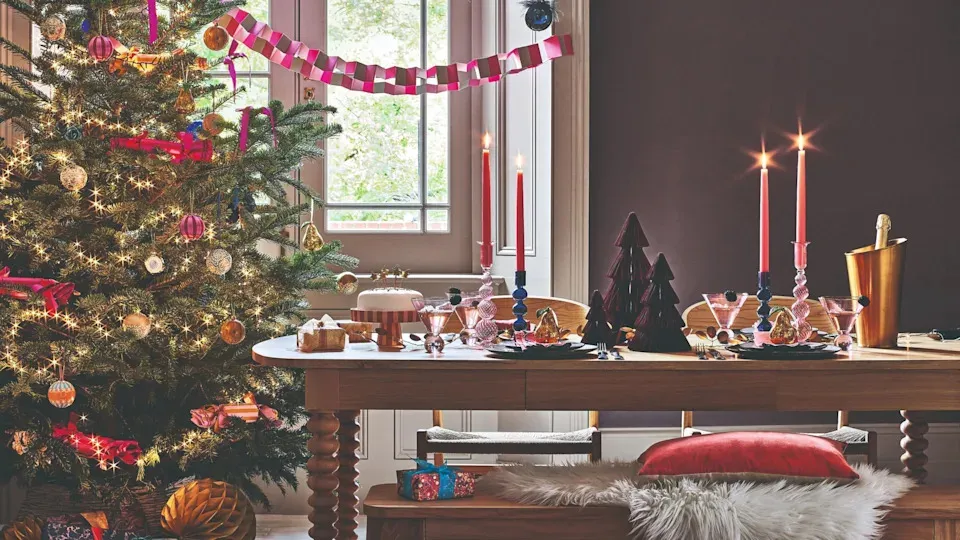
Dining rooms are the fastest-growing category in holiday decorating right now, and the reason is simple: it’s the one room where people actually gather, so decor earns its keep. The 2026 twist is mixing candy-colored glassware and paper garlands into traditional red-and-gold settings. Inexpensive, cheerful, slightly irreverent — this is a trend with real staying power, because it’s built on things people already do.
16. Maximalist Christmas With Blue-and-White Porcelain Everywhere
- Garland, fresh or realistic faux: $60–$150 for a large run
- Blue-and-white porcelain accents, thrifted: $25–$80
- Multicolor vintage-style ornament sets: $30–$70
- Patterned tablecloth and a centerpiece: $25–$60
- Gold-framed mirror or art, if you don’t own one: $40–$120
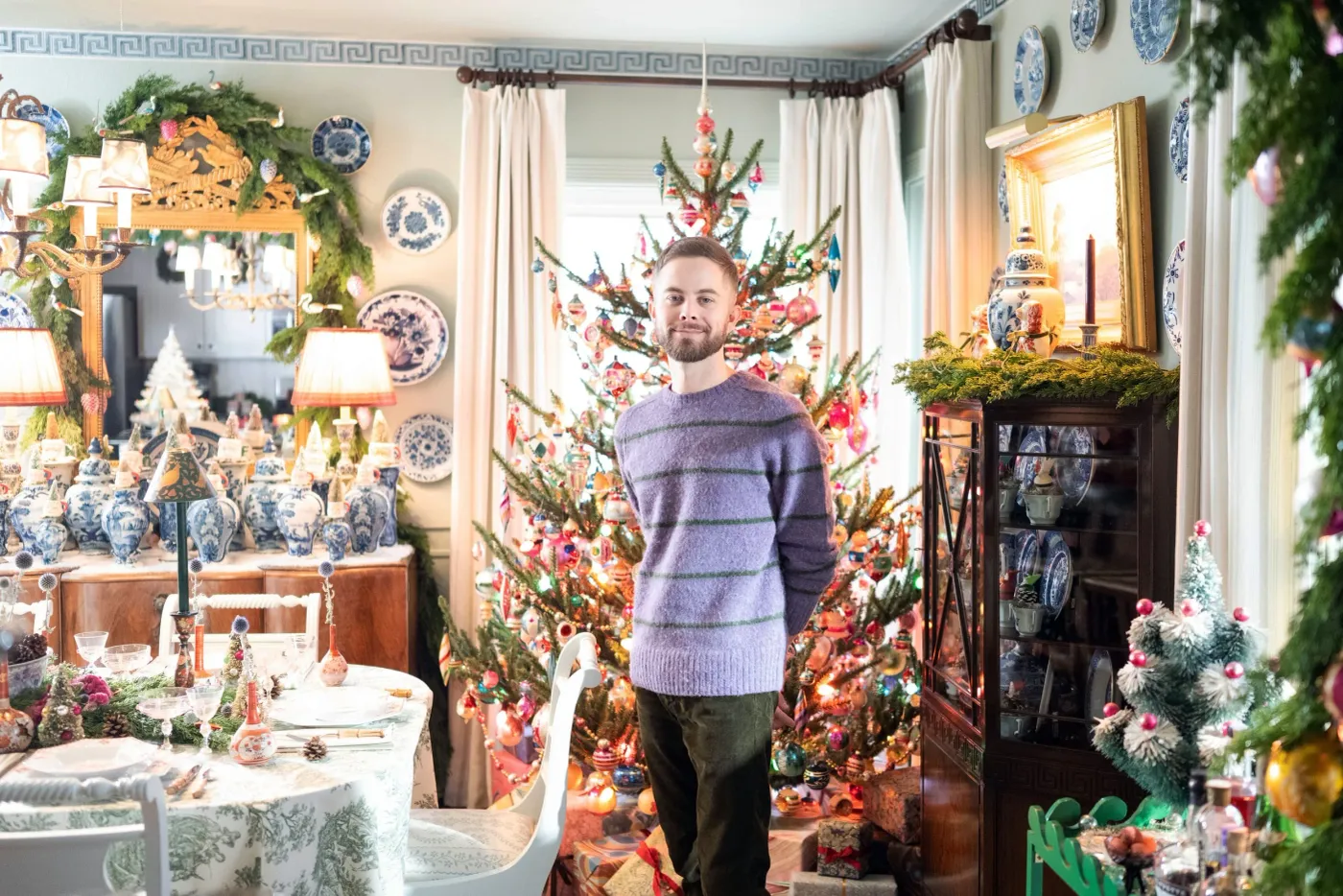
Budget alternative: skip the ornament sets and raid estate sales and Goodwill for loose vintage glass, sold by the bag for $3 to $8. The mismatched colors are the whole point.
- Measure every surface you plan to cover — abundance needs about 70% coverage per surface, not 100%
- Pull out what you already own first; collections look best when they’re genuinely yours
- Check whether your walls can carry a stronger palette — light blue handles multicolor, dark walls fight it
- Set a hard limit per surface so abundant doesn’t tip into cluttered
17. A Knitted Leaf Garland on a Dark Braided Stem
- Knit or crochet 12 to 18 leaves in fall colors — or buy a bag of loose knitted leaves for about $8.
- Braid three strands of dark brown yarn into a stem roughly 4 feet long.
- Sew each leaf to the braid at the base only, so the tips stay loose and lift off the surface.
- Alternate leaf sizes and angle them in different directions down the length.
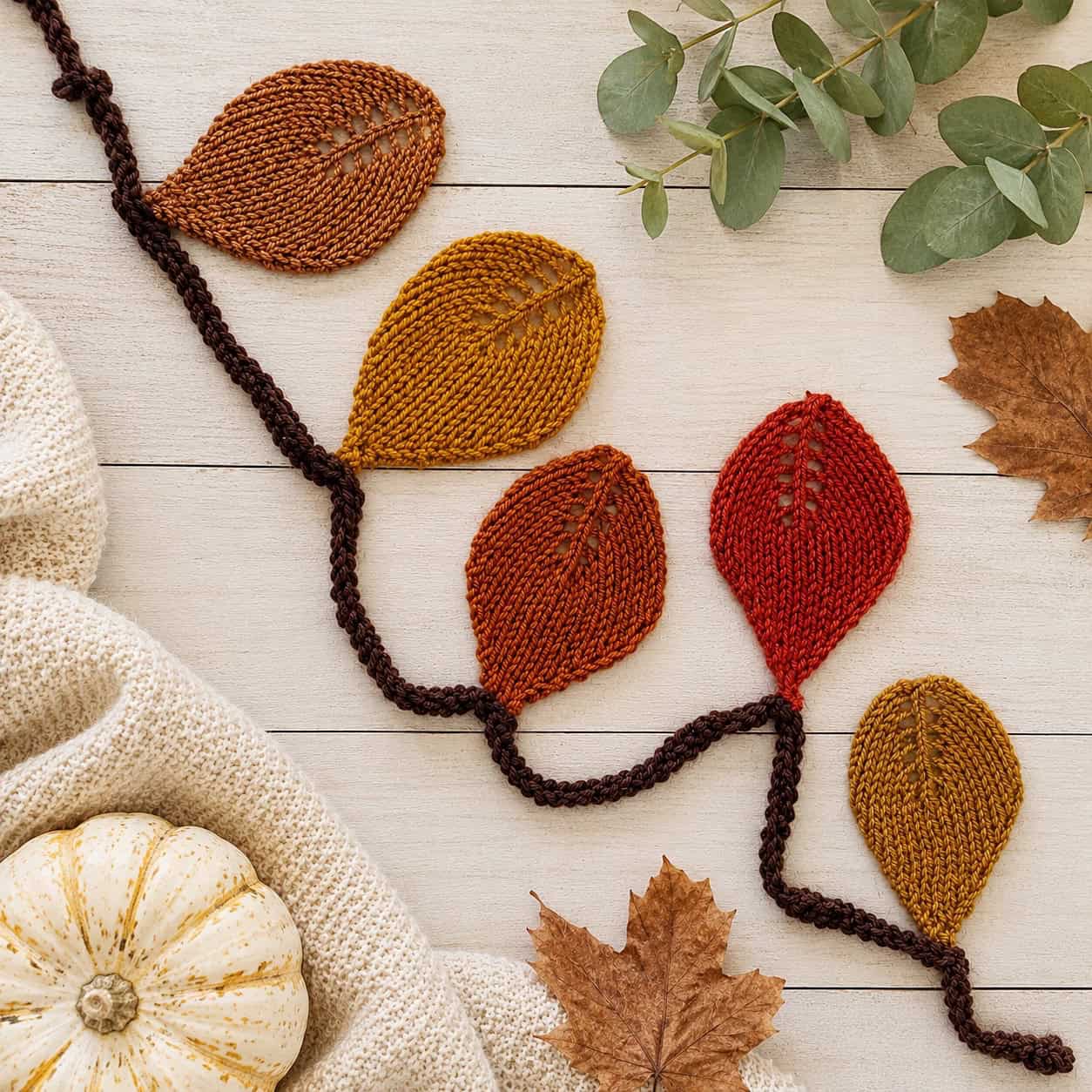
Time: about two hours, plus drying. Materials: $10–$25.
The palette is deliberately lopsided: 40% burnt orange and red-orange, 25% mustard yellow, 20% dark brown, 15% cream. That’s more orange than most people would dare, and it works because the dark braided stem gives all of it somewhere to land. Swap mustard for rust and cream for sage and you have a spring version of the exact same formula.
18. Curtains Printed With Garland So You Never Hang a Swag
Printed curtain panels are the least expensive way to fake an heirloom holiday look — no swag, no nails, no swearing. Order panels 1.5 to 2 times your window width so the print stays full without stretching, and hang the rod about 4 inches below the ceiling to make the window look taller than it is. Wash them on cold and hang damp: ironing a print this detailed takes 40 minutes you will never get back.
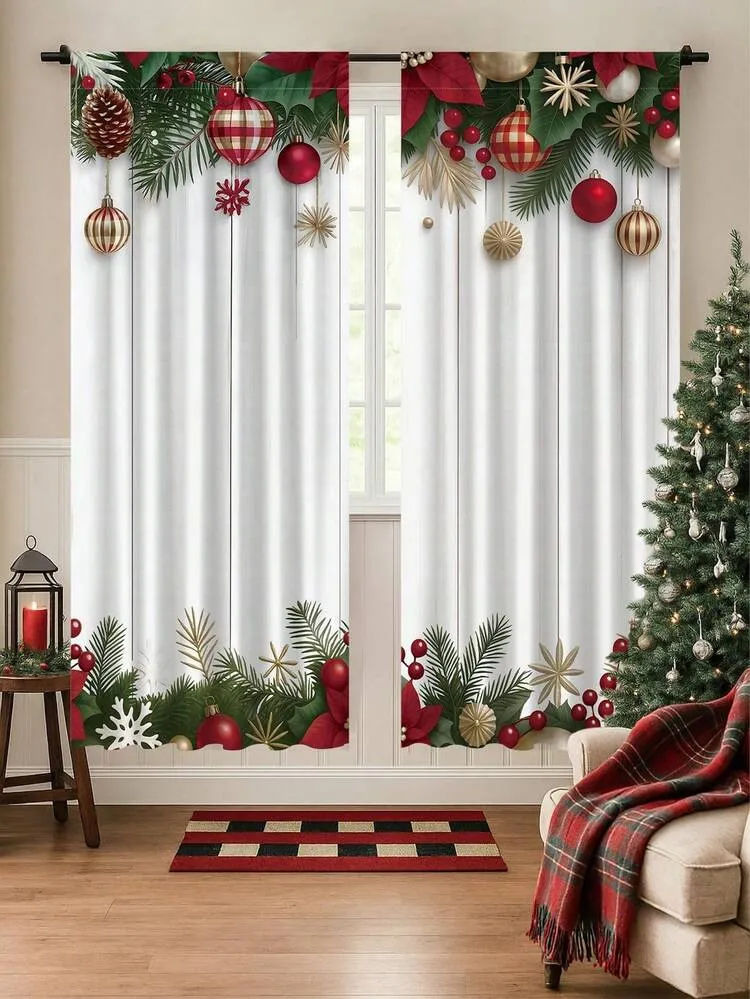
The trick is that the garland print lives on the borders, not the middle. Your eye catches green pine and red berries at the top and bottom, which frames the window exactly the way real swags would, while the center stays white and keeps the room bright. The red plaid throw and the black lantern echo those colors lower down, so the corner reads as one composition rather than three separate purchases.
19. A White Entry Hutch With Faux Fur Stockings and Boots Full of Greenery
Faux fur stockings look expensive and aren’t: Target and Walmart both run them for $8–$14, and thrift stores often have them for $3. Fill a pair of tall boots you already own with clipped greenery from a $9 garland, and hang the garland across the hutch with removable hooks instead of nails. The whole setup lands around $45 — and for a dressier entrance with color instead of cream, compare it with Idea #3.
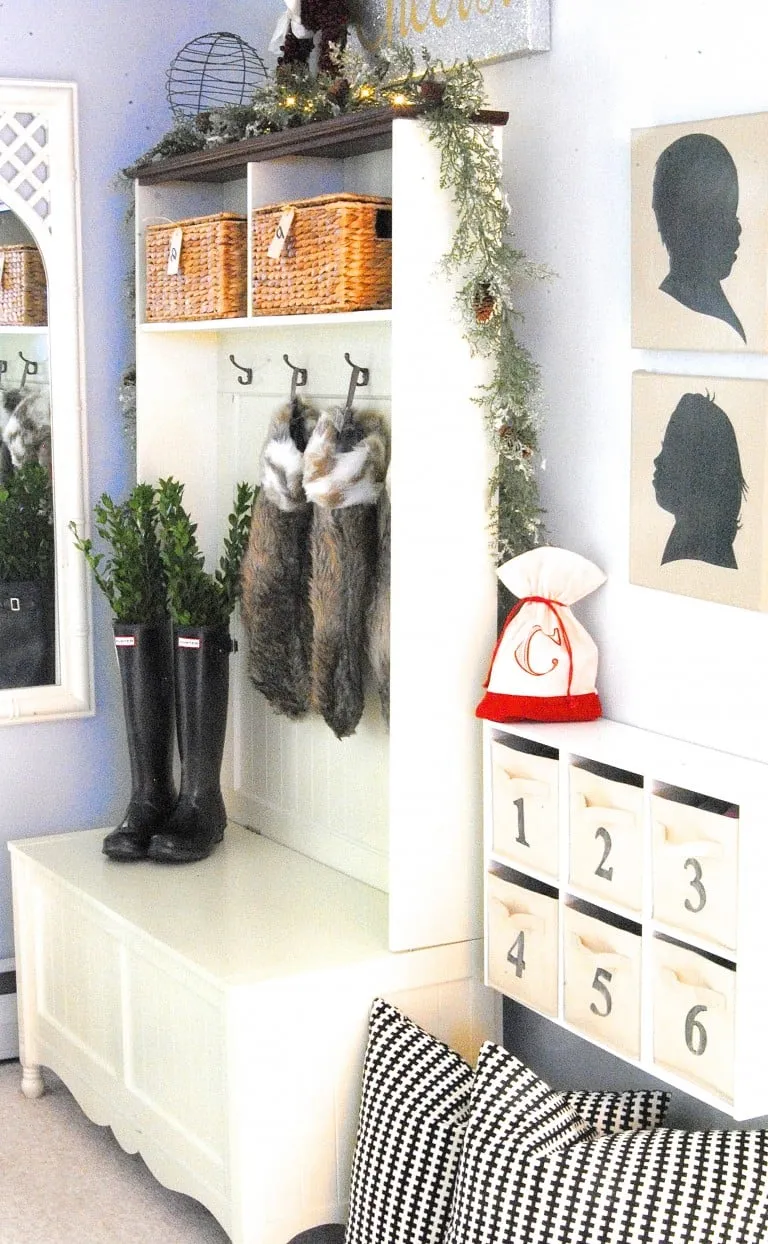
- Clear the hutch completely first — you’ll style it better with an empty surface
- Weigh your stockings; faux fur plus a gift inside can pull a small hook right off
- Check that the boot greenery isn’t blocking a walkway your family uses daily
- Decide where the extension cord runs before you plug anything in
20. Gold and Silver Ornaments in a Woven Basket Collar
Metallic ornaments only look expensive when the ratio is right: roughly 60% one metal, 40% the other. An even split reads like a discount bin. Keep your lights warm white rather than cool, since cool light turns gold green, and use a woven collar instead of fabric — a basket catches and softens the light at the base, while fabric just absorbs it and disappears against the floor.
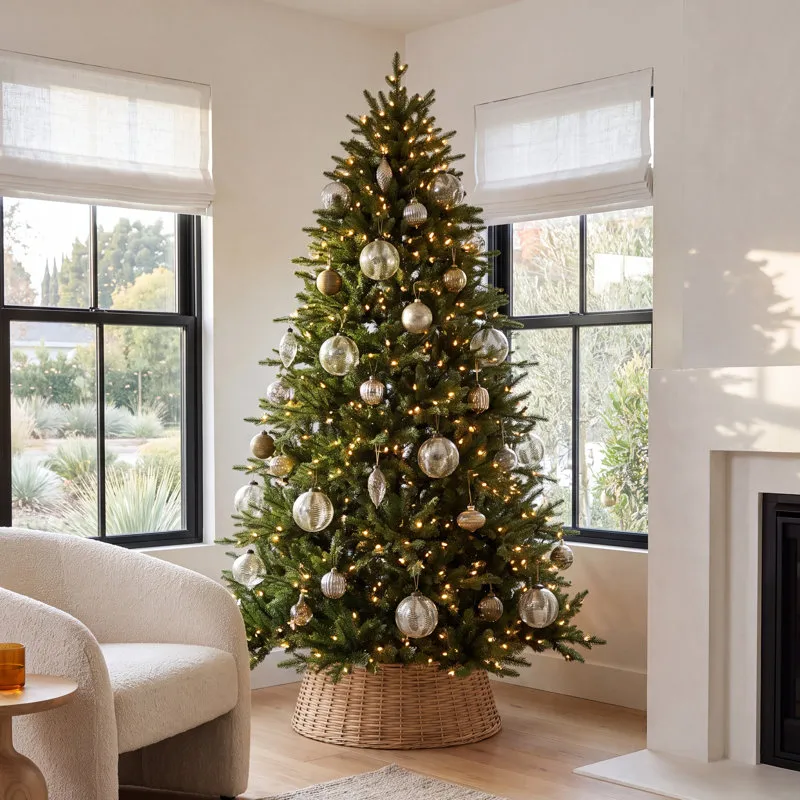
This layout wants a corner with at least 4 feet of wall and 18 inches of clearance on the open side, which works in most living rooms from 150 square feet up. A 7-foot tree needs a 9-foot ceiling to top out comfortably; drop to 6 feet under 8-foot ceilings. If your floorspace is tighter than that, the neutral corner in Idea #11 squeezes in without looking cramped.
21. A Wooden Market Stall Garlanded With Dried Orange Sachets
- Wooden gabled display stand, built or thrifted: $20–$70
- Evergreen garland with string lights: $25–$50
- Dried orange slices and cinnamon sticks: $8–$18
- Mesh bags and twine: $5–$10
- Mini flocked trees, set of three: $18–$35
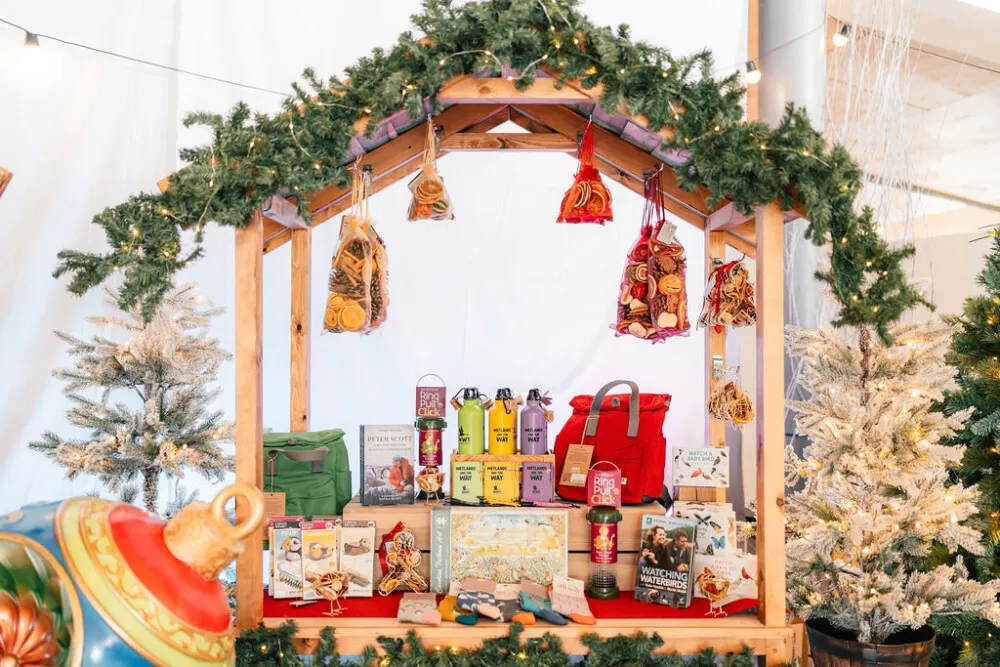
Budget alternative: build the stand from scrap wood and skip the flocked trees entirely. The dried citrus sachets do all the visual work, and they cost pennies each.
The orange and spice sachets are doing something most decor can’t: they smell. Warm spices read as holiday to your brain faster than any color palette, and hanging them at eye level means the scent hits you before you see it. Repetition helps too — a dozen small identical shapes at slightly different lengths reads as generous abundance, and it’s the same principle behind Idea #1.
22. Black Metal Elves Holding Toilet Paper in a Holiday Bathroom
Whimsical bathroom decor is a joy until it’s in the way. Keep anything floor-standing out of the path between the door and the toilet, and never place fabric or garland within 2 feet of a heater vent — bathroom humidity plus fabric is a mildew recipe. If this is a guest-visible powder room, it’s a great spot for personality. If it’s a busy family bathroom, expect the elves to get relocated. Constantly.
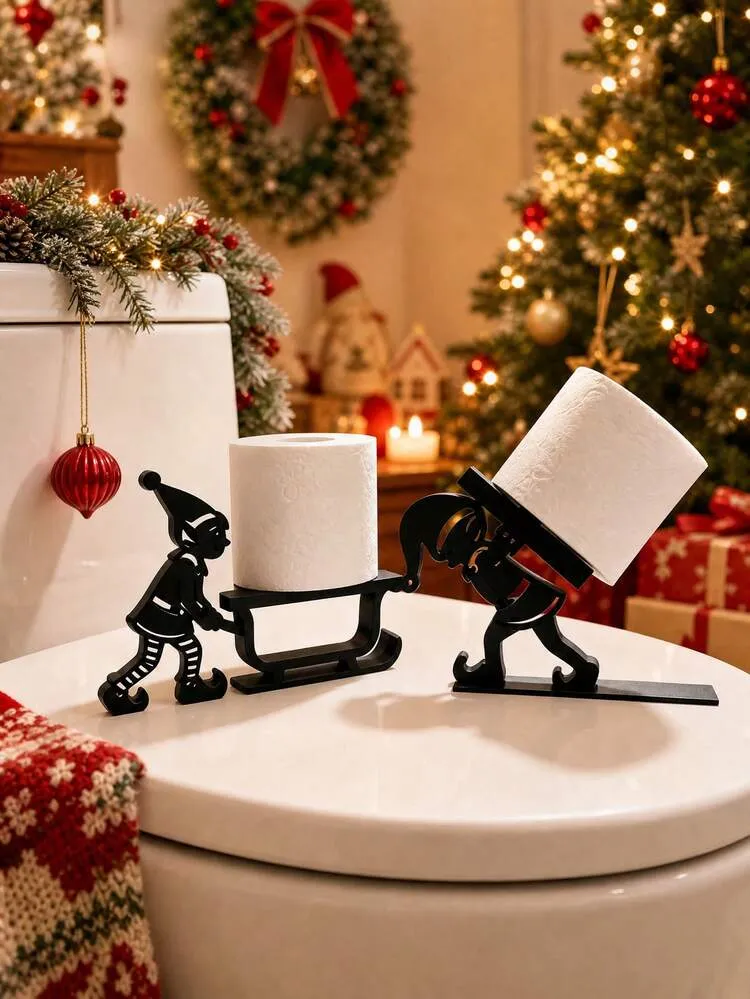
- Choose a spot with 8 to 10 inches of free space beside the toilet for a standing figure.
- Wipe the surface dry — metal figures sitting on a damp tank leave rust rings.
- Wrap the tank garland with the battery pack tucked behind the tank, not inside it.
- Test that the roll still spins freely once the figure is in position.
Time: 15 minutes. Materials: $15–$40 for the holders, plus about $12 for lights.
23. Ceiling-Hung Stars and Oversized Ornaments in a Grand Hall
Ceiling decor is the biggest thing happening in holiday decorating for 2026, and it started in commercial lobbies that people photographed and brought home. Hanging stars, oversized teardrops, and long beaded garlands fill the volume above eye level, where most homes have nothing going on at all. You don’t need a lobby — one row of paper stars on fishing line over a dining table gets you most of the effect for the price of a pack of cardstock.
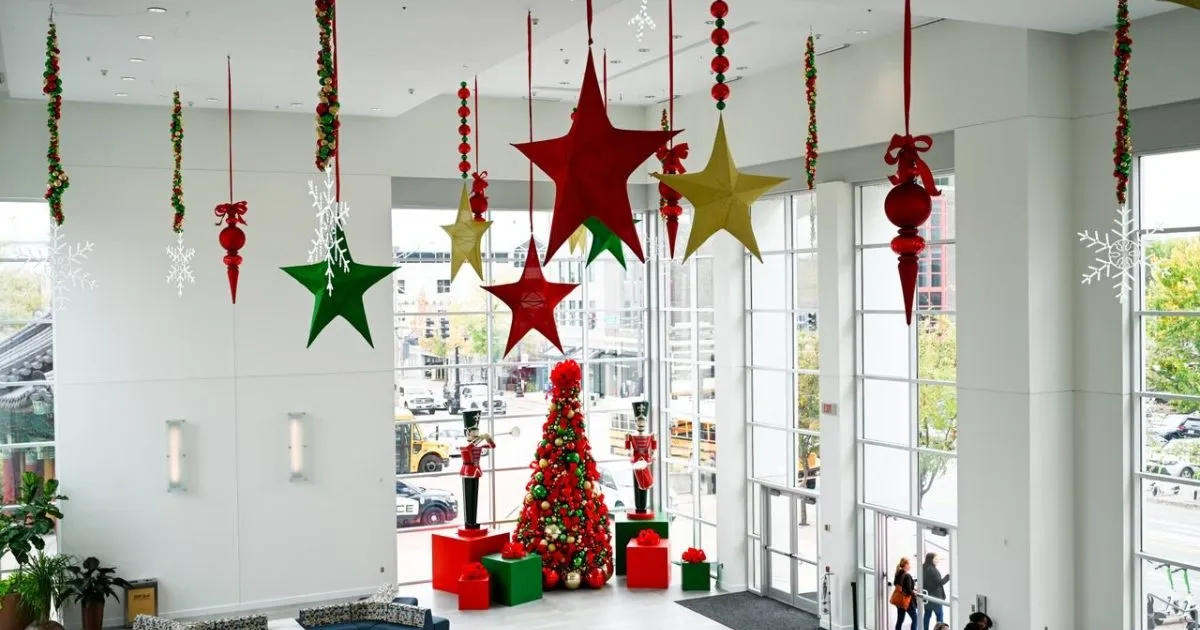
The scale contrast is everything here. Nutcrackers the size of a person, gift boxes you could climb into, stars the size of dinner plates — every element is bigger than it should be, which is why the room reads as theatrical instead of cluttered. Scale everything down to normal and you’d just have a nice tree in a big empty space. Oversize is the whole idea.
24. A Fuzzy Green Deer Beside Pastel and Metallic Eggs
Whimsical seasonal styling leans on one rule: 50% white and light wood surface, 30% pastel (pink, blue, green, yellow), 15% metallic gold and bronze, 5% something fuzzy or animated that makes you smile. The gold is what keeps the pastels from looking like a nursery. Swap the pastels for jewel tones and the same formula handles winter without a single new object. Pair it with the knitted garland in Idea #17 and your whole year of seasonal decor is covered.
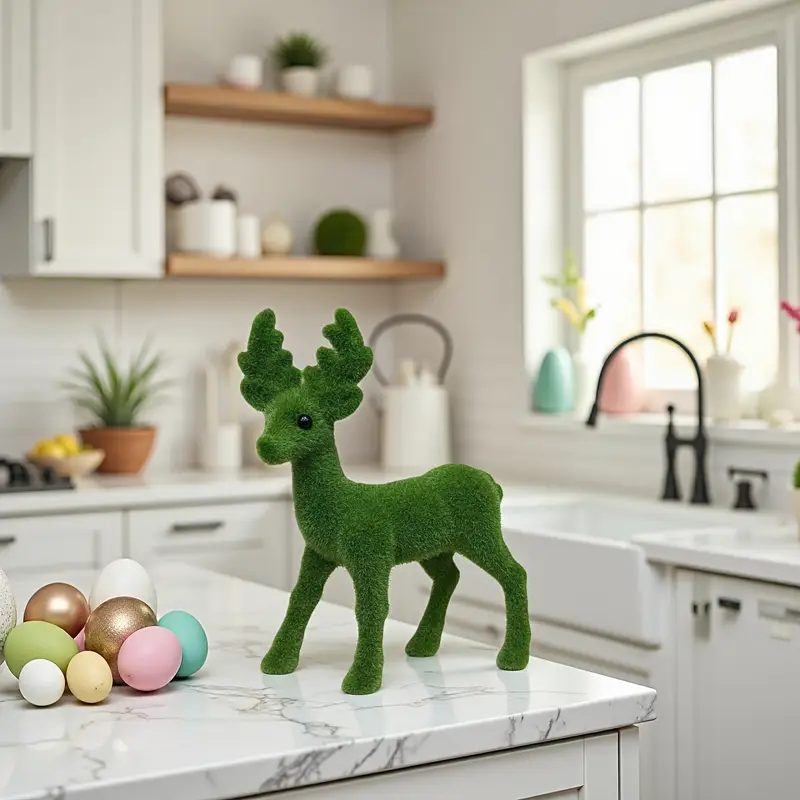
- Check your counter depth — 12 inches of clear space reads as styled, 6 inches reads as clutter
- Confirm the figurine isn’t hiding an outlet or your sink sprayer
- Decide how much daylight the kitchen gets; pastels go muddy in dim rooms
- Group in odd numbers — three, five, or seven eggs, never four
25. A Christmas Tree Built From Wooden Dowels and Beads
- Cut a 1-inch central dowel to 5 feet and drill evenly spaced holes down its length.
- Thread large wooden beads onto the pole to set the spacing between each tier.
- Cut horizontal dowels in decreasing lengths, from 30 inches at the bottom to 8 at the top.
- Slide each one through its hole and secure with a dab of wood glue.
- Top with a wooden star and hang light ornaments only — this is a display, not a load-bearing tree.
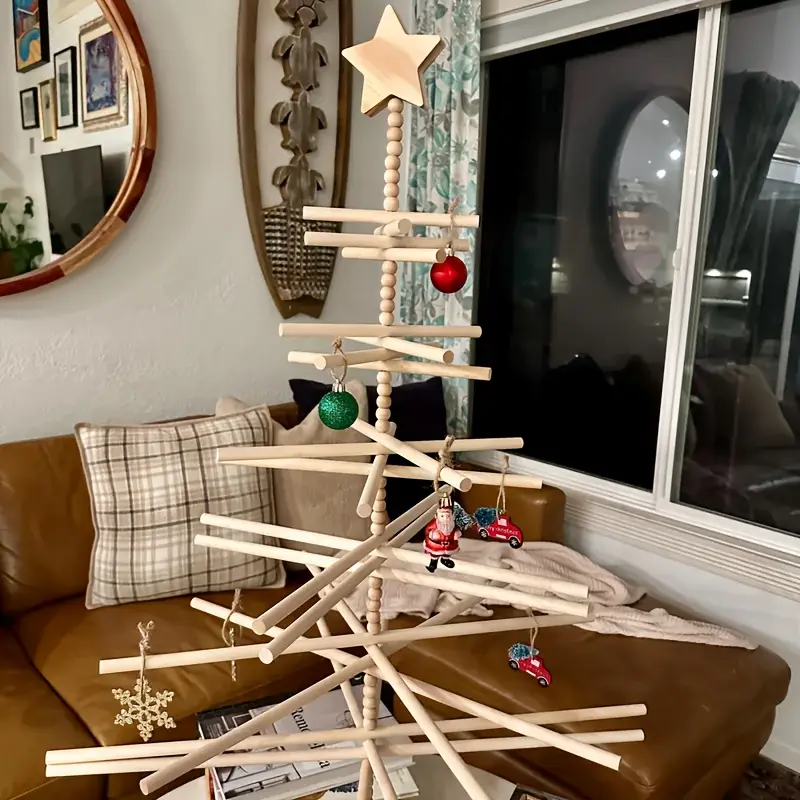
Time: one afternoon plus drying. Materials: $25–$40.
- Dowels and beads: $12–$20
- Wood glue, sandpaper, and stain: $10–$15
- Wooden star topper: $5–$12
- Lightweight ornaments, thrifted or dollar store: $10–$25
Budget alternative: use a single thrifted wooden ladder instead of building the frame — same rustic triangle, about $15 at a flea market. See Idea #6 for the yarn version of a tree that isn’t a tree.
Make It, Hang It, Live in It
None of the best holiday rooms in this collection came out of a single box — they came from a twine bow tied slightly crooked, a bag of dollar-store ornaments, and a free afternoon. Pick one project this weekend, start with what you already own, and let the rest of the season catch up.
📌 Pin your favorite idea now so it’s waiting for you when the boxes come down from the attic.