
Most people assume a blue Christmas tree commits you to one look — frosty, and a little bit cold. Then they see a heavily flocked fir lit with warm white bulbs behind sheer patterned curtains and realize blue might actually be the coziest color in the room.
We spent serious time browsing Target, Etsy, and Anthropologie, plus a few late nights in Wayfair’s ornament aisles, to pull together 27 ideas that actually deliver. Everything here spans $18 to $1,200, with budget and luxury versions sitting side by side so you can see exactly where to spend and where to save.
Inside you’ll find flocked finishes, coastal starfish, jewel-toned velvet ribbon, plaid accents, pastel mermaids, and one sculptural tree you’ll either love or text a friend about. Blue is having a real 2026 moment as people move away from the same red-and-green formula. And stay until the end — we break down the most common mistakes that can ruin these looks.
📌 Save this to Pinterest for later — you’ll want to revisit these ideas.
This post contains affiliate links. If you buy through them, we may earn a small commission at no extra cost to you.
1. Flocked Blue Tree Glowing Against a Big Paneled Window
The trick here is temperature. A saturated blue tree reads cold on its own, so warm white string lights do the heavy lifting — they pull the blue toward cozy instead of clinical. Heavy white flocking adds a second layer, softening the silhouette until the tree looks snow-dusted rather than painted. Sheer patterned curtains on either side frame the window and filter daylight through the branches during the day, so the flocking glows from behind. The white faux fur skirt finishes the job by bouncing a little light up into the lowest branches, which would otherwise go dark.
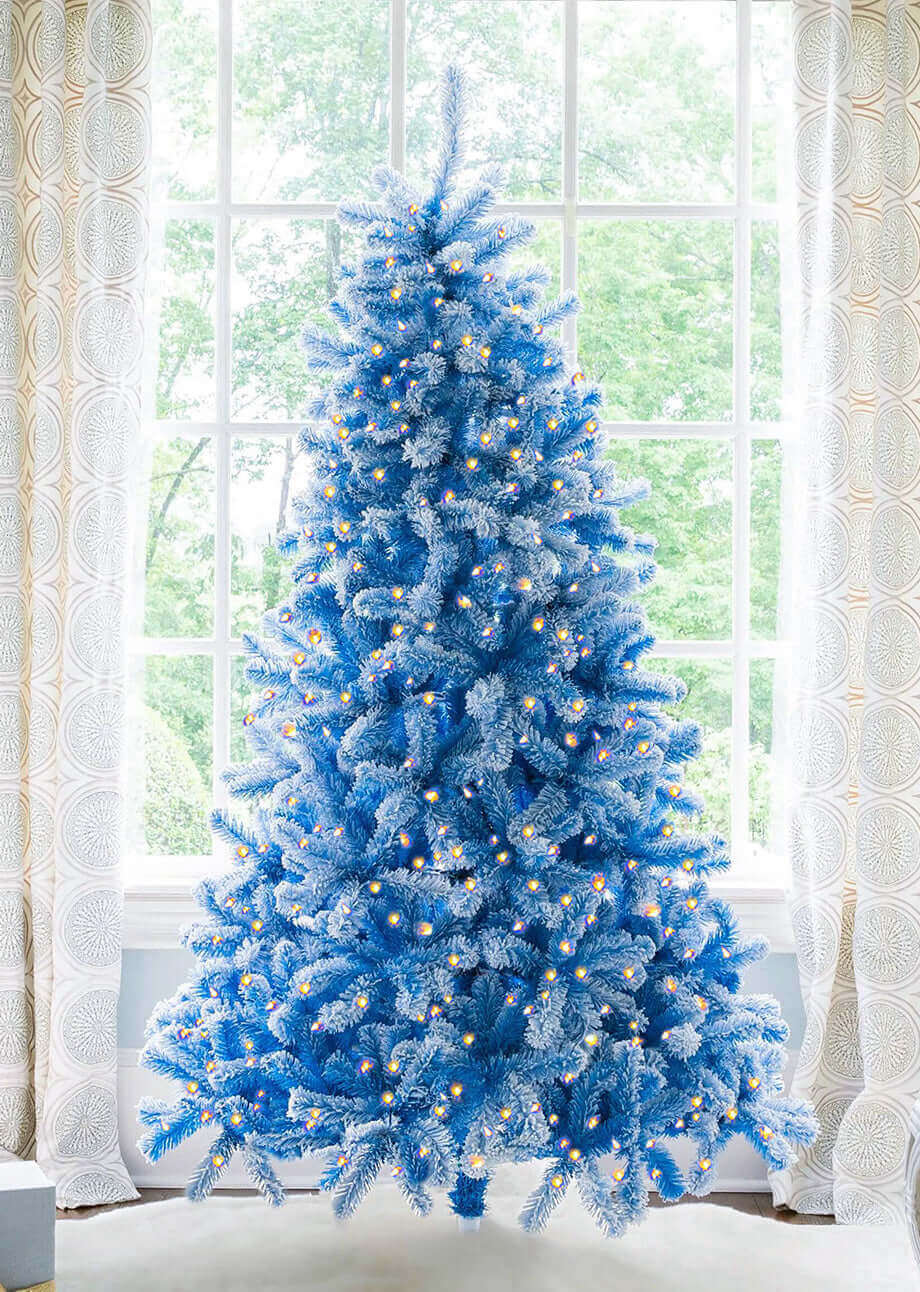
This setup wants roughly 9 feet of clear wall width and a window with a sill about 30 inches off the floor, so the tree skirts the glass instead of blocking it. Ten-foot ceilings are ideal; at eight feet, cap the tree at 7 feet and keep the fur skirt low-profile. If you’re working with one small window, look at Idea #7, which builds the same layered blue-and-white feeling at a much tighter footprint.
2. Red Glitter, Navy Sparkle, and One Fuzzy Monogram
A ratio keeps this from turning into a theme: aim for roughly three warm ornaments for every one blue, and let the blue ones be the largest pieces on the tree. Then allow exactly one oversized personal ornament — a fuzzy monogram letter, a felt figure, a family craft — and hang it at eye level, between 56 and 62 inches from the floor, where it can’t get lost in the branches. Two or three personal pieces and the tree stops reading as styled and starts reading as a scrapbook. Keep glitter finishes out at the branch tips, never pushed inward, so they catch daylight from the window.
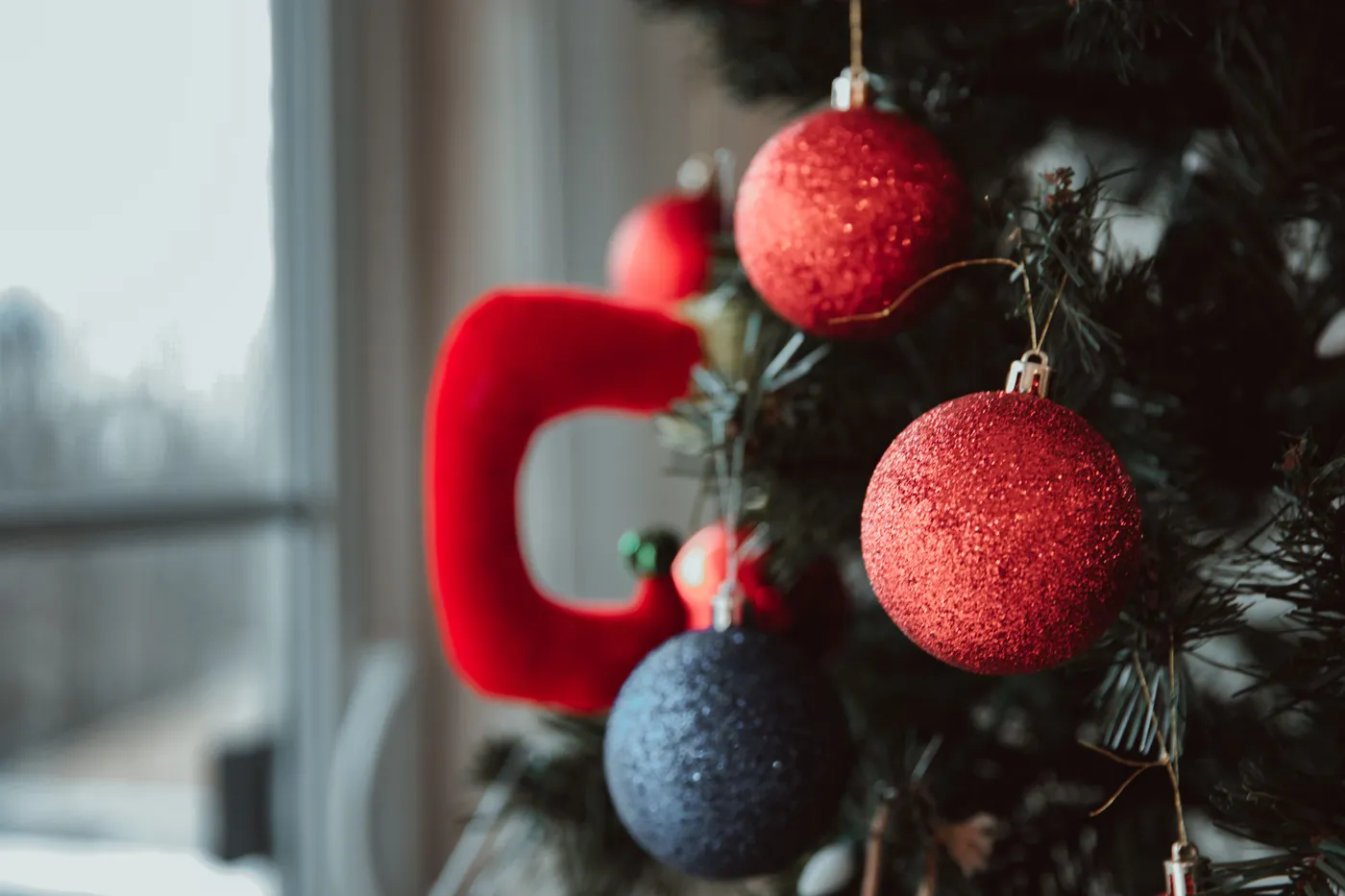
40% forest green base + 30% sparkling red + 20% glittery navy blue + 10% soft white light. Green acts as the neutral here, which is why this much red and blue can coexist without clashing — the tree itself does the mediating. Swap red for copper and navy for emerald and you have a completely different tree on the identical formula. Swap in blush and lilac and it turns candy-shop sweet. Just don’t let the accents pass 50% combined, or the green stops reading as Christmas and starts reading as a background.
3. Frosted Blue and Silver Tree Tied Up in Velvet Ribbon
Here’s what a 7.5-foot version realistically costs:
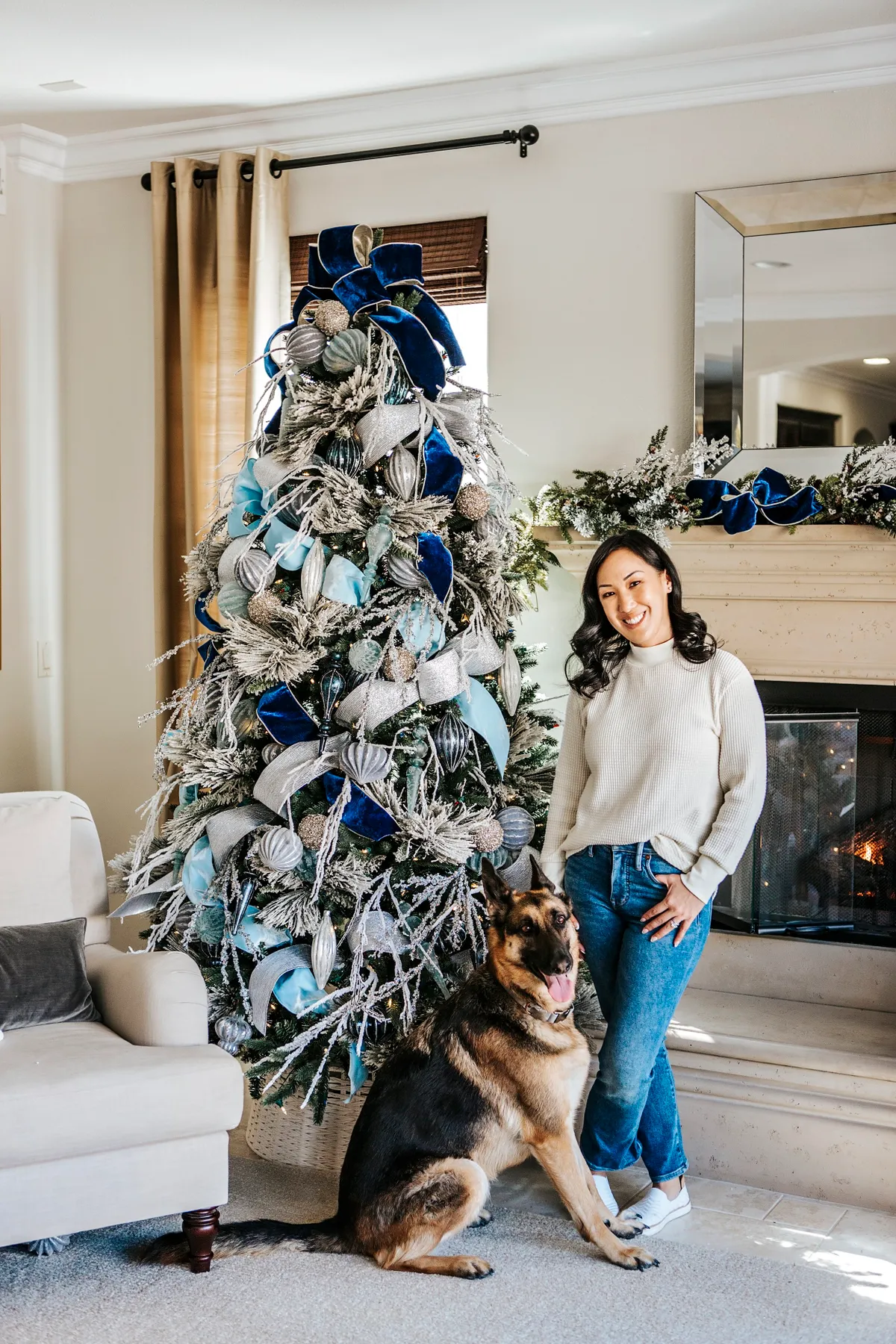
- Flocked tree, unlit or pre-lit: $180–$450
- Deep blue velvet ribbon plus light blue fabric ribbon, 4 spools: $45–$95
- Silver, ice-blue, and glitter ornaments, about 60 pieces: $70–$200
- White woven tree skirt or collar: $30–$75
- Warm white string lights: $20–$45
Total: $345–$865. Budget alternative: a $99–$150 unlit flocked tree from Walmart or At Home, velvet ribbon from a fabric store’s remnant bin at $4–$7 a yard, and a Facebook Marketplace bundle of silver baubles gets you to roughly $220.
It’s the ribbon. Not the ornaments, not the flocking — the ribbon. Ribbon draws one continuous line from the top of the tree to the bottom, so your eye travels vertically instead of bouncing around a field of shiny circles, and velvet specifically absorbs light while it reflects, which is why it reads richer than satin at the same price per yard. Take the ribbon away and you’re left with a pretty but flat tree. Cut strips 18 to 24 inches long, tuck the ends into the branches rather than knotting them, and space them every 8 to 10 inches.
4. Mantel Garland with Blue Velvet Bows and Icicles
Measure your mantel first, then buy a garland 12 to 18 inches longer than the span so it can pool at the ends.
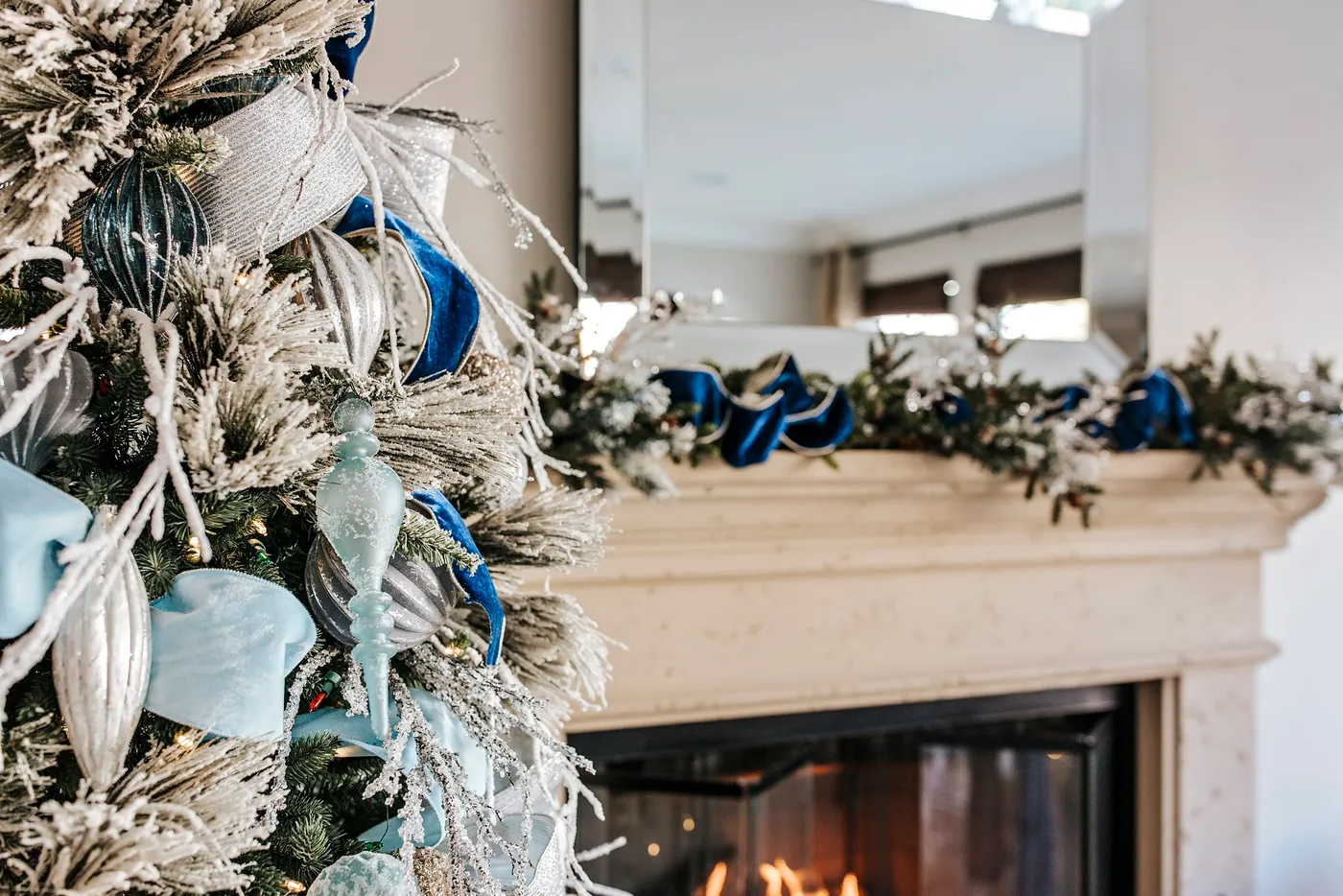
- Loosen every branch by hand for five minutes — flocked garlands ship compressed and look thin straight out of the box.
- Wire 5 to 7 velvet bows onto the garland, spacing them so none sits directly over a stocking hook.
- Tuck 3 to 4 icicle or drop ornaments around each bow, hanging them at slightly different lengths.
- Hide the wire with small frosted sprigs.
- Fluff once more, then step back and check the silhouette from the doorway, not from two feet away.
Time: about 45 minutes. Material cost: $35–$90, less if you’re reusing last year’s garland.
A $25 flocked garland from Target plus $8 of 2.5-inch velvet ribbon from Walmart gets you about 90% of this look — people notice the bows, not the needle density. For ornaments, buy one mixed box of silver and blue at $20 rather than three curated sets at $40 each. Check Facebook Marketplace in early December: mantel garlands are one of the most commonly resold holiday items, often still in the box, at 40 to 60% off retail. The mirror above stays — it doubles the garland and makes a modest arrangement look twice as generous.
5. A White Tree, Teal Baubles, and One Giant Polar Bear
A white tree in a light blue room is a lot of pale on pale, and it goes one of two ways. With warm white lights and one strong anchor — the polar bear, a dark table, a woven basket — it reads serene and deliberate. With cool white LEDs and nothing to hold it down, it reads washed out and slightly institutional, especially in photos. White trees also show dust far more than green ones, and older ones yellow with age and heat, so store yours somewhere cool and dark. If you want the pale look with less upkeep, a flocked green tree gives you most of the same feeling.
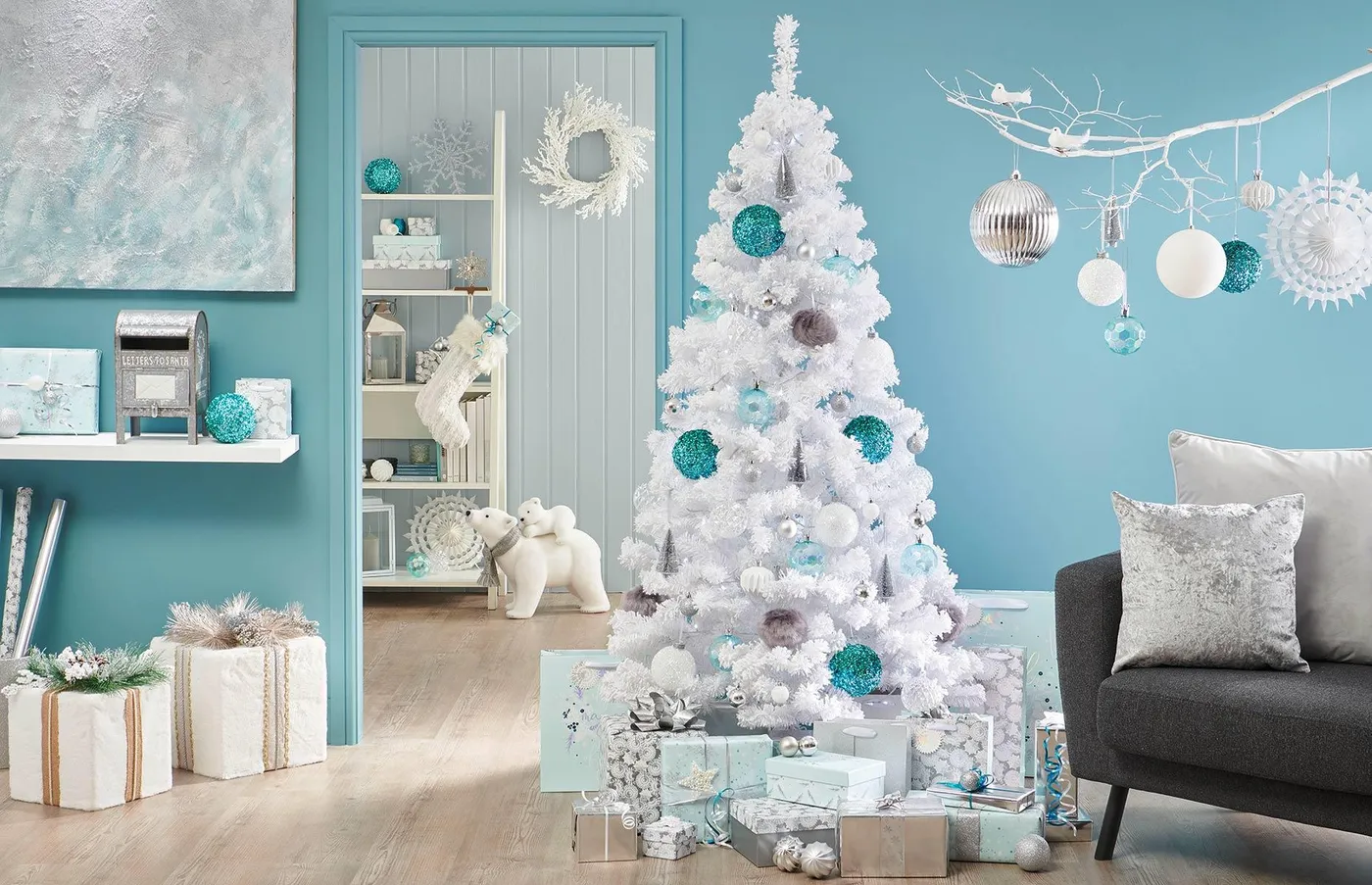
This is the winter-white tree that hangs around past New Year’s. The whole point of a blue-and-white scheme is that it doesn’t scream December — swap the ornaments for plain silver in January and it works through February without anyone raising an eyebrow. That extended-season logic is the same reason icy palettes keep gaining ground on Pinterest every year: people are decorating for a season, not a single holiday. So the trend has real staying power. Want one holiday-specific splurge? Spend it on the tree and keep the ornaments season-neutral.
6. Coastal Starfish Tree with Driftwood and Galvanized Metal
Three colors, one motif, repeated at every scale. The starfish shows up as an ornament, in the gift styling, and on the driftwood arrangement in the galvanized bucket — so the theme feels collected rather than bought as a set. The second move is the one people miss: rough materials. Galvanized metal, driftwood, and unbleached paper sit next to fluffy white and warm gold, and that slight friction stops a coastal tree from turning saccharine. Without the rough stuff, the same ornaments read like a beach gift shop. With it, they read like a house near the water.
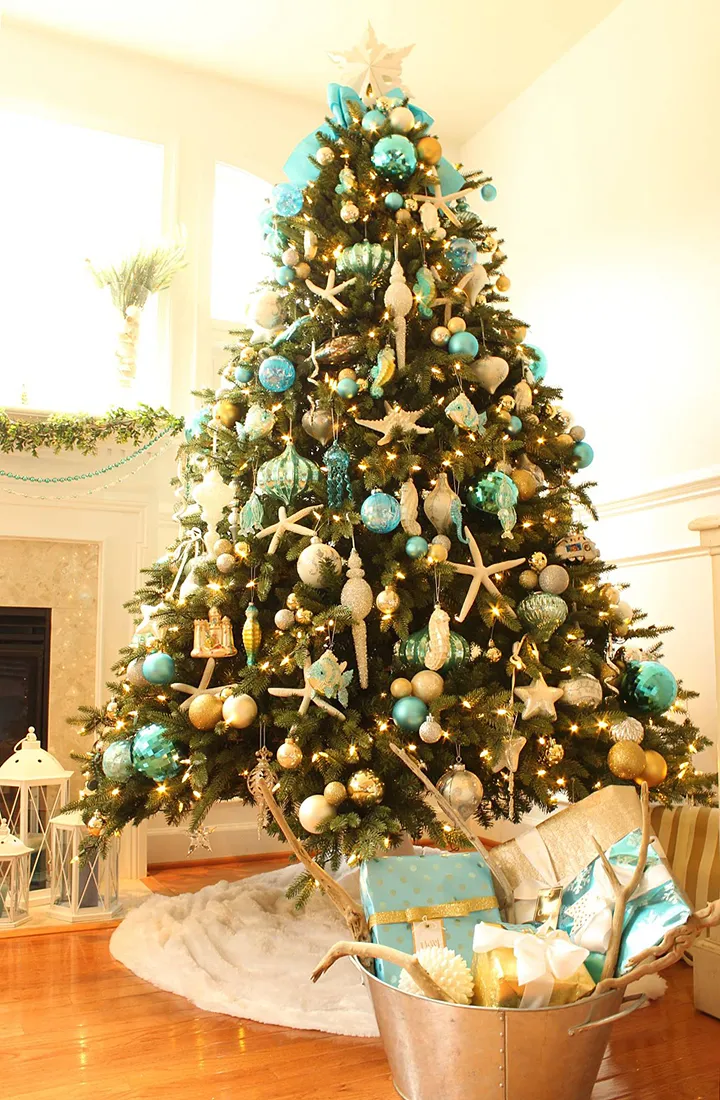
- 7.5 ft green tree: $120–$400
- Warm white string lights: $20–$45
- Sea-themed ornaments — starfish, seahorse, shells — 20–25 pieces: $45–$140
- Blue, gold, and white baubles, 50–60 pieces: $60–$180
- Fluffy white tree skirt: $25–$70
- Two white lanterns plus a galvanized bucket: $35–$90
Total: $305–$925. Budget alternative: a $5 bag of real starfish from a craft store plus a $12 box of plain blue baubles does 80% of the work — real shells beat resin ones anyway.
7. Blue and White Cut-Out Ornaments Above a Faux Fur Rug
Flat cut-out ornaments disappear on a full tree unless you handle them differently than round baubles. Hang them on the outer 6 inches of the branch, angled 10 to 15 degrees off the branch line, so a face or a shape actually catches light rather than sitting edge-on. Then work to a two-to-one ratio: two round ornaments for every flat one, roughly 60 rounds and 30 flats on a 7.5-foot tree. The rounds in blue, silver, and champagne carry the sparkle; the patterned cut-outs carry the personality. Reverse that ratio and the tree starts looking like a craft fair booth.
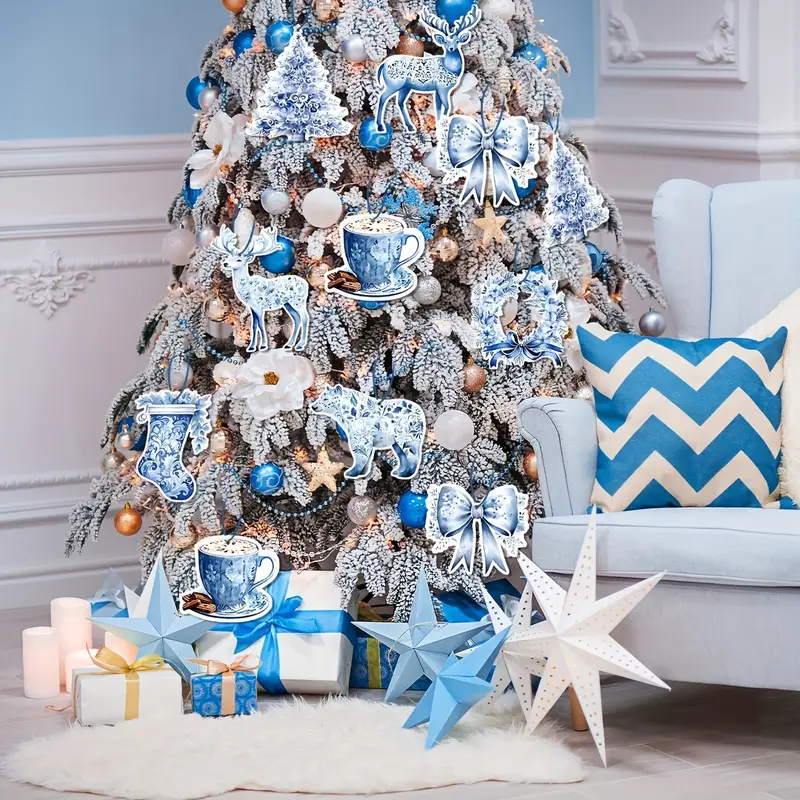
This is a full-room idea, not a corner idea. The light blue wall and matching armchair are part of the composition, so it wants a room of at least 120 square feet with a 9-foot ceiling. In a smaller space, keep the tree and drop the armchair, putting the paper stars on a shelf instead — you lose the echo between chair and tree, but the wall color still carries it. Evenings matter more than square footage here; this palette lives or dies by lighting.
8. Blue Glass Ornaments Painted with Tiny Winter Villages
Painted glass ornaments with glitter snow are gorgeous and slightly high-maintenance. The paint chips if ornaments knock together in storage, the glitter sheds a little every year, and warm hands leave prints on the glaze. Store each one in tissue or a divided ornament box, never loose in a bin, and keep them clear of the tree’s hottest bulb — direct heat is what makes painted finishes craze and dull over time. Count on replacing two or three a year. If you want the same winter-village feeling with zero fuss, painted wood or enamel ornaments give you the look and shrug off the abuse.
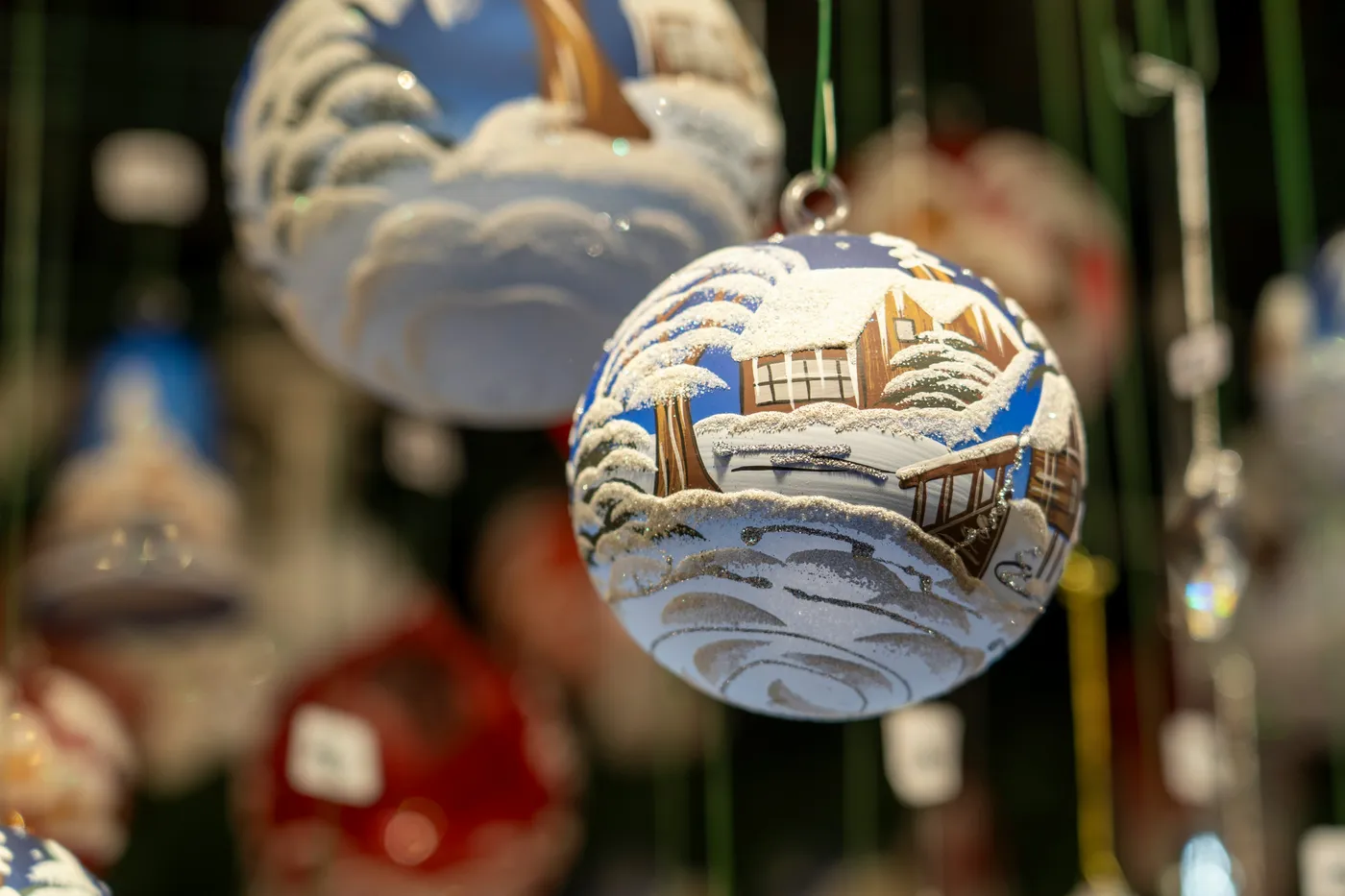
You can paint your own in an afternoon.
- Buy clear glass or shatterproof plastic spheres, about 3 inches across — plastic is safer and takes paint the same way.
- Paint the winter white first: a small snowbank at the bottom, then let it dry fully.
- Add two or three tiny houses in a single flat color, using the ornament’s curve as the horizon line.
- Dot windows with a toothpick and a lighter shade.
- Brush craft glue over the snow and dip it in fine white glitter.
- Seal with matte acrylic spray so the glitter stops shedding.
Time: about 2 hours for six. Cost: roughly $18 in supplies.
9. Pale Blue Flocked Tree in a Wooden Planter Against Orange Walls
Pale blue and terracotta orange are a genuinely beautiful pairing, and also an unforgiving one. Flocking picks up whatever light hits it, so in a room with warm, dim evening light that blue tree can drift toward grey. Before you buy, hold an ornament against the wall at night with your actual lamps on. Second, flocking sheds — expect a light dusting around the planter every time the tree moves, so put it over a rug or hard floor, not carpet you care about. And a wooden planter box is heavier than it looks: fill it with weighted foam or sand, never water.
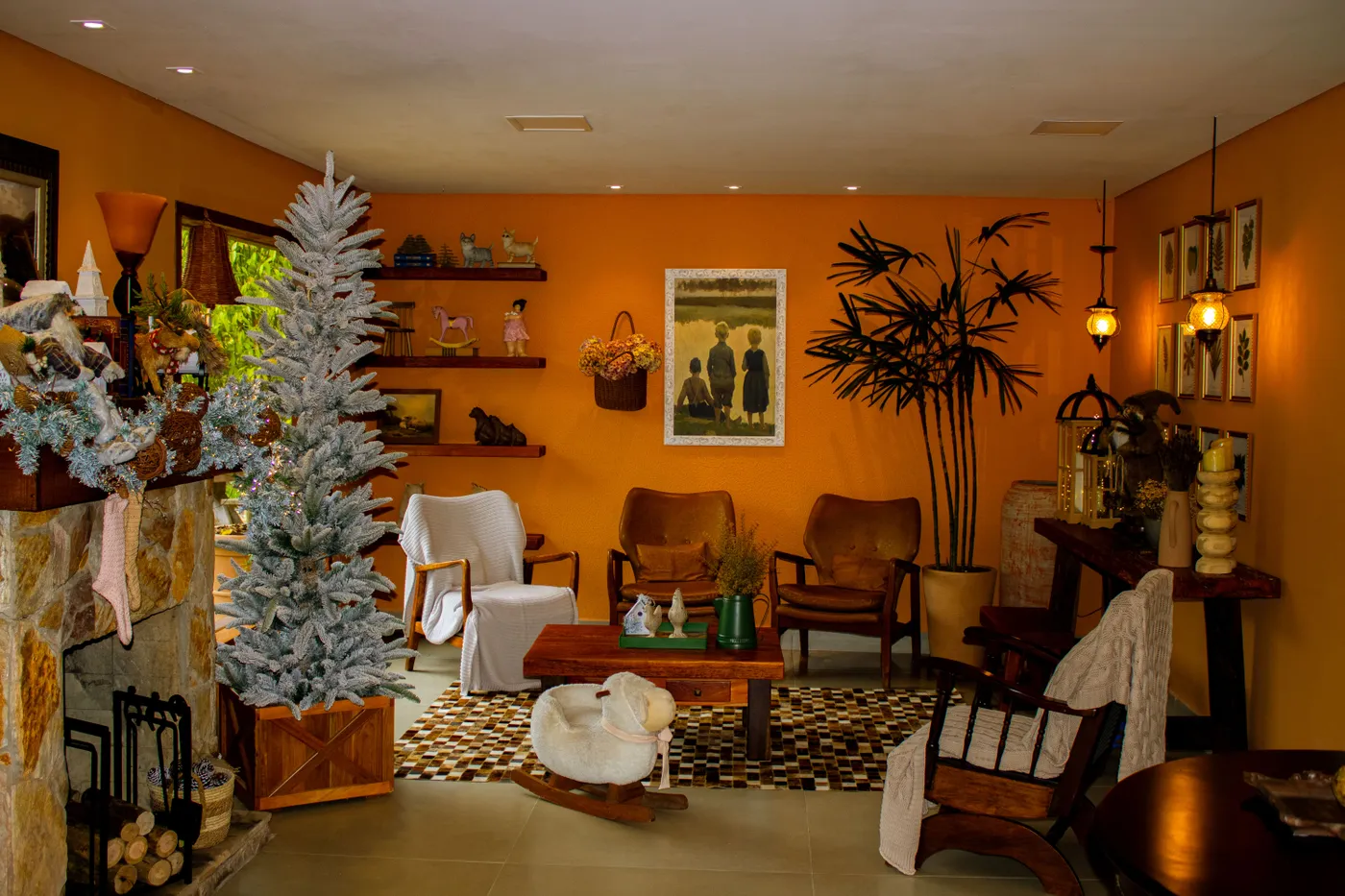
50% warm terracotta and beige + 30% dark brown wood + 15% pale blue + 5% green. The formula matters more than the specific colors: the blue is a seasoning, not a base. That’s why this works in a room that’s aggressively warm — the tree is the single cool note, so your eye goes straight to it. Reverse the ratio and make blue dominant, and the room feels cold and slightly off no matter how nice the tree is. Copy the 15% logic with sage, dusty rose, or mustard instead.
10. A Drenched Blue and Purple Light Display with One White Star
Civic trees went saturated. Where downtown displays used to be a warm white wash, the ones people photograph now are drenched in blue and purple with a hard white star on top. The reason is simple: cool monochrome reads better on phone cameras at night than a scattering of red and gold, and cities figured that out fast. It trickles home, too — colored LED trees are the fastest-growing category in outdoor holiday lighting, and blue leads by a wide margin. This one has legs. Colored lights photograph well, cost less than designer ornaments, and require almost no styling skill.
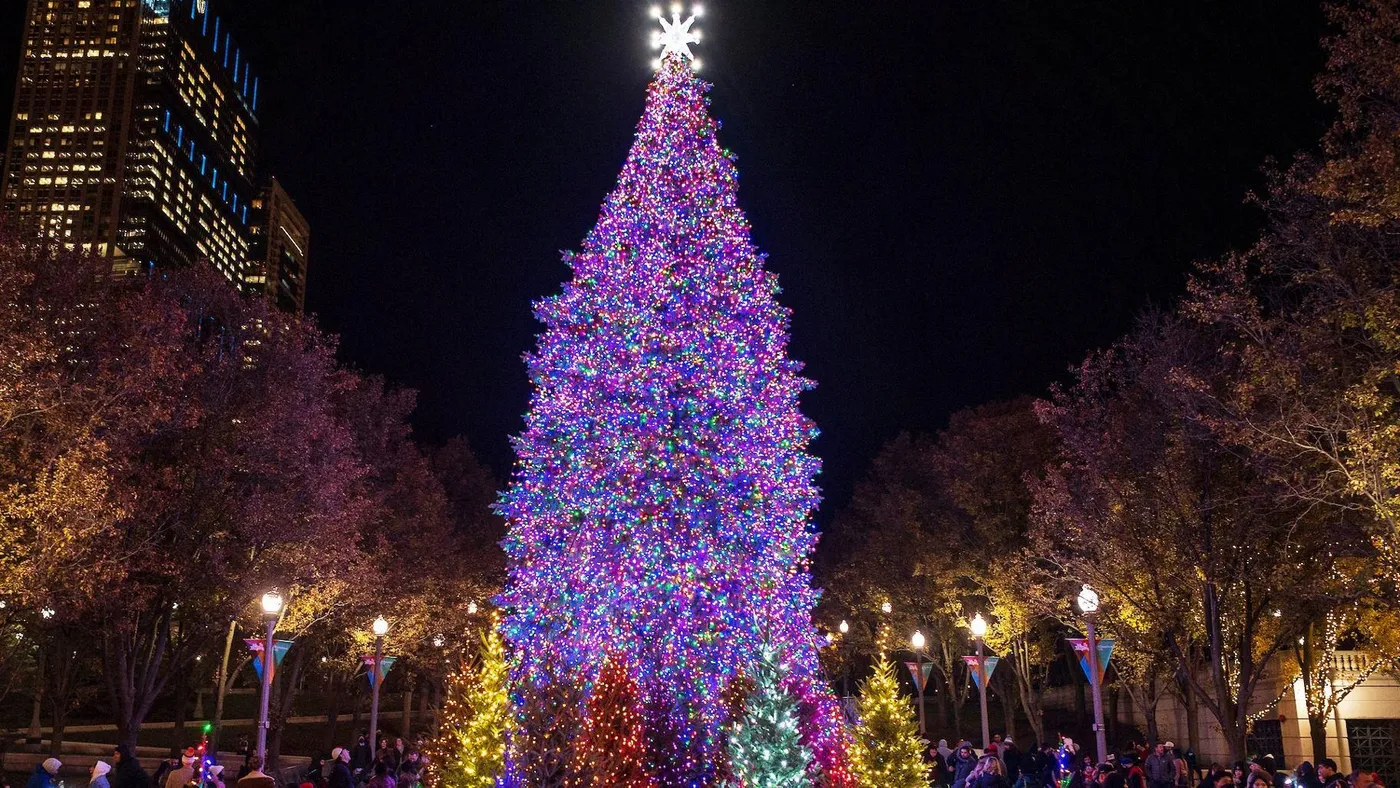
It’s the star. Everything else on this tree is a wash of saturated color, and the star is the only element that’s pure, bright white. That single value contrast is what stops the whole thing from becoming a blur of purple — your eye needs one place to land, and the star gives it one. On a home-scale version, protect that idea: if your topper glows with colored light, swap it for a white one and let it be the brightest thing in the tree. If everything is equally bright, nothing is.
11. Flocked Tree Against Deep Teal Paneling with Kraft Paper Gifts
Kraft paper and ribbon is the cheapest good-looking wrap there is: $12 for a roll of kraft, $6 for a spool of red satin ribbon, done. Skip printed paper entirely — the contrast between plain brown and glossy ribbon is what makes this look expensive. For the flocked wreath and garland, At Home and Walmart both run $30–$45 versions in November that read nearly identical to the $120 ones once they’re fluffed. And buy your tree in the first week of December, not the third: most retailers mark flocked trees down 25 to 40% before mid-month, then stop discounting because they know you’re out of time.
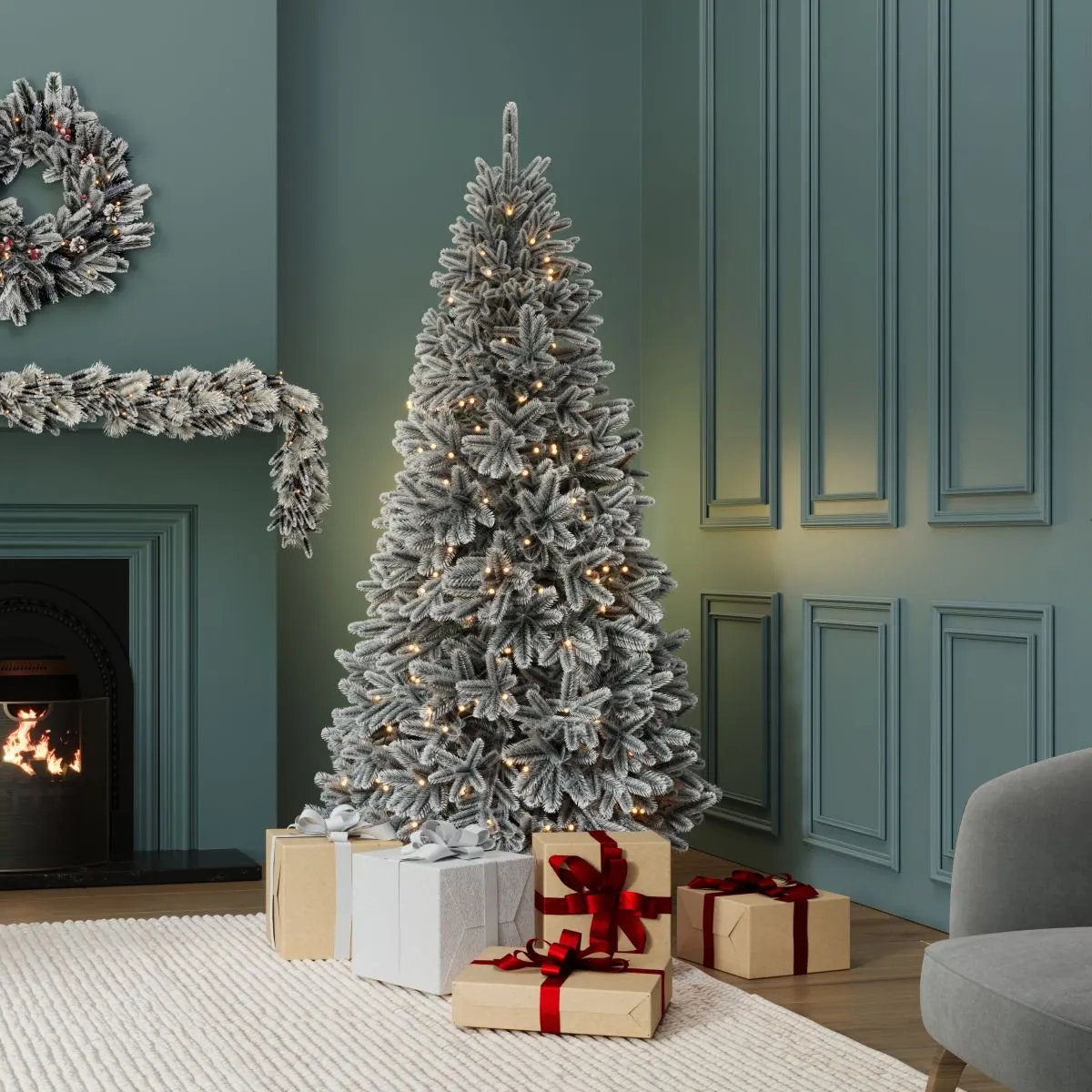
Deep teal paneled walls are a commitment, and they set the rules. You need a 9-foot ceiling minimum — the paneling wants vertical space, and a 7.5-foot tree plus a proper topper eats 8 feet before you hang a single ornament. Room width matters less than wall height, so a narrow dining room can absolutely do this. Keep the tree at least 3 feet from the fireplace opening so the flocking stays white instead of picking up soot. Compare with Idea #7, which solves the same question with pale blue walls instead of dark teal.
12. Alternating Blue and Pink Lights on a Balcony Tree
Alternating light colors only works if the bands are deliberate.
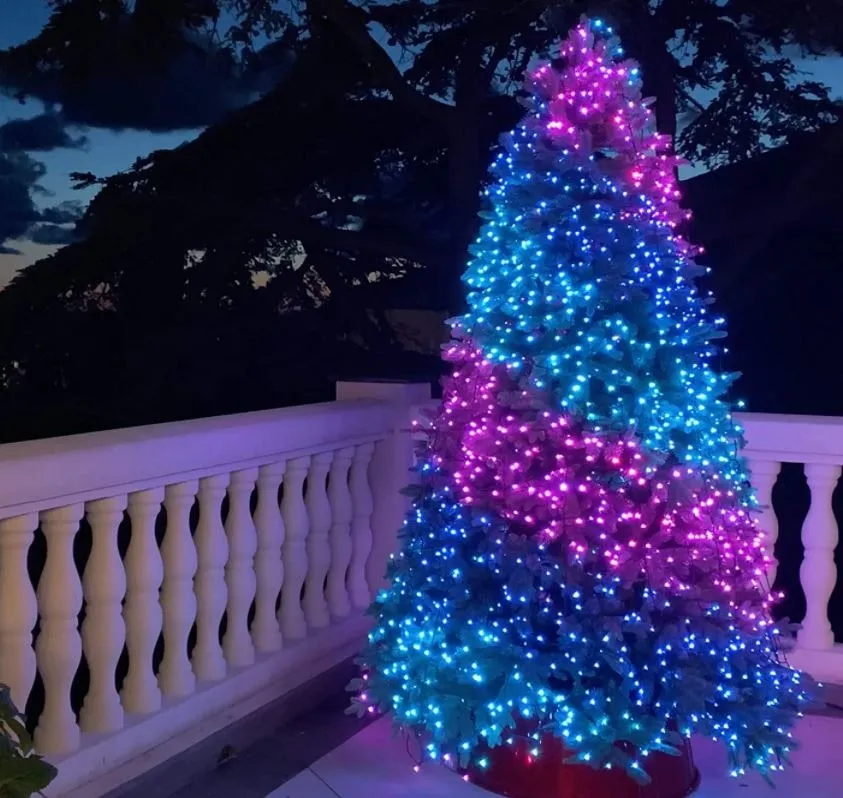
- Measure the tree’s height and divide your strands into equal sections — six bands of 3 to 4 rows each reads best.
- Wind the blue strand first, then the pink, so the colors never twist together mid-branch.
- Use outdoor-rated clips or zip ties at every band break, and leave no loose span longer than 6 inches.
- Plug everything into one outdoor timer set for 5 p.m. to 11 p.m., so you’re not out on the balcony every night.
Time: about 90 minutes for a 6-foot balcony tree. Cost: $40–$70 for two 100-count outdoor strands plus a timer.
50% bright blue light + 50% bright pink light, strictly banded, 0% neutral. That even split is what makes it read as a designed gesture instead of an accident — wide bands tell the eye it’s on purpose. For something subtler, shift to 70% blue and 30% pink with the pink as three or four accent bands instead of half the tree. Or keep the 50/50 and swap pink for warm white for a colder, calmer version. Just never alternate every single row, or it turns into noise.
13. Blue Velvet Bows Draped Vertically Over a Basket Collar
Vertical ribbon bows need anchoring, or gravity wins by New Year’s. Wrap a 6-inch length of floral wire around the branch first, twist the bow’s center onto it, then tuck the tails 4 to 5 inches into the branches so the bow sits proud of the needles instead of dangling loose. Place one every 10 to 12 inches vertically, offset from each other so they don’t line up in rows. For the basket collar, measure your trunk at the base — most collars accommodate up to 10 inches, and an 8-inch trunk with wide-fanning bottom branches is the most common fit failure.
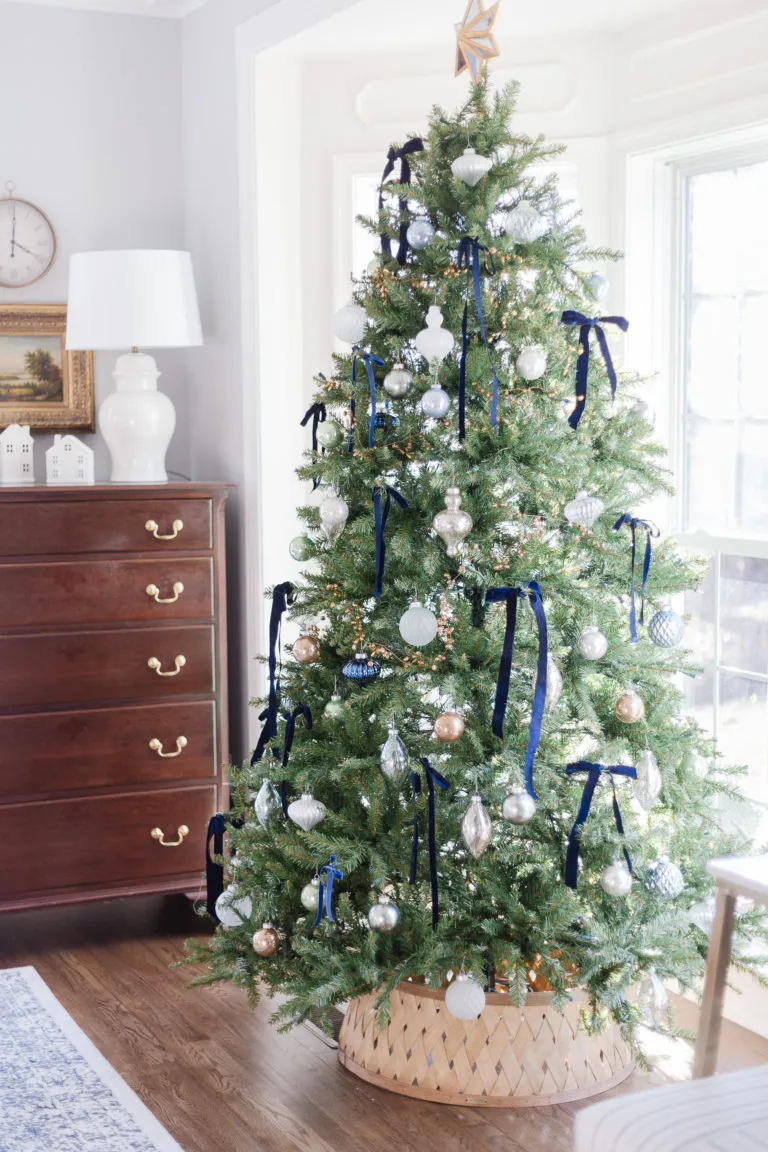
- 7.5 ft green tree: $100–$350
- Warm white string lights: $20–$45
- Silver, white, light blue, and bronze ornaments, 70 pieces: $80–$220
- Dark blue velvet ribbon, 3 spools: $35–$70
- Woven wood basket tree collar: $40–$90
- Simple star topper: $12–$45
Total: $287–$820. Budget alternative: skip the collar and flip a $15 thrifted woven basket upside down over the base — nearly identical from standing height.
14. Deep Blue and Gold Diamond Ornaments with a Starburst Finish
The gold starburst. Everything else on this tree is round — ornaments, berries, the curve of the ribbon. The starburst is the one hard-edged, angular shape in the whole composition, and it’s what keeps the tree from feeling like a bowl of marbles. Take it off and you’d still have a luxurious tree, but a shapeless one. On your own version, pick exactly one angular ornament per tree: a starburst, a diamond, a geometric wire frame. Hang it at eye level near the front, and let the rounds do everything else.
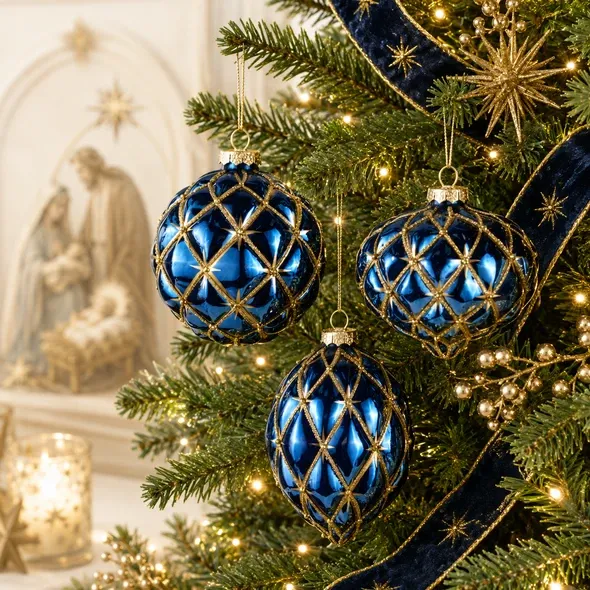
Two principles are doing all the work. First, ratio: roughly 80% blue and green with 20% gold, which keeps the gold reading as jewelry instead of a second theme. Gold is the most neutral metallic there is — it warms a cold palette without competing with it. Second, geometric repetition: the diamond pattern on the blue ornaments and the star ends on the gold picks echo the starburst, so a quiet visual rhyme runs through the tree. That rhyme is why it looks styled instead of merely full.
15. Illuminated Wall Star Over a Flocked Tree and Champagne Ornaments
Before you commit to wall lights, check these five things:
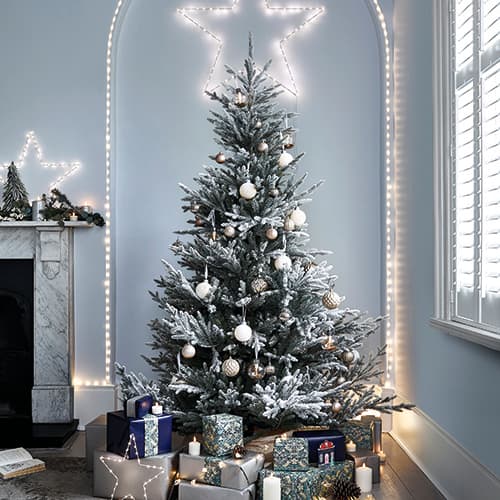
- Find the nearest outlet. You need one within cord distance of the star, and an extension cord across a doorway looks terrible.
- Test the wall finish. Adhesive hooks lift paint on flat and matte finishes; try it behind a piece of furniture first.
- Measure the arch or wall area, then buy lights 20% longer than that measurement.
- Check your wall color at night with the actual bulbs on — pale blue can turn grey under cool LEDs.
- Set a floor budget for the wall treatment. Under $100, skip the arch and just do the star.
The illuminated wall star is the hero here, and it’s cheap. Target and Walmart both carry light-up stars in the $15–$30 range, and one 24-inch star with a warm glow does most of what a professionally installed display does. Want the arch? Use two battery-operated 100-count fairy strands with a timer instead of hardwired ones — no cords, no outlets, about $25 total. The gifts do the rest: silver, dark blue, and one patterned paper, tied with ribbon you already own.
16. Speckled Teal Glass Ornaments Lit from Behind
A mottled or speckled glass ornament only looks special when light can pass through it, so placement is everything. Hang feature glass pieces within 10 to 12 inches of a bulb, ideally one directly behind and one to the side, so the finish glows instead of sitting dull. On a 7.5-foot tree you only need 10 to 14 of these statement pieces total — think of them as spotlights, not filler. Everything else should be matte or textured so the glass has something to stand against. Put a speckled ornament against a wall of speckled ornaments and you’ve spent money on something nobody can see.
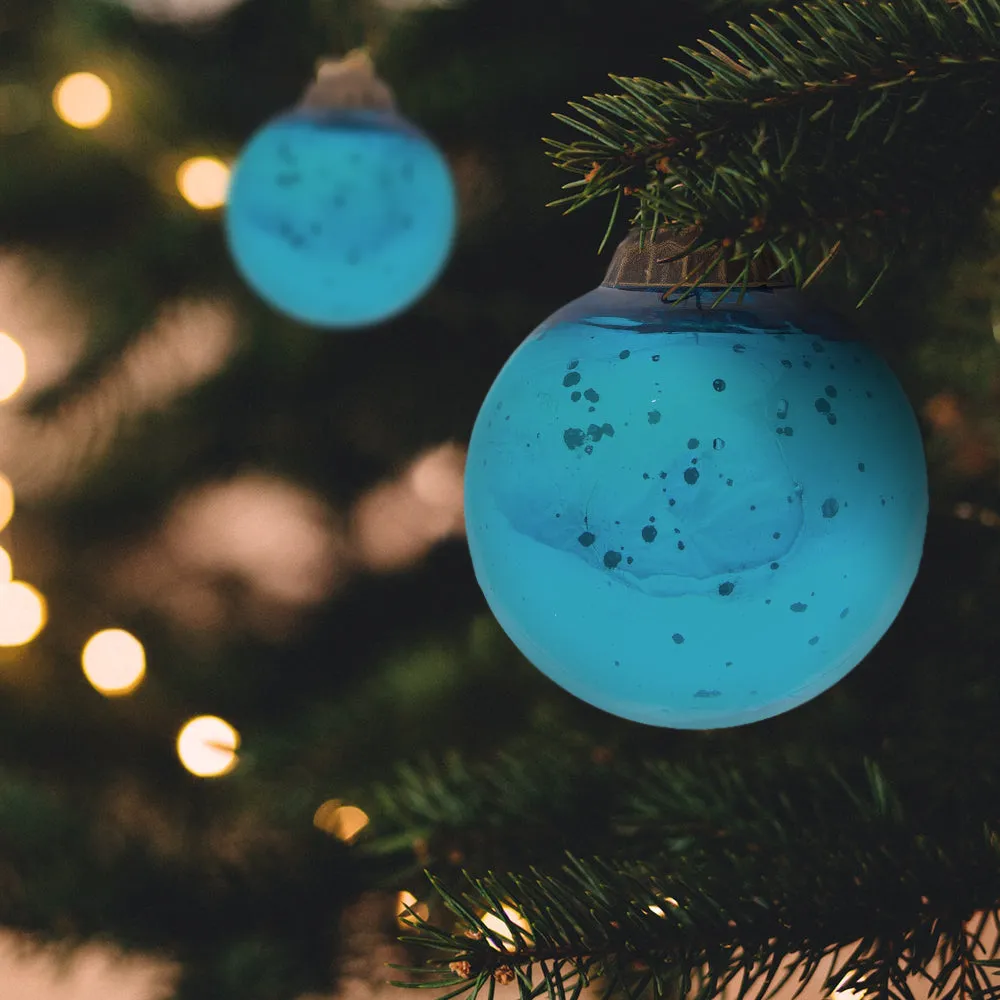
Mottled glass finishes are the least forgiving ornaments you can own. Every fingerprint shows, and they show more as the finish ages. Clean them with a dry microfiber cloth, never a wet one — moisture gets into the metallic cap and starts corrosion from the inside. Check the hanger loops each year; glass is heavy for its size and the caps loosen. Buy one spare, because glass ornaments matching a specific finish are usually discontinued within two seasons.
17. A Monochrome Blue Public Tree with Everything Else in Warm White
Building-scale lighting went monochrome. Instead of draping everything in warm white, designers now wash one structure in a single saturated color and let the surrounding trees stay plain — the contrast does the work. Blue is the default because it holds up at a distance; from across a plaza, warm white trees blur into a haze while blue stays legible. At home the same principle scales down beautifully: wrap one tree in blue, leave the rest of the yard in warm white. One color commitment beats five colors fighting each other, every single time.
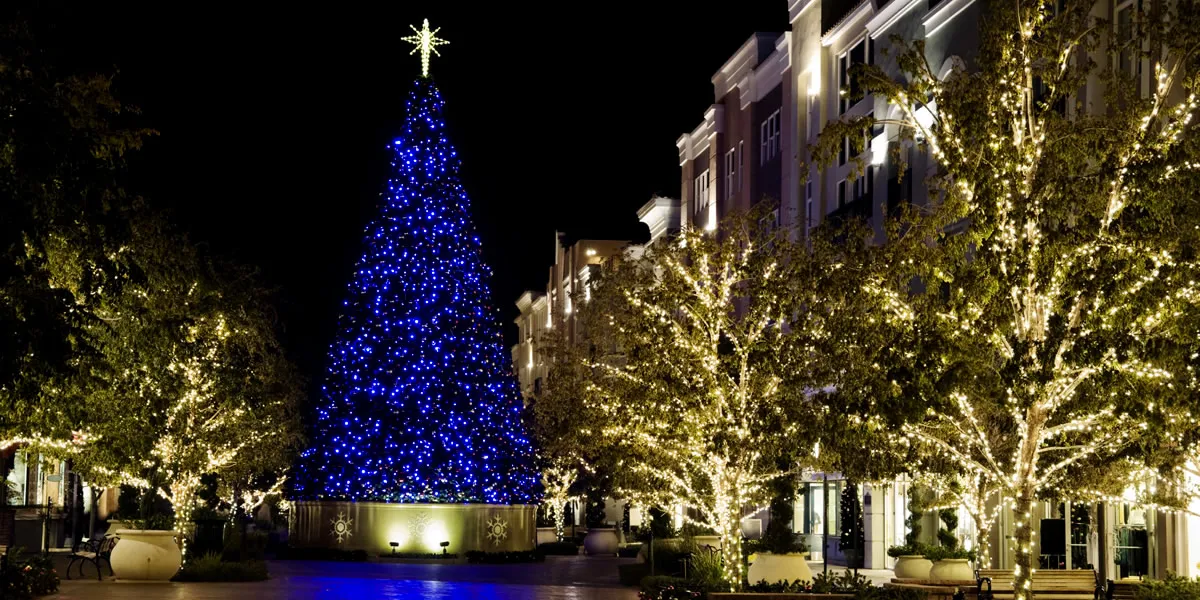
This is a plaza-scale arrangement, so translate the idea rather than the footprint. The ratio worth stealing is roughly one statement tree for every 6 to 8 plain lit trees — that’s what makes the blue one read as the subject instead of one node in a network. At home, that means one blue-lit tree out front and everything else in warm white. Keep the blue tree at least 15 feet from any warm-lit tree so the temperatures don’t muddle, and place it where it’s visible from the street. Working smaller? Idea #12 gets the same drama in 6 feet.
18. A Mermaid Tree in Iridescent Aqua and Pastel Pink
- 7.5 ft green tree: $120–$400
- Warm white string lights: $20–$45
- Iridescent and pastel spherical ornaments, 50–60 pieces: $60–$170
- Sea-creature novelty ornaments — starfish, seahorses, shells — 12–18 pieces: $40–$120
- Frosted fern picks in blue and pink, 8–10 stems: $25–$60
- Light blue tulle ribbon, 2 rolls: $10–$25
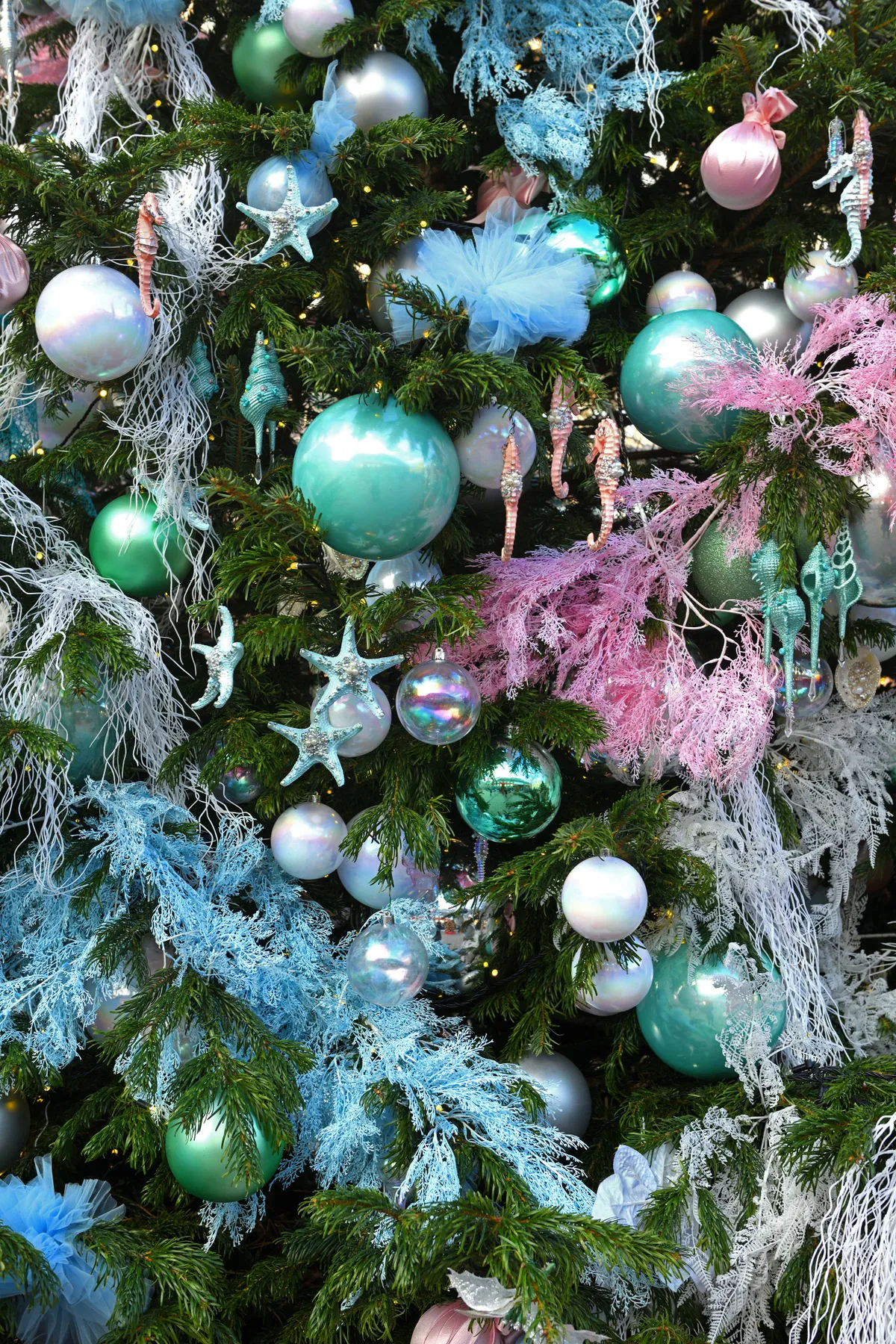
Total: $275–$820. Budget alternative: skip the frosted picks and make your own from a $6 bundle of faux greenery sprayed with two cans of white floral paint — about $20 and a Saturday afternoon.
Pastel trees are wonderful and a little fragile. Tulle bows snag on branch tips every time you walk past, and pets treat dangling ribbon as a toy — if you have a cat, wire the tulle in tightly or skip it. Iridescent finishes also photograph better than they read in person under warm dim light; if your living room runs on 2700K lamps in the evening, the shimmer mostly vanishes. And the theme has a tipping point: sea creatures plus frosted ferns plus tulle plus iridescent spheres is a lot of ideas on one tree. Pull one category back and the rest breathe.
19. Red and Blue Plaid Ribbon Carried Over to the Sofa Pillows
The plaid ribbon is the whole idea, and the proof is that it shows up twice — on the tree and again on the sofa pillows. That repetition is what makes the room feel considered instead of decorated. Plaid also does something no solid ribbon can: it carries three colors at once, so you get depth without adding another ornament color. Remove the plaid and use solid red ribbon and the tree is still pretty — it just isn’t connected to anything. Buy 4-inch width for a 7.5-foot tree; anything narrower disappears.
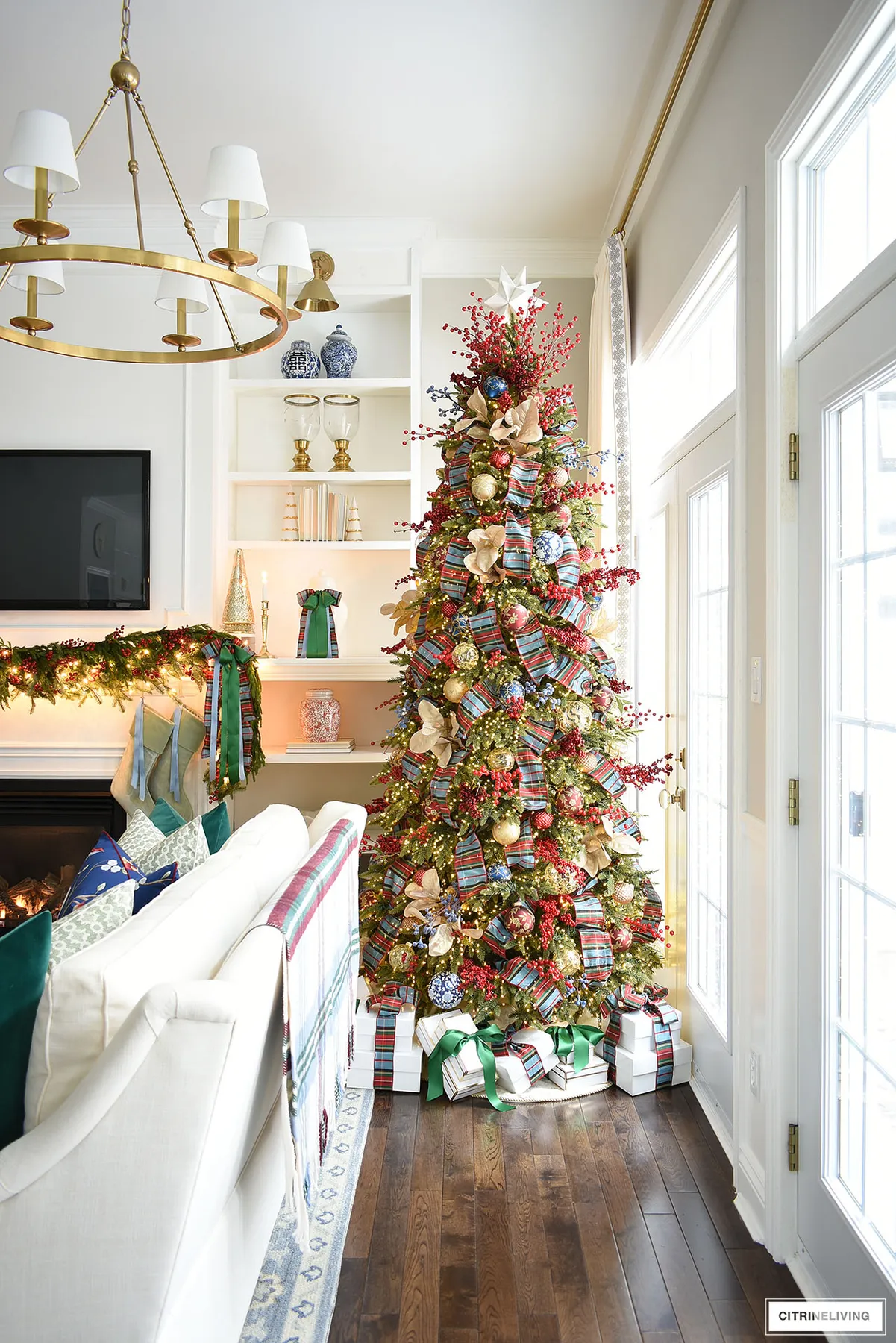
Big plaid bows are easier than they look.
- Cut ribbon into 24-inch lengths — one length makes one full bow.
- Fold into a loop, pinch the center, and twist once so the plaid faces outward on both sides.
- Wrap a 5-inch piece of floral wire around the pinch, leaving two 2-inch tails for anchoring.
- Attach to the branch, fluff the loops, and trim the ends at a slight angle.
- Make 8 to 10 total, spacing them at least 12 inches apart so the plaid doesn’t shout.
Time: about 10 minutes per bow. Cost: $18–$30 a roll, and one roll covers a full tree.
20. A Wooden Beaded Dress Ornament Among Pinecones and Blue Baubles
Mixing matte and glitter finishes works best at roughly 70% matte, 30% glitter. Matte ornaments look richer up close and hold their color under warm light; glitter reads almost twice as bright, so a little goes a long way and too much flattens the tree into one sparkly mass. The second rule: one unexpected shape per cluster. Here, the wooden dress ornament does that job — a flat, figurative piece among dozens of spheres. You only need three or four such pieces on a full tree. Any more and the eye can’t find a focal point. Compare with Idea #26, same principle of one playful feature piece, completely different era of ornament.
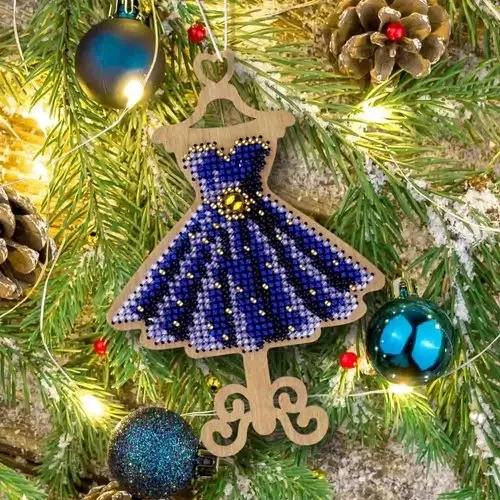
The best pieces on this tree are the ones that look old, and old is cheap. Thrift stores and estate sales in November are full of wooden and vintage ornaments at $1–$3 apiece, and Etsy sellers offer hand-painted wood ornaments for $8–$15 — still less than a single designer bauble. Don’t buy pinecones: collect them from a park, bake them at 200°F for an hour to kill anything living inside, then dip the tips in white paint. Blue glitter and matte baubles in bulk run about $14 for 30 pieces at Walmart.
21. Layered Blue and Peacock Feather Garland Over Frosted Branches
60% frosted green and blue-grey foliage + 30% layered blue and teal feather + 10% purple and peacock accent. The foliage has to dominate or the garland looks like a craft-store bin — the frosted needles are what make the feathers feel like they came from nature. Feathers are efficient because they carry color and texture at the same time, so you get two effects from one material. Swap the blues for warm amber and rust and you have a completely different look on the same formula. Keep peacock eye accents under 10%; they’re intense, and a lot of them turns the tree into a costume.
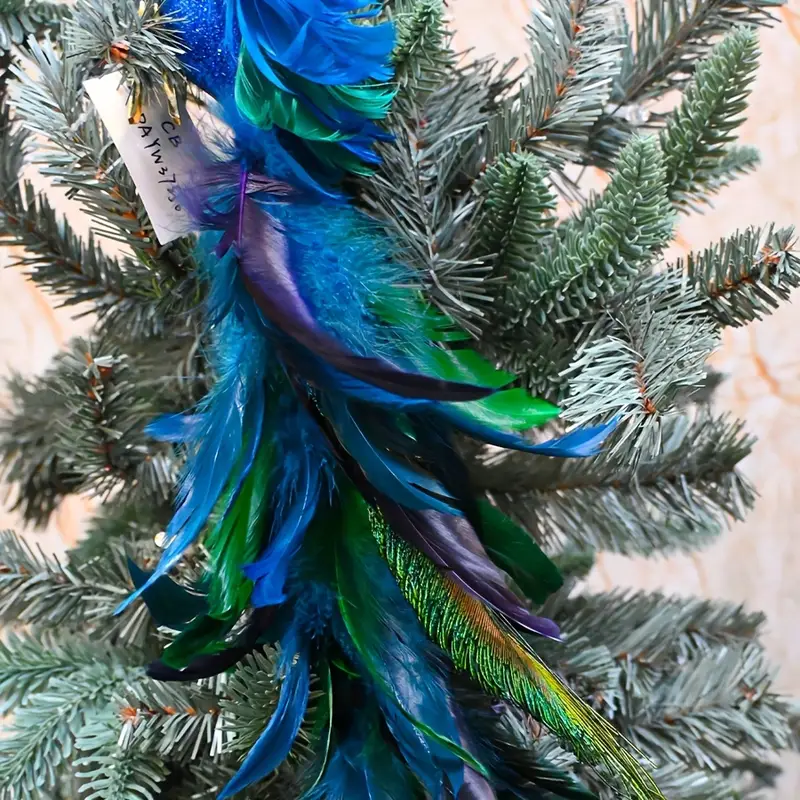
This is a texture project wearing a color costume. At a glance it’s a blue tree, but the effect comes from layering soft, semi-translucent feathers over crisp frosted needles — two materials that reflect light completely differently, so the surface keeps changing as you walk past. The frosted blue-grey needles are the unsung hero: they bridge the green branches and the blue feathers so the transition never looks abrupt. And the single peacock eye feather works because it’s the only place with a real pattern in an otherwise abstract composition.
Feathers are beautiful and a bit of a commitment. They shed, especially in dry winter air, they collect dust in a way that’s hard to clean without ruffling the barbs, and they are not flame-resistant — keep them well away from candles and fireplaces. Cats find them irresistible, and store them flat in a sealed bin rather than hanging them in a hot attic, where faux feathers fade to grey.
22. Blue Glitter Spheres and Teardrops with Silver Beaded Swirls
Teardrop ornaments need vertical room, so plan the tree height around them. On a 6-foot tree, drops longer than 4 inches crowd the branches and start looking like icicles in a bad way; on a 7.5-foot or taller tree, 5- to 6-inch drops sit comfortably. Whatever the size, keep drops on the outer third of the branch and space them at least 8 inches apart — vertical shapes on a vertical tree flatten out when clustered. Since teardrops and spheres read better together than either alone, keep the ratio near one drop per six rounds. Compare with Idea #23 if you’d rather skip drops entirely.
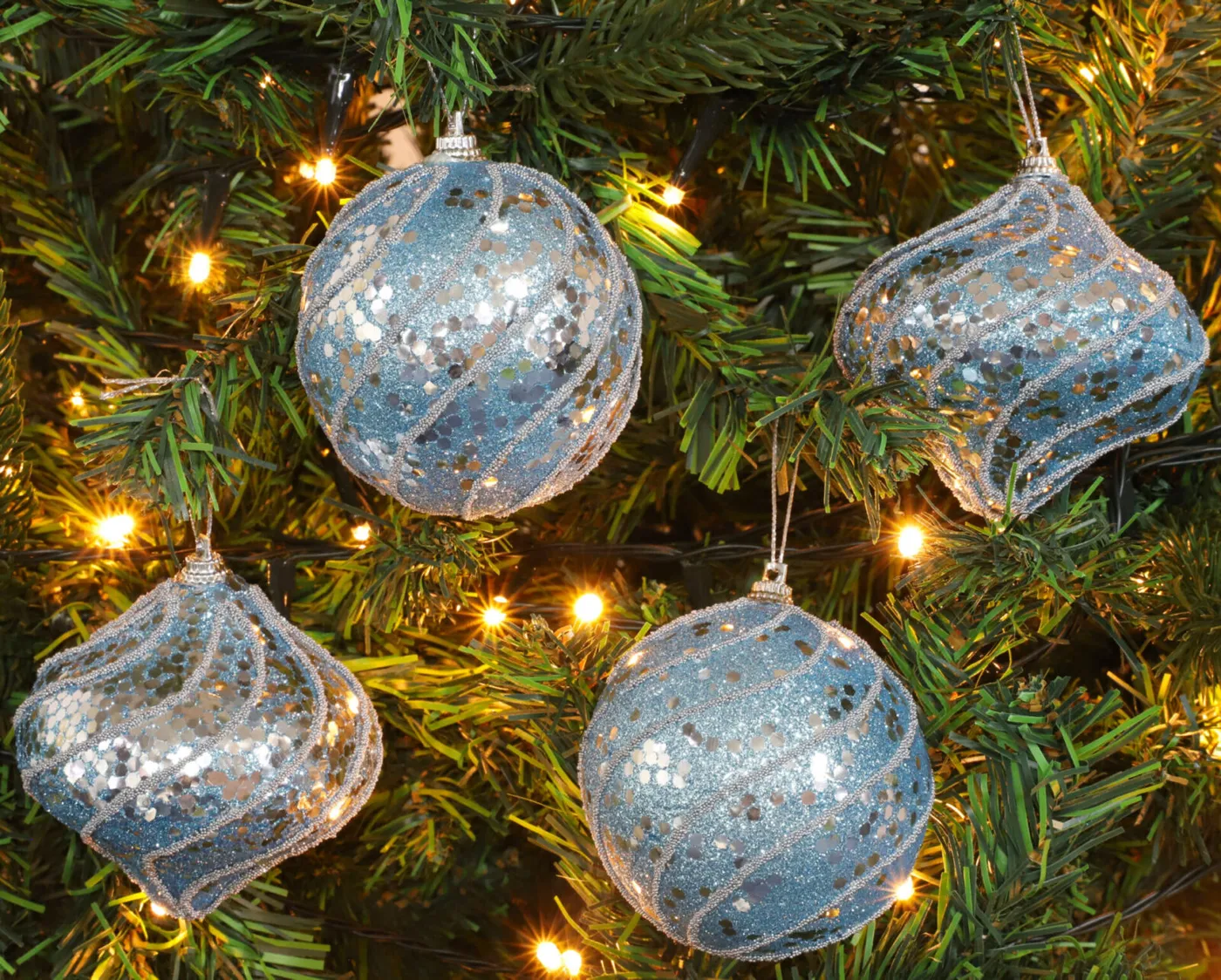
Glitter and sequins are a slow leak. Expect a light dusting under the tree every year, and expect sequins to loosen over three or four seasons — the adhesive holding them is usually the first thing to go. Repair is easy if you catch it early: a dot of clear craft glue and a pair of tweezers saves a $12 ornament from the bin. Store them individually in tissue, since sequins scratch each other in a loose box. And if you have a crawling baby in the house, skip glitter ornaments for a year or two — it gets everywhere.
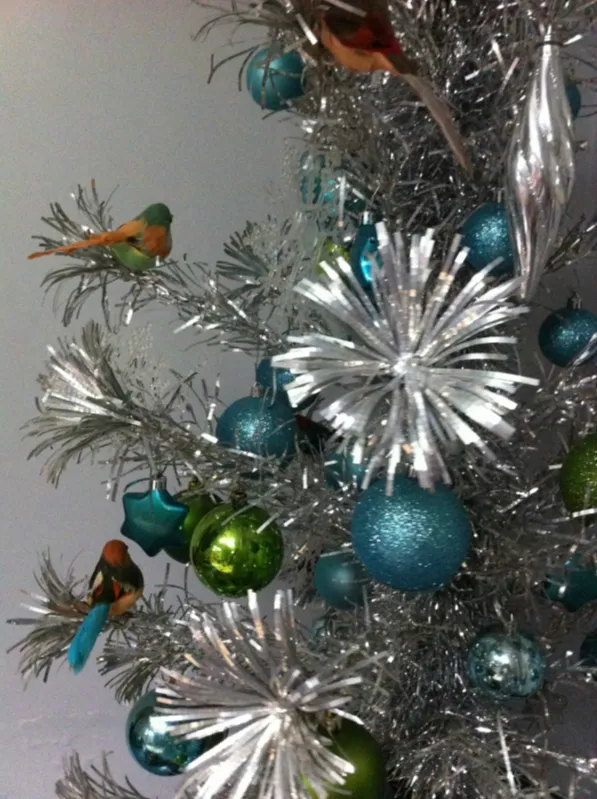
23. Blue and Silver Balls Only, Backed by a Dark Grey Sofa
- 7.5 ft green tree: $100–$350
- White fairy lights: $15–$40
- Blue and silver ball ornaments, about 60 pieces in three sizes: $65–$180
- Silver star tree topper: $15–$40
- Silver and white wrapping paper plus ribbon: $20–$40
- Light-colored tree skirt: $25–$60
Total: $240–$710. Budget alternative: buy one 100-piece mixed box of blue and silver ornaments for about $30 instead of three curated sets — mixed boxes actually look better because the sizes and finishes vary naturally.
Ball-only trees live and die by size variation. Buy ornaments in three diameters and work to a 60/30/10 split: 60% medium (about 2.5 inches), 30% small (1.5 inches), 10% large (4 inches or bigger). Most people get this backwards and hang too many large balls, which makes a tree look stubby. Then work in a spiral rather than in rows — hang from the top down in a slow spiral so no two ornaments line up vertically. A 7.5-foot tree lands best with 60 to 80 balls total.
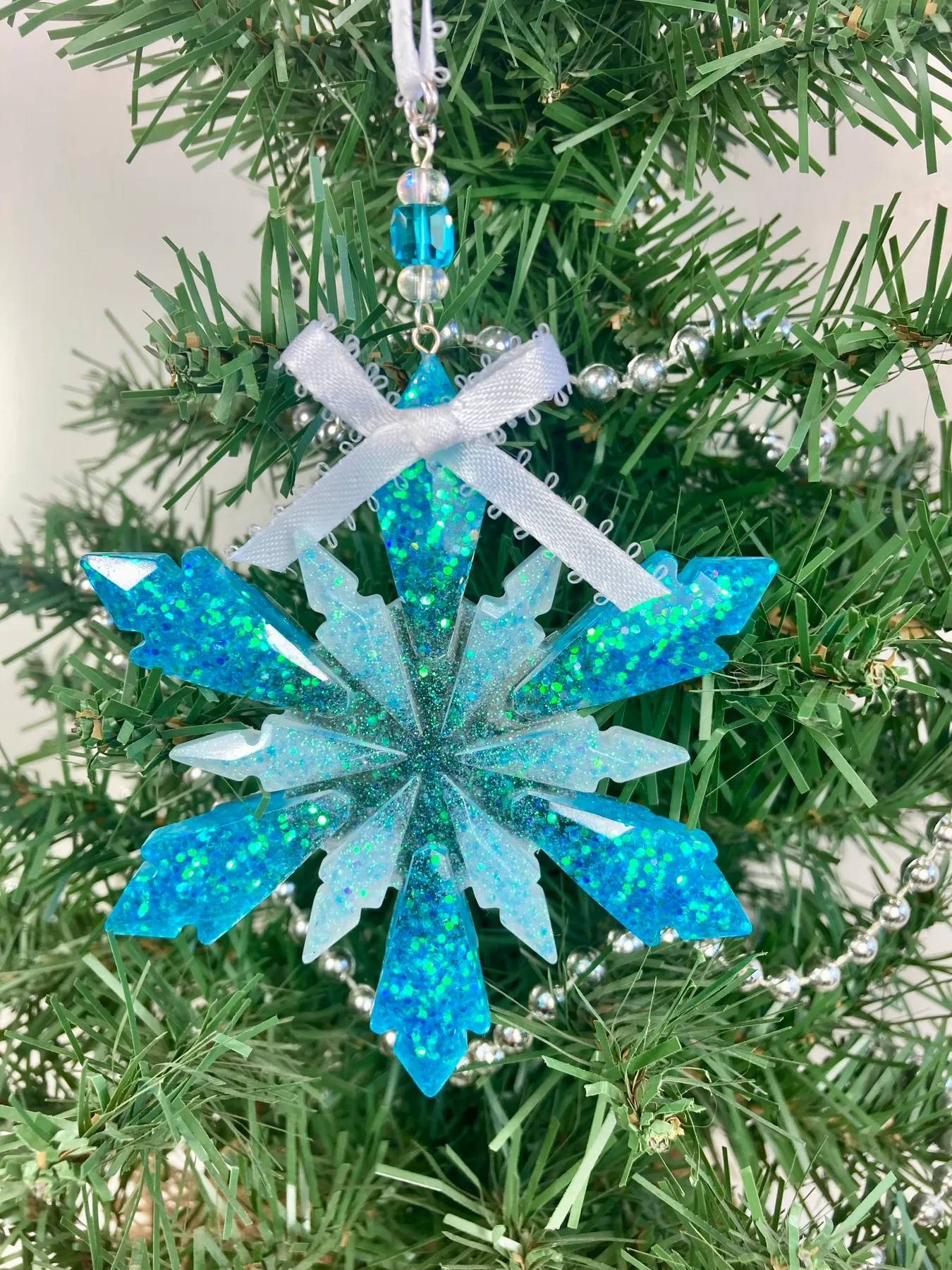
24. A Glitter Snowflake on a Beaded Chain Instead of a Wire Hook
The beaded chain hanger. Someone spent real thought on how this ornament attaches — a silver chain with clear and blue beads instead of a plain wire hook — and that one detail is what lifts it from craft-store to keepsake. Hanging hardware is the most ignored element in holiday decorating, and it’s the cheapest thing to fix. Swap plain metal hooks for ribbon, chain, or beaded loops and the same ornaments instantly look more expensive. Do it on the ten ornaments closest to eye level and leave the rest alone.
Four things to verify first:
- Weigh your heaviest ornament — anything over 4 ounces needs a metal hook, not a ribbon loop.
- Check branch strength at the tips. Beaded chain adds drag and can pull a weak branch down overnight.
- Count your hangers before you start; one missing hook means one ornament on the floor all season.
- Pick your ribbon width first. Half-inch reads delicate, 1.5-inch reads generous — both work, but mixing them on one tree doesn’t.
25. Icy Blue and Lavender Tree Between Acrylic Chairs and Chandeliers
Three things are happening. First, a single light temperature — icy blue and lavender LEDs with nothing warm in the mix, which is what lets the room read as one continuous material instead of a collection of objects. Second, reflection doing the decorating: the polished marble floor and clear acrylic chairs double the tree’s light, so a fairly simple ornament scheme looks twice as dense. Third, materials that agree with each other — crystal, acrylic, glass, marble, all smooth and cool, all catching the same blue light. Add one warm wood piece and the spell breaks.
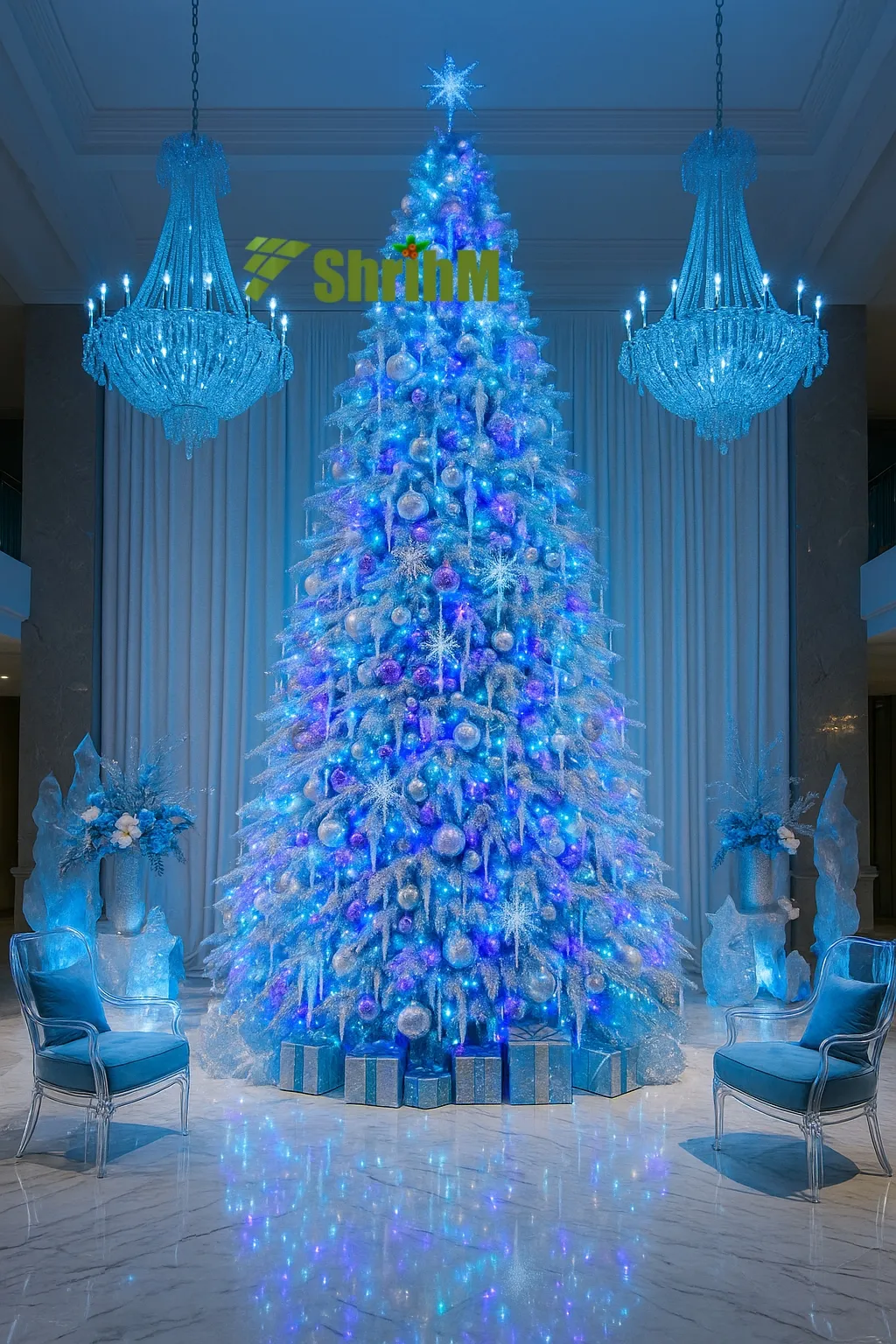
Two honest warnings. Polished marble floors and clear acrylic furniture are a rough combination with toddlers — both show every mark and neither forgives a fall. And cool LED light is unforgiving with the wrong bulbs: mix 4000K tree lights with 2700K room lamps and the blue areas look grey and slightly sickly. Keep every bulb in the room cool, or keep the warm lamps far from the tree. Plan for storage, too — oversized acrylic and sculptural decor doesn’t fold away.
A cool-light scheme reads intentional when the light sources are layered at different heights. Lit at eye level only, it looks like a store window; lit from three levels, it looks like architecture. Aim for floor-level uplights behind the tree, the tree itself at mid-height, and a lit fixture above. Keep every source within 500 Kelvin of the others so the blues stay consistent, and dim everything to about 60% — full brightness flattens the gradient that makes a cool palette feel cold instead of cheap. This is the opposite approach to Idea #5, which warms the same idea up.
26. Light Blue Ornaments with Cartoon Winter Figures and Satin Bows
70% dark green base + 20% light blue + 10% warm white sparkle. The trick is that the ornament pattern itself supplies the detail, so the tree doesn’t need many colors to feel busy — a repeating illustrated figure does the work that eight ornament styles normally would. That’s why a light blue and dark green pairing can carry a whole tree while a four-color scheme turns muddy. Swap light blue for pale pink and keep the same 20% and the formula still holds. Push the accent color past 30% and the illustrations start competing with each other.
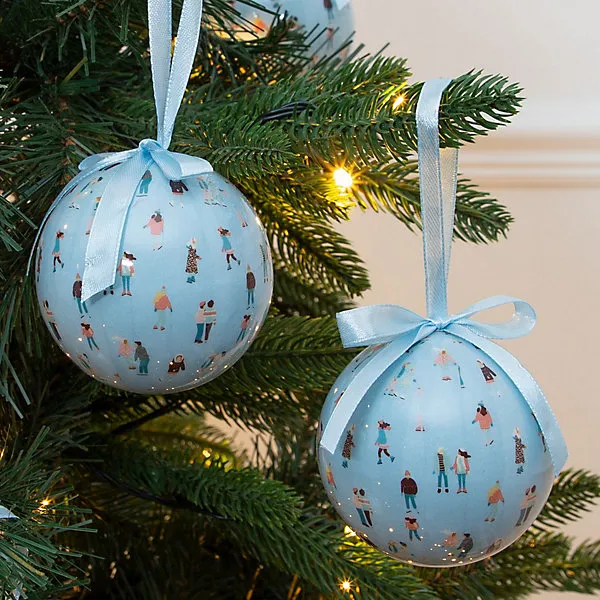
The satin ribbon bow on top of each ornament. It’s a thirty-cent addition that changes the entire read of the piece — a plain sphere with a metal cap looks like it came from a value pack, and the same sphere with a matching satin bow looks like something from a boutique. The bow also does a practical job: it hides the cap and hanger, usually the least attractive part of an ornament. Make them yourself from 3/8-inch ribbon and a dot of glue. Twenty bows takes half an hour.
Here’s the version that costs almost nothing. Buy a 24-pack of plain light blue shatterproof spheres for about $15, add your own white glitter accents with craft glue and fine glitter, and finish each with a satin bow. All in, about $26 for two dozen ornaments that look like a boutique set. For illustrated pieces, Etsy sellers ship custom designs for $6–$10 each, so pick four or five favorites and use them as the feature pieces among your DIY basics.
27. A Sculptural White Cone Tree Held Together by Multicolored Bows
Before you build anything, verify these four things:
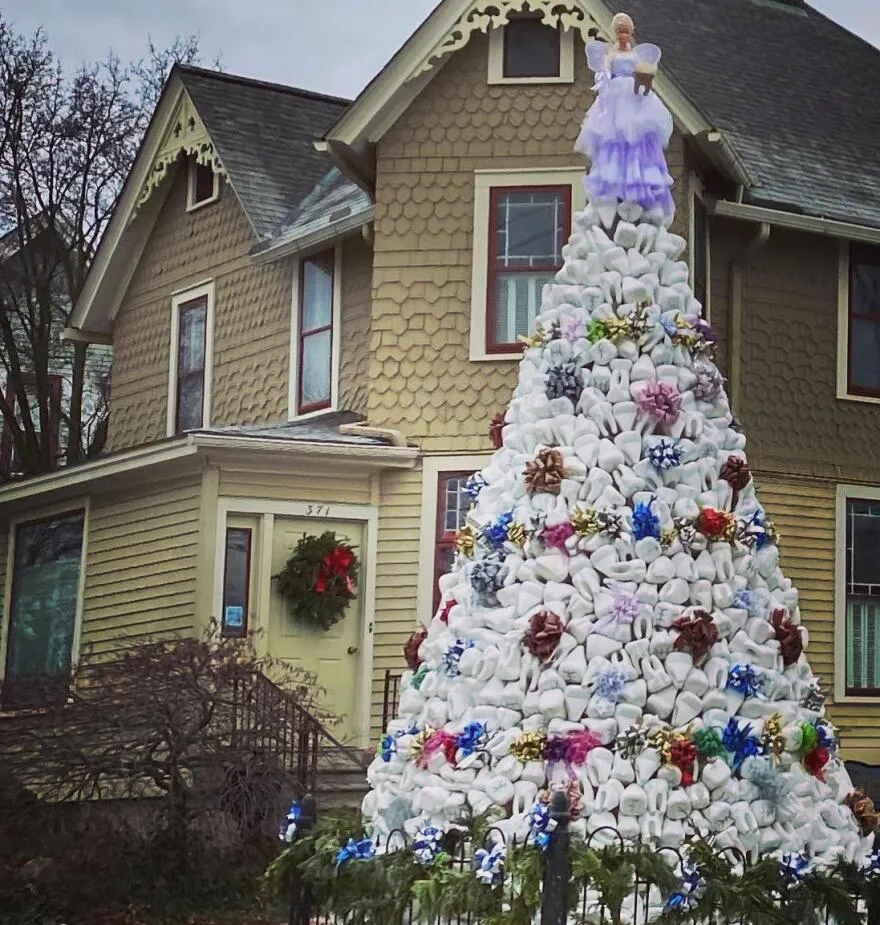
- Decide on weight and anchoring first — anything over 6 feet tall outdoors needs ground stakes or a weighted base, not just a frame.
- Check wind exposure. A sculptural cone catches wind like a sail, so a corner lot needs guy lines.
- Photograph your house color in daylight. The light purple and cream accents work against yellow siding; against grey stucco you’d want a different topper.
- Confirm the whole thing fits through your garage or shed door for storage, or plan to build it in place every year.
For a sculptural tree like this, the bows are the design, not the decoration.
- Sketch the cone shape and mark four horizontal bands from base to tip.
- Space bows 10 to 14 inches apart, varying the sizes deliberately within each band.
- Restrict the palette to three or four colors, repeating them in a loose pattern rather than in clusters.
- Build density toward the base and thin it near the top so the silhouette stays cone-shaped.
- Add the topper figure last, at least 12 inches tall so it reads from the sidewalk.
Time: about 6 hours. Cost: $60–$120 in ribbon if you’re making the bows yourself.
Pick Your Blue, Then Let the Tree Do the Rest
The blue doesn’t have to match anything you already own — it just has to be the one note your room doesn’t already have. Get the light temperature right, choose one idea here, and the ornaments will sort themselves out. 📌 Pin your favorite to your holiday board now, so it’s waiting for you when December arrives and you’re standing in a store aisle with no plan.