
Most people think a flocked Christmas tree is about looking snowy. It’s actually about light — all that white surface bounces warm bulbs back into the room instead of swallowing them, which is why the good ones glow and the cheap ones look like a dusted lawn ornament.
We dug through Facebook Marketplace, Target, Walmart, HomeGoods, and a stack of secondhand listings, then filtered everything down to 30 setups that hold up in a normal living room — from about $4 for a pair of thrifted brass candlesticks up to $795 for a floor-to-ceiling statement. You’ll find cool blue-green trees, gold-trimmed bay windows, ceramic luminaries, and budget-next-to-luxury versions of the same idea.
Flocked trees are surging in 2026 partly because they photograph so well with 2700K warm light, and partly because flocking hides scuffs and bald patches better than bare green branches. Some links here are affiliate links, which means we may earn a small commission at no extra cost to you.
And stay until the end — we break down the most common mistakes that can ruin these looks.
📌 Save this to Pinterest for later — you’ll want to revisit these ideas.
1. A Tall Flocked Tree That Anchors a Soft Grey Room
Flocked branches are essentially a lighting trick: every white surface bounces light back into the room instead of absorbing it, which is why this corner feels bright even on a grey afternoon. The warm bulbs play against the dark window panes behind them, and that contrast is what makes the tree read as a glowing object rather than a green thing standing near a sofa. The light grey upholstery and the white mantel do the rest by staying out of the way.
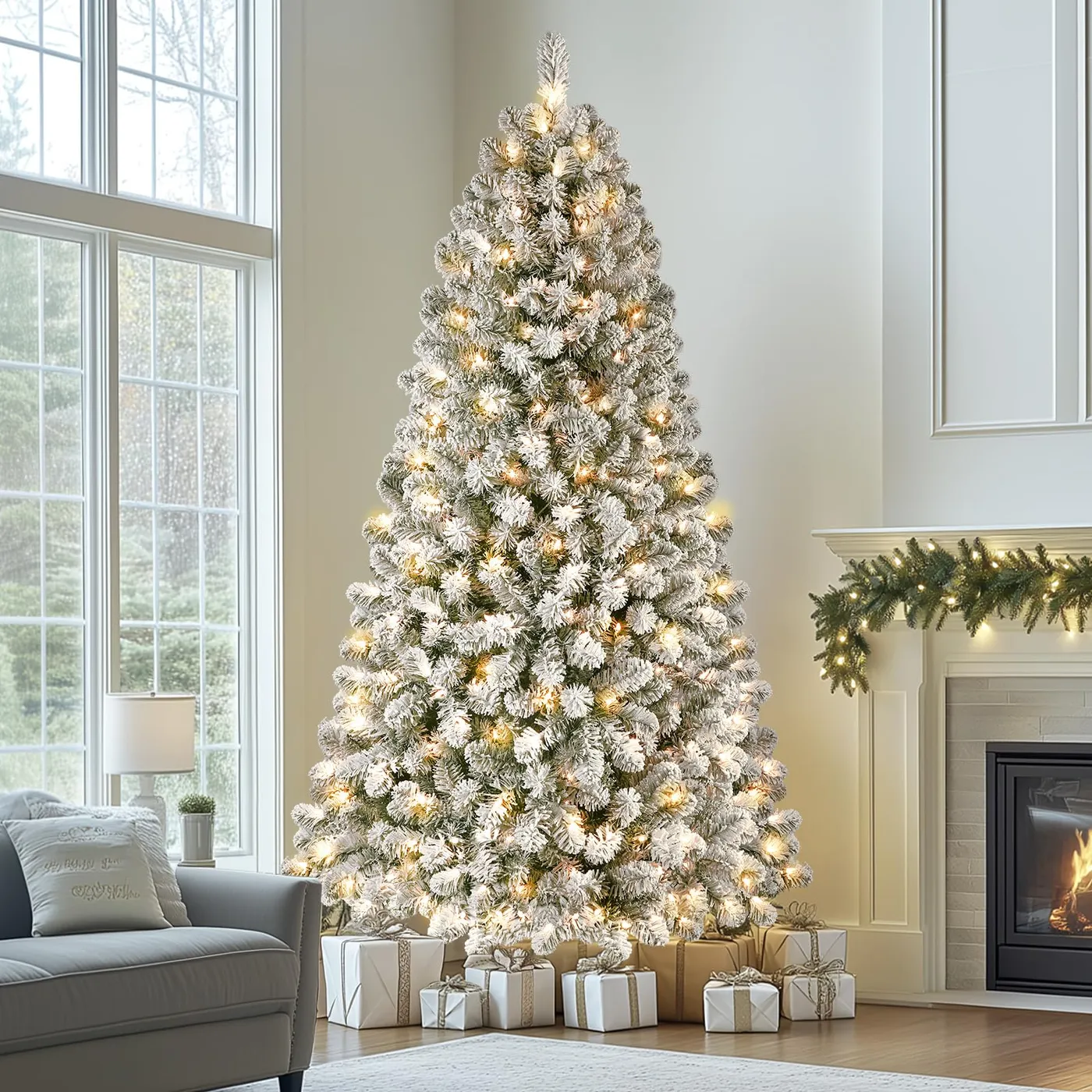
Take away the lighted garland on the mantel and you lose the horizontal line that ties the tree to the wall — the room instantly becomes one lonely glowing object with a lot of empty space above it. The garland is what makes the fireplace and the tree read as a pair rather than two separate holiday projects. That’s why the mantel is draped in light instead of piled with figurines: the goal is connection, not volume. Keep the garland in the same warm white as the tree.
2. White Ornaments, Macramé, and a Garland Hung High
Texture density is what separates a designer tree from a store display. For a tree this full, plan on roughly 10 ornaments per foot of height — a 7-footer wants about 70 pieces — and make sure no two neighbors share the same finish. Here that means matte white balls, pinecones, and warm wood, which is why your eye keeps traveling instead of landing on one cluster and stopping. Fewer, bigger pieces beat a hundred tiny matching ones.
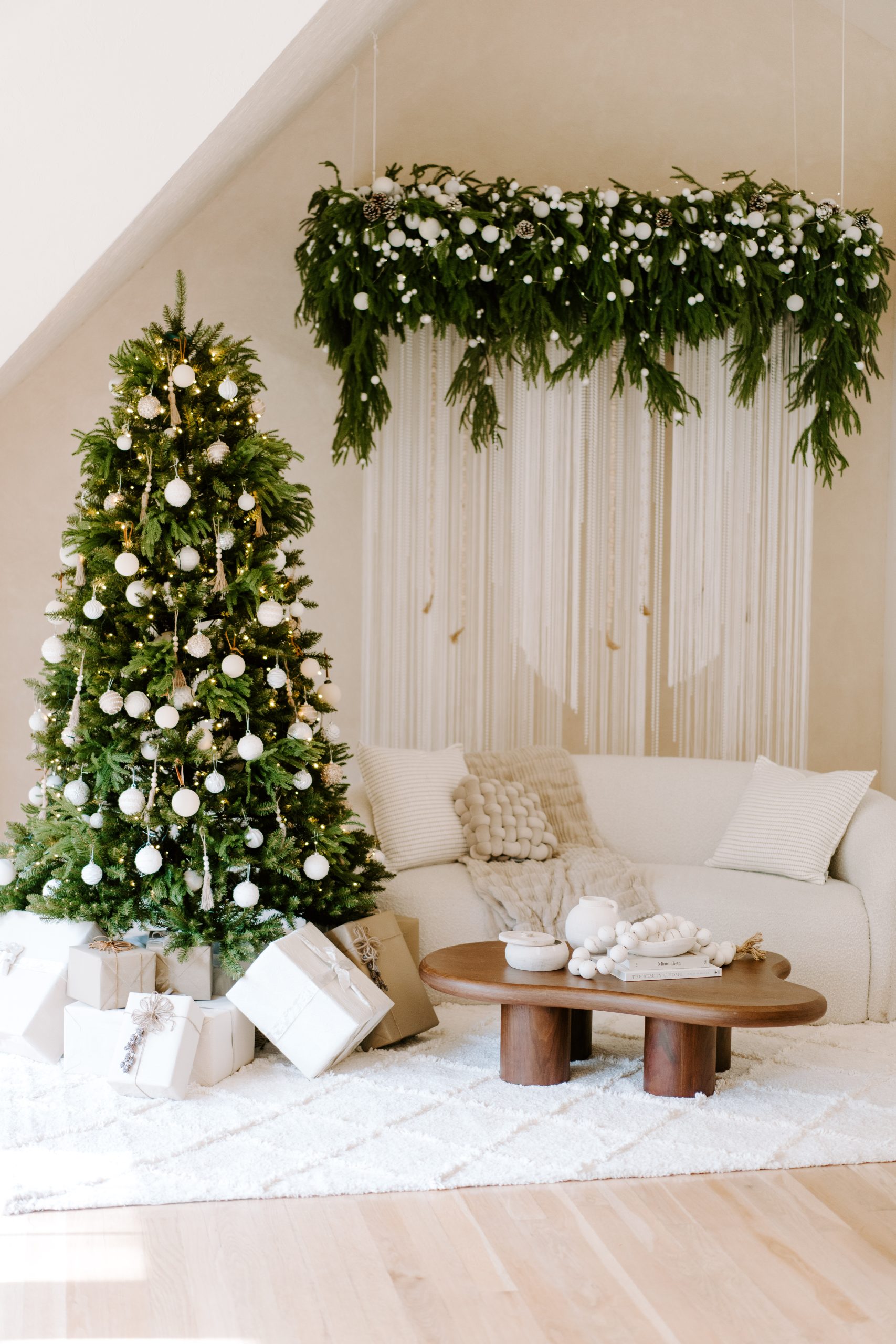
The formula is roughly 50% green foliage, 25% white ornament and garland, 15% natural texture (pinecones, wood, macramé), and 10% warm glow. Swap the white for cream and the pinecones for dried citrus and you get the same room with a sunnier, less snowy feel. Trade the macramé for a woven textile and it tilts boho. The percentages are what hold the look together — the specific pieces are almost interchangeable.
3. A Flocked Tree Beside a Snowy Window With Floating Shelves
This arrangement wants about 12×14 feet and a 9-foot ceiling. The tree sits beside the window rather than in front of it, which keeps the snowy view intact — center an 8-footer on a picture window and you’ve just blocked the best thing in the room. The floating shelves need at least 30 inches between them so they read as a display rather than a stack. Working with something smaller? See Idea #26, where the same palette fits a slim tree beside a fireplace.
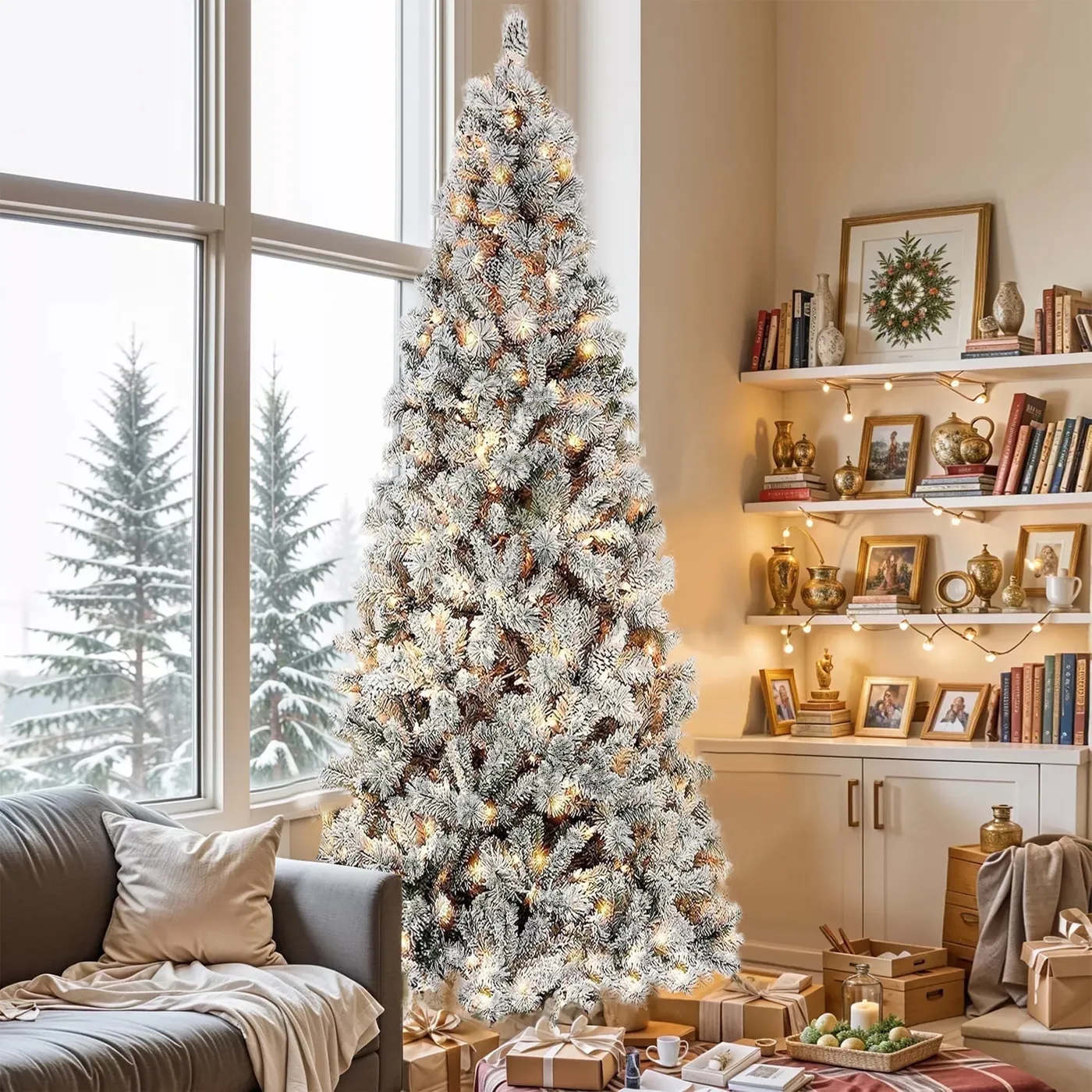
Two honest caveats. That snowy view is doing a lot of free work — if your window looks at a driveway or a neighbor’s wall, this setup will feel flatter, and you’re better off adding a sheer layer and letting the tree carry the moment. Second, flocking sheds. Expect a light dusting every time you decorate or shift the tree, so keep a vacuum close and skip a white rug directly underneath.
4. Two Wood Lanterns, Red-Trim Curtains, and a Basket Collar
- 7.5 ft flocked tree: $180–$450
- Woven basket tree collar: $25–$70
- Two distressed wood lanterns with LED candles: $40–$90
- Warm white string lights (300 count): $15–$35
- Curtains with red trim: $30–$70
- Kraft paper, ribbon, red knit stocking: $40–$80
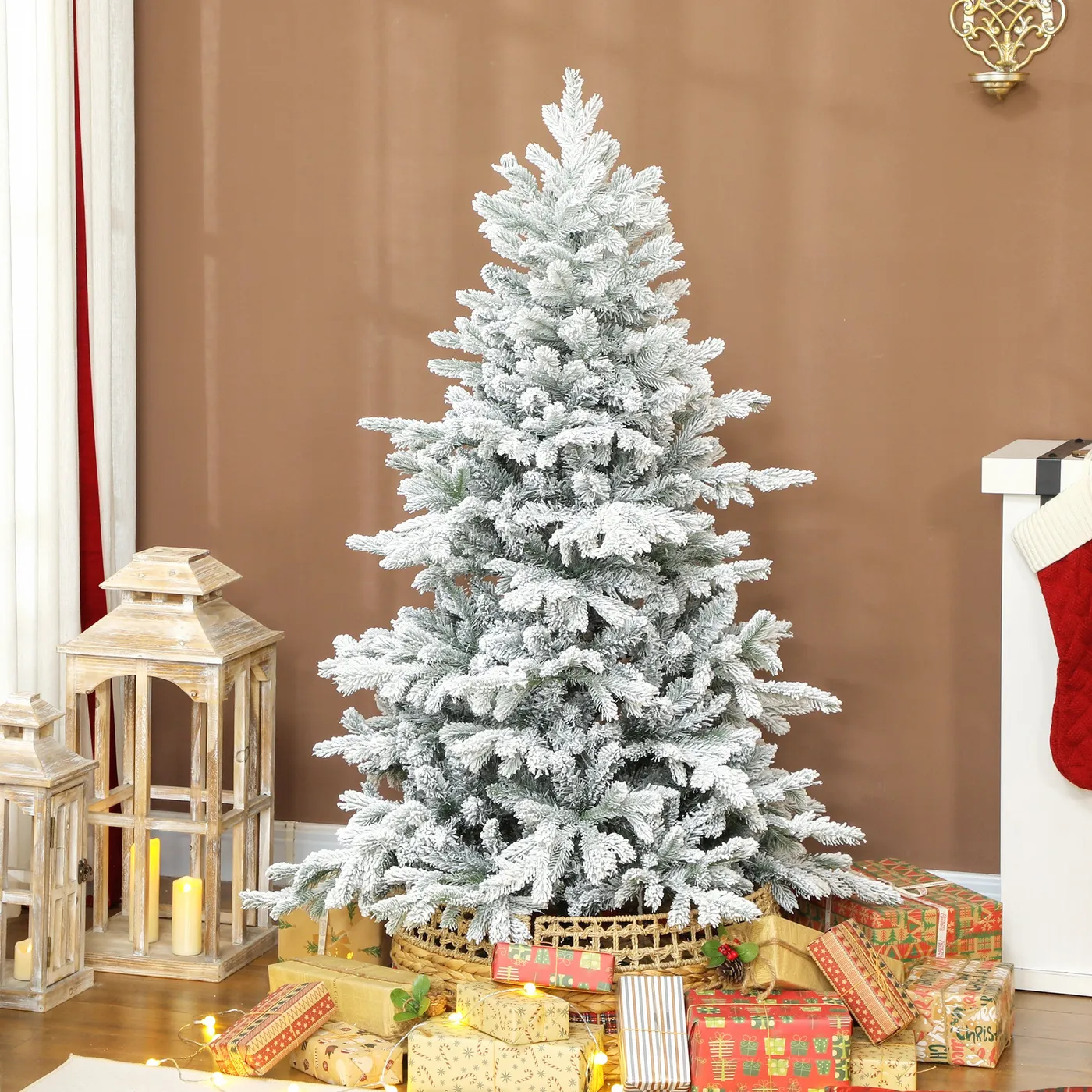
Total: roughly $330–$795. Budget alternative: a Marketplace flocked tree ($50–$120) plus thrifted lanterns at $8–$15 each gets you the same vignette for about half.
- Measure the tree’s widest branch spread at floor level — usually 42 to 48 inches on a 7.5-footer.
- Set each lantern 18 to 22 inches out from the trunk and angle it a few degrees toward the tree.
- Keep the two distances different (one at 18, one at 21) so it doesn’t look like a mirror.
- Use battery LEDs so you’re never running a cord across the floor.
- Cluster gifts between lanterns and trunk — the lanterns frame the tree, they aren’t the subject.
Time: about 45 minutes. Cost: $40–$90 if you’re buying the lanterns new.
5. A Flocked Tree in Front of a Christmas Tapestry
Maximalist Christmas is back, and not ironically. Vintage tapestries, ceramic snowmen, wall-mounted stars — the pieces that used to get edited out of holiday photos are exactly what people are saving now, because they read as a real family’s house instead of a catalog set. Saves for vintage and “grandma-core” holiday decor have climbed for three seasons straight. The trend has staying power because it isn’t a color scheme; it’s an attitude about the stuff you already own.
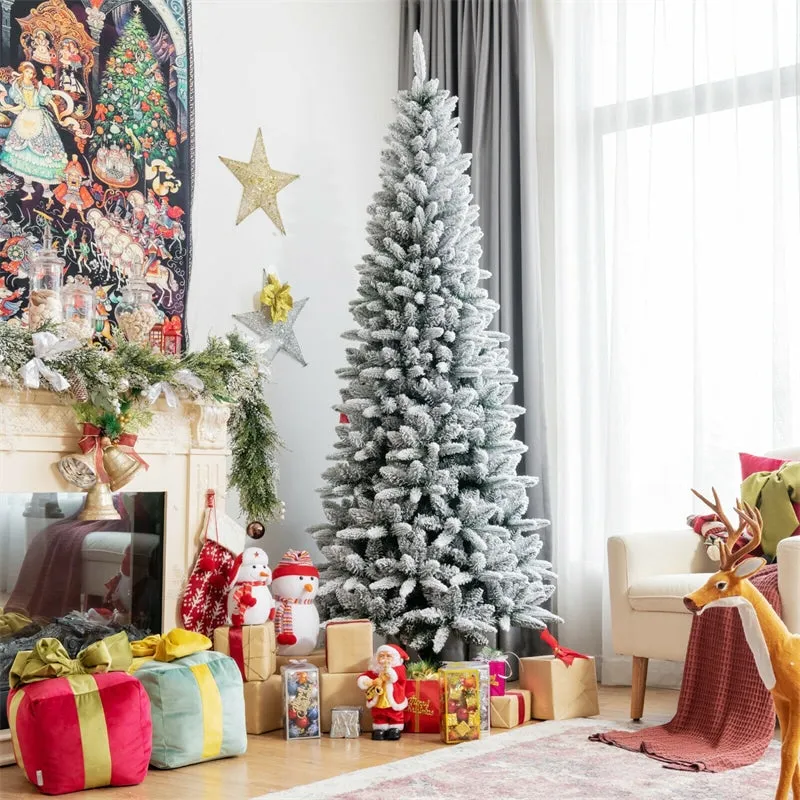
The tapestry is the load-bearing wall of this room. Remove it and the figurines on the mantel and floor stop reading as a collection and start reading as clutter — same objects, completely different verdict. That’s the rule with maximalist holiday decor: you need one large, confident piece as the anchor, and everything smaller gets permission to be charming. Without an anchor, edit down to five figurines and call it done.
6. Pre-Lit Flocking Over a Dark Woven Wicker Basket
Pre-lit trees are almost always under-lit from the factory. On a heavily flocked tree, budget about 100 lights per foot of height rather than the 50-ish most 7-footers ship with — flocking reflects light, but it also hides bulbs, so you need roughly double what a green tree would want. Add a warm white strand and run it along the inside of the branches, closest to the trunk. That interior glow is what makes a flocked tree look lit from within instead of tangled in a net.
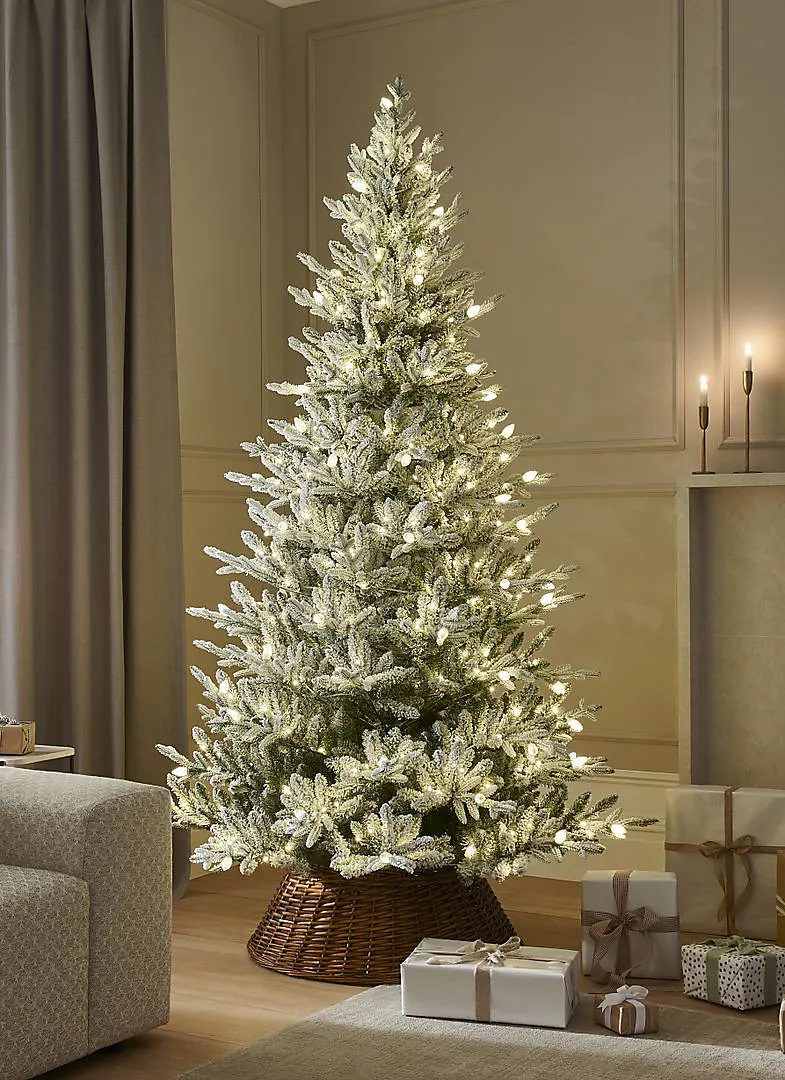
You don’t need a designer tree to get this look. Facebook Marketplace is flooded with flocked trees every January at $40–$120, and a dark woven basket from a thrift store runs $6–$15 — which is exactly the base here. Brass candlesticks are the easiest thrift score in the country at $4–$12 each, and mismatched heights look better than a matched set anyway. Target and Walmart both carry solid kraft paper and simple ribbon, so the whole floor vignette lands under $100.
7. Warm Globe Lights Against Black Gridded Windows
Three things are doing quiet work here. The black window grid frames the snowy view, so it reads like a photograph instead of a draft. The globe lights are larger and fewer than fairy lights, which suits a slim tree — they add visual weight where the silhouette is thin. And the round red table echoes the round bulbs, so one saturated accent doesn’t feel random. It’s a repetition trick: same shape, two materials, one room.
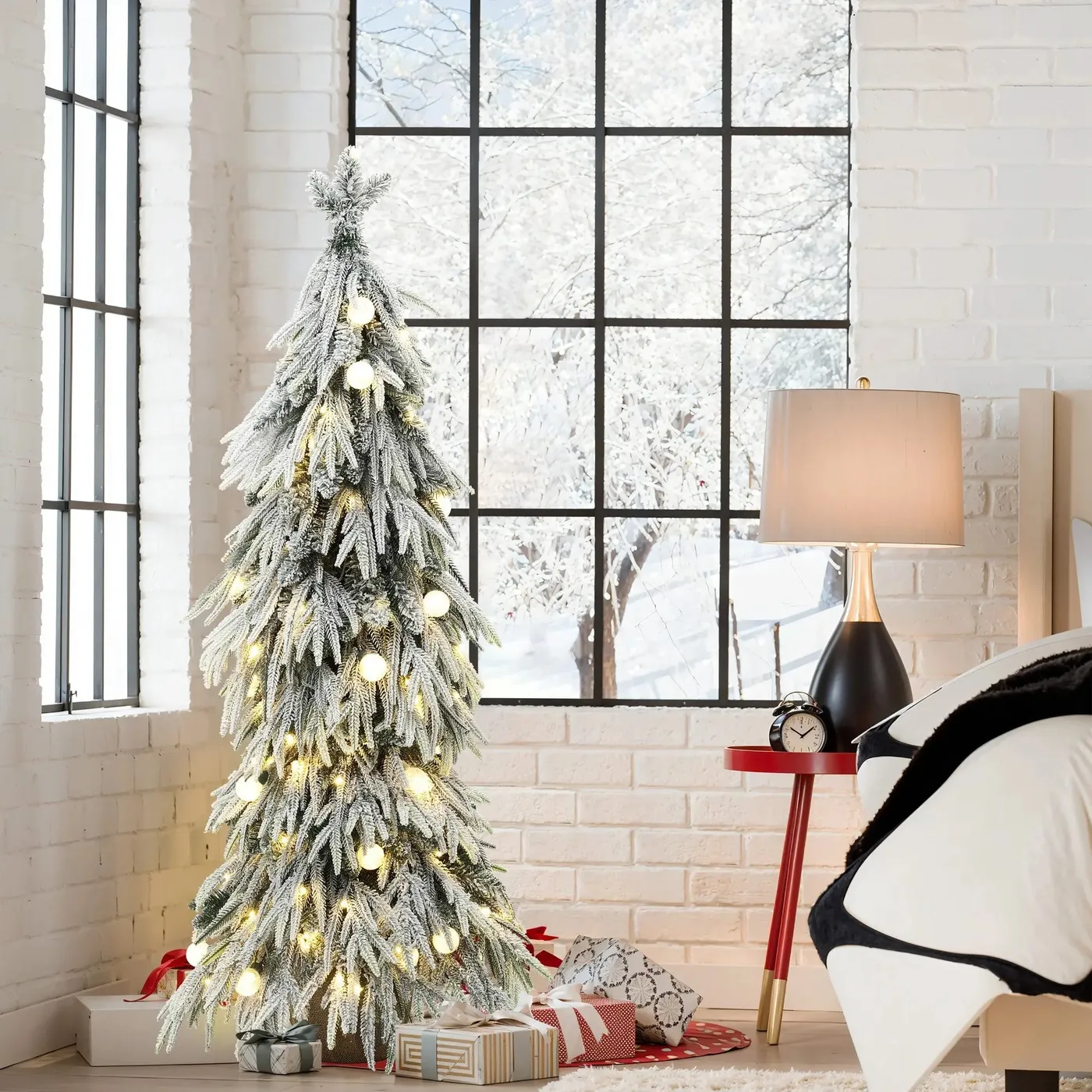
Slim flocked trees plus globe lights can tip into sparse fast. Globes take up real estate, so on a 6-foot tree, ten of them looks intentional and twenty looks like a craft project. That red side table is also committing you to a warm accent all season — if you repaint furniture every February, choose brass or black instead and let the wrapping paper carry the red.
8. Blue-Green Branches With Wood Bead Garland
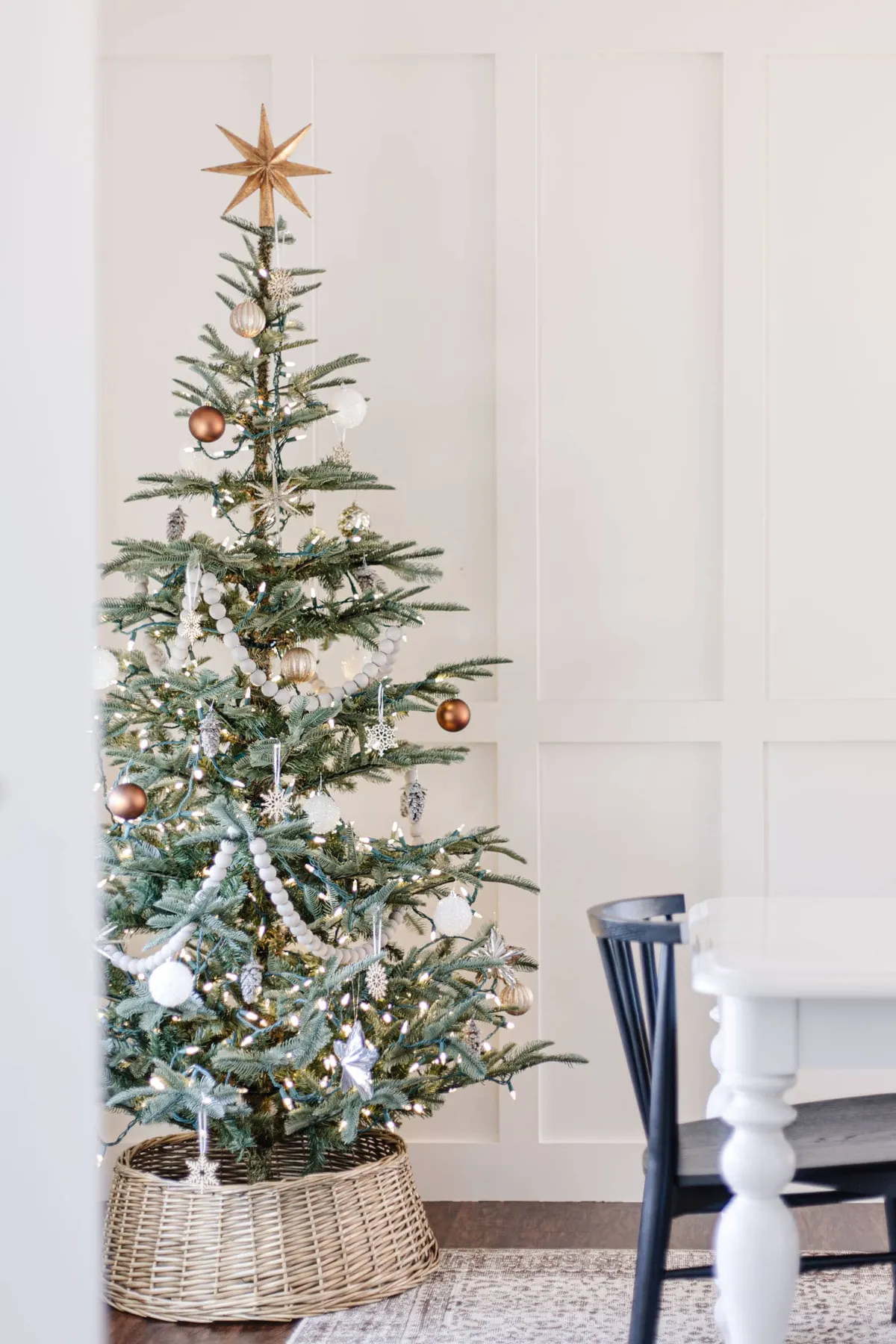
Roughly 55% blue-green foliage, 20% warm white light, 15% natural texture, and 10% gold. The trick is that the cool base never touches the warm light directly — the wood beads sit between them, which is why nothing clashes. Swap blue-green for deep teal and it turns moodier; go sage and it goes soft and coastal. Gold appears only twice, at the star and the velvet ribbon, which is what keeps it reading as contrast rather than theme.
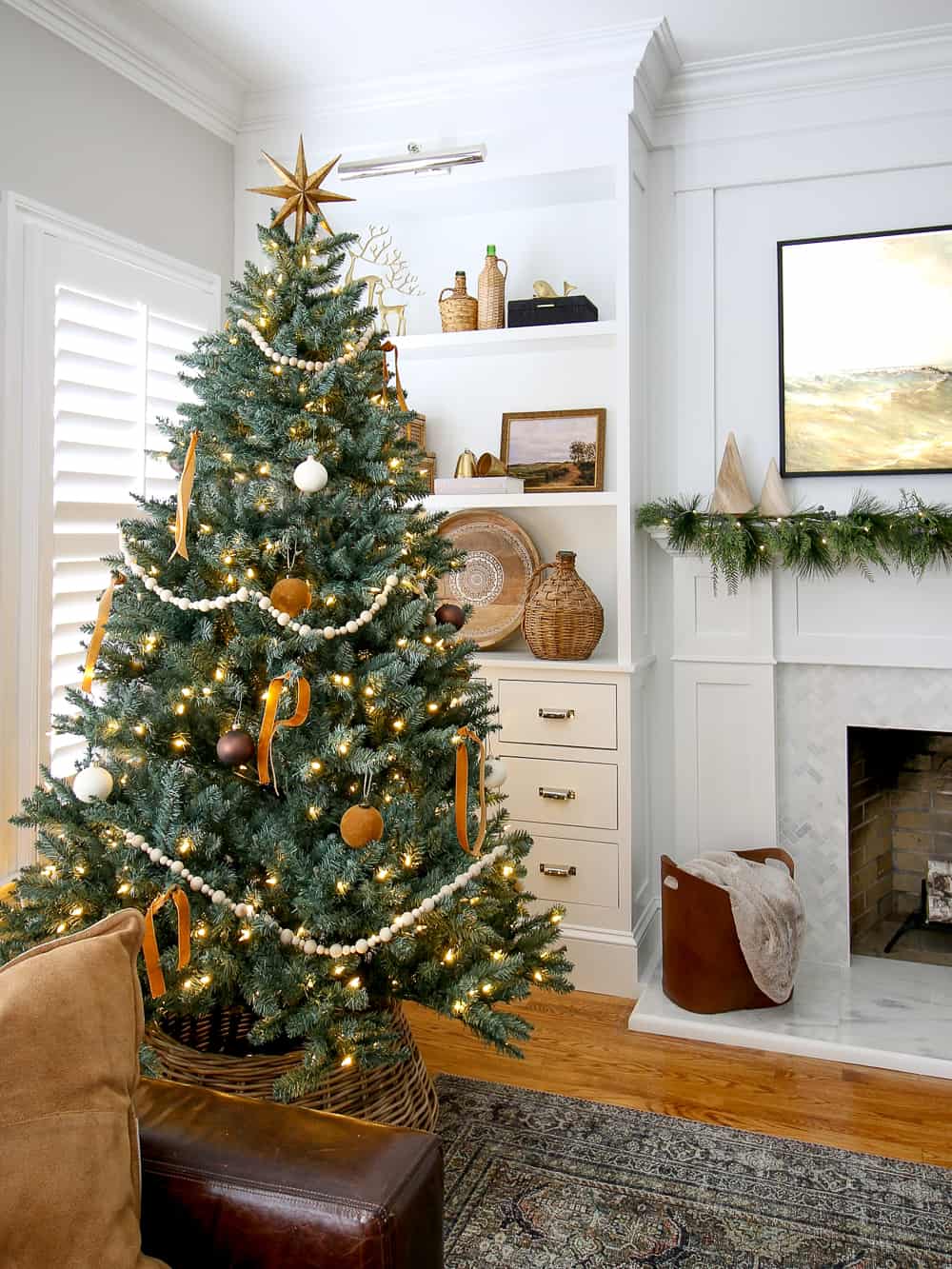
The wooden bead garland is the piece that saves this tree. Without it, blue-green branches under warm lights can feel cold and slightly aquatic — the beads interrupt that with a matte, earthy texture that pulls everything back toward a living room. The brown-and-white ornaments do the same job on the branches. If you steal one thing, steal the beads: about 9 feet of wood bead garland runs $18 and it works on any color of tree.
9. A Slim Flocked Tree on a White Faux Fur Skirt
Faux fur is beautiful and high-maintenance in equal measure. Plan to shake it out weekly and vacuum it every couple of weeks through December, more if you have a shedding pet. Flocking is the other chore — it drops steadily for the first week after unpacking, then settles. Store the skirt in a breathable cotton bag, not plastic, or it picks up a musty smell by year two. A knitted pom-pom skirt like the one in Idea #12 is the lower-effort cousin.
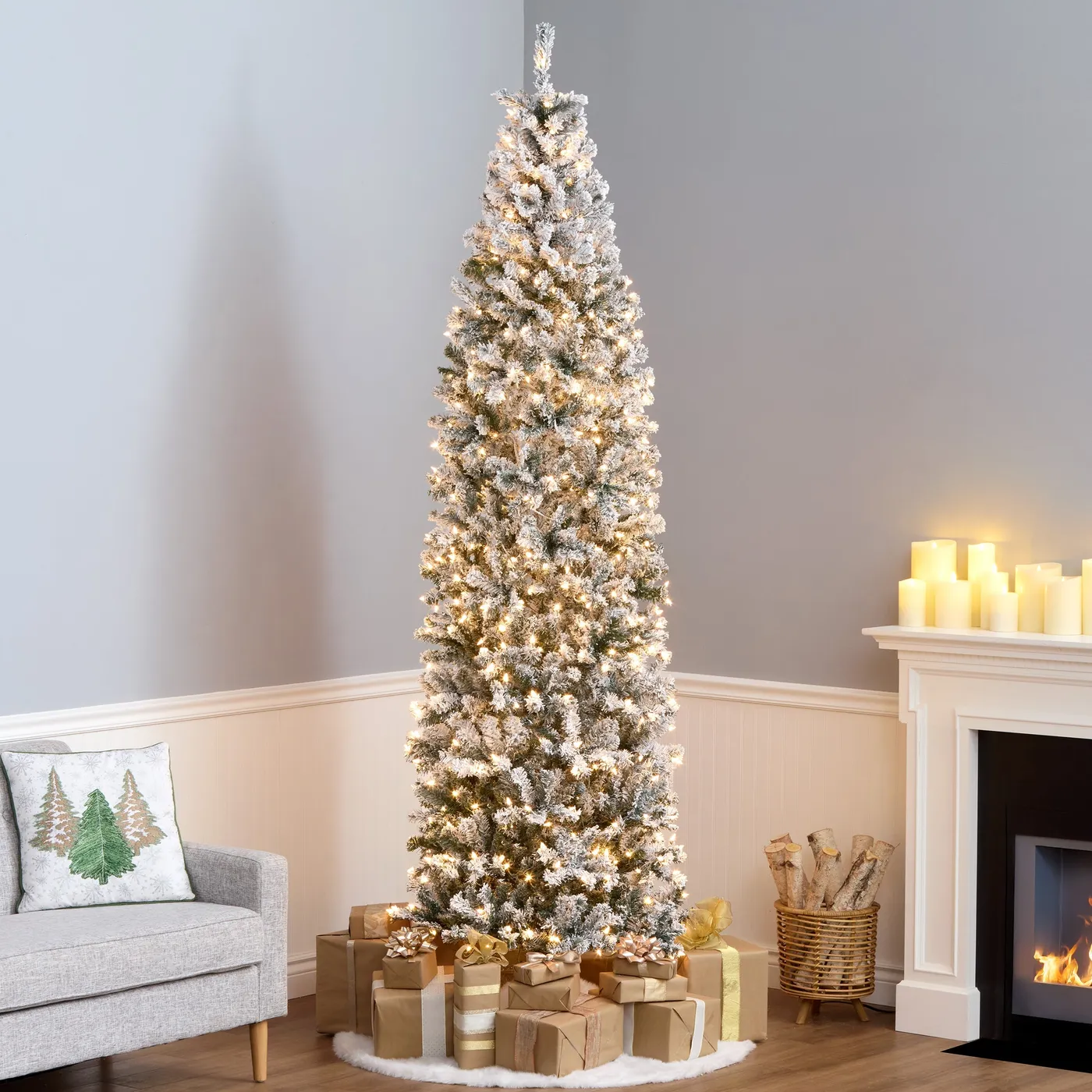
Slim flocked trees are the most forgiving size in this whole article. A 7 to 7.5 footer clears an 8-foot ceiling with room for a star, and it needs only about a 3-foot radius of clear floor — call it 6 to 8 square feet of footprint. It works in apartments, beside a fireplace, in a hallway nook. Short on floor space? The fur skirt actually helps, because it visually widens a narrow base.
10. Silver Baubles, Trailing Ivy, and a Burning Fire
Greens at the base of a tree need structure or they look like a dropped houseplant. Use three to four ivy stems per side with wire you can bend, tuck the ends into the stand, and let them spill about 12 inches onto the floor. Keep every bit of greenery at least 36 inches from an open firebox — that’s the clearance most chimney guidelines land on. If the fire is actually burning, use LED pillar candles on the hearth instead of real ones.
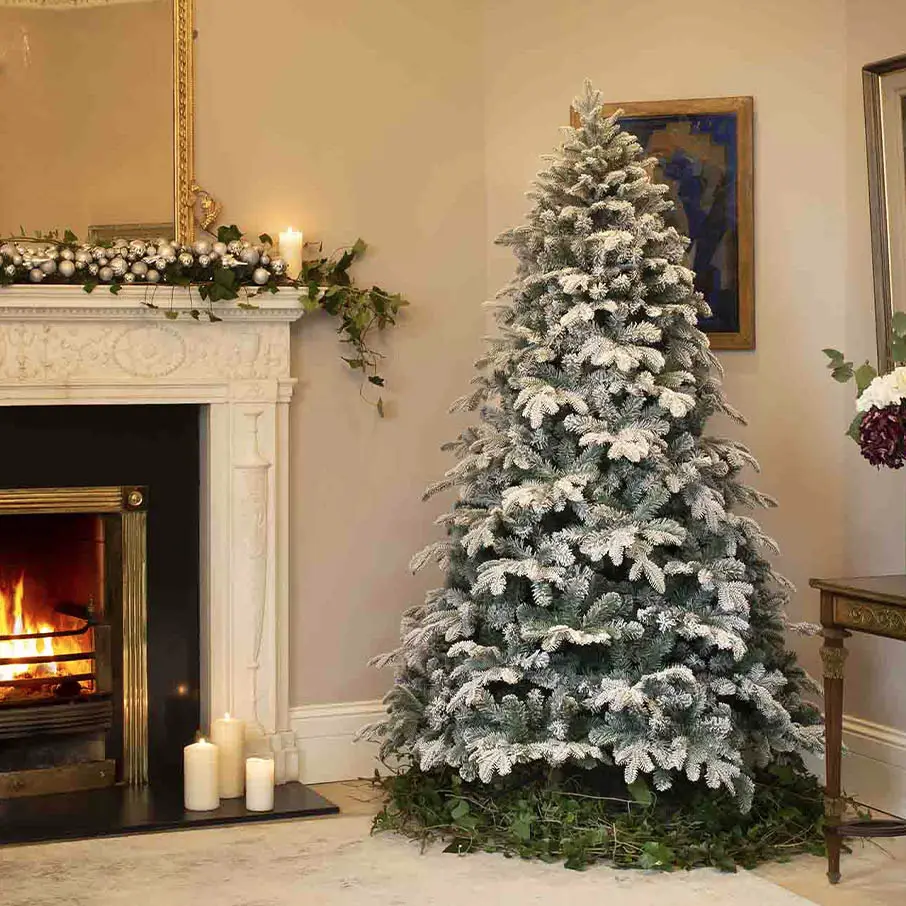
Silver, white, and green is a cool palette, and a real fire is what keeps it from feeling chilly. The brass grate and gold mirror add two more warm notes, so the cool tones read as frost rather than coldness. The mirror does a second job: it doubles every candle flame in the room, which is why this hearth feels brighter than three pillar candles have any right to.
11. A White Flocked Tree Framed by a Dark Green Door
- 7 ft flocked white tree: $160–$400
- Silver and gold ornament set (60–80 pieces): $45–$120
- White string lights: $12–$30
- Red and white wrapping paper, ribbon, candy cane picks: $28–$65
- 9 ft garland for the door: $35–$80
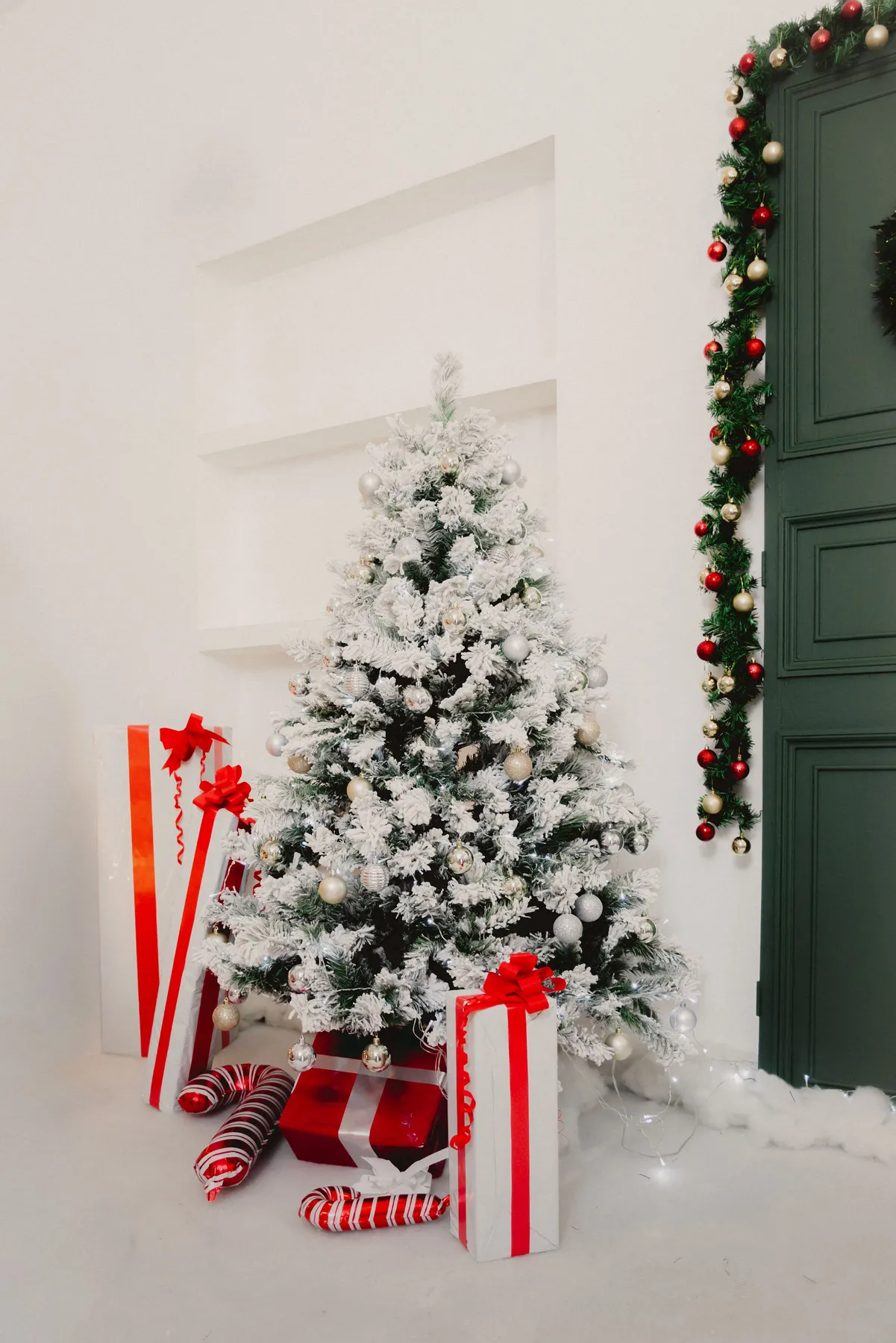
Total: $280–$695. Budget alternative: dollar-store ornaments in silver and gold at $1.25 each plus a Marketplace tree brings this to roughly $180.
The mix runs 50% white flock, 20% gold, 20% silver, 10% red. That red is the only warm color in the room and it’s deliberately kept small — swap it for blush and the vignette goes soft and romantic; swap it for burgundy and it turns traditional and slightly moody. Drop the gold entirely and you have a frosty silver-white scheme. The proportions, not the hues, are what make a white tree against a dark green door feel intentional.
12. Fuzzy Balls, Mercury Glass, and a Pom-Pom Skirt
- Hang the lights first, starting on the inside — no ornaments until the glow is right.
- Place the largest pieces first, pushed 3 to 4 inches into the branches.
- Add mid-size mercury glass at the outer tips so it catches light from the room.
- Tuck fuzzy textile ornaments in last — they absorb light and want to sit near the surface.
- Step back every ten ornaments. Density creep is real.
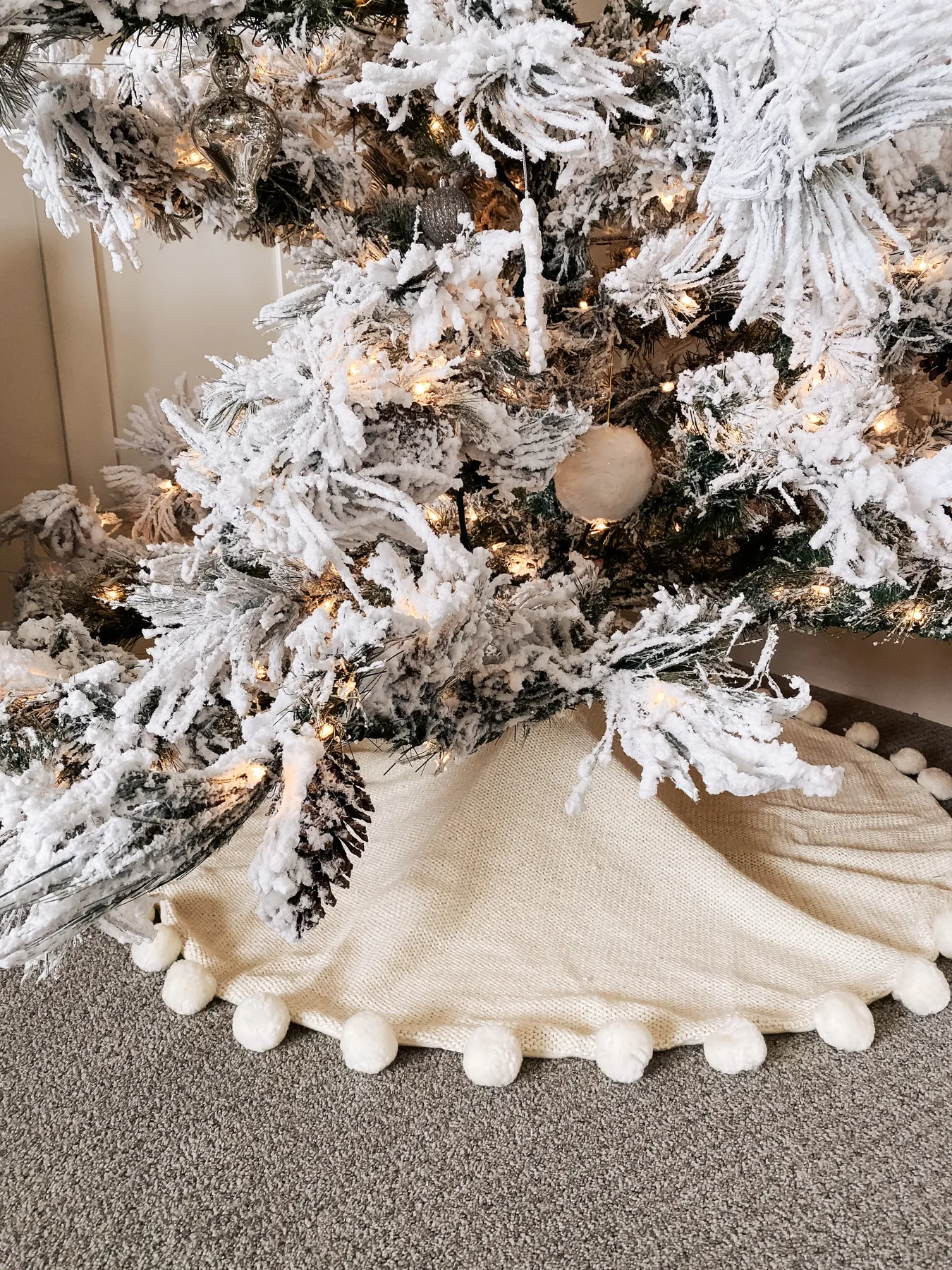
Time: 90 minutes for a 7-footer. Cost: $40–$90 in ornament picks.
Three finishes, maximum — and never two of the same finish at eye level. This tree runs matte white, mercury glass, and fuzzy textile: matte for shape, mercury for reflection, fuzz for softness. Add glitter on top of that and the tree starts competing with itself until no single ornament reads. Pick your three, then spend your budget on quantity within those three instead of variety across eight.
13. Wood Bead Garland Against White Board and Batten
The mixed-metal look is the easiest thing on this list to fake. Target’s Threshold line and Walmart’s Better Homes & Gardens both sell assorted gold, bronze, and silver ball sets for $20–$40 per 50-pack. A woven wicker collar from HomeGoods or TJ Maxx runs $25–$40, and thrift stores rarely price them above $10. Buy one box of plain gold balls and one box of white, then mix them by hand — the eye reads it as curated, and you’ve spent about $60.
- Measure wall width and ceiling height before buying a collar or topper.
- Confirm an outlet sits within the tree’s cord reach, or plan on an extension.
- Check that the collar opening fits over the stand, not just the trunk.
- Decide your ornament finish family before you shop, not after.
- Budget $150 minimum if you’re starting from zero.
14. A Grand Flocked Tree on Reflective Marble Floors
This is a double-height-space tree. You need at least 16 feet of ceiling to make a 12-footer look deliberate rather than oversized, plus a footprint of roughly 10 to 12 square feet — and honestly an entry hall or stairwell landing suits it better than a living room. On marble, put a felt pad under the stand; flocking plus slick tile is a slipping hazard. Smaller rooms should look at Idea #3 or Idea #26 instead.
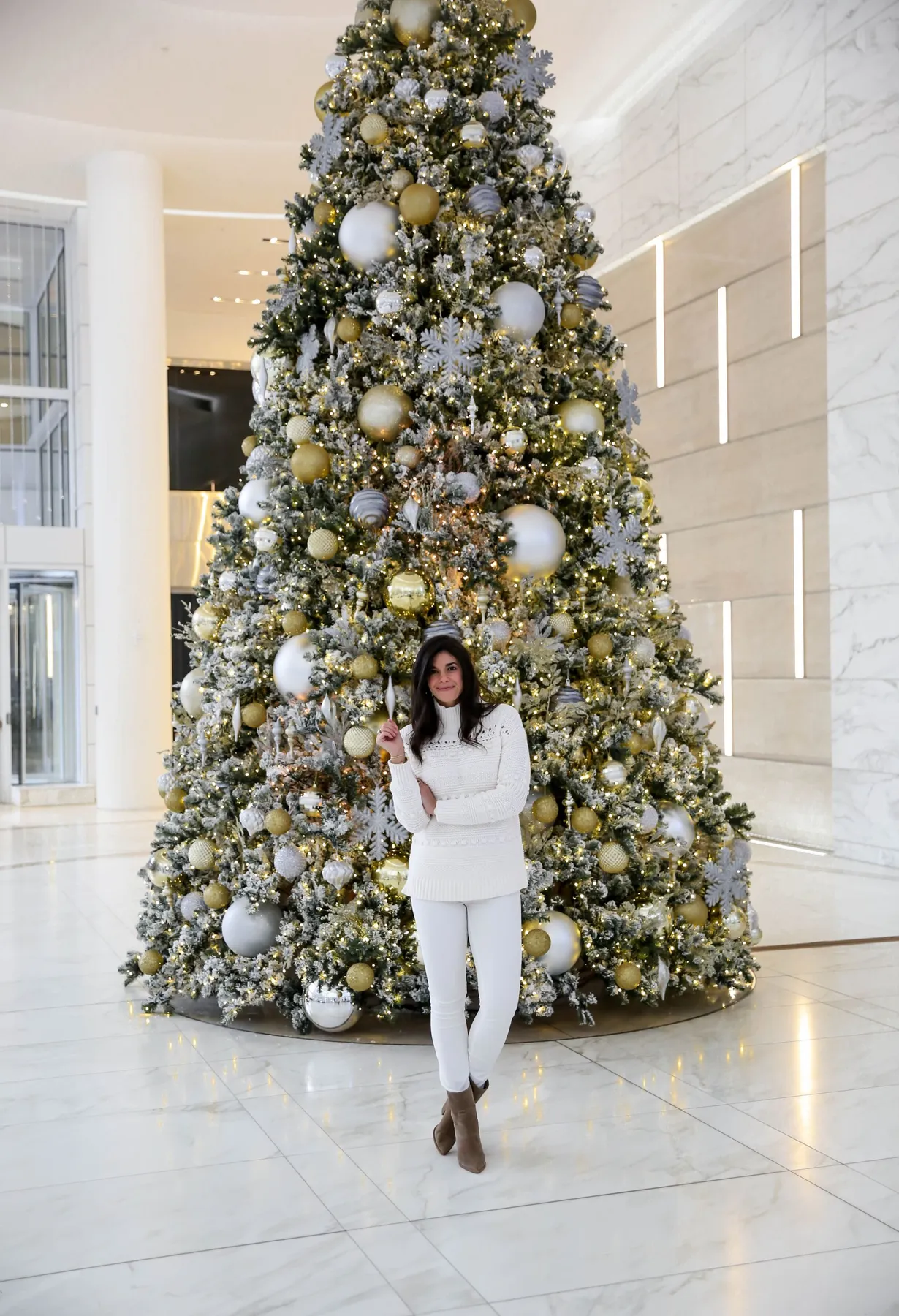
Scale is the entire idea, and it’s the one thing you cannot substitute. A 7.5-footer in this space would look like a forgotten object; a 12-footer makes the room feel designed. If your ceiling is 9 feet, don’t chase this look — chase the proportions. A tree that stops 12 to 18 inches below the ceiling lets the eye travel upward, and height relative to the room is what people actually register.
15. Red Baubles and a Tiny Happy Holidays Door
Red and white can go candy cane in about thirty seconds. The fix is ratio: keep red to roughly a fifth of the ornaments and let gold or silver carry the rest, which is exactly what’s happening here. One more thing — flocking plus glittered ornaments equals a lot of shedding, so a dark rug under this tree will show every fleck. If you’re hosting, vacuum right before guests arrive and again the morning after.

Ornament placement follows a simple rule: big pieces deep, small pieces out. Push 4-inch baubles 3 to 4 inches into the branches where they sit in shadow, then let 2-inch pieces hang at the tips where they catch room light. Space them roughly 4 inches apart, and hang at least a third slightly off-center — a perfectly even grid is what makes a tree look machine-made. It’s also how nine ornaments start looking like twenty.
16. The Six-Foot Flocked Fir With 250 Warm Lights
- 6 ft flocked pre-lit tree (250 warm white lights): $90–$220
- Extra warm white strand (250 count): $12–$28
- Neutral ornament set (60 pieces): $35–$90
- Tree collar or skirt: $20–$55
- Wrapping paper and ribbon: $15–$35
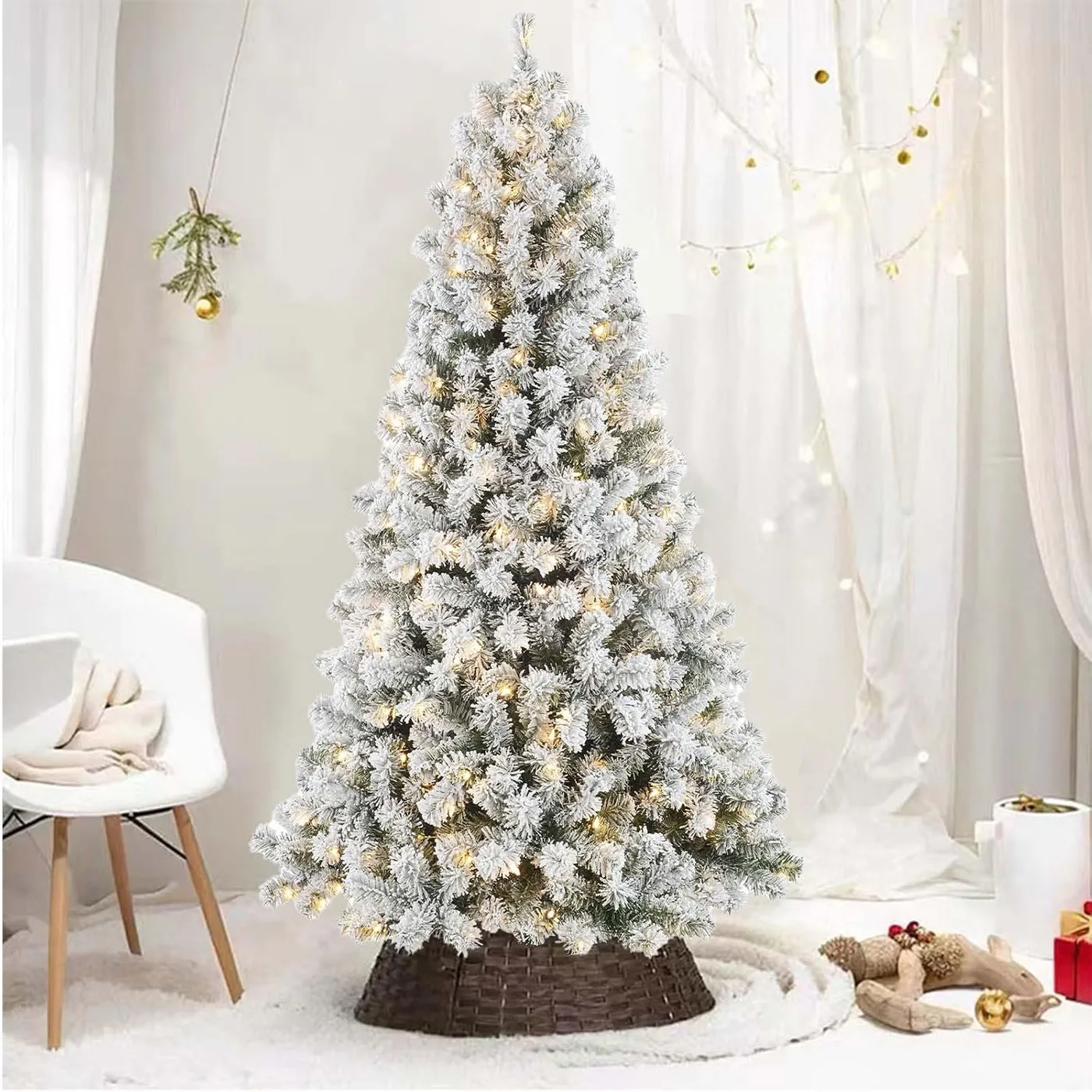
Total: $172–$428. Note that 250 lights on a 6-footer is about 42 per foot — on the sparse side for flocked branches, so plan on that extra strand.
A 6-foot tree is the cost sweet spot because it’s the size most people are upgrading from. Buy used: Marketplace and local buy-nothing groups fill up with flocked trees every January at $40–$70, and flocking hides scuffs better than bare green branches. Spend the savings on light instead — an extra $20 of warm white strands does more for the look than $100 of ornaments ever will.
17. Gold-Trimmed Bay Windows Behind a White Tree
Gold-trimmed millwork and heavy flocking are the interior version of quiet luxury, and holiday decor has followed. Instead of novelty ribbon and plastic figurines, people are buying fewer, better ornaments in white and gold and letting the architecture carry the room. It photographs beautifully, which matters on Pinterest, and it ages well — the same ornaments work for a decade as long as the palette stays tight. This one isn’t going anywhere in 2026.

A bay window like this usually lives in a room with 10-foot ceilings and at least a 14×16 footprint, which is why an 8-footer sits comfortably instead of dominating. Keep the tree to the side of the glass so the snow view stays open. If your ceiling is 8 feet, drop to a 7-footer and skip the oversized gift boxes. Idea #7 uses the same window-side trick at a smaller scale.
18. A Red Sofa, White Plank Walls, and Red-and-White Branches
Call it 45% white base (walls, vertical paneling, flocked branches), 30% red, 15% warm glow, 10% gold accents. The red repeats at three scales — ornaments, sofa, throw — and that’s what makes it look deliberate rather than decorated. Swap the red for navy and the room turns coastal-winter; swap it for deep forest green and it goes classic. Whatever you swap, keep that 30% share. Proportion is the load-bearing part.
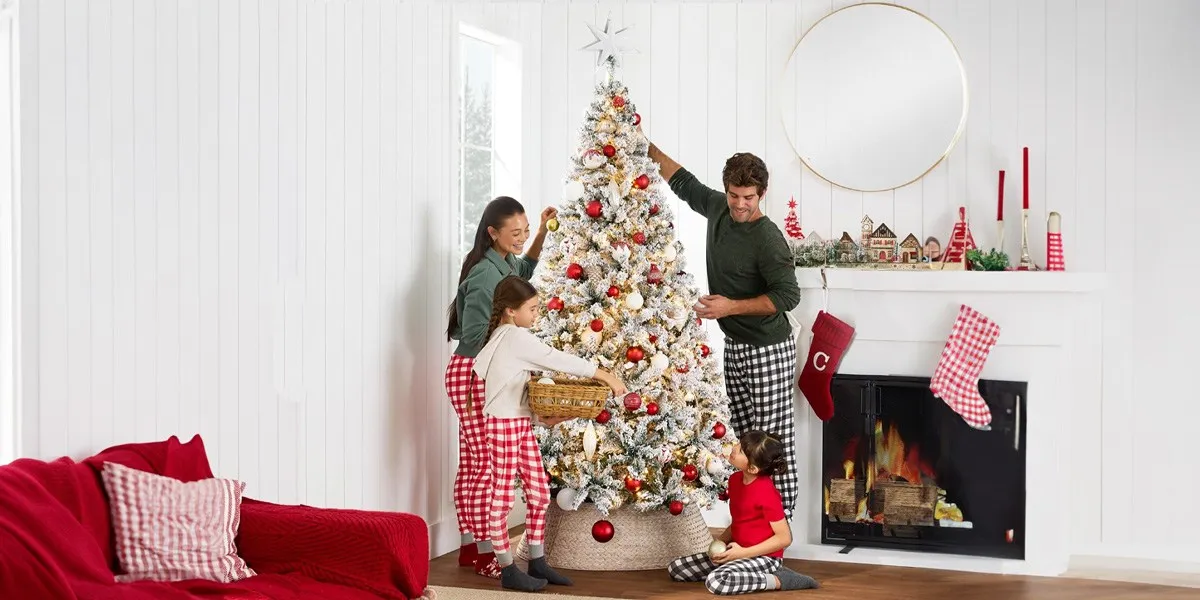
There’s a circular motif running through the frame: round ornaments, a round gold mirror, a round arrangement on the mantel. That repetition is why a fairly busy room still feels calm — your eye has a shape to follow. The vertical plank walls do the opposite job, adding rigid lines that keep all those circles from floating. And the red sofa makes the tree’s red ornaments read as part of the room rather than a display.
19. One Blue Glitter Ornament in the Flocked Branches
That single blue glitter ornament is the whole photograph. Flocking, pinecones, one saturated accent — nothing else in the frame needs to compete, and the tree stays wintry instead of becoming a color story. Remove it and you have a perfectly nice snowy branch with nothing to look at. On a flocked tree, one accent color used sparingly beats five colors used evenly. Buy six in that blue and stop.
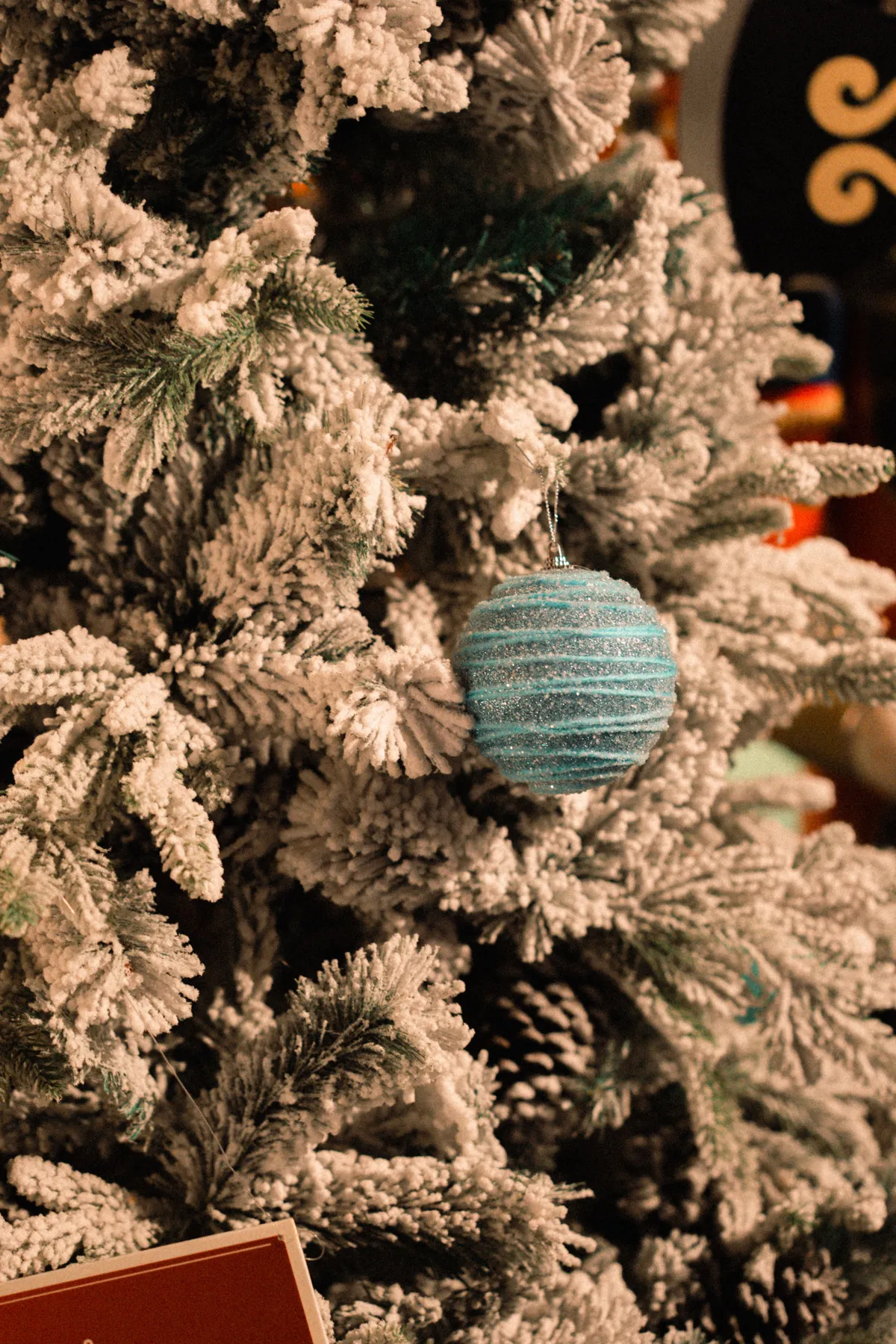
When you’re working with one accent color, place it in a loose triangle: the highest point around two-thirds up the tree, then two lower points offset left and right. Six to eight pieces total on a 7-footer, spaced at least 15 inches apart. That spacing is what makes a lone ornament read as intentional instead of leftover. Keep the accent in a single finish too — a matte blue and a glitter blue at the same size will look like a mistake.
20. Cream Straw Ornaments and a Lighted Wreath
Natural-material ornaments — woven straw, wood, felt, cream fabric — are the easiest holiday decor to live with. Dust them with a dry brush once a season and store them in a fabric bin rather than cardboard so nothing creases. Fairy lights are the fussy part: test every strand before you hang it, because one dead section means restringing the whole tree. Bulbs are cheap to replace; do it in November, not on the 20th of December.

- 7 ft tree with warm white fairy lights: $120–$350
- Cream and woven natural ornaments (60 pieces): $45–$110
- Woven basket tree collar: $25–$60
- Pre-lit green wreath: $25–$55
- Kraft and patterned wrapping paper: $18–$40
- Gold reindeer figurine: $12–$30
Total: $245–$645. Budget alternative: buy the tree used ($50–$100), then spend $40 at a thrift store on straw ornaments.
21. A Light Woven Basket Under a Flocked Tree
Vertical paneling is gorgeous and unforgiving. Every smudge, every strand of tinsel that hits the wall, every fingerprint at kid height shows up in raking light. Keep a dry microfiber cloth and a magic eraser on hand. Also worth knowing: a woven basket collar only works if the tree stand actually fits inside — measure the stand’s diameter before you buy, because a collar that’s too small is the most common holiday return I see.
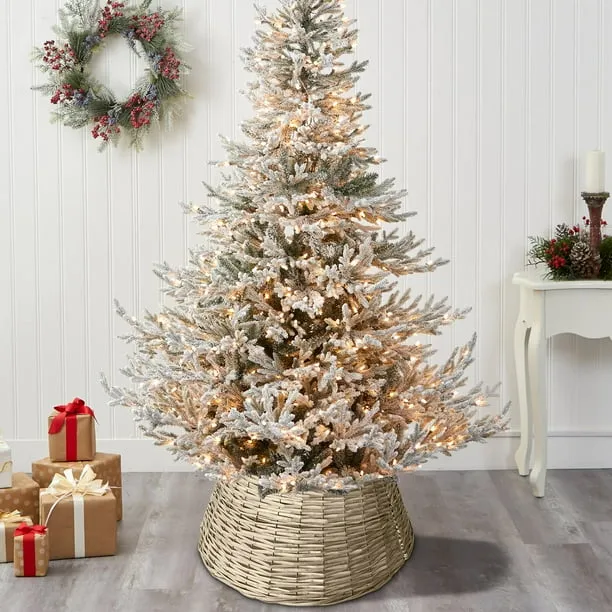
This setup works in a room from about 10×12 feet up with a standard 9-foot ceiling. The slim tree takes roughly a 3-foot radius, and a small side table needs another 18 inches of clearance so you can still walk past. Leave at least 30 inches between the tree and any doorway — you’ll want that during parties. For tighter spaces, the door-side arrangement in Idea #13 is the better fit.
22. Silver Teardrops and a Spiky Glittered Topper
Silver and white only works when you add something non-metallic. This tree gets away with it because of a blush tasseled cushion and a bowl of pinecones in the foreground — organic shapes that keep an all-silver scheme from looking like a showroom. Add three natural elements to any metallic tree: wood, dried botanicals, and one textile. Skip that step and a silver tree reads cold no matter how good the ornaments are.
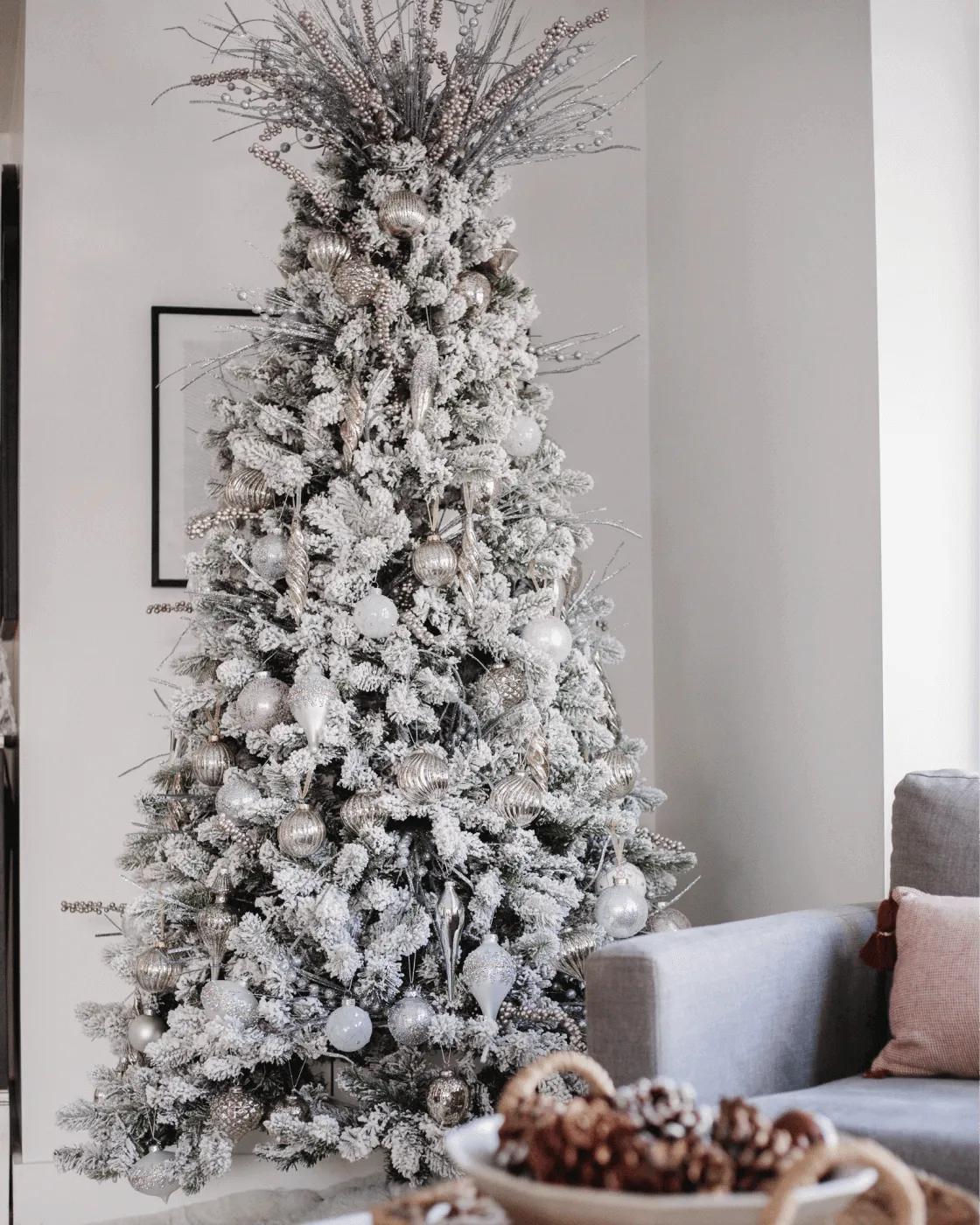
The spiky silver topper is what makes this tree look designed rather than decorated. A standard star or bow would have been fine, but the spray of glittered branches and berries matches the flocking’s irregular texture, so the top looks like it grew that way. Toppers are the most overlooked purchase in holiday decor and the first thing anyone sees. Spend there, not on your twentieth ornament.
23. A Flocked Tree Beside a Garlanded White Mantel
- Measure the mantel width and plan garland at least 1.5 times that length.
- Anchor both ends with removable hooks, then drape in soft swags rather than a straight line.
- Tuck in birch logs and a white vase of bare branches for height.
- Hang the wreath centered on the fireplace opening, not the wall, at roughly eye level.
- Keep gift boxes on the hearth smaller than the wreath so the mantel stays the focal point.
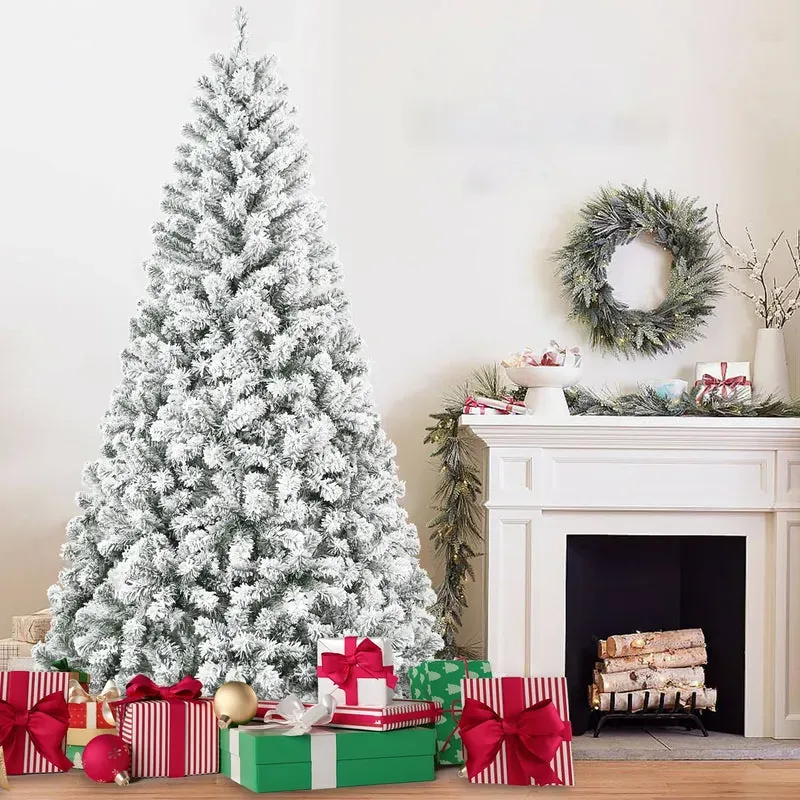
Time: about an hour. Cost: $60–$140 for garland, wreath, and fillers.
The mix runs about 55% white (tree, mantel, walls), 20% green, 15% warm glow, 10% red. Red shows up only in the gift wrap, which is why the room feels calm despite plenty going on. Trade the red paper for brown kraft and it goes quiet and Scandinavian; trade it for plaid ribbon and it turns traditional. Either way, green and white should stay the majority — that ratio is what makes a flocked tree and a green garland feel like one thought.
24. Gold, Bronze, and Pinecone Ribbon on Flocked Branches
Gold and bronze on a flocked tree is one of the easiest looks to build secondhand. Thrift stores price ornament bags at $3–$8 for a mixed dozen, and you can sort them into white, gold, and bronze in five minutes at home. Ribbon is where people overspend — a 10-yard roll of gold glitter ribbon runs $8–$14 at Walmart and covers a 7-foot tree. Pinecones are free if you have a yard, and a $6 bag of cinnamon pinecones smells better anyway.
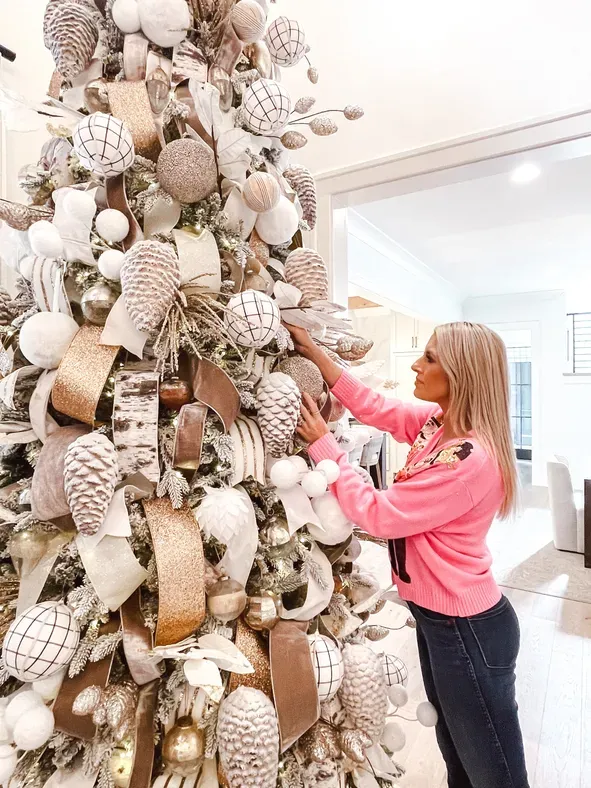
Now the honest part about an opulent tree: dust. Flocking plus velvet ribbon plus glittered berry branches is a magnet for it, and a tree this ornate takes about an hour and a half to take down. Store ornaments wrapped by finish rather than by size so next year goes faster. If you have toddlers, keep the glittered berry picks on the upper two-thirds — they’re the pieces most likely to end up in a mouth.
25. Blue Flocking Next to a Classical White Mantel
Blue flocking is a risk, and it works here because everything around it is neutral-warm. The white classical mantel and gold mirror give the blue somewhere to sit, while the warm white string lights keep the branches from reading cold. Had the mantel been modern and black, this would be a much harder room to pull off. The gift wrap adds a small hit of red — just enough to make the blue look chosen rather than accidental.

- Check the flocking color in daylight before you commit — blue reads grey in some rooms.
- Order mantel garland at 1.5x the mantel width, no less.
- Test one strand of lights against the blue branches to confirm the warmth balance.
- Decide whether the mirror above the mantel will reflect the tree or fight it.
26. A Slim Flocked Tree Beside a Lit Wreath
Flocked trees photograph brighter than they look in person because there’s no green foliage absorbing light. In a grey-walled room like this, that means you can run about 30% fewer lights than on a green tree and still get the glow — as long as you’re using 2700K warm white rather than daylight LEDs. Daylight bulbs turn flocking flat and blue-white. It’s a $15 difference and it’s the single most common flocked-tree mistake I see.
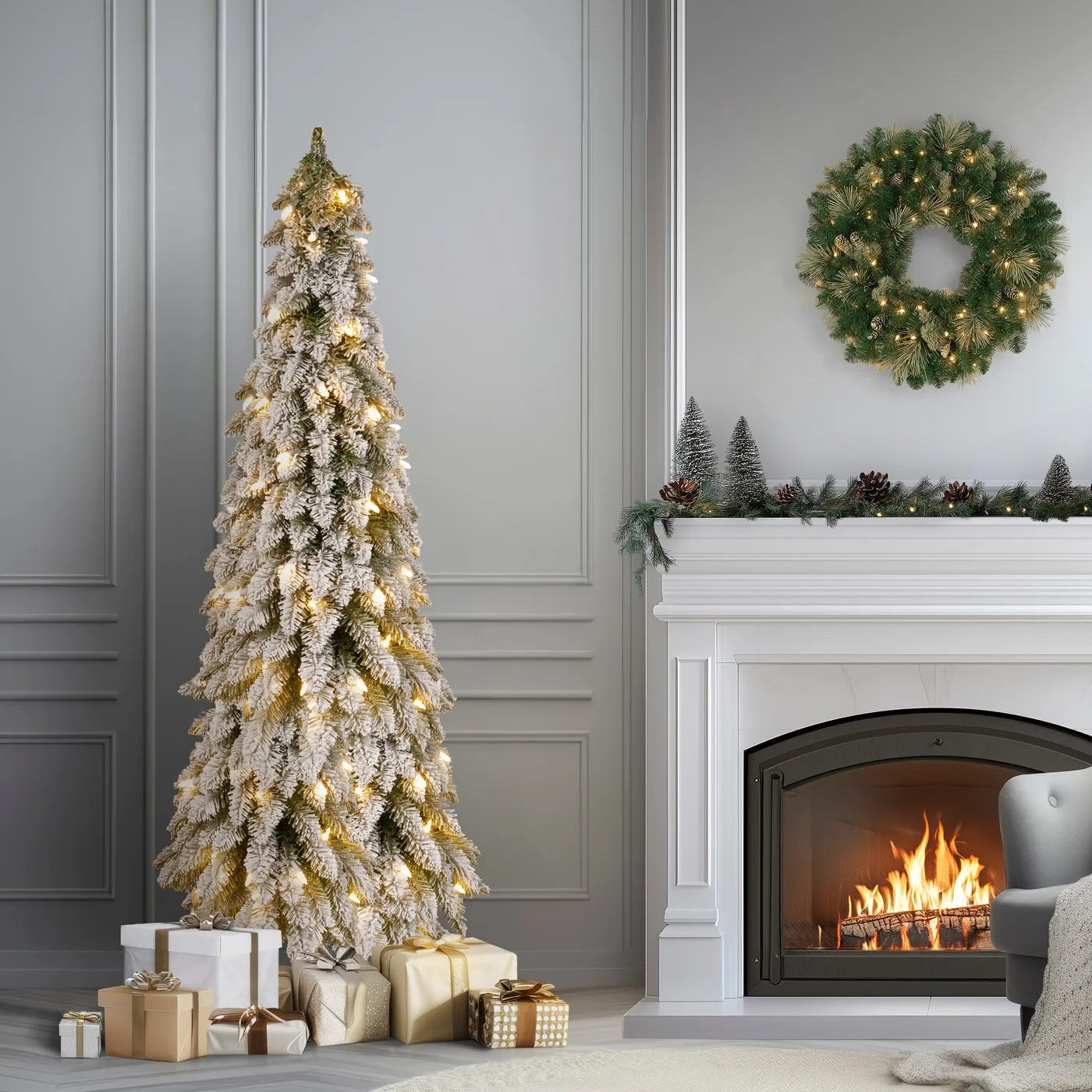
A slim 7 to 7.5-footer pairs beautifully with a standard fireplace wall and needs only about 36 inches of clearance on each side — enough to see the mantel, not enough to overwhelm it. Works in rooms 11×13 feet and up with 8 to 9-foot ceilings. Keep the armchair about 4 feet back so the fire doesn’t bake your throw. Larger rooms should scale up rather than add a second tree: Idea #3.
27. Miniature Brush Trees and an Illuminated Snowman
- 7.5 ft flocked slim tree: $150–$380
- Warm white string lights (500 count): $18–$40
- Garland, mini brush trees, illuminated snowman: $60–$140
- Wrapped gifts in gold, green, red, and white: $40–$90
- Tree collar or skirt: $20–$55
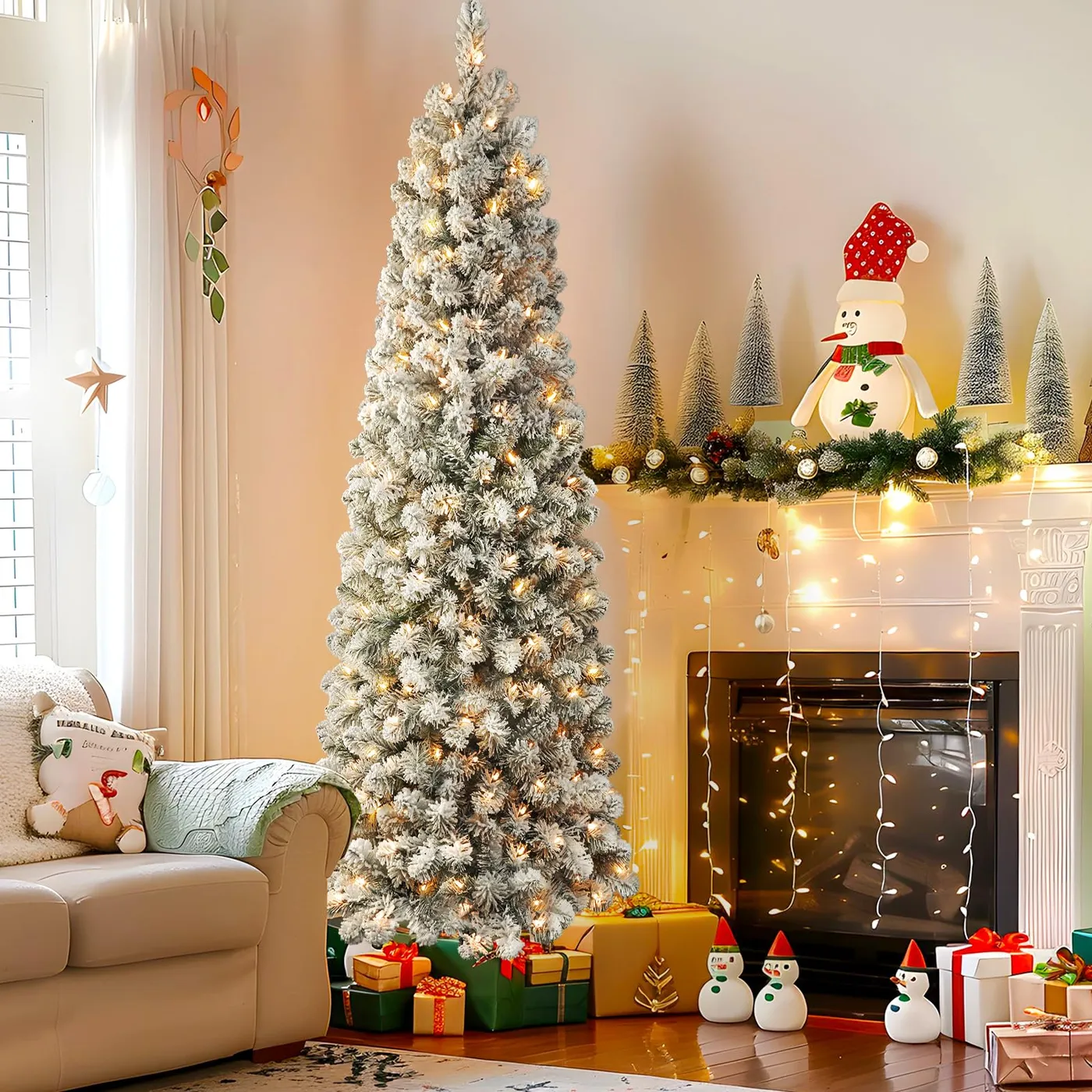
Total: $288–$705. Budget alternative: skip the illuminated snowman ($30–$70) and use a $10 brush tree set instead.
The illuminated snowman is doing more than it looks like. Without it, the mantel is garland and mini trees — pleasant, forgettable. With it, there’s a character at counter-height giving your eye a place to land while the tree handles the vertical drama. One large personality piece per mantel is the rule; two and it tips into Christmas store display. If snowmen aren’t your thing, a nutcracker does the same job.
28. Pre-Lit Flocking in a Panelled Classic Room
An elegant flocked tree with gold and silver gifts is beautiful and quietly demanding. This arrangement lives in a room with generous walkway — about 4 feet around the tree — because the gifts are part of the composition, not stacked in a corner. Cram a tree this size into a 10×10 room and the presents become obstacles you step over. Be honest about your floor plan before you buy, especially the pre-lit version, which is heavier than it looks.
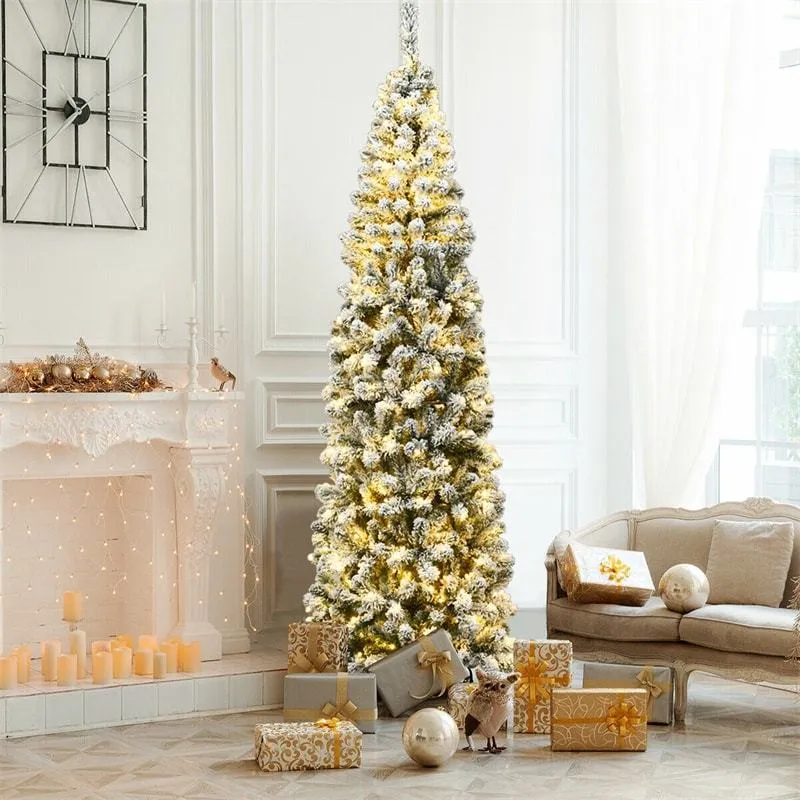
Gold and silver wrapping is the cheapest luxury upgrade in holiday decor. Skip printed paper entirely — plain white or kraft rolls run $5–$9 for 40 square feet, and a $6 spool of gold ribbon plus a $4 roll of silver makes every box look expensive. TJ Maxx and HomeGoods sell gold and silver ornament sets for $15–$25 per box in early November, before the good stuff sells out. Pull off this look secondhand for under $150.
29. A Flocked Wreath Above the Fireplace in a Grey Room
- Center the wreath on the fireplace opening, not the mantel — they’re rarely aligned.
- Hang it 8 to 12 inches above the mantel shelf so candles don’t scorch the branches.
- Use an adhesive hook rated for 5 pounds; a 24-inch flocked wreath gets close to that.
- Add a second wreath at the window if you want symmetry, but keep both sizes identical.
- Check the result from the sofa, not while standing in front of the fireplace.
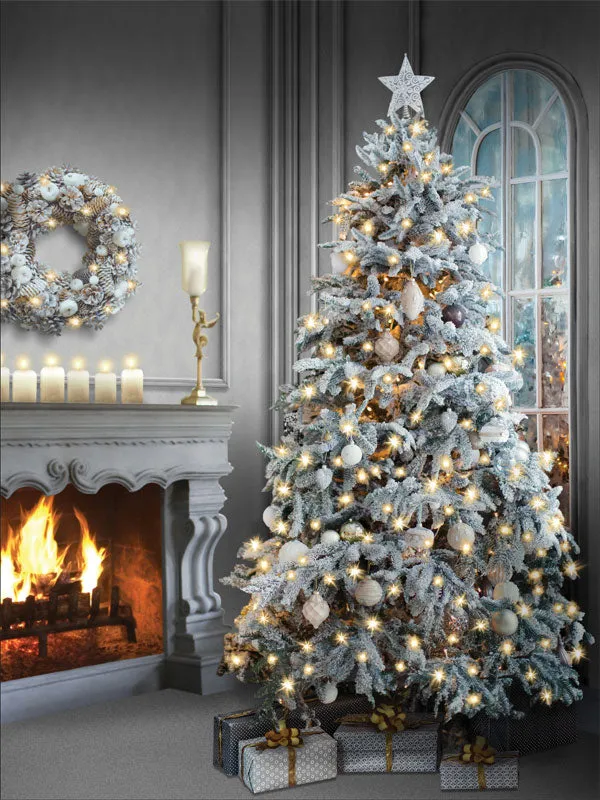
Time: 20 minutes. Cost: $25–$60 for a pre-lit flocked wreath.
Grey paneled walls plus a white flocked tree could read cold, and the warm string lights are what prevent it. Everything else here is cool — grey walls, snowy window, white mantel — so the bulbs are the only heat in the frame, and your eye goes straight to them. Useful lesson: in a monochrome room, warm light becomes the accent color. You don’t need red to make a space feel seasonal.
30. A White Ceramic Tree Luminary With Gold Edges
The whole charm of this piece is that it’s a Christmas tree made of light rather than decorated with it. Gold-painted edges catch the room’s glow, the star cutout at the top throws a small pattern on the wall behind it, and the soft bokeh of string lights in the background does the rest. On a sideboard or a console, it gives you the holidays in about two square feet — which is the entire point.

Ceramic tree luminaries are having a genuine revival, and 2026’s versions are sharper than the vintage ones: cleaner kiln work, real gold leaf on the edges, a star cutout that actually casts something. Part of the appeal is scale — it’s a Christmas tree you can own when you don’t have room for a real one. Expect to see more of these in small apartments and on tablescapes rather than as pure nostalgia.
Your Frosted Tree, Your Floor Plan
Whether you end up with a slim 6-footer in a corner or a twelve-foot flocked statement in a stairwell, the rules are the same: warm light, honest scale, and one confident anchor piece. Start with what your room actually gives you — the window, the ceiling, the outlet — and build from there.
📌 Pin the ideas you love most so they’re waiting for you when it’s time to decorate.