
29+ Stunning Black Christmas Tree Ideas for 2026 That Will Transform Your Home

Black Christmas trees are having a serious moment on Pinterest right now — and the 2026 versions look nothing like the neon novelty trees you remember.
We spent a few weeks combing through Target, West Elm, Walmart, Etsy, and Amazon to bring you only what’s worth your attention this year, from $15 ornaments to $1,200 statement trees. Inside you’ll find 29 curated ideas spanning modern minimalist black trees, gothic Victorian styling, monochrome glam, and cozy traditional setups — with budget and luxury versions of the same look compared side by side, and every idea shoppable with direct product links.
What’s driving it in 2026? Dark-hued trees finally read as design rather than gimmick, and the matte-black-and-silver palette sits beautifully against the warm, textured interiors everyone’s pinning. And stay until the end — we break down the most common mistakes that can ruin these looks. 📌 Save this to Pinterest for later — you’ll want to revisit these.
1. Victorian Gothic Glow: Gold, Dark Wood, and a Bat Topper
There’s a reason this room feels lit from within: every bulb in it sits between 2200K and 2700K. On dark patterned wallpaper and wood trim, anything above 3000K turns muddy and gray. Swap your tree lights for warm-white LED strands rated at 2700K, put them on a dimmer, and keep the wall sconces on a separate switch so you can bring them up after the tree goes off. One more thing — with a paper this busy, cap your ornaments at three finishes: matte red, antique gold, and one glass. Let the tree do the rest.
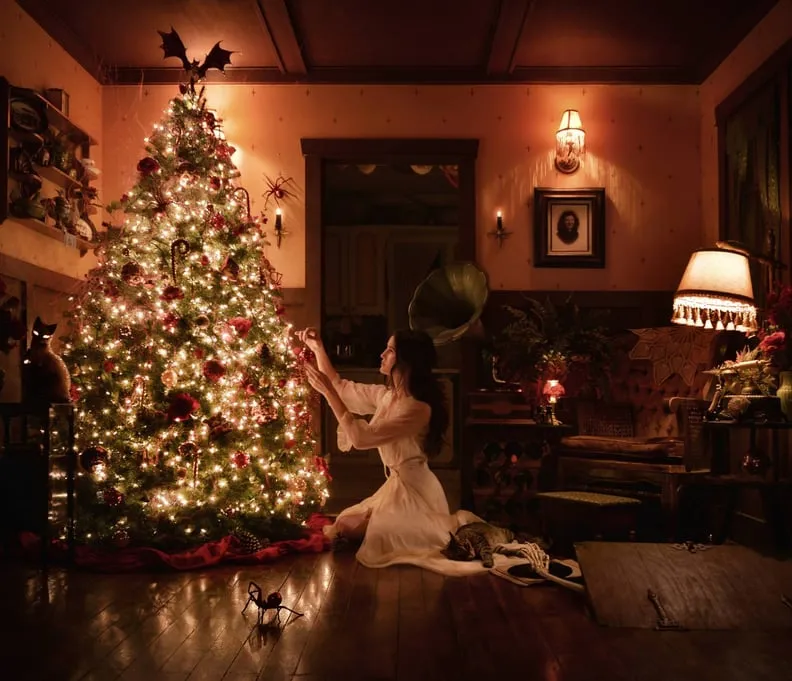
A bat-winged topper over red and gold baubles shouldn’t work. It does because the whole room plays the same game — decorative spiders, a black cat figure, a Victorian armchair — all slightly theatrical without tipping into costume. The tree is the bright anchor in a low-lit space, so your eye lands there first, then wanders to the sconces and the trim. Love the mood but not the monsters? Keep the palette and the light temperature, and swap the Halloween accents for brass birds or small framed silhouettes.
2. The Bare Black Tree That Lets the Presents Do the Talking
- Black tree, 7–7.5 ft: $120–$400
- Red and gold wrapping paper, ribbon, and tags: $45–$95
- Red drawstring Santa gift bags (set of 4–6): $18–$40
- Large Santa figurine: $35–$90
- Red patterned area rug: $90–$350
- Total: $308–$975
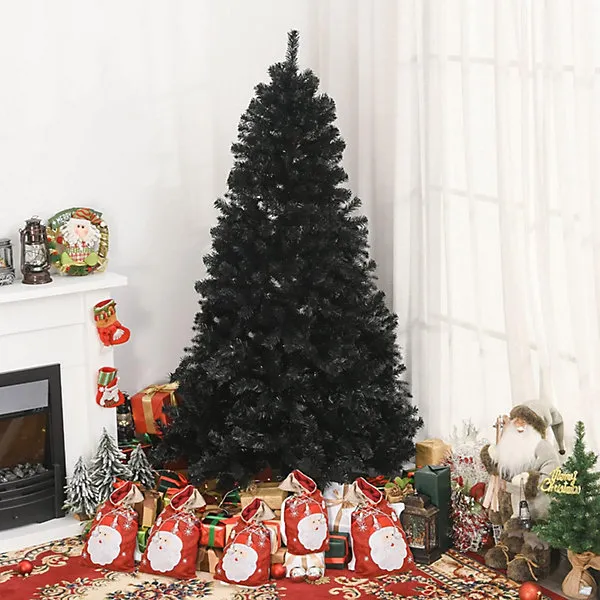
Budget alternative: skip the figurine and the rug, grab a $59 black tree at Walmart, and wrap everything in kraft paper with a single red velvet ribbon. You’ll land around $140 and nobody will notice the difference.
The undecorated tree is the whole point. Every ornament you add fights the black branches, and those branches are exactly what make the red and gold read as rich instead of loud. What you’d lose by decorating it is that pause — the half-second where your eye registers “that tree is empty” before it lands on the gifts. So spend your money at the base instead: gorgeous wrap, coordinating Santa bags, one big figurine, and a rug with enough red in it to tie the corners of the room together.
3. Silver on Black: A Grey-Bauble Trio That Keeps Its Cool
You can absolutely get this look for less than the styled version costs. Target’s Threshold line sells silver and gunmetal ornament sets in packs of 20 for about $15–$25, and Walmart carries matte black baubles in bulk for under $20. The tripod floor lamp is the piece worth spending on — IKEA’s Vickleby, or a Facebook Marketplace find at $30–$60, plus a $12 can of matte black spray paint if the wood tone is wrong. Grab the dark grey armchair secondhand; that silhouette shows up on Marketplace constantly.

70% black base (tree, wrapped gifts, chair) + 20% silver and grey baubles + 10% white (ribbon, wall molding, the single snowflake ornament). That’s the formula. Keep the black cool-toned rather than warm, or the silver turns dingy next to it. Swap the silver for brushed brass and the room warms instantly; swap the white ribbon for deep navy and it gets sharper and more graphic. The proportions stay the same either way — that’s what makes it work.
4. Red Berries and Pinecones on a Slim Pre-Lit Tree
- Fluff the tree from the inside out, branch by branch, before anything goes on. Slim trees need it far more than full ones.
- Place berry sprigs in clusters of three, angled outward and slightly down, every 8–10 inches.
- Tuck pinecones deep against the trunk so they look grown rather than glued on.
- Set the wicker skirt over the stand and push its fabric edge under the lowest branches.
- Wrap gifts in plain kraft plus one accent color so the tree stays the star.
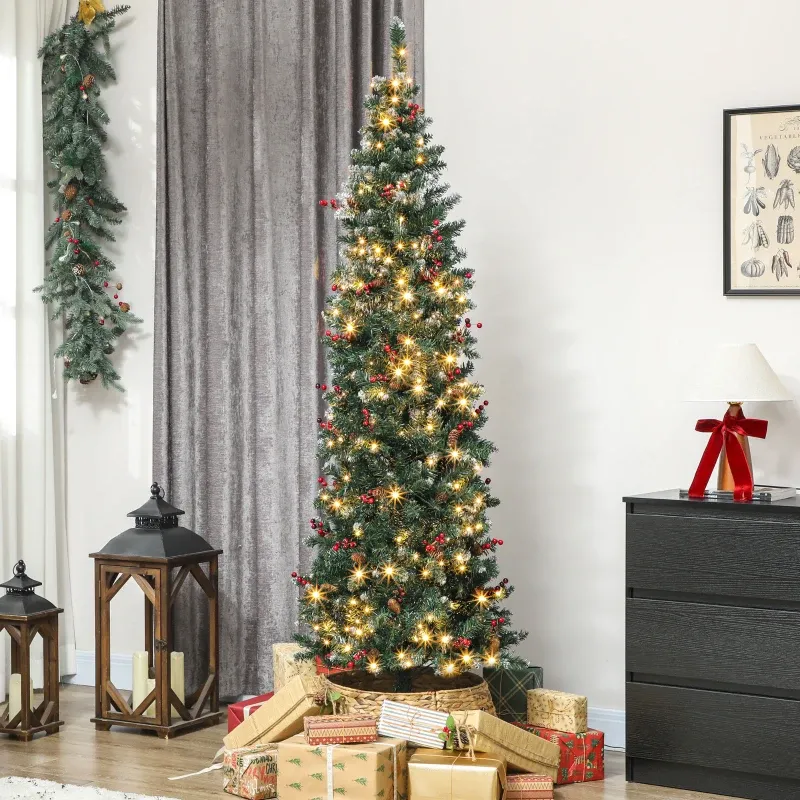
About 45 minutes, and under $40 in supplies if you already own the tree.
Slim pre-lit trees are unforgiving. Push one flat against a wall and you’re fine; float it in the middle of a room and it looks like a coat rack from every angle. Keep this one within 6 inches of a wall, or buy two and flank a doorway. Also worth knowing: pre-lit strands fail branch by branch, not all at once. When a section dies, don’t replace the tree — a $12 strand of warm-white lights woven over the top hides it completely.
5. Three Blacks and One Silver: Monochrome Tree Dressing
This setup wants an alcove or corner at least 4 feet wide and ceilings of 8 feet or higher — the tree reads best as a tall, narrow column rather than a wide triangle. Anything under 7.5 feet tall in an 8-foot room will feel stumpy next to a black chair and a black tree. If your space is tighter, see Idea #17, where a slimmer pre-lit black tree fits a smaller footprint without losing the effect. A 2.5-foot clearance in front keeps the black gift boxes visible instead of hidden.

The finish mixing is the trick. Matte black ornaments, glossy black baubles, and one shiny silver ball — all the same shape, all the same size. If you swapped everything to matte, the tree would flatten into a black blob. The glossier baubles catch whatever light is in the room and give the branches depth. Buy one large assorted set rather than three single-finish sets; you’ll get the ratio right without thinking, and the cost is identical.
6. A Slim Black Tree Between Sage Green and Velvet
Slim trees need air around them — 12 to 18 inches of visible wall on each side, minimum. Here the black trunk line sits between a sage-green fireplace wall and a lighter neutral one, and that vertical seam is doing more work than any ornament could. If your room has one strong wall color, line the tree up with the edge of it rather than the center. Centering a slim tree on a colored wall makes both look small. Offsetting it makes the wall feel wider and the tree feel taller.
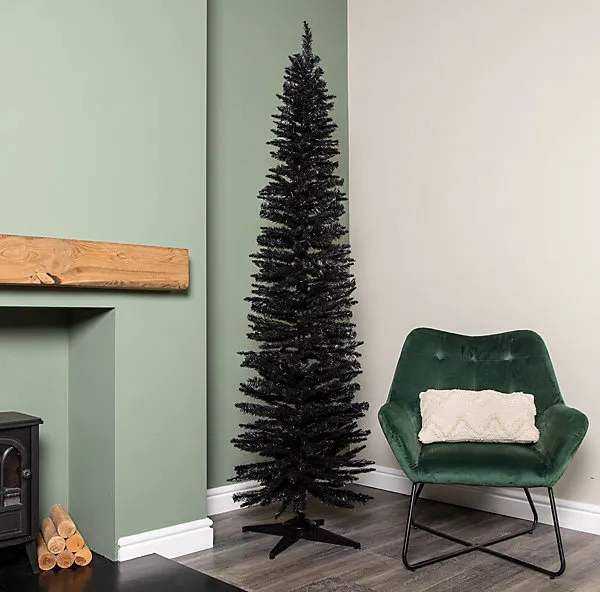
Black against sage green is a cool-on-warm pairing, and it’s why this corner feels calm instead of spooky. The dark green velvet armchair picks up the wall color in a deeper register, the cream textured cushion breaks up the middle, and the light wood mantel keeps everything from going heavy. Nothing here is red or gold, and that’s deliberate — the tree is a silhouette, not a celebration. It’s the opposite instinct from Idea #2, where an empty black tree is all about what’s piled underneath it.
7. A Whole Village Tucked Into the Branches
Miniature village collections used to live on the mantel. In 2026 they’ve moved into the tree itself, sitting on tiered circular platforms that spiral up through the branches — part nostalgia, part the broader maximalist swing away from minimalist white trees. Department 56 and Lemax are the classics, but Etsy sellers are now 3D-printing platforms made specifically for this. The trend has legs because it’s a collection you add to every year, which is exactly what makes people keep pinning it.
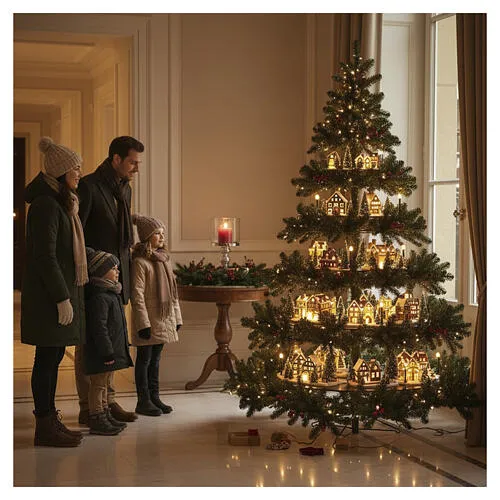
- Full green tree, 7.5 ft: $150–$500
- Tiered circular platforms (3–4): $40–$120
- Illuminated mini houses, 12–18 pieces: $180–$600
- Warm-white string lights, 2 strands: $20–$40
- Red berry sprigs: $12–$25
- Total: $402–$1,285
Budget alternative: build the tiers yourself from cardboard cake rounds wrapped in burlap (about $8 total) and start with six houses instead of eighteen. Add two every year.
8. Warm Fairy Lights on Dark Branches, Close Up
On a dark tree, light count matters more than ornament count. Budget 100 lights per vertical foot for a black or charcoal tree — a 7-foot tree wants roughly 700 minimum, and 900 if you want it to actually glow. Use strands with black or dark green wire so the cord disappears into the branches. And keep every bulb at 2700K or warmer; cool white on near-black needles reads blue and turns the whole tree cold in photos.

90% dark charcoal branches + 10% warm amber glow. That’s it — no ornaments, no ribbon, no topper required. It works because the lights are the only source in frame, so the background falls off into black and the branches look denser than they are. To copy it at home, turn off every other lamp, angle one strand toward the front of the tree, and stand at a 30-degree angle rather than straight on.
9. Charcoal Wrapping, Herringbone Ribbon, and Faux Fur Underfoot
The wrapping is where you save. Black kraft paper runs about $12 for a 30-foot roll at Target or Walmart, and a dark blue with gold accents is usually $8–$15. Herringbone ribbon is the one thing worth buying nice — a 10-yard spool from Etsy runs $12–$20 and you’ll reuse it for years. The faux fur rug is the sleeper item: a $40 charcoal shag from Amazon or a $15 thrifted one does the same job, and it’s what makes dark gifts photographed on a dark floor actually visible.

Dark tree, dark rug, dark wrapping — this is a low-light composition, and it will look flat in a dim room. You need one warm source aimed at it, ideally a floor lamp or a dimmable overhead on low, or the whole vignette becomes a black rectangle. Watch where the faux fur sits, too: near a walkway it collects every crumb and pet hair within a week. Keep it under the tree only and shake it out weekly.
10. The Unlit Black Tree in a Dark Grey Room
This one needs volume. A bare black tree at 7 feet in a small room looks like an unfinished project; in a room with 9-foot ceilings and a dark grey wall behind it, it looks intentional. Give it at least 3 feet of clearance on the visible sides, and place it near a floor lamp so that cream shade gives your eye somewhere to land. If your ceilings are 8 feet or lower, go with Idea #6 instead — a slim silhouette reads better in a tighter footprint.
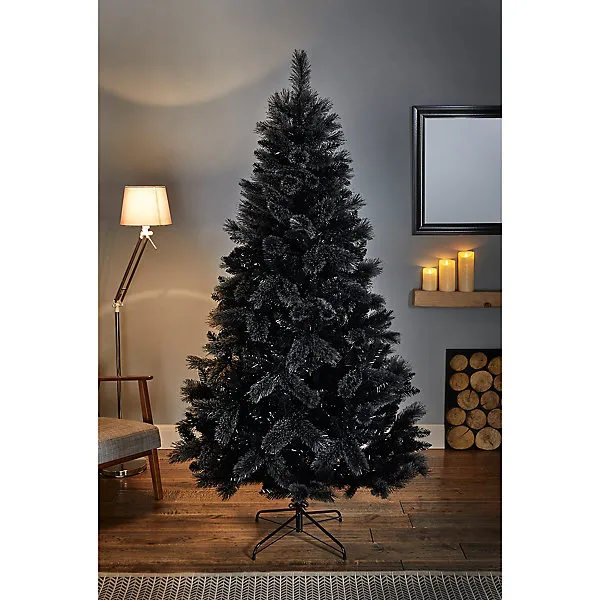
The tree is entirely undecorated, and that’s the whole idea. No lights, no baubles, no ribbon. What makes it work is everything around it: the dark grey wall giving it a shadow to sit against, the cream lamp shade telling your eye the room is finished, and three lit pillar candles on the floating shelf supplying all the warmth. Take the candles away and the room goes cold. Take the tree away and the room goes empty. It’s a balancing act, not a decorating project.
11. Multicolor Lights and a Braided Cream Skirt by the Stairs
- Unbox the pre-lit tree and fluff every branch outward before plugging anything in.
- Add one extra strand of multicolor LEDs to the front half only — that’s where the eye and the camera go.
- Round the base with a cream braided skirt and tuck its edge under the lowest branches.
- Cluster gifts by color: all red on one side, all green on the other.
- Run matching garland up the stair rail so the eye travels from tree to staircase in one line.
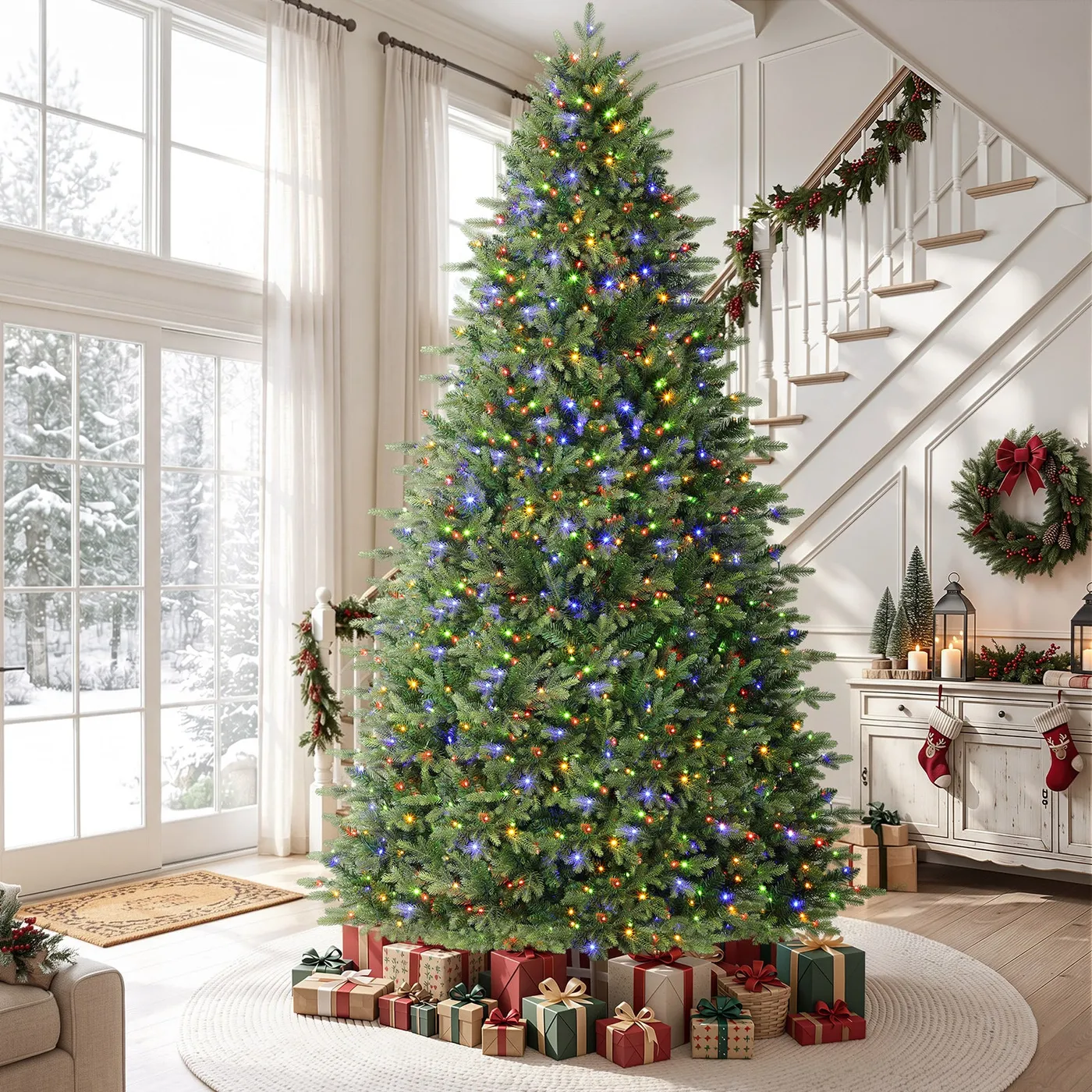
About 90 minutes, and roughly $60 in extras on top of the tree.
Multicolor LEDs are the cheapest and longest-lived option — expect 20,000+ hours, so you’re replacing nothing for years. The upkeep lives elsewhere. Braided fabric skirts need a monthly shake and a spot clean with cold water, never a machine wash, or they unravel at the seams. Multicolor bulbs also read very bright in photos, so if you’re shooting for Pinterest, dim the room first. A cream skirt and a white staircase do a lot to soften how loud the lights look.
12. Buffalo Plaid, Flocked Branches, and a Black Leather Tree Charm
- Flocked tree, 6.5–7 ft: $130–$450
- Black leather tree-shaped ornaments (set of 6): $24–$48
- Red and black buffalo plaid ribbon, 10 yd: $10–$18
- Dark grey glossy ball ornaments (set of 12): $15–$30
- Gold ornament hangers: $6–$12
- Total: $185–$558

Budget alternative: buy a plain green tree and a $9 can of snow flocking spray, then hit only the outer branch tips. You get 80% of the look for around $25 and one afternoon.
Flocked trees photograph best between 6.5 and 7.5 feet, and they want a corner with a little distance — at least 6 feet from where you usually sit, so the flocking reads as texture rather than dust. This one works in rooms of roughly 100 square feet and up. Match your plaid ribbon to your wrapping and you’re done; it’s the same palette play as Idea #25, where a plaid scarf gets draped straight through the branches instead of tied around them.
13. Damask Walls, Gold Mirrors, and Clip-On Candle Lights
Green damask wallpaper and gold-framed portraits sound like a period drama, and that’s precisely why this is climbing again — the old-money Christmas aesthetic keeps pulling people away from neutral minimalism. Ornate gold frames, candle-shaped tree lights, red velvet, and a stone fireplace under garland is the same instinct behind the Victorian revival in Idea #1, minus the bats. It has staying power because it’s built almost entirely from secondhand and inherited pieces, which makes it affordable and personal rather than trend-driven.
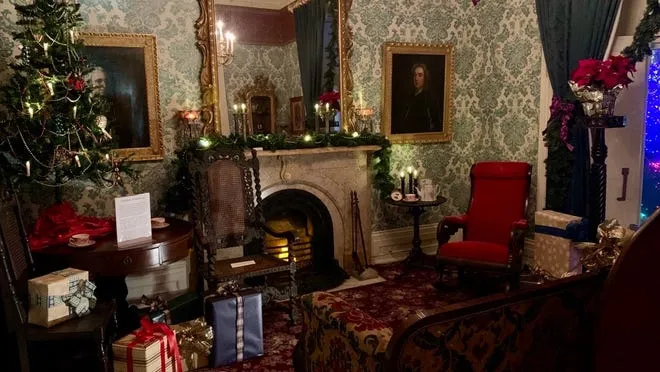
Three things make it work. First, repetition: the gold frames, the candle bulbs, and the garland beads all repeat a warm metallic, so the room feels composed rather than cluttered. Second, the red velvet armchair and the red patterned rug sit on opposite sides of the tree, framing it without boxing it in. Third, the tree is lit but not loud — candle-shaped bulbs give soft points of light, which suits a room that already has this much pattern competing for attention.
14. Ivory Clip-On Candles on Green Branches
- Count your branch tips first — you want roughly one clip-on candle per 6 to 8 inches of visible branch.
- Check that your clips match your branch gauge; thick artificial needles need wider clips or they slide.
- Confirm the candles are LED and cool to the touch, especially with a knit throw nearby.
- Measure the run to your outlet — candle sets chain, and you’ll want them on a foot switch.
- Decide white or ivory before buying; ivory reads warmer against green, white reads crisper.
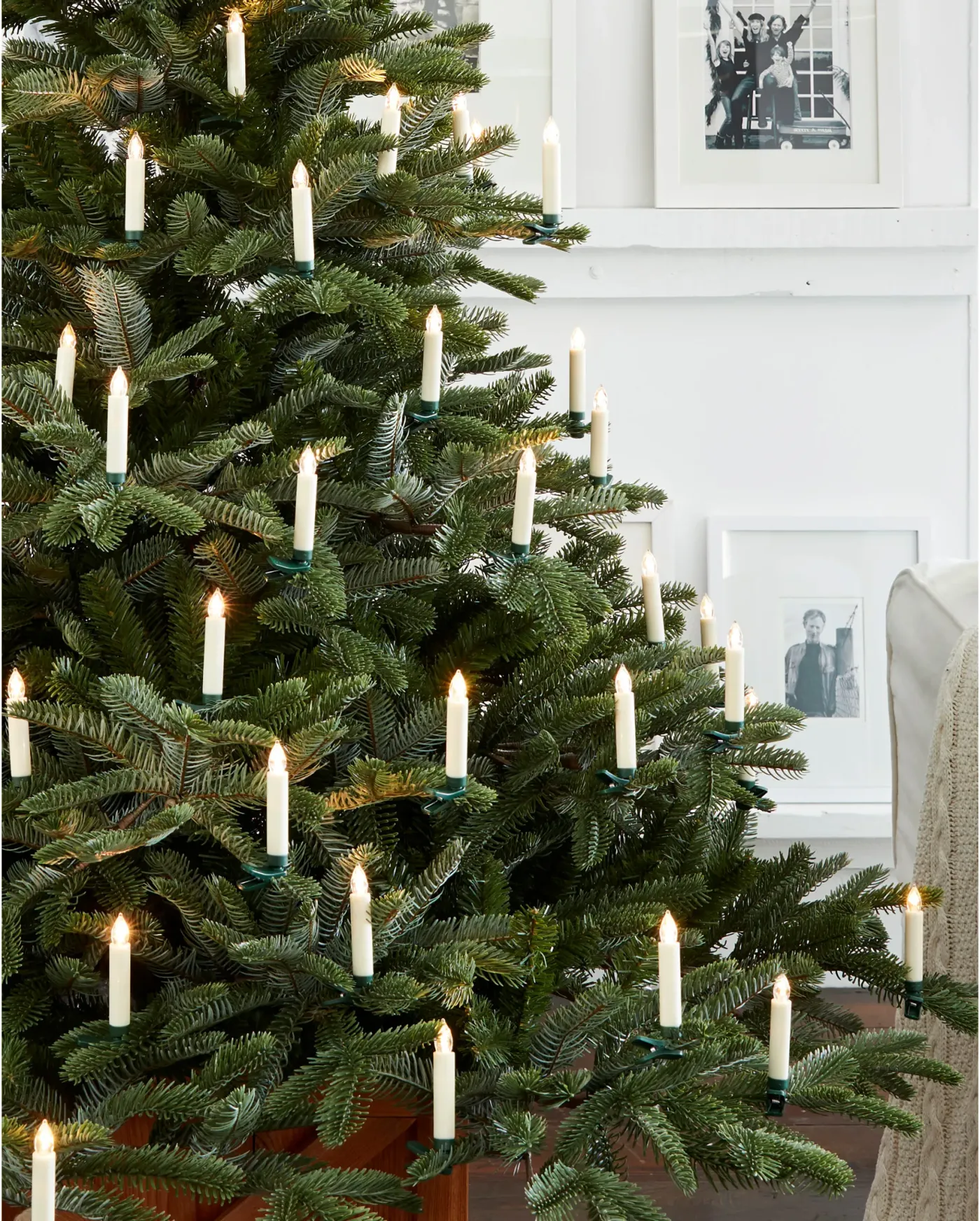
The candle clips are the detail nobody notices and everybody feels. Each one is a small green clip that holds the bulb upright and angles it slightly away from the trunk — exactly how a real candle would sit. Skip the clips and drape a strand instead, and the tree looks lit from inside rather than from the tips. You lose that soft, slightly crooked, flickering quality that makes this read traditional rather than modern.
15. Warm Yellow Fairy Lights on a Dark Cone by the Front Door
A tall cone of warm fairy lights looks magical at 8pm and like a tangled spool at noon. On a covered porch or entry that’s the trade-off — nobody sees it in daylight, so it only has to work after dark. Put your outlet on a timer, because a tree this densely wrapped draws enough power to matter, and make sure the strands are rated for damp locations if rain can reach them. Brick pavers get slick underfoot with a cord running across, so tape it down.
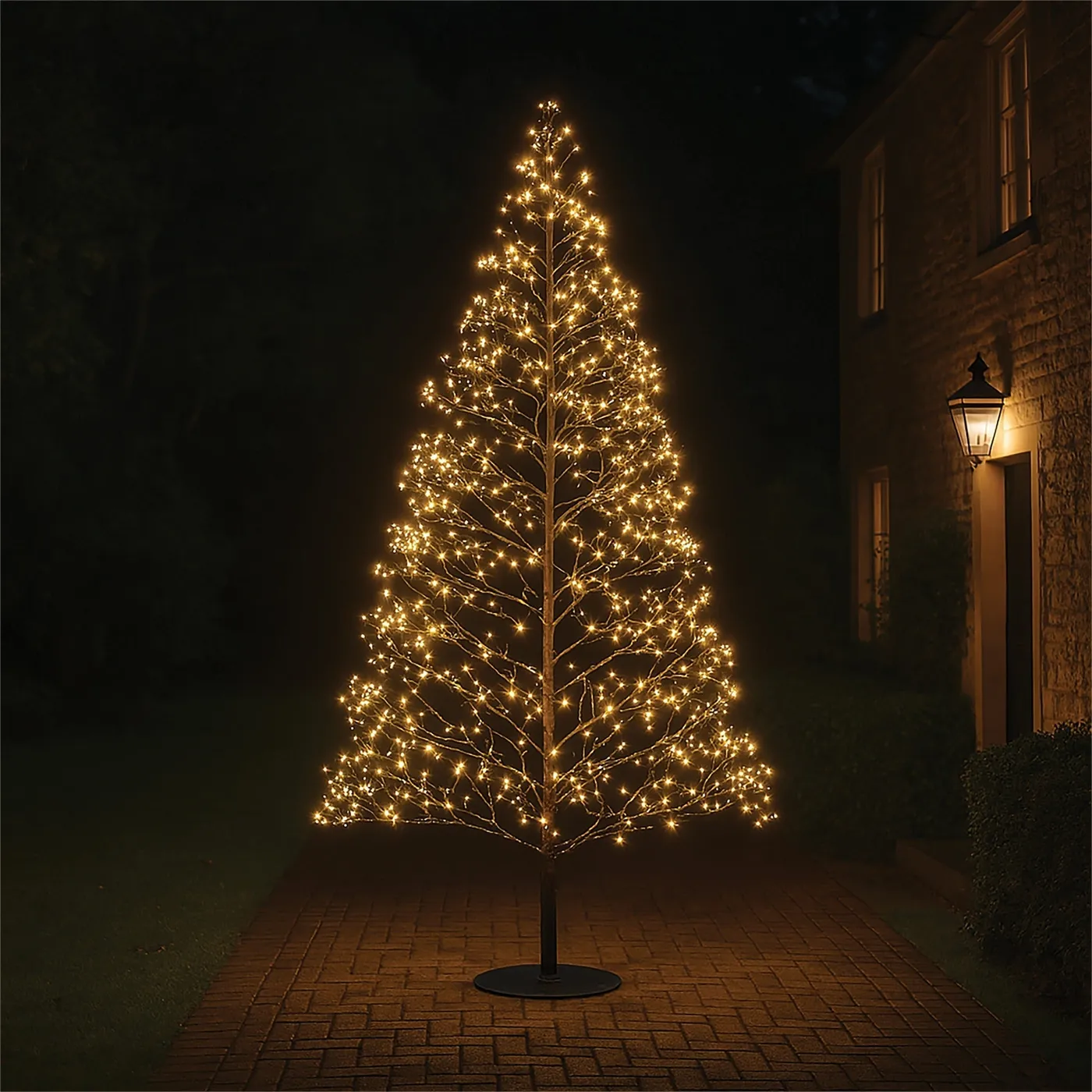
Wrap density is everything here. On a 6-foot cone, 900 to 1,200 warm-white micro lights gives you the solid glowing silhouette; 300 gives you a sad outline. Wrap the trunk first, then spiral outward from the bottom up in slightly overlapping loops, and tuck the last 6 inches of cord into the stand base. A black or brown cord disappears into dark branches. A white one will show up in every photo you take.
16. White Lights, Fur Skirt, and a Silver Starburst on a Gallery Wall
80% monochrome (black tree, black-and-white art, dark wood floor) + 15% cool white light + 5% silver. The gallery wall matters as much as the tree — it’s a repeating grid of black frames that echoes the tree’s own shape and keeps the composition from becoming one dark blob on a pale wall. Swap the silver starburst topper for warm brass and the scheme warms several degrees. Swap the white faux fur skirt for a black one and you lose the grounding effect entirely.
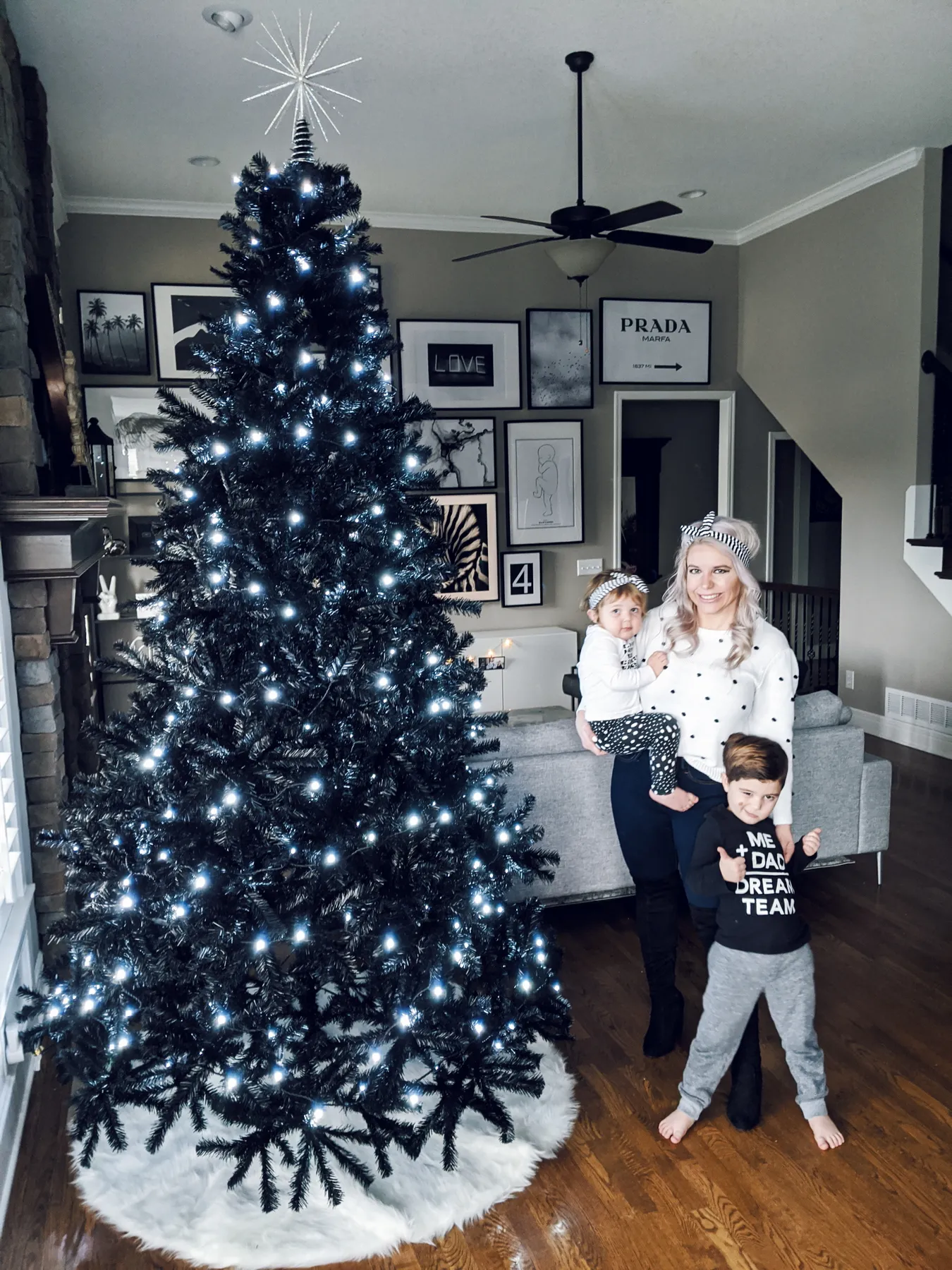
The gallery wall is where you save the most. Thrifted frames at $2–$6 each plus free printable black-and-white botanicals gets you a full wall for under $40; custom framing would run $400 and up. Walmart and Target both carry white faux fur skirts for $20–$35, and the silver starburst topper is a $15–$30 Amazon staple. Cool-white strands are usually cheaper than warm white in multipacks — buy one long strand rather than three short ones.
17. A Pre-Lit Black Tree in a Leather-and-Shag Corner
Pre-lit black trees usually ship with warm white LEDs already attached, and that’s the biggest single reason they work. If you’re adding to it, match the temperature exactly — mixing a 2700K built-in strand with a 4000K add-on makes half the tree look sickly. On a slim black tree, run your ornaments in a spiral rather than evenly: cluster three baubles, skip 8 inches, cluster three more. Even spacing on a dark tree looks like polka dots; spiraling gives it movement.
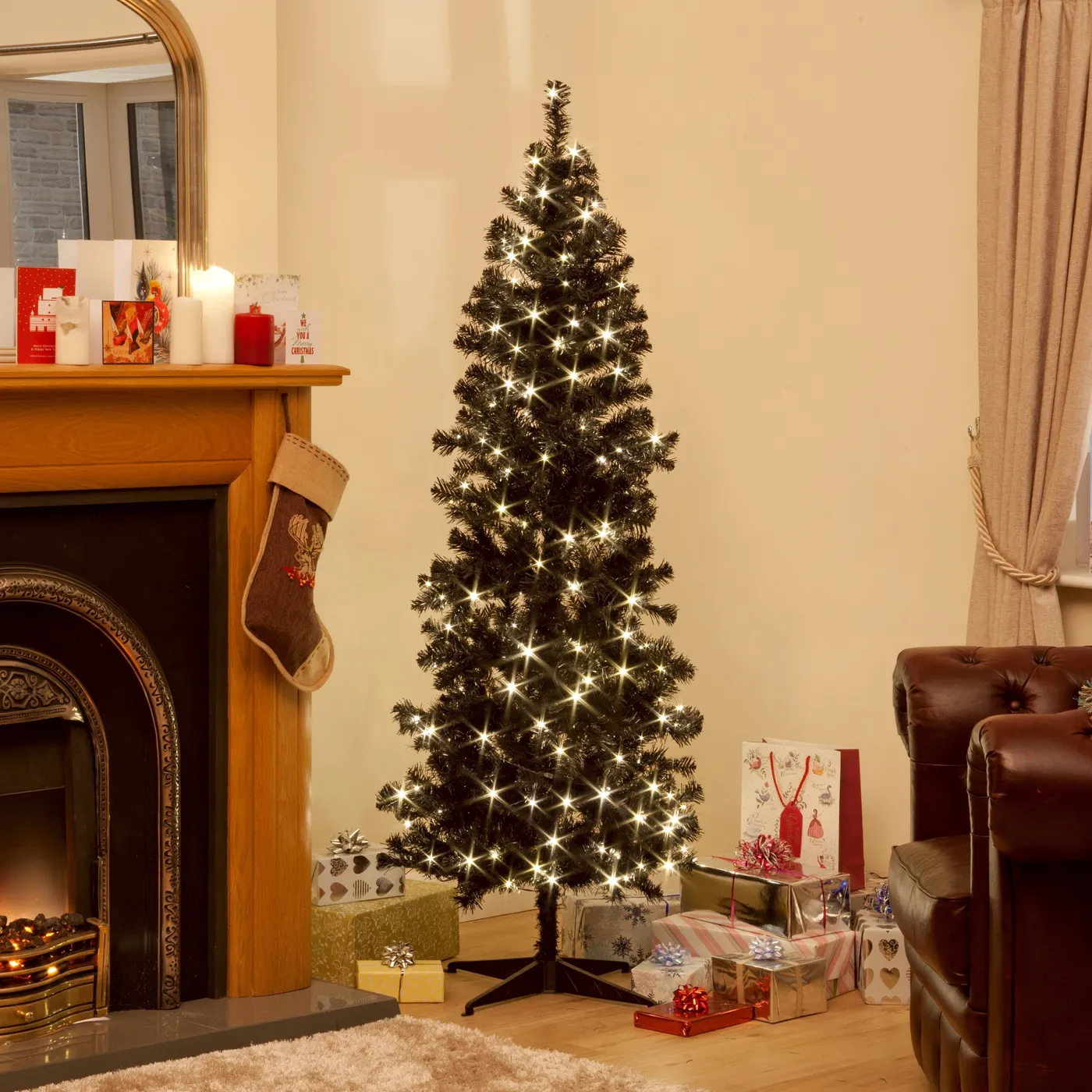
This corner works in rooms from roughly 120 to 250 square feet. Slim pre-lit black trees run 6 to 7.5 feet; anything taller in a room this size starts to feel like a column. Keep 24 to 30 inches between the tree and the leather armchair so the light beige shag rug stays visible — that rug is doing real work, separating dark furniture from a dark tree. For a bigger room with taller ceilings, see Idea #29.
18. Glitter Black Baubles and a Bare Branch Silhouette
Those bare black branches standing beside the tree — that’s the piece to steal. They’re just decorative twigs with a few black ornaments hung on them, and they cost almost nothing, but they extend the black silhouette past the tree and give the whole setup a shape that isn’t a triangle. Take them away and you have a nice black tree with silver baubles. Keep them and the arrangement looks styled. Any craft store sells branches; a matte black spray can finishes them in 20 minutes.

Matte silver and glittery black ornaments on a black tree succeed because they separate on texture rather than color. The glitter catches light and sparkles; the matte silver absorbs it and goes soft. Neither is bright enough to fight the tree, so the whole thing reads as one dark object with depth. Even the small pink tree in the background works — it’s small enough to register as a wink rather than a clash, and it stops the black-and-silver scheme from getting too serious.
19. Fiber Optic Gradient: Purple to Blue to Green on Black
Fiber optic trees have been around since the ’90s, but the new versions do a smooth color gradient — purplish-pink at the crown, blue through the middle, green at the base — instead of strobing through a rainbow. That one change made them photogenic, and a dark paneled wall makes the gradient pop. It’s the same reason people keep pinning color-changing LED strips: it’s a mood piece, not a decoration. My honest read — it’s fun, it’s very 2026, and it isn’t going to be your forever tree.
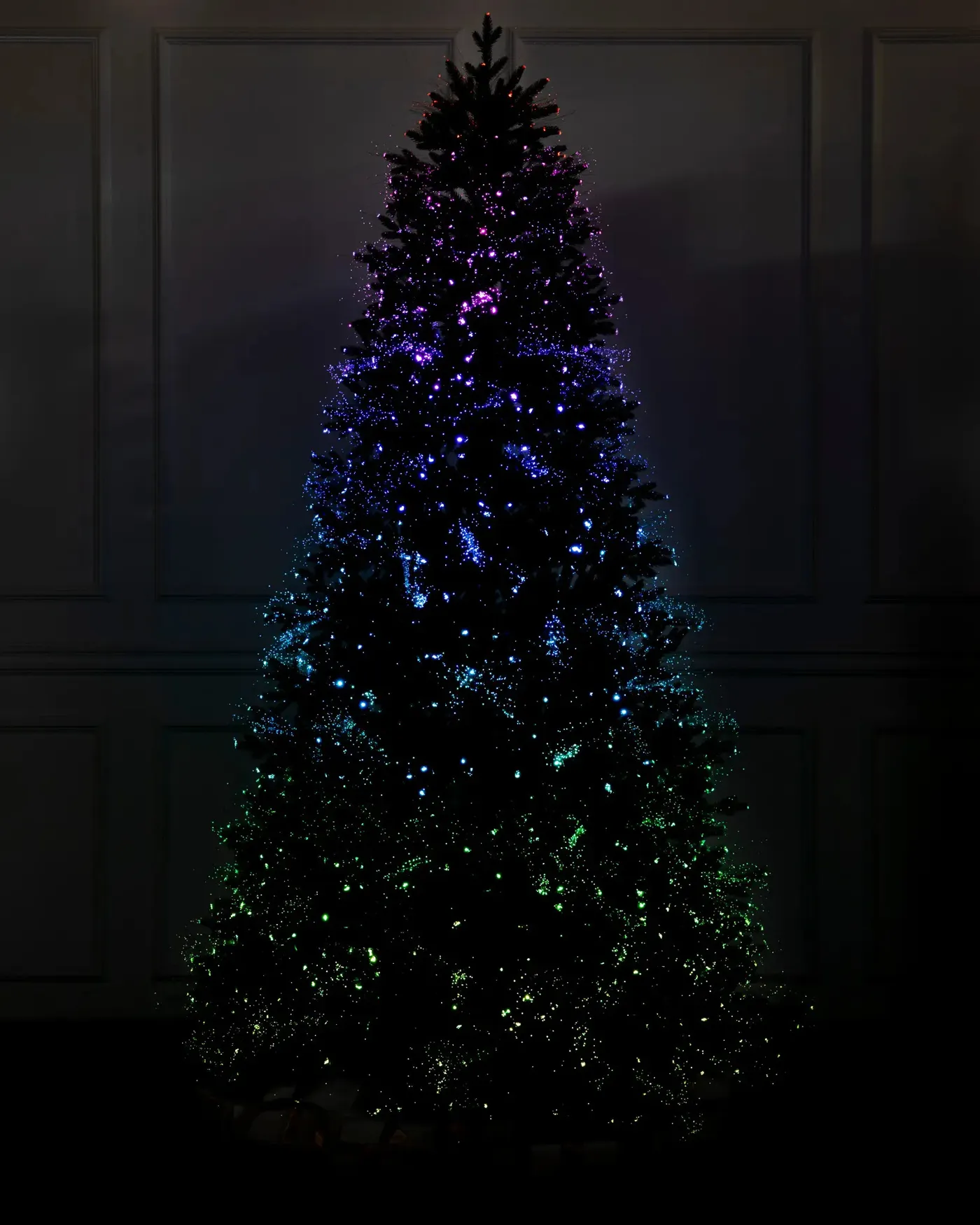
Fiber optic strands are fragile. Bend one too far while fluffing and that strand goes dark permanently — you can’t splice them, and replacements are usually tree-specific. They also don’t combine well with regular light strands, so you’re locked into the built-in color cycle. Want the drama without the commitment? Buy an inexpensive black tree and a $30 color-changing LED strand instead. Same gradient, fully replaceable, and you can go back to warm white in January.
20. Glossy Red and Gold on Near-Black Needles
- Dark or black tree, 7 ft: $150–$450
- Glossy red ornaments, set of 40: $25–$60
- Reflective gold ornaments, set of 30: $22–$50
- Opaque white and silver filler ornaments, set of 24: $15–$30
- Warm white string lights, 2 strands: $20–$40
- Total: $232–$630

Budget alternative: hit the dollar store for red and gold balls — a full 7-foot tree runs about $30 — then spend your money on one nice set of large statement balls for the front. Nobody counts the ones in back.
Glossy ornaments show everything: fingerprints, dust, and the hard-water spots you get from wiping them with a damp cloth. Use a dry microfiber only, once before the season and once before you pack them away. Reflective gold finishes also flake at the cap after a few years — store them in a divided box rather than a bag and they’ll last a decade. Want zero upkeep? Matte finishes hide dust far better, at the cost of some shine.
21. Black Tapers in Amber Glass on a Red Wall
- Choose taper candles in true black, not dark grey — they should read as a deliberate line.
- Set them in amber or smoked glass holders so the flame reflects warm through the glass.
- Space candles 10–12 inches apart on the table so the flames don’t compete.
- Place the tallest holder at the back so height steps down toward the diner.
- Keep the tree and floor lamp behind as backlight; never put a candle in front of a light source.
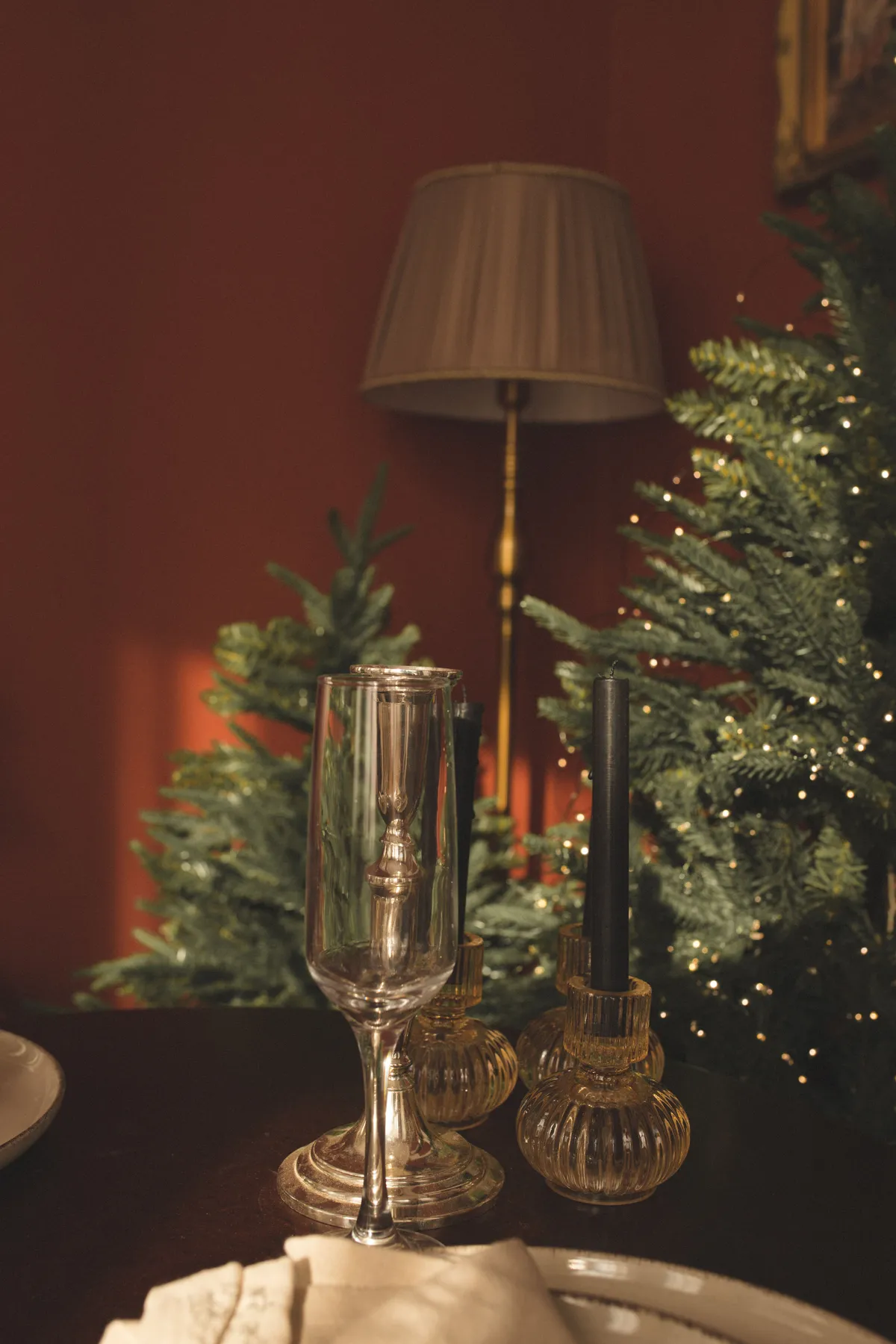
Cost: about $30 for holders and $8 for candles. Ten minutes of setup.
Deep red wall + forest green tree + amber glass + black candles. That’s a warm 60/30/10 in a different key: 60% red and green (the room), 30% amber and cream (the glass and the pleated shade), 10% black (the candle line). The black is only 10%, and that’s why it works — it’s the detail, not the theme. Swap the tapers for ivory and the table goes traditional. Swap the amber holders for clear glass and the glow disappears. Compare with Idea #24, where black and warm light meet at much higher contrast.
22. White Pillar Candles on a Dark Mantel, Wreath Above
- Measure your mantel depth — pillar candles need 4 inches minimum to sit safely.
- Check what’s above: a mirror or framed art within 12 inches will get scorched by tall flames.
- Confirm the wreath hanger fits your mirror frame without scratching the finish.
- Test your ornament count — red, gold, silver, and white needs a limit or the tree gets noisy.
- Decide your real light source; this look dies after dark without a dimmable overhead.

White pillar candles are the cheapest drama in Christmas decorating — a set of 6 runs $12–$20 at Walmart or IKEA, and staggered heights matter far more than brand. The wreath can be a $6 plain green one with a $4 sprig of faux red berries wired in. Ornaments are where most people overspend; red, gold, and silver baubles in bulk packs from Target or Amazon cost roughly $40 total for a full 7-foot tree, string lights included.
23. One Matte Charcoal Bauble, Almost No Light
Matte finishes are the quiet workhorse of a dark tree. A single matte charcoal-grey ball disappears into black branches until light hits it, then reads as a soft grey circle — no glare, no competing sparkle. If you’re building a black tree, make matte about 60% of your ornament mix, gloss 25%, and metallic 15%. Buy them in one large assorted set rather than four small ones. You’ll get the proportions right without thinking about it, and it’s usually cheaper per ornament.

The restraint is the entire design. One ornament, one soft light source, no color, no ribbon. What you’d lose by adding more is the mood — this reads as serene because there’s nothing to look at but the shape of the ball and the blur of light behind it. It’s the opposite end of the spectrum from Idea #7, where a single tree holds an entire illuminated village. Both work. They just want different rooms, and different Decembers.
24. Black Twig Tree, Dense LEDs, Wood Lattice Behind
- Set the twig tree about 8–10 inches in front of the lattice so the glow falls on the wood.
- Wind lights from the base up, looping every 2–3 inches of branch for even coverage.
- Keep the cord black, or wrap it once around the trunk to hide the run to the outlet.
- Put the whole thing on a foot switch — you’ll want it on before you want to reach behind the tree.
- Leave the lattice bare; a wreath or garland will fight the tree’s silhouette.
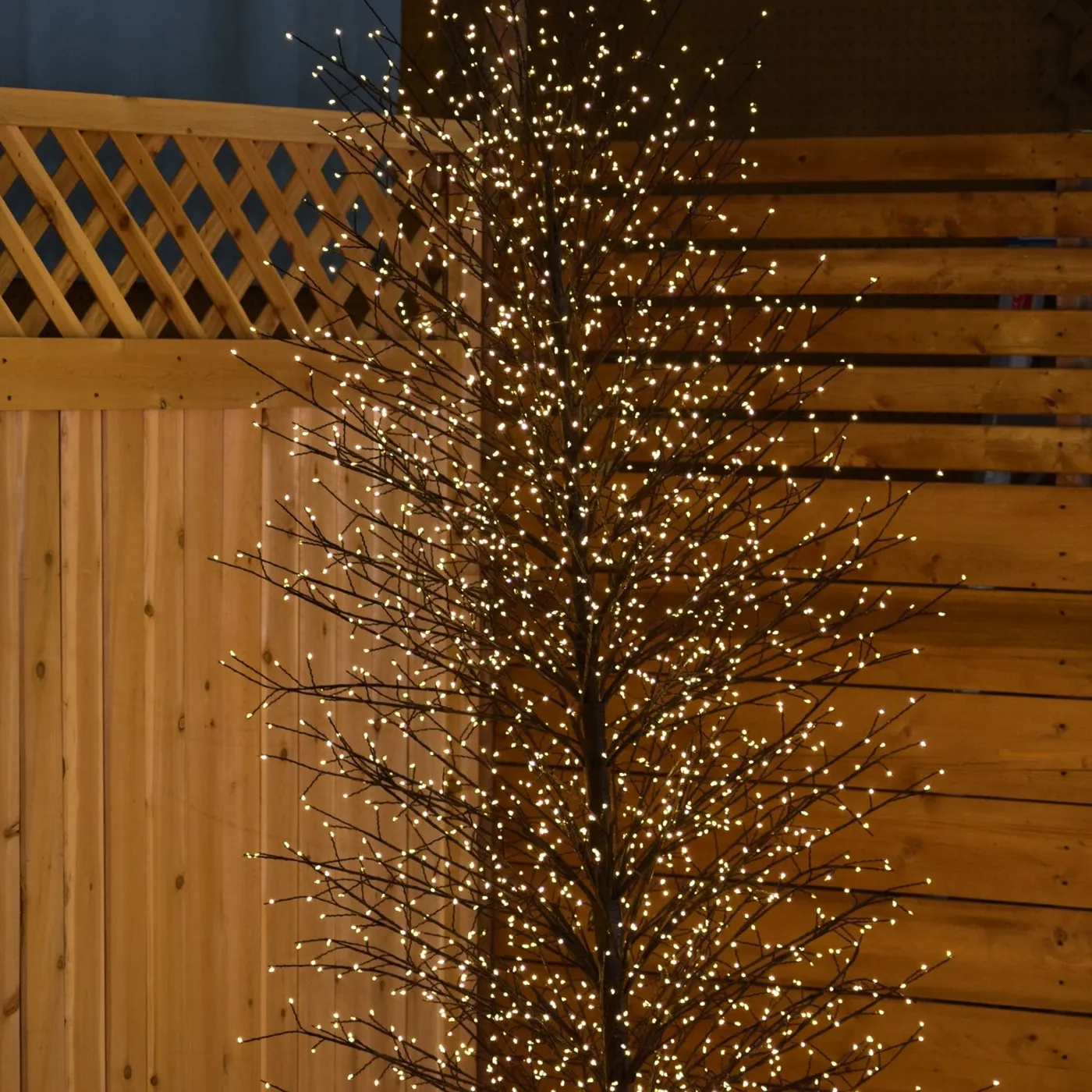
About 40 minutes of wrapping, roughly $45–$90 depending on light count.
Twig trees live in narrow spots: entry corners, beside a console, the strip of wall next to a door. This setup works in a 3-foot-wide space with 7-foot ceilings and up, which makes it one of the few options here that fits a hallway. If your wall is wider than 4 feet, a single twig tree starts to look lonely — that’s when you want Idea #16 and a gallery wall to keep it company.
25. A Plaid Scarf Draped Through Flocked Branches
Draping a scarf instead of a garland works because fabric falls. A ribbon stays where you put it; a scarf settles into the branches and creates asymmetric weight, which is what makes a flocked tree look casual rather than staged. The black-and-grey plaid is doing double duty, too — it’s the only cool-toned element on a warm white tree, so the whole thing reads modern rather than ski lodge. Silver star on top, white window frame behind it, done.
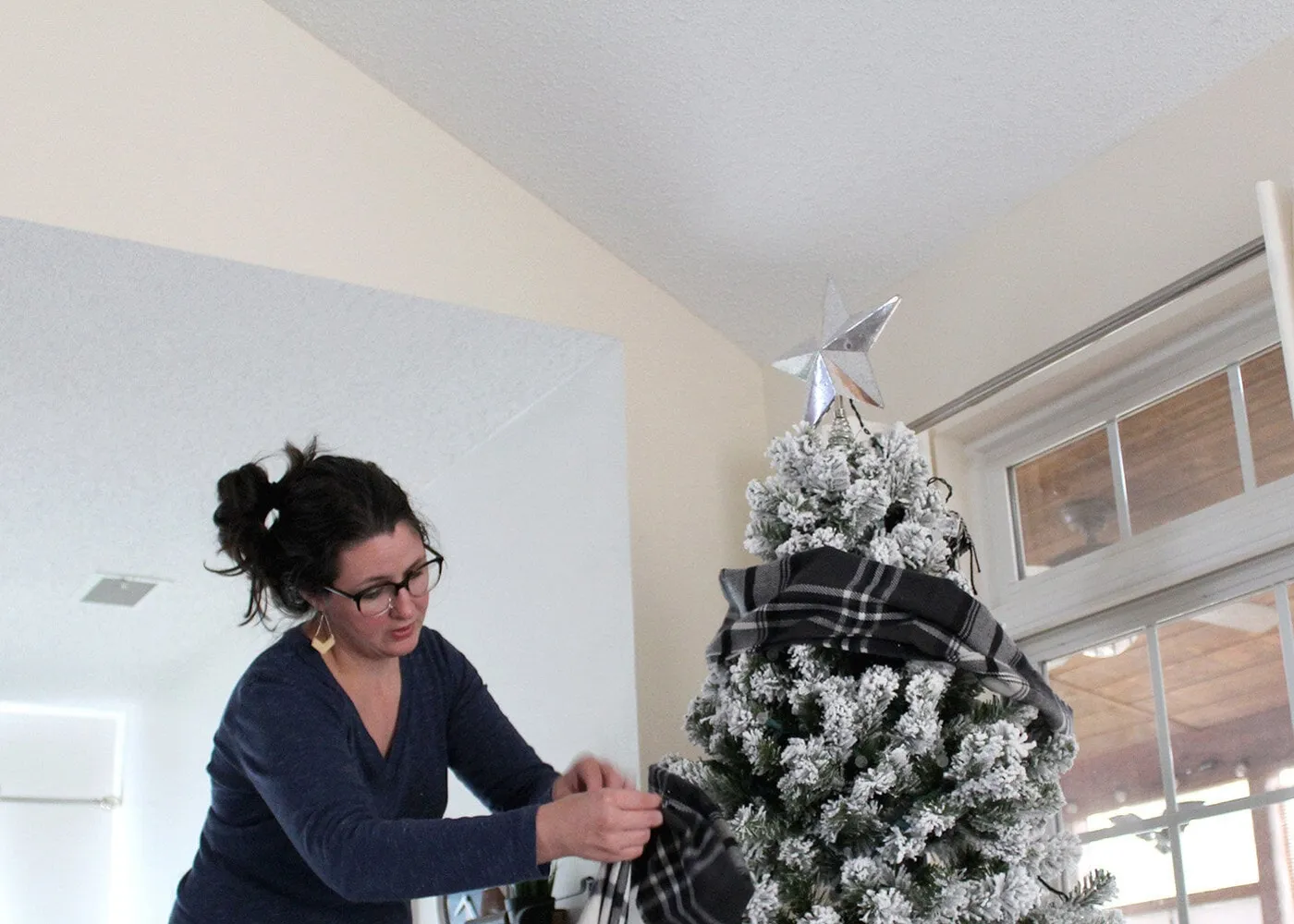
Flocked trees shed. Expect a light dusting of white on your floor every time you move it, brush it, or look at it wrong — it’s not a defect, it’s the format. Vacuum gently with a brush attachment, never a beater bar, or you’ll strip the flocking off in patches. Also: the scarf trick only works with a light scarf. A chunky wool blanket will pull branches down and leave a sag you can’t fix without re-fluffing the entire section.
26. Black Needles, Iridescent Sheen, Wooden Crate Base
If your black tree has an iridescent or silvery sheen on the needles, stop adding metallics. The needles already do it. Warm white LEDs will pick up that sheen and give you sparkle for free, while silver ornaments would double down and turn the tree into a disco ball. Stick to matte black, charcoal, and a small amount of warm white in your ornament mix and let the light do the work. A dark brown wooden crate at the base grounds it better than any skirt.
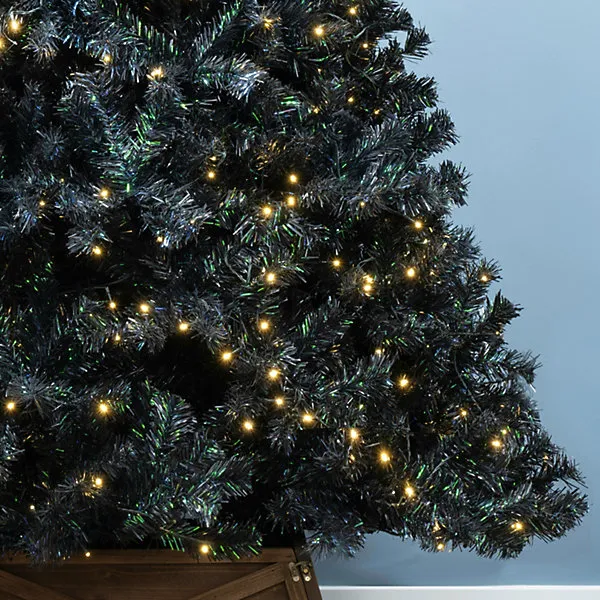
50% black (tree and crate) + 35% warm white light + 15% soft blue from the wall behind. That light blue backdrop is doing something specific: it gives a cool edge to the warm glow, which stops the corner from turning orange. Swap the blue wall for cream and the tree warms up considerably; swap it for charcoal and the iridescent sheen disappears entirely. Same tree, three completely different rooms.
27. Black, White, and Gold Against a Fireplace Mantel
- Black tree, 7 ft: $140–$420
- White, gold, and black ornaments, assorted: $45–$110
- Evergreen garland for the mantel, 9 ft: $25–$60
- Black candle holders (set of 3): $18–$45
- Wrapping paper in black, white, gold, and kraft: $30–$70
- Black deer head or similar statement decor: $25–$80
- Total: $283–$785
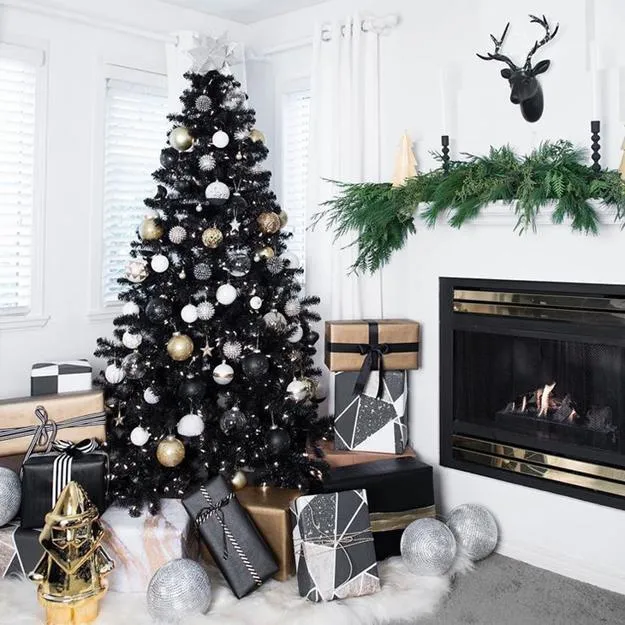
Budget alternative: skip the deer head and use a thrifted brass candelabra instead. Kraft paper does most of the work — wrap nearly everything in it and use three ribbon colors to differentiate.
Black and white with gold trim is the 2026 version of glam, and it’s everywhere because it photographs absurdly well. Not for the flashy gold — because a white fireplace with gold detailing gives the black tree a bright, symmetrical host. It’s less holiday and more interior design that happens to be December. People are styling Christmas the way they’d style a console table, and this palette has runway left because it works in January too.
28. Ribbed Black Drop Ornament with Silver Accents
Ribbed, reflective ornaments are the prettiest and the fussiest. Those silver segments are usually a coating rather than solid metal, so they cloud up if you clean them with anything wet. Dry-dust with a soft brush, store in a divided tray, and never stack them — the ribbed edges chip each other. Expect 3 to 5 good years from a set like this. Want the same look with less upkeep? Look for solid black glass or matte black wood drops, which don’t show wear.
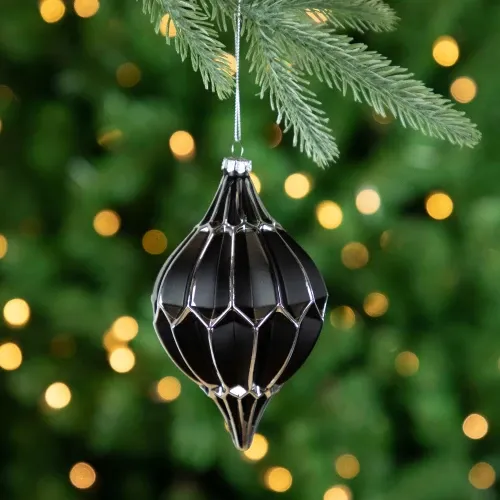
- Decide your tree’s needle color first — this ornament reads black-on-green, not black-on-black.
- Count your drop ornaments and space them evenly; drop shapes need room or they tangle.
- Hang them from sturdy metal hooks, not the flimsy gold wire that comes in the box.
- Check that your hangers match — mismatched hangers are visible on large ornaments.
- Plan your light direction; reflective silver accents need a source in front of them.
29. White Poinsettias and Silver Ornaments on a Full Black Tree
This is the full-size version: a tall, wide black tree that wants a wall at least 8 feet wide and ceilings of 9 feet or more. Below that, the tree swallows the room. Give the black console table 30 inches of clearance from the tree so both read as separate objects, and keep 3 feet of walking space in front. If your footprint is smaller, Idea #17 shows how a slim pre-lit black tree gets the same mood without the volume.
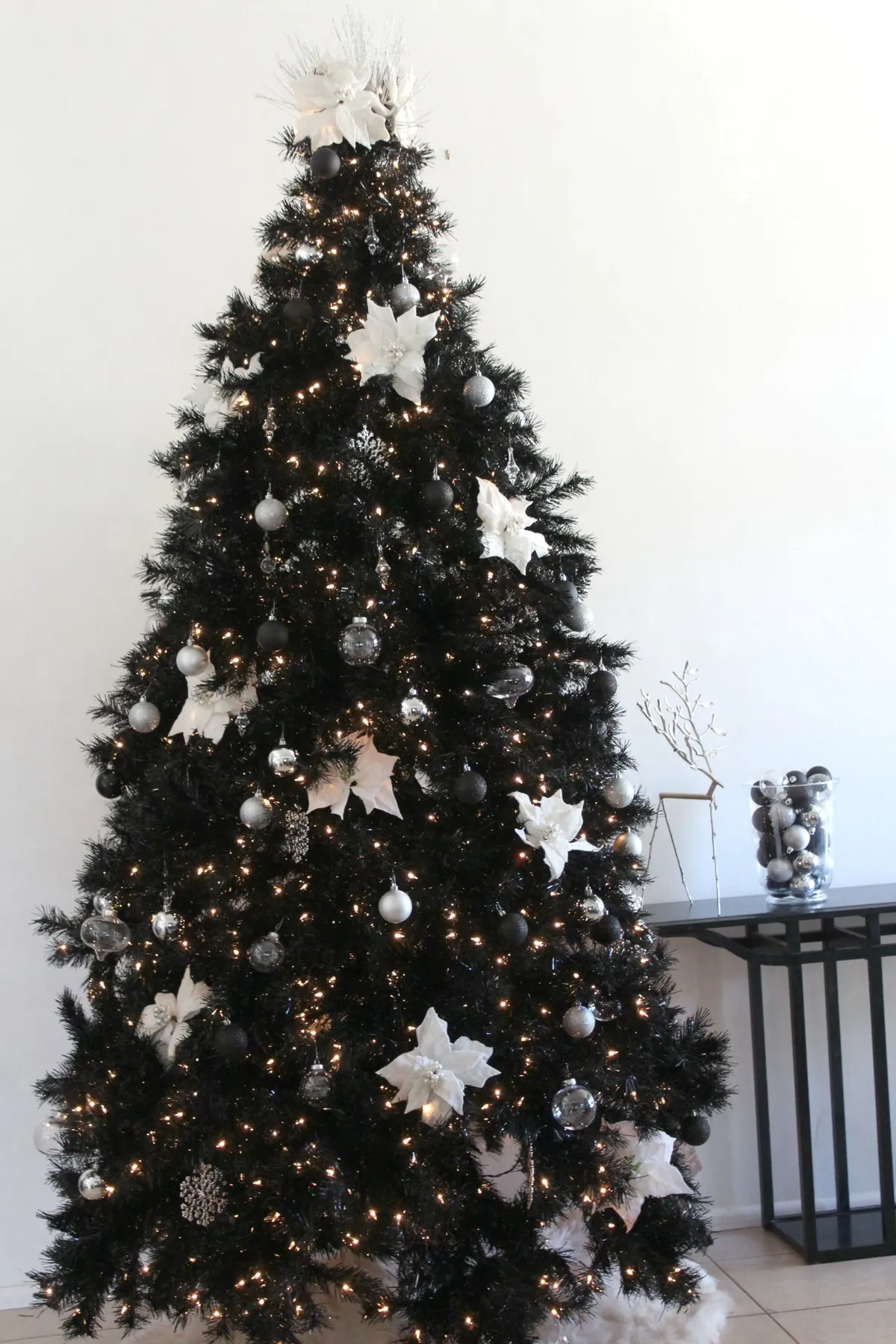
The white faux poinsettias are the signature, and they’re where you can go cheap — Amazon and Walmart sell stems for $3–$7 each, and 12 to 15 fills a full tree. Silver and clear ornaments in bulk cost about $35; matte black ones you can spray-paint yourself from a dollar-store set for $8 plus a can of matte black. The white fluffy skirt runs $25–$40, and that glass vase of ornaments on the console is a $12 thrift-store find you can refill from your own tree.
Turn Off the Lights and Plug In the Tree
Whichever direction you go — moody Victorian, monochrome glam, or warm traditional — a black tree rewards contrast, restraint, and one genuinely good light source. Start with the silhouette, then layer in two finishes and one accent color, and you’ll be ahead of ninety percent of the trees on your feed. 📌 Save your favorite version to Pinterest now, so when December gets busy you already know exactly what you’re doing.