
You know that feeling when you finally spot the tree skirt that looks exactly right — and then realize the photo is from 2019 and the maker closed her shop? Yeah. That’s exactly why we put this together. We spent real hours digging through Etsy, Target, IKEA, Anthropologie, and a handful of very good vintage sellers to pull only the ones worth your attention this year, with prices landing between about $28 and $340.
Inside you’ll find 31 curated ideas — traditional red-and-green crochet, chunky cream knits, Fair Isle snowflakes, vintage-inspired embroidery, and a few wild cards (yes, there’s a bright yellow one). Budget and luxury versions sit side by side, so you can see exactly where the money actually goes.
Handmade textiles are having a genuine moment in 2026, with crochet tree skirts climbing steadily on Pinterest as people trade disposable decor for pieces they’ll still own in a decade. And stay until the end — we break down the most common mistakes that can ruin these looks.
📌 Save this to Pinterest for later — you’ll want to revisit these ideas.
1. Red, White, and Green Granny Squares Up Close
If you’re crocheting this yourself, work each color block exactly three rounds deep, then cap the whole square with a single row of dark green. Three rounds is the sweet spot where a color reads clearly without swallowing the next one. Any shallower and the blocks blur together; any deeper and the pattern turns muddy. Use a 5.5mm hook with worsted-weight cotton so the stitches stay crisp and the color edges don’t soften.
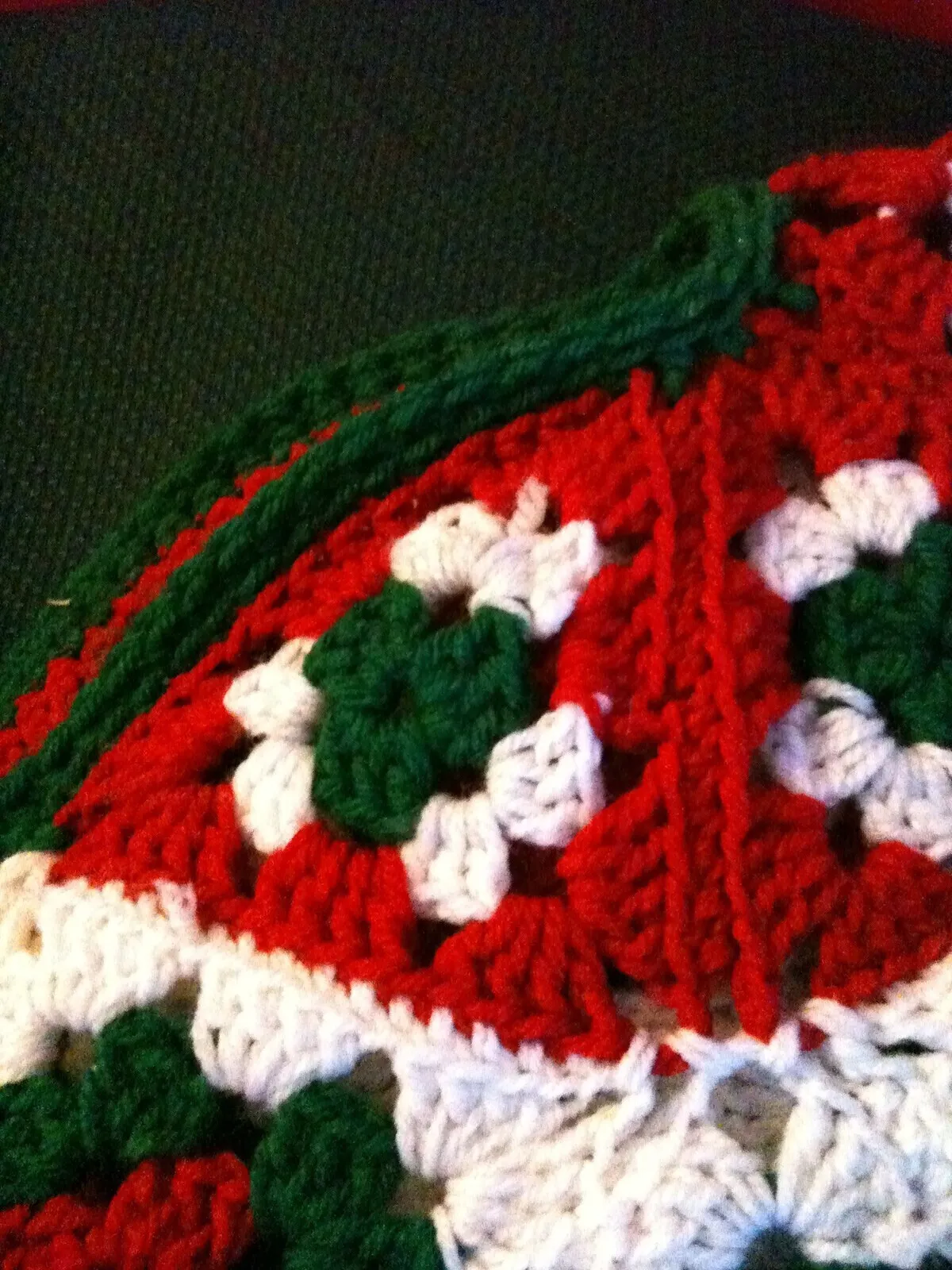
Two things are doing the heavy lifting in this piece. First, scale — the stitches are big enough that you read texture from across the room, not just up close. Second, that flat dark green fabric underneath acts as a matte backdrop, letting three saturated colors sit together without competing. Take the plain background away and the whole thing gets busy fast.
2. A Flocked Tree on a Multi-Pattern Knit Skirt
Take the skirt away and this tree goes quiet. Flocked branches, warm lights, a cream mantel — it’s all soft, low-contrast, easy on the eye. The red, blue, and pink knit at the base is the only saturated thing in the frame, and it reorganizes the whole vignette around itself. One bold textile at the floor line is worth more than a dozen extra ornaments at eye level.
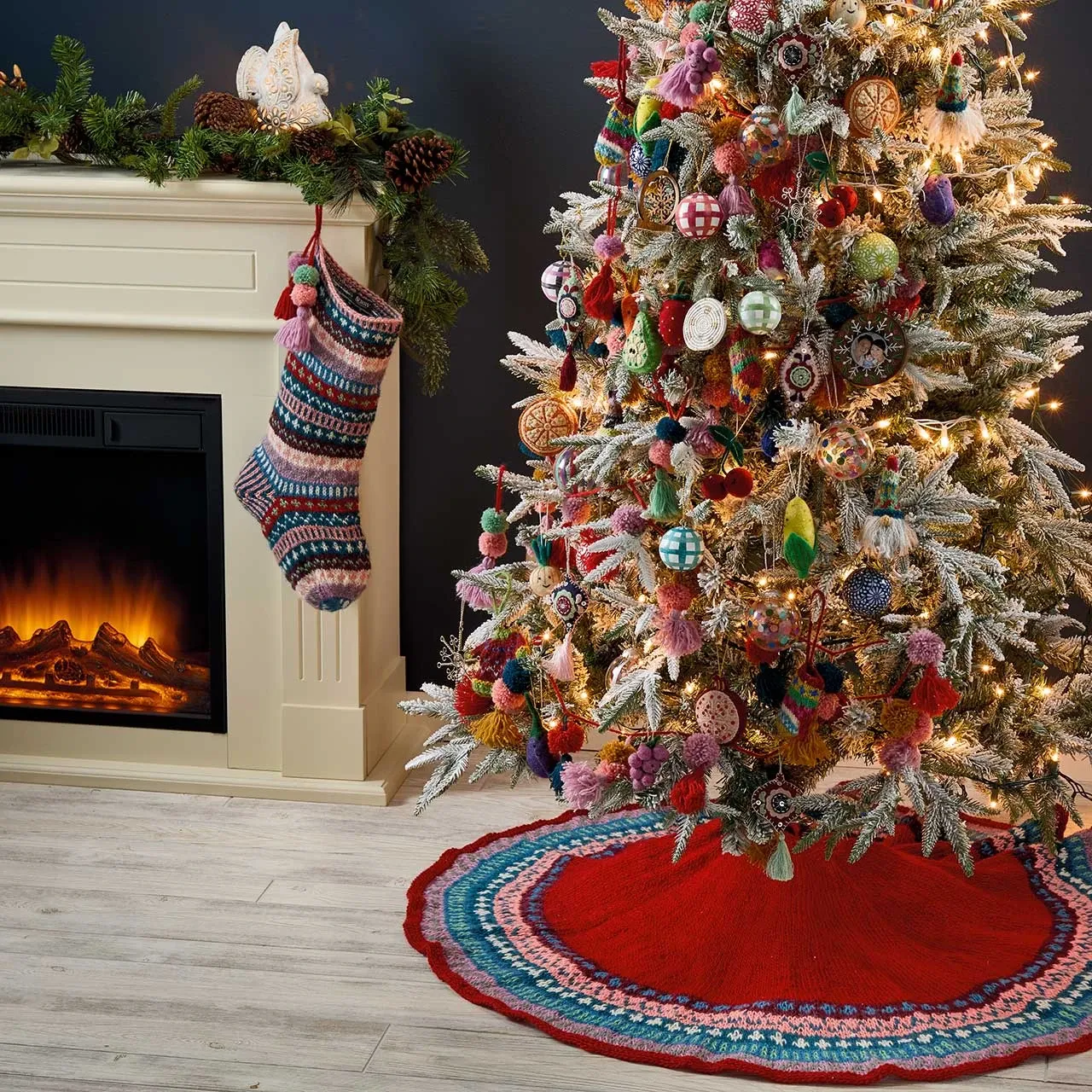
This setup needs a dark wall behind it and enough floor to breathe — roughly a 10×12 foot living room minimum, with the tree standing off the wall by at least 12 inches so the skirt’s full circle shows. The skirt itself looks right at 48 to 56 inches across for a 7.5-foot tree. In a tighter room, a 36-inch skirt and a slimmer tree will read far better than a big skirt jammed into a corner.
3. Crochet Ornaments Glowing Under Warm String Lights
Make one of these pom-pom ornaments in about 25 minutes:
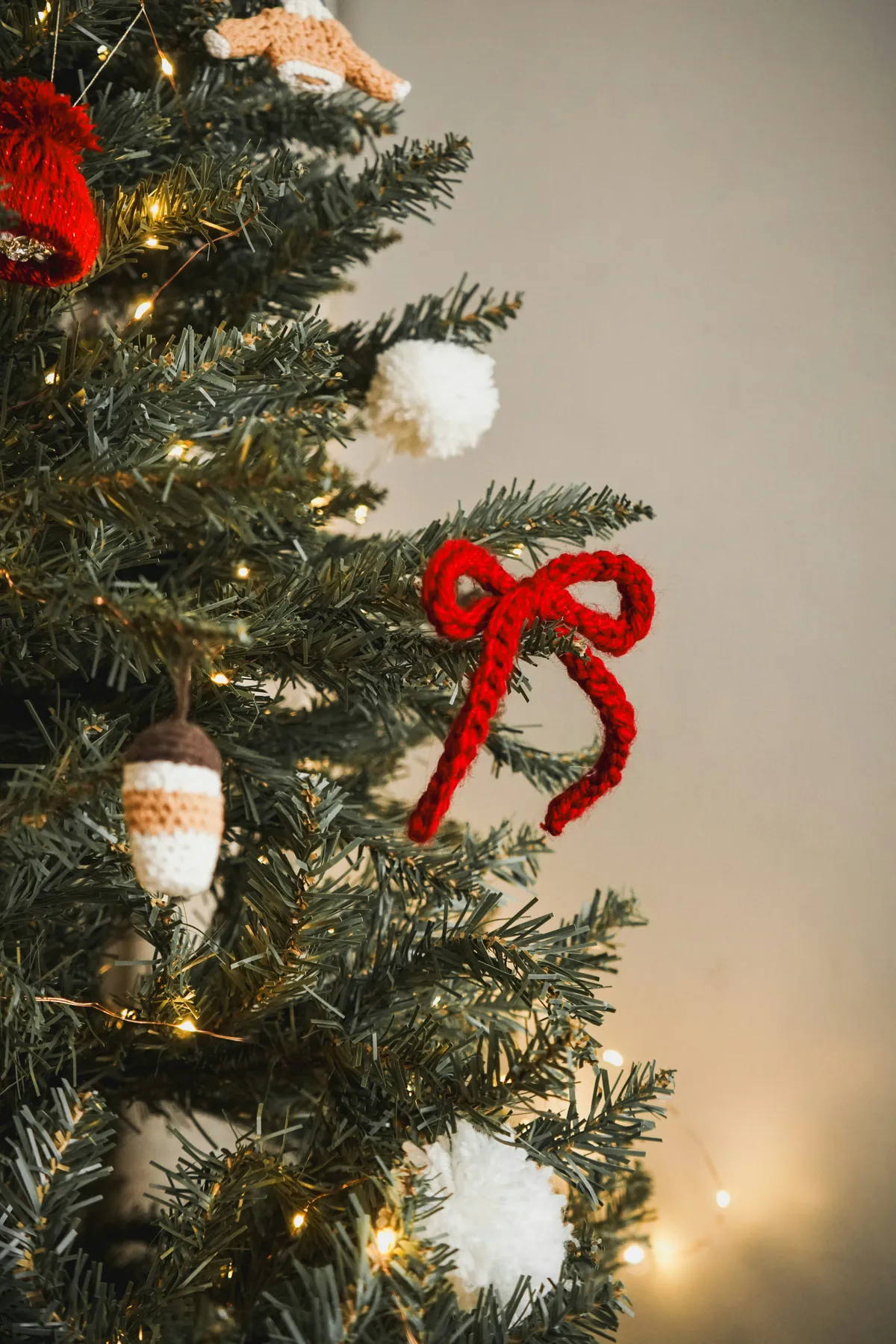
- Chain 4 and join into a ring with worsted cotton in off-white.
- Work 12 double crochet into the ring, then join the round.
- Round two: two double crochet in every stitch, for 24 total.
- Round three: single crochet all the way around, then stuff lightly with polyfill.
- Cinch it closed, leave a 6-inch tail, and tie it straight to a branch.
Materials run about $2 per ornament once you own a 5mm hook — and the stuffing you already have in a cushion.
The handmade ones in this shot sell for $12 to $18 apiece on Etsy, which adds up fast on a seven-footer. Instead: grab a $6 bag of white cotton yarn, or hit the thrift store for a cream wool sweater and cut it into 3-inch circles for a felted look. IKEA felt ornament sets run about $8 for six, and Target’s wooden bead strands mix in beautifully. Think of it as the ornament-scale cousin of Idea #19.
4. Chevron Bands and a Cable-Stitched Center
The formula here is roughly 45% red, 30% white, 15% green, and 10% natural wood from the stand peeking through. Red owns the widest band and the cable-stitched center, white breaks it up, and green anchors the outer edge so the whole thing doesn’t float. Swap red for a deep berry and green for sage and the math still holds — keep one color clearly dominant and let the other two support it.
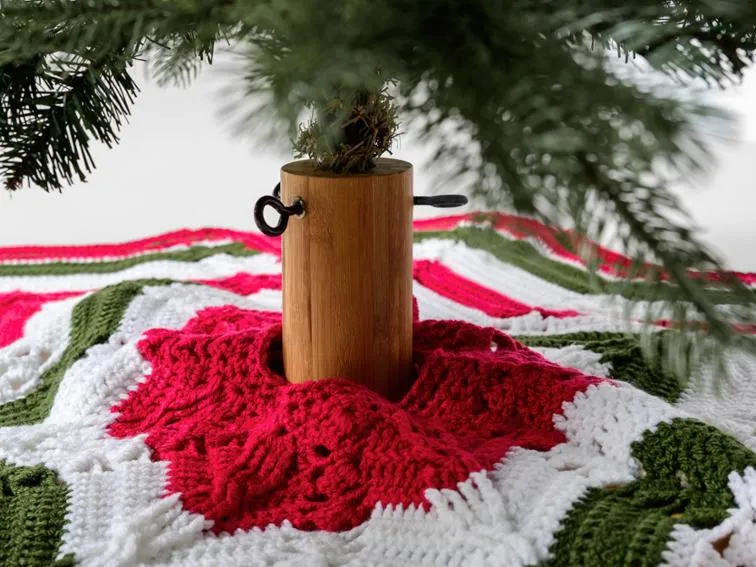
Two things to watch. A skirt with a wide center opening will expose your tree stand, so measure the stand’s footprint before you commit or plan on a fabric wrap underneath. And red cotton bleeds — wash it alone in cold water the first time, or you’ll tint those white bands pink in a single cycle. Hand washing is safest for anything with cable texture, and it takes about ten minutes.
5. Cream Meets Checkerboard in a Star-Shaped Skirt
Octagonal and star-shaped skirts are all over Pinterest right now, and it’s not nostalgia for its own sake. The shape reads as a rug rather than a cover, which fits the broader shift toward decor you leave out and actually look at. Checkerboard, meanwhile, came back through grandmillennial styling and never really left. This one has staying power — the form is classic, the pattern is the trend.
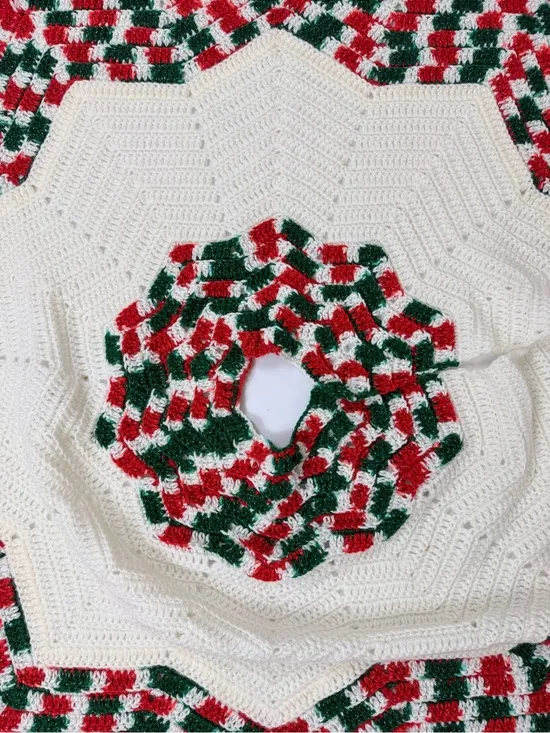
A star skirt only looks intentional if the points lie flat. Three rules:
- Block it wet on foam mats and pin every point out to full length.
- Let it dry a full 48 hours — cotton holds shape only when bone dry.
- Steam the underside, never the face, so the stitch definition stays crisp.
Skip blocking and that octagon curls into a bowl by New Year’s.
6. Little Green Trees on a Cream Crochet Field
- Yarn, 6 to 8 skeins worsted cotton — $55 to $85
- 5mm hook and stitch markers — $10 to $20
- Blocking mats and pins — $20 to $35
- Ribbed border yarn in forest green — $8 to $14
- Pattern — $0 to $8
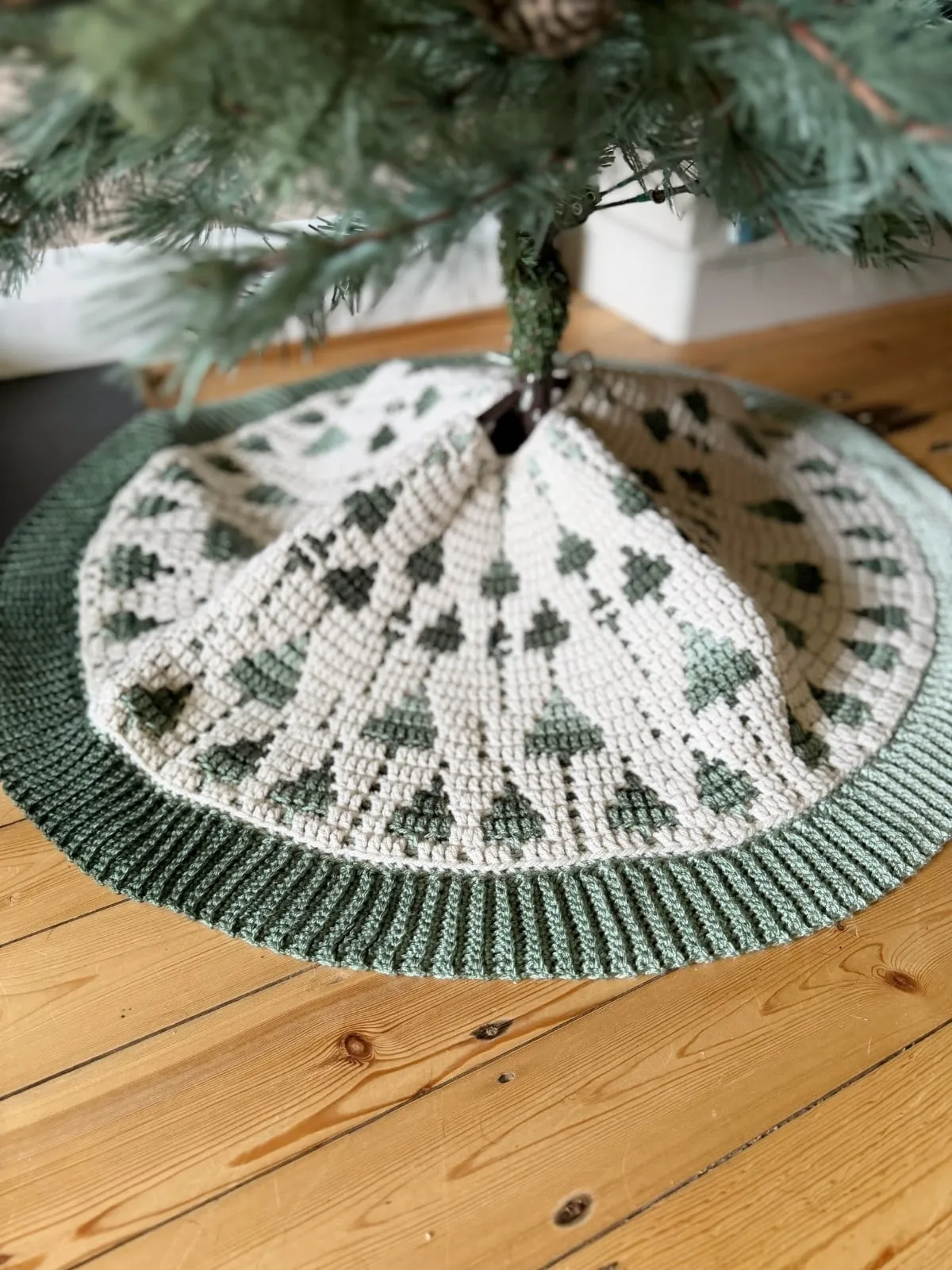
The tree motif repeats at a consistent size and spacing, and that repetition is the whole trick. At a small scale it reads as texture from standing height and as pattern up close — two designs out of one. The solid green ribbed border then acts like a frame, stopping the motif before it reaches the floor edge. Framing a repeating pattern is the cheapest way to make handmade work look finished.
7. Chunky Cream Yarn Against Dark Green Branches
Cream yarn is beautiful and completely unforgiving. Tree sap, dusty ornaments, and a hot bulb resting against it will all leave marks. Vacuum monthly with the brush attachment on the lowest suction, and spot clean with cool water and a drop of dish soap. Skip the washing machine entirely. Realistically you’re looking at ten minutes a season — negligible, as long as you don’t let sap sit for a month.
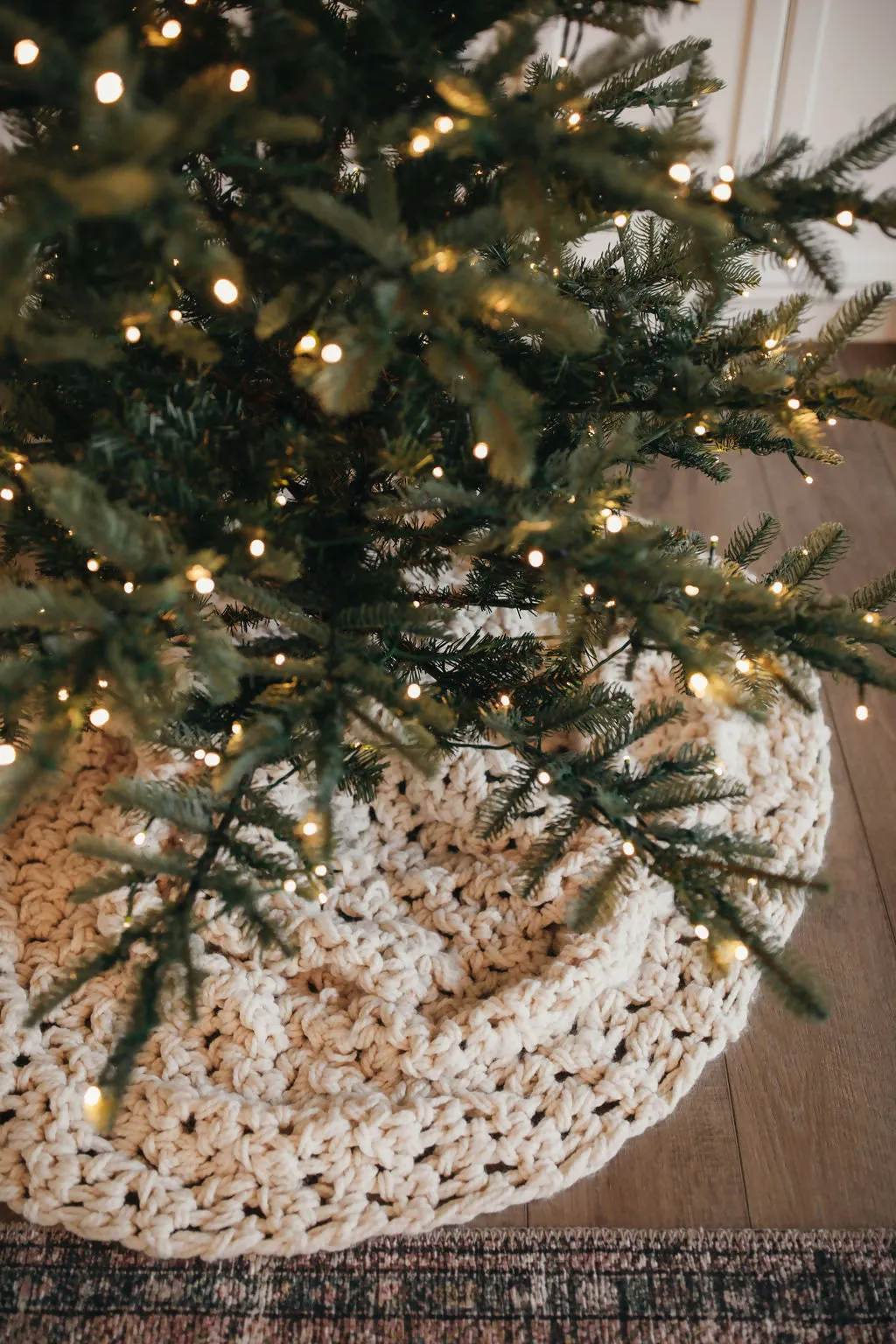
It’s the gauge that makes this work. Super-bulky yarn in single crochet means each stitch is nearly an inch wide, so the skirt reads as blanket rather than doily. A finer yarn in the exact same color and shape would look like a lace mat. That chunky scale is what makes cream feel warm instead of clinical next to dark green needles — and it’s why the whole thing photographs so well under warm lights.
8. A Bright Yellow Knit Skirt on Parquet Floors
A true chunky-knit skirt in this weight runs $140 to $220 handmade. The workaround: buy two chunky cream or mustard throws from IKEA at $40 to $60 each, felt them in a hot wash, then cut and stitch a circle with a center opening. Facebook Marketplace is full of abandoned arm-knit blankets for around $25. Total spend under $80 for a nearly identical silhouette — and if yellow isn’t your wall’s friend, Idea #14 shows how it plays against warmer tones.
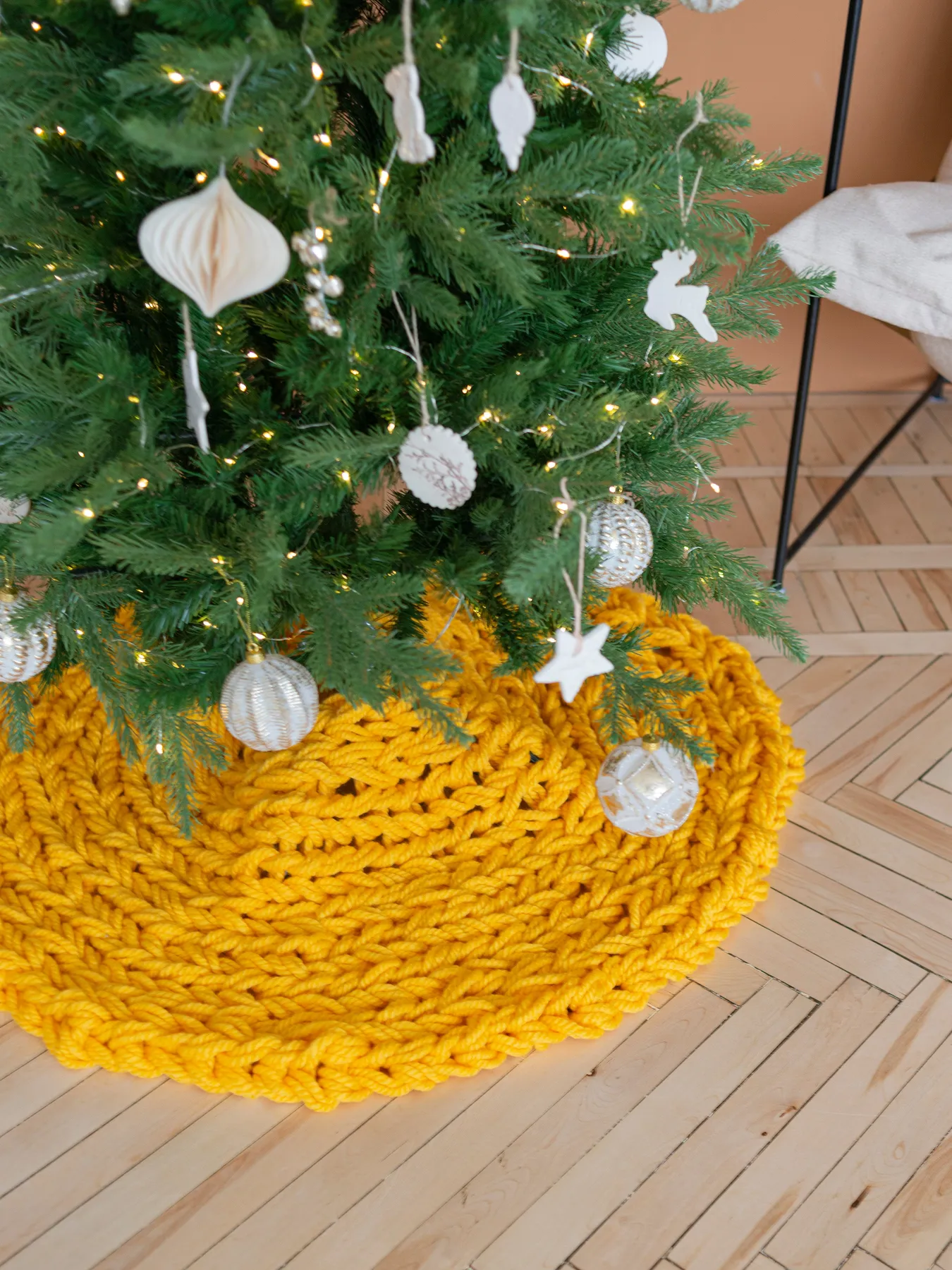
- Measure your tree stand’s base — the opening needs to clear it by two inches.
- Check the wall color in daylight; yellow shifts hard against orange-brown.
- Confirm your floor type — chunky knits skate across parquet without a grip pad.
- Decide whether the skirt lives out all season or gets packed away; chunky knit eats storage space.
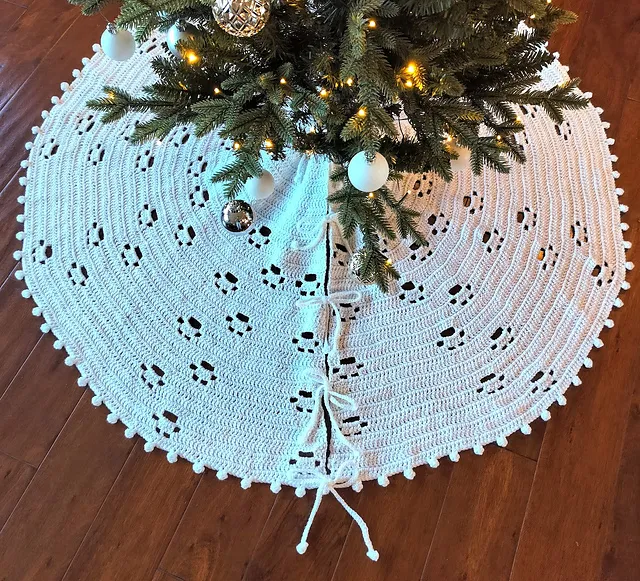
9. White Openwork with Bobble Trim and Bow Ties
The bow ties are the detail people always ask about, and each one takes about 15 minutes:
- Chain 12, then work 11 half double crochet across the row.
- Single crochet around the whole strip to firm up the edges.
- Pinch the center and wrap yarn around it six times.
- Pull tight, knot at the back, and weave in the tail.
- Sew one side to the skirt edge and leave the other loose.
Budget about $1.50 in yarn per bow — five ties cost less than $8 total.
Openwork needs a dark floor under it. Those geometric cutouts only register as pattern when light passes through and something contrasty sits below, and here the dark brown wood does exactly that job. On a pale carpet the same skirt reads as a plain white circle from three feet away. If your floors are light, lay a dark patterned rug under the tree first and thank yourself later.
10. Classic Red Cable Knit Under White Lights
Red skirt plus red berry garland plus a patterned rug is a lot of red in one small area. It works here because the garland sits high and the rug’s pattern is grey and tan, but it’s a fine line. Also: cable knit collects needle debris in its grooves. Shake it out every couple of weeks rather than waiting until January, when the fibers have had a month to work the needles in deep.
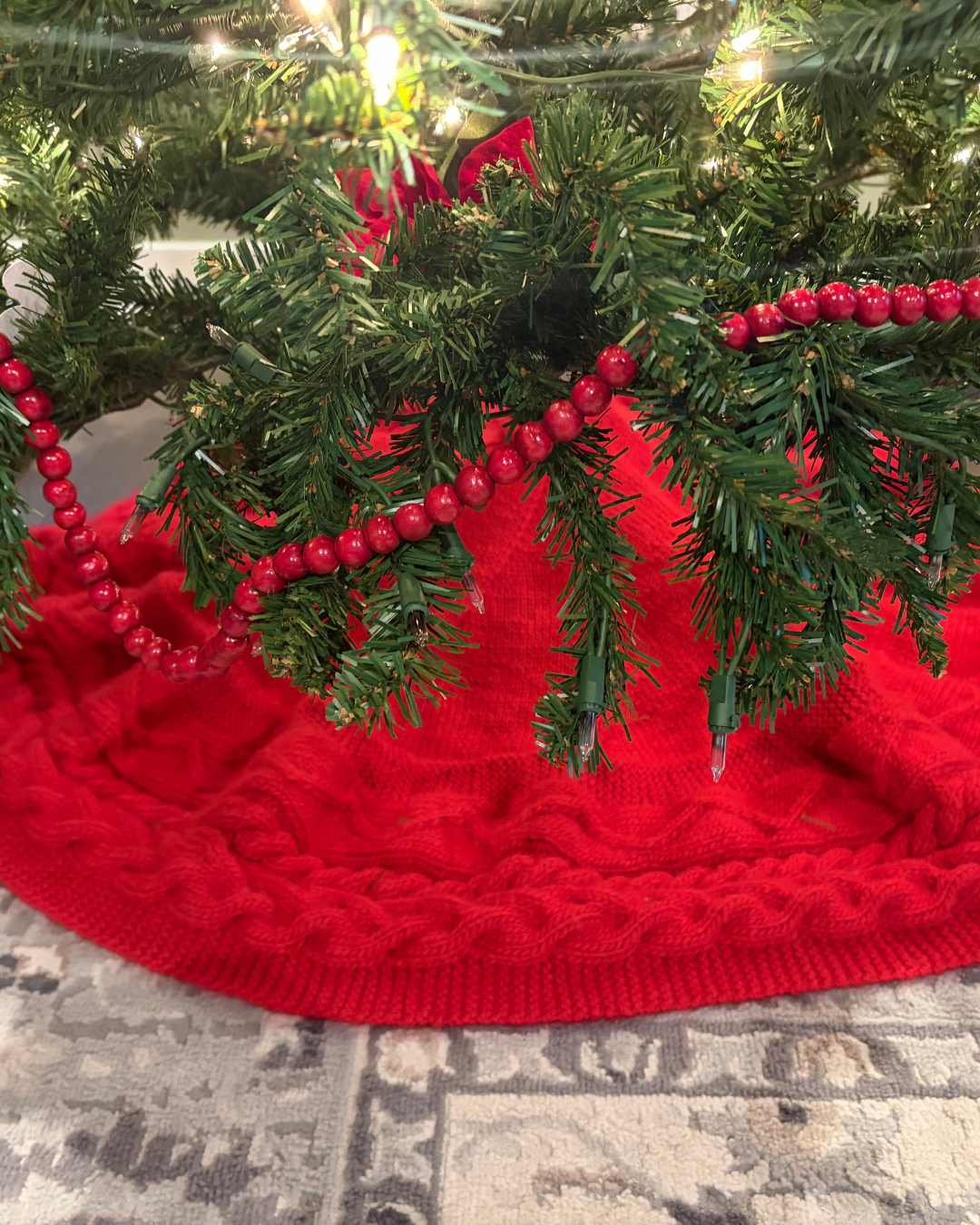
The ratio is roughly 70% red, 20% green, 10% white light. That’s why this reads traditional instead of chaotic — red owns the floor, green stays up in the branches, and white only appears as glow. Want it calmer? Drop the berry garland and let the lights carry the accent. Want it richer? Swap the white bulbs for amber and the whole scene warms up ten degrees.
11. Cream Cable Knit Surrounded by Wrapped Gifts
This look needs floor. Plan on a skirt 48 to 60 inches across and leave at least six inches of bare wood beyond the edge before the gifts start — otherwise the cable border disappears under boxes. A 7.5-foot tree in a 12×14 room is the sweet spot. In a tighter space, go 44 inches and wrap fewer, larger boxes so the skirt still shows its pattern.
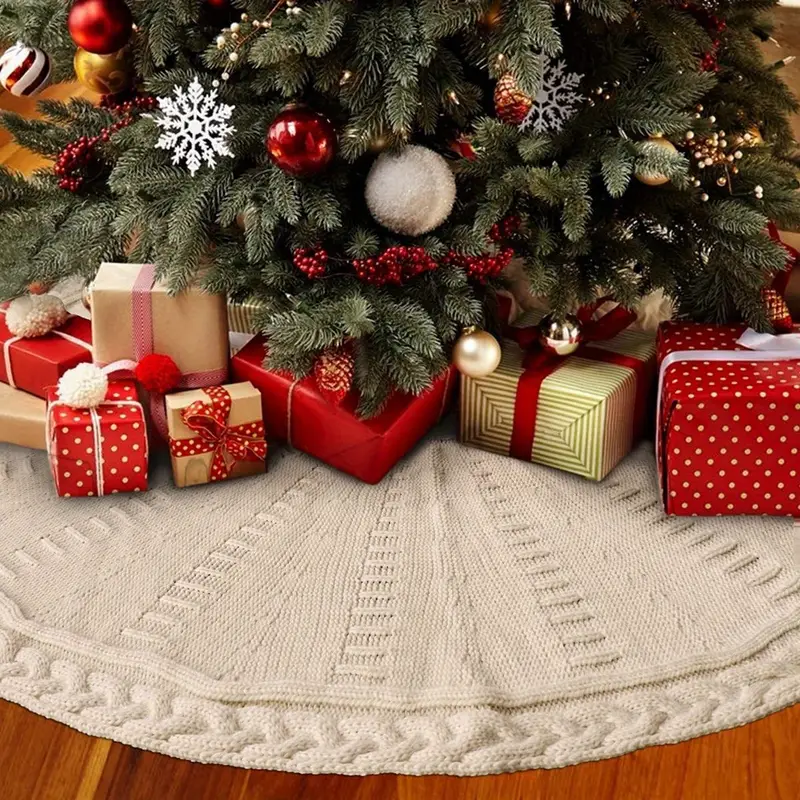
- Knitted cream skirt, 54-inch — $120 to $260
- Red and gold baubles, 24 to 36 pieces — $25 to $60
- Warm fairy lights, 200 count — $15 to $30
- Kraft paper, ribbon, and tags — $18 to $35
- 7.5-foot realistic tree — $150 to $400
12. White Tree Silhouettes on Deep Red Knit
Scattering small white trees at random is a braver choice than a neat border, and it pays off — the eye keeps moving instead of stopping at one motif. The white scalloped edge then contains all that scatter so it never tips into mess. If you’re making this yourself, resist the urge to space the trees evenly. Slight irregularity is what makes it look collected rather than printed.
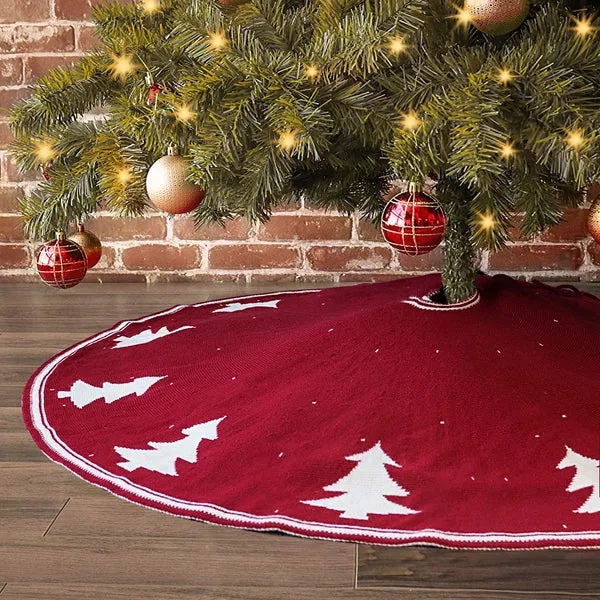
The scalloped white edge is the element you’d miss. Without it, this is a red circle with white shapes on it — nice, but flat. That single contrast border does three jobs at once: it separates the skirt from a dark wood floor, it echoes the roundness of the tree, and it visually lifts the whole piece off the ground. Cheapest detail in the design, biggest loss if you cut it.
13. Scalloped Cable Border on a Cream Skirt
Frosted trees shed. Put a cream skirt under a flocked tree and you’ll have white dust ground into the knit within a week. Two fixes: shake the tree hard in the garage before carrying it in, or spray the lower third with a light coat of matte sealant. And raise the pile slightly — a quarter-inch felt pad keeps the skirt off the floor and out of the dust line entirely.
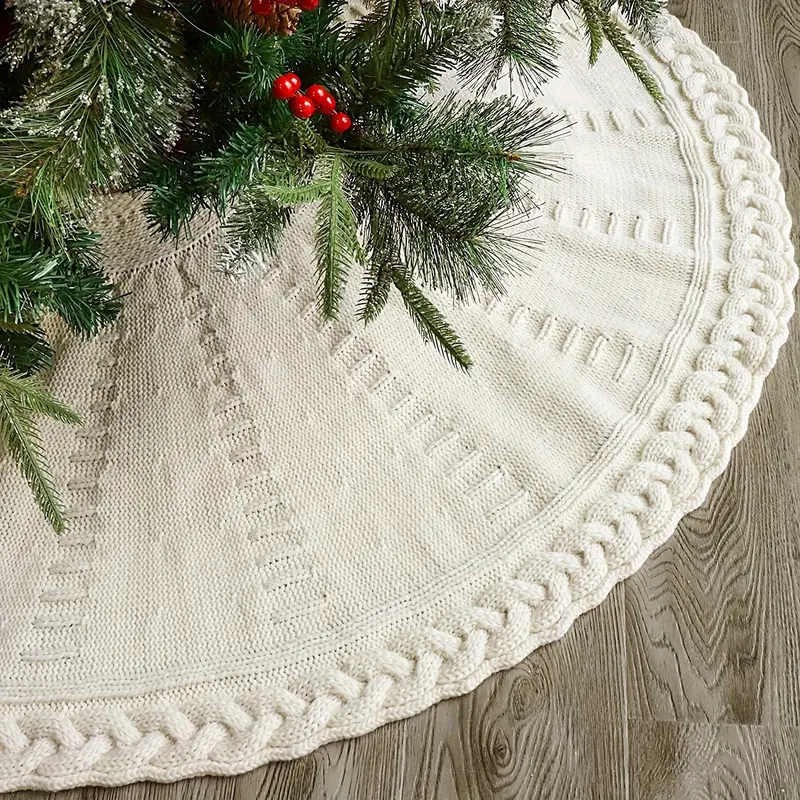
Cream knit plus faux snow is a maintenance pairing, so plan for it. Vacuum weekly with a brush attachment, and lint-roll the radiating stripes where dust settles into the grooves. If the skirt gets damp from a reservoir spill, dry it flat and away from heat — hanging a wet knit stretches it permanently. Realistic annual upkeep: a $12 lint roller, one deep clean in January, fifteen minutes a week.
14. Yellow Chunky Knit with a Matching Knit Hat Topper
The matching hat is the entire personality of this tree, and it costs almost nothing to copy. A knit beanie from Target or Walmart runs $8 to $14 — turn it inside out, stuff the crown lightly, and pin it over the top branch. Thrift stores have bins of them for $3. Add silver and white globe ornaments from IKEA at about $6 for ten, and you’re under $30 for the whole topper-and-ornament story. The skirt is the investment; Idea #8 covers how to fake that part cheaply.
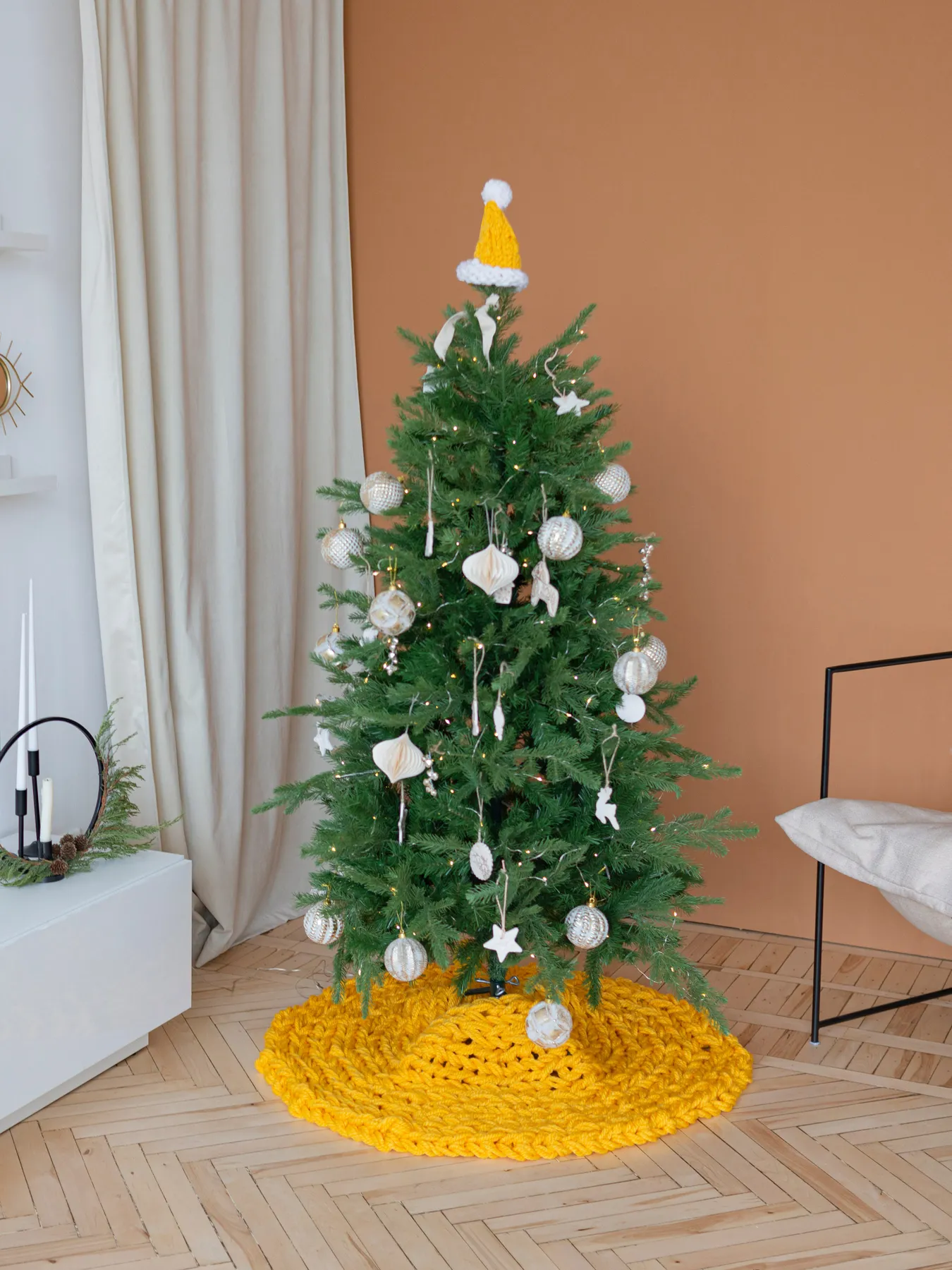
Herringbone floors and a warm brown accent wall both want width, not height. This room works because the skirt is roughly 50 inches across and the tree stays under seven feet — the yellow reads as a grounded block instead of a beacon. In a room under 10×10, drop to a 40-inch skirt and keep the topper; repeating yellow at top and bottom is what makes a small room feel deliberate.
15. Bare Chunky Knit Dressed with Berries and Gold
Styling the skirt surface takes about 20 minutes and costs whatever is already in your ornament bin:
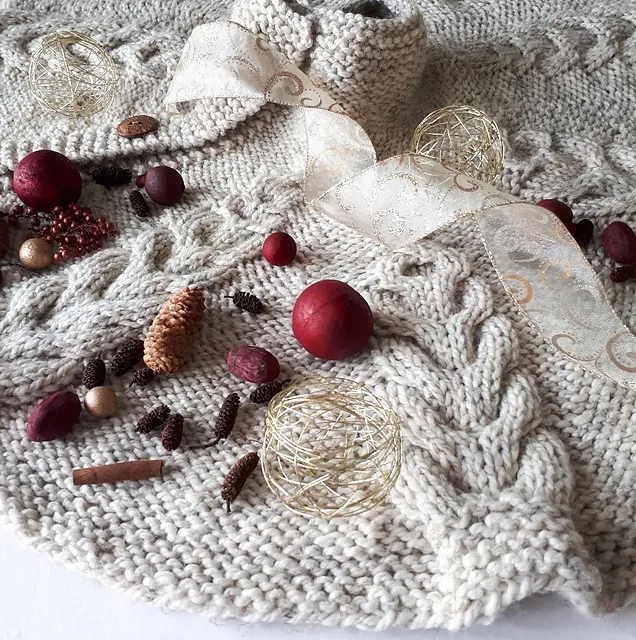
- Cluster three elements at the front left, not evenly around the circle.
- Start with the largest — sprigs of red berries laid flat, stems hidden.
- Add pinecones in odd numbers, angled so the scales catch light.
- Thread a cream-and-gold ribbon in a loose S-curve across the front.
- Finish with three gold wire spheres and a single cinnamon stick.
Everything here can come from a $15 grocery-store bundle.
Real pinecones bring real sap, and sap on light beige wool is a permanent souvenir. Bake foraged cones at 200°F for 30 minutes to dry them out, or simply buy faux. Also worth saying out loud: a decorated skirt is a display, not a floor covering. If kids or dogs share the room, keep the berries and gold spheres on a tray you can lift off. Pretty and practical can coexist, but only if you plan for the chaos.
16. Zigzag Bands Radiating from a Star Center
Count the bands: white, red, white, green, white, red — six rings plus a star center. Roughly 45% white, 35% red, 20% green, with white acting as the spacer between every other color. That white buffer is what lets two strong colors sit side by side without vibrating. Change the palette to navy and mustard and keep the white spacers exactly where they are; the formula travels wherever you take it.
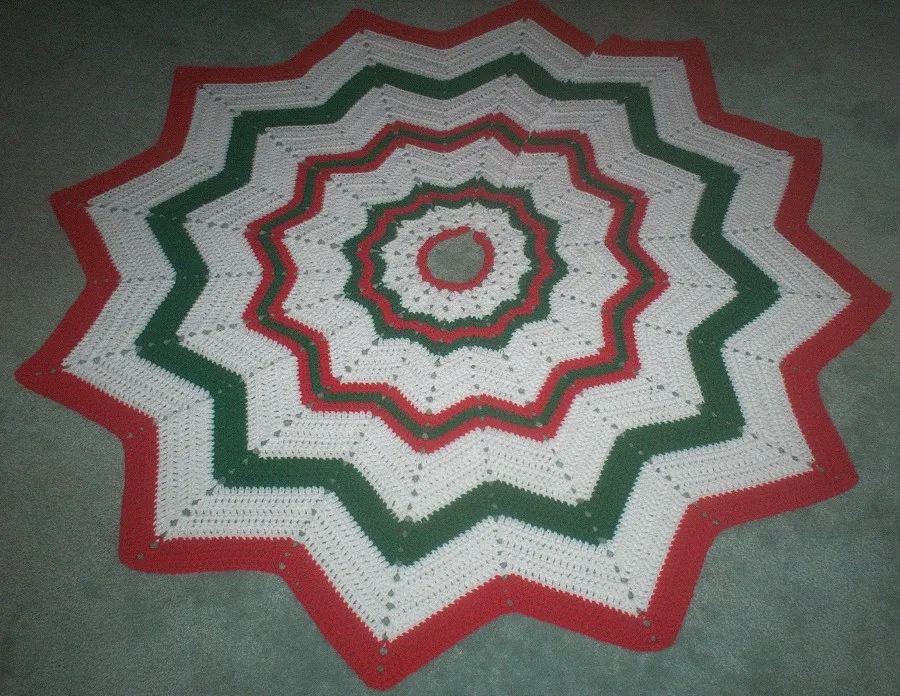
Getting the points of a star skirt to behave is 90% finishing:
- Crochet the final round one hook size down so the edge doesn’t flare.
- Pin each point to a measured radius — not eyeballed — on blocking mats.
- Mist with cool water and a capful of fabric starch, then dry 48 hours.
Do this once and the star survives a full season of being walked past.
17. Snowflakes, Blue Hearts, and a Crochet Blanket Nearby
Blue Christmas is genuinely back — not the retro kind, the quiet kind. Pinterest boards are full of white-flocked trees with pale blue and silver, sitting next to grey sofas and crocheted throws. It’s a reaction against maximal red-and-green, and it photographs beautifully in low winter light. Staying power? Fair. But the crochet blanket over the sofa anchors it in handmade tradition, which keeps the whole scheme from feeling cold.
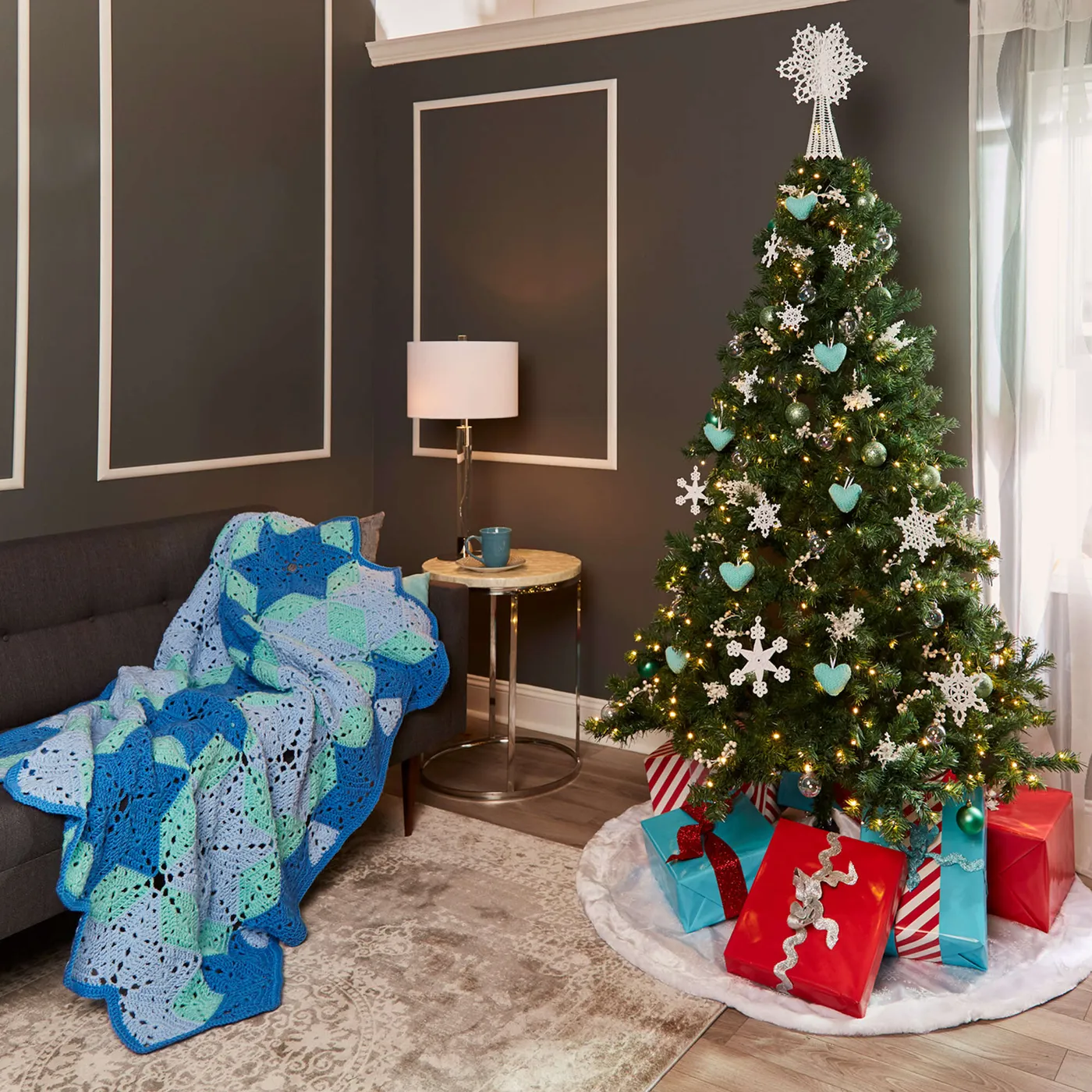
- White fluffy tree skirt, 48-inch — $35 to $75
- Snowflake ornaments, set of 12 — $15 to $30
- Light blue heart ornaments, set of 6 — $10 to $22
- Blue and green crochet throw — $40 to $90
- Crochet snowflake tree topper — $8 to $25
18. Oatmeal Chunky Knit with a Braided Scalloped Edge
Light oatmeal against dark wood is the entire story. The skirt reads almost like a light source — it lifts the bottom of the tree off the floor and stops dark branches from merging into dark boards. The braided scalloped edge then gives the circle a visible ending, which matters more than you’d expect on a shape with no corners to signal where it stops.
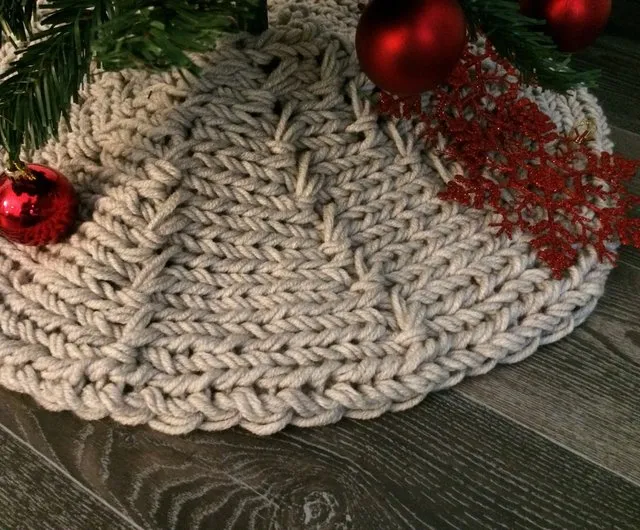
- Check your floor tone — oatmeal only pops on mid-to-dark wood or grey stain.
- Measure the braided edge’s depth; a thick border eats three to four inches of visible skirt.
- Confirm your ornament colors read against beige, not just against green.
- Decide which direction the opening faces — the braid makes the seam obvious.
19. A Tiny Crochet Dress Ornament with a Star Button
The white star button. Everything else here — the red yarn, the little skirt silhouette — is charming but generic. That single star does two jobs: it tells you instantly what the object is, and it adds the one bit of contrast the red needs. Swap it for a plain round button and the ornament loses its whole personality. Small details aren’t decoration; they’re what makes an object legible.
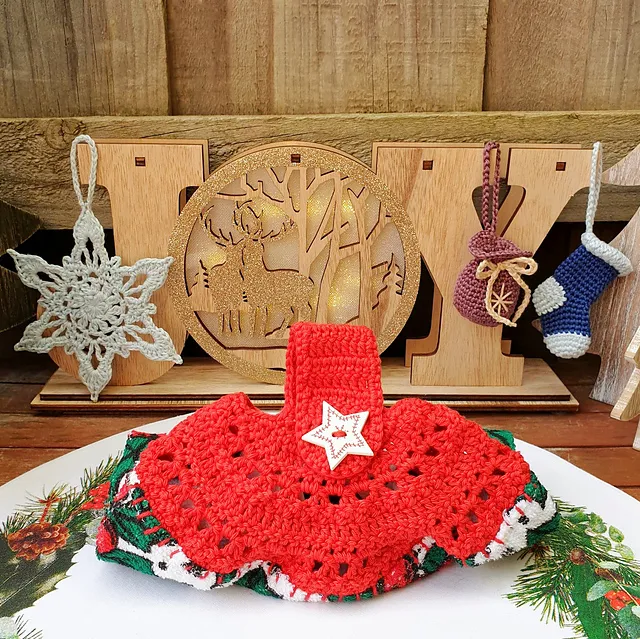
These take about 30 minutes once you’ve made one:
- Chain 8 and join into a ring with red cotton.
- Work 16 double crochet into the ring to form the hem.
- Increase every other stitch for two rounds to build the flare.
- Switch to single crochet for four rounds to shape the bodice.
- Sew a small white star button at the center and add a hanging loop.
Under $1 in materials each — six of them for the price of one shop-bought.
20. Distressed Persian Rug Pattern in Rust and Navy
A rug-pattern skirt is a pattern-matching problem. If you have a patterned rug under the tree, keep the two scales different — a large medallion skirt over a small kilim works; two similarly-scaled patterns absolutely do not. Rule of thumb: the skirt’s motifs should be at least twice the size of the rug’s, or half. Nothing in between. Solid floor? Then go as bold as you like with rust and navy.
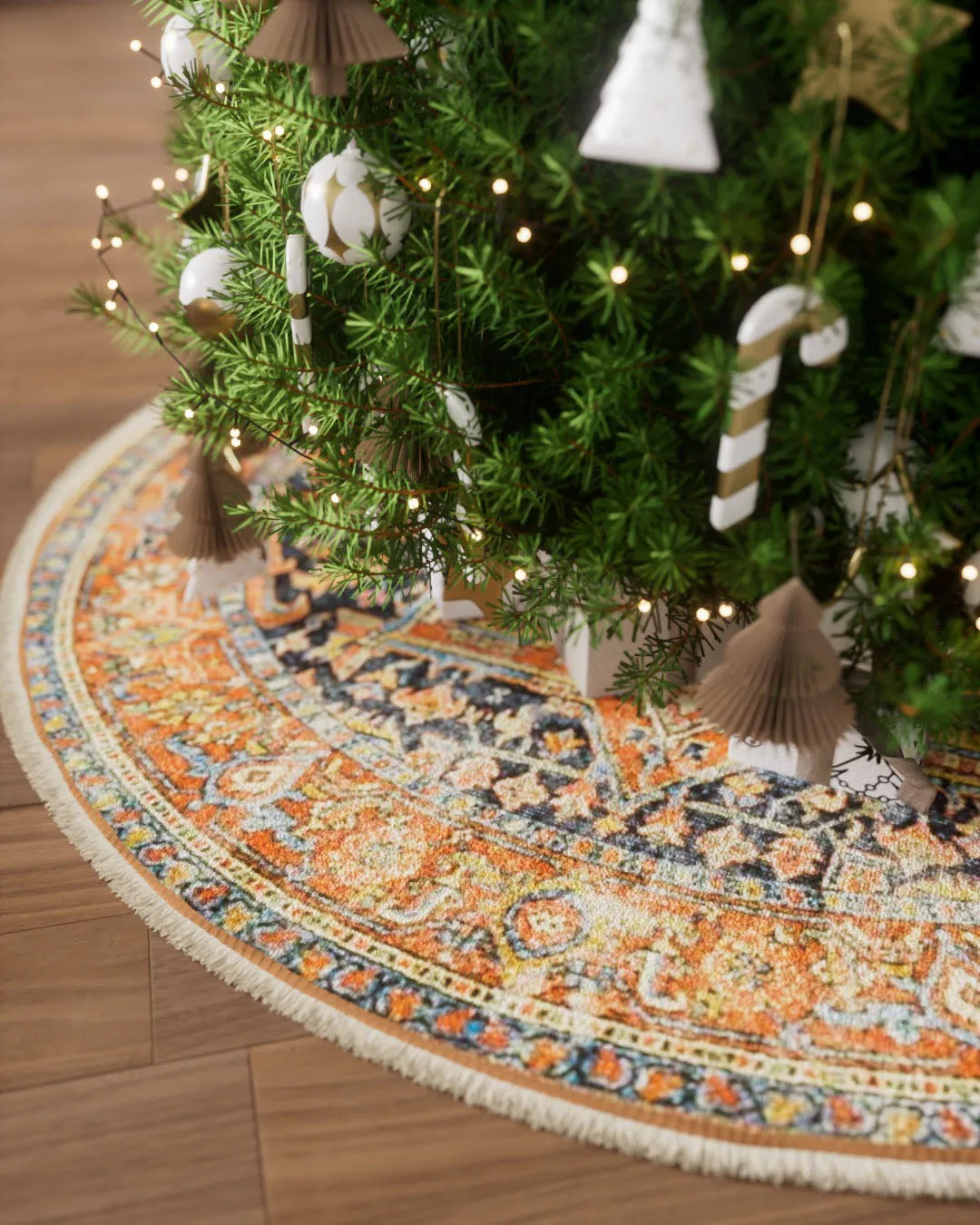
Wide plank flooring and an open room both call for width. This reads best at 54 to 60 inches across with generous fringe — anything smaller and the pattern gets cropped before the eye can read it. A nine-foot ceiling and at least 12 feet of wall width gives rust and navy their due. If your tree sits in a corner between two walls, size down and let the fringe carry the drama instead.
21. Deep Red Crochet Star with Green Scalloped Edge
Crochet on tile slides. These gnomes are charming until one tips over and the skirt has shifted six inches by morning. Put a rubberized grip mat underneath — the kind sold for area rugs, about $12 — and cut it to a circle two inches smaller than the skirt. Also: deep red cotton pills wherever it rubs against a tree stand, so keep metal legs off the yarn entirely.
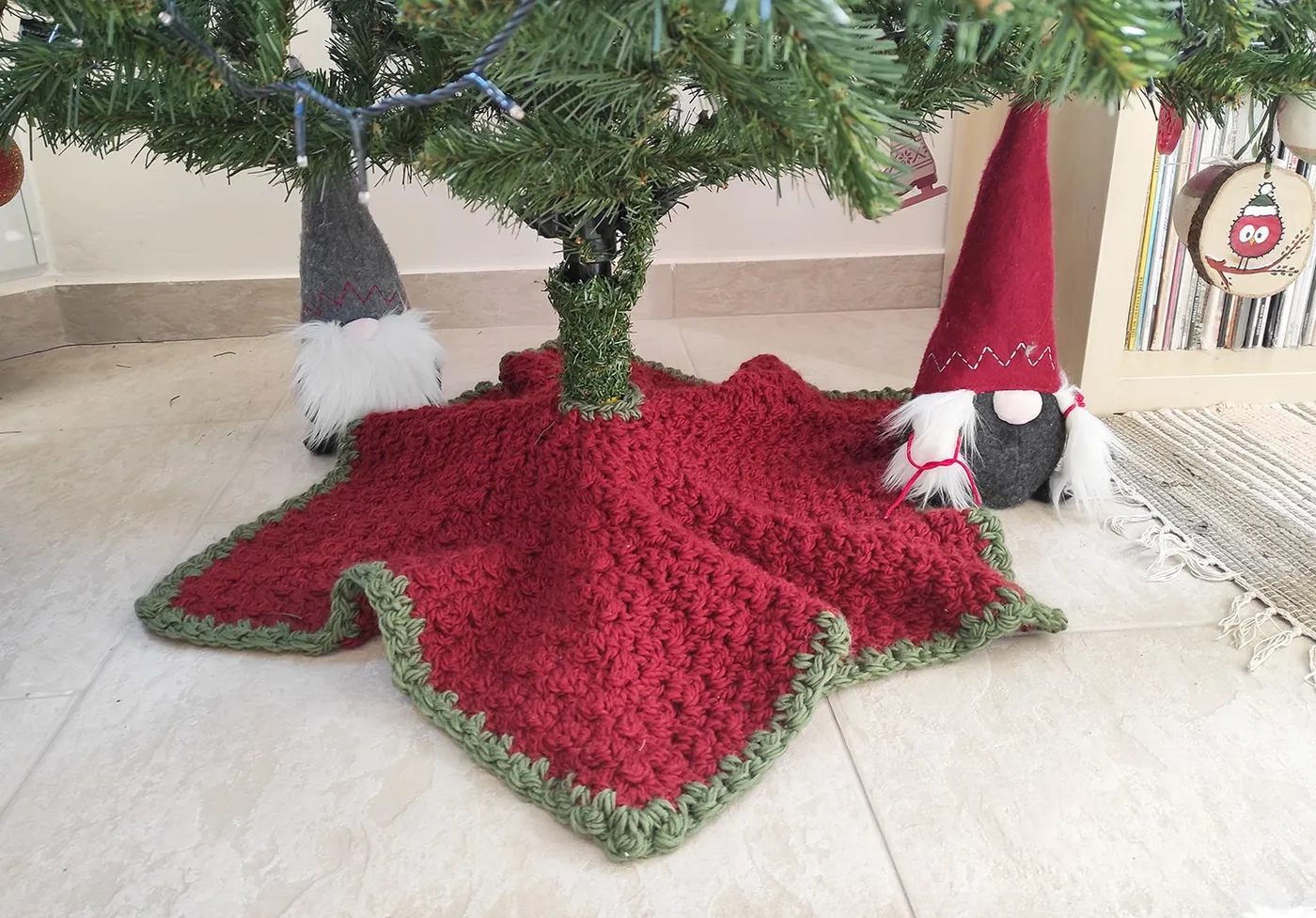
A chunky star skirt in this weight runs $120 to $200 handmade. Realistically, a $25 skein of super-bulky red acrylic plus a $6 skein of green for the border gets you there in a weekend — and acrylic is genuinely the right call, since it takes a wash and won’t fade in storage. The gnomes run $8 to $15 at Target and Walmart. Total under $50 against $250 store-bought.
22. White Woodland Animals on a Red Cloth Skirt
80% red, 20% white, zero third color. That discipline is why the animals read as illustration rather than clutter — every motif gets identical treatment, so the eye files them as one pattern. Swap red for deep green and the white embroidery still works beautifully. Add a third color and it falls apart. Compare with Idea #28, which runs the same block-and-embellish logic with a completely different palette.
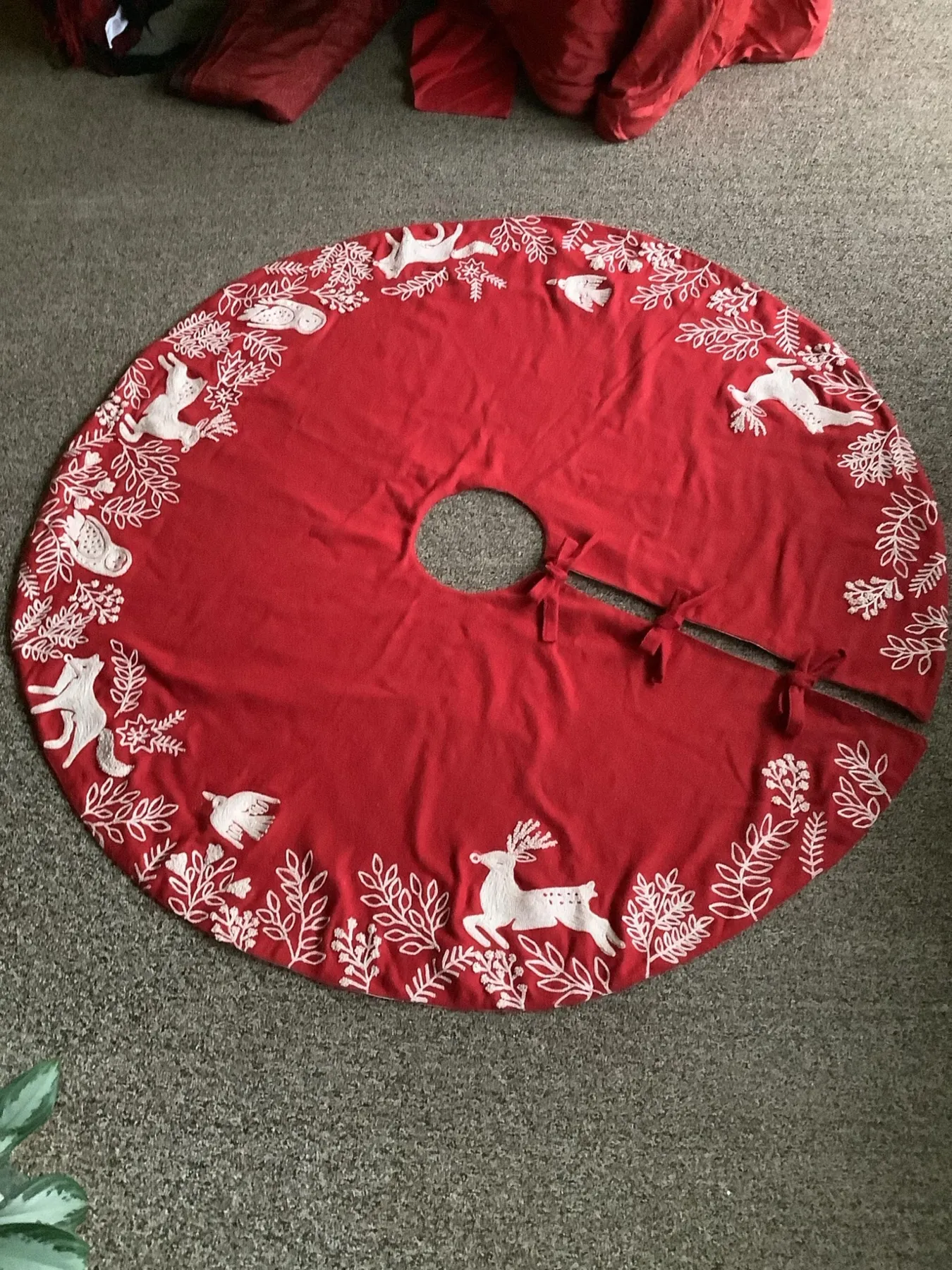
Notice where the animals sit: on a border band, not scattered across the middle. That’s a classic textile move — keep the center quiet since the tree covers it anyway, and put the storytelling where it’ll actually be seen from standing height. The border band also makes the circle feel larger than it is, which is a free optical upgrade.
23. Moss Green Yarn Coiled into a Tree Shape
A 30-minute project with almost no skill required:
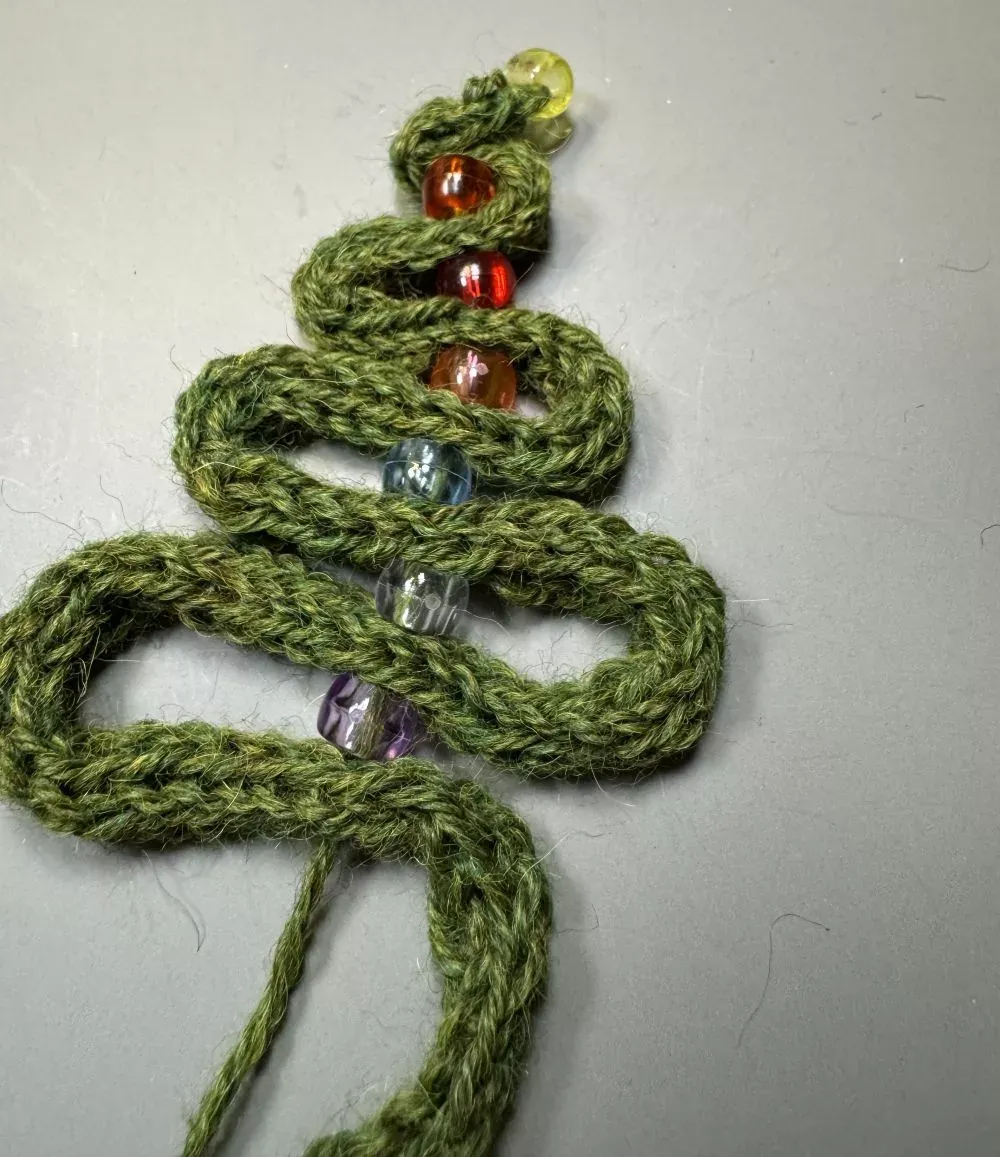
- Cut three yards of chunky moss green yarn and lay it in a loose S-curve.
- Thread eight to ten translucent faceted beads onto thin wire.
- Wrap the wire around the yarn at even intervals, twisting to secure.
- Bend the shape into a zigzag tree silhouette, widening at the base.
- Pin the ends with a dot of hot glue and mount on card or board.
Materials run about $6 total if you already own beads.
Bead spacing makes or breaks this. Cluster them tighter near the top and wider at the base — that’s how a real tree distributes ornaments, and your eye expects it even when the tree is abstract. Nine beads evenly spaced reads as a craft project; fifteen weighted toward the crown reads as design. Same yarn, same time, completely different result.
24. Scalloped Quilt Panels with Birds and Holly
- Quilted panel fabric, 3 yards — $45 to $95
- Batting and backing — $18 to $35
- Scallop template and rotary cutter — $15 to $28
- Fabric ties and thread — $8 to $15
- Pre-made version, if you’d rather not — $110 to $190
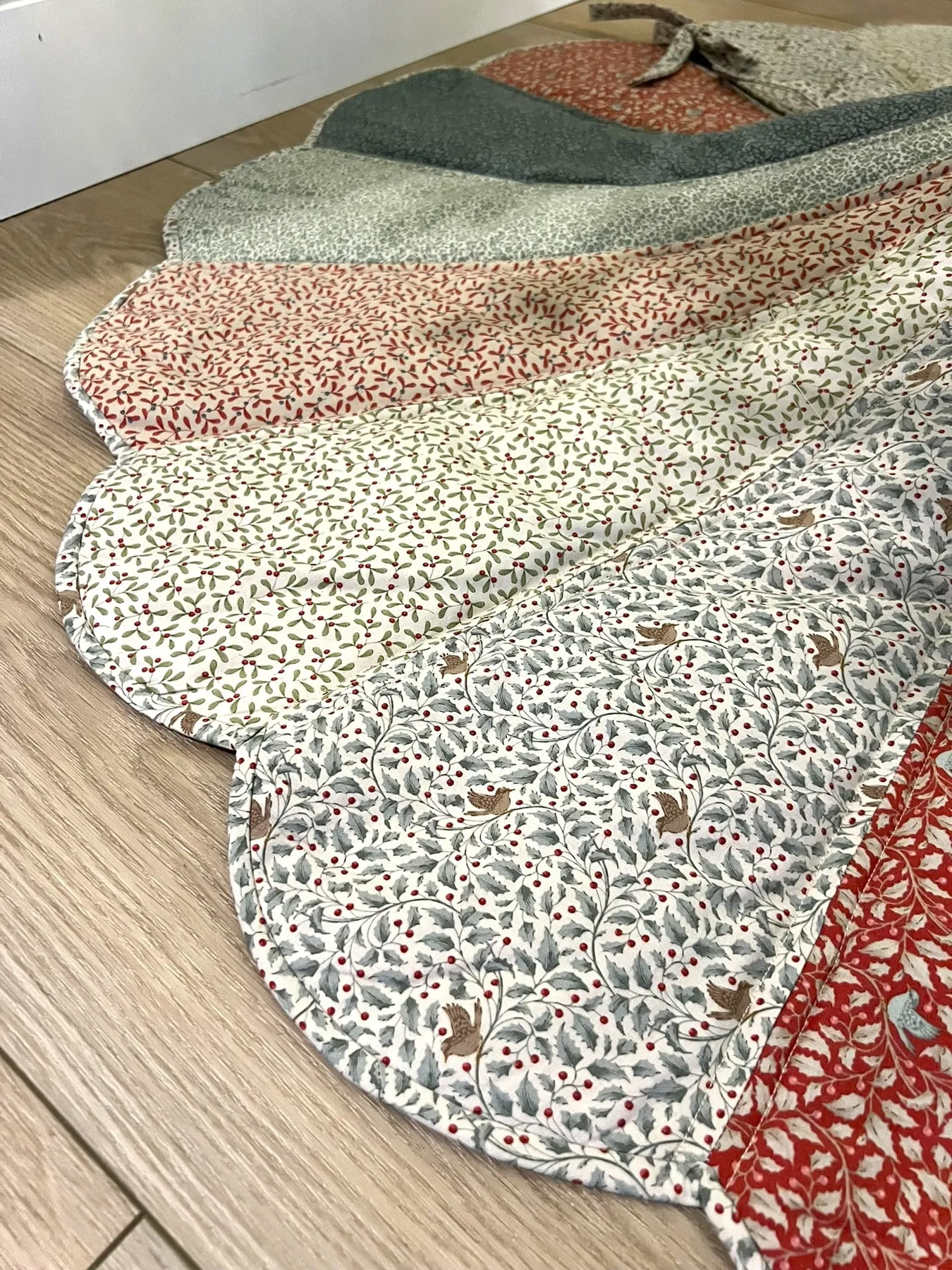
The scalloped edge is the thing. A straight-bound circle would look tidy; scallops make it look considered. On a quilted skirt they also do structural work — each curve hides a seam where two panels meet, so the pattern changes read as intentional rather than mismatched. That’s the difference between a homemade craft and an heirloom piece.
25. A Hand-Hooked Red Truck in the Snow
Hand-hooked loops are basically a tiny rug, which means they behave like one. Pet claws snag them, a vacuum beater bar shreds them, and anything wet wicks straight into the backing. Vacuum with suction only, never the brush roll. Trim snags with scissors rather than pulling them. And store it rolled — loop side out, never folded — or you’ll be pressing out permanent creases next December.
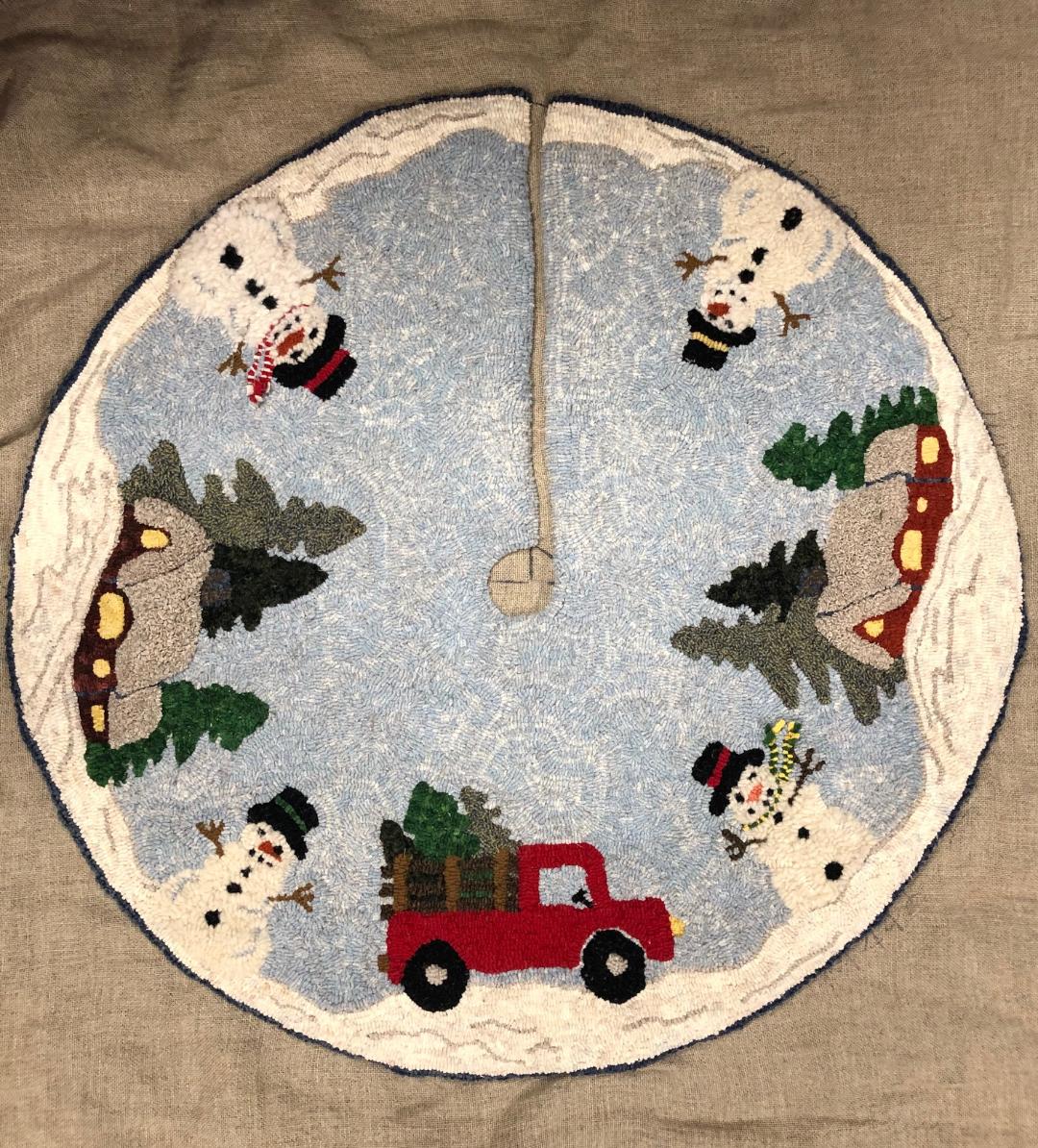
Before you fall for a hooked skirt, check three things:
- Pile height — anything over half an inch won’t sit flat under a heavy stand.
- Your tree stand’s diameter — hooked skirts rarely open wide enough without stretching.
- Floor type — on carpet, hooked loops grip and bunch; on wood, they slide.
None of these are dealbreakers, but all three are much easier to solve before the tree goes up.
26. Hexagonal Floral Crochet in Champagne Neutrals
This is a big-room skirt. At 60 to 72 inches across it needs floor space and soft light — the arched window behind it is doing as much work as the crochet itself. Ceiling height of nine feet or more keeps it from feeling like it’s eating the room. In a space this neutral, the skirt’s scale is the only thing creating drama, so don’t size down out of caution.
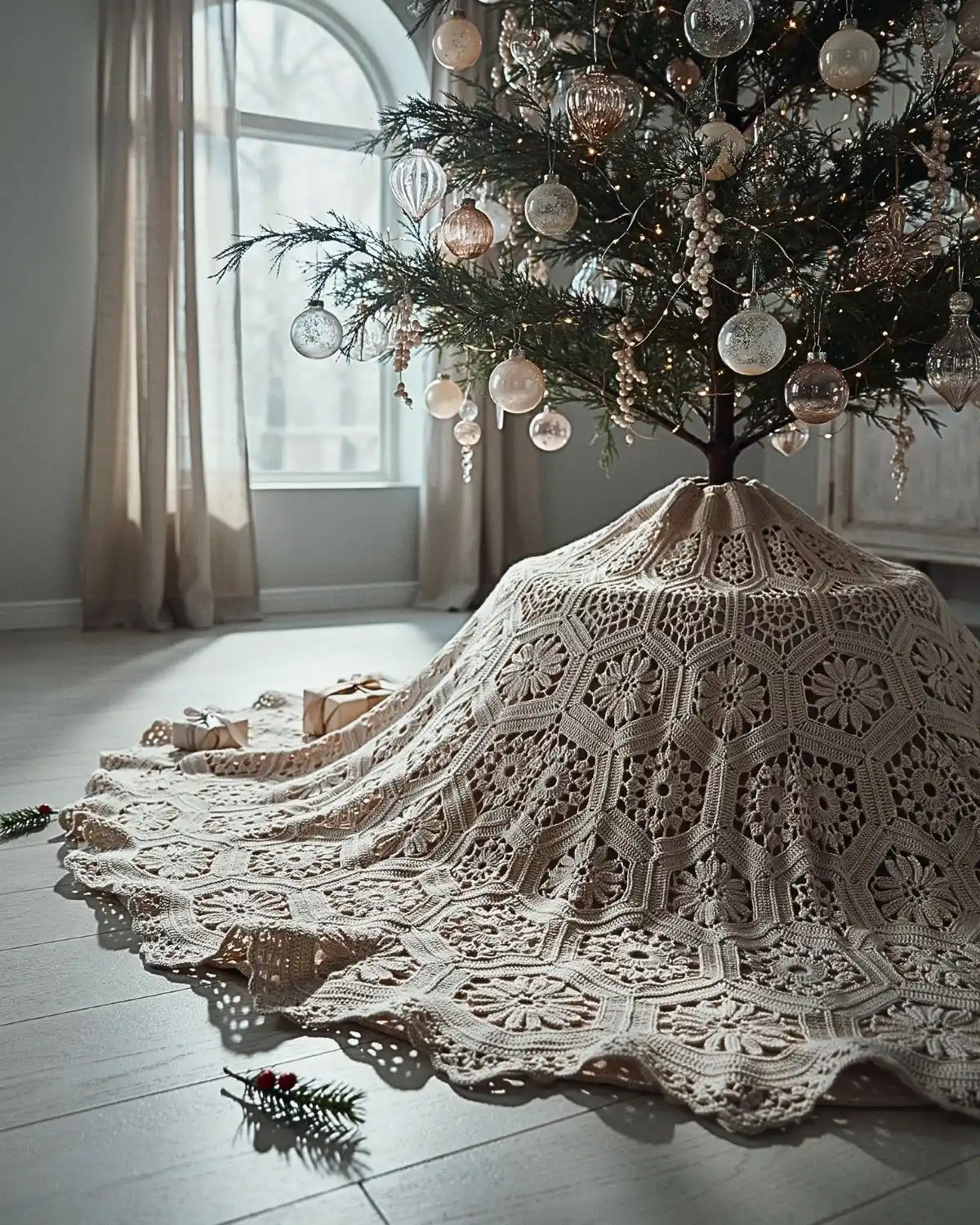
Handmade hexagon-motif skirts in this yarn weight run $220 to $400. Closer look: the ornament palette is doing half the work, and that part is cheap. Clear and champagne glass baubles from Target run $12 for a set of eight; pearl strands from a craft store are $6. Pair those with a $60 cream knit skirt from Amazon and the room reads the same from the doorway.
27. White Yarn, White Hook, White Fluffy Surface
Starting a skirt from scratch? Here’s the honest sequence:
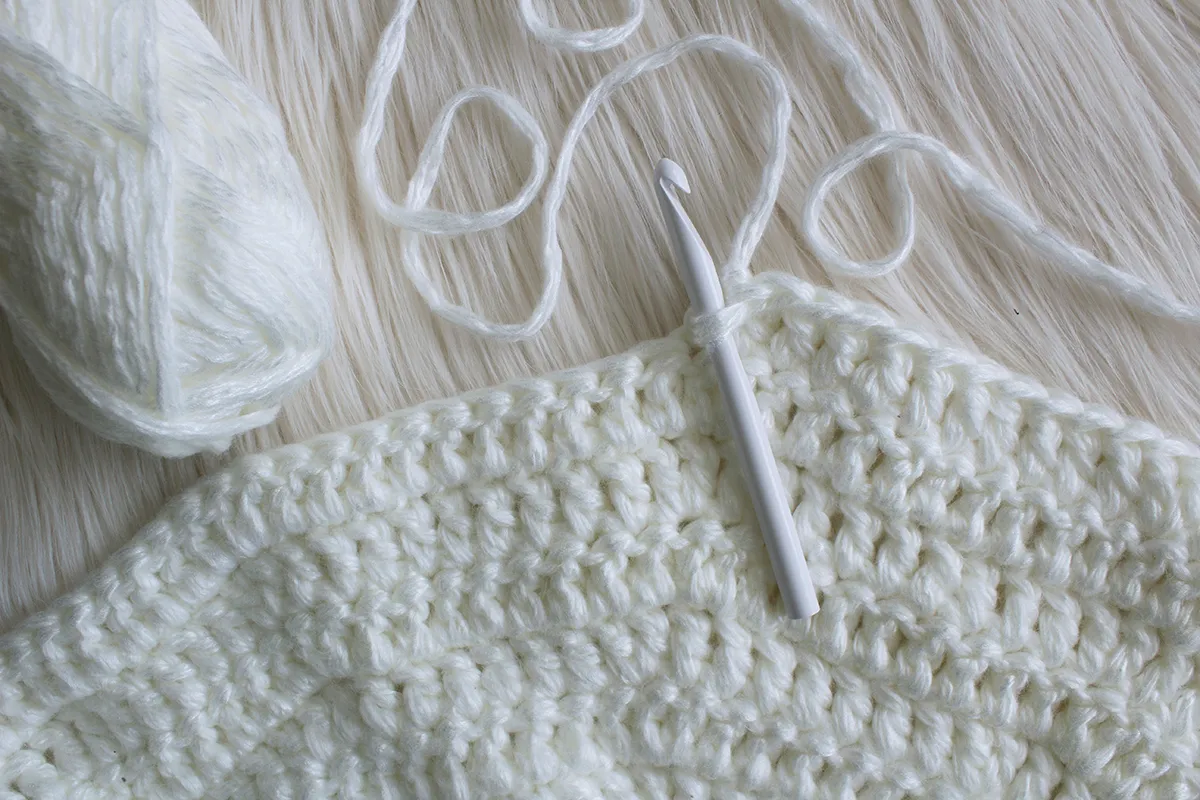
- Magic ring, 12 double crochet — that’s your center opening.
- Increase 12 stitches per round until the circle measures about 12 inches.
- Switch to increasing every other round to keep the edges flat.
- Work even rounds until you reach your target diameter.
- Add the border last, working one hook size down.
Expect 20 to 30 hours. For a shortcut version, see Idea #30.
Keep your hook and yarn the same color as the work — it’s not superstition. White yarn on a white surface lets you see every stitch loop clearly, which is why this setup photographs so peacefully. Working cream yarn on a dark sofa is how you end up frogging four rounds at 11pm. Light background, light project. Always.
28. Segmented Panels with a Beaded Candy Cane
Beaded embroidery is quietly becoming the craft of the moment — it keeps showing up in 2026 collections as an antidote to print and digital pattern. There’s something appealing about an ornament you can feel with your fingertips. On tree skirts it reads as vintage without tipping into costume, especially when the background stays simple. It’s slower to make than appliqué, and honestly, that’s rather the point.
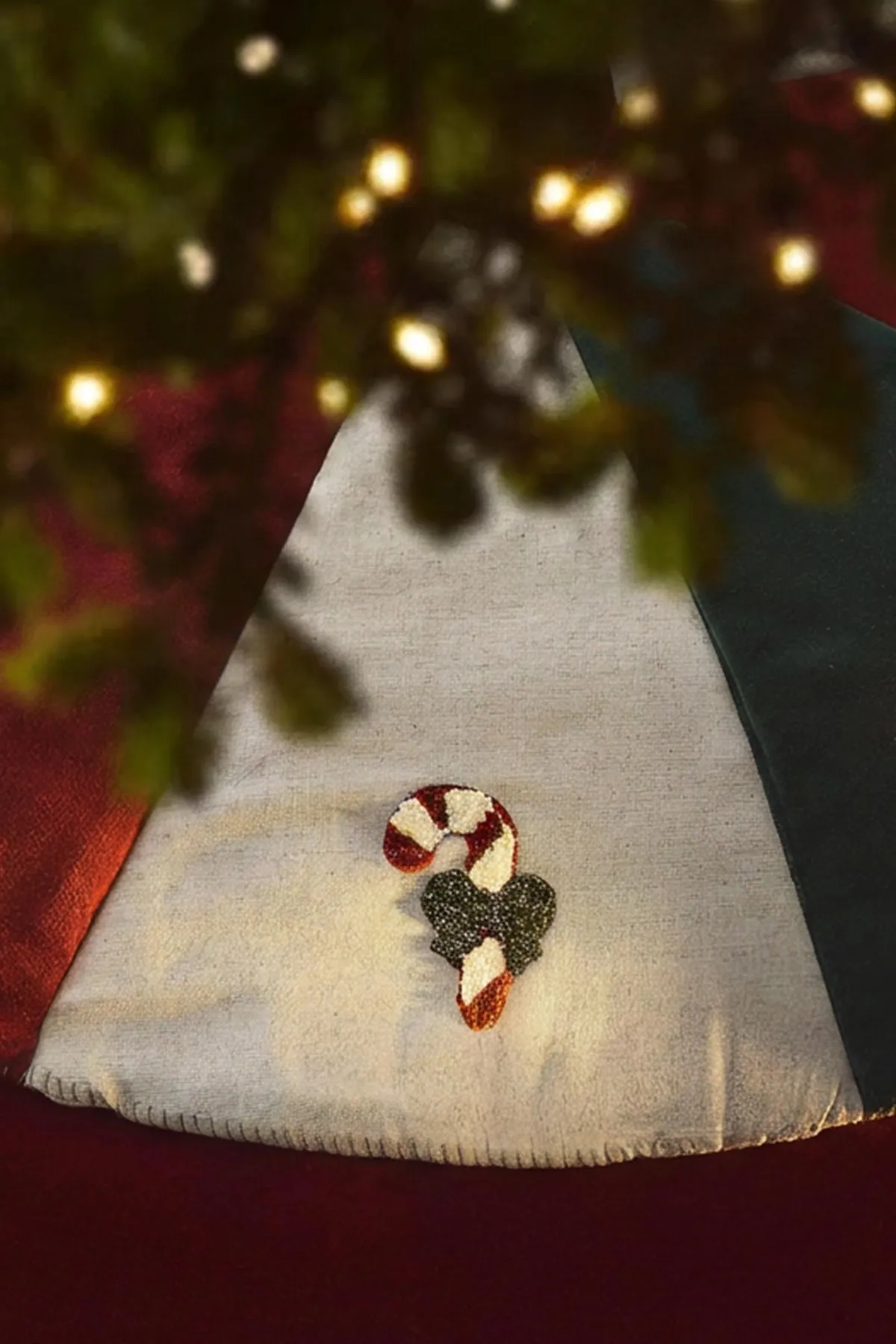
Three wide color blocks — off-white, dark green, dark red — then one dense embellishment, centered on the lightest segment. That’s the whole design. The restraint is why the beadwork reads as precious rather than fussy. If every panel carried embroidery, the eye would have nowhere to rest. Put the detail where contrast is highest and let the other panels stay quiet.
29. Fair Isle Snowflakes and Zigzags on Brown
Fair Isle lives and dies by color discipline. Three colors, one dominant, and the lightest one carries the motif. Here: cream snowflakes on a brown ground with mustard as a thin accent band. Want a fourth color? Put it in a single one-row stripe — never inside the motif itself. And keep every snowflake at the same stitch count, or the bands will drift out of alignment by round six and never recover.
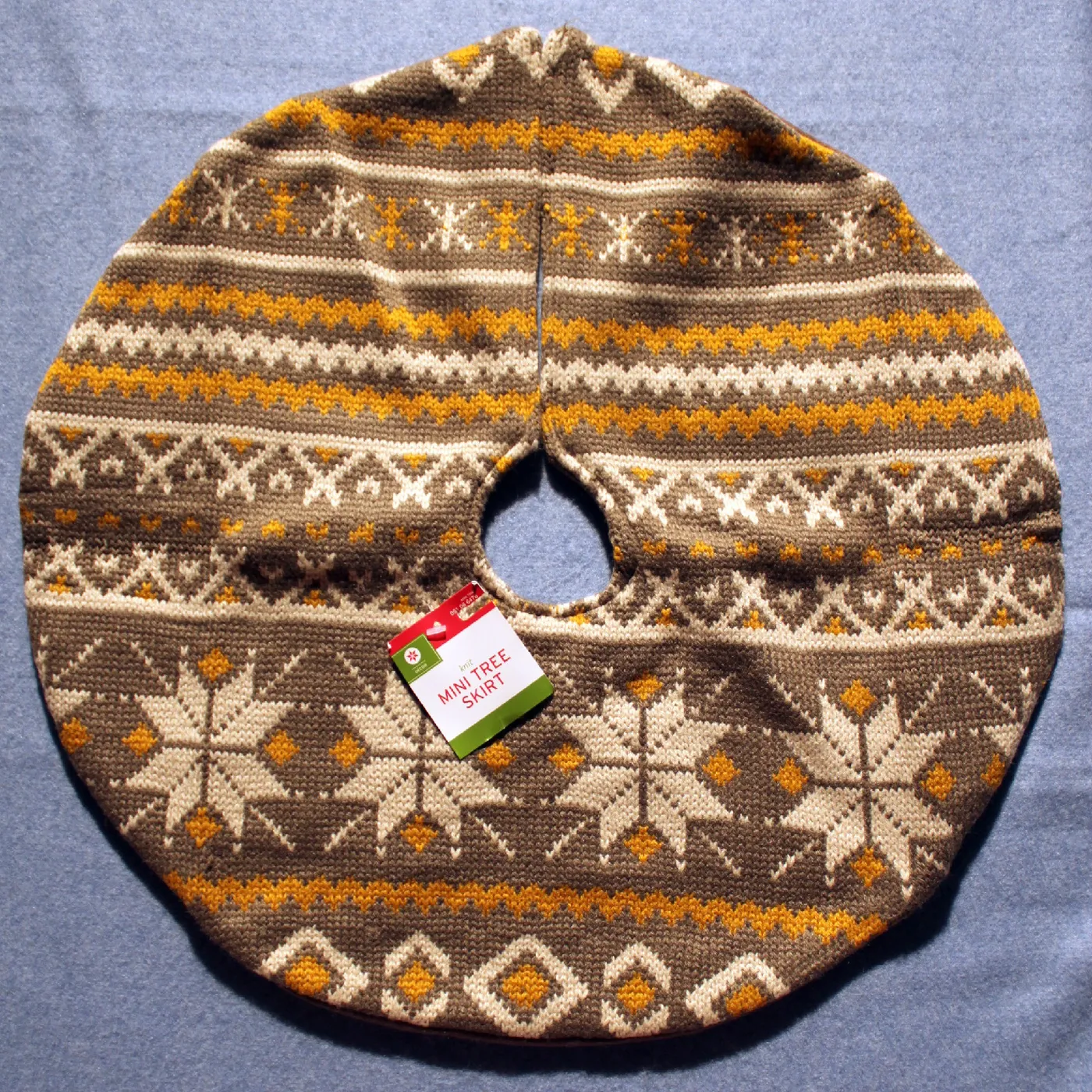
55% brown, 30% cream, 15% mustard — that’s the entire equation. Cream does the drawing, brown holds the background, mustard appears only in narrow separators. Swap brown for charcoal and mustard for rust and you have a totally different skirt from identical charts. The pattern isn’t the design; the ratio is.
30. Gold Ribbon Woven Through Chunky White Crochet
- Chunky white cotton, 5 to 6 skeins — $45 to $75
- Gold metallic ribbon, 3 yards — $8 to $16
- Round gold fasteners, pack of 50 — $6 to $12
- Dark red wooden bead garland — $12 to $25
- White faux fur to layer underneath — $20 to $40
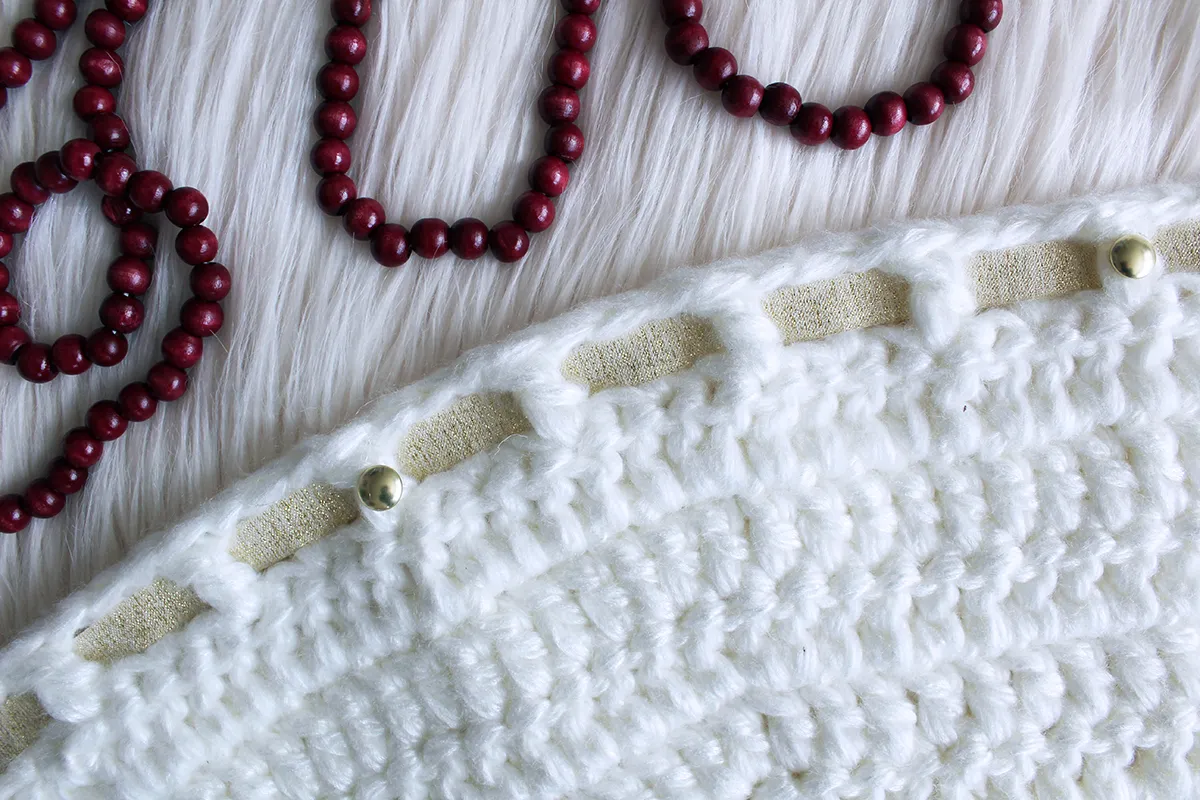
Metallic ribbon is stiff and it frays. Cut the ends on a sharp diagonal, then seal them with a lighter held an inch away — one pass, don’t linger. And weave it loose. Pull it taut and the crochet puckers in a way you can’t undo without re-blocking the entire piece. Same for the beads: weight on chunky crochet stretches the loops over a season, so keep the garland on the tree, not the skirt.
31. Red with Gold Embroidery, Holly, and Button Closure
For a 7.5 to 9-foot tree, a 60-inch skirt is the number that makes a room look finished rather than just furnished. Anything under 48 inches on a nine-footer reads as a coaster. Leave 8 to 10 inches of visible skirt beyond the lowest branches, and double-check that your stand fits through the center opening — embroidered fabric has almost no stretch at all.
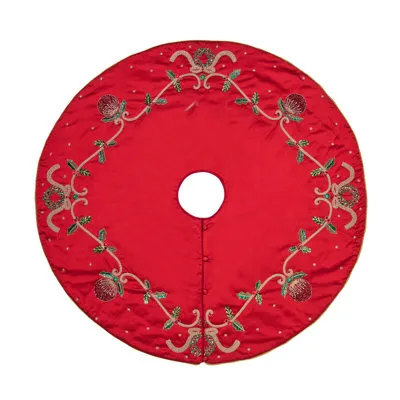
The gold trim along the outer edge is the piece that holds it together. Embroidered scrolls and holly are lovely, but on a red-on-red skirt they’d blur into the background without a hard boundary. That thin gold line gives the circle a crisp finish and catches the tree lights, so the whole thing feels lit from within. One line of trim, and it’s the difference between homemade and heirloom.
Your Tree Deserves a Better Foundation
Whether it’s a chunky cream knit you fought for on Etsy or a thrifted sweater you cut up on a Sunday afternoon, the piece under your tree sets the tone for everything above it. Start with the scale guide, trust your floor tone, and don’t skip blocking — that’s usually the whole difference between charming and crooked.
Pick one idea from this list, measure twice, and enjoy it for years. 📌 Pin this guide now so it’s waiting for you next December.