
You know the moment: the tree is up, the lights are on, and then you look down and realize the base looks like an afterthought. That’s usually when the late-night Pinterest scrolling starts — which is why we gathered 34 real tree skirts from real homes, from hand-crocheted heirlooms to a red plastic storage bin with a belt strapped around it. We dug through Etsy makers, JOANN remnant bins, Target baskets, and thrift-store finds to pull together ideas that range from about $12 worth of yarn to roughly $250 for something beaded, velvet, and vintage. Inside you’ll find chunky knits, quilted patchwork, woven collars, burlap, crochet, and a few bases that skip fabric entirely — cozy neutral, traditional patchwork, natural fiber, and opulent gold-and-velvet styles all covered, with budget versions sitting right next to the splurge. In 2026 the pull is toward things that look handmade and slightly imperfect: the anti-plastic holiday, basically. And stay until the end — we break down the most common mistakes that can ruin these looks. 📌 Save this to Pinterest for later — you’ll want to revisit these ideas.
1. Chunky Knit Jute Skirt Against a Terracotta Wall
Here’s the measurement that actually matters: a knit skirt should extend about six inches past your lowest branch tips on every side. On a seven-foot tree with a 46-inch spread, that’s a skirt in the 58-to-60-inch range. Go smaller and the whole thing reads like a doily under a coat rack. Work yours in a jumbo weight — t-shirt yarn or doubled chunky wool on a size 50 circular — so the stitches stay legible from across the room instead of dissolving into texture mush.
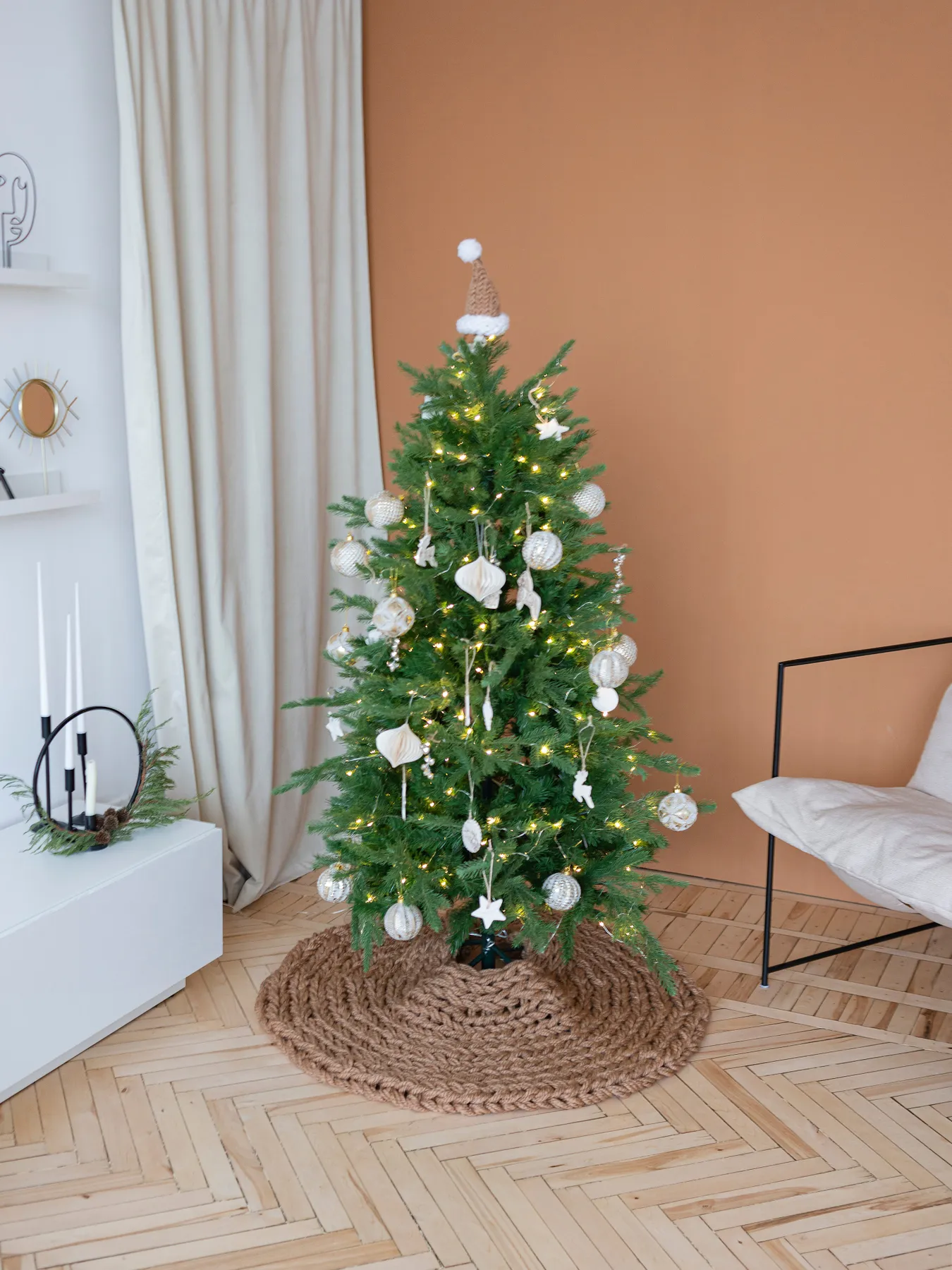
Two things are doing the heavy lifting here. First, contrast of scale: giant stitches next to slim white and metallic ornaments keeps the tree from feeling cluttered. Second, color temperature — the jute’s warm brown picks up the terracotta accent wall behind it, so the base feels planted in the room rather than dropped in front of it. The knitted Santa hat up top quietly repeats the texture, which is the kind of echo your eye registers before your brain catches up.
2. Scalloped Quilted Floral Skirt on a Woven Tan Rug
The scalloped edge. Take it away and you have a perfectly nice quilted circle behaving exactly like every other quilted circle — flat, a little stiff, sitting there. The scallops lift and curve, so the hem reads soft even though the fabric is structured, and that slight lift is what keeps it from looking like a puddle of pattern under the branches. It’s forgiving too: a scalloped hem hides uneven quilting and slightly wonky seams better than a straight one ever will.
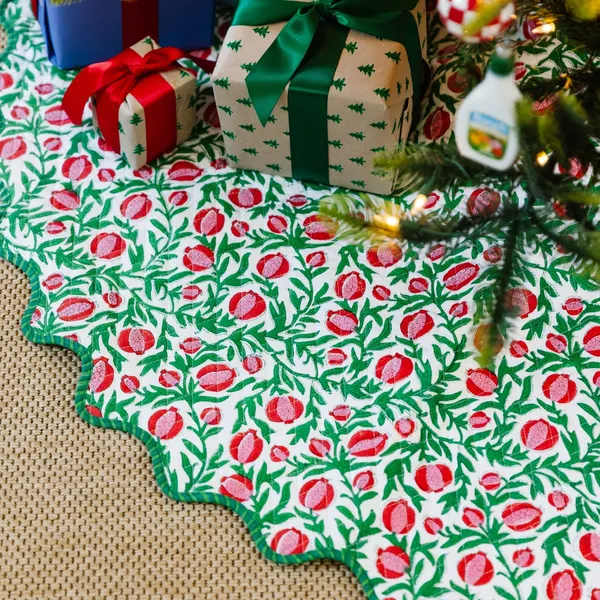
- Quilted floral skirt or pre-quilted yardage: $35–$90
- Tan woven jute rug underneath: $25–$70
- Kraft wrap, twine, and a small tree stamp: $12–$20
- Warm white string lights: $15–$40
- Total: $87–$220
Budget alternative: cut a scalloped template from cardboard, trace it onto two yards of clearance quilted fabric, and bind the edge with bias tape — about $30 and an afternoon.
3. Patchwork Squares Tied with Yarn and an Eyelet Ruffle
A tied patchwork version is the friendliest first sewing project on this list. Start with a 45-inch circle of muslin as your base.
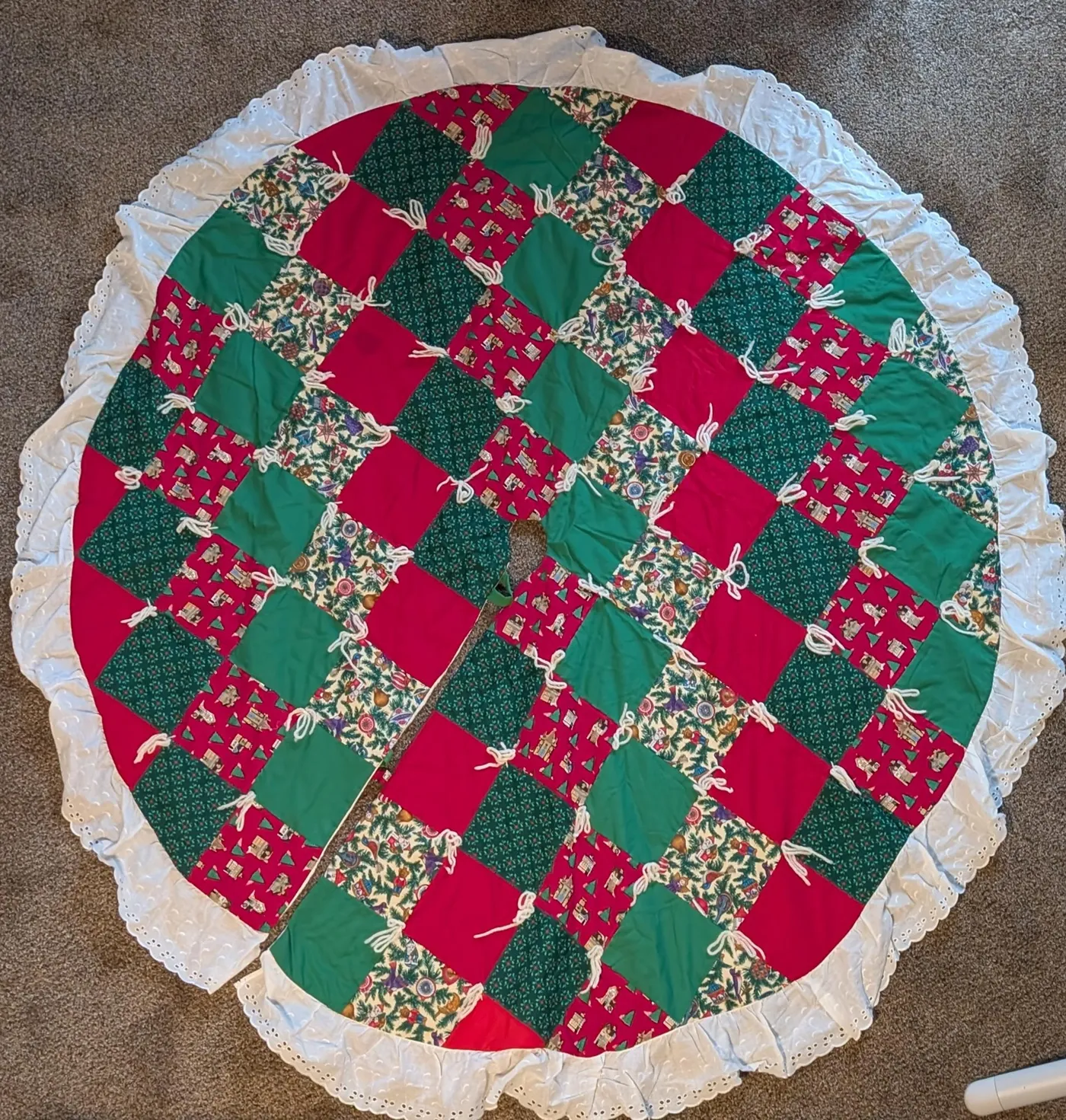
- Cut 5-inch squares — roughly 60 of them — in solid red, solid green, and two holiday prints.
- Lay them in a grid on the muslin, overlapping edges by ½ inch, and pin.
- Machine-stitch each square down along two sides, working in rows.
- Tie a short yarn knot at every corner intersection, leaving 1-inch tails.
- Stitch a wide eyelet lace ruffle around the outer edge, gathering as you go.
About five hours total and $40 in fabric if you shop the remnant bin.
Eyelet lace is beautiful and completely unbothered by reality. It snags on pine needles, catches on gift ribbon, and shows every scuff from shoes and paws. If your tree lives in a high-traffic spot, expect to spot-clean that ruffle twice a season and keep small scissors nearby for loose threads. Cheap cotton lace will fray in the wash — hand wash cold, or don’t wash it at all and just vacuum it gently with a brush attachment.
4. Radiating Fabric Wedges in Mrs. Claus Prints
Pieced, slightly chaotic, grandmother-approved textiles are having a real run. The 2026 version isn’t matching sets — it’s scrappy memory-quilt energy: fabric from a stash, a thrifted sheet, a bolt you bought in 2019 and never used. Pinterest searches for hand-pieced holiday decor keep climbing because people want the tree to look like it accumulated meaning over time rather than arriving in one shrink-wrapped box. This is a trend with legs, too — a well-made pieced skirt is the kind of thing somebody’s kid argues over in thirty years.
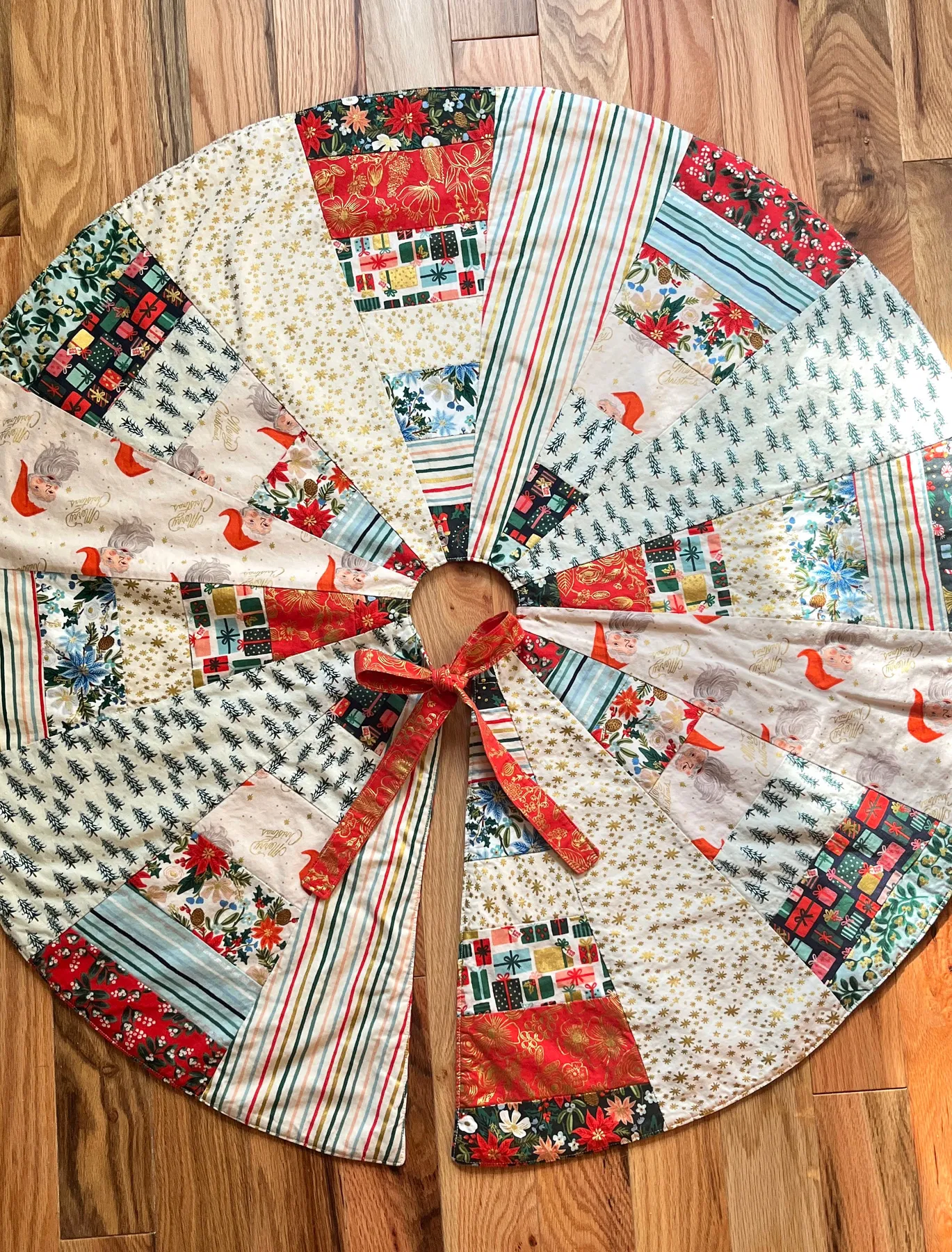
Twelve wedges is the magic number. Cut a 30-degree template with a 22-inch outer edge and a 4-inch inner arc, and every piece nests without math headaches. Press seams open as you go rather than saving them for the end — it’s the difference between a skirt that lies flat and one that ripples like a potato chip. When you’re mixing busy prints, keep all twelve in one palette and let just two or three wedges carry the loud pattern.
5. Bright Red Crochet with a Scalloped Border
Crochet is durable, but it’s a lint magnet, and saturated red shows every pine needle and strand of tinsel. Plan on a monthly pass with a rubber-gloved hand or a lint roller, and store it flat rather than folded so the scallops don’t take a permanent crease. Cotton holds its shape for decades and can be hand-washed cold; acrylic pills faster but survives a machine on delicate. Either way, keep it away from a heat register — acrylic near a vent softens and droops over a season.
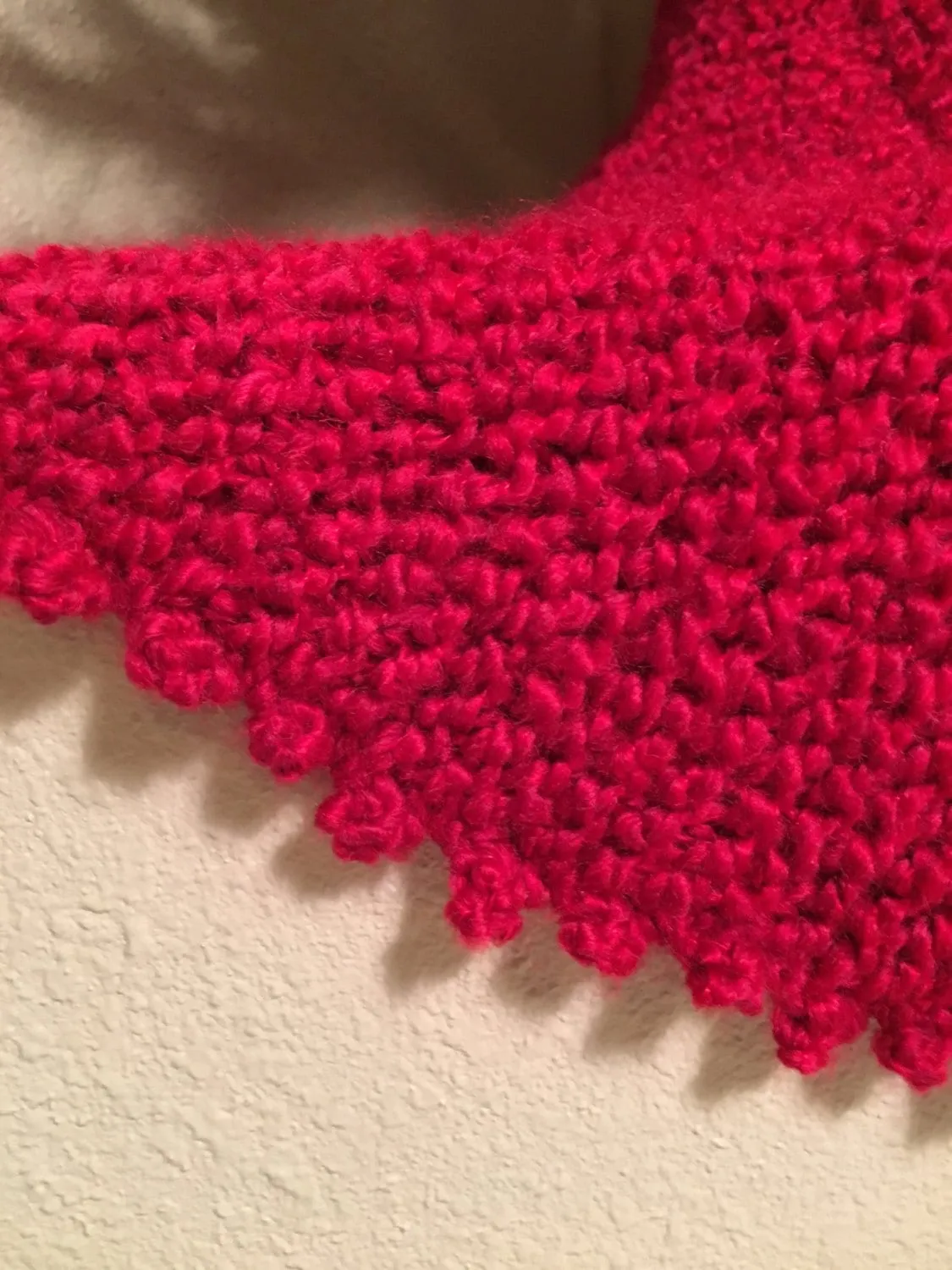
Look at what a tight stitch does against that textured off-white wall. The gauge is dense enough that the surface reads almost like a solid material until you’re standing right over it, and the scalloped edge is the only soft line in the composition. There’s a lesson buried in that: when the color is this loud, texture has to do the work of pattern. A loose, holey stitch in the same red would look flimsy. Tight gauge makes it look deliberate.
6. Red Velvet with Gold Beaded Art Deco Fans
- Red velvet or velvet-like skirt: $60–$180
- Gold seed beads and sequins, if you’re embellishing: $25–$60
- Beading needles, thread, small hoop: $10–$18
- Inner ring or liner to hold the shape: $15–$35
- Total: $110–$293
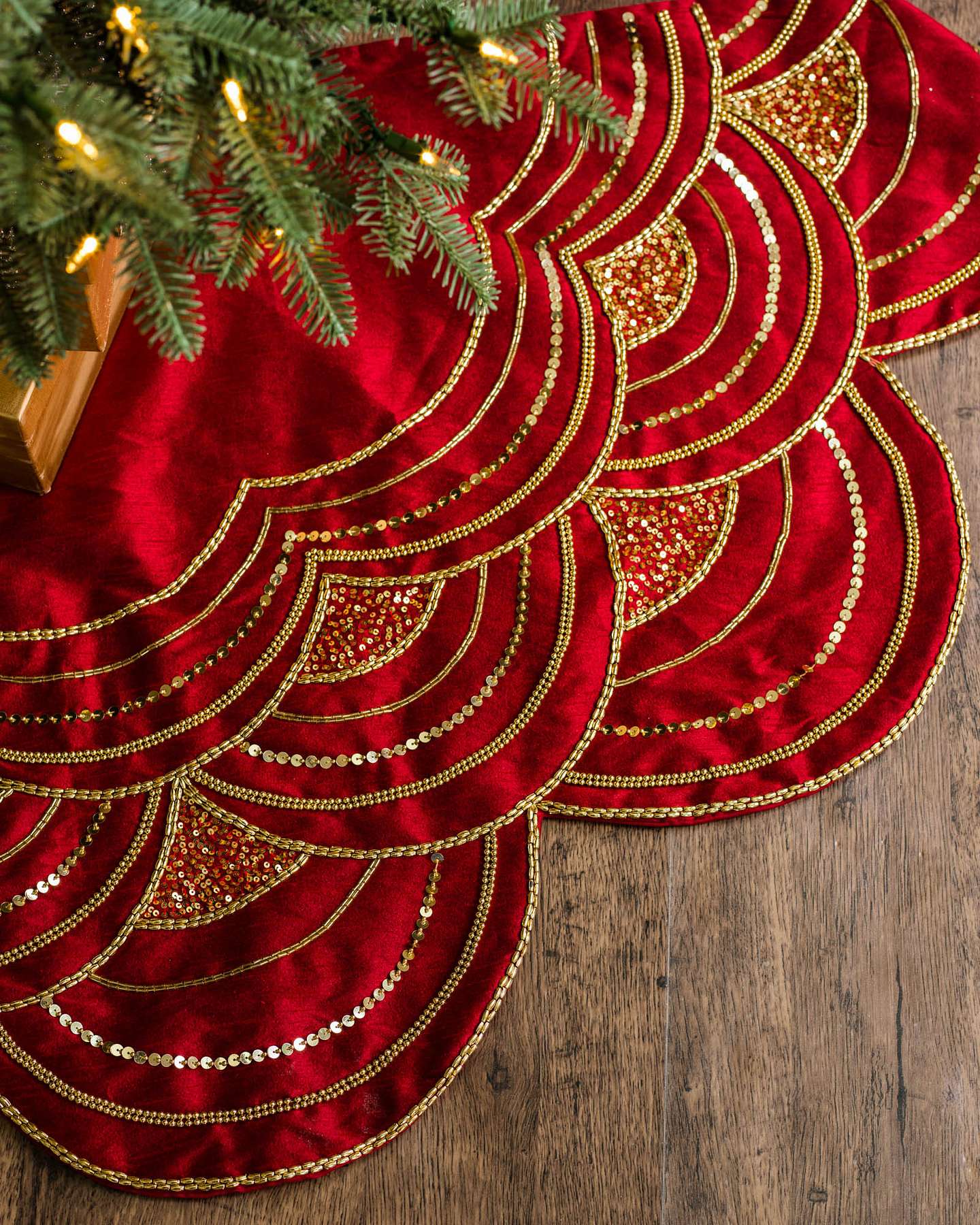
Budget alternative: buy a plain velvet skirt and bead only the front fan — a third of the work, and all of the impact from where people actually stand.
The fan motif is the entire personality of this piece. Velvet alone is elegant but anonymous; the Art Deco arcs give it a period and a point of view, and gold seed beads catch tree lights in a way flat sequins can’t. Notice the sizing hierarchy, too — big sequins filling the fan interior, smaller flat sequins and single beads outlining the shape. That hierarchy is why it reads as jewelry instead of craft-fair glitter.
7. Red and Off-White with Blanket-Stitch Trim
Blanket stitching around a curved hem looks charming and takes forever. If you’re hand-stitching, budget an episode or two of something per side and don’t start this in December. The bigger risk is proportion — red-and-cream at a 50/50 split reads candy-cane fast. Test your layout on the floor and photograph it. Phone photos flatten contrast in a way your eye doesn’t, and you’ll spot where it goes too sweet before you cut a single piece.
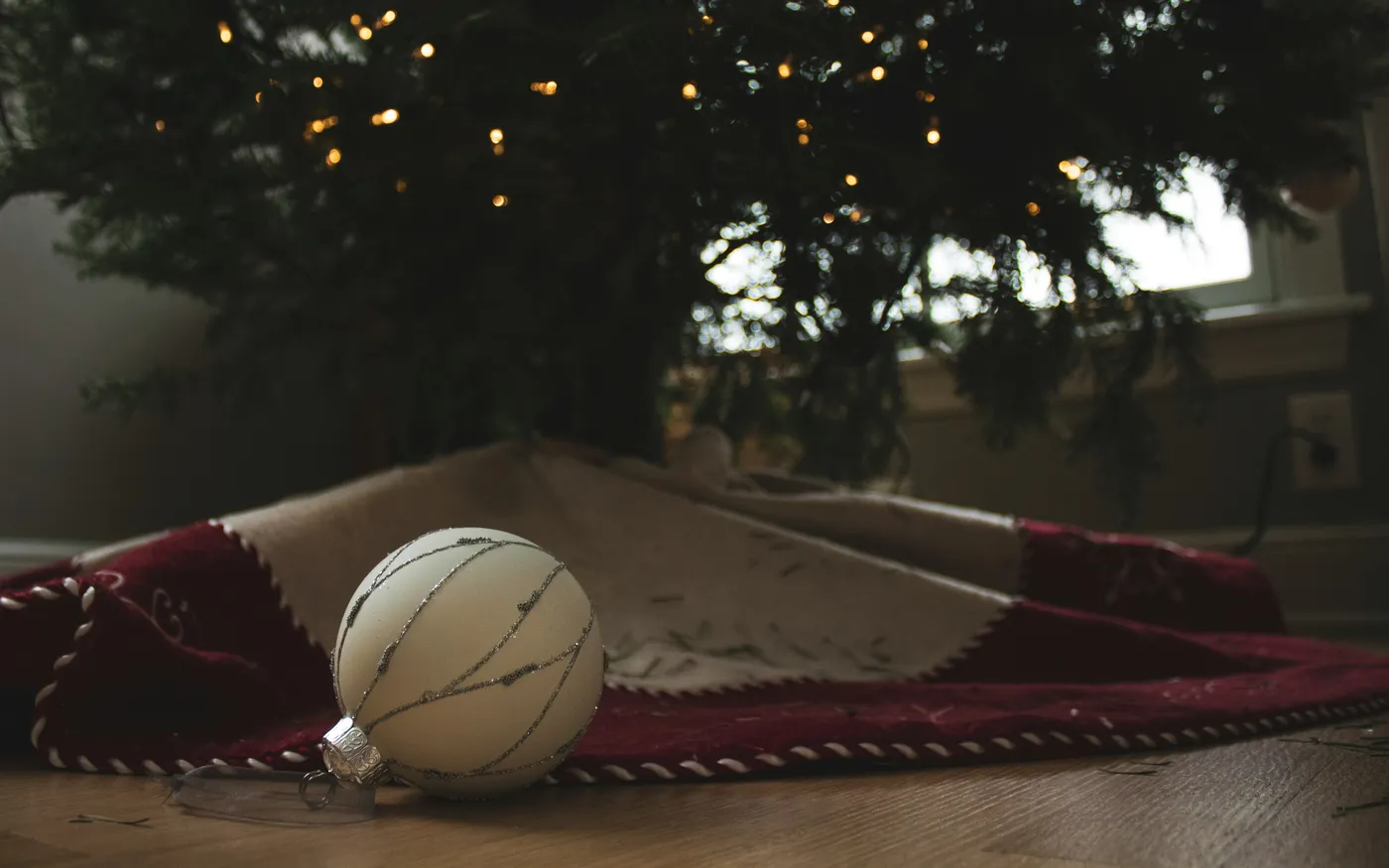
The vibe here is a $12 project wearing a $90 outfit. Start with a flat sheet or a canvas drop cloth from a hardware store, cut a circle, and add white perle cotton blanket stitching around the edge. Appliqué or embroider simple motifs in chain stitch if you want more. Compare with Idea #16 — same homespun spirit, very different construction path. Total spend if you already own a needle: under $25.
8. Conical Red Texture Collar on Herringbone Floors
A collar only works when it’s tall enough to hide the stand and short enough not to swallow the bottom branches. Twelve to fourteen inches is the sweet spot for a seven-foot tree; on a nine-footer, go 16. Diameter matters just as much — it needs to clear the stand’s legs by three inches so you’re not wrestling fabric every time you water. This one suits herringbone and plank floors because the cone gives the tree a proper base. For tighter rooms, see Idea #27.
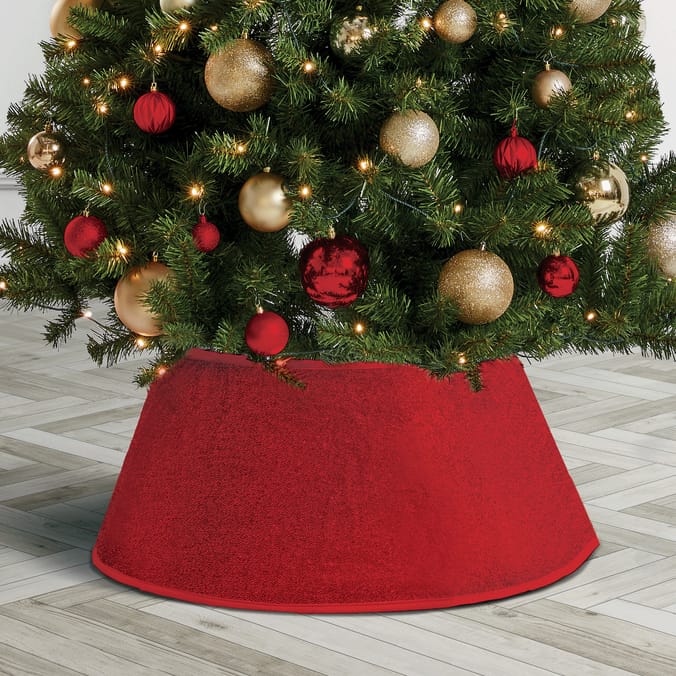
It’s the texture, not the color. A smooth red cone would look like a painted lampshade. This fabric has a soft, almost felted nap that absorbs light, so the collar reads as cloth — cozy, slightly blurred — while the glossy red and glitter gold ornaments above it stay sharp. That contrast between soft and shiny is the whole trick, and it costs nothing to copy. Any matte, nubby fabric gets you 90% of the way there.
9. Fluffy Red Skirt Sprinkled with Sequin Snowflakes
Sequin snowflakes are the rare upgrade you can finish in one evening.
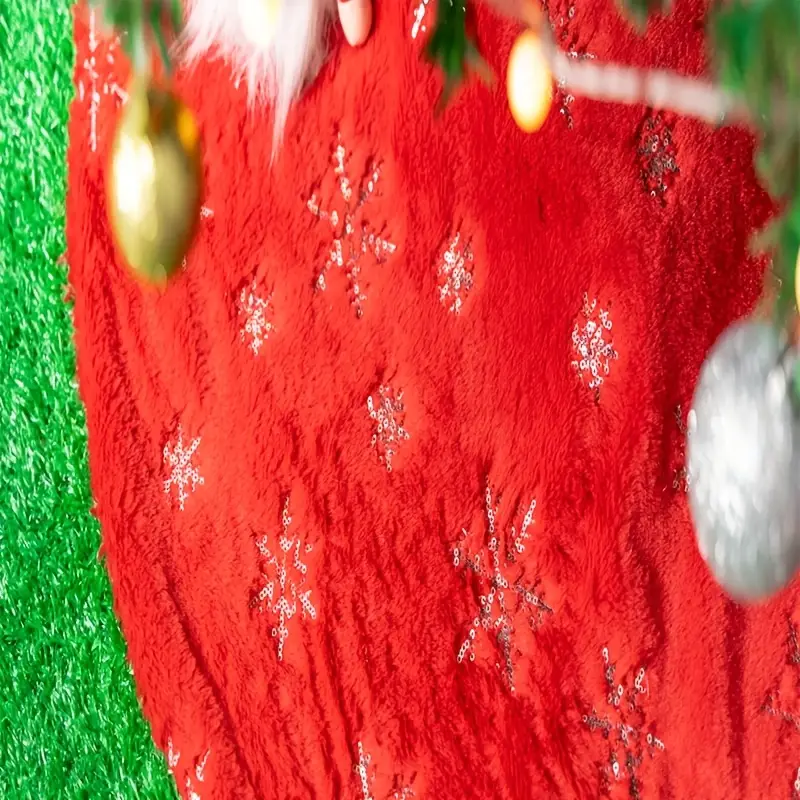
- Cut a simple circle from red fleece or faux fur — no hemming required.
- Lay it flat and chalk a loose, off-center scatter of snowflake positions.
- Pin appliqué snowflakes at varying sizes, keeping the largest near the front edge.
- Hand-tack each one at the center and at four points, not just the middle.
- Vacuum gently with a brush attachment to lift the pile around the appliqués.
About two hours and $20–$35 in supplies.
Sparkle gets a bad reputation because most people spread it evenly. Here the snowflakes cluster and thin out, which mimics how light falls through branches — dense where the tree is heavy, sparse at the edges. It also gives the eye somewhere to travel around the base instead of stopping dead at a symmetrical ring. If you copy this, resist the urge to space them perfectly. Deliberate imperfection is the technique.
10. Dark Rattan Collar Tied with a Green Rope Bow
Think of it as 70% dark brown fiber, 20% forest green, 10% warm light. The rattan is the base note, the green rope bow is the accent that tells you it’s December, and the string lights do the rest. Swap the green rope for plaid ribbon and you’ve got a cabin look; swap it for cream velvet ribbon and the whole thing goes quiet and Scandinavian. The formula holds as long as brown stays dominant — the moment the accent creeps past about 25%, the collar starts competing with the tree.
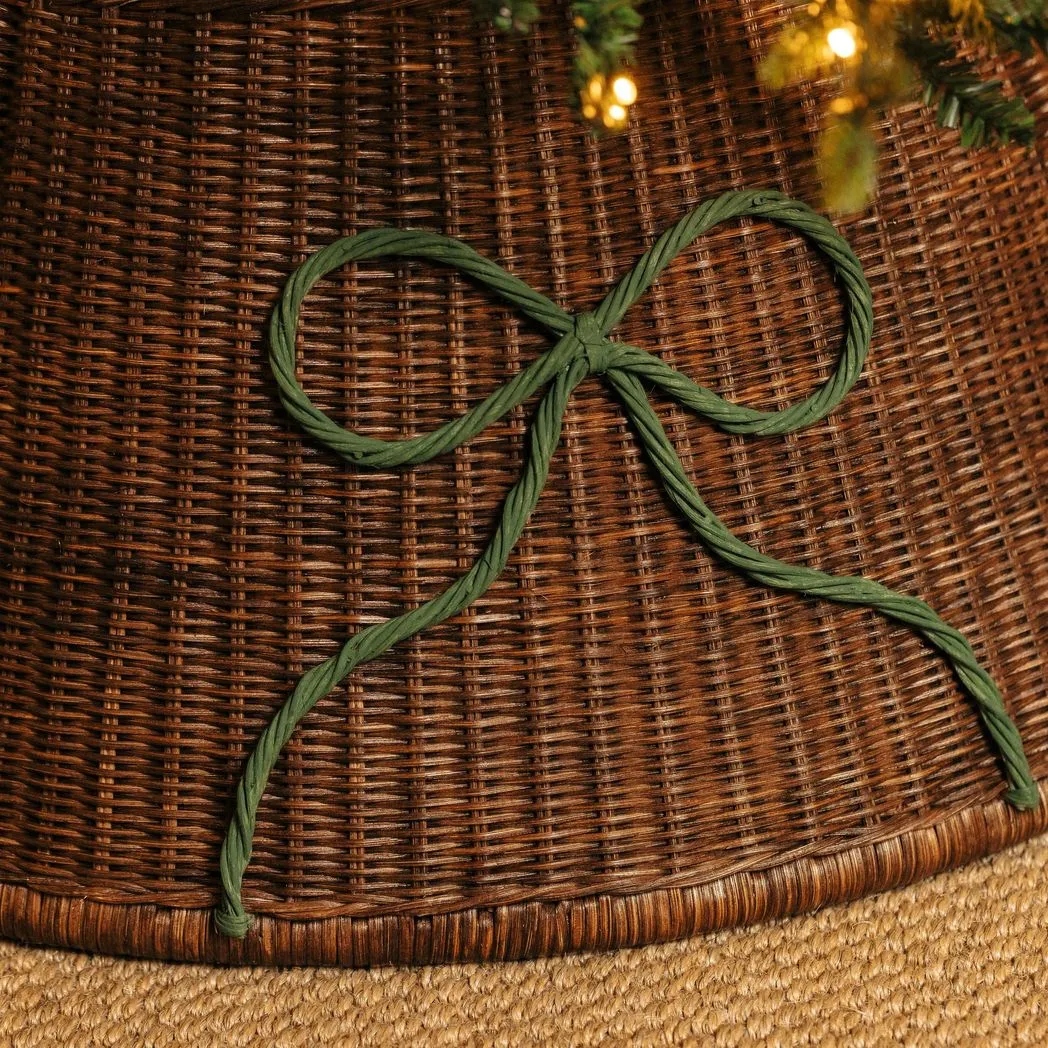
Real rattan collars run $60–$140, which is fair for something hand-woven and sturdy enough to last a decade. The thriftier route: a dark woven laundry hamper with the bottom cut out, or a large discount-store basket turned upside down. Thrift shops and Facebook Marketplace are full of both for $8–$20. Check the rim for splits before you commit, and reinforce the inside with a zip-tied wire ring if it feels floppy.
11. Flocked Tree Settled into a Two-Tone Woven Basket
- Large woven basket, 18–22 inch opening: $30–$85
- Spray paint or fabric dye for the base band: $8–$15
- Flocked tree, if buying new: $120–$400
- Cream shag rug: $40–$120
- Warm white string lights: $15–$40
- Total: $213–$660
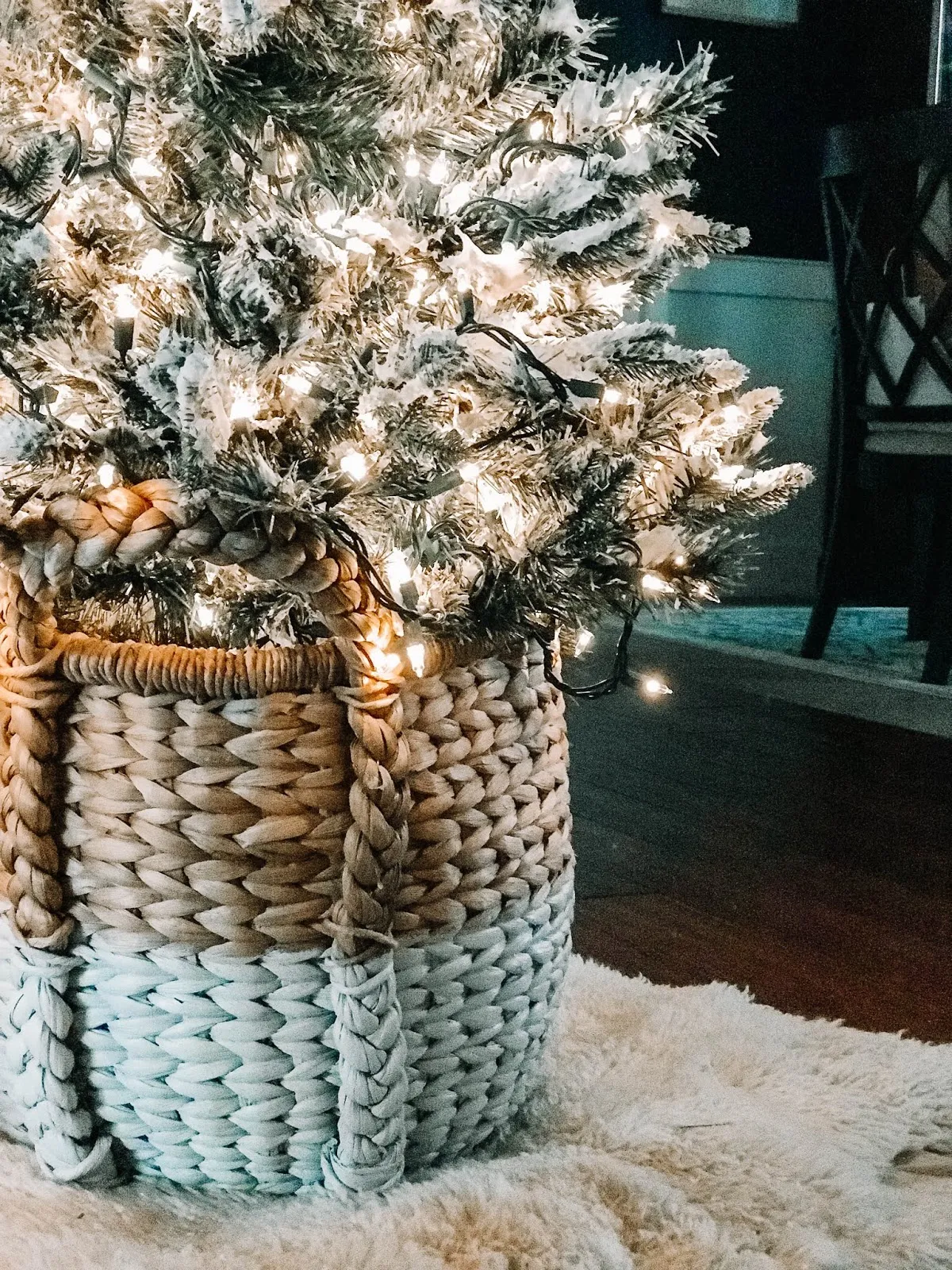
Budget alternative: paint the bottom third of any thrifted basket in soft blue and skip the flocking entirely — a plain green tree in that basket still reads wintery.
Two-tone baskets work because the color band sits at standing eye level, not at floor level. Keep your paint line at roughly the bottom third and use a matte finish so it doesn’t fight the tree lights. Also line the inside with a cheap plastic saucer or a cut-down bin lid. Woven baskets wick moisture, and if you’re using a real tree you want a barrier between that reservoir and all that fiber.
12. Sculptural Silver Stand with Root-Like Legs
Open, furniture-grade tree stands are the quiet 2026 flex. As people move toward smaller trees and less stuff, the base becomes the statement — a piece of metalwork you’d genuinely leave out in January. Small metal shops and independent makers have picked up on it, and the look fits the broader shift toward visible craft: no more hiding the mechanics behind twenty yards of fabric. This is a trend I’d bet on lasting, because it solves a real problem instead of manufacturing one.
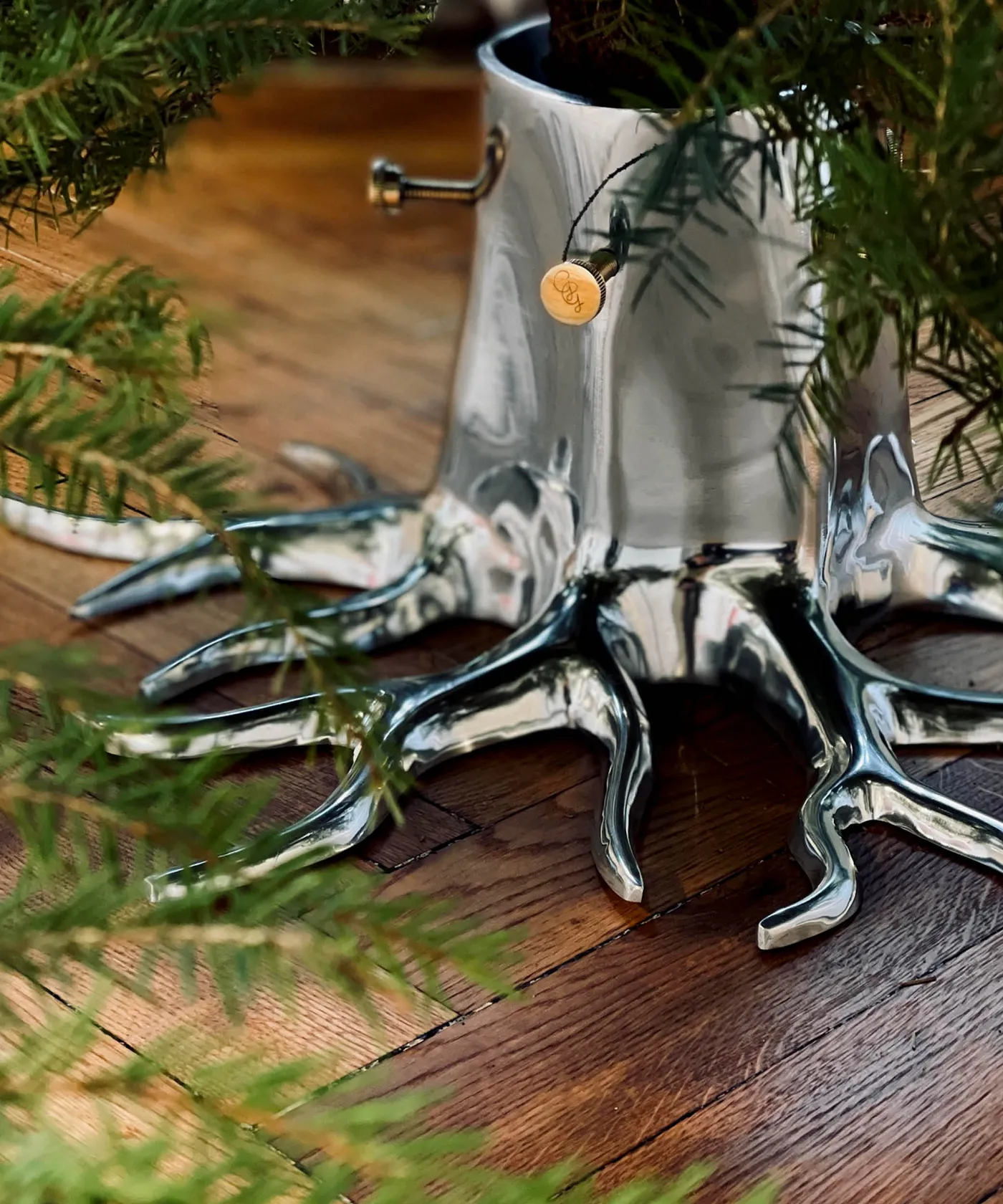
The legs. Root-like, branching, slightly irregular — they’re the reason this reads as sculpture instead of plumbing. A standard three-prong stand in the same polished silver would look like hardware. What makes it work is that the legs echo the branching above them, so the tree and its base feel like a single object rather than a thing sitting in a thing. That one decision is worth more than any ornament collection.
13. Ribbed Beige Knit on a Dark Patterned Rug
Vertical ribbing is a slimming trick. A wide, cable-heavy knit can make a base look bulky, while ribs pull the eye upward toward the branches. If you’re making one, work the ribs so they radiate from the center opening rather than running horizontally around the circle — a small construction choice that decides whether the finished skirt looks tailored or like a deflated tire. And match yarn weight to tree: a four-foot tabletop tree can’t carry a jumbo knit.
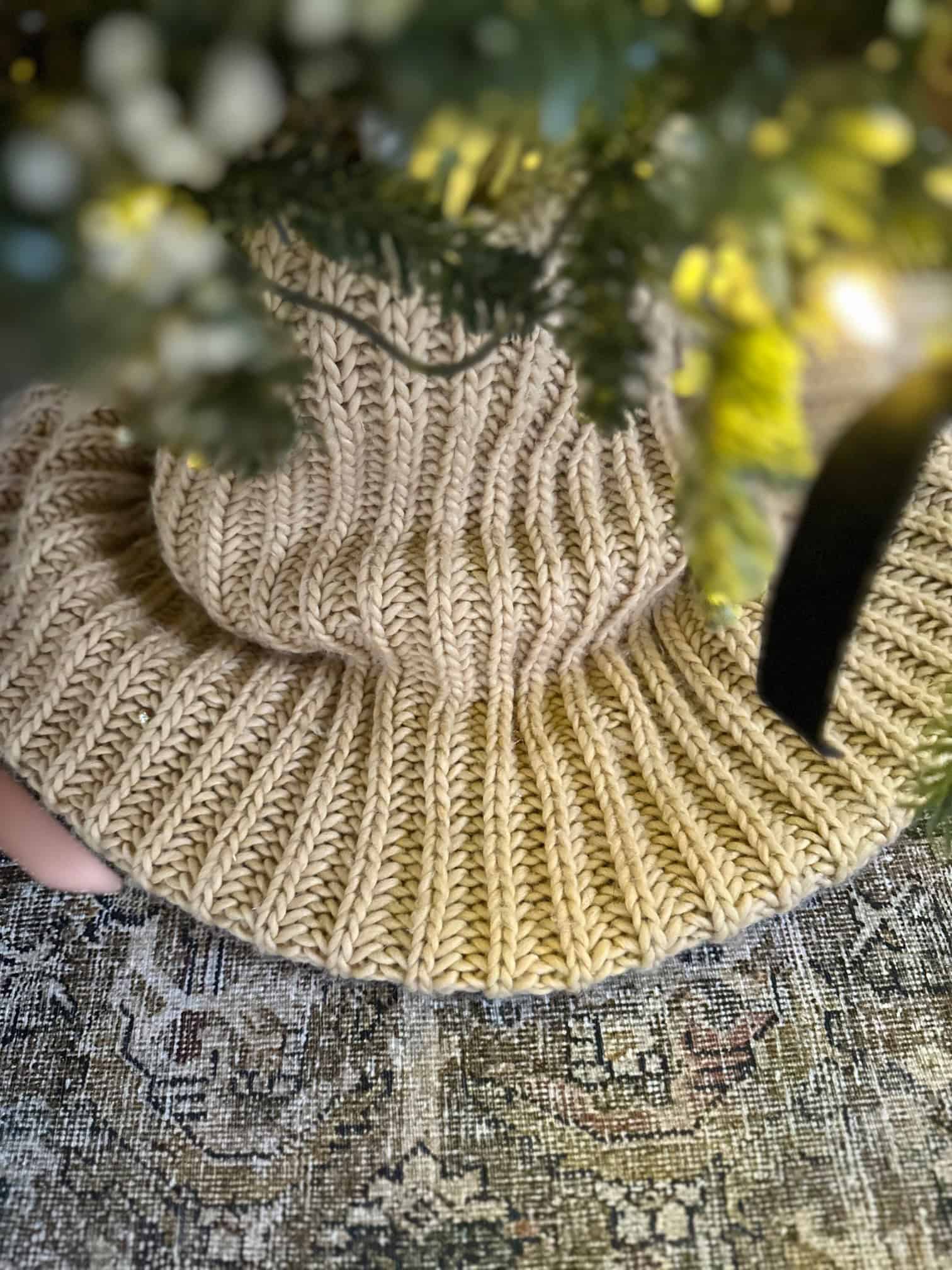
Beige knit on a dark patterned rug is a beautiful pairing with one very real downside: every pine needle shows. So does sap, and so does the occasional cocoa spill. Wool washes but felts if you’re careless; acrylic survives the machine but pills. The honest move is to spot-clean and accept that a knit skirt in a family room will look lived-in by New Year’s. If that bothers you, go darker — or save the light knit for a low-traffic room.
14. Real Tree in a Woven Wicker Basket with Jingle Bells
The basket earns its place because it does two jobs: it hides the reservoir and it warms up a very green tree. Then the ornaments do something smart — glossy red, matte white, and glitter silver in roughly equal measure. Three finishes, three textures, no visual monotony. The jingle bell garland on the white wall carries the palette past the tree itself, so the whole corner reads as decorated instead of just the tree. That’s the difference between decorating and styling.
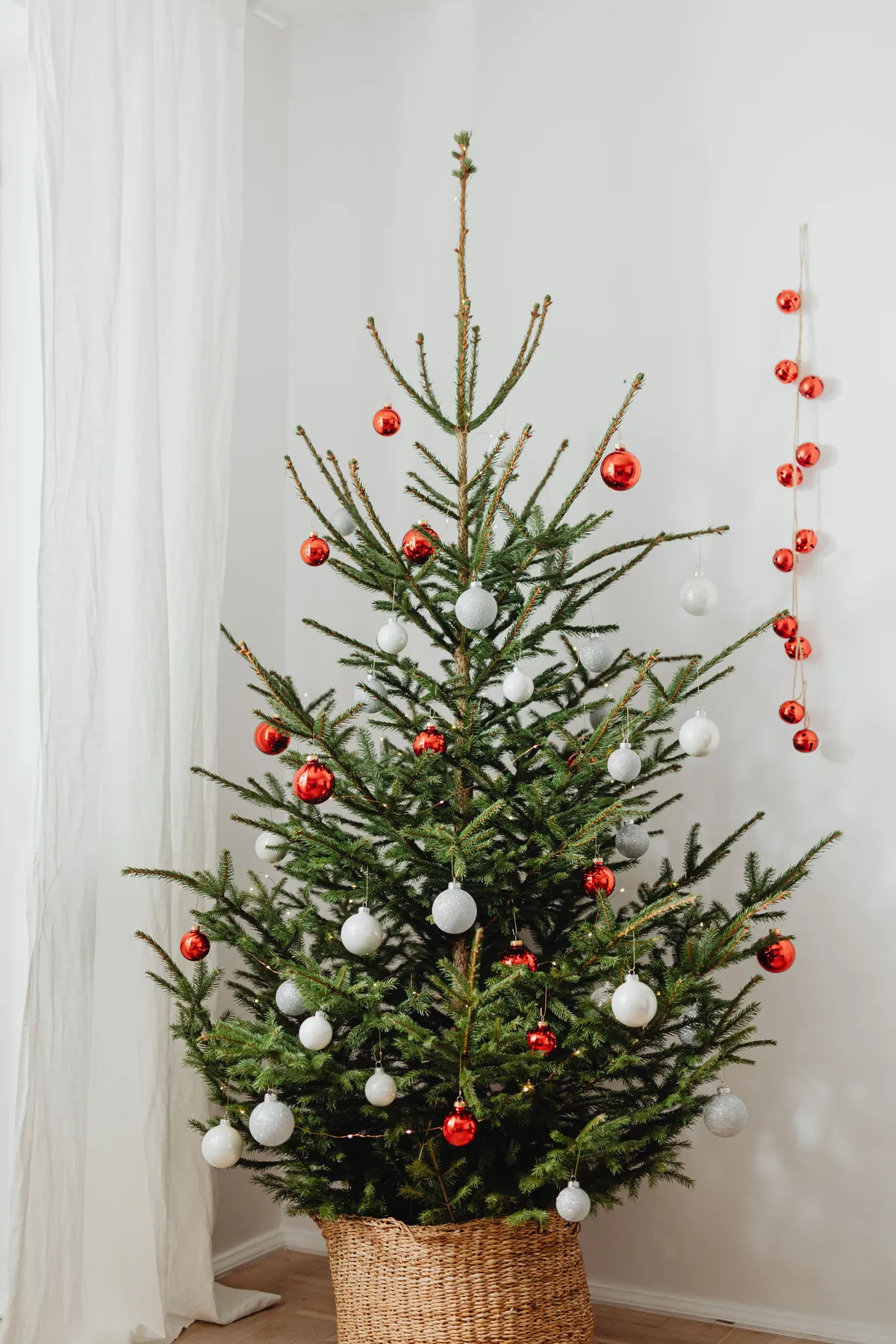
A woven basket from a thrift store runs $6–$15 and does exactly what a $120 tree collar does. Look for a wide, flat bottom and handles you can tuck inside. Line it with a heavy plastic bag or a cheap boot tray so water doesn’t wreck the weave. Ornaments are where people overspend — buy one good mixed set and fill the gaps with ribbon and inexpensive bells. See Idea #20 for the same basket logic in a darker finish.
15. Woven Dried Fiber Collar in Earthy Neutrals
Natural fiber is lovely and slightly high-strung. It collects dust deep in the weave, so plan on a monthly vacuum with a brush attachment plus a soft paintbrush for the tight spots. Dry indoor heat makes it brittle over a few seasons; a light mist of water once a month keeps the fibers from cracking. Keep it well away from the tree’s water source, and never store it in a damp basement — mildew in a woven collar is basically unremovable.
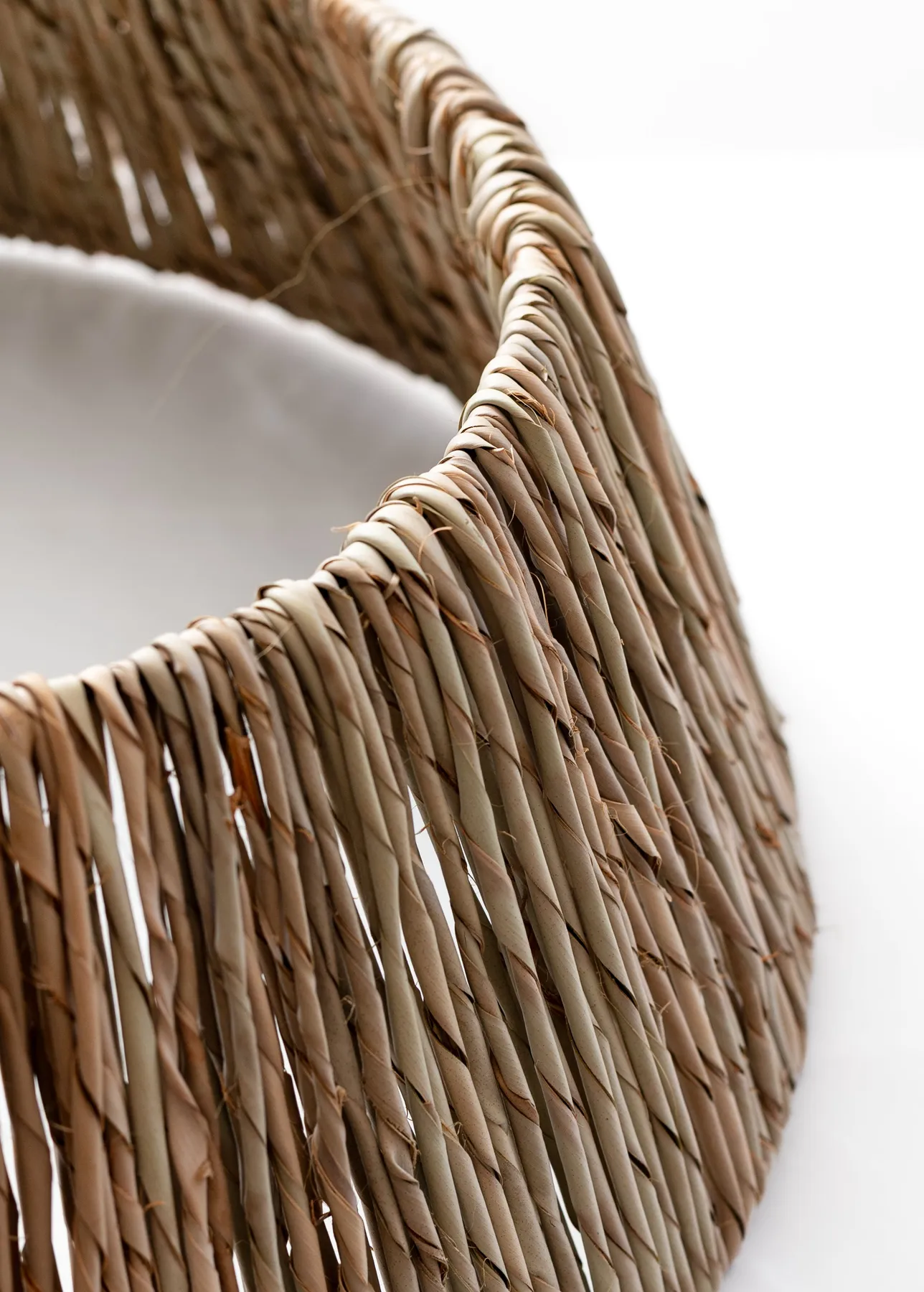
A cylinder this dense works best on trees from six to eight feet. Below that, the proportions start to look like a bucket. The opening should measure 20 to 24 inches across for a standard stand, and the height should land just under the lowest branches — around 10 to 12 inches. If your tree is taller than eight feet, scale the whole thing up rather than letting it disappear. On a light floor, the beige-on-beige effect is the point here.
16. Star-Block Quilted Skirt with a Holly Ruffle
The star block is easier than it looks once you stop chasing perfection.
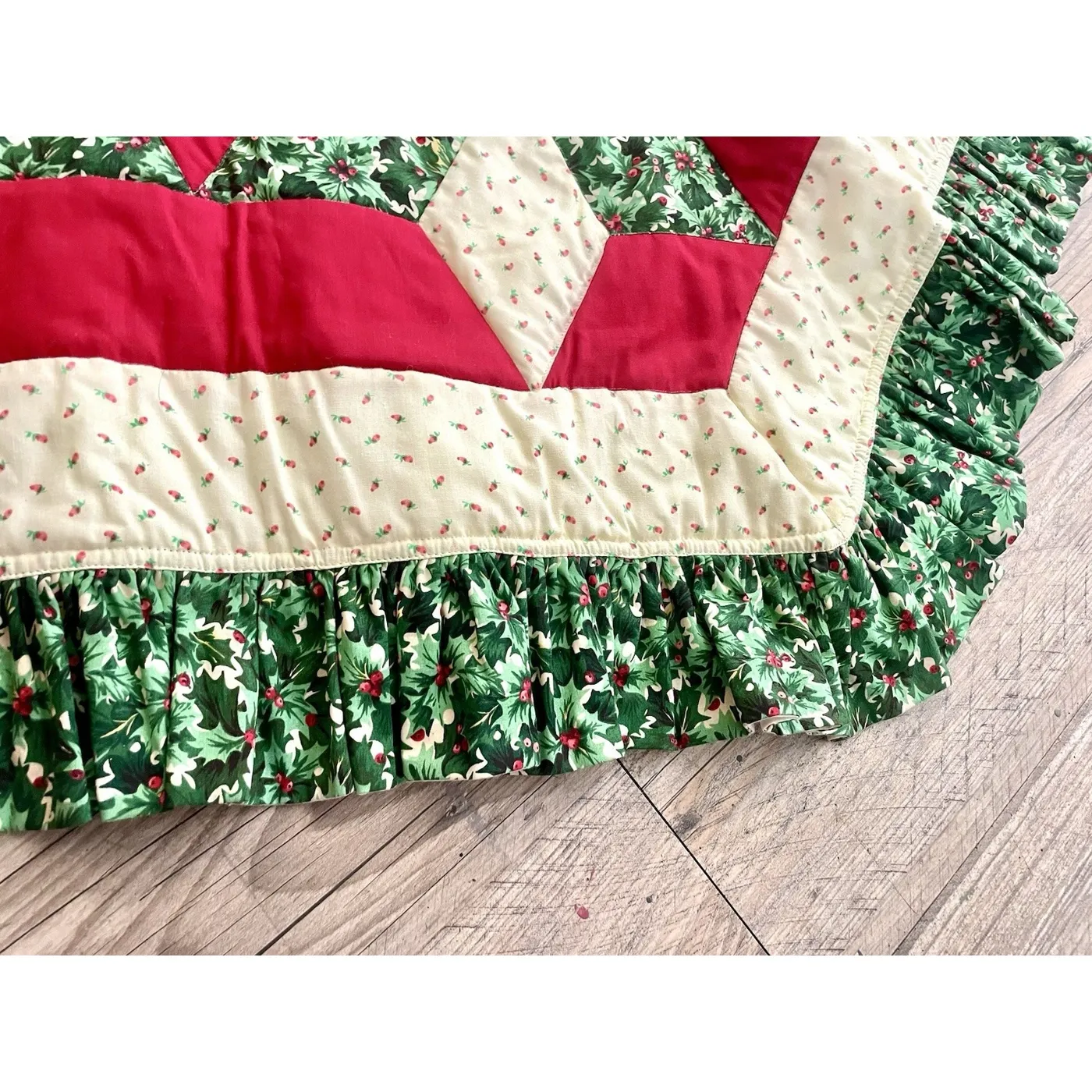
- Cut one center square and four corner squares in solid red.
- Add cream-with-red-dot and green holly rectangles around the center.
- Assemble four identical blocks, then join them into a circle.
- Quilt simple diagonal lines across each block to hold the batting.
- Gather a wide holly-print strip into a ruffle and attach it along the outer edge.
About six hours and $45–$70 in fabric, less if you’re working from scraps.
The formula here is 40% solid red, 30% cream-with-dot, 25% green holly, 5% surprise. That last bit matters — one fabric that doesn’t quite match the others is what keeps a traditional palette from turning into a catalog page. Swap the holly for a small black-and-cream check and you get a modern farmhouse version. Swap the dots for plaid and it goes full cabin. The proportions stay identical.
17. Cream Crochet with Bobbles and Raised Cables
- Measure your tree’s branch spread, then add 10–12 inches for the finished diameter.
- Confirm yarn weight — DK or worsted in cream shows stitch definition better than bulky.
- Swatch the bobble stitch and check gauge before committing to a full circle.
- Decide on the closure: a slit with ties beats wrestling a closed ring around the trunk.
- Budget $35–$60 in yarn and 10–15 hours of crochet time.
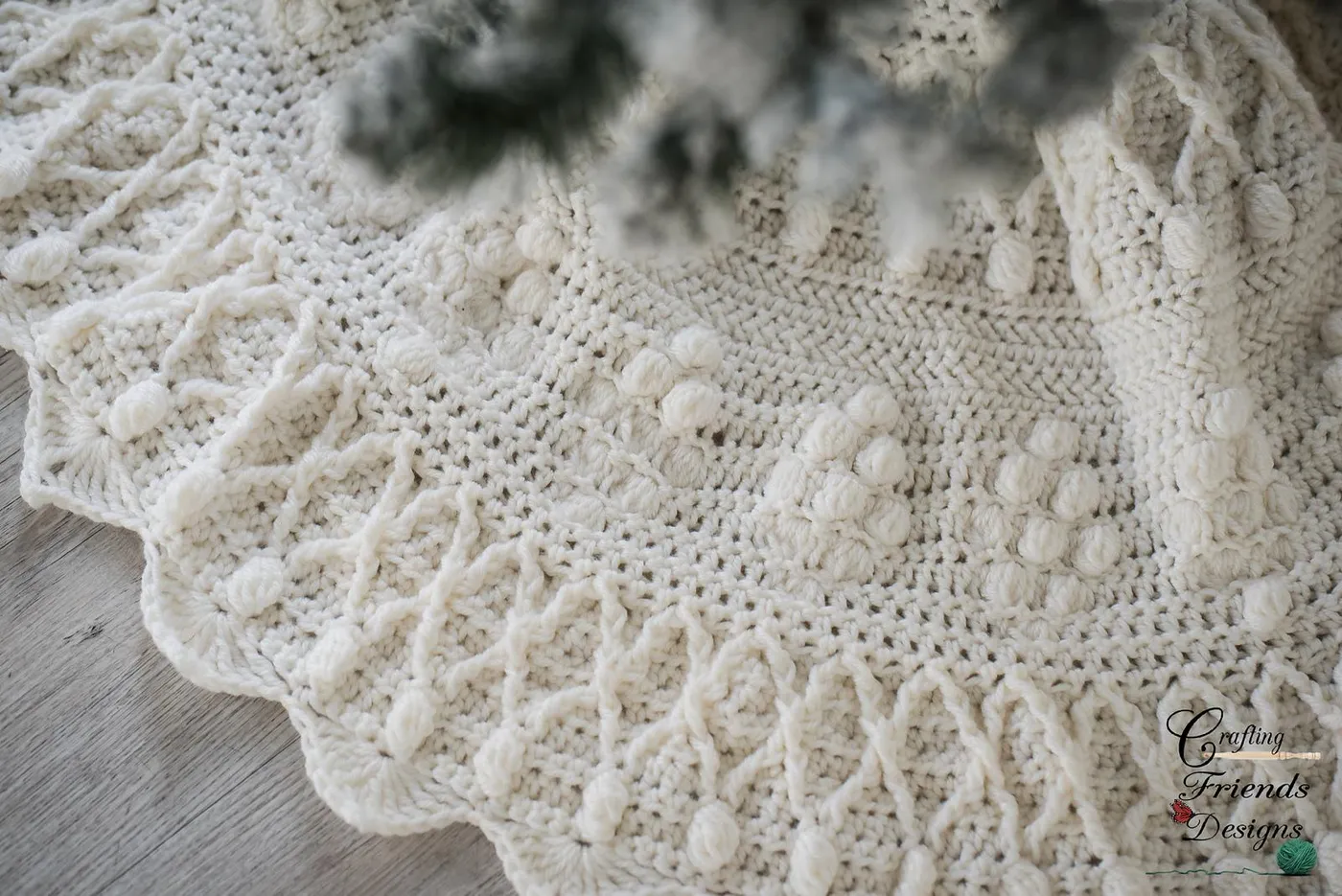
Bobbles eat yarn, and cream yarn shows every flaw. Work the bobble rows at least three rows apart so the texture reads as deliberate pattern instead of lumps, and crochet the final row at a slightly tighter tension so the scalloped edge curls under rather than flipping up. One more: join your rounds with a standing stitch instead of a chain-three. On a cream skirt, that invisible join is the difference between handmade and homemade.
18. Gold-on-Gold Tree with a Metallic Drum Skirt
Eighty percent gold, 20% green — that’s the whole recipe. The tree’s own needles supply the only cool note, which is exactly why the gold never tips into gaudy. Inside that 80%, vary the finish: matte ornaments, hammered ornaments, high-shine ornaments, and one piece of mercury glass. Want to swap it up? Keep the proportions and change the metal. All-silver on green is the same formula with a colder mood; copper on green lands somewhere warm and vintage.
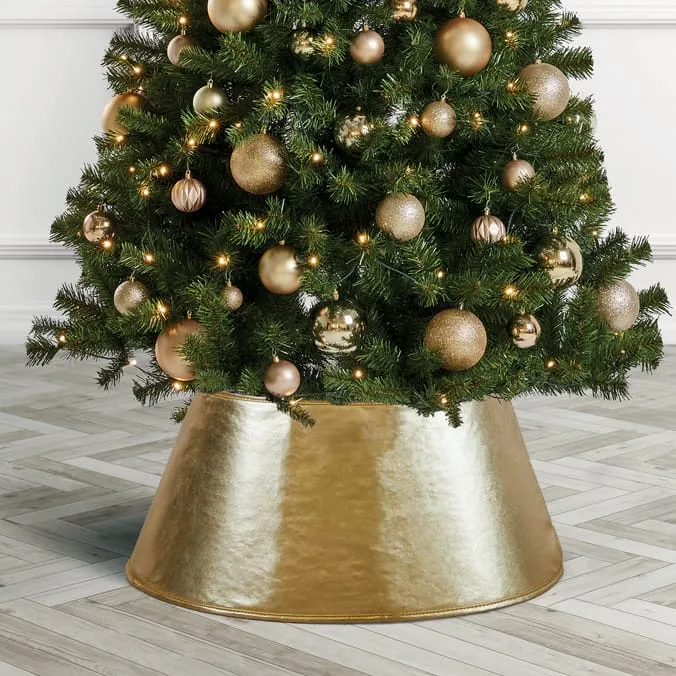
Metallic drum skirts are gorgeous and unforgiving. Every fingerprint, scuff, and pine needle shows against a polished surface. They dent, too — a sturdy inner ring is not optional, and neither is storing it somewhere it won’t get crushed. The upside: they wipe clean, which is more than you can say for velvet. Just don’t put one on a floor you’re about to refinish; the reflection picks up every scratch underneath it.
19. Emerald Velvet Embroidered with Gold Celtic Knots
- Emerald velvet skirt: $55–$160
- Gold metallic embroidery thread and stabilizer: $12–$25
- Embroidery hoop and needles: $10–$20
- Wide red satin ribbon for gifts: $10–$20
- Total: $87–$225
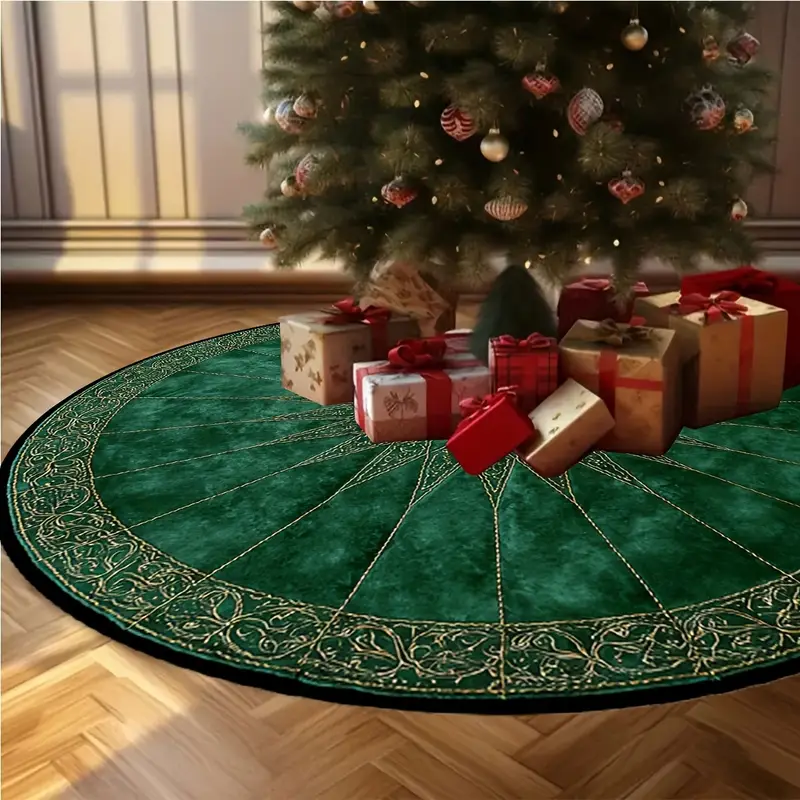
Budget alternative: buy a plain emerald skirt and add one continuous gold running stitch two inches from the hem. An hour of work, and it reads as hand-finished from standing height.
Green-on-green is the sophisticated move here — the tree and the skirt sit at nearly the same hue, so the velvet reads as shadow rather than as another object in the room. Then the gold embroidery gives your eye a boundary. Without a metallic edge, the whole base would blur into one soft mass. The red ribbons finish it by supplying the only warm color in the composition, which is why the base feels celebratory instead of moody.
20. Dark Geometric Weave Collar with Red and Gold
This flared basket silhouette suits a wide, full tree — the kind whose branches push out 30 inches or more. On a seven-and-a-half-foot tree with a 50-inch spread, a collar that runs 16 inches across at the top and 22 at the base balances it nicely. Under eight-foot ceilings, that ratio keeps the tree from looking top-heavy. Narrow rooms do better with a slimmer cylindrical version; a collar that flares this much needs a little breathing room around it.
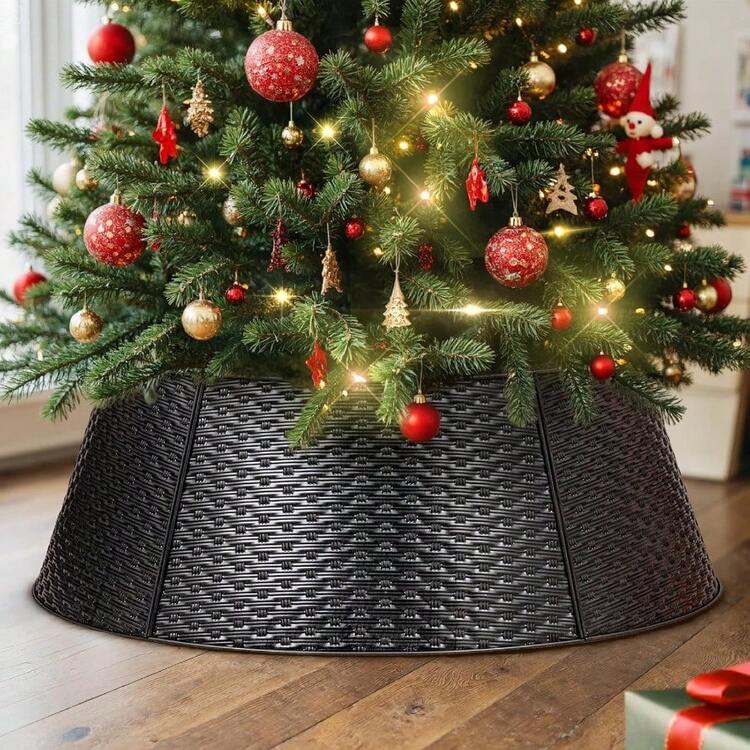
Basket-weave collars in this shape sell for $80 and up. Two cheaper routes: a large dark hamper or wastebasket with the bottom removed, or a plastic cone wrapped in a thrifted woven runner and hot-glued into place. Both land under $25. If you’re buying new, check the top rim — a thick rolled rim hides the stand better than a thin one and won’t dig into your floors.
21. Red Star-Leg Stand on a Braided Natural Fiber Rug
The round braided rug doing the work of a skirt. No stitches, no hem, nothing to store — just a $25 floor covering that happens to be exactly the diameter a tree base needs. It’s the most honest solution on this list and the one most people walk right past because it doesn’t look like a “tree skirt” on a shelf. Bright red star-shaped legs peeking out underneath it is the whole charm, and it takes about four seconds to install.
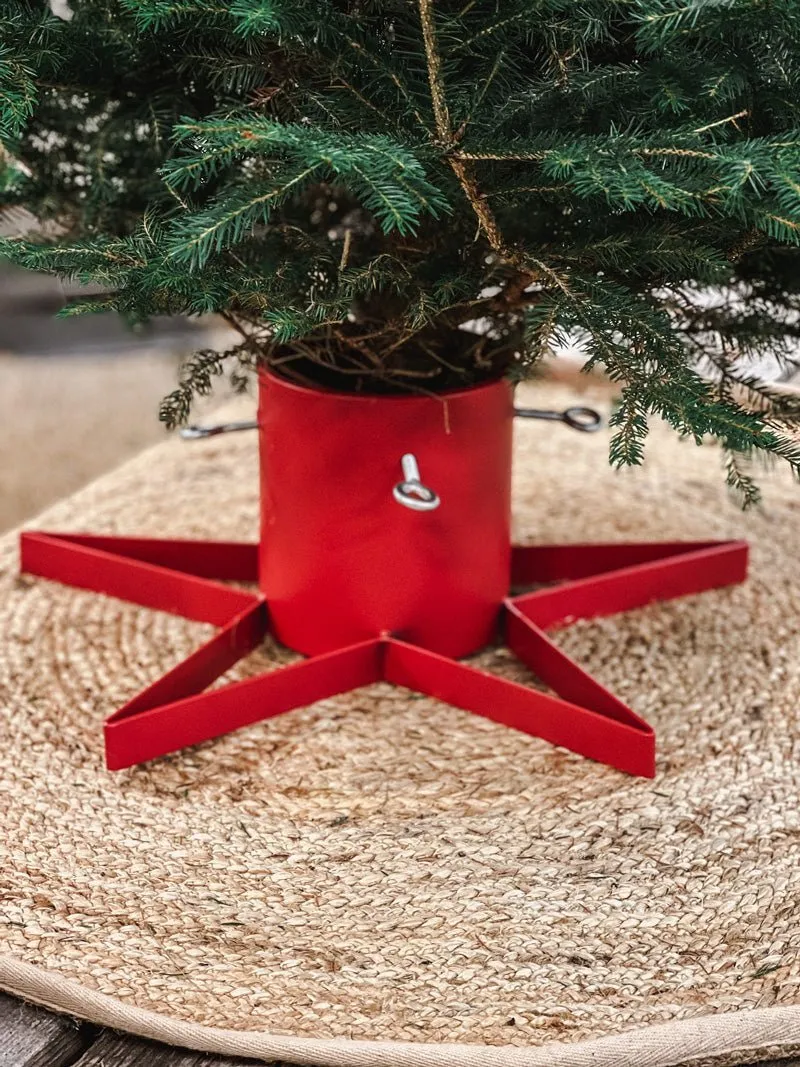
- Confirm the stand is stable on a rug — braided jute can shift; add a rubber pad underneath.
- Measure the rug: 36 inches across suits most seven-foot trees.
- Check that it sits fully on top of your hard floor, not half on carpet.
- Water the tree over a tray, not over the rug, or rotate the rug weekly.
22. Coiled Rope Skirt Twisted and Glued by Hand
This one costs almost nothing if you buy rope by the spool.
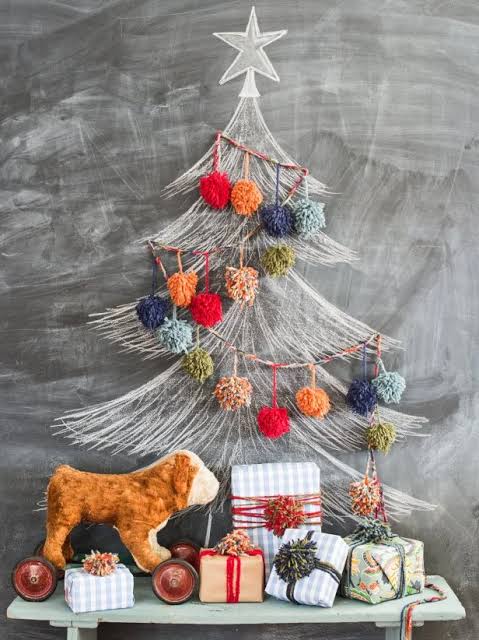
- Buy 100 feet of ½-inch cotton or sisal rope — roughly $20–$30.
- Coil tightly on a cardboard circle, gluing each loop to the last with hot glue.
- Work in 4-inch concentric rings so the glue has time to set.
- Leave a central opening about 4 inches wide, then seal the cut end under the final loop.
- Flip it over and press flat under a stack of books overnight.
Three hours, one burn risk, and a skirt nobody else owns.
- 100 ft cotton or sisal rope: $20–$35
- Hot glue sticks, big pack: $8–$15
- Cardboard or foam ring for the base: $0–$8
- Non-slip pad underneath: $6–$12
- Total: $34–$70
Compare with Idea #29, where the same rope idea gets a white painted finish.
23. Matte Gold Ornaments, Red Bows, Woven Collar
It’s restrained maximalism. There’s a lot happening — gold balls, patterned ribbon bows, leafy picks — but every element sits inside a two-color system, so nothing fights for attention. Notice the matte gold carrying most of the volume while the bows handle pattern. If all those ornaments had been glossy, the tree would have tipped sparkly-and-cheap. Matte finishes absorb light, and that’s precisely what makes a gold-heavy tree look expensive instead of loud.
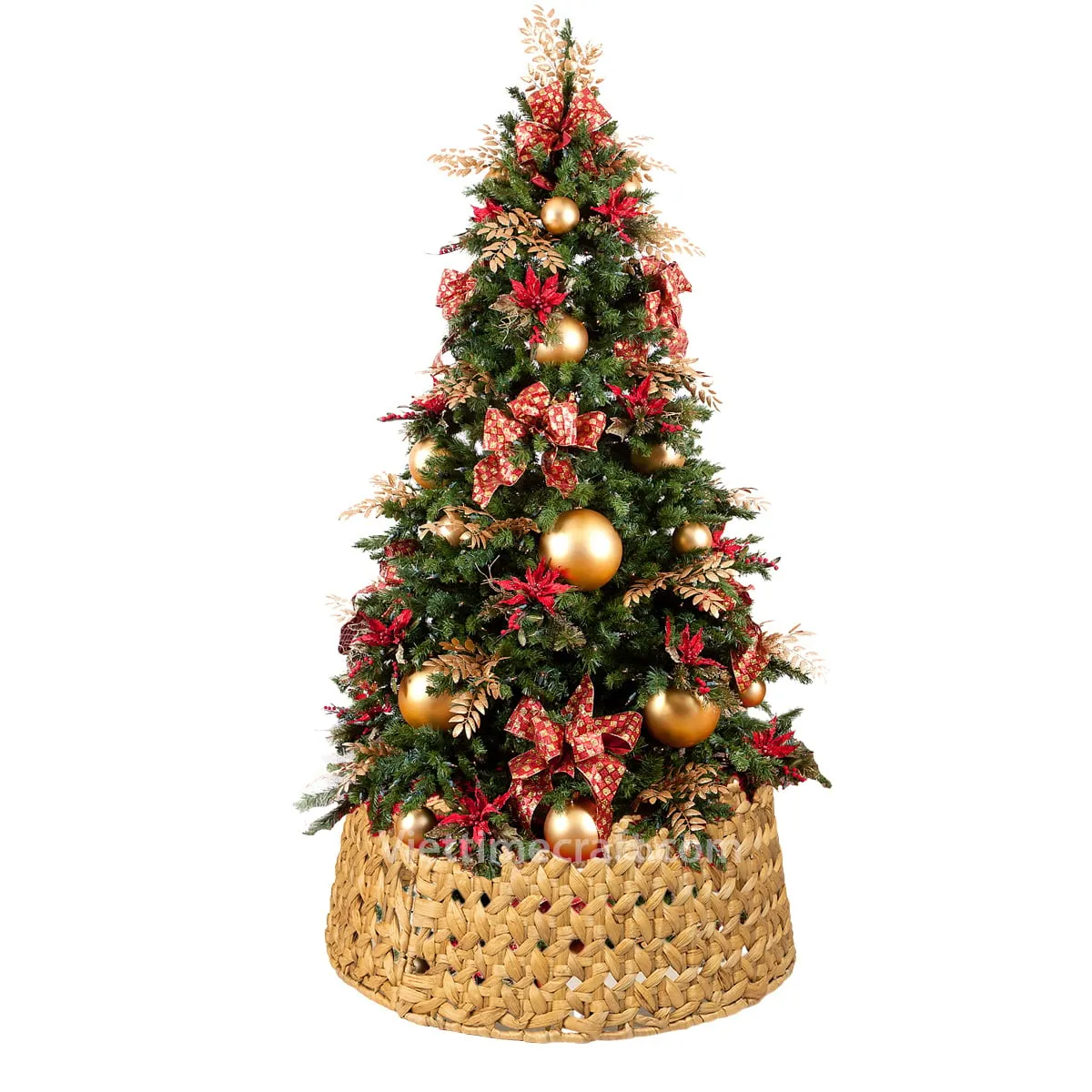
This density of decoration needs space to breathe. It works in a room with nine-foot ceilings and at least 18 inches of clearance on all sides. In a lower, tighter room, cut the bow count in half and let one large ornament style dominate. The light brown woven collar is a smart pairing too — it stays quiet under all that gold instead of competing with it. Small rooms should go with a lower-profile base and fewer picks.
24. A Red Storage Bin Reinvented as a Santa Suit
The fastest base on this entire list, and I mean that sincerely.
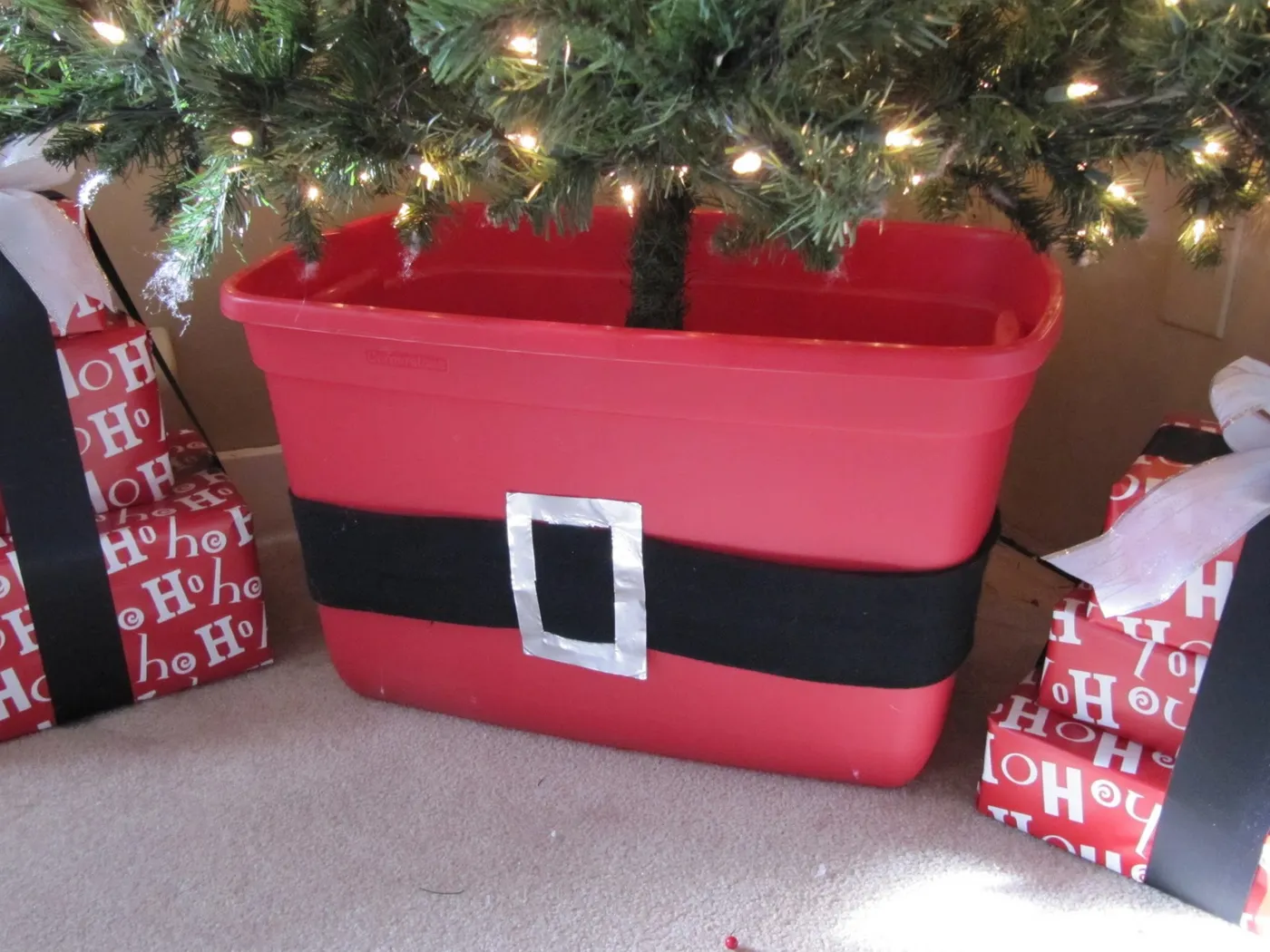
- Wipe down a red plastic storage bin and flip it so the open side faces the floor.
- Cut the bottom out with a utility knife, leaving a 1-inch lip — that’s where the trunk goes.
- Wrap a strip of black fabric around the middle for a belt and hot-glue the ends at the back.
- Cut a buckle from silver foil board and glue it over the belt seam.
- Add white fleece trim if you want it to read more Santa coat and less storage.
Forty minutes and about $12 if the bin is already in the garage.
A plastic bin is not load-bearing, and it’s not fire-retardant beyond what the label says. Keep the tree’s weight on its actual stand and treat the bin as a cover only — never let it carry the tree. Hot glue on thin plastic can warp in a warm room, so use tape or a pressure-fitted strap instead. And check for sharp edges after cutting; plastic shavings underfoot are nobody’s holiday.
25. Off-White Knit with Red Stitching and Ties
The red trim is doing more than decorating — it’s outlining the shape. On an off-white skirt in a room with a pale floor, the boundary simply disappears without it. Run your stitching line ¼ inch in from the edge, all the way around the outer circle, the center opening, and both sides of the slit. Then add ties: two 12-inch red fabric strips at the closure. That one detail turns a flat circle into something that looks intentionally tailored.
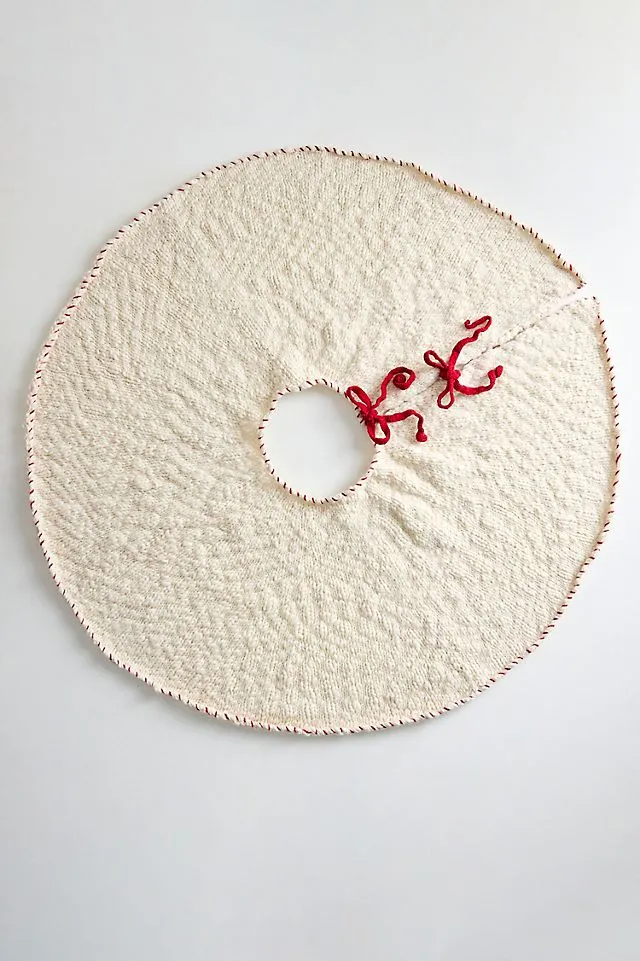
The slit and its ties. A closed ring is technically easier to make, but it forces you to lift the tree — which nobody is doing in a living room on a Sunday. The moment you cut a radius and add two red ties, the skirt becomes practical, and the closure becomes a design feature instead of a compromise. If you take nothing else from this piece, take this: build the opening into the plan from day one.
26. Burlap Collar Under a Tree Full of Gold
Burlap is the great equalizer. A yard runs $6–$10, and a conical collar takes about a yard and a half. You don’t need to sew — fold, glue, and clip, then trim the bottom edge so it sits flush on the floor. Compare with Idea #27, which is the same shape in woven fiber at roughly four times the price. Run a strip of light brown binding tape along the top rim to keep the burlap from shedding onto your floor.
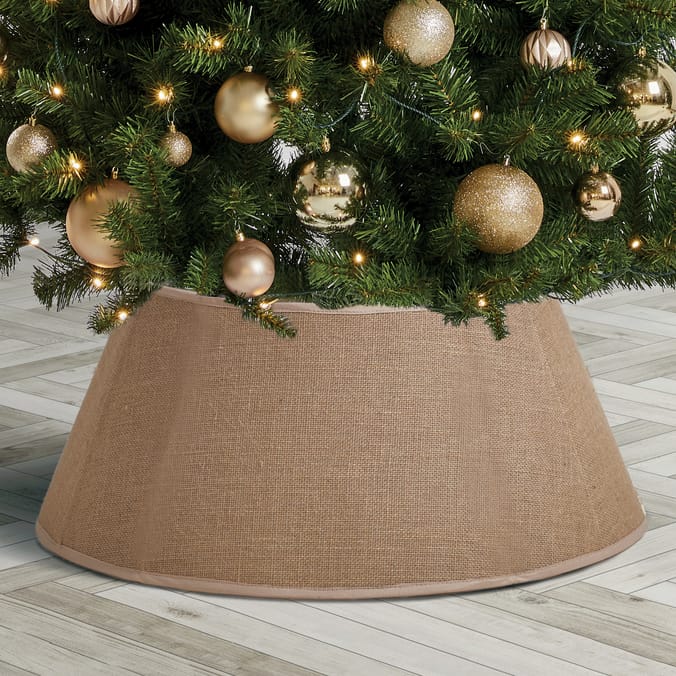
Burlap sheds. It will keep shedding for the first two seasons, and no amount of shaking it out in the garage solves that permanently. It also has a distinct smell when new — air it out for a week before it comes into the living room. The upside: it’s the rare material that looks better slightly rumpled, and stains read as texture. Vacuum monthly, and never machine wash it.
27. Woven Fiber Collar Doubling as Gift Storage
Fill the collar and you’re using floor space for storage instead of just covering a stand — a genuine advantage under a six-foot tree in a small living room. Aim for a collar 14 to 16 inches tall so the gifts sit below the lowest branches, and keep the footprint inside 24 inches across. Any wider and the tree starts to look like it’s been planted in a planter. Pair it with a round fringed rug, as here, and the entire base becomes one intentional zone.
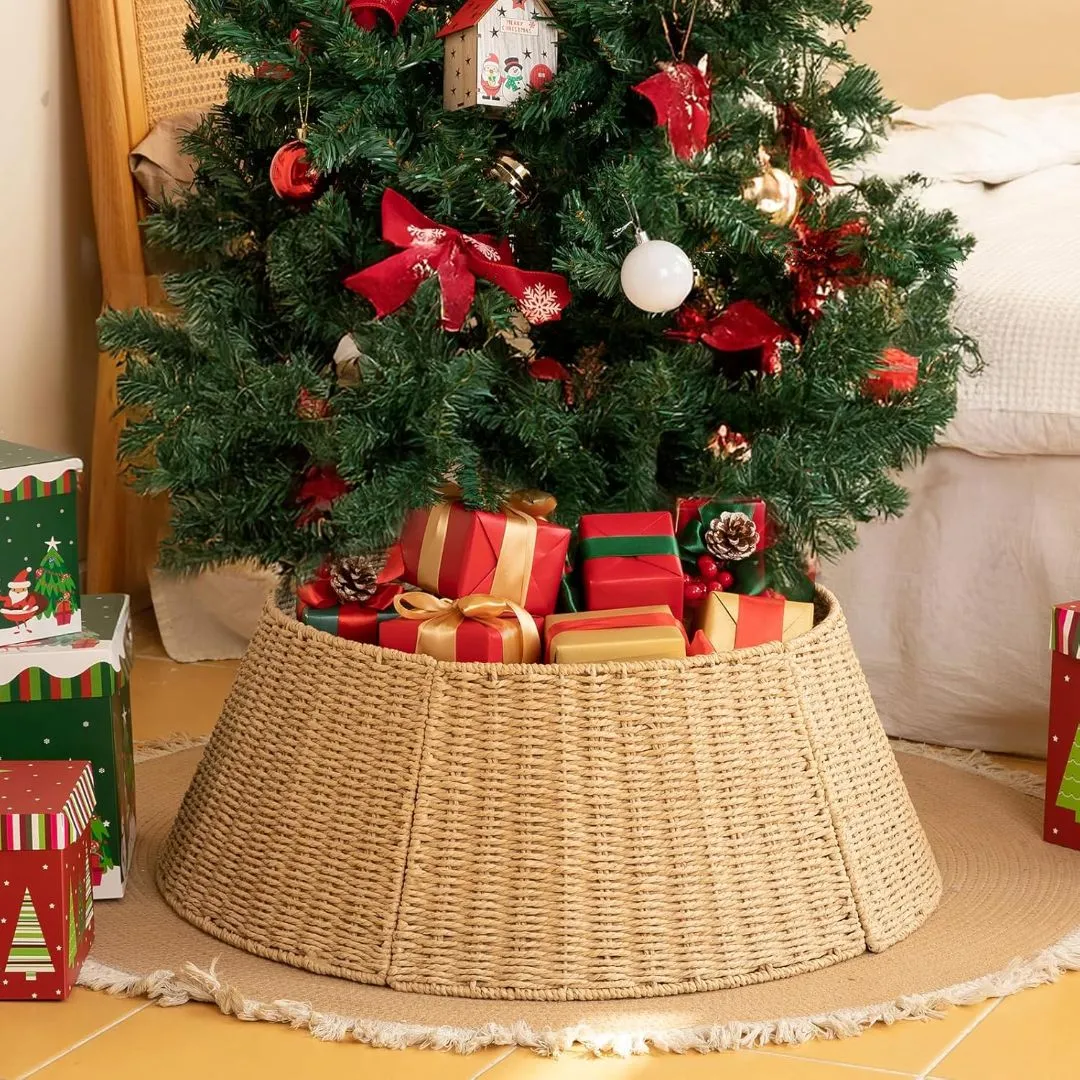
Call it 50% natural fiber, 30% red, 15% green, 5% gold. The fiber dominates, which is why the red and green read as holiday instead of as a color clash. Swap the gold for silver and the mood goes cold and crisp; swap red for burgundy and it turns vintage. Keep natural fiber at half or more and the formula survives almost any color change you throw at it.
28. The Case for Skipping the Skirt Entirely
- Look at what’s already under the tree — a good stand, a nice rug, or nothing at all.
- Check the tree’s stability; if it wobbles, fix that before worrying about fabric.
- Measure the visible gap between the lowest branches and the floor.
- Decide whether you need to hide a reservoir or just feel like you should.
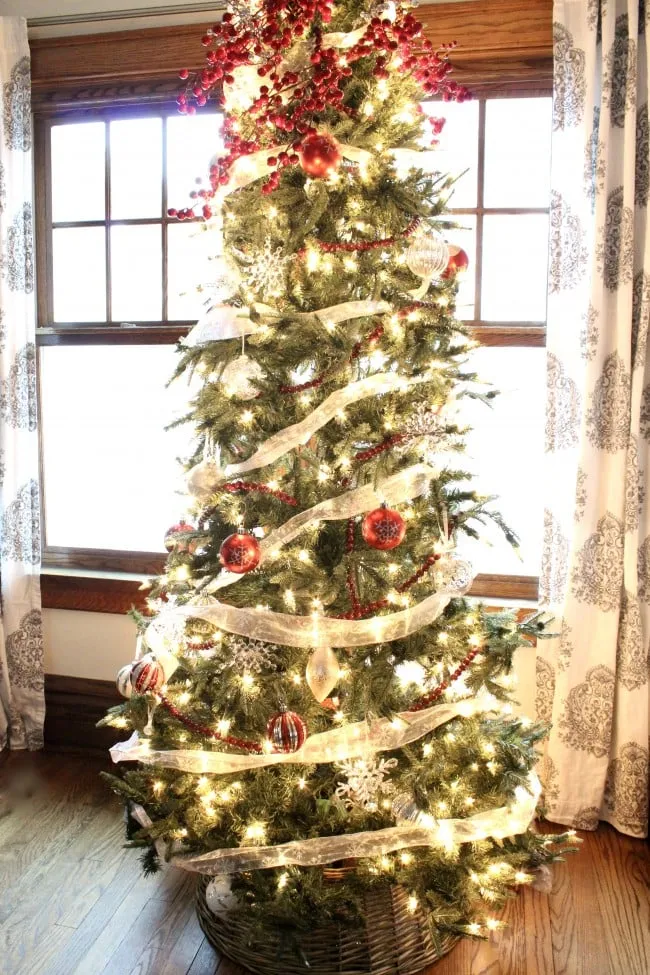
Not every tree needs a skirt, collar, or basket. If the stand is handsome, the floor is a material you actually like, and the gifts land in a proper pile, fabric is often just one more thing to store eleven months a year. The honest test: photograph your tree with nothing under it. If the picture still reads finished, you’ve saved yourself $60 and a bin in the basement. If it looks like the tree is floating, go find a base — and skim the mistakes section first.
29. White Coiled Rope Collar with Wooden Bead Garlands
White rope is the easiest way to fake a ceramic collar. Coil ½-inch cotton rope on a cardboard ring, gluing as you go, then paint the finished piece with two coats of matte white craft paint thinned slightly so it sinks into the fibers. The matte finish is what sells it — gloss reads as plastic from across the room. Total cost around $30 versus $90 and up for a ceramic look-alike, and yours will be lighter to move.
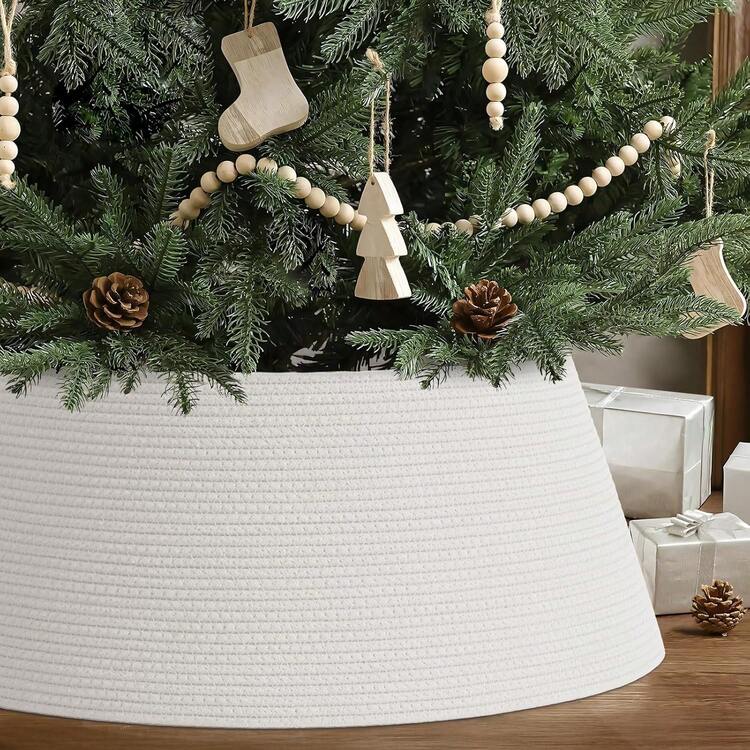
Everything here shares a temperature. The white rope, the pale wooden beads, the little wood cutouts, the pinecones — all warm neutrals sitting against forest green. Nothing fights, nothing shines, and the tree gets to be the loudest thing in the frame. Silver-wrapped gifts at the base add one cool note so the composition isn’t flat. That’s a well-edited palette, and it costs less than a single designer ornament set.
30. Crochet Checkerboard Border in Cream, Red, and Green
The checkerboard border. Take it out and you have a perfectly pleasant cream circle that vanishes into a light floor. The alternating red and green blocks give the skirt a graphic edge — the same punch as a striped rug, applied to a round. The v-stitch center matters too: it’s airy enough to contrast with the dense border, so there’s a soft-to-firm progression from the trunk outward. That progression is why your eye keeps moving instead of sliding off.
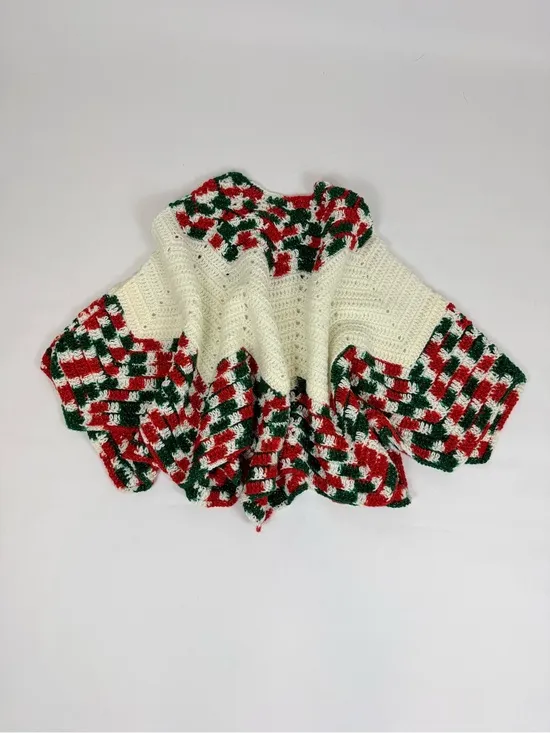
Three colors means three sets of ends to weave in, and a scalloped edge that will stretch if you hang it. Store it rolled around a pool noodle or a rolled towel, never folded. Bright red and green yarns are the likeliest to bleed, especially in cotton — wash cold, alone, and only if you absolutely must. Realistically: spot clean, air it out, and accept that a cream center will yellow slightly over the years.
31. Learning the Motif: A Gold Hook and White Lace
If you want the crocheted look without committing to a whole skirt, start with motifs.
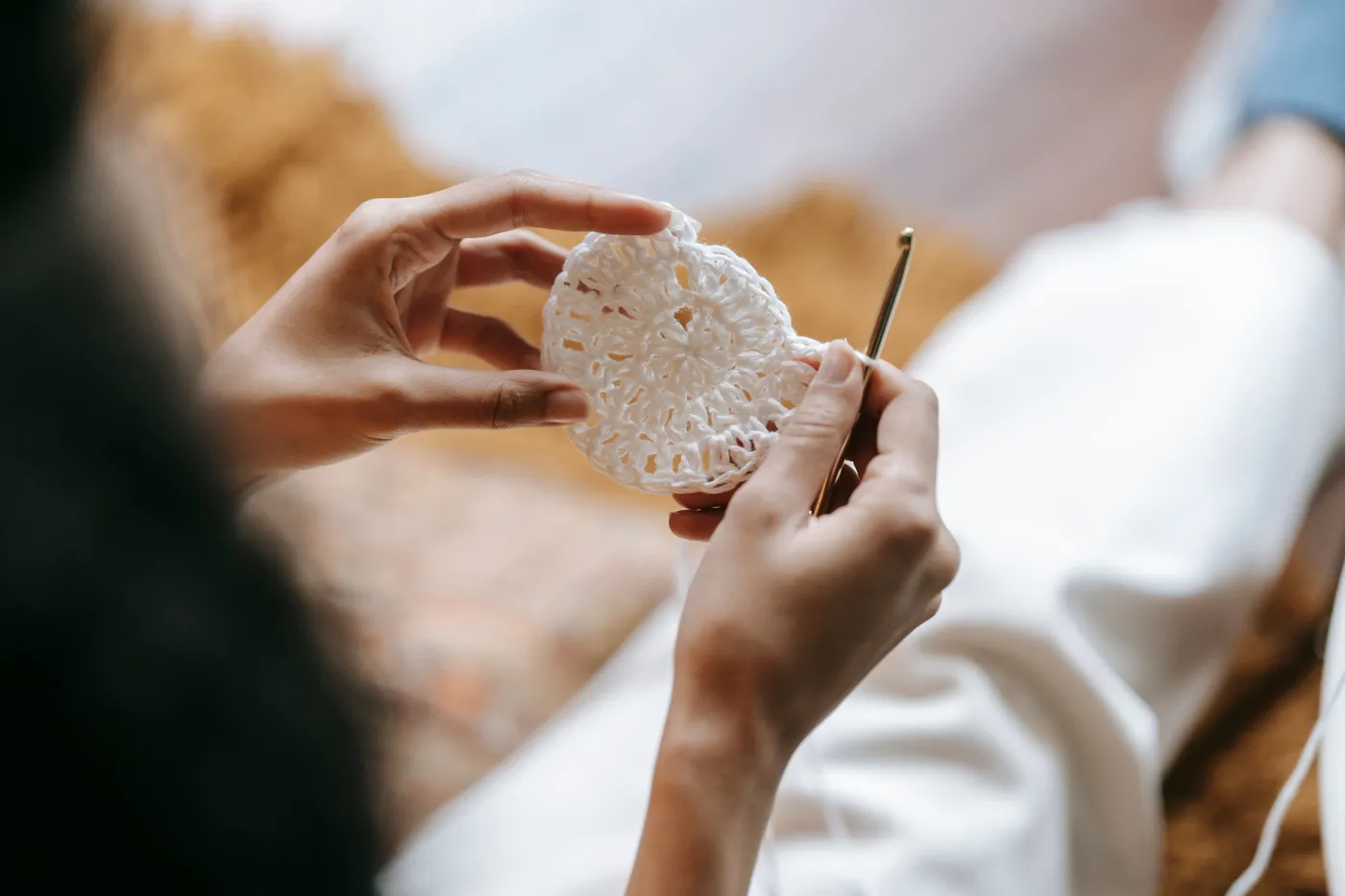
- Chain six stitches and join into a ring.
- Work twelve double crochets into the ring and join.
- Chain three, then repeat around: double crochet, chain two.
- Add a final round of chain fives and single crochets for the lace edge.
- Block each motif flat with pins and light steam — this is where lace gets its shape.
Twenty minutes per motif, about $6 in cotton thread.
Use a hook one size smaller than the thread label suggests. Lace motifs need tight, even tension to hold their shape, and a loose gauge shows up as lumpy petals once you block them. A 1.75 mm metal hook with size 10 cotton is a reliable starting point. Gold hooks are pretty, but check the grip — the finish wears off cheap ones and the metal starts catching your thread mid-row.
32. White Crochet Ornaments Against Green Branches
Strong sunlight is doing something generous here — the crocheted angel throws a lace shadow onto the wall, so the decoration extends past the tree itself. That only happens with flat, openwork lace and a pale wall, which is a decent argument for sitting your tree near a window instead of in a dark corner. The all-white ornament set also lets the crochet texture do the talking. Gold baubles become punctuation rather than the whole paragraph.
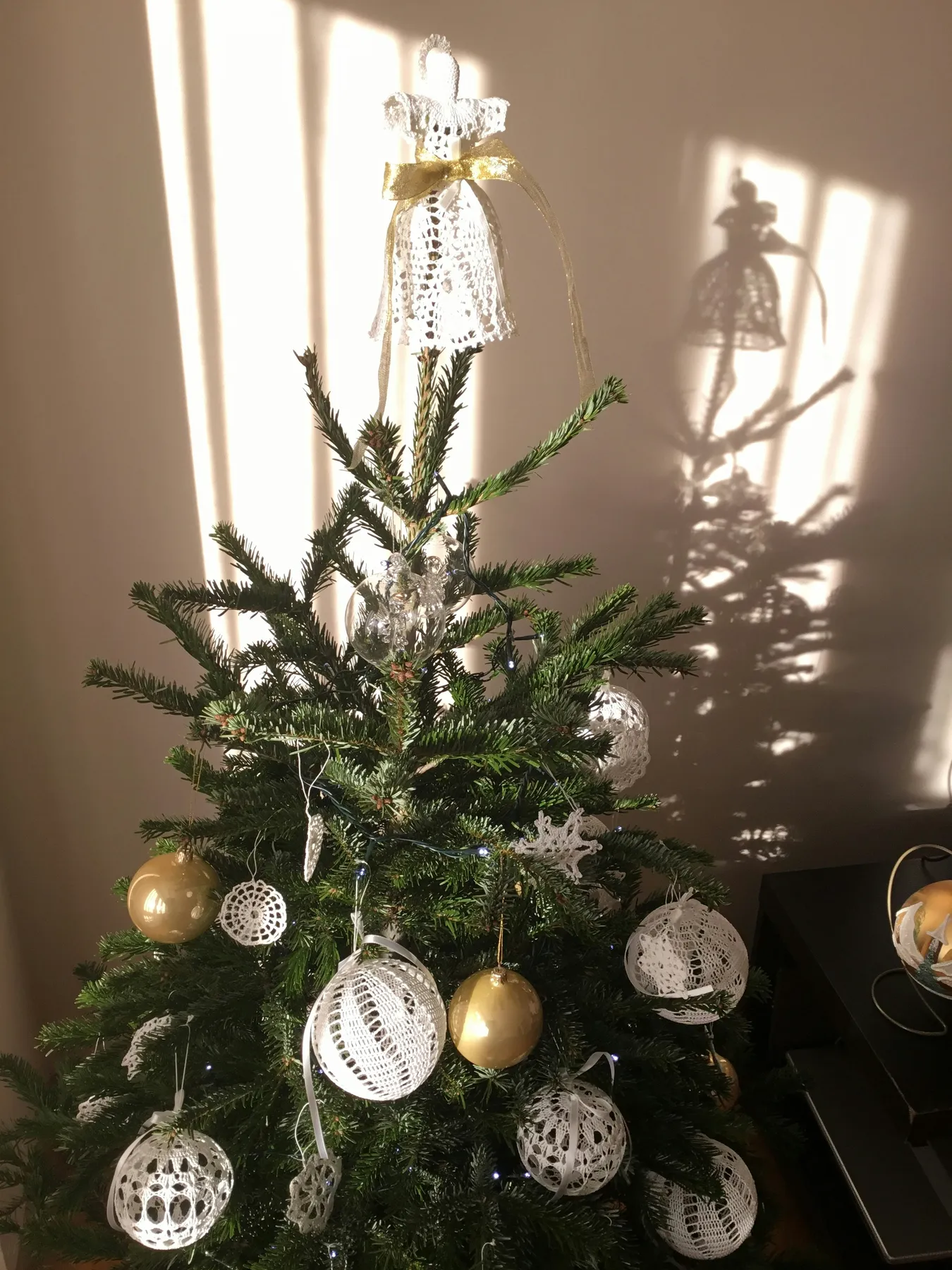
Crocheted ornaments are the cheapest upgrade in holiday decorating — a ball of cotton thread costs $4 and makes six snowflakes or stars. Stiffen them with a 50/50 water and craft-glue dip, pin them over a foil-covered cup, and let them dry overnight. Mixed with dollar-store gold baubles they hold their own easily. Want the topper too? Use a simple angel pattern with a gold ribbon loop. See Idea #17 for the skirt version.
33. Cream Embroidered Scrollwork Under Red and Gold
- Cream felted wool or heavy cotton skirt: $40–$95
- Gold embroidery thread and stabilizer: $10–$20
- Red and gold ornament sets, mixed finishes: $35–$90
- Embroidery hoop and needles: $8–$15
- Total: $93–$220
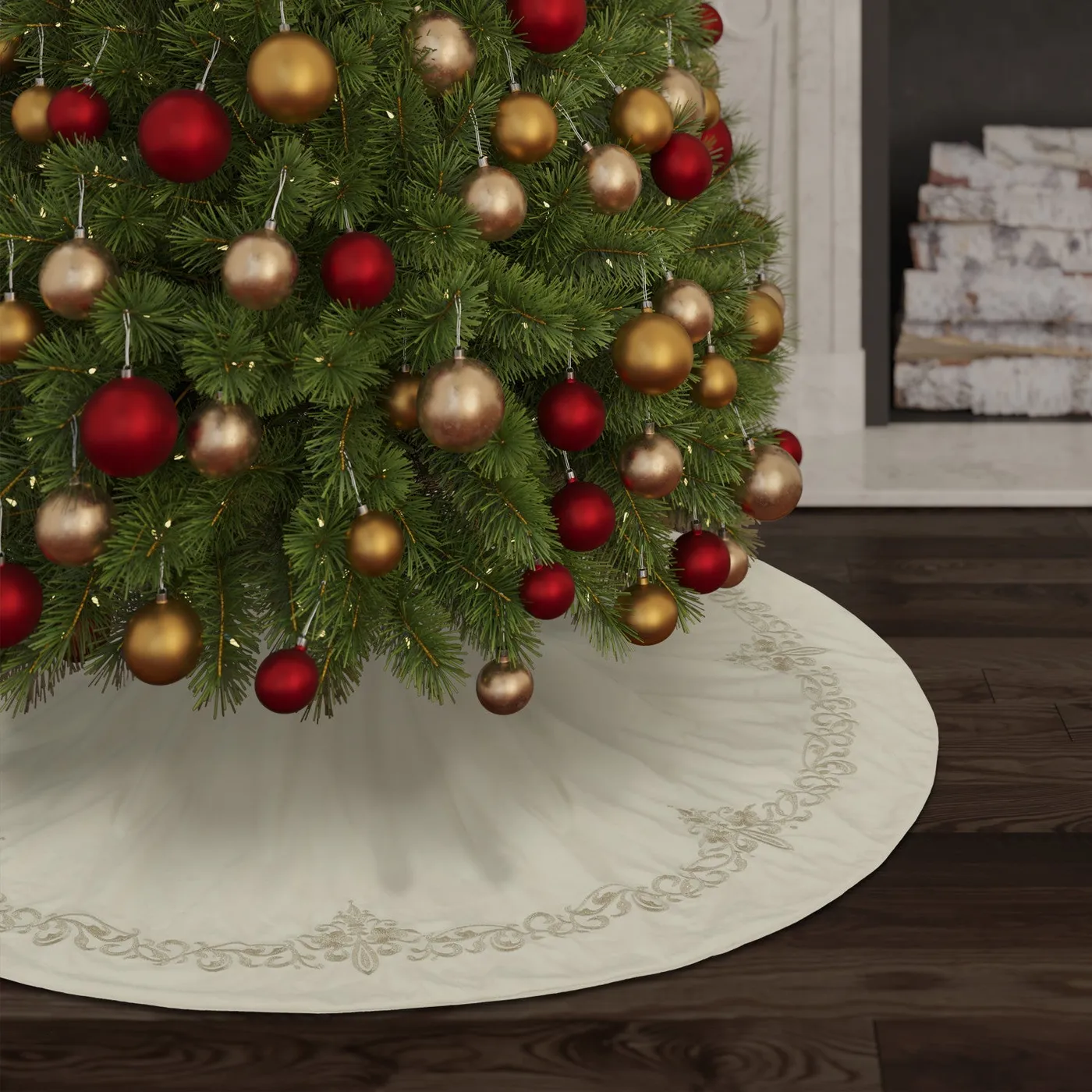
Budget alternative: skip the embroidery and use gold craft paint on a stamp to run a scroll pattern along the hem — roughly $15 and one afternoon of drying time.
A cream base in a rich color scheme needs a certain amount of floor to be seen. This works where the tree sits at least two feet from the nearest wall and the floor is dark; the contrast is doing half the work. On pale oak, a cream skirt at this scale tends to vanish. In tighter spaces, a smaller drum or a woven collar reads better, and the cream-and-gold idea moves happily to a tabletop tree.
34. A Distressed White Wooden Box Instead of Fabric
The box is doing architecture, not decoration. It’s square, it’s solid, and it stops the tree from feeling like a cone stuck to the floor — it gives it a plinth. Against dark grey built-ins and black armchairs, that hard-edged geometry is what makes the tree belong to the room rather than merely occupy it. A soft fabric skirt in the same spot would have looked apologetic. This is the one idea on the list where structure beats texture.
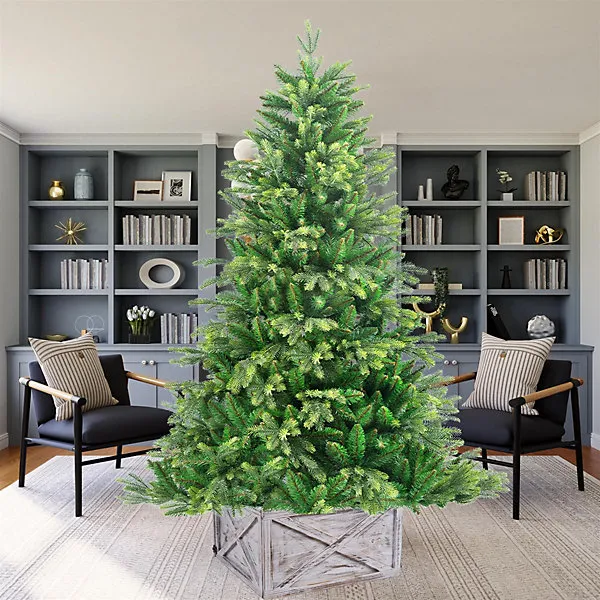
A wooden box base only works if the box is genuinely sturdy and the tree actually fits inside it. Measure the stand’s leg span, add two inches, and build or buy to that number — not to the tree’s branch width. Line the inside with a waterproof tray, because wood and tree water are enemies. And check screw access: if you can’t reach the bolts without lifting the tree, you’ve built yourself a beautiful problem.
Your Tree Deserves Better Than a Bedsheet
Thirty-four bases, and honestly not one of them requires a sewing machine or a big budget — a coiled rope, a thrifted basket, or a $25 braided rug will out-charm anything that came in plastic packaging. Pick the one that matches what’s already in your room, measure twice, and let it look a little handmade. 📌 Pin this guide now so it’s waiting for you when the tree comes out of the box.