
Small christmas tree ideas 2026 is having a major moment on Pinterest right now — and one look at the saved boards tells you why. Half the pins are six-foot trees nobody has floor space for. The other half are these: two-foot charmers styled on kitchen islands, windowsills, and desks, saved by people in apartments, parents of toddlers, and anyone who refuses to rearrange a sofa in December.
We spent serious time browsing Target, Walmart, Etsy, and IKEA to bring you only what’s worth your attention this year, across a range of roughly $4 to $320. Inside you’ll find 32 curated ideas spanning rustic-natural, nostalgic-vintage, pastel-playful, and modern-minimal — with budget and luxury versions compared side by side where it counts. And stay until the end — we break down the most common mistakes that can ruin these looks.
What’s driving it in 2026 is a shift toward edited, character-driven tabletop trees over perfectly matched sets. 📌 Save this to Pinterest for later — you’ll want to revisit these ideas.
1. A Tiny Flocked Bottle Brush Forest on a Dark Shelf
The single thing that makes a cluster of flocked bottle brush trees work is height variation. Nothing here is the same size — the tallest runs maybe eight inches, the shortest barely four. Set them on a dark brown surface and stagger the group so the tallest sits slightly off-center rather than dead middle. Spaced evenly, the same trees read as a boring row. Tucked close, with the white flocking catching whatever light lands on the shelf, they read as a scene.
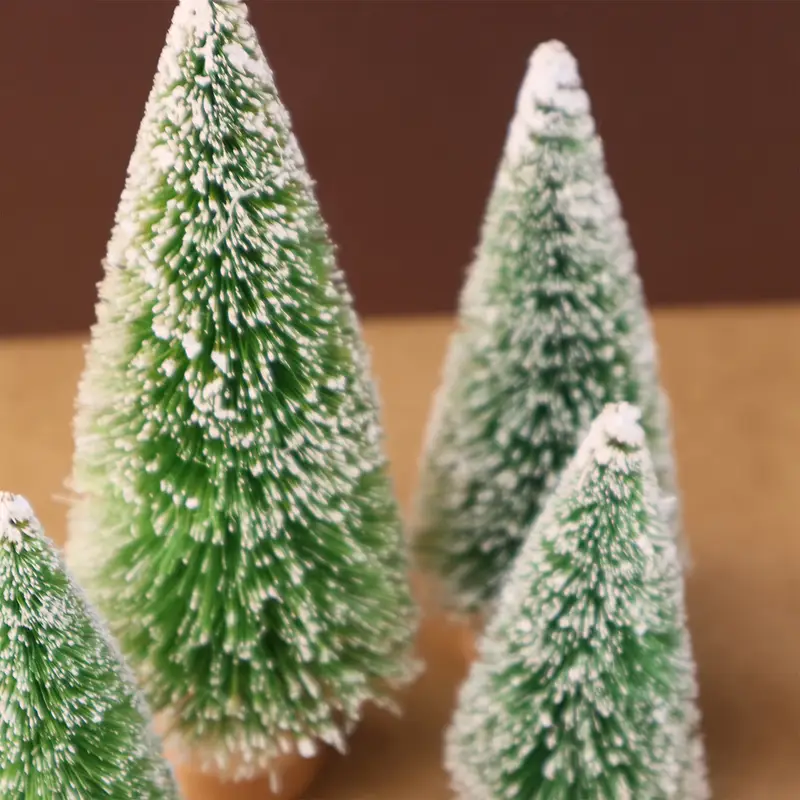
Two principles are doing the work. First, repetition with variation: five near-identical shapes at five different heights. Second, value contrast — pale green bristles tipped in white against a deep brown backdrop. That dark background is not an accident, and it’s why the flocking looks brighter than it actually is. Move these same trees onto a white mantel and they will nearly vanish.
2. Burlap, Silver, and Faux Fur in a Woven Basket
Wide burlap ribbon is the cheapest way to make a small tree look collected rather than crafty — but only if you tuck it instead of looping it. Cut 3-inch-wide burlap into 10-inch strips, fold each into a loose U shape, and push the fold into the branches so the tails drape downward. Space them every 4 to 5 inches and stop about 3 inches short of the top. A 10-yard roll runs about $8 and covers a 24-inch tree twice over. Looped bows look homemade; tucked folds look gathered.
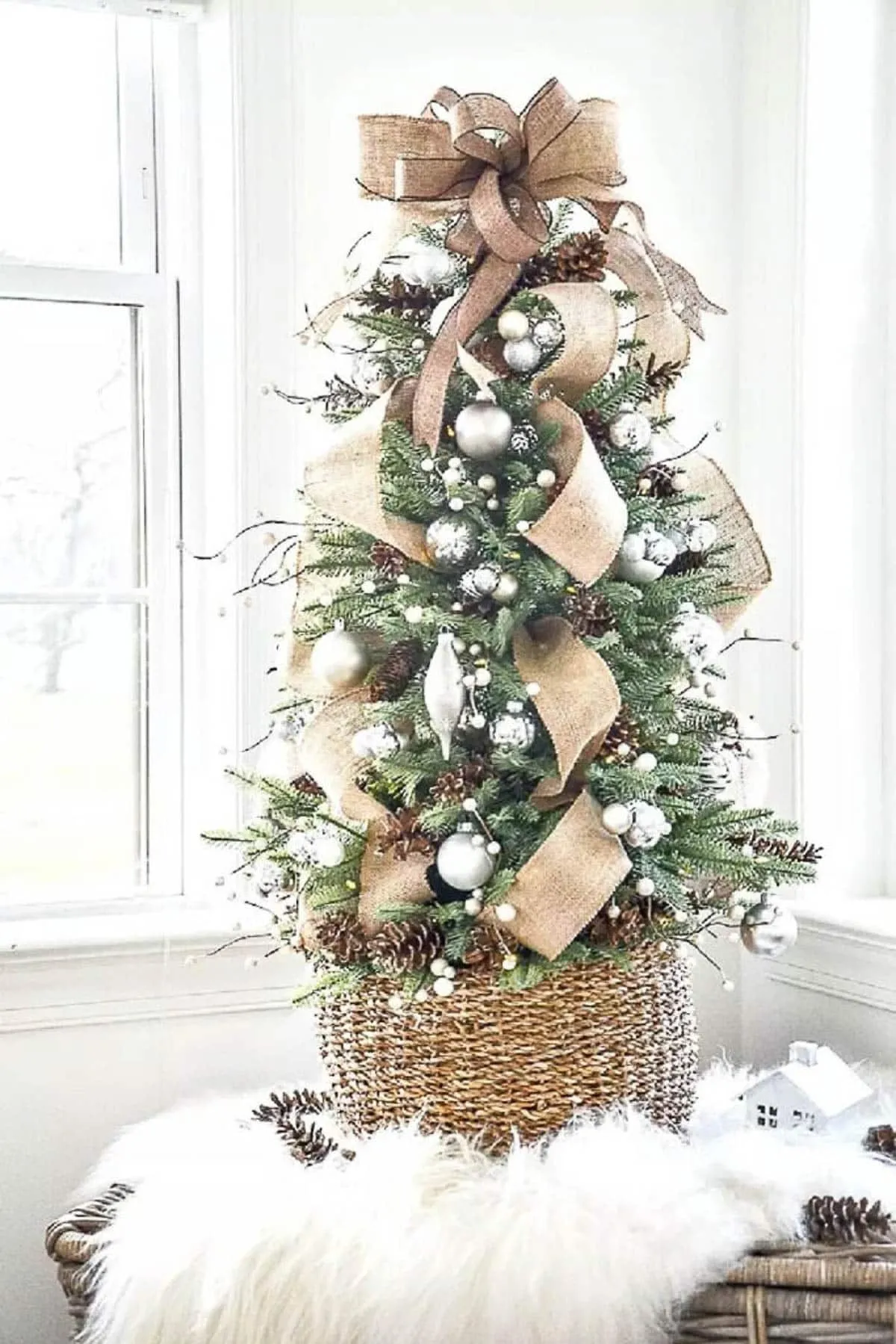
Faux fur under a tree is lovely until someone sets down a mug of cocoa. If yours is a house where that happens, put a washable cotton throw down first and layer the fur on top of it. Also worth knowing: that woven basket is doing structural work, not just decoration. Line it with a plastic bag and a brick of floral foam before the tree goes in, or a top-heavy 24-inch tree will tip the first time a cat investigates.
3. A Frosted Tabletop Pine Dressed in Burlap and Birch
Here’s the ratio: roughly 70% natural texture, 20% warm light, 10% green. The burlap-wrapped base and that oversized pinecone carry the natural side; the string lights do the rest of the heavy lifting. Swap the burlap for a chunky cream knit and the whole vignette turns soft and cabin-like. Swap the pinecone for a brass bell and it reads a touch more formal. Keep the ratio, change the materials, and this display can shift mood every season without new furniture.
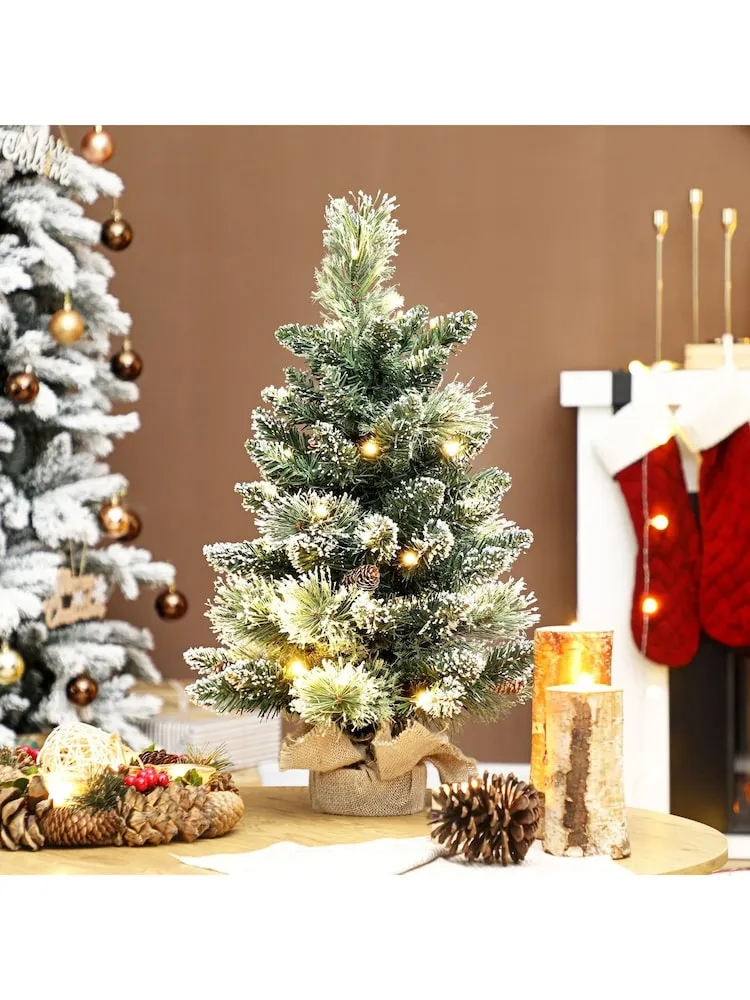
You can build this for under $45. A 20-inch frosted tabletop pine runs $18 to $25 at Walmart or Target in early November. Birch-log LED candles are about $12 for a pair; a real birch slice with a tea light costs $3. Burlap by the yard is around $2.50 at any craft store. The pinecone is free if you know someone with a pine tree — otherwise $4 at a florist. This is the tabletop version of Idea #29, scaled down to a side table.
4. Twin Bark-Base Evergreens with Red Glitter Stars
Two small evergreens on bark-covered log bases, plus the trimmings:
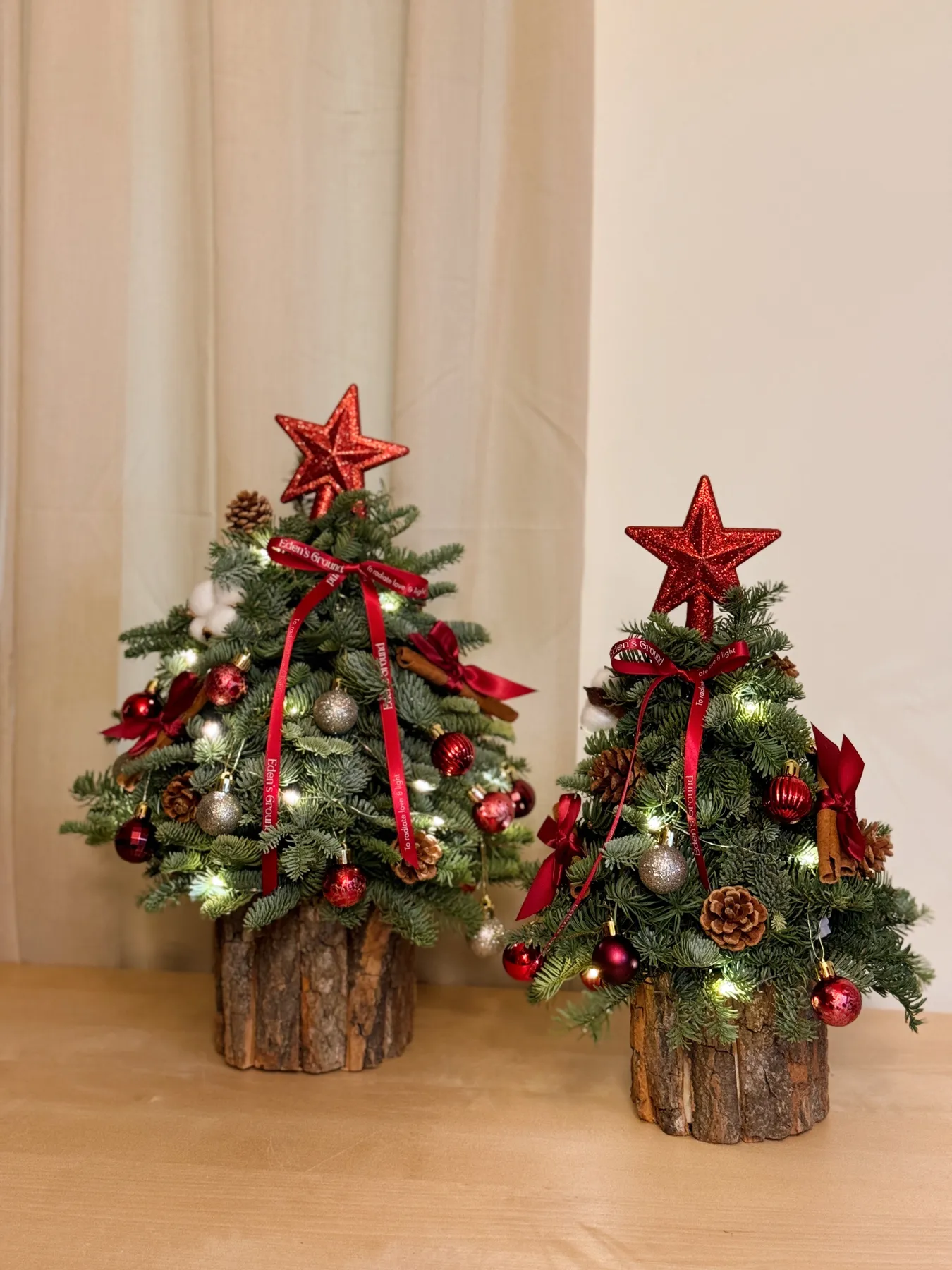
- Two 18–24 inch evergreens, fresh or faux: $30–$60
- Bark-wrapped log bases: $14–$30 each
- Red glitter star toppers: $6–$12
- Red and silver baubles, pinecone and cinnamon picks: $20–$35
- Two sets of warm white battery lights: $16–$24
- Total: $100–$190 for the pair
Budget alternative: two faux 24-inch trees at Michaels on Black Friday ($20 each), cinnamon sticks bundled with twine in place of log bases, and thrifted red and silver ornaments get you to about $55.
This pairing wants at least 40 inches of surface — a console, a buffet, or a fireplace hearth. Leave about 14 inches between the two trees so the branches never touch; once they do, the pair reads as one lumpy mass. Bark bases add roughly 4 inches of height, so a 24-inch tree tops out near 28 inches, comfortably below a window ledge. Working with less than 30 inches of surface? Drop to a single tray display instead.
Log bases are usually sold in one diameter, and your trunk rarely matches. If the tree leans, wrap the trunk with two or three turns of burlap until it sits snug in the hole — a shim, essentially. Do that before the lights go on, because re-seating a lit tree is a guaranteed way to knock off half your ornaments. Also: water a fresh tree in a hollow base every other day, and never let the interior of a bark log sit in standing water or it will mold by New Year’s.
5. Symmetrical Pre-Lit Trees Flanking a Dark Front Door
Symmetric double-tree entries have been a staple for years, but the version people are saving now is smaller and cheaper: two short pre-lit trees instead of full-size pairings, which drops the cost from $400-plus to under $100. The whole look leans on the door as the anchor. Once you frame a dark gray door with two matching green shapes, everything else — lanterns, candles, ribbon — just needs to stay quiet and let the symmetry do the talking.
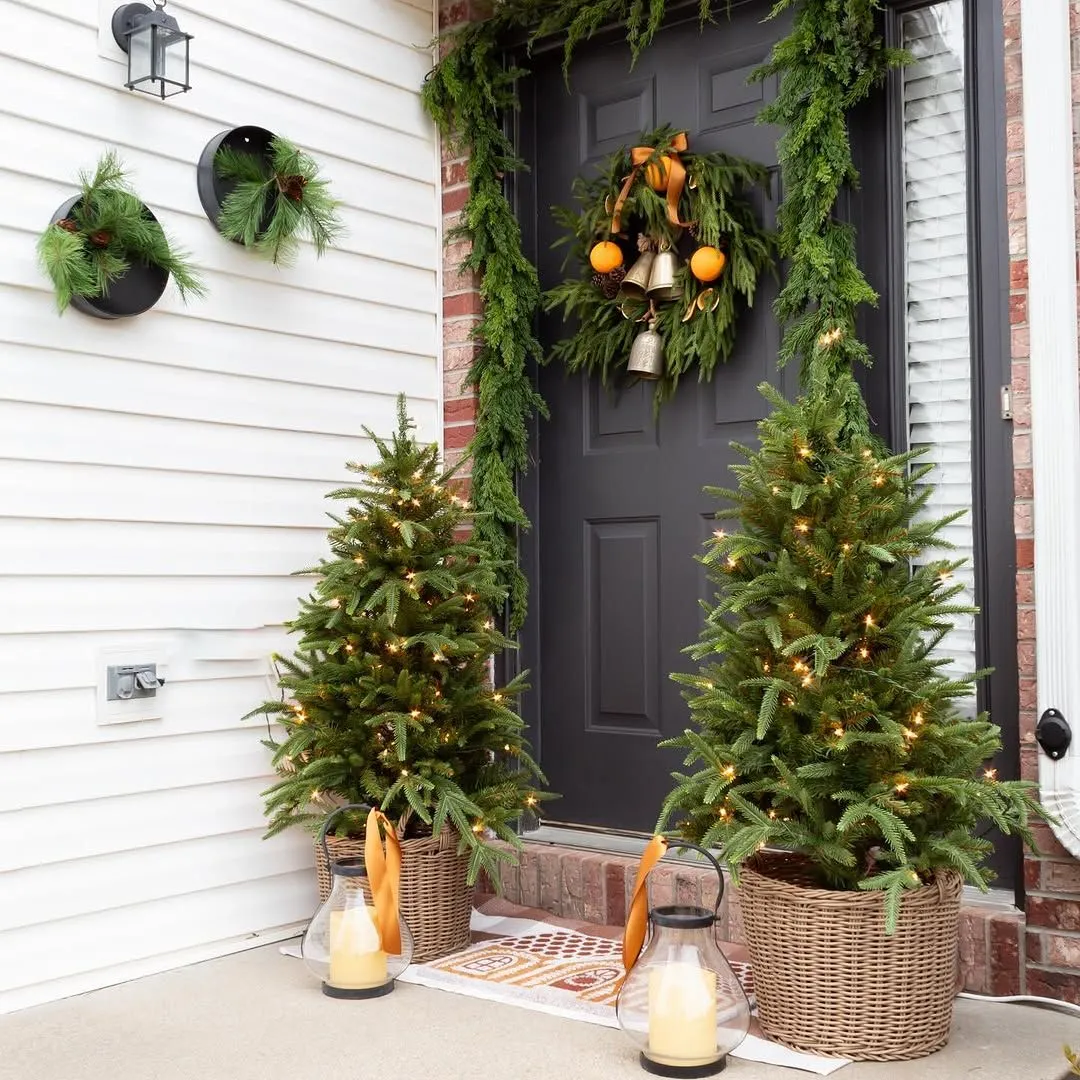
It’s the orange ribbon and the citrus in the wreath. Everything else here is a known quantity: green trees, wicker baskets, clear glass, candlelight. The orange slices and that ribbon are the only warm, saturated notes, and they’re what make you look twice instead of scrolling past. Remove them and you’d have a perfectly nice but completely forgettable holiday entry. One color, carrying all the personality.
6. Tinsel-Heavy Vintage Tree Against Mint Green Walls
Here’s the honest part: heavy tinsel is a ratio game, and the ratio changes completely when the tree shrinks. On a 7-foot tree, a few packs of silver tinsel read as abundance. On a 24-inch tabletop tree, one strand reads as an accident. If you love this vintage look and want it small, use tinsel as a single accent — one bundled cluster tucked near the base — and let colorful glass ornaments carry the density instead. The mint green walls and their blue border do the rest of the work.
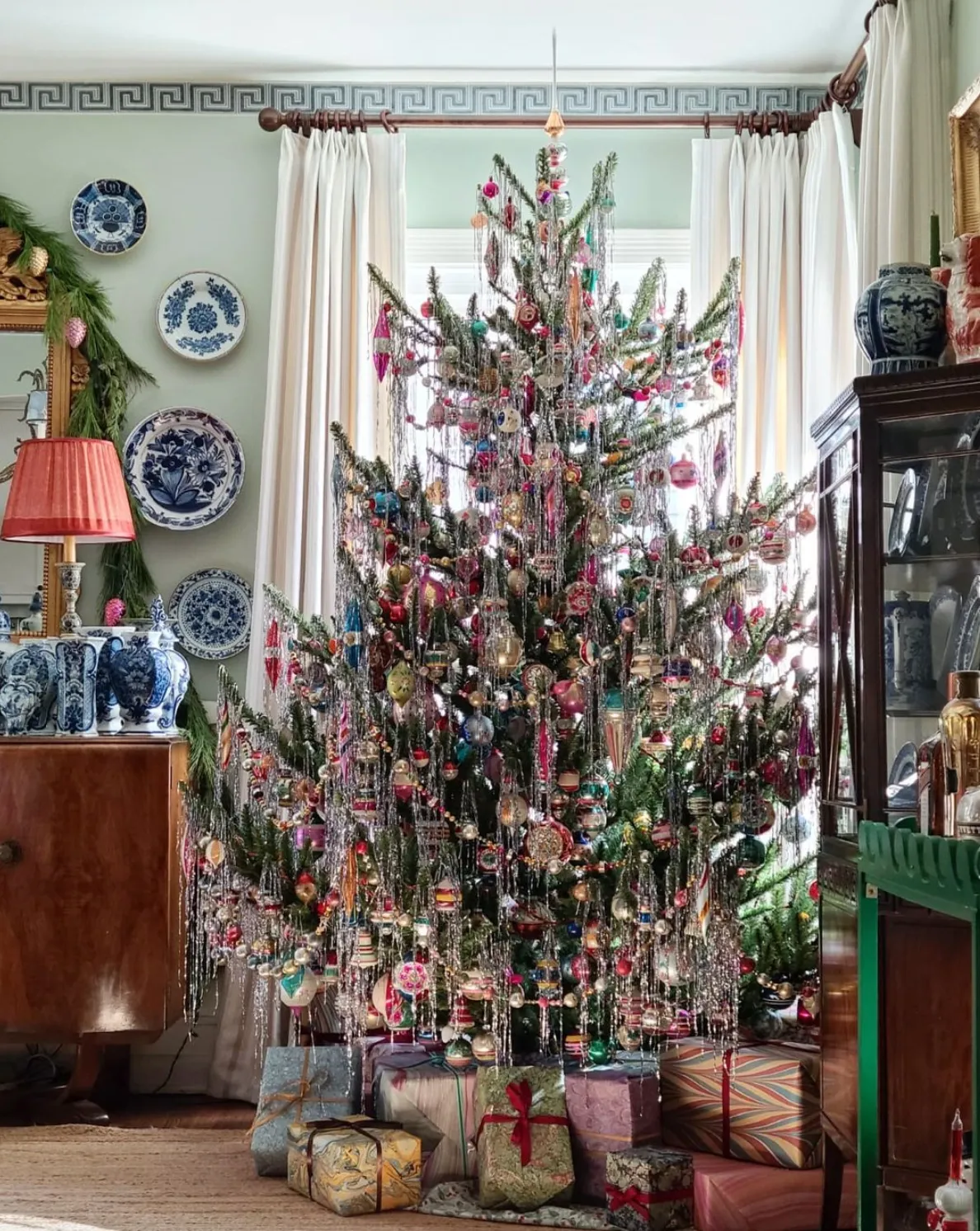
Tinsel sheds every time you breathe near it. Expect to vacuum the rug twice in December and find stray strands in July. Vintage glass ornaments are the other commitment: they chip, and the paint on older ones dulls with handling. Store them in egg cartons or original boxes with tissue between each piece, never in a jumbled bin. If you want the look without the fuss, buy new glass-look ornaments in the same bright mixed palette — same effect, zero heartbreak when one drops.
7. A Wooden Dough Bowl Tree with a Glitter Gold Star
The wooden bowl is quietly the smartest thing here. A small tree on an open base looks like it’s floating; a small tree in a wide, low vessel gains a grounded silhouette that reads as intentional styling rather than a tree that outgrew its pot. The glitter gold star earns its spot too — it’s the only metallic up top, so your eye travels down through red and gold baubles, pinecones, and lands in the bowl. Then the firelight behind it does the rest.
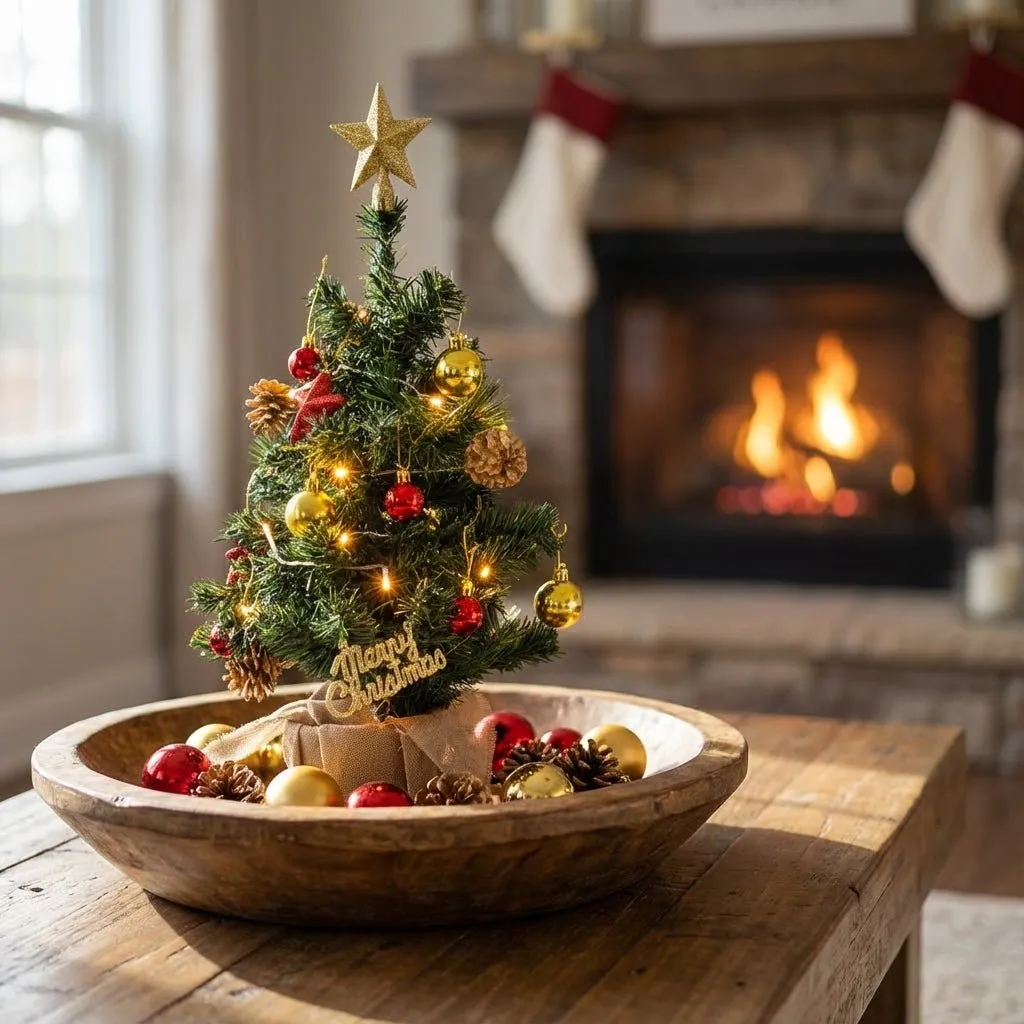
Dough bowls are expensive. A 16-inch wooden serving bowl from Target is about $20 and reads nearly the same once it’s holding pinecones and stray baubles. Thrift stores are the real goldmine — wooden bowls land on shelves constantly for $6 to $12, and a scratch or two only helps the look. The glitter star: Dollar Tree, $1.25, and honestly indistinguishable from the $14 version once the lights are on. It’s the same ‘small tree as centerpiece’ logic as Idea #14, just on a console instead of a dining table.
8. Two Berry-Dotted Mini Trees on a Gold Tray
Group tray displays at three different heights, not two. Here the two conical trees run roughly 12 and 16 inches, and the mercury glass candle sits slightly behind and between them, so its flame reads as a third, much smaller light source. Keep the tallest object off-center — dead middle kills an arrangement. A round gold tray 14 to 16 inches across gives the grouping a boundary, and that boundary is what keeps a tabletop display from looking like clutter.
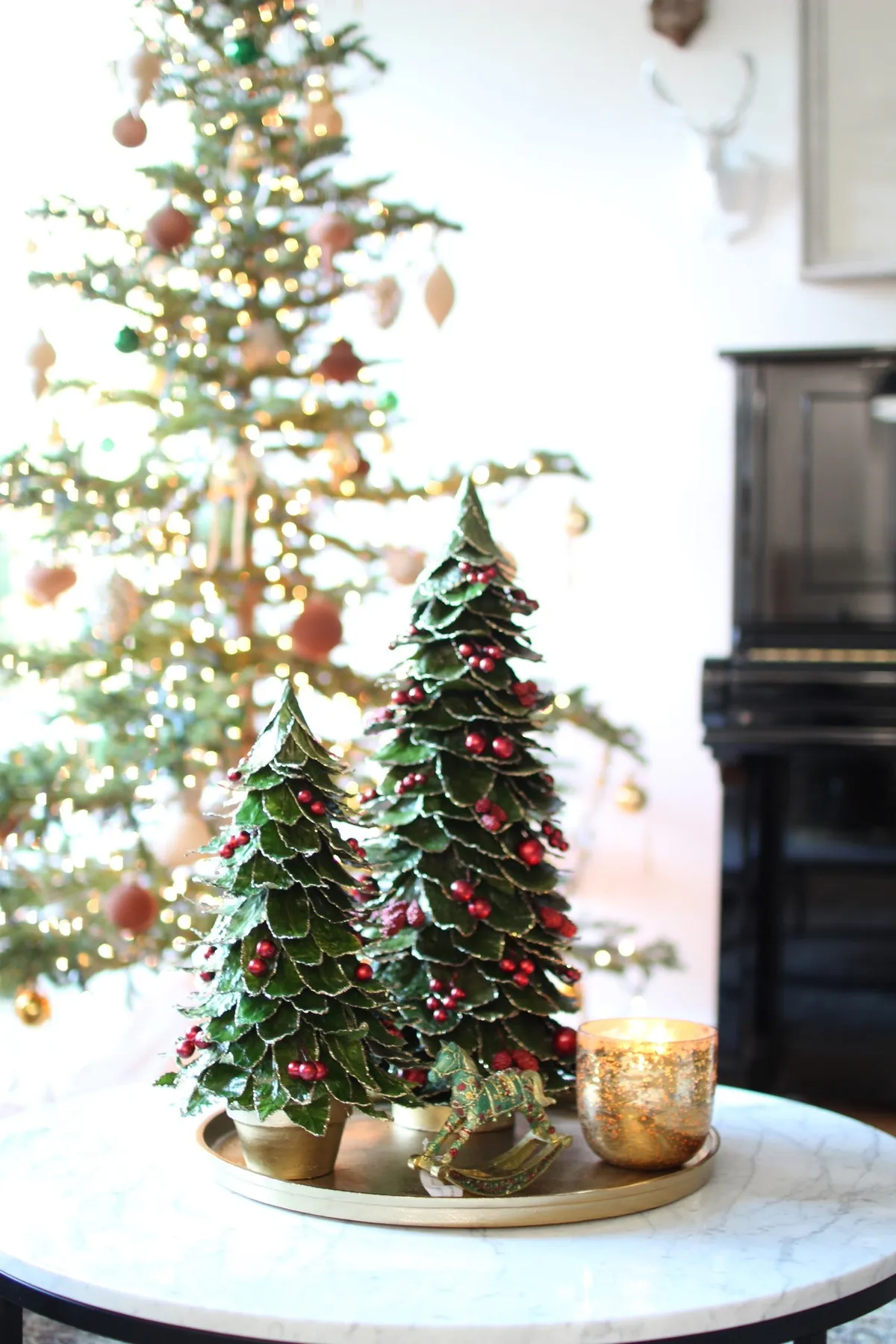
- Set a 12-ounce plastic cup inside each gold pot and trim it so the rim hides just below the edge.
- Push the tree stem into a fist-sized ball of floral foam, then force it down into the cup.
- Tuck preserved moss around the trunk to hide the foam — one handful covers a 4-inch pot.
- Wire red berry picks into the branches from the inside out, 6 to 8 stems total, so the berries sit close to the needles.
Time: about 20 minutes for both trees. Materials: roughly $12 if you already own the pots and tray.
9. A Red Star Topper and Berry Picks by the Fireplace
A floor-standing small tree has different rules than a tabletop one. This tree sits on a rug beside a fireplace, which means it needs at least 24 inches of clearance from the hearth — closer and the heat dries the needles fast, especially with a real fire going. At 30 to 36 inches tall, this size works in rooms as small as 80 square feet because it occupies floor space, not wall space. If your room is tighter than that, a windowsill tree takes up zero floor.
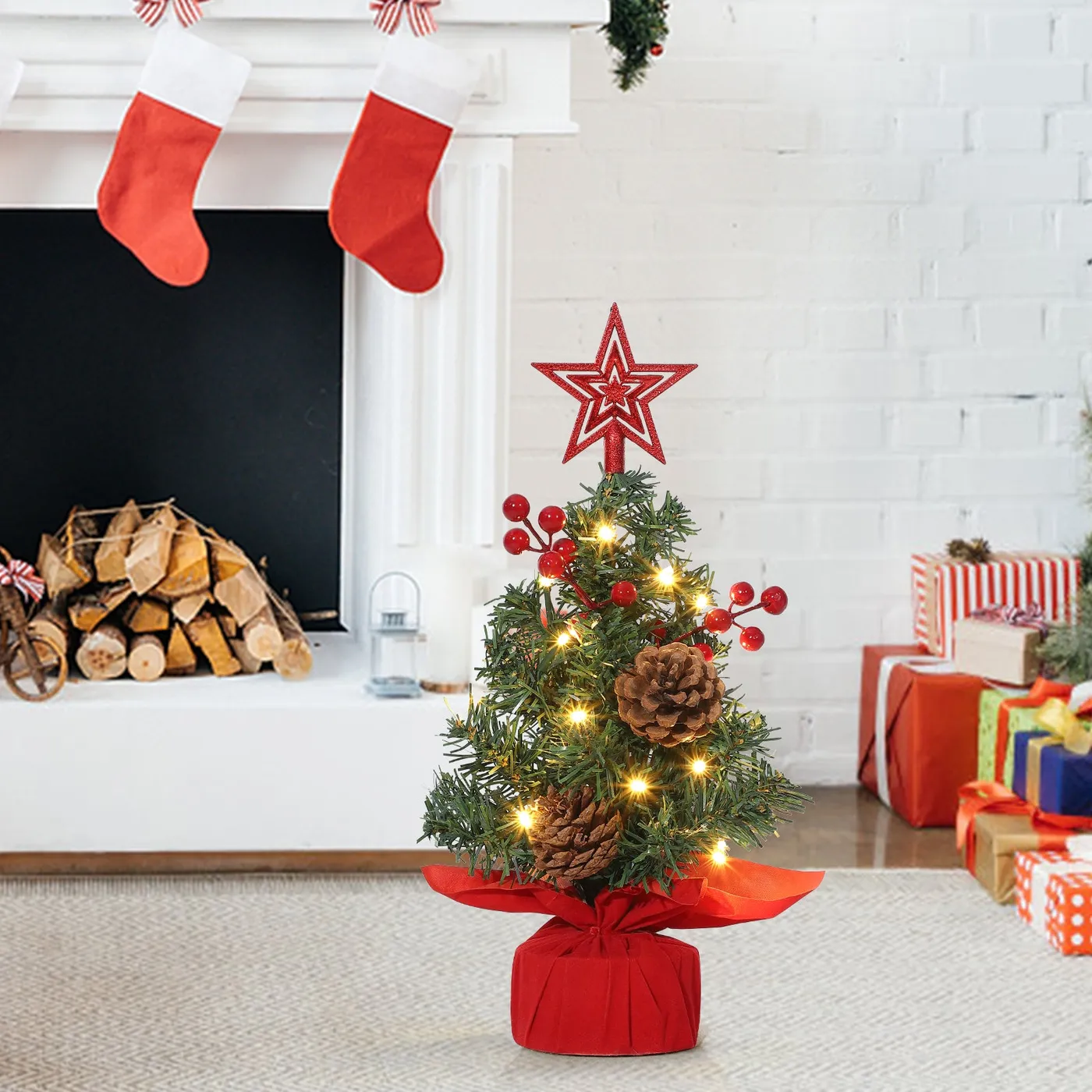
Read this one as 60% pine green, 25% warm white light, 15% red. The red does very little in terms of volume — a star topper, some berry picks — but it’s the only saturated color in the frame, so it registers instantly. Want the same structure in a cooler key? Swap the red for cranberry glass and silver berries and you keep the exact proportions. Want it warmer? Trade silver for antique brass and the whole glow goes golden.
10. Paper Honeycomb Ornaments on a Playful Pastel Tree
Paper ornaments are the cheapest personality money can buy. Honeycomb spheres run $5 to $8 for a set of six at Target or Walmart; felt ornaments are about $3 for a four-pack in the dollar aisle. The stacked white gift boxes with pink ribbons are just cardboard boxes from the craft store at $1 each, rewrapped in ribbon you already own. Flanking a small tree with wrapped boxes doubles the visual footprint without adding a single branch. Total: about $30.
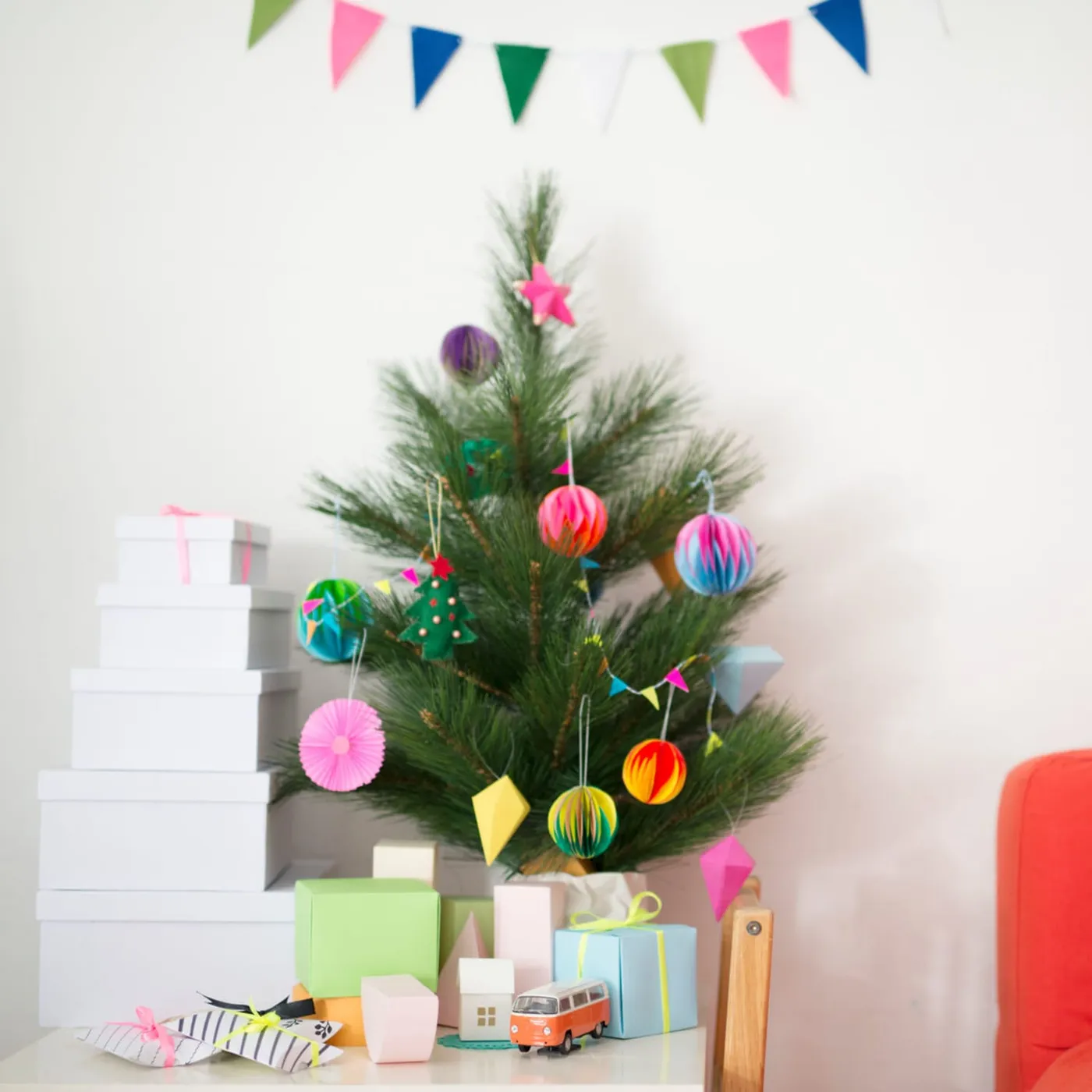
One warning about paper and felt ornaments: they weigh almost nothing, which is usually a gift — until you hang them on a small tree and realize they swing every time someone walks past. The bigger issue is pets. A 20-inch tree loaded with paper honeycombs and sitting at floor level is an irresistible target for a cat. Put this one on a surface, not the floor, and consider museum putty under the boxes if you have a determined dog.
11. A Desk-Size Evergreen with a Cardinal and an Owl
The cardinal. In a palette of sage green, cream, wicker, and pale wood, that single bright red bird is the only thing your eye locks onto — and it’s about the size of a thumb. Remove it and the tree becomes a pleasant blur of natural tones. That’s the whole trick with a desk-size tree: you don’t need many ornaments, you need one that’s genuinely a different color from everything else around it. The owl and the candle ornament can stay quiet; the cardinal carries the tree.
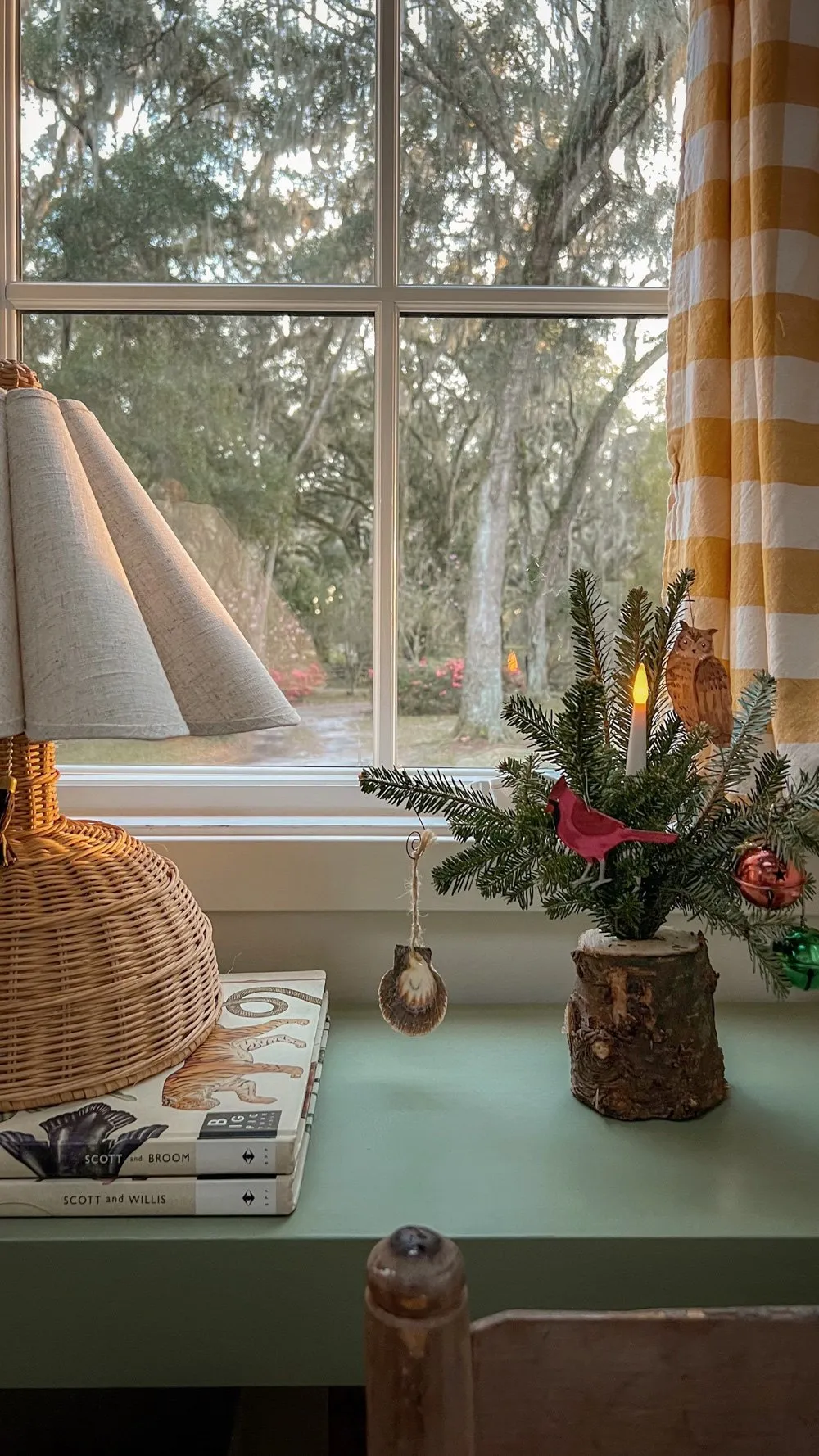
Size the tree to the desk, not the holiday. A desk tree should top out around 40% of the surface width — on a 48-inch desk, that’s a 19-inch tree, max. Anything taller and you’ll be moving your mug every morning. Also, run it on batteries. A visible cord trailing off a desk ruins the whole ‘I just happen to have a tree here’ effect, and battery LED sets now run 60-plus hours on three AAs. Set the timer and forget it.
12. Glitter Bows and Jewel-Tone Baubles on a Compact Tree
- Cut 2-inch-wide ribbon into 8-inch lengths and pinch each into a bow shape with your fingers.
- Twist a 4-inch length of floral wire around the center and leave the ends long.
- Paint the front of the bow with a thin layer of craft glue and dip it into fine glitter over a paper plate.
- Let it dry 30 minutes, tap off the excess, then wire the bow into the branch so it sits flat against the needles.
- Repeat in two colors, alternating by height so no two matching bows sit next to each other.
Time: 45 minutes for a dozen bows. Cost: about $10 for ribbon and glitter.
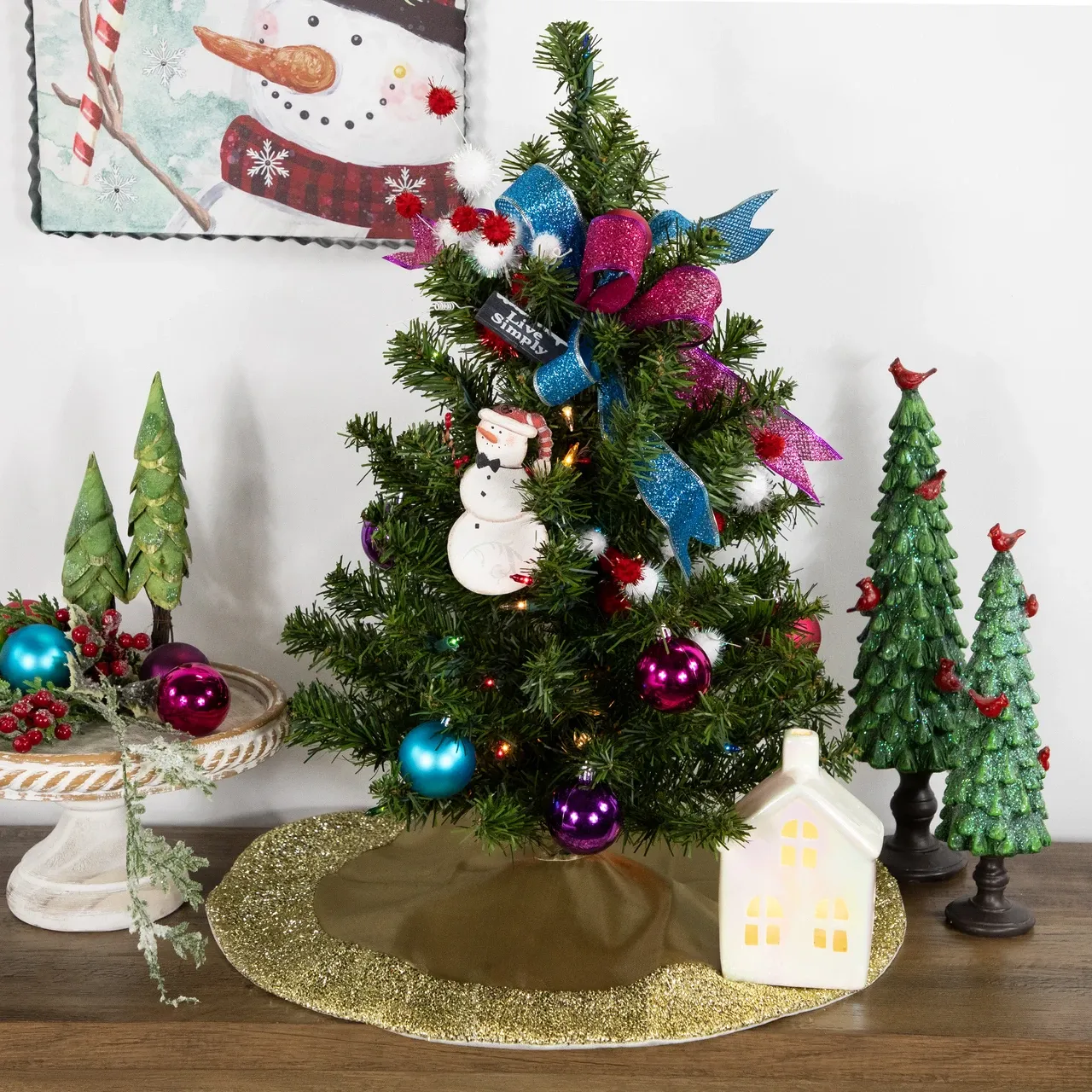
Jewel-tone maximalism came back hard, and it isn’t going anywhere in 2026 — it’s the small-tree version of the dopamine decor wave that started with color-drenched rooms. Teal, magenta, and purple against pine green shouldn’t work, and that slight wrongness is exactly why it does. If you’re nervous, notice what the gold glitter skirt is doing: it grounds all that color so the eye has a floor to rest on. It’s the same instinct as Idea #6, just with a more edited ornament count.
13. A Flocked Tree on a Distressed Table by the Window
Flocked trees shed. Every time you move it, every time you decorate it, and every time a cat brushes past, a fine white dust lands on the table. That’s normal, not a defect. The thing to actually watch is sunlight — flocking yellows and turns brittle when it sits in direct light for weeks, and this tree is parked right in front of a large window. Pull the sheer curtains during the brightest part of the day and it will look new for years instead of one season.
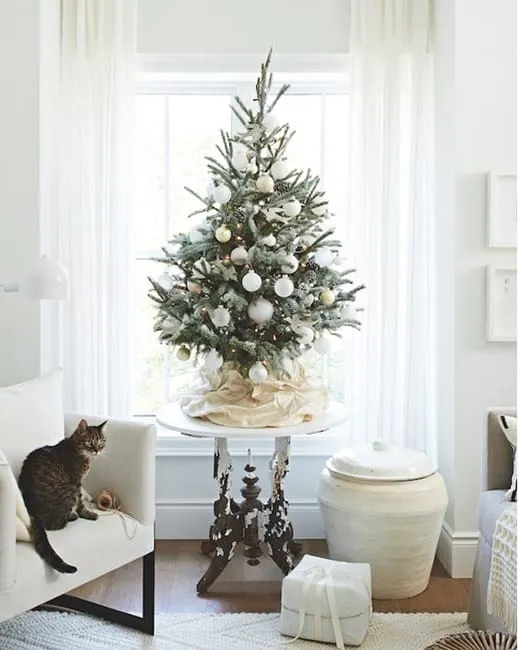
The contrast between fresh white and worn brown is the entire point. That round table has a distressed finish, chipped paint and all, and the flocked tree above it is pristine. Put the same tree on a glossy new console and the arrangement gets stiff and self-conscious. The gathered beige fabric at the base softens the transition between tree and table, which is why it doesn’t need a patterned skirt competing for attention.
14. Pastel Baubles and a Gold Garland in a Bright Dining Room
This room runs about 70% white, 20% natural jute and wood, 10% pastel. That ratio is why a small colorful tree can sit in the corner of a bright, neutral dining room without looking loud. Want more color? Don’t add more ornaments — increase the pastel percentage by swapping the jute rug for one with a soft mint border. Want less? Pull the gold paper garland off the mantel and let the tree do the talking alone. The mint pendant ties it back together either way.
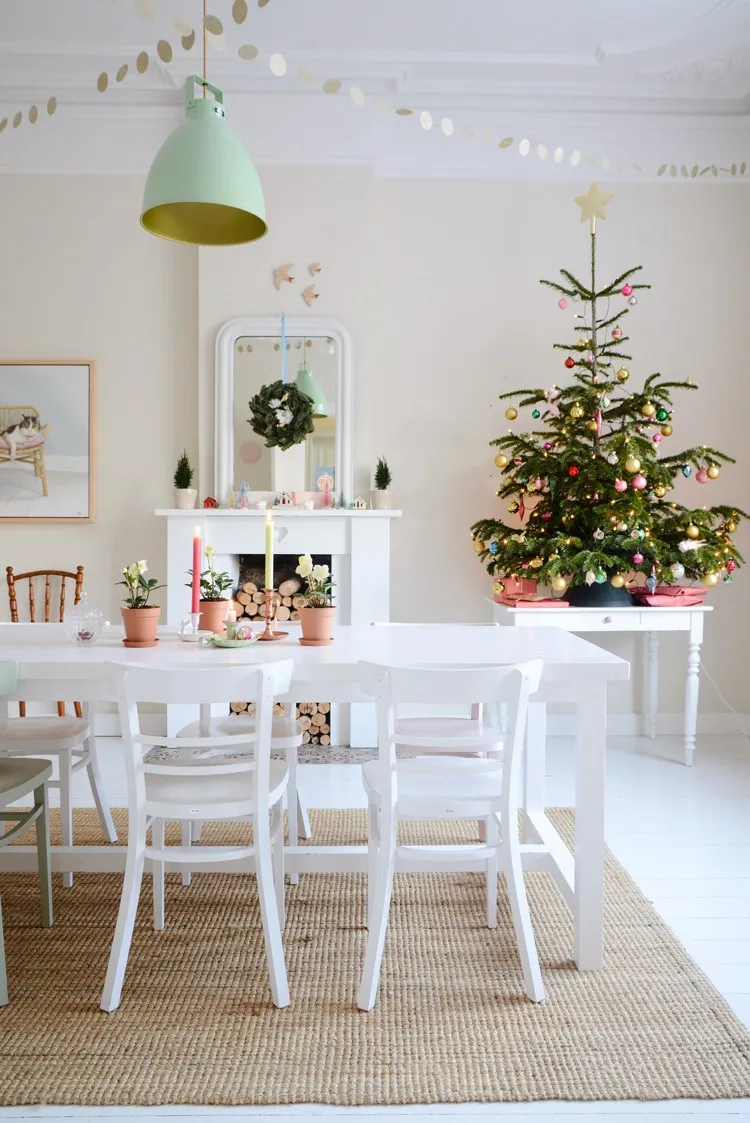
Side-table trees work best when the table is 26 to 32 inches tall and the tree is 20 to 24 inches. That keeps the top of the tree below eye level when you’re seated, so dinner conversation isn’t interrupted by a tree. Give it at least 18 inches of clearance from the nearest chair back. In a dining room under 120 square feet, this is the move — you get a full holiday moment without losing a single seat, and the fireplace mantel stays free for the mirror.
15. A Flocked Tree in a Galvanized Bucket of Dried Moss
A flocked tree dressed rustic, in a bucket:
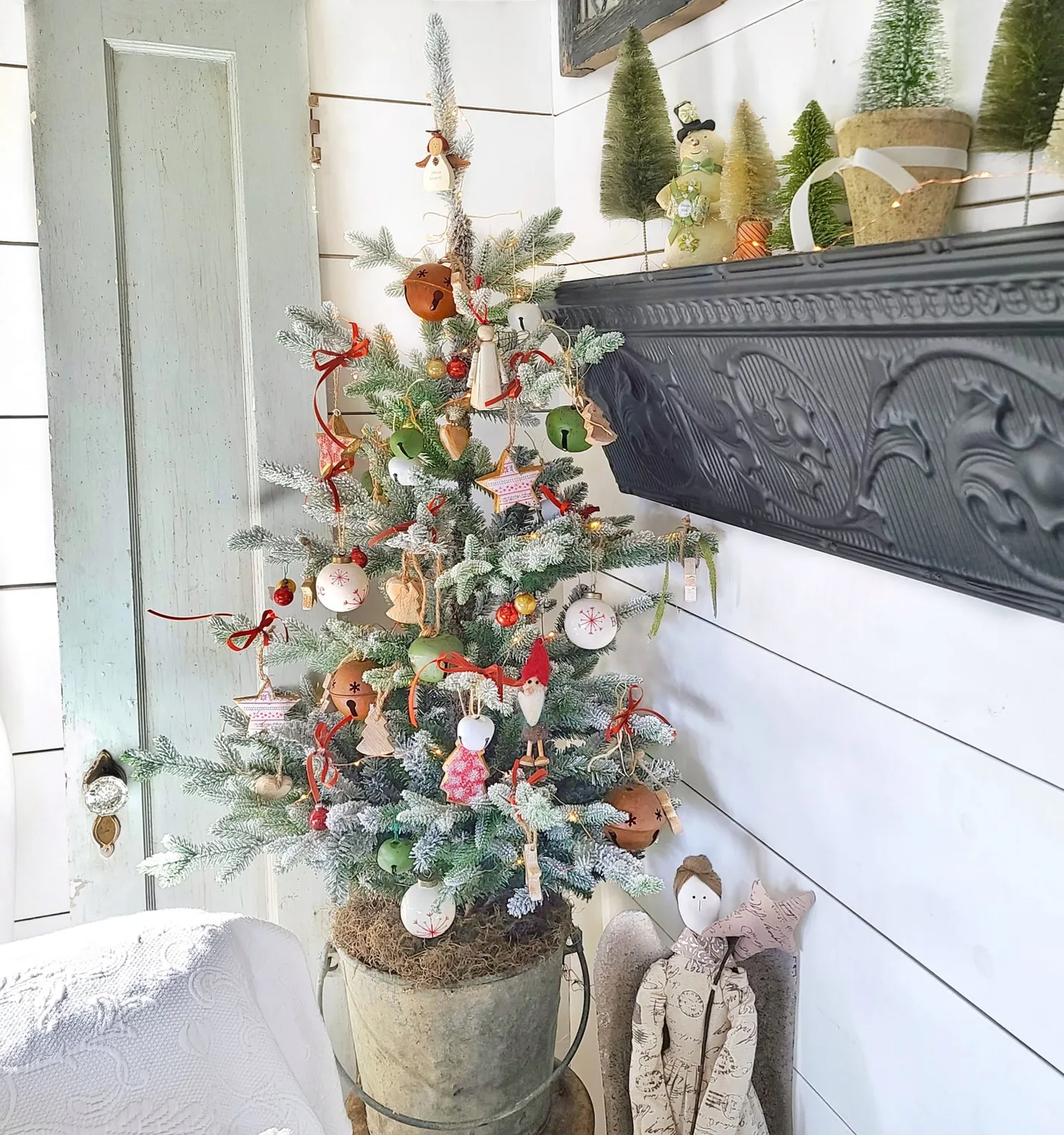
- 24 inch flocked artificial tree: $25–$45
- Galvanized bucket: $10–$18
- Dried or preserved moss to fill it: $8–$14
- Bell, star, and figurine ornaments as a set: $18–$30
- Red ribbon by the roll: $5–$8
- Total: $66–$115
Budget alternative: a $12 galvanized bucket from a farm-supply store, $5 of moss from the craft aisle, and ornaments pulled from last year’s box — you’re down to about $35, and nobody will know the difference against a white shiplap wall.
Dried moss is doing two jobs in that bucket: it hides the stand and it kills the hollow metallic echo that makes a galvanized container sound cheap when you bump it. Pack it in loosely, about 2 inches deep, and leave the top edge of the bucket visible — overfilling makes the tree look like it’s sinking. One 4-quart bag of preserved moss covers a standard 10-inch bucket with room to spare.
16. Cream Paper Globes and Bronze Glass on a Window Seat
Paper globe ornaments are lovely, cheap, and surprisingly fragile. They crush. Stack them wrong in a storage bin and you’ll open the box next November to a pile of flattened spheres — so pack them in a single layer, or in a box with dividers. They also dislike damp basements and hot attics, both of which will warp the paper. And if this tree lives near a window seat, keep it out of direct afternoon sun or the cream paper goes yellow by February.
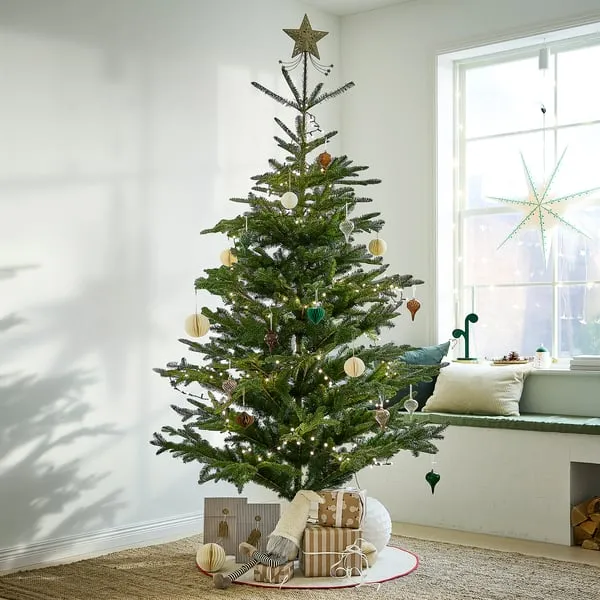
- Cut 8 circles of cream cardstock, 3 inches across, using a punch or a small bowl as a guide.
- Fold each circle in half and stack them with the folds aligned.
- Run a line of glue down the center fold and press the stack together.
- Fan the circles open into a sphere, then glue the first and last half-circles to each other to lock the shape.
- Thread a loop of twine through the top, knot it, and hang.
Time: about 8 minutes per ornament. Cost: roughly 40 cents each.
17. A Half-Decorated Flocked Tree on the Kitchen Table
Ornaments are the single easiest thing to buy secondhand. Thrift stores and estate sales are full of glass baubles at 25 to 50 cents apiece, and a mixed box of 40 for $8 is completely normal. The red bell in this arrangement? That’s exactly the kind of piece that turns up in a bag of vintage Christmas odds and ends. Facebook Marketplace listings for a box of Christmas ornaments routinely go for $15 and include enough to fill a small tree three times over.
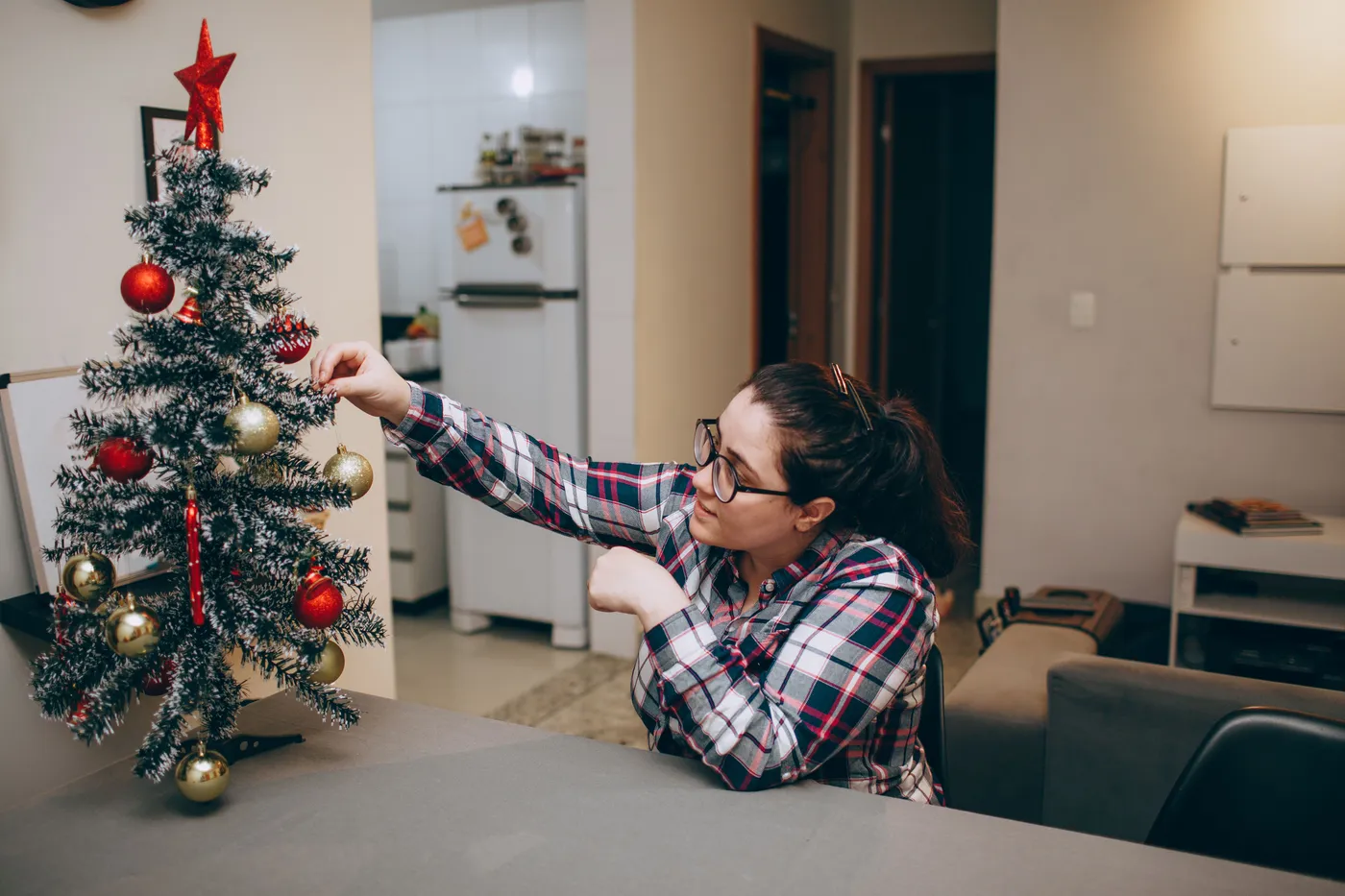
The bell. Among all those smooth red and gold spheres, one textured bell shape breaks the rhythm — and it’s the reason this tree doesn’t look like a generic boxed set. When you’re decorating small, you only have room for a handful of ornaments, so each one has to pull weight. Pick one piece per tree that’s a different silhouette from everything else: a bell, a bird, a tiny wooden sleigh. That becomes your signature.
18. A Wash Tub Planter with Snowflake Ornaments
Raw galvanized metal against dark green is a stronger pairing than most people expect. The tub is matte and slightly dented, which makes the tree look freshly cut even when it isn’t, and the silver and white ornaments pick up that cool metal tone instead of fighting it. The crossbar stand underneath lifts the whole thing off the carpet, so the base reads as furniture rather than a bucket parked on the floor. Remove that stand and the arrangement goes flat, with everything sitting at one height.
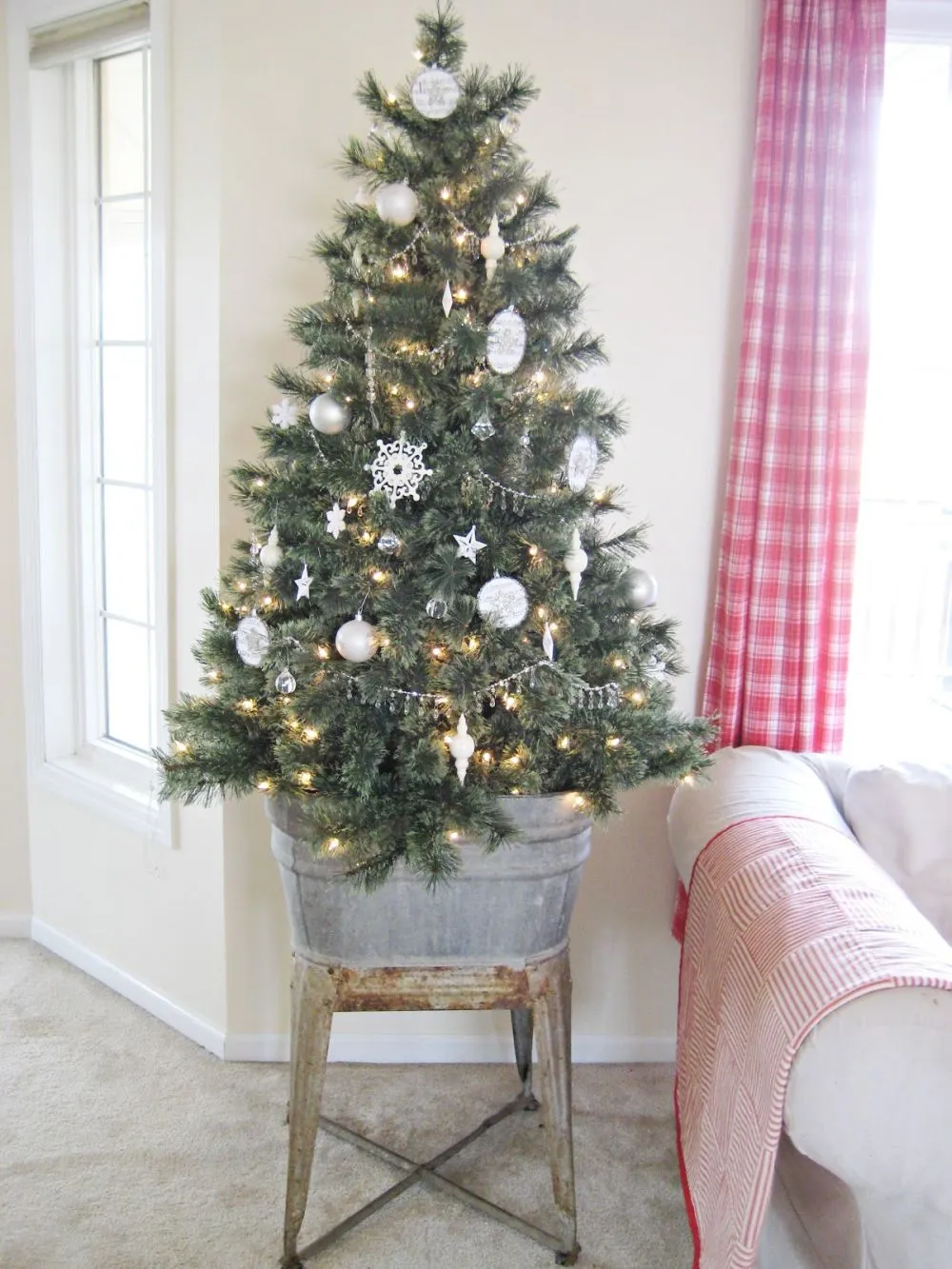
This tub arrangement stands roughly 30 inches tall before you add the tree, so a 24-inch tree tops out near 54 inches — genuine floor presence, not a tabletop moment. Give it 20 inches of clearance on all sides and keep it off high-traffic paths; the metal stand is heavy but the tub itself is not, and a shoulder check will send it over. Works in rooms from about 90 square feet up, and the red plaid curtain behind it gives the whole corner a warm anchor.
19. A Pink Feather Boa Wrapped Through a Silver Tree
A feather boa garland is a commitment. It sheds constantly, especially the first season, and it holds dust like nothing else — plan on a gentle shake outside every few weeks and a lint roller for anything dark underneath it. Faux fur tree skirts have the same personality: gorgeous, and terrible near a wood-burning fireplace where stray sparks land. If either bothers you, swap the boa for wide wired ribbon in blush and keep the fur skirt, but treat it with a fabric protector spray first.
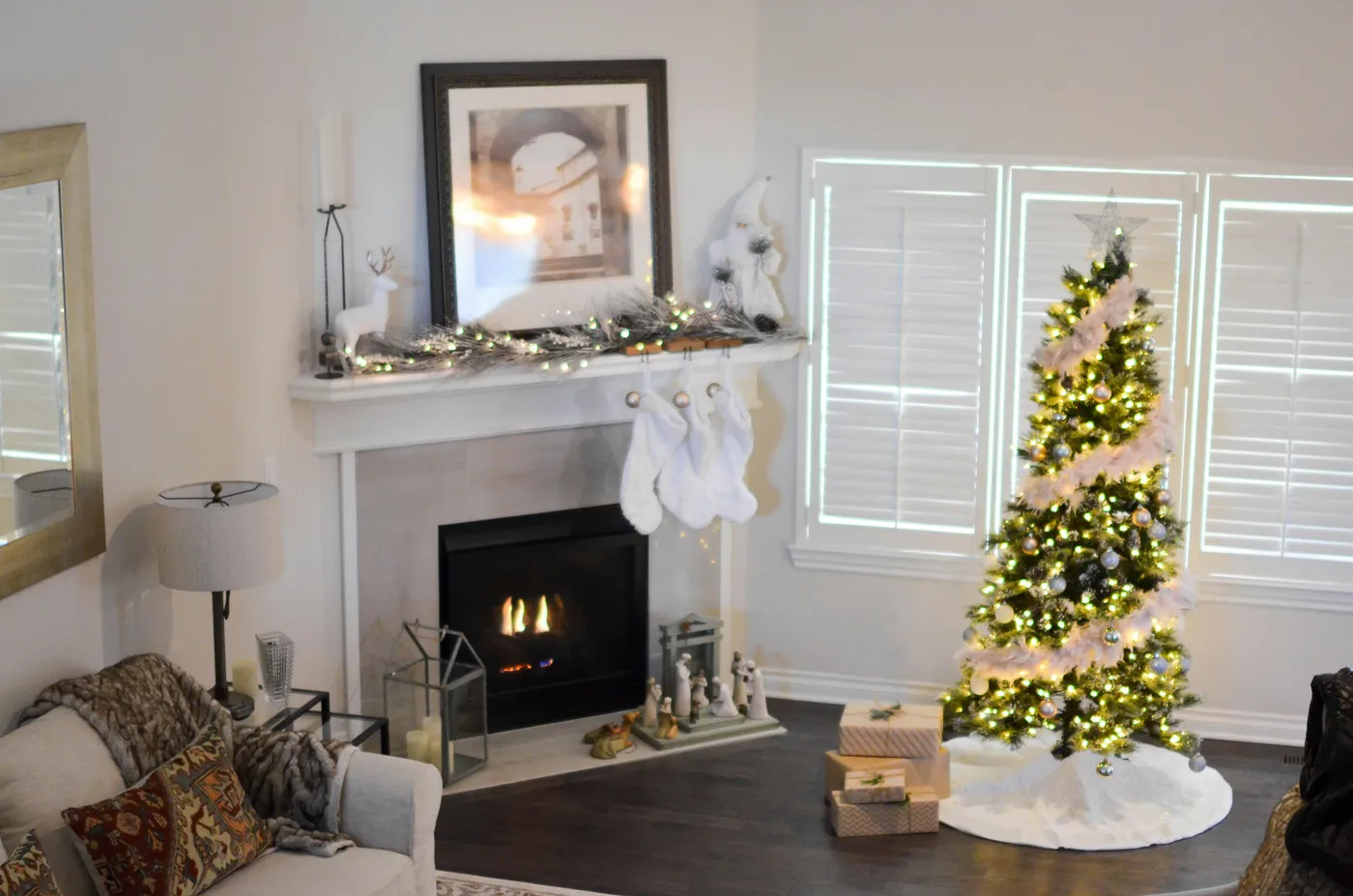
Wrap boas in a spiral, not a loop. Start at the bottom and wind upward with about 10 inches of vertical travel per full turn, so the pink reads as a soft diagonal line rather than a ring around the tree. On anything under 4 feet, a single 6-foot boa is plenty — two will swallow the ornaments. And place it after the lights but before the baubles, so the ornaments sit on top of the fluff instead of disappearing under it.
20. A Gold Tinsel Tree with Vintage Bead Ornaments
Vintage tinsel trees are having a resale moment, but you don’t have to pay collector prices. A 24-inch gold tinsel tree runs $15 to $20 new at Walmart or At Home; thrift stores price them at $3 to $6 when they show up, usually in January. The colorful bead ornaments are the sleeper find — old beaded garland and glass bead strands turn up in craft-store bargain bins for $2 a bag. Stack the display on books you already own and the whole vignette lands under $30.
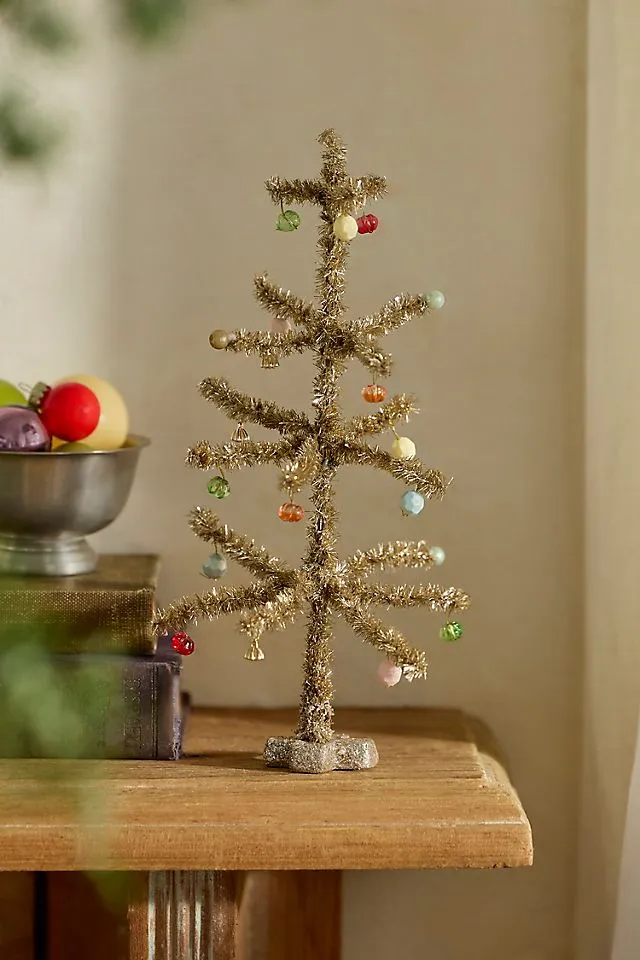
The formula is roughly 50% gold, 40% assorted bead color, 10% silver. That silver bowl of larger ornaments on the left is the 10%, and it works because it’s a different metal at a different scale — it gives the eye somewhere to rest. Swap it for a white ceramic bowl and the arrangement turns softer and more modern. Swap the pastel beads for all-red and you get a much more traditional tree. As with the tinsel-heavy look in Idea #6, keep the metal count low and let the color do the work.
21. A Real Mini Evergreen Behind a Tiny Picket Fence
The miniature picket fence is a small symptom of a bigger 2026 move: cottage-core styling applied to holiday decor. People want their December tables to look like a storybook, not a showroom. That’s also why real, living mini evergreens are outselling faux in the 18-to-30-inch range — they photograph beautifully and they actually smell like the holiday. Fair warning, though: a living tree indoors is a two-to-three-week commitment, not a season-long one.
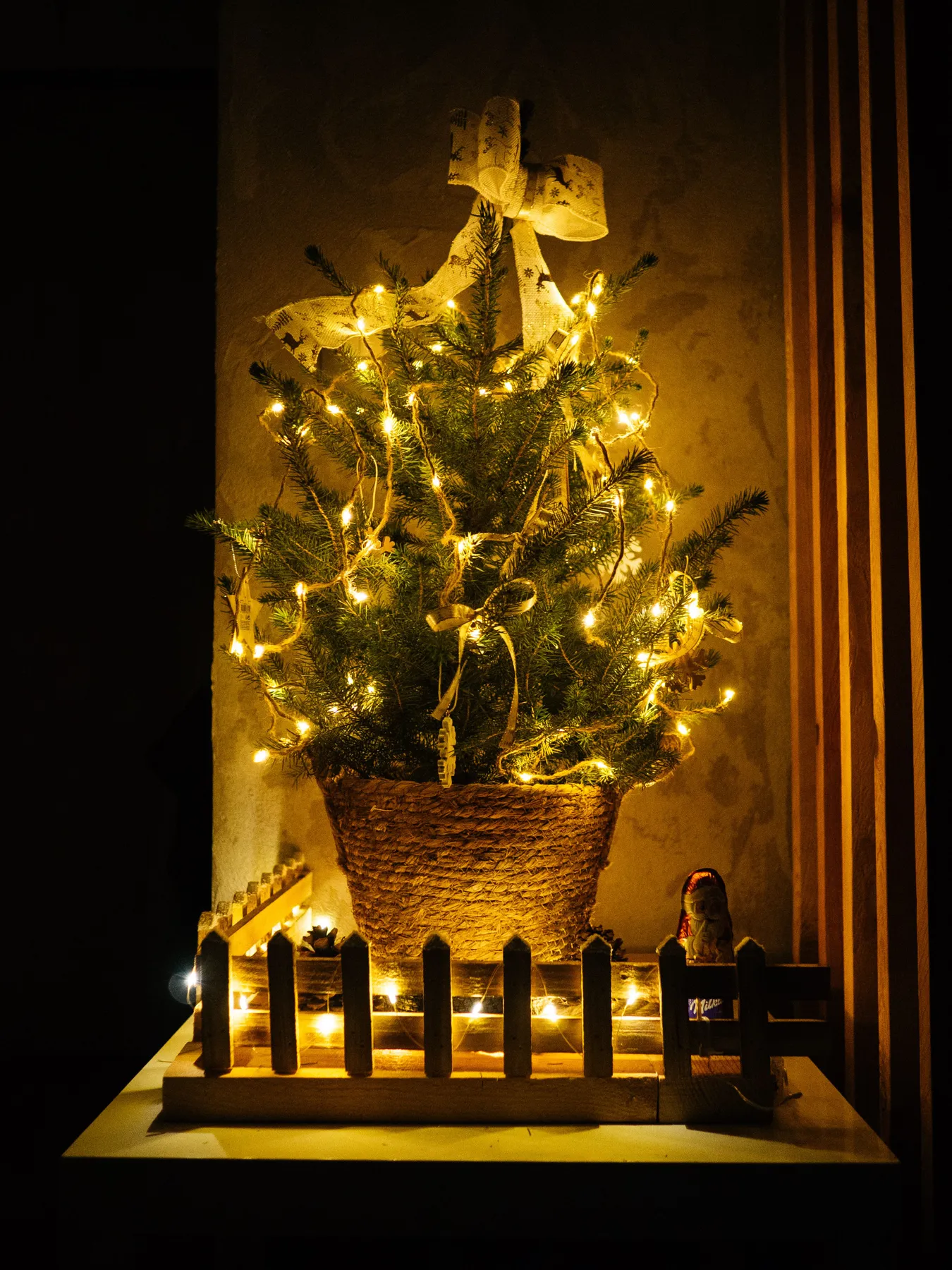
- Water it thoroughly the day before you bring it inside and let it drain completely.
- Set it away from heat vents and radiators — warm, dry air kills these far faster than low light.
- Check the soil every three days and water when the top inch is dry, but never let it sit in a saucer of water.
- Keep it indoors no more than 10 to 14 days, then move it to an unheated garage for a week before repotting or planting.
Time: about 10 minutes of care per week. Cost: $25 to $40 for the tree.
22. A Snowflake Planter with Dried Oranges and Pinecones
Dried orange slices. They cost almost nothing, they’re the only warm saturated element in a display built on green, white, and natural burlap, and they tie the whole thing to the citrus-and-clove smell people associate with December. In a small display like this one, a single strong non-green color does more than ten ornaments ever could. Skip the oranges and you have a nice natural vignette. Add them and it becomes specific and memorable.
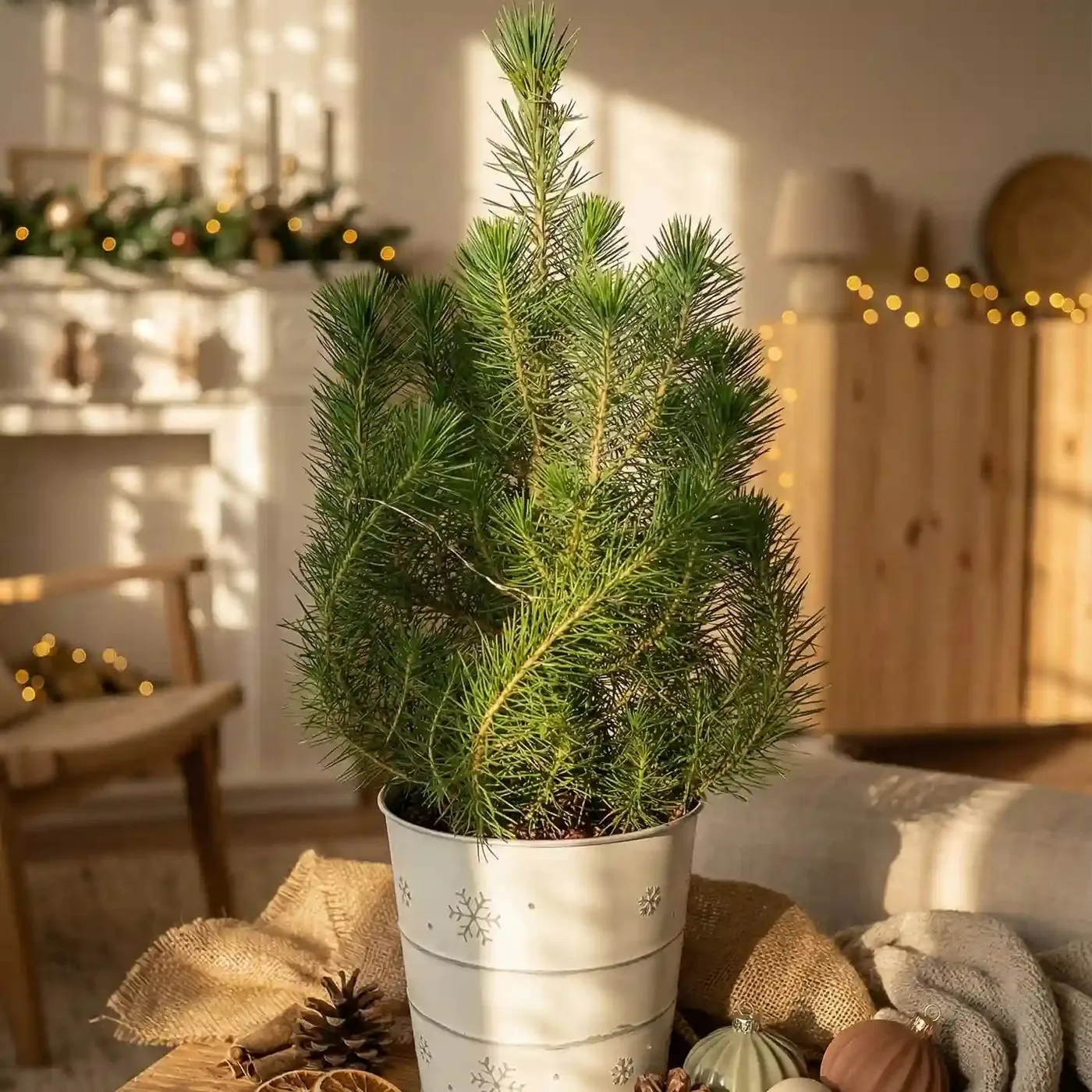
If that pine is a live tree, the white metal planter is a problem waiting to happen. Metal holds cold and heat differently than terra cotta, and a live root ball needs drainage the average decorative planter doesn’t provide. Set the nursery pot inside the planter, raise it on a couple of bricks so it never sits in runoff, and lift it out for watering rather than pouring into the decorative container. Do that and a $30 tree survives to be planted in spring.
23. Red Tinsel and Multicolor Lights, Unapologetically Nostalgic
Multicolor lights are the entire personality here, and they work because everything else is loud too — red tinsel, gold bells, mixed baubles, a gold star. The mistake people make is combining multicolor lights with a restrained, monochrome ornament scheme; the lights then look like an accident instead of a decision. Match the energy and it reads as deliberately nostalgic, which is exactly the mood this little tree is chasing from its spot on the snow-dusted boards.

Bold color tolerates small sizes better than subtle palettes do. A 20-inch tree with multicolor lights and red tinsel holds its own on a bookshelf, a bar cart, or a wide windowsill. What it can’t do is sit in the corner of a large room and carry the space — under 24 inches, it needs a surface or a tight vignette around it. Give it 12 inches of clear wall behind it so the colored lights have something to bounce off.
24. The Tabletop Tree With Built-In Lights
Pre-lit tabletop trees live or die on their cord. Before you buy, check three things: whether the lights run on batteries or a plug, whether the cord exits near the bottom of the trunk, and whether the adapter is small enough to hide under the base. A plug that exits mid-trunk will show against the branches no matter how you style it. Battery-operated sets with a built-in timer are worth the extra $8 — six hours on, eighteen off, and you never think about it again.
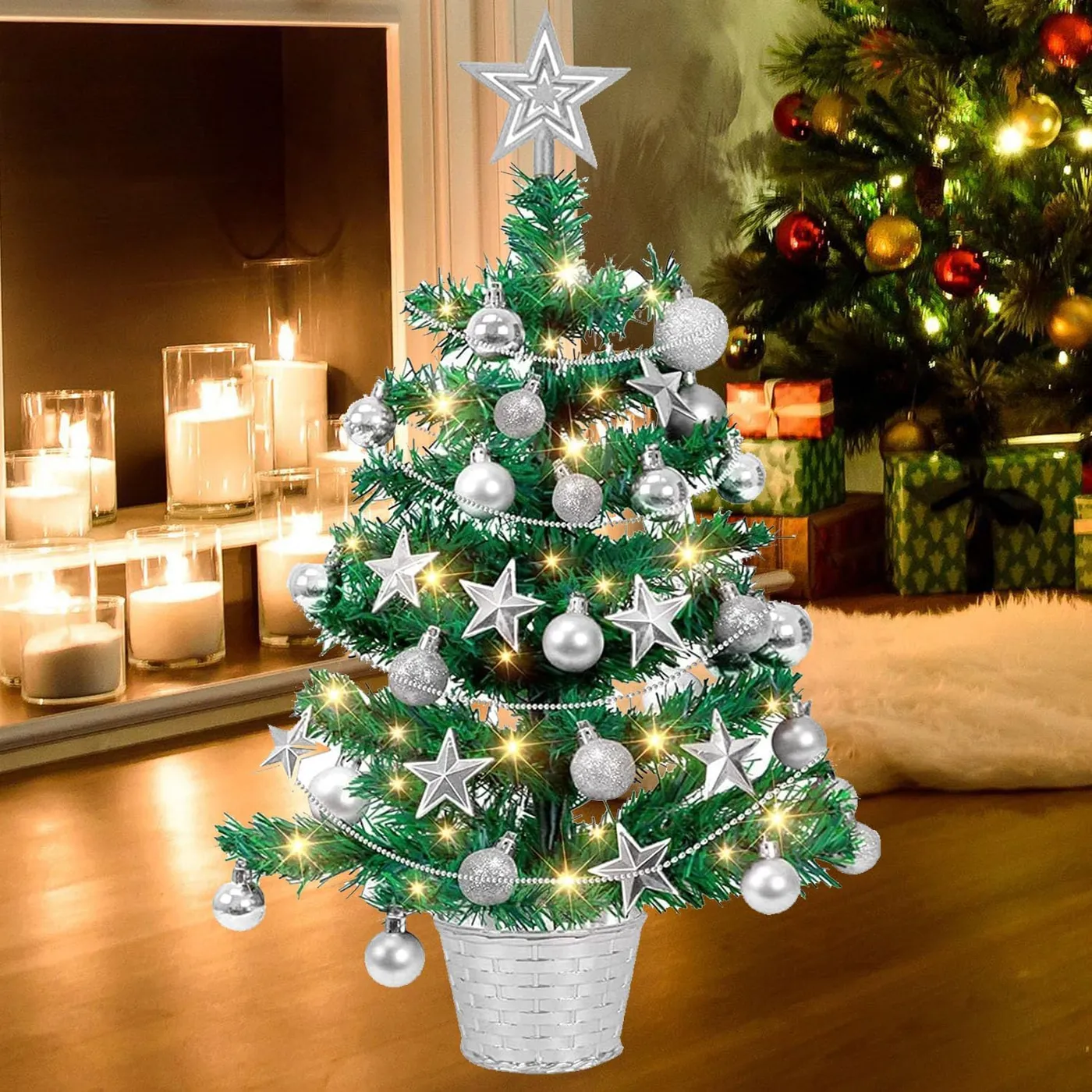
Pricing on pre-lit tabletop trees swings wildly. A 24-inch pre-lit tree runs $20 to $35 at Walmart, Target, or Big Lots during November, and the same size runs $60 to $90 at specialty holiday stores. The difference is usually fullness and the quality of the light string, not the overall look. If you already own a small unlit tree, a $9 strand of 100 warm white battery LEDs takes about 15 minutes to wrap and gets you the same result for less.
25. Flocked, Gold, and Peach on the Kitchen Island
Call it 60% frosted white and green, 25% gold, 15% peach. The peach is what keeps this from looking like every other gold-and-flocked tree on the internet — it’s the same value as the gold but far softer, which reads as warmth rather than shine. Switch the peach for blush and it goes sweeter. Switch it for burgundy and the whole island display turns richer and more traditional. The burlap-wrapped base stays regardless.
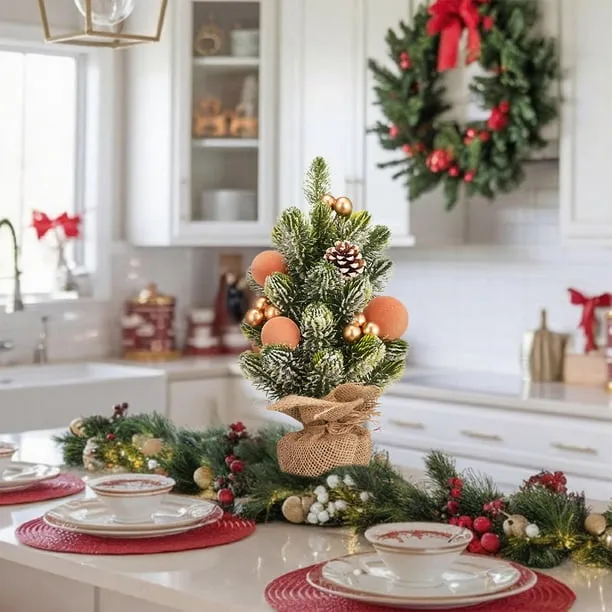
Gold ornaments on a white kitchen island are a risk: shiny metal against glossy white quartz can turn cold and clinical fast. What saves it is the flocked finish and the burlap wrap, both of which add matte texture to a very smooth setting. It’s the same principle as the burlap-and-faux-fur pairing in Idea #2 — a small tree needs one rough, natural element to keep it from looking like plastic.
26. Blue and Silver with a Fluffy White Garland
Blue and silver is a beautiful combination with one built-in trap: it photographs cooler than it feels. In a room with warm white bulbs, blue ornaments can look gray and slightly lifeless by evening. The other thing to know is that white fluffy garland goes gray with dust quickly, and it isn’t washable. If your tree sits anywhere near a kitchen or a wood stove, plan on replacing it every other year, or swap it for a white ribbon you can wipe down with a damp cloth.
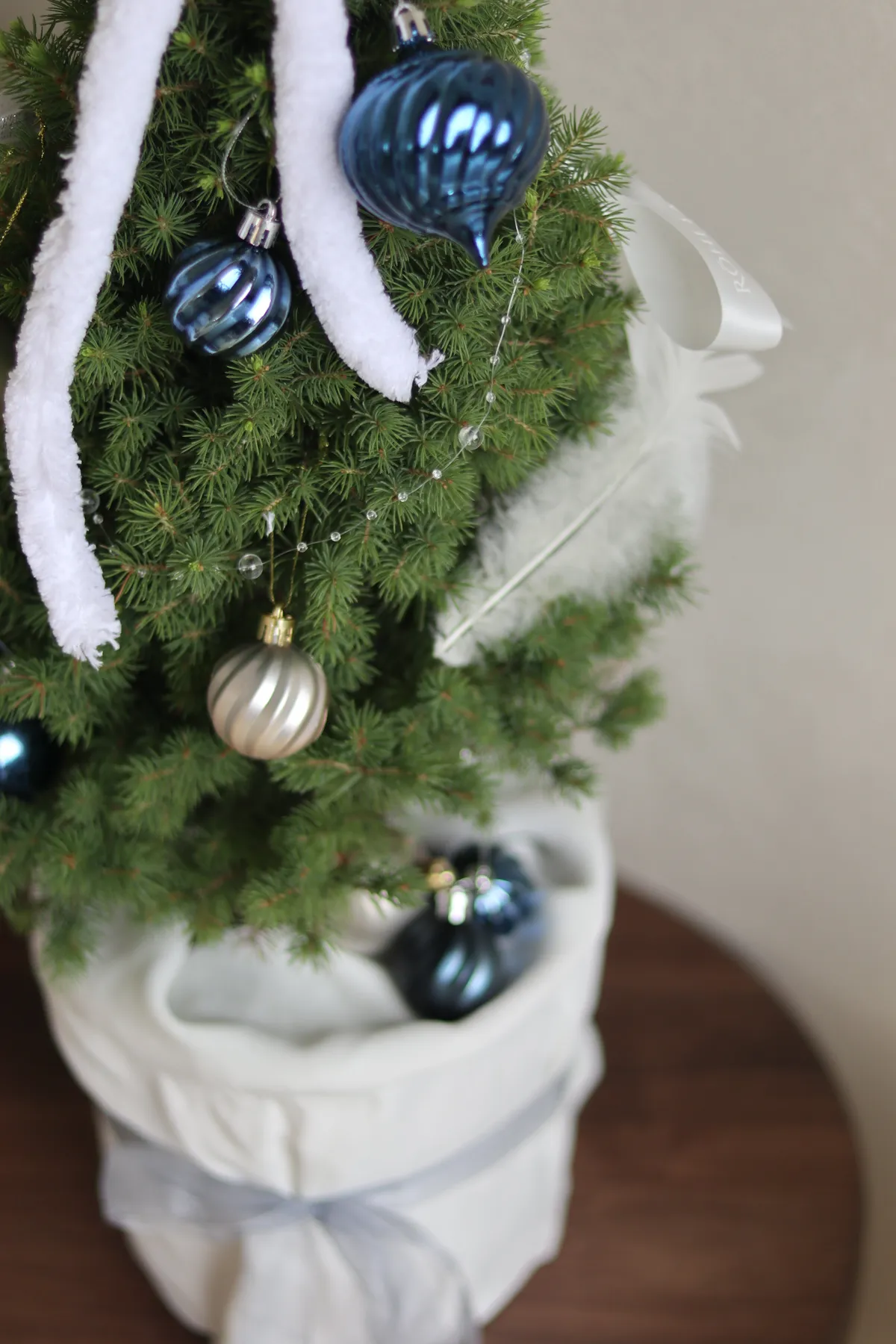
- Cut a square of white cotton or linen about 20 inches larger than the pot’s diameter.
- Set the pot in the center and gather the fabric up around the trunk, keeping the folds even.
- Tie a grey ribbon in a simple knot at the trunk — not a bow — and trim the tails to about 6 inches.
- Fluff the fabric at the bottom so it pools slightly on the table instead of hugging the pot.
Time: 5 minutes. Cost: $6 to $10 for a yard of cotton.
27. Beaded Garland Snow Globes in a Wooden Bucket
Nostalgia has been the dominant holiday aesthetic for a few seasons now, and 2026 pushes it further: beaded garlands, miniature snow globes, and warm white lights instead of cool. It’s a reaction to years of minimalist Scandi Christmas styling — people want their grandmother’s December, just edited. The board-and-batten wall and round window give this room a farmhouse frame, but the ornaments themselves are pure 1975, and that contrast is entirely on purpose.
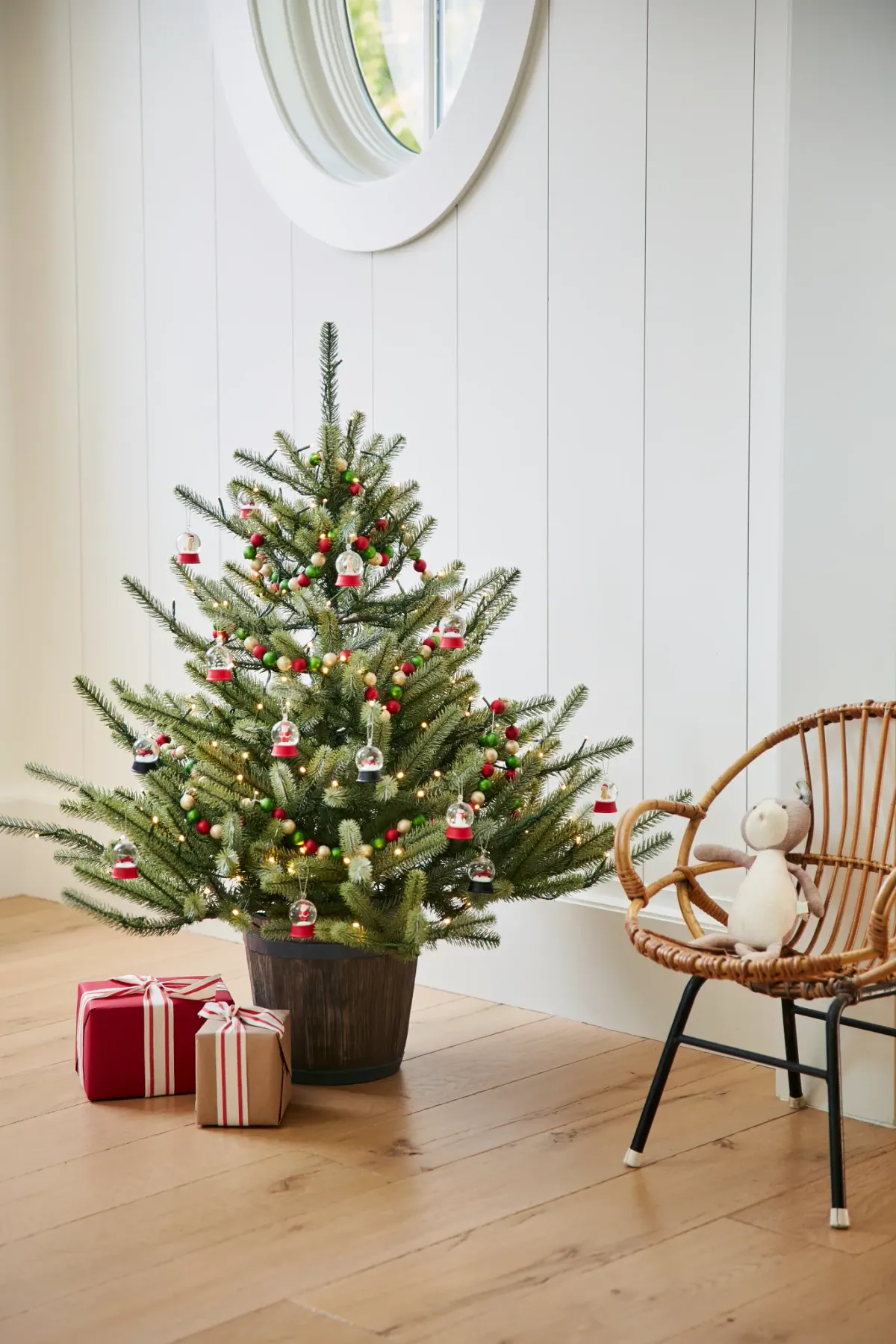
The miniature snow globe ornaments. Beaded garland and warm lights are everywhere; the tiny globes are what make this tree feel collected rather than bought. They’re also small — under 2 inches — which matters on a compact tree, because oversized ornaments are the single most common styling mistake people make on small trees. One or two of these, spaced well apart, do more than six large baubles clustered together.
28. Santa Topper and Faux Fur Skirt in a Red-and-Gold Corner
Classic red-and-gold, sized for a small footprint:
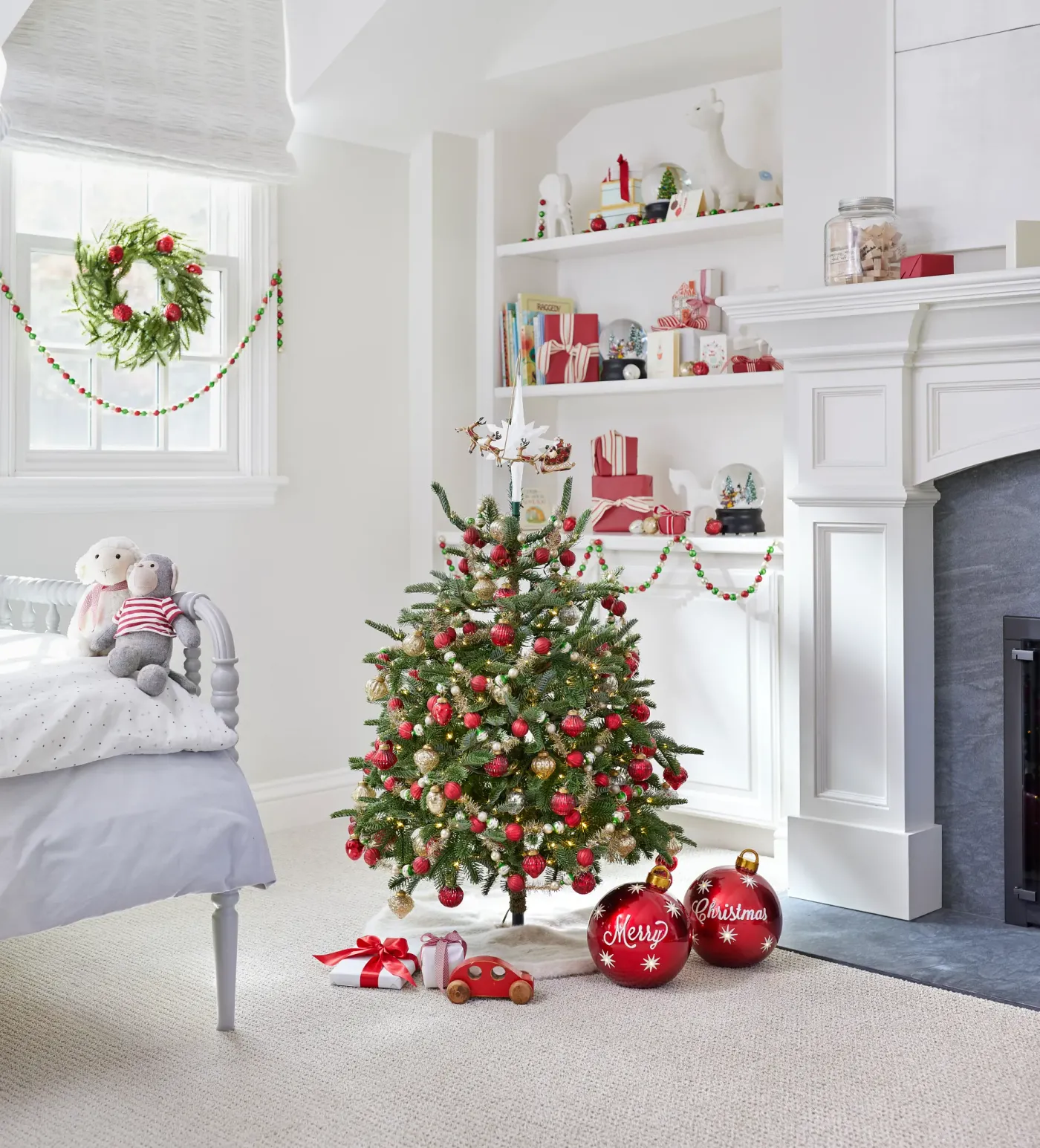
- 4-foot artificial tree: $45–$75
- Red and gold ornament sets, about 60 pieces: $25–$40
- Warm white string lights: $10–$18
- White faux fur tree skirt: $20–$35
- Santa and reindeer topper: $12–$20
- Total: $112–$188
Budget alternative: a $30 tree from Walmart, ornaments from a single mixed box at Michaels with a 50% off coupon (about $15), and a white fleece blanket gathered at the base instead of a fur skirt. That’s roughly $55 for a look that reads nearly identical from across the room.
Faux fur skirts are sized by diameter, and most of them are cut for 7-foot trees. On anything under 5 feet, a standard 48-inch skirt swallows the base and pools on the carpet. Buy a 30-inch collar-style skirt, or bunch a 48-inch one so the excess gathers behind the tree where nobody can see it. The skirt should stop 6 to 8 inches from the widest branches, no more.
29. Berries and Burlap on a Snow-Covered Sideboard
Two things to know before you commit to a snow-covered display. First, artificial snow flakes off and gets everywhere — vacuum it up with a hose attachment rather than a brush, or you’ll grind it into the surface. Second, flocked trees and open flames should never share a surface. That pillar candle needs to be a battery LED, or at minimum kept 12 inches from the branches. Flocking is treated fabric, and it will catch.
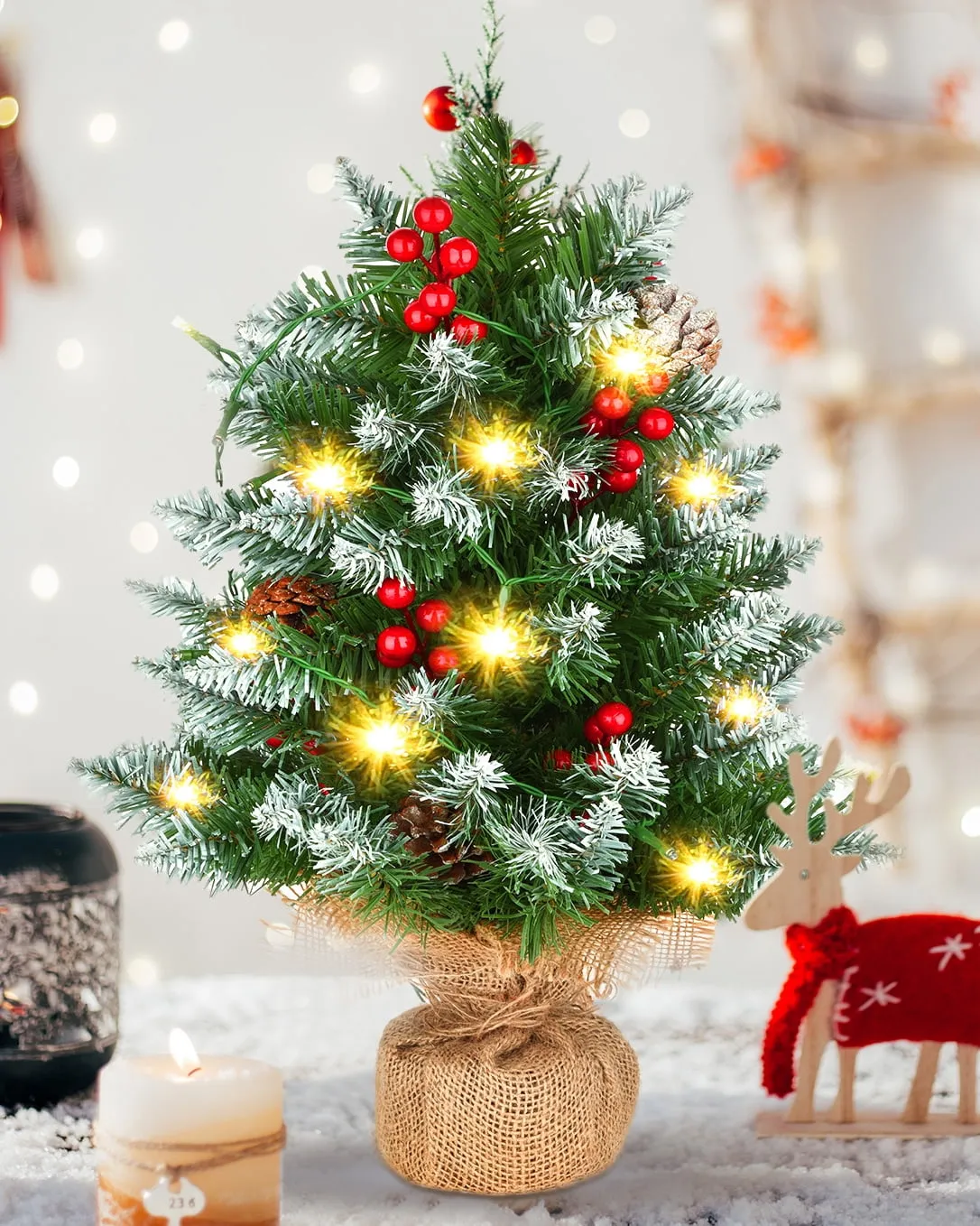
This is a sideboard arrangement: roughly 48 inches wide and 18 inches deep, with the tree about 20 inches tall. That leaves room for the wooden reindeer, the candle, and a small stack of greenery without anything crowding the edge. Keep the tallest element — the tree — within 6 inches of the back so the front stays open and browsable. If your sideboard is under 36 inches wide, drop the reindeer and keep just the tree and one accessory.
30. A Pink Flocked Tree Next to the Electric Fireplace
Pink flocked trees get marked up because they’re a niche item. A 24-inch pink flocked tree runs $35 to $60 at specialty shops, but Walmart and Target both carry them for $22 to $30 in early November, and they sell out fast. Cheaper still: buy a plain 24-inch green tree for $15 and a can of pink snow spray for $8 — two light coats, 30 minutes of drying, and you have the same look. Add cotton bolls at $6 a stem and you’re done. It’s the softer counterpart to the neutral flocked tree in Idea #13.
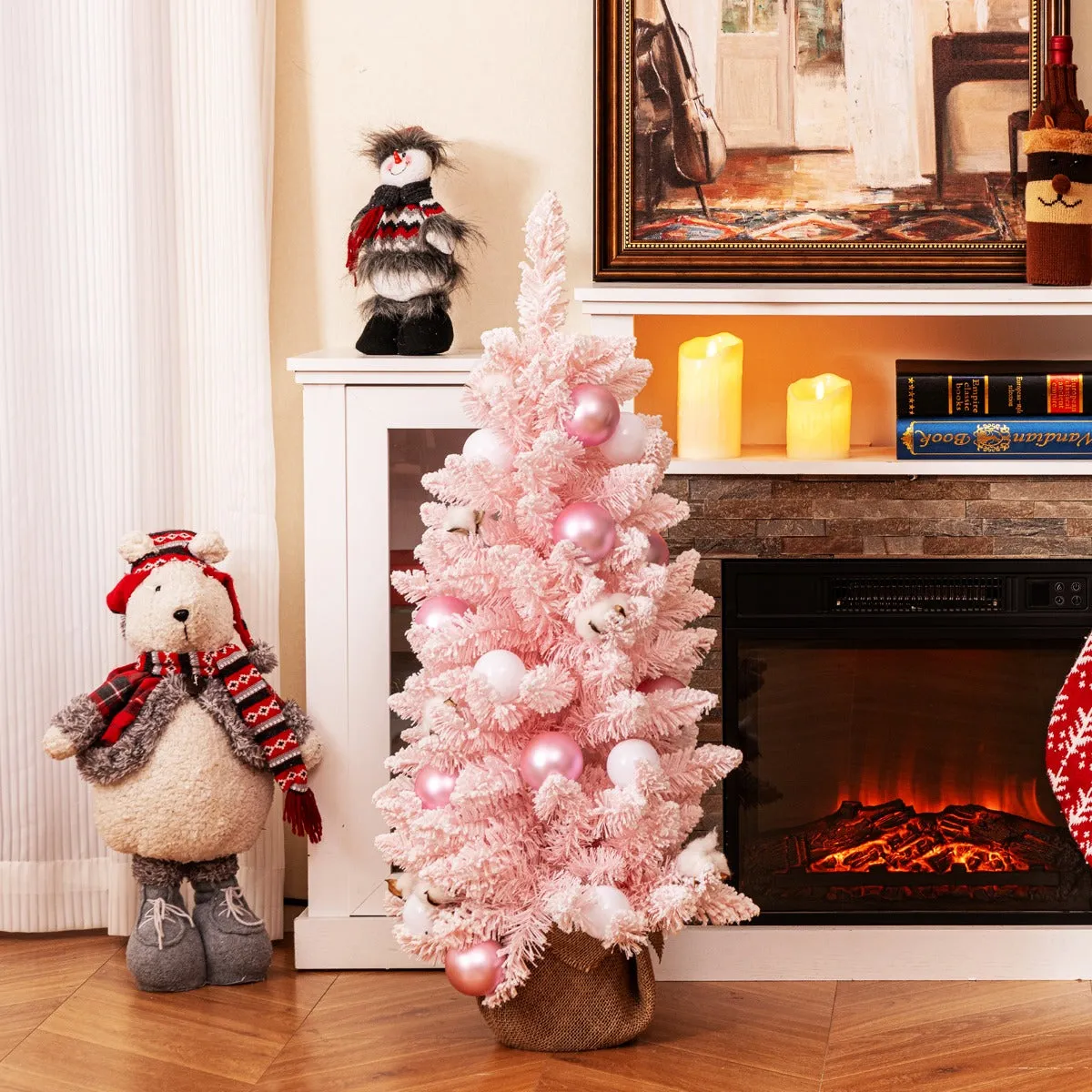
Roughly 70% pink and white, 20% light wood and neutral, 10% black. That black matters more than it sounds — the dark framed art and the fireplace elements keep all that pastel from floating away into candy land. Want it even softer? Drop the black and add more cream. Want it sharper? Add one hit of bright red, which the plush figures beside it are already hinting at.
31. A Glowing Miniature Forest with a Single Deer
The deer. In a miniature forest of glowing bottle brush trees, one small standing figure creates scale — suddenly the trees aren’t decorations, they’re a landscape with something living in it. That’s a completely different emotional response from the one you get looking at a cluster of lights. Without the deer you have a pretty arrangement. With it, you have a scene, and your brain fills in the rest. One $4 figurine is doing more work than the other ten trees combined.
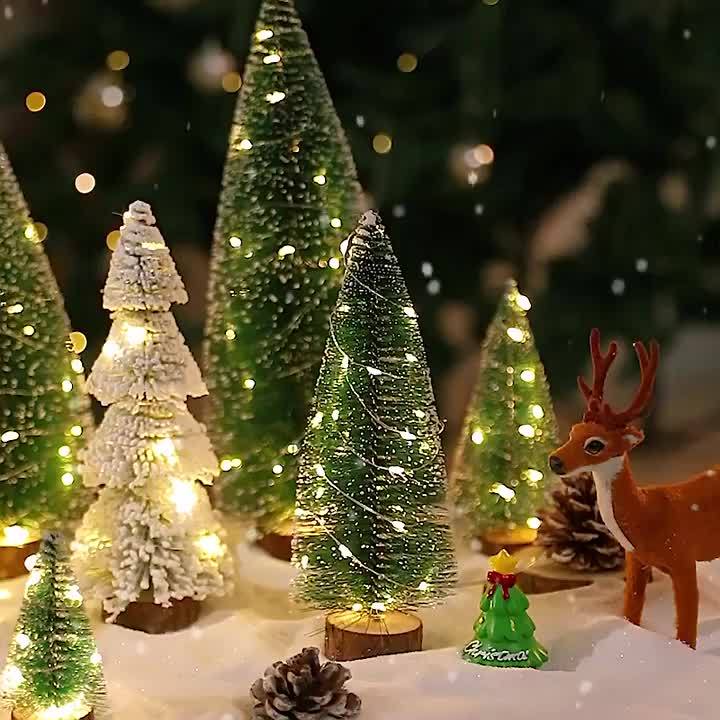
Every tree in this grouping is lit, including the frosted white ones, and that’s what keeps the mix from reading as two separate collections. The plain green and the frosted white become one continuous forest because the same tiny warm bulbs run through all of them. Faux snow underneath unifies it further, and the height rhythm — tallest trees in back, tiny ones up front — creates real depth on a surface that’s only a few inches deep.
32. A Gold-Dressed Tree on the Windowsill
- Measure the sill depth first — you need at least 8 inches to fit a basket base and a 20-inch tree safely.
- Set a piece of non-slip shelf liner under the basket; painted sills get slick when they’re cold.
- Run the lights on batteries and route the pack behind the basket, out of the window line.
- Check that no branch touches the glass — condensation will spot the needles and dull the gold ornaments.
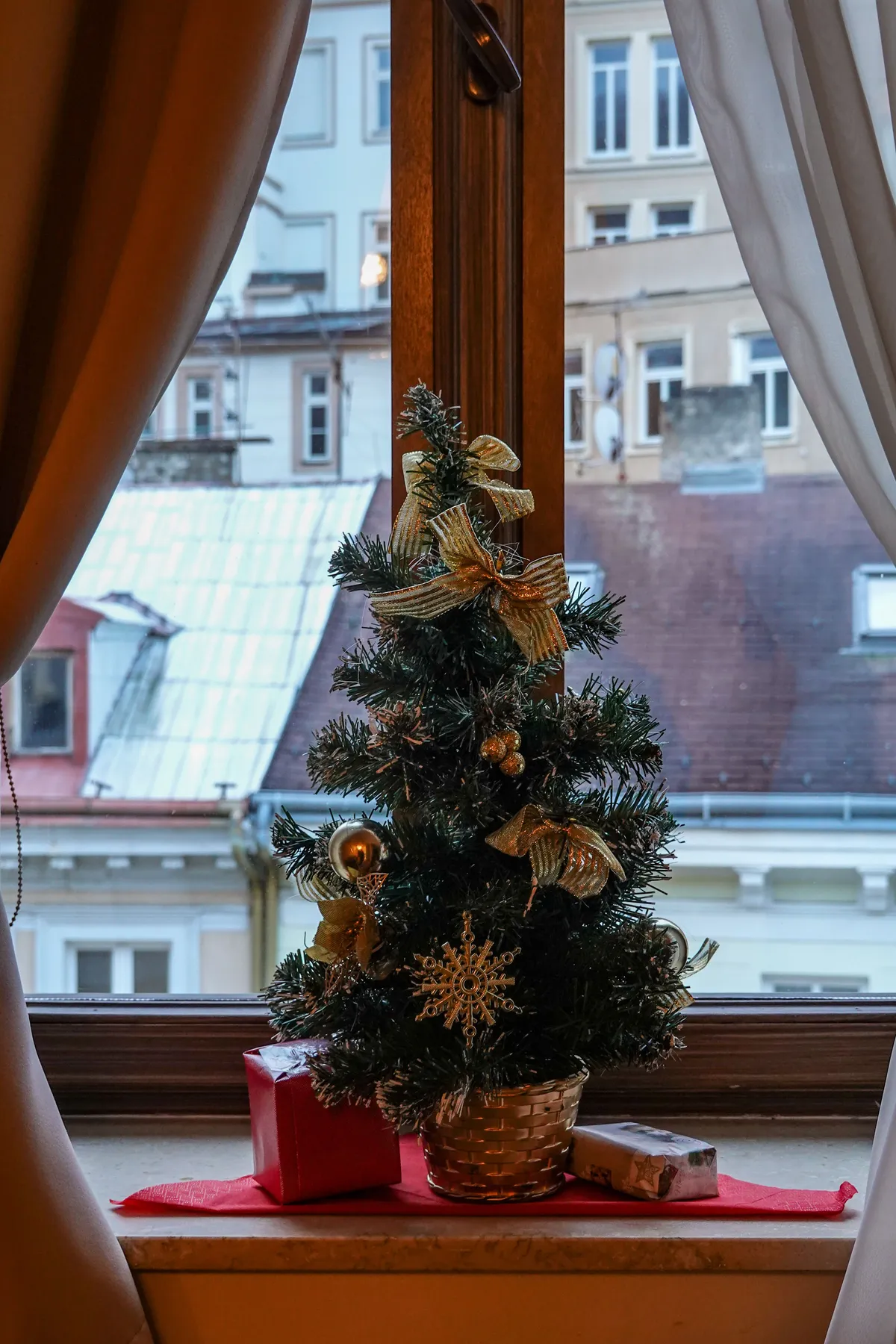
Time: 15 minutes. Cost: about $10 for liner and batteries.
Windowsills are lovely and also the worst possible climate for a tree. South-facing glass acts like a magnifying glass on gold ornaments, and in winter that glass gets cold enough to frost anything touching it. If yours sits above a radiator, the heat will dry a live tree out in a week and warp faux branches over a season. Keep the tree a few inches back from the glass — and if there’s a radiator directly below, this is one idea worth skipping.
Your Tiniest Tree Might Be the Best One in the House
Thirty-two ideas, and not one of them needs a corner of the living room you don’t actually have. Start with the surface you’ve got — a desk, a sill, a sideboard, a kitchen island — and let the tree match it, instead of rearranging furniture to match the tree.
Pin this guide now, because the best small-tree ideas are the ones you come back to in November with the measurements already saved on your phone.