
Still scrolling white Christmas photos at 11 p.m., wondering which ones actually work in a house with a dog, a radiator, and one outlet behind the tree? Same.
We spent serious time browsing HomeGoods, Amazon, and Target to bring you only what’s worth your attention this year — from $8 ornament sets to $650 trees.
What follows is 33 real rooms, photographed in real homes, covering frosted flocked trees, white-and-silver elegance, cozy neutral minimalism, and crisp black-and-white modern — with budget and luxury versions of the same look compared side by side.
White decorating is peaking in 2026 for a practical reason: flocked faux trees and warm-white LED strands finally look convincing up close, and neutral decor still works in January when everything else comes down.
And stay until the end — we break down the most common mistakes that can ruin these looks.
📌 Save this to Pinterest for later — you’ll want to revisit these ideas.
1. The Glitter-Swirl Ornament That Sets the Whole Tone
Here’s the thing nobody tells you about flocked trees: hang your shiniest ornaments inside the branches, not at the tips. Push a 4-inch silver-swirl bauble back so the frosted needles frame it like a shadow box, then let matte white pieces sit out front where they catch the light. On an 8-foot tree, work in three sizes — 4 inch, 3 inch, and 2½ inch — and tuck a small black-beaded ornament near each large one. That single dark punctuation is what keeps an all-white tree from going soft and shapeless.

Two principles are doing the heavy lifting here. First, texture contrast: glitter against matte flocking reads as depth, even though both surfaces are essentially white. Second, the ten percent rule — roughly a tenth of this ornament’s surface is that tiny dark beading, and it gives the eye somewhere to land. Swap the black beads for pearls and you keep every bit of the elegance but lose the snap.
2. Flocked Tree, Corduroy Sofa, and a Wall of Fairy Lights
Take away the cream corduroy sofa and this corner collapses into a showroom display. The sofa gives the tree somewhere to land — a place for your eye to rest after all that white — and it supplies the room’s only real texture: soft, ridged upholstery against crisp flocking. Notice the fairy lights strung on the white paneling behind it. They stretch the glow past the tree so the whole corner reads as one warm scene instead of a tree standing alone in a bright room.
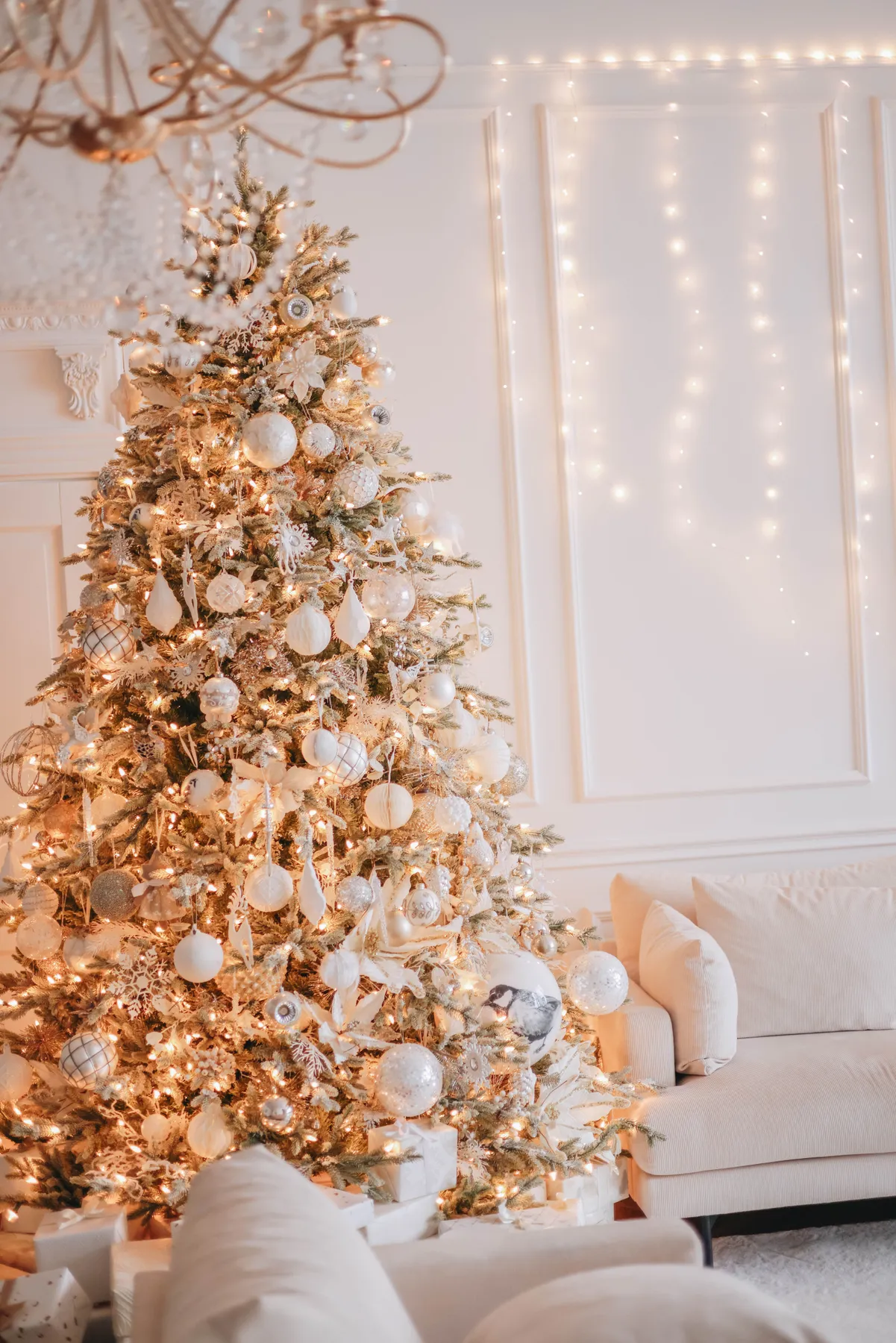
This layout wants a room at least 12 by 14 feet with 9-foot ceilings. Tighter than that and a 7-foot flocked tree plus an 84-inch sofa starts to feel like a furniture showroom. In a smaller living room, drop to a 6½-foot tree and a 72-inch sofa. Working with less than 10 by 10? Skip the sofa entirely and use the tabletop version of this tree instead.
- Tree (7 ft flocked): $180–450
- Lighting (tree strands plus wall fairy lights): $40–120
- Textiles (corduroy sofa, throw, tree skirt): $900–2,400
- Ornaments in white, silver, and champagne: $80–200
- Wrapping paper and ribbon: $25–60
3. A Brick Entry Draped in Evergreen and Warm White
Two honest warnings before you start fastening garland to brick. Never drive nails into the brick face — use cup hooks set in the mortar joints, or outdoor clips, which hold fine down to about 20°F and pop off in spring without a mark. Second, density costs money: a genuinely lush garland needs roughly 100 bulbs per foot of greenery, which means two strands per 9-foot run, not one. Real evergreen stays fresh four to six weeks in cold outdoor air. Inside a heated entryway, it’ll start dropping needles in about ten days.
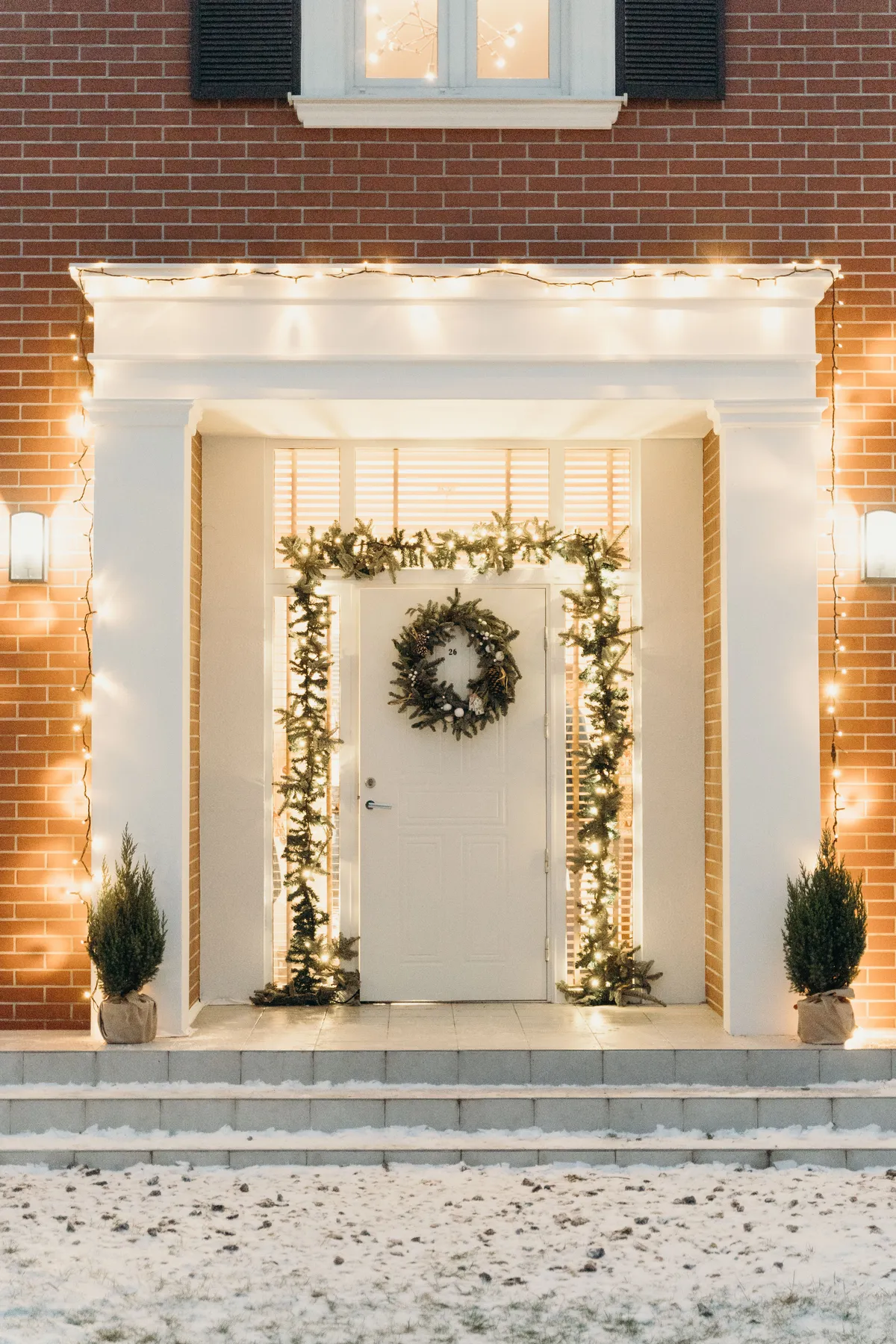
A custom-lit 9-foot garland runs $150–300 installed. Here’s the route that looks the same from the sidewalk: a plain faux garland from Walmart at $25–40, two warm-white LED strands at about $12 each, and a bundle of fresh cedar from a local tree farm for $8–14 tucked on top for the smell and the droop. Add a HomeGoods wreath at $30–45, two potted evergreens in burlap sacks at roughly $25 each from a home center, and you’ve spent under $150 total.
4. Stone Mantel, Knit Stockings, and Not a Speck of Red
The formula here is 70% neutral base — white stone, beige hearth, stacked logs — plus 20% forest green garland, plus 10% metallic split evenly between silver and gold. That’s the whole recipe. No red, no pattern, no theme. Want it cooler? Swap the gold baubles for all-silver and replace the logs with birch. Want it richer? Trade the green garland for deep blue velvet ribbon and gold picks — same formula, winterier result.
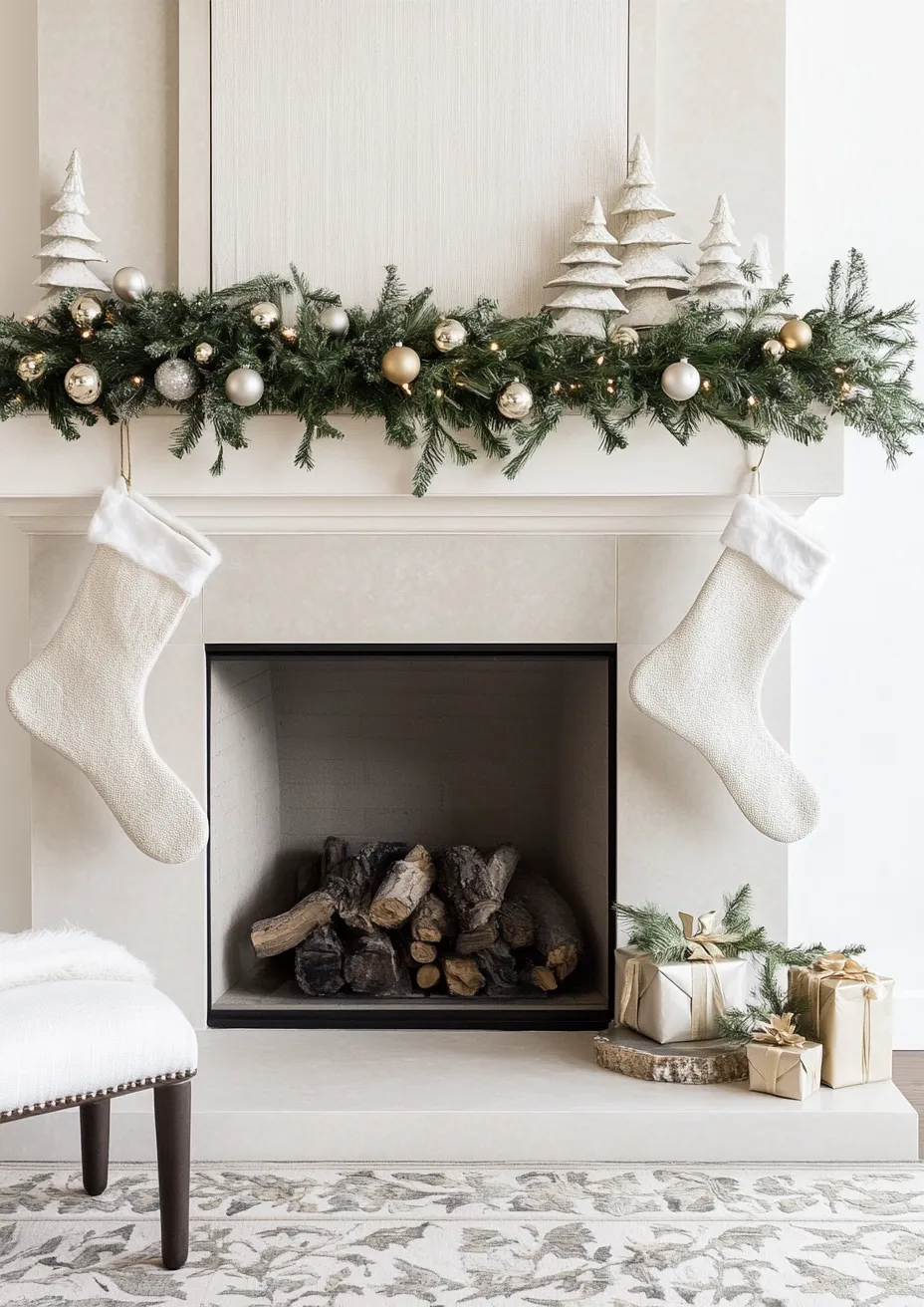
- Measure your mantel and add 12 inches of overhang on each side.
- Lay a faux garland base, then zip-tie a second layer of eucalyptus or cedar picks on top for depth.
- Weave lights every 6 inches, pushing bulbs toward the front so they’re visible from the sofa.
- Tuck ornaments in clusters of three — one large, two small — never evenly spaced.
- Finish with the knit stockings hung slightly off-center so the log stack stays visible.
About 45 minutes of work, $60–150 depending on how much greenery you already own.
Knitted stockings sag into teardrops the second you fill them. Use two hooks per stocking — one at the cuff, one at the toe — spaced about 8 inches apart under the mantel lip. The toe hook keeps the foot from stretching, and you can still tuck a small gift inside without the whole thing drooping by New Year’s.
5. White Angel Ornaments Over a Shaggy Beige Rug
Flocked trees shed. So do white pom-pom ornaments, which collect dust like tiny sweaters. Pair either with a shag rug and you’re vacuuming twice a week in December — use a bare-floor setting and a brushless attachment, or the flocking gets yanked out with the fibers. To dust a flocked tree, blow cool air across it from a foot away with a hair dryer, then vacuum the floor. Never wipe flocking with a damp cloth; it smears into gray streaks that don’t come out.
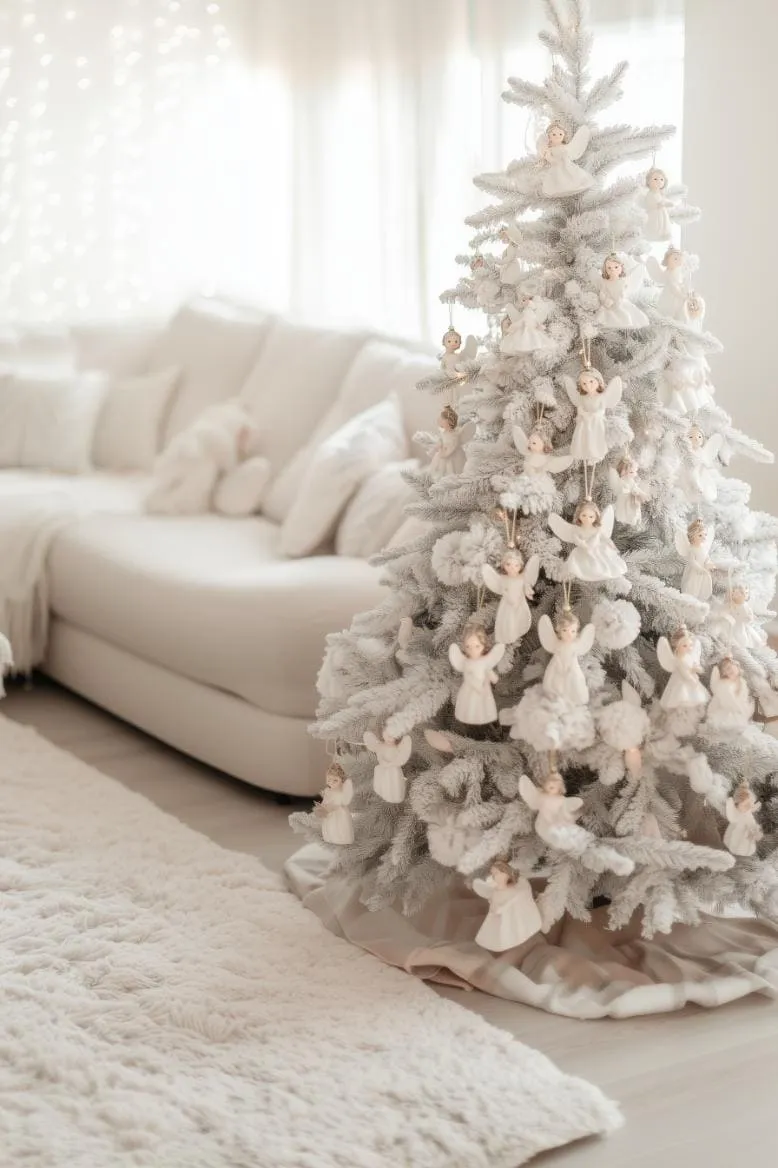
Everything in this corner sits within a few shades of everything else — tree, sofa, pillows, rug — so contrast has to come from somewhere else, and here it’s texture. Flocking, bouclé, pom-poms, shag. Four different surfaces, one color family. That’s the trick with white-on-white: vary the surface, not the shade. Compare with Idea #16 — same instinct, but grey is allowed in to do the grounding work.
- Measure floor to ceiling before buying; flocked trees read wider than they measure.
- Count your outlets — this corner needs power for tree lights plus anything on the wall.
- Test a hidden branch with a lint roller before you commit to the whole tree.
- Buy a tree storage bag the same week as the tree; flocking crushes permanently.
- Decide now whether this tree is staying up past New Year’s.
6. Log-Slice Candles on a Rustic Wooden Table
Keep the tallest candle on the table under 12 inches, then step down in 2-inch increments — 12, 10, 8, 6. Anything taller and your guests spend the evening playing peekaboo across the table. And don’t group everything at dead center. Place your largest cluster one-third of the way in from each end instead; it feels collected rather than staged, and it keeps the sightline open straight down the middle.
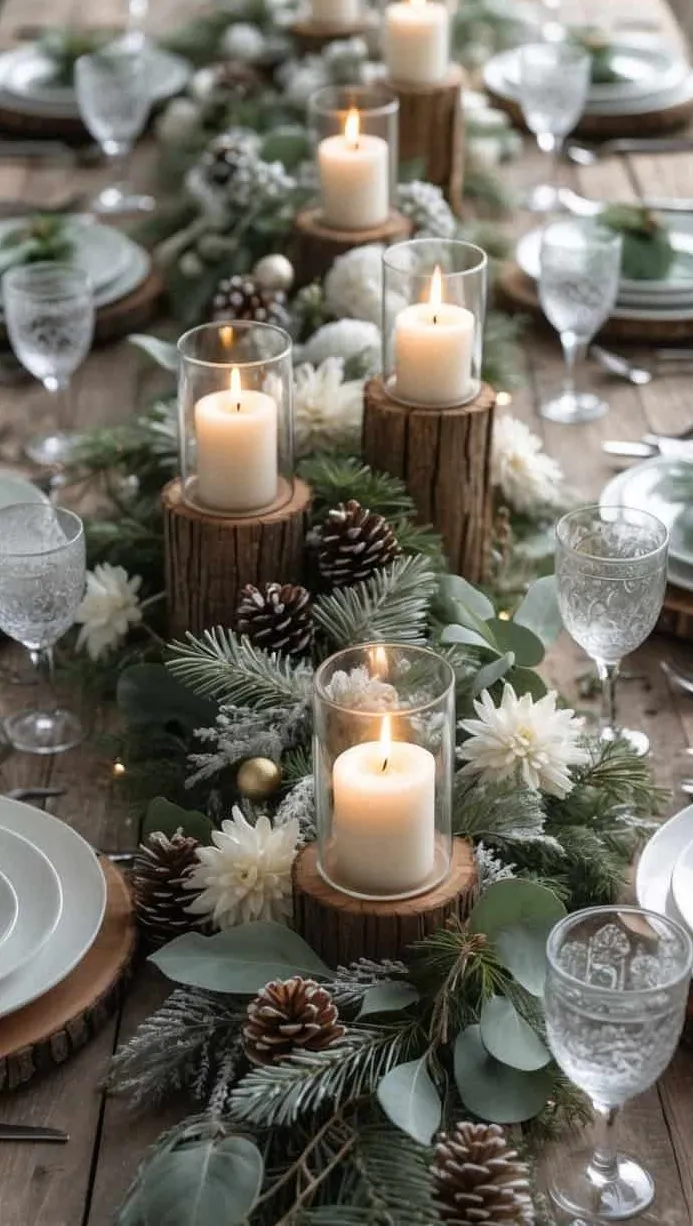
- Dining table and chairs (if you’re buying): $400–1,800
- Candles and glass hurricane holders: $70–180
- Textiles (runner, linen napkins): $30–90
- Decor (wood slices, pinecones, eucalyptus, white chrysanthemums, gold ornaments): $60–160
- Wood slice chargers for six: $18–45
The woodland table is having a moment because it’s the anti-red-and-green option — and because it doesn’t die on December 26. Swap the chrysanthemums for amaryllis or white ranunculus and the same setup carries into February. Interest in natural, compostable holiday decor keeps growing, partly because people are tired of storing twelve bins of resin.
7. Silver-Rimmed Plates and Tall White Tapers
Take away the tall white tapers and this is just a nicely set table. The candles are why it reads as an occasion. Height pulls the eye up and out of the plate, creating a vertical rhythm no flat centerpiece can match, and the flames add the only warm color in a silver-and-white scheme. Everything else — the silver-rimmed plates, the patterned crystal, the frosted greenery — is supporting cast.
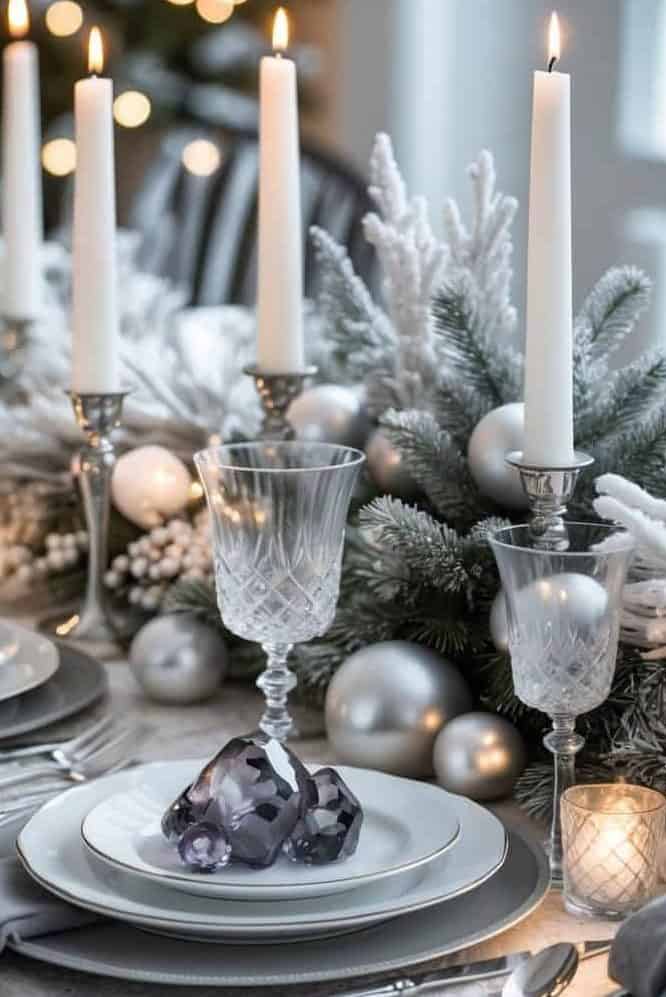
This setting needs a table at least 40 inches wide so chargers and a centerpiece can coexist without crowding. A 6-foot rectangular table seats six comfortably at 24 inches of run per person; anything shorter and you’re relocating candlesticks to eat. On a round 48-inch table, drop the tall tapers and go with one low arrangement — the vertical trick only works when there’s room to see past it.
Count it out: 60% white (cloth, plates, tapers), 25% silver (rims, flatware, candlesticks, ornaments), 15% frosted green. Cool, clean, and easy to shop for. Switch the silver to gold and the table warms up. Trade it for matte black and the whole thing flips modern and graphic.
8. Mercury Glass and Deep Blue Velvet on a Flocked Tree
Designer ribbon runs $18–25 for a 10-yard roll. Hobby Lobby’s 2½-inch velvet is $8–10 for the same length and holds up to being crushed inside a storage bin. Mercury glass ornaments are the other sticker shock — $8–12 apiece at high-end shops, while Walmart and Target sell 12-piece silver-gradient sets for $10–18. White glitter poinsettia picks turn up at dollar stores for $1.25 each. Total savings on a fully trimmed 7-foot tree: somewhere near $200, and nobody will know.
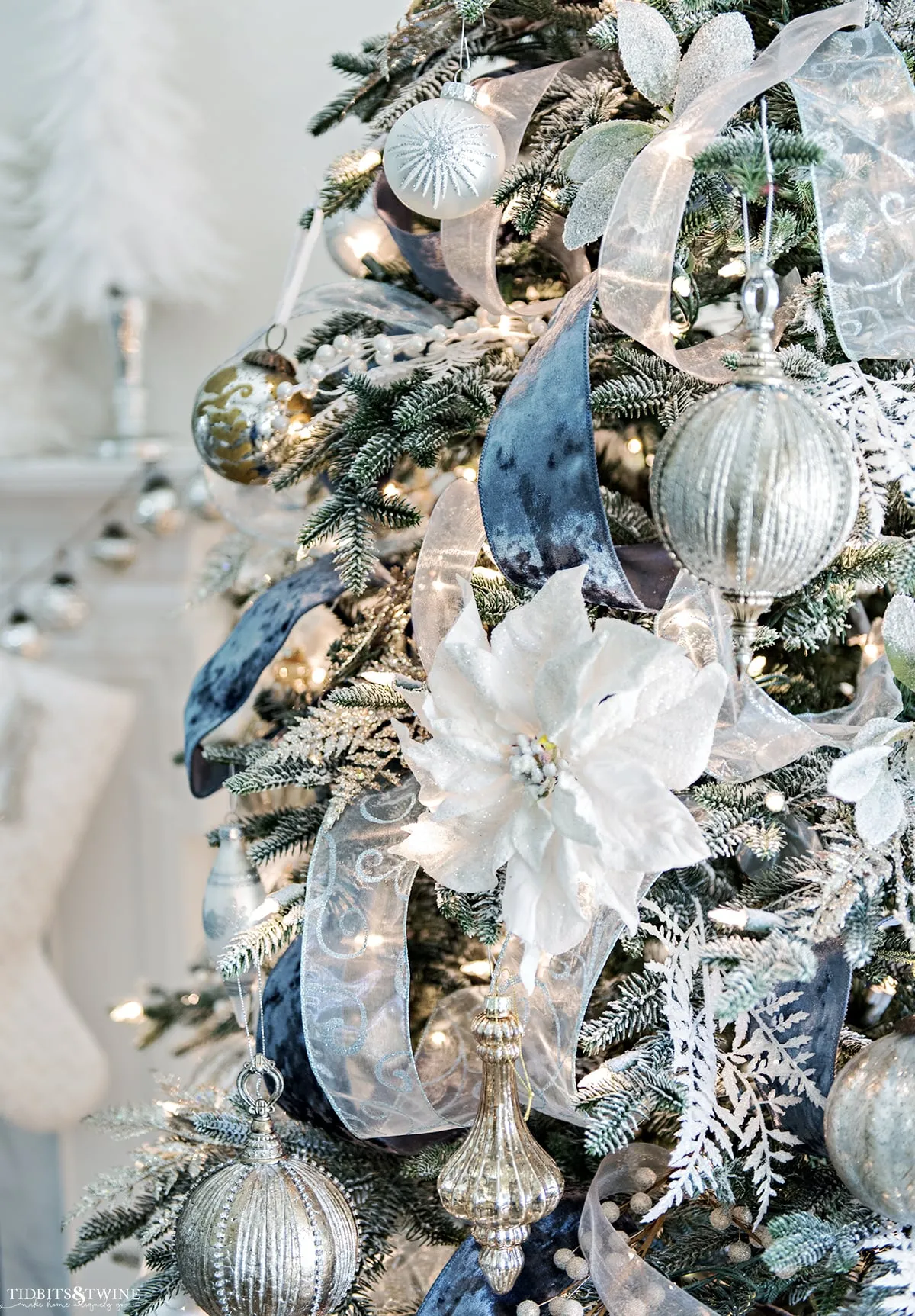
Deep blue is the hardest accent color to get right under tree lights. Under a warm 2700K strand, navy goes black. Under cooler 4000K LEDs, it turns grey and muddy. Before you buy forty ornaments, drape one ribbon and hang two baubles on your actual tree, with your actual lights on, and look at it after dark. If the blue holds, buy the rest. If it dies, switch to slate grey or midnight teal — both survive warm bulbs.
9. Candlelight, Broad Leaves, and a Round Dark Mirror
- Hang the round mirror so its bottom edge sits 6 inches above the mantel — any lower and the candles block the reflection.
- Place four pillar candles in a row, 10 to 14 inches in front of the glass.
- Use unscented pillars; scented wax leaves a film on frames and artwork.
- Run the green garland along the mantel edge, letting broad leaves drape past the corner by a few inches.
- Light the candles 20 minutes before guests arrive so the wax pools evenly and the flames settle.
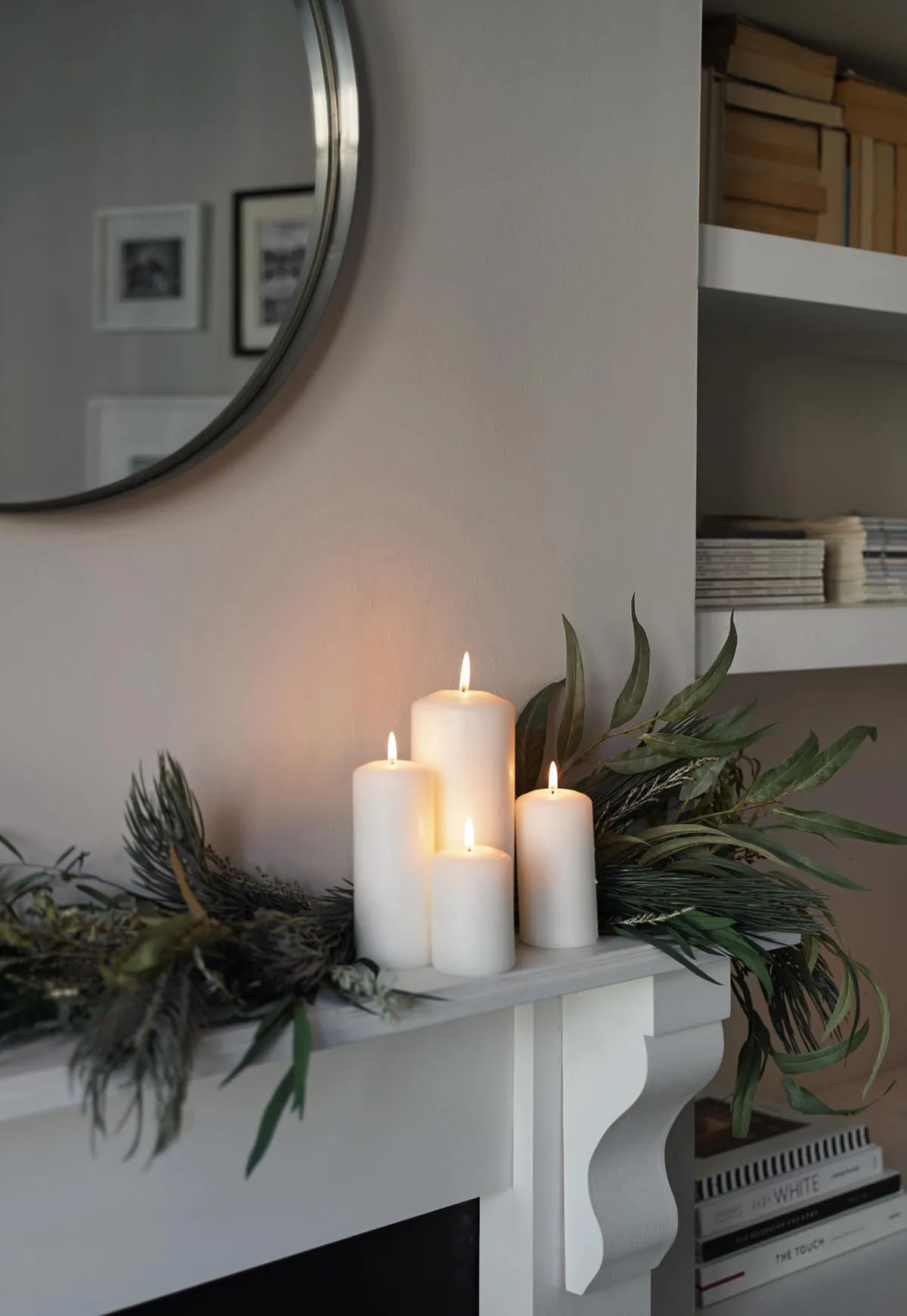
About 30 minutes of setup and $40–90 in materials, assuming you already own a mirror.
This is the most traditional formula in the whole article: 65% white (wall, mantel, built-ins, candles) plus 25% green garland plus 10% dark — the mirror frame and the firebox. That last 10% is what keeps a white wall from looking unfinished. Want it softer? Thin the dark down to a slim brass frame. Want it bolder? Blacken the mantel shelf itself.
10. Frosted Pinecones and a Golden-Framed Mirror
Real pinecones drop sap and shed scales onto white mantels, and store-bought frosted ones shed glitter the same way. Fix both: dunk real pinecones in a 10-to-1 water-and-craft-glue bath, dry them on newspaper for two days, then frost them with spray snow. The glue seals the scales shut. If you’d rather not bother, build the whole garland on a 1×2 board cut to mantel length — stack the pinecones and baubles on top of it, and the entire arrangement lifts off in one piece next January.
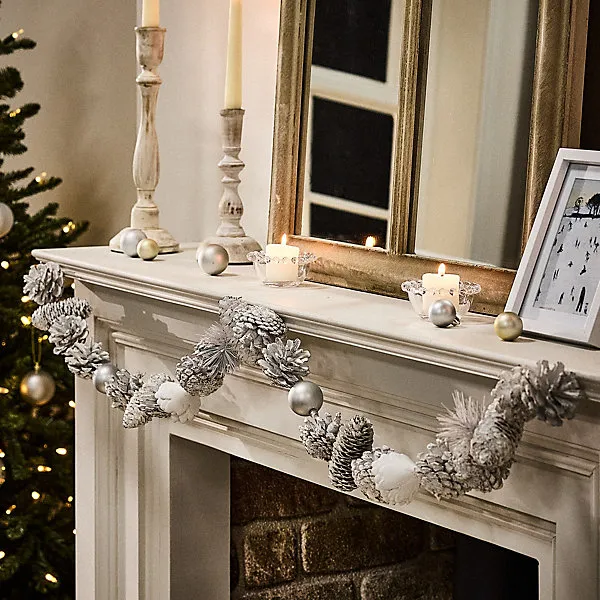
- Measure mantel depth — you need 6 inches minimum for a layered garland.
- Check clearance above the firebox: 12 inches minimum for anything combustible.
- Confirm what the mantel can hold; drywall anchors take about 25 pounds, brick far more.
- Find an outlet for the garland lights before you commit to a layout.
- Photograph your mantel empty — you’ll want the reference when you reset it next year.
11. Cranberries, Plaid, and Twig Wreath Napkin Rings
The grocery-store centerpiece is quietly winning: cranberries, eucalyptus, and potted greenery instead of resin figurines. It tracks with a bigger shift toward perishable, compostable decor — things you use up and toss rather than box in the attic. The plaid runner keeps it from feeling too earnest, and the whole setup costs less than a single figurine used to. This will still look right in 2030 because it isn’t referencing a trend; it’s referencing a farm table.
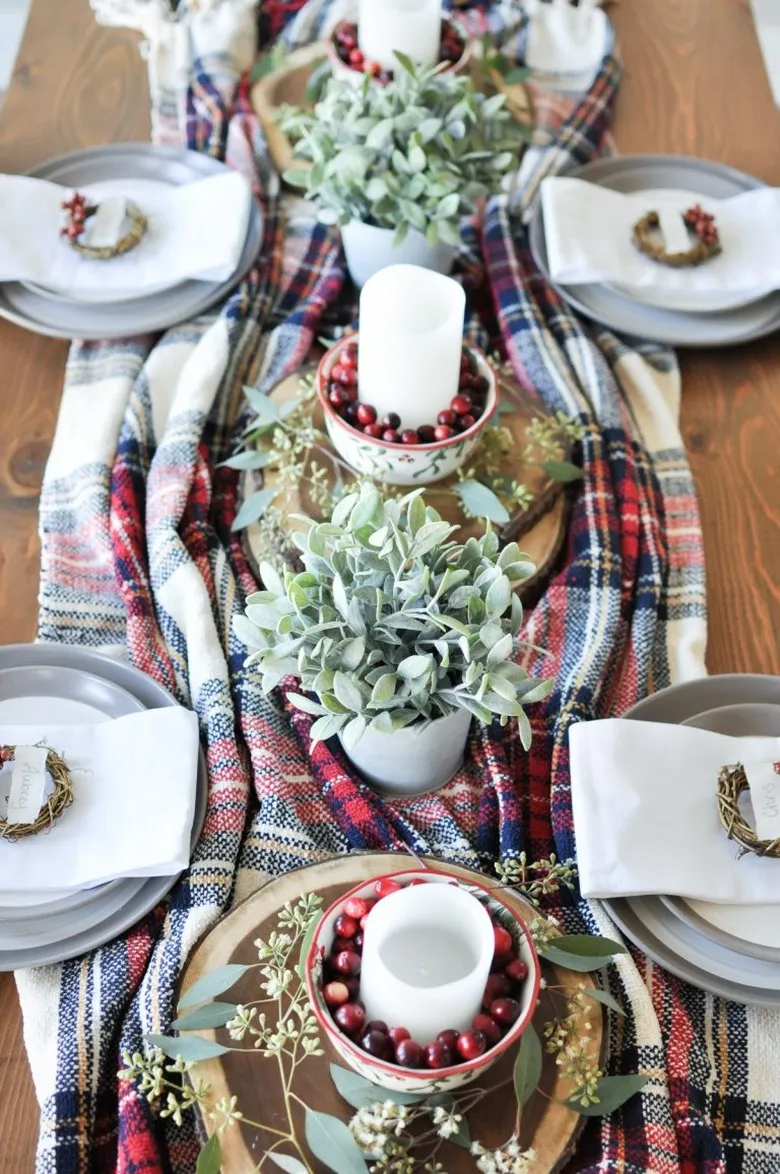
Red shows up three times at three different scales — in the runner’s plaid, in the cranberries, and in the small accents — which is exactly what repetition is supposed to do. The wood slice chargers bridge the plaid and the greenery, and the twig napkin rings echo the wood without matching it. Nothing here came as a set. That’s why it works.
This layout wants a 72- to 96-inch rectangular table. Keep the runner 14 inches wide so chargers still fit on either side. On a table under 60 inches, skip the runner entirely and put a single cranberry bowl in the middle — the same idea survives at half the footprint. For a round table, use one low arrangement and no runner at all.
12. Dusty Blue Tablecloth With Quilted Teal Chairs
- Table and chairs: $500–2,000
- Patterned blue tablecloth: $30–90
- Chargers, plates, and pink napkins: $60–150
- Candle holders and pillars: $40–90
- Bottle brush trees and centerpiece greenery: $40–110
- Wall paint or touch-ups: $0–80
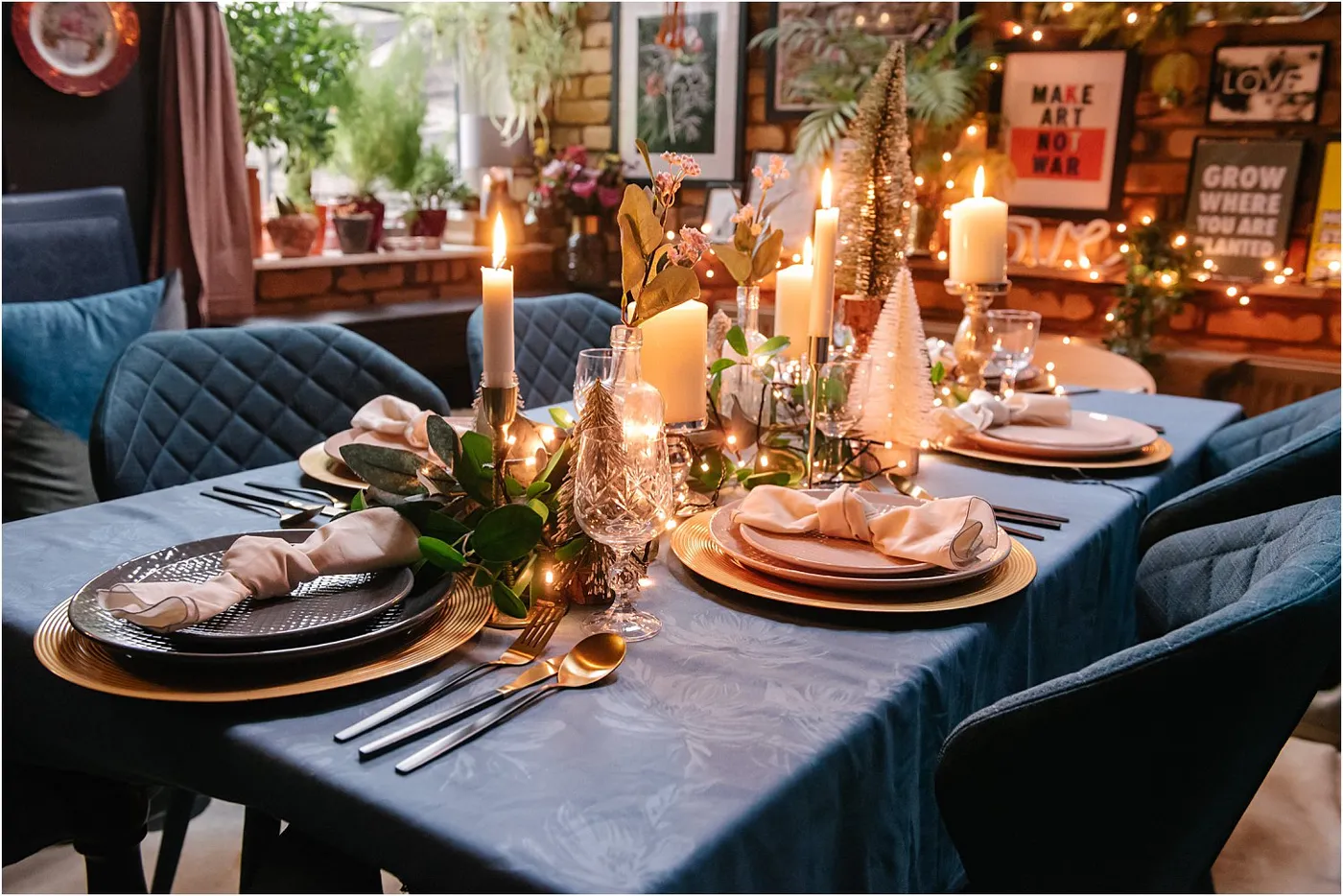
- Measure the table and count chairs; quilted seats need 24 inches of clearance behind them.
- Hold the tablecloth against your wall color in daylight — dusty blue turns grey under warm bulbs.
- Test one gold charger against the cloth before buying six.
- Confirm your lighter reaches the far candles.
- Decide where the string lights plug in.
Candle wax on a patterned cloth is the most likely casualty of the evening. Let it harden completely, scrape with a credit card, then press a paper towel over the residue with a warm iron — the wax lifts into the towel. Real greenery drops needles within about ten days, so shake it over the trash every couple of days. And those quilted teal chairs will collect every crumb in the house.
13. An All-White Table With Glass Trees in the Background
This setting needs room to breathe: a 40-inch-wide table, at least 6 feet of length, and 24 inches of run per guest. It also wants a background — the softly lit tree behind it is doing real work here. If your dining room opens onto a space with no tree, put the clear glass trees on a sideboard you can see from the table, or the whole thing reads a little sterile.
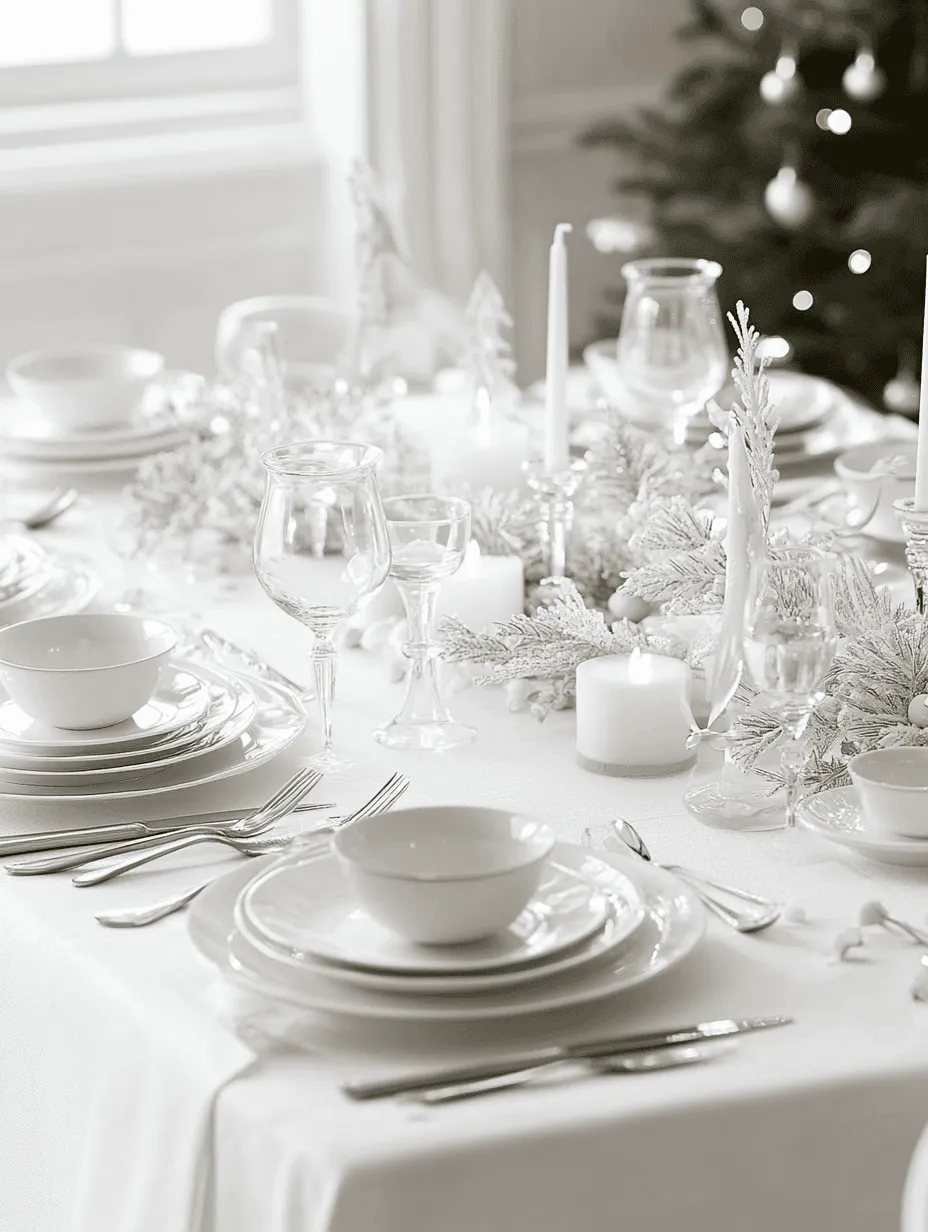
When the cloth, the plates, the candles, and the greenery are all white, you lose every edge. The silver cutlery and the darker floor are the only things keeping this from looking like an overexposed photograph — in person, not just on camera. If your dining room has light floors and light walls, add one deliberate dark note: black chair legs, a charcoal runner, darker taper holders. Want the same geometry with more bite? See Idea #33.
14. A Golden Retriever-Approved White Sofa and Silver Tree
A white sofa and a golden retriever can coexist — but only with the right fabric. Look for solution-dyed performance weaves like Crypton or Sunbrella, or a washable slipcover you can pull off and launder. Keep a lint roller in the side table and a blanket on the one cushion where the dog actually lies, because that spot will not stay white. Faux-fur pillows shed for about three weeks, then settle. Vacuum them brushless or the pile pulls out.
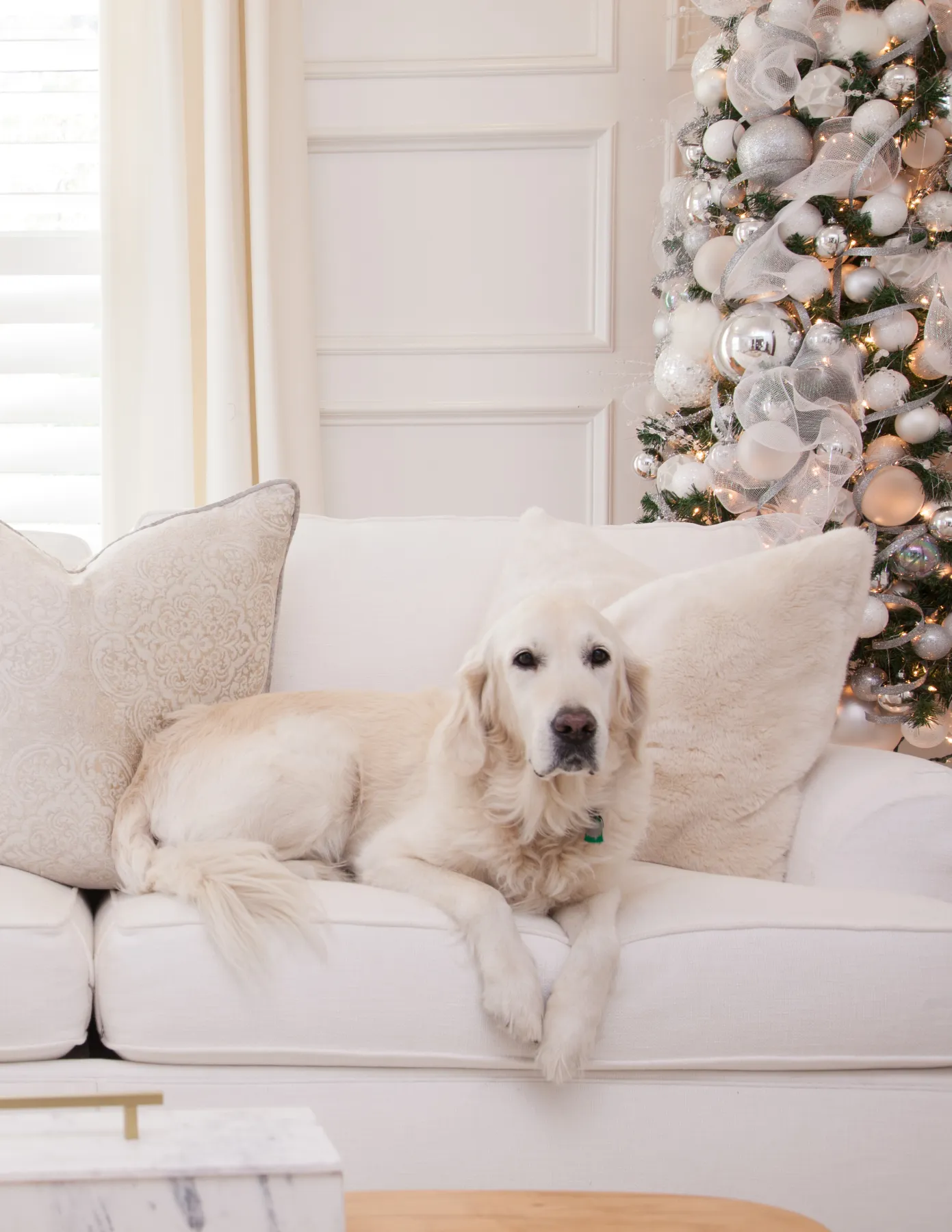
A designer white slipcover sofa runs $2,000–3,500. IKEA’s slipcovered sofas start around $500 and the covers are machine washable, which is the entire point when there’s a dog involved. Faux-fur pillow covers run $12–25 at HomeGoods. Wide deco mesh ribbon for the tree — not thin organza — is $6–10 for 10 yards at Walmart, versus $22 at craft boutiques.
Wide mesh ribbon looks expensive when you spiral it in three passes from the top down, twisting gently every 12 inches so it catches the lights. Don’t loop it in perfect circles; that’s what makes a tree look like a department store display. Let it dip behind a branch occasionally and reappear lower down. Ten minutes of tucking beats an hour of measuring.
15. A Clear Glitter Star and a Gold-Capped White Bauble
- Divide the tree into three vertical zones and hang your largest ornaments in the bottom third first.
- Work in odd-numbered clusters — three ornaments of mixed size, all within a hand’s width of each other.
- Place clear or crystal pieces right next to a bulb so they pick up and scatter the light.
- Keep white and gold ornaments at eye level, around 60 to 66 inches up, where they’ll actually be seen.
- Add the bead garland last, draped in soft swags rather than tight loops.

About an hour for a 7-foot tree, and $0 if you’re reusing what you own.
A clear ornament near a warm bulb glows from the inside out — it’s the cheapest way to make a tree look twice as lit. The gold cap on the white bauble does the same job in reverse, giving a matte sphere one small warm note. Notice there’s no tinsel and no colored lights. Transparency and warmth are doing all the work.
16. Clear Lights, White Houses, and a Fluffy White Rug
A 7½-foot slender tree fits comfortably in a 10-by-12 living room, provided you keep 30 inches of walking space around it. Go with a 5-by-8 rug minimum so the sofa and the tree both sit on it — floating furniture on a too-small rug is the fastest way to make a white room look accidental. Ceilings under 8 feet? Cap the tree at 6½ feet and skip the topper.
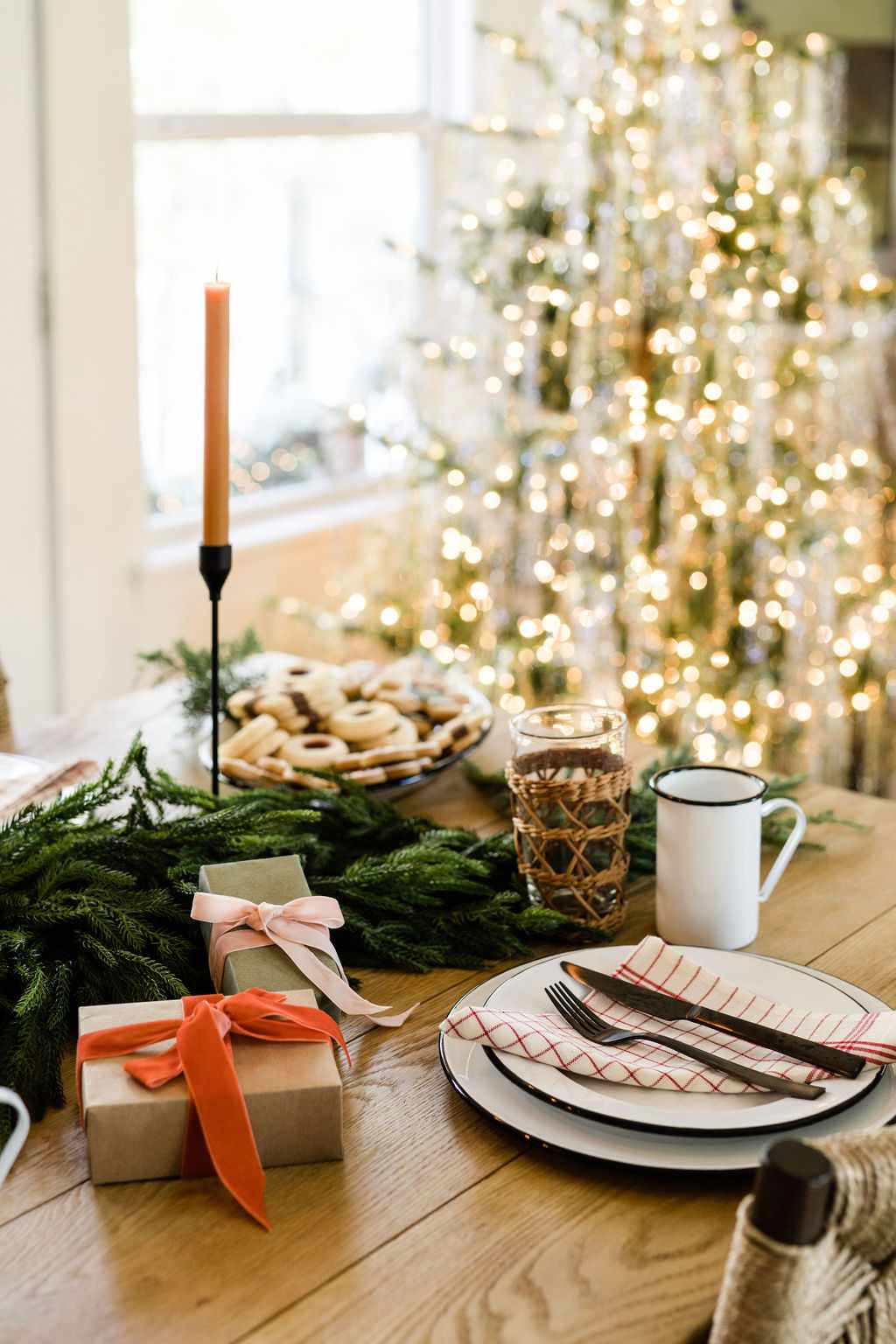
The ratio is 80% white (walls, tree, rug, mantel) plus 15% light grey (pillows, throw) plus 5% silver. The grey is the load-bearing element — it’s what stops white-on-white from turning into a soft-focus blur. Swap the grey pillows for camel and the whole room warms up, visually speaking, by a couple hundred degrees Kelvin.
- Tree (7½ ft slim, pre-lit): $150–400
- Sofa (modular, light upholstery): $900–2,600
- Rug (5×8, fluffy): $120–350
- Ornaments, garland, stockings, tiny white houses: $90–220
- String lights, extension cords, wall paint: $25–140
17. The White Tree That Matches the Fireplace Exactly
It’s the white tree skirt. Without it you’d see a metal stand sitting on the floor, and the illusion of a tree growing out of a white room would break immediately. The skirt also covers the base of the tree, where the lights are dimmest, giving the ornaments something soft to sit against. The garland, the silver holders, the stockings — all beautiful, all replaceable. The skirt isn’t.
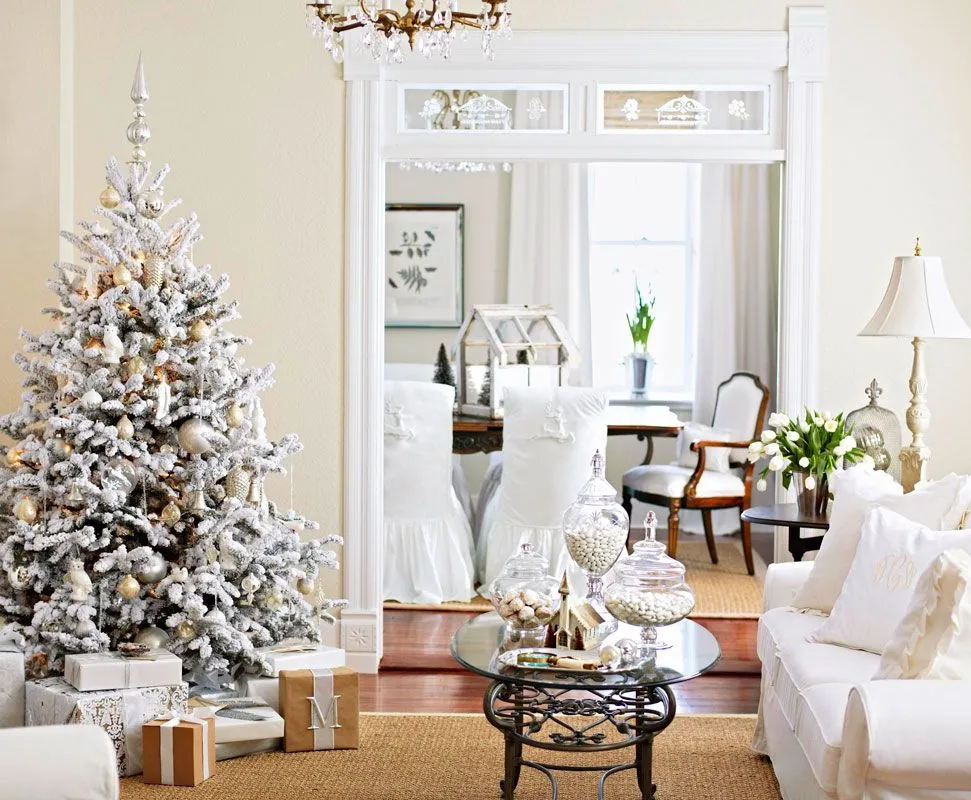
When the tree, the wall, the mantel, and the fireplace are all the same white, the tree loses its silhouette. That’s fine in a photograph with good lighting; in a dim living room at 8 p.m. it can read as one soft blob. The white tapers and the warm string lights are what save it. If your room gets no daylight, add one non-white element — a natural wood bowl, a brass candlestick, a grey throw — or the whole corner goes flat.
18. A Glowing Ceramic House Hiding in the Flocking
- Check your tree lights’ color temperature — 2700K is warm, while 4000K makes a ceramic house look industrial.
- Weigh heavy ornaments; ceramic houses run 3 to 6 ounces and need wire hooks, not flimsy loops.
- Pick your four or five focal ornaments before you hang anything else.
- Count your light strands; a 7-foot tree wants 400 to 600 bulbs.
- Test-light the tree the night before you decorate.
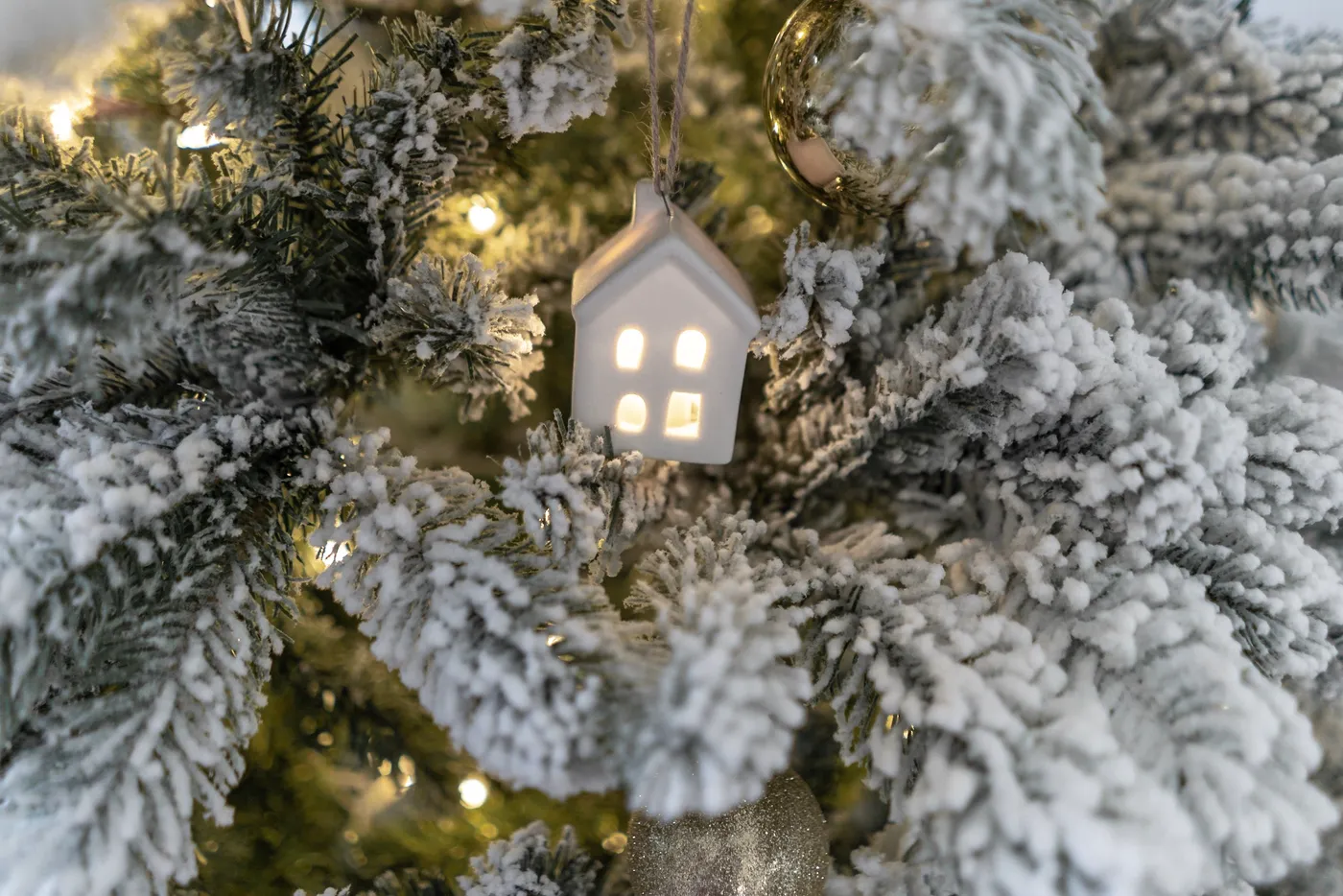
Your best ornaments need a bulb directly behind them, not beside them. A ceramic house with lit windows looks hollow hanging in front of bare branches — push it 4 to 6 inches back so the flocked needles frame it and a warm bulb glows through the cutouts. That’s the difference between an ornament and an actual lit miniature. Most trees waste their best pieces at the front, in full light.
Miniature houses and nostalgic ornaments are back in a way that feels personal rather than commercial. People are collecting one a year instead of buying a matched set, which is why the trend has staying power — it grows with the household. Flocked branches make the perfect backdrop because they already look like snow around a little roof.
19. Metallic Gold on White, Next to a White Sectional
Seventy-five percent white, 15% silver, 10% gold. Gold stays in the minority and that’s exactly why it works — a gold-heavy white tree turns brassy fast. Notice the metallic lamp on the side table carries the same 10% through the room, so the tree doesn’t look like a separate event happening in the corner. Swap rose gold in for the gold and pewter for the silver and you keep the identical formula with a warmer read.
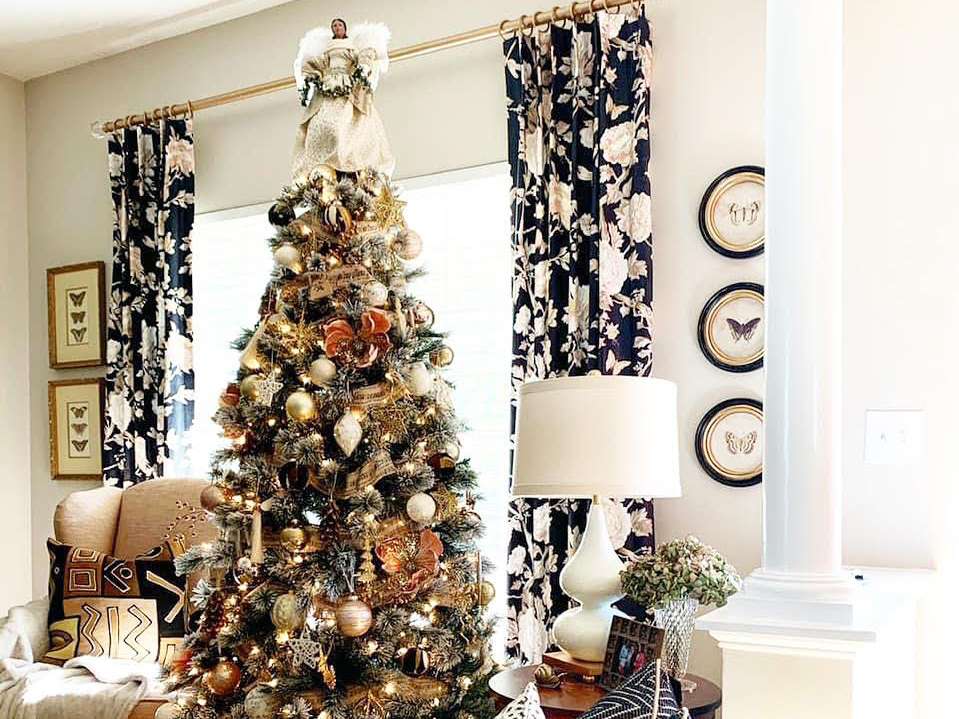
Gold ornaments look expensive and mostly aren’t. Dollar stores sell six-packs of small matte gold balls for $1.25, Target’s 12-piece glitter sets run about $12, and a 24-piece silver-and-gold assortment on Amazon is around $20. White tree skirts run $8–15 at Walmart versus $60 at a design store. That metallic table lamp? A $40 find doing the work of a $200 lighting purchase. This is the warmer cousin of Idea #27, which runs the same tree in cooler silver.
20. A Marble Coffee Table Christmas Tree (Yes, Really)
Tabletop trees live or die on proportion. On a 36-inch round table, an 18- to 24-inch tree is the sweet spot — anything taller and you can’t see the person across from you. Keep ornaments between 1½ and 2 inches and use no more than 25 of them. The whole vignette, gifts included, should stay inside a third of the table’s width so there’s still somewhere to set a mug.
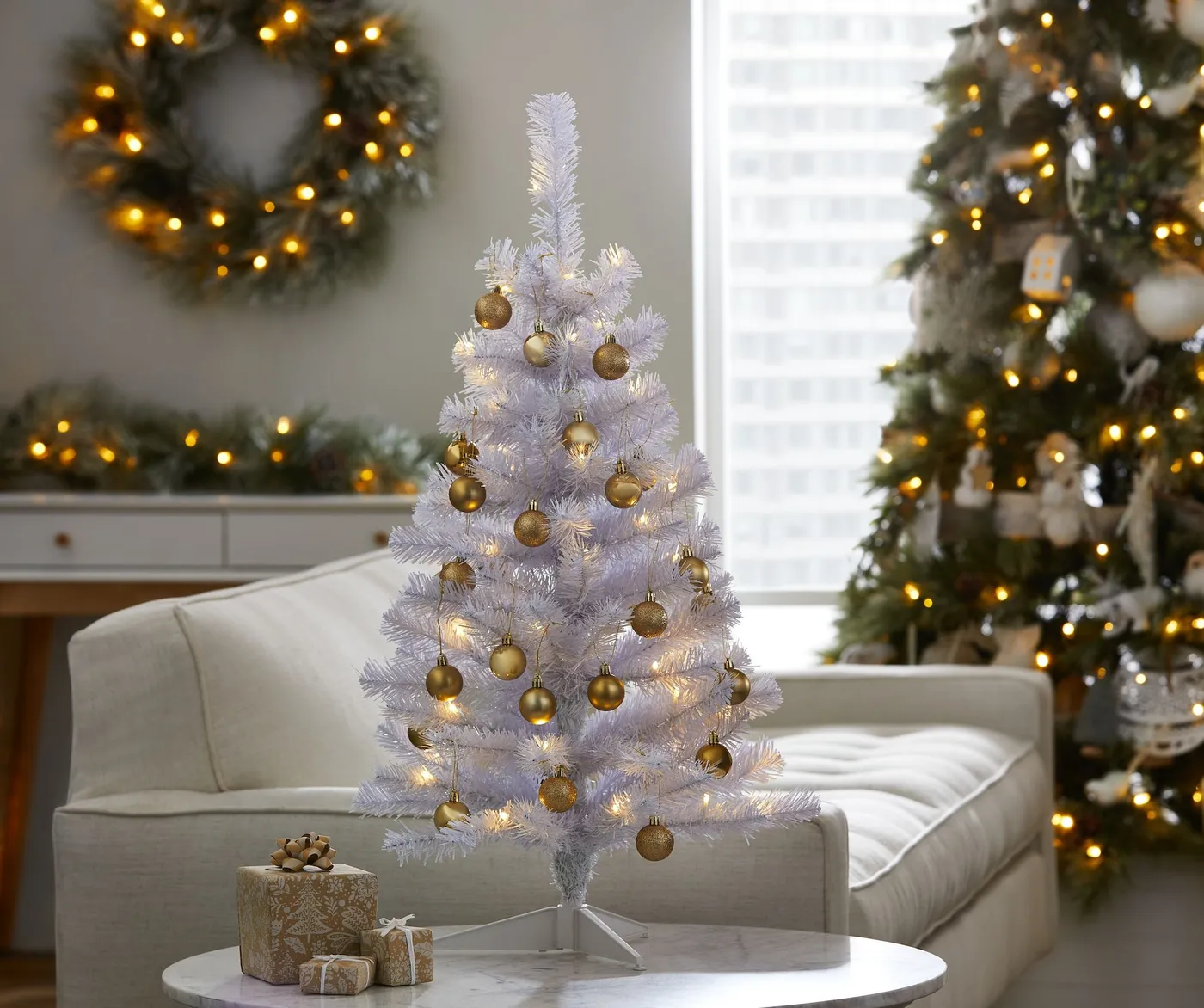
Two trees in one room is a risk that pays off when they differ in size and color. The green tree in the background is the real event; the white one on the marble is a vignette. Because it isn’t competing with the big tree, the small one can be gold-heavy and slightly formal. Same logic as a bookcase that’s mostly navy with one bright object on it.
- Clear the coffee table completely — clutter kills a tabletop vignette.
- Set the tree on a tray or a marble offcut to protect the surface from water and scratches.
- Wrap the base in a scrap of fabric or a small knit; the mini stand shouldn’t be visible.
- Hang gold ornaments only, and let a few sit loose around the base.
- Add two wrapped gifts with narrow ribbon — this is a photo moment, not a storage solution.
Twenty minutes and $40–70 for the tree, ornaments, and wrap.
21. Buffalo Check and a Crystal Teardrop on Flocked Branches
The black-and-white buffalo check ribbon. It’s the only pattern in an otherwise solid white tree, and it does more for the composition than any single ornament — including the crystal teardrop, which is lovelier but much quieter. Without the plaid, you’d have a pretty but slightly sleepy tree. With it, the black glitter balls suddenly make sense, because they’re echoing a pattern that was already introduced two branches earlier.
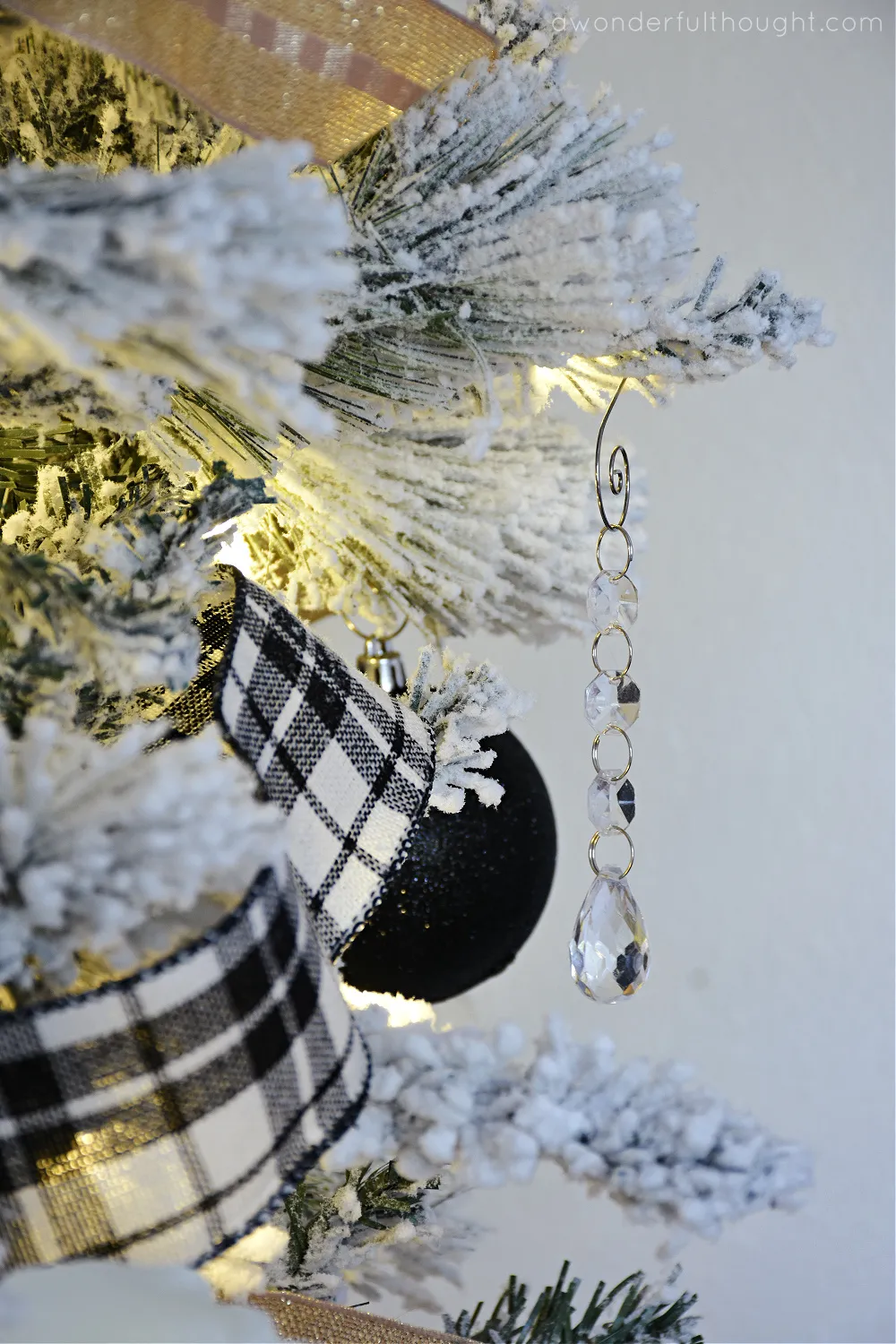
High-contrast ornaments need elbow room. As a rule, place one black or crystal piece every 18 to 24 inches of branch, which on a 7½-foot tree works out to somewhere between 8 and 12 statement pieces, maximum. Pack them tighter than that and the white stops reading as white. Keep your ribbon at 2½ inches wide — 4-inch plaid overwhelms the branch spacing and starts to look like wrapping paper.
22. A Green Tree Wearing Nothing But White and Silver
- Tree (7 ft, unlit): $80–350
- Lights (warm white LED, 600 bulbs): $20–45
- Ornaments (white and silver baubles): $60–150
- White poinsettia picks: $12–30
- Tree skirt and area rug: $25–70
- Wrapping paper and ribbon: $15–30
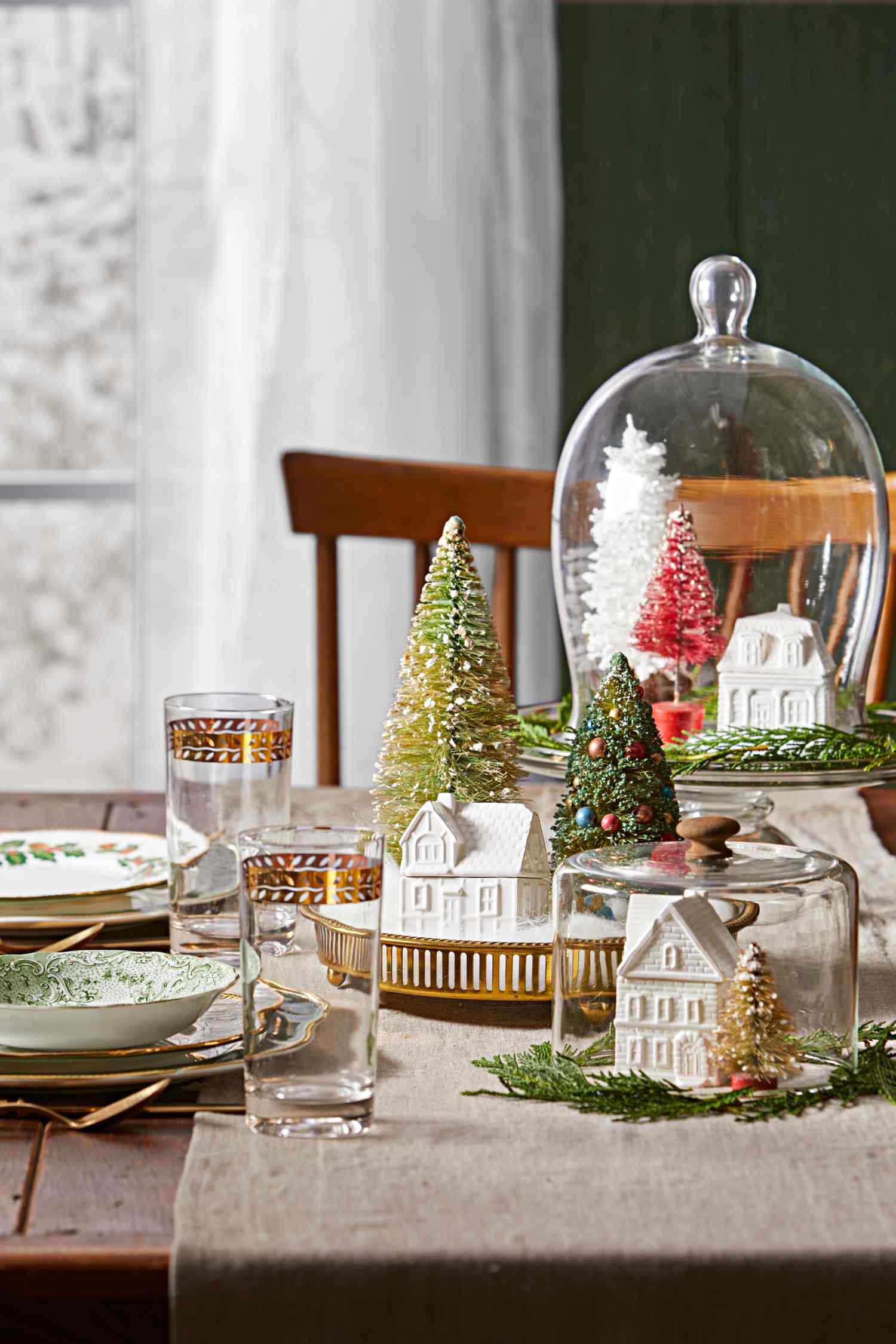
Glittered white poinsettia picks shed onto dark green needles, where every fleck shows. Give them a hard shake over the trash before they go anywhere near the tree, and vacuum underneath weekly. White ornaments on a green tree also show dust and fingerprints more than you’d expect — a dry microfiber cloth once a week keeps them bright.
White ornaments on dark green give you the highest contrast in Christmas decorating, which is exactly why they’re unforgiving. Every gap in the branches will be obvious. Plan on 10 to 12 ornaments per foot of tree — roughly double what a flocked tree needs — and fill the interior branches with cheap filler balls from Target before you hang anything you actually like.
23. The Snow Globe Tree With a Tiny Lit Church Inside
- Clear an 18-inch square surface — a side table, a shelf, a windowsill.
- Raise the snow globe tree 3 to 4 inches on a stack of books so it isn’t sitting at floor level of the vignette.
- Tuck a battery LED puck light behind it, aimed at the glass rather than the front.
- Keep everything else on the surface to white plus one pastel — tiny pink-tipped trees, a pale blue ornament.
- Place or photograph it before the room goes dark; the glow needs contrast to register.
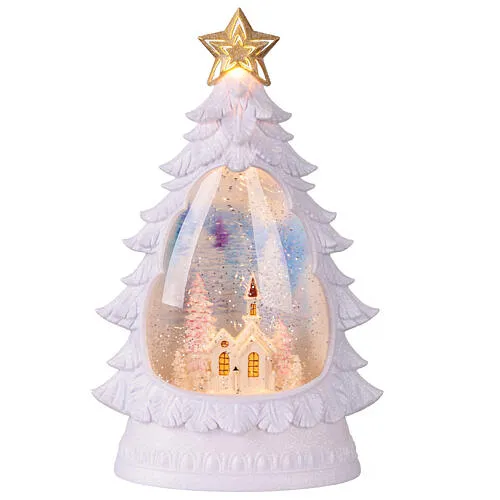
Twenty minutes and $25–60, most of it the globe itself.
The palette runs 70% white, 15% pale pink, 10% gold, and 5% light blue. That last five percent is the one people forget, and it’s what keeps the pink from reading candy-shop. Want it moodier? Swap the pink for slate blue and the gold for antique brass — the same formula goes from sweet to slightly Nordic without changing a single proportion.
24. Pastel Baubles on a Heavily Flocked Tree
Pastels on flocking is a low-contrast combination, and low contrast can tip into washed-out fast. It works here because the lights are doing the definition work and the gold star gives the eye a top note. Cap yourself at three pastel colors. Four or more and the tree starts reading like a nursery mobile instead of a Christmas tree. Compare with Idea #5 — same white-on-white instinct, executed with angel ornaments instead of pastels.
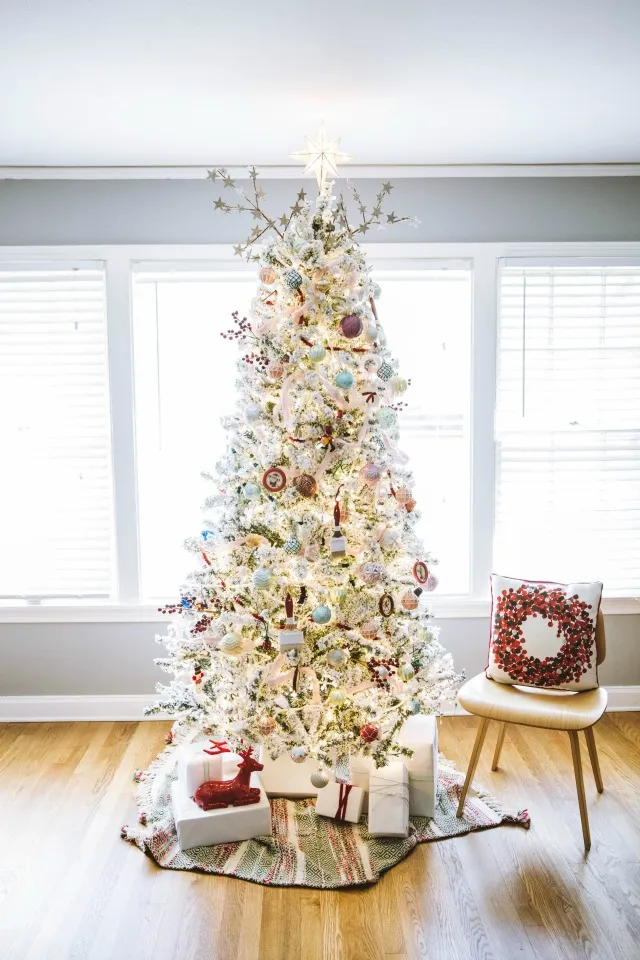
A 6½-foot flocked tree from Walmart runs around $99; the same size at a specialty retailer is $500–600. Pastel ornament sets are $12–20 for a dozen at Target. The striped woven tree skirt? IKEA usually has something close for $25, and a plain white sheet gathered at the base reads similarly for free. Total cost if you shop smart: under $200.
Hang pastels in clouds, not rows. Cluster three to five ornaments at varying depths — one pushed deep into the branches, two at mid-depth, one at the tip — then leave a hand-width gap before the next cluster. Evenly spaced ornaments look like a catalog; clustered ones look like a person decorated the tree. On flocked branches, the deep ones look properly snowed-in.
25. A White Slipcover Sofa With a Red Gnome on the Piano
The white slipcover. It’s what lets everything else — the red ornaments, the orange pillows, the patterned wallpaper, the gingerbread house, the gnome — be as loud as it wants without the room tipping into chaos. A colored sofa would compete with all of it. The slipcover is a neutral stage, and it’s washable, which matters in a room with this much personality and, presumably, this much foot traffic.
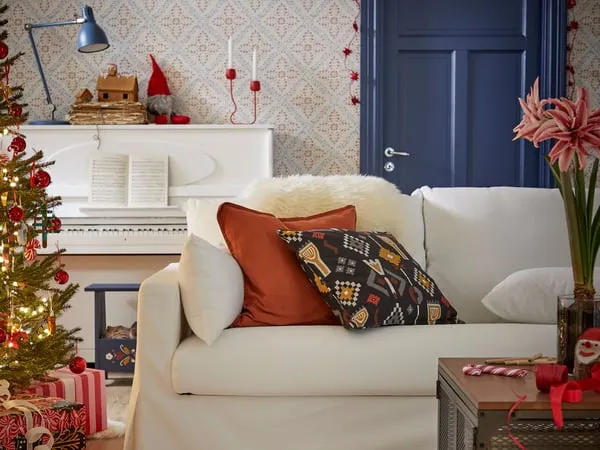
Call it grandmillennial, call it collected — the look is personal objects over coordinated sets. Patterned wallpaper, a real piano, a gingerbread house that’s half decoration and half snack. It’s been building for a few years as a reaction to beige minimalism, and it has staying power because it doesn’t depend on any single trend. It depends on whoever lives there.
26. Ornate White Molding, a Flocked Wreath, and Satin Ribbons
- Measure the wall between the molding and the mantel — a 24-inch wreath needs 30 inches of clear space.
- Check which direction the window faces; north-facing white rooms turn blue by 4 p.m.
- Confirm the tree sits at least 12 inches from any vent or radiator.
- Count outlets before you plan the lights and the mantel garland.
- Have a lint roller and a soft brush ready for flocking cleanup.
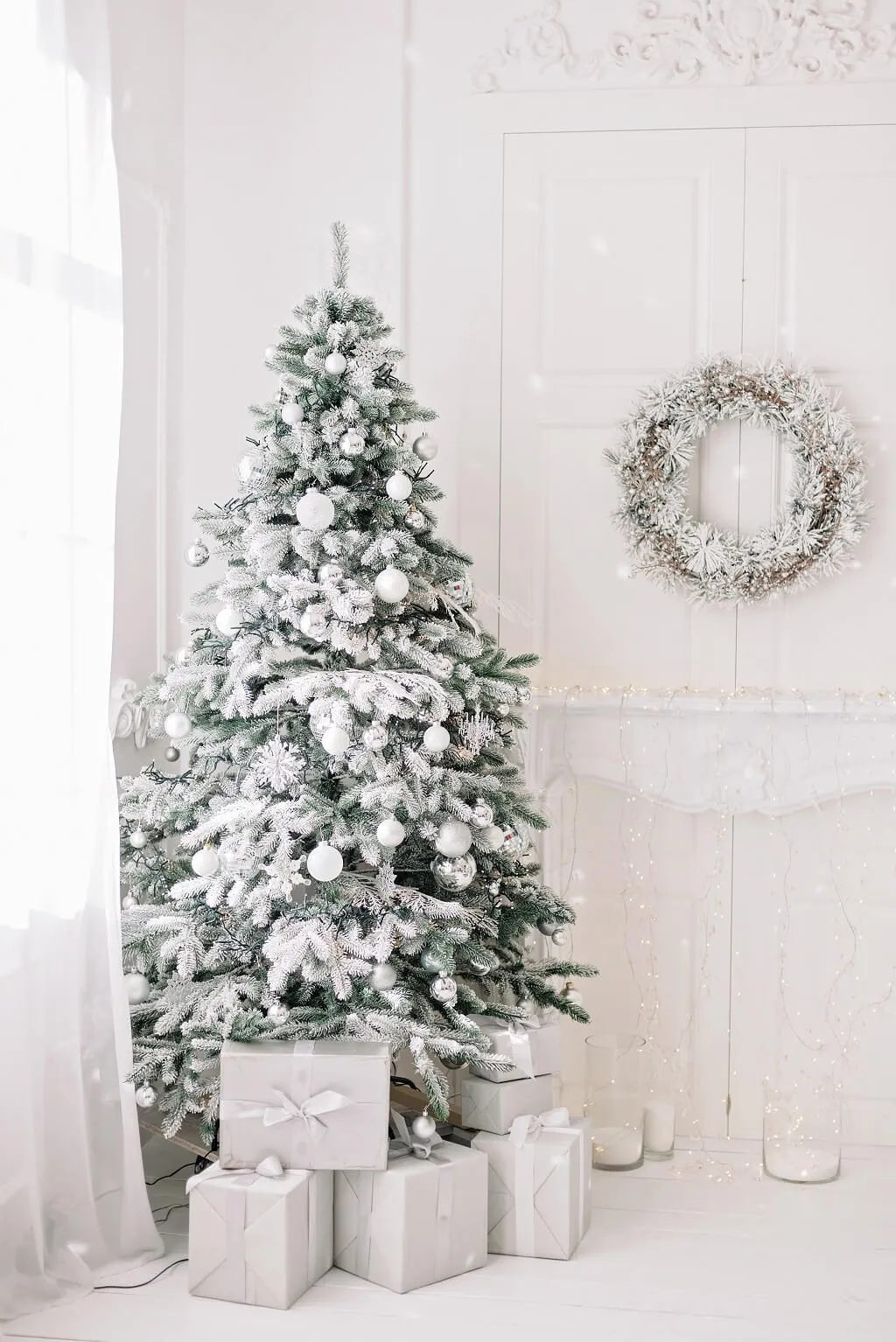
Repetition is doing the work here. The flocked wreath echoes the flocked tree, the mantel fairy lights echo the tree lights, the white molding echoes the white gifts stacked on the floor. Glossy ornaments play against matte flocking, so the shimmer never gets uniform. And the grey-and-white wrapped presents give the eye one small break from all that brightness — which is what keeps an all-white corner from becoming tiring to sit in.
27. Silver-Wrapped Gifts Beside Glowing White Branches
The illuminated white branches. They let a single tree fill an entire corner without buying a second one, and they cast the kind of soft light that makes a plain beige wall look intentional. Take them away and you have a nice white tree against a blank wall. The branches are what turn it into a scene — and they’re the cheapest thing in the room.
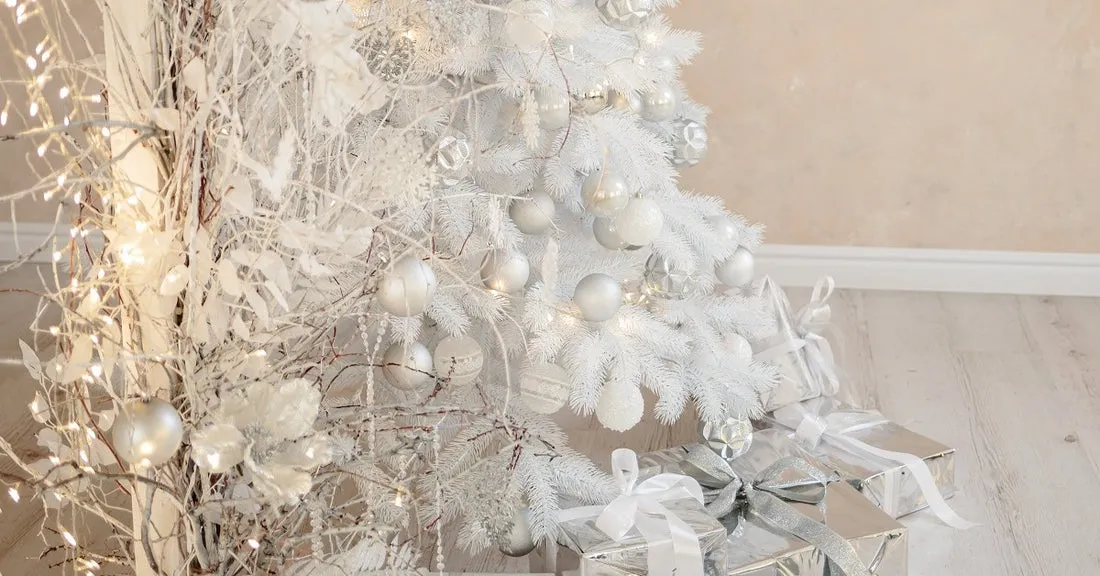
- White tree (7 ft): $60–250
- Silver and white ornaments: $40–120
- Light-up white branches: $25–70
- Silver wrapping paper and ribbon: $10–25
- Paint or wall treatment: $0–80
This works best in an 8-by-8 corner or a shallow alcove. Keep the tree between 6½ and 7 feet, and leave 6 inches between the branches and the wall so the glow spills upward instead of getting swallowed. If your corner is narrower than 6 feet, use a pencil tree and two branch lights rather than a full-width tree.
28. Plaid Napkins Folded Into Little Christmas Trees
- Lay a square napkin pattern-side down, then fold it in half diagonally into a triangle.
- Accordion-fold from the long edge upward in 1-inch pleats until you reach the point.
- Pinch the pleats together at the center and fold the top triangle down over them.
- Stand it upright in a glass or lay it on the plate; the pleats fan out into a tree shape.
- Add a short cinnamon stick as a trunk if you’re feeling generous with guests.
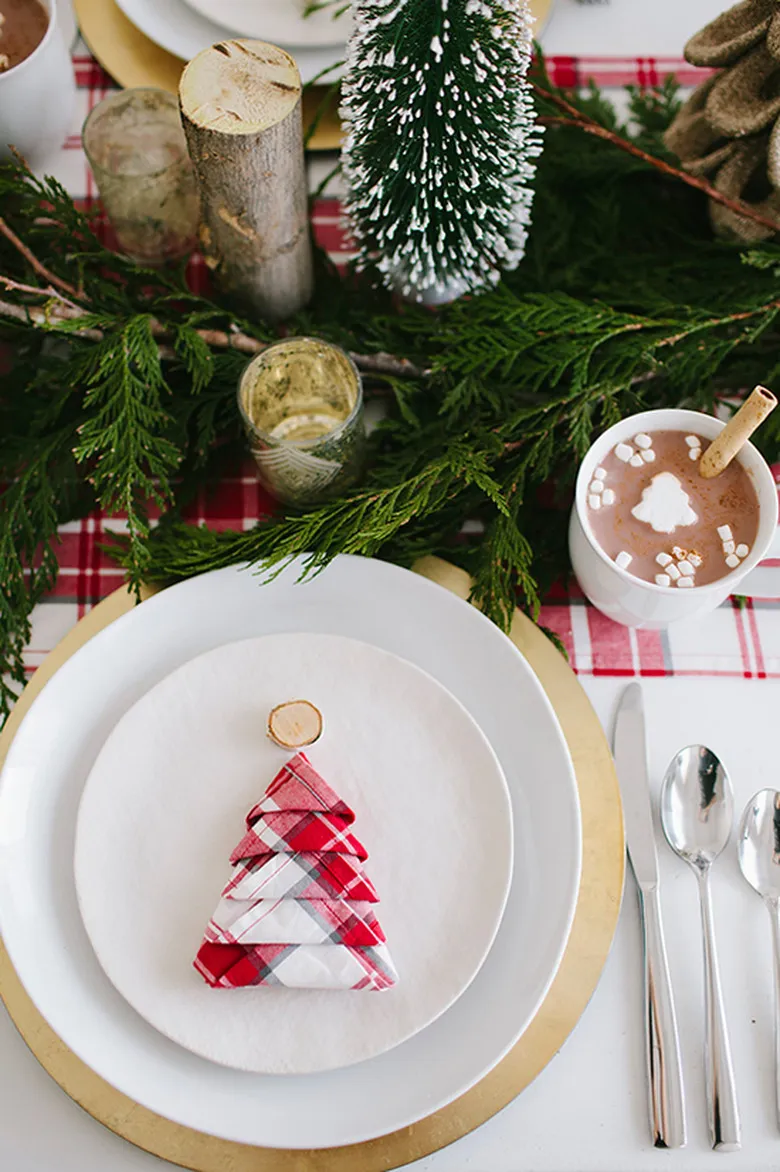
About two minutes per napkin, and $0 beyond what you already own.
Red-and-white plaid shows every drop of hot chocolate and every smear of butter. Treat stains with a stain stick before they set, wash cold, and expect to iron — pleats don’t survive a dryer. Real evergreen garland on a tablecloth drops needles and leaves sap rings, so set it on a strip of wax paper or a wood slice. Bottle brush trees shed tiny bristles, so keep them off the cloth.
29. Cable Knit Stockings on a Rustic Wood Mantel
Real garland on a raw wood mantel will leave sap and moisture marks. Line the shelf with felt or a strip of parchment before you drape anything. And watch your clearance: cable knit and faux fur are far more flammable than cotton, and they need 12 inches of air above the firebox — more than most mantels give. If you light fires often, move the stockings to a wall hook during burns and put them back after.
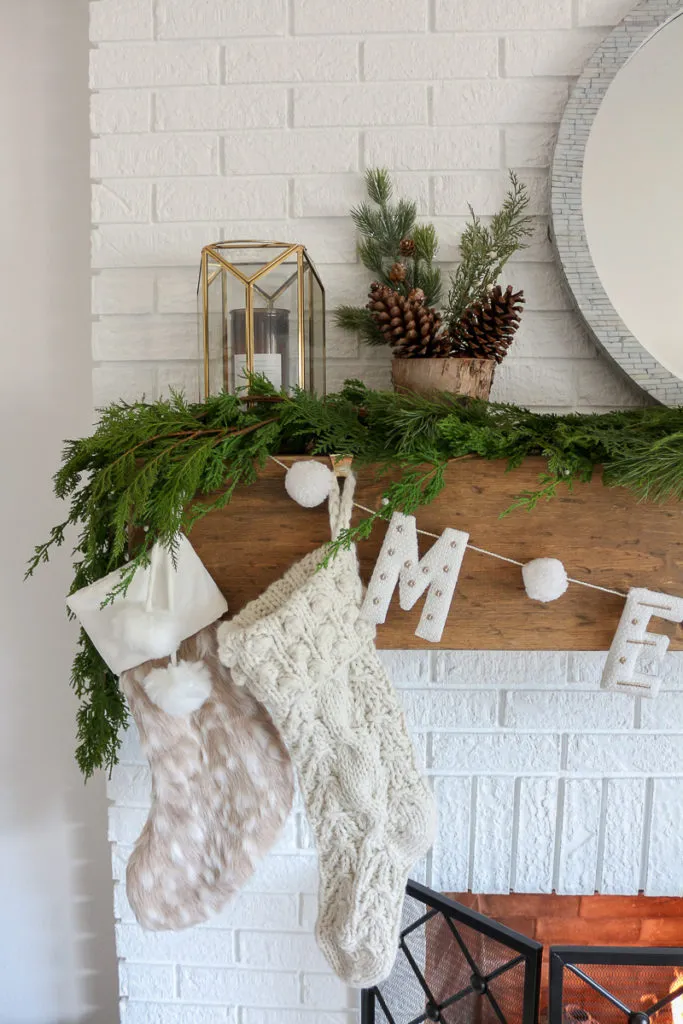
The gold geometric lantern is a $15–25 find at Target; similar designs at home boutiques fetch $70. Cable knit stockings run $8–15 at Walmart and Old Navy, and faux fur ones are $12–20 at HomeGoods. The white letter garland is about $6 total with dollar-store letters and twine. Thrifted wicker baskets filled with pinecones cost almost nothing and fill the same visual slot as a designer arrangement.
Your two stockings — one knitted, one textured fur — should hang at slightly different heights, four to six inches apart. Matching heights look like a store display; the offset looks like a house. Fill the knit one loosely so it holds a rounded shape, and let the fur stocking hang nearly empty so the texture reads instead of the bulk.
30. A Slender White Tree Against a Beige Sectional
Sixty percent beige and cream — sofa, rug, floor, walls — plus 30% white for the tree, ornaments, and fireplace, plus 10% metallic split between silver and gold. Beige does the job that grey does in a cooler room: it softens. Swap the beige sectional for a light grey one and the same tree in the same corner reads noticeably icier. That cooler version is running elsewhere on this list, and the difference is entirely in the upholstery.
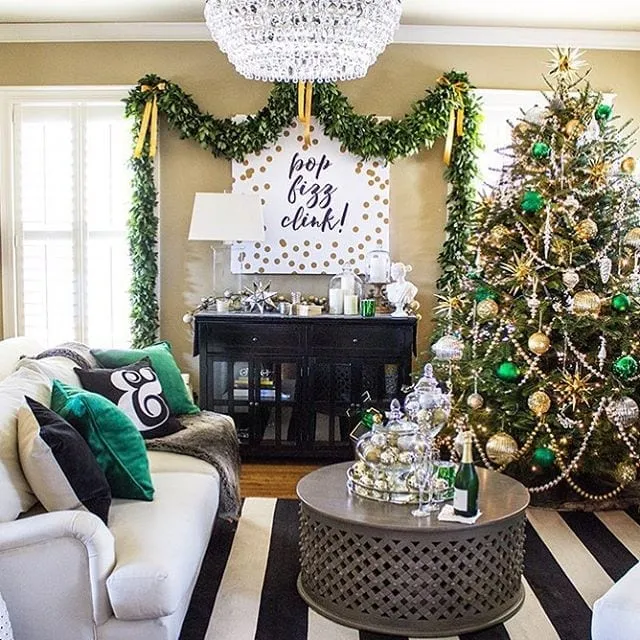
A tall, narrow tree solves a specific problem: vertical interest in a low room. Everything in this space sits under 30 inches — sectional, coffee table, rug. The tree is the only thing reaching upward. The patterned rug matters too. Without it, all that solid beige would flatten the wide shot, and the white tree would have nothing to be white against.
31. Blue and White Ginger Jars Meet a Flocked Tree
Blue-and-white porcelain has been quietly re-entering living rooms through the grandmillennial revival, and Christmas is where it makes the most sense — the palette is already there. Ginger jars on open shelving mean the holiday decor isn’t confined to the tree, and flocked branches make blue ornaments read brighter than they ever do on green. This is one that won’t look dated by 2030.
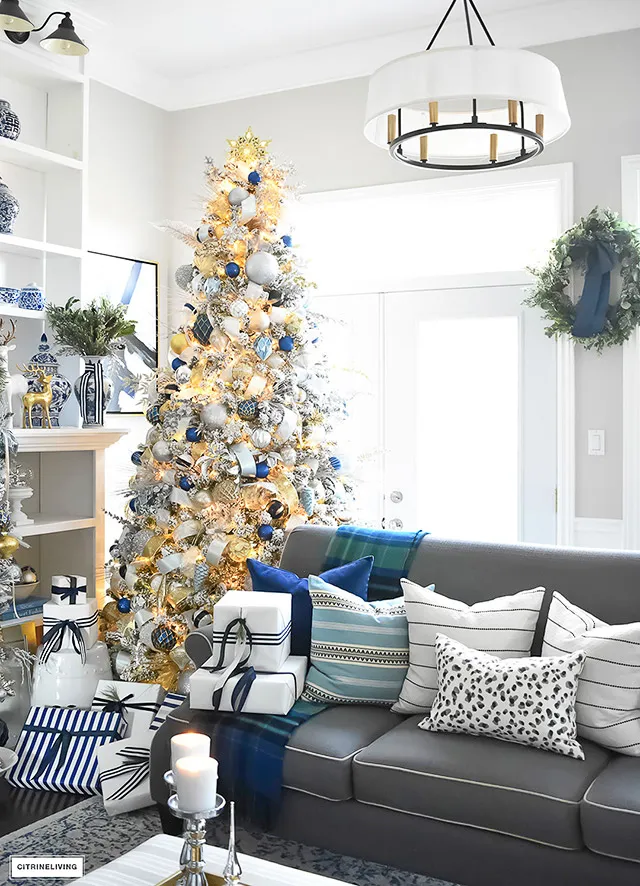
Antique ginger jars run $150–400 each. HomeGoods and TJ Maxx regularly stock new blue-and-white jars for $15–30, and thrift stores turn them up for $5. Navy and silver ornaments run $10–18 for a 12-pack at Target, and a plaid throw is $20–35 at Walmart. If you want the shelves to look collected rather than bought, mix two genuinely thrifted jars with three budget ones. For a smaller version of this blue story, see Idea #8.
32. The Glitter Santa With a Basket Full of Toys
The glitter. Without it, this is a painted resin Santa, and there are ten thousand of those. The glitter coating turns him into an object that behaves like an ornament — he reflects the warm lights around him instead of absorbing them. That’s the entire difference between a figurine that looks like a thrift-store find and one that looks like it came from a holiday boutique.
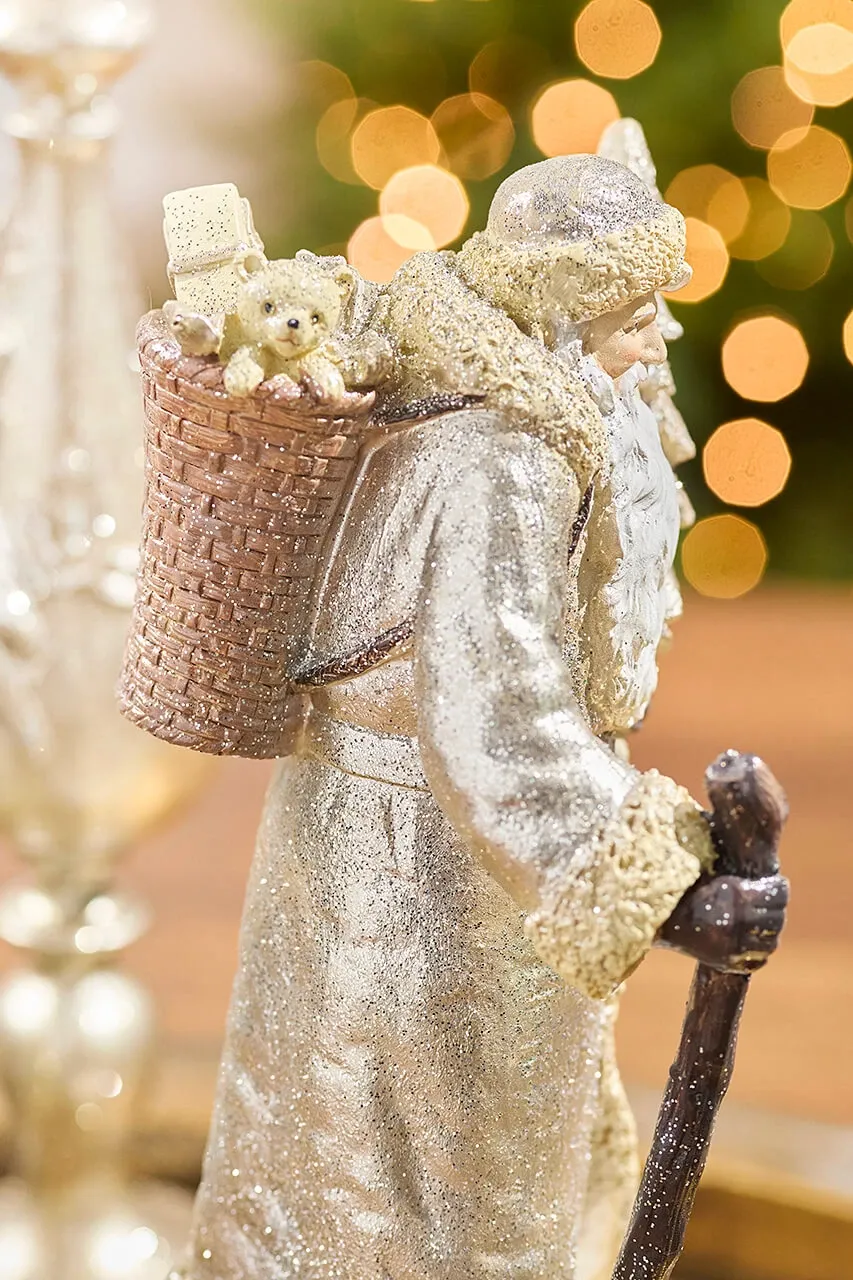
Backlighting. All those warm golden circles behind him are doing more work than the figurine itself — they give the glitter something to catch, and they blur the background so the small details read clearly. The basket props matter too. The teddy bear and the little bird give your eye somewhere to land after the sparkle. It’s scale inside scale, which is how a small object holds a big frame.
- Place the figurine 2 inches in front of a warm 2700K bulb, angled so light hits at about 45 degrees.
- Skip overhead lighting — it flattens glitter into grey.
- Use a single bulb rather than a multi-bulb fixture so the sparkle stays distinct.
- Set it slightly below eye level so you look into the sparkle instead of down onto it.
- Keep the surface behind it darker than the figurine.
Ten minutes and $0 if you own a lamp.
33. Black Napkins, Black Candles, and One Green Garland
Fifty-five percent white — cloth, plates, candle bodies — plus 30% black, plus 10% green garland and 5% gold flatware. That’s a lot of black for a Christmas table, and it’s exactly why the gold flatware matters. Without it, the whole thing reads funeral-formal. Swap the black for deep navy and you keep the graphic look with a softer edge. Change the gold to brass and it gets warmer still.
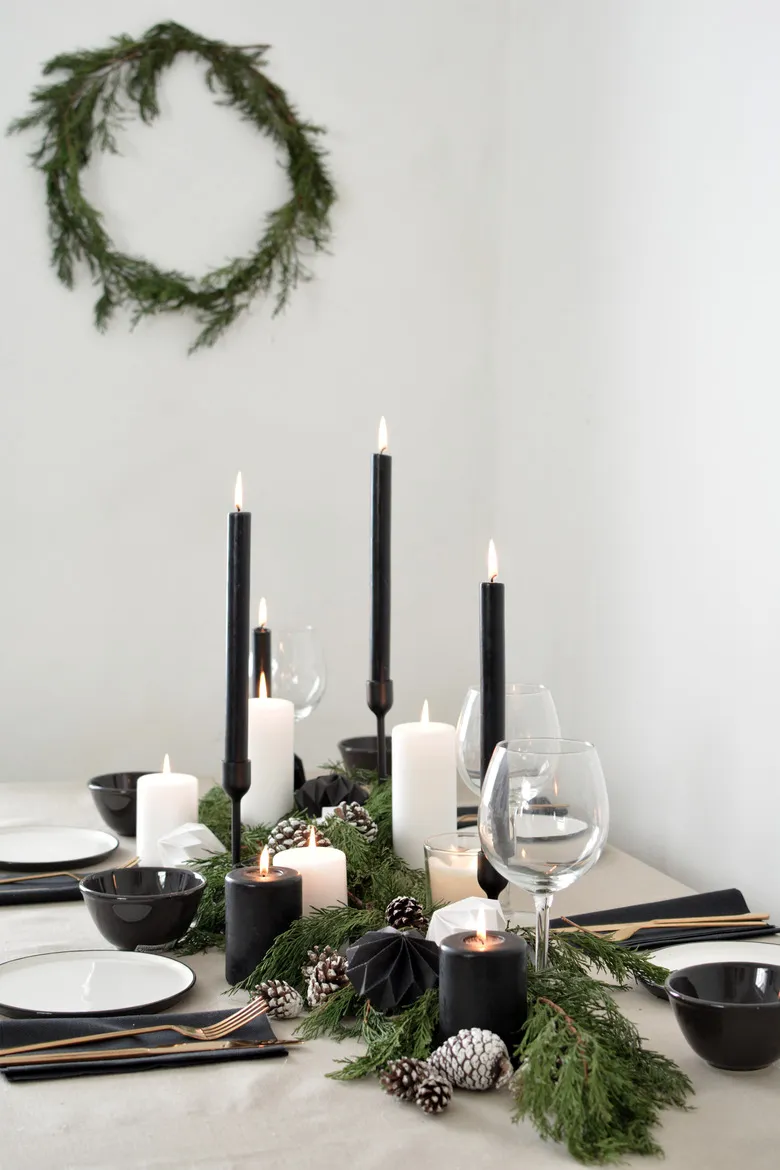
This table wants width — 42 inches minimum — and low ambient light. Black on white is dramatic in a dim dining room and merely heavy in a bright one with overhead recessed cans. For a table under 6 feet, reduce the black to napkins and one pair of taper holders, and let the greenery carry the rest. Compare with Idea #7 — same table geometry, opposite mood.
Black candles drip, and black wax on a light tablecloth is unforgiving. Keep the pillars and tapers on a tray or a wood slice so drips land somewhere removable. Very tall black tapers also catch the eye before anything else on the table, including your guests. If that’s not the energy you want, use black only in the napkins and bowls and keep the candles white.
Snow Is Optional — Style Isn’t
Whether you land on a flocked tree in a cream corner or a black-and-white table that makes your family ask questions, white Christmas decorating works when you commit to texture instead of just color. Start with the one idea that fits the room you actually have, and build out from there.
And when it finally comes together — the lights, the flocking, the one gold ornament that makes the whole thing make sense — snap a photo and pin it so you can find it again next November. 📌